

ISO 19237
(Main)Intelligent transport systems — Pedestrian detection and collision mitigation systems (PDCMS) — Performance requirements and test procedures
- Abstract
ISO 19237:2017 specifies the concept of operation, minimum functionality, system requirements, system interfaces, and test procedures for Pedestrian Detection and Collision Mitigation Systems (PDCMS). It specifies the behaviours that are required for PDCMS, and the system test criteria necessary to verify that a given implementation meets the requirements of this document. Implementation choices are left to system designers wherever possible. PDCMS reduce the severity of pedestrian collisions that cannot be avoided, and may reduce the likelihood of fatality and severity of injury. PDCMS require information about range to pedestrians, motion of pedestrians, motion of the subject vehicle (SV), driver commands and driver actions. PDCMS detect pedestrians ahead of time, determine if detected pedestrians represent a hazardous condition, and warn the driver if a hazard exists. PDCMS estimate if the driver has an adequate opportunity to respond to the hazard. If there is inadequate time available for the driver to respond, and if appropriate criteria are met, PDCMS determine that a collision is imminent. Based upon this assessment, PDCMS will activate CWs and vehicle brakes to mitigate collision severity. This document, while not a collision avoidance standard, does not preclude a manufacturer from implementing collision avoidance with PDCMS. Systems that include other countermeasures such as evasive steering are not within the scope of this document. Responsibility for the safe operation of the vehicle remains with the driver. ISO 19237:2017 applies to light duty passenger vehicles (see 3.6). It does not apply to other vehicle categories such as heavy vehicles or motorcycles. PDCMS are not intended for off-road use.
- Status
- Not Published
- Technical Committee
- ISO/TC 204 - Intelligent transport systems
- Drafting Committee
- ISO/TC 204/WG 14 - Vehicle/roadway warning and control systems
- Current Stage
- 6000 - International Standard under publication
- Start Date
- 19-Sep-2026
- Completion Date
- 10-Oct-2026
Buy Documents


ISO/PRF 19237 - Intelligent transport systems — Pedestrian detection and collision mitigation systems (PDCMS) — Performance requirements and test procedures

REDLINE ISO/PRF 19237 - Intelligent transport systems — Pedestrian detection and collision mitigation systems (PDCMS) — Performance requirements and test procedures
ISO 19237 is an International Standard from ISO for pedestrian detection and collision mitigation systems (PDCMS) in light duty passenger vehicles. It specifies the concept of operation, minimum functionality, system requirements, system interfaces, and test procedures for systems that detect pedestrians ahead, warn the driver, and, when needed, activate braking to reduce collision severity. The document is written for system designers, vehicle manufacturers, and test teams that need a common performance and validation basis.
What does ISO 19237 specify?
ISO 19237 specifies what a PDCMS has to do, how it is expected to behave, and how its performance is checked. It focuses on light duty passenger vehicles and on pedestrian collisions that cannot be avoided, with implementation choices left to system designers wherever possible.
The document is organized into six clauses and a bibliography:
- Clause 1 - Scope
- Clause 2 - Normative references
- Clause 3 - Terms and definitions
- Clause 4 - Symbols and abbreviated terms
- Clause 5 - Requirements and other provisions
- Clause 6 - Test procedures
- Bibliography
In practical terms, Clause 5 sets the functional and performance expectations, while Clause 6 gives validation test conditions and pass criteria. The scope also makes clear that responsibility for safe vehicle operation remains with the driver.
What are the key requirements of ISO 19237?
ISO 19237 sets out both the operating logic of PDCMS and the minimum mitigation performance the system must provide. The most important points are in Clause 5, with the test logic in Clause 6.
How PDCMS must function
Clause 5.1 requires a PDCMS-equipped light duty passenger vehicle to detect pedestrians, estimate their direction, distance, and relative velocity, determine subject vehicle speed, issue collision warnings, activate and modulate braking, control brake lights, and support driver control through an ESC-based yaw stability and longitudinal wheel slip capability.
In practice, this means the system is not only a sensor feature. It must connect sensing, warning, braking, and vehicle stability functions so that the vehicle can react in a controlled way when a pedestrian hazard is detected.
Clause 5.2 defines three operating states - PDCMS Off, PDCMS Inactive, and PDCMS Active. The system moves between these states based on ignition status, self-test results, failures, driver turn-on or turn-off actions, and vehicle speed.
In practice, the system must not try to operate outside its intended speed window, and it must react predictably when a fault occurs. Manufacturers decide some details of the state transitions, but the basic logic is fixed.
What performance the system must deliver
Clause 5.3.1 requires the system to activate when a pedestrian crossing situation creates an imminent collision risk. The document also notes environmental factors that affect performance, including weather, illumination, occlusion, and unusual pedestrian shapes or carried items.
Clause 5.3.1 also requires performance on roads with a radius of curvature of 500 m or greater. Clause 5.3.2 describes an optional advanced capability for more severe curvature, down to 125 m, and for left and right turn scenarios. If a manufacturer claims that capability, the system must also limit false positive pedestrian detections in those situations.
Clause 5.3.3 sets operating speed limits. All PDCMS must have a minimum subject vehicle velocity of 2.8 m/s or less, and a maximum subject vehicle velocity of 16.6 m/s or more.
In practice, this means the system has to be usable in low-speed traffic and still work up to 60 km/h. The speed window is a key buying and validation point because it defines when the mitigation function can be expected to operate.
What the countermeasures must do
Clause 5.3.4 makes emergency braking (EB) mandatory. If automatic service braking is applied, the brake lights must be illuminated.
The EB function must be capable of achieving at least a 5.6 m/s speed reduction before a collision occurs or the vehicle stops while EB remains on. The driver must also be able to increase braking force, unless the subject vehicle is already braking at maximum capability. Driver override of EB is optional, but when it is implemented it must be possible through driver actions defined by the manufacturer.
Clause 5.3.4 also requires braking behavior that does not produce locked wheels for longer than anti-lock brake system (ABS) or electronic stability control (ESC) devices would allow. Clause 5.3.5 requires the driver to be informed of operating limitations, system failures, and the PDCMS off-state.
In practice, the standard expects a system that can warn, brake, and remain controllable, while still giving the driver clear information about what the system is doing.
When the system must operate
Clause 5.4 requires PDCMS to be capable of daytime, twilight, and night-time activation.
That matters because a pedestrian safety function has to work across lighting conditions, not only in daylight.
How the tests are done
Clause 6 states that the procedures are basic validation tests for manufacturers, not exhaustive conformity tests. The tests use an adult pedestrian target and require controlled conditions: a dry, paved surface, limited slope, ambient temperature above 0 °C and below 40 °C, and horizontal visibility greater than 1 km.
For daytime testing, bright conditions are required, and the test course uses a straight vehicle path crossed by a pedestrian path. For night-time testing, the document adds lamp placement and illuminance rules, low-beam headlamps on the test vehicle, and a similar crossing setup.
What terms does ISO 19237 define?
ISO 19237 defines the main terms used to describe the system and its test target.
- Collision warning (CW) - a warning system that alerts the driver of a potential pedestrian collision in the forward path.
- Driver override - driver-initiated suppression of EB or CW.
- Emergency braking (EB) - automatic braking activated when an imminent pedestrian collision is detected.
- Light duty passenger vehicle - a vehicle in category M1, as referenced in the document.
- Subject vehicle (SV) - the vehicle equipped with the PDCMS.
- Target pedestrian (TP) - the pedestrian placed within the sensor field of view and able to be impacted by the SV.
- Pedestrian collision - a collision between the SV and a pedestrian.
Who uses ISO 19237?
ISO 19237 is used by vehicle manufacturers, PDCMS suppliers, systems engineers, and validation teams working on pedestrian safety functions for light duty passenger vehicles. It is also relevant to test laboratories that run the daytime and night-time validation procedures, and to quality or technical buyers who need to define what a PDCMS must do before selecting a system.
The document is especially useful when PDCMS is developed as a stand-alone function or integrated into a broader driver assistance or support system.
What changed in ISO 19237 from the previous edition?
ISO 19237 is the second edition and it cancels and replaces ISO 19237:2017.
The main changes stated in the document are:
- clarification that a hazardous situation is not limited to a pedestrian crossing a straight road, with road curvature requirements added
- reduction in minimum subject vehicle velocity
- a new requirement that all PDCMS be capable of twilight and night-time activation, which was previously optional
Which standards are used with ISO 19237?
| Reference | What it contributes |
|---|---|
| ISO 1176 | Masses vocabulary and codes, including the kerb mass basis used for vehicle mass conditions in testing |
| ISO 19206-2 | Requirements for pedestrian test targets used in PDCMS testing |
| ISO/CIE 19476:2014 | Performance characterization of illuminance meters and luminance meters used for night-time measurements |
What does the ISO 19237 document contain?
ISO 19237 contains a state transition diagram for PDCMS behavior, functional descriptions of Off, Inactive, and Active states, and figures that illustrate pedestrian crossing situations and curved-road or turn scenarios. It also includes the daytime and night-time test layouts, measurement points, and lamp arrangement needed for validation testing.
The document provides the method for setting up the vehicle and pedestrian paths, the measurement approach for illumination, and the pass criteria for activation tests. Table 1 gives the illuminance requirements for dark-condition testing, and the figures support practical test execution for manufacturer validation.
Relations
- Effective Date
- 04-May-2024
Buy Documents
ISO/PRF 19237 - Intelligent transport systems — Pedestrian detection and collision mitigation systems (PDCMS) — Performance requirements and test procedures
REDLINE ISO/PRF 19237 - Intelligent transport systems — Pedestrian detection and collision mitigation systems (PDCMS) — Performance requirements and test procedures
Get Certified
Connect with accredited certification bodies for this standard

BSI Group
BSI (British Standards Institution) is the business standards company that helps organizations make excellence a habit.

TÜV Rheinland
TÜV Rheinland is a leading international provider of technical services.

TÜV SÜD
TÜV SÜD is a trusted partner of choice for safety, security and sustainability solutions.
Sponsored listings
Frequently Asked Questions
ISO 19237 is a draft published by the International Organization for Standardization (ISO). Its full title is "Intelligent transport systems — Pedestrian detection and collision mitigation systems (PDCMS) — Performance requirements and test procedures". This standard covers: ISO 19237:2017 specifies the concept of operation, minimum functionality, system requirements, system interfaces, and test procedures for Pedestrian Detection and Collision Mitigation Systems (PDCMS). It specifies the behaviours that are required for PDCMS, and the system test criteria necessary to verify that a given implementation meets the requirements of this document. Implementation choices are left to system designers wherever possible. PDCMS reduce the severity of pedestrian collisions that cannot be avoided, and may reduce the likelihood of fatality and severity of injury. PDCMS require information about range to pedestrians, motion of pedestrians, motion of the subject vehicle (SV), driver commands and driver actions. PDCMS detect pedestrians ahead of time, determine if detected pedestrians represent a hazardous condition, and warn the driver if a hazard exists. PDCMS estimate if the driver has an adequate opportunity to respond to the hazard. If there is inadequate time available for the driver to respond, and if appropriate criteria are met, PDCMS determine that a collision is imminent. Based upon this assessment, PDCMS will activate CWs and vehicle brakes to mitigate collision severity. This document, while not a collision avoidance standard, does not preclude a manufacturer from implementing collision avoidance with PDCMS. Systems that include other countermeasures such as evasive steering are not within the scope of this document. Responsibility for the safe operation of the vehicle remains with the driver. ISO 19237:2017 applies to light duty passenger vehicles (see 3.6). It does not apply to other vehicle categories such as heavy vehicles or motorcycles. PDCMS are not intended for off-road use.
ISO 19237:2017 specifies the concept of operation, minimum functionality, system requirements, system interfaces, and test procedures for Pedestrian Detection and Collision Mitigation Systems (PDCMS). It specifies the behaviours that are required for PDCMS, and the system test criteria necessary to verify that a given implementation meets the requirements of this document. Implementation choices are left to system designers wherever possible. PDCMS reduce the severity of pedestrian collisions that cannot be avoided, and may reduce the likelihood of fatality and severity of injury. PDCMS require information about range to pedestrians, motion of pedestrians, motion of the subject vehicle (SV), driver commands and driver actions. PDCMS detect pedestrians ahead of time, determine if detected pedestrians represent a hazardous condition, and warn the driver if a hazard exists. PDCMS estimate if the driver has an adequate opportunity to respond to the hazard. If there is inadequate time available for the driver to respond, and if appropriate criteria are met, PDCMS determine that a collision is imminent. Based upon this assessment, PDCMS will activate CWs and vehicle brakes to mitigate collision severity. This document, while not a collision avoidance standard, does not preclude a manufacturer from implementing collision avoidance with PDCMS. Systems that include other countermeasures such as evasive steering are not within the scope of this document. Responsibility for the safe operation of the vehicle remains with the driver. ISO 19237:2017 applies to light duty passenger vehicles (see 3.6). It does not apply to other vehicle categories such as heavy vehicles or motorcycles. PDCMS are not intended for off-road use.
ISO 19237 is classified under the following ICS (International Classification for Standards) categories: 03.220.01 - Transport in general; 35.240.60 - IT applications in transport; 43.040.80 - Crash protection and restraint systems. The ICS classification helps identify the subject area and facilitates finding related standards.
ISO 19237 has the following relationships with other standards: It is inter standard links to ISO 19237:2017. Understanding these relationships helps ensure you are using the most current and applicable version of the standard.
ISO 19237 is available in PDF format for immediate download after purchase. The document can be added to your cart and obtained through the secure checkout process. Digital delivery ensures instant access to the complete standard document.
Standards Content (Sample)
International
Standard
Second edition
Intelligent transport systems —
Pedestrian detection and collision
mitigation systems (PDCMS) —
Performance requirements and test
procedures
Systèmes de transport intelligents — Systèmes de détection des
piétons et de prévention des collisions (PDCMS) — Exigences de
performance et procédures d'essai
PROOF/ÉPREUVE
Reference number
© ISO 2026
All rights reserved. Unless otherwise specified, or required in the context of its implementation, no part of this publication may
be reproduced or utilized otherwise in any form or by any means, electronic or mechanical, including photocopying, or posting on
the internet or an intranet, without prior written permission. Permission can be requested from either ISO at the address below
or ISO’s member body in the country of the requester.
ISO copyright office
CP 401 • Ch. de Blandonnet 8
CH-1214 Vernier, Geneva
Phone: +41 22 749 01 11
Email: copyright@iso.org
Website: www.iso.org
Published in Switzerland
PROOF/ÉPREUVE
ii
Contents Page
Foreword .iv
Introduction .v
1 Scope . 1
2 Normative references . 1
3 Terms and definitions . 1
4 Symbols and abbreviated terms. 3
5 Requirements and other provisions . 3
5.1 Minimum enabling capabilities .3
5.2 Operating model — State transition diagram .4
5.2.1 State functional descriptions .4
5.2.2 PDCMS Off .4
5.2.3 PDCMS Inactive .5
5.2.4 PDCMS Active .5
5.3 Performance requirements .5
5.3.1 General .5
5.3.2 Optional increased road curvature and turn scenario handling .6
5.3.3 Operating speed .6
5.3.4 Countermeasure requirements .7
5.3.5 Driver controls and human interface .8
5.4 PDCMS Operation .8
6 Test procedures . 8
6.1 General .8
6.2 Test procedure requirements.9
6.2.1 General .9
6.2.2 Pedestrian test target specification .9
6.2.3 Driving surface .9
6.2.4 Ambient air temperature .9
6.2.5 Horizontal visibility .9
6.2.6 Vehicle pre-conditioning .9
6.2.7 Vehicle mass .9
6.3 Test requirements for daytime .9
6.3.1 Ambient illumination .9
6.3.2 Test procedures .9
6.3.3 Pass criteria .10
6.4 Test requirements for night-time .11
6.4.1 Ambient illumination .11
6.4.2 Test setup .11
6.4.3 Illuminance measurement methods . 13
6.4.4 Illuminance values . 13
6.4.5 Test procedures .14
6.4.6 Pass criteria . 15
Bibliography .16
PROOF/ÉPREUVE
iii
Foreword
ISO (the International Organization for Standardization) is a worldwide federation of national standards
bodies (ISO member bodies). The work of preparing International Standards is normally carried out through
ISO technical committees. Each member body interested in a subject for which a technical committee
has been established has the right to be represented on that committee. International organizations,
governmental and non-governmental, in liaison with ISO, also take part in the work. ISO collaborates closely
with the International Electrotechnical Commission (IEC) on all matters of electrotechnical standardization.
The procedures used to develop this document and those intended for its further maintenance are described
in the ISO/IEC Directives, Part 1. In particular, the different approval criteria needed for the different types
of ISO document should be noted. This document was drafted in accordance with the editorial rules of the
ISO/IEC Directives, Part 2 (see www.iso.org/directives).
ISO draws attention to the possibility that the implementation of this document may involve the use of (a)
patent(s). ISO takes no position concerning the evidence, validity or applicability of any claimed patent
rights in respect thereof. As of the date of publication of this document, ISO had received notice of (a)
patent(s) which may be required to implement this document. However, implementers are cautioned that
this may not represent the latest information, which may be obtained from the patent database available at
www.iso.org/patents. ISO shall not be held responsible for identifying any or all such patent rights.
Any trade name used in this document is information given for the convenience of users and does not
constitute an endorsement.
For an explanation of the voluntary nature of standards, the meaning of ISO specific terms and expressions
related to conformity assessment, as well as information about ISO's adherence to the World Trade
Organization (WTO) principles in the Technical Barriers to Trade (TBT), see www.iso.org/iso/foreword.html.
This document was prepared by Technical Committee ISO/TC 204, Intelligent transport systems.
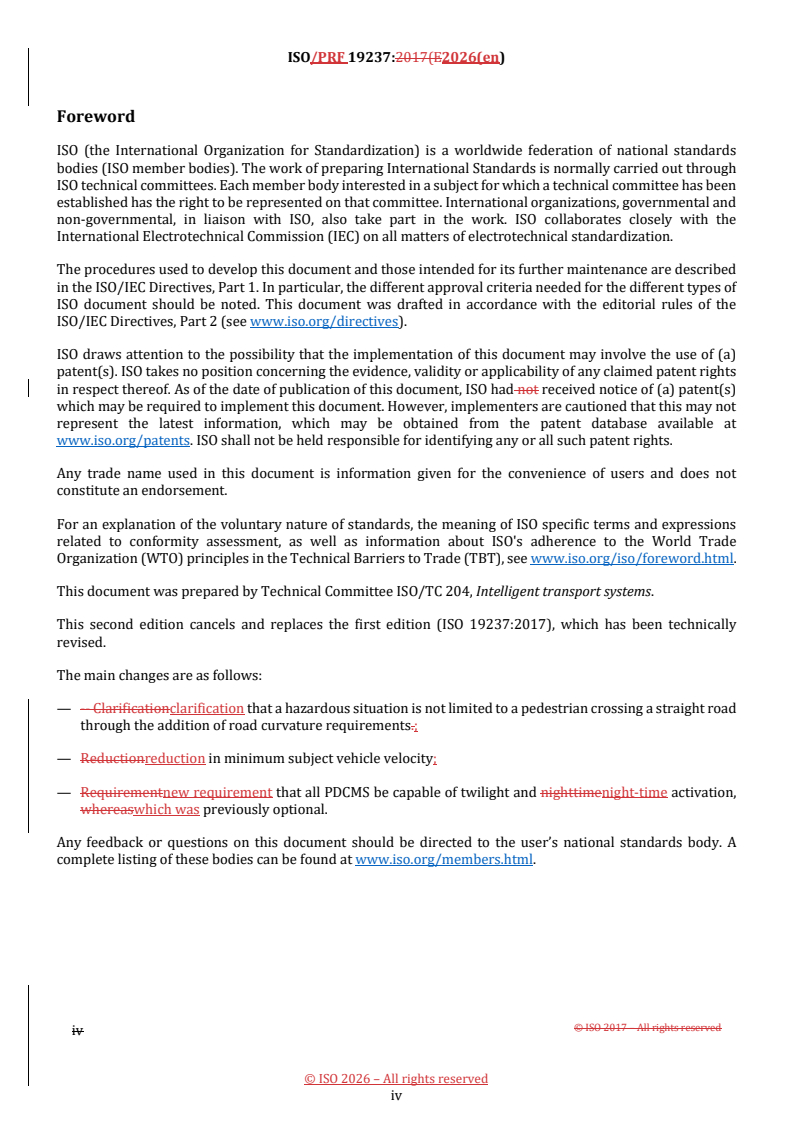
This second edition cancels and replaces the first edition (ISO 19237:2017), which has been technically
revised.
The main changes are as follows:
— clarification that a hazardous situation is not limited to a pedestrian crossing a straight road through the
addition of road curvature requirements;
— reduction in minimum subject vehicle velocity;
— new requirement that all PDCMS be capable of twilight and night-time activation, which was previously
optional.
Any feedback or questions on this document should be directed to the user’s national standards body. A
complete listing of these bodies can be found at www.iso.org/members.html.
PROOF/ÉPREUVE
iv
Introduction
The fatality and severe injury rates of traffic accidents involving pedestrians are significantly high, resulting
in the loss of many lives.
Pedestrian detection and collision mitigation systems (PDCMS) reduce the severity of pedestrian
collisions that cannot be avoided and can reduce the likelihood of fatality. By a collision warning (CW) and
automatically activating emergency braking, PDCMS assist in slowing a vehicle when a collision is likely.
Functional elements of a PDCMS are shown in Figure 1.
Figure 1 — Functional elements of pedestrian detection and collision mitigation systems (PDCMS)
A PDCMS detects pedestrians ahead of time, determine if detected pedestrians represent a hazardous
condition, and warn the driver if a hazard exists. A PDCMS estimates if the driver has an adequate opportunity
to respond to the hazard. If there is inadequate time available for the driver to respond, and if appropriate
criteria are met, a PDCMS determines that a collision is imminent. Based upon this assessment, a PDCMS will
activate CWs and vehicle brakes to mitigate collision severity. This document, while not a collision avoidance
standard, does not preclude a manufacturer from implementing collision avoidance with a PDCMS.
System designers and other users can apply the provisions of this document to stand-alone PDCMS or to the
integration of the PDCMS functions into other driving assistance and support systems.
PROOF/ÉPREUVE
v
International Standard ISO 19237:2026(en)
Intelligent transport systems — Pedestrian detection and
collision mitigation systems (PDCMS) — Performance
requirements and test procedures
1 Scope
This document specifies the concepts of operation, minimum functionality, system requirements, system
interfaces and test procedures for pedestrian detection and collision mitigation systems (PDCMS), which
can reduce the likelihood of fatality and severity of injury. A PDCMS requires information about range to
pedestrians, motion of pedestrians, motion of the subject vehicle (SV), driver commands and driver actions.
It specifies the behaviours that are required for PDCMS, and the system test criteria necessary to verify that
a given implementation meets the requirements of this document. Implementation choices are left to system
designers wherever possible.
Systems that include other countermeasures such as evasive steering are not within the scope of this
document.
Responsibility for the safe operation of the vehicle remains with the driver.
This document applies to light duty passenger vehicles. It does not apply to other vehicle categories such as
heavy vehicles or motorcycles. PDCMS are not intended for off-road use.
2 Normative references
The following documents are referred to in the text in such a way that some or all of their content constitutes
requirements of this document. For dated references, only the edition cited applies. For undated references,
the latest edition of the referenced document (including any amendments) applies.
ISO 1176, Road vehicles — Masses — Vocabulary and codes
ISO 19206-2, Road vehicles — Test devices for target vehicles, vulnerable road users and other objects, for
assessment of active safety functions — Part 2: Requirements for pedestrian targets
ISO/CIE 19476, Characterization of the performance of illuminance meter and luminance meter
3 Terms and definitions
For the purposes of this document, the following terms and definitions apply.
ISO and IEC maintain terminology databases for use in standardization at the following addresses:
— ISO Online browsing platform: available at https:// www .iso .org/ obp
— IEC Electropedia: available at https:// www .electropedia .org/
3.1
collision warning
CW
warning system that alerts the driver of a potential collision with a pedestrian (3.9) in the forward path of
the subject vehicle
PROOF/ÉPREUVE
3.2
driver override
driver-initiated suppression of an emergency braking (3.3) or collision warning (3.1) countermeasure
3.3
emergency braking
EB
countermeasure for pedestrian detection and collision mitigation systems that responds to the detection
of an imminent pedestrian collision (3.10) by automatically activating braking to quickly reduce the relative
velocity
3.4
heavy vehicle
single vehicle or combination of vehicles defined as Category 1-2 or Category 2 in the United Nations Economic
[2]
and Social Council World Forum for Harmonization of Vehicle Regulations (WP.29) TRANS/WP.29/1045
3.5
impact point of position
lateral contact position from the subject vehicle (SV) (3.11) point of view or expected lateral contact position
at the front of the SV when the SV collides with a pedestrian (3.9) or when a collision is expected
3.6
light duty passenger vehicle
vehicle according to category M1 (≦8 passenger seats except driver seat) in the United Nations Economic and
[1]
Social Council World Forum for Harmonization of Vehicle Regulations (WP.29) TRANS/WP.29/78/Rev.2
3.7
minimum speed reduction
smallest drop in speed that a pedestrian detection and collision mitigation system is able to achieve when
activated
3.8
minimum velocity
v
min
minimum subject vehicle (3.11) speed for which a pedestrian detection and collision mitigation system is
capable of activating a countermeasure
3.9
pedestrian
human being on the road or near the road
3.10
pedestrian collision
collision between a subject vehicle (3.11) and a pedestrian (3.9)
3.11
subject vehicle
SV
vehicle equipped with a pedestrian detection and collision mitigation system
3.12
target pedestrian
TP
pedestrian (3.9) that is positioned within the field of view of the sensor and that can be impacted by the
subject vehicle (3.11)
PROOF/ÉPREUVE
4 Symbols and abbreviated terms
ABS Anti-lock brake system
CW Collision warning
ESC Electronic stability control
EB Emergency braking
PDCMS Pedestrian detection and collision mitigation system
SV Subject vehicle
TP Target pedestrian
v Minimum velocity for PDCMS operation
min
v Subject vehicle velocity
sv
v Target pedestrian lateral velocity
tpL
v Maximum SV velocity for PDCMS operation
max
d (Lateral) distance between the vehicle pass and TP as shown in Figure 2
L
x (Longitudinal) distance between SV and TP as shown in Figure 2
c
Figure 2 — Lateral and longitudinal distance
5 Requirements and other provisions
5.1 Minimum enabling capabilities
Light duty passenger vehicles equipped with a PDCMS shall be capable of providing the following
characteristics:
— detecting the presence of pedestrian(s);
— determining the direction of the detected pedestrian from the SV, distance and relative velocity between
the SV and the detected forward pedestrian;
— determining the SV velocity;
— initiating appropriate PDCMS countermeasures;
PROOF/ÉPREUVE
— providing CWs;
— activating and modulating the brakes whether or not the driver is already braking;
— controlling the brake lights;
— enhancing driver control based on brakes with a yaw stability capability and a capability to manage
longitudinal wheel slip, by util
...
ISO/DISPRF 19237:2025(en)
ISO/TC 204/ WG 14
Secretariat: ANSI
Date: 2025-11-202026-08-21
Intelligent transport systems — Pedestrian detection and collision
mitigation systems (PDCMS) — Performance requirements and test
procedures
Systèmes intelligents de transport intelligents — Systèmes de détection des piétons et de prévention des
collisions (PDCMS) — Exigences de performance et modes opératoiresprocédures d'essai
PROOF
ISO/PRF 19237:2017(E2026(en)
All rights reserved. Unless otherwise specified, or required in the context of its implementation, no part of this publication
may be reproduced or utilized otherwise in any form or by any means, electronic or mechanical, including photocopying,
or posting on the internet or an intranet, without prior written permission. Permission can be requested from either ISO
at the address below or ISO’s member body in the country of the requester.
ISO copyright office
CP 401 • Ch. de Blandonnet 8
CH-1214 Vernier, Geneva
Phone: + 41 22 749 01 11
EmailE-mail: copyright@iso.org
Website: www.iso.org
Published in Switzerland
ii
ii
ISO/DISPRF 19237:20252026(en)
Contents Page
Foreword . iv
Introduction . v
1 Scope . 1
2 Normative references . 1
3 Terms and definitions . 1
4 Symbols and abbreviated terms . 3
5 Requirements and other provisions . 4
5.1 Minimum enabling capabilities . 4
5.2 Operating model — State transition diagram . 5
5.3 Performance requirements . 6
5.4 PDCMS Operation . 11
6 Test procedures . 11
6.1 General. 11
6.2 Test procedure requirements . 11
6.3 Test requirements for daytime . 12
6.4 Test requirements for night-time . 14
Bibliography . 23
iii
ISO/PRF 19237:2017(E2026(en)
Foreword
ISO (the International Organization for Standardization) is a worldwide federation of national standards
bodies (ISO member bodies). The work of preparing International Standards is normally carried out through
ISO technical committees. Each member body interested in a subject for which a technical committee has been
established has the right to be represented on that committee. International organizations, governmental and
non-governmental, in liaison with ISO, also take part in the work. ISO collaborates closely with the
International Electrotechnical Commission (IEC) on all matters of electrotechnical standardization.
The procedures used to develop this document and those intended for its further maintenance are described
in the ISO/IEC Directives, Part 1. In particular, the different approval criteria needed for the different types of
ISO document should be noted. This document was drafted in accordance with the editorial rules of the
ISO/IEC Directives, Part 2 (see www.iso.org/directives).
ISO draws attention to the possibility that the implementation of this document may involve the use of (a)
patent(s). ISO takes no position concerning the evidence, validity or applicability of any claimed patent rights
in respect thereof. As of the date of publication of this document, ISO had not received notice of (a) patent(s)
which may be required to implement this document. However, implementers are cautioned that this may not
represent the latest information, which may be obtained from the patent database available at
www.iso.org/patents. ISO shall not be held responsible for identifying any or all such patent rights.
Any trade name used in this document is information given for the convenience of users and does not
constitute an endorsement.
For an explanation of the voluntary nature of standards, the meaning of ISO specific terms and expressions
related to conformity assessment, as well as information about ISO's adherence to the World Trade
Organization (WTO) principles in the Technical Barriers to Trade (TBT), see www.iso.org/iso/foreword.html.
This document was prepared by Technical Committee ISO/TC 204, Intelligent transport systems.
This second edition cancels and replaces the first edition (ISO 19237:2017), which has been technically
revised.
The main changes are as follows:
— -- Clarificationclarification that a hazardous situation is not limited to a pedestrian crossing a straight road
through the addition of road curvature requirements.;
— Reductionreduction in minimum subject vehicle velocity;
— Requirementnew requirement that all PDCMS be capable of twilight and nighttimenight-time activation,
whereaswhich was previously optional.
Any feedback or questions on this document should be directed to the user’s national standards body. A
complete listing of these bodies can be found at www.iso.org/members.html.
iv
iv
ISO/DISPRF 19237:20252026(en)
Introduction
The fatality and severe injury rates of traffic accidents involving pedestrians are significantly high, resulting
in the loss of many lives.
Pedestrian detection and collision mitigation systems (PDCMS) reduce the severity of pedestrian collisions
that cannot be avoided and can reduce the likelihood of fatality. By a collision warning (CW) and automatically
activating emergency braking, PDCMS assist in slowing a vehicle when a collision is likely.
Functional elements of a PDCMS are shown in Figure 1Figure 1.
Figure 1 — Functional elements of pedestrian detection and collision mitigation systems (PDCMS)
A PDCMS detects pedestrians ahead of time, determine if detected pedestrians represent a hazardous
condition, and warn the driver if a hazard exists. A PDCMS estimates if the driver has an adequate opportunity
to respond to the hazard. If there is inadequate time available for the driver to respond, and if appropriate
criteria are met, a PDCMS determines that a collision is imminent. Based upon this assessment, a PDCMS will
activate CWs and vehicle brakes to mitigate collision severity. This document, while not a collision avoidance
standard, does not preclude a manufacturer from implementing collision avoidance with a PDCMS.
v
ISO/PRF 19237:2017(E2026(en)
System designers and other users of this document can apply itthe provisions of this document to stand-alone
PDCMS or to the integration of the PDCMS functions into other driving assistance and support systems.
vi
vi
DRAFT International Standard ISO/DIS 19237:2025(en)
Intelligent transport systems — Pedestrian detection and collision
mitigation systems (PDCMS) — Performance requirements and test
procedures
1 Scope
This document specifies the conceptconcepts of operation, minimum functionality, system requirements,
system interfaces, and test procedures for pedestrian detection and collision mitigation systems (PDCMS),
which can reduce the likelihood of fatality and severity of injury. A PDCMS requires information about range
to pedestrians, motion of pedestrians, motion of the subject vehicle (SV), driver commands and driver actions.
It specifies the behaviours that are required for PDCMS, and the system test criteria necessary to verify that a
given implementation meets the requirements of this document. Implementation choices are left to system
designers wherever possible.
PDCMS reduce the severity of pedestrian collisions that cannot be avoided, and may reduce the likelihood of
fatality and severity of injury. PDCMS require information about range to pedestrians, motion of pedestrians,
motion of the subject vehicle (SV), driver commands and driver actions. PDCMS detect pedestrians ahead of
time, determine if detected pedestrians represent a hazardous condition, and warn the driver if a hazard
exists. PDCMS estimate if the driver has an adequate opportunity to respond to the hazard. If there is
inadequate time available for the driver to respond, and if appropriate criteria are met, PDCMS determine that
a collision is imminent. Based upon this assessment, PDCMS will activate CWs and vehicle brakes to mitigate
collision severity. This document, while not a collision avoidance standard, does not preclude a manufacturer
from implementing collision avoidance with PDCMS.
Systems that include other countermeasures such as evasive steering are not within the scope of this
document.
Responsibility for the safe operation of the vehicle remains with the driver.
This document applies to light duty passenger vehicles. It does not apply to other vehicle categories such as
heavy vehicles or motorcycles. PDCMS are not intended for off-road use.
2 Normative references
The following documents are referred to in the text in such a way that some or all of their content constitutes
requirements of this document. For dated references, only the edition cited applies. For undated references,
the latest edition of the referenced document (including any amendments) applies.
ISO 1176, Road vehicles — Masses — Vocabulary and codes
ISO 19206--2, Road vehicles — Test devices for target vehicles, vulnerable road users and other objects, for
assessment of active safety functions — Part 2: Requirements for pedestrian targets
ISO/CIE 19476:2014, Characterization of the performance of illuminance meter and luminance meter
3 Terms and definitions
For the purposes of this document, the following terms and definitions apply.
ISO/PRF 19237:2017(E2026(en)
ISO and IEC maintain terminology databases for use in standardization at the following addresses:
— — ISO Online browsing platform: available at https://www.iso.org/obp
— — IEC Electropedia: available at https://www.electropedia.org/
3.1 3.1
collision warning
CW
warning system that alerts the driver of a potential collision with a pedestrian (3.9) in the forward path of the
subject vehicle
3.2 3.2
driver override
driver-initiated suppression of an emergency braking (3.3) or collision warning (3.1) countermeasure
3.3 3.3
emergency braking
EB
PDCMS countermeasure for pedestrian detection and collision mitigation systems that responds to the
detection of an imminent pedestrian collision (3.10) by automatically activating braking to quickly reduce the
relative velocity
3.4 3.4
heavy vehicle
any single vehicle or combination of vehicles defined as Category 1-2 or Category 2 in [2].the United Nations
Economic and Social Council World Forum for Harmonization of Vehicle Regulations (WP.29)
[2]
TRANS/WP.29/1045
3.5 3.5
impact point of position
lateral contact position from the subject vehicle (SV) (3.11) point of view or expected lateral contact position
at the front of the SV when the SV collides with a pedestrian (3.9) or when a collision is expected
3.6 3.6
light duty passenger vehicle
vehicle according to category M1 (≦8 passenger seats except driver seat) in [1]the United Nations Economic
and Social Council World Forum for Harmonization of Vehicle Regulations (WP.29)
[1]
TRANS/WP.29/78/Rev.2
3.7 3.7
minimum speed reduction
minimum speed reduction PDCMS shall achieve
3.8smallest drop in speed that a pedestrian detection and collision mitigation system is able to achieve when
activated
ISO/DISPRF 19237:20252026(en)
3.8
minimum velocity
V
min
v
min
minimum subject vehicle (3.11SV) speed for which PDCMSa pedestrian detection and collision mitigation
system is capable of activating a countermeasure
3.9 3.9
pedestrian
human being on the road or near the road
3.10 3.10
pedestrian collision
collision between a subject vehicle (3.11the SV) and a pedestrian (3.9)
3.11 3.11
subject vehicle
SV
vehicle equipped with PDCMS as defined hereina pedestrian detection and collision mitigation system
3.12 3.12
target pedestrian
TP
pedestrian (3.9) that is positioned within the field of view of the sensor and that can be impacted by the subject
vehicle (3.11SV)
4 Symbols and abbreviated terms
ABS Anti-lock brake system
CW Collision warning
ESC Electronic stability control
EB Emergency braking
EB
Emergency brakingPedestrian detection and collision mitigation system
PDCMS
SV Subject vehicle
TP Target pedestrian
v Minimum velocity for PDCMS operation
min
v Subject vehicle velocity
sv
v Target pedestrian lateral velocity
tpL
v Maximum SV velocity for PDCMS operation
max
Ldd (Lateral) distance between the vehicle pass and TP as shown in Figure 2figure 2
L
x (Longitudinal) distance between SV and TP as shown in Figure 2figure 2
c
ISO/PRF 19237:2017(E2026(en)
Figure 2 — Lateral and longitudinal distance
5 Requirements and other provisions
5.1 Minimum enabling capabilities
Light duty passenger vehicles equipped with a PDCMS shall be capable of providing the following
characteristics:
— — detectdetecting the presence of pedestrian(s);
— — determinedetermining the direction of the detected pedestrian from the SV, distance and relative
velocity between the SV and the detected forward pedestrian;
— — determinedetermining the subject vehicleSV velocity;
— — initiateinitiating appropriate PDCMS countermeasures;
— — provideproviding CWs;
— — activateactivating and modulatemodulating the brakes whether or not the driver is already braking;
— — controlcontrolling the brake lights;
— — enhanceenhancing driver control based on brakes with a yaw stability capability and a capability to
manage longitudinal wheel slip, by utilizing an ESC system;
— — generategenerating at least the minimum required PDCMS speed reduction;
ISO/DISPRF 19237:20252026(en)
— — after EB has been initiated, permitpermitting the driver to increase the deceleration to any higher
value up to the maximum possible vehicle deceleration;
— — permitpermitting driver override at any time;
— — provideproviding information about system availability to the driver.
5.2 Operating model — State transition diagram
5.2.1 State functional descriptions
The PDCMS shall function according to the state transition diagram in Figure 3Figure 3. Specific
implementation of the state transitions, beyond what is illustrated below, of the state transitions is left to the
manufacturer.
Key
1 Ignition Onignition on or (optional) Ignition Onignition on and driver turn Onon
2 failure detected (automatic deactivation possible)
3 vsv ≥ ≥ vmin and vsv ≤ ≤ vmax
4 vsv < < vmin or vsv > > vmax
Exception:NOTE This does not apply when the SV speed falls below vmin or exceeds vmax as long as the command is being issued.
5 fail self-test, ignition Offoff or (optional) driver turn Offoff
Figure 3 — State transition diagram including optional features
ISO/PRF 19237:2017(E2026(en)
The PDCMS state descriptions of the PDCMS address the functional requirements of a PDCMS, identifying
which functions shall be performed in each state.
5.2.2 PDCMS Off
No countermeasures are performed in the PDCMS Off state. Upon turning the ignition to the Off position, the
PDCMS shall transition to the PDCMS Off state. Whenever the self-test function determines that the PDCMS
areis not able to deliver adequate performance, or when the driver manually turns off the PDCMS (optional),
it shall transition to the PDCMS Off state. The PDCMS may be in the PDCMS Off state when the vehicle’s ignition
is on.
5.2.3 PDCMS Inactive
In the PDCMS Inactive state, the PDCMS shall monitor vehicle speed and determine if it is appropriate to
activate the system.
The PDCMS shall enter the PDCMS Inactive state from the PDCMS Off state if the ignition on sequence has been
completed and the engine is running. The PDCMS shall enter Inactive state from the Active state if the
conditions for activating are not met, for example, if the vehicle speed drops below v . If a manufacturer
min
defined failure mode is encountered for which an automatic recovery (optional) is possible, the PDCMS shall
transition from PDCMS Active state to PDCMS Inactive state. Based on the results of a diagnostic self-test,
functions of all or some of the countermeasures may be restored. Once the recovery occurs, the system may
transition back to PDCMS Active state. Finally, if the driver manually turns on PDCMS (optional), then it shall
transit from the PDCMS Off state to the PDCMS Inactive state.
5.2.4 PDCMS Active
The PDCMS shall enter this state if the vehicle speed is greater than or equ
...