

ISO/IEC 23090-35:2026
(Main)Information technology — Coded representation of immersive media — Part 35: Conformance and reference software for low latency, low complexity LiDAR coding
- Abstract
This document provides accompanying reference software for ISO/IEC 23090-30. The software is an integral part of this document. The use of this reference software is not required to make an implementation of an encoder or decoder in conformance to ISO/IEC 23090-30. Requirements established in ISO/IEC 23090-30 take precedence over the behaviour of the reference software. This document also specifies a set of tests and procedures designed to indicate whether encoders or decoders meet the normative requirements specified in ISO/IEC 23090-30.
- Status
- Published
- Publication Date
- 01-Nov-2026
- Technical Committee
- ISO/IEC JTC 1/SC 29 - Coding of audio, picture, multimedia and hypermedia information
- Drafting Committee
- ISO/IEC JTC 1/SC 29/WG 7 - MPEG 3D Graphics coding
- Current Stage
- 6060 - International Standard published
- Start Date
- 02-Nov-2026
- Completion Date
- 02-Nov-2026


ISO/IEC 23090-35:2026 is an International Standard published by ISO for conformance and reference software for low latency, low complexity LiDAR coding. It supports ISO/IEC 23090-30 by providing reference encoder and decoder software, test bitstreams, and procedures for checking bitstream and decoder conformance. The document is intended for implementers and testers who need a practical way to build, exercise, and compare ISO/IEC 23090-30 systems.
What does ISO/IEC 23090-35:2026 specify?
ISO/IEC 23090-35:2026 specifies accompanying reference software for ISO/IEC 23090-30 and a set of tests and procedures to indicate whether encoders or decoders meet the normative requirements in ISO/IEC 23090-30. The reference software is part of this document, but using it is not required to claim conformance to ISO/IEC 23090-30, and ISO/IEC 23090-30 always takes precedence if the two differ.
The document is organized into these main clauses:
- Clause 1 - Scope
- Clause 2 - Normative references
- Clause 3 - Terms and definitions
- Clause 4 - Abbreviated terms
- Clause 5 - Conventions
- Clause 6 - Reference software for ISO/IEC 23090-30
- Clause 7 - Conformance testing for ISO/IEC 23090-30
In practice, that structure tells a reader where to find the software, the shared terminology, and the conformance test procedures.
What are the key requirements of ISO/IEC 23090-35:2026?
ISO/IEC 23090-35:2026 is mainly about how to use reference software and how to apply it in conformance checking. The most important points are in Clauses 6 and 7, because they define what the software is for, how the tests work, and what evidence those tests provide.
Reference software and its role
Clause 6 says the reference software supports users in establishing and testing conformance and interoperability, and in learning how ISO/IEC 23090-30 works. The software package contains mpeg-pcc-tml software for Simple and Main profiles, and the manual mpeg-pcc-tml-sw-manual.pdf is provided for installation and use. In practice, this gives implementers a concrete starting point for decoder or encoder development, and a shared executable basis for comparisons.
Bitstream conformance testing
Clause 7.2 states that bitstream conformance follows the specification text in ISO/IEC 23090-30. Clause 7.4 then defines the practical test: a claimed conforming bitstream is processed by the reference software decoder, and it shall not produce error or non-conformance messages. This matters because it gives a repeatable first check, but the standard also says that passing this test is only a strong presumption of conformance, not definitive proof.
Clause 7.4 also explains that a verifier should parse the entire bitstream and the values derived from it, but does not have to execute every stage of decoding. That is useful in practice because many checks can be done directly on syntax elements before full decoding is complete. The same clause notes that this test should not be applied to bitstreams known to contain transmission errors.
Decoder conformance and output
Clause 7.3 points decoder conformance back to ISO/IEC 23090-30, specifically the conformance point requirements in that part. Clause 7.5.3 says the decoding output is specified in ISO/IEC 23090-30, and rendering after decoding is outside the scope of this document. For users, that means this part is about decoded output and bitstream processing, not about how point clouds are displayed.
Clause 7.5.1 links the conformance bitstreams to the constraints associated with a specified profile and level, and Clause 7.5.2 lists the file contents supplied with each test bitstream. Each zipped test set includes the .bit file, readme.md, a .cfg file when applicable, an .md5 file, and decoded point cloud frame files with matching checksums. This helps labs verify both the encoded stream and the expected decoded result.
Test coverage across coding features
Clause 7.6 and Table 1 define the feature families covered by the test bitstreams. The suite spans common functionality and many coding tools, including geometry coding, attribute coding, LoD handling, predictor search, and spherical domain coding. In practice, this lets a tester target specific functions instead of checking only one full-stream example.
Table 1 groups the test streams by feature area such as EBS, EC, ST, GPS, APS, ACO, GS, OGC, PLCS, DPOC, UNEOC, UCN, UVP, LLA, UPOC, SCS, GATT, QuantATT, LodRAHT, SLOD, NumLOD, DecLoD, DisLoD, CentLoD, SL, PSInterLOD, PSIntraLOD, NumPRED, DirectPRED, NB, LCP, ICP, RahtPRED, SDC, and ANBF. Those names are useful because they point directly to the coding tool or behavior being exercised.
Recommendations and practical cautions
Clause 7.5.4 adds one informative recommendation: a conforming decoder should be able to resume decoding as soon as possible after loss or corruption of part of a bitstream. That is not presented as a conformance test in this document, but it is useful guidance for robust implementations.
What terms does ISO/IEC 23090-35:2026 define?
ISO/IEC 23090-35:2026 relies on the terms in ISO/IEC 23090-30 and adds a small set of its own definitions.
- Bitstream - a sequence of bits that represents compressed point cloud data according to a specific coding syntax.
- Decoder - a process or device that reconstructs point cloud data from a conforming bitstream; rendering is outside the scope of this document.
- Encoder - an embodiment of a process that produces a bitstream.
- Reference software decoder - a software implementation of the decoding process for a conforming bitstream.
- Reference software encoder - a software implementation that compresses point cloud data into a conforming bitstream.
Who uses ISO/IEC 23090-35:2026?
ISO/IEC 23090-35:2026 is used by developers of LiDAR encoders and decoders, especially teams working with ISO/IEC 23090-30 conformance. It is also relevant to validation engineers, interoperability test labs, and quality teams that need a common test basis for Simple and Main profiles.
In practice, people use it to:
- understand the decoding and encoding process by example
- build a decoder or encoder from the reference software
- generate test bitstreams for implementation checks
- compare implementation behavior against a shared reference
- examine whether a bitstream triggers conformance errors in the reference decoder
Which standards are used with ISO/IEC 23090-35:2026?
ISO/IEC 23090-35:2026 uses ISO/IEC 23090-30:2026 as its normative reference. That part provides the core LiDAR coding rules, the conformance requirements, the decoding output specification, and the conformance point information that this document refers to in Clauses 7.2, 7.3, 7.4, and 7.5.
ISO/IEC 23090-35:2026 also adopts the terms and conventions from ISO/IEC 23090-30:2026, so users need that part alongside this one when they want to interpret the test procedures correctly.
What does the ISO/IEC 23090-35:2026 document contain?
ISO/IEC 23090-35:2026 contains the reference software information, a short manual pointer, and a structured conformance test framework for ISO/IEC 23090-30. It also contains a feature-based table of reference bitstreams and a long list of named test streams that exercise specific coding tools and configurations.
The test material covers geometry parameter sets, attribute parameter sets, axis order, scaling, onechain geometry coding, laser coding state preservation, duplicate point handling, sensing-related tools, attribute transforms, quantization, multiple LoD methods, predictor search, direct predictors, neighbour bias, last component prediction, inter-component prediction, RAHT prediction, spherical domain coding, and attribute neighbour blending filtering. That breadth matters because it lets users check isolated tools as well as combinations of tools.
The document also describes the contents of each zipped test package, including bitstreams, configuration files, readme files, checksums, and decoded point clouds. For engineers, that makes the document useful not just as a reference, but as a repeatable test set for development, verification, and interoperability work.
Get Certified
Connect with accredited certification bodies for this standard

BSI Group
BSI (British Standards Institution) is the business standards company that helps organizations make excellence a habit.

NYCE
Mexican standards and certification body.
Sponsored listings
Frequently Asked Questions
ISO/IEC 23090-35:2026 is a standard published by the International Organization for Standardization (ISO). Its full title is "Information technology — Coded representation of immersive media — Part 35: Conformance and reference software for low latency, low complexity LiDAR coding". This standard covers: This document provides accompanying reference software for ISO/IEC 23090-30. The software is an integral part of this document. The use of this reference software is not required to make an implementation of an encoder or decoder in conformance to ISO/IEC 23090-30. Requirements established in ISO/IEC 23090-30 take precedence over the behaviour of the reference software. This document also specifies a set of tests and procedures designed to indicate whether encoders or decoders meet the normative requirements specified in ISO/IEC 23090-30.
This document provides accompanying reference software for ISO/IEC 23090-30. The software is an integral part of this document. The use of this reference software is not required to make an implementation of an encoder or decoder in conformance to ISO/IEC 23090-30. Requirements established in ISO/IEC 23090-30 take precedence over the behaviour of the reference software. This document also specifies a set of tests and procedures designed to indicate whether encoders or decoders meet the normative requirements specified in ISO/IEC 23090-30.
ISO/IEC 23090-35:2026 is classified under the following ICS (International Classification for Standards) categories: 35.040.40 - Coding of audio, video, multimedia and hypermedia information. The ICS classification helps identify the subject area and facilitates finding related standards.
ISO/IEC 23090-35:2026 is available in PDF format for immediate download after purchase. The document can be added to your cart and obtained through the secure checkout process. Digital delivery ensures instant access to the complete standard document.
Standards Content (Sample)
International
Standard
ISO/IEC 23090-35
First edition
Information technology — Coded
2026-11
representation of immersive
media —
Part 35:
Conformance and reference
software for low latency, low
complexity LiDAR coding
Reference number
© ISO/IEC 2026
All rights reserved.
This ISO publication is protected by copyright and is owned by ISO and/or its licensors.
The content of this ISO publication is provided under licence, not sold. Use is subject to the applicable licence terms issued by ISO,
an ISO member body, or an authorized third-party distributor.
Except as required for implementation or expressly permitted by a separate licence, no part of this ISO publication may be
reproduced, distributed, modified, used, or made available in any form or by any means – electronic or mechanical, including
photocopying, scanning, recording, or posting on internal or external digital platforms.
Any use beyond the scope of the granted rights is prohibited and may result in legal action.
ISO copyright office
CP 401 • CH-1214 Vernier, Geneva
Phone: +41 22 749 01 11
Email: copyright@iso.org
Website: www.iso.org
Published in Switzerland
© ISO/IEC 2026 – All rights reserved
ii
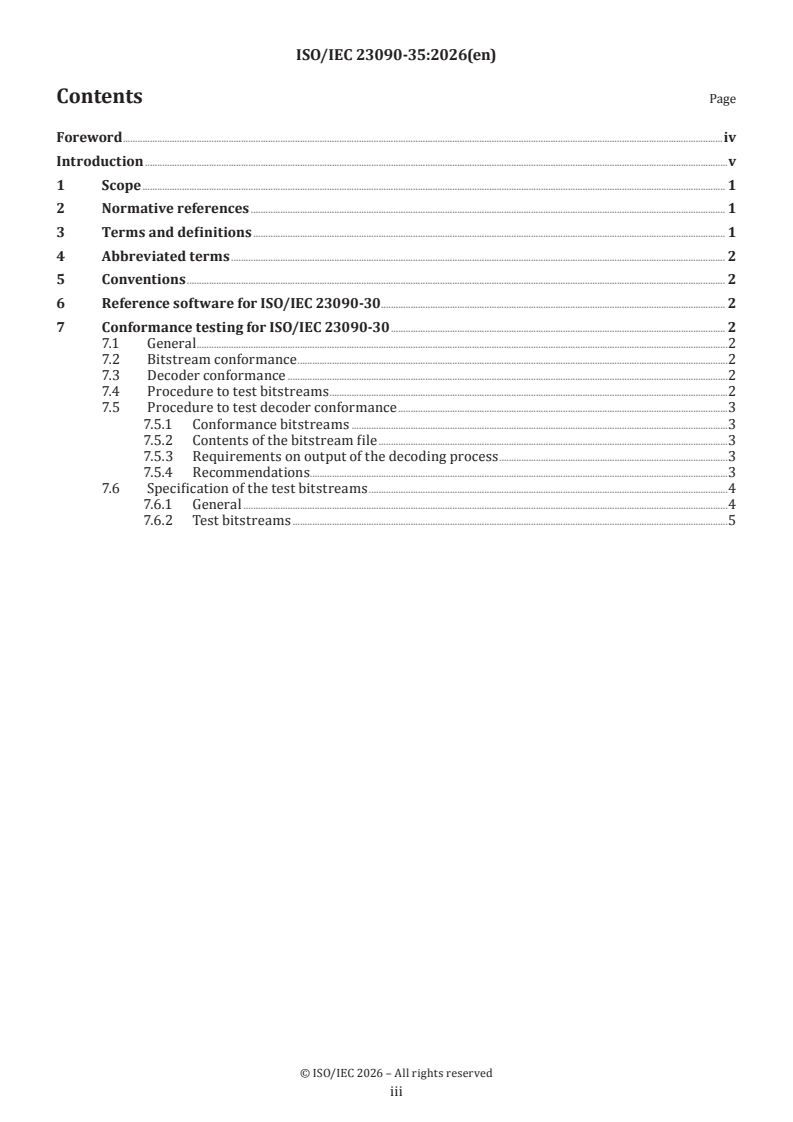
Contents Page
Foreword .iv
Introduction .v
1 Scope . 1
2 Normative references . 1
3 Terms and definitions . 1
4 Abbreviated terms . 2
5 Conventions . 2
6 Reference software for ISO/IEC 23090-30 . 2
7 Conformance testing for ISO/IEC 23090-30 . 2
7.1 General .2
7.2 Bitstream conformance .2
7.3 Decoder conformance .2
7.4 Procedure to test bitstreams .2
7.5 Procedure to test decoder conformance .3
7.5.1 Conformance bitstreams .3
7.5.2 Contents of the bitstream file .3
7.5.3 Requirements on output of the decoding process .3
7.5.4 Recommendations.3
7.6 Specification of the test bitstreams .4
7.6.1 General .4
7.6.2 Test bitstreams .5
© ISO/IEC 2026 – All rights reserved
iii
Foreword
ISO (the International Organization for Standardization) and IEC (the International Electrotechnical
Commission) form the specialized system for worldwide standardization. National bodies that are
members of ISO or IEC participate in the development of International Standards through technical
committees established by the respective organization to deal with particular fields of technical activity.
ISO and IEC technical committees collaborate in fields of mutual interest. Other international organizations,
governmental and non-governmental, in liaison with ISO and IEC, also take part in the work.
The procedures used to develop this document and those intended for its further maintenance are described
in the ISO/IEC Directives, Part 1. In particular, the different approval criteria needed for the different types
of document should be noted. This document was drafted in accordance with the editorial rules of the ISO/
IEC Directives, Part 2 (see www.iso.org/directives or www.iec.ch/members_experts/refdocs).
ISO and IEC draw attention to the possibility that the implementation of this document may involve the
use of (a) patent(s). ISO and IEC take no position concerning the evidence, validity or applicability of any
claimed patent rights in respect thereof. As of the date of publication of this document, ISO and IEC had not
received notice of (a) patent(s) which may be required to implement this document. However, implementers
are cautioned that this may not represent the latest information, which may be obtained from the patent
database available at www.iso.org/patents and https://patents.iec.ch. ISO and IEC shall not be held
responsible for identifying any or all such patent rights.
Any trade name used in this document is information given for the convenience of users and does not
constitute an endorsement.
For an explanation of the voluntary nature of standards, the meaning of ISO specific terms and expressions
related to conformity assessment, as well as information about ISO's adherence to the World Trade
Organization (WTO) principles in the Technical Barriers to Trade (TBT) see www.iso.org/iso/foreword.html.
In the IEC, see www.iec.ch/understanding-standards.
This document was prepared by Joint Technical Committee ISO/IEC JTC 1, Information technology,
Subcommittee SC 29, Coding of audio, picture, multimedia and hypermedia information.
A list of all parts in the ISO/IEC 23090 series can be found on the ISO and IEC websites.
Any feedback or questions on this document should be directed to the user’s national standards
body. A complete listing of these bodies can be found at www.iso.org/members.html and
www.iec.ch/national-committees.
© ISO/IEC 2026 – All rights reserved
iv
Introduction
0.1 General
This document specifies reference software and conformance testing for ISO/IEC 23090-30 low latency, low
complexity LiDAR coding (L3C2).
0.2 Purpose
The purpose of this document is to provide the following:
— Reference decoder software for decoding ISO/IEC 23090-30 compliant bitstreams.
— Reference encoder software for generating ISO/IEC 23090-30 compliant bitstreams.
— Procedures to test bitstream and decoder conformance.
— A set of reference bitstreams conforming to ISO/IEC 23090-30.
0.3 Examples of use
Some examples of uses that can be appropriate for the reference decoder software are as follows:
— As an illustration of how to perform the decoding process specified in ISO/IEC 23090-30.
— As the starting basis for the implementation of a decoder that conforms to ISO/IEC 23090-30.
— For testing the conformance of a decoder implementation with the decoding process specified in
ISO/IEC 23090-30.
— For testing the conformance of a bitstream to the constraints specified for bitstream conformance in
ISO/IEC 23090-30, as the software can detect and report many bitstream conformance violations.
NOTE 1 The lack of the detection of any conformance violation by the reference decoder software is
not definitive proof that the bitstream conforms to all constraints specified for bitstream conformance in
ISO/IEC 23090-30.
Some examples of uses that can be appropriate for the reference encoder software are as follows:
— As an illustration of how to perform an encoding process that produces bitstreams that conform to the
constraints specified for bitstream conformance in ISO/IEC 23090-30.
— As the starting basis for the implementation of an encoder that conforms to ISO/IEC 23090-30.
— As a means of generating bitstreams for testing the conformance of a decoder implementation with the
decoding process specified in ISO/IEC 23090-30.
— As a means of evaluating and demonstrating examples of the quality that can be achieved by an encoding
process that conforms to ISO/IEC 23090-30.
NOTE 2 No guarantee of the quality that will be achieved by an encoder is provided by its conformance to
ISO/IEC 23090-30, as the conformance of an encoder to ISO/IEC 23090-30 is defined only in terms of format
constraints imposed on the bitstream syntax. The reference encoder software provides some illustrative
examples of what quality can be achieved in conformance to ISO/IEC 23090-30, it does not define minimum
encoding quality or maximum encoding quality.
© ISO/IEC 2026 – All rights reserved
v
International Standard ISO/IEC 23090-35:2026(en)
Information technology — Coded representation of
immersive media —
Part 35:
Conformance and reference software for low latency, low
complexity LiDAR coding
1 Scope
This document provides accompanying reference software for ISO/IEC 23090-30. The software is an integral
part of this document.
The use of this reference software is not required to make an implementation of an encoder or decoder in
conformance to ISO/IEC 23090-30. Requirements established in ISO/IEC 23090-30 take precedence over the
behaviour of the reference software.
This document also specifies a set of tests and procedures designed to indicate whether encoders or
decoders meet the normative requirements specified in ISO/IEC 23090-30.
2 Normative references
The following documents are referred to in the text in such a way that some or all of their content constitutes
requirements of this document. For dated references, only the edition cited applies. For undated references,
the latest edition of the referenced document (including any amendments) applies.
ISO/IEC 23090-30:2026, Information technology — Coded representation of immersive media — Part 30: Low
latency, low complexity light detection and ranging (LiDAR) coding
3 Terms and definitions
For the purposes of this document, the terms and definitions given in ISO/IEC 23090-30 and the following
apply.
ISO and IEC maintain terminology databases for use in standardization at the following addresses:
— ISO Online browsing platform: available at https:// www .iso .org/ obp
— IEC Electropedia: available at https:// www .electropedia .org/
3.1
bitstream
sequence of bits representing compressed point cloud data structured according to the syntax of a specific
coding specification
3.2
decoder
process or device that reconstructs point cloud data from a structured bitstream conforming to a specific
coding specification
Note 1 to entry: Decoder does not include the point cloud rendering process, which is outside the scope of this
document.
© ISO/IEC 2026 – All rights reserved
3.3
encoder
embodiment of a process that produces a bitstream
3.4
reference software decoder
software implementation of the decoding process that reconstructs point cloud data from a structured
bitstream conforming to a specific coding specification
3.5
reference software encoder
software implementation that compresses point cloud data into a structured bitstream conforming to a
specific coding specification
4 Abbreviated terms
The abbreviated terms in ISO/IEC 23090-30:2026, Clause 4 apply.
5 Conventions
The conventions specified in ISO/IEC 23090-30:2026, Clause 5 apply.
6 Reference software for ISO/IEC 23090-30
Reference software is useful in aiding users of a compression standard to establish and test conformance
and interoperability, and to educate users and demonstrate the capabilities of ISO/IEC 23090-30:2026. The
reference software for ISO/IEC 23090-30:2026 is available at: https:// standards .iso .org/ iso -iec/ 23090/ -35/
ed -1/ en/ .
The software package contains one part:
— mpeg-pcc-tml software: Support for Simple and Main profiles.
The reference software manual is mpeg-pcc-tml-sw-manual.pdf. This manual can be used to install and use
the reference software.
7 Conformance testing for ISO/IEC 23090-30
7.1 General
The following subclauses specify normative tests for verifying conformance of bitstreams as well as
decoders. Those normative tests make use of test data (bitstream test suites) provided are available at:
https:// standards .iso .org/ iso -iec/ 23090/ -35/ ed -1/ en/ and the reference software decoder specified in
Clause 6.
7.2 Bitstream conformance
Bitstream conformance follows the specification text in ISO/IEC 23090-30.
7.3 Decoder conformance
Decoder conformance for ISO/IEC 23090-30, such as conformance point, etc., is specified by
ISO/IEC 23090-30:2026, 6.5.1.
7.4 Procedure to test bitstreams
A bitstream that claims conformance with ISO/IEC 23090-30 shall pass the following normative test.
© ISO/IEC 2026 – All rights reserved
The bitstream shall be decoded by processing it with the reference software decoder. When processed by
the reference software decoder, the bitstream shall not cause any error or non-conformance messages to be
reported by the reference software decoder. This test should not be applied to bitstreams that are known to
contain errors introduced by transmission, as such errors are highly likely to result in bitstreams that lack
conformance to ISO/IEC 23090-30.
Successfully passing the reference software decoder test provides only a strong presumption that the
bitstream under test does indeed meet all the requirements specified in ISO/IEC 23090-30 that are tested by
the reference software decoder.
ISO/IEC 23090-30 contains several informative recommendations that are not an integral part of this
document. When testing a bitstream for conformance, it can also be useful to test whether or not the
bitstream follows those recommendations.
To check correctness of a bitstream, it is necessary to parse the entire bitstream and to extract all the
syntax elements and other values derived from those syntactic elements and used by the decoding process
specified in ISO/IEC 23090-30.
A verifier need not necessarily perform all stages of the decoding process specified in ISO/IEC 23090-30 in
order to verify bitstream correctness. Many tests can be performed on syntax elements in a state prior to
their use in some processing stages.
7.5 Procedure to test decoder conformance
7.5.1 Conformance bitstreams
A bitstream has values of main_profile_compatibility_flag and level_idc corresponding to a set of specified
constraints on a bitstream for which a decoder conforming to a specified profile, and level is required in
Annex A of ISO/IEC 23090-30:2026 to properly perform the decoding process.
7.5.2 Contents of the bitstream file
The conformance bitstreams are included in this document and are available at: https:// standards .iso
.org/ iso -iec/ 23090/ -35/ ed -1/ en/ . The following information is included in a single zipped file for each such
bitstream.
— *.bit – bitstream as described in subclause 7.6.2
— readme.md – description
— *.cfg – config file used to generate bitstream with TML encoder SW (not applicable if TML encoder release
version not used)
— *.md5 – MD5sum of the bitstream file
— *_dec.ply – unordered decoded point cloud frames
— *_dec.ply.md5 – MD5 checksum for decoded point cloud frame
7.5.3 Requirements on output of the decoding process
The output of the decoding process is specified in Clause 8 of ISO/IEC 23090-30:2026.
The rendering process, which can follow the output of the decoding process, is outside the scope of this
document.
7.5.4 Recommendations
In addition to the requirements, it is desirable that conforming decoders implement various informative
recommendations specified in ISO/IEC 23090-30 that are not an integral part of ISO/IEC 23090-30. This
clause discusses some of these recommendations.
© ISO/IEC 2026 – All rights reserved
It is recommended that a conforming decoder be able to resume the decoding process as soon as possible
after the loss or corruption of part of a bitstream.
7.6 Specification of the test bitstreams
7.6.1 General
The test bitstreams are part of the mechanism to verify decoder conformance according to the
ISO/IEC 23090-30 specification. The bitstreams used for the decoder conformance testing specified in this
document shall be those listed in Table 1. They are available at: https:// standards .iso .org/ iso -iec/ 23090/
-35/ ed -1/ en/ .
Table 1 — List of reference bitstreams
Categories Feature Name Features tested
Common functionality EBS Entropy bypass stream
EC Entropy continuation
ST Slice/Tile
GPS GPS (Geometry Parameter Set)
APS APS (Attribute Parameter Set)
ACO Axis coding order
Geometry coding GS Geometry scaling
OGC Onechain geometry coding
PLCS Preserve laser coding state
DPOC Duplicate points in onechain geometry coding
UNEOC Use NSensing estimation in onechain coding
UCN Use Coarse neighbours
UVP Use Vertical prediction
LLA Low latency attributes coding
UPOC Unordered points in onechain coding
SCS Sensing coverage signalling
Attribute coding GATT Generic attribute
QuantATT Quantization
LodRAHT Level of Details (LoD) and Region Adaptive Hierarchical Transform (RAHT)
SLOD Single LoD
NumLOD Number of LoDs
DecLOD LoD method: Decimation
DisLOD LoD method: Distance
CentLOD LoD method: Block-based
SL Scalable Lifting
PSInterLOD Predictor search: inter LoD
PSIntraLOD Predictor search: intra LoD
NumPRED Number of predictors
DirectPRED Direct predictors (Pred)
NB Neighbour bias
LCP Last component pred
ICP Predicting Transform: Inter component pred
© ISO/IEC 2026 – All rights reserved
TTabablele 1 1 ((ccoonnttiinnueuedd))
Categories Feature Name Features tested
RahtPRED RAHT prediction
SDC Spherical domain coding
ANBF Attribute neighbour blending filtering
7.6.2 Test bitstreams
7.6.2.1 Entropy bypass stream (EBS)
7.6.2.1.1 Test bitstream EBS_A_X
Specification: The bitstream exercises the entropy bypass stream Off functionality.
— bypass_stream_enabled flag equal to 0.
— lowLatencyAttributesCoding equal to 1 (low latency attribute).
— attr_coding_type is equal to 4 (onechain).
Functional stage: Entropy bypass stream disabled and low latency attribute coding on Main profile.
Purpose: Check that the decoder can properly decode bitstreams in which entropy stream disabled.
7.6.2.1.2 Test bitstream EBS_B_X
Specification: The bitstream exercises the entropy bypass stream On functionality.
— bypass_stream_enabled flag equal to 1
— lowLatencyAttributesCoding equal to 1 (low latency attribute)
— attr_coding_type is equal to 4 (onechain)
Functional stage: Entropy bypass stream enabled and low latency attribute coding on Main profile.
Purpose: Check that the decoder can properly decode bitstreams in which entropy stream enabled.
7.6.2.1.3 Test bitstream EBS_C_X
Specification: The bitstream exercises the entropy bypass stream On functionality.
— bypass_stream_enabled flag equal to 1
— lowLatencyAttributesCoding equal to 0
— attr_coding_type is equal to 0 (RAHT)
Functional stage: Entropy bypass stream enabled and RAHT attribute coding on Simple and Main profile.
Purpose: Check that the decoder can properly decode bitstreams in which entropy stream enabled.
7.6.2.1.4 Test bitstream EBS_D_X
Specification: The bitstream exercises the entropy bypass stream On functionality.
— bypass_stream_enabled flag equal to 1
— lowLatencyAttributesCoding equal to 0
— attr_coding_type is equal to 1 (Predicting)
© ISO/IEC 2026 – All rights reserved
Functional stage: Entropy bypass stream enabled and Predicting attribute coding on Simple and Main
profile.
Purpose: Check that the decoder can properly decode bitstreams in which entropy stream enabled.
7.6.2.1.5 Test bitstream EBS_E_X
Specification: The bitstream exercises the entropy bypass stream On functionality.
— bypass_stream_enabled flag equal to 1
— lowLatencyAttributesCoding equal to 0
— attr_coding_type is equal to 2 (Lifting)
Functional stage: Entropy bypass stream enabled and Lifting attribute coding on Simple and Main profile.
Purpose: Check that the decoder can properly decode bitstreams in which entropy stream enabled.
7.6.2.1.6 Test bitstream EBS_F_X
Specification: The bitstream exercises the entropy bypass stream On functionality.
— bypass_stream_enabled flag equal to 1
— lowLatencyAttributesCoding equal to 0
— attr_coding_type is equal to 3 (raw)
Functional stage: Entropy bypass stream enabled and raw attribute coding on Simple and Main profile.
Purpose: Check that the decoder can properly decode bitstreams in which entropy stream enabled.
7.6.2.1.7 Test bitstream EBS_G_X
Specification: The bitstream exercises the entropy bypass stream Off functionality.
— bypass_stream_enabled flag equal to 0
— lowLatencyAttributesCoding equal to 0
— attr_coding_type is equal to 0 (RAHT)
Functional stage: Entropy bypass stream disabled and RAHT attribute coding on Main profile.
Purpose: Check that the decoder can properly decode bitstreams in which entropy stream disabled.
7.6.2.1.8 Test bitstream EBS_H_X
Specification: The bitstream exercises the entropy bypass stream Off functionality.
— bypass_stream_enabled flag equal to 0
— lowLatencyAttributesCoding equal to 0
— attr_coding_type is equal to 1 (Predicting)
Functional stage: Entropy bypass stream disabled and Predicting attribute coding on Main profile.
Purpose: Check that the decoder can properly decode bitstreams in which entropy stream disabled.
© ISO/IEC 2026 – All rights reserved
7.6.2.1.9 Test bitstream EBS_I_X
Specification: The bitstream exercises the entropy bypass stream Off functionality.
— bypass_stream_enabled flag equal to 0
— lowLatencyAttributesCoding equal to 0
— attr_coding_type is equal to 2 (Lifting)
Functional stage: Entropy bypass stream disabled and Lifting attribute coding on Main profile.
Purpose: Check that the decoder can properly decode bitstreams in which entropy stream disabled.
7.6.2.1.10 Test bitstream EBS_J_X
Specification: The bitstream exercises the entropy bypass stream Off functionality.
— bypass_stream_enabled flag equal to 0
— lowLatencyAttributesCoding equal to 0
— attr_coding_type is equal to 3 (raw)
Functional stage: Entropy bypass stream disabled and raw attribute coding on Main profile.
Purpose: Check that the decoder can properly decode bitstreams in which entropy stream disabled.
7.6.2.2 Entropy continuation (EC)
7.6.2.2.1 Test bitstream EC_A_X
Specification: The bitstream exercises the entropy continuation functionality enabled.
— gbh_entropy_continuation_flag: 1
— lowLatencyAttributesCoding equal to 1 (low latency attribute)
— attr_coding_type: 4 (onechain)
— sliceMaxPoints: 25000
— sliceMinPoints: 5000
Functional stage: Entropy continuation on Onechain Geometry Coding and low latency attribute coding on
Main profile.
Purpose: Check that the decoder can properly decode bitstreams in which entropy continuation function is
enabled.
7.6.2.2.2 Test bitstream EC_B_X
Specification: The bitstream exercises the entropy continuation functionality enabled.
— gbh_entropy_continuation_flag: 1
— lowLatencyAttributesCoding equal to 0
— attr_coding_type: 1 (predicting)
— sliceMaxPoints: 25000
— sliceMinPoints: 5000
© ISO/IEC 2026 – All rights reserved
Functional stage: Entropy continuation on Onechain Geometry Coding and predicting attribute coding on
Simple and Main profile.
Purpose: Check that the decoder can properly decode bitstreams in which entropy continuation function is
enabled.
7.6.2.2.3 Test bitstream EC_C_X
Specification: The bitstream exercises the entropy continuation functionality enabled.
— gbh_entropy_continuation_flag: 1
— lowLatencyAttributesCoding equal to 0
— attr_coding_type: 0 (RAHT)
— sliceMaxPoints: 25000
— sliceMinPoints: 5000
Functional stage: Entropy continuation on Onechain Geometry Coding and RAHT attribute coding on Simple
and Main profile.
Purpose: Check that the decoder can properly decode bitstreams in which entropy continuation function is
enabled.
7.6.2.2.4 Test bitstream EC_D_X
Specification: The bitstream exercises the entropy continuation functionality enabled.
— gbh_entropy_continuation_flag: 1
— lowLatencyAttributesCoding equal to 0
— attr_coding_type: 2 (lifting)
— sliceMaxPoints: 25000
— sliceMinPoints: 5000
Functional stage: Entropy continuation on Onechain Geometry Coding and lifting attribute coding on Simple
and Main profile.
Purpose: Check that the decoder can properly decode bitstreams in which entropy continuation function is
enabled.
7.6.2.2.5 Test bitstream EC_E_X
Specification: The bitstream exercises the entropy continuation functionality enabled.
— gbh_entropy_continuation_flag: 1
— lowLatencyAttributesCoding equal to 0
— attr_coding_type: 3 (raw)
— sliceMaxPoints: 25000
— sliceMinPoints: 5000
Functional stage: Entropy continuation on Onechain Geometry Coding and raw attribute coding on Simple
and Main profile.
© ISO/IEC 2026 – All rights reserved
Purpose: Check that the decoder can properly decode bitstreams in which entropy continuation function is
enabled.
7.6.2.2.6 Test bitstream EC_F_X
Specification: The bitstream exercises the entropy continuation functionality enabled/disabled on different
slices.
— gbh_entropy_continuation_flag: 0, 1, 0, 1
— lowLatencyAttributesCoding equal to 1 (low latency attribute)
— attr_coding_type: 4 (onechain)
— sliceMaxPoints: 25000
— sliceMinPoints: 5000
Functional stage: Entropy continuation on Onechain Geometry Coding and low latency attribute coding on
Main profile.
Purpose: Check that the decoder can properly decode bitstreams in which entropy continuation function is
enabled/disabled on different slices.
7.6.2.3 Slice/Tile (ST)
7.6.2.3.1 Test bitstream ST_A_X
Specification: The bitstream consists of zero tile and one slice.
— tileSize: 0
— partitionMethod: 0
Functional stage: Common functionality in Simple profile.
Purpose: Check that the decoder can properly decode bitstreams in which zero tile and one slice are present
in Simple profile.
7.6.2.3.2 Test bitstream ST_B_X
Specification: The bitstream consists of zero tile and one slice.
— tileSize:0
— partitionMethod: 0
Functional stage: Common functionality in Main profile.
Purpose: Check that the decoder can properly decode bitstreams in which zero tile and one slice are present
in Main profile.
7.6.2.3.3 Test bitstream ST_C_X
Specification: The bitstream consists of zero tile and one slice.
— tileSize:0
— partitionMethod: 4
Functional stage: Common functionality in Simple profile.
© ISO/IEC 2026 – All rights reserved
Purpose: Check that the decoder can properly decode bitstreams in which zero tile and one slice are present
in Simple profile.
7.6.2.3.4 Test bitstream ST_D_X
Specification: The bitstream consists of zero tile and one slice.
— tileSize:0
— partitionMethod: 4
Functional stage: Common functionality in Main profile.
Purpose: Check that the decoder can properly decode bitstreams in which zero tile and one slice are present
in Main profile.
7.6.2.3.5 Test bitstream ST_E_X
Specification: The bitstream consists of zero tile and one slice.
— t i leSi z e: 4 00000
— partitionMethod: 0
Functional stage: Common functionality in Simple profile.
Purpose: Check that the decoder can properly decode bitstreams in which zero tile and one slice are present
in Simple profile.
7.6.2.3.6 Test bitstream ST_F_X
Specification: The bitstream consists of zero tile and one slice.
— t i leSi z e: 4 00000
— partitionMethod: 0
Functional stage: Common functionality in Main profile.
Purpose: Check that the decoder can properly decode bitstreams in which zero tile and one slice are present
in Main profile.
7.6.2.3.7 Test bitstream ST_G_X
Specification: The bitstream consists of zero tile and one slice.
— t i leSi z e: 4 00000
— partitionMethod: 4
Functional stage: Common functionality in Simple profile.
Purpose: Check that the decoder can properly decode bitstreams in which zero tile and one slice are present
in Simple profile.
7.6.2.3.8 Test bitstream ST_H_X
Specification: The bitstream consists of zero tile and one slice.
— t i leSi z e: 4 00000
— partitionMethod: 4
© ISO/IEC 2026 – All rights reserved
Functional stage: Main profile.
Functional stage: Common functionality in Main profile.
Purpose: Check that the decoder can properly decode bitstreams in which zero tile and one slice are present
in Main profile.
7.6.2.3.9 Test bitstream ST_I_X
Specification: The bitstream consists of three tiles and three slices.
— t i leSi z e: 200000
— partitionMethod: 4
Functional stage: Common functionality in Simple profile.
Purpose: Check that the decoder can properly decode bitstreams in which three tiles and three slices are
present in Simple profile.
7.6.2.3.10 Test bitstream ST_J_X
Specification: The bitstream consists of three tiles and three slices.
— t i leSi z e: 200000
— partitionMethod: 4
Functional stage: Common functionality in Main profile.
Purpose: Check that the decoder can properly decode bitstreams in which three tiles and three slices are
present in Main profile.
7.6.2.4 Geometry parameter set (GPS)
7.6.2.4.1 Test bitstream GPS_A_X
Specification: The bitstream includes one geometry parameter set (GPS), which is sharing among 3 frames.
Functional stage: Common functionality in Main profile.
Purpose: Check that the decoder can properly decode bitstreams in which one GPS is sharing among multiple
frames.
7.6.2.4.2 Test bitstream GPS_B_X
Specification: The bitstream includes one GPS, which is repeating for each frame.
Functional stage: Common functionality in Main profile.
Purpose: Check that the decoder can properly decode bitstreams in which one GPS repeats for each frame.
7.6.2.4.3 Test bitstream GPS_C_X
Specification: The bitstream includes one GPS, which is repeating for each frame.
Functional stage: Common functionality in Simple profile.
Purpose: Check that the decoder can properly decode bitstreams in which one GPS repeats for each frame.
© ISO/IEC 2026 – All rights reserved
7.6.2.5 Attribute parameter set (APS)
7.6.2.5.1 Test bitstream APS_A_X
Specification: The bitstream includes one APS, which is sharing among 3 frames.
Functional stage: Common functionality in Main profile.
Purpose: Check that the decoder can properly decode bitstreams in which one APS is sharing among multiple
frames.
7.6.2.5.2 Test bitstream APS_B_X
Specification: The bitstream includes one APS, which is sharing among 3 frames.
Functional stage: Common functionality in Simple profile.
Purpose: Check that the decoder can properly decode bitstreams in which one APS is sharing among multiple
frames.
7.6.2.6 axis_coding_order (ACO)
7.6.2.6.1 Test bitstream ACO_A_X
Specification: The bitstream tests on geometry axis coding order (set as zyx) of the coded point cloud.
— geometry_axis_order: 0 (zyx)
Functional stage: Common functionality in Main profile.
Purpose: Check that the decoder can properly decode bitstreams in which axis coding order is set in Main
profile.
7.6.2.6.2 Test bitstream ACO_B_X
Specification: The bitstream tests on geometry axis coding order (set as xyz) of the coded point cloud.
— geometry_axis_order: 1 (xyz)
Functional stage: Common functionality in Main profile.
Purpose: Check that the decoder can properly decode bitstreams in which axis coding order is set in Main
profile.
7.6.2.6.3 Test bitstream ACO_C_X
Specification: The bitstream tests on geometry axis coding order (set as xzy) of the coded point cloud.
— geometry_axis_order: 2 (xzy)
Functional stage: Common functionality in Main profile.
Purpose: Check that the decoder can properly decode bitstreams in which axis coding order is set in Main
profile.
7.6.2.6.4 Test bitstream ACO_D_X
Specification: The bitstream tests on geometry axis coding order (set as yzx) of the coded point cloud.
— geometry_axis_order: 3 (yzx)
© ISO/IEC 2026 – All rights reserved
Functional stage: Common functionality in Main profile.
Purpose: Check that the decoder can properly decode bitstreams in which axis coding order is set in Main
profile.
7.6.2.6.5 Test bitstream ACO_E_X
Specification: The bitstream tests on geometry axis coding order (set as zyx) of the coded point cloud.
— geometry_axis_order: 4 (zyx)
Functional stage: Common functionality in Main profile.
Purpose: Check that the decoder can properly decode bitstreams in which axis coding order is set in Main
profile.
7.6.2.6.6 Test bitstream ACO_F_X
Specification: The bitstream tests on geometry axis coding order (set as zxy) of the coded point cloud.
— geometry_axis_order: 5 (zxy)
Functional stage: Common functionality in Main profile.
Purpose: Check that the decoder can properly decode bitstreams in which axis coding order is set in Main
profile.
7.6.2.6.7 Test bitstream ACO_G_X
Specification: The bitstream tests on geometry axis coding order (set as yxz) of the coded point cloud.
— geometry_axis_order: 6 (yxz)
Functional stage: Common functionality in Main profile.
Purpose: Check that the decoder can properly decode bitstreams in which axis coding order is set in Main
profile.
7.6.2.6.8 Test bitstream ACO_H_X
Specification: The bitstream tests on geometry axis coding order (set as xyz) of the coded point cloud.
— geometry_axis_order: 7 (xyz)
Functional stage: Common functionality in Main profile.
Purpose: Check that the decoder can properly decode bitstreams in which axis coding order is set in Main
profile.
7.6.2.7 Geometry scaling (GS)
7.6.2.7.1 Test bitstream GS_A_X
Specification: Geometry scaling in onechain geometry coding is turned on and it uses geometry global scale
factor.
— positionQuantizationScale: 0.25
Functional stage: Geometry coding in Main profile.
Purpose: Check if the decoder can properly decode bitstreams in which geometry global scale factor is
configured in Main profile.
© ISO/IEC 2026 – All rights reserved
7.6.2.7.2 Test bitstream GS_B_X
Specification: Geometry scaling in onechain geometry coding is turned on and it uses geometry global scale
factor.
— positionQuantizationScale: 0.015625
Functional stage: Geometry coding in Main profile.
Purpose: Check if the decoder can properly decode bitstreams in which geometry global scale factor is
configured in Main profile.
7.6.2.7.3 Test bitstream GS_C_X
Specification: Geometry scaling in onechain geometry coding is turned on and it uses geometry global scale
factor.
— positionQuantizationScale: 0.125
Functional stage: Geometry coding in Main profile.
Purpose: Check if the decoder can properly decode bitstreams in which geometry global scale factor is
configured in Main profile.
7.6.2.7.4 Test bitstream GS_D_X
Specification: Geometry scaling in onechain geometry coding is turned on and it uses geometry global scale
factor.
— positionQuantizationScale: 0.03125
Functional stage: Geometry coding in Main profile.
Purpose: Check if the decoder can properly decode bitstreams in which geometry global scale factor is
configured in Main profile.
7.6.2.7.5 Test bitstream GS_E_X
Specification: Geometry scaling in onechain geometry coding is turned on and it uses geometry global scale
factor.
— positionQuantizationScale: 0.03125
Functional stage: Geometry coding in Simple profile.
Purpose: Check if the decoder can properly decode bitstreams in which geometry global scale factor is
configured in Simple profile.
7.6.2.8 Onechain geometry coding (OGC)
7.6.2.8.1 Test bitstream OGC_A_X
Specification: Onechain geometry coding is the only geometry coding method in L3C2. The bitstream tests
onechain geometry coding with a point cloud which has two points.
Functional stage: Geometry coding in Main profile.
Purpose: Check that the decoder can properly decode bitstreams in which Onechain geometry coding is
used to code point cloud with two points in Main profile.
© ISO/IEC 2026 – All rights reserved
7.6.2.8.2 Test bitstream OGC_B_X
Specification: Onechain geometry coding is the only geometry coding method in L3C2. The bitstream tests
onechain geometry coding with a point cloud which has two points.
Functional stage: Geometry coding in Simple profile.
Purpose: Check that the decoder can properly decode bitstreams in which Onechain geometry coding is
used to code point cloud with two points in Simple profile.
7.6.2.8.3 Test bitstream OGC_C_X
Specification: Onechain geometry coding is the only geometry coding method in L3C2. The bitstream tests
onechain geometry coding with a point cloud which has 18 bits depth (use Ford data).
Functional stage: Geometry coding in Main profile.
Purpose: Check that the decoder can properly decode bitstreams in which Onechain geometry coding is
used to code a point cloud with 18 bits depth in Main profile.
7.6.2.8.4 Test bitstream OGC_D_X
Specification: Onechain geometry coding is the only geometry coding method in L3C2. The bitstream tests
onechain geometry coding with a point cloud which has 18 bits depth (use Ford data).
Functional stage: Geometry coding in Simple profile.
Purpose: Check that the decoder can properly decode bitstreams in which Onechain geometry coding is
used to code a point cloud with 18 bits depth in Simple profile.
7.6.2.8.5 Test bitstream OGC_E_X
Specification: Onechain geometry coding is the only geometry coding method in L3C2. The bitstream tests
onechain geometry coding with a point cloud which has one point.
Functional stage: Geometry coding in Main profile.
Purpose: Check that the decoder can properly decode bitstreams in which Onechain geometry coding is
used to code point cloud with one point in Main profile.
7.6.2.8.6 Test bitstream OGC_F_X
Specification: Onechain geometry coding is the only geometry coding method in L3C2. The bitstream tests
onechain geometry coding with a point cloud which has one point.
Functional stage: Geometry coding in Simple profile.
Purpose: Check that the decoder can properly decode bitstreams in which Onechain geometry coding is
used to code point cloud with one point in Simple profile.
7.6.2.8.7 Test bitstream OGC_G_X
Specification: Onechain geometry coding is the only geometry coding method in L3C2. The bitstream tests
onechain geometry coding with a point cloud which has 18 bits depth (use QNX data).
Functional stage: Geometry coding in Main profile.
Purpose: Check that the decoder can properly decode bitstreams in which Onechain geometry coding is
used to code a point cloud with 18 bits depth in Main profile.
© ISO/IEC 2026 – All rights reserved
7.6.2.8.8 Test bitstream OGC_H_X
Specification: Onechain geometry coding is the only geometry coding method in L3C2. The bitstream tests
onechain geometry coding with a point cloud which has 18 bits depth (use QNX data).
Functional stage: Geometry coding in Simple profile.
Purpose: Check that the decoder can properly decode bitstreams in which Onechain geometry coding is
used to code a point cloud with 18 bits depth in Simple profile.
7.6.2.9 Preserve laser coding state (PLCS)
7.6.2.9.1 Test bitstream PLCS_A_X
Specification: The bitstream exercises the functionality to preserve laser coding state between slices.
— entropyContinuationEnabled: 1
— perLaserCodingStatePreserved: 1
Functional stage: Geometry coding in Main profile.
Purpose: Check that the decoder can properly decode bitstreams in which preserve laser coding state
functionality is enabled in Main profile.
7.6.2.9.2 Test bitstream PLCS_B_X
Specification: The bitstream exercises the functionality to preserve laser coding state between slices.
— entropyContinuationEnabled: 1
— perLaserCodingStatePreserved: 1
Functional stage: Geometry coding in Simple profile.
Purpose: Check that the decoder can properly decode bitstreams in which preserve laser coding state
functionality is enabled in Simple profile.
7.6.2.9.3 Test bitstream PLCS_C_X
Specification: The bitstream exercises the functionality to preserve laser coding state between slices.
— entropyContinuationEnabled: 1
— perLaserCodingStatePreserved: 0
Functional stage: Geometry coding in Main profile.
Purpose: Check that the decoder can properly decode bitstreams in which preserve laser coding state
functionality is disabled in Main profile.
7.6.2.9.4 Test bitstream PLCS_D_X
Specification: The bitstream exercises the functionality to preserve laser coding state between slices.
— entropyContinuationEnabled: 1
— perLaserCodingStatePreserved: 0
Functional stage: Geometry coding in Simple profile.
Purpose: Check that the decoder can properly decode bitstreams in which preserve laser coding state
functionality is disabled in Simple profile.
© ISO/IEC 2026 – All rights reserved
7.6.2.10 Duplicate points in onechain geometry coding (DPOC)
7.6.2.10.1 Test bitstream DPOC_A_X
Specification: The bitstream exercises the functionality to enable removal of duplicated points.
— mergeDuplicatedPoints: 1
— lowLatencyAttributesCoding: 1 (low latency attribute)
— attr_coding_type: 4 (onechain)
Functional stage: Geometry coding in Main profile.
Purpose: Check that the decoder can properly decode bitstreams in which removal of duplicated points
functionality is enabled on low latency attribute coding in Main profile.
7.6.2.10.2 Test bitstream DPOC_B_X
Specificatio
...