

ISO/IEC 23002-7:2026
(Main)Information technology — MPEG video technologies — Part 7: Versatile supplemental enhancement information messages for coded video bitstreams
- Abstract
This Specification specifies the syntax and semantics of video usability information (VUI) parameters and supplemental enhancement information (SEI) messages. The VUI parameters and SEI messages defined in this Specification are designed to be conveyed within coded video bitstreams in a manner specified in a video coding specification or to be conveyed by other means determined by the specifications for systems that make use of such coded video bitstreams. This Specification is particularly intended for use with coded video bitstreams as specified by Rec. ITU-T H.266 | ISO/IEC 23090-3, although it is drafted in a manner intended to be sufficiently generic that it can also be used with other types of coded video bitstreams. VUI parameters and SEI messages can assist in processes related to decoding, display or other purposes. However, unless otherwise specified in a referencing specification, the interpretation and use of the VUI parameters and SEI messages specified in this Specification is not a required functionality of a video decoder or receiving video system. Although semantics are specified for the VUI parameters and SEI messages, decoders and receiving video systems can simply ignore the content of the VUI parameters and SEI messages or can use them in a manner that somewhat differs from what is specified in this Specification.
- Status
- Published
- Publication Date
- 27-Sep-2026
- Current Stage
- 6060 - International Standard published
- Start Date
- 28-Sep-2026
- Due Date
- 16-Jul-2027
- Completion Date
- 28-Sep-2026

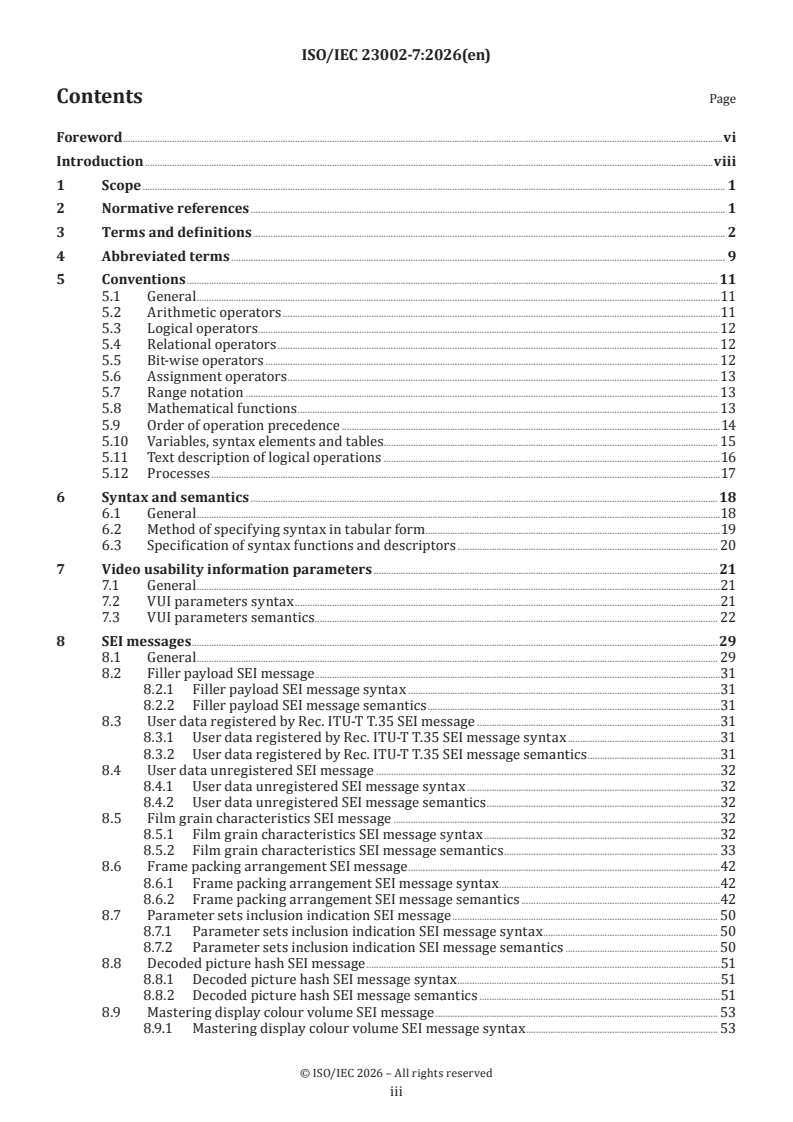
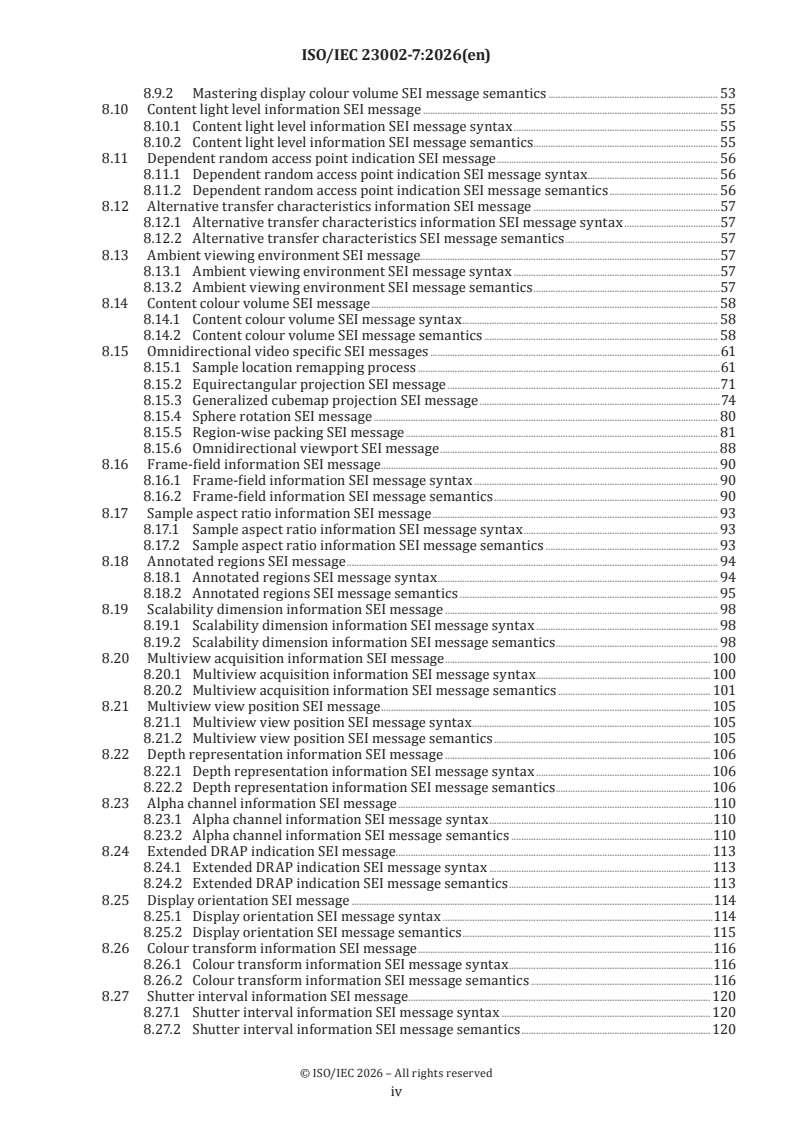
ISO/IEC 23002-7:2026 is an ISO International Standard for MPEG video technologies that specifies video usability information (VUI) parameters and supplemental enhancement information (SEI) messages for coded video bitstreams. It is intended for video coding specifications and systems that carry those bitstreams, especially Rec. ITU-T H.266 | ISO/IEC 23090-3, and it defines signaling that can support decoding, display, metadata exchange, and related processing.
What does ISO/IEC 23002-7:2026 specify?
ISO/IEC 23002-7:2026 specifies the syntax and semantics of VUI parameters and SEI messages, and it explains how those items are carried and interpreted in coded video bitstreams. Clause 6 sets out the container and payload rules that referencing specifications need, Clause 7 defines VUI parameters, Clause 8 defines SEI messages, and Clause 9 gives parsing support for k-th order Exp-Golomb codes.
The document is organized as follows:
- Clause 1 - Scope
- Clause 2 - Normative references
- Clause 3 - Terms and definitions
- Clause 4 - Abbreviated terms
- Clause 5 - Conventions
- Clause 6 - Syntax and semantics
- Clause 7 - Video usability information parameters
- Clause 8 - SEI messages
- Clause 9 - Parsing process for k-th order Exp-Golomb codes
In practice, the standard is meant to be referenced by other specifications. That matters because this document defines the signaling itself, while the referencing video coding or systems specification decides how the signaling is packed into a bitstream or used by a receiver.
What are the key requirements of ISO/IEC 23002-7:2026?
ISO/IEC 23002-7:2026 is mainly about how to signal extra video information cleanly and how decoders should treat it. The most important requirements are in the transport rules of Clause 6, the VUI rules of Clause 7, and the SEI message rules of Clause 8.
Transport and payload handling
Clause 6 says that a referencing specification shall define a container for VUI parameters or SEI messages and shall identify the payload length in bits. It also requires the payload size used for conformance to match the actual number of bits in the VUI or SEI syntax structure.
That matters because implementers need a clear boundary for parsing. The clause also states that if extra bits are present at the end of a VUI or SEI payload, a conforming decoder ignores them, which gives later editions room to extend payloads without breaking older decoders.
Clause 6 also defines helper functions such as more_data_in_payload( ), payload_extension_present( ), and read_bits( ). These are the parsing tools used by the syntax tables, so they matter for anyone implementing a bitstream reader.
VUI parameters in Clause 7
Clause 7 defines VUI parameters that apply to one or more CLVSs. The VUI flags describe source scan type, aspect ratio, overscan, colour description, and chroma sample location, so downstream systems can interpret the pictures correctly.
Two VUI flags are especially important in practice:
vui_progressive_source_flagandvui_interlaced_source_flagindicate whether the source should be treated as progressive, interlaced, unknown, or signaled at picture level through a frame-field information SEI message.vui_non_packed_constraint_flagandvui_non_projected_constraint_flagconstrain whether frame packing arrangement SEI messages, equirectangular projection SEI messages, or generalized cubemap projection SEI messages may appear for the CLVS.
Clause 7 also ties colour-related values to coding-independent code points from Rec. ITU-T H.273 | ISO/IEC 23091-2 and defines chroma-format-dependent behavior. In practice, that lets an encoder signal how to interpret the picture dimensions, colour handling, and chroma sample positions without hard-coding those assumptions into the decoder.
SEI message scope and persistence
Clause 8 says that SEI messages can have different persistence scopes. Some apply to the current picture, some to the current CLVS, and some are defined by the message syntax itself. The persistence scope is summarized in Table 4.
This matters because the same bitstream can carry both short-lived and longer-lived metadata. An implementer has to know whether a message affects only one picture, all later pictures in a layer, or a broader sequence.
Picture and display-related SEI messages
Clause 8 includes film grain characteristics, frame packing arrangement, frame-field information, sample aspect ratio information, display orientation, alternative transfer characteristics information, ambient viewing environment, and content light level information.
These messages are used when the bitstream needs to describe how pictures should be presented or interpreted. For example:
- film grain characteristics can model grain with additive or multiplicative blending
- frame packing arrangement can describe side-by-side, top-bottom, or temporal interleaving arrangements
- frame-field information can indicate how a picture should be displayed as progressive or interlaced content
- display orientation can signal horizontal flipping or rotation variants
For a buyer or engineering team, this means the standard supports signaling that affects display pipelines, stereoscopic presentation, and visual appearance after decoding.
Verification, access, and metadata SEI messages
Clause 8 also covers decoded picture hash, parameter sets inclusion indication, dependent random access point indication, extended DRAP indication, encoder optimization information, source picture timing information, and phase indication.
The decoded picture hash SEI message is especially practical for validation. It supports MD5, CRC, and checksum-based verification, so it can be used to check that a decoded picture matches the expected output.
Clause 8 additionally covers message families for object mask information, modality information, text description information, packed regions information, image format metadata, and AI usage restrictions request. These are relevant when a bitstream needs to carry descriptive or policy-related metadata alongside the picture content.
Omnidirectional, multiview, depth, and post-processing signaling
Clause 8 also covers omnidirectional video specific SEI messages, multiview acquisition information, multiview view position, depth representation information, alpha channel information, scalability dimension information, and neural-network post-filter messages.
These are the parts that matter for VR, 360-degree video, multiview rendering, auxiliary pictures, and neural-network-based post-processing. Clause 8.15 includes sample location remapping and projection-related messages, while the neural-network post-filter clauses define characteristics and activation signaling for post-processing workflows.
What terms does ISO/IEC 23002-7:2026 define?
- VUI (video usability information) - Parameters that signal how pictures should be interpreted, such as source scan type, aspect ratio, colour description, and chroma location.
- SEI (supplemental enhancement information) - Bitstream messages that carry additional information for decoding, display, verification, or other uses.
- CLVS (coded layer video sequence) - A sequence of picture units in one layer, used as a scope for several VUI and SEI meanings.
- CVS (coded video sequence) - A sequence of access units that forms one or more coded video sequences.
- IRAP (intra random access point) - A picture type that allows decoding to restart from that point within a layer.
- DRAP (dependent random access point) - A random-access concept used in SEI signaling related to dependent access behavior.
- NNPF (neural-network post-processing filter) - A neural-network-based post-processing function described by NNPFC and NNPFA SEI messages.
- PU (picture unit) - The unit that carries coded pictures in a layer-based bitstream structure.
Who uses ISO/IEC 23002-7:2026?
ISO/IEC 23002-7:2026 is used by standards developers, codec implementers, and system architects who need a common way to signal video interpretation data in coded video bitstreams. It is also relevant to encoder and decoder vendors that implement VUI or SEI support in products or libraries.
In practice, users include:
- video codec implementers working with H.266-style bitstreams
- streaming, broadcasting, and distribution system designers
- engineers handling stereoscopic, multiview, 360-degree, depth, alpha, or auxiliary-picture workflows
- teams building verification, conformance, or hashing tools
- quality managers checking that signaling matches the intended picture handling
- product teams that need to carry metadata such as display orientation, content light level, text description, or image format metadata
What changed in ISO/IEC 23002-7:2026 from the previous edition?
ISO/IEC 23002-7:2026 cancels and replaces ISO/IEC 23002-7:2024 and is described as a technically revised fourth edition.
The main changes stated in the foreword and introduction are:
- extensions to the film grain characteristics SEI message
- extensions to the neural-network post-filter characteristics SEI message
- extensions to the neural-network post-filter activation SEI message
- addition of the SEI processing order SEI message
- addition of the processing order nesting SEI message
- addition of the encoder optimization information SEI message
- addition of the source picture timing information SEI message
- addition of the object mask information SEI message
- addition of the modality information SEI message
- addition of the text description information SEI message
- addition of the generative face video SEI message and the generative enhancement face video SEI message
- addition of the digitally signed content initialization, selection, and verification SEI messages
- addition of the AI usage restrictions request SEI message
- addition of the packed regions information SEI message
- addition of the image format metadata SEI message
- corrections to various minor defects in the prior content
Which standards are used with ISO/IEC 23002-7:2026?
ISO/IEC 23002-7:2026 uses the following normative references:
- ISO/IEC 10646 - provides the Universal Coded Character Set for text data.
- ISO/IEC 11578:1996 - provides RPC-related identification referenced by metadata use cases.
- ISO 12234-2 - provides TIFF/EP image data format support.
- ISO 15076-1 - provides ICC profile architecture, profile format, and data structure.
- ISO 16684-1 - provides the XMP data model, serialization, and core properties.
- ISO 16684-3 - provides JSON-LD serialization of XMP.
- ISO 20677 - provides extensions to color management architecture and profile structure.
- ISO/IEC 21617-1 - provides JPEG Trust core foundation.
- Rec. ITU-T H.273 | ISO/IEC 23091-2 - provides coding-independent code points used for video-related signaling in Clause 7 and elsewhere.
- Rec. ITU-T T.35:2000 - provides the code allocation procedure used for registered user data.
- Rec. ITU-T T.871 | ISO/IEC 10918-5 - provides JFIF support relevant to image format metadata.
- CTA-766-D (ANSI) - provides region rating tables and content advisory descriptors.
- CIPA-DC-008-2023 - provides Exif metadata definitions.
- ISO/CIE 11664-1 - provides standard colorimetric observers.
- IETF RFC 1321 - provides the MD5 Message-Digest Algorithm used by decoded picture hash.
- IETF RFC 4151 - provides the tag URI scheme.
- IETF RFC 5646 - provides language tags.
- IETF RFC 3986 - provides generic URI syntax.
- NIST FIPS PUB 180-4 - provides the Secure Hash Standard.
What does the ISO/IEC 23002-7:2026 document contain?
ISO/IEC 23002-7:2026 contains syntax tables, semantic descriptions, and parsing rules for VUI parameters and a large set of SEI messages. It also includes convention rules for operators, precedence, syntax elements, ranges, and process notation, which support precise bitstream parsing.
The document contains:
- syntax and semantics for VUI parameters in Clause 7
- syntax and semantics for many SEI message types in Clause 8
- specialized processes for omnidirectional video mapping and sample location remapping
- equations and worked definitions for film grain, neural-network post-filter behavior, depth representation, and hash calculation
- figures and tables that illustrate packing arrangements, view handling, and signaling relationships
- a parsing process for k-th order Exp-Golomb codes in Clause 9
For implementation work, those contents are used to build encoders, decoders, conformance tests, verification tools, and system-level metadata handling for coded video bitstreams.
Relations
- Effective Date
- 13-Feb-2026
Get Certified
Connect with accredited certification bodies for this standard

BSI Group
BSI (British Standards Institution) is the business standards company that helps organizations make excellence a habit.

NYCE
Mexican standards and certification body.
Sponsored listings
Frequently Asked Questions
ISO/IEC 23002-7:2026 is a standard published by the International Organization for Standardization (ISO). Its full title is "Information technology — MPEG video technologies — Part 7: Versatile supplemental enhancement information messages for coded video bitstreams". This standard covers: This Specification specifies the syntax and semantics of video usability information (VUI) parameters and supplemental enhancement information (SEI) messages. The VUI parameters and SEI messages defined in this Specification are designed to be conveyed within coded video bitstreams in a manner specified in a video coding specification or to be conveyed by other means determined by the specifications for systems that make use of such coded video bitstreams. This Specification is particularly intended for use with coded video bitstreams as specified by Rec. ITU-T H.266 | ISO/IEC 23090-3, although it is drafted in a manner intended to be sufficiently generic that it can also be used with other types of coded video bitstreams. VUI parameters and SEI messages can assist in processes related to decoding, display or other purposes. However, unless otherwise specified in a referencing specification, the interpretation and use of the VUI parameters and SEI messages specified in this Specification is not a required functionality of a video decoder or receiving video system. Although semantics are specified for the VUI parameters and SEI messages, decoders and receiving video systems can simply ignore the content of the VUI parameters and SEI messages or can use them in a manner that somewhat differs from what is specified in this Specification.
This Specification specifies the syntax and semantics of video usability information (VUI) parameters and supplemental enhancement information (SEI) messages. The VUI parameters and SEI messages defined in this Specification are designed to be conveyed within coded video bitstreams in a manner specified in a video coding specification or to be conveyed by other means determined by the specifications for systems that make use of such coded video bitstreams. This Specification is particularly intended for use with coded video bitstreams as specified by Rec. ITU-T H.266 | ISO/IEC 23090-3, although it is drafted in a manner intended to be sufficiently generic that it can also be used with other types of coded video bitstreams. VUI parameters and SEI messages can assist in processes related to decoding, display or other purposes. However, unless otherwise specified in a referencing specification, the interpretation and use of the VUI parameters and SEI messages specified in this Specification is not a required functionality of a video decoder or receiving video system. Although semantics are specified for the VUI parameters and SEI messages, decoders and receiving video systems can simply ignore the content of the VUI parameters and SEI messages or can use them in a manner that somewhat differs from what is specified in this Specification.
ISO/IEC 23002-7:2026 is classified under the following ICS (International Classification for Standards) categories: 35.040.40 - Coding of audio, video, multimedia and hypermedia information. The ICS classification helps identify the subject area and facilitates finding related standards.
ISO/IEC 23002-7:2026 has the following relationships with other standards: It is inter standard links to ISO/IEC 23002-7:2024. Understanding these relationships helps ensure you are using the most current and applicable version of the standard.
ISO/IEC 23002-7:2026 is available in PDF format for immediate download after purchase. The document can be added to your cart and obtained through the secure checkout process. Digital delivery ensures instant access to the complete standard document.
Standards Content (Sample)
International
Standard
ISO/IEC 23002-7
Fourth edition
Information technology — MPEG
2026-09
video technologies —
Part 7:
Versatile supplemental
enhancement information messages
for coded video bitstreams
Technologies de l'information — Technologies vidéo MPEG —
Partie 7: Messages d'améliorations complémentaires polyvalents
pour les flux binaires vidéo codés
Reference number
© ISO/IEC 2026
All rights reserved. Unless otherwise specified, or required in the context of its implementation, no part of this publication may
be reproduced or utilized otherwise in any form or by any means, electronic or mechanical, including photocopying, or posting on
the internet or an intranet, without prior written permission. Permission can be requested from either ISO at the address below
or ISO’s member body in the country of the requester.
ISO copyright office
CP 401 • Ch. de Blandonnet 8
CH-1214 Vernier, Geneva
Phone: +41 22 749 01 11
Email: copyright@iso.org
Website: www.iso.org
Published in Switzerland
© ISO/IEC 2026 – All rights reserved
ii
Contents Page
Foreword .vi
Introduction .viii
1 Scope . 1
2 Normative references . 1
3 Terms and definitions . 2
4 Abbreviated terms . 9
5 Conventions .11
5.1 General .11
5.2 Arithmetic operators .11
5.3 Logical operators . 12
5.4 Relational operators . 12
5.5 Bit-wise operators . 12
5.6 Assignment operators . 13
5.7 Range notation . 13
5.8 Mathematical functions . 13
5.9 Order of operation precedence .14
5.10 Variables, syntax elements and tables. 15
5.11 Text description of logical operations .16
5.12 Processes .17
6 Syntax and semantics .18
6.1 General .18
6.2 Method of specifying syntax in tabular form . .19
6.3 Specification of syntax functions and descriptors . 20
7 Video usability information parameters .21
7.1 General .21
7.2 VUI parameters syntax .21
7.3 VUI parameters semantics. 22
8 SEI messages .29
8.1 General . 29
8.2 Filler payload SEI message .31
8.2.1 Filler payload SEI message syntax .31
8.2.2 Filler payload SEI message semantics .31
8.3 User data registered by Rec. ITU-T T.35 SEI message .31
8.3.1 User data registered by Rec. ITU-T T.35 SEI message syntax .31
8.3.2 User data registered by Rec. ITU-T T.35 SEI message semantics .31
8.4 User data unregistered SEI message .32
8.4.1 User data unregistered SEI message syntax .32
8.4.2 User data unregistered SEI message semantics .32
8.5 Film grain characteristics SEI message .32
8.5.1 Film grain characteristics SEI message syntax .32
8.5.2 Film grain characteristics SEI message semantics . 33
8.6 Frame packing arrangement SEI message .42
8.6.1 Frame packing arrangement SEI message syntax .42
8.6.2 Frame packing arrangement SEI message semantics .42
8.7 Parameter sets inclusion indication SEI message . 50
8.7.1 Parameter sets inclusion indication SEI message syntax . 50
8.7.2 Parameter sets inclusion indication SEI message semantics . 50
8.8 Decoded picture hash SEI message .51
8.8.1 Decoded picture hash SEI message syntax .51
8.8.2 Decoded picture hash SEI message semantics .51
8.9 Mastering display colour volume SEI message . 53
8.9.1 Mastering display colour volume SEI message syntax . 53
© ISO/IEC 2026 – All rights reserved
iii
8.9.2 Mastering display colour volume SEI message semantics . 53
8.10 Content light level information SEI message . 55
8.10.1 Content light level information SEI message syntax . 55
8.10.2 Content light level information SEI message semantics . 55
8.11 Dependent random access point indication SEI message . 56
8.11.1 Dependent random access point indication SEI message syntax . 56
8.11.2 Dependent random access point indication SEI message semantics . 56
8.12 Alternative transfer characteristics information SEI message .57
8.12.1 Alternative transfer characteristics information SEI message syntax .57
8.12.2 Alternative transfer characteristics SEI message semantics .57
8.13 Ambient viewing environment SEI message.57
8.13.1 Ambient viewing environment SEI message syntax .57
8.13.2 Ambient viewing environment SEI message semantics .57
8.14 Content colour volume SEI message . 58
8.14.1 Content colour volume SEI message syntax . 58
8.14.2 Content colour volume SEI message semantics . 58
8.15 Omnidirectional video specific SEI messages .61
8.15.1 Sample location remapping process .61
8.15.2 Equirectangular projection SEI message .71
8.15.3 Generalized cubemap projection SEI message .74
8.15.4 Sphere rotation SEI message . 80
8.15.5 Region-wise packing SEI message . 81
8.15.6 Omnidirectional viewport SEI message . 88
8.16 Frame-field information SEI message . 90
8.16.1 Frame-field information SEI message syntax . 90
8.16.2 Frame-field information SEI message semantics . 90
8.17 Sample aspect ratio information SEI message . 93
8.17.1 Sample aspect ratio information SEI message syntax . 93
8.17.2 Sample aspect ratio information SEI message semantics . 93
8.18 Annotated regions SEI message . 94
8.18.1 Annotated regions SEI message syntax . 94
8.18.2 Annotated regions SEI message semantics . 95
8.19 Scalability dimension information SEI message . 98
8.19.1 Scalability dimension information SEI message syntax . 98
8.19.2 Scalability dimension information SEI message semantics . 98
8.20 Multiview acquisition information SEI message . 100
8.20.1 Multiview acquisition information SEI message syntax . 100
8.20.2 Multiview acquisition information SEI message semantics . 101
8.21 Multiview view position SEI message . 105
8.21.1 Multiview view position SEI message syntax . 105
8.21.2 Multiview view position SEI message semantics . 105
8.22 Depth representation information SEI message . 106
8.22.1 Depth representation information SEI message syntax . 106
8.22.2 Depth representation information SEI message semantics . 106
8.23 Alpha channel information SEI message .110
8.23.1 Alpha channel information SEI message syntax .110
8.23.2 Alpha channel information SEI message semantics .110
8.24 Extended DRAP indication SEI message . 113
8.24.1 Extended DRAP indication SEI message syntax . 113
8.24.2 Extended DRAP indication SEI message semantics . 113
8.25 Display orientation SEI message .114
8.25.1 Display orientation SEI message syntax .114
8.25.2 Display orientation SEI message semantics . 115
8.26 Colour transform information SEI message .116
8.26.1 Colour transform information SEI message syntax .116
8.26.2 Colour transform information SEI message semantics .116
8.27 Shutter interval information SEI message . 120
8.27.1 Shutter interval information SEI message syntax . 120
8.27.2 Shutter interval information SEI message semantics . 120
© ISO/IEC 2026 – All rights reserved
iv
8.28 Neural-network post-filter SEI messages . 121
8.28.1 Neural-network post-filter characteristics SEI message . 121
8.28.2 Neural-network post-filter activation SEI message . 150
8.29 Phase indication SEI message . 153
8.29.1 Phase indication SEI message syntax . 153
8.29.2 Phase indication SEI message semantics . 153
8.30 SEI processing order and processing order nesting SEI messages . 155
8.30.1 SEI processing order SEI message . 155
8.30.2 Processing order nesting SEI message . 164
8.31 Encoder optimization information SEI message . 168
8.31.1 Encoder optimization information SEI message syntax . 168
8.31.2 Encoder optimization information SEI message semantics . 169
8.32 Source picture timing information SEI message . 173
8.32.1 Source picture timing information SEI message syntax . 173
8.32.2 Source picture timing information SEI message semantics .174
8.33 Object mask information SEI message . 178
8.33.1 Object mask information SEI message syntax . 178
8.33.2 Object mask information SEI message semantics. 179
8.34 Modality information SEI message . 184
8.34.1 Modality information SEI message syntax .184
8.34.2 Modality information SEI message semantics .184
8.35 Text description information SEI message . 186
8.35.1 Text description information SEI message syntax . 186
8.35.2 Text description information SEI message semantics . 186
8.36 Generative face video and generative enhancement face video SEI messages . 189
8.36.1 Generative face video SEI message . 189
8.36.2 Generative enhancement face video SEI message .206
8.37 Digitally signed content SEI messages . 215
8.37.1 General . 215
8.37.2 Digitally signed content initialization SEI message . 216
8.37.3 Digitally signed content selection SEI message . 220
8.37.4 Digitally signed content verification SEI message . 222
8.38 AI usage restrictions request SEI message . 225
8.38.1 AI usage restrictions request SEI message syntax . 225
8.38.2 AI usage restrictions request SEI message semantics . 225
8.39 Packed regions information SEI message . 227
8.39.1 Packed regions information SEI message syntax . 227
8.39.2 Packed regions information SEI message semantics . 228
8.40 Image format metadata SEI message . 233
8.40.1 Image format metadata SEI message syntax . 233
8.40.2 Image format metadata SEI message semantics .234
8.41 Reserved SEI message . 236
8.41.1 Reserved SEI message syntax . . 236
8.41.2 Reserved SEI message semantics . 236
9 Parsing process for k-th order Exp-Golomb codes .236
9.1 General . 236
9.2 Mapping process for signed Exp-Golomb codes . 238
Bibliography .239
© ISO/IEC 2026 – All rights reserved
v
Foreword
ISO (the International Organization for Standardization) and IEC (the International Electrotechnical
Commission) form the specialized system for worldwide standardization. National bodies that are
members of ISO or IEC participate in the development of International Standards through technical
committees established by the respective organization to deal with particular fields of technical activity.
ISO and IEC technical committees collaborate in fields of mutual interest. Other international organizations,
governmental and non-governmental, in liaison with ISO and IEC, also take part in the work.
The procedures used to develop this Specification and those intended for its further maintenance are
described in the ISO/IEC Directives, Part 1. In particular, the different approval criteria needed for the different
types of document should be noted. This Specification was drafted in accordance with the editorial rules of
the ISO/IEC Directives, Part 2 (see www.iso.org/directives or www.iec.ch/members_experts/refdocs).
ISO and IEC draw attention to the possibility that the implementation of this Specification may involve
the use of (a) patent(s). ISO and IEC take no position concerning the evidence, validity or applicability of
any claimed patent rights in respect thereof. As of the date of publication of this Specification, ISO and
IEC had received notice of (a) patent(s) which may be required to implement this Specification. However,
implementers are cautioned that this may not represent the latest information, which may be obtained from
the patent database available at www.iso.org/patents and https://patents.iec.ch. ISO and IEC shall not be
held responsible for identifying any or all such patent rights.
Any trade name used in this Specification is information given for the convenience of users and does not
constitute an endorsement.
For an explanation of the voluntary nature of standards, the meaning of ISO specific terms and expressions
related to conformity assessment, as well as information about ISO's adherence to the World Trade
Organization (WTO) principles in the Technical Barriers to Trade (TBT) see www.iso.org/iso/foreword.html.
In the IEC, see www.iec.ch/understanding-standards.
This Specification was prepared by Joint Technical Committee ISO/IEC JTC 1, Information technology,
Subcommittee SC 29, Coding of audio, picture, multimedia and hypermedia information information, in
collaboration with ITU-T (as Rec. ITU-T H.274).
This fourth edition cancels and replaces the third edition (ISO/IEC 23002-7:2024), which has been technically
revised.
The main changes are as follows:
— extensions to the film grain characteristics SEI message, the neural-network post-filter characteristics
SEI message, and the neural-network post-filter activation SEI message,
— the addition of the SEI processing order SEI message and the processing order nesting SEI message,
— the addition of the encoder optimization information SEI message,
— the addition of the source picture timing information SEI message,
— the addition of the object mask information SEI message,
— the addition of the modality information SEI message,
— the addition of the text description information SEI message,
— the addition of the generative face video SEI message and the generative enhancement face video message,
— the addition of the digitally signed content initialization SEI message, the digitally signed content
selection SEI message, and the digitally signed content verification SEI message,
— the addition of the AI usage restrictions request SEI message,
— the addition of the packed regions information SEI message, and
© ISO/IEC 2026 – All rights reserved
vi
— the addition of the image format metadata SEI message.
A list of all parts in the ISO/IEC 23002 series can be found on the ISO and IEC websites.
Any feedback or questions on this Specification should be directed to the user’s national standards
body. A complete listing of these bodies can be found at www.iso.org/members.html and
www.iec.ch/national-committees.
© ISO/IEC 2026 – All rights reserved
vii
Introduction
Versions of this Specification
Rec. ITU-T H.274 | ISO/IEC 23002-7 version 1 refers to the first approved version of this Specification. The
first edition published by ITU-T as Rec. ITU-T H.274 (08/2020) and by ISO/IEC as ISO/IEC 23002-7:2021
corresponded to the first version.
Rec. ITU-T H.274 | ISO/IEC 23002-7 version 2 refers to the integrated text containing nine additional SEI
messages, namely the annotated regions SEI message, the alpha channel information SEI message, the depth
representation information SEI message, the multiview acquisition information SEI message, the multiview
view position SEI message, the scalability dimension information SEI message, the extended dependent
random access point indication SEI message, the display orientation SEI message, and the colour transform
information SEI message. Besides these additional SEI messages, this version also contains corrections to
various minor defects in the prior content of the specification. The second edition published by ITU-T as Rec.
ITU-T H.274 (05/2022) and by ISO/IEC as ISO/IEC 23002-7:2022 corresponds to the second version.
Rec. ITU-T H.274 | ISO/IEC 23002-7 version 3 refers to the integrated text containing four additional SEI
messages, namely the shutter interval information SEI message, the neural-network post-filter characteristics
SEI message, the neural-network post-filter activation SEI message, and the phase indication SEI message.
Besides these additional SEI messages, this version also contains corrections to various minor defects in
the prior content of the specification. The third edition published by ISO/IEC as ISO/IEC 23002-7:2024
corresponds to the third version. This third edition of ISO/IEC 23002-7 corresponds to the third edition
published by ITU-T as Rec. ITU-T H.274 (09/2023).
Rec. ITU-T H.274 | ISO/IEC 23002-7 version 4 (the current version) refers to the integrated text additionally
containing extensions to the film grain characteristics SEI message, the neural-network post-filter
characteristics SEI message, the neural-network post-filter activation SEI message, and 15 additional SEI
messages, namely the SEI processing order SEI message, the processing order nesting SEI message, the
encoder optimization information SEI message, the source picture timing information SEI message, the object
mask information SEI message, the modality information SEI message, the text description information
SEI message, the generative face video SEI message, the generative enhancement face video message, the
digitally signed content initialization SEI message, the digitally signed content selection SEI message,
digitally signed content verification SEI message, the AI usage restrictions request SEI message, the packed
regions information SEI message, and the image format metadata SEI message. Additionally, the version 4
integrated text also contains corrections to various minor defects in the prior content of the Specification.
The fourth edition published by ITU-T as Rec. ITU-T H.274 (XX/2026) corresponds to the fourth version.
Conventions
The term "this Specification" is used to refer to this Recommendation | International Standard.
In this Specification, the following verbal forms are used:
— “shall” indicates a requirement. When used to express a mandatory constraint on the values of syntax
elements or the values of variables derived from these syntax elements, it is the responsibility of the
encoder to ensure that the constraint is fulfilled.
— “should” indicates a recommendation. It is used to refer to behaviour of an implementation that is
encouraged to be followed under anticipated ordinary circumstances, but is not a requirement for
conformance to this Specification.
— “may” indicates a permission.
— “can” indicates a possibility or a capability.
Information marked as “NOTE” is intended to assist the understanding or use of the document. “Notes to
entry” used in Clause 3 provide additional information that supplements the terminological data and can
contain provisions relating to the use of a term.
© ISO/IEC 2026 – All rights reserved
viii
International Standard ISO/IEC 23002-7:2026(en)
Information technology — MPEG video technologies —
Part 7:
Versatile supplemental enhancement information messages
for coded video bitstreams
1 Scope
This Specification specifies the syntax and semantics of video usability information (VUI) parameters and
supplemental enhancement information (SEI) messages. The VUI parameters and SEI messages defined in
this Specification are designed to be conveyed within coded video bitstreams in a manner specified in a
video coding specification or to be conveyed by other means determined by the specifications for systems
that make use of such coded video bitstreams. This Specification is particularly intended for use with coded
video bitstreams as specified by Rec. ITU-T H.266 | ISO/IEC 23090-3, although it is drafted in a manner
intended to be sufficiently generic that it can also be used with other types of coded video bitstreams.
VUI parameters and SEI messages can assist in processes related to decoding, display or other purposes.
However, unless otherwise specified in a referencing specification, the interpretation and use of the VUI
parameters and SEI messages specified in this Specification is not a required functionality of a video decoder
or receiving video system. Although semantics are specified for the VUI parameters and SEI messages,
decoders and receiving video systems can simply ignore the content of the VUI parameters and SEI messages
or can use them in a manner that somewhat differs from what is specified in this Specification.
2 Normative references
The following documents are referred to in the text in such a way that some or all of their content constitutes
requirements of this Specification. For dated references, only the edition cited applies. For undated
references, the latest edition of the referenced document (including any amendments) applies.
ISO/IEC 10646, Information technology — Universal coded character set (UCS)
ISO/IEC 11578:1996, Information technology — Open Systems Interconnection — Remote Procedure Call (RPC)
ISO 12234-2, Electronic still-picture imaging — Removable memory — Part 2: TIFF/EP image data format
ISO 15076-1, Image technology colour management — Architecture, profile format and data structure — Part
1: Based on ICC.1:2022
ISO 16684-1, Graphic technology — Extensible metadata platform (XMP) — Part 1: Data model, serialization
and core properties
ISO 16684-3, Graphic technology — Extensible metadata platform (XMP) specification — Part 3: JSON-LD
serialization of XMP
ISO 20677, Image technology colour management — Extensions to architecture, profile format and data
structure
ISO/IEC 21617-1, Information technology – JPEG Trust – Part 1: Core Foundation
Rec. ITU-T H.273 | ISO/IEC 23091-2, Information technology — Coding-independent code points — Part 2: Video
Rec. ITU-T T.35:2000, Procedure for the allocation of ITU-T defined codes for non-standard facilities
© ISO/IEC 2026 – All rights reserved
Rec. ITU-T T.871 | ISO/IEC 10918-5, Information technology – Digital compression and coding of continuous-
tone still images: JPEG File Interchange Format (JFIF)
CTA-766-D (ANSI), U.S. and Canadian Region Rating Tables (RRT) and Content Advisory Descriptors for
Transport of Content Advisory Information Using ATSC Program and System Information Protocol (PSIP)
CIPA-DC-008-2023, Camera & Imaging Products Association Exif, Exchangeable image file format for digital still
cameras
ISO/CIE 11664-1, Colorimetry — Part 1: CIE standard colorimetric observers
IETF RFC 1321, The MD5 Message-Digest Algorithm
IETF RFC 4151, The ‘tag’ URI Scheme
IETF RFC 5646, Tags for Identifying Languages.
IETF RFC 3986, Uniform Resource Identifiers (URI): Generic Syntax
NIST FIPS PUB 180-4, Secure Hash Standard (SHS)
3 Terms and definitions
For the purposes of this Specification, the following terms and definitions apply.
ISO and IEC maintain terminology databases for use in standardization at the following addresses:
— ISO Online browsing platform: available at https:// www .iso .org/ obp
— IEC Electropedia: available at https:// www .electropedia .org/
3.1
AU
access unit
set of PUs that belong to different layers and contain coded pictures associated with the same output time
3.2
APS
adaptation parameter set
syntax structure containing syntax elements that apply to zero or more slices as determined by zero or more
syntax elements found in slice headers
3.3
alpha blending
process in which an auxiliary coded picture is used in combination with a primary coded picture and with
other data not specified by this Specification in the display process
Note 1 to entry: In an alpha blending process, the luma samples of an auxiliary coded picture are interpreted as
indications of the degree of opacity (or, equivalently, the degrees of transparency) associated with corresponding
samples of the primary coded picture.
3.4
associated IRAP picture
previous IRAP picture (when present) in decoding order, for a particular picture, in the same layer as the
particular picture
© ISO/IEC 2026 – All rights reserved
3.5
associated inserted picture
picture picB in a picture list picListA associated with a particular picture pica, where picB is a picture that
is in picListA and is the corresponding picture of an inserted picture generated when applying the process
indicated by an SEI message either to a corresponding picture of picA or to an associated inserted picture of
picA
Note 1 to entry: The particular picture picA itself can be a picture that is not in the picture list picListA associated
with picA.
3.6
azimuth circle
circle on a sphere connecting all points with the same azimuth value
Note 1 to entry: An azimuth circle is always a great circle like a longitude line on the earth.
3.7
byte
sequence of 8 bits, within which, when written or read as a sequence of bit values, the left-most and right-
most bits represent the most and least significant bits, respectively, and the bits are written or read from
left to right
3.8
chroma
sample array or single sample representing one of the two colour difference signals related to the primary
colours, represented by the symbols Cb and Cr
Note 1 to entry: The term chroma is used rather than the term chrominance in order to avoid implying the use of
linear light transfer characteristics that is often associated with the term chrominance.
3.9
CLVS
coded layer video sequence
sequence of PUs of the same layer that consists, in decoding order, of a CLVSS PU, followed by zero or more
PUs that are not CLVSS PUs, including all subsequent PUs up to but not including any subsequent PU that is a
CLVSS PU
3.10
CLVSS PU
PU in which the coded picture is a CLVSS picture
3.11
CLVSS
coded layer video sequence start
coded picture that starts a new CLVS as specified in a video coding specification
Note 1 to entry: In Rec. ITU-T H.266 | ISO/IEC 23090-3, a CLVSS picture is an IRAP picture with NoIncorrectPicOutputFlag
equal to 1 or a gradual decoding refresh picture with NoIncorrectPicOutputFlag equal to 1. In Rec. ITU-T
H.265 | ISO/IEC 23008-2, a CLVSS picture is an IRAP picture with NoRaslOutputFlag equal to 1.
3.12
coded picture
coded representation of a picture containing all CTUs of the picture
3.13
coded slice NAL unit
NAL unit that contains a coded slice
3.14
coded video bitstream
sequence of bits that forms the representation of a sequence of AUs forming one or more CVSs
© ISO/IEC 2026 – All rights reserved
3.15
CVS
coded video sequence
sequence of AUs that consists, in decoding order, of a CVSS AU, followed by zero or more AUs that are not CVSS
AUs, including all subsequent AUs up to but not including any subsequent AU that is a CVSS AU
3.16
CVSS AU
AU that has a PU for each layer present in the CVS and the coded picture in each PU is a CLVSS picture
3.17
component
array or single sample from one of the three arrays (luma and two chroma) that compose a picture in
4:2:0, 4:2:2, or 4:4:4 colour format or the array or a single sample of the array that compose a picture in
mon
...