

ISO/IEC 23093-6:2026
(Main)Information technology — Internet of media things — Part 6: Media data formats and application programming interface (API) for distributed artificial intelligence (AI) processing
- Abstract
This document specifies the syntax and semantics of description schemes to represent data exchanged by media analysers for distributed artificial intelligence (AI) processing. Moreover, it specifies the application programming interfaces (APIs) to exchange these data between media things. This document does not specify how analysis is carried out, but defines the interfaces between the media things.
- Status
- Published
- Publication Date
- 27-Jul-2026
- Current Stage
- 6060 - International Standard published
- Start Date
- 28-Jul-2026
- Due Date
- 18-Jan-2026
- Completion Date
- 28-Jul-2026
Buy Documents

ISO/IEC 23093-6:2026 - Information technology — Internet of media things — Part 6: Media data formats and application programming interface (API) for distributed artificial intelligence (AI) processing
ISO/IEC 23093-6:2026 is an ISO standard for the Internet of media things (IoMT) that defines how media analysers describe their output data and how media things exchange that data through APIs. It specifies the syntax and semantics of those description schemes for distributed artificial intelligence (AI) processing, for implementers of IoMT sensors, analysers, storage and actuators.
What does ISO/IEC 23093-6:2026 specify?
ISO/IEC 23093-6:2026 specifies the data descriptions and interfaces used when media analysers exchange analysed media data, metadata, or commands in an IoMT system. It sets the format of the exchanged information and the API structure around it, but leaves the analysis method itself outside its scope.
The document is organized into:
- Clause 3 for terms, definitions, and abbreviated terms
- Clause 4 for schema documents and namespace prefixes
- Clause 5 for APIs
- Clause 6 for the media analyser output vocabulary
- Annex A for code sets used by the analyser capability and analyser descriptions
| Annex | What it covers |
|---|---|
| Annex A | Code sets for capability and analyser descriptions, including capability and parameter code sets and analyser code sets such as odour image, gesture, video, security, season, weather, action, and others |
Clause 6 covers a broad set of analyser types, including gesture, speech, question, face, object, video, healthcare, livestock, crop, location, weather, pose, sleep, and answer generation functions. That breadth matters in practice because the same data model can be reused across different IoMT applications.
What are the key requirements of ISO/IEC 23093-6:2026?
ISO/IEC 23093-6:2026 defines a common way to package analyser output and call analyser functions so that different media things can exchange structured data consistently. In practice, this is what lets an analyser, storage component, sensor, or actuator interpret the same data without each system inventing its own format.
Schema documents and namespace handling
Clause 4 says that the syntax and semantics are provided as schema snippets embedded in the text, and that users can assemble them into a valid schema document with the schema wrapper given at the start of the clause. It also says each schema document uses a version attribute with the value "ISO/IEC 23093-6".
This matters because implementers need the wrapper and namespace declarations to build valid XML schema documents. Clause 4 also distinguishes between normative and non-normative prefixes, which helps when validating or exchanging XML instances.
API model between media things
Clause 5 describes the APIs for operating MAnalyser and exchanging structured data between MThings. The document uses a GET/SET interaction model:
- MSensor provides sensed data through GET functions
- MStorage saves sensed or analysed data through SET functions
- MAnalyser produces metadata by analysing sensed data or data from other analysers
- MActuator is controlled through SET functions
This matters because the document is not only about data formats, but also about how components call each other. A system integrator can use this model to decide which component exposes which function.
Return types and data exchange formats
Clause 5 explains that exchanged data may be delivered as simple strings, such as a URL, or as typed structures such as MPEGVSensedDataType, SensedDataType, AnalysedDataType, MPEGVCommandType, or ActuationDataType. It also states that these data can be represented in XML or binary format.
That is important in practice because it allows both lightweight calls and structured interchange. A developer can choose a simple string when that is enough, or use the standard data classes when the data needs to be machine-readable and interoperable.
Specific analyser APIs
Clauses 5.3 to 5.41 define APIs for a long list of analyser functions, including:
- IoMT time synchroniser
- IoMT hand gesture detector, recogniser, and command generator
- IoMT healthcare information generator
- IoMT odour-image-to-scent converter
- IoMT speech recogniser and text-to-speech converter
- IoMT question analyser and answer generator
- IoMT direction guider and collision coordinator
- IoMT people counter, video summariser, face region detector, face verifier, light colour analyser, security alert generator
- IoMT human attribute recogniser and car attribute recogniser
- IoMT livestock abnormality detector and analyser
- IoMT data manager, object detector, object segmentator, object tracker
- IoMT text descriptor, generic event detector, crop growth tracker, location recogniser, season recogniser, weather recogniser
- IoMT pose estimator, action recogniser, sleep stage analyser, personalised sleep quality analyser, intermediate feature generator
For a buyer or engineer, this means the standard is intended to support many named analyser roles with consistent function definitions, rather than only one narrow use case.
Media analyser output vocabulary
Clause 6 defines the media analyser output vocabulary (MAOV) for the analyser set listed in the clause. It gives each analyser its own general description, syntax, binary representation, semantics, and example or examples.
This matters because interoperability depends on more than function names. Clause 6 tells implementers how analyser results are structured and interpreted, which is what downstream software needs to consume them correctly.
Extensibility
Clause 6 notes that MAOV is designed to be extensible and that additional media analysers can be added easily. That is useful when a system needs to introduce a new analyser category while staying aligned with the same schema approach.
What terms does ISO/IEC 23093-6:2026 define?
ISO/IEC 23093-6:2026 defines the key vocabulary used to describe IoMT analyser data and interfaces.
- media analyser (MAnalyser) - An MAnalyser is a thing that analyses media or metadata and produces interpreted media, metadata, or commands.
- API - An application programming interface is the callable interface used here to exchange structured data between MThings.
- MAOV - Media analyser output vocabulary is the data vocabulary defined for analyser outputs in clause 6.
- MTDL - Media thing description language is the schema language referenced for describing IoMT data structures.
- IIDL - Interaction information description language is the namespace used in the schema imports and examples for interaction data.
- MACV - Media actuator command vocabulary is one of the abbreviated terms used for command data sent to actuators.
- DCV - Device command vocabulary is another abbreviated term used in the document’s schema and examples.
- XML - Extensible mark-up language is the textual representation used for the schema and examples.
Who uses ISO/IEC 23093-6:2026?
ISO/IEC 23093-6:2026 is used by architects and developers who build IoMT systems with analysers, sensors, storage, and actuators. It is also relevant to quality and integration teams that need a shared data model for how those components exchange information.
Typical users include:
- IoMT platform architects defining component interfaces
- Software developers implementing MAnalyser APIs and outputs
- System integrators connecting MSensor, MStorage, and MActuator functions
- Engineers working on gesture, speech, face, object, video, healthcare, security, livestock, crop, or sleep analysis workflows
- Teams that need structured XML or binary data exchange across media things
In practice, this standard is useful when a project needs one analyser to feed another, or when analysed results must be handed off to storage or control functions without custom interfaces.
Which standards are used with ISO/IEC 23093-6:2026?
ISO/IEC 23093-6:2026 relies on these normative references:
- ISO/IEC 23093-1, Information technology - Internet of media things - Part 1: Architecture - provides the IoMT architecture and the shared framework used by this part.
- ISO/IEC 23093-2, Information technology - Internet of media things - Part 2: Discovery and communication API - provides the discovery and communication API referenced for IoMT interactions.
- ISO/IEC 23093-3, Information technology - Internet of media things - Part 3: Media data formats and API - supplies related media data format and API material used in the schema definitions.
- ISO/IEC 23005-5:2019, Information technology - Media context and control - Part 5: Data formats for interaction devices - provides related data format conventions for interaction devices.
These references matter because ISO/IEC 23093-6 builds on the broader IoMT structure and related media data models rather than defining everything from first principles.
What does the ISO/IEC 23093-6:2026 document contain?
ISO/IEC 23093-6:2026 contains schema snippets, API descriptions, namespace conventions, analyser-specific syntax, binary representations, semantics, and examples. Clause 4 includes the schema wrapper and prefix mapping needed to assemble valid schema documents, and Table 1 maps the prefixes used in the text and examples.
Clause 5 contains the API definitions and the role-based function model for MAnalyser and other MThings. Clause 6 contains repeated per-analyser subsections with general descriptions, syntax, binary representation, semantics, and examples for each analyser family.
The document also includes figures that illustrate function invocation between MThings and a sequence of calls between a camera, a face region detector, a face verifier, and a light actuator. Annex A provides code-set definitions for analyser capability and analyser categories, which supports consistent identification of supported functions in implementations.
Buy Documents
ISO/IEC 23093-6:2026 - Information technology — Internet of media things — Part 6: Media data formats and application programming interface (API) for distributed artificial intelligence (AI) processing
Get Certified
Connect with accredited certification bodies for this standard

BSI Group
BSI (British Standards Institution) is the business standards company that helps organizations make excellence a habit.

NYCE
Mexican standards and certification body.
Sponsored listings
Frequently Asked Questions
ISO/IEC 23093-6:2026 is a standard published by the International Organization for Standardization (ISO). Its full title is "Information technology — Internet of media things — Part 6: Media data formats and application programming interface (API) for distributed artificial intelligence (AI) processing". This standard covers: This document specifies the syntax and semantics of description schemes to represent data exchanged by media analysers for distributed artificial intelligence (AI) processing. Moreover, it specifies the application programming interfaces (APIs) to exchange these data between media things. This document does not specify how analysis is carried out, but defines the interfaces between the media things.
This document specifies the syntax and semantics of description schemes to represent data exchanged by media analysers for distributed artificial intelligence (AI) processing. Moreover, it specifies the application programming interfaces (APIs) to exchange these data between media things. This document does not specify how analysis is carried out, but defines the interfaces between the media things.
ISO/IEC 23093-6:2026 is classified under the following ICS (International Classification for Standards) categories: 35.040.40 - Coding of audio, video, multimedia and hypermedia information. The ICS classification helps identify the subject area and facilitates finding related standards.
ISO/IEC 23093-6:2026 is available in PDF format for immediate download after purchase. The document can be added to your cart and obtained through the secure checkout process. Digital delivery ensures instant access to the complete standard document.
Standards Content (Sample)
International
Standard
ISO/IEC 23093-6
First edition
Information technology — Internet
2026-07
of media things —
Part 6:
Media data formats and application
programming interface (API) for
distributed artificial intelligence
(AI) processing
Reference number
© ISO/IEC 2026
All rights reserved. Unless otherwise specified, or required in the context of its implementation, no part of this publication may
be reproduced or utilized otherwise in any form or by any means, electronic or mechanical, including photocopying, or posting on
the internet or an intranet, without prior written permission. Permission can be requested from either ISO at the address below
or ISO’s member body in the country of the requester.
ISO copyright office
CP 401 • Ch. de Blandonnet 8
CH-1214 Vernier, Geneva
Phone: +41 22 749 01 11
Email: copyright@iso.org
Website: www.iso.org
Published in Switzerland
© ISO/IEC 2026 – All rights reserved
ii
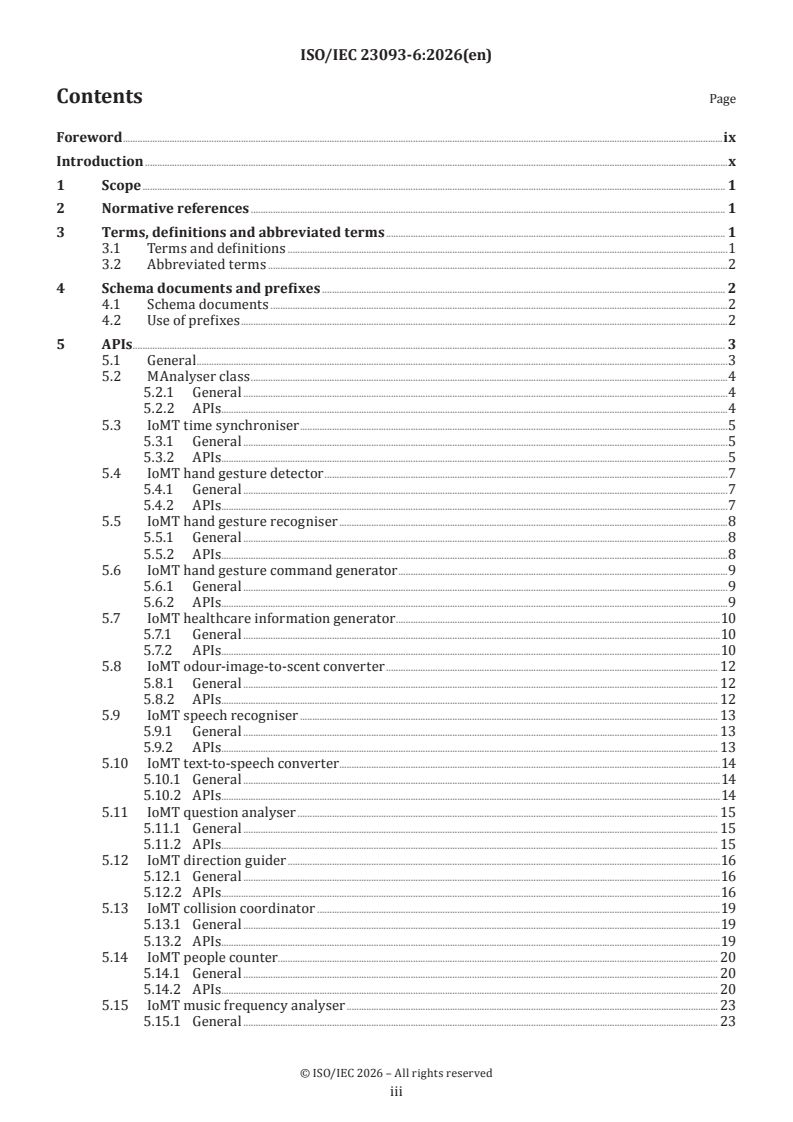
Contents Page
Foreword .ix
Introduction .x
1 Scope . 1
2 Normative references . 1
3 Terms, definitions and abbreviated terms . 1
3.1 Terms and definitions .1
3.2 Abbreviated terms .2
4 Schema documents and prefixes . 2
4.1 Schema documents .2
4.2 Use of prefixes .2
5 APIs . 3
5.1 General .3
5.2 MAnalyser class .4
5.2.1 General .4
5.2.2 APIs . .4
5.3 IoMT time synchroniser .5
5.3.1 General .5
5.3.2 APIs . . .5
5.4 IoMT hand gesture detector .7
5.4.1 General .7
5.4.2 APIs . . .7
5.5 IoMT hand gesture recogniser .8
5.5.1 General .8
5.5.2 APIs . .8
5.6 IoMT hand gesture command generator .9
5.6.1 General .9
5.6.2 APIs . .9
5.7 IoMT healthcare information generator .10
5.7.1 General .10
5.7.2 APIs . .10
5.8 IoMT odour-image-to-scent converter . 12
5.8.1 General . 12
5.8.2 APIs . . 12
5.9 IoMT speech recogniser . 13
5.9.1 General . 13
5.9.2 APIs . . 13
5.10 IoMT text-to-speech converter . .14
5.10.1 General .14
5.10.2 APIs . .14
5.11 IoMT question analyser . 15
5.11.1 General . 15
5.11.2 APIs . . 15
5.12 IoMT direction guider .16
5.12.1 General .16
5.12.2 APIs . . .16
5.13 IoMT collision coordinator .19
5.13.1 General .19
5.13.2 APIs . .19
5.14 IoMT people counter. 20
5.14.1 General . 20
5.14.2 APIs . . . 20
5.15 IoMT music frequency analyser . 23
5.15.1 General . 23
© ISO/IEC 2026 – All rights reserved
iii
5.15.2 APIs . . . 23
5.16 IoMT video content class generator .24
5.16.1 General .24
5.16.2 APIs . .24
5.17 IoMT face region detector . 25
5.17.1 General . 25
5.17.2 APIs . . 25
5.18 IoMT face verifier . 26
5.18.1 General . 26
5.18.2 APIs . . 26
5.19 IoMT light colour analyser . 28
5.19.1 General . 28
5.19.2 APIs . . . 28
5.20 IoMT security alert generator . 29
5.20.1 General . 29
5.20.2 APIs . . . 29
5.21 IoMT video summariser . 30
5.21.1 General . 30
5.21.2 APIs . . . 30
5.22 IoMT human attribute recogniser .31
5.22.1 General .31
5.22.2 APIs . . .31
5.23 IoMT car attribute recogniser .32
5.23.1 General .32
5.23.2 APIs . . 33
5.24 IoMT livestock abnormality detector . 34
5.24.1 General . 34
5.24.2 APIs . . 34
5.25 IoMT livestock abnormality analyser . 35
5.25.1 General . 35
5.25.2 APIs . . . 35
5.26 IoMT data manager. 36
5.26.1 General . 36
5.26.2 APIs . . . 36
5.27 IoMT object detector . 38
5.27.1 General . 38
5.27.2 APIs . . . 38
5.28 IoMT object segmentator . 39
5.28.1 General . 39
5.28.2 APIs . . . 39
5.29 IoMT object tracker . 40
5.29.1 General . 40
5.29.2 APIs . . 40
5.30 IoMT text descriptor .41
5.30.1 General .41
5.30.2 APIs . . .41
5.31 IoMT generic event detector .42
5.31.1 General .42
5.31.2 APIs . .43
5.32 IoMT crop growth tracker . 44
5.32.1 General . 44
5.32.2 APIs . . . 44
5.33 IoMT location recogniser .45
5.33.1 General .45
5.33.2 APIs . .45
5.34 IoMT season recogniser.47
5.34.1 General .47
5.34.2 APIs . .47
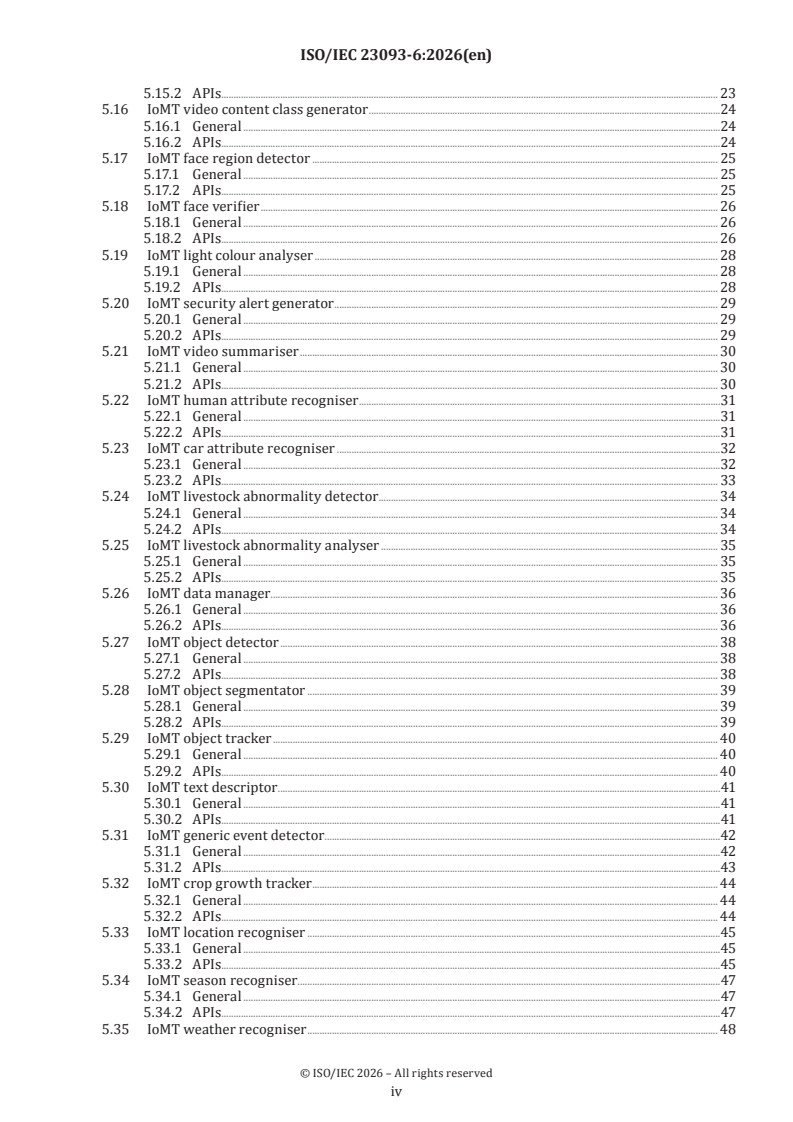
5.35 IoMT weather recogniser . 48
© ISO/IEC 2026 – All rights reserved
iv
5.35.1 General . 48
5.35.2 APIs . . 48
5.36 IoMT pose estimator . 49
5.36.1 General . 49
5.36.2 APIs . . 49
5.37 IoMT action recogniser . 50
5.37.1 General . 50
5.37.2 APIs . . 50
5.38 IoMT sleep stage analyser .52
5.38.1 General .52
5.38.2 APIs . .52
5.39 IoMT personalised sleep quality analyser . 53
5.39.1 General . 53
5.39.2 APIs . . 53
5.40 IoMT intermediate feature generator . 54
5.40.1 General . 54
5.40.2 APIs . . . 54
5.41 IoMT answer generator . 55
5.41.1 General . 55
5.41.2 APIs . . . 55
6 Media analyser output vocabulary .57
6.1 General .57
6.2 Schema wrapper . 58
6.3 IoMT time synchroniser . 58
6.3.1 General . 58
6.3.2 Syntax . .59
6.3.3 Binary Representation .59
6.3.4 Semantics .59
6.3.5 Example . 60
6.4 IoMT hand gesture detector . 60
6.4.1 General . 60
6.4.2 Syntax . . 60
6.4.3 Binary Representation .62
6.4.4 Semantics . 64
6.4.5 Example . 66
6.5 IoMT hand gesture recogniser .71
6.5.1 General .71
6.5.2 Syntax . .71
6.5.3 Binary Representation . 72
6.5.4 Semantics . 72
6.5.5 Example . 73
6.6 IoMT hand gesture command generator . 73
6.6.1 General . 73
6.6.2 Syntax . .74
6.6.3 Binary Representation .74
6.6.4 Semantics .74
6.6.5 Example .74
6.7 IoMT healthcare information generator . 75
6.7.1 General . 75
6.7.2 Syntax . . 75
6.7.3 Binary Representation .76
6.7.4 Semantics . 78
6.7.5 Examples . 80
6.8 IoMT odour-image-to-scent converter . 82
6.8.1 General . 82
6.8.2 Syntax . . 82
6.8.3 Binary Representation . 82
6.8.4 Semantics . 83
© ISO/IEC 2026 – All rights reserved
v
6.8.5 Example . 84
6.9 IoMT question analyser . 84
6.9.1 General . 84
6.9.2 Syntax . . 85
6.9.3 Binary Representation . 85
6.9.4 Semantics . 86
6.9.5 Examples . 87
6.10 IoMT music frequency analyser . 87
6.10.1 General . 87
6.10.2 Syntax . . 87
6.10.3 Binary Representation . 88
6.10.4 Semantics . 88
6.10.5 Examples . 89
6.11 IoMT video content class generator . 90
6.11.1 General . 90
6.11.2 Syntax . . 90
6.11.3 Binary Representation . 90
6.11.4 Semantics . 90
6.11.5 Examples . 90
6.12 IoMT face region detector .91
6.12.1 General .91
6.12.2 Syntax . .91
6.12.3 Binary Representation .91
6.12.4 Semantics . 92
6.12.5 Example . 93
6.13 IoMT face verifier . 93
6.13.1 General . 93
6.13.2 Syntax . . 93
6.13.3 Binary Representation . 94
6.13.4 Semantics . 94
6.13.5 Example . 94
6.14 IoMT light colour analyser . 95
6.14.1 General . 95
6.14.2 Syntax . 95
6.14.3 Binary Representation . 95
6.14.4 Semantics . 96
6.14.5 Example . 96
6.15 IoMT video summariser . 96
6.15.1 General .
...