

ISO 7622-1:2013
(Main)Steel cord conveyor belts — Longitudinal traction test — Part 1: Measurement of elongation
General Information
- Abstract
ISO 7622-1:2013 specifies a method for the determination of the elongation of steel cords constituting the carcass of conveyor belts, when subjected to a force corresponding to 10 % and 60 % of the specified tensile strength. It applies exclusively to conveyor belts with a steel carcass.
- Status
- Published
- Publication Date
- 16-Apr-2013
- Technical Committee
- ISO/TC 41/SC 3 - Conveyor belts
- Drafting Committee
- ISO/TC 41/SC 3 - Conveyor belts
- Current Stage
- 9093 - International Standard confirmed
- Start Date
- 04-Dec-2023
- Completion Date
- 29-Aug-2026
Buy Documents
ISO 7622-1:2013 - Steel cord conveyor belts -- Longitudinal traction test
ISO 7622-1:2013 - Steel cord conveyor belts — Longitudinal traction test — Part 1: Measurement of elongation/17/2013
ISO 7622-1:2013 - Courroies transporteuses a câbles d'acier -- Essai de traction dans le sens longitudinal
ISO 7622-1:2013 - Courroies transporteuses à câbles d'acier — Essai de traction dans le sens longitudinal — Partie 1: Mesurage de l'allongement/17/2013
Overview
ISO 7622-1:2013 - "Steel cord conveyor belts - Longitudinal traction test - Part 1: Measurement of elongation" specifies a laboratory method to determine the elongation of steel cords taken from the carcass of conveyor belts. The standard defines how to measure elongation at forces equal to 10% and 60% of the specified tensile strength. It applies exclusively to conveyor belts with a steel carcass and is intended primarily for destructive testing (e.g., in litigation or when no manufacturer certificate is available).
Key Topics and Requirements
- Test principle: Measure cord elongation with an extensometer while applying tension up to 60% of specified tensile strength via a dynamometric tensile testing machine.
- Specimens: Four cords extracted from the belt (minimum 400 mm sample), prepared as two S-twist and two Z-twist specimens; rubber coating stripped where clamped.
- Apparatus:
- Dynamometer with adjustable force, jaw separation rate 25 mm/min ± 5 mm/min, and jaw separation capability of at least 250 mm.
- Holding device preventing slip (e.g., two fixed grooved pulleys ≥50 mm diameter or 10× cord diameter).
- Extensometer accurate to at least 0.01%; measurement interval 100–300 mm.
- Procedure:
- Tests carried out at least 5 days after manufacture.
- Standard test atmosphere: 23 °C ± 2 °C and 50% ± 5% RH (ISO 18573, Atmosphere B) unless otherwise stated.
- Apply initial tractive force equal to 50 × linear density of the cord to define zero; record elongation at 10% and 60% of specified tensile strength.
- Results & reporting:
- Express elongation as a percentage of initial length.
- Report the arithmetic mean of the four measurements, rounded to 0.1%.
- Test report must reference ISO 7622-1 and note any optional or exceptional conditions.
Applications and Users
ISO 7622-1 is used for:
- Quality control and verification of steel cord conveyor belts.
- Forensic testing and litigation where belt performance is disputed.
- Independent testing laboratories, belt manufacturers, procurement/specification teams, and end-users in mining, bulk handling, and heavy industry.
- Situations where manufacturer certificates are unavailable or need confirmation.
Related Standards
- ISO 7622-2 - Measurement of tensile strength (companion standard).
- ISO 18573 - Conveyor belts - Test atmospheres and conditioning periods (referenced for conditioning and climate control).
Keywords: ISO 7622-1, steel cord conveyor belts, longitudinal traction test, measurement of elongation, extensometer, tensile strength, conveyor belt testing, steel carcass.
Relations
- Effective Date
- 12-Feb-2026
- Effective Date
- 06-Jun-2022
- Effective Date
- 26-Nov-2011
Buy Documents
ISO 7622-1:2013 - Steel cord conveyor belts -- Longitudinal traction test
ISO 7622-1:2013 - Steel cord conveyor belts — Longitudinal traction test — Part 1: Measurement of elongation/17/2013
ISO 7622-1:2013 - Courroies transporteuses a câbles d'acier -- Essai de traction dans le sens longitudinal
ISO 7622-1:2013 - Courroies transporteuses à câbles d'acier — Essai de traction dans le sens longitudinal — Partie 1: Mesurage de l'allongement/17/2013
Frequently Asked Questions
ISO 7622-1:2013 is a standard published by the International Organization for Standardization (ISO). Its full title is "Steel cord conveyor belts — Longitudinal traction test — Part 1: Measurement of elongation". This standard covers: ISO 7622-1:2013 specifies a method for the determination of the elongation of steel cords constituting the carcass of conveyor belts, when subjected to a force corresponding to 10 % and 60 % of the specified tensile strength. It applies exclusively to conveyor belts with a steel carcass.
ISO 7622-1:2013 specifies a method for the determination of the elongation of steel cords constituting the carcass of conveyor belts, when subjected to a force corresponding to 10 % and 60 % of the specified tensile strength. It applies exclusively to conveyor belts with a steel carcass.
ISO 7622-1:2013 is classified under the following ICS (International Classification for Standards) categories: 53.040.20 - Components for conveyors. The ICS classification helps identify the subject area and facilitates finding related standards.
ISO 7622-1:2013 has the following relationships with other standards: It is inter standard links to EN ISO 7622-1:2013, ISO 4731:2006, ISO 7622-1:1984. Understanding these relationships helps ensure you are using the most current and applicable version of the standard.
ISO 7622-1:2013 is available in PDF format for immediate download after purchase. The document can be added to your cart and obtained through the secure checkout process. Digital delivery ensures instant access to the complete standard document.
Standards Content (Sample)
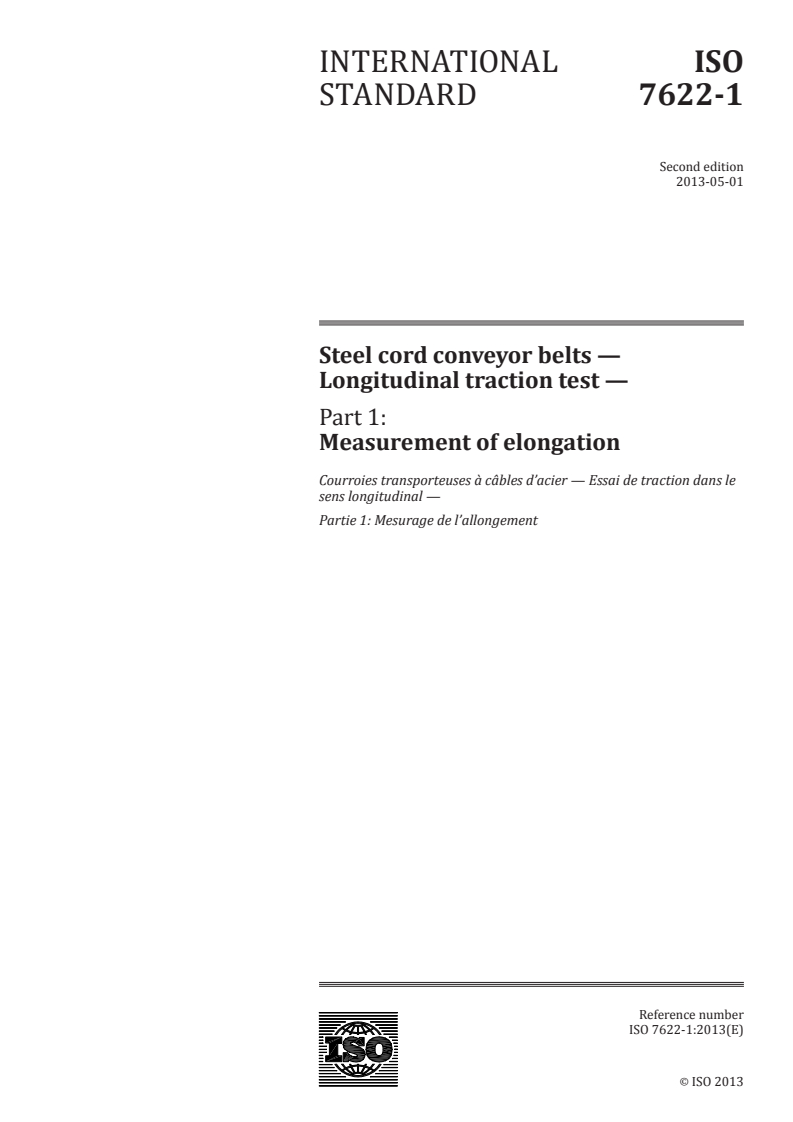
INTERNATIONAL ISO
STANDARD 7622-1
Second edition
2013-05-01
Steel cord conveyor belts —
Longitudinal traction test —
Part 1:
Measurement of elongation
Courroies transporteuses à câbles d’acier — Essai de traction dans le
sens longitudinal —
Partie 1: Mesurage de l’allongement
Reference number
©
ISO 2013
© ISO 2013
All rights reserved. Unless otherwise specified, no part of this publication may be reproduced or utilized otherwise in any form
or by any means, electronic or mechanical, including photocopying, or posting on the internet or an intranet, without prior
written permission. Permission can be requested from either ISO at the address below or ISO’s member body in the country of
the requester.
ISO copyright office
Case postale 56 • CH-1211 Geneva 20
Tel. + 41 22 749 01 11
Fax + 41 22 749 09 47
E-mail copyright@iso.org
Web www.iso.org
Published in Switzerland
ii © ISO 2013 – All rights reserved
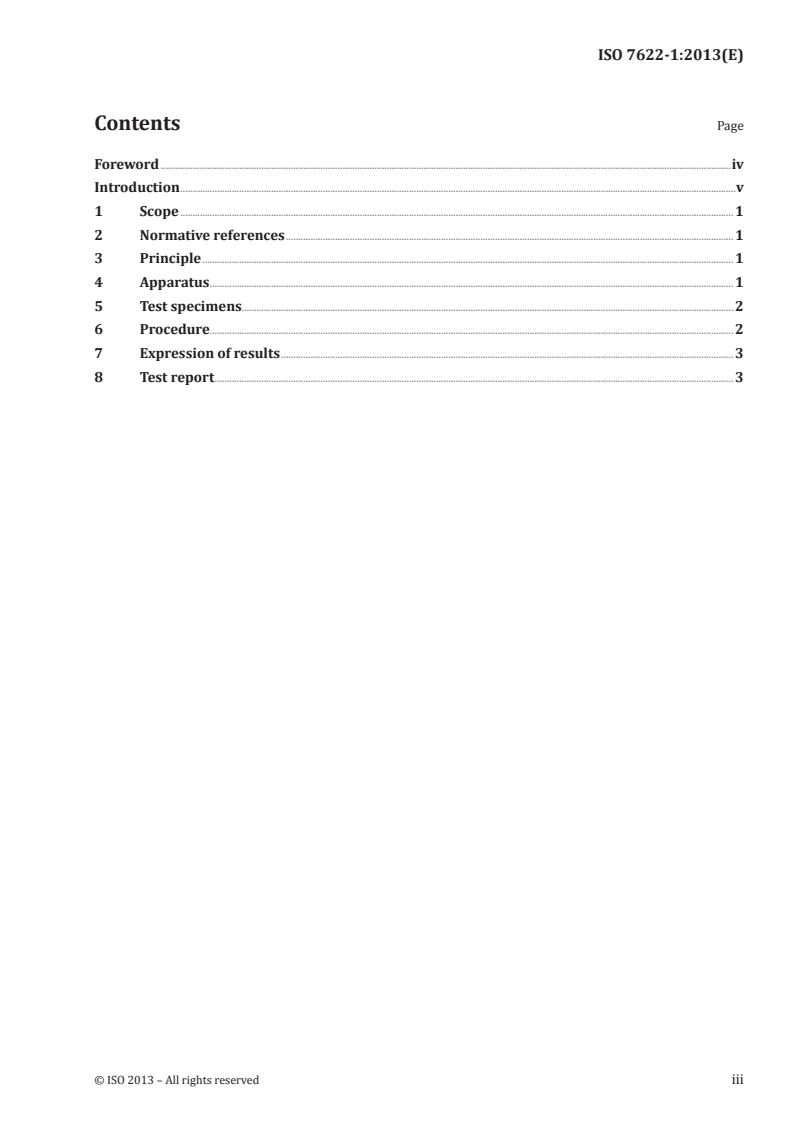
Contents Page
Foreword .iv
Introduction .v
1 Scope . 1
2 Normative references . 1
3 Principle . 1
4 Apparatus . 1
5 Test specimens. 2
6 Procedure. 2
7 Expression of results . 3
8 Test report . 3
Foreword
ISO (the International Organization for Standardization) is a worldwide federation of national standards
bodies (ISO member bodies). The work of preparing International Standards is normally carried out
through ISO technical committees. Each member body interested in a subject for which a technical
committee has been established has the right to be represented on that committee. International
organizations, governmental and non-governmental, in liaison with ISO, also take part in the work.
ISO collaborates closely with the International Electrotechnical Commission (IEC) on all matters of
electrotechnical standardization.
International Standards are drafted in accordance with the rules given in the ISO/IEC Directives, Part 2.
The main task of technical committees is to prepare International Standards. Draft International
Standards adopted by the technical committees are circulated to the member bodies for voting.
Publication as an International Standard requires approval by at least 75 % of the member bodies
casting a vote.
Attention is drawn to the possibility that some of the elements of this document may be the subject of
patent rights. ISO shall not be held responsible for identifying any or all such patent rights.
ISO 7622-1 was prepared by Technical Committee ISO/TC 41, Pulleys and belts (including veebelts),
Subcommittee SC 3, Conveyor belts.
This second edition cancels and replaces the first edition (ISO 7622-1:1984), of which it constitutes a
minor revision.
ISO 7622 consists of the following parts, under the general title Steel cord conveyor belts — Longitudinal
traction test:
— Part 1: Measurement of elongation
— Part 2: Measurement of tensile strength
iv © ISO 2013 – All rights reserved
Introduction
This test method is intended to verify, by destructive testing, the elongation properties of steel cords
constituting the carcass of conveyor belts. As it is a destructive test, it is used onl
...
INTERNATIONAL ISO
STANDARD 7622-1
Second edition
2013-05-01
Steel cord conveyor belts —
Longitudinal traction test —
Part 1:
Measurement of elongation
Courroies transporteuses à câbles d’acier — Essai de traction dans le
sens longitudinal —
Partie 1: Mesurage de l’allongement
Reference number
©
ISO 2013
© ISO 2013
All rights reserved. Unless otherwise specified, no part of this publication may be reproduced or utilized otherwise in any form
or by any means, electronic or mechanical, including photocopying, or posting on the internet or an intranet, without prior
written permission. Permission can be requested from either ISO at the address below or ISO’s member body in the country of
the requester.
ISO copyright office
Case postale 56 • CH-1211 Geneva 20
Tel. + 41 22 749 01 11
Fax + 41 22 749 09 47
E-mail copyright@iso.org
Web www.iso.org
Published in Switzerland
ii © ISO 2013 – All rights reserved
Contents Page
Foreword .iv
Introduction .v
1 Scope . 1
2 Normative references . 1
3 Principle . 1
4 Apparatus . 1
5 Test specimens. 2
6 Procedure. 2
7 Expression of results . 3
8 Test report . 3
Foreword
ISO (the International Organization for Standardization) is a worldwide federation of national standards
bodies (ISO member bodies). The work of preparing International Standards is normally carried out
through ISO technical committees. Each member body interested in a subject for which a technical
committee has been established has the right to be represented on that committee. International
organizations, governmental and non-governmental, in liaison with ISO, also take part in the work.
ISO collaborates closely with the International Electrotechnical Commission (IEC) on all matters of
electrotechnical standardization.
International Standards are drafted in accordance with the rules given in the ISO/IEC Directives, Part 2.
The main task of technical committees is to prepare International Standards. Draft International
Standards adopted by the technical committees are circulated to the member bodies for voting.
Publication as an International Standard requires approval by at least 75 % of the member bodies
casting a vote.
Attention is drawn to the possibility that some of the elements of this document may be the subject of
patent rights. ISO shall not be held responsible for identifying any or all such patent rights.
ISO 7622-1 was prepared by Technical Committee ISO/TC 41, Pulleys and belts (including veebelts),
Subcommittee SC 3, Conveyor belts.
This second edition cancels and replaces the first edition (ISO 7622-1:1984), of which it constitutes a
minor revision.
ISO 7622 consists of the following parts, under the general title Steel cord conveyor belts — Longitudinal
traction test:
— Part 1: Measurement of elongation
— Part 2: Measurement of tensile strength
iv © ISO 2013 – All rights reserved
Introduction
This test method is intended to verify, by destructive testing, the elongation properties of steel cords
constituting the carcass of conveyor belts. As it is a destructive test, it is used onl
...
NORME ISO
INTERNATIONALE 7622-1
Deuxième édition
2013-05-01
Courroies transporteuses à câbles
d’acier — Essai de traction dans le
sens longitudinal —
Partie 1:
Mesurage de l’allongement
Steel cord conveyor belts — Longitudinal traction test —
Part 1: Measurement of elongation
Numéro de référence
©
ISO 2013
DOCUMENT PROTÉGÉ PAR COPYRIGHT
© ISO 2013
Droits de reproduction réservés. Sauf indication contraire, aucune partie de cette publication ne peut être reproduite ni utilisée
sous quelque forme que ce soit et par aucun procédé, électronique ou mécanique, y compris la photocopie, l’affichage sur
l’internet ou sur un Intranet, sans autorisation écrite préalable. Les demandes d’autorisation peuvent être adressées à l’ISO à
l’adresse ci-après ou au comité membre de l’ISO dans le pays du demandeur.
ISO copyright office
Case postale 56 • CH-1211 Geneva 20
Tel. + 41 22 749 01 11
Fax + 41 22 749 09 47
E-mail copyright@iso.org
Web www.iso.org
Publié en Suisse
ii © ISO 2013 – Tous droits réservés
Sommaire Page
Avant-propos .iv
Introduction .v
1 Domaine d’application . 1
2 Références normatives . 1
3 Principe . 1
4 Appareillage . 1
5 Éprouvettes . 2
6 Mode opératoire. 2
7 Expression des résultats. 3
8 Rapport d’essai . 3
Avant-propos
L’ISO (Organisation internationale de normalisation) est une fédération mondiale d’organismes
nationaux de normalisation (comités membres de l’ISO). L’élaboration des Normes internationales est
en général confiée aux comités techniques de l’ISO. Chaque comité membre intéressé par une étude
a le droit de faire partie du comité technique créé à cet effet. Les organisations internationales,
gouvernementales et non gouvernementales, en liaison avec l’ISO participent également aux travaux.
L’ISO collabore étroitement avec la Commission électrotechnique internationale (CEI) en ce qui concerne
la normalisation électrotechnique.
Les Normes internationales sont rédigées conformément aux règles données dans les Directives
ISO/CEI, Partie 2.
La tâche principale des comités techniques est d’élaborer les Normes internationales. Les projets de
Normes internationales adoptés par les comités techniques sont soumis aux comités membres pour vote.
Leur publication comme Normes internationales requiert l’approbation de 75 % au moins des comités
membres votants.
L’attention est appelée sur le fait que certains des éléments du présent document peuvent faire l’objet de
droits de propriété intellectuelle ou de droits analogues. L’ISO ne saurait être tenue pour responsable de
ne pas avoir identifié de tels droits de propriété et averti de leur existence.
L’ISO 7622-1 a été élaborée par le comité technique ISO/TC 41, Poulies et courroies (y compris les courroies
trapézoïdales), sous-comité SC 3, Courroies transporteuses.
Cette deuxième édition annule et remplace la première édition (ISO 7622-1:1984), qui a fait l’objet d’une
révision mineure.
L’ISO 7622 comprend les parties suivantes, présentées sous le titre général Courroies transporteuses à
câbles d’acier — Essai de traction dans le sens longitudinal:
— Partie 1: Mesurage de l’allongement
— Partie 2: Mesurage de la résistance à la rupture
iv © ISO 2013 – Tous droits réservés
Introduction
La présente méthode d’essai a pour objectif de vérifier, par un essai destructif, les caractéristiques
d’allongement des câbles d’acier constituant la carcasse des courroies transporteuses. S’agissant d’un
essai destructif, il n’est utilisé que dans le cas d’un litige ou en l’absence de certificats de conformité
délivrés par le fabricant de câbles.
Des différences d’allongement peuvent apparaître entre des câbles d’a
...
NORME ISO
INTERNATIONALE 7622-1
Deuxième édition
2013-05-01
Courroies transporteuses à câbles
d’acier — Essai de traction dans le
sens longitudinal —
Partie 1:
Mesurage de l’allongement
Steel cord conveyor belts — Longitudinal traction test —
Part 1: Measurement of elongation
Numéro de référence
©
ISO 2013
DOCUMENT PROTÉGÉ PAR COPYRIGHT
© ISO 2013
Droits de reproduction réservés. Sauf indication contraire, aucune partie de cette publication ne peut être reproduite ni utilisée
sous quelque forme que ce soit et par aucun procédé, électronique ou mécanique, y compris la photocopie, l’affichage sur
l’internet ou sur un Intranet, sans autorisation écrite préalable. Les demandes d’autorisation peuvent être adressées à l’ISO à
l’adresse ci-après ou au comité membre de l’ISO dans le pays du demandeur.
ISO copyright office
Case postale 56 • CH-1211 Geneva 20
Tel. + 41 22 749 01 11
Fax + 41 22 749 09 47
E-mail copyright@iso.org
Web www.iso.org
Publié en Suisse
ii © ISO 2013 – Tous droits réservés
Sommaire Page
Avant-propos .iv
Introduction .v
1 Domaine d’application . 1
2 Références normatives . 1
3 Principe . 1
4 Appareillage . 1
5 Éprouvettes . 2
6 Mode opératoire. 2
7 Expression des résultats. 3
8 Rapport d’essai . 3
Avant-propos
L’ISO (Organisation internationale de normalisation) est une fédération mondiale d’organismes
nationaux de normalisation (comités membres de l’ISO). L’élaboration des Normes internationales est
en général confiée aux comités techniques de l’ISO. Chaque comité membre intéressé par une étude
a le droit de faire partie du comité technique créé à cet effet. Les organisations internationales,
gouvernementales et non gouvernementales, en liaison avec l’ISO participent également aux travaux.
L’ISO collabore étroitement avec la Commission électrotechnique internationale (CEI) en ce qui concerne
la normalisation électrotechnique.
Les Normes internationales sont rédigées conformément aux règles données dans les Directives
ISO/CEI, Partie 2.
La tâche principale des comités techniques est d’élaborer les Normes internationales. Les projets de
Normes internationales adoptés par les comités techniques sont soumis aux comités membres pour vote.
Leur publication comme Normes internationales requiert l’approbation de 75 % au moins des comités
membres votants.
L’attention est appelée sur le fait que certains des éléments du présent document peuvent faire l’objet de
droits de propriété intellectuelle ou de droits analogues. L’ISO ne saurait être tenue pour responsable de
ne pas avoir identifié de tels droits de propriété et averti de leur existence.
L’ISO 7622-1 a été élaborée par le comité technique ISO/TC 41, Poulies et courroies (y compris les courroies
trapézoïdales), sous-comité SC 3, Courroies transporteuses.
Cette deuxième édition annule et remplace la première édition (ISO 7622-1:1984), qui a fait l’objet d’une
révision mineure.
L’ISO 7622 comprend les parties suivantes, présentées sous le titre général Courroies transporteuses à
câbles d’acier — Essai de traction dans le sens longitudinal:
— Partie 1: Mesurage de l’allongement
— Partie 2: Mesurage de la résistance à la rupture
iv © ISO 2013 – Tous droits réservés
Introduction
La présente méthode d’essai a pour objectif de vérifier, par un essai destructif, les caractéristiques
d’allongement des câbles d’acier constituant la carcasse des courroies transporteuses. S’agissant d’un
essai destructif, il n’est utilisé que dans le cas d’un litige ou en l’absence de certificats de conformité
délivrés par le fabricant de câbles.
Des différences d’allongement peuvent apparaître entre des câbles d’a
...