

ISO 1419:2019
(Main)Rubber- or plastics-coated fabrics — Accelerated-ageing tests
General Information
- Abstract
This document describes four methods of assessing the resistance of coated fabrics to deterioration by accelerated ageing.
- Status
- Published
- Publication Date
- 22-May-2019
- Technical Committee
- ISO/TC 45/SC 4 - Products (other than hoses)
- Drafting Committee
- ISO/TC 45/SC 4/WG 13 - Coated fabrics
- Current Stage
- 9093 - International Standard confirmed
- Start Date
- 28-Jun-2024
- Completion Date
- 29-Aug-2026
Buy Documents

ISO 1419:2019 - Rubber- or plastics-coated fabrics -- Accelerated-ageing tests
ISO 1419:2019 - Rubber- or plastics-coated fabrics — Accelerated-ageing tests/23/2019
Overview
ISO 1419:2019 - Rubber- or plastics-coated fabrics - Accelerated-ageing tests - defines four accelerated-ageing methods to assess how coated fabrics deteriorate under controlled heat, humidity and time. The standard is primarily used to evaluate loss of volatiles (plasticizer loss in plasticized-PVC), general heat ageing, tropical high-humidity ageing, and specific ageing for nitrocellulose-type coatings. It references ISO 188, ISO 2231 and ISO 2286 series for procedures, conditioning and mass determinations.
Key topics and technical requirements
- Four test methods (A–D):
- Method A - Loss of volatiles on heating (for plasticized PVC): measures mass loss after exposure at 100 °C and reports loss as a percentage of coating mass. Uses ISO 188 procedures.
- Method B - General elevated-temperature ageing: exposes specimens to warm air (typically 70 °C) and evaluates post‑exposure physical/chemical changes.
- Method C - Tropical test: high‑humidity accelerated ageing (relative humidity not less than 95 %) to simulate tropical environments.
- Method D - Specific ageing for nitrocellulose-type coatings.
- Apparatus and environmental control:
- Air oven with slow air circulation (3–10 air changes per hour), temperature control (e.g., 100 °C ±1 °C for Method A, 70 °C ±1 °C for Method B), accurate thermometry and capability to suspend specimens without contact or direct radiant heating.
- Restrictions inside the oven (no copper/copper alloy, specimen spacing and oven free air-space limits).
- Specimen preparation and measurement:
- Defined numbers and placement of test pieces (e.g., Method A calls for multiple specimens, avoiding selvedges).
- Conditioning atmospheres per ISO 2231 and mass determinations per ISO 2286-1/2.
- Balance accuracy requirements (e.g., 1 mg for Method A).
- Reporting:
- Required test report content includes method reference, fabric identification, conditioning atmosphere, individual and mean results, and any deviations.
Applications and users
- Who uses ISO 1419:2019:
- Manufacturers of rubber- or plastics-coated fabrics (PVC‑coated, nitrocellulose coatings, etc.)
- Independent test laboratories and QA/QC teams
- Product designers, materials engineers and failure‑analysis specialists
- Procurement and compliance officers specifying durability requirements
- Practical uses:
- Quality control and batch verification to detect plasticizer loss or other ageing-related changes
- Comparative evaluation of coating formulations and substrates
- Simulating service environments (hot, humid, tropical) for product development
- Supporting specifications, claims and conformity assessments for coated textile products
Related standards
- ISO 188 - Rubber - Accelerated ageing and heat resistance tests
- ISO 2231 - Standard atmospheres for conditioning and testing (conditioning atmospheres A, B, C)
- ISO 2286-1 / ISO 2286-2 - Determination of roll characteristics; coating and substrate mass per unit area
ISO 1419:2019 is essential when you need standardized, reproducible accelerated‑ageing data for coated fabrics used in outdoor, industrial or tropical applications.
Relations
- Effective Date
- 28-Jan-2023
- Effective Date
- 23-Apr-2020
Buy Documents
ISO 1419:2019 - Rubber- or plastics-coated fabrics -- Accelerated-ageing tests
ISO 1419:2019 - Rubber- or plastics-coated fabrics — Accelerated-ageing tests/23/2019
Get Certified
Connect with accredited certification bodies for this standard

Control Union Certifications
Global certification for agriculture and sustainability.

Hohenstein Institut
Textile testing and certification.

Bureau Veritas Bangladesh
Bureau Veritas certification services in Bangladesh.
Sponsored listings
Frequently Asked Questions
ISO 1419:2019 is a standard published by the International Organization for Standardization (ISO). Its full title is "Rubber- or plastics-coated fabrics — Accelerated-ageing tests". This standard covers: This document describes four methods of assessing the resistance of coated fabrics to deterioration by accelerated ageing.
This document describes four methods of assessing the resistance of coated fabrics to deterioration by accelerated ageing.
ISO 1419:2019 is classified under the following ICS (International Classification for Standards) categories: 59.080.40 - Coated fabrics. The ICS classification helps identify the subject area and facilitates finding related standards.
ISO 1419:2019 has the following relationships with other standards: It is inter standard links to ISO 16828:2025, ISO 1419:2018. Understanding these relationships helps ensure you are using the most current and applicable version of the standard.
ISO 1419:2019 is available in PDF format for immediate download after purchase. The document can be added to your cart and obtained through the secure checkout process. Digital delivery ensures instant access to the complete standard document.
Standards Content (Sample)
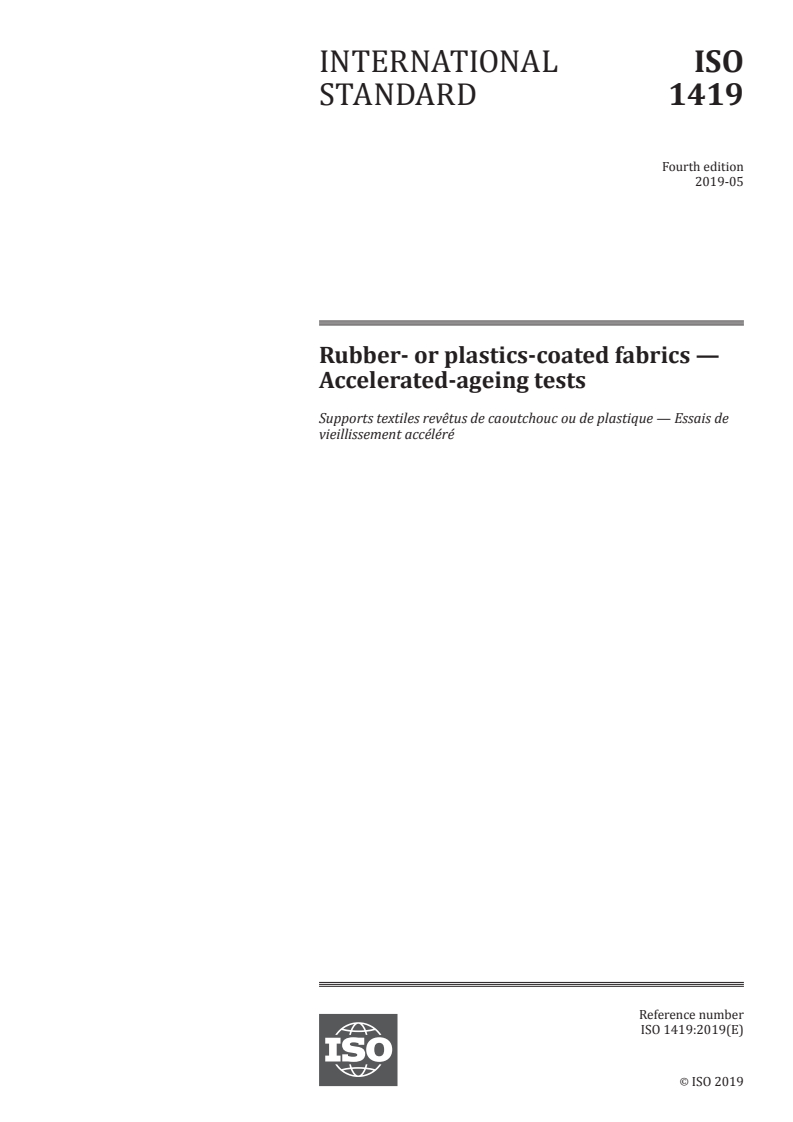
INTERNATIONAL ISO
STANDARD 1419
Fourth edition
2019-05
Rubber- or plastics-coated fabrics —
Accelerated-ageing tests
Supports textiles revêtus de caoutchouc ou de plastique — Essais de
vieillissement accéléré
Reference number
©
ISO 2019
© ISO 2019
All rights reserved. Unless otherwise specified, or required in the context of its implementation, no part of this publication may
be reproduced or utilized otherwise in any form or by any means, electronic or mechanical, including photocopying, or posting
on the internet or an intranet, without prior written permission. Permission can be requested from either ISO at the address
below or ISO’s member body in the country of the requester.
ISO copyright office
CP 401 • Ch. de Blandonnet 8
CH-1214 Vernier, Geneva
Phone: +41 22 749 01 11
Fax: +41 22 749 09 47
Email: copyright@iso.org
Website: www.iso.org
Published in Switzerland
ii © ISO 2019 – All rights reserved
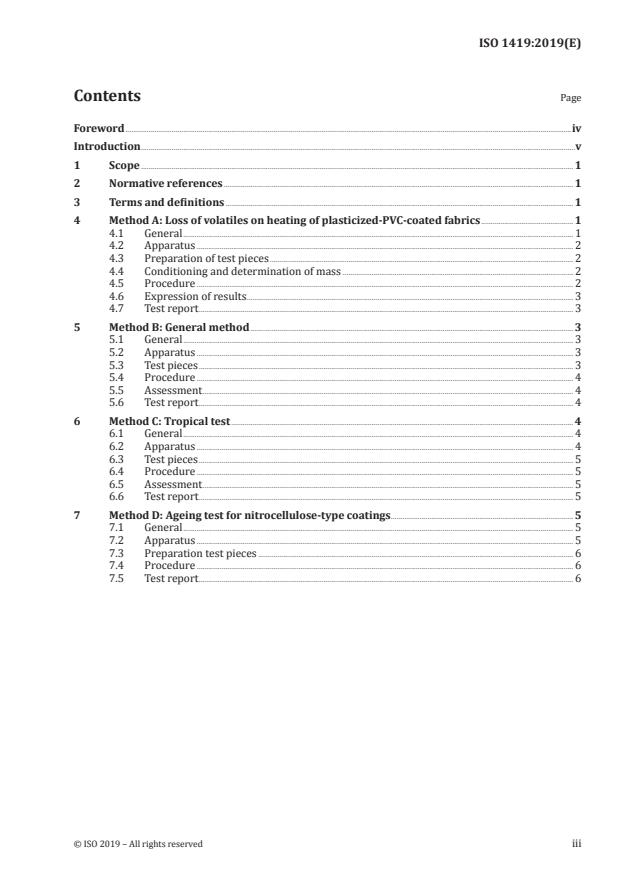
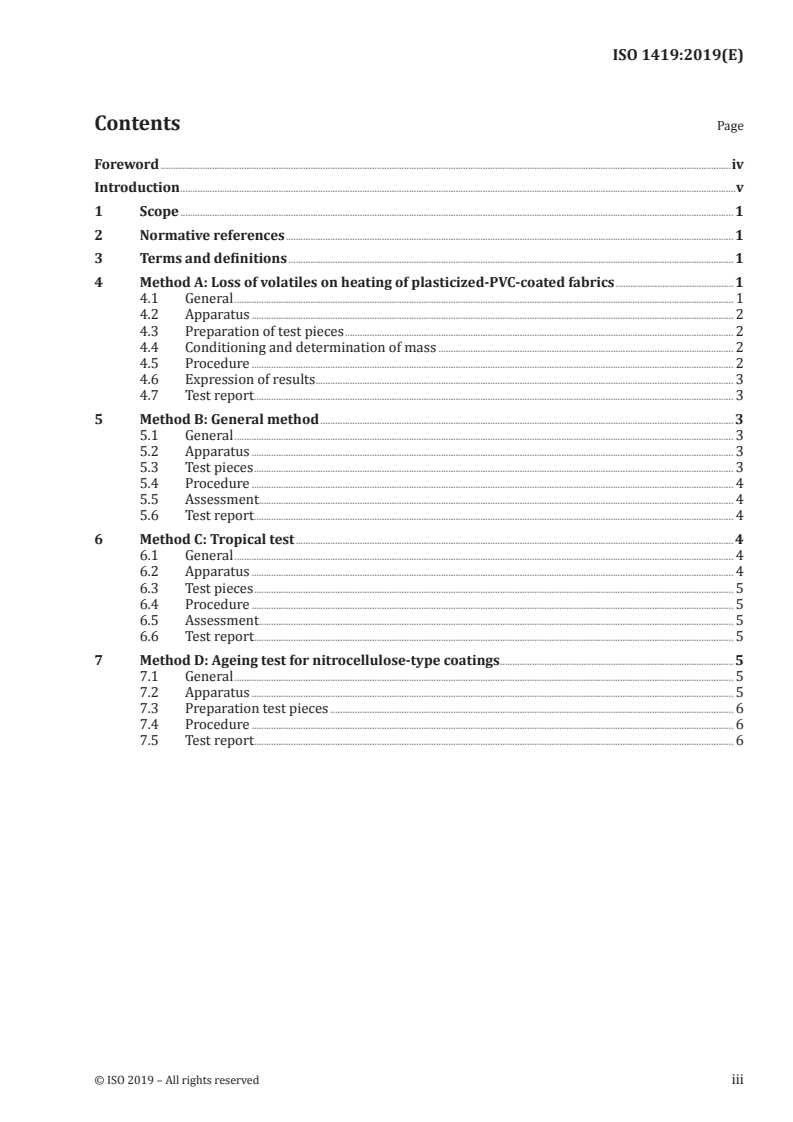
Contents Page
Foreword .iv
Introduction .v
1 Scope . 1
2 Normative references . 1
3 Terms and definitions . 1
4 Method A: Loss of volatiles on heating of plasticized-PVC-coated fabrics .1
4.1 General . 1
4.2 Apparatus . 2
4.3 Preparation of test pieces . 2
4.4 Conditioning and determination of mass . 2
4.5 Procedure . 2
4.6 Expression of results . 3
4.7 Test report . 3
5 Method B: General method . 3
5.1 General . 3
5.2 Apparatus . 3
5.3 Test pieces . 3
5.4 Procedure . 4
5.5 Assessment . 4
5.6 Test report . 4
6 Method C: Tropical test . 4
6.1 General . 4
6.2 Apparatus . 4
6.3 Test pieces . 5
6.4 Procedure . 5
6.5 Assessment . 5
6.6 Test report . 5
7 Method D: Ageing test for nitrocellulose-type coatings . 5
7.1 General . 5
7.2 Apparatus . 5
7.3 Preparation test pieces . 6
7.4 Procedure . 6
7.5 Test report . 6
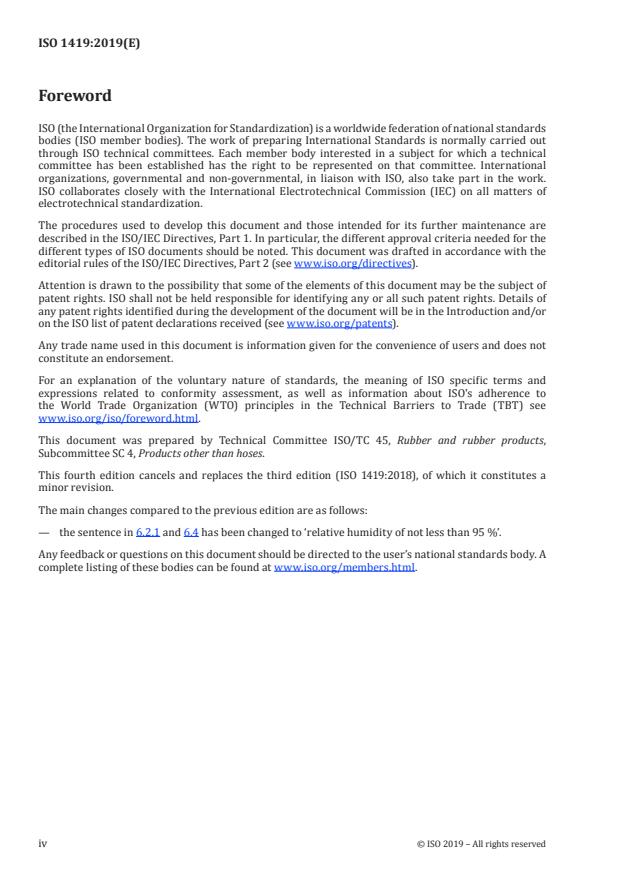
Foreword
ISO (the International Organization for Standardization) is a worldwide federation of national standards
bodies (ISO member bodies). The work of preparing International Standards is normally carried out
through ISO technical committees. Each member body interested in a subject for which a technical
committee has been established has the right to be represented on that committee. International
organizations, governmental and non-governmental, in liaison with ISO, also take part in the work.
ISO collaborates closely with the International Electrotechnical Commission (IEC) on all matters of
electrotechnical standardization.
The procedures used to develop this document and those intended for its further maintenance are
described in the ISO/IEC Directives, Part 1. In particular, the different approval criteria needed for the
different types of ISO documents should be noted. This document was drafted in accordance with the
editorial rules of the ISO/IEC Directives, Part 2 (see www .iso .org/directives).
Attention is drawn to the possibility that some of the elements of this document may be the subject of
patent rights. ISO shall not be held responsible for identifying any or all such patent rights. Details of
any patent rights identified during the development of the document will be in the Introduction and/or
on the ISO list of patent declarations received (see www .iso .org/patents).
Any trade name used in this document is information given for the convenience of users and does not
constitute an endorsement.
For an explanation of the voluntary nature of standards, the meaning of ISO specific terms and
expressions related to conformity assessment, as well as information about ISO's adherence to
the World Trade Organization (WTO) principles in the Technical Barriers to Trade (TBT) see
www .iso .org/iso/foreword .html.
This document was prepared by Technical Committee ISO/TC 45, Rubber and rubber products,
Subcommittee SC 4, Products other than hoses.
This fourth edition cancels and replaces the third edition (ISO 1419:2018), of which it constitutes a
minor revision.
The main changes compared to the previous edition are as follows:
— the sentence in 6.2.1 and 6.4 has been changed to ‘relative humidity of not less than 95 %’.
Any feedback or questions on this document should be directed to the user’s national standards body. A
complete listing of these bodies can be found at www .iso .org/members .html.
iv © ISO 2019 – All rights reserved
Introduction
The ageing of coated fabrics consists in subjecting test pieces, with previously determined properties,
to a controlled deteriorating influence for a known period. The selection of the most appropriate test
method(s), ageing time and temperature will depend on the purpose of the test and the type of coated
fabric. The properties used to measure the deterioration of coated fabrics may be strength properties,
flexing, blocking or any other desired physical or chemical property. By selection of appropriate
methods of test, the properties can be investigated.
INTERNATIONAL STANDARD ISO 1419:2019(E)
Rubber- or plastics-coated fabrics — Accelerated-ageing
tests
WARNING — Persons using this document should be familiar with normal laboratory practice.
This document does not purport to address all of the safety problems, if any, associated with its
use. It is the responsibility of the user to establish appropriate safety and health practices and to
ensure compliance with any national regulatory conditions.
1 Scope
This document describes four methods of assessing the resistance of coated fabrics to deterioration by
accelerated ageing.
2 Normative references
The following documents, in whole or in part, are normatively referenced in this document and are
indispensable for its application. For dated references, only the edition cited applies. For undated
references, the latest edition of the referenced document (including any amendments) applies.
ISO 188, Rubber, vulcanized or thermoplastic — Accelerated ageing and heat resistance tests
ISO 2231, Rubber- or plastics-coated fabrics — Standard atmospheres for conditioning and testing
ISO 2286-1, Rubber- or plastics-coated fabrics — Determination of roll characteristics — Part 1: Methods
for determination of length, width and net mass
ISO 2286-2, Rubber- or plastics-coated fabrics — Determination of roll characteristics — Part 2: Methods
for determination of total mass per unit area, mass per unit area of coating and mass per unit area of
substrate
3 Terms and definitions
No terms and definitions are listed in this document.
ISO and IEC maintain terminological databases for use in standardization at the following addresses:
— ISO Online browsing platform: available at https: //www .iso .org/obp
— IEC Electropedia: available at http: //www .electropedia .org/
4 Method A: Loss of v
...
INTERNATIONAL ISO
STANDARD 1419
Fourth edition
2019-05
Rubber- or plastics-coated fabrics —
Accelerated-ageing tests
Supports textiles revêtus de caoutchouc ou de plastique — Essais de
vieillissement accéléré
Reference number
©
ISO 2019
© ISO 2019
All rights reserved. Unless otherwise specified, or required in the context of its implementation, no part of this publication may
be reproduced or utilized otherwise in any form or by any means, electronic or mechanical, including photocopying, or posting
on the internet or an intranet, without prior written permission. Permission can be requested from either ISO at the address
below or ISO’s member body in the country of the requester.
ISO copyright office
CP 401 • Ch. de Blandonnet 8
CH-1214 Vernier, Geneva
Phone: +41 22 749 01 11
Fax: +41 22 749 09 47
Email: copyright@iso.org
Website: www.iso.org
Published in Switzerland
ii © ISO 2019 – All rights reserved
Contents Page
Foreword .iv
Introduction .v
1 Scope . 1
2 Normative references . 1
3 Terms and definitions . 1
4 Method A: Loss of volatiles on heating of plasticized-PVC-coated fabrics .1
4.1 General . 1
4.2 Apparatus . 2
4.3 Preparation of test pieces . 2
4.4 Conditioning and determination of mass . 2
4.5 Procedure . 2
4.6 Expression of results . 3
4.7 Test report . 3
5 Method B: General method . 3
5.1 General . 3
5.2 Apparatus . 3
5.3 Test pieces . 3
5.4 Procedure . 4
5.5 Assessment . 4
5.6 Test report . 4
6 Method C: Tropical test . 4
6.1 General . 4
6.2 Apparatus . 4
6.3 Test pieces . 5
6.4 Procedure . 5
6.5 Assessment . 5
6.6 Test report . 5
7 Method D: Ageing test for nitrocellulose-type coatings . 5
7.1 General . 5
7.2 Apparatus . 5
7.3 Preparation test pieces . 6
7.4 Procedure . 6
7.5 Test report . 6
Foreword
ISO (the International Organization for Standardization) is a worldwide federation of national standards
bodies (ISO member bodies). The work of preparing International Standards is normally carried out
through ISO technical committees. Each member body interested in a subject for which a technical
committee has been established has the right to be represented on that committee. International
organizations, governmental and non-governmental, in liaison with ISO, also take part in the work.
ISO collaborates closely with the International Electrotechnical Commission (IEC) on all matters of
electrotechnical standardization.
The procedures used to develop this document and those intended for its further maintenance are
described in the ISO/IEC Directives, Part 1. In particular, the different approval criteria needed for the
different types of ISO documents should be noted. This document was drafted in accordance with the
editorial rules of the ISO/IEC Directives, Part 2 (see www .iso .org/directives).
Attention is drawn to the possibility that some of the elements of this document may be the subject of
patent rights. ISO shall not be held responsible for identifying any or all such patent rights. Details of
any patent rights identified during the development of the document will be in the Introduction and/or
on the ISO list of patent declarations received (see www .iso .org/patents).
Any trade name used in this document is information given for the convenience of users and does not
constitute an endorsement.
For an explanation of the voluntary nature of standards, the meaning of ISO specific terms and
expressions related to conformity assessment, as well as information about ISO's adherence to
the World Trade Organization (WTO) principles in the Technical Barriers to Trade (TBT) see
www .iso .org/iso/foreword .html.
This document was prepared by Technical Committee ISO/TC 45, Rubber and rubber products,
Subcommittee SC 4, Products other than hoses.
This fourth edition cancels and replaces the third edition (ISO 1419:2018), of which it constitutes a
minor revision.
The main changes compared to the previous edition are as follows:
— the sentence in 6.2.1 and 6.4 has been changed to ‘relative humidity of not less than 95 %’.
Any feedback or questions on this document should be directed to the user’s national standards body. A
complete listing of these bodies can be found at www .iso .org/members .html.
iv © ISO 2019 – All rights reserved
Introduction
The ageing of coated fabrics consists in subjecting test pieces, with previously determined properties,
to a controlled deteriorating influence for a known period. The selection of the most appropriate test
method(s), ageing time and temperature will depend on the purpose of the test and the type of coated
fabric. The properties used to measure the deterioration of coated fabrics may be strength properties,
flexing, blocking or any other desired physical or chemical property. By selection of appropriate
methods of test, the properties can be investigated.
INTERNATIONAL STANDARD ISO 1419:2019(E)
Rubber- or plastics-coated fabrics — Accelerated-ageing
tests
WARNING — Persons using this document should be familiar with normal laboratory practice.
This document does not purport to address all of the safety problems, if any, associated with its
use. It is the responsibility of the user to establish appropriate safety and health practices and to
ensure compliance with any national regulatory conditions.
1 Scope
This document describes four methods of assessing the resistance of coated fabrics to deterioration by
accelerated ageing.
2 Normative references
The following documents, in whole or in part, are normatively referenced in this document and are
indispensable for its application. For dated references, only the edition cited applies. For undated
references, the latest edition of the referenced document (including any amendments) applies.
ISO 188, Rubber, vulcanized or thermoplastic — Accelerated ageing and heat resistance tests
ISO 2231, Rubber- or plastics-coated fabrics — Standard atmospheres for conditioning and testing
ISO 2286-1, Rubber- or plastics-coated fabrics — Determination of roll characteristics — Part 1: Methods
for determination of length, width and net mass
ISO 2286-2, Rubber- or plastics-coated fabrics — Determination of roll characteristics — Part 2: Methods
for determination of total mass per unit area, mass per unit area of coating and mass per unit area of
substrate
3 Terms and definitions
No terms and definitions are listed in this document.
ISO and IEC maintain terminological databases for use in standardization at the following addresses:
— ISO Online browsing platform: available at https: //www .iso .org/obp
— IEC Electropedia: available at http: //www .electropedia .org/
4 Method A: Loss of v
...