


ISO 13496:2021
(Main)Meat and meat products — Detection and determination of colouring agents
General Information
- Abstract
This document specifies a detection method using thin-layer chromatography and a determination method using high performance liquid chromatography (HPLC) for synthetic colouring agents in meat and meat products. This document specifies the HPLC method as the reference method. This document is applicable to meat and meat products, including livestock and poultry products. The method using thin-layer chromatography can detect the following colouring agents: Tartrazine, Patent Blue V, Quinoline Yellow, Indigotine, Sunset Yellow FCF, Brilliant Black PN, Amaranth, Black 7984, Ponceau 4R, Fast Green FCF, Erythrosine, Blue VRS. Synonyms and identity numbers of these colouring agents are listed in Annex A. The plant colours and plant extracts which have been observed not to interfere with this method are listed in B.1. Natural colours which in some cases have been shown to interfere with this method are listed in B.2. The method using HPLC can detect the following colouring agents: Tartrazine, Allura Red AC, Amaranth, Brilliant Blue FCF, Ponceau 4R, New Red, Sunset Yellow FCF, Carmoisine, Erythrosine, Indigotine. Chromatograms of these standard reference colours are shown in Annex D.
- Status
- Published
- Publication Date
- 11-Aug-2021
- Technical Committee
- ISO/TC 34/SC 6 - Meat, poultry, fish, eggs and their products
- Drafting Committee
- ISO/TC 34/SC 6/WG 23 - Determination of additives
- Current Stage
- 9020 - International Standard under periodical review
- Start Date
- 15-Jul-2026
- Completion Date
- 15-Jul-2026
Buy Documents
ISO 13496:2021 - Meat and meat products -- Detection and determination of colouring agents
ISO 13496:2021 - Meat and meat products — Detection and determination of colouring agents/12/2021
Overview
ISO 13496:2021 - "Meat and meat products - Detection and determination of colouring agents" - specifies validated laboratory methods for identifying and quantifying synthetic colouring agents in meat and poultry products. The standard defines a thin‑layer chromatography (TLC) procedure for screening and a high performance liquid chromatography (HPLC) procedure (reverse phase) as the reference quantitative method. The document covers sampling, sample preparation, extraction, chromatographic separation, identification and quantification procedures, and reporting requirements.
Key topics and technical requirements
- Scope and applicability: Applies to meat and meat products including livestock and poultry.
- Reference method: HPLC in reverse phase (RP) is specified as the reference (quantitative) technique; identification by retention time and quantification using the external standard method.
- Screening method: TLC method for rapid detection after extraction and adsorption onto polyamide powder; purification by column chromatography prior to separation.
- Colouring agents covered:
- TLC can detect: Tartrazine, Patent Blue V, Quinoline Yellow, Indigotine, Sunset Yellow FCF, Brilliant Black PN, Amaranth, Black 7984, Ponceau 4R, Fast Green FCF, Erythrosine, Blue VRS.
- HPLC can detect: Tartrazine, Allura Red AC, Amaranth, Brilliant Blue FCF, Ponceau 4R, New Red, Sunset Yellow FCF, Carmoisine, Erythrosine, Indigotine.
- Sample handling: Representative laboratory sample (≥200 g), homogenization without temperature rise above 25 °C, analysis preferably within 24 hours.
- Analytical details: Reagents, apparatus (e.g., polyamide powder, TLC plates, HPLC column), eluent compositions and procedures are specified. The standard also addresses precision, limit of detection (LOD) and limit of quantification (LOQ).
- Interferences and precautions: Annexes list plant colours and extracts that do not interfere, and natural colours that may interfere. Specific warnings include temperature limits for Indigotine (≤35 °C) and light sensitivity of Erythrosine.
Practical applications and users
ISO 13496:2021 is intended for:
- Food testing laboratories performing routine screening and confirmatory analysis.
- Regulators and enforcement agencies verifying compliance with food additive and labelling regulations.
- Meat processors and QA teams monitoring incoming raw materials or finished products for unauthorized colouring agents.
- Import/export inspectors and certification bodies requiring standardised reference methods for international trade.
Use cases include routine surveillance, compliance testing, forensic investigations of adulteration, and method validation in laboratory accreditation.
Related standards
Normative references cited within ISO 13496:2021 include:
- ISO 3696 - Water for analytical laboratory use
- ISO 4793 - Laboratory sintered (fritted) filters
- AOAC 46.1.08 - Official Methods of Analysis (used for standard colour purity assessment)
Keywords: ISO 13496:2021, meat and meat products, colouring agents, detection, determination, HPLC, thin‑layer chromatography, synthetic food colours, Tartrazine, Erythrosine, Ponceau 4R.
Relations
- Effective Date
- 03-Dec-2022
- Effective Date
- 23-Apr-2020
Buy Documents
ISO 13496:2021 - Meat and meat products -- Detection and determination of colouring agents
ISO 13496:2021 - Meat and meat products — Detection and determination of colouring agents/12/2021
Get Certified
Connect with accredited certification bodies for this standard

BSI Group
BSI (British Standards Institution) is the business standards company that helps organizations make excellence a habit.

Bureau Veritas
Bureau Veritas is a world leader in laboratory testing, inspection and certification services.

DNV
DNV is an independent assurance and risk management provider.
Sponsored listings
Frequently Asked Questions
ISO 13496:2021 is a standard published by the International Organization for Standardization (ISO). Its full title is "Meat and meat products — Detection and determination of colouring agents". This standard covers: This document specifies a detection method using thin-layer chromatography and a determination method using high performance liquid chromatography (HPLC) for synthetic colouring agents in meat and meat products. This document specifies the HPLC method as the reference method. This document is applicable to meat and meat products, including livestock and poultry products. The method using thin-layer chromatography can detect the following colouring agents: Tartrazine, Patent Blue V, Quinoline Yellow, Indigotine, Sunset Yellow FCF, Brilliant Black PN, Amaranth, Black 7984, Ponceau 4R, Fast Green FCF, Erythrosine, Blue VRS. Synonyms and identity numbers of these colouring agents are listed in Annex A. The plant colours and plant extracts which have been observed not to interfere with this method are listed in B.1. Natural colours which in some cases have been shown to interfere with this method are listed in B.2. The method using HPLC can detect the following colouring agents: Tartrazine, Allura Red AC, Amaranth, Brilliant Blue FCF, Ponceau 4R, New Red, Sunset Yellow FCF, Carmoisine, Erythrosine, Indigotine. Chromatograms of these standard reference colours are shown in Annex D.
This document specifies a detection method using thin-layer chromatography and a determination method using high performance liquid chromatography (HPLC) for synthetic colouring agents in meat and meat products. This document specifies the HPLC method as the reference method. This document is applicable to meat and meat products, including livestock and poultry products. The method using thin-layer chromatography can detect the following colouring agents: Tartrazine, Patent Blue V, Quinoline Yellow, Indigotine, Sunset Yellow FCF, Brilliant Black PN, Amaranth, Black 7984, Ponceau 4R, Fast Green FCF, Erythrosine, Blue VRS. Synonyms and identity numbers of these colouring agents are listed in Annex A. The plant colours and plant extracts which have been observed not to interfere with this method are listed in B.1. Natural colours which in some cases have been shown to interfere with this method are listed in B.2. The method using HPLC can detect the following colouring agents: Tartrazine, Allura Red AC, Amaranth, Brilliant Blue FCF, Ponceau 4R, New Red, Sunset Yellow FCF, Carmoisine, Erythrosine, Indigotine. Chromatograms of these standard reference colours are shown in Annex D.
ISO 13496:2021 is classified under the following ICS (International Classification for Standards) categories: 67.120.10 - Meat and meat products. The ICS classification helps identify the subject area and facilitates finding related standards.
ISO 13496:2021 has the following relationships with other standards: It is inter standard links to ISO 407:2023, ISO 13496:2000. Understanding these relationships helps ensure you are using the most current and applicable version of the standard.
ISO 13496:2021 is available in PDF format for immediate download after purchase. The document can be added to your cart and obtained through the secure checkout process. Digital delivery ensures instant access to the complete standard document.
Standards Content (Sample)
INTERNATIONAL ISO
STANDARD 13496
Second edition
2021-08
Meat and meat products — Detection
and determination of colouring agents
Reference number
©
ISO 2021
© ISO 2021
All rights reserved. Unless otherwise specified, or required in the context of its implementation, no part of this publication may
be reproduced or utilized otherwise in any form or by any means, electronic or mechanical, including photocopying, or posting
on the internet or an intranet, without prior written permission. Permission can be requested from either ISO at the address
below or ISO’s member body in the country of the requester.
ISO copyright office
CP 401 • Ch. de Blandonnet 8
CH-1214 Vernier, Geneva
Phone: +41 22 749 01 11
Email: copyright@iso.org
Website: www.iso.org
Published in Switzerland
ii © ISO 2021 – All rights reserved
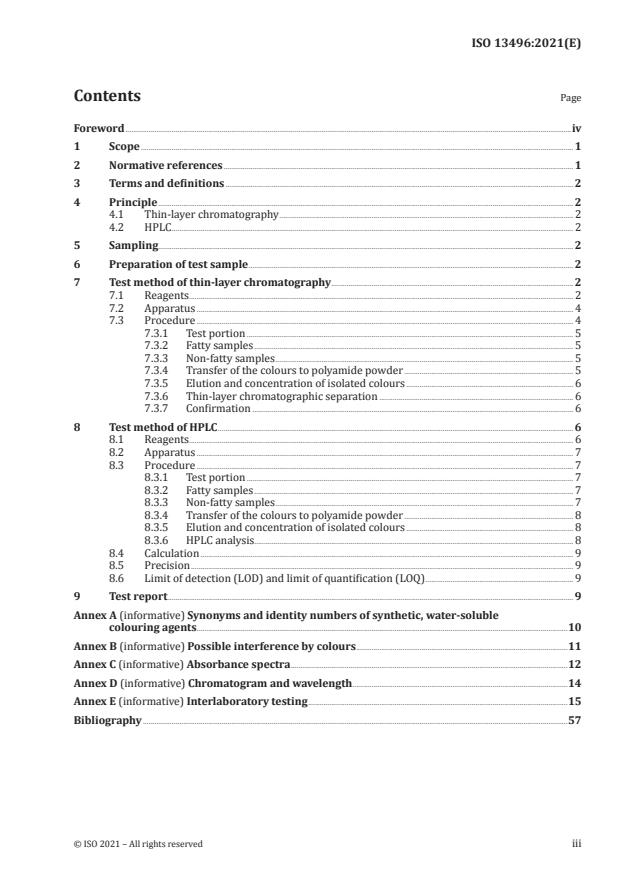
Contents Page
Foreword .iv
1 Scope . 1
2 Normative references . 1
3 Terms and definitions . 2
4 Principle . 2
4.1 Thin-layer chromatography . 2
4.2 HPLC . 2
5 Sampling . 2
6 Preparation of test sample . 2
7 Test method of thin-layer chromatography . 2
7.1 Reagents. 2
7.2 Apparatus . 4
7.3 Procedure . 4
7.3.1 Test portion . 5
7.3.2 Fatty samples . 5
7.3.3 Non-fatty samples . 5
7.3.4 Transfer of the colours to polyamide powder . 5
7.3.5 Elution and concentration of isolated colours . 6
7.3.6 Thin-layer chromatographic separation . 6
7.3.7 Confirmation . 6
8 Test method of HPLC . 6
8.1 Reagents. 6
8.2 Apparatus . 7
8.3 Procedure . 7
8.3.1 Test portion . 7
8.3.2 Fatty samples . 7
8.3.3 Non-fatty samples . 7
8.3.4 Transfer of the colours to polyamide powder . 8
8.3.5 Elution and concentration of isolated colours . 8
8.3.6 HPLC analysis. 8
8.4 Calculation . 9
8.5 Precision . 9
8.6 Limit of detection (LOD) and limit of quantification (LOQ) . 9
9 Test report . 9
Annex A (informative) Synonyms and identity numbers of synthetic, water-soluble
colouring agents .10
Annex B (informative) Possible interference by colours .11
Annex C (informative) Absorbance spectra .12
Annex D (informative) Chromatogram and wavelength .14
Annex E (informative) Interlaboratory testing .15
Bibliography .57
Foreword
ISO (the International Organization for Standardization) is a worldwide federation of national standards
bodies (ISO member bodies). The work of preparing International Standards is normally carried out
through ISO technical committees. Each member body interested in a subject for which a technical
committee has been established has the right to be represented on that committee. International
organizations, governmental and non-governmental, in liaison with ISO, also take part in the work.
ISO collaborates closely with the International Electrotechnical Commission (IEC) on all matters of
electrotechnical standardization.
The procedures used to develop this document and those intended for its further maintenance are
described in the ISO/IEC Directives, Part 1. In particular, the different approval criteria needed for the
different types of ISO documents should be noted. This document was drafted in accordance with the
editorial rules of the ISO/IEC Directives, Part 2 (see www .iso .org/ directives).
Attention is drawn to the possibility that some of the elements of this document may be the subject of
patent rights. ISO shall not be held responsible for identifying any or all such patent rights. Details of
any patent rights identified during the development of the document will be in the Introduction and/or
on the ISO list of patent declarations received (see www .iso .org/ patents).
Any trade name used in this document is information given for the convenience of users and does not
constitute an endorsement.
For an explanation of the voluntary nature of standards, the meaning of ISO specific terms and
expressions related to conformity assessment, as well as information about ISO's adherence to the
World Trade Organization (WTO) principles in the Technical Barriers to Trade (TBT), see www .iso .org/
iso/ foreword .html.
This document was prepared by Technical Committee ISO/TC 34, Food products, Subcommittee SC 6,
Meat, poultry, fish, eggs and their products.
This second edition cancels and replaces the first edition (ISO 13496:2000), which has been technically
revised. The main changes compared with the previous edition are as follows:
— a new test method, high performance liquid chromatography (HPLC), has been added;
— the order of the clauses has been rearranged;
— the title of the document has been modified;
— the Scope has been modified.
Any feedback or questions on this document should be directed to the user’s national standards body. A
complete listing of these bodies can be found at www .iso .org/ members .html.
iv © ISO 2021 – All rights reserved
INTERNATIONAL STANDARD ISO 13496:2021(E)
Meat and meat products — Detection and determination of
colouring agents
1 Scope
This document specifies a detection method using thin-layer chromatography and a determination
method using high performance liquid chromatography (HPLC) for synthetic colouring agents in meat
and meat products.
This document specifies the HPLC method as the reference method.
This document is applicable to meat and meat products, including livestock and poultry products.
The method using thin-layer chromatography can detect the following colouring agents:
— Tartrazine — Patent Blue V
— Quinoline Yellow — Indigotine
— Sunset Yellow FCF — Brilliant Black PN
— Amaranth — Black 7984
— Ponceau 4R — Fast Green FCF
— Erythrosine — Blue VRS
Synonyms and identity numbers of these colouring agents are listed in Annex A. The plant colours and
plant extracts which have been observed not to interfere with this method are listed in B.1. Natural
colours which in some cases have been shown to interfere with this method are listed in B.2.
The method using HPLC can detect the following colouring agents:
— Tartrazine — Allura Red AC
— Amaranth — Brilliant Blue FCF
— Ponceau 4R — New Red
— Sunset Yellow FCF — Carmoisine
— Erythrosine — Indigotine
Chromatograms of these standard reference colours are shown in Annex D.
2 Normative references
The following documents are referred to in the text in such a way that some or all of their content
constitutes requirements of this document. For dated references, only the edition cited applies. For
undated references, the latest edition of the referenced document (including any amendments) applies.
ISO 3696, Water for analytical laboratory use — Specification and test methods
ISO 4793, Laboratory sintered (fritted) filters — Porosity grading, classification and designation
AOAC 46.1.08, Official Methods of Analysis (AOAC International)
3 Terms and definitions
For the purposes of this document, the following terms and definitions apply.
ISO and IEC maintain terminology databases for use in standardization at the following addresses:
— ISO Online browsing platform: available at https:// www .iso .org/ obp
— IEC Electropedia: available at http:// www .electropedia .org/
3.1
detection of colouring agents
detection of the presence or absence of colouring agents in accordance with the method specified in
this document
4 Principle
4.1 Thin-layer chromatography
The colouring agents are extracted from a test portion with hot water and adsorbed onto polyamide
powder. The extracted colouring agents are purified by column chromatography and the colours are
eluted from the column. The colouring agents are identified by thin-layer chromatography.
4.2 HPLC
The colouring agents are extracted from a test portion with hot water and adsorbed onto polyamide
powder. The extracted colouring agents are injected into the column and chromatographed in HPLC in
reverse phase (RP). The colouring agents are identified according to retention time and quantified with
external standard method.
5 Sampling
It is important that the laboratory receive a sample which is truly representative and has not been
damaged or changed during transport or storage.
Proceed from a representative sample of at least 200 g. Store the sample in such a way that deterioration
and change in composition are prevented.
6 Preparation of test sample
Homogenize the laboratory sample with the appropriate equipment (7.2.1). Take care that the
temperature of the sample material does not rise above 25 °C. If a mincer is used, pass the sample at
least twice through the equipment.
Fill a suitable airtight container with the prepared sample. Close the container and store in such a way
that deterioration and change in the composition of the sample are prevented. Analyse the sample as
soon as practicable, but always within 24 h after homogenization.
7 Test method of thin-layer chromatography
7.1 Reagents
Use only reagents of recognized analytical grade, unless otherwise specified.
7.1.1 Water, conforming to at least grade 3 in accordance with ISO 3696.
2 © ISO 2021 – All rights reserved
7.1.2 Petroleum ether, boiling range 40 °C to 60 °C.
7.1.3 Methanol.
7.1.4 Ammonia, 25 % aqueous solution, ρ = 0,910 g/ml.
7.1.5 Acetic acid, 100 % mass fraction, ρ = 1,050 g/ml.
7.1.6 Trisodium citrate dihydrate.
7.1.7 Propan-1-ol.
7.1.8 Ethyl acetate.
7.1.9 2-Methyl-2-propanol.
7.1.10 Propionic acid.
7.1.11 Eluent solution for column chromatography.
Mix 95 volumes of methanol (7.1.3) with five volumes of ammonia solution (7.1.4).
7.1.12 Acetic acid, 50 % solution in methanol.
Mix one volume of acetic acid (7.1.5) with one volume of methanol (7.1.3).
7.1.13 Polyamide powder, of particle size 0,05 mm to 0,16 mm.
7.1.14 Sand, fine granular, hydrochloric acid-washed, neutralized and calcinated.
7.1.15 Standard reference colours.
The purities of the standard colours can vary so it is necessary to know the purity of the colours to be
used as standards. The purity shall be determined by the method given in AOAC 46.1.08.
NOTE Certified food colours can also be used as standards.
7.1.16 Standard reference solutions for thin-layer chromatography.
Separately make solutions in water of each of the standard reference colours (7.1.15) with a standard
colour content of about 1 g/l.
Prepare solutions of Indigotine on the day of use. Other solutions will keep for at least three months
(solutions of Erythrosine for one month) when stored in the dark.
7.1.17 Eluent for thin-layer chromatography: solution I.
Weigh, to the nearest 0,1 g, 25 g of trisodium citrate dihydrate (7.1.6) into a 1 000 ml one-mark
volumetric flask. Dissolve in water, dilute to the mark with water and mix.
Mix 80 volumes of this citrate solution with 20 volumes of ammonia solution (7.1.4) and 12 volumes of
methanol (7.1.3).
To avoid or reduce interference from safflor or saffran, it is advisable to use chromatography solution II
(7.1.18).
7.1.18 Eluent for thin-layer chromatography: solution II.
Mix six volumes of propan-1-ol (7.1.7) with one volume of ethyl acetate (7.1.8) and three volumes of
water.
7.1.19 Eluent for thin-layer chromatography: solution III.
Mix 50 volumes of 2-methyl-2-propanol (7.1.9) with 12 volumes of propionic acid (7.1.10) and 38 volumes
of water.
7.2 Apparatus
The usual laboratory apparatus and, in particular, the following shall be used.
7.2.1 Mechanical or electrical homogenizing equipment, capable of homogenizing the laboratory
sample.
Use a high-speed rotational cutter, or a mincer fitted with a plate with apertures not exceeding 4,0 mm
in diameter.
7.2.2 Centrifuge tubes.
7.2.3 Flat-bottomed flasks, of capacity 250 ml, with ground glass stoppers.
7.2.4 Round-bottomed flasks, of capacity 100 ml, with ground glass joint.
7.2.5 Centrifuge, operating at a radial acceleration of about 2 000g.
7.2.6 Rotary evaporator.
7.2.7 Chromatographic column, of glass, with fritted filter and tap, of length about 20 cm, diameter
about 30 mm, filter pore size 40 µm to 100 µm (porosity grade P 100 in accordance with ISO 4793).
Put some glass wool in the column and add 1 g to 2 g of sand (7.1.14).
7.2.8 Plastics container, of volume about 10 ml, with lid.
7.2.9 Thin-layer plates, coated with a layer of cellulose powder of 0,10 mm thickness, or equivalent.
Ready-to-use plates are suitable.
7.2.10 Micropipettes, of capacity approximately 5 µl.
7.2.11 pH-meter, accurate to within 0,1 pH unit.
7.3 Procedure
WARNING — If the sample contains Indigotine, the temperature shall not at any time during
the analysis exceed 35 °C. Indigotine partially decomposes in chromatography solution I, so
chromatography solution II shall be used.
WARNING — Erythrosine is sensitive to light. When pausing in the course of the analysis,
solutions and plates shall be stored in the dark. The same also holds for Indigotine.
4 © ISO 2021 – All rights reserved
7.3.1 Test portion
Weigh, to the nearest 0,1 g, 5 g of the prepared test sample (see Clause 6) into a centrifuge tube (7.2.2).
For fatty samples, proceed in accordance with 7.3.2.
For non-fatty samples, proceed in accordance with 7.3.3.
7.3.2 Fatty samples
Add about 20 ml of petroleum ether (7.1.2) to the centrifuge tube and mix with a glass rod. Decant the
petroleum ether.
Repeat this procedure three times.
7.3.3 Non-fatty samples
Add 25 ml of boiling water (see warning above) and mix. Add 25 ml of the eluent solution (7.1.11).
Check that the pH is 9 ± 0,5 using the pH-meter (7.2.11). If not, adjust the pH with acetic acid (7.1.5) or
ammonia solution (7.1.4).
Mix well. Chill the sample in a freezer for 15 min (to prevent turbidity).
Centrifuge (7.2.5) for 10 min at a radial acceleration of about 2 000g.
Decant the clear solution into a flat-bottomed flask (7.2.3). In the case of Indigotine, use a round-
bottomed flask (7.2.4).
Add 5 ml of water to the centrifuge tube containing the residue. Mix and add 10 ml of the eluent solution
(7.1.11). Mix and centrifuge as above.
Repeat the procedure until all colour has been extracted from the sample then combine all the extracts.
Evaporate the combined extracts in a water bath to about 25 ml in order to remove the methanol. In the
case of Indigotine, use a round-bottomed flask (7.2.4) and the rotary evaporator (7.2.6) at 35 °C.
Add 25 ml of boiling water (see warnings) and mix.
7.3.4 Transfer of the colours to polyamide powder
Using acetic acid (7.1.5) or ammonia solution (7.1.4) adjust the pH to between 4 and 5.
Add 1 g of polyamide powder (7.1.13) to the warm solution (see warnings). Shake vigorously for 1 min.
Allow the powder to form a sediment.
Check that no colour remains in the solution. If the solution is coloured, add some more polyamide
powder and shake vigorously.
NOTE Some natural colours (see Annex B) are not entirely adsorbed on the polyamide powder, leaving the
solution coloured even if all synthetic colours have been completely adsorbed. It is usually possible to decide
from the type of sample whether or not such natural colours are present.
Shake and transfer the warm suspension to the chromatographic column (7.2.7).
Rinse the flat-bottomed flask with three 10 ml portions of hot water (see warnings) and add the
rinsings, portion by portion, to the column. Wash the column another three times with 10 ml portions
of hot water (see warnings) and finally three times with 5 ml of methanol (7.1.3). If natural colours are
eluted, continue washing the column with methanol until the eluted methanol is colourless.
7.3.5 Elution and concentration of isolated colours
Place a flask (7.2.4) under the column and elute the colours from the polyamide powder with 5 ml
portions of the eluent solution (7.1.11), at an elution volume flow rate of 2 ml/min, until the polyamide
is colourless.
Evaporate the eluate to dryness using the evaporator (7.2.6) at a temperature of at most 35 °C (see
warnings).
Add 1,0 ml or 2,0 ml of eluent solution (7.1.11) depending on the amount and number of colours and
dissolve the residue. Transfer the colour solution to a plastics container (7.2.8).
7.3.6 Thin-layer chromatographic separation
7.3.6.1 Standard reference plates
Prepare three standard reference thin-layer chromatographic plates. Using a micropipette (7.2.10),
dispense a spot of about 5 µl (diameter, d < 5 mm) of each standard solution (7.1.16) separately on each
plate (7.2.9). Develop these separately, one with each chromatography eluent (7.1.17, 7.1.18 and 7.1.19)
in an unsaturated tank until the solvent front is about 10 cm to 12 cm from the starting line. Remove
the plates from the tank and dry in air under a hood. Store the plates in the dark. The spots, except for
that of Indigotine, are stable for several years.
7.3.6.2 Samples
Using a micropipette (7.2.10), apply to a thin-layer plate (7.2.9) a just-visible amount of sample solution
(see 7.3.5). Dry using a hair dryer. In the case of Indigotine, dry in air.
Develop the plate in an unsaturated tank to a height of approximately 10 cm to 12 cm using a suitable
chromatography solution (7.1.16, 7.1.17 or 7.1.18), i.e. the solution which gives the best separation of
the colours detected in the sample (see Clause 1). Sometimes it will be necessary to prepare a second
sample plate and develop this in one of the other two eluents to obtain the best separation.
Remove the plate from the tank and dry in air under a hood.
Compare the sample spots with the appropriate standard reference plate (see 7.3.6.1).
It is recommended that different amounts of sample solutions be applied in the case of mixtures of
colorants, because colorants can be present in various concentrations in the concentrate.
Tailing is usually caused by inadequate purification. If this is the case, adsorb the colorant again with
the adsorbent, wash with hot water and remove the adsorbent as previously described.
7.3.7 Confirmation
Confirm the identity of the colorants by chromatographing the concentrate (see 7.3.6.2) in a mixture of
standards for the colorants identified in the first chromatogram.
In case of doubt, elute the colorant from the plate with a neutral solution (water or ethanol, or 0,2 g/l
ammonium acetate solution), an acid (0,1 mol/l hydrochloric acid) and an alkali (0,1 mol/l sodium
hydroxide solution), and compare the absorption spectrum of the colorant to that of the standard. See
the absorbance spectra shown in Annex C.
8 Test method of HPLC
8.1 Reagents
Use only reagents of recognized analytical grade, unless otherwise specified.
6 © ISO 2021 – All rights reserved
8.1.1 Acetonitrile, HPLC quality.
8.1.2 Ammonium acetate.
8.1.3 Ammonium acetate solution (0,02 mol/l).
Weigh 1,54 g of ammonium acetate (8.1.2), add appropriate water to dissolve and dilute to 1 000 ml
with water. Filter through 0,45 µm microporous membrane (8.2.2).
8.1.4 Methanol, 10 % solution in water.
Mix 10 volumes of methanol (7.1.3) with 90 volumes of water (7.1.1).
8.1.5 Stock solutions (1 mg/ml).
Separately make solutions in 10 % methanol (8.1.4) of each of the standard reference colours (7.1.15)
with a standard colour content of about 1 mg/ml.
8.1.6 Working reference solutions (50 µg/ml).
Dilute the 1 mg/ml stock solutions (8.1.5) 20 times with 10 % methanol (8.1.4) and filter through
0,45 µm microporous membrane (8.2.2).
8.2 Apparatus
The usual laboratory apparatus and, in particular, the following shall be used.
8.2.1 HPLC chromatographic system, with column thermostat and UV/visible or diode array
detector.
8.2.2 Micro filters with membranes (diameter of the pores: 0,45 µm).
8.3 Procedure
WARNING — If the sample contains Indigotine, the temperature shall not at any time during the
analysis exceed 35 °C.
WARNING — Erythrosine is sensitive to light. When pausing in the course of the analysis, the
solutions shall be stored in the dark. The same also holds for Indigotine.
8.3.1 Test portion
Weigh, to the nearest 0,001 g, 5 g of the prepared test sample (see Clause 6) into a centrifuge tube
(7.2.2).
For fatty samples, proceed in accordance with 8.3.2.
For non-fatty samples, proceed in accordance with 8.3.3.
8.3.2 Fatty samples
See 7.3.2.
8.3.3 Non-fatty samples
See 7.3.3.
8.3.4 Transfer of the colours to polyamide powder
See 7.3.4.
8.3.5 Elution and concentration of isolated colours
Place a flask (7.2.4) under the column and elute the colours from the polyamide powder with 5 ml
portions of the eluent solution (7.1.11), at an elution volume flow rate of 2 ml/min, until the polyamide
is colourless.
Evaporate the eluate to dryness using the evaporator (7.2.6) at a temperature of at most 35 °C (see
warnings).
Add 1,0 ml or 2,0 ml of water (7.1.1) depending on the amount and number of colours and dissolve the
residue. Filter the colour solution through 0,45 µm microporous membrane (8.2.2) for injection into the
HPLC chromatographic system (8.2.1).
8.3.6 HPLC analysis
8.3.6.1 Operating conditions
The operating conditions are as follows:
a) Column: C18 (5 μm, 4,6 × 250 mm).
b) Mobile phase:
A: 0,02 mol/l ammonium acetate solution (8.1.3);
B: acetonitrile (8.1.1), elution gradient see Table 1.
c) Column temperature: 35 °C.
d) Flow rate: 1,0 ml/min.
e) Injection volume: 20 μl.
f) Wavelength range of diode array detector: 400 nm to 800 nm, or wavelength of UV detector
detection: see Annex D.
Table 1 — Elution gradient
Time, min Phase A, % Phase B, %
0 95 5
3 65 35
7 0 100
10 0 100
10,1 95 5
21 95 5
8.3.6.2 Determination
Under above conditions, when the retention time for the peak of analyte in the unknown sample is the
same as the retention time of the standard, the sample can be assumed to contain synthetical pigments.
The chromatogram of synthetical pigments standard is given in Annex D. The method is quantified by
the external standard curve. The responses of synthetical pigments in the sample solution should be in
the linear range of the instrumental detection.
8 © ISO 2021 – All rights reserved
8.3.6.3 Parallel test
According to the above procedure, the same sample was tested in a parallel test.
8.3.6.4 Blank test
Except for weighing the sample, follow the procedure described above.
8.4 Calculation
The level of colorant is calculated as shown by Formula (1):
CV×
X = (1)
m
where
X is the content of the colorant in the sample, in grams per kilogram (mg/kg);
C is the concentration of the colorant in the sample solution, in milligrams per litre (mg/l);
V is the final diluted volume of the sample solution, in millilitres (ml);
m is the sample mass, in grams (g).
The result is subtracted from the blank value.
Express the calculation result as the arithmetic average of two single test results obtained under
repetitive conditions. Express the results to two significant figures. Interlaboratory testing results are
shown in Annex E.
8.5 Precision
The absolute difference between two single test results obtained under repetitive conditions shall not
exceed 10 % of the arithmetic mean.
8.6 Limit of detection (LOD) and limit of quantification (LOQ)
For Tartrazine, Amaranth, Ponceau 4R, Sunset Yellow FCF, Erythrosine, Allura Red AC, Brilliant Blue
FCF, New Red, Carmoisine and Indigotine, the LOD is 0,15 mg/kg and the LOQ is 0,5 mg/kg.
9 Test report
The test report shall specify:
— all information necessary for the complete identification of the sample;
— the sampling method used, if known;
— the test method used, with reference to this document including its year of publication, i.e.
— all operating details not specified in this document, or regarded as optional, together with details of
any incidents which can have influenced the test result;
— the test result obtained, including a reference to the clause which explains how the results were
calculated;
— the date of the test.
Annex A
(informative)
Synonyms and identity numbers of synthetic, water-soluble
colouring agents
Table A.1 — Synonyms and identity numbers of synthetic, water-soluble colouring agents
a b d
Name Synonym 1 Synonym 2 C.I. E No. CAS No.
Tartrazine FD&C Yellow No. 5 19140 E 102 1934-21-0
Quinoline Yellow 47005 E 104 8004-92-0
Sunset Yellow FCF FD&C Yellow No. 6 15985 E 110 2783-94-0
Amaranth FD&C Red No. 2 Naphthol Red S 16185 E 123 915-67-3
Ponceau 4R New coccine Cochineal Red A 16255 E 124 2611-82-7
Erythrosine FD&C Red No. 3 45430 E 127 16423-68-0
Patent Blue V 42051 E 131 3536-49-0
Indigotine FD&C Blue No. 2 73015 E 132 860-22-0
Brilliant Black PN 28440 E 151 2519-30-4
Black 7984 27755 E 152 2118-39-0
c
Fast Green FCF FD&C Green No. 3 42053 2353-45-9
c c
Blue VRS 2045
Allura Red AC 16035 E129 25956-17-16
Brilliant Blue FCF 42090 E133 3844-45-9
c c
New Red 220658-76-4
Carmoisine Azorubine 14720 E122 3567-69-6
a [4]
C.I.: Identity number according to the Colour Index .
b
E No.: Current number within the European Community (EC).
c
E No. is not available.
d
CAS No.: Chemical abstracts service number.
10 © ISO 2021 – All rights reserved
Annex B
(informative)
Possible interference by colours
B.1 Colours which do not interfere
The following plant colours or plant extracts have been observed not to interfere with this method:
— alfalfa — chlorophyllin copper complex
— annatto (bixin and norbixin) — flower of tagetes
— anthocyanins — marigold
— beetroot red — mustard
— β-apocarotenal — paprika oleoresin
— β-apocarotenic acid ethyl ester — riboflavin
— β-carotene — tea
— canthaxanthin — tomato
— chlorophyll
B.2 Colours which can interfere
In some cases, natural colours have been observed to interfere with this method. Their uses in foods
and the synthetic colours of which the determination can be affected are given in Table B.1.
Table B.1 — Colours which can interfere
Substance Use in foods Interferes with analysis of
a
Curcumin Spice, also used as yellow colour Quinoline Yellow (E 104)
a
Brilliant Black PN (E 151)
a
Black 7984 (E 152)
b
Saffran Spice, too expensive for use as a colour Erythrosine (E 127)
a,b
Quinoline Yellow (E 104)
a,b
Brilliant Black PN (E 151)
b
Black 7984 (E 152)
b
Safflor Substitute for saffran Tartrazine (E 102)
a
The interferences are minor and may be considered negligible.
b
To avoid or reduce interference from safflor or saffran, it is advisable to use chromatography solution II (7.1.18).
Annex C
(informative)
Absorbance spectra
Key
X wavelength, nm
Y absorbance
Quinoline Yellow
Erythrosine
Tartrazine
Black 7984
Amaranth
Blue VRS
Figure C.1 — Absorbance spectra of Amaranth, Black 7984, Blue VRS, Erythrosine,
Tartrazine and Quinoline Yellow
12 © ISO 2021 – All rights reserved
Key
X wavelength, nm
Y absorbance
Sunset Yellow FCF
Brilliant Black PN
Fast Green FCF
Patent Blue V
Ponceau 4R
Indigotine
Figure C.2 — Absorbance spectra of Brilliant Black PN, Fast Green FCF, Indigotine,
Patent Blue V, Ponceau 4R and Sunset Yellow FCF
Annex D
(informative)
Chromatogram and wavelength
D.1 Chromatogram of standard
Key
X time, min
Y absorbance
1. Tartrazine 2. New Red 3. Amaranth 4. Indigotine 5. Ponceau 4R
6. Sunset Yellow FCF 7. Allura Red AC 8. Brilliant Blue FCF 9. Carmoisine 10. Erythrosine
Figure D.1 — Chromatogram (λ: 400 nm to 800 nm) of Tartrazine, New Red, Amaranth,
Indigotine, Ponceau 4R, Sunset Yellow FCF, Allura Red AC, Brilliant Blue FCF, Carmoisine and
Erythrosine
D.2 Recommended wavelength of UV detector detection
The recommended detection wavelength for different colouring agents using UV detector detection is:
Tartrazine: 428 nm Allura Red AC: 508 nm
Amaranth: 525 nm Brilliant Blue FCF: 628 nm
Ponceau 4R: 508 nm New Red: 508 nm
Sunset Yellow FCF: 480 nm Carmoisine: 518 nm
Erythrosine: 531 nm Indigotine: 610 nm
14 © ISO 2021 – All rights reserved
Annex E
(informative)
Interlaboratory testing
E.1 Overview
The international laboratory ring test of this document was conducted from 27th June 2020 to 26th July
2020. Eleven laboratories participated in two parallel tests of five samples each.
The test was conducted by the Shanghai Institute of Quality Inspection and Technical Research, China,
which also prepared the statistical analysis and final report.
The test method described in this document is adopted here for the determination of colouring agents
in meat product samples.
Five different kinds of meat samples (A: chicken, B: mutton, C: pork, D: beef; and E: duck) were used
during the ring test, and each with several mean levels.
E.2 Statistical analysis of the test results of colouring agents
E.2.1 Tartrazine
E.2.1.1 Original test results
Eleven laboratories participated in the determination of Tartrazine content in meat samples. The
results are shown in Table E.1.
Table E.1 — Original test results — Tartrazine content
Level j
Laboratory i
mg/kg
A B C D E
1 0,492 0,443 9,07 9,75 2,09 2,17 5,11 3,73 0,876 0,900
2 0,512 0,516 10,60 10,13 2,25 2,34 4,92 4,91 0,935 0,962
3 0,510 0,503 10,50 10,50 2,17 2,20 4,81 4,86 0,929 0,976
4 0,480 0,496 9,62 9,81 2,32 2,29 4,63 4,51 0,813 0,931
5 0,481 0,502 9,23 9,34 2,48 2,50 4,65 4,65 0,947 0,996
6 0,479 0,501 9,83 10,01 2,25 2,64 4,41 4,70 0,866 0,885
7 0,544 0,528 10,06 10,52 2,27 2,31 4,57 4,76 0,854 0,886
8 0,492 0,521 10,32 10,01 2,11 2,52 4,57 4,80 0,951 0,908
9 0,479 0,459 9,81 10,10 2,07 2,45 4,60 4,46 0,889 0,842
10 0,500 0,532 8,38 8,56 2,67 2,99 4,39 4,78 1,279 1,181
11 0,549 0,573 10,68 10,87 2,28 2,51 4,67 5,04 0,906 0,925
E.2.1.2 Cell means
The cell means of the determination of Tartrazine content are shown in Table E.2.
Table E.2 — Cell means — Tartrazine content
Level j
Laboratory i
mg/kg
A B C D E
1 0,467 5 9,410 2,130 4,420 0,888 0
2 0,514 0 10,365 2,295 4,915 0,948 5
3 0,506 5 10,500 2,185 4,835 0,952 5
4 0,488 0 9,715 2,305 4,570 0,872 0
5 0,491 5 9,285 2,490 4,650 0,971 5
6 0,490 0 9,920 2,445 4,555 0,875 5
7 0,536 0 10,290 2,290 4,665 0,870 0
8 0,506 5 10,165 2,315 4,685 0,929 5
9 0,469 0 9,955 2,260 4,530 0,865 5
10 0,516 0 8,470 2,830 4,585 1,230 0
11 0,561 0 10,775 2,395 4,855 0,915 5
E.2.1.3 Cell absolute differences
The cell absolute differences of the determination of Tartrazine content are shown in Table E.3.
Table E.3 — Cell absolute differences — Tartrazine content
Level j
Laboratory i mg/kg
A B C D E
1 0,049 0,68 0,08 1,38 0,024
2 0,004 0,47 0,09 0,01 0,027
3 0,007 0,00 0,03 0,05 0,047
4 0,016 0,19 0,03 0,12 0,118
5 0,021 0,11 0,02 0,00 0,049
6 0,022 0,18 0,39 0,29 0,019
7 0,016 0,46 0,04 0,19 0,032
8 0,029 0,31 0,41 0,23 0,043
9 0,020 0,29 0,38 0,14 0,047
10 0,032 0,18 0,32 0,39 0,098
11 0,024 0,19 0,23 0,37 0,019
E.2.1.4 Scrutiny of results for consistency and outliers
E.2.1.4.1 Graphical consistency technique by Mandel’s h and k statistics
See Figures E.1 and E.2.
16 © ISO 2021 – All rights reserved
Key
1 % critical values
5 % critical values
Figure E.1 — Tartrazine content — Mandel’s interlaboratory consistency statistic, h,
grouped by laboratories
Key
1 % critical values
5 % critical values
Figure E.2 — Tartrazine content — Mandel’s intralaboratory consistency statistic, k,
grouped by laboratories
The h graph shows that laboratory 10 had a straggler at level B, as did laboratory 11 at level A, while
laboratory 10 had outliers at levels C and E. As further validation, laboratory 10 obtained much higher
test results than all other laboratories at levels C and E, and therefore these two results were rejected.
The k graph shows that laboratory 1 had stragglers at levels A and B, as did laboratory 4 on level E,
while laboratory 1 had an outlier at level D. As further validation, the absolute difference between the
data measured by laboratory 1 at level D is the largest, and therefore the result was rejected.
E.2.1.4.2 Cochran’s test
The remaining data are used to do a further Cochran’s test which gives the values of the test statistic C
shown in Table E.4.
Table E.4 — Tartrazine content — Value of Cochran’s test statistic C
Level j
Parameter
A B C D E
Cochran’s test, C 0,356 0 0,377 7 0,313 7 0,305 0 0,543 0
Stragglers (n = 2) 0,570 0,570 0,602 0,602 0,602
Outliers (n = 2) 0,684 0,684 0,718 0,718 0,718
Number of laboratories, p 11 11 10 10 10
If the test statistic is greater than its 5 % critical value and less than or equal to its 1 % critical value,
the item tested is regarded as a straggler. If the test statistic is greater than its 1 % critical value, the
item tested is regarded as an outlier.
The application of the Cochran’s test confirms no stragglers and outliers.
E.2.1.4.3 Grubbs’ test
The application of the Grubbs’ test to the cell means gives the values of the test statistic G shown in
Table E.5.
Table E.5 — Tartrazine content — Application of Grubbs’ test to cell means
Level j Number of Single low Single high Double low Double high
laboratories, p
A 11 1,322 2,048 0,589 7 0,335 4
B 11 2,183 1,347 0,328 2 0,675 5
C 10 1,644 1,626 0,445 9 0,429 2
D 10 1,124 1,677 0,701 8 0,398 5
E 10 1,093 1,579 0,701 2 0,488 7
Stragglers (5 %)
p = 10 2,290 2,290 0,186 4 0,186 4
p = 11 2,355 2,355 0,221 3 0,221 3
Outliers (1 %)
p = 10 2,482 2,482 0,115 0 0,115 0
p = 11 2,564 2,564 0,144 8 0,144 8
For the Grubbs’ test for one outlying observation, outliers and stragglers give rise to values which are
larger than its 1 % and 5 % critical values, respectively.
For the Grubbs’ test for two outlying observations, outliers and stragglers give rise to values which are
smaller than its 1 % and 5 % critical values, respectively.
The application of the Grubbs’ test to the cell means confirms no stragglers and outliers.
E.2.1.5 Calculation of the general mean and standard deviation
Calculation of the general mean (m) and standard deviation (s and s ) of Tartrazine content in each
r R
sample gives the values shown in Table E.6.
18 © ISO 2021 – All rights reserved
Table E.6 — Tartrazine content — Computed values of m, s , s
r R
Level j
Parameter
mg/kg
A B C D E
Number of laboratories, p 11 11 10 10 10
General mean, m 0,504 9,90 2,31 4,68 0,909
Repeatability standard deviation, s 0,017 5 0,235 9 0,163 7 0,157 9 0,035 8
r
Reproducibility standard deviation, s 0,030 4 0,674 0 0,159 7 0,177 1 0,047 1
R
E.2.1.6 Dependence of precision on general mean, m
Table E.6 shows that s and s have a strong positive correlation with m. The actual calculation
r R
demonstrates a linear correlation between logs (or logs ) with logm, as follows:
r R
logs = 0,885 9 logm − 1,383 1, R = 0,891 4
r
logs = 0,994 7 logm − 1,249 3, R = 0,958 4
R
E.2.1.7 Final values of precision
The precision of the Tartrazine content measurement method should be given as follows:
0,89
— s = 0,041 + m
r
0,99
— s = 0,056 + m
R
E.2.2 New Red
E.2.2.1 Original test results
Eleven laboratories participated in the determination of New Red content in meat samples. The test
results are shown in Table E.7.
Table E.7 — Original test results — New Red content
Level j
Laboratory i
mg/kg
A B C D E
1 0,476 0,522 10,13 10,36 2,05 2,24 4,60 3,91 0,975 0,938
2 0,486 0,510 9,87 9,77 2,13 2,19 4,82 4,77 0,995 1,016
3 0,487 0,494 9,75 9,78 2,04 2,08 4,62 4,67 0,952 0,922
4 0,484 0,543 9,74 9,85 2,17 2,12 4,68 4,72 0,963 0,941
5 0,495 0,510 9,71 9,58 2,26 2,46 4,61 4,60 0,941 0,920
6 0,551 0,496 10,27 10,64 2,36 2,75 4,49 4,57 0,969 0,948
7 0,502 0,461 10,78 10,18 2,17 2,76 4,62 4,41 0,882 0,906
8 0,523 0,503 10,18 10,21 2,48 2,45 4,84 4,23 0,963 0,902
9 0,507 0,448 9,71 10,19 2,54 2,09 4,26 4,59 0,846 0,889
10 0,478 0,534 10,44 10,73 2,93 2,78 4,48 4,37 1,121 1,072
11 0,525 0,493 11,99 9,96 2,60 2,58 4,72 4,87 0,908 0,967
E.2.2.2 Cell means
The cell means of the determination of New Red content are shown in Table E.8.
Table E.8 — Cell means — New Red content
Level j
Laboratory i
mg/kg
A B C D E
1 0,499 0 10,245 2,145 4,255 0,956 5
2 0,498 0 9,820 2,160 4,795 1,005 5
3 0,490 5 9,765 2,060 4,645 0,937 0
4 0,513 5 9,795 2,145 4,700 0,952 0
5 0,502 5 9,645 2,360 4,605 0,930 5
6 0,523 5 10,455 2,555 4,530 0,958 5
7 0,481 5 10,480 2,465 4,515 0,894 0
8 0,513 0 10,195 2,465 4,535 0,932 5
9 0,477 5 9,950 2,315 4,425 0,867 5
10 0,506 0 10,585 2,855 4,425 1,096 5
11 0,509 0 10,975 2,590 4,795 0,937 5
E.2.2.3 Cell absolute differences
The cell absolute differences of the determination of New Red content are shown in Table E.9.
Table E.9 — Cell absolute differences — New Red content
Level j
Laboratory i mg/kg
A B C D E
1 0,046 0,23 0,19 0,69 0,037
2 0,024 0,10 0,06 0,05 0,021
3 0,007 0,03 0,04 0,05 0,030
4 0,059 0,11 0,05 0,04 0,022
5 0,015 0,13 0,20 0,01 0,021
6 0,055 0,37 0,39 0,08 0
...
INTERNATIONAL ISO
STANDARD 13496
Second edition
2021-08
Meat and meat products — Detection
and determination of colouring agents
Reference number
©
ISO 2021
© ISO 2021
All rights reserved. Unless otherwise specified, or required in the context of its implementation, no part of this publication may
be reproduced or utilized otherwise in any form or by any means, electronic or mechanical, including photocopying, or posting
on the internet or an intranet, without prior written permission. Permission can be requested from either ISO at the address
below or ISO’s member body in the country of the requester.
ISO copyright office
CP 401 • Ch. de Blandonnet 8
CH-1214 Vernier, Geneva
Phone: +41 22 749 01 11
Email: copyright@iso.org
Website: www.iso.org
Published in Switzerland
ii © ISO 2021 – All rights reserved
Contents Page
Foreword .iv
1 Scope . 1
2 Normative references . 1
3 Terms and definitions . 2
4 Principle . 2
4.1 Thin-layer chromatography . 2
4.2 HPLC . 2
5 Sampling . 2
6 Preparation of test sample . 2
7 Test method of thin-layer chromatography . 2
7.1 Reagents. 2
7.2 Apparatus . 4
7.3 Procedure . 4
7.3.1 Test portion . 5
7.3.2 Fatty samples . 5
7.3.3 Non-fatty samples . 5
7.3.4 Transfer of the colours to polyamide powder . 5
7.3.5 Elution and concentration of isolated colours . 6
7.3.6 Thin-layer chromatographic separation . 6
7.3.7 Confirmation . 6
8 Test method of HPLC . 6
8.1 Reagents. 6
8.2 Apparatus . 7
8.3 Procedure . 7
8.3.1 Test portion . 7
8.3.2 Fatty samples . 7
8.3.3 Non-fatty samples . 7
8.3.4 Transfer of the colours to polyamide powder . 8
8.3.5 Elution and concentration of isolated colours . 8
8.3.6 HPLC analysis. 8
8.4 Calculation . 9
8.5 Precision . 9
8.6 Limit of detection (LOD) and limit of quantification (LOQ) . 9
9 Test report . 9
Annex A (informative) Synonyms and identity numbers of synthetic, water-soluble
colouring agents .10
Annex B (informative) Possible interference by colours .11
Annex C (informative) Absorbance spectra .12
Annex D (informative) Chromatogram and wavelength .14
Annex E (informative) Interlaboratory testing .15
Bibliography .57
Foreword
ISO (the International Organization for Standardization) is a worldwide federation of national standards
bodies (ISO member bodies). The work of preparing International Standards is normally carried out
through ISO technical committees. Each member body interested in a subject for which a technical
committee has been established has the right to be represented on that committee. International
organizations, governmental and non-governmental, in liaison with ISO, also take part in the work.
ISO collaborates closely with the International Electrotechnical Commission (IEC) on all matters of
electrotechnical standardization.
The procedures used to develop this document and those intended for its further maintenance are
described in the ISO/IEC Directives, Part 1. In particular, the different approval criteria needed for the
different types of ISO documents should be noted. This document was drafted in accordance with the
editorial rules of the ISO/IEC Directives, Part 2 (see www .iso .org/ directives).
Attention is drawn to the possibility that some of the elements of this document may be the subject of
patent rights. ISO shall not be held responsible for identifying any or all such patent rights. Details of
any patent rights identified during the development of the document will be in the Introduction and/or
on the ISO list of patent declarations received (see www .iso .org/ patents).
Any trade name used in this document is information given for the convenience of users and does not
constitute an endorsement.
For an explanation of the voluntary nature of standards, the meaning of ISO specific terms and
expressions related to conformity assessment, as well as information about ISO's adherence to the
World Trade Organization (WTO) principles in the Technical Barriers to Trade (TBT), see www .iso .org/
iso/ foreword .html.
This document was prepared by Technical Committee ISO/TC 34, Food products, Subcommittee SC 6,
Meat, poultry, fish, eggs and their products.
This second edition cancels and replaces the first edition (ISO 13496:2000), which has been technically
revised. The main changes compared with the previous edition are as follows:
— a new test method, high performance liquid chromatography (HPLC), has been added;
— the order of the clauses has been rearranged;
— the title of the document has been modified;
— the Scope has been modified.
Any feedback or questions on this document should be directed to the user’s national standards body. A
complete listing of these bodies can be found at www .iso .org/ members .html.
iv © ISO 2021 – All rights reserved
INTERNATIONAL STANDARD ISO 13496:2021(E)
Meat and meat products — Detection and determination of
colouring agents
1 Scope
This document specifies a detection method using thin-layer chromatography and a determination
method using high performance liquid chromatography (HPLC) for synthetic colouring agents in meat
and meat products.
This document specifies the HPLC method as the reference method.
This document is applicable to meat and meat products, including livestock and poultry products.
The method using thin-layer chromatography can detect the following colouring agents:
— Tartrazine — Patent Blue V
— Quinoline Yellow — Indigotine
— Sunset Yellow FCF — Brilliant Black PN
— Amaranth — Black 7984
— Ponceau 4R — Fast Green FCF
— Erythrosine — Blue VRS
Synonyms and identity numbers of these colouring agents are listed in Annex A. The plant colours and
plant extracts which have been observed not to interfere with this method are listed in B.1. Natural
colours which in some cases have been shown to interfere with this method are listed in B.2.
The method using HPLC can detect the following colouring agents:
— Tartrazine — Allura Red AC
— Amaranth — Brilliant Blue FCF
— Ponceau 4R — New Red
— Sunset Yellow FCF — Carmoisine
— Erythrosine — Indigotine
Chromatograms of these standard reference colours are shown in Annex D.
2 Normative references
The following documents are referred to in the text in such a way that some or all of their content
constitutes requirements of this document. For dated references, only the edition cited applies. For
undated references, the latest edition of the referenced document (including any amendments) applies.
ISO 3696, Water for analytical laboratory use — Specification and test methods
ISO 4793, Laboratory sintered (fritted) filters — Porosity grading, classification and designation
AOAC 46.1.08, Official Methods of Analysis (AOAC International)
3 Terms and definitions
For the purposes of this document, the following terms and definitions apply.
ISO and IEC maintain terminology databases for use in standardization at the following addresses:
— ISO Online browsing platform: available at https:// www .iso .org/ obp
— IEC Electropedia: available at http:// www .electropedia .org/
3.1
detection of colouring agents
detection of the presence or absence of colouring agents in accordance with the method specified in
this document
4 Principle
4.1 Thin-layer chromatography
The colouring agents are extracted from a test portion with hot water and adsorbed onto polyamide
powder. The extracted colouring agents are purified by column chromatography and the colours are
eluted from the column. The colouring agents are identified by thin-layer chromatography.
4.2 HPLC
The colouring agents are extracted from a test portion with hot water and adsorbed onto polyamide
powder. The extracted colouring agents are injected into the column and chromatographed in HPLC in
reverse phase (RP). The colouring agents are identified according to retention time and quantified with
external standard method.
5 Sampling
It is important that the laboratory receive a sample which is truly representative and has not been
damaged or changed during transport or storage.
Proceed from a representative sample of at least 200 g. Store the sample in such a way that deterioration
and change in composition are prevented.
6 Preparation of test sample
Homogenize the laboratory sample with the appropriate equipment (7.2.1). Take care that the
temperature of the sample material does not rise above 25 °C. If a mincer is used, pass the sample at
least twice through the equipment.
Fill a suitable airtight container with the prepared sample. Close the container and store in such a way
that deterioration and change in the composition of the sample are prevented. Analyse the sample as
soon as practicable, but always within 24 h after homogenization.
7 Test method of thin-layer chromatography
7.1 Reagents
Use only reagents of recognized analytical grade, unless otherwise specified.
7.1.1 Water, conforming to at least grade 3 in accordance with ISO 3696.
2 © ISO 2021 – All rights reserved
7.1.2 Petroleum ether, boiling range 40 °C to 60 °C.
7.1.3 Methanol.
7.1.4 Ammonia, 25 % aqueous solution, ρ = 0,910 g/ml.
7.1.5 Acetic acid, 100 % mass fraction, ρ = 1,050 g/ml.
7.1.6 Trisodium citrate dihydrate.
7.1.7 Propan-1-ol.
7.1.8 Ethyl acetate.
7.1.9 2-Methyl-2-propanol.
7.1.10 Propionic acid.
7.1.11 Eluent solution for column chromatography.
Mix 95 volumes of methanol (7.1.3) with five volumes of ammonia solution (7.1.4).
7.1.12 Acetic acid, 50 % solution in methanol.
Mix one volume of acetic acid (7.1.5) with one volume of methanol (7.1.3).
7.1.13 Polyamide powder, of particle size 0,05 mm to 0,16 mm.
7.1.14 Sand, fine granular, hydrochloric acid-washed, neutralized and calcinated.
7.1.15 Standard reference colours.
The purities of the standard colours can vary so it is necessary to know the purity of the colours to be
used as standards. The purity shall be determined by the method given in AOAC 46.1.08.
NOTE Certified food colours can also be used as standards.
7.1.16 Standard reference solutions for thin-layer chromatography.
Separately make solutions in water of each of the standard reference colours (7.1.15) with a standard
colour content of about 1 g/l.
Prepare solutions of Indigotine on the day of use. Other solutions will keep for at least three months
(solutions of Erythrosine for one month) when stored in the dark.
7.1.17 Eluent for thin-layer chromatography: solution I.
Weigh, to the nearest 0,1 g, 25 g of trisodium citrate dihydrate (7.1.6) into a 1 000 ml one-mark
volumetric flask. Dissolve in water, dilute to the mark with water and mix.
Mix 80 volumes of this citrate solution with 20 volumes of ammonia solution (7.1.4) and 12 volumes of
methanol (7.1.3).
To avoid or reduce interference from safflor or saffran, it is advisable to use chromatography solution II
(7.1.18).
7.1.18 Eluent for thin-layer chromatography: solution II.
Mix six volumes of propan-1-ol (7.1.7) with one volume of ethyl acetate (7.1.8) and three volumes of
water.
7.1.19 Eluent for thin-layer chromatography: solution III.
Mix 50 volumes of 2-methyl-2-propanol (7.1.9) with 12 volumes of propionic acid (7.1.10) and 38 volumes
of water.
7.2 Apparatus
The usual laboratory apparatus and, in particular, the following shall be used.
7.2.1 Mechanical or electrical homogenizing equipment, capable of homogenizing the laboratory
sample.
Use a high-speed rotational cutter, or a mincer fitted with a plate with apertures not exceeding 4,0 mm
in diameter.
7.2.2 Centrifuge tubes.
7.2.3 Flat-bottomed flasks, of capacity 250 ml, with ground glass stoppers.
7.2.4 Round-bottomed flasks, of capacity 100 ml, with ground glass joint.
7.2.5 Centrifuge, operating at a radial acceleration of about 2 000g.
7.2.6 Rotary evaporator.
7.2.7 Chromatographic column, of glass, with fritted filter and tap, of length about 20 cm, diameter
about 30 mm, filter pore size 40 µm to 100 µm (porosity grade P 100 in accordance with ISO 4793).
Put some glass wool in the column and add 1 g to 2 g of sand (7.1.14).
7.2.8 Plastics container, of volume about 10 ml, with lid.
7.2.9 Thin-layer plates, coated with a layer of cellulose powder of 0,10 mm thickness, or equivalent.
Ready-to-use plates are suitable.
7.2.10 Micropipettes, of capacity approximately 5 µl.
7.2.11 pH-meter, accurate to within 0,1 pH unit.
7.3 Procedure
WARNING — If the sample contains Indigotine, the temperature shall not at any time during
the analysis exceed 35 °C. Indigotine partially decomposes in chromatography solution I, so
chromatography solution II shall be used.
WARNING — Erythrosine is sensitive to light. When pausing in the course of the analysis,
solutions and plates shall be stored in the dark. The same also holds for Indigotine.
4 © ISO 2021 – All rights reserved
7.3.1 Test portion
Weigh, to the nearest 0,1 g, 5 g of the prepared test sample (see Clause 6) into a centrifuge tube (7.2.2).
For fatty samples, proceed in accordance with 7.3.2.
For non-fatty samples, proceed in accordance with 7.3.3.
7.3.2 Fatty samples
Add about 20 ml of petroleum ether (7.1.2) to the centrifuge tube and mix with a glass rod. Decant the
petroleum ether.
Repeat this procedure three times.
7.3.3 Non-fatty samples
Add 25 ml of boiling water (see warning above) and mix. Add 25 ml of the eluent solution (7.1.11).
Check that the pH is 9 ± 0,5 using the pH-meter (7.2.11). If not, adjust the pH with acetic acid (7.1.5) or
ammonia solution (7.1.4).
Mix well. Chill the sample in a freezer for 15 min (to prevent turbidity).
Centrifuge (7.2.5) for 10 min at a radial acceleration of about 2 000g.
Decant the clear solution into a flat-bottomed flask (7.2.3). In the case of Indigotine, use a round-
bottomed flask (7.2.4).
Add 5 ml of water to the centrifuge tube containing the residue. Mix and add 10 ml of the eluent solution
(7.1.11). Mix and centrifuge as above.
Repeat the procedure until all colour has been extracted from the sample then combine all the extracts.
Evaporate the combined extracts in a water bath to about 25 ml in order to remove the methanol. In the
case of Indigotine, use a round-bottomed flask (7.2.4) and the rotary evaporator (7.2.6) at 35 °C.
Add 25 ml of boiling water (see warnings) and mix.
7.3.4 Transfer of the colours to polyamide powder
Using acetic acid (7.1.5) or ammonia solution (7.1.4) adjust the pH to between 4 and 5.
Add 1 g of polyamide powder (7.1.13) to the warm solution (see warnings). Shake vigorously for 1 min.
Allow the powder to form a sediment.
Check that no colour remains in the solution. If the solution is coloured, add some more polyamide
powder and shake vigorously.
NOTE Some natural colours (see Annex B) are not entirely adsorbed on the polyamide powder, leaving the
solution coloured even if all synthetic colours have been completely adsorbed. It is usually possible to decide
from the type of sample whether or not such natural colours are present.
Shake and transfer the warm suspension to the chromatographic column (7.2.7).
Rinse the flat-bottomed flask with three 10 ml portions of hot water (see warnings) and add the
rinsings, portion by portion, to the column. Wash the column another three times with 10 ml portions
of hot water (see warnings) and finally three times with 5 ml of methanol (7.1.3). If natural colours are
eluted, continue washing the column with methanol until the eluted methanol is colourless.
7.3.5 Elution and concentration of isolated colours
Place a flask (7.2.4) under the column and elute the colours from the polyamide powder with 5 ml
portions of the eluent solution (7.1.11), at an elution volume flow rate of 2 ml/min, until the polyamide
is colourless.
Evaporate the eluate to dryness using the evaporator (7.2.6) at a temperature of at most 35 °C (see
warnings).
Add 1,0 ml or 2,0 ml of eluent solution (7.1.11) depending on the amount and number of colours and
dissolve the residue. Transfer the colour solution to a plastics container (7.2.8).
7.3.6 Thin-layer chromatographic separation
7.3.6.1 Standard reference plates
Prepare three standard reference thin-layer chromatographic plates. Using a micropipette (7.2.10),
dispense a spot of about 5 µl (diameter, d < 5 mm) of each standard solution (7.1.16) separately on each
plate (7.2.9). Develop these separately, one with each chromatography eluent (7.1.17, 7.1.18 and 7.1.19)
in an unsaturated tank until the solvent front is about 10 cm to 12 cm from the starting line. Remove
the plates from the tank and dry in air under a hood. Store the plates in the dark. The spots, except for
that of Indigotine, are stable for several years.
7.3.6.2 Samples
Using a micropipette (7.2.10), apply to a thin-layer plate (7.2.9) a just-visible amount of sample solution
(see 7.3.5). Dry using a hair dryer. In the case of Indigotine, dry in air.
Develop the plate in an unsaturated tank to a height of approximately 10 cm to 12 cm using a suitable
chromatography solution (7.1.16, 7.1.17 or 7.1.18), i.e. the solution which gives the best separation of
the colours detected in the sample (see Clause 1). Sometimes it will be necessary to prepare a second
sample plate and develop this in one of the other two eluents to obtain the best separation.
Remove the plate from the tank and dry in air under a hood.
Compare the sample spots with the appropriate standard reference plate (see 7.3.6.1).
It is recommended that different amounts of sample solutions be applied in the case of mixtures of
colorants, because colorants can be present in various concentrations in the concentrate.
Tailing is usually caused by inadequate purification. If this is the case, adsorb the colorant again with
the adsorbent, wash with hot water and remove the adsorbent as previously described.
7.3.7 Confirmation
Confirm the identity of the colorants by chromatographing the concentrate (see 7.3.6.2) in a mixture of
standards for the colorants identified in the first chromatogram.
In case of doubt, elute the colorant from the plate with a neutral solution (water or ethanol, or 0,2 g/l
ammonium acetate solution), an acid (0,1 mol/l hydrochloric acid) and an alkali (0,1 mol/l sodium
hydroxide solution), and compare the absorption spectrum of the colorant to that of the standard. See
the absorbance spectra shown in Annex C.
8 Test method of HPLC
8.1 Reagents
Use only reagents of recognized analytical grade, unless otherwise specified.
6 © ISO 2021 – All rights reserved
8.1.1 Acetonitrile, HPLC quality.
8.1.2 Ammonium acetate.
8.1.3 Ammonium acetate solution (0,02 mol/l).
Weigh 1,54 g of ammonium acetate (8.1.2), add appropriate water to dissolve and dilute to 1 000 ml
with water. Filter through 0,45 µm microporous membrane (8.2.2).
8.1.4 Methanol, 10 % solution in water.
Mix 10 volumes of methanol (7.1.3) with 90 volumes of water (7.1.1).
8.1.5 Stock solutions (1 mg/ml).
Separately make solutions in 10 % methanol (8.1.4) of each of the standard reference colours (7.1.15)
with a standard colour content of about 1 mg/ml.
8.1.6 Working reference solutions (50 µg/ml).
Dilute the 1 mg/ml stock solutions (8.1.5) 20 times with 10 % methanol (8.1.4) and filter through
0,45 µm microporous membrane (8.2.2).
8.2 Apparatus
The usual laboratory apparatus and, in particular, the following shall be used.
8.2.1 HPLC chromatographic system, with column thermostat and UV/visible or diode array
detector.
8.2.2 Micro filters with membranes (diameter of the pores: 0,45 µm).
8.3 Procedure
WARNING — If the sample contains Indigotine, the temperature shall not at any time during the
analysis exceed 35 °C.
WARNING — Erythrosine is sensitive to light. When pausing in the course of the analysis, the
solutions shall be stored in the dark. The same also holds for Indigotine.
8.3.1 Test portion
Weigh, to the nearest 0,001 g, 5 g of the prepared test sample (see Clause 6) into a centrifuge tube
(7.2.2).
For fatty samples, proceed in accordance with 8.3.2.
For non-fatty samples, proceed in accordance with 8.3.3.
8.3.2 Fatty samples
See 7.3.2.
8.3.3 Non-fatty samples
See 7.3.3.
8.3.4 Transfer of the colours to polyamide powder
See 7.3.4.
8.3.5 Elution and concentration of isolated colours
Place a flask (7.2.4) under the column and elute the colours from the polyamide powder with 5 ml
portions of the eluent solution (7.1.11), at an elution volume flow rate of 2 ml/min, until the polyamide
is colourless.
Evaporate the eluate to dryness using the evaporator (7.2.6) at a temperature of at most 35 °C (see
warnings).
Add 1,0 ml or 2,0 ml of water (7.1.1) depending on the amount and number of colours and dissolve the
residue. Filter the colour solution through 0,45 µm microporous membrane (8.2.2) for injection into the
HPLC chromatographic system (8.2.1).
8.3.6 HPLC analysis
8.3.6.1 Operating conditions
The operating conditions are as follows:
a) Column: C18 (5 μm, 4,6 × 250 mm).
b) Mobile phase:
A: 0,02 mol/l ammonium acetate solution (8.1.3);
B: acetonitrile (8.1.1), elution gradient see Table 1.
c) Column temperature: 35 °C.
d) Flow rate: 1,0 ml/min.
e) Injection volume: 20 μl.
f) Wavelength range of diode array detector: 400 nm to 800 nm, or wavelength of UV detector
detection: see Annex D.
Table 1 — Elution gradient
Time, min Phase A, % Phase B, %
0 95 5
3 65 35
7 0 100
10 0 100
10,1 95 5
21 95 5
8.3.6.2 Determination
Under above conditions, when the retention time for the peak of analyte in the unknown sample is the
same as the retention time of the standard, the sample can be assumed to contain synthetical pigments.
The chromatogram of synthetical pigments standard is given in Annex D. The method is quantified by
the external standard curve. The responses of synthetical pigments in the sample solution should be in
the linear range of the instrumental detection.
8 © ISO 2021 – All rights reserved
8.3.6.3 Parallel test
According to the above procedure, the same sample was tested in a parallel test.
8.3.6.4 Blank test
Except for weighing the sample, follow the procedure described above.
8.4 Calculation
The level of colorant is calculated as shown by Formula (1):
CV×
X = (1)
m
where
X is the content of the colorant in the sample, in grams per kilogram (mg/kg);
C is the concentration of the colorant in the sample solution, in milligrams per litre (mg/l);
V is the final diluted volume of the sample solution, in millilitres (ml);
m is the sample mass, in grams (g).
The result is subtracted from the blank value.
Express the calculation result as the arithmetic average of two single test results obtained under
repetitive conditions. Express the results to two significant figures. Interlaboratory testing results are
shown in Annex E.
8.5 Precision
The absolute difference between two single test results obtained under repetitive conditions shall not
exceed 10 % of the arithmetic mean.
8.6 Limit of detection (LOD) and limit of quantification (LOQ)
For Tartrazine, Amaranth, Ponceau 4R, Sunset Yellow FCF, Erythrosine, Allura Red AC, Brilliant Blue
FCF, New Red, Carmoisine and Indigotine, the LOD is 0,15 mg/kg and the LOQ is 0,5 mg/kg.
9 Test report
The test report shall specify:
— all information necessary for the complete identification of the sample;
— the sampling method used, if known;
— the test method used, with reference to this document including its year of publication, i.e.
— all operating details not specified in this document, or regarded as optional, together with details of
any incidents which can have influenced the test result;
— the test result obtained, including a reference to the clause which explains how the results were
calculated;
— the date of the test.
Annex A
(informative)
Synonyms and identity numbers of synthetic, water-soluble
colouring agents
Table A.1 — Synonyms and identity numbers of synthetic, water-soluble colouring agents
a b d
Name Synonym 1 Synonym 2 C.I. E No. CAS No.
Tartrazine FD&C Yellow No. 5 19140 E 102 1934-21-0
Quinoline Yellow 47005 E 104 8004-92-0
Sunset Yellow FCF FD&C Yellow No. 6 15985 E 110 2783-94-0
Amaranth FD&C Red No. 2 Naphthol Red S 16185 E 123 915-67-3
Ponceau 4R New coccine Cochineal Red A 16255 E 124 2611-82-7
Erythrosine FD&C Red No. 3 45430 E 127 16423-68-0
Patent Blue V 42051 E 131 3536-49-0
Indigotine FD&C Blue No. 2 73015 E 132 860-22-0
Brilliant Black PN 28440 E 151 2519-30-4
Black 7984 27755 E 152 2118-39-0
c
Fast Green FCF FD&C Green No. 3 42053 2353-45-9
c c
Blue VRS 2045
Allura Red AC 16035 E129 25956-17-16
Brilliant Blue FCF 42090 E133 3844-45-9
c c
New Red 220658-76-4
Carmoisine Azorubine 14720 E122 3567-69-6
a [4]
C.I.: Identity number according to the Colour Index .
b
E No.: Current number within the European Community (EC).
c
E No. is not available.
d
CAS No.: Chemical abstracts service number.
10 © ISO 2021 – All rights reserved
Annex B
(informative)
Possible interference by colours
B.1 Colours which do not interfere
The following plant colours or plant extracts have been observed not to interfere with this method:
— alfalfa — chlorophyllin copper complex
— annatto (bixin and norbixin) — flower of tagetes
— anthocyanins — marigold
— beetroot red — mustard
— β-apocarotenal — paprika oleoresin
— β-apocarotenic acid ethyl ester — riboflavin
— β-carotene — tea
— canthaxanthin — tomato
— chlorophyll
B.2 Colours which can interfere
In some cases, natural colours have been observed to interfere with this method. Their uses in foods
and the synthetic colours of which the determination can be affected are given in Table B.1.
Table B.1 — Colours which can interfere
Substance Use in foods Interferes with analysis of
a
Curcumin Spice, also used as yellow colour Quinoline Yellow (E 104)
a
Brilliant Black PN (E 151)
a
Black 7984 (E 152)
b
Saffran Spice, too expensive for use as a colour Erythrosine (E 127)
a,b
Quinoline Yellow (E 104)
a,b
Brilliant Black PN (E 151)
b
Black 7984 (E 152)
b
Safflor Substitute for saffran Tartrazine (E 102)
a
The interferences are minor and may be considered negligible.
b
To avoid or reduce interference from safflor or saffran, it is advisable to use chromatography solution II (7.1.18).
Annex C
(informative)
Absorbance spectra
Key
X wavelength, nm
Y absorbance
Quinoline Yellow
Erythrosine
Tartrazine
Black 7984
Amaranth
Blue VRS
Figure C.1 — Absorbance spectra of Amaranth, Black 7984, Blue VRS, Erythrosine,
Tartrazine and Quinoline Yellow
12 © ISO 2021 – All rights reserved
Key
X wavelength, nm
Y absorbance
Sunset Yellow FCF
Brilliant Black PN
Fast Green FCF
Patent Blue V
Ponceau 4R
Indigotine
Figure C.2 — Absorbance spectra of Brilliant Black PN, Fast Green FCF, Indigotine,
Patent Blue V, Ponceau 4R and Sunset Yellow FCF
Annex D
(informative)
Chromatogram and wavelength
D.1 Chromatogram of standard
Key
X time, min
Y absorbance
1. Tartrazine 2. New Red 3. Amaranth 4. Indigotine 5. Ponceau 4R
6. Sunset Yellow FCF 7. Allura Red AC 8. Brilliant Blue FCF 9. Carmoisine 10. Erythrosine
Figure D.1 — Chromatogram (λ: 400 nm to 800 nm) of Tartrazine, New Red, Amaranth,
Indigotine, Ponceau 4R, Sunset Yellow FCF, Allura Red AC, Brilliant Blue FCF, Carmoisine and
Erythrosine
D.2 Recommended wavelength of UV detector detection
The recommended detection wavelength for different colouring agents using UV detector detection is:
Tartrazine: 428 nm Allura Red AC: 508 nm
Amaranth: 525 nm Brilliant Blue FCF: 628 nm
Ponceau 4R: 508 nm New Red: 508 nm
Sunset Yellow FCF: 480 nm Carmoisine: 518 nm
Erythrosine: 531 nm Indigotine: 610 nm
14 © ISO 2021 – All rights reserved
Annex E
(informative)
Interlaboratory testing
E.1 Overview
The international laboratory ring test of this document was conducted from 27th June 2020 to 26th July
2020. Eleven laboratories participated in two parallel tests of five samples each.
The test was conducted by the Shanghai Institute of Quality Inspection and Technical Research, China,
which also prepared the statistical analysis and final report.
The test method described in this document is adopted here for the determination of colouring agents
in meat product samples.
Five different kinds of meat samples (A: chicken, B: mutton, C: pork, D: beef; and E: duck) were used
during the ring test, and each with several mean levels.
E.2 Statistical analysis of the test results of colouring agents
E.2.1 Tartrazine
E.2.1.1 Original test results
Eleven laboratories participated in the determination of Tartrazine content in meat samples. The
results are shown in Table E.1.
Table E.1 — Original test results — Tartrazine content
Level j
Laboratory i
mg/kg
A B C D E
1 0,492 0,443 9,07 9,75 2,09 2,17 5,11 3,73 0,876 0,900
2 0,512 0,516 10,60 10,13 2,25 2,34 4,92 4,91 0,935 0,962
3 0,510 0,503 10,50 10,50 2,17 2,20 4,81 4,86 0,929 0,976
4 0,480 0,496 9,62 9,81 2,32 2,29 4,63 4,51 0,813 0,931
5 0,481 0,502 9,23 9,34 2,48 2,50 4,65 4,65 0,947 0,996
6 0,479 0,501 9,83 10,01 2,25 2,64 4,41 4,70 0,866 0,885
7 0,544 0,528 10,06 10,52 2,27 2,31 4,57 4,76 0,854 0,886
8 0,492 0,521 10,32 10,01 2,11 2,52 4,57 4,80 0,951 0,908
9 0,479 0,459 9,81 10,10 2,07 2,45 4,60 4,46 0,889 0,842
10 0,500 0,532 8,38 8,56 2,67 2,99 4,39 4,78 1,279 1,181
11 0,549 0,573 10,68 10,87 2,28 2,51 4,67 5,04 0,906 0,925
E.2.1.2 Cell means
The cell means of the determination of Tartrazine content are shown in Table E.2.
Table E.2 — Cell means — Tartrazine content
Level j
Laboratory i
mg/kg
A B C D E
1 0,467 5 9,410 2,130 4,420 0,888 0
2 0,514 0 10,365 2,295 4,915 0,948 5
3 0,506 5 10,500 2,185 4,835 0,952 5
4 0,488 0 9,715 2,305 4,570 0,872 0
5 0,491 5 9,285 2,490 4,650 0,971 5
6 0,490 0 9,920 2,445 4,555 0,875 5
7 0,536 0 10,290 2,290 4,665 0,870 0
8 0,506 5 10,165 2,315 4,685 0,929 5
9 0,469 0 9,955 2,260 4,530 0,865 5
10 0,516 0 8,470 2,830 4,585 1,230 0
11 0,561 0 10,775 2,395 4,855 0,915 5
E.2.1.3 Cell absolute differences
The cell absolute differences of the determination of Tartrazine content are shown in Table E.3.
Table E.3 — Cell absolute differences — Tartrazine content
Level j
Laboratory i mg/kg
A B C D E
1 0,049 0,68 0,08 1,38 0,024
2 0,004 0,47 0,09 0,01 0,027
3 0,007 0,00 0,03 0,05 0,047
4 0,016 0,19 0,03 0,12 0,118
5 0,021 0,11 0,02 0,00 0,049
6 0,022 0,18 0,39 0,29 0,019
7 0,016 0,46 0,04 0,19 0,032
8 0,029 0,31 0,41 0,23 0,043
9 0,020 0,29 0,38 0,14 0,047
10 0,032 0,18 0,32 0,39 0,098
11 0,024 0,19 0,23 0,37 0,019
E.2.1.4 Scrutiny of results for consistency and outliers
E.2.1.4.1 Graphical consistency technique by Mandel’s h and k statistics
See Figures E.1 and E.2.
16 © ISO 2021 – All rights reserved
Key
1 % critical values
5 % critical values
Figure E.1 — Tartrazine content — Mandel’s interlaboratory consistency statistic, h,
grouped by laboratories
Key
1 % critical values
5 % critical values
Figure E.2 — Tartrazine content — Mandel’s intralaboratory consistency statistic, k,
grouped by laboratories
The h graph shows that laboratory 10 had a straggler at level B, as did laboratory 11 at level A, while
laboratory 10 had outliers at levels C and E. As further validation, laboratory 10 obtained much higher
test results than all other laboratories at levels C and E, and therefore these two results were rejected.
The k graph shows that laboratory 1 had stragglers at levels A and B, as did laboratory 4 on level E,
while laboratory 1 had an outlier at level D. As further validation, the absolute difference between the
data measured by laboratory 1 at level D is the largest, and therefore the result was rejected.
E.2.1.4.2 Cochran’s test
The remaining data are used to do a further Cochran’s test which gives the values of the test statistic C
shown in Table E.4.
Table E.4 — Tartrazine content — Value of Cochran’s test statistic C
Level j
Parameter
A B C D E
Cochran’s test, C 0,356 0 0,377 7 0,313 7 0,305 0 0,543 0
Stragglers (n = 2) 0,570 0,570 0,602 0,602 0,602
Outliers (n = 2) 0,684 0,684 0,718 0,718 0,718
Number of laboratories, p 11 11 10 10 10
If the test statistic is greater than its 5 % critical value and less than or equal to its 1 % critical value,
the item tested is regarded as a straggler. If the test statistic is greater than its 1 % critical value, the
item tested is regarded as an outlier.
The application of the Cochran’s test confirms no stragglers and outliers.
E.2.1.4.3 Grubbs’ test
The application of the Grubbs’ test to the cell means gives the values of the test statistic G shown in
Table E.5.
Table E.5 — Tartrazine content — Application of Grubbs’ test to cell means
Level j Number of Single low Single high Double low Double high
laboratories, p
A 11 1,322 2,048 0,589 7 0,335 4
B 11 2,183 1,347 0,328 2 0,675 5
C 10 1,644 1,626 0,445 9 0,429 2
D 10 1,124 1,677 0,701 8 0,398 5
E 10 1,093 1,579 0,701 2 0,488 7
Stragglers (5 %)
p = 10 2,290 2,290 0,186 4 0,186 4
p = 11 2,355 2,355 0,221 3 0,221 3
Outliers (1 %)
p = 10 2,482 2,482 0,115 0 0,115 0
p = 11 2,564 2,564 0,144 8 0,144 8
For the Grubbs’ test for one outlying observation, outliers and stragglers give rise to values which are
larger than its 1 % and 5 % critical values, respectively.
For the Grubbs’ test for two outlying observations, outliers and stragglers give rise to values which are
smaller than its 1 % and 5 % critical values, respectively.
The application of the Grubbs’ test to the cell means confirms no stragglers and outliers.
E.2.1.5 Calculation of the general mean and standard deviation
Calculation of the general mean (m) and standard deviation (s and s ) of Tartrazine content in each
r R
sample gives the values shown in Table E.6.
18 © ISO 2021 – All rights reserved
Table E.6 — Tartrazine content — Computed values of m, s , s
r R
Level j
Parameter
mg/kg
A B C D E
Number of laboratories, p 11 11 10 10 10
General mean, m 0,504 9,90 2,31 4,68 0,909
Repeatability standard deviation, s 0,017 5 0,235 9 0,163 7 0,157 9 0,035 8
r
Reproducibility standard deviation, s 0,030 4 0,674 0 0,159 7 0,177 1 0,047 1
R
E.2.1.6 Dependence of precision on general mean, m
Table E.6 shows that s and s have a strong positive correlation with m. The actual calculation
r R
demonstrates a linear correlation between logs (or logs ) with logm, as follows:
r R
logs = 0,885 9 logm − 1,383 1, R = 0,891 4
r
logs = 0,994 7 logm − 1,249 3, R = 0,958 4
R
E.2.1.7 Final values of precision
The precision of the Tartrazine content measurement method should be given as follows:
0,89
— s = 0,041 + m
r
0,99
— s = 0,056 + m
R
E.2.2 New Red
E.2.2.1 Original test results
Eleven laboratories participated in the determination of New Red content in meat samples. The test
results are shown in Table E.7.
Table E.7 — Original test results — New Red content
Level j
Laboratory i
mg/kg
A B C D E
1 0,476 0,522 10,13 10,36 2,05 2,24 4,60 3,91 0,975 0,938
2 0,486 0,510 9,87 9,77 2,13 2,19 4,82 4,77 0,995 1,016
3 0,487 0,494 9,75 9,78 2,04 2,08 4,62 4,67 0,952 0,922
4 0,484 0,543 9,74 9,85 2,17 2,12 4,68 4,72 0,963 0,941
5 0,495 0,510 9,71 9,58 2,26 2,46 4,61 4,60 0,941 0,920
6 0,551 0,496 10,27 10,64 2,36 2,75 4,49 4,57 0,969 0,948
7 0,502 0,461 10,78 10,18 2,17 2,76 4,62 4,41 0,882 0,906
8 0,523 0,503 10,18 10,21 2,48 2,45 4,84 4,23 0,963 0,902
9 0,507 0,448 9,71 10,19 2,54 2,09 4,26 4,59 0,846 0,889
10 0,478 0,534 10,44 10,73 2,93 2,78 4,48 4,37 1,121 1,072
11 0,525 0,493 11,99 9,96 2,60 2,58 4,72 4,87 0,908 0,967
E.2.2.2 Cell means
The cell means of the determination of New Red content are shown in Table E.8.
Table E.8 — Cell means — New Red content
Level j
Laboratory i
mg/kg
A B C D E
1 0,499 0 10,245 2,145 4,255 0,956 5
2 0,498 0 9,820 2,160 4,795 1,005 5
3 0,490 5 9,765 2,060 4,645 0,937 0
4 0,513 5 9,795 2,145 4,700 0,952 0
5 0,502 5 9,645 2,360 4,605 0,930 5
6 0,523 5 10,455 2,555 4,530 0,958 5
7 0,481 5 10,480 2,465 4,515 0,894 0
8 0,513 0 10,195 2,465 4,535 0,932 5
9 0,477 5 9,950 2,315 4,425 0,867 5
10 0,506 0 10,585 2,855 4,425 1,096 5
11 0,509 0 10,975 2,590 4,795 0,937 5
E.2.2.3 Cell absolute differences
The cell absolute differences of the determination of New Red content are shown in Table E.9.
Table E.9 — Cell absolute differences — New Red content
Level j
Laboratory i mg/kg
A B C D E
1 0,046 0,23 0,19 0,69 0,037
2 0,024 0,10 0,06 0,05 0,021
3 0,007 0,03 0,04 0,05 0,030
4 0,059 0,11 0,05 0,04 0,022
5 0,015 0,13 0,20 0,01 0,021
6 0,055 0,37 0,39 0,08 0
...