

ISO 37176:2024
(Main)Smart community infrastructure — Responsiveness assessment and maturity model
General Information
- Abstract
This document describes a maturity assessment model to evaluate the degree of responsiveness of the smart community infrastructure with different maturity levels. This document provides the assessment domain (e.g. governance infrastructure, health infrastructure), categories (e.g. availability, affordability, safety and security, quality of service), and the criteria of maturity levels to assess the responsiveness to promote the interaction between the residents and the community by satisfying residents’ needs. This document: — clarifies the assessment domain associated with residents’ needs in the community; — provides users with standardized assessment categories to measure the degree of responsiveness of the smart community infrastructure. This document is intended to be used by providers and operators of community infrastructure, community planners and government decision-makers. This document applies to all types of communities, regardless of their geographical location and size.
- Status
- Published
- Publication Date
- 21-Aug-2024
- Technical Committee
- ISO/TC 268/SC 1 - Smart community infrastructures
- Drafting Committee
- ISO/TC 268/SC 1 - Smart community infrastructures
- Current Stage
- 6060 - International Standard published
- Start Date
- 22-Aug-2024
- Due Date
- 20-Jun-2025
- Completion Date
- 22-Aug-2024


Overview
ISO 37176:2024 - Smart community infrastructure - Responsiveness assessment and maturity model defines a standardized maturity assessment model to evaluate how responsive a community’s smart infrastructure is to residents’ needs. The standard clarifies assessment domains (for example: governance, health, safety, transportation and extended infrastructure), provides assessment categories, and sets out maturity criteria to measure and improve the interaction between residents and community systems. ISO 37176 applies to all types of communities, regardless of size or location, and is intended for providers, operators, community planners and government decision-makers.
Key topics and technical requirements
- Maturity model structure: A multi‑level maturity scale (five levels) representing increasing degrees of responsiveness for community infrastructure.
- Assessment domains: Coverage includes governance infrastructure, health infrastructure, safety infrastructure, transportation infrastructure and extended infrastructure, each with domain‑specific performance characteristics and data sources.
- Assessment categories: Users are guided to evaluate responsiveness across standardized categories (examples include availability, accessibility, affordability, safety and security, quality of service, and adaptability), ensuring consistent measurement across communities.
- Performance characteristics & data sources: For each domain, the standard outlines measurable performance characteristics and recommended types of data to support assessment.
- Achievement criteria & assessment process: Includes an achievement‑criteria table, a maturity assessment process, and guidance on assessment and continuous improvement.
- Supporting material: Annexes provide examples of responsiveness assessment to aid practical implementation.
Practical applications
- Benchmarking responsiveness of municipal services (health, transport, safety) against a recognized maturity model.
- Designing improvements to community infrastructures to better meet residents’ evolving needs and increase resident–community interaction.
- Policy and planning: Helps government decision‑makers and community planners prioritize investments and formulate responsive service strategies.
- Operator use: Utilities, mobility providers, and service operators can use the model to align operational metrics (availability, QoS, safety) with community responsiveness goals.
- Inclusive evaluation: Applicable to small towns, large cities, and cross‑jurisdictional communities for consistent assessment and comparison.
Who should use this standard
- Community infrastructure providers and operators
- Urban and community planners
- Local and regional government decision‑makers
- Smart city/IoT program managers and consultants
Related standards
- ISO 37153 (Community infrastructure maturity model - CIMM) - complementary background on infrastructure maturity
- ISO/IEC 33001 (process and maturity model terminology) and ISO 37100 - referenced for definitions and context
Keywords: ISO 37176, smart community infrastructure, responsiveness assessment, maturity model, community infrastructure maturity, assessment categories, governance infrastructure, health infrastructure, transportation infrastructure, availability, adaptability.
Get Certified
Connect with accredited certification bodies for this standard

BSI Group
BSI (British Standards Institution) is the business standards company that helps organizations make excellence a habit.

Bureau Veritas
Bureau Veritas is a world leader in laboratory testing, inspection and certification services.

DNV
DNV is an independent assurance and risk management provider.
Sponsored listings
Frequently Asked Questions
ISO 37176:2024 is a standard published by the International Organization for Standardization (ISO). Its full title is "Smart community infrastructure — Responsiveness assessment and maturity model". This standard covers: This document describes a maturity assessment model to evaluate the degree of responsiveness of the smart community infrastructure with different maturity levels. This document provides the assessment domain (e.g. governance infrastructure, health infrastructure), categories (e.g. availability, affordability, safety and security, quality of service), and the criteria of maturity levels to assess the responsiveness to promote the interaction between the residents and the community by satisfying residents’ needs. This document: — clarifies the assessment domain associated with residents’ needs in the community; — provides users with standardized assessment categories to measure the degree of responsiveness of the smart community infrastructure. This document is intended to be used by providers and operators of community infrastructure, community planners and government decision-makers. This document applies to all types of communities, regardless of their geographical location and size.
This document describes a maturity assessment model to evaluate the degree of responsiveness of the smart community infrastructure with different maturity levels. This document provides the assessment domain (e.g. governance infrastructure, health infrastructure), categories (e.g. availability, affordability, safety and security, quality of service), and the criteria of maturity levels to assess the responsiveness to promote the interaction between the residents and the community by satisfying residents’ needs. This document: — clarifies the assessment domain associated with residents’ needs in the community; — provides users with standardized assessment categories to measure the degree of responsiveness of the smart community infrastructure. This document is intended to be used by providers and operators of community infrastructure, community planners and government decision-makers. This document applies to all types of communities, regardless of their geographical location and size.
ISO 37176:2024 is classified under the following ICS (International Classification for Standards) categories: 13.020.20 - Environmental economics. Sustainability. The ICS classification helps identify the subject area and facilitates finding related standards.
ISO 37176:2024 is available in PDF format for immediate download after purchase. The document can be added to your cart and obtained through the secure checkout process. Digital delivery ensures instant access to the complete standard document.
Standards Content (Sample)
International
Standard
ISO 37176
First edition
Smart community infrastructure —
2024-08
Responsiveness assessment and
maturity model
Infrastructures urbaines intelligentes — Evaluation de la
conformité et modèle de maturité
Reference number
© ISO 2024
All rights reserved. Unless otherwise specified, or required in the context of its implementation, no part of this publication may
be reproduced or utilized otherwise in any form or by any means, electronic or mechanical, including photocopying, or posting on
the internet or an intranet, without prior written permission. Permission can be requested from either ISO at the address below
or ISO’s member body in the country of the requester.
ISO copyright office
CP 401 • Ch. de Blandonnet 8
CH-1214 Vernier, Geneva
Phone: +41 22 749 01 11
Email: copyright@iso.org
Website: www.iso.org
Published in Switzerland
ii
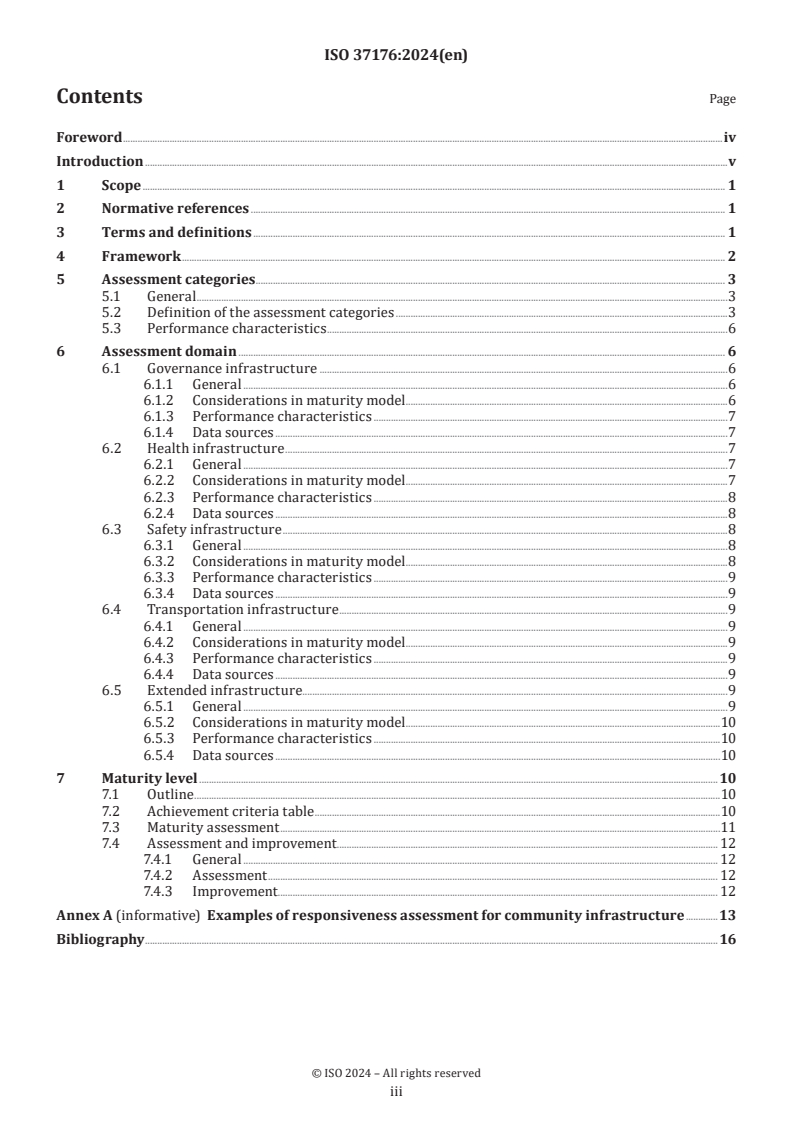
Contents Page
Foreword .iv
Introduction .v
1 Scope . 1
2 Normative references . 1
3 Terms and definitions . 1
4 Framework . 2
5 Assessment categories . 3
5.1 General .3
5.2 Definition of the assessment categories .3
5.3 Performance characteristics .6
6 Assessment domain . 6
6.1 Governance infrastructure .6
6.1.1 General .6
6.1.2 Considerations in maturity model .6
6.1.3 Performance characteristics .7
6.1.4 Data sources .7
6.2 Health infrastructure .7
6.2.1 General .7
6.2.2 Considerations in maturity model .7
6.2.3 Performance characteristics .8
6.2.4 Data sources .8
6.3 Safety infrastructure .8
6.3.1 General .8
6.3.2 Considerations in maturity model .8
6.3.3 Performance characteristics .9
6.3.4 Data sources .9
6.4 Transportation infrastructure .9
6.4.1 General .9
6.4.2 Considerations in maturity model .9
6.4.3 Performance characteristics .9
6.4.4 Data sources .9
6.5 Extended infrastructure . .9
6.5.1 General .9
6.5.2 Considerations in maturity model .10
6.5.3 Performance characteristics .10
6.5.4 Data sources .10
7 Maturity level . 10
7.1 Outline .10
7.2 Achievement criteria table .10
7.3 Maturity assessment .11
7.4 Assessment and improvement . . 12
7.4.1 General . 12
7.4.2 Assessment . 12
7.4.3 Improvement. 12
Annex A (informative) Examples of responsiveness assessment for community infrastructure .13
Bibliography .16
iii
Foreword
ISO (the International Organization for Standardization) is a worldwide federation of national standards
bodies (ISO member bodies). The work of preparing International Standards is normally carried out through
ISO technical committees. Each member body interested in a subject for which a technical committee
has been established has the right to be represented on that committee. International organizations,
governmental and non-governmental, in liaison with ISO, also take part in the work. ISO collaborates closely
with the International Electrotechnical Commission (IEC) on all matters of electrotechnical standardization.
The procedures used to develop this document and those intended for its further maintenance are described
in the ISO/IEC Directives, Part 1. In particular, the different approval criteria needed for the different types
of ISO document should be noted. This document was drafted in accordance with the editorial rules of the
ISO/IEC Directives, Part 2 (see www.iso.org/directives).
ISO draws attention to the possibility that the implementation of this document may involve the use of (a)
patent(s). ISO takes no position concerning the evidence, validity or applicability of any claimed patent
rights in respect thereof. As of the date of publication of this document, ISO had not received notice of (a)
patent(s) which may be required to implement this document. However, implementers are cautioned that
this may not represent the latest information, which may be obtained from the patent database available at
www.iso.org/patents. ISO shall not be held responsible for identifying any or all such patent rights.
Any trade name used in this document is information given for the convenience of users and does not
constitute an endorsement.
For an explanation of the voluntary nature of standards, the meaning of ISO specific terms and expressions
related to conformity assessment, as well as information about ISO's adherence to the World Trade
Organization (WTO) principles in the Technical Barriers to Trade (TBT), see www.iso.org/iso/foreword.html.
This document was prepared by Technical Committee ISO/TC 268, Sustainable cities and communities,
Subcommittee SC 1, Smart community infrastructures.
Any feedback or questions on this document should be directed to the user’s national standards body. A
complete listing of these bodies can be found at www.iso.org/members.html.
iv
Introduction
Residents play the leading role in the long-term development of communities. With the rapid development
of information technology (IT), the satisfaction of individuals’ needs matters most in the long-term
development of communities. Only when the needs of residents are fully and rapidly met can people's quality
of life be truly improved. For such a process, the rapid response from the community to the residents is an
essential component to measure the residents’ satisfaction with the community, which makes new demands
on the responsiveness of the community infrastructure.
ISO 37153 describes a community infrastructure maturity model (CIMM) and a standardized approach
for the assessment and improvement using the CIMM. However, ISO 37153 assesses the community
infrastructure, which does not focus on the importance of the interaction between residents and community.
At the same time, responsiveness is an important quality of community infrastructure, which has not been
focused on in existing standards.
This document describes a maturity assessment model for the responsiveness of community infrastructure
to measure whether the localised infrastructure is sufficiently adaptable to support changing needs. The
maturity assessment model takes into consideration the assessment domain and assessment categories
to evaluate the responsiveness of the community infrastructure. In this way, the degree of community
responsiveness can be known and used to promote the building of a more responsive community. The
community can make a rapid response to the residents’ needs by the agile responsiveness of the community
infrastructure. The essence of achieving the responsiveness of the community is to enhance the interaction
between the residents and the community.
v
International Standard ISO 37176:2024(en)
Smart community infrastructure — Responsiveness
assessment and maturity model
1 Scope
This document describes a maturity assessment model to evaluate the degree of responsiveness of the smart
community infrastructure with different maturity levels.
This document provides the assessment domain (e.g. governance infrastructure, health infrastructure),
categories (e.g. availability, affordability, safety and security, quality of service), and the criteria of maturity
levels to assess the responsiveness to promote the interaction between the residents and the community by
satisfying residents’ needs.
This document:
— clarifies the assessment domain associated with residents’ needs in the community;
— provides users with standardized assessment categories to measure the degree of responsiveness of the
smart community infrastructure.
This document is intended to be used by providers and operators of community infrastructure, community
planners and government decision-makers.
This document applies to all types of communities, regardless of their geographical location and size.
2 Normative references
There are no normative references in this document.
3 Terms and definitions
For the purposes of this document, the following terms and definitions apply.
ISO and IEC maintain terminology databases for use in standardization at the following addresses:
— ISO Online browsing platform: available at https:// www .iso .org/ obp
— IEC Electropedia: available at https:// www .electropedia .org/
3.1
community
group of people with an arrangement of responsibilities, activities and relationships
Note 1 to entry: In many, but not all, contexts, a community has a defined geographical boundary.
Note 2 to entry: A city is a type of community.
[SOURCE: ISO 37100:2016, 3.2.2]
3.2
responsive community infrastructure
community infrastructure that is built for making rapid and effective responses to residents’ increasingly
diversified needs
3.3
maturity model
model derived from one or more specified process assessment model(s) that identifies the process sets
associated with the levels in a specified scale of organizational process maturity
Note 1 to entry: The maturity model for the VSE profiles is defined in ISO/IEC/TR 29110-3-1:2015, Annex A.
[SOURCE: ISO/IEC 33001:2015, 3.3.7, modified — Note 1 to entry has been added]
3.4
community infrastructure maturity model
CIMM
maturity model applied to community infrastructure, which defines maturity levels in order to assess the
level of maturity of community infrastructure
[SOURCE: ISO 37153:2024, 3.5]
3.5
process
series of actions or events taking place in a defined manner leading to the accomplishment of an expected result
Note 1 to entry: “Defined” in this context does not necessarily mean documented. A defined process includes, but is not
limited to, adaptive means.
[SOURCE: ISO/IEC 15944-1:2011, 3.53, modified — Note 1 to entry has been added]
4 Framework
Users include people or citizens of the community and industry or enterprises. People or citizens of the
community are one of the major users of community infrastructures. Industries or enterprises which have
or plan to have activities in the community are another major type of users of community infrastructures.
Therefore, their perspectives are essential to identify community infrastructure performance metrics.
Users should follow a concrete process to assess the maturity of the community infrastructure. Faced with
residents' various needs, the requirements for community infrastructure are growing. The community
infrastructure should be equipped with responsive characteristics to make a rapid and effective response
to residents. Therefore, the inherent characteristics are utilized to assess the responsiveness maturity of
the community infrastructure. Five different levels which represent different responsiveness levels are
assigned to community infrastructure. Figure 1 shows the whole process of the maturity model.
Figure 1 — Framework of the responsiveness assessment and maturity model for community
infrastructure
5 Assessment categories
5.1 General
Users should follow the concrete assessment categories to measure the maturity level of the community
infrastructure, and the descriptions of each category are essential.
To assess the responsiveness of the community infrastructure by assessment categories, users should:
— comprehensively consider seven categories of the community infrastructure, including the availability,
accessibility, affordability, the safety and security, the quality of service and adaptability;
— evaluate the responsiveness of the community infrastructure by assessing these seven categories on
each community infrastructure.
5.2 Definition of the assessment categories
Assessment categories refer to concrete indicators that are used to comprehensively measure the
responsiveness of the community infrastructure. Users should define five assessment categories of
the maturity model for each assessment domain on its attribute. Each requirement for the community
infrastructure can be divided into six categories to measure the responsiveness of the community
infrastructure.
The assessment categories for each assessment domain are shown in Table 1.
Table 1 — Assessment categories for each assessment domain in maturity model
Domain Categories Relevant supporting documents
— ISO 37120, ISO 37122 and ISO 37123 provide guidance on how to
evaluate the indicators of governance.
Availability
— ISO 37151 provides guidance on evaluating the availability for
residents, including temporal coverage, area coverage, population
coverage and stability.
— ISO 37120, ISO 37122 and ISO 37123 provide guidance on how to
evaluate the indicators of governance.
Accessibility
— ISO 37151 provides guidance on evaluating the capability of being
accessed and used by a wide range of people.
— ISO 37120, ISO 37122 and ISO 37123 provide guidance on how to
evaluate the indicators of governance.
Affordability
— ISO 37151 provides guidance on evaluating the cost of the infra-
structure on governance.
Governance infra-
structure
— ISO 37120, ISO 37122 and ISO 37123 provide guidance on how to
evaluate the indicators of governance.
Safety and security
— ISO 37151 provides guidance on evaluating the safety, cyber secu-
rity and data privacy, and physical security.
— ISO 37120, ISO 37122 and ISO 37123 provide guidance on how to
evaluate the indicators of governance.
Quality of service
— ISO 37151 provides guidance on evaluating the service capacity,
easy procedures to understand and use, proper invoicing, community
infrastructure-specific qualities and the provision of information.
— ISO 37120, ISO 37122 and ISO 37123 provide guidance on how to
evaluate the indicators of governance.
Adaptability
— ISO 20887 provides guidance on evaluating the capability of
adapting to changing needs.
— ISO 37120, ISO 37122 and ISO 37123 provide guidance on how to
evaluate the indicators of health.
Availability
— ISO 37151 provides guidance on evaluating the availability for
residents, including temporal coverage, area coverage, population
coverage and stability.
— ISO 37120, ISO 37122 and ISO 37123 provide guidance on how to
evaluate the indicators of health.
Accessibility
— ISO 37151 provides guidance on evaluating the capability of being
accessed and used by a wide range of people.
— ISO 37120, ISO 37122 and ISO 37123 provide guidance on how to
evaluate the indicators of health.
Affordability
— ISO 37151 provides guidance on evaluating the cost on the infra-
structure on health.
Health infrastructure
— ISO 37120, ISO 37122 and ISO 37123 provide guidance on how to
evaluate the indicators of health.
Safety and security
— ISO 37151 provides guidance on evaluating the safety, cyber secu-
rity and data privacy, and physical security.
— ISO 37120, ISO 37122 and ISO 37123 provide guidance on how to
evaluate the indicators of health.
Quality of service
— ISO 37151 provides guidance on evaluating the service capacity,
easy procedure to understand and use, proper invoicing, community
infrastructure-specific qualities and provision of information.
— ISO 37120, ISO 37122 and ISO 37123 provide guidance on how to
evaluate the indicators of health.
Adaptability
— ISO 20887 provides guidance on evaluating the capability of
adapting to changing needs.
NOTE The categories of availability, accessibility, affordability, safety and security, and quality of service refer to ISO 37151. The
category of adaptability refers to ISO 20887.
TTabablele 1 1 ((ccoonnttiinnueuedd))
Domain Categories Relevant supporting documents
— ISO 37120, ISO 37122 and ISO 37123 provide guidance on how to
evaluate the indicators of safety.
Availability
— ISO 37151 provides guidance on evaluating the availability for
residents, including temporal coverage, area coverage, population
coverage and stability.
— ISO 37120, ISO 37122 and ISO 37123 provide guidance on how to
evaluate the indicators of safety.
Accessibility
— ISO 37151 provides guidance on evaluating the capability of being
accessed and used by a wide range of people.
— ISO 37120, ISO 37122 and ISO 37123 provide guidance on how to
evaluate the indicators of safety.
Affordability
— ISO 37151 provides guidance on evaluating the service price.
Safety infrastructure
— ISO 37120, ISO 37122 and ISO 37123 provide guidance on how to
evaluate the indicators of safety.
Safety and security
— ISO 37151 provides guidance on evaluating the safety, cyber secu-
rity and data privacy, and physical security.
— ISO 37120, ISO 37122 and ISO 37123 provide guidance on how to
evaluate the indicators of safety.
Quality of service
— ISO 37151 provides guidance on evaluating the service capacity,
easy procedure to understand and use, proper invoicing, community
infrastructure-specific qualities, and provision of information.
—ISO 37120, ISO 37122 and ISO 37123 provide guidance on how to
evaluate the indicators of safety.
Adaptability
— ISO 20887 provides guidance on evaluating the capability of
adapting to changing needs.
— ISO 37120, ISO 37122 and ISO 37123 provide guidance on how to
evaluate the indicators of transportation.
Availability
— ISO 37151 provides guidance on evaluating the availability for
residents, including temporal coverage, area coverage, population
coverage and stability.
— ISO 37120, ISO 37122 and ISO 37123 provide guidance on how to
evaluate the indicators of transportation.
Accessibility
— ISO 37151 provides guidance on evaluating the capability of being
accessed and used by a wide range of people.
— ISO 37120, ISO 37122 and ISO 37123 provide guidance on how to
evaluate the indicators of transportation.
Affordability
— ISO 37151 provides guidance on evaluating the service price.
Transportation infra-
— ISO 37120, ISO 37122 and ISO 37123 provide guidance on how to
structure
evaluate the indicators of transportation.
Safety and security
— ISO 37151
...