

ISO/FDIS 9455-8
(Main)Soft soldering fluxes — Test methods — Part 8: Determination of zinc content
- Abstract
Describes the principle, the reagents and materials, the apparatus, the test procedure, the calculation of results, the precision and the contents of the test report.
- Status
- Not Published
- Technical Committee
- ISO/TC 44/SC 12 - Soldering materials
- Drafting Committee
- ISO/TC 44/SC 12 - Soldering materials
- Current Stage
- 5020 - FDIS ballot initiated: 2 months. Proof sent to secretariat
- Start Date
- 10-Sep-2026
- Completion Date
- 10-Sep-2026
Buy Documents
ISO/FDIS 9455-8 - Soft soldering fluxes — Test methods — Part 8: Determination of zinc content
REDLINE ISO/FDIS 9455-8 - Soft soldering fluxes — Test methods — Part 8: Determination of zinc content
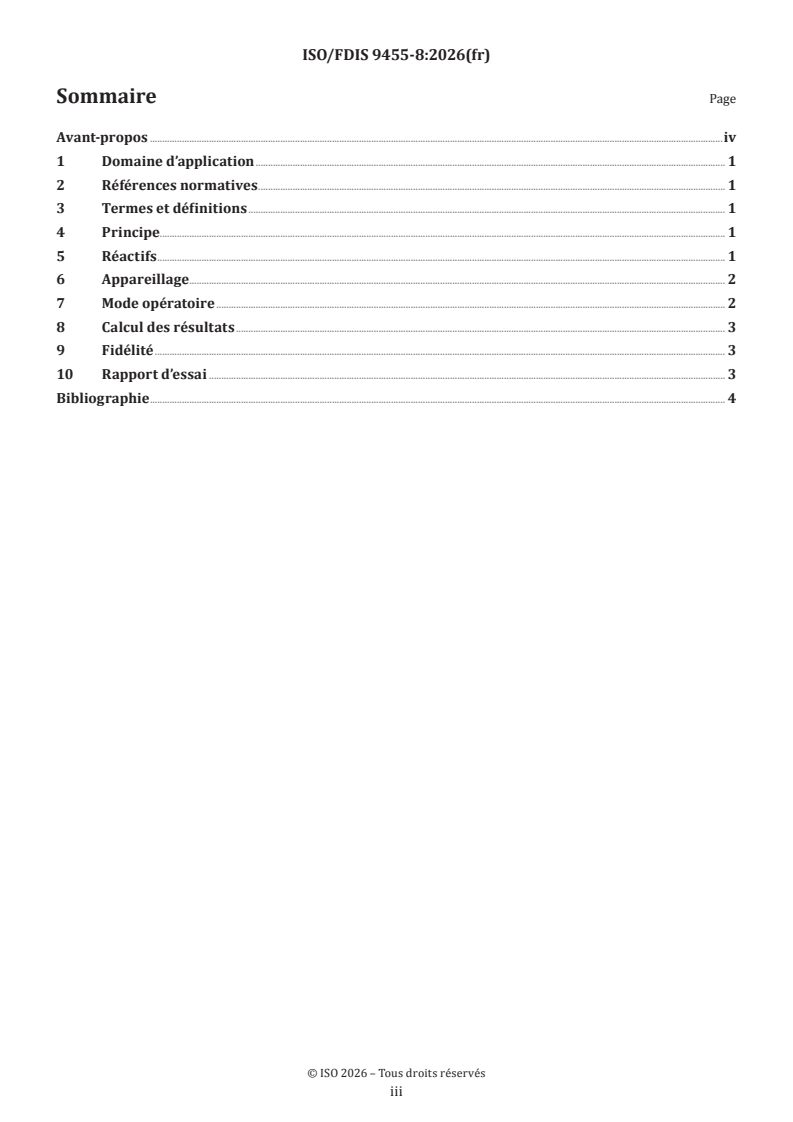
ISO/FDIS 9455-8 - Flux de brasage tendre — Méthodes d'essai — Partie 8: Dosage du zinc
ISO/FDIS 9455-8 is an ISO document at FDIS stage in the Soft soldering fluxes - Test methods series. It specifies a laboratory titration method for determining zinc content in water-soluble fluxes of type 3, with the result expressed as zinc chloride. The document is for people who need a repeatable way to test flux samples and report the zinc level in a traceable form.
What does ISO/FDIS 9455-8 specify?
ISO/FDIS 9455-8 specifies a method for measuring the zinc content of water-soluble soft soldering fluxes of type 3. The method is aimed at aqueous flux solutions with about 25% zinc, expressed as zinc chloride, and the sample amount should be adjusted when the concentration or physical form differs.
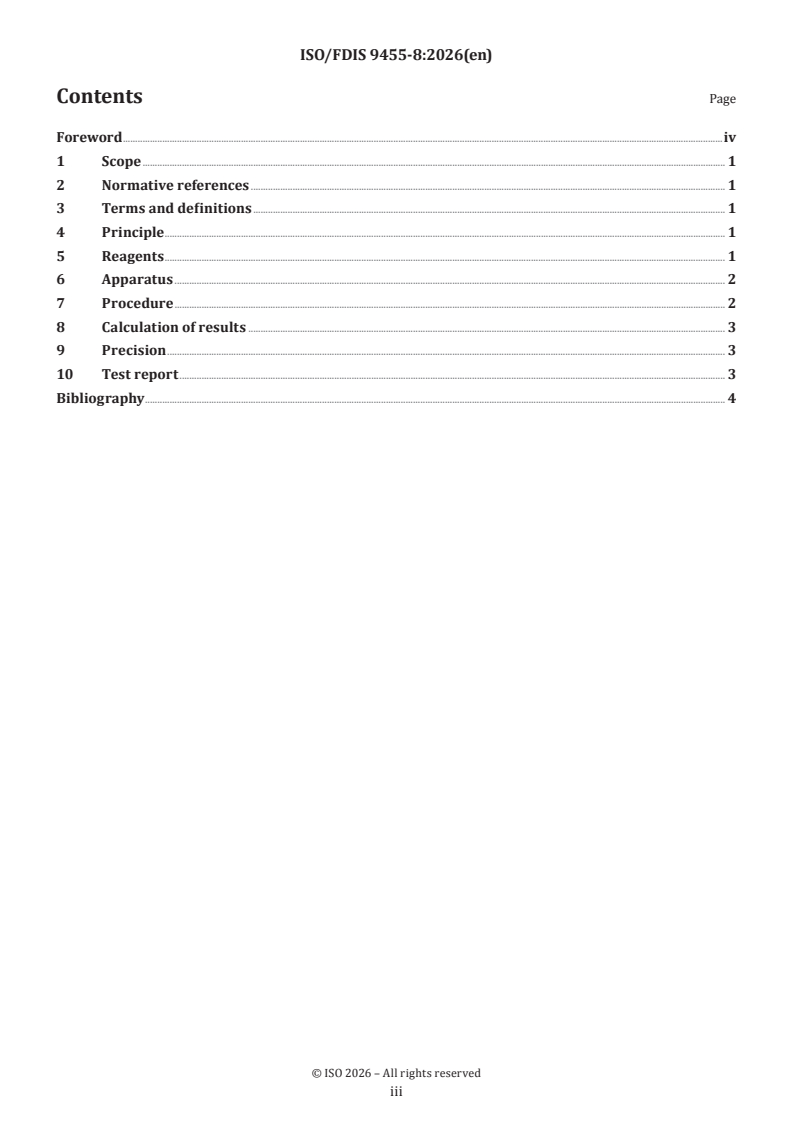
The document is organized into clauses on scope, normative references, terms and definitions, principle, reagents, apparatus, procedure, calculation of results, precision and test report, followed by a bibliography. That structure tells the reader exactly where to find the test chemistry, how to run the analysis, how to calculate the result, and what to record.
What are the key requirements of ISO/FDIS 9455-8?
Sample preparation and test conditions
Clause 7 requires triplicate determinations and starts from 25.0 ml of flux sample for the stated concentration range. If the flux is solid, it is dissolved in water first, and if the zinc level is far from the stated range, the sample volume is adjusted. In practice, this means the analyst must choose a sample size that keeps the titration within the method's working range.
Test principle
Clause 4 defines the analytical principle. The flux solution is treated with sulfuric acid, ammonium chloride and ammonia solution, any iron that precipitates is removed as hydroxide, and the zinc is then determined by titration with EDTA solution. This matters because iron can interfere with the measurement, so the separation step is part of the method, not an optional cleanup.
Reagents and water quality
Clause 5 says to use reagents of recognized analytical quality and distilled or deionized water only. It specifies the EDTA standard volumetric solution, buffer solution at pH 10, sulfuric acid solution, Eriochrome black T mixture, hydrochloric acid, ascorbic acid, ammonium chloride and ammonia solution. In practice, the listed reagent quality and compositions are needed to keep the end point and calculation consistent between laboratories.
Titration end point
Clause 7 calls for adding ascorbic acid, buffer solution and Eriochrome black T mixture, then titrating to a blue end point. The solution is first brought to a red-purple colour, and incandescent light can help detect the end point more clearly. This is the key observation step, so the analyst needs a stable colour change and a consistent way to judge it.
Calculation of results
Clause 8 expresses the zinc content of the original flux sample as zinc chloride using the volume of EDTA solution and the density of the sample at 20 °C. The method therefore needs a measured density value, not just the titration result. If a different sample volume is used or the material is solid, the calculation has to be adjusted.
Precision and reporting
Clause 9 gives precision data from tests on three zinc-containing fluxes and four laboratories, covering a range from 17% to 28% zinc chloride. Clause 10 lists the report items: sample identification, the method reference, results, unusual features and any non-standard or optional operations. That makes the test record usable for comparison, audits and quality control.
Who uses ISO/FDIS 9455-8?
ISO/FDIS 9455-8 is used by laboratories that test soft soldering fluxes for zinc content. It is also relevant to manufacturers, suppliers, quality teams and buyers who need agreed test results for water-soluble fluxes of type 3. In practice, it supports batch control, incoming inspection and product documentation.
What changed in ISO/FDIS 9455-8 from the previous edition?
ISO/FDIS 9455-8 is the second edition and cancels and replaces ISO 9455-8:1991. The foreword states that it is a minor revision and that the normative references were updated.
Which standards are used with ISO/FDIS 9455-8?
ISO 9454-1:2016, Soft soldering fluxes - Classification and requirements - Part 1: Classification, labelling and packaging, is cited in the scope for the definition of water-soluble fluxes of type 3. It provides the classification basis for the material being tested, so the user knows which flux family the zinc test applies to.
What does the ISO/FDIS 9455-8 document contain?
ISO/FDIS 9455-8 contains a full laboratory method rather than a product specification. It gives the principle, detailed reagent preparations, the apparatus needed, the step-by-step procedure, the calculation formula, precision data and the required contents of the test report.
The procedure section is the practical core: it shows how to prepare the sample, handle iron precipitation, develop the indicator colour and titrate to the end point. The calculation section turns the titration volume into zinc content, while the precision section helps users judge how much variation to expect between results.
The document also includes the foreword and bibliography, which place the method in the ISO 9455 series and point to the companion classification standard.
Relations
- Effective Date
- 12-Feb-2026
- Effective Date
- 23-Aug-2025
- Revises
ISO 9455-8:1991 - Soft soldering fluxes — Test methods — Part 8: Determination of zinc content - Effective Date
- 09-Aug-2025
Buy Documents
ISO/FDIS 9455-8 - Soft soldering fluxes — Test methods — Part 8: Determination of zinc content
REDLINE ISO/FDIS 9455-8 - Soft soldering fluxes — Test methods — Part 8: Determination of zinc content
ISO/FDIS 9455-8 - Flux de brasage tendre — Méthodes d'essai — Partie 8: Dosage du zinc
Get Certified
Connect with accredited certification bodies for this standard

DVS-ZERT GmbH
German welding certification society.
CARES (UK Certification Authority for Reinforcing Steels)
UK certification for reinforcing steels and construction.
EWF/IIW (European/International Welding Federation)
International welding personnel certification.
Sponsored listings
Frequently Asked Questions
ISO/FDIS 9455-8 is a draft published by the International Organization for Standardization (ISO). Its full title is "Soft soldering fluxes — Test methods — Part 8: Determination of zinc content". This standard covers: Describes the principle, the reagents and materials, the apparatus, the test procedure, the calculation of results, the precision and the contents of the test report.
Describes the principle, the reagents and materials, the apparatus, the test procedure, the calculation of results, the precision and the contents of the test report.
ISO/FDIS 9455-8 is classified under the following ICS (International Classification for Standards) categories: 25.160.50 - Brazing and soldering. The ICS classification helps identify the subject area and facilitates finding related standards.
ISO/FDIS 9455-8 has the following relationships with other standards: It is inter standard links to prEN ISO 9455-8, ISO 13325:2019/Amd 1:2023, ISO 9455-8:1991. Understanding these relationships helps ensure you are using the most current and applicable version of the standard.
ISO/FDIS 9455-8 is available in PDF format for immediate download after purchase. The document can be added to your cart and obtained through the secure checkout process. Digital delivery ensures instant access to the complete standard document.
Standards Content (Sample)
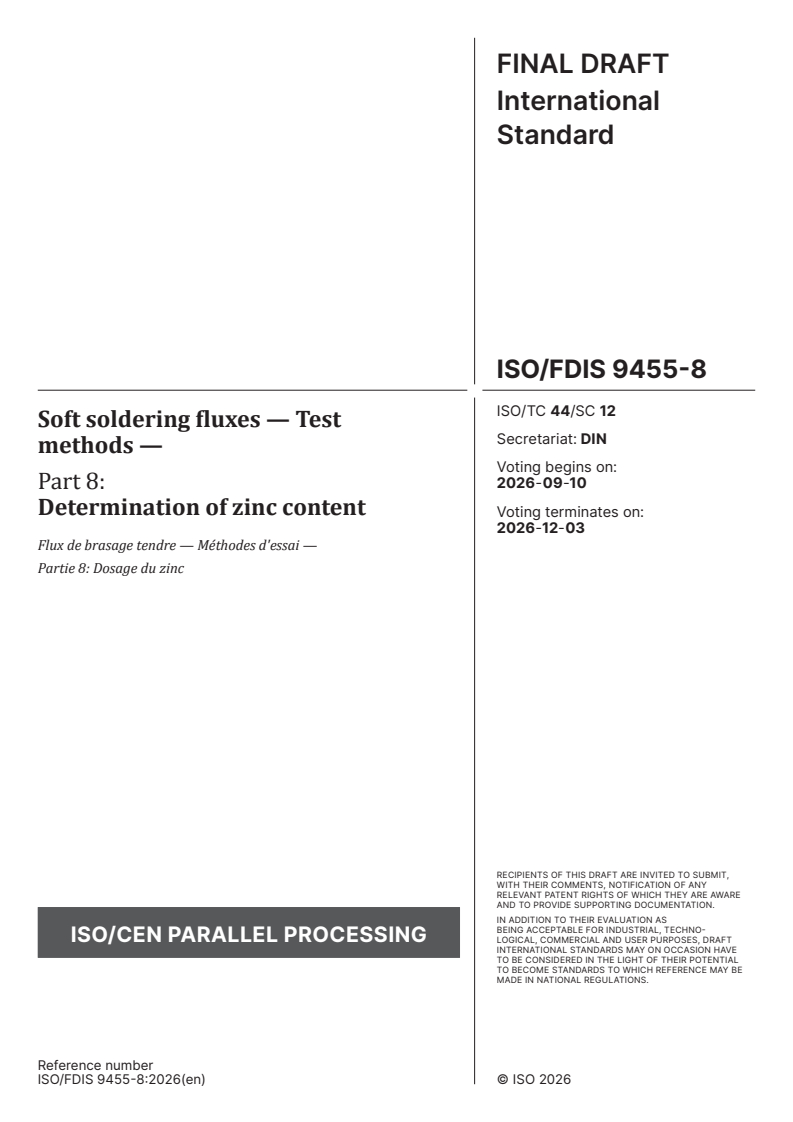
FINAL DRAFT
International
Standard
ISO/TC 44/SC 12
Soft soldering fluxes — Test
Secretariat: DIN
methods —
Voting begins on:
2026-09-10
Part 8:
Determination of zinc content
Voting terminates on:
2026-12-03
Flux de brasage tendre — Méthodes d'essai —
Partie 8: Dosage du zinc
RECIPIENTS OF THIS DRAFT ARE INVITED TO SUBMIT,
WITH THEIR COMMENTS, NOTIFICATION OF ANY
RELEVANT PATENT RIGHTS OF WHICH THEY ARE AWARE
AND TO PROVIDE SUPPOR TING DOCUMENTATION.
IN ADDITION TO THEIR EVALUATION AS
BEING ACCEPTABLE FOR INDUSTRIAL, TECHNO-
ISO/CEN PARALLEL PROCESSING LOGICAL, COMMERCIAL AND USER PURPOSES, DRAFT
INTERNATIONAL STANDARDS MAY ON OCCASION HAVE
TO BE CONSIDERED IN THE LIGHT OF THEIR POTENTIAL
TO BECOME STAN DARDS TO WHICH REFERENCE MAY BE
MADE IN NATIONAL REGULATIONS.
Reference number
FINAL DRAFT
International
Standard
ISO/TC 44/SC 12
Soft soldering fluxes — Test
Secretariat: DIN
methods —
Voting begins on:
Part 8:
Determination of zinc content
Voting terminates on:
Flux de brasage tendre — Méthodes d'essai —
Partie 8: Dosage du zinc
RECIPIENTS OF THIS DRAFT ARE INVITED TO SUBMIT,
WITH THEIR COMMENTS, NOTIFICATION OF ANY
RELEVANT PATENT RIGHTS OF WHICH THEY ARE AWARE
AND TO PROVIDE SUPPOR TING DOCUMENTATION.
© ISO 2026
IN ADDITION TO THEIR EVALUATION AS
All rights reserved. Unless otherwise specified, or required in the context of its implementation, no part of this publication may
BEING ACCEPTABLE FOR INDUSTRIAL, TECHNO-
ISO/CEN PARALLEL PROCESSING
LOGICAL, COMMERCIAL AND USER PURPOSES, DRAFT
be reproduced or utilized otherwise in any form or by any means, electronic or mechanical, including photocopying, or posting on
INTERNATIONAL STANDARDS MAY ON OCCASION HAVE
the internet or an intranet, without prior written permission. Permission can be requested from either ISO at the address below
TO BE CONSIDERED IN THE LIGHT OF THEIR POTENTIAL
or ISO’s member body in the country of the requester.
TO BECOME STAN DARDS TO WHICH REFERENCE MAY BE
MADE IN NATIONAL REGULATIONS.
ISO copyright office
CP 401 • Ch. de Blandonnet 8
CH-1214 Vernier, Geneva
Phone: +41 22 749 01 11
Email: copyright@iso.org
Website: www.iso.org
Published in Switzerland Reference number
ii
Contents Page
Foreword .iv
1 Scope . 1
2 Normative references . 1
3 Terms and definitions . 1
4 Principle . 1
5 Reagents . 1
6 Apparatus . 2
7 Procedure . 2
8 Calculation of results . 3
9 Precision . 3
10 Test report . 3
Bibliography . 4
iii
Foreword
ISO (the International Organization for Standardization) is a worldwide federation of national standards
bodies (ISO member bodies). The work of preparing International Standards is normally carried out through
ISO technical committees. Each member body interested in a subject for which a technical committee
has been established has the right to be represented on that committee. International organizations,
governmental and non-governmental, in liaison with ISO, also take part in the work. ISO collaborates closely
with the International Electrotechnical Commission (IEC) on all matters of electrotechnical standardization.
The procedures used to develop this document and those intended for its further maintenance are described
in the ISO/IEC Directives, Part 1. In particular, the different approval criteria needed for the different types
of ISO document should be noted. This document was drafted in accordance with the editorial rules of the
ISO/IEC Directives, Part 2 (see www.iso.org/directives).
ISO draws attention to the possibility that the implementation of this document may involve the use of (a)
patent(s). ISO takes no position concerning the evidence, validity or applicability of any claimed patent
rights in respect thereof. As of the date of publication of this document, ISO had not received notice of (a)
patent(s) which may be required to implement this document. However, implementers are cautioned that
this may not represent the latest information, which may be obtained from the patent database available at
www.iso.org/patents. ISO shall not be held responsible for identifying any or all such patent rights.
Any trade name used in this document is information given for the convenience of users and does not
constitute an endorsement. For an explanation of the voluntary nature of standards, the meaning of ISO
specific terms and expressions related to conformity assessment, as well a
...
ISO/TC 44/SC 12
Secretariat: DIN
Date: 2026-0608-26
Soft soldering fluxes — Test methods —
Part 8:
Determination of zinc content
Flux de brasage tendre — Méthodes d'essai —
Partie 8: Dosage du zinc
FDIS stage
ThiThiThiThiThiThiThiThiThiThis drs drs drs drs drs drs drs drs drs drafafafafafafafafafaft is t is t is t is t is t is t is t is t is t is submitted tsubmitted tsubmitted tsubmitted tsubmitted tsubmitted tsubmitted tsubmitted tsubmitted tsubmitted toooooooooo a a a a a a a a a a p p p p p p p p p parallel arallel arallel arallel arallel arallel arallel arallel arallel arallel vovovovovovovovovovote in ISOte in ISOte in ISOte in ISOte in ISOte in ISOte in ISOte in ISOte in ISOte in ISO, CE, CE, CE, CE, CE, CE, CE, CE, CE, CEN.N.N.N.N.N.N.N.N.N.
All rights reserved. Unless otherwise specified, or required in the context of its implementation, no part of this publication
may be reproduced or utilized otherwise in any form or by any means, electronic or mechanical, including photocopying,
or posting on the internet or an intranet, without prior written permission. Permission can be requested from either ISO
at the address below or ISO’s member body in the country of the requester.
ISO copyright office
CP 401 • Ch. de Blandonnet 8
CH-1214 Vernier, Geneva
Phone: + 41 22 749 01 11
E-mail: copyright@iso.org
Website: www.iso.org
Published in Switzerland
ii
Contents
Foreword . iii
Scope . iii
Normative references . iii
Terms and definitions . iii
Principle. iii
Reagents . iii
Apparatus . iii
Procedure . iii
Calculation of results . iii
Precision . iii
Test report . iii
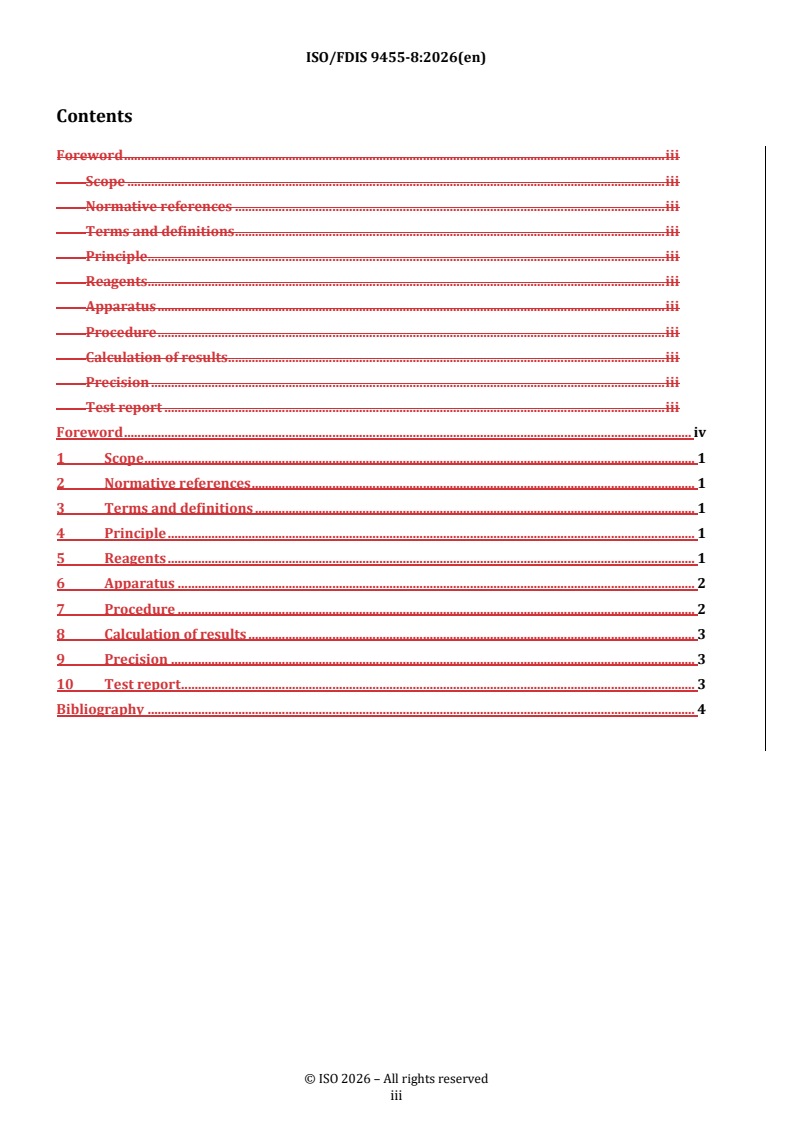
Foreword . iv
1 Scope . 1
2 Normative references . 1
3 Terms and definitions . 1
4 Principle . 1
5 Reagents . 1
6 Apparatus . 2
7 Procedure . 2
8 Calculation of results . 3
9 Precision . 3
10 Test report . 3
Bibliography . 4
iii
Foreword
ISO (the International Organization for Standardization) is a worldwide federation of national standards
bodies (ISO member bodies). The work of preparing International Standards is normally carried out through
ISO technical committees. Each member body interested in a subject for which a technical committee has been
established has the right to be represented on that committee. International organizations, governmental and
non-governmental, in liaison with ISO, also take part in the work. ISO collaborates closely with the
International Electrotechnical Commission (IEC) on all matters of electrotechnical standardization.
Draft International Standards adopted by the technical committees are circulated to the member bodies for
voting. Publication as an International Standard requires approval by at least 75 % of the member bodies
casting a vote.
International Standard ISO 9455-8The procedures used to develop this document and those intended for its
further maintenance are described in the ISO/IEC Directives, Part 1. In particular, the different approval
criteria needed for the different types of ISO document should be noted. This document was drafted in
accordance with the editorial rules of the ISO/IEC Directives, Part 2 (see www.iso.org/directives).
ISO draws attention to the possibility that the implementation of this document may involve the use of (a)
patent(s). ISO takes no position concerning the evidence, validity or applicability of any claimed patent rights
in respect thereof. As of the date of publication of this document, ISO had not received notice of (a) patent(s)
which may be required to implement this document. However, implementers are cautioned that this may not
represent the latest information, which may be obtained from the patent database available at
www.iso.org/patents. ISO shall not be held responsible for identifying any or all such patent rights.
Any trade name used in this document is information given for the convenience of users and does not
constitute an endorsement. For an explanation of the voluntary nature of standards, the meaning of ISO
specific terms and expressions related to conformity assessment, as well as information about ISO's adherence
to the World Trade Organization (WTO) principles in the Technical Barriers to Trade (TBT), see
www.iso.org/iso/foreword.html.
This document was prepared by Technical Committee ISO/TC 44, Welding and allied processes, Sub-
Committee SC 12, Soldering and brazing materials., in collaboration with the European Committee for
Standardization (CEN) Technical Committee CEN/TC 121, Welding and allied processes, in accordance with the
Agreement on technical cooperation between ISO and CEN (Vienna Agreement).
Th
...
PROJET FINAL
Norme
internationale
ISO/TC 44/SC 12
Flux de brasage tendre — Méthodes
Secrétariat: DIN
d'essai —
Début de vote:
2026-09-10
Partie 8:
Dosage du zinc
Vote clos le:
2026-12-03
Soft soldering fluxes — Test methods —
Part 8: Determination of zinc content
LES DESTINATAIRES DU PRÉSENT PROJET SONT
INVITÉS À PRÉSENTER, AVEC LEURS OBSERVATIONS,
NOTIFICATION DES DROITS DE PROPRIÉTÉ DONT ILS
AURAIENT ÉVENTUELLEMENT CONNAISSANCE ET À
FOURNIR UNE DOCUMENTATION EXPLICATIVE.
OUTRE LE FAIT D’ÊTRE EXAMINÉS POUR
ÉTABLIR S’ILS SONT ACCEPTABLES À DES FINS
INDUSTRIELLES, TECHNOLOGIQUES ET COM-MERCIALES,
AINSI QUE DU POINT DE VUE DES UTILISATEURS, LES
PROJETS DE NORMES
TRAITEMENT PARALLÈLE ISO/CEN
INTERNATIONALES DOIVENT PARFOIS ÊTRE CONSIDÉRÉS
DU POINT DE VUE DE LEUR POSSI BILITÉ DE DEVENIR DES
NORMES POUVANT
SERVIR DE RÉFÉRENCE DANS LA RÉGLEMENTATION
NATIONALE.
Numéro de référence
PROJET FINAL
Norme
internationale
ISO/TC 44/SC 12
Flux de brasage tendre — Méthodes
Secrétariat: DIN
d'essai —
Début de vote:
Partie 8: 2026-09-10
Dosage du zinc
Vote clos le:
2026-12-03
Soft soldering fluxes — Test methods —
Part 8: Determination of zinc content
LES DESTINATAIRES DU PRÉSENT PROJET SONT
INVITÉS À PRÉSENTER, AVEC LEURS OBSERVATIONS,
NOTIFICATION DES DROITS DE PROPRIÉTÉ DONT ILS
AURAIENT ÉVENTUELLEMENT CONNAISSANCE ET À
FOURNIR UNE DOCUMENTATION EXPLICATIVE.
DOCUMENT PROTÉGÉ PAR COPYRIGHT
OUTRE LE FAIT D’ÊTRE EXAMINÉS POUR
ÉTABLIR S’ILS SONT ACCEPTABLES À DES FINS
© ISO 2026 INDUSTRIELLES, TECHNOLOGIQUES ET COM-MERCIALES,
AINSI QUE DU POINT DE VUE DES UTILISATEURS, LES
Tous droits réservés. Sauf prescription différente ou nécessité dans le contexte de sa mise en œuvre, aucune partie de cette
PROJETS DE NORMES
TRAITEMENT PARALLÈLE ISO/CEN
INTERNATIONALES DOIVENT PARFOIS ÊTRE CONSIDÉRÉS
publication ne peut être reproduite ni utilisée sous quelque forme que ce soit et par aucun procédé, électronique ou mécanique,
DU POINT DE VUE DE LEUR POSSI BILITÉ DE DEVENIR DES
y compris la photocopie, ou la diffusion sur l’internet ou sur un intranet, sans autorisation écrite préalable. Une autorisation peut
NORMES POUVANT
être demandée à l’ISO à l’adresse ci-après ou au comité membre de l’ISO dans le pays du demandeur.
SERVIR DE RÉFÉRENCE DANS LA RÉGLEMENTATION
NATIONALE.
ISO copyright office
Case postale 401 • Ch. de Blandonnet 8
CH-1214 Vernier, Genève
Tél.: +41 22 749 01 11
E-mail: copyright@iso.org
Web: www.iso.org
Publié en Suisse Numéro de référence
ii
Sommaire Page
Avant-propos .iv
1 Domaine d’application . 1
2 Références normatives . 1
3 Termes et définitions . 1
4 Principe. 1
5 Réactifs . 1
6 Appareillage . 2
7 Mode opératoire . 2
8 Calcul des résultats . 3
9 Fidélité . 3
10 Rapport d’essai . 3
Bibliographie . 4
iii
Avant-propos
L'ISO (Organisation internationale de normalisation) est une fédération mondiale d'organismes nationaux
de normalisation (comités membres de l'ISO). L'élaboration des Normes internationales est en général
confiée aux comités techniques de l'ISO. Chaque comité membre intéressé par une étude a le droit de faire
partie du comité technique créé à cet effet. Les organisations internationales, gouvernementales et non
gouvernementales, en liaison avec l'ISO participent également aux travaux. L'ISO collabore étroitement avec
la Commission électrotechnique internationale (IEC) en ce qui concerne la normalisation électrotechnique.
Les procédures utilisées pour élaborer le présent document et celles destinées à sa mise à jour sont
décrites dans les Directives ISO/IEC, Partie 1. Il convient, en particulier, de prendre note des différents
critères d'approbation requis pour les différents types de documents ISO. Le présent document a
été rédigé conformément aux règles de rédaction données dans les Directives ISO/IEC, Partie 2 (voir
www.iso.org/directives).
L’ISO attire l’attention sur le fait que la mise en application du présent document peut entraîner l’utilisation
d’un ou de plusieurs brevets. L’ISO ne prend pas position quant à la preuve, à la validité et à l’applicabilité de
tout droit de brevet revendiqué à cet égard. À la date de publication du présent document, l’ISO n'avait pas
reçu notification qu’un ou plusieurs brevets pouvaient être nécessaires à sa mise en application. Toutefois,
il y a lieu d’avertir les responsables de la mise en application du présent document que des informations
plus récentes sont susceptibles de figurer dans la base de données de brevets, disponible à l'adresse
www.iso.org/brevets. L’ISO ne saurait être tenue pour responsable de ne pas avoir identifié tout ou partie de
tels droits de propriété.
Les appellations commerciales éventuellement mentionnées dans le présent document sont données pour
information, par souci de commodité, à l’intention des utilisateurs et ne sauraient constituer un engagement.
Pour une explication de la nature volontaire des normes, la signification des termes et expressions
spécifiques de l'ISO liés à l'évaluation de la conformité, ou pour toute information au sujet de l'adhésion de
l'ISO aux principes de l’Organisation mondiale du commerce (OMC) con
...