

ISO 15613:2025
(Main)Specification and qualification of welding procedures for metallic materials — Qualification based on a pre-production welding test
General Information
- Abstract
This document specifies how a preliminary welding procedure specification is qualified based on a pre-production welding test. This document is applicable to arc welding, gas welding, beam welding, resistance welding, stud welding and friction welding of metallic materials.
- Status
- Published
- Publication Date
- 17-Aug-2025
- Technical Committee
- ISO/TC 44/SC 10 - Quality management in the field of welding
- Drafting Committee
- ISO/TC 44/SC 10 - Quality management in the field of welding
- Current Stage
- 6060 - International Standard published
- Start Date
- 18-Aug-2025
- Due Date
- 22-Sep-2023
- Completion Date
- 18-Aug-2025
Buy Documents
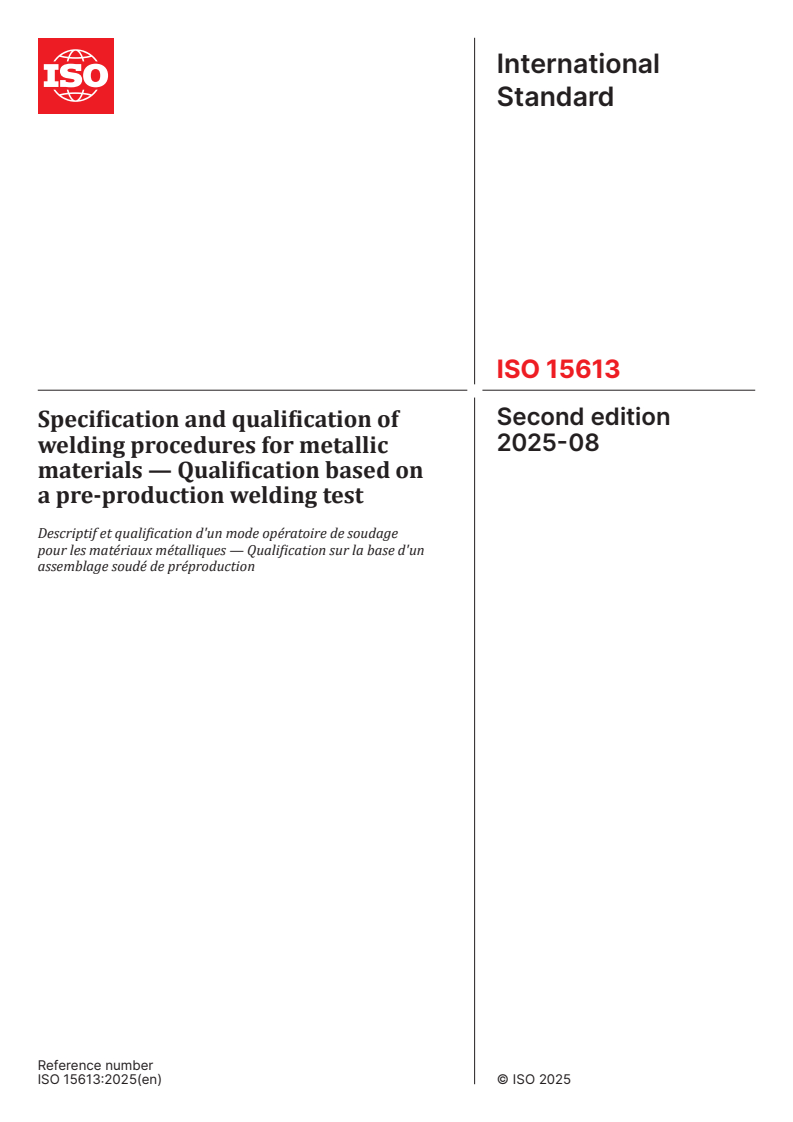
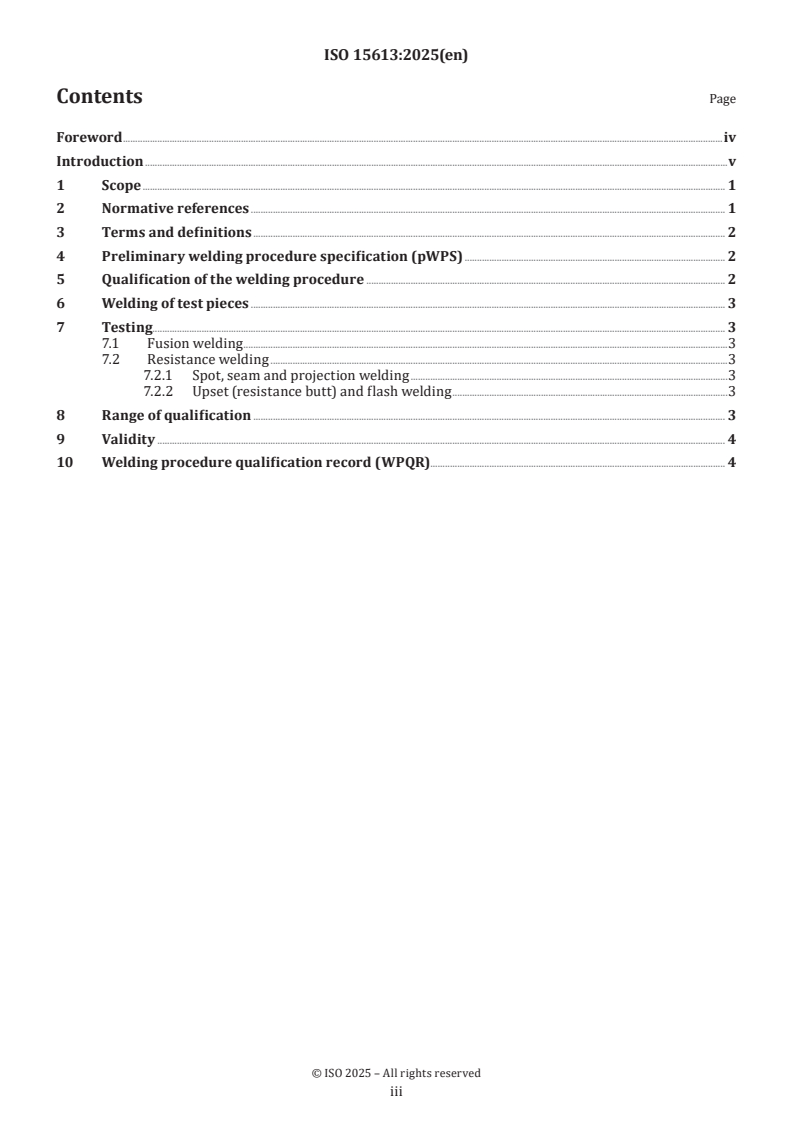
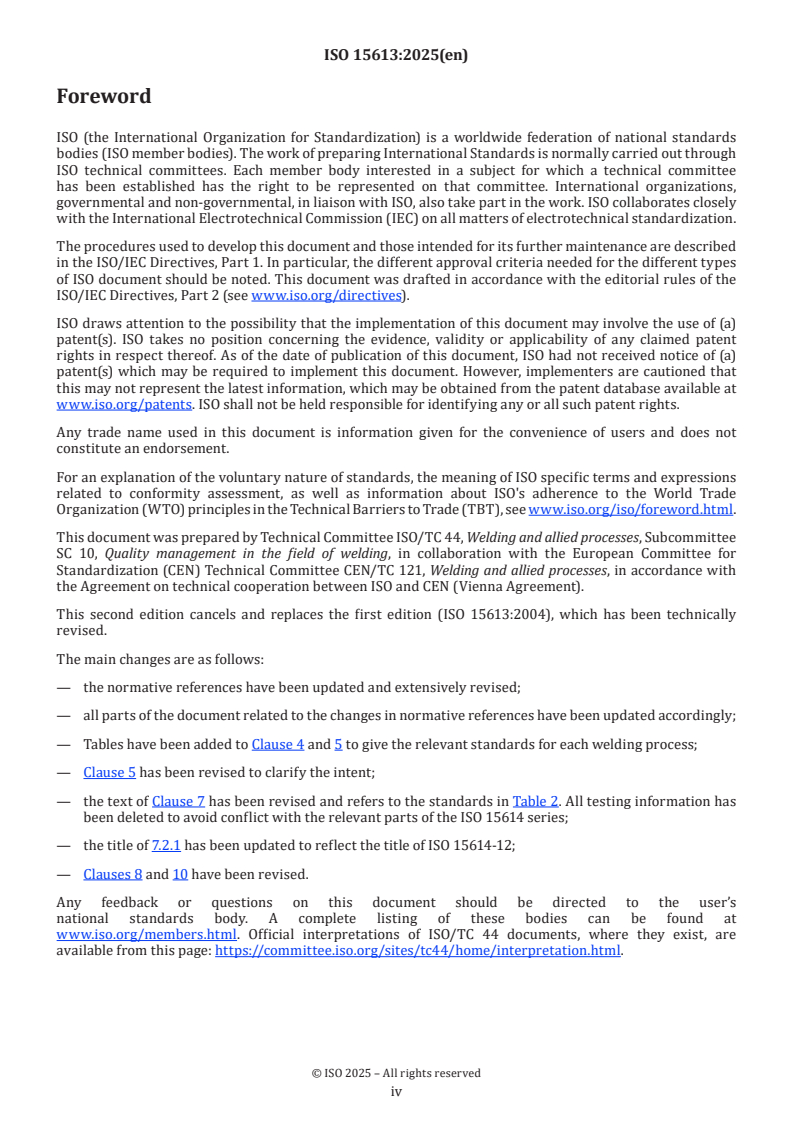
ISO 15613:2025 - Specification and qualification of welding procedures for metallic materials — Qualification based on a pre-production welding test Released:18. 08. 2025
ISO 15613:2025 - Descriptif et qualification d'un mode opératoire de soudage pour les matériaux métalliques — Qualification sur la base d'un assemblage soudé de préproduction Released:18. 08. 2025
Overview
ISO 15613:2025 - Specification and qualification of welding procedures for metallic materials - defines how a preliminary welding procedure specification (DMOS‑P) is qualified using a pre‑production welding test (an assembly welded to simulate production). The standard applies to a wide range of processes, including arc welding, gas welding, beam welding, resistance welding, stud welding and friction welding, and sets out how qualification assemblies, testing, examination and the resulting qualification record (PV‑QMOS) are to be handled.
Key topics and requirements
- Scope of qualification: Qualification is based on one or more pre‑production assemblies designed to reproduce essential characteristics of the real production weld - e.g., dimensions, fixturing, thermal dissipation, accessibility and welding positions.
- Preliminary welding procedure specification (DMOS‑P): A DMOS‑P must be prepared in accordance with the appropriate ISO 15609 part for the welding process (see Related Standards).
- Who performs qualification: An authorised examiner or examination body must carry out qualification in line with the applicable ISO 15614 part for the welding process (see Table mapping in the standard).
- Controls, examination and testing: Where technically possible, tests and inspections of qualification assemblies follow the relevant ISO 15614 parts (for fusion welding) or ISO 15614‑12 / 15614‑13 (for resistance welding). When ISO 15614‑1 is used, level 2 is the default examination level unless otherwise specified.
- Use of real components and production tooling: Qualification assemblies should use actual production components, fixtures and jigs where practicable. Tack welds present in production should be included in the qualification assembly.
- Range and validity: The qualification is limited to the specific assembly type used for the pre‑production test. Thickness limits apply to each component and to weld thickness. For resistance welding, qualification validity is tied to the specific pre‑production assembly and comparable PV‑QMOS records may be considered if equipment, electrodes, materials and parameters are comparable.
- Documentation: The outcome is recorded in a PV‑QMOS (qualification certificate) with defined domain and duration of validity; a qualified WPS remains valid only while production welding falls within that domain.
Applications
ISO 15613:2025 is used to qualify welding procedures when standard test coupons do not represent the complexity of real assemblies. Typical practical applications:
- Qualifying procedures for complex, large or restrained fabrications
- Validating procedures where thermal dissipation, clamping or accessibility significantly influence weld quality
- Ensuring production welding conforms to a qualified DMOS‑P through a documented PV‑QMOS
Who uses this standard
- Welding engineers and procedure writers
- QA/QC and NDT inspectors
- Welding examiners and certification bodies
- Fabricators in sectors requiring documented welding qualification (heavy fabrication, pressure equipment, transportation, energy and specialized manufacturing)
Related standards
- ISO 15607 (general rules)
- ISO 15609‑1 to ISO 15609‑6 (DMOS formats by process)
- ISO 15614 series (qualification test methods)
- ISO 25901 (welding vocabulary)
Keywords: ISO 15613:2025, welding procedure qualification, pre‑production welding test, DMOS‑P, PV‑QMOS, welding standards, metallic materials.
Relations
- Effective Date
- 25-Feb-2026
- Effective Date
- 12-Feb-2026
- Consolidates
ISO 10535:2021 - Assistive products — Hoists for the transfer of persons — Requirements and test methods - Effective Date
- 06-Jun-2022
- Effective Date
- 06-Jun-2022
Buy Documents
ISO 15613:2025 - Specification and qualification of welding procedures for metallic materials — Qualification based on a pre-production welding test Released:18. 08. 2025
ISO 15613:2025 - Descriptif et qualification d'un mode opératoire de soudage pour les matériaux métalliques — Qualification sur la base d'un assemblage soudé de préproduction Released:18. 08. 2025
Get Certified
Connect with accredited certification bodies for this standard

DVS-ZERT GmbH
German welding certification society.
CARES (UK Certification Authority for Reinforcing Steels)
UK certification for reinforcing steels and construction.
EWF/IIW (European/International Welding Federation)
International welding personnel certification.
Sponsored listings
Frequently Asked Questions
ISO 15613:2025 is a standard published by the International Organization for Standardization (ISO). Its full title is "Specification and qualification of welding procedures for metallic materials — Qualification based on a pre-production welding test". This standard covers: This document specifies how a preliminary welding procedure specification is qualified based on a pre-production welding test. This document is applicable to arc welding, gas welding, beam welding, resistance welding, stud welding and friction welding of metallic materials.
This document specifies how a preliminary welding procedure specification is qualified based on a pre-production welding test. This document is applicable to arc welding, gas welding, beam welding, resistance welding, stud welding and friction welding of metallic materials.
ISO 15613:2025 is classified under the following ICS (International Classification for Standards) categories: 25.160.10 - Welding processes. The ICS classification helps identify the subject area and facilitates finding related standards.
ISO 15613:2025 has the following relationships with other standards: It is inter standard links to EN ISO 15614-2:2025, EN ISO 15613:2025, ISO 10535:2021, ISO 15613:2004. Understanding these relationships helps ensure you are using the most current and applicable version of the standard.
ISO 15613:2025 is available in PDF format for immediate download after purchase. The document can be added to your cart and obtained through the secure checkout process. Digital delivery ensures instant access to the complete standard document.
Standards Content (Sample)
International
Standard
ISO 15613
Second edition
Specification and qualification of
2025-08
welding procedures for metallic
materials — Qualification based on
a pre-production welding test
Descriptif et qualification d'un mode opératoire de soudage
pour les matériaux métalliques — Qualification sur la base d'un
assemblage soudé de préproduction
Reference number
© ISO 2025
All rights reserved. Unless otherwise specified, or required in the context of its implementation, no part of this publication may
be reproduced or utilized otherwise in any form or by any means, electronic or mechanical, including photocopying, or posting on
the internet or an intranet, without prior written permission. Permission can be requested from either ISO at the address below
or ISO’s member body in the country of the requester.
ISO copyright office
CP 401 • Ch. de Blandonnet 8
CH-1214 Vernier, Geneva
Phone: +41 22 749 01 11
Email: copyright@iso.org
Website: www.iso.org
Published in Switzerland
ii
Contents Page
Foreword .iv
Introduction .v
1 Scope . 1
2 Normative references . 1
3 Terms and definitions . 2
4 Preliminary welding procedure specification (pWPS) . 2
5 Qualification of the welding procedure . 2
6 Welding of test pieces . 3
7 Testing. 3
7.1 Fusion welding .3
7.2 Resistance welding .3
7.2.1 Spot, seam and projection welding .3
7.2.2 Upset (resistance butt) and flash welding .3
8 Range of qualification . 3
9 Validity .4
10 Welding procedure qualification record (WPQR).4
iii
Foreword
ISO (the International Organization for Standardization) is a worldwide federation of national standards
bodies (ISO member bodies). The work of preparing International Standards is normally carried out through
ISO technical committees. Each member body interested in a subject for which a technical committee
has been established has the right to be represented on that committee. International organizations,
governmental and non-governmental, in liaison with ISO, also take part in the work. ISO collaborates closely
with the International Electrotechnical Commission (IEC) on all matters of electrotechnical standardization.
The procedures used to develop this document and those intended for its further maintenance are described
in the ISO/IEC Directives, Part 1. In particular, the different approval criteria needed for the different types
of ISO document should be noted. This document was drafted in accordance with the editorial rules of the
ISO/IEC Directives, Part 2 (see www.iso.org/directives).
ISO draws attention to the possibility that the implementation of this document may involve the use of (a)
patent(s). ISO takes no position concerning the evidence, validity or applicability of any claimed patent
rights in respect thereof. As of the date of publication of this document, ISO had not received notice of (a)
patent(s) which may be required to implement this document. However, implementers are cautioned that
this may not represent the latest information, which may be obtained from the patent database available at
www.iso.org/patents. ISO shall not be held responsible for identifying any or all such patent rights.
Any trade name used in this document is information given for the convenience of users and does not
constitute an endorsement.
For an explanation of the voluntary nature of standards, the meaning of ISO specific terms and expressions
related to conformity assessment, as well as information about ISO's adherence to the World Trade
Organization (WTO) principles in the Technical Barriers to Trade (TBT), see www.iso.org/iso/foreword.html.
This document was prepared by Technical Committee ISO/TC 44, Welding and allied processes, Subcommittee
SC 10, Quality management in the field of welding, in collaboration with the European Committee for
Standardization (CEN) Technical Committee CEN/TC 121, Welding and allied processes, in accordance with
the Agreement on technical cooperation between ISO and CEN (Vienna Agreement).
This second edition cancels and replaces the first edition (ISO 15613:2004), which has been technically
revised.
The main changes are as follows:
— the normative references have been updated and extensively revised;
— all parts of the document related to the changes in normative references have been updated accordingly;
— Tables have been added to Clause 4 and 5 to give the relevant standards for each welding process;
— Clause 5 has been revised to clarify the intent;
— the text of Clause 7 has been revised and refers to the standards in Table 2. All testing information has
been deleted to avoid conflict with the relevant parts of the ISO 15614 series;
— the title of 7.2.1 has been updated to reflect the title of ISO 15614-12;
— Clauses 8 and 10 have been revised.
Any feedback or questions on this document should be directed to the user’s
national standards body. A complete listing of these bodies can be found at
www.iso.org/members.html. Official interpretations of ISO/TC 44 documents, where they exist, are
available from this page: https://committee.iso.org/sites/tc44/home/interpretation.html.
iv
Introduction
One of the methods for welding procedure qualification is based on a pre-production welding test as given
in ISO 15607.
Qualification based on a pre-production welding test can be used where the shape and dimensions of the
standard test pieces do not adequately represent the joint to be welded.
In such cases, one or more special test pieces can be made to simulate the production joint in all essential
features, for example dimensions, restraint, heat sink effects and limited access.
This document is one of a number of standards dealing with specification and qualification of welding
procedures. Detai
...
Norme
internationale
ISO 15613
Deuxième édition
Descriptif et qualification d'un
2025-08
mode opératoire de soudage pour
les matériaux métalliques —
Qualification sur la base d'un
assemblage soudé de préproduction
Specification and qualification of welding procedures for metallic
materials — Qualification based on a pre-production welding test
Numéro de référence
DOCUMENT PROTÉGÉ PAR COPYRIGHT
© ISO 2025
Tous droits réservés. Sauf prescription différente ou nécessité dans le contexte de sa mise en œuvre, aucune partie de cette
publication ne peut être reproduite ni utilisée sous quelque forme que ce soit et par aucun procédé, électronique ou mécanique,
y compris la photocopie, ou la diffusion sur l’internet ou sur un intranet, sans autorisation écrite préalable. Une autorisation peut
être demandée à l’ISO à l’adresse ci-après ou au comité membre de l’ISO dans le pays du demandeur.
ISO copyright office
Case postale 401 • Ch. de Blandonnet 8
CH-1214 Vernier, Genève
Tél.: +41 22 749 01 11
E-mail: copyright@iso.org
Web: www.iso.org
Publié en Suisse
ii
Sommaire Page
Avant-propos .iv
Introduction .vi
1 Domaine d'application . 1
2 Références normatives . 1
3 Termes et définitions . 2
4 Descriptif du mode opératoire de soudage préliminaire (DMOS-P) . 2
5 Qualification du mode opératoire de soudage . 3
6 Soudage des assemblages de qualification . 3
7 Contrôle, examen et essai . 3
7.1 Soudage par fusion .3
7.2 Soudage par résistance .3
7.2.1 Soudage par points, à la molette et par bossages .3
7.2.2 Soudage en bout par résistance pure et soudage par étincelage .4
8 Domaine de validité . 4
9 Durée de validité. 4
10 Procès-verbal de qualification de mode opératoire de soudage (PV-QMOS) . 4
iii
Avant-propos
L'ISO (Organisation internationale de normalisation) est une fédération mondiale d'organismes nationaux
de normalisation (comités membres de l'ISO). L'élaboration des Normes internationales est en général
confiée aux comités techniques de l'ISO. Chaque comité membre intéressé par une étude a le droit de faire
partie du comité technique créé à cet effet. Les organisations internationales, gouvernementales et non
gouvernementales, en liaison avec l'ISO participent également aux travaux. L'ISO collabore étroitement avec
la Commission électrotechnique internationale (IEC) en ce qui concerne la normalisation électrotechnique.
Les procédures utilisées pour élaborer le présent document et celles destinées à sa mise à jour sont
décrites dans les Directives ISO/IEC, Partie 1. Il convient, en particulier, de prendre note des différents
critères d'approbation requis pour les différents types de documents ISO. Le présent document a
été rédigé conformément aux règles de rédaction données dans les Directives ISO/IEC, Partie 2 (voir
www.iso.org/directives).
L’ISO attire l’attention sur le fait que la mise en application du présent document peut entraîner l’utilisation
d’un ou de plusieurs brevets. L’ISO ne prend pas position quant à la preuve, à la validité et à l’applicabilité de
tout droit de brevet revendiqué à cet égard. À la date de publication du présent document, l’ISO n'avait pas
reçu notification qu’un ou plusieurs brevets pouvaient être nécessaires à sa mise en application. Toutefois,
il y a lieu d’avertir les responsables de la mise en application du présent document que des informations
plus récentes sont susceptibles de figurer dans la base de données de brevets, disponible à l'adresse
www.iso.org/brevets. L’ISO ne saurait être tenue pour responsable de ne pas avoir identifié tout ou partie de
tels droits de propriété.
Les appellations commerciales éventuellement mentionnées dans le présent document sont données pour
information, par souci de commodité, à l’intention des utilisateurs et ne sauraient constituer un engagement.
Pour une explication de la nature volontaire des normes, la signification des termes et expressions
spécifiques de l'ISO liés à l'évaluation de la conformité, ou pour toute information au sujet de l'adhésion de
l'ISO aux principes de l’Organisation mondiale du commerce (OMC) concernant les obstacles techniques au
commerce (OTC), voir www.iso.org/avant-propos.
Le présent document a été élaboré par le comité technique ISO/TC 44, Soudage et techniques connexes, sous-
comité SC 10, Gestion de la qualité dans le domaine du soudage en collaboration avec le comité technique
CEN/TC 121, Soudage et techniques connexes, du Comité européen de normalisation (CEN), conformément à
l'Accord de coopération technique entre l'ISO et le CEN (Accord de Vienne).
Cette deuxième édition annule et remplace la première édition (ISO 15613:2004), qui a fait l’objet d’une
révision technique.
Les principales modifications sont les suivantes:
— mise à jour et révision approfondie des références normatives;
— mise à jour de toutes les parties du document impactées par l’un des changements dans les références
normatives;
— ajout de tableaux dans les Articles 4 et 5 afin de citer les normes appropriées pour chaque procédé de
soudage;
— révision de l’Article 5 pour clarifier son intention;
— révision du texte de l’Article 7 pour faire référence aux normes du Tableau 2. Suppression de toutes les
informations relatives aux essais afin d’éviter tout conflit avec les parties appropriées de l’ISO 15614;
— mise à jour du titre du 7.2.1 pour mise en cohérence avec le titre de l’ISO 15614-2;
— révision de l’Article 8 et de l’Article 10.
iv
Il convient que l’utilisateur adresse tout retour d’information ou toute question concernant le présent
document à l’organisme national de normalisation de son pays. Une liste exhaustive desdits organismes se
trouve à l’adresse www.iso.org/members.html.
Les interprétations officielles des documents de l'ISO/TC 44, lorsqu'elles existent sont disponibles depuis la
page: https://committee.iso.org/sites/tc44/home/interpretation.html
v
Introduction
L'une des méthodes de qualification du mode opératoire de soudage est basée sur un assemblage soudé de
préproduction, comme indiqué dans l’ISO 15607.
La qualification basée sur un assemblage soudé de préproduction peut être utilisée lorsque la forme et
les dimensions des assemblages de qualification standards ne sont pas suffisamment représentatives de
l’assemblage à souder.
Dans de tels cas, un ou plusieurs assemblages de qualification spéciaux peuvent être réalisés pour simuler
l’assemblage en fabrication dans toutes ses caractéristiques essentielles, par exemple dimensions, bridage,
dissipation thermique et accessibilité.
Le présent document est l’une des nombreuses normes relatives au descriptif et à la qualification d'un mode
opératoire de soudage. Des détails sont donnés dans l'ISO 15607.
vi
Norme internationale ISO 15613:2025(fr)
Descriptif et qualification d'un mode opératoire de soudage
pour les matériaux métalliques — Qualification sur la base
d'un assemblage soudé de préproduction
1 Domaine d'application
Le présent document spécifie comment est qualifié un descriptif de mode opératoire de soudage préliminaire
sur la base d’un assemblage soudé de préproduction.
La présente norme est applicable au soudage à l’arc, au soudage aux gaz, au soudage par faisceau, au soudage
par résistance, au soudage des goujons et au soudage par friction des matériaux métalliques.
2 Références normatives
Les documents suivants sont cités dans le texte de sorte qu’ils constituent, pour tout
...