

ISO 105-Z03:1996
(Main)Textiles — Tests for colour fastness — Part Z03: Intercompatibility of basic dyes for acrylic fibres
General Information
- Abstract
Specifies a method for the determination of the behaviour of a basic dye in relation to its compatibility with other basic dyes when applied to acrylic fibres.
- Status
- Published
- Publication Date
- 18-Sep-1996
- Technical Committee
- ISO/TC 38/SC 1 - Tests for coloured textiles and colorants
- Drafting Committee
- ISO/TC 38/SC 1 - Tests for coloured textiles and colorants
- Current Stage
- 9093 - International Standard confirmed
- Start Date
- 06-Jul-2024
- Completion Date
- 29-Aug-2026
Buy Documents
ISO 105-Z03:1996 - Textiles — Tests for colour fastness — Part Z03: Intercompatibility of basic dyes for acrylic fibres Released:9/19/1996
ISO 105-Z03:1996 - Textiles — Essais de solidité des teintures — Partie Z03: Intercompatibilité des colorants basiques pour fibres acryliques Released:1/29/1998
Overview
ISO 105-203:1996 - Textiles: Tests for colour fastness - Part Z03: Intercompatibility of basic dyes for acrylic fibres specifies a laboratory method to determine how a basic (cationic) dye behaves when mixed with other basic dyes on acrylic fibres. The standard clarifies whether a dye yields on‑tone, bluer or yellower dyeings across a set sequence of reference dyes, using defined test baths and visual assessment scales. It is part of the ISO 105 colour‑fastness series.
Key topics and requirements
- Scope: Evaluates compatibility of a basic dye with other basic dyes when applied to acrylic fibres under controlled dyeing conditions.
- Reference dye series: Two five‑step scales (yellow and blue) are used. Compatibility is reported as the value of the reference dye that produces on‑tone dyeings with the test dye.
- Test conditions:
- Liquor:goods ratio: 40:1
- pH: 4.5 ± 0.2 (acetate buffer)
- Pretreatment: approx. 95 °C for 10 min in 1% glacial acetic acid + 1% sodium acetate (omf)
- Dyeing temperature and time adjustable within 90–100 °C and 5–10 min to achieve approximately equal exhaustion across specimens
- Use grade 3 water (ISO 3696) and analytical‑grade reagents
- Specimens and procedure: 4–6 specimens per dyebath; five dyebaths prepared - one for each reference dye - containing specified amounts of reference dye and the dye under test to achieve about 1/2 of 1/1 standard depth.
- Assessment: Visual assessment across the sequence; compatibility value can be whole or half steps (e.g., 2.5). Values outside the scale are reported as less than 1 or greater than 5.
- Reporting: Include standard number/year, full description of dye and acrylic fibre used, and the observed compatibility value.
- Safety: Follow good laboratory practice, personal protective equipment, and local safety regulations.
Applications and users
- Dye and chemical manufacturers validating new basic dyes for acrylic fibre systems
- Textile mills and dyehouses performing quality control and batch formulation
- Colour‑matching and R&D laboratories assessing dye combinations to avoid unlevelness or hue shifts
- Procurement and compliance teams ensuring dyes meet compatibility requirements for blended shades
- Troubleshooting colorfastness and shade variation issues in acrylic garments and home textiles
Related standards
- ISO 105 series (general colour‑fastness testing principles)
- ISO 105‑A01: General principles of testing (referenced for context)
- ISO 3696:1987 Water for analytical laboratory use (water quality for testing)
Keywords: ISO 105-203:1996, colour fastness, compatibility testing, basic dyes, acrylic fibres, dyeing procedure, reference dyes, textile testing, laboratory method.
Buy Documents
ISO 105-Z03:1996 - Textiles — Tests for colour fastness — Part Z03: Intercompatibility of basic dyes for acrylic fibres Released:9/19/1996
ISO 105-Z03:1996 - Textiles — Essais de solidité des teintures — Partie Z03: Intercompatibilité des colorants basiques pour fibres acryliques Released:1/29/1998
Get Certified
Connect with accredited certification bodies for this standard

Control Union Certifications
Global certification for agriculture and sustainability.

Hohenstein Institut
Textile testing and certification.

Bureau Veritas Bangladesh
Bureau Veritas certification services in Bangladesh.
Sponsored listings
Frequently Asked Questions
ISO 105-Z03:1996 is a standard published by the International Organization for Standardization (ISO). Its full title is "Textiles — Tests for colour fastness — Part Z03: Intercompatibility of basic dyes for acrylic fibres". This standard covers: Specifies a method for the determination of the behaviour of a basic dye in relation to its compatibility with other basic dyes when applied to acrylic fibres.
Specifies a method for the determination of the behaviour of a basic dye in relation to its compatibility with other basic dyes when applied to acrylic fibres.
ISO 105-Z03:1996 is classified under the following ICS (International Classification for Standards) categories: 59.080.01 - Textiles in general. The ICS classification helps identify the subject area and facilitates finding related standards.
ISO 105-Z03:1996 is available in PDF format for immediate download after purchase. The document can be added to your cart and obtained through the secure checkout process. Digital delivery ensures instant access to the complete standard document.
Standards Content (Sample)
INTERNATIONAL
IS0
STANDARD
First edition
1996-09- 15
Textiles - Tests for colour fastness -
Part 203:
Intercompatibility of basic dyes for acrylic fibres
Textiles - Essais de solidit des teintures -
Partie 203: lntercompatibilitk des colorants basiques pour fibres acryliques
Reference number
IS0 105-203: 1996(E)
IS0 105203: 1996(E)
Foreword
IS0 (the International Organization for Standardization) is a worldwide
federation of national standards bodies (IS0 member bodies). The work of
preparing International Standards is normally carried out through IS0
technical committees. Each member body interested in a subject for which
a technical committee has been established has the right to be represented
on that committee. International organizations, governmental and non-
governmental, in liaison with ISO, also take part in the work. IS0
collaborates closely with the International Electrotechnical Commission
(IEC) on all matters of electrotechnical standardization.
Draft International Standards adopted by the technical committees are
circulated to the member bodies for voting. Publication as an International
Standard requires approval by at least 75 % of the member bodies casting
a vote.
International Standard IS0 105203 was prepared by Technical Committee
ISOflC 38, Texti/es, Subcommittee SC 1, Tests for coloured textiles and
colorants.
IS0 105 was previously published in thirteen “parts”, each designated by a
letter (e.g. “Part A”), with publication dates between 1978 and 1985. Each
part contained a series of “sections”, each designated by the respective
part letter and by a two-digit serial number (e.g. “Section AOI”). These
sections are now being republished as separate documents, themselves
designated “parts” but retaining their earlier alphanumeric designations. A
complete list of these parts is given in IS0 105-AOI .
0 IS0 1996
All rights reserved. Unless otherwise specified, no part of this publication may be reproduced
or utilized in any form or by any means, electronic or mechanical, including photocopying and
microfilm, without permission in writing from the publisher.
International Organization for Standardization
Case postale 56 l CH-1211 Geneve 20 l Switzerland
Printed in Switzerland
INTERNATIONAL STANDARD o IS0 IS0 105-203: 1996(E)
- Tests for colour fastness -
Textiles
203:
Part
Intercompatibility of basic dyes for acrvlic fibres
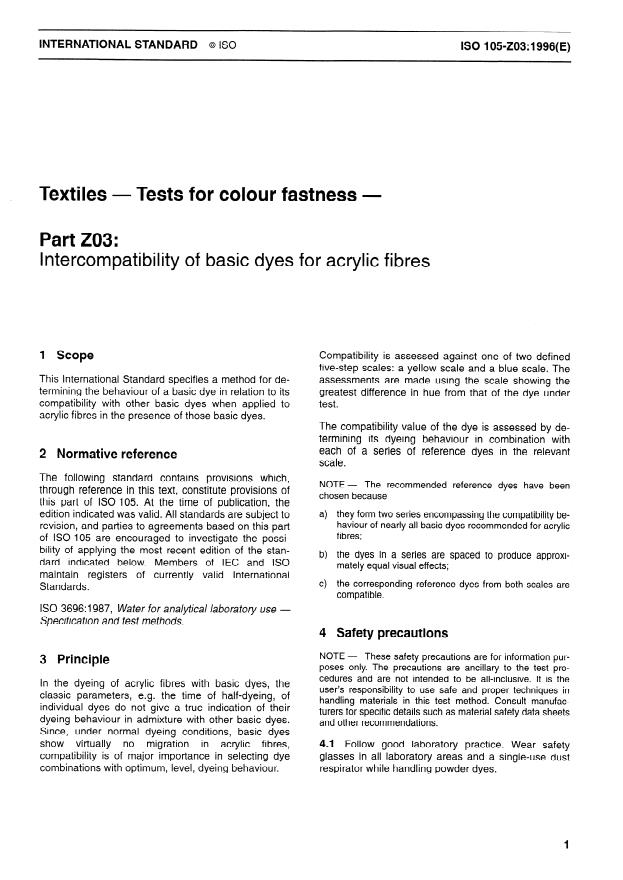
Compatibility is assessed against one of two defined
1 Scope
five-step scales: a yellow scale and a blue scale. The
This International Standard specifies a method for de- assessments are made using the scale showing the
greatest difference in hue from that of the dye under
termining the behaviour of a basic dye in relation to its
compatibility with other basic dyes when applied to test.
acrylic fibres in the presence of those basic dyes.
The compatibility value of the dye is assessed by de-
termining its dyeing behaviour in combination with
each of a series of reference dyes in the relevant
2 Normative reference
scale.
The following standard contains provisions which,
NOTE - The recommended reference dyes have been
through reference in this text, constitute provisions of
chosenbecause
this part of IS0 105. At the time of publication, the
a) they form two series encompassing the compatibility be-
edition indicated was valid. All standards are subject to
haviour of nearly all basic dyes recommended for acrylic
revision, and parties to agreements based on this part
fibres;
of IS0 105 are encouraged to investigate the possi-
bility of applying the most recent edition of the stan-
b) the dyes in a series are spaced to produce approxi-
dard indicated below. Members of IEC and IS0
mately equal visual effects;
maintain registers of currently valid International
c) the corresponding reference dyes from both scales are
Standards.
compatible.
IS0 3696:1987, Water for analytical laboratory use -
Specification and test methods.
4 Safety precautions
NOTE - These safety precautions are for information pur-
3 Principle
poses only. The precautions are ancillary to the test pro-
cedures and are not intended to be all-inclusive. It is the
In the dyeing of acrylic fibres with basic dyes, the
user’s responsibility to use safe and proper techniques in
classic parameters, e.g. the time of half-dyeing, of
handling materials in this test method. Consult manufac-
individual dyes do not give a true indication of their
turers for specific details such as material safety data sheets
dyeing behaviour in admixture with other basic dyes.
and other recommendations.
Since, under normal dyeing conditions, basic dyes
4.1 Follow good laboratory practice. Wear safety
show virtually no migration in acrylic fibres,
glasses in all laboratory areas and a single-use dust
compatibility is of major importance in selecting dye
respirator while handling powder dyes.
combinations with optimum, level, dyeing behaviour.
IS0 105-203: 1996(E)
0 IS0
4.2 Handle all chemicals with care. 5.1 Apparatus for dyeing at a 4O:l liquor:goods
ratio at the required constant temperature.
4.3 Use chemical goggles or a face shield, imper-
5.2 Reference dyes?
vious gloves and an impervious apron during handling
of concentrated acetic acid.
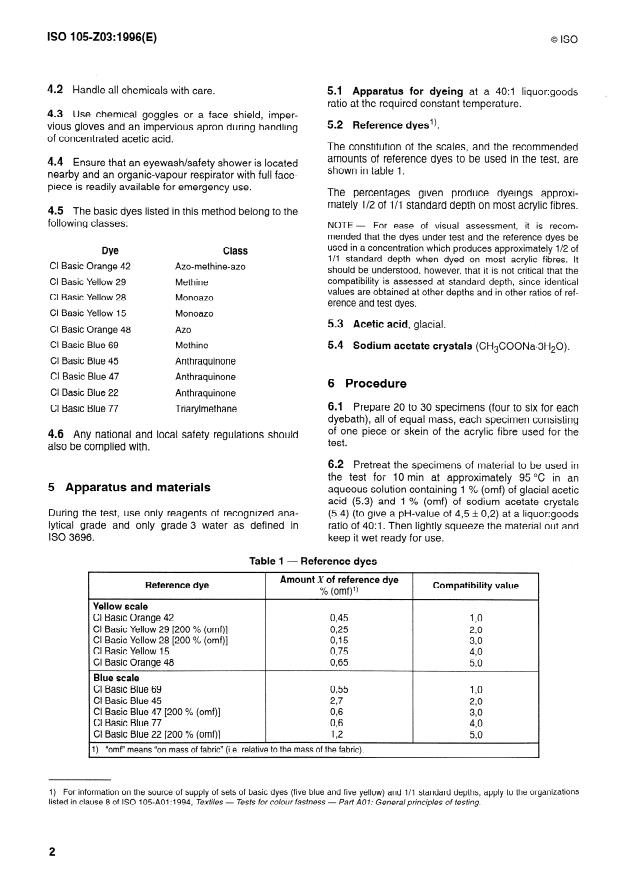
The constitution of the scales, and the recommended
amounts of reference dyes to be used in the test, are
4.4 Ensure that an eyewash/safety shower is located
shown in table 1.
nearby and an organic-vapour respirator with full face-
piece is readily available for emergency use.
The percentages given produce dyeings approxi-
mately l/2 of l/l standard depth on most acrylic fibres.
4.5 The basic dyes listed in this method belong to the
following classes:
NOTE - For ease of visual assessment, it is recom-
mended that the dyes under test and the reference dyes be
used in a concentration which produces approximately l/2 of
Class
Dye
l/l standard depth when dyed on most acrylic fibres. It
Cl Basic Orange 42 Azo-methine-azo
should be understood, however, that it is not critical that the
compatibility is assessed at standard depth, since
...
NORME ISO
INTERNATIONALE 105-Z03
Première édition
1996-09-15
Textiles — Essais de solidité des
teintures —
Partie Z03:
Intercompatibilité des colorants basiques pour
fibres acryliques
Textiles — Tests for colour fastness —
Part Z03: Intercompatibility of basic dyes for acrylic fibres
A
Numéro de référence
Avant-propos
L'ISO (Organisation internationale de normalisation) est une fédération
mondiale d'organismes nationaux de normalisation (comités membres de
l'ISO). L'élaboration des Normes internationales est en général confiée aux
comités techniques de l'ISO. Chaque comité membre intéressé par une
étude a le droit de faire partie du comité technique créé à cet effet. Les
organisations internationales, gouvernementales et non gouvernementales,
en liaison avec l'ISO participent également aux travaux. L'ISO collabore
étroitement avec la Commission électrotechnique internationale (CEI) en
ce qui concerne la normalisation électrotechnique.
Les projets de Normes internationales adoptés par les comités techniques
sont soumis aux comités membres pour vote. Leur publication comme
Normes internationales requiert l'approbation de 75 % au moins des
comités membres votants.
La Norme internationale ISO 105-Z03 a été élaborée par le comité
technique ISO/TC 38, Textiles, sous-comité SC 1, Essais des textiles
colorés et des colorants.
L'ISO 105 a été, auparavant publiée en 13 «parties», chacune désignée
par une lettre (par exemple «Partie A»), avec des dates de publication
allant de 1978 à 1985. Chaque partie contenait une série de «sections»
dont chacune était désignée par la lettre correspondant à la partie
respective et par un numéro de série à deux chiffres (par exemple
«Section A01»). Ces sections sont à présent publiées à nouveau comme
documents séparés, eux-mêmes désignés «parties» mais en conservant
leurs désignations alphanumériques antérieures. Une liste complète de ces
parties est donnée dans l'ISO 105-A01.
© ISO 1996
Droits de reproduction réservés. Sauf prescription différente, aucune partie de cette publi-
cation ne peut être reproduite ni utilisée sous quelque forme que ce soit et par aucun pro-
cédé, électronique ou mécanique, y compris la photocopie et les microfilms, sans l'accord
écrit de l'éditeur.
Organisation internationale de normalisation
Case postale 56 • CH-1211 Genève 20 • Suisse
Internet central@iso.ch
X.400 c=ch; a=400net; p=iso; o=isocs; s=central
Version française tirée en 1998
Imprimé en Suisse
ii
©
NORME INTERNATIONALE ISO ISO 105-Z03:1996(F)
Textiles — Essais de solidité des teintures —
Partie Z03:
Intercompatibilité des colorants basiques pour fibres acryliques
1 Domaine d'application
La présente partie de l'ISO 105 décrit une méthode pour la détermination de la compatibilité d'un
colorant basique avec d'autres colorants basiques lorsqu'ils sont combinés pour une application sur des
fibres acryliques.
2 Référence normative
La norme suivante contient des dispositions qui, par suite de la référence qui en est faite, constituent
des dispositions valables pour la présente partie de l'ISO 105. Au moment de la publication, l'édition
indiquée était en vigueur. Toute norme est sujette à révision et les parties prenantes des accords fondés
sur la présente partie de l'ISO 105 sont invitées à rechercher la possibilité d'appliquer l'édition la plus
récente de la norme indiquée ci-après. Les membres de la CEI et de l'ISO possèdent le registre des
Normes internationales en vigueur à un moment donné.
Eau pour laboratoire à usage analytique — Spécification et méthodes d'essai
ISO 3696:1987, .
3 Principe
Lors de la teinture de fibres acryliques avec des colorants basiques, les paramètres traditionnels, par
exemple la durée de demi-teinture, des colorants individuels ne fournissent pas une véritable indication
de leur aptitude à la teinture lorsqu'ils sont mélangés avec d'autres colorants basiques. Étant donné que
les colorants basiques ne présentent pratiquement aucune migration dans les fibres acryliques, dans
des conditions normales de teinture, la compatibilité est d'une importance majeure lors du choix des
combinaisons de colorants ayant une aptitude à la teinture de niveau optimal.
La compatibilité est évaluée par rapport à l'une ou l'autre des deux échelles à cinq degrés: une échelle
de jaune et une échelle de bleu. Les évaluations sont effectuées en utilisant l'échelle indiquant la plus
grande différence de teinte de couleur par rapport au colorant soumis à l'essai.
L'indice de compatibilité du colorant est évalué en déterminant son aptitude à la teinture en association
avec chacun des colorants de référence d'une série dans l'échelle appropriée.
NOTE — Les colorants préconisés ont été choisis pour les raisons suivantes:
a) ils constituent deux séries qui englobent les caractéristiques de compatibilité de presque tous
les colorants basiques recommandés pour les fibres acryliques;
©
b) les colorants constituant une série sont répartis de manière à produire des effets visuels quasi
équivalents;
c) les colorants de référence correspondants qui appartiennent aux deux échelles sont
compatibles.
4 Mesures de sécurité
NOTE — Ces mesures de sécurité sont indiquées à titre d'information uniquement. Elles
s'ajoutent au mode opératoire et ne sont pas censées couvrir tous les risques. Il incombe à
l'utilisateur d'appliquer des techniques sûres et appropriées lors de la manipulation des produits
indiqués dans la présente méthode d'essai. S'adresser aux fabricants afin de se procurer les
informations spécifiques, telles que les fiches techniques et les autres recommandations.
4.1 Suivre les bonnes pratiques de laboratoire et porter des lunettes de sécurité dans toutes les
pièces du laboratoire et un masque de protection respiratoire antipoussière jetable lors de la
manipulation des colorants en poudre.
4.2 Manipuler tous les produits chimiques avec soin.
4.3 Lors de la manipulation d'acide acétique concentré, porter des lunettes de protection ou un écran
facial, des gants et un tablier imperméables.
4.4 S'assurer qu'un lave-oeil et/ou une douche d'urgence sont installés à proximité et qu'un appareil
respiratoire à vapeur organique avec pièce faciale complète est disponible, prêt à l'emploi, en cas
d'urgence.
4.5 Les colorants basiques répertoriés dans la présente méthode appartiennent aux classes
suivantes:
Colorant Classe
CI Orange alcalin 42 Azo-méthine-azo
CI Jaune alcalin 29 Méthine
CI Jaune alcalin 28 Monazo
CI Jaune alcalin 15 Monazo
CI Orange alcalin 48 Azo
CI Bleu alcalin 69 Méthine
CI Bleu alcalin 45 Anthraquinone
CI Bleu alcalin 47 Anthraquinone
CI Bleu alcalin 22 Anthraquinone
CI Bleu alcalin 77 Triarylméthane
©
ISO ISO 105-Z03:1996(F)
4.6 Il convient que les utilisateurs respectent tout règlement national et local en vigueur en matière de
sécurité.
5 Appareillage et matériaux
A cours de l'essai, utiliser uniquement des réactifs de qualité analytique reconnue et de l'eau de
qualité 3 conforme aux spécifications de l'ISO 3696.
, permettant l'obtention d'un rapport de bain de 40:1 à la température
5.1 Appareil de teinture
constante requise.
1)
5.2 Colorants de référence
La constitution des échelles ainsi que les quantités recommandées de colorants de référence à utiliser
pour l'essai doiven
...