


ISO/R 1020:1969
(Main)Title missing - Legacy paper document
Title missing - Legacy paper document
General Information
- Status
- Withdrawn
- Publication Date
- 31-Dec-1968
- Technical Committee
- ISO/TMBG - Technical Management Board - groups
- Drafting Committee
- ISO/TMBG - Technical Management Board - groups
- Current Stage
- 9599 - Withdrawal of International Standard
- Start Date
- 01-Jan-1974
- Completion Date
- 12-Feb-2026


ISO/R 1020:1969 - Title missing - Legacy paper document Released:1/1/1969


ISO/R 1020:1969 - Title missing - Legacy paper document Released:1/1/1969
Frequently Asked Questions
ISO/R 1020:1969 is a standardization document published by the International Organization for Standardization (ISO). Its full title is "Title missing - Legacy paper document". This standard covers: Title missing - Legacy paper document
Title missing - Legacy paper document
ISO/R 1020:1969 is available in PDF format for immediate download after purchase. The document can be added to your cart and obtained through the secure checkout process. Digital delivery ensures instant access to the complete standard document.
Standards Content (Sample)
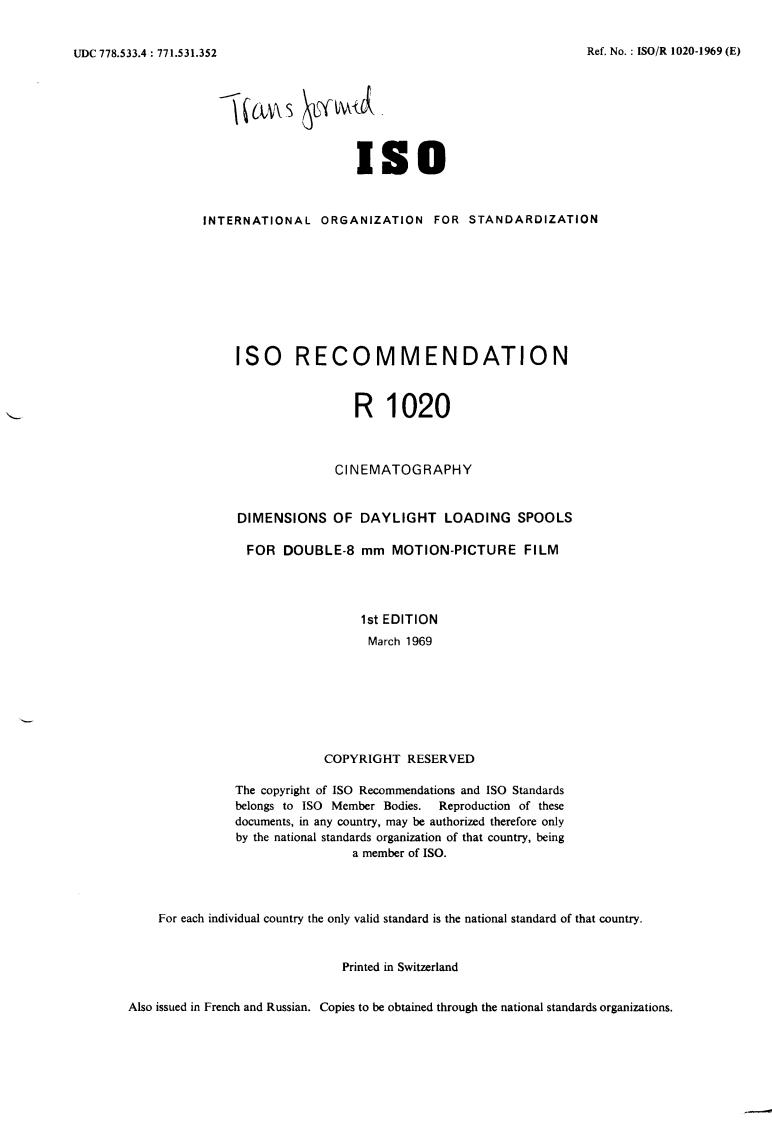
Ref. No. : ISO/R 1020-1969 (E)
UDC 778.533.4 : 771.531.352
IS0
IN TERN AT I ON A L O R G A N IZ AT1 O N FOR S TA N DARD I ZAT 1 ON
IS O R EC O M M EN DATI O N
R 1020
CINEMATOGRAPHY
DIMENSIONS OF DAYLIGHT LOADING SPOOLS
FOR DOUBLE-8 rnrn MOTION-PICTURE FILM
1st EDITION
March 1969
COPYRIGHT RESERVED
The copyright of IS0 Recommendations and IS0 Standards
belongs to IS0 Member Bodies. Reproduction of these
documents, in any country, may be authorized therefore only
by the national standards organization of that country, being
a member of ISO.
For each individual country the only valid standard is the national standard of that country.
Printed in Switzerland
Also issued in French and Russian. Copies to be obtained through the national standards organizations.
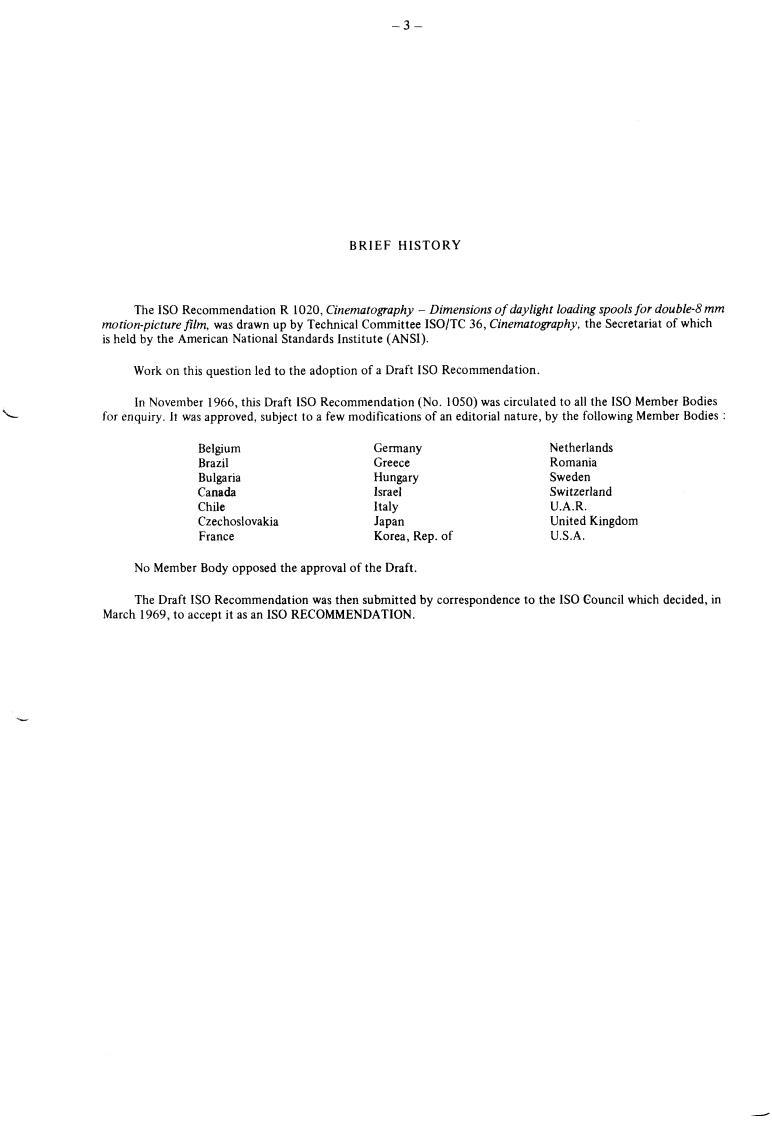
-3-
BRIEF HISTORY
The IS0 Recommendation R 1020, Cinematography - Dimensions of daylight loading spools for double-8 mm
motion-picture film, was drawn up by Technical Committee ISO/TC 36, Cinematography, the Secretariat of which
is held by the American National Standards Institute (ANSI).
Work on this question led to the adoption of a Draft IS0 Recommendation.
In November 1966, this Draft IS0 Recommendation (No. 1050) was circulated to all the IS0 Member Bodies
for enquiry. It was approved, subject to a few modifications of an editorial nature, by the following Member Bodies
Belgium Germany Netherlands
Romania
Brazil Greece
Sweden
Bulgaria Hungary
Switzerland
Canada Israel
U.A.R.
Chile Italy
United Kingdom
Czechoslovakia Japan
U.S.A.
France Korea, Rep. of
No Member Body opposed the approval of the Draft.
The Draft IS0 Recommendation was then submitted by correspondence to the IS0 Council which decided, in
March 1969, to accept it as an IS0 RECOMMENDATION.
-5- ISO/R 1020-1%9 (E)
IS0 Recommendation R 1020 March 1969
CINEMATOGRAPHY
DIMENSIONS OF DAYLIGHT LOADING SPOOLS
FOR DOUBLE-8 mm MOTION-PICTURE FILM
1. SCOPE
This IS0 Recommendation specifies the dimensions of daylight loading spools for double-8 mm motion-picture
film.
-6- ISO/R 1020-1969 (E)
*I I
c
U
O
.-
n
* m
+.a
U
in
t
O
.c
U
U
C
I 1
-7- ISO/R 1020-1969 (E)
-8- JSO/R 1020-1969 (I
TABLE - Dimensions of double-8 mm nominal spool sizes
Dimension
Nominal spool size millimetres inches
I I l l
+ 0.20 + 0.008
7.5 m, 15 m, 30 m 7.30 0.287
IC
+ 0.2 + 0.01
D 7.5 m, 15 m, 30 m 9.8 0.38
7.5 m 19.0 f 0.3 0.75 f 0.01
E
15 m, 30 m 32.0 f 0.5 1.26 f 0.02
I
F 7.5 m, 15 m, 30 m see clause 2.3
+ 0.35 + 0.014
7.5 m, 15 m, 30 m 16.05 0.632
Hl
I H2 I 7.5 m, 15 m, 30'm I 16.00 min. I 0.630 min. I
O O
J and J,
7.5 m, 15 m, 30 m
18.5 - 0.4 - 0.02
7.5 m 15.6 min. 0.61 min.
K
15 m, 30 m 25.5 min. 1.00 min.
O O
7.5 m
52*0 - 0.8 2.05 - 0.03
O O
M and Ml
15 m
71.5 - 1.0 2'81 - 0.04
O O
30 m
92.0 - 1.0 3h2 - 0.04
7.5 m 0.40 ma. 0.016 max.
P (See clause 2.6)
15 m, 30 m 0.50 max. 0.020 max.
7.5 m
0.5 0.02
S
15 m, 30 m 0.8 0.03
J
2. DJMENSIONS AND CHARACTERISTICS
2.1 The dimensions given above are for general purpose double-8 mm motion-picture film spools with
nominal capacities of 7.5 metres (25 feet), 15 metres (50 feet), and 30 metres (100 feet). Spools
for high-speed cameras generally should be more carefully balanced and are not necessarily covered
by this IS0 Recommendation.
2.2 If rivet heads, or other fastening devices, extend beyond the outer surfaces of the flanges, they should
lie at a diameter larger than the minimum K diameter and should be within the boundaries defined
by other portions of the volume of rotation diagram.
-9
ISO/R 1020-1969 (E)
2.3 Dimension F represents a slot in the spool core for attaching the film. Its design and dimensions are
critical if a spooi is to operate satisfactorily, both in self-threading cameras and cassette-loaded cameras.
In seif-threading cameras the film should, without fail, seek out and easily slide into the slot, but for
cassette-loaded cameras the slot should resist extraction of the film by action of the clock-spring at the
end of the first camera exposure run.
Starting at a point adjacent to the four-splined flange and running at least one-half the core width, the
slot should be designed to meet manual-threading, self-threading, and cassette-loading requirements.
Slot sides may diverge over the remaining one-half of the core width. One way of accomplishing this is
to design the slot in the form of a weaving channel with an effective separation of 0.1 5 to 0.25 mm
(0.006 to 0.010 in) between the teeth on one side of the slot and the teeth on the other side of the slot
as measured with a wide, stiff blade-gauge which should slip easily into this zone.
2.
Dimension H2 is the space between the flanges inside the core, but outside the D diameter zone.
2.5 DimensionsJ and JI represent the thickness or effective thickness, respectively, of the spool within the
K diameter area which is centered on the spindle hole axis of each flange.
2.6 A reference plane of rotation for each flange is defined by a plane perpendicular to
...
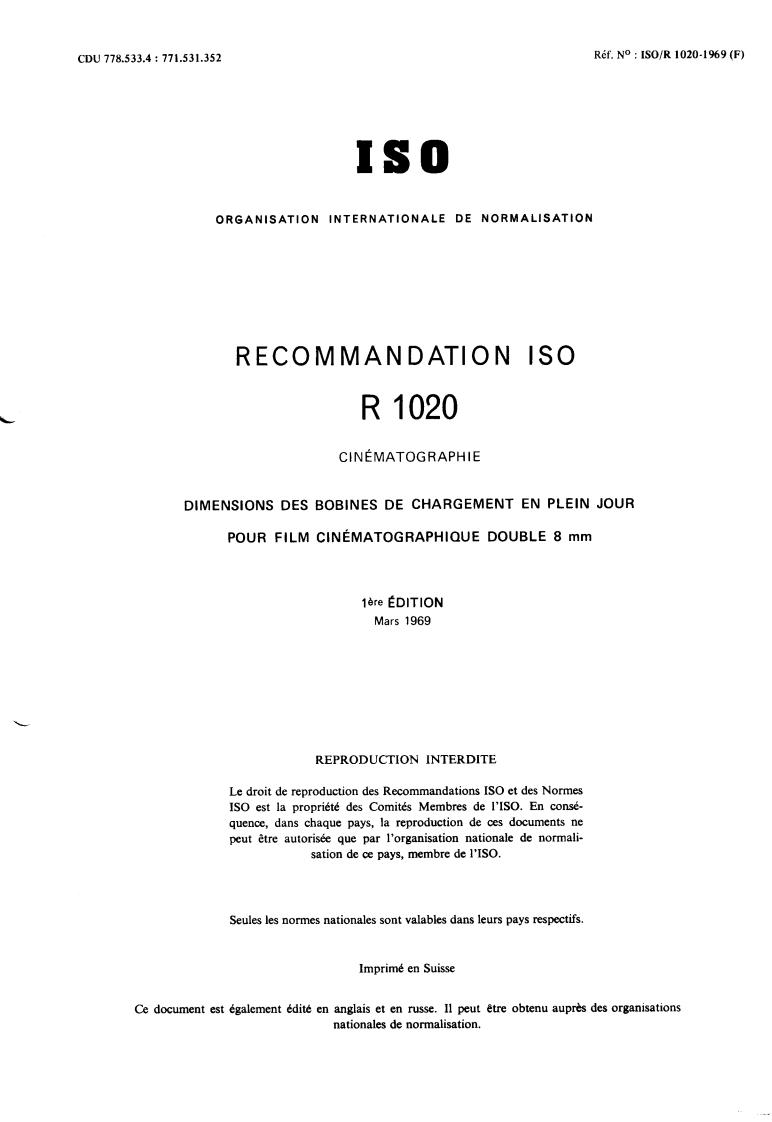
Réf. No : ISO/R 1020-1%9 (F)
CDU 778.533.4 : 771.531.352
IS0
ORGAN IS AT1 ON I N T E R N AT I O N A LE DE NORM A LIS AT I ON
RECOMMANDATION IS0
R 1020
CIN~MATOGRAPH I E
DIMENSIONS DES BOBINES DE CHARGEMENT EN PLEIN JOUR
POUR FILM CINÉMATOGRAPHIQUE DOUBLE 8 mm
ibre EDITION
Mars 1969
REPRODUCTION INTERDITE
Le droit de reproduction des Recommandations IS0 et des Normes
IS0 est la propriété des Comités Membres de I’ISO. En consé-
quence, dans chaque pays, la reproduction de ces documents ne
peut être autorisée que par l’organisation nationale de normali-
sation de ce pays, membre de I’ISO.
Seules les normes nationales sont valables dans leurs pays respectifs.
Imprimé en Suisse
Ce document est également édité en anglais et en russe. I1 peut être obtenu aup& des organisations
nationales de normalisation.
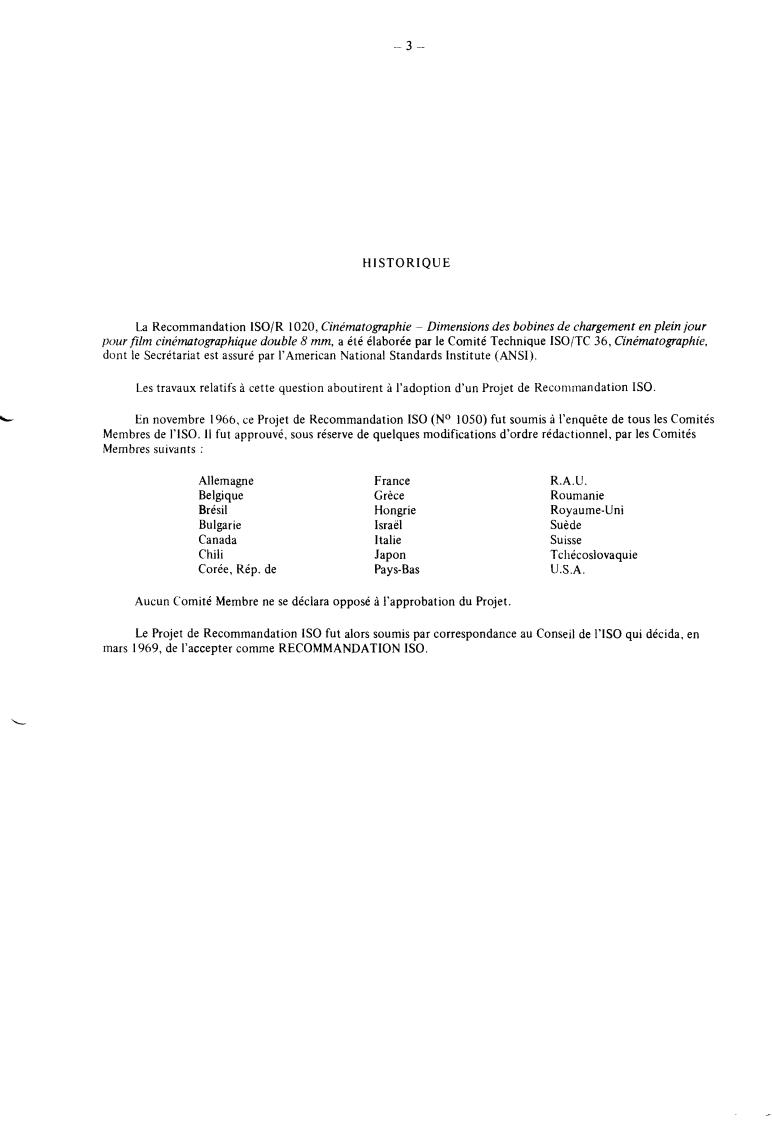
-3-
HISTORIQUE
La Recommandation ISO/R 1020, Cinématographie - Dimensions des bobines de chargement en plein jour
pour film cinématographique double 8 mm, a été élaborée par le Comité Technique ISOiTC 36, Cinématographie,
dont le Secrétariat est assuré par I’American National Standards Institute (ANSI).
Les travaux relatifs à cette question aboutirent à l’adoption d’un Projet de Recommandation ISO.
En novembre 1966, ce Projet de Recommandation IS0 (NO 1050) fut soumis à l’enquête de tous les Comités
Membres de 1’1SO. Il fut approuvé, sous réserve de quelques modifications d’ordre rédactionnel, par les Comités
Membres suivants :
Allemagne
France R.A.U.
Belgique
Grèce Roumanie
Brésil
Hongrie Royaume-Uni
Bulgarie Israël Suède
Canada Italie Suisse
Chili Japon Tchécoslovaquie
Corée, Rép. de Pays-Bas U.S.A.
Aucun Comité Membre ne se déclara opposé à l’approbation du Projet.
Le Projet de Recommandation IS0 fut alors soumis par correspondance au Conseil de IWO qui décida, en
mars 1969, de l’accepter comme RECOMMANDATION ISO.
.
II
-5-
ISO/R 1020-1969 (F)
Recommandation IS0 R 1020 Mars 1969
DIMENSIONS DES BOBINES DE CHARGEMENT EN PLEIN JOUR
POUR FILM CINÉMATOGRAPHIQUE DOUBLE 8 rnrn
1. OBJET
La présente Recommandation IS0 frxe les dimensions des bobines de chargement en plein jour pour film
cinématographique double 8 mm.
-6- ISO/R 1020-1969 (F)
*I I
N
ISO/R 1020-1969 (F)
-7-
I
N
-8- ISO/R 1020-1969 (F)
~
TABLEAU - Dimensions des bobines doubles 8 mm de capacité nominale
Dimension Capacité nominale millimètres inches
+ 0,008
C
7,5 m, 15 m, 30 m 7,30 0,287
+ Oi2 1 0,38 + 0,Ol
7,5 m, 15 m, 30 m
93 0
ID
+ 0,30
7,5 m 0,75 f 0,Oî
1990 0
E
15 m, 30 m
32,O f 0,5 1,26 f 0,02
I 73 m, 15 m,30m I voir paragraphe 2.3 I
+ 0,35
+ 0,014
73 m, 15 m, 30 m 16,05
0,632
I l I
I 73 m, 15 m, 30 m I 16,OO min. I 0,630 min.
O O
Jet JI 1 7,5 m, 15 m, 30 m
1 “~5 - 0,4 I - 0,02
15,6 min. 0,61 min.
K
15 m, 30 m 25,5 min.
1,OO min.
O O
7,5 m
5230 - 0,8 2’05 - 0,03
O O
M et Ml 15 m
7195 - 1,o 2’81 - 0.04
O O
30 m
9290 - 1,o 3’62 - 0,04
7,5 m
0,40 max. 0,016 max.
P (Voir paragraphe 2.6)
15 m, 30 m 0,50 max. 0,020 max.
7,5 m
0s 0,02
S
15 m, 30 m 098 0,03
2. DIMENSIONS ET CARACTÉRISTIQUES
2.1 Les dimensions indiquées ci-dessus sont valables pour les bobines d’usage général pour films cinéma-
tographiques doubles 8 mm ayant des capacités nominales de 7,5 m (25 ft), 15 m (50 ft) ou
30 m (100 ft). Les bobines pour caméras à grande vitesse doivent généralement être plus soigneusement
équilibrées et n’entrent pas nécessairement dans le cadre de la présente Recommandation ISO.
2.2 Si des têtes de rivets ou d’autres organes d’assemblage dépassent la surface extérieure des joues, elles
doivent se trouver dans une zone de diamètre supérieur au diamètre minimal K et à l’intérieur des
limites définies par les autres parties du diagramme du volume d’encombrement.
9- ISO/R 1020-1969 (F)
La cote F s’applique à une fente pratiquée dans le noyau de la bobine pour fixer le film. Sa forme et ses
2.3
dimensions sont critiques pour une bobine qui doit fonctionner correctement aussi bien dans les caméras
à engagement automatique du film que dans les caméras à chargement par cassettes. Dans les caméras à
engagement automatique, le film doit trouver sûrement la fente et s’y engager tacilement, mais dans les
caméras à chargement par cassettes la fente doit s’opposer à ce que le film s’échappe par l’effet d’expansion
des dernières spires à la fin du premier passage du film.
Partant d’un point de la joue adjacent A la joue à quatre crans et s’étendant sur au moins la moitié de la
largeur du noyau, la fente doit être prévue pour convenir à l’engagement manuel ou automatique du
film ainsi qu’aux impératifs du chargement par cassettes. Les bords de la fente peuvent diverger sur
l’autre moitié de la largeur du noyau. II est possible de réaliser ces conditions en donnant à la fente la
forme d’un canal sinueux, avec un écart effectif de 0,15 à 0,25 mm (0,006 i 0,010 in) entre les dentelures
de l’un des bords et celles de l’autre bord, mesuré avec un calibre à lame large et rigide pouvant glisser
facilement dans cette zone.
2.4 La cote H2 représente la distance entre joues à l’intérieur du noyau. mais en dehors de la zone de
diamètre D.
Les cotes J et /, représentent respectivement l’épaisseur et l’épaisseur effective de la bobine à l’intérieur
2.5
de la zone de diamètre K centrée sur l’axe du trou de chaque joue.
2.6 Un plan de rotation de r
...
Questions, Comments and Discussion
Ask us and Technical Secretary will try to provide an answer. You can facilitate discussion about the standard in here.
Loading comments...