

ISO 20252:2026
(Main)Market, opinion and social research, including insights and data analytics — Vocabulary and service requirements
- Abstract
This document establishes terms, definitions and service requirements for service providers conducting market, opinion and social research, including insights and data analytics. This document does not apply to non-research activities, such as direct marketing.
- Status
- Published
- Publication Date
- 31-Aug-2026
- Technical Committee
- ISO/TC 225 - Market, opinion and social research
- Drafting Committee
- ISO/TC 225 - Market, opinion and social research
- Current Stage
- 6060 - International Standard published
- Start Date
- 01-Sep-2026
- Due Date
- 19-Jan-2027
- Completion Date
- 01-Sep-2026
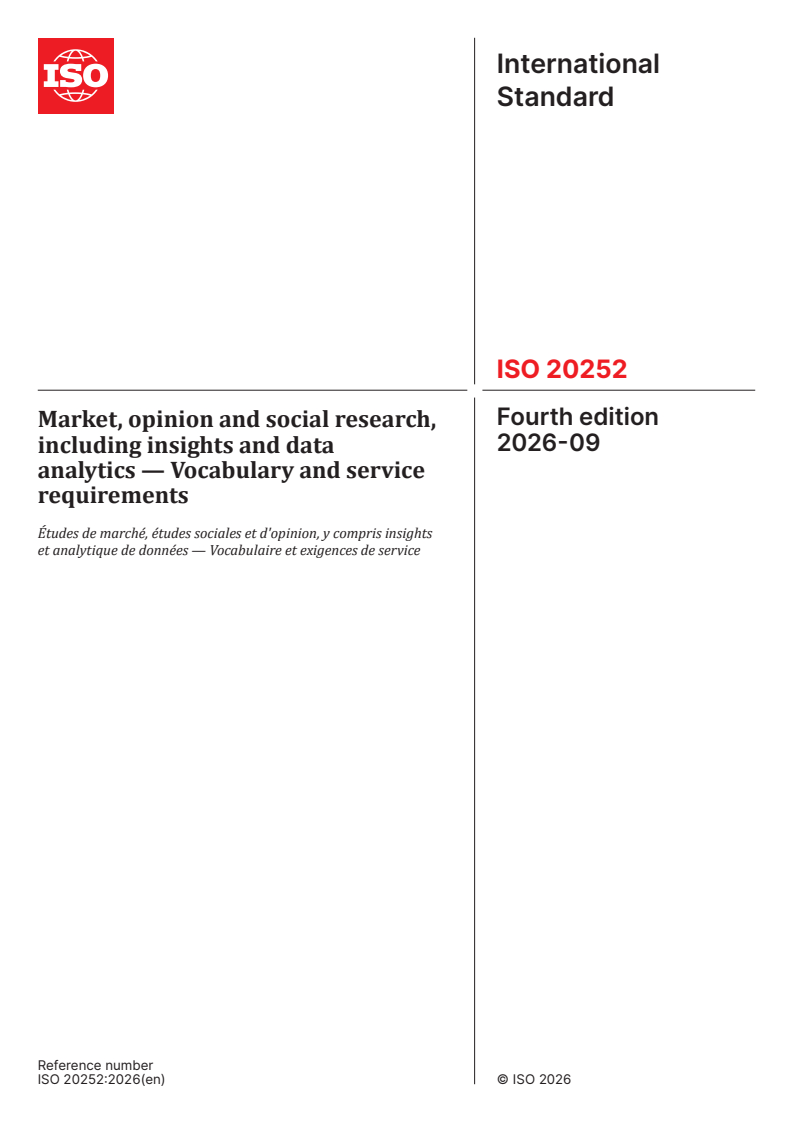

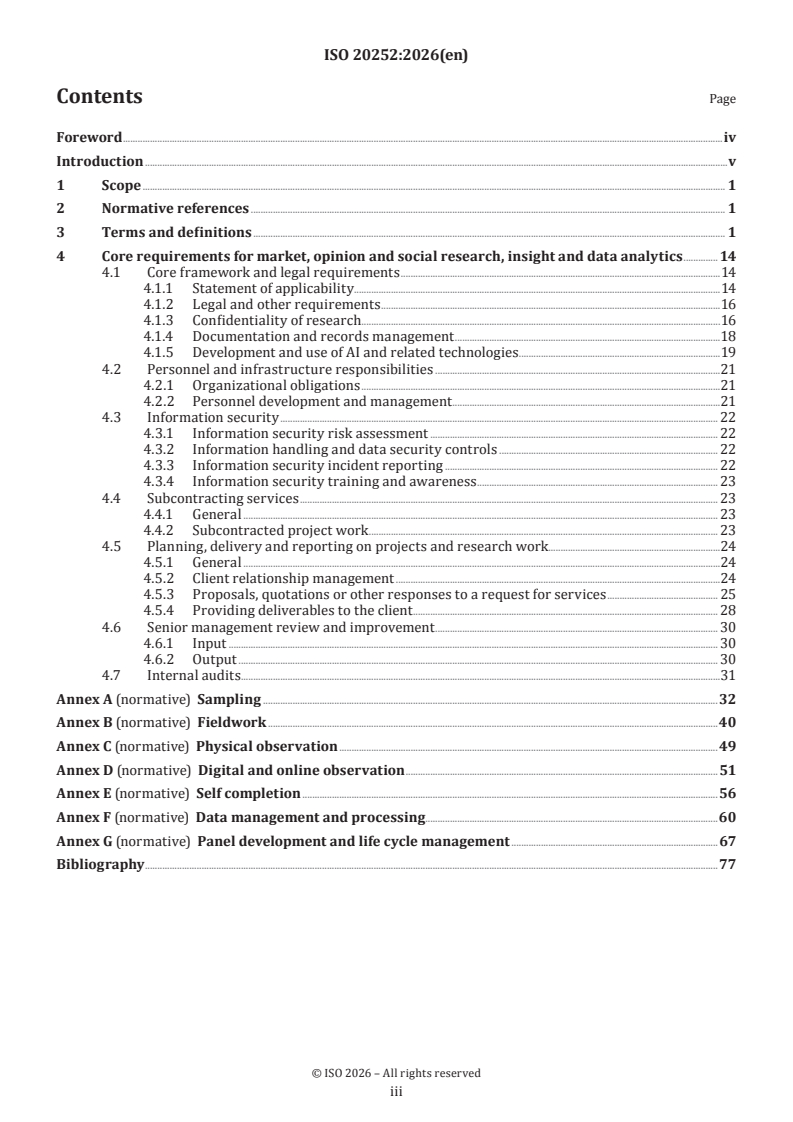
ISO 20252:2026 is an International Standard from ISO for market, opinion and social research, including insights and data analytics. It specifies vocabulary and service requirements for service providers that conduct this work, so organizations can describe methods consistently and manage projects in a controlled way.
The standard applies to research service providers and is not written for non-research activities such as direct marketing. A conformity claim is built on Clause 4 plus at least one normative annex, chosen to match the research method or service being provided.
What does ISO 20252:2026 specify?
ISO 20252:2026 sets the terms, definitions and service requirements for service providers conducting market, opinion and social research, including insights and data analytics. It also sets the method-specific requirements that support conformity claims for sampling, fieldwork, observation, self-completion, data processing and panel services.
The document is organized into three main parts:
- Clause 1 defines the scope.
- Clause 3 gives the vocabulary used throughout the standard.
- Clause 4 sets the core service requirements, supported by Annexes A to G.
| Annex | What it covers |
|---|---|
| Annex A | Sampling |
| Annex B | Fieldwork |
| Annex C | Physical observation |
| Annex D | Digital and online observation |
| Annex E | Self-completion |
| Annex F | Data management and processing |
| Annex G | Panel development and life cycle management |
This structure matters in practice because a service provider can show exactly which research methods are inside its conformity claim and which controls apply to each one.
What are the key requirements of ISO 20252:2026?
ISO 20252:2026 is built around a core management framework in Clause 4, then method-specific requirements in the annexes. In practice, the standard expects a provider to define its scope, control its processes, manage people and data, and document the work so it can be reviewed or audited.
Core framework, legal duties and confidentiality
Clause 4.1 requires a statement of applicability (SoA), legal and other requirements, confidentiality controls, records management, and controls for the development and use of AI and related technologies. This means the provider must define what parts of the standard apply, protect participant information, and document how automation, machine learning or other AI-supported tools are used in research work.
Clause 4.1.3 addresses confidentiality in research, including participant reassurance, invitations to participate, and data collection from children or vulnerable persons. In practice, this means the provider needs clear privacy, invitation and safeguarding practices that fit the research context.
Clause 4.1.4 requires documented systems, project records and traceability. That matters because a project should be auditable from design through delivery, including the documents that show what was planned, what was done and what was reported.
People, security and subcontracting
Clause 4.2 covers organizational obligations and personnel development and management. Clause 4.3 covers information security risk assessment, data handling and security controls, incident reporting, and training and awareness. In practice, the standard links quality with competence and security, so staff need suitable training and the organization needs controls for access, handling and incidents.
Clause 4.4 covers subcontracting services and subcontracted project work. This is important because research work may involve external fieldworkers, panels, software, cloud services or storage providers, but the service provider remains responsible for the work performed under its control.
Planning, delivery and reporting
Clause 4.5 covers planning, delivery and reporting on projects and research work. It includes client relationship management, responses to requests for services, design of data collection instruments, translation, testing, incentives, delivery of outputs, client reporting and publication of research results. In practice, this is the part that governs how a project is designed, agreed, run and handed back to the client.
Clause 4.6 requires senior management review and improvement, and Clause 4.7 requires internal audits. The internal audit programme is expected to cover the document, the SoA, subcontracted provisions, legal and regulatory obligations, information security, changes in risk or operations, and opportunities for improvement. This matters because the standard is not only about project delivery, but also about running a controlled management system over time.
Method-specific annexes
- Annex A - Sampling: covers probability and non-probability samples, sample size, design, transparency, sample sources, de-duplication, device ID, cookies, sample blending, fraud and inattentive participants. This helps a provider explain how respondents were selected and how sample quality was protected.
- Annex B - Fieldwork: covers recruitment and training of fieldworkers, identity documents, project briefing, CATI, qualitative recruitment and moderation, data validation, and client reporting. This matters because people collecting data need clear instructions, traceability and validation.
- Annex C - Physical observation: covers the documentation of methods, participant or observation-point selection, observation bias, briefing of fieldworkers, and client reporting. It is the annex used when the data come from observation in the physical environment.
- Annex D - Digital and online observation: covers passive data collection, proposals and tenders, data cleaning and editing, sentiment and text analysis, website usage analytics, device monitoring and protection of individuals. It applies where behaviour is observed in digital environments without direct questioning.
- Annex E - Self-completion: covers self-completion surveys and related methods such as online questionnaires, diaries, touch-tone entry, voice recognition entry and postal research, together with identity and response validation. This is the annex to use when participants answer without direct dialogue with a fieldworker.
- Annex F - Data management and processing: covers data entry, cleaning, coding, editing, weighting, file preparation, tabulation, analysis and data file delivery. It also covers accuracy for non-manual data entry and the handling of imputation and synthetic data.
- Annex G - Panel development and life cycle management: covers panel structure and size, recruitment, profile data, identity verification, transparency, maintenance, incentives, opt-out, participation frequency, sample blending and fraud control. This is the annex for continuously reporting panels and related sample sources.
What terms does ISO 20252:2026 define?
Service provider - An organization that conducts research projects, or parts of them, using statistical data and or social science methods and techniques.
Participant - A person or organization from whom or about whom data are collected for research.
Panel - A sample database of potential participants who say they will cooperate for future data collection if selected.
Probability sample - A random sample in which each population member has a known, non-zero chance of selection, which supports calculation of margin of error.
Non-probability sample - A sample in which the chance of selection for each population member is unknown, so the sample is chosen by means other than statistical sampling design.
Artificial intelligence (AI) - A set of technologies designed to simulate human intelligence and provide problem-solving capabilities.
Attestation - A declaration by the service provider that it conforms with the statement of applicability.
Who uses ISO 20252:2026?
ISO 20252:2026 is used by market, opinion and social research organizations, including insight and data analytics providers. It is also relevant to in-company research departments, academic and university research groups, official statistics bodies, local authorities, and individual researchers acting in the same capacity.
In practice, the standard is used by:
- research managers who need a common service framework
- quality managers who set controls, records and audits
- buyers and clients who want clear deliverables and method transparency
- sample and panel providers who support recruitment and access
- fieldwork teams, moderators and recruiters
- data processing, coding and analysis teams
- auditors and senior management who review the system
What changed in ISO 20252:2026 from the previous edition?
ISO 20252:2026 is the fourth edition and it cancels and replaces ISO 20252:2019. It also incorporates the technical content of ISO 19731:2017.
The stated changes include:
- review of the document for the increasing use of automated techniques and AI and related technologies
- revised requirements where those techniques are used
- updated Clause 4 terminology and requirements aligned with other International Standards such as ISO/IEC 27001
- updated terms and definitions in Clause 3
- splitting of the former Annex A so that panel management moved to new Annex G
- strengthened data quality requirements in Annex A
- new or updated content added across the annexes
What does the ISO 20252:2026 document contain?
ISO 20252:2026 contains a long vocabulary section and a service-requirements framework that runs from general management controls to method-specific annexes. The vocabulary covers research methods, sampling, observation, data handling, security, AI, panels, survey work and reporting terms used across the document.
The annexes provide the detailed controls that apply to common research activities, including how samples are selected, how fieldworkers are trained, how observation is documented, how self-completion data are validated, how data are coded and processed, and how panels are managed. The document also includes requirements for client reporting, validation, file control, information security and internal audit, so it can be used as a working framework for research operations and audits.
Relations
- Effective Date
- 06-Sep-2025
- Effective Date
- 20-Jan-2024
Get Certified
Connect with accredited certification bodies for this standard

BSI Group
BSI (British Standards Institution) is the business standards company that helps organizations make excellence a habit.

Bureau Veritas
Bureau Veritas is a world leader in laboratory testing, inspection and certification services.

DNV
DNV is an independent assurance and risk management provider.
Sponsored listings
Frequently Asked Questions
ISO 20252:2026 is a standard published by the International Organization for Standardization (ISO). Its full title is "Market, opinion and social research, including insights and data analytics — Vocabulary and service requirements". This standard covers: This document establishes terms, definitions and service requirements for service providers conducting market, opinion and social research, including insights and data analytics. This document does not apply to non-research activities, such as direct marketing.
This document establishes terms, definitions and service requirements for service providers conducting market, opinion and social research, including insights and data analytics. This document does not apply to non-research activities, such as direct marketing.
ISO 20252:2026 is classified under the following ICS (International Classification for Standards) categories: 01.040.03 - Services. Company organization, management and quality. Administration. Transport. Sociology. (Vocabularies); 03.020 - Sociology. Demography; 03.100.20 - Trade. Commercial function. Marketing. The ICS classification helps identify the subject area and facilitates finding related standards.
ISO 20252:2026 has the following relationships with other standards: It is inter standard links to ISO 19731:2017, ISO 20252:2019. Understanding these relationships helps ensure you are using the most current and applicable version of the standard.
ISO 20252:2026 is available in PDF format for immediate download after purchase. The document can be added to your cart and obtained through the secure checkout process. Digital delivery ensures instant access to the complete standard document.
Standards Content (Sample)
International
Standard
ISO 20252
Fourth edition
Market, opinion and social research,
2026-09
including insights and data
analytics — Vocabulary and service
requirements
Études de marché, études sociales et d'opinion, y compris insights
et analytique de données — Vocabulaire et exigences de service
Reference number
© ISO 2026
All rights reserved. Unless otherwise specified, or required in the context of its implementation, no part of this publication may
be reproduced or utilized otherwise in any form or by any means, electronic or mechanical, including photocopying, or posting on
the internet or an intranet, without prior written permission. Permission can be requested from either ISO at the address below
or ISO’s member body in the country of the requester.
ISO copyright office
CP 401 • Ch. de Blandonnet 8
CH-1214 Vernier, Geneva
Phone: +41 22 749 01 11
Email: copyright@iso.org
Website: www.iso.org
Published in Switzerland
ii
Contents Page
Foreword .iv
Introduction .v
1 Scope . 1
2 Normative references . 1
3 Terms and definitions . 1
4 Core requirements for market, opinion and social research, insight and data analytics . 14
4.1 Core framework and legal requirements .14
4.1.1 Statement of applicability .14
4.1.2 Legal and other requirements .16
4.1.3 Confidentiality of research . .16
4.1.4 Documentation and records management .18
4.1.5 Development and use of AI and related technologies .19
4.2 Personnel and infrastructure responsibilities .21
4.2.1 Organizational obligations .21
4.2.2 Personnel development and management .21
4.3 Information security . 22
4.3.1 Information security risk assessment . 22
4.3.2 Information handling and data security controls . 22
4.3.3 Information security incident reporting . 22
4.3.4 Information security training and awareness . 23
4.4 Subcontracting services . 23
4.4.1 General . 23
4.4.2 Subcontracted project work . 23
4.5 Planning, delivery and reporting on projects and research work.24
4.5.1 General .24
4.5.2 Client relationship management .24
4.5.3 Proposals, quotations or other responses to a request for services . 25
4.5.4 Providing deliverables to the client . 28
4.6 Senior management review and improvement . 30
4.6.1 Input . 30
4.6.2 Output . 30
4.7 Internal audits.31
Annex A (normative) Sampling .32
Annex B (normative) Fieldwork .40
Annex C (normative) Physical observation .49
Annex D (normative) Digital and online observation . 51
Annex E (normative) Self completion .56
Annex F (normative) Data management and processing .60
Annex G (normative) Panel development and life cycle management . 67
Bibliography .77
iii
Foreword
ISO (the International Organization for Standardization) is a worldwide federation of national standards
bodies (ISO member bodies). The work of preparing International Standards is normally carried out through
ISO technical committees. Each member body interested in a subject for which a technical committee
has been established has the right to be represented on that committee. International organizations,
governmental and non-governmental, in liaison with ISO, also take part in the work. ISO collaborates closely
with the International Electrotechnical Commission (IEC) on all matters of electrotechnical standardization.
The procedures used to develop this document and those intended for its further maintenance are described
in the ISO/IEC Directives, Part 1. In particular, the different approval criteria needed for the different types
of ISO document should be noted. This document was drafted in accordance with the editorial rules of the
ISO/IEC Directives, Part 2 (see www.iso.org/directives).
ISO draws attention to the possibility that the implementation of this document may involve the use of (a)
patent(s). ISO takes no position concerning the evidence, validity or applicability of any claimed patent
rights in respect thereof. As of the date of publication of this document, ISO had not received notice of (a)
patent(s) which may be required to implement this document. However, implementers are cautioned that
this may not represent the latest information, which may be obtained from the patent database available at
www.iso.org/patents. ISO shall not be held responsible for identifying any or all such patent rights.
Any trade name used in this document is information given for the convenience of users and does not
constitute an endorsement.
For an explanation of the voluntary nature of standards, the meaning of ISO specific terms and expressions
related to conformity assessment, as well as information about ISO's adherence to the World Trade
Organization (WTO) principles in the Technical Barriers to Trade (TBT), see www.iso.org/iso/foreword.html.
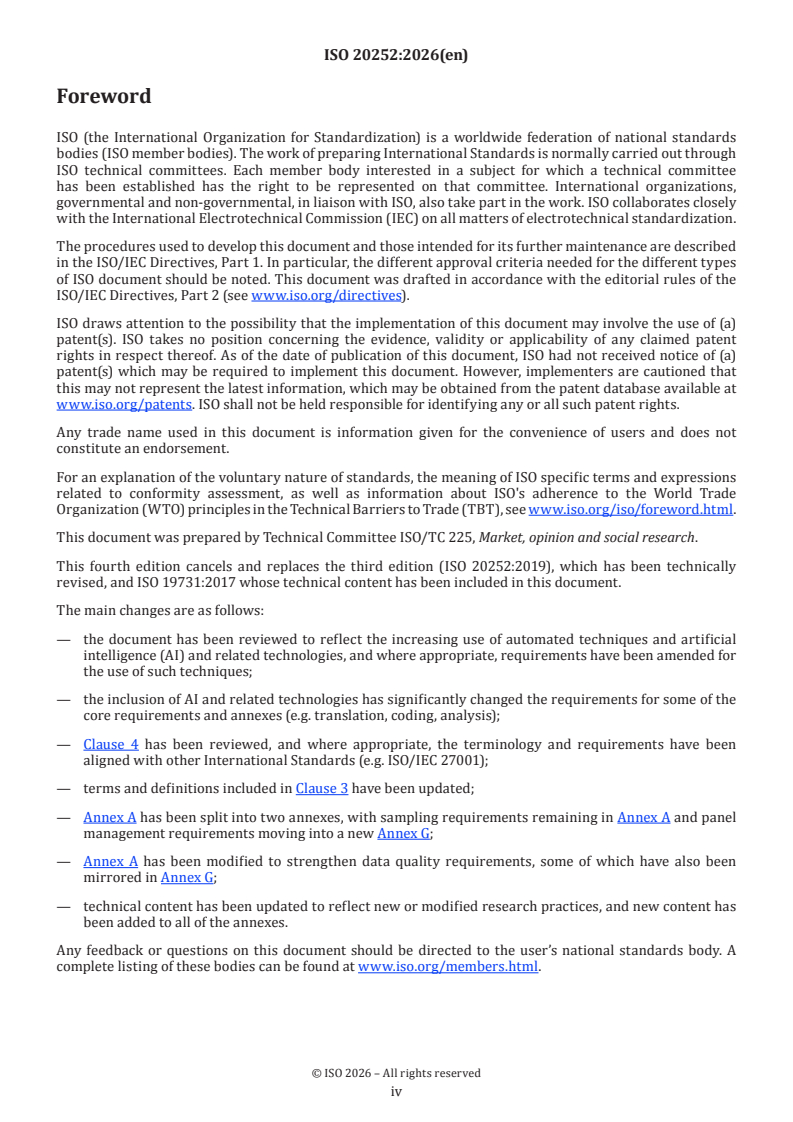
This document was prepared by Technical Committee ISO/TC 225, Market, opinion and social research.
This fourth edition cancels and replaces the third edition (ISO 20252:2019), which has been technically
revised, and ISO 19731:2017 whose technical content has been included in this document.
The main changes are as follows:
— the document has been reviewed to reflect the increasing use of automated techniques and artificial
intelligence (AI) and related technologies, and where appropriate, requirements have been amended for
the use of such techniques;
— the inclusion of AI and related technologies has significantly changed the requirements for some of the
core requirements and annexes (e.g. translation, coding, analysis);
— Clause 4 has been reviewed, and where appropriate, the terminology and requirements have been
aligned with other International Standards (e.g. ISO/IEC 27001);
— terms and definitions included in Clause 3 have been updated;
— Annex A has been split into two annexes, with sampling requirements remaining in Annex A and panel
management requirements moving into a new Annex G;
— Annex A has been modified to strengthen data quality requirements, some of which have also been
mirrored in Annex G;
— technical content has been updated to reflect new or modified research practices, and new content has
been added to all of the annexes.
Any feedback or questions on this document should be directed to the user’s national standards body. A
complete listing of these bodies can be found at www.iso.org/members.html.
iv
Introduction
The principal objective of international standardization within the market, opinion and social research
(henceforth referred to as “research”) is the facilitation of global and consistent industry standards
applicable to different national and regional markets. The intent of this document is to follow a structure to
ensure that its implementation leads to continual improvement of research and to harmonize other national
standards and industry codes already available.
The increasing use of automated processes and AI and related technologies in market, opinion and social
research has been reflected in this document in a technology neutral manner to reflect the fast-changing
nature of these techniques. The addition of automation and AI and related technologies has resulted in some
significant changes in some parts of the core framework, notably translation and coding.
The research business core framework remains and is documented as Clause 4. Clause 4 has been re-ordered
and aligned with other standards (such as ISO/IEC 27001) which are complementary to this document.
The language used in this document has been aligned with such standards to increase accessibility and
familiarity.
Annexes A to G provide the specific framework for various globally recognized research methodologies.
The service provider can align its practices to the requirements as stated within each annex in order to
attest conformity to the particular research methodology or functions. The annexes have been expanded
with the addition of a new Annex G, panel development and life cycle management, the content of which was
previously included in Annex A. In addition, Annex A has been strengthened with the addition of new data
quality requirements to reflect the increasing challenges in this area.
The intent is to apply the requirements specified in Clause 4 as the mandatory framework for any attestation
by a service provider conforming with this document, supported by at least one annex. The structure
and scope of this document do not permit any attestation to this document without also meeting the
requirements of at least one annex.
Regardless of whether a business undertakes research activities as an in-house or subcontracted function,
the service provider is ultimately responsible for ensuring that research activities meet the requirements
of this document. Therefore, the scope and boundaries of the applicable disciplines are reflected in the
statement of applicability (SoA), including the annexes with management processes in place to ensure the
requirements of this document are met.
Any claim of attestation will clearly and unambiguously state which annexes are included within the scope
of conformity. The long-term aim is that businesses will attest the majority, if not all, of their research
activities to this document.
v
International Standard ISO 20252:2026(en)
Market, opinion and social research, including insights and
data analytics — Vocabulary and service requirements
1 Scope
This document establishes terms, definitions and service requirements for service providers conducting
market, opinion and social research, including insights and data analytics.
This document does not apply to non-research activities, such as direct marketing.
2 Normative references
There are no normative references in this document.
3 Terms and definitions
For the purposes of this document, the following terms and definitions apply.
ISO and IEC maintain terminology databases for use in standardization at the following addresses:
— ISO Online browsing platform: available at https:// www .iso .org/ obp
— IEC Electropedia: available at https:// www .electropedia .org/
3.1
accuracy
degree of closeness between the estimate and the agreed parameter value (3.5)
3.2
active panel member
panel member (3.79) who, within the last 12 months, has participated in at least one research project if
requested, updated their profile data (3.87), or registered to join the panel (3.78)
3.3
affiliate networks
aggregated individual affiliates and publishers in partnership relationships where potential participants
(3.80) are members of communities and are offered opportunities to participate in research
3.4
aggregator
supplier that facilitates access to participants (3.80) sourced from multiple online sources (e.g. panels (3.78))
and making them accessible via a single interface
3.5
agreed parameter value
degree of closeness between an estimate and the true value
3.6
algorithm
set of rules for transforming the logical representation of data
[SOURCE: ISO/IEC 18836:2001, 4.2]
3.7
anonymize
to remove, obscure, aggregate, or alter identifiers in such a way that individuals to whom the data originally
related can no longer be identified, either directly or indirectly
3.8
appraisal
process of monitoring the competence of an individual or group of individuals in carrying out their work
3.9
artificial intelligence
AI
set of technologies that are designed to simulate human intelligence and to provide problem-solving
capabilities
3.10
artificial intelligence agent
AI agent
automated entity that uses AI (3.9) to perform tasks, interact with its environment, and take actions to
achieve specific goals often by interacting with users, data or other systems
3.11
asset
any resource owned by an organization that has potential or actual economic value
EXAMPLE Files, images, concepts.
3.12
attestation
declaration of conformity by the service provider (3.120) related to the statement of applicability (SoA)
3.13
audit
systematic, independent and documented process for obtaining evidence and evaluating it objectively to
determine the extent to which organizations or service providers (3.120) conform to the requirements of this
document
3.14
auditor
person with the competence to conduct an audit (3.13)
3.15
automated coding
form of coding where manual coding is replaced, totally or in part, by various forms of computer coding or
computer-assisted coding using computer-stored code (3.20) lists, dictionaries, automated systems, machine
learning, artificial intelligence (3.9) or other technologies
3.16
bias
systematic deviation between the estimate and the agreed parameter value (3.5)
3.17
bot
autonomous software that operates as an agent for a user or a program or simulates a human activity
3.18
business governance
rules and protocols put in place to address specific standards and requirements of stakeholders and
interested parties when providing services
3.19
client
individual, organization, department or division, whether it is internal or external, that requests or
commissions a research project
3.20
code
character or combination of numeric, alphabetic or other types of characters associated with each response
category
3.21
code frame
list of categories with associated codes (3.20) for classifying responses
3.22
competent
possessing the necessary knowledge, skill and/or experience to perform certain tasks effectively and in
accordance with applicable requirements
3.23
completion rate
number of participants (3.80) who fully complete a research project divided by the number of participants
who were invited to participate
3.24
computer-assisted interviewing
CAI
interviews where responses are keyed directly into a computer and where the administration of the
interview is managed by a specifically designed program
EXAMPLE Computer-assisted personal interviewing (CAPI), computer-assisted telephone interviewing (CATI),
computer-assisted self-interviewing (CASI), computer-assisted interviewing via web/internet (CAWI).
3.25
confidentiality
requirement that information, materials and data collected are protected from unauthorized access
3.26
consent
freely given agreements based on adequate information obtained prior to the collection/use of participant
(3.80) data
3.27
convenience sample
sample (3.105) chosen on the basis of accessibility, expediency, cost, efficiency, or other reason not directly
concerned with statistical sampling design
[SOURCE: ISO 11074:2025, 3.97, modified — “statistical sampling design” replaced “sampling parameters”.
Note 1 to entry deleted.]
3.28
cookie
small piece of information (i.e. program code (3.20) that is stored on a browser for the purpose of identifying
that browser during activities and between visits or sessions
3.29
corrective action
action or actions to eliminate the cause or causes of a nonconformity and to prevent recurrence
3.30
dashboard
software application with which a number of mini applications can be reviewed or managed and reported
EXAMPLE Mini applications can include an app to export data or allow API access.
3.31
data cleaning
process of identifying, correcting or removing unneeded or inaccurate data for research quality purposes
3.32
data collection instrument
tool created for the purpose of gathering information from participants (3.80)
EXAMPLE Questionnaire (3.92), discussion guide (3.46), biometric device, web scraping technology, camera.
3.33
data editing
set of methods for verifying the collected data and, if necessary, correcting the data
3.34
data entry
process step where data collected are converted into a computer-readable form or other types of
standardized forms
Note 1 to entry: Simple data entry is data entry containing no built-in logic checks.
Note 2 to entry: Logic data entry is a data entry process that uses automated checks for the logic of data on elements
such as data types, filters (3.50), question skips and response options.
3.35
data processing
management and converting of data from their raw state through to a required output
3.36
data quality
characteristics of data that relate to their ability to satisfy stated requirements
[SOURCE: ISO 14044:2006, 3.19]
3.37
data record
results from the performance of a research project using project-related documents (3.88), including primary
records (3.85)
3.38
de-duplication
process to remove data records (3.37) corresponding to participants (3.80) or records (3.94) that appear
more than once in a research data set or panel (3.78)
3.39
depth interview
in-depth interview
IDI
semi-structured or unstructured interview conducted to understand the underlying motivations, beliefs,
attitudes behaviours and feelings of a participant (3.80)
3.40
derived data item
data item calculated or recoded from one or more sources and/or categories
3.41
device ID
unique alphanumeric string associated with a computer, smartphone, tablet or other computing device
Note 1 to entry: A device can have multiple device IDs for a different purpose. These include device or operating
©1)
systems IDs to enable Wi-Fi or near field communications (3.70) or uniquely identify a device on a mobile carrier
network. Other unique device IDs (such as an International Mobile Equipment Identity (IMEI) (3.55)), are also used by
apps, developers and other companies to identify, track and analyse devices and their users for a number of purposes,
including online advertising.
Note 2 to entry: For a personal computer (PC) or laptop computer, the media access control (MAC) address can be used
as a device ID.
Note 3 to entry: A device ID can be personally identifiable.
3.42
digital analytics
analysing and reporting of electronic data for the purpose of measuring and understanding people and their
behaviour
3.43
digital and online observation
collection of data through observation of digital activity including behaviour, habits, activities, relations,
expressed opinions or performance of individuals or groups without the use of direct questioning and
undertaken in the digital and online environment
Note 1 to entry: Digital observational data collection (3.74) excludes physical observation (3.84).
3.44
digital device
portable electronic device that can collect data, either directly or indirectly, and share it with a third party
(3.131)
Note 1 to entry: Digital devices include smartphones, smart watches, fitness or health tracking devices, tablets, geo-
location devices and biometric data gathering devices.
3.45
digital fingerprint
information collected about a computer, tablet, smartphone or other computing device for the purpose of
identification of individual research participants (3.80) or devices
Note 1 to entry: Digital fingerprints are typically created using web browser configuration parameters along with
other device parameters that can be obtained from a device. These parameters are used to create a single string that
comprises the digital fingerprint.
Note 2 to entry: A digital fingerprint may be personally identifiable.
3.46
discussion guide
list of points or topics which are to be covered in a depth interview (3.39), focus group (3.51) or other
qualitative research (3.90) method
3.47
dongle
small piece of hardware, often a universal serial bus (USB) device, that can be connected to other electronic
equipment to enable additional services such as access to the internet
©
1) Wi-Fi is a registered trademark of Wi-Fi Alliance®, and is an example of a suitable product(s) available commercially.
This information is given for the convenience of users of this document and does not constitute an endorsement by ISO of
this product.
3.48
drop-out
abandon
abandonment
instances where participants (3.80) start and do not finish a research project
3.49
fieldworker
interviewer
person involved in the collection of research data
Note 1 to entry: Fieldworkers include, but are not limited to, face-to-face and telephone interviewers, recruiters (3.95)
for qualitative research (3.90) or other research, mystery shoppers (3.68) and other people carrying out data collection
by observation, and persons collecting data from retail outlets, following instructions from the service provider
(3.120).
3.50
filter
question or instruction in a data collection instrument (3.32) that restricts answers to a subgroup of
participants (3.80)
3.51
focus group
group discussion
open discussion with a small number of selected participants (3.80) conducted by a moderator (3.67)
Note 1 to entry: Focus groups can be conducted face to face, by telephone, online or by a combination of these. Online
focus groups can be synchronous or real time (e.g. chat sessions), or asynchronous over an extended period of time
(e.g. message and/or bulletin boards).
3.52
fraudulent participant
participant (3.80) or panel member (3.79) who deliberately misrepresents their identity, profile data (3.87)
or responses, or uses technology to bypass research project controls
3.53
frequency count
number of times a unique value appears in a data set
3.54
hidden question
statement or query in surveys (3.127) that is not visible to individuals
3.55
IMEI
International Mobile Equipment Identity
unique identifying number identifier attributed to every digital device (3.44), assigned by the manufacturer
of the digital device, and regulated by the Global System for Mobile Communications (GSM) Association
(GSMA)
Note 1 to entry: See also device ID (3.41).
3.56
imputation
procedure where missing data are replaced by estimated or modelled data
3.57
inattentive participant
participant (3.80) who does not give an adequate level of thought to the responses they provide
3.58
incentive
gift, payment or other considerations offered to potential participants (3.80) to increase participant
cooperation
3.59
indexing
numerical scale used to compare variables with one another or with a reference number
3.60
information security
preservation of confidentiality (3.25), integrity and availability of information
3.61
in-person intercept
sampling method whereby fieldworkers (3.49) invite potential participants (3.80) to undertake research
activities while they are engaged in another activity, in a particular location. (e.g. on the street, shopping
malls)
3.62
internal audit
in-house audit (3.13) carried out periodically by competent (3.22) individuals, to assess whether projects,
processes and systems are consistent with the requirements within this document
Note 1 to entry: An internal audit can be carried out by the service provider’s (3.120) personnel or subcontracted.
3.63
managed network
collaborative network of panels (3.78) sourced from multiple providers, using agreed quality controls, co-
ordinated and administered by a single intermediary
3.64
management review
establishment of procedures approved by senior management (3.118) to review its management system
at planned intervals to ensure its continuing suitability, adequacy and effectiveness, including the stated
policies and objectives related to the management system
3.65
margin of error
statistical term for the degree of deviation within a probability sample (3.86)
3.66
marketplace
platform for buyers and sellers of samples (3.105)
3.67
moderator
individual responsible for facilitating the interactions among participants (3.80) of a focus group (3.51) or
another qualitative research (3.90) forum
3.68
mystery shopper
observer
retail auditor
fieldworkers (3.49), researchers or participants (3.80) who observe and/or evaluate to a defined specification
3.69
mystery shopping
project using fieldworkers (3.49), researchers or participants (3.80) who observe and/or evaluate to a defined
specification
3.70
near field communication
wireless technology that enables communication between devices over a short distance
3.71
netting
method of treating codes (3.20) assigned to multiple-response questions, which can include open-ended
codes, where the net refers to the total number of participants (3.80) responding with the same group of
codes, even when each participant has given more than one response within the same group of codes
3.72
non-probability sample
sample (3.105) from a population wherein each member’s probability of being included is unknown
3.73
non-response
absence of measurement on some sample (3.105) or census members for all or some questions or variables
3.74
observational data collection
observational research
observational methodologies
collection of data through observation including behaviour, habits, activities, relations, expressed opinions
or performance of individuals or groups, as well as phenomena, including the use of passive techniques,
without the use of direct questioning
Note 1 to entry: See also passive data collection (3.82) and physical observation (3.84).
3.75
online intercept
sampling method that invites potential participants (3.80) to undertake research activities while they are
online, e.g. from advertisements on social media (3.122), web browsing, web notices within apps and other
websites to an online portal where they are screened for research projects in real time
3.76
open-ended question
type of question where participants (3.80) are asked to answer in their own words
3.77
opt-out
explicit request to terminate participation in a research project
3.78
panel
sample (3.105) database of potential participants (3.80) who declare that they will cooperate for future data
collection if selected
3.79
panel member
individual recruited from a documented source who has provided profile data (3.87) and appropriate
information for validation of identity, and has agreed to participate in research according to the terms and
conditions of panel membership
3.80
participant
person or organization from whom or about whom data are collected for research
3.81
participation rate
number of participants (3.80) providing a usable response divided by the total number invited to participate
3.82
passive data collection
passive methodologies
process of data collection that avoids or minimizes active interaction with participants (3.80)
3.83
personal data
information that relates to a natural person and directly or indirectly allows that person to be identified
Note 1 to entry: The identification can be made for example by reference to direct identifiers (e.g. name, specific
geographic location, telephone number, picture, sound, video recording or biometric data) or indirectly by reference to
an individual’s physical, physiological, mental, economic, cultural or social characteristics.
3.84
physical observation
physical observational research
collection of data through observation, whether in person or by video, including behaviour, habits, activities,
relations, expressed opinions or performance of individuals or groups without the use of direct questioning
and undertaken in the physical environment
Note 1 to entry: Physical observation excludes digital and online observation (3.43).
3.85
primary record
data collected directly from the source and in their original state
Note 1 to entry: This can include survey (3.127) data, interview transcripts, field notes, video and audio recordings,
browsing history, personal data (3.83) (e.g. biometric measurements and recordings).
3.86
probability sample
random sample (3.105) from a population wherein each member has a known and non-zero probability of
being included and allows for the calculation of margin of error (3.65)
EXAMPLE Simple random sampling (SRS), stratified sampling, cluster sampling, systematic sampling, multistage
sampling (in which some of the methods above are combined in stages).
3.87
profile data
descriptive characteristics of a panel member (3.79)
3.88
project-related document
documentation (or document), material or specification for the performance of research project, including
research design, recruitment, data collection, data processing (3.35) and analysis
EXAMPLE Questionnaire (3.92), discussion guide (3.46), recruitment screener, code frame (3.21), sampling frame
(3.111), proposal, quota specification.
3.89
publishing
dissemination of research outputs through any means
3.90
qualitative research
analysis of motivations, patterns of thought, opinion, attitude, assessment or behaviour, via research
techniques such as focus groups (3.51), depth interviews (3.39), discourse content analysis and qualitative
observational data collection (3.74)
3.91
quantitative research
numerical measurement of observations via research techniques such as questionnaires (3.92), opinion polls,
surveys (3.127) and experimental research
3.92
questionnaire
structured or partly structured instrument for collecting data, consisting of a series of questions
Note 1 to entry: Questionnaires can be self-completion or administered by a fieldworker (3.49) or an artificial
intelligence agent (3.10).
3.93
quota sample
sample (3.105) drawn using a non-probabilistic method (e.g. convenience samples (3.27) or multiple source
sampling), such that it conforms to a predefined structure with respect to certain variables
3.94
record
special type of physical or digital document that provides historical evidence of an event, activity or fact
Note 1 to entry: For example, a questionnaire (3.92) is a document, but once it is completed by a participant (3.80) or a
fieldworker (3.49), it becomes a record.
3.95
recruiter
person who identifies and invites potential participants (3.80) to take part in a research project
3.96
reliability
overall consistency among replicated measures
Note 1 to entry: In this context, measurement has a high reliability if it can be repeated with the same or similar
results under the same or similar conditions.
3.97
representativeness
degree to which a sample (3.105) reflects the target population (3.129) being studied
Note 1 to entry: A representative sample is one in which the distribution of important characteristics is approximately
the same as in the target population.
Note 2 to entry: The definition of “important characteristics” is generally a function of the research topic.
3.98
response rate
calculation of the proportion of people responding to a survey (3.127)
3.99
retail audit
collection of data from retail outlets using documentary (e.g. paper or digital) and/or observational methods
3.100
review
assessment to determine the suitability, adequacy and/or effectiveness of a project, process and/or system
in achieving its established objectives
3.101
risk
combination of the probability of an event and its consequences
3.102
risk assessment
overall process of risk (3.101) identification, risk analysis, risk evaluation and risk mitigation
[SOURCE: ISO 22734-1:2025, 3.39, modified — Note 1 to entry deleted.]
3.103
robot instruction file
file that defines how an internet search engine interacts with the pages and files of a website and is often
used to define where automated systems are not allowed to go
3.104
router
online software application that screens incoming participants (3.80) and then uses those results to assign
research participants to one of multiple available research projects
Note 1 to entry: A router can also offer participants additional screeners and surveys (3.127) after screener
qualification failure or survey completion.
Note 2 to entry: It differs from “hardware router” as a communication equipment that relays data between two or
more different networks.
3.105
sample
subset of the population of interest
3.106
sample aggregation
process of combining multiple distinct sample (3.105) sources without adjusting for differences in their
composition
3.107
sample blending
process of merging multiple sample (3.105) sources while applying statistical techniques to ensure
consistency and reduce bias (3.16) in order to create a more representative and homogenous sample
3.108
sample broker
intermediary that connects buyers and sellers of samples (3.105)
3.109
sample exchange
technology enabled platform where multiple suppliers provide samples (3.105) for purchase by buyers in
real time
3.110
sample provider
individuals or organizations responsible for the provision and management of samples (3.105) from relevant
sources such as panels (3.78) and other research database participant (3.80) sources, online-intercept-based
sources and email lists
Note 1 to entry: Sample providers can offer some or all of the following services:
— sample broker (3.108) services;
— sample aggregation (3.106);
— router (3.104) technology.
3.111
sampling frame
list of population elements or other appropriate sources from which a sample (3.105) is to be drawn
3.112
screening
systematic process to confirm or establish the eligibility of participants (3.80)
Note 1 to entry: Screening can be undertaken pre, during or post data collection.
3.113
screen out
exclusion of participants (3.80) from progressing through a research project based on their answers to
certain questions
3.114
secondary data
data that have already been collected and are available from another source
3.115
secure end link
security methods that ensure research projects and participant (3.80) data are recorded accurately and
protected whilst in transit
3.116
security classification
category to which data and systems are assigned to denote the degree of protection required
3.117
self-service
do-it-yourself
DIY
technological platform facilitating some or all stages of a research project
3.118
senior management
person or group of people who directs or controls a service provider (3.120) at the highest level
3.119
sentiment
feeling or attitude associated with, for example, a sound, image or statement, usually on a continuum from
positive to neutral to negative
3.120
service provider
organization that conducts research projects or parts of research projects using statistical data and/or
social science methods and techniques
EXAMPLE Private research institutions; academic and university research institutions; in-company research
departments; local authorities, official statistics agencies or individual researchers acting in the same capacity.
Note 1 to entry: Service providers can include specialist providers which provide specific services such as panel (3.78)
providers, sample providers (3.110) or language service providers.
3.121
silent call
telephone call generated by a dialler and answered by a participant (3.80) before a fieldworker (3.49) is made
available
Note 1 to entry: A dialler (automated dialling equipment) is any equipment or software able to dial a telephone number
and make the call available to the fieldworker.
3.122
social media
online technologies and practices that people use to share opinions, insights, experiences and perspectives
with each other, transforming traditional one-to-many interactions into many-to-many interactions
3.123
spyware
devices or software that capture a participant’s (3.80) data or behaviour without obtaining consent (3.26)
3.124
subcontract
outsource
engage an external organization or individual to perform part of the service provider’s (3.120) function or
process, under the responsibility of the service provider
Note 1 to entry: Hired or otherwise subcontracted services and/or assets (3.11) include, for example, participant (3.80)
panels (3.78), cloud services, computer software and hardware, other technology platforms, electronic or other secure
data storage facilities and focus group (3.51) venues.
3.125
subcontractor
individual or organization to whom a service provider (3.120) has contracted part of its activities
Note 1 to entry: Self-employed individual fieldworkers (3.49) are not defined as subcontractors for the purposes of this
document.
3.126
substitution
replacement of a term in a data set by another term during data entry (3.34) to enhance accuracy (3.1),
correct errors, standardize terminology or address missing data
3.127
survey
data collection from a sample (3.105) of a target population (3.129) from which inferences can be made
3.128
synthetic data
information generated by computational or statistical models from real-world (usually historical) data,
designed to approximate the patterns, characteristics or statistical attributes of the target group
3.129
target population
group of people of interest in the research project to which inferences are made
3.130
text analysis
content analysis
method used to describe the characteristics of a message
3.131
third party
independent organization or individual not under the responsibility of the service provider (3.120)
3.132
training data
data used to train AI (3.9) and other related technologies or models
[SOURCE: ISO/IEC 22989:2022, 3.3.16]
3.133
unique visitor
inferred measure that signifies a distinct, unduplicated individual requesting a page from a website during a
given period, regardless of how often they visit
3.134
validation
procedures to check conformity to specifications or requirements at any stage of the research process
3.135
validity
assurance that the results of a research process represent what was intended
3.136
vulnerable person
person who is permanently or temporarily unable to represent their own interests through a mental,
emotional, societal or physical cause that can limit their capacity to make voluntary and informed decisions
3.137
wav
...