

ISO 4561:2023
(Main)Wood raw parquets elements — Classification
General Information
- Abstract
This document establishes the classification, by quality, of raw parquet elements intended for the manufacture of strips for different types of parquet floorings of the following wood species: — oak (Quercus sp.), — beech (Fagus sylvatica sp.), — birch (Betula sp.), — maple (Acer sp.), — fir (Abies sp.), and — spruce (Picea sp.).
- Status
- Published
- Publication Date
- 05-Jul-2023
- Technical Committee
- ISO/TC 218 - Timber
- Drafting Committee
- ISO/TC 218/WG 5 - Parquet and wood flooring
- Current Stage
- 6060 - International Standard published
- Start Date
- 06-Jul-2023
- Due Date
- 28-Feb-2023
- Completion Date
- 06-Jul-2023
Buy Documents
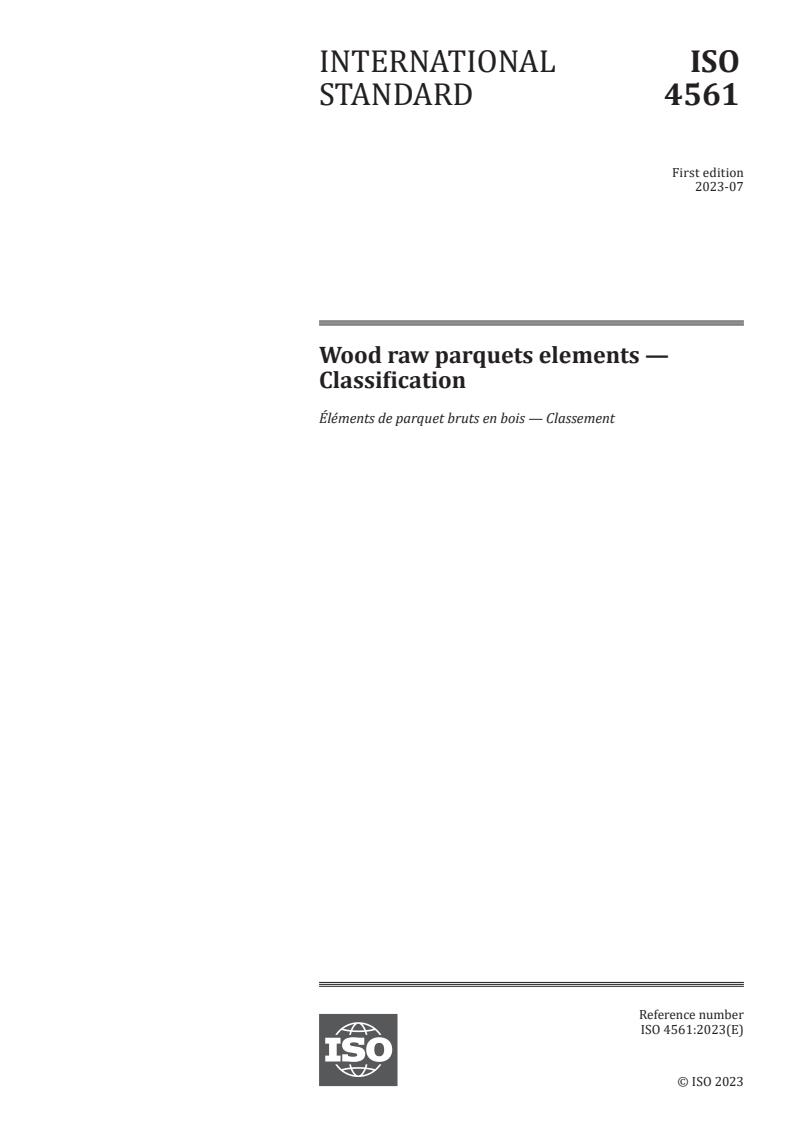

ISO 4561:2023 - Wood raw parquets elements — Classification Released:6. 07. 2023
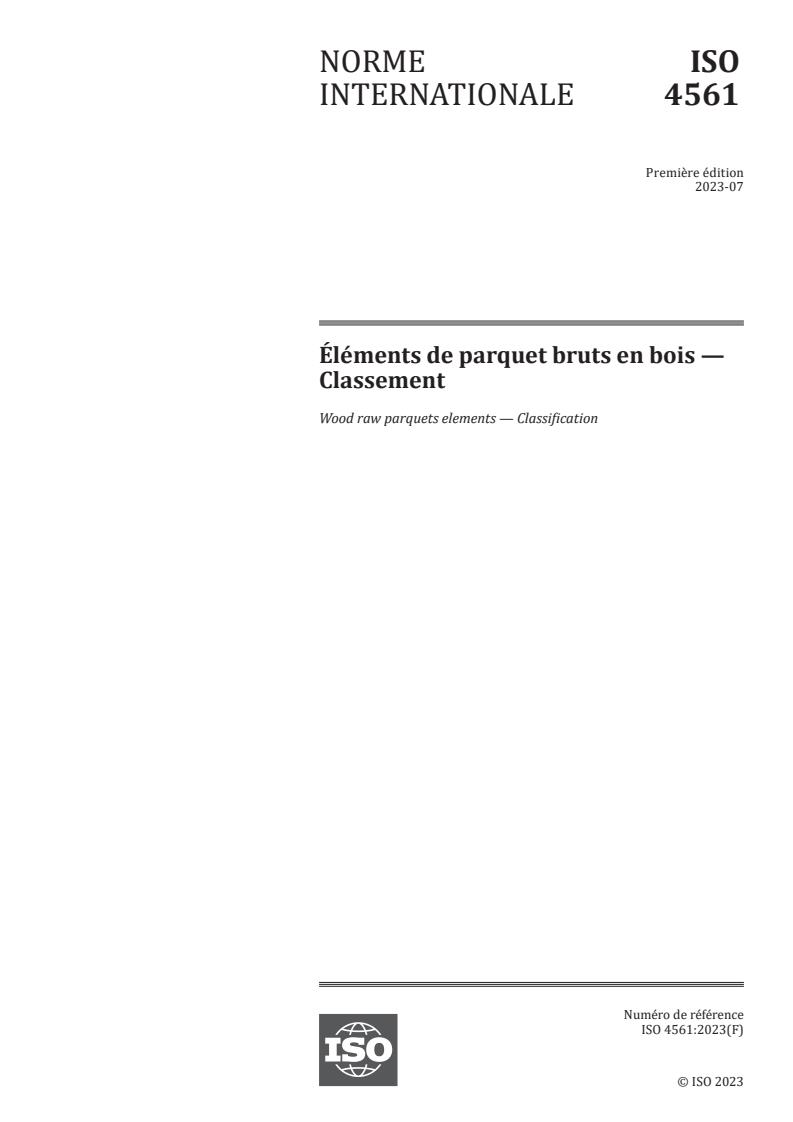
ISO 4561:2023 - Éléments de parquet bruts en bois — Classement Released:6. 07. 2023
Overview
ISO 4561:2023 - Wood raw parquets elements - Classification - defines the international classification, by quality, of raw parquet elements used to manufacture strips for parquet flooring. It covers six wood species: oak (Quercus sp.), beech (Fagus sylvatica sp.), birch (Betula sp.), maple (Acer sp.), fir (Abies sp.) and spruce (Picea sp.). This first edition merges and updates earlier ISO documents and is prepared by ISO/TC 218 (Timber).
Key SEO phrases: ISO 4561, wood raw parquet elements, parquet classification, parquet quality grades, oak beech birch maple fir spruce.
Key topics and technical requirements
ISO 4561 specifies classification rules, permissible defects and delivery/manufacture references. Main technical topics include:
- Grades: raw parquet elements are divided into Grade I, Grade II and Grade M (M applies only to oak). Elements exceeding allowed defects must not be sold under ISO designations for the species.
- Manufacture and delivery: manufacturing characteristics and delivery conditions are defined by ISO 4556; beech elements are steamed prior to delivery unless otherwise requested.
- General dimensional/appearance limits:
- Slope of grain not exceeding 10% relative to piece axis.
- Bow allowed on one plane up to 1% of piece length.
- Spring (crook) allowed up to 0.5% of piece length.
- Cup (fir/spruce only) allowed up to 2 mm across width.
- Saw marks permitted up to 0.5 mm depth.
- Defect limits (select examples from tables for face, back, ends and edges):
- Shallow checks: typically 1 mm (Grade I) up to 2–4 mm (Grade II depending on species and face/back).
- Sound knots: permitted sizes vary by species and grade (e.g., up to 10–20 mm on oak faces; 15–25 mm on other species for some grades).
- Black/dead knots: stricter limits (often 1–10 mm on faces, larger allowances on backs/edges).
- Wane, curl, bore-holes and pitch-pockets: specific allowances differ by species and grade; number of face defects limited (e.g., max 3 defects for Grade I, 4 for Grade II in some cases).
The standard relies on vocabulary and terms from ISO 5323 and ISO 24294.
Applications and who uses it
ISO 4561 is used by:
- Parquet manufacturers and millworkers specifying raw parquet grade for production of strips and finished parquet flooring.
- Timber merchants and buyers for product acceptance, inspection and contracting.
- Quality control and inspection personnel establishing compliance with permitted defect limits.
- Architects, specifiers and procurement teams writing technical product requirements for projects.
- Standards bodies and testing laboratories harmonizing classification and trade descriptions.
Practical benefits include consistent grading, improved trade clarity, and reduced disputes over raw parquet element quality.
Related standards
- ISO 4556 - Wood raw parquet elements - General characteristics (manufacture/delivery).
- ISO 5323 - Wood flooring and parquet - Vocabulary.
- ISO 24294 - Timber - Round and sawn timber - Vocabulary.
For full numeric tables, defect definitions and complete requirements consult the official ISO 4561:2023 document.
Relations
- Consolidated By
ISO/TR 19115-4 - Geographic information — Metadata — Part 4: JSON schema implementation of metadata fundamentals - Effective Date
- 22-Jun-2024
- Revises
ISO 5333:1978 - Coniferous wood raw parquet blocks — Classification of fir and spruce parquet blocks - Effective Date
- 23-Apr-2020
- Effective Date
- 23-Apr-2020
- Effective Date
- 23-Apr-2020
Buy Documents
ISO 4561:2023 - Wood raw parquets elements — Classification Released:6. 07. 2023
ISO 4561:2023 - Éléments de parquet bruts en bois — Classement Released:6. 07. 2023
Get Certified
Connect with accredited certification bodies for this standard

Gozdarski inštitut Slovenije
Slovenian Forestry Institute. Forest management certification support, timber testing.
Sponsored listings
Frequently Asked Questions
ISO 4561:2023 is a standard published by the International Organization for Standardization (ISO). Its full title is "Wood raw parquets elements — Classification". This standard covers: This document establishes the classification, by quality, of raw parquet elements intended for the manufacture of strips for different types of parquet floorings of the following wood species: — oak (Quercus sp.), — beech (Fagus sylvatica sp.), — birch (Betula sp.), — maple (Acer sp.), — fir (Abies sp.), and — spruce (Picea sp.).
This document establishes the classification, by quality, of raw parquet elements intended for the manufacture of strips for different types of parquet floorings of the following wood species: — oak (Quercus sp.), — beech (Fagus sylvatica sp.), — birch (Betula sp.), — maple (Acer sp.), — fir (Abies sp.), and — spruce (Picea sp.).
ISO 4561:2023 is classified under the following ICS (International Classification for Standards) categories: 79.080 - Semi-manufactures of timber. The ICS classification helps identify the subject area and facilitates finding related standards.
ISO 4561:2023 has the following relationships with other standards: It is inter standard links to ISO/TR 19115-4, ISO 5333:1978, ISO 3399:1976, ISO 3398:1977. Understanding these relationships helps ensure you are using the most current and applicable version of the standard.
ISO 4561:2023 is available in PDF format for immediate download after purchase. The document can be added to your cart and obtained through the secure checkout process. Digital delivery ensures instant access to the complete standard document.
Standards Content (Sample)
INTERNATIONAL ISO
STANDARD 4561
First edition
2023-07
Wood raw parquets elements —
Classification
Éléments de parquet bruts en bois — Classement
Reference number
© ISO 2023
All rights reserved. Unless otherwise specified, or required in the context of its implementation, no part of this publication may
be reproduced or utilized otherwise in any form or by any means, electronic or mechanical, including photocopying, or posting on
the internet or an intranet, without prior written permission. Permission can be requested from either ISO at the address below
or ISO’s member body in the country of the requester.
ISO copyright office
CP 401 • Ch. de Blandonnet 8
CH-1214 Vernier, Geneva
Phone: +41 22 749 01 11
Email: copyright@iso.org
Website: www.iso.org
Published in Switzerland
ii
Contents Page
Foreword .iv
Introduction .v
1 Scope . 1
2 Normative references . 1
3 Terms and definitions . 1
4 Manufacture, characteristics, delivery conditions . 1
5 Classification . 2
Bibliography . 7
iii
Foreword
ISO (the International Organization for Standardization) is a worldwide federation of national standards
bodies (ISO member bodies). The work of preparing International Standards is normally carried out
through ISO technical committees. Each member body interested in a subject for which a technical
committee has been established has the right to be represented on that committee. International
organizations, governmental and non-governmental, in liaison with ISO, also take part in the work.
ISO collaborates closely with the International Electrotechnical Commission (IEC) on all matters of
electrotechnical standardization.
The procedures used to develop this document and those intended for its further maintenance are
described in the ISO/IEC Directives, Part 1. In particular the different approval criteria needed for the
different types of ISO documents should be noted. This document was drafted in accordance with the
editorial rules of the ISO/IEC Directives, Part 2. www.iso.org/directives
Attention is drawn to the possibility that some of the elements of this document may be the subject of
patent rights. ISO shall not be held responsible for identifying any or all such patent rights. Details of
any patent rights identified during the development of the document will be in the Introduction and/or
on the ISO list of patent declarations received. www.iso.org/patents
Any trade name used in this document is information given for the convenience of users and does not
constitute an endorsement.
For an explanation on the meaning of ISO specific terms and expressions related to conformity
assessment, as well as information about ISO's adherence to the WTO principles in the Technical
Barriers to Trade (TBT) see the following URL: Foreword - Supplementary information
This document was prepared by Technical Committee ISO/TC 218, Timber.
This first edition of ISO 4561 replaces ISO 5333:1978, ISO 3398:1977 and ISO 3399:1976 as being the
merging of these three standards.
The main changes are as follows:
— updating of the vocabulary according to ISO 5323:2019
— clarifying on an editorial point of view some requirements
— introducing new species
Any feedback or questions on this document should be directed to the user’s national standards body. A
complete listing of these bodies can be found at www.iso.org/members.html.
iv
Introduction
The main purpose of this document is to establish the common international point of member countries
of the International Organization for Standardization (ISO), concerning the classification, by quality, of
broadleaved and coniferous raw parquet elements intended for the manufacture of strips for different
types of parquet floorings.
v
INTERNATIONAL STANDARD ISO 4561:2023(E)
Wood raw parquets elements — Classification
1 Scope
This document establishes the classification, by quality, of raw parquet elements intended for the
manufacture of strips for different types of parquet floorings of the following wood species:
— oak (Quercus sp.),
— beech (Fagus sylvatica sp.),
— birch (Betula sp.),
— maple (Acer sp.),
— fir (Abies sp.), and
— spruce (Picea sp.).
2 Normative references
The following documents are referred to in the text in such a way that some or all of their content
constitutes requirements of this document. For dated references, only the edition cited applies. For
undated references, the latest edition of the referenced document (including any amendments) applies.
ISO 4556, Wood raw parquet elements – general characteristics
ISO 5323, Wood flooring and parquet — Vocabulary
ISO 24294, Timber — Round and sawn timber — Vocabulary
3 Terms and definitions
For the purposes of this document, the terms and definitions given in ISO 5323 and ISO 24294 apply.
ISO and IEC maintain terminology databases for use in standardization at the following addresses:
— ISO Online browsing platform: available at https:// www .iso .org/ obp
— IEC Electropedia: available at https:// www .electropedia .org/
4 Manufacture, characteristics, delivery conditions
The manufacture, the characteristics and the delivery conditions shall be in accordance with ISO 4556.
Unless otherwise requested, the wood of beech parquet elements shall be steamed before delivery.
5 Classification
Raw parquet elements shall not contain more defects than those allowed in the following Tables 1 to 7.
Raw parquet elements are divided into grades:
I
II
M (only for oak raw parquet elements)
Oak raw parquet elements containing more defects than those allowed for the last grade (M) shall not
be delivered under the designations “ISO oak raw parquet elements”, nor under any other designation
which may lead to confusion with one of the grades given.
Beech raw parquet elements, Birch raw parquet elements, Maple raw parquet elements, Fir raw parquet
elements and Spruce raw parquet elements containing more defects than those allowed for the second
grade (II) shall not be delivered under the designations “ISO beech raw parquet elements”, “ISO birch
raw parquet elements”, “
...
NORME ISO
INTERNATIONALE 4561
Première édition
2023-07
Éléments de parquet bruts en bois —
Classement
Wood raw parquets elements — Classification
Numéro de référence
DOCUMENT PROTÉGÉ PAR COPYRIGHT
© ISO 2023
Tous droits réservés. Sauf prescription différente ou nécessité dans le contexte de sa mise en œuvre, aucune partie de cette
publication ne peut être reproduite ni utilisée sous quelque forme que ce soit et par aucun procédé, électronique ou mécanique,
y compris la photocopie, ou la diffusion sur l’internet ou sur un intranet, sans autorisation écrite préalable. Une autorisation peut
être demandée à l’ISO à l’adresse ci-après ou au comité membre de l’ISO dans le pays du demandeur.
ISO copyright office
Case postale 401 • Ch. de Blandonnet 8
CH-1214 Vernier, Genève
Tél.: +41 22 749 01 11
E-mail: copyright@iso.org
Web: www.iso.org
Publié en Suisse
ii
Sommaire Page
Avant-propos .iv
Introduction .v
1 Domaine d’application . 1
2 Références normatives .1
3 Termes et définitions . 1
4 Fabrication, caractéristiques, conditions de livraison . 1
5 Classement . . 1
Bibliographie . 7
iii
Avant-propos
L'ISO (Organisation internationale de normalisation) est une fédération mondiale d'organismes
nationaux de normalisation (comités membres de l'ISO). L'élaboration des Normes internationales est
en général confiée aux comités techniques de l'ISO. Chaque comité membre intéressé par une étude
a le droit de faire partie du comité technique créé à cet effet. Les organisations internationales,
gouvernementales et non gouvernementales, en liaison avec l'ISO, participent également aux travaux.
L'ISO collabore étroitement avec la Commission électrotechnique internationale (IEC) en ce qui
concerne la normalisation électrotechnique.
Les procédures utilisées pour élaborer le présent document et celles destinées à sa mise à jour sont
décrites dans les Directives ISO/IEC, Partie 1. Il convient, en particulier, de prendre note des différents
critères d'approbation requis pour les différents types de documents ISO. Le présent document a
été rédigé conformément aux règles de rédaction données dans les Directives ISO/IEC, Partie 2.
www.iso.org/directives
L'attention est appelée sur le fait que certains des éléments du présent document peuvent faire l'objet
de droits de brevet. L’ISO ne saurait être tenue pour responsable de ne pas avoir identifié de tels droits
de brevet. Les détails concernant les références aux droits de propriété intellectuelle ou autres droits
analogues identifiés lors de l'élaboration du document sont indiqués dans l'Introduction et/ou dans la
liste des déclarations de brevets reçues par l'ISO. www.iso.org/brevets
Les appellations commerciales éventuellement mentionnées dans le présent document sont données
pour information, par souci de commodité, à l'intention des utilisateurs et ne sauraient constituer un
engagement.
Pour une explication de la signification des termes et expressions spécifiques de l'ISO liés à l'évaluation
de la conformité, ou pour toute information au sujet de l'adhésion de l'ISO aux principes de l’Organisation
mondiale du commerce (OMC) concernant les obstacles techniques au commerce (OTC), voir le lien
suivant: www.iso.org/iso/fr/avant-propos.html.
Le présent document a été élaboré par le comité technique ISO/TC 218, Bois.
Cette première édition de l’ISO 4561 remplace l’ISO 5333:1978, l’ISO 3398:1977 et l’ISO 3399:1976
comme étant la fusion de ces trois normes.
Les principales modifications sont les suivantes:
— mise à jour du vocabulaire conformément à l’ISO 5323:2019
— clarification rédactionnelle de certaines exigences
— introduction de nouvelles essences
Il convient que l’utilisateur adresse tout retour d’information ou toute question concernant le présent
document à l’organisme national de normalisation de son pays. Une liste exhaustive desdits organismes
se trouve à l’adresse www.iso.org/fr/members.html.
iv
Introduction
Le principal objectif du présent document est d'établir le point international commun des pays membres
de l'Organisation internationale de normalisation (ISO), concernant le classement, par qualité, des
éléments de parquet bruts en bois feuillus et en bois résineux destinés à la fabrication de lames pour
différents types de parquets.
v
NORME INTERNATIONALE ISO 4561:2023(F)
Éléments de parquet bruts en bois — Classement
1 Domaine d’application
Le présent document établit le classement, par qualité, d’éléments de parquet bruts des essences
suivantes, destinés à la fabrication de lames pour différents types de parquets:
— chêne (Quercus sp.),
— hêtre (Fagus sylvatica sp.),
— bouleau (Betula sp.),
— érable (Acer sp.),
— sapin (Abies sp.),
— épicéa (Picea sp.).
2 Références normatives
Les documents suivants sont cités dans le texte de sorte qu’ils constituent, pour tout ou partie de leur
contenu, des exigences du présent document. Pour les références datées, seule l’édition citée s’applique.
Pour les références non datées, la dernière édition du document de référence s'applique (y compris les
éventuels amendements).
ISO 4556, Éléments de parquet bruts en bois — Caractéristiques générales
ISO 5323, Planchers en bois et parquets — Vocabulaire
ISO 24294, Bois — Bois ronds et bois sciés — Vocabulaire
3 Termes et définitions
Pour les besoins du présent document, les termes et définitions de l’ISO 5323 et de l’ISO 24294
s'appliquent.
L'ISO et l'IEC tiennent à jour des bases de données terminologiques destinées à être utilisées en
normalisation, consultables aux adresses suivantes:
— ISO Online browsing platform: disponible à l'adresse https:// www .iso .org/ obp
— IEC Electropedia: disponible à l'adresse https:// www .electropedia .org/
4 Fabrication, caractéristiques, conditions de livraison
La fabrication, les caractéristiques et les conditions de livraison doivent être conformes à l’ISO 4556.
Sauf demande contraire, les bois d’éléments de parquet en hêtre doivent être étuvés avant la livraison.
5 Classement
Les éléments de parquet bruts ne doivent pas présenter plus de défauts que ceux admis dans
les Tableaux 1 à 7 suivants.
Les éléments de parquet bruts sont divisés en classes:
I
II
M (uniquement les éléments de parquet bruts en chêne)
Les éléments de parquet bruts en chêne qui présentent plus de défauts que ceux admis pour la dernière
qualité (M) ne doivent pas être livrés sous les dénominations «éléments de parquet bruts en chêne ISO»,
ni sous toute autre désignation susceptible d’entraîner une confusion avec l’une des classes indiquées.
Les éléments de parquet bruts en hêtre, les éléments de parquet bruts en bouleau, les éléments de
parquet bruts en érable, les éléments de parquet bruts en sapin et les éléments de parquet bruts en
épicéa qui présentent plus de défauts que ceux autorisés pour la deux
...