

ISO 7226:1988
(Main)Hexagonal dienuts
General Information
- Abstract
This second edition cancels and replaces the first edition (ISO 7226:1985), of which it constitutes a minor revision. Specifies the general dimensions of hexagonal for certain suze ofISO metric threads, ISO inch threads and pipe threads, as well as the non-preferred thread series BSW, BSF and BA. Gives the marking of these dienuts.
- Status
- Published
- Publication Date
- 18-May-1988
- Current Stage
- 9093 - International Standard confirmed
- Start Date
- 03-Nov-2023
- Completion Date
- 29-Aug-2026
Buy Documents


ISO 7226:1988 - Hexagonal dienuts Released:5/19/1988


ISO 7226:1988 - Filieres hexagonales de filetage a main Released:5/19/1988


ISO 7226:1988 - Filieres hexagonales de filetage a main Released:5/19/1988
Overview
ISO 7226:1988 specifies the general dimensions and marking for hexagonal die nuts (hexagonal dies) used for hand threading. This second edition (1988) supersedes ISO 7226:1985 with a minor revision. The standard covers hexagonal die nuts for a range of thread systems: ISO metric (coarse and fine), ISO inch (UNC/UNF), pipe threads (series R and G), and non-preferred series (BSW, BSF, BA). It was prepared by ISO/TC 29 (Small tools).
Key topics and requirements
- Scope and applicability: Dimensional rules for hexagonal die nuts intended for manual threading, including groups of threaded diameters and corresponding dies.
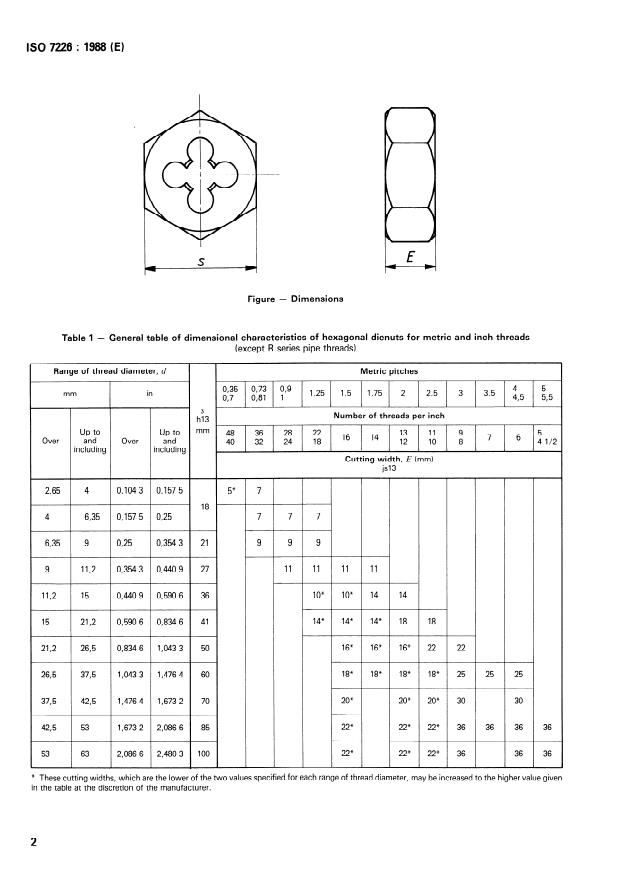
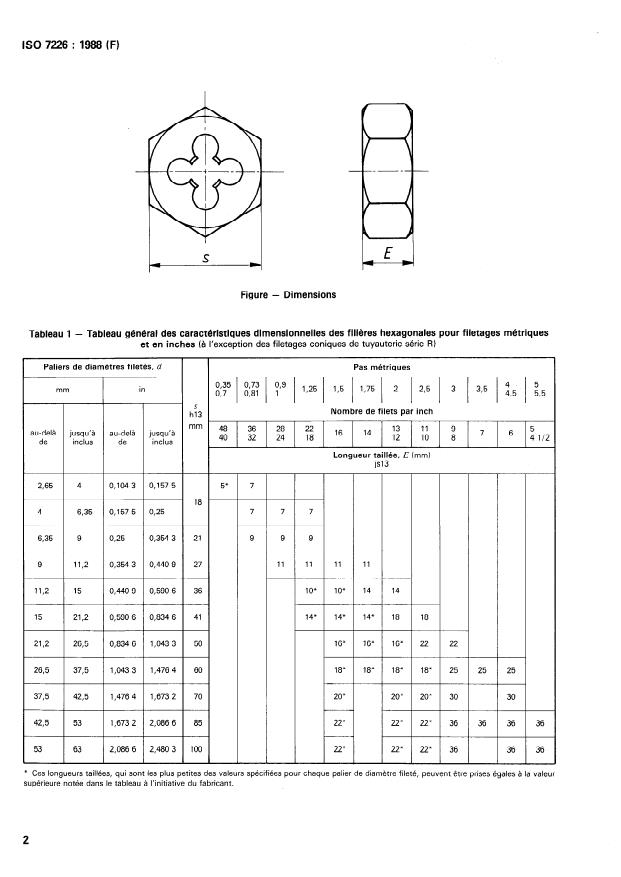
- Dimensional tables: Two main tables define dimensional characteristics:
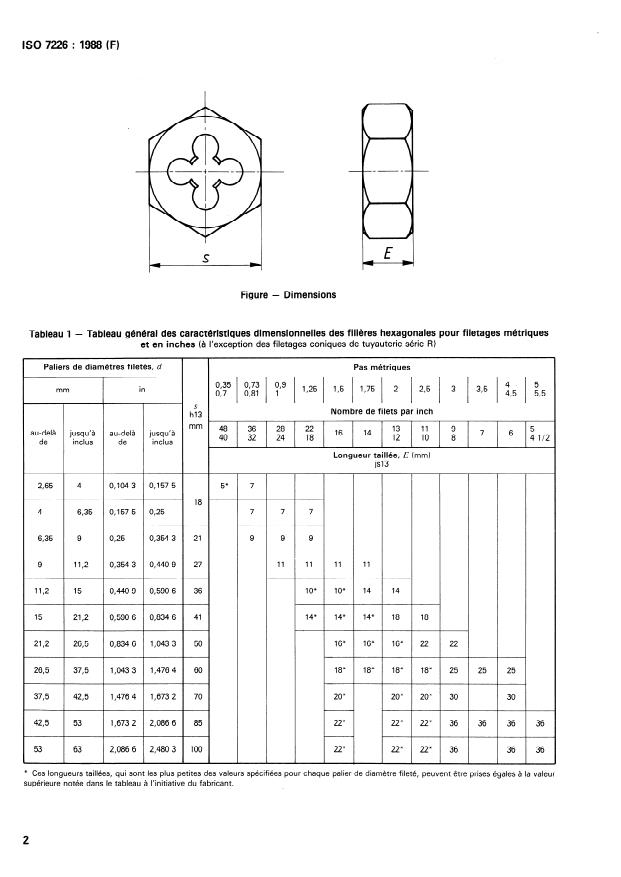
- Table 1 - Hexagonal die nuts for metric and inch threads (excluding tapered pipe series R).
- Table 2 - Hexagonal die nuts for tapered pipe threads, series R (gives approximate base diameters, pitch and cut length E).
- Length and profile parameters: Specifies machined (cut) lengths and related size groups; the standard notes permissible manufacturer options for certain minimum lengths.
- Marking requirements:
- Die nuts conforming to Table 1 must be marked with the thread designation as specified in ISO 2568.
- Die nuts conforming to Table 2 (series R) must be marked with the letter R immediately followed by the thread designation (example shown: "R 1/8").
- When tools fully conform to ISO, the ISO symbol may be added to the marking at the manufacturer’s discretion.
- References and related profiles: The standard references ISO thread and pipe standards (ISO 68, ISO 261, ISO 2568, ISO 7-1, ISO 228-1, etc.) for thread profiles and designations.
Applications
- Tool manufacturers: Designing and producing hexagonal die nuts to standardized dimensions for interchangeability.
- Fastener and tooling suppliers: Labelling and cataloguing dies that match customer thread specifications (metric, UNC/UNF, pipe threads, BSW/BSF/BA).
- Maintenance, repair and workshop technicians: Selecting correct hexagonal die nuts for on-site hand threading and thread repair.
- Quality and conformity assessment: Inspecting die nuts for compliance with standardized dimensions and marking for traceability.
Related standards
- ISO 2568 - Thread die designations and labelling
- ISO 68, ISO 261 - Thread profiles and series (metric)
- ISO 7-1, ISO 228-1 - Pipe thread designations and tolerances
- ISO 263, ISO 2563, ISO 4230/4231 - Complementary standards on thread cutting tools
Keywords: ISO 7226, hexagonal die nuts, hexagonal dies, thread dies, ISO metric threads, UNC, UNF, pipe threads series R, BSW, BSF, BA, marking, dimensions, tolerances.
Relations
- Effective Date
- 15-Apr-2008
Buy Documents
ISO 7226:1988 - Hexagonal dienuts Released:5/19/1988
ISO 7226:1988 - Filieres hexagonales de filetage a main Released:5/19/1988
ISO 7226:1988 - Filieres hexagonales de filetage a main Released:5/19/1988
Get Certified
Connect with accredited certification bodies for this standard

DVS-ZERT GmbH
German welding certification society.
CARES (UK Certification Authority for Reinforcing Steels)
UK certification for reinforcing steels and construction.
EWF/IIW (European/International Welding Federation)
International welding personnel certification.
Sponsored listings
Frequently Asked Questions
ISO 7226:1988 is a standard published by the International Organization for Standardization (ISO). Its full title is "Hexagonal dienuts". This standard covers: This second edition cancels and replaces the first edition (ISO 7226:1985), of which it constitutes a minor revision. Specifies the general dimensions of hexagonal for certain suze ofISO metric threads, ISO inch threads and pipe threads, as well as the non-preferred thread series BSW, BSF and BA. Gives the marking of these dienuts.
This second edition cancels and replaces the first edition (ISO 7226:1985), of which it constitutes a minor revision. Specifies the general dimensions of hexagonal for certain suze ofISO metric threads, ISO inch threads and pipe threads, as well as the non-preferred thread series BSW, BSF and BA. Gives the marking of these dienuts.
ISO 7226:1988 is classified under the following ICS (International Classification for Standards) categories: 25.100.50 - Taps and threading dies. The ICS classification helps identify the subject area and facilitates finding related standards.
ISO 7226:1988 has the following relationships with other standards: It is inter standard links to ISO 7226:1985. Understanding these relationships helps ensure you are using the most current and applicable version of the standard.
ISO 7226:1988 is available in PDF format for immediate download after purchase. The document can be added to your cart and obtained through the secure checkout process. Digital delivery ensures instant access to the complete standard document.
Standards Content (Sample)
~ ISO
INTERNATIONAL STANDARD
Second edition
1988-05-15
INTERNATIONAL ORGANIZATION FOR STANDARDIZATION
ORGANISATION INTERNATIONALE DE NORMALISATION
MEXflYHAPOaHAR OPt-AHM3A~MR fl0 CTAH,QAPTM3A~MM
Hexagonal dienuts
Fili&es hexagonales de filetage h main
Reference number
ISO 7226: 1988 (E)
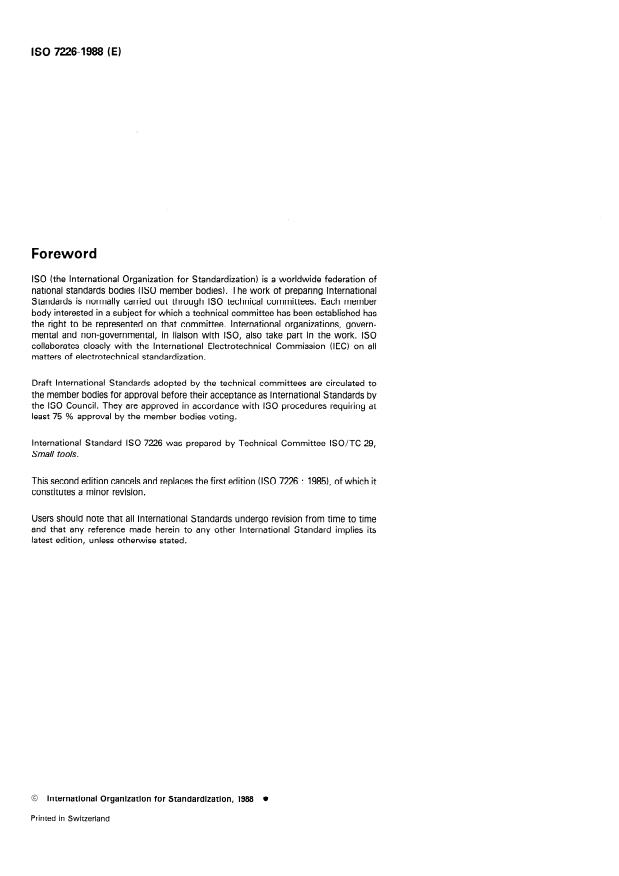
ISO 7226-1988 (El
Foreword
ISO (the International Organization for Standardization) is a worldwide federation of
national Standards bodies (ISO member bodies). The work of preparing International
Standards is normally carried out through ISO technical committees. Esch member
body interested in a subject for which a technical committee has been established has
the right to be represented on that committee. International organizations, govern-
mental and non-governmental, in liaison with ISO, also take part in the work. ISO
collaborates closely with the International Electrotechnical Commission (IEC) on all
matters of electrotechnical standardization.
Draft International Standards adopted by the technical committees are circulated to
the member bodies for approval before their acceptance as International Standards by
the ISO Council. They are approved in accordance with ISO procedures requiring at
least 75 % approval by the member bodies voting.
International Standard ISO 7226 was prepared by Technical Committee ISO/TC 29,
Smafl tools.
This second edition
cancels a nd repla ces the first edition (ISO 7226 : 1 98% of which it
constitutes a minor revision.
Users should note that all International Standards undergo revision from time to time
and that any reference made herein to any other International Standard implies its
latest edition, unless otherwise stated.
0 International Organkation for Standardkation, 1988
Printed in Switzerland
ISO 7226 : 1988 (E)
INTERNATIONAL STANDARD
Hexagonal dienuts
0 Introduction ISO 263, ISO inch screw threads - Generalplan and selection
for screws, bolts and nuts - Diameter range 0,06 to 6 in.
Circular screwing dies are specified for certain thread forms in
ISO 2568, ISO 4230 and ISO 4231. For certain sizes of these ISO 2568, Hand- and machine-operated circular screwing dies
threads, it is convenient for some purposes to use hexagonal and hand-operated die Stocks.
dienuts instead of circular dies and, for purposes connected
with their manufacture and use, it is desirable that certain ISO 4230, Hand- and machine-operated circular screwing dies
dimensions of these dienuts should be standardized. for taper pipe threads - R series.
ISO 4231, Hand- and machine-operated circular screwing dies
for parallel pipe threads - G series.
1 Scope and field of application
3 Dimensions and tolerantes
This International Standard specifies the general dimensions of
hexagonal dienuts for certain sizes of ISO metric threads
See the figure, and tables 1 and 2.
(coarse and fine pitch series - see ISO 68 and ISO 2611, ISO
inch threads (UNC and UNF series - see ISO 68 and ISO 263),
and pipe threads (G and R series - see ISO 7-l and
4 Marking
ISO 228-11, as well as t
...
ISO
NORME INTERNATIONALE 7226
Deuxième édition
1988-05-15
INTERNATIONAL ORGANIZATION FOR STANDARDIZATION
ORGANISATION INTERNATIONALE DE NORMALISATION
MEXC(YHAPOAHAR OPTAHM3AuMR Il0 CTAHflAPTM3A~MM
Filières hexagonales de filetage à main
Hexagonal dienuts
’ Numéro de référence
ISO 7226: 1988 (F)
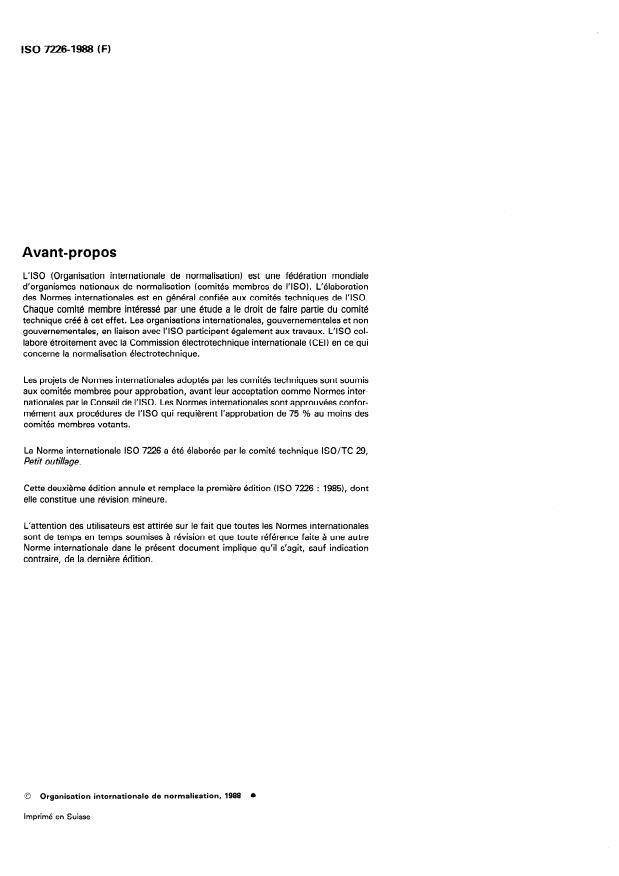
ISO 72264988 (FI
Avant-propos
L’ISO (Organisation internationale de normalisation) est une fédération mondiale
d’organismes nationaux de normalisation (comités membres de I’ISO). L’élaboration
des Normes internationales est en général confiée aux comités techniques de I’ISO.
Chaque comité membre intéressé par une étude a le droit de faire partie du comité
technique créé à cet effet. Les organisations internationales, gouvernementales et non
gouvernementales, en liaison avec I’ISO participent également aux travaux. L’ISO col-
labore étroitement avec la Commission électrotechnique internationale (CEI) en ce qui
concerne la normalisation électrotechnique.
Les projets de Normes internationales adoptés par les comités techniques sont soumis
aux comités membres pour approbation, avant leur acceptation comme Normes inter-
nationales par le Conseil de I’ISO. Les Normes internationales sont approuvées confor-
mément aux procédures de I’ISO qui requièrent l’approbation de 75 % au moins des
comités membres votants.
La Norme internationale ISO 7226 a été élaborée par le comité technique ISO/TC 29,
Petit outillage.
Cette deuxiéme édition annule et remplace la première édition (ISO 7226 : 1985), dont
elle constitue une révision mineure.
L’attention des utilisateurs est attirée sur le fait que toutes les Normes internationales
sont de temps en temps soumises à révision et que toute référence faite à une autre
Norme internationale dans le présent document implique qu’il s’agit, sauf indication
contraire, de la dernière édition.
Organisation internationale de normalisation, 1988
Imprimé en Suisse
ISO 7226 : 1988 (F)
NORME INTERNATIONALE
Filières hexagonales de filetage à main
ISO 263, Filetages /SO en inches - Vue d’ensemble et selec-
0 Introduction
tion pour boulonnerie - Diamètres de 0,06 à 6 in.
L’ISO 2568, I’ISO 4230 et I’ISO 4231 spécifient des filiéres
ISO 2563, Filières rondes de filetage, à main et à machine, et
rondes pour certains types de filetages. Pour certaines dimen-
porte-filière à main.
sions de ces filetages et pour certaines applications, il est plus
pratique d’utiliser des filières hexagonales plutôt que des filières
ISO 4230, Filières rondes de filetage, à main et à machine,
rondes. II a donc été jugé nécessaire, pour des problèmes liés à
pour filetages coniques de tuyauterie - Série R.
leur fabrication et à leur utilisation, de normaliser certaines
dimensions de ces filiéres.
ISO 4231, Filières rondes de ftletage, à main et à machine,
pour filetages cylindriques de tuyauterie - Skie G.
1 Objet et domaine d’application
3 Dimensions et tolérances
La présente Norme internationale spécifie les dimensions géné-
rales de filières hexagonales (écrous filières) pour certaines
Voir la figure et les tableaux 1 et 2.
dimensions de filetages métriques ISO (série à pas gros et
séries à pas fins - voir I’ISO 68 et I’ISO 2611, de filetage ISO en
voir I’ISO 68 et I’ISO 263) et de
inches (séries UNC et UNF -
filetages de tuyau
...
ISO
NORME INTERNATIONALE 7226
Deuxième édition
1988-05-15
INTERNATIONAL ORGANIZATION FOR STANDARDIZATION
ORGANISATION INTERNATIONALE DE NORMALISATION
MEXC(YHAPOAHAR OPTAHM3AuMR Il0 CTAHflAPTM3A~MM
Filières hexagonales de filetage à main
Hexagonal dienuts
’ Numéro de référence
ISO 7226: 1988 (F)
ISO 72264988 (FI
Avant-propos
L’ISO (Organisation internationale de normalisation) est une fédération mondiale
d’organismes nationaux de normalisation (comités membres de I’ISO). L’élaboration
des Normes internationales est en général confiée aux comités techniques de I’ISO.
Chaque comité membre intéressé par une étude a le droit de faire partie du comité
technique créé à cet effet. Les organisations internationales, gouvernementales et non
gouvernementales, en liaison avec I’ISO participent également aux travaux. L’ISO col-
labore étroitement avec la Commission électrotechnique internationale (CEI) en ce qui
concerne la normalisation électrotechnique.
Les projets de Normes internationales adoptés par les comités techniques sont soumis
aux comités membres pour approbation, avant leur acceptation comme Normes inter-
nationales par le Conseil de I’ISO. Les Normes internationales sont approuvées confor-
mément aux procédures de I’ISO qui requièrent l’approbation de 75 % au moins des
comités membres votants.
La Norme internationale ISO 7226 a été élaborée par le comité technique ISO/TC 29,
Petit outillage.
Cette deuxiéme édition annule et remplace la première édition (ISO 7226 : 1985), dont
elle constitue une révision mineure.
L’attention des utilisateurs est attirée sur le fait que toutes les Normes internationales
sont de temps en temps soumises à révision et que toute référence faite à une autre
Norme internationale dans le présent document implique qu’il s’agit, sauf indication
contraire, de la dernière édition.
Organisation internationale de normalisation, 1988
Imprimé en Suisse
ISO 7226 : 1988 (F)
NORME INTERNATIONALE
Filières hexagonales de filetage à main
ISO 263, Filetages /SO en inches - Vue d’ensemble et selec-
0 Introduction
tion pour boulonnerie - Diamètres de 0,06 à 6 in.
L’ISO 2568, I’ISO 4230 et I’ISO 4231 spécifient des filiéres
ISO 2563, Filières rondes de filetage, à main et à machine, et
rondes pour certains types de filetages. Pour certaines dimen-
porte-filière à main.
sions de ces filetages et pour certaines applications, il est plus
pratique d’utiliser des filières hexagonales plutôt que des filières
ISO 4230, Filières rondes de filetage, à main et à machine,
rondes. II a donc été jugé nécessaire, pour des problèmes liés à
pour filetages coniques de tuyauterie - Série R.
leur fabrication et à leur utilisation, de normaliser certaines
dimensions de ces filiéres.
ISO 4231, Filières rondes de ftletage, à main et à machine,
pour filetages cylindriques de tuyauterie - Skie G.
1 Objet et domaine d’application
3 Dimensions et tolérances
La présente Norme internationale spécifie les dimensions géné-
rales de filières hexagonales (écrous filières) pour certaines
Voir la figure et les tableaux 1 et 2.
dimensions de filetages métriques ISO (série à pas gros et
séries à pas fins - voir I’ISO 68 et I’ISO 2611, de filetage ISO en
voir I’ISO 68 et I’ISO 263) et de
inches (séries UNC et UNF -
filetages de tuyau
...