

ISO 8549-4:2026
(Main)Prosthetics and orthotics — Vocabulary — Part 4: Terms relating to limb amputation
- Abstract
This document defined terms for the description of surgical limb amputations and amputation procedures. NOTE Traumatic limb loss and congenital limb deficiency are not included in this document.
- Status
- Published
- Publication Date
- 19-May-2026
- Technical Committee
- ISO/TC 168 - Prosthetics and orthotics
- Drafting Committee
- ISO/TC 168 - Prosthetics and orthotics
- Current Stage
- 6060 - International Standard published
- Start Date
- 20-May-2026
- Due Date
- 02-May-2026
- Completion Date
- 20-May-2026
ISO 8549-4:2026 is an International Standard from ISO that gives vocabulary for limb amputation in prosthetics and orthotics. It defines terms for surgical limb amputations and amputation procedures so clinicians, researchers, manufacturers, and other users can describe cases in the same way.
What does ISO 8549-4:2026 specify?
ISO 8549-4:2026 specifies terms for the description of surgical limb amputations and amputation procedures. Traumatic limb loss and congenital limb deficiency are outside its scope.
The document is organized as:
- Clause 1 - Scope
- Clause 2 - Normative references
- Clause 3 - Terms and definitions
- Index
Clause 3 is divided into four topics: general limb amputation, upper limb amputation levels, lower limb amputation levels, and amputation procedures. That structure matters in practice because the terminology is grouped by the body region and by the kind of event being described.
What are the key requirements of ISO 8549-4:2026?
ISO 8549-4:2026 is a terminology standard, so its main substance is the defined wording used to describe amputations. The important point for users is to record the limb, side, level, and procedure accurately, because the document repeatedly shows that a complete description depends on those details.
General limb amputation terms
Clause 3.1 defines the core terms for any limb amputation, including limb amputation, upper limb amputation, lower limb amputation, residual limb / residuum / stump, and level of amputation. In practice, these are the terms that support clinical notes, case reports, registries, and communication between teams.
Clause 3.1 also covers combinations such as unilateral upper and lower limb amputation, contralateral upper and lower limb amputation, bilateral upper limb amputation, bilateral lower limb amputation, triple amputation, and quadruple amputation. These terms matter when a record has to show how many limbs are involved and on which side.
Upper limb amputation levels
Clause 3.2 sets out the named upper-limb levels from partial hand amputation through wrist disarticulation, transradial amputation, elbow disarticulation, transhumeral amputation, shoulder disarticulation, and scapulothoracic disarticulation, also called forequarter amputation. This helps users describe the exact anatomical level rather than relying on vague wording.
For partial hand amputation, the document breaks the term down further into thumb amputation, phalangeal amputation, metacarpophalangeal disarticulation, metacarpal amputation, carpometacarpal disarticulation, and carpal amputation. The note to entry says a complete description requires the amputated bones and their levels, which is important for precise surgical and prosthetic documentation.
Lower limb amputation levels
Clause 3.3 does the same for the lower limb, from partial foot amputation through ankle disarticulation, transtibial amputation, knee disarticulation, transfemoral amputation, hip disarticulation, and transpelvic amputation. This gives a shared vocabulary for records, outcome studies, and prosthetic planning.
Partial foot amputation is also broken down into phalangeal, metatarsophalangeal disarticulation, metatarsal, tarsometatarsal disarticulation, and tarsal amputation. As with partial hand amputation, the document says the amputated bones and their levels must be identified for a full description.
Amputation procedures
Clause 3.4 defines procedural terms: initial amputation, initial upper limb amputation, initial lower limb amputation, revision amputation, two-stage amputation, and reamputation. These terms help distinguish a first operation from later surgery on the same limb.
The notes to entry are clinically useful. For example, the note on initial lower limb amputation says the description shall specify upper or lower limb and left or right side, while the note on two-stage amputation explains that the first stage may remove devitalized or infected parts and the second stage may involve revision, a higher level, and wound closure.
What terms does ISO 8549-4:2026 define?
ISO 8549-4:2026 defines the language used to describe amputations, and several terms are especially central:
- limb amputation - surgical removal of the whole or part of a limb.
- residual limb / residuum / stump - the portion of the limb remaining after an amputation.
- level of amputation - the joint or limb segment where the amputation is performed.
- partial hand amputation - amputation of the upper limb distal to the wrist joint.
- partial foot amputation - amputation of the lower limb distal to the ankle joint.
- revision amputation - surgery on a previously amputated limb without changing the amputation level.
- reamputation - amputation of an amputated limb to a higher level.
Who uses ISO 8549-4:2026?
ISO 8549-4:2026 is intended for all practitioners who deal with persons who have had a limb amputation. In practice, that includes surgeons, prosthetics and orthotics professionals, and other clinicians who need to describe cases clearly and compare them with other cases.
The introduction also names persons who have had an amputation, epidemiologists, researchers, manufacturers, and government and non-government organisations. These users need shared terminology for patient records, studies, product development, reporting, and communication across organisations.
What changed in ISO 8549-4:2026 from the previous edition?
ISO 8549-4:2026 is the third edition and cancels and replaces ISO 8549-4:2020. The foreword says the document has been technically revised.
The stated changes are:
- hyphens in anatomical terms, such as transpelvic, have been abandoned in line with other parts of the ISO 8549 series
- the term “amputee” has been removed and replaced with “person who have had an amputation”
What does the ISO 8549-4:2026 document contain?
ISO 8549-4:2026 contains front matter, a foreword, an introduction, three clauses, and an index. Clause 3 is the main body and contains the defined terms, grouped into four subclauses.
The entries use short notes to make the terminology more precise, especially where a full description must include the limb, side, bones, or level involved. The document also points users to ISO and IEC terminology databases, which supports consistent lookup and use of the terms in standardization work.
The index lists the preferred terms and synonym forms for quick navigation, which is useful when the document is used for coding, reporting, or terminology checking.
Relations
- Revises
ISO 8549-4:2020 - Prosthetics and orthotics — Vocabulary — Part 4: Terms relating to limb amputation - Effective Date
- 06-May-2023
Get Certified
Connect with accredited certification bodies for this standard

BSI Group
BSI (British Standards Institution) is the business standards company that helps organizations make excellence a habit.

TÜV Rheinland
TÜV Rheinland is a leading international provider of technical services.

TÜV SÜD
TÜV SÜD is a trusted partner of choice for safety, security and sustainability solutions.
Sponsored listings
Frequently Asked Questions
ISO 8549-4:2026 is a standard published by the International Organization for Standardization (ISO). Its full title is "Prosthetics and orthotics — Vocabulary — Part 4: Terms relating to limb amputation". This standard covers: This document defined terms for the description of surgical limb amputations and amputation procedures. NOTE Traumatic limb loss and congenital limb deficiency are not included in this document.
This document defined terms for the description of surgical limb amputations and amputation procedures. NOTE Traumatic limb loss and congenital limb deficiency are not included in this document.
ISO 8549-4:2026 is classified under the following ICS (International Classification for Standards) categories: 01.040.11 - Health care technology (Vocabularies); 11.040.40 - Implants for surgery, prosthetics and orthotics. The ICS classification helps identify the subject area and facilitates finding related standards.
ISO 8549-4:2026 has the following relationships with other standards: It is inter standard links to ISO 8549-4:2020. Understanding these relationships helps ensure you are using the most current and applicable version of the standard.
ISO 8549-4:2026 is available in PDF format for immediate download after purchase. The document can be added to your cart and obtained through the secure checkout process. Digital delivery ensures instant access to the complete standard document.
Standards Content (Sample)
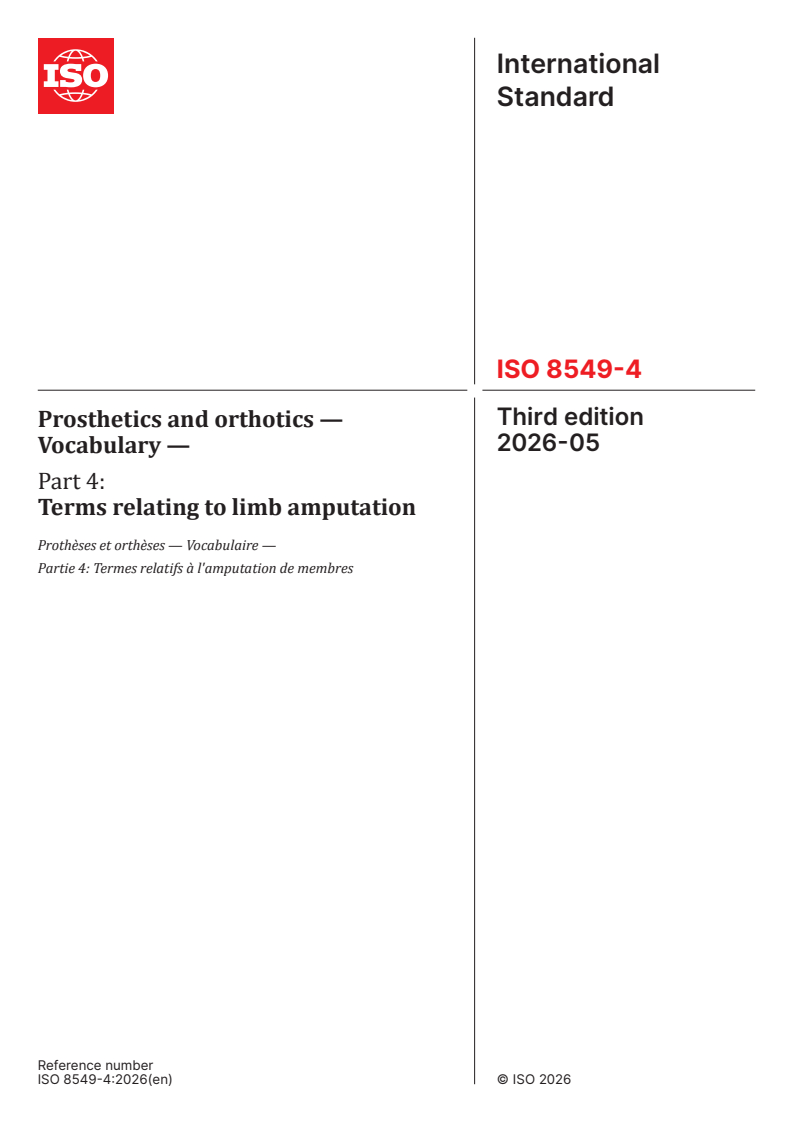
International
Standard
ISO 8549-4
Third edition
Prosthetics and orthotics —
2026-05
Vocabulary —
Part 4:
Terms relating to limb amputation
Prothèses et orthèses — Vocabulaire —
Partie 4: Termes relatifs à l'amputation de membres
Reference number
© ISO 2026
All rights reserved. Unless otherwise specified, or required in the context of its implementation, no part of this publication may
be reproduced or utilized otherwise in any form or by any means, electronic or mechanical, including photocopying, or posting on
the internet or an intranet, without prior written permission. Permission can be requested from either ISO at the address below
or ISO’s member body in the country of the requester.
ISO copyright office
CP 401 • Ch. de Blandonnet 8
CH-1214 Vernier, Geneva
Phone: +41 22 749 01 11
Email: copyright@iso.org
Website: www.iso.org
Published in Switzerland
ii
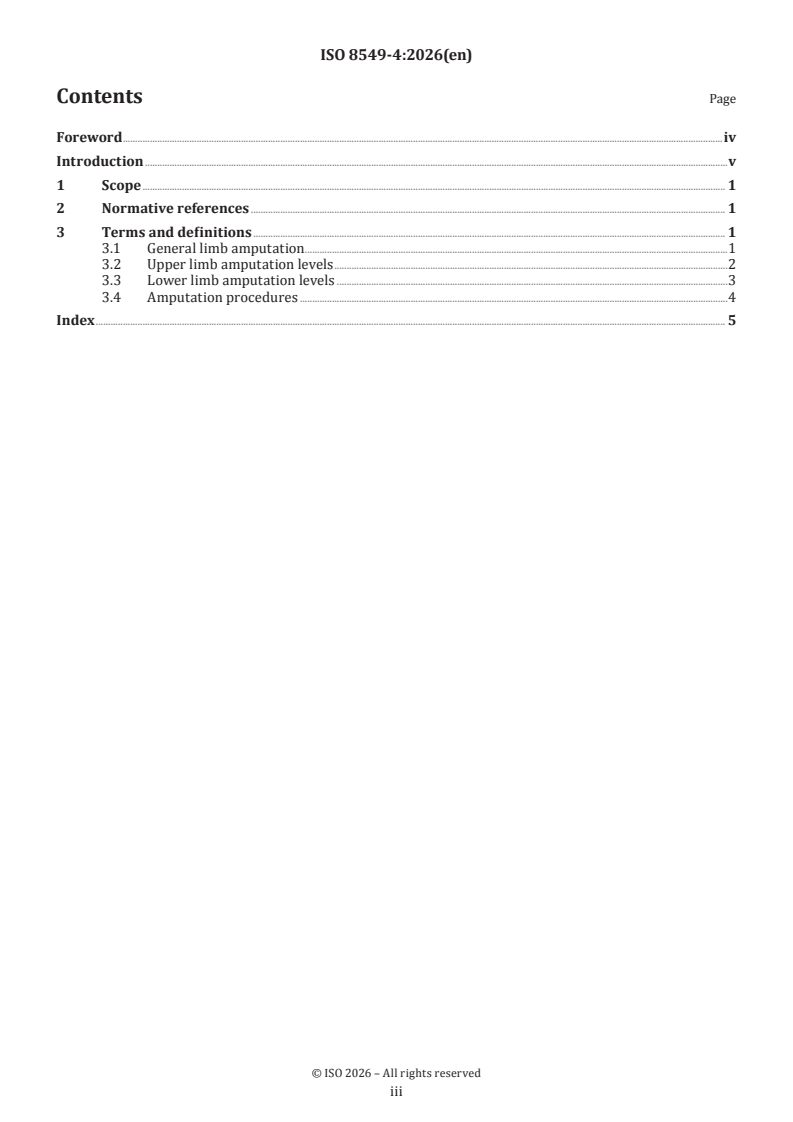
Contents Page
Foreword .iv
Introduction .v
1 Scope . 1
2 Normative references . 1
3 Terms and definitions . 1
3.1 General limb amputation .1
3.2 Upper limb amputation levels .2
3.3 Lower limb amputation levels .3
3.4 Amputation procedures .4
Index . 5
iii
Foreword
ISO (the International Organization for Standardization) is a worldwide federation of national standards
bodies (ISO member bodies). The work of preparing International Standards is normally carried out through
ISO technical committees. Each member body interested in a subject for which a technical committee
has been established has the right to be represented on that committee. International organizations,
governmental and non-governmental, in liaison with ISO, also take part in the work. ISO collaborates closely
with the International Electrotechnical Commission (IEC) on all matters of electrotechnical standardization.
The procedures used to develop this document and those intended for its further maintenance are described
in the ISO/IEC Directives, Part 1. In particular, the different approval criteria needed for the different types
of ISO documents should be noted. This document was drafted in accordance with the editorial rules of the
ISO/IEC Directives, Part 2 (see www.iso.org/directives).
ISO draws attention to the possibility that the implementation of this document may involve the use of (a)
patent(s). ISO takes no position concerning the evidence, validity or applicability of any claimed patent
rights in respect thereof. As of the date of publication of this document, ISO had not received notice of (a)
patent(s) which may be required to implement this document. However, implementers are cautioned that
this may not represent the latest information, which may be obtained from the patent database available at
www.iso.org/patents. ISO shall not be held responsible for identifying any or all such patent rights.
Any trade name used in this document is information given for the convenience of users and does not
constitute an endorsement.
For an explanation of the voluntary nature of standards, the meaning of ISO specific terms and expressions
related to conformity assessment, as well as information about ISO’s adherence to the World Trade
Organization (WTO) principles in the Technical Barriers to Trade (TBT), see www.iso.org/iso/foreword.html.
This document was prepared by Technical Committee ISO/TC 168, Prosthetics and orthotics.
This third edition cancels and replaces the second edition (ISO 8549-4:2020), which has been technically
revised.
The main changes are as follows:
— the use of hyphens in anatomical terms, such as transpelvic, has been abandoned in line with other parts
of the ISO 8549 series;
— the term “amputee” has been removed from the standard and replaced with “person who have had an
amputation”.
A list of all parts in the ISO 8549 series can be found on the ISO website.
Any feedback or questions on this document should be directed to the user’s national standards body. A
complete listing of these bodies can be found at www.iso.org/members.html.
iv
Introduction
This document provides an internationally accepted terminology which describes the full range of limb
amputation levels and procedures.
This is intended for the use of all practitioners dealing with persons who have had a limb amputation to
describe their clinical experiences and compare them with the experience of others.
It can also be of value to other stakeholders, including persons who have had an amputation, epidemiologists,
researchers, manufacturers, and government and non-government organisations.
v
International Standard ISO 8549-4:2026(en)
Prosthetics and orthotics — Vocabulary —
Part 4:
Terms relating to limb amputation
1 Scope
This document defined terms for the description of surgical limb amputations and amputation procedures.
NOTE Traumatic limb
...