

ISO 12214:2018
(Main)Road vehicles — Direction-of-motion stereotypes for automotive hand controls
General Information
- Abstract
ISO 12214:2018 gives design recommendations and requirements for the direction-of-motion of hand controls found in passenger, multipurpose and commercial vehicles, and buses.
- Status
- Published
- Publication Date
- 01-Mar-2018
- Technical Committee
- ISO/TC 22/SC 39 - Ergonomics
- Drafting Committee
- ISO/TC 22/SC 39 - Ergonomics
- Current Stage
- 9092 - International Standard to be revised
- Start Date
- 25-Nov-2025
- Completion Date
- 29-Aug-2026
Buy Documents
ISO 12214:2018 - Road vehicles -- Direction-of-motion stereotypes for automotive hand controls
ISO 12214:2018 - Road vehicles — Direction-of-motion stereotypes for automotive hand controls/2/2018
Overview - ISO 12214:2018 (direction-of-motion stereotypes)
ISO 12214:2018, "Road vehicles - Direction-of-motion stereotypes for automotive hand controls," provides human-factors design recommendations and requirements for the expected direction of motion for hand-operated controls in passenger, multipurpose and commercial vehicles, and buses. Prepared by ISO/TC 22/SC 39 (Ergonomics), this third edition updates guidance on how control orientation, mounting plane and control type influence driver expectations and use. The standard aims to reduce actuation errors, shorten operating time and lower driver workload by aligning controls with established direction-of-motion stereotypes.
Key topics and technical requirements
- Control mounting planes: Stereotypes are specified for three orthogonal planes - horizontal (X–Y), vertical‑transverse (Y–Z) and vertical‑longitudinal (X–Z) - plus some inclined planes.
- On/increase control directions: Typical expected motions are up, forward, right, pull towards, and rotate over top. (Commercial trucks may use a downward “on” motion.)
- Prohibited/limited configurations: Several configurations are not recommended (for example, certain rockers/toggles on sloping surfaces and some switch layouts for power windows).
- Specific function controls:
- Power mirrors: Strong stereotypes when switches face the driver (mounting planes angled ≈30°–60° from the door plane); four‑way pads and joysticks are covered.
- Power windows: Recommended 2×2 fore‑aft switch layouts (toggle/rocker/push–pull) on horizontal or slightly angled surfaces; 1×4 layouts and vertical plane 2×2 layouts are discouraged.
- Window cranks: Orientation guidance and expected rotation directions for raising/lowering left and right side windows.
- Stalk‑mounted controls: Directions for turn signals, wipers and headlamps (e.g., raising/lowering stalks for turn signals; rotate-over-top for wipers when shared with signal stalk).
- Power door locks: No strong rocker stereotype - labeling and tactile coding are recommended.
- Human factors findings: Stereotype strength is independent of age, gender or handedness; the document is based on empirical research and ergonomics principles.
Applications - who uses ISO 12214:2018
- Automotive designers and UX/ergonomics engineers specifying hand control layouts
- Human factors practitioners conducting usability and safety assessments
- Vehicle manufacturers, suppliers of switches/controls and interior hardware
- Regulatory and compliance teams referencing ergonomic requirements for in-vehicle controls
Related standards and references
- Bibliography cites human-factors research and industry reports (e.g., SAE J1139 and multiple SAE/UMTRI studies) that informed the standard.
- No normative references are listed within ISO 12214:2018 itself.
Keywords: ISO 12214:2018, direction-of-motion stereotypes, automotive hand controls, human factors, ergonomics, power window controls, stalk-mounted controls, power mirror controls.
Relations
- Revises
ISO 12214:2010 - Road vehicles — Direction-of-motion stereotypes for automotive hand controls - Effective Date
- 10-Jun-2017
Buy Documents
ISO 12214:2018 - Road vehicles -- Direction-of-motion stereotypes for automotive hand controls
ISO 12214:2018 - Road vehicles — Direction-of-motion stereotypes for automotive hand controls/2/2018
Get Certified
Connect with accredited certification bodies for this standard

TÜV Rheinland
TÜV Rheinland is a leading international provider of technical services.

TÜV SÜD
TÜV SÜD is a trusted partner of choice for safety, security and sustainability solutions.

BSI Group
BSI (British Standards Institution) is the business standards company that helps organizations make excellence a habit.
Sponsored listings
Frequently Asked Questions
ISO 12214:2018 is a standard published by the International Organization for Standardization (ISO). Its full title is "Road vehicles — Direction-of-motion stereotypes for automotive hand controls". This standard covers: ISO 12214:2018 gives design recommendations and requirements for the direction-of-motion of hand controls found in passenger, multipurpose and commercial vehicles, and buses.
ISO 12214:2018 gives design recommendations and requirements for the direction-of-motion of hand controls found in passenger, multipurpose and commercial vehicles, and buses.
ISO 12214:2018 is classified under the following ICS (International Classification for Standards) categories: 43.020 - Road vehicles in general. The ICS classification helps identify the subject area and facilitates finding related standards.
ISO 12214:2018 has the following relationships with other standards: It is inter standard links to ISO 12214:2010. Understanding these relationships helps ensure you are using the most current and applicable version of the standard.
ISO 12214:2018 is available in PDF format for immediate download after purchase. The document can be added to your cart and obtained through the secure checkout process. Digital delivery ensures instant access to the complete standard document.
Standards Content (Sample)
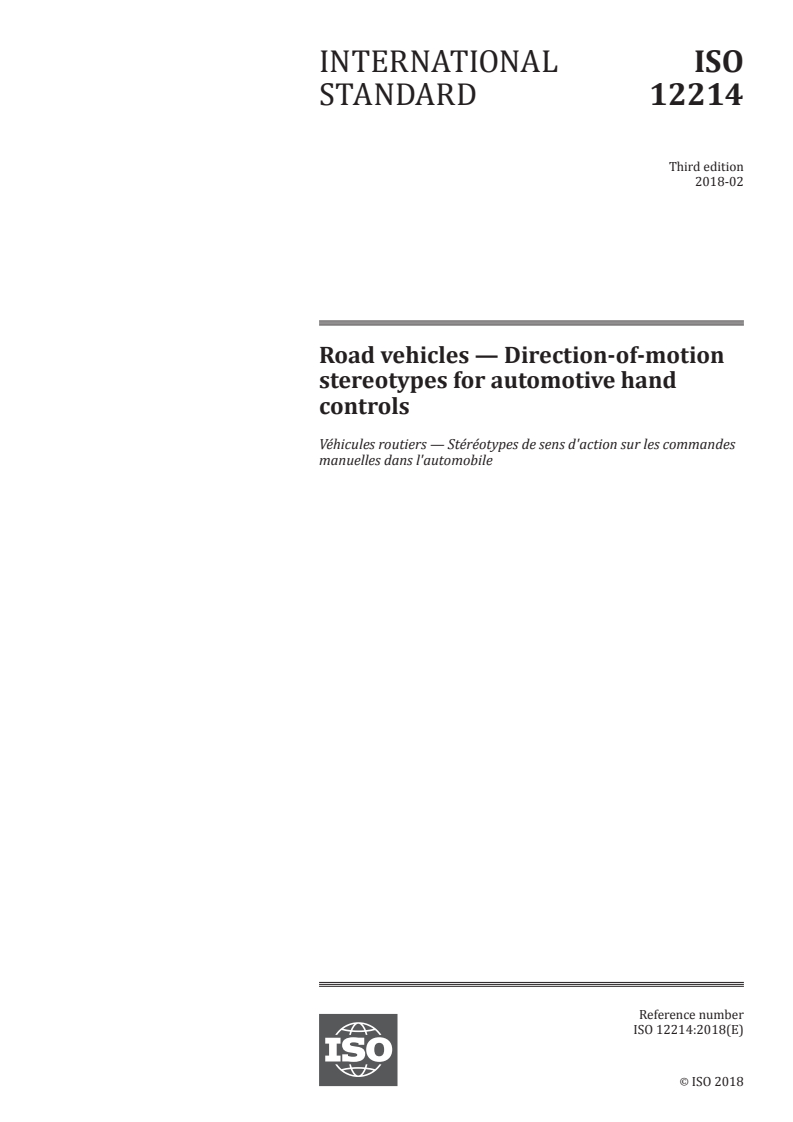
INTERNATIONAL ISO
STANDARD 12214
Third edition
2018-02
Road vehicles — Direction-of-motion
stereotypes for automotive hand
controls
Véhicules routiers — Stéréotypes de sens d'action sur les commandes
manuelles dans l'automobile
Reference number
©
ISO 2018
© ISO 2018
All rights reserved. Unless otherwise specified, or required in the context of its implementation, no part of this publication may
be reproduced or utilized otherwise in any form or by any means, electronic or mechanical, including photocopying, or posting
on the internet or an intranet, without prior written permission. Permission can be requested from either ISO at the address
below or ISO’s member body in the country of the requester.
ISO copyright office
CP 401 • Ch. de Blandonnet 8
CH-1214 Vernier, Geneva
Phone: +41 22 749 01 11
Fax: +41 22 749 09 47
Email: copyright@iso.org
Website: www.iso.org
Published in Switzerland
ii © ISO 2018 – All rights reserved
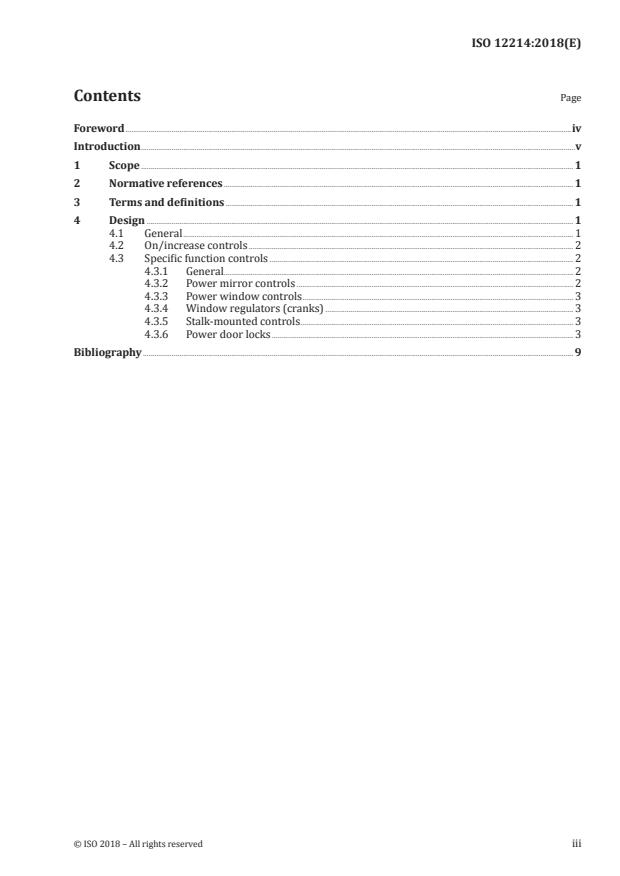
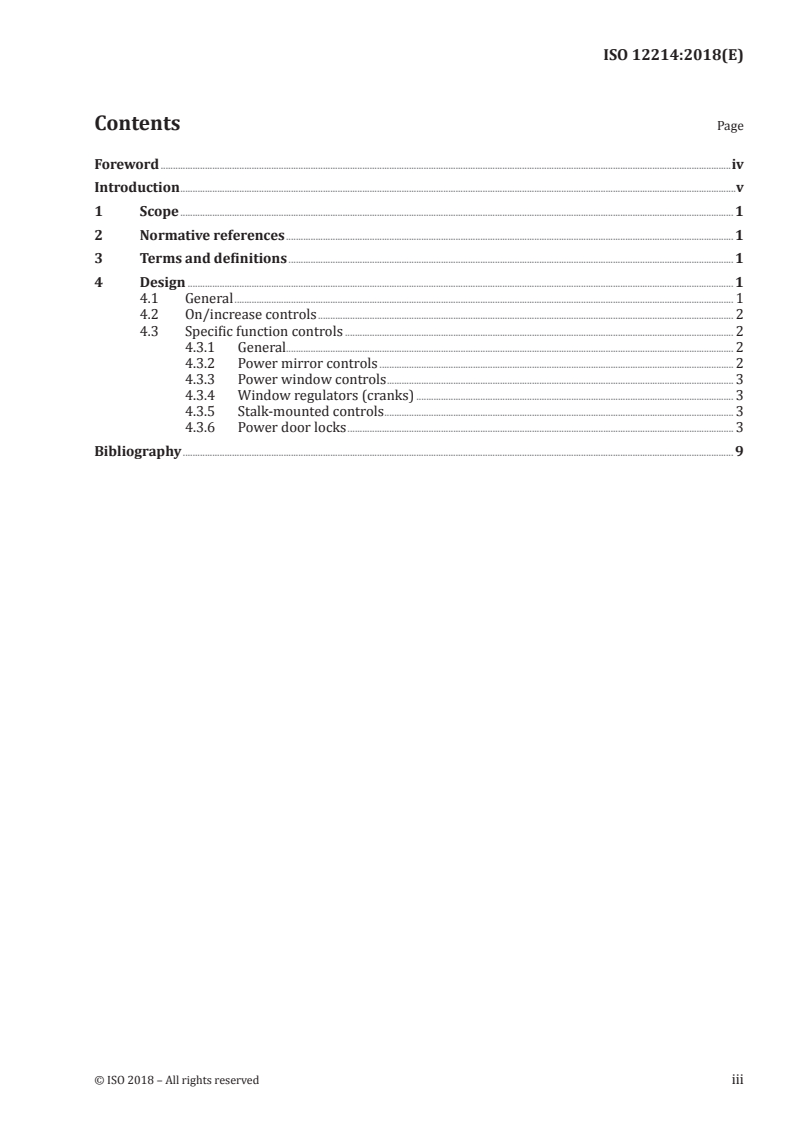
Contents Page
Foreword .iv
Introduction .v
1 Scope . 1
2 Normative references . 1
3 Terms and definitions . 1
4 Design . 1
4.1 General . 1
4.2 On/increase controls . 2
4.3 Specific function controls . 2
4.3.1 General. 2
4.3.2 Power mirror controls . 2
4.3.3 Power window controls . 3
4.3.4 Window regulators (cranks) . 3
4.3.5 Stalk-mounted controls . 3
4.3.6 Power door locks . 3
Bibliography . 9
Foreword
ISO (the International Organization for Standardization) is a worldwide federation of national standards
bodies (ISO member bodies). The work of preparing International Standards is normally carried out
through ISO technical committees. Each member body interested in a subject for which a technical
committee has been established has the right to be represented on that committee. International
organizations, governmental and non-governmental, in liaison with ISO, also take part in the work.
ISO collaborates closely with the International Electrotechnical Commission (IEC) on all matters of
electrotechnical standardization.
The procedures used to develop this document and those intended for its further maintenance are
described in the ISO/IEC Directives, Part 1. In particular the different approval criteria needed for the
different types of ISO documents should be noted. This document was drafted in accordance with the
editorial rules of the ISO/IEC Directives, Part 2 (see www .iso .org/ directives).
Attention is drawn to the possibility that some of the elements of this document may be the subject of
patent rights. ISO shall not be held responsible for identifying any or all such patent rights. Details of
any patent rights identified during the development of the document will be in the Introduction and/or
on the ISO list of patent declarations received (see www .iso .org/ patents).
Any trade name used in this document is information given for the convenience of users and does not
constitute an endorsement.
For an explanation on the voluntary nature of standards, the meaning of ISO specific terms and
expressions related to conformity assessment, as well as information about ISO's adherence to the
World Trade Organization (WTO) principles in the Technical Barriers to Trade (TBT) see the following
URL: www .iso .org/ iso/ foreword .html.
This document was prepared by Technical Committee ISO/TC 22, Road vehicles, Subcommittee SC 39,
Ergonomics.
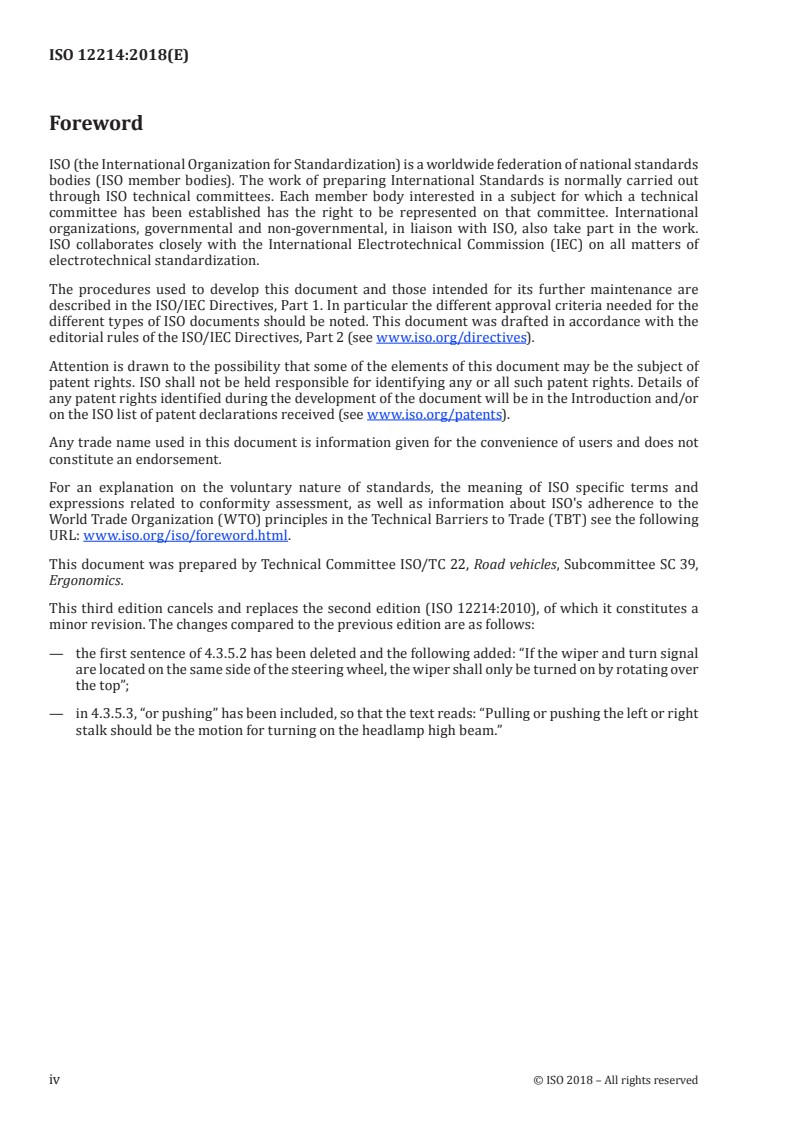
This third edition cancels and replaces the second edition (ISO 12214:2010), of which it constitutes a
minor revision. The changes compared to the previous edition are as follows:
— the first sentence of 4.3.5.2 has been deleted and the following added: “If the wiper and turn signal
are located on the same side of the steering wheel, the wiper shall only be turned on by rotating over
the top”;
— in 4.3.5.3, “or pushing” has been included, so that the text reads: “Pulling or pushing the left or right
stalk should be the motion for turning on the headlamp high beam.”
iv © ISO 2018 – All rights reserved
Introduction
Drivers develop expectations regarding the operating motions of various types of controls as a result of
their accumulated experience with vehicle controls. To simplify the operation of controls for drivers, the
direction-of-motion to operate these controls needs to conform to these expectations, or stereotypes.
The strength of a stereotype varies with the control configuration (control type, location, orientation
and mounting plane). Studies have demonstrated that stereotype strength is not related to driver age,
gender, or left- or right-handedness. Failure to conform to direction-of-motion stereotypes can lead to
actuation errors, longer operating times and an increase in driver workload.
This document is based on past research and general human factor principles. Control labelling and
tactile or shape coding are not addressed in this document. However, appropriate labelling and coding
can improve the accuracy of control use.
INTERNATIONAL STANDARD ISO 12214:2018(E)
Road vehicles — Direction-of-motion stereotypes for
automotive hand controls
1 Scope
This document gives design recommendations and requirements for the direction-of-motion of hand
controls found in passenger, multipurpose and commercial vehicles, and buses.
2 Normative references
There are no normative references in this document.
3 Terms and definitions
For the purposes of this document, the following terms and definitions apply.
ISO and IEC maintain terminological databases for use in standardization at the following addresses:
— IEC Electropedia: available at http:// www .electropedia .org/
— ISO Online browsing platform: available at https:// www .iso .org/ obp
3.1
control configuration
particular combination of control type, location, orientation and mounting plane
3.2
direction-of-motion stereotype
direction of control motion expected by a majority of people to achieve a given effect for a specified
control configuration
3.3
stereotype strength
percentage of people who activate the control in a particular direction
3.4
on/increase control
control whose function is to turn something on/off or to increase/decrease some unspecified effect
3.5
specific function control
control used to activate some specific function or achieve a specific effect
EXAMPLE Control to lock or unlock doors, raise or lower windows, or turn on headlamps, headlamp high
beam or windshield wipers.
4 Design
4.1 General
This document gives the recommended direction-of-motion and control orientation for controls
mounted on each of three orthogonal planes:
— horizontal (X-Y) plane;
— vertical-transverse (Y-Z) plane;
— vertical-longitudinal (X-Z) plane.
Some of
...
INTERNATIONAL ISO
STANDARD 12214
Third edition
2018-02
Road vehicles — Direction-of-motion
stereotypes for automotive hand
controls
Véhicules routiers — Stéréotypes de sens d'action sur les commandes
manuelles dans l'automobile
Reference number
©
ISO 2018
© ISO 2018
All rights reserved. Unless otherwise specified, or required in the context of its implementation, no part of this publication may
be reproduced or utilized otherwise in any form or by any means, electronic or mechanical, including photocopying, or posting
on the internet or an intranet, without prior written permission. Permission can be requested from either ISO at the address
below or ISO’s member body in the country of the requester.
ISO copyright office
CP 401 • Ch. de Blandonnet 8
CH-1214 Vernier, Geneva
Phone: +41 22 749 01 11
Fax: +41 22 749 09 47
Email: copyright@iso.org
Website: www.iso.org
Published in Switzerland
ii © ISO 2018 – All rights reserved
Contents Page
Foreword .iv
Introduction .v
1 Scope . 1
2 Normative references . 1
3 Terms and definitions . 1
4 Design . 1
4.1 General . 1
4.2 On/increase controls . 2
4.3 Specific function controls . 2
4.3.1 General. 2
4.3.2 Power mirror controls . 2
4.3.3 Power window controls . 3
4.3.4 Window regulators (cranks) . 3
4.3.5 Stalk-mounted controls . 3
4.3.6 Power door locks . 3
Bibliography . 9
Foreword
ISO (the International Organization for Standardization) is a worldwide federation of national standards
bodies (ISO member bodies). The work of preparing International Standards is normally carried out
through ISO technical committees. Each member body interested in a subject for which a technical
committee has been established has the right to be represented on that committee. International
organizations, governmental and non-governmental, in liaison with ISO, also take part in the work.
ISO collaborates closely with the International Electrotechnical Commission (IEC) on all matters of
electrotechnical standardization.
The procedures used to develop this document and those intended for its further maintenance are
described in the ISO/IEC Directives, Part 1. In particular the different approval criteria needed for the
different types of ISO documents should be noted. This document was drafted in accordance with the
editorial rules of the ISO/IEC Directives, Part 2 (see www .iso .org/ directives).
Attention is drawn to the possibility that some of the elements of this document may be the subject of
patent rights. ISO shall not be held responsible for identifying any or all such patent rights. Details of
any patent rights identified during the development of the document will be in the Introduction and/or
on the ISO list of patent declarations received (see www .iso .org/ patents).
Any trade name used in this document is information given for the convenience of users and does not
constitute an endorsement.
For an explanation on the voluntary nature of standards, the meaning of ISO specific terms and
expressions related to conformity assessment, as well as information about ISO's adherence to the
World Trade Organization (WTO) principles in the Technical Barriers to Trade (TBT) see the following
URL: www .iso .org/ iso/ foreword .html.
This document was prepared by Technical Committee ISO/TC 22, Road vehicles, Subcommittee SC 39,
Ergonomics.
This third edition cancels and replaces the second edition (ISO 12214:2010), of which it constitutes a
minor revision. The changes compared to the previous edition are as follows:
— the first sentence of 4.3.5.2 has been deleted and the following added: “If the wiper and turn signal
are located on the same side of the steering wheel, the wiper shall only be turned on by rotating over
the top”;
— in 4.3.5.3, “or pushing” has been included, so that the text reads: “Pulling or pushing the left or right
stalk should be the motion for turning on the headlamp high beam.”
iv © ISO 2018 – All rights reserved
Introduction
Drivers develop expectations regarding the operating motions of various types of controls as a result of
their accumulated experience with vehicle controls. To simplify the operation of controls for drivers, the
direction-of-motion to operate these controls needs to conform to these expectations, or stereotypes.
The strength of a stereotype varies with the control configuration (control type, location, orientation
and mounting plane). Studies have demonstrated that stereotype strength is not related to driver age,
gender, or left- or right-handedness. Failure to conform to direction-of-motion stereotypes can lead to
actuation errors, longer operating times and an increase in driver workload.
This document is based on past research and general human factor principles. Control labelling and
tactile or shape coding are not addressed in this document. However, appropriate labelling and coding
can improve the accuracy of control use.
INTERNATIONAL STANDARD ISO 12214:2018(E)
Road vehicles — Direction-of-motion stereotypes for
automotive hand controls
1 Scope
This document gives design recommendations and requirements for the direction-of-motion of hand
controls found in passenger, multipurpose and commercial vehicles, and buses.
2 Normative references
There are no normative references in this document.
3 Terms and definitions
For the purposes of this document, the following terms and definitions apply.
ISO and IEC maintain terminological databases for use in standardization at the following addresses:
— IEC Electropedia: available at http:// www .electropedia .org/
— ISO Online browsing platform: available at https:// www .iso .org/ obp
3.1
control configuration
particular combination of control type, location, orientation and mounting plane
3.2
direction-of-motion stereotype
direction of control motion expected by a majority of people to achieve a given effect for a specified
control configuration
3.3
stereotype strength
percentage of people who activate the control in a particular direction
3.4
on/increase control
control whose function is to turn something on/off or to increase/decrease some unspecified effect
3.5
specific function control
control used to activate some specific function or achieve a specific effect
EXAMPLE Control to lock or unlock doors, raise or lower windows, or turn on headlamps, headlamp high
beam or windshield wipers.
4 Design
4.1 General
This document gives the recommended direction-of-motion and control orientation for controls
mounted on each of three orthogonal planes:
— horizontal (X-Y) plane;
— vertical-transverse (Y-Z) plane;
— vertical-longitudinal (X-Z) plane.
Some of
...