


ISO 8124-12:2023
(Main)Safety of toys — Part 12: Microbiological safety
Safety of toys — Part 12: Microbiological safety
This document specifies acceptable criteria for microbiological cleanliness and adequacy of preservation of the specified toy materials. The requirements in this document apply to all toys that are, contain or are supplied with aqueous materials (e.g. paste, putty, liquid or gel). In addition, this document applies to toys that are or include a cosmetic (including those intended for use on a toy as well as on the child). Powders and similar substances intended to be mixed with water are also within the scope of this document. The cleanliness and preservation effectiveness requirements are applicable to a toy as it is initially received by the consumer in an unopened and undamaged container and do not apply after a toy is subjected to reasonably foreseeable conditions of normal use and abuse, unless specifically noted otherwise. The microbial limits and test methods contained in this document are inappropriate to apply to products that are consumer complaint returns, as there is no way to establish what conditions the toys have been subject to before being returned. The following are excluded from the scope of this document: — materials that are inaccessible during normal use or reasonably foreseeable abuse; — powder or powder-like materials intended to show biological phenomena, e.g. shrimp eggs, seeds, soil; — food.
Sécurité des jouets — Partie 12: Sécurité microbiologique
General Information
- Status
- Published
- Publication Date
- 03-Aug-2023
- Technical Committee
- ISO/TC 181 - Safety of toys
- Drafting Committee
- ISO/TC 181/WG 10 - Microbiology
- Current Stage
- 6060 - International Standard published
- Start Date
- 04-Aug-2023
- Due Date
- 13-May-2023
- Completion Date
- 04-Aug-2023
Relations
- Consolidated By
ISO 3262-17:2024 - Extenders — Specifications and methods of test — Part 17: Precipitated calcium silicate - Effective Date
- 06-Jun-2022
Overview
ISO 8124-12:2023 - Safety of toys - Part 12: Microbiological safety - sets international criteria for the microbiological cleanliness and preservation effectiveness of toy materials that are, contain or are supplied with aqueous media (e.g., paste, putty, liquid, gel) or cosmetic-like products intended for use on children or toys. It covers powders meant to be mixed with water and applies to the condition of the toy as received by the consumer (unopened and undamaged). The standard is intended to reduce infection risks from contaminated toys and complements other toy-safety and microbiology standards.
Key topics and technical requirements
- Scope & exclusions: Applies to aqueous toy materials and cosmetic-type toy products; excludes inaccessible materials during normal use, powder-like biological demonstration materials (e.g., seeds, soil), and food.
- Risk assessment: Manufacturers must evaluate formulations for susceptibility to microbial growth using ISO 29621 guidance and water activity testing (products with water activity < 0.5 are typically low risk).
- Microbiological cleanliness limits:
- Infant products, face paints, and products for eye/mucous membrane areas: maximum 100 CFU/ml or CFU/g for total aerobic mesophilic count (TAMC) and total yeast and mould count (TYMC).
- All other products: maximum 1 000 CFU/ml or CFU/g.
- Bile‑tolerant gram‑negative bacteria: max 100 CFU/ml or CFU/g for all products.
- Absence (<1 CFU/g) required for: Pseudomonas aeruginosa, Escherichia coli, Staphylococcus aureus, Salmonella spp., Candida albicans.
- Preservation (challenge) testing:
- 1% volume fraction inoculum with the minimum organism suite (S. aureus, E. coli, P. aeruginosa, C. albicans, Aspergillus brasiliensis) and defined sampling intervals.
- Minimum sampling intervals: 7, 14 and 28 days; minimum sample size: 10 g.
- Evaluation criteria: Category A (infant/eye/face paints) requires faster and greater log reductions (e.g., ≥3 log reduction for bacteria at 7 days) than Category B (other products).
- Test methods & procedures: Referenced ISO microbiological methods (e.g., ISO 11930, ISO 21148, ISO 6222, ISO 16212 and other cosmetic/ water microbiology standards).
Practical applications and users
- Toy manufacturers and formulators: to design, validate and document microbiological safety and preservative effectiveness for aqueous toys and cosmetic-like toys.
- Quality assurance / QC labs: to perform compliance testing, sample plans and challenge tests per ISO methods.
- Regulatory and conformity assessors: to evaluate product safety dossiers and market surveillance.
- Contract testing laboratories and safety consultants: for test method execution and interpretation.
Related standards
- ISO 8124 series (toy safety suite)
- ISO 11930, ISO 21148 (cosmetics/toy microbiology procedures)
- ISO 18787 (water activity)
- ISO 29621 (risk assessment for low‑risk products)
- ASTM F963 (reference influence noted in the introduction)
ISO 8124-12 is essential for ensuring safe, preservative-effective aqueous toys and cosmetic-type play products and for reducing microbiological hazards in consumer markets.
Frequently Asked Questions
ISO 8124-12:2023 is a standard published by the International Organization for Standardization (ISO). Its full title is "Safety of toys — Part 12: Microbiological safety". This standard covers: This document specifies acceptable criteria for microbiological cleanliness and adequacy of preservation of the specified toy materials. The requirements in this document apply to all toys that are, contain or are supplied with aqueous materials (e.g. paste, putty, liquid or gel). In addition, this document applies to toys that are or include a cosmetic (including those intended for use on a toy as well as on the child). Powders and similar substances intended to be mixed with water are also within the scope of this document. The cleanliness and preservation effectiveness requirements are applicable to a toy as it is initially received by the consumer in an unopened and undamaged container and do not apply after a toy is subjected to reasonably foreseeable conditions of normal use and abuse, unless specifically noted otherwise. The microbial limits and test methods contained in this document are inappropriate to apply to products that are consumer complaint returns, as there is no way to establish what conditions the toys have been subject to before being returned. The following are excluded from the scope of this document: — materials that are inaccessible during normal use or reasonably foreseeable abuse; — powder or powder-like materials intended to show biological phenomena, e.g. shrimp eggs, seeds, soil; — food.
This document specifies acceptable criteria for microbiological cleanliness and adequacy of preservation of the specified toy materials. The requirements in this document apply to all toys that are, contain or are supplied with aqueous materials (e.g. paste, putty, liquid or gel). In addition, this document applies to toys that are or include a cosmetic (including those intended for use on a toy as well as on the child). Powders and similar substances intended to be mixed with water are also within the scope of this document. The cleanliness and preservation effectiveness requirements are applicable to a toy as it is initially received by the consumer in an unopened and undamaged container and do not apply after a toy is subjected to reasonably foreseeable conditions of normal use and abuse, unless specifically noted otherwise. The microbial limits and test methods contained in this document are inappropriate to apply to products that are consumer complaint returns, as there is no way to establish what conditions the toys have been subject to before being returned. The following are excluded from the scope of this document: — materials that are inaccessible during normal use or reasonably foreseeable abuse; — powder or powder-like materials intended to show biological phenomena, e.g. shrimp eggs, seeds, soil; — food.
ISO 8124-12:2023 is classified under the following ICS (International Classification for Standards) categories: 07.100.99 - Other standards related to microbiology; 97.200.50 - Toys. The ICS classification helps identify the subject area and facilitates finding related standards.
ISO 8124-12:2023 has the following relationships with other standards: It is inter standard links to ISO 3262-17:2024. Understanding these relationships helps ensure you are using the most current and applicable version of the standard.
ISO 8124-12:2023 is available in PDF format for immediate download after purchase. The document can be added to your cart and obtained through the secure checkout process. Digital delivery ensures instant access to the complete standard document.
Standards Content (Sample)
INTERNATIONAL ISO
STANDARD 8124-12
First edition
2023-08
Safety of toys —
Part 12:
Microbiological safety
Sécurité des jouets —
Partie 12: Sécurité microbiologique
Reference number
© ISO 2023
All rights reserved. Unless otherwise specified, or required in the context of its implementation, no part of this publication may
be reproduced or utilized otherwise in any form or by any means, electronic or mechanical, including photocopying, or posting on
the internet or an intranet, without prior written permission. Permission can be requested from either ISO at the address below
or ISO’s member body in the country of the requester.
ISO copyright office
CP 401 • Ch. de Blandonnet 8
CH-1214 Vernier, Geneva
Phone: +41 22 749 01 11
Email: copyright@iso.org
Website: www.iso.org
Published in Switzerland
ii
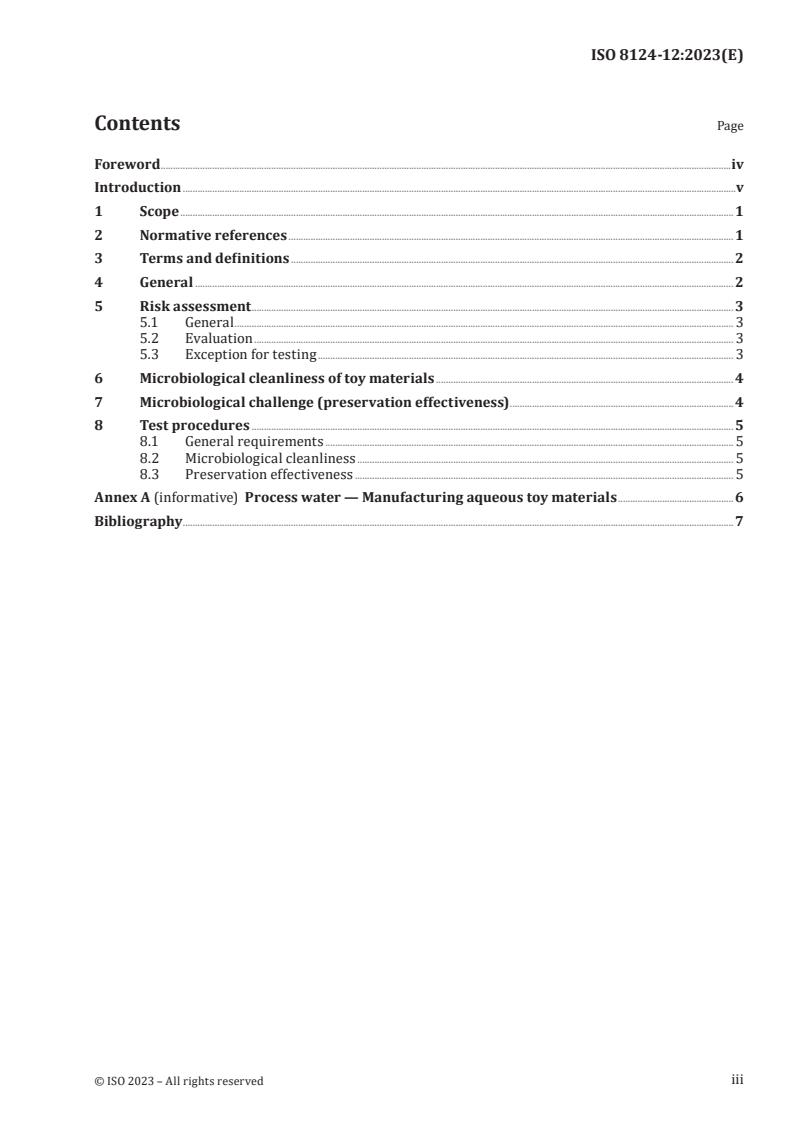
Contents Page
Foreword .iv
Introduction .v
1 Scope . 1
2 Normative references . 1
3 Terms and definitions . 2
4 General . 2
5 Risk assessment . 3
5.1 General . 3
5 . 2 E v a lu at ion . 3
5.3 Exception for testing . 3
6 Microbiological cleanliness of toy materials . 4
7 Microbiological challenge (preservation effectiveness) . 4
8 Test procedures . 5
8.1 General requirements . 5
8.2 Microbiological cleanliness . 5
8.3 Preservation effectiveness . 5
Annex A (informative) Process water — Manufacturing aqueous toy materials .6
Bibliography . 7
iii
Foreword
ISO (the International Organization for Standardization) is a worldwide federation of national standards
bodies (ISO member bodies). The work of preparing International Standards is normally carried out
through ISO technical committees. Each member body interested in a subject for which a technical
committee has been established has the right to be represented on that committee. International
organizations, governmental and non-governmental, in liaison with ISO, also take part in the work.
ISO collaborates closely with the International Electrotechnical Commission (IEC) on all matters of
electrotechnical standardization.
The procedures used to develop this document and those intended for its further maintenance are
described in the ISO/IEC Directives, Part 1. In particular, the different approval criteria needed for the
different types of ISO document should be noted. This document was drafted in accordance with the
editorial rules of the ISO/IEC Directives, Part 2 (see www.iso.org/directives).
ISO draws attention to the possibility that the implementation of this document may involve the use
of (a) patent(s). ISO takes no position concerning the evidence, validity or applicability of any claimed
patent rights in respect thereof. As of the date of publication of this document, ISO had not received
notice of (a) patent(s) which may be required to implement this document. However, implementers are
cautioned that this may not represent the latest information, which may be obtained from the patent
database available at www.iso.org/patents. ISO shall not be held responsible for identifying any or all
such patent rights.
Any trade name used in this document is information given for the convenience of users and does not
constitute an endorsement.
For an explanation of the voluntary nature of standards, the meaning of ISO specific terms and
expressions related to conformity assessment, as well as information about ISO's adherence to
the World Trade Organization (WTO) principles in the Technical Barriers to Trade (TBT), see
www.iso.org/iso/foreword.html.
This document was prepared by Technical Committee ISO/TC 181, Safety of toys.
A list of all parts in the ISO 8124 series can be found on the ISO website.
Any feedback or questions on this document should be directed to the user’s national standards body. A
complete listing of these bodies can be found at www.iso.org/members.html.
iv
Introduction
This document is largely based upon existing requirements in ASTM F963, with some modifications to
narrow the scope and facilitate use of the document in multiple jurisdictions.
However, it should not be construed that a toy manufactured in conformity with this document will
be in full compliance with relevant national toy safety requirements in the market where the product
is intended to be distributed. The user of this document is therefore advised to be aware of relevant
national requirements.
Conformity with the requirements of this document will minimize potential hazards associated with
toys due to lack of microbiological cleanliness or inadequate preservation, either of which can result
in illness or injury resulting from use of the toy in its intended play modes (normal use) as well as
unintended play modes (reasonably foreseeable abuse).
This document will not, nor is it intended to, eliminate parental responsibility in the appropriate
selection of toys. Nor will this document eliminate the need for parental supervision in situations where
children of various ages have access to the same toy(s).
v
INTERNATIONAL STANDARD ISO 8124-12:2023(E)
Safety of toys —
Part 12:
Microbiological safety
1 Scope
This document specifies acceptable criteria for microbiological cleanliness and adequacy of
preservation of the specified toy materials. The requirements in this document apply to all toys that
are, contain or are supplied with aqueous materials (e.g. paste, putty, liquid or gel). In addition, this
document applies to toys that are or include a cosmetic (including those intended for use on a toy as
well as on the child). Powders and similar substances intended to be mixed with water are also within
the scope of this document.
The cleanliness and preservation effectiveness requirements are applicable to a toy as it is initially
received by the consumer in an unopened and undamaged container and do not apply after a toy is
subjected to reasonably foreseeable conditions of normal use and abuse, unless specifically noted
otherwise. The microbial limits and test methods contained in this document are inappropriate to
apply to products that are consumer complaint returns, as there is no way to establish what conditions
the toys have been subject to before being returned.
The following are excluded from the scope of this document:
— materials that are inaccessible during normal use or reasonably foreseeable abuse;
— powder or powder-like materials intended to show biological phenomena, e.g. shrimp eggs, seeds,
soil;
— food.
2 Normative references
The following documents are referred to in the text in such a way that some or all of their content
constitutes requirements of this document. For dated references, only the edition cited applies. For
undated references, the latest edition of the referenced document (including any amendments) applies.
ISO 6222, Water quality — Enumeration of culturable micro-organisms — Colony count by inoculation in
a nutrient agar culture medium
ISO 7899 (all parts), Water quality — Detection and enumeration of intestinal enterococci
ISO 9308 (all parts), Water quality — Enumeration of Escherichia coli and coliform bacteria
ISO 11930, Cosmetics — Microbiology — Evaluation of the antimicrobial protection of a cosmetic product
ISO 16212, Cosmetics — Microbiology — Enumeration of yeast and mould
ISO 17516, Cosmetics — Microbiology — Microbiological limits
ISO 18415, Cosmetics — Microbiology — Detection of specified and non-specified microorganisms
ISO 18416, Cosmetics — Microbiology — Detection of Candida albicans
ISO 18787, Foodstuffs — Determination of water activity
ISO 21148, Cosmetics — Microbiology — General instructions for microbiological examination
ISO 21149, Cosmetics — Microbiology — Enumeration and detection of aerobic mesophilic bacteria
ISO 21150, Cosmetics — Microbiology — Detection of Escherichia coli
ISO 22717, Cosmetics — Microbiology — Detection of Pseudomonas aeruginosa
ISO 22718, Cosmetics — Microbiology — Detection of Staphylococcus aureus
ISO 29621, Co
...
Questions, Comments and Discussion
Ask us and Technical Secretary will try to provide an answer. You can facilitate discussion about the standard in here.
Loading comments...