

ISO/DTS 20443
(Main)Health informatics — Identification of medicinal products — Implementation for ISO 11615 data elements and structures for the unique identification and exchange of regulated medicinal product information
General Information
- Abstract
ISO/TS 20443:2017 defines concepts and describes data elements and their structural relationships, which are required for the unique identification and the detailed description of Medicinal Products. Taken together, all ISO IDMP standards (ISO 11615, ISO 11616, ISO 11238, ISO 11239 and ISO 11240) define, characterise, and uniquely identify regulated Medicinal Products for human use from approval, to post-marketing and renewal or withdrawal from the market, where applicable. Furthermore, to support successful information exchange in relation to the unique identification and characterisation of Medicinal Products, the normative use of HL7 common product model (CPM) and structured product labeling (SPL) messaging is described. References to the use of other relevant standards for Medicinal Product information are included in ISO/TS 20443:2017 to support successful information exchange.
- Status
- Not Published
- Technical Committee
- ISO/TC 215 - Health informatics
- Drafting Committee
- ISO/TC 215 - Health informatics
- Current Stage
- 5020 - FDIS ballot initiated: 2 months. Proof sent to secretariat
- Start Date
- 16-Jul-2026
- Completion Date
- 16-Jul-2026
Buy Documents
ISO/DTS 20443 - Health informatics — Identification of medicinal products — Implementation for ISO 11615 data elements and structures for the unique identification and exchange of regulated medicinal product information
REDLINE ISO/DTS 20443 - Health informatics — Identification of medicinal products — Implementation for ISO 11615 data elements and structures for the unique identification and exchange of regulated medicinal product information
Overview
ISO/DTS 20443:2026 – Health Informatics – Identification of Medicinal Products – Implementation for ISO 11615 Data Elements and Structures is an essential standard for the healthcare and pharmaceutical sectors. Developed by ISO/TC 215 in collaboration with CEN, this standard provides detailed guidance for the unique identification and exchange of regulated medicinal product information. It focuses on implementing ISO 11615 data elements and structures, ensuring that medicinal product information is consistently described, uniquely identified, and efficiently exchanged across regulatory authorities, industry stakeholders, and global data repositories.
This document is part of the broader suite of ISO IDMP (Identification of Medicinal Products) standards, including ISO 11615, ISO 11616, ISO 11238, ISO 11239, and ISO 11240, which collectively establish best practices for managing regulated product data throughout the product lifecycle - from approval to post-market activities and withdrawal.
Key Topics
- Unique Identification of Medicinal Products: Defines standardized data elements and structural relationships necessary to unambiguously identify and describe medicinal products for human use.
- IDMP Data Structures: Outlines data models for medicinal product components such as packaging, ingredients, substances, devices, clinical particulars, and authorizations, aligned with global regulatory requirements and EN ISO 21090:2011 data types.
- Structured Information Exchange: Specifies message formats for data exchange, supporting HL7 Common Product Model (CPM) and HL7 SPL (Structured Product Labeling) to promote interoperability and regulatory compliance.
- Interoperability and Mapping: Provides informative mappings to HL7 FHIR (Fast Healthcare Interoperability Resources), including XML and JSON examples, to facilitate international data harmonization and implementation.
- Change and Version Management: Details processes for maintenance and updates of IDMP data elements and identifiers, supporting traceability and version control throughout a product’s regulatory lifecycle.
Applications
ISO/DTS 20443 is vital for:
- Regulatory Authorities: Facilitating electronic submission and exchange of medicinal product information for market approval, surveillance, and international harmonization.
- Pharmaceutical Industry: Supporting MAHs, manufacturers, and clinical trial sponsors in preparing, managing, and submitting structured product dossiers and regulatory communications.
- Clinical Trial Management: Ensuring investigational and authorized products are uniquely tracked and referenced across global clinical trial submissions.
- Healthcare IT Vendors: Guiding the development of compliant software solutions that construct, parse, and transmit IDMP-compliant datasets.
- Interagency Communication: Standardizing data exchange between regulatory bodies, third-party organizations, and international data repositories to improve product traceability and public health outcomes.
Related Standards
ISO/DTS 20443 is a practical complement within the IDMP (Identification of Medicinal Products) standards portfolio, which includes:
- ISO 11615: Data elements and structures for unique identification and exchange of regulated medicinal product information.
- ISO 11616: Unique identification of medicinal product packs.
- ISO 11238: Data elements and structures for unique identification and exchange of regulated information on substances.
- ISO 11239: Data elements and structures for unique identification and exchange of regulated information on pharmaceutical dose forms, units of presentation, routes of administration, and packaging.
- ISO 11240: Requirements for the identification and exchange of units of measurement.
- HL7 Structured Product Labeling (SPL): Model for regulatory product submissions.
- HL7 FHIR: Framework for exchanging electronic health records and medicinal product data.
Practical Value
By adhering to ISO/DTS 20443, organizations benefit from:
- Consistency: Ensures regulated medicinal product information is described, managed, and exchanged using harmonized international standards.
- Traceability and Safety: Supports reliable identification and tracking of medicinal products, reinforcing pharmacovigilance and patient safety.
- Regulatory Readiness: Simplifies compliance with evolving global regulatory requirements for product identification, data integrity, and electronic submissions.
- Interoperability: Enhances integration between regulatory systems, pharmaceutical companies, and healthcare IT solutions by leveraging common data models, vocabularies, and messaging protocols.
ISO/DTS 20443 is a cornerstone for implementing robust, future-proof health informatics infrastructures supporting efficient medicinal product data management and global regulatory collaboration.
Relations
- Effective Date
- 12-Feb-2026
- Effective Date
- 11-Feb-2023
- Effective Date
- 28-Jan-2023
Buy Documents
ISO/DTS 20443 - Health informatics — Identification of medicinal products — Implementation for ISO 11615 data elements and structures for the unique identification and exchange of regulated medicinal product information
REDLINE ISO/DTS 20443 - Health informatics — Identification of medicinal products — Implementation for ISO 11615 data elements and structures for the unique identification and exchange of regulated medicinal product information
Get Certified
Connect with accredited certification bodies for this standard

BSI Group
BSI (British Standards Institution) is the business standards company that helps organizations make excellence a habit.

NYCE
Mexican standards and certification body.
Sponsored listings
Frequently Asked Questions
ISO/DTS 20443 is a draft published by the International Organization for Standardization (ISO). Its full title is "Health informatics — Identification of medicinal products — Implementation for ISO 11615 data elements and structures for the unique identification and exchange of regulated medicinal product information". This standard covers: ISO/TS 20443:2017 defines concepts and describes data elements and their structural relationships, which are required for the unique identification and the detailed description of Medicinal Products. Taken together, all ISO IDMP standards (ISO 11615, ISO 11616, ISO 11238, ISO 11239 and ISO 11240) define, characterise, and uniquely identify regulated Medicinal Products for human use from approval, to post-marketing and renewal or withdrawal from the market, where applicable. Furthermore, to support successful information exchange in relation to the unique identification and characterisation of Medicinal Products, the normative use of HL7 common product model (CPM) and structured product labeling (SPL) messaging is described. References to the use of other relevant standards for Medicinal Product information are included in ISO/TS 20443:2017 to support successful information exchange.
ISO/TS 20443:2017 defines concepts and describes data elements and their structural relationships, which are required for the unique identification and the detailed description of Medicinal Products. Taken together, all ISO IDMP standards (ISO 11615, ISO 11616, ISO 11238, ISO 11239 and ISO 11240) define, characterise, and uniquely identify regulated Medicinal Products for human use from approval, to post-marketing and renewal or withdrawal from the market, where applicable. Furthermore, to support successful information exchange in relation to the unique identification and characterisation of Medicinal Products, the normative use of HL7 common product model (CPM) and structured product labeling (SPL) messaging is described. References to the use of other relevant standards for Medicinal Product information are included in ISO/TS 20443:2017 to support successful information exchange.
ISO/DTS 20443 is classified under the following ICS (International Classification for Standards) categories: 35.240.80 - IT applications in health care technology. The ICS classification helps identify the subject area and facilitates finding related standards.
ISO/DTS 20443 has the following relationships with other standards: It is inter standard links to FprCEN ISO/TS 20443, ISO 5893:2019, ISO/TS 20443:2017. Understanding these relationships helps ensure you are using the most current and applicable version of the standard.
ISO/DTS 20443 is available in PDF format for immediate download after purchase. The document can be added to your cart and obtained through the secure checkout process. Digital delivery ensures instant access to the complete standard document.
Standards Content (Sample)
FINAL DRAFT
Technical
Specification
ISO/TC 215
Health informatics — Identification
Secretariat: ANSI
of medicinal products —
Voting begins on:
Implementation for ISO 11615 data
2026-07-16
elements and structures for the
Voting terminates on:
unique identification and exchange
2026-10-08
of regulated medicinal product
information
RECIPIENTS OF THIS DRAFT ARE INVITED TO SUBMIT,
WITH THEIR COMMENTS, NOTIFICATION OF ANY
RELEVANT PATENT RIGHTS OF WHICH THEY ARE AWARE
AND TO PROVIDE SUPPOR TING DOCUMENTATION.
IN ADDITION TO THEIR EVALUATION AS
BEING ACCEPTABLE FOR INDUSTRIAL, TECHNO
ISO/CEN PARALLEL PROCESSING LOGICAL, COMMERCIAL AND USER PURPOSES, DRAFT
INTERNATIONAL STANDARDS MAY ON OCCASION HAVE
TO BE CONSIDERED IN THE LIGHT OF THEIR POTENTIAL
TO BECOME STAN DARDS TO WHICH REFERENCE MAY BE
MADE IN NATIONAL REGULATIONS.
Reference number
FINAL DRAFT
Technical
Specification
ISO/TC 215
Health informatics — Identification
Secretariat: ANSI
of medicinal products —
Voting begins on:
Implementation for ISO 11615 data
elements and structures for the
Voting terminates on:
unique identification and exchange
of regulated medicinal product
information
RECIPIENTS OF THIS DRAFT ARE INVITED TO SUBMIT,
WITH THEIR COMMENTS, NOTIFICATION OF ANY
RELEVANT PATENT RIGHTS OF WHICH THEY ARE AWARE
AND TO PROVIDE SUPPOR TING DOCUMENTATION.
© ISO 2026
IN ADDITION TO THEIR EVALUATION AS
All rights reserved. Unless otherwise specified, or required in the context of its implementation, no part of this publication may
BEING ACCEPTABLE FOR INDUSTRIAL, TECHNO
ISO/CEN PARALLEL PROCESSING
LOGICAL, COMMERCIAL AND USER PURPOSES, DRAFT
be reproduced or utilized otherwise in any form or by any means, electronic or mechanical, including photocopying, or posting on
INTERNATIONAL STANDARDS MAY ON OCCASION HAVE
the internet or an intranet, without prior written permission. Permission can be requested from either ISO at the address below
TO BE CONSIDERED IN THE LIGHT OF THEIR POTENTIAL
or ISO’s member body in the country of the requester.
TO BECOME STAN DARDS TO WHICH REFERENCE MAY BE
MADE IN NATIONAL REGULATIONS.
ISO copyright office
CP 401 • Ch. de Blandonnet 8
CH-1214 Vernier, Geneva
Phone: +41 22 749 01 11
Email: copyright@iso.org
Website: www.iso.org
Published in Switzerland Reference number
ii
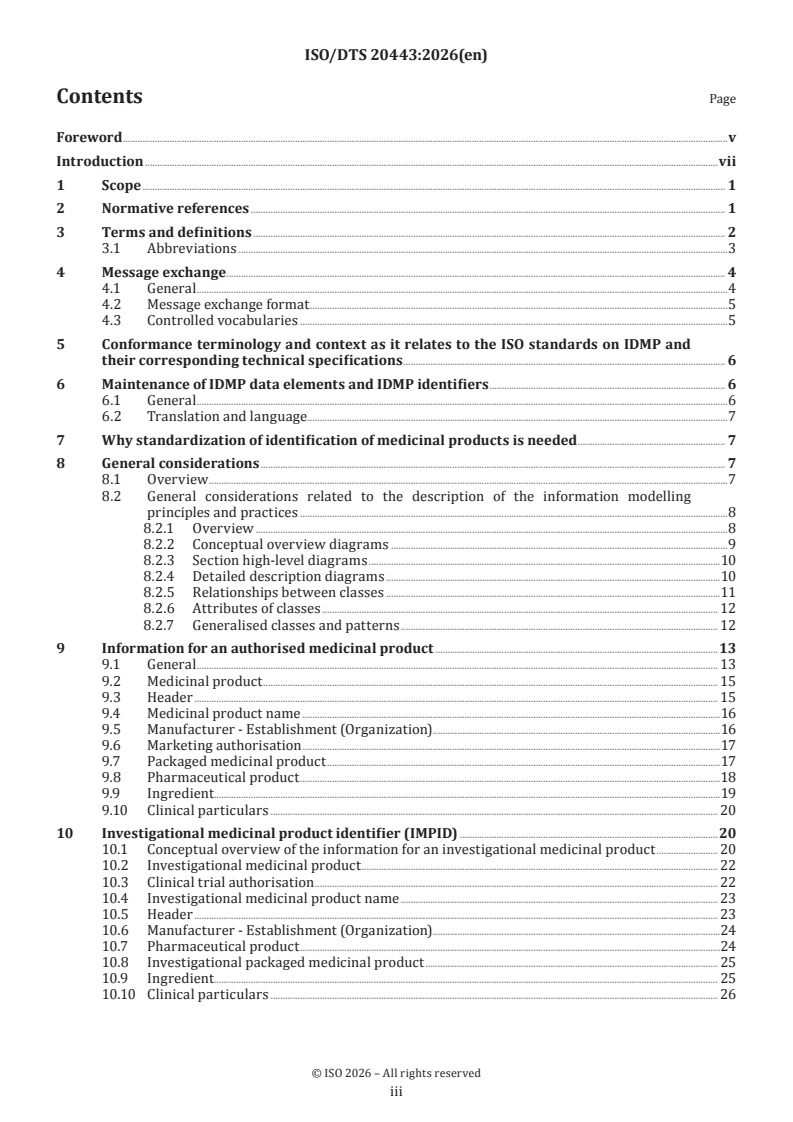
Contents Page
Foreword .v
Introduction .vii
1 Scope . 1
2 Normative references . 1
3 Terms and definitions . 2
3.1 Abbreviations .3
4 Message exchange. 4
4.1 General .4
4.2 Message exchange format .5
4.3 Controlled vocabularies .5
5 Conformance terminology and context as it relates to the ISO standards on IDMP and
their corresponding technical specifications . 6
6 Maintenance of IDMP data elements and IDMP identifiers . 6
6.1 General .6
6.2 Translation and language .7
7 Why standardization of identification of medicinal products is needed . 7
8 General considerations . 7
8.1 Overview .7
8.2 General considerations related to the description of the information modelling
principles and practices .8
8.2.1 Overview .8
8.2.2 Conceptual overview diagrams .9
8.2.3 Section high-level diagrams .10
8.2.4 Detailed description diagrams .10
8.2.5 Relationships between classes .11
8.2.6 Attributes of classes . 12
8.2.7 Generalised classes and patterns . 12
9 Information for an authorised medicinal product .13
9.1 General . 13
9.2 Medicinal product . 15
9.3 Header . 15
9.4 Medicinal product name .16
9.5 Manufacturer - Establishment (Organization).16
9.6 Marketing authorisation .17
9.7 Packaged medicinal product .17
9.8 Pharmaceutical product .18
9.9 Ingredient.19
9.10 Clinical particulars . 20
10 Investigational medicinal product identifier (IMPID) .20
10.1 Conceptual overview of the information for an investigational medicinal product . 20
10.2 Investigational medicinal product . 22
10.3 Clinical trial authorisation . 22
10.4 Investigational medicinal product name . 23
10.5 Header . 23
10.6 Manufacturer - Establishment (Organization).24
10.7 Pharmaceutical product .24
10.8 Investigational packaged medicinal product . 25
10.9 Ingredient. 25
10.10 Clinical particulars . 26
iii
11 Conceptual and detailed information models of authorised and investigational
medicinal product .26
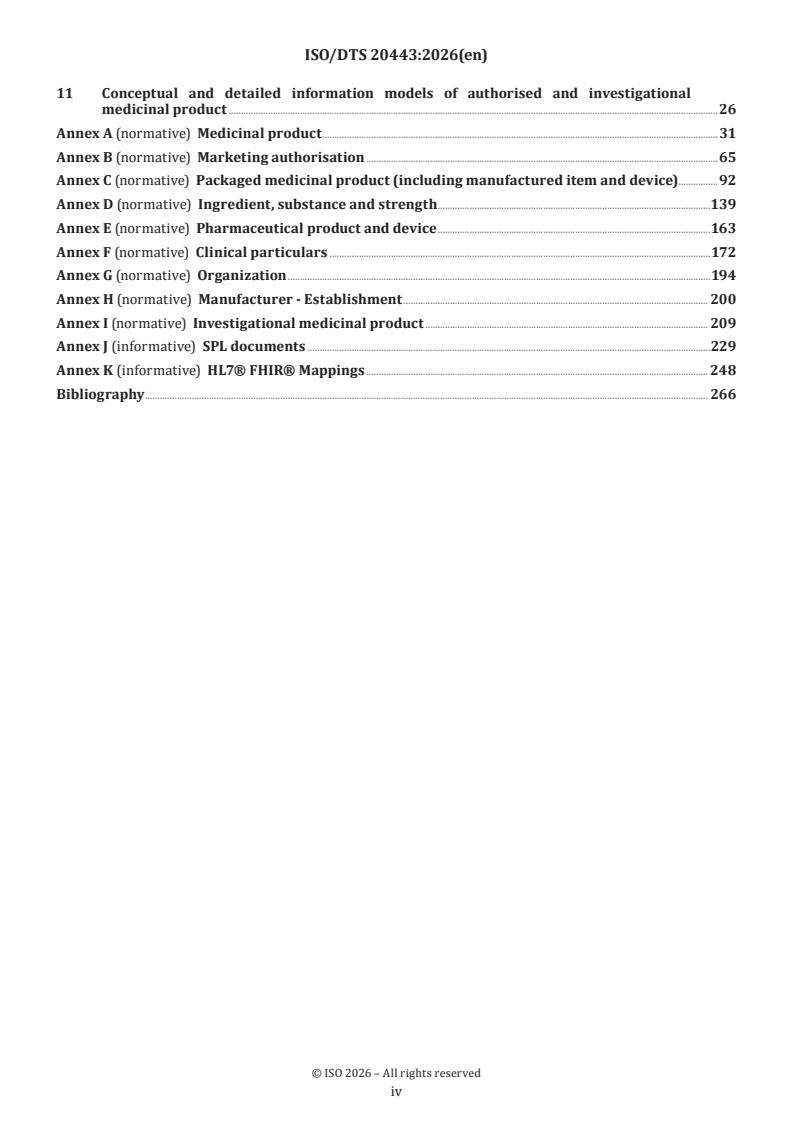
Annex A (normative) Medicinal product .31
Annex B (normative) Marketing authorisation .65
Annex C (normative) Packaged medicinal product (including manufactured item and device) .92
Annex D (normative) Ingredient, substance and strength .139
Annex E (normative) Pharmaceutical product and device .163
Annex F (normative) Clinical particulars .172
Annex G (normative) Organization .194
Annex H (normative) Manufacturer - Establishment . 200
Annex I (normative) Investigational medicinal product . 209
Annex J (informative) SPL documents .229
Annex K (informative) HL7® FHIR® Mappings . 248
Bibliography . 266
iv
Foreword
ISO (the International Organization for Standardization) is a worldwide federation of national standards
bodies (ISO member bodies). The work of preparing International Standards is normally carried out through
ISO technical committees. Each member body interested in a subject for which a technical committee
has been established has the right to be represented on that committee. International organizations,
governmental and non-governmental, in liaison with ISO, also take part in the work. ISO collaborates closely
with the International Electrotechnical Commission (IEC) on all matters of electrotechnical standardization.
The procedures used to develop this document and those intended for its further maintenance are described
in the ISO/IEC Directives, Part 1. In particular, the different approval criteria needed for the different types
of ISO documents should be noted. This document was drafted in accordance with the editorial rules of the
ISO/IEC Directives, Part 2 (see www.iso.org/directives).
ISO draws attention to the possibility that the implementation of this document may involve the use of (a)
patent(s). ISO takes no position concerning the evidence, validity or applicability of any claimed patent
rights in respect thereof. As of the date of publication of this document, ISO had not received notice of (a)
patent(s) which may be required to implement this document. However, implementers are cautioned that
this may not represent the latest information, which may be obtained from the patent database available at
www.iso.org/patents. ISO shall not be held responsible for identifying any or all such patent rights.
Any trade name used in this document is information given for the convenience of users and does not
constitute an endorsement.
For an explanation of the voluntary nature of standards, the meaning of ISO specific terms and expressions
related to conformity assessment, as well as information about ISO’s adherence to the World Trade
Organization (WTO) principles in the Technical Barriers to Trade (TBT), see www.iso.org/iso/foreword.html.
This document was prepared by Technical Committee ISO/TC 215, Health informatics, in collaboration with
the European Committee for Standardization (CEN) Technical Committee CEN/TC 251, Health informatics, in
accordance with the Agreement on technical cooperation between ISO and CEN (Vienna Agreement).
This second edition cancels and replaces the first edition (ISO/TS 20443:2017) which has been technically
revised.
The main changes are as follows:
— Extensive technical and structural revision of the standard, including more than 70 structural changes
to improve clarity, consistency, and usability.
— Alignment with the latest developments of ISO 11615, including updates to the overall data model and
related concepts.
— Major extension and refinement of the information model through the introduction of new attributes,
associations, and classes, as well as refinement and reallocation of existing elements across pharmaceutical
product, manufactured item, device, ingredient, substance, packaging, and regulatory domains.
— Redesign of the strength representation model, including the introduction of “Strength Type”, “Strength”,
and “Reference Substance” constructs, revised substance-strength associations, and alternative linkage
mechanisms consistent with ISO 11615, while preserving backward compatibility.
— Introduction of interoperability mappings and implementation artefacts, including a new informative
Annex K defining mappings to HL7 FHIR, as well as inclusion of HL7 FHIR (XML/JSON) examples and
updated HL7 SPL snippets.
— Strengthening of model constraints and data integrity through updates to cardinalities, mandatory
elements, and classification structures (e.g. therapeutic indication, population grouping, product domain
classification).
— Clarification and enhancement of existing requirements, including updates to cardinalities, classifications,
and modelling constraints to ensure more precise and consistent interpretation.
v
— Addition of informative content, bibliographic references, and explanatory material to support
implementation and understanding.
Any feedback or questions on this document should be directed to the user’s national standards body. A
complete listing of these bodies can be found at www.iso.org/members.html.
vi
Introduction
1)
This document provides requirements and recommendations for implementing ISO 11615 . It is one of
the five ISO International Standards and four ISO Technical Specifications which together characterise the
basis for the unique and unambiguous identification of medicinal products (IDMP). The ISO documents on
IDMP are: ISO 11615, ISO/TS 20443 (this document), ISO 11616, ISO/TS 20451, ISO 11238, ISO/TS 19844,
ISO 11239, ISO/TS 20440, and ISO 11240.
The primary purpose of this document is to provide technical guidance to software implementers. Short
descriptions of business rationale are also included, where relevant, to provide context. Thus, this document
focuses on business and technical considerations for implementation that will construct and parse well-
formed, transmittable IDMP messages. Following transmission of this information, unique identifiers are
to be produced in conformance with the standards to support applications where it is important to reliably
identify and trace regulated biopharmaceutical products.
However, this document does not include extensive information on creation or maintenance of identifier
repositories. Reference is made to regional guidance and implementation guides to support practical
implementation within a given region or jurisdiction. ISO/TR 14872 describes core principles for supporting
the development, implementation and ongoing maintenance of IDMP identifiers and terminologies.
The data elements and message specifications described in this document support, at a minimum, the
following interactions within the following scope:
— regulatory medicines authority to regulatory medicines authority;
— pharmaceutical company to regulatory medicines authority;
— sponsor of a clinical trial to regulatory medicines authority;
— regulatory medicines authority to other stakeholders (as applicable);
— regulatory medicines authority to worldwide-maintained data sources.
Unique identifiers produced in conformance with this document are aimed at supporting applications where
it is necessary to reliably identify and trace the use of medicinal products.
1) Third edition under preparation. Stage at the time of balloting: ISO/DIS 11615.
vii
FINAL DRAFT Technical Specification ISO/DTS 20443:2026(en)
Health informatics — Identification of medicinal products —
Implementation for ISO 11615 data elements and structures
for the unique identification and exchange of regulated
medicinal product information
IMPORTANT — The electronic file of this document contains colours which are considered to be
useful for the correct understanding of the document. Users should therefore consider printing this
document using a colour printer.
1 Scope
This document provides technical and business-oriented requirements and recommendations for
2)
implementing ISO 11615 within systems that create, exchange, and process IDMP compliant medicinal
product information. It focuses on the data elements, structures, and message specifications required to
construct and interpret well-formed IDMP messages for regulatory and industry use. The scope covers
interactions involving:
— regulatory authorities;
— pharmaceutical companies and marketing authorisation holders;
— clinical trial sponsors;
— other authorised stakeholders and global data sources.
This document applies to the exchange of medicinal product information needed to ensure unique, consistent,
and traceable identification of medicinal products. Furthermore, to support successful information
3)
exchange, the use of the non-normative HL7® CPM (Common Product Model), the HL7® SPL (Structured
4)
Product Labeling), and HL7® FHIR® are described. References to the use of other relevant standards for
medicinal product information are included in this document to support successful information exchange.
The document does not cover the governance, creation, or maintenance of identifier repositories, nor region
specific regulatory procedures (e.g. marketing authorisation workflows), or internal business processes
and system design for individual organizations, or training materials or domain-specific regulatory
interpretations. Regional implementation guides can be consulted for jurisdiction-specific requirements.
2 Normative references
The following documents are referred to in the text in such a way that some or all of their content constitutes
requirements of this document. For dated references, only the edition cited applies. For undated references,
the latest edition of the referenced document (including any amendments) applies.
ISO 639, Code for individual languages and language groups
ISO 3166-1, Codes for the representation of names of countries and their subdivisions — Part 1: Country code
ISO 8601-1, Date and time — Representations for information interchange — Part 1: Basic rules
2) Third edition under preparation. Stage at the time of balloting: ISO/DIS 11615:2026.
3) HL7 is the registered trademark of Health Level Seven International. This information is given for the convenience of
users of this document and does not constitute an endorsement by ISO of the product named.
4) FHIR is a trademark of HL7®. This information is given for the convenience of users of this document and does not
constitute an endorsement by ISO of the product named.
ISO 8601-2, Date and time — Representations for information interchange — Part 2: Extensions
ISO 12639, Graphic technology — Prepress digital data exchange — Tag image file format for image technology
(TIFF/IT)
ISO/TS 19844:2018, Health informatics — Identification of medicinal products (IDMP) — Implementation
guidelines for ISO 11238 for data elements and structures for the unique identification and exchange of regulated
information on substances
ISO 11238, Health informatics — Identification of medicinal products — Data elements and structures for the
unique identification and exchange of regulated information on substances
ISO 11239, Health informatics — Identification of medicinal products — Data elements and structures for the
unique identification and exchange of regulated information on pharmaceutical dose forms, units of presentation,
routes of administration and packaging
ISO 11240, Health informatics — Identification of medicinal products — Data elements and structures for the
unique identification and exchange of units of measurement
ISO 11615, Health informatics — Identification of medicinal products — Data elements and structures for the
unique identification and exchange of regulated medicinal product information
ISO 11616, Health informatics — Identification of medicinal products — Data elements and structures for
unique identification and exchange of regulated pharmaceutical product information
ISO/TS 20440, Health informatics — Identification of medicinal products — Implementation guidelines for
ISO 11239 data elements and structures for the unique identification and exchange of regulated information on
pharmaceutical dose forms, units of presentation, routes of administration and packaging
ISO/TS 20451, Health informatics — Identification of medicinal products — Implementation guidelines for
ISO 11616 data elements and structures for the unique identification and exchange of regulated pharmaceutical
product information
ISO 21090, Health Informatics — Harmonized data types for information interchange
ISO/HL7 27953-1:2011, Health informatics — Individual case safety reports (ICSRs) in pharmacovigilance —
Part 1: Framework for adverse event reporting
ISO/HL7 27953-2, Health informatics — Individual case safety reports (ICSRs) in pharmacovigilance — Part 2:
Human pharmaceutical reporting requirements for ICSR
3 Terms and definitions
No terms and definitions are listed in this document.
ISO and IEC maintain terminology databases for use in standardization at the following addresses:
— ISO Online browsing platform: available at https:// www .iso .org/ obp
— IEC Electropedia: available at https:// www .electropedia .org/
3.1 Abbreviations
ATC anatomical therapeutic chemical
BAID medicinal product batch identifier
BAID 1 medicinal product batch identifier (outer packaging)
BAID 2 medicinal product batch identifier (immediate packaging)
CDA clinical document architecture
CEN European Committee for Standardisation
CPM common product model
EMA European Medicines Agency, EU
FDA Food and Drug Administration, US
FHIR® Fast Healthcare Interoperability Resources
FLFS fulfills relationship
GTIN® Global Trade Identification Number; a trademark of GS1
GUID globally unique identifier
HL7® Health Level Seven
International Conference on Harmonisation of Technical Requirements for Registration of
ICH
Pharmaceuticals for Human Use
ICSR individual case safety reporting
ID identifier
IDMP identification of medicinal product
IG implementation guide
IMPID investigational medicinal product identifier
IND investigational new drug
INN international nonproprietary name
ISO International Organization for Standardisation
JSON JavaScript object notation
LOINC logical observation identifiers names and codes
MPID medicinal product identifier
NCI National Cancer Institute
NDA new drug application
OID object identifier
OMG object modelling group
PCID packaged medicinal product identifier
PCPC personal care products council
PhPID pharmaceutical product identifier
PSUR periodic safety update report
RIM reference information model
SDOs standards development organizations
SME small to medium enterprise
SmPC summary of product characteristics
SPL structured product labeling
Substance ID substance identifier
UDI unique device identification (code)
UML unified modeling language
UUID universally unique identifier
XML extensible markup language
4 Message exchange
4.1 General
HL7® messaging standards have been widely implemented globally. The HL7® V3 architecture messaging
standard deals with a static model of healthcare information as viewed within the scope of HL7® standards
development activities. The HL7® FHIR® (Fast Healthcare Interoperability Resources) specification
5)
defines a set of capabilities for use across the healthcare process, about 157 modular components (called
Resources) that can be assembled into working systems that support the wider healthcare domain. ISO
recognises HL7® as an accredited partner organization for mutually issuing standards. The first mutually
published standard was ISO/HL7 21731.
HL7® V3 was developed to address the complex requirements of health information technology. The HL7
Reference Information Model (RIM) is the cornerstone of V3 and the essential model from which all HL7
messages are derived. The RIM defines data content needed in a specific context and provides an explicit
representation of the semantic and lexical connections that exist between the information carried in the
elements of a message. V3 seeks to develop specifications that facilitate interoperability between systems.
The HL7® model-driven methodology is used to develop consensus-based standards for healthcare system
interoperability and information exchange. HL7® V3 messages are based on an XML encoding syntax.
FHIR® is a specification based on emerging industry approaches, but informed by years of lessons around
requirements, successes and challenges gained through defining and implementing HL7® V2, HL7® v3 and
the RIM, and CDA. FHIR® focuses to simplify implementations, it leverages existing logical and conceptual
models to provide a consistent, easy to implement, and rigorous mechanism for exchanging data between
healthcare applications. FHIR® has built-in mechanisms for traceability to the HL7® RIM and other
important content models. This ensures alignment to HL7®’s previously defined patterns and best practices
without requiring the implementer to have intimate knowledge of the RIM or any HL7® v3 derivations.
5) As per current FHIR® Release #5: https:// hl7 .org/ fhir/
6)
HL7® has confirmed that HL7® Version 3 is no longer actively developed and almost all new HL7®
projects have been building upon FHIR®. But some V3-based standards continue to be used in practice.
[7]
For example, CDA (Clinical Document Architecture) which is rooted in HL7® V3 models remains widely
implemented in many national programs and regulatory workflows (e.g. clinical documents, discharge
summaries, structured reports); the pharmacovigilance Individual Case Safety Report (ICSR) standards
(ISO/HL7 27953-1 and ISO/HL7 27953-2) used for adverse event reporting are HL7® V3-based and continue
to be officially reaffirmed and remain valid until at least December 2026 (as per ANSI/HL7 listings); the
HL7® SPL (see Reference [8]) and HL7® CPM (see Reference [9]) are also HL7® V3-based standards
7)
used for regulatory use cases (including IDMP) in one of the ICH regions . The framework described in
ISO/HL7 27953-1 shall apply.
Although not all current HL7® projects are based on FHIR®, nearly all new development, innovation efforts,
and strategic investments at HL7® now converge on FHIR®. This includes emerging interoperability
initiatives, accelerator programs, implementation guides, new tooling such as FHIR® Foundry, and federal
interoperability strategies, all of which overwhelmingly prioritize FHIR®.
The ISO standards on IDMP were designed to specify the necessary data elements and associated standards
to be used for unique identifiers. These were developed as an integral part of the IDMP consensus
requirements and are consistent with the HL7® Common Product Model (CPM) and the HL7® FHIR®
specification. The IDMP data elements represent a subset of those in the CPM and FHIR®. The use of HL7®
messaging standards will facilitate the integration of IDMP into the broader healthcare community, improve
8)
interoperability through standardized resource-based data exchange, support FAIR data principles , reduce
integration costs and complexity, and provide a future-proof foundation for advanced analytics and decision
support.
4.2 Message exchange format
In the context of this document, the message exchange formats to be utilised as informative reference
in transactions are the HL7® SPL (Structured Product Labeling) and HL7® FHIR®. The HL7® SPL is a
standard message exchange format based on Clinical Document Architecture (CDA) and the HL7® Reference
Information Model (RIM). FHIR® and SPL instances (code snippets) and FHIR® mappings (see Annex K) are
provided in this document to illustrate the representation of an IDMP concept within the HL7® SPL message
exchange format and within HL7® FHIR® specification. Technical conformance criteria for messages will
not be addressed in this document and shall be left to regional guidance and implementations per their
respective requirements. A reference to the most up to date HL7® CPM, HL7 SPL, and HL7® FHIR® reference
9),10)
as a resource for IDMP implementation is accessible on the HL7® portal .
4.3 Controlled vocabularies
A controlled vocabulary is a standardised, predefined set of terms used to describe, categorize and retrieve
information in a consistent and unambiguous way. It ensures that everyone uses the same authorised terms
to refer to the same concepts, improving search accuracy and reducing confusion. Controlled vocabularies:
— ensure terminology consistency in how concepts are named and described (e.g. “oral tablet” is always
coded the same way);
— eliminate ambiguity by ensuring each term refers to only one concept (e.g. regulators and applicants use
the same semantics through medicines’ life cycle);
6) The withdrawal and retirement of V3-based specifications signify the cessation of all maintenance activities, including
the discontinuation of tooling and editorial support, and formally denote that the specification has reached a mature state
and will no longer be subject to further enhancement.
7) US FDA.
8) The FAIR data principles are a set of internationally recognized guidelines designed to ensure that data can be
Findable, Accessible, Interoperable, and Reusable (Reference [10]).
9) https:// www .hl7 .org/
10) https:// hl7 .org/ fhir/
— improve search and retrieval (since users do not need to guess which synonyms were used) and reduce
manual interpretation of the information because structured, coded data are machine readable;
— organize knowledge, making systems more navigable and interoperable;
— solve problems of synonyms, homographs and variant spellings by enforcing a one-to-one relationship
between concepts and preferred terms.
The controlled vocabularies are used in many domains, e.g. libraries (cataloguing, subject headings), in
databases and search engines, in knowledge graphs and AI systems (to ensure semantic consistency), in
ontologies and metadata standards, and they are foundational in organising information for retrieval and
supporting the semantic interoperability across systems.
In the regulatory, pharmaceutical and healthcare standards development domain there are many
terms in use to describe basic concepts used for different purposes and in different contexts. The terms
and definitions described in ISO 11615 apply to the concepts, which are required to uniquely identify,
characterise, and exchange regulated medicinal products and associated information. A long-term goal for
IDMP is to promote the development of controlled vocabularies for worldwide application, with transitional
measures envisioned to accommodate regional requirements.
Regional guidance or implementation guides shall be developed to support practical implementation within
[1]
a given region or jurisdiction. ISO/TR 14872 is a technical report that provides a framework for identifying
core principles for the maintenance of identifiers and terms for ISO IDMP standards.
NOTE Harmonization by regions to adopt identical controlled vocabularies for IDMP implementation is out of the
scope of this document but is being facilitated by external activities outside of ISO.
5 Conformance terminology and context as it relates to the ISO standards on IDMP
and their corresponding technical specifications
— Mandatory: Defining elements necessary for the unique identification of medicinal products per the ISO
IDMP standards and their technical specifications.
— Conditional: Conditional applies to the “within category” data elements, as applicable, when there are
alternative data sources for a given data element(s) to identify a medicinal and pharmaceutical product.
Regional implementation of the ISO IDMP standards and technical specifications may elevate the
conditional conformance categories to “mandatory” per regional requirements.
— Optional: When listed at the category level (e.g. specified substance), optional corresponds to ISO
categories or data elements that are either not absolutely necessary for the unique identification
of medicinal or pharmaceutical products according to the ISO IDMP standards and their technical
specifications, or conditionally mandatory. Regional implementation of the ISO standards on IDMP
may elevate the optional conformance categories to “mandatory” or “conditional” to meet regional
requirements.
6 Maintenance of IDMP data elements and IDMP identifiers
6.1 General
Creation, maintenance, and publication of the actual IDMP identifiers are envisioned as a distributed process
where each participating regulatory authority would establish and maintain the identifiers utilised in their
respective regions. Over the longer term, a list of certain identifiers for global use may be developed and
agreed via a federated approach and associated with the regulatory process in each respective region. It is
anticipated that IDMP maintenance requirements will mature and evolve over time and IDMP scope and use
cases expand.
6.2 Translation and language
With the specific exception of medicinal product name information (see A.2.13), there is no description of
the translation of information described in ISO 11615. It was acknowledged that, for global implementation,
translation of the information will be required and will occur according to regional implementation
guidelines as applicable.
The requirement for translation is determined by a region. An international body can require documents
translated in some or all languages of its member nationalities. In addition, a country with multiple sizeable
sub-populations using multiple languages can require translations into more than one of these languages.
The IDMP standards do not set such requirements. The multilingual make-up of many regions is supported
by HL7® CPM and SPL for multilingual contexts and international exchange of IDMP data. For example,
Annex J specifies how SPL is to be utilised in support of multilingual requirements; also, multi-language
support in FHIR® (localization, internationalization) is available at https:// build .fhir .org/ languages .html
7 Why standardization of identification of medicinal products is needed
Medicines regulatory authorities and pharmaceutical industry engage in an intensive information exchange
during drug development, drug evaluation and approval phase and the post-authorisation phase. The
standardization of medicinal product information is regarded as one of the key elements of this information
flow.
However, regulators in the various regions have established their own procedures and applications with
standards that differ in data format, content, language, and applied terminology (e.g. different terminology
is used for describing substances, routes of administration, pharmaceutical dose forms, pharmaceutical
products and medicinal products).
Due to the lack of a common and harmonized approach, both regulators and pharmaceutical industry are
confronted with the following issues:
— no possibility to exchange medicinal product information between medicines regulatory authorities and
pharmaceutical industry in a structured and efficient way;
— difficulties in ensuring data consistency and in evaluating and comparing medicinal product-related
information across the regions due to the lack of harmonized definitions of terminologies and data
sets, which impairs pharmacovigilance, electronic prescription and electronic dispensing activities,
especially across borders;
— for the pharmaceutical industry, major administrative burdens and duplication of efforts requiring
substantial human and financial resources to comply with and handle different regional requirements;
— lack of consistency in the use of terminology in the healthcare community.
The objectives of the IDMP are to address these issues by developing harmonized standards that build
on the regulatory, scientific and technical processes already established and to support the population
and maintenance of existing systems or applications with fully reliable regulatory medicinal product
information.
Harmonized standards will support external stakeholders in developing “off-the-shelf” interoperable tools
in conformance with international standards. International standards will also help maximize forward
compatibility of data and minimize the complexities of backward compatibility.
8 General considerations
8.1 Overview
This document is intended to accompany, but not replace, ISO 11615 or HL7® FHIR®, CPM and SPL standards.
To satisfy the requirements as described in this document, the following identifiers shall be specified as
described in this document for the unique identification of medicinal products:
— Medicinal Product Identifier (MPID);
— Medicinal Product Package Identifier (PCID);
— Medicinal Product Batch Identifier (outer packaging, BAID 1), allocated to a specific batch of a medicinal
product, which appears on the outer packaging of the medicinal product;
— Medicinal Product Batch Identifier (immediate packaging, BAID 2), allocated to a specific batch of a
medicinal product, which appears on the immediate packaging, where this is not the outer packaging;
— expiration date;
— serialization-package level identification of a packaged medicinal product (including the particular
package configuration). Serial numbers should be either numeric (numbers) or letters, or alphanumeric
(both numbers and letters), and should have no more than 20 characters (either letters, or numbers, or
both).
NOTE 1 Serialization requirements are given in regional guidance.
NOTE 2 In addi
...
ISO/TC 215
Secretariat: ANSI
Date: 2026-03-2507-01
Health informatics — Identification of medicinal products —
Implementation for ISO 11615 data elements and structures for the
unique identification and exchange of regulated medicinal product
information
This draft is submitted to a parallel vote in ISO, CEN.
All rights reserved. Unless otherwise specified, or required in the context of its implementation, no part of this publication
may be reproduced or utilized otherwise in any form or by any means, electronic or mechanical, including photocopying,
or posting on the internet or an intranet, without prior written permission. Permission can be requested from either ISO
at the address below or ISO’s member body in the country of the requester.
ISO copyright office
CP 401 • Ch. de Blandonnet 8
CH-1214 Vernier, Geneva
Phone: + 41 22 749 01 11
E-mail: copyright@iso.org
Website: www.iso.org
Published in Switzerland
ii
Contents
Foreword . v
Introduction . xiii
1 Scope . 1
2 Normative references . 1
3 Terms and definitions . 3
3.1 Abbreviations . 3
4 Message exchange . 4
4.1 General . 4
4.2 Message exchange format . 6
4.3 Controlled vocabularies . 6
5 Conformance terminology and context as it relates to the ISO standards on IDMP and
their corresponding technical specifications . 7
6 Maintenance of IDMP data elements and IDMP identifiers . 7
6.1 General . 7
6.2 Translation and language . 7
7 Why standardization of identification of medicinal products is needed . 8
8 General considerations . 8
8.1 Overview . 8
8.2 General considerations related to the description of the information modelling
principles and practices . 9
9 Information for an authorised medicinal product . 18
9.1 General . 18
9.2 Medicinal product . 20
9.3 Header . 21
9.4 Medicinal product name . 22
9.5 Manufacturer - Establishment (Organization) . 22
9.6 Marketing authorisation . 23
9.7 Packaged medicinal product . 24
9.8 Pharmaceutical product . 26
9.9 Ingredient . 27
9.10 Clinical particulars . 28
10 Investigational medicinal product identifier (IMPID) . 29
10.1 Conceptual overview of the information for an investigational medicinal product . 29
10.2 Investigational medicinal product . 32
10.3 Clinical trial authorisation . 33
10.4 Investigational medicinal product name . 35
10.5 Header . 35
10.6 Manufacturer - Establishment (Organization) . 35
10.7 Pharmaceutical product . 36
10.8 Investigational packaged medicinal product . 37
10.9 Ingredient . 37
10.10 Clinical particulars . 37
11 Conceptual and detailed information models of authorised and investigational medicinal
product . 38
iii
Annex A (normative) Medicinal product . 45
Annex B (normative) Marketing authorisation . 82
Annex C (normative) Packaged medicinal product (including manufactured item and device)113
Annex D (normative) Ingredient, substance and strength . 164
Annex E (normative) Pharmaceutical product and device . 191
Annex F (normative) Clinical particulars . 202
Annex G (normative) Organization . 227
Annex H (normative) Manufacturer - Establishment . 234
Annex I (normative) Investigational medicinal product . 244
Annex J (informative) SPL documents . 269
Annex K (informative) HL7® FHIR® Mappings . 290
Bibliography . 310
iv
Foreword
ISO (the International Organization for Standardization) is a worldwide federation of national standards
bodies (ISO member bodies). The work of preparing International Standards is normally carried out through
ISO technical committees. Each member body interested in a subject for which a technical committee has been
established has the right to be represented on that committee. International organizations, governmental and
non-governmental, in liaison with ISO, also take part in the work. ISO collaborates closely with the
International Electrotechnical Commission (IEC) on all matters of electrotechnical standardization.
The procedures used to develop this document and those intended for its further maintenance are described
in the ISO/IEC Directives, Part 1. In particular, the different approval criteria needed for the different types of
ISO documents should be noted. This document was drafted in accordance with the editorial rules of the
ISO/IEC Directives, Part 2 (see www.iso.org/directives).
Attention is drawnISO draws attention to the possibility that some of the elementsimplementation of this
document may beinvolve the subjectuse of (a) patent(s). ISO takes no position concerning the evidence,
validity or applicability of any claimed patent rights in respect thereof. As of the date of publication of this
document, ISO had not received notice of (a) patent(s) which may be required to implement this document.
However, implementers are cautioned that this may not represent the latest information, which may be
obtained from the patent database available at www.iso.org/patents. ISO shall not be held responsible for
identifying any or all such patent rights. Details of any patent rights identified during the development of the
document will be in the Introduction and/or on the ISO list of patent declarations received (see ).
Any trade name used in this document is information given for the convenience of users and does not
constitute an endorsement.
For an explanation onof the voluntary nature of standards, the meaning of ISO specific terms and expressions
related to conformity assessment, as well as information about ISO'sISO’s adherence to the World Trade
Organization (WTO) principles in the Technical Barriers to Trade (TBT)), see
www.iso.org/iso/foreword.htmlthe following URL: .
This document was prepared by Technical Committee ISO/TC 215, Health informatics, in collaboration with
the European Committee for Standardization (CEN) Technical Committee CEN/TC 251, Health informatics, in
accordance with the Agreement on technical cooperation between ISO and CEN (Vienna Agreement).
This second edition cancels and replaces the first edition (CEN ISO/TS 20443:2018 2017) which has been
technically revised.
The main changes are as follows:
a) Extensive technical and structural revision of General improvements to the text.
— More standard, including more than 70 structural changes to the contentimprove clarity, consistency, and
usability.
1)
c) AlignAlignment with the latest developments of prEN ISO 11615
d) A total of forty-one (41) updated or newly created information models have been incorporated into,
including updates to the manuscript provided in the scalable vector graphics (SVG) format as per ISO rules
for standards compliant diagram representation.
1)
Currently under revision according to the ISO revision process.
v
e) Alloverall data elements defined in this document have been expressed using EN ISO 21090:2011 data
types as per prEN ISO 11615 providing a consistent and standards based representation across the
information model.
f) Multiplicity definitions have been added for all UML classes and attributes associated with the data
elements described in this document, ensuring complete and consistent specification of cardinality across
the IDMP model.
— This document applies Oxford English spelling consistent with the editorial requirements of the ISO/IEC
Directives, including the use of the -ize suffix. Established legal terms, however, retain their original
spelling (e.g. terms and related to marketing authorisation, manufacturing authorisation).concepts.
g) A general pattern together with visual representation has been added in to clarify the hierarchical
numbering of clausesMajor extension and subclauses that describe specifically the classes and
attributesrefinement of the information models within this document further to the ISO authoring rules.
i) A new has been added to this specification with mappings between the IDMP data elements and their
equivalent representations within the HL7 FHIR data model. This annex serves through the introduction
of new attributes, associations, and classes, as an informative reference for implementers to ensure
consistent and interoperable data exchange.
j) HL7 FHIR examples in XML and JSON format have been added to the text.
k) Updates to several HL7 SPL snippets.
l) Informative (non-normative) statements concerning the included HL7 v3 architecture snippets and HL7
FHIR examples have been incorporated both into the main body of the document and the annexes.
m) Bibliographic references have been added into the manuscript.
n) A relationship has been introduced between the "Pharmaceutical Product" class and the "Manufactured
Item" class, defined with a cardinalitywell as refinement and reallocation of [0.*]. This relationship is
applicable to authorised medicinal products and supports the linkage between theexisting elements
across pharmaceutical product and its constituent, manufactured item(s).
— The attribute “Marketing Authorisation Type” has been introduced as a concept descriptor (CD) with a
cardinality of [0.1] for authorised medicinal products. This attribute enables the structured classification
of the type of marketing authorisation in accordance with controlled , device, ingredient, substance,
packaging, and regulatory terminologydomains.
p) The attribute “Procedure Identifier / Number” within "Marketing Authorisation Procedure" class has
been renamed “Procedure Identifier or Number” for authorised medicinal product.
q) The manufacturing authorisation effective date has been refined by separating it into two distinct
attributes: "Start Date" and "End Date".
r) The "Device" class has been extended to include a new attribute, "Class", for representing Redesign of the
classification of devices for authorised medicinal products.
s) The attribute “Sterilisation requirement indicator” within "Device" class has been renamed “Sterilization
Requirement Indicator” for authorised medicinal product.
t) Added the attribute "Manufactured Item Description" to the "Manufactured Item" class to enable
descriptive data capture for authorised medicinal products.
vi
u) The "Physical Characteristics" class has been updated to include the attributes "Scoring Type" and
"Scoring Number" for authorised medicinal products.
v) The "Pharmaceutical Product" class has been updated to include the attribute "Pharmaceutical Product
Description" for authorised medicinal product.
w) The "Manufacturing - Business Operation" class has been extended to include two new attributes "Start
Date" and "End date" for authorised medicinal product.
x) The attribute '(I)MPID cross-reference' within the "Product Cross-reference" class has been renamed to
"Cross-Reference" for authorised medicinal product.
y) The "Route of Administration" class has been updated to include the data element "Method of
Administration" for authorised medicinal products.
z) Addition of the data element "Package Description" to the "Packaged Medicinal Product" class for
authorised medicinal products.
aa) Within the "Manufactured Item" class, the attribute "Description" has been renamed to "Manufactured
Item Description" for authorised medicinal products.
bb) The "Batch Identifier" class, previously part of the "Packaged Medicinal Product" class, has been
reassigned to the "Package Item (Container)" class to better align with packaging hierarchy for authorised
medicinal product.
cc) A new association between the "Device" class and the "Attached Document" class has been introduced,
with a multiplicity of [0.] for authorised medicinal products.
dd) A new data element "Domain" has been introduced into the "Medicinal Product" class for authorised
product to support enhanced product classification.
ee) The multiplicity of the "Intended Effect" attribute in the "Therapeutic Indication" class has been revised,
changing from [0.1] to [1.] to ensure at least one intended effect is recorded for authorised medicinal
products.
ff) Within the "Marketing Authorisation" class, the attribute "Type" has been renamed to "Marketing
Authorisation Type" for authorised medicinal products.
gg) A new association called "is a" has been added from the "Package Item (Container)" class to the "Device"
class, defined with a cardinality of [0.1] for authorised medicinal product. The former association
between these two classes has been retained but renamed to "contains", reflecting its functional meaning
more clearly.
hh) The "Medicinal Product Name" class has been updated with a new concept descriptor (CD) data element,
"medicinal product name "Type", with a cardinality of [0.1], for authorised medicinal products.
— strength representation model, including the introduction of “Strength model for authorised medicinal
products has been restructured to accommodate the latest developments of prEN ISO 11615 . Main
structural change is that the specified substance now connects back to the substance and the concept of
"Type”, “Strength”, and “Reference Substance" is introduced as an alternate way to go from” constructs,
revised substance to -strength. The previous ingredient model together associations, and alternative
linkage mechanisms consistent with its description remains within this document forISO 11615, while
preserving backward compatibility reasons with the existing jurisdictional implementations by the ICH
regions.
vii
— Introduction of interoperability mappings and implementation artefacts, including a new informative
Annex KA new data element " defining mappings to HL7 FHIR, as well as inclusion of HL7 FHIR
(XML/JSON) examples and updated HL7 SPL snippets.
— Strengthening of model constraints and data integrity through updates to cardinalities, mandatory
elements, and classification structures (e.g. therapeutic indication, population grouping, product domain
classification).
— Clarification and enhancement of existing requirements, including updates to cardinalities, classifications,
and modelling constraints to ensure more precise and consistent interpretation.
jj) Ingredient Function" has been introduced into the "Ingredient" class. This element is represented as a
concept descriptor (CD) with a multiplicity of [0.*], enabling the assignment of one or more functions to
an ingredient for authorised medicinal products.
kk) A new data element "Composition Grouping" has been introduced into the "Ingredient" class for
authorised medicinal product to enable grouping of composition information by product part. This
element is represented as a string (ST) with a multiplicity of [0.1].
ll) The "Substance" class has been updated to include the "Substance Origin" data element, represented as a
concept descriptor (CD) with a multiplicity of [0.1], for authorised medicinal products.
mm) The "Substance" class has been updated to include the "Substance Role" data element,
represented as a concept descriptor (CD) with a multiplicity of [0.1], for authorised medicinal products.
nn) The data elements "Strength (Presentation)" and "Strength (Concentration)" have been replaced by two
new elements: "Strength Type" (concept descriptor, CD) and "Strength" (ratio of physical quantities,
RTO) for authorised medicinal products.
oo) The "Strength" class has been updated to include the "Strength Qualifier" data element, defined as a
concept descriptor (CD) with a multiplicity of [0.1] for authorised medicinal products.
pp) In authorised medicinal product, the "Reference Strength" class has been redefined as the "Reference
Substance" class. The former "Reference Substance" attribute has been renamed to "Substance", and a
new concept descriptor attribute, "Substance Role Code" (CD [0.1]), has been introduced. Strength related
components previously contained in the class have been removed and are now represented through an
association with the "Strength" class. Additionally, the "Reference Substance" class has been repositioned
in the hierarchy to reside between the "Substance" class and the "Strength" class, with a multiplicity of
[0.*].
qq) The multiplicity between "Substance" to "Strength"class has been revised from [1.*] to [0.*], in alignment
with the alternative linkage mechanism introduced by prEN ISO 11615 for authorised product.
rr) A new association from the "Specified Substance" class to the "Substance" class has been introduced,
defined with a multiplicity of [1.*] indicating that each specified substance must reference one or more
substances for authorised medicinal product.
ss) Within the "Product Cross-Reference" class, the element "Referenced Product Type" has been updated
and is now named "Referenced Product or Package Type" for authorised medicinal product.
tt) The "Population Specifics" class of the authorised medicinal product has been updated to reflect a
renaming of the "Race" element, which is now called "Population Group" to better represent the intended
categorisation.
viii
uu) Within the "Therapeutic Indication" class, the element "Timing / Duration" has been renamed to "Timing
or Duration" for authorised medicinal product.
vv) Within the "Medicinal Product Name" class, the element "Country / Language" has been renamed to
"Country and Language" for authorised medicinal product.
ww) Within the "Medicinal Product Name" class, the element "Time / Period Part" has been
renamed to "Time-Period Part" for authorised medicinal product.
xx) The "Manufacturing / Business Operation" class has been renamed "Manufacturing – Business Operation"
for authorised medicinal product.
yy) The "Manufacturer / Establishment (Organisation)" class has been renamed "Manufacturer -
Establishment (Organization)" for authorised medicinal product.
zz) The class “Master File Holder (Organisation)” has been renamed “Master File Holder (Organization)” for
authorised medicinal product.
aaa) The class “Medicines Regulatory Agency (Organisation)” has been renamed “Medicines
Regulatory Agency (Organization)” for authorised medicinal product.
bbb) The class “Marketing Authorisation Holder (Organisation)” has been renamed “Marketing
Authorisation Holder (Organization)” for authorised medicinal product.
ccc) Within the "Status Reasons" class, the attribute "Change Request Organisation Type" has been renamed
to "Change Request Organization Type" for authorised medicinal products.
ddd) Within the "Therapeutic Indication" class, the attribute "Indication as "Disease / Symptom /
Procedure" has been renamed to "Indication as "Disease - Symptom - Procedure" for authorised medicinal
product.
eee) Within the "ContraIndication" class, the attribute "Contraindications as "Disease - Symptom -
Procedure" has been renamed to "Contraindications as "Disease - Symptom - Procedure" for authorised
medicinal product.
fff) Within the "Undesirable Effects" class, the attribute "Symptom / Condition / Effect Classification" has
been renamed to "Symptom-Condition-Effect Classification" for authorised medicinal product.
ggg) Within the "Marketing Authorisation Application" class, the attribute "Application Identifier /
Number" has been renamed to "Application Identifier or Number" for authorised medicinal product.
hhh) The class “Shelf Life / Storage” has been renamed “ShelfL-ife or Storage” for authorised
medicinal product.
iii) Addition of a relationship between the "Device" classinformative content, bibliographic references, and
the "Attached Document" class with a multiplicity [0.*] for authorised medicinal product.
jjj) Addition of a relation between the "Pharmaceutical Product" class and the "Manufactured Item" class with
multiplicity of [0.*] for investigational medicinal product.
kkk) Addition of the data element "Method of Administration" into "Route of Administration" class
for investigational medicinal products.
lll) The "Pharmaceutical Product" class has been updated to include the attribute "Pharmaceutical Product
Description" for investigational medicinal product.
ix
mmm) The "Manufacturing - Business Operation" class has been extended to include two new
attributes "Start Date" and "End date" for investigational medicinal product.
nnn) The attribute '(I)MPID cross-reference' within the "Product Cross-reference" class has been
renamed to "Cross-Reference" for investigational medicinal product.
ooo) The "Physical Characteristics" class has been updated to include the attributes "Scoring Type"
and "Scoring Number" for investigational medicinal product.
ppp) Within the "Manufactured Item" class, the attribute "Description" has been renamed to
"Manufactured Item Description" for authorised medicinal products.
qqq) Addition of an attribute "Class" into "Device"class for investigational medicinal product.
rrr) Addition of the data element "Package Description" to the "Packaged Medicinal Product" class for
investigational medicinal product.
sss) A new association between the "Device" class and the "Attached Document" class has been introduced,
with a multiplicity of [0.] for investigational medicinal product.
— A new data element "Domain" has been introduced into the "Investigational Medicinal Product" class
texplanatory material to support enhanced investigational medicinal product
classificationimplementation and understanding.
uuu) Any feedback or questions on this document should be directed to the user’s national
standards body. A complete listing of these bodies can be found at www.iso.org/members.htmlThe
multiplicity of the "Intended Effect" attribute in the "Therapeutic Indication" class has been revised,
changing from [0.1] to [1.] to ensure at least one intended effect is recorded for investigational medicinal
products.
vvv) A new association called "is a" has been added from the "Package Item (Container)" class to the
"Device" class, defined with a cardinality of [0.1] for investigational medicinal product. The former
association between these two classes has been retained but renamed to "contains", reflecting its
functional meaning more clearly.
www) The "Medicinal Product Name" class has been updated with a new concept descriptor (CD) data
element, "medicinal product name "Type", with a cardinality of [0.1], for investigational medicinal
products.
xxx) Strength model for investigational medicinal products has been restructured to accommodate
the latest developments of prEN ISO 11615 . Main structural change is that the specified substance now
connects back to the substance and the concept of "Reference Substance" is introduced as an alternate
way to go from substance to strength. The previous ingredient model together with its description
remains within this document for backward compatibility with existing jurisdictional implementations.
yyy) A new data element "Ingredient Function" has been introduced into the "Ingredient" class for
investigational medicinal product. This element is represented as a concept descriptor (CD) with a
multiplicity of [0.*] enabling the assignment of one or more functions to an ingredient for investigational
medicinal products.
zzz) A new data element "Composition Grouping" has been introduced into the "Ingredient" class for
investigational medicinal product to enable grouping of composition information by product part. This
element is represented as a string (ST) with a multiplicity of [0.1].
x
aaaa) The "Substance" class has been updated to include the "Substance Origin" data element,
represented as a concept descriptor (CD) with a multiplicity of [0.1] for investigational medicinal
products.
bbbb) The "Substance" class has been updated to include the "Substance Role" data element,
represented as a concept descriptor (CD) with a multiplicity of [0.1] for investigational medicinal
products.
cccc) The data elements "Strength (Presentation)" and "Strength (Concentration)" have been
replaced by two new elements: "Strength Type" (concept descriptor, CD) and "Strength" (ratio of physical
quantities, RTO) for investigational medicinal products.
dddd) The "Strength" class has been updated to include the "Strength Qualifier" data element, defined
as a concept descriptor (CD) with a multiplicity of [0.1], for investigational medicinal products.
eeee) In investigational medicinal product, the "Reference Strength" class has been redefined as the
"Reference Substance" class. The former "Reference Substance" attribute has been renamed to
"Substance", and a new concept descriptor attribute, "Substance Role Code" (CD [0.1]), has been
introduced. Strength related components previously contained in the class have been removed and are
now represented through an association with the "Strength" class. Additionally, the "Reference
Substance" class has been repositioned in the hierarchy to reside between the "Substance" class and the
"Strength" class, with a multiplicity of [0.*].
ffff) The multiplicity between "Substance" to "Strength"class has been revised from [1.*] to [0.*], in alignment
with the alternative linkage mechanism introduced by prEN ISO 11615 for investigational medicinal
product.
gggg) A new association from the "Specified Substance" class to the "Substance" class has been
introduced, defined with a multiplicity of [1.*] indicating that each specified substance must reference
one or more substances for investigational medicinal product.
hhhh) Within the "Product Cross-Reference" class, the element "Referenced Product Type" has been
updated and is now named "Referenced Product or Package Type" for investigational medicinal product.
iiii) The "Population Specifics" class of the investigational medicinal product has been updated to reflect a
renaming of the "Race" element, which is now called "Population Group" to better represent the intended
categorization.
jjjj) Within the "Therapeutic Indication" class, the element "Timing / Duration" has been renamed to "Timing
or Duration" for investigational medicinal product.
kkkk) Within the "Medicinal Product Name" class, the element "Country / Language" has been
renamed to "Country and Language" for investigational medicinal product.
llll) Within the "Medicinal Product Name" class, the element "Time / Period Part" has been renamed to "Time-
Period Part" for investigational medicinal product.
mmmm) The "Manufacturing / Business Operation" class has been renamed "Manufacturing – Business
Operation" for investigational medicinal product.
nnnn) The "Manufacturer / Establishment (Organisation)" class has been renamed "Manufacturer-
Establishment (Organization)" for investigational medicinal product.
oooo) The class “Master File Holder (Organisation)” has been renamed “Master File Holder
(Organization)” for investigational medicinal product.
xi
pppp) The class “Medicines Regulatory Agency (Organisation)” has been renamed “Medicines
Regulatory Agency (Organization)” for investigational medicinal product.
qqqq) The class “Marketing Authorisation Holder (Organisation)” has been renamed “Marketing
Authorisation Holder (Organization)” for investigational medicinal product.
rrrr) Within the "Therapeutic Indication" class, the attribute "Indication as "Disease / Symptom /
Procedure" has been renamed to "Indication as "Disease - Symptom - Procedure" for investigational
medicinal product.
ssss) Within the "ContraIndication" class, the attribute "Contraindications as "Disease - Symptom -
Procedure" has been renamed to "Contraindications as "Disease - Symptom - Procedure" for
investigational medicinal product.
tttt) Within the "Undesirable Effects" class, the attribute "Symptom / Condition / Effect Classification" has
been renamed to "Symptom-Condition-Effect Classification" for investigational medicinal product.
uuuu) Within the "Marketing Authorisation Application" class, the attribute "Application Identifier /
Number" has been renamed to "Application Identifier or Number" for investigational medicinal product.
vvvv) The class “Shelf Life / Storage” has been renamed “Shelf-Life or Storage” for investigational
medicinal product.
wwww) There is a relationship between the "Device" class and the "Attached Document" class with a
multiplicity [0.*] in investigational medicinal product.
.
xii
Introduction
This document is a guideprovides requirements and recommendations for implementing EN
2) 1)
ISO 11615:2017/A1:2022 . . It is partone of a set ofthe five ISO International Standards and four ISO
Technical Specifications which together shall characterise the basis for the unique and unambiguous
3)
identification of medicinal products (IDMP). This document set comprise : ENThe ISO documents on IDMP
are: ISO 11615:2017/A1:2022 , CEN, ISO/TS 20443:2018 , EN (this document), ISO 11616:2017 , CEN,
ISO/TS 20451:2018 , EN, ISO 11238:2018 , ISO/TS 19844:2018 , EN, ISO 11239:2023 , CEN,
ISO/TS 20440:2023 , and EN ISO 11240:2012 .
The primary purpose of this document is to provide technical guidance to software implementers. Short
descriptions of business rationale are also included, where relevant, to provide context. Thus, this document
focuses on business and technical considerations for implementation that will construct and parse well-
formed, transmittable IDMP messages. Following transmission of this information, unique identifiers are to
be produced in conformance with the standards to support applications where it is important to reliably
identify and trace regulated biopharmaceutical products.
However, this document does not include extensive information on creation or maintenance of identifier
repositories. Reference is made to regional guidance and implementation guides to support practical
implementation within a given region or jurisdiction. The ISO/TR 14872 describes core principles for
supporting the development, implementation and ongoing maintenance of IDMP identifiers and
terminologies.
The data elements and message specifications described in this document support, at a minimum, the
following interactions within the following scope:
— — Regulatoryregulatory medicines authority to regulatory medicines authority.;
— — Pharmaceuticalpharmaceutical company to regulatory medicines authority.;
— — Sponsorsponsor of a clinical trial to regulatory medicines authority.;
— — Regulatoryregulatory medicines authority to other stakeholders (as applicable).);
— — Regulatoryregulatory medicines authority to worldwide-maintained data sources.
Unique identifiers produced in conformance with this document are aimed at supporting applications where
it is necessary to reliably identify and trace the use of medicinal products.
2)
Currently under revision as prEN ISO 11615 per ISO standard development process .
1)
Third edition under preparation. Stage at the time of balloting: ISO/DIS 11615.
3)
Currently under revision.
xiii
Health informatics — Identification of medicinal products —
Implementation for ISO 11615 data elements and structures for the
unique identification and exchange of regulated medicinal product
information
IMPORTANT — The electronic file of this document contains colours which are considered to be useful
for the correct understanding of the document. Users should therefore consider printing this
document using a colour printer.
1 Scope
Provision ofThis document provides technical and business-oriented guidancerequirements and
2)
recommendations for implementing EN ISO 11615:2017/A1:2022 within systems that create, exchange, and
process IDMP compliant medicinal product information. It focuses on the data elements, structures, and
message specifications required to construct and interpret well-formed IDMP messages for regulatory and
industry use. The scope covers interactions involving:
— Regulatoryregulatory authorities;
— Pharmaceuticalpharmaceutical companies and marketing authorisation holders;
— Clinicalclinical trial sponsors;
— Otherother authorised stakeholders and global data sources.
This guidancedocument applies to the exchange of medicinal product information needed to ensure unique,
consistent, and traceable identification of medicinal products. Furthermore, to support successful information
3)
CPM (Common Product Model), the HL7® SPL (Structured
exchange, the use of the non-normative HL7®
4)
Product Labeling) ,), and HL7® FHIR® are described. References to the use of other relevant standards for
medicinal product information are included in this document to support successful information exchange.
The document does not cover the governance, creation, or maintenance of identifier repositories, nor region
specific regulatory procedures (e.g. marketing authorizationauthorisation workflows), or internal business
processes and system design for individual organizations, or training materials or domain-specific regulatory
interpretations. Regional implementation guides can be consulted for jurisdiction-specific requirements.
2 Normative references
The following documents are referred to in the text in such a way that some or all of their content constitutes
requirements of this document. For dated references, only the edition cited applies. For undated references,
the latest edition of the referenced document (including any amendments) applies.
2)
Third edition under preparation. Stage at the time of balloting: ISO/DIS 11615:2026.
3)
HL7 is the registered trademark of Health Level Seven International. This information is given for the convenience of
users of this document and does not constitute an endorsement by ISO of the product named.
4)
FHIR is a trademark of HL7®. This information is given for the convenience of users of this document and does not
constitute an endorsement by ISO of the product named.
ISO/HL7 27953-1:2011, Health informatics — Individual case safety reports (ICSRs) in pharmacovigilance —
Part 1: Framework for adverse event reporting
ISO/HL7 27953-2:2011, Health informatics — Individual case safety reports (ICSRs) in pharmacovigilance —
Part 2: Human pharmaceutical reporting requirements for ICSR
ISO 639, Code for individual languages and language groups
ISO 3166-1, Codes for the representation of names of countries and their subdivisions — Part 1: Country code
ISO 8601-1:2019/Amd 1:2022, Date and time — Representations for information interchange — Part 1: Basic
rules — Amendment 1: Technical corrections
ISO 8601-2:2019/Amd 1:2025, Date and time — Representations for information interchange — Part 2:
Extensions — Amendment 1: Canonical expressions, extensions to time scale components and date time
arithmetic
ISO 12639:2004/Amd 1:2007, Graphic technology — Prepress digital data exchange — Tag image file format
for image technology (TIFF/IT) — Amendment 1: Use of JBIG2-Amd2 compression in TIFF/IT
ISO/TS 19844:2018, Health informatics — Identification of medicinal products (IDMP) — Implementation
guidelines for ISO 11238 for data elements and structures for the unique identification and exchange of regulated
information on substances
ISO/TS 20440:2023 11238, Health informatics — Identification of medicinal products — Implementation
guidelines for ISO 11239 data elements and structures for the unique identification and exchange of regulated
information on pharmaceutical dose forms, units of presentation, routes of administration and packaging
EN ISO 11238:2018, Health informatics - Identification of medicinal products - — Data elements and structures
for the unique identification and exchange of regulated information on substances (ISO 11238:2018)
EN ISO 11239:2023, Health informatics - — Identification of medicinal products - — Data elements and
structures for the unique identification and exchange of regulated information on pharmaceutical dose forms,
units of presentation, routes of administration and packaging (ISO 11239:2023)
EN ISO 11240:2012, Health informatics - — Identification of medicinal products - — Data elements and
structures for the unique identification and exchange of units of measurement
(ISO 11240:2012)
EN ISO 11615:2017, Health informatics - — Identification of medicinal products - — Data elements and
structures for the unique identification and exchange of regulated medicinal product information (ISO
11615:2017)
prEN ISO 11615 11616, Health informatics - — Identification of medicinal products - — Data elements and
structures for the unique identification and exchange of regulated medicinalpharmaceutical product information
(ISO/DIS 11615:2025)
EN ISO 11615:2017/A1:2022/TS 20440, Health informatics -— Identification of medicinal products - Data
elements and structures for the unique identification and exchange of regulated medicinal product information
- Amendment 1 (ISO 11615:2017/Amd 1:2022)
EN ISO 11616:2017, Health informatics - Identification of medicinal products - Data elements and structures for
the Unique Identification and Exchange of regulated Pharmaceutical Product Information (ISO 11616:2017)
...