

ISO 23765
(Main)Ships and marine technology — Marine environment protection — Specification for collecting data on ship's fuel oil consumption
- Abstract
This document provides a method for ships of 5 000 gross tonnage (GT) and above to collect data on fuel oil consumption, as required by regulation 22A of MARPOL, Annex VI. It specifies practical methods to measure the fuel oil consumption, the distance travelled and the hours underway. Annex A provides an example of a ship fuel oil consumption data collection plan.
- Status
- Not Published
- Technical Committee
- ISO/TC 8/SC 2 - Marine environment protection
- Drafting Committee
- ISO/TC 8/SC 2 - Marine environment protection
- Current Stage
- 6000 - International Standard under publication
- Start Date
- 04-Nov-2026
- Completion Date
- 07-Nov-2026
Buy Documents
ISO/PRF 23765 - Ships and marine technology — Marine environment protection — Specification for collecting data on ship's fuel oil consumption
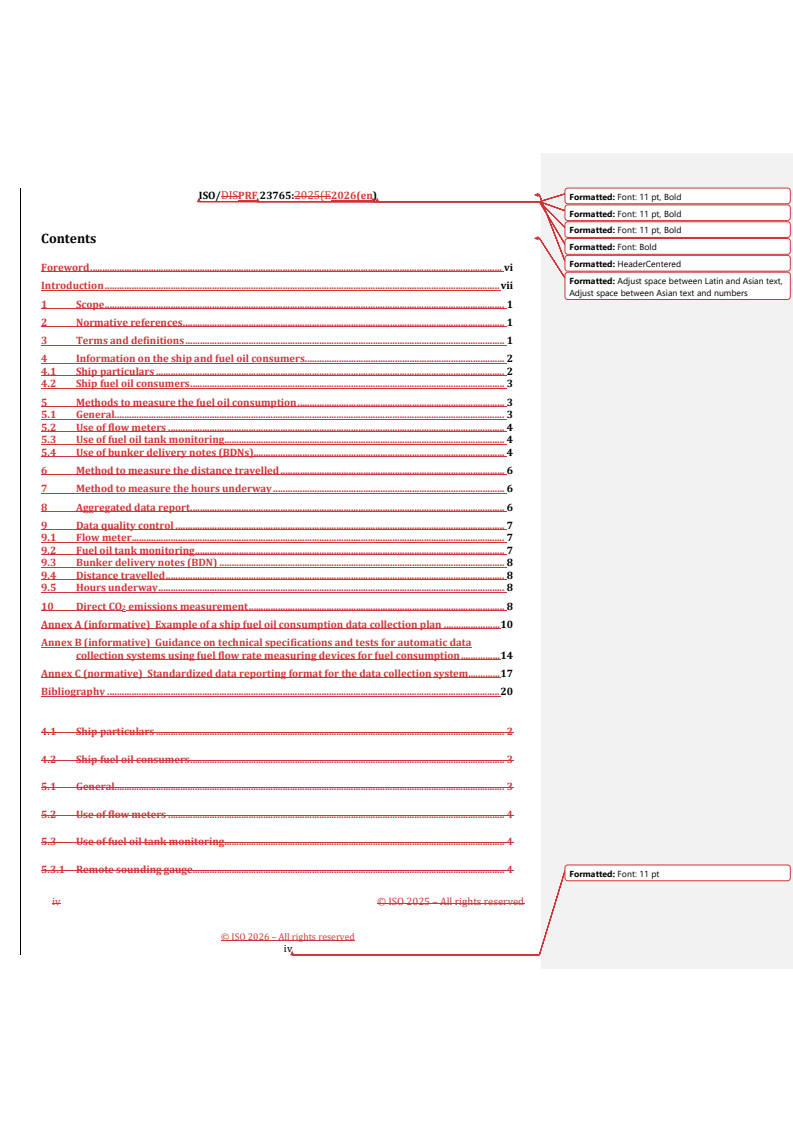
REDLINE ISO/PRF 23765 - Ships and marine technology — Marine environment protection — Specification for collecting data on ship's fuel oil consumption
ISO 23765 is an ISO standard for ships and marine technology that specifies how ships of 5 000 gross tonnage (GT) and above collect fuel oil consumption data for MARPOL Annex VI regulation 22A. It gives practical methods for measuring fuel oil consumption, distance travelled and hours underway, so ship operators and administrations can report the same operational data in a consistent way.
What does ISO 23765 specify?
ISO 23765 specifies the ship fuel oil consumption data collection method used for MARPOL Annex VI, together with the related distance-travelled and hours-underway records. It is organized into clauses that move from ship data and measurement methods to reporting and data quality control.
The document is structured as follows:
- Clause 1 - Scope
- Clause 2 - Normative references
- Clause 3 - Terms and definitions
- Clause 4 - Information on the ship and fuel oil consumers
- Clause 5 - Methods to measure the fuel oil consumption
- Clause 6 - Method to measure the distance travelled
- Clause 7 - Method to measure the hours underway
- Clause 8 - Aggregated data report
- Clause 9 - Data quality control
- Clause 10 - Direct CO2 emissions measurement
- Annexes A to C
| Annex | What it covers |
|---|---|
| Annex A | Example of a ship fuel oil consumption data collection plan |
| Annex B | Guidance on technical specifications and tests for automatic data collection systems using fuel flow rate measuring devices |
| Annex C | Standardized data reporting format for the data collection system |
In practice, this structure lets a ship prepare the collection plan, measure the fuel, verify the records and submit the aggregated data in the required format.
What are the key requirements of ISO 23765?
ISO 23765 is built around a simple reporting chain: identify the ship and its fuel consumers, measure consumption with an accepted method, aggregate voyage data, and control the quality of the records. The most important requirements are in Clauses 4 to 9 and Annex C.
1) Collect the ship and consumer data first
Clause 4 requires basic ship particulars such as the ship name, IMO number, company, flag, ship type, gross tonnage, net tonnage, deadweight tonnage, and where applicable EEDI and ice class. It also requires identifying each fuel oil consumer by type, model, number, power and fuel oil type.
In practice, this creates the baseline for separating consumption by main engine(s), auxiliary engine(s), oil-fired boiler(s) and other consumers. Without that breakdown, the reporting data cannot show where the fuel was used.
2) Report fuel use for all on-board consumption
Clause 5.1 says fuel oil consumption includes all fuel used on board, whether the ship is underway or not. It also states that each fuel oil consumer must be reported separately.
That matters because annual reporting is not only about propulsion. Fuel used for auxiliaries, boilers and other equipment is part of the record and must be captured in the same system.
3) Use one of three fuel-measurement methods
Clause 5 allows three methods for collecting annual fuel oil consumption data:
- flow meters
- fuel oil tank monitoring
- bunker delivery notes (BDNs)
Flow meters measure fuel flow to each consumer and can be used to build daily totals. Fuel oil tank monitoring uses remote sounding gauges or manual sounding in the daily service tank. BDN-based calculation uses bunkered fuel, tank contents and offloaded fuel to derive the annual total.
In practice, the choice of method affects the equipment, the records and the level of detail. BDNs help verify total fuel use, but they do not show consumption by each consumer.
4) Record density and fuel type for conversion
Clause 5.1 requires the fuel density to be obtained so the measured fuel can be converted to metric tonnes. The document allows onboard measurement systems, BDN data from the supplier, or laboratory testing. It also links fuel type to the conversion factor used for reporting.
This matters because ships may measure fuel in different units or at different temperatures. The density and conversion factor make the data comparable across ship systems and fuel types.
5) Measure distance travelled and hours underway as annual aggregates
Clause 6 requires the distance travelled under own propulsion to be included in the annual aggregated data, in nautical miles, and recorded in the logbook. Clause 7 does the same for hours underway. Both clauses treat the ship movement as a voyage from departure from a berth to arrival at the next berth within a port boundary.
For operators, this means the reporting period needs consistent voyage records, not just engine data. The distance and time totals support the fuel-consumption report and should be traceable in the logbook.
6) Submit aggregated data through the standardized format
Clause 8 requires reporting of the aggregated values to the administration in a standardized format developed by the organization. It also addresses calendar-year reporting, noon-report reporting, and transfer situations when a ship changes flag or company.
In practice, this clause is the handover point between ship records and the report submitted to the administration. It makes the master responsible for ship-to-company reporting and requires the company management team to submit the data.
7) Control data quality and keep supporting records
Clause 9 gives data quality control measures for flow meters, tank monitoring, BDNs, distance travelled and hours underway. It covers verification intervals, calibration, maintenance records, backup methods, and how to close data gaps.
This is important because the annual report depends on evidence. The clause also sets retention periods for several records, so the ship must keep maintenance and delivery documentation available for review.
8) Direct CO2 emissions measurement is optional
Clause 10 says direct CO2 emissions measurement is not required by regulation 22A, but if a ship uses it in the SEEMP, the method must measure exhaust gas flows and CO2 concentration, cover all emissions, and keep calibration and maintenance records.
That gives operators an optional monitoring route, but it adds equipment and record-keeping requirements. If used, it has to be integrated into the ship's management plan.
What terms does ISO 23765 define?
ISO 23765 defines the terms used to build the reporting system and avoid different interpretations on board and ashore.
- ship fuel oil consumption data - the annual data that must be collected and reported under Appendix IX of MARPOL Annex VI.
- fuel oil - fuel delivered to and intended for use on board a ship.
- conversion factor - the non-dimensional factor used to convert fuel oil consumption into CO emissions.
- voyage - movement of a ship from departure from a berth to arrival at the next berth.
- hours underway - the time a ship is operating under its own propulsion.
- distance travelled - the actual distance travelled over the ground, measured in nautical miles.
- consumer type - the type of equipment that uses marine fuel, such as main engine(s), auxiliary engine(s), oil-fired boiler(s) or other consumers.
These terms matter because they define what is counted, when counting starts and ends, and how the annual totals are built.
Who uses ISO 23765?
ISO 23765 is used by ship operators, masters, chief engineers, company management teams, administrations and recognized organizations involved in MARPOL Annex VI data collection. It is also relevant to fuel suppliers because BDNs are part of the verification trail.
In practice, the standard supports shipboard measurement, logbook recording, SEEMP preparation, data aggregation and review of the reported values. It is aimed at ships of 5 000 GT and above.
What changed in ISO 23765 from the previous edition?
ISO 23765 is the second edition and it replaces ISO 23765:2021. The document states that it has been technically revised.
The stated changes are:
- Clause 2 and the Bibliography have been updated
- Clause 5 has been fully revised
- Annex C has been fully revised
Which standards are used with ISO 23765?
ISO 23765 is written in the MARPOL Annex VI framework and refers to several companion documents that support the data collection system.
- MARPOL Annex VI and Appendix IX - the legal basis for ship fuel oil consumption data collection and reporting.
- IMO MEPC.282(70), as amended by MEPC.388(81) and MEPC.395(82) - SEEMP guidance that places the collection method into the ship energy efficiency management plan.
- MEPC.1/Circ.913 - guidance on applying the Appendix IX amendments and the enhanced granularity of IMO DCS data.
- MEPC.245(66) - the basis referenced for EEDI calculation and the emission factor used in Annex A.
- ISO 8217:2024 - marine fuel specification used in the fuel-type examples linked to the conversion factors.
- SOLAS regulation V/28.1 - the logbook basis for recording distance travelled.
- International Convention on Tonnage Measurement of Ships, 1969 - the basis for calculating gross tonnage and net tonnage.
- Polar Code - the referenced basis for the ice class definition used in the reporting format.
What does the ISO 23765 document contain?
ISO 23765 contains practical measurement methods, reporting rules and quality-control guidance for ship fuel oil consumption data. It also includes a worked example of a ship fuel oil consumption data collection plan in Annex A.
Annex B provides guidance for automatic data collection systems using fuel flow rate measuring devices, including the system components, alarms and functional tests. Annex C gives the standardized reporting format used for aggregated data submission, including ship particulars, propulsion power, distance travelled, hours underway, fuel consumption by consumer and fuel type, and the method used to measure the fuel.
The document is therefore both a reporting specification and an implementation guide. It helps a ship define what to measure, how to measure it, what to keep on board, and how to present the final annual report.
Relations
- Effective Date
- 18-Nov-2023
Buy Documents
ISO/PRF 23765 - Ships and marine technology — Marine environment protection — Specification for collecting data on ship's fuel oil consumption
REDLINE ISO/PRF 23765 - Ships and marine technology — Marine environment protection — Specification for collecting data on ship's fuel oil consumption
Get Certified
Connect with accredited certification bodies for this standard

DNV
DNV is an independent assurance and risk management provider.

BSI Group
BSI (British Standards Institution) is the business standards company that helps organizations make excellence a habit.

Bureau Veritas
Bureau Veritas is a world leader in laboratory testing, inspection and certification services.
Sponsored listings
Frequently Asked Questions
ISO 23765 is a draft published by the International Organization for Standardization (ISO). Its full title is "Ships and marine technology — Marine environment protection — Specification for collecting data on ship's fuel oil consumption". This standard covers: This document provides a method for ships of 5 000 gross tonnage (GT) and above to collect data on fuel oil consumption, as required by regulation 22A of MARPOL, Annex VI. It specifies practical methods to measure the fuel oil consumption, the distance travelled and the hours underway. Annex A provides an example of a ship fuel oil consumption data collection plan.
This document provides a method for ships of 5 000 gross tonnage (GT) and above to collect data on fuel oil consumption, as required by regulation 22A of MARPOL, Annex VI. It specifies practical methods to measure the fuel oil consumption, the distance travelled and the hours underway. Annex A provides an example of a ship fuel oil consumption data collection plan.
ISO 23765 is classified under the following ICS (International Classification for Standards) categories: 13.020.99 - Other standards related to environmental protection; 47.020.99 - Other standards related to shipbuilding and marine structures. The ICS classification helps identify the subject area and facilitates finding related standards.
ISO 23765 has the following relationships with other standards: It is inter standard links to ISO 23765:2021. Understanding these relationships helps ensure you are using the most current and applicable version of the standard.
ISO 23765 is available in PDF format for immediate download after purchase. The document can be added to your cart and obtained through the secure checkout process. Digital delivery ensures instant access to the complete standard document.
Standards Content (Sample)
International
Standard
Second edition
Ships and marine technology —
Marine environment protection —
Specification for collecting data on
ship's fuel oil consumption
Navires et technologie maritime — Protection de
l'environnement marin — Spécifications relatives à la collecte de
données sur la consommation de mazout des navires
PROOF/ÉPREUVE
Reference number
© ISO 2026
All rights reserved.
This ISO publication is protected by copyright and is owned by ISO and/or its licensors.
The content of this ISO publication is provided under licence, not sold. Use is subject to the applicable licence terms issued by ISO,
an ISO member body, or an authorized third-party distributor.
Except as required for implementation or expressly permitted by a separate licence, no part of this ISO publication may be
reproduced, distributed, modified, used, or made available in any form or by any means – electronic or mechanical, including
photocopying, scanning, recording, or posting on internal or external digital platforms.
Any use beyond the scope of the granted rights is prohibited and may result in legal action.
ISO copyright office
CP 401 • CH-1214 Vernier, Geneva
Phone: +41 22 749 01 11
Email: copyright@iso.org
Website: www.iso.org
Published in Switzerland
PROOF/ÉPREUVE
ii
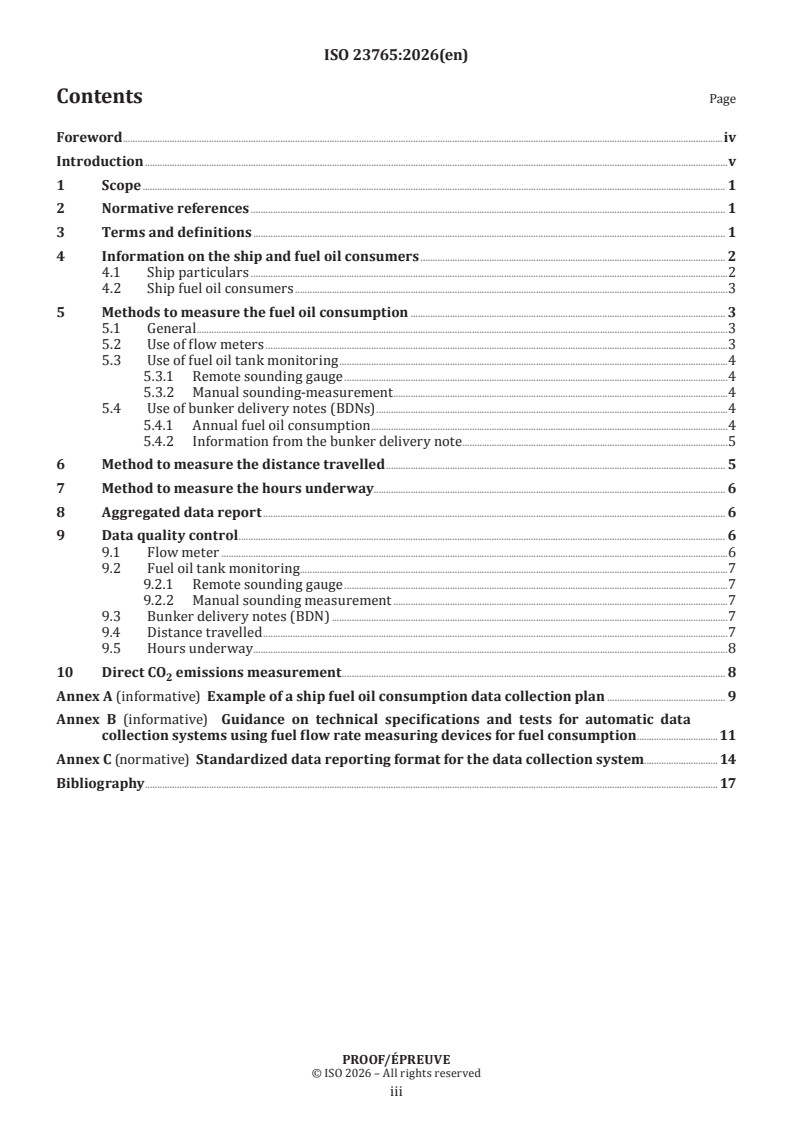
Contents Page
Foreword .iv
Introduction .v
1 Scope . 1
2 Normative references . 1
3 Terms and definitions . 1
4 Information on the ship and fuel oil consumers . 2
4.1 Ship particulars .2
4.2 Ship fuel oil consumers .3
5 Methods to measure the fuel oil consumption . 3
5.1 General .3
5.2 Use of flow meters .3
5.3 Use of fuel oil tank monitoring .4
5.3.1 Remote sounding gauge .4
5.3.2 Manual sounding-measurement .4
5.4 Use of bunker delivery notes (BDNs) .4
5.4.1 Annual fuel oil consumption .4
5.4.2 Information from the bunker delivery note .5
6 Method to measure the distance travelled . 5
7 Method to measure the hours underway. 6
8 Aggregated data report . 6
9 Data quality control . 6
9.1 Flow meter .6
9.2 Fuel oil tank monitoring.7
9.2.1 Remote sounding gauge .7
9.2.2 Manual sounding measurement .7
9.3 Bunker delivery notes (BDN) .7
9.4 Distance travelled .7
9.5 Hours underway . .8
10 Direct CO emissions measurement . 8
Annex A (informative) Example of a ship fuel oil consumption data collection plan . 9
Annex B (informative) Guidance on technical specifications and tests for automatic data
collection systems using fuel flow rate measuring devices for fuel consumption .11
Annex C (normative) Standardized data reporting format for the data collection system . 14
Bibliography . 17
PROOF/ÉPREUVE
iii
Foreword
ISO (the International Organization for Standardization) is a worldwide federation of national standards
bodies (ISO member bodies). The work of preparing International Standards is normally carried out through
ISO technical committees. Each member body interested in a subject for which a technical committee
has been established has the right to be represented on that committee. International organizations,
governmental and non-governmental, in liaison with ISO, also take part in the work. ISO collaborates closely
with the International Electrotechnical Commission (IEC) on all matters of electrotechnical standardization.
The procedures used to develop this document and those intended for its further maintenance are described
in the ISO/IEC Directives, Part 1. In particular, the different approval criteria needed for the different types
of ISO document should be noted. This document was drafted in accordance with the editorial rules of the
ISO/IEC Directives, Part 2 (see www.iso.org/directives).
ISO draws attention to the possibility that the implementation of this document may involve the use of (a)
patent(s). ISO takes no position concerning the evidence, validity or applicability of any claimed patent
rights in respect thereof. As of the date of publication of this document, ISO had not received notice of (a)
patent(s) which may be required to implement this document. However, implementers are cautioned that
this may not represent the latest information, which may be obtained from the patent database available at
www.iso.org/patents. ISO shall not be held responsible for identifying any or all such patent rights.
Any trade name used in this document is information given for the convenience of users and does not
constitute an endorsement.
For an explanation of the voluntary nature of standards, the meaning of ISO specific terms and expressions
related to conformity assessment, as well as information about ISO's adherence to the World Trade
Organization (WTO) principles in the Technical Barriers to Trade (TBT), see www.iso.org/iso/foreword.html.
This document was prepared by Technical Committee ISO/TC 8, Ships and marine technology, Subcommittee
SC 2, Marine environment protection.
This second edition cancels and replaces the first edition (ISO 23765:2021), which has been technically
revised.
The main changes are as follows:
— Clause 2 and Bibliography have been updated;
— Clause 5 and Annex C have been fully revised.
Any feedback or questions on this document should be directed to the user’s national standards body. A
complete listing of these bodies can be found at www.iso.org/members.html.
PROOF/ÉPREUVE
iv
Introduction
The International Maritime Organization (IMO) Marine Environment Protection Committee (MEPC), at its
[1]
seventieth session (MEPC 70), adopted resolution MEPC.278(70) on Amendments to MARPOL, Annex VI,
on data collection systems (DCS) for fuel oil consumption of ships, which entered into force on 1 March 2018.
[2]
IMO MEPC, at its eighty first session (MEPC 81) in March 2024, adopted resolution MEPC.385(81) on
Amendments to MARPOL, Annex VI, on DCS for fuel oil consumption of ships, which entered into force
[3]
on 1 August 2025. MEPC 81 also adopted resolution MEPC.388(81) , Amendments to 2022 Guidelines
for the development of a ship energy efficiency management plan (SEEMP), to update the method of the
[4]
management plan for the amended DCS. MEPC 81 approved MEPC.1/Circ.913 , Guidance on the application
of the amendments to Appendix IX of MARPOL Annex VI on inclusion of data on transport work and enhanced
granularity in the IMO Ship Fuel Consumption Database (IMO DCS) as adopted by resolution MEPC.385(81).
[5]
MEPC 82 in October 2024 adopted resolution MEPC.395(82) , 2024 Guidelines for the development of a Ship
Energy Efficiency Management Plan (SEEMP).
In accordance with regulation 22.2 of MARPOL, Annex VI, the ship energy efficiency management plan
(SEEMP) for ships of 5 000 gross tonnage (GT) and above must include a description of the methodology
used to collect the data required by regulation 22A of MARPOL, Annex VI, including the process used to
report the data to the ship's administration.
In addition, in accordance with regulation 5.4.5 of MARPOL, Annex VI, administrations must ensure that
for each ship to which regulation 22A applies, the SEEMP complies with regulation 22.2. This must be done
prior to collection of data under regulation 22A to ensure the methodology and the process are in place prior
to the beginning of the ship's first reporting period.
According to the Appendix IX of MARPOL Annex VI, as amended by MEPC.385(81), fuel consumption at each
fuel oil consumer, such as main engine(s), auxiliary engine(s)/generator(s), oil-fired boiler(s) and any other
oil-fuel oil consumer(s) onboard ships, must be reported separately.
[6]
Resolution IMO MEPC.282(70) 2016, Guidelines for the development of a ship energy efficiency management
[3] [5]
plan (SEEMP), as amended by MEPC.388(81) , MEPC.395(82) and MEPC.1/Circ.913, provide detailed
guidelines for the IMO DCS. Additionally, Part 2 of the SEEMP, Ship fuel oil consumption data collection plan, is
expected to be verified by the administrations or recognized organizations (RO).
For the purpose of clarifying the method to measure fuel oil consumption on board ships, three methods for
measuring fuel oil consumption (by bunker delivery note [BDN], flow meter and sounding) are prescribed in
this document for mutual understanding among ship operators and maritime administrations.
PROOF/ÉPREUVE
v
International Standard ISO 23765:2026(en)
Ships and marine technology — Marine environment
protection — Specification for collecting data on ship's fuel oil
consumption
1 Scope
This document provides a method for ships of 5 000 gross tonnage (GT) and above to collect data on fuel
oil consumption, as required by regulation 22A of MARPOL Annex VI and its Appendix IX to Annex VI. This
document specifies practical methods to measure the fuel oil consumption of each fuel oil consumer, the
distance travelled and the hours underway.
2 Normative references
There are no normative references in this document.
3 Terms and definitions
For the purposes of this document, the following terms and definitions apply.
ISO and IEC maintain terminology databases for use in standardization at the following addresses:
— ISO Online browsing platform: available at https:// www .iso .org/ obp
— IEC Electropedia: available at https:// www .electropedia .org/
3.1
ship fuel oil consumption data
data required to be collected on an annual basis and reported as specified in Appendix IX of MARPOL,
Annex VI
3.2
emission
release of substances, subject to control by MARPOL Annex VI, from ships into the atmosphere or sea
3.3
fuel oil
fuel delivered to and intended for use on board a ship
Note 1 to entry: Fuel oil includes the types of fuels listed in Figure A.1.
3.4
conversion factor
non-dimensional conversion factor between fuel oil (3.3) consumption and CO emission (3.2)
3.5
voyage
movement of a ship between a departure from a berth (3.6) to the arrival at the next berth (3.7)
3.6
departure from a berth
departure
starting point when a ship leaves a berth (3.11) at one single port boundary (3.12)
PROOF/ÉPREUVE
3.7
arrival at the next berth
arrival
starting point when a ship is berthed (moored, anchored and/or adrift) at one single port boundary (3.12)
3.8
calendar year
period from 1 January until 31 December of a year
3.9
hours underway
duration the ship is in operation under its own propulsion
3.10
distance travelled
actual distance travelled over the ground, in nautical miles
3.11
berth
named or numbered place where a vessel is moored at a wharf
3.12
port boundary
geographic area defined by the designated authority of the states, encompassing the individual port facilities
within a port
3.13
consumer type
type of facilities which consume marine fuels, such as main engine(s), auxiliary engine(s), oil-fired boiler(s)
or others which consume fuel
4 Information on the ship and fuel oil consumers
4.1 Ship particulars
The following basic vessel information shall be collected:
a) name of the ship;
b) IMO number;
c) company;
d) flag;
e) ship type;
f) gross tonnage;
g) net tonnage (NT);
h) deadweight tonnage (DWT);
i) energy efficiency design index (EEDI) (if applicable);
j) ice class (if applicable).
PROOF/ÉPREUVE
4.2 Ship fuel oil consumers
For collecting fuel oil consumption data, the following information shall be obtained (see Table 1 and
Figure A.1 in Annex A):
a) fuel oil consumers;
b) type/model;
c) number (if a ship has two or more machineries in one consumer type);
d) power (kW); and
e) fuel oil type and conversion factor, C .
F
Table 1 — Example of fuel oil consumer data information format
Fuel oil Power Fuel oil types (C )
F
Type/model Number
consumers kW Primary/secondary
1 Main engine(s)
2 Auxiliary engine(s)
3 Oil-fired boiler(s)
4 Others (specify)
5 Methods to measure the fuel oil consumption
5.1 General
The fuel oil consumption shall include all the fuel oil consumed on board including, but not limited to, the
fuel oil consumed by the main engine(s), auxiliary engine(s), oil-fired boiler(s) and other fuel oil consumers,
regardless of whether a ship is underway or not. The fuel oil consumption of each fuel oil consumer shall be
reported for each type of fuel oil consumer.
[2]
NOTE 1 MARPOL Annex VI and its Appendix IX specifies the method of reporting of fuel oil consumption.
The method for collecting data for annual fuel oil consumption used at each fuel oil consumer on a ship can
be chosen from three methods as described in 5.2 and 5.3. The data from the bunker delivery note (BDN)
(see 5.4) cannot provide data of fuel oil consumption at each fuel oil consumer, because BDN provide only
total amount of fuel oil supplied to the ships; however, the data can be used for verification of total amount of
fuel consumed at all the fuel oil consumers.
The density of the fuel oil shall be obtained by one of the following methods to calculate the volume
correction factor and the weight correction factor for converting the measured fuel oil consumption value
into metric tonnes units:
a) on board measurement systems;
b) BDNs from the fuel supplier at the bunkering port;
c) laboratory testing.
Annex A provides an example of a ship fuel oil consumption data collection plan.
NOTE 2 Data relating to boil-off gas (BOG) consumed on board the ship for propulsion or operation is collected and
[8]
reported as fuel as part of the data collection system for fuel oil consumption of ships .
5.2 Use of flow meters
This method determines the annual amount of fuel oil consumption by measuring fuel oil flow to each fuel
oil consumer on board using fuel flow meters. The annual fuel oil consumption is the sum of daily fuel oil
PROOF/ÉPREUVE
consumption data of all relevant fuel oil consuming processes on board measured by fuel flow meters. The
fuel flow meters shall be located so that the fuel oil consumption of each oil fuel oil consumer on board can
be measured. In case of fuel flow meter malfunction, manual readings at daily service tank of each fuel oil
consumer (see 5.3) or other alternative methods shall be conducted instead. It is not necessary to correct
this fuel oil measurement for sludge if the flow meter is installed after the daily service tank, as sludge
is removed from the fuel oil prior to the daily service tank. Annex B gives guidance on an automatic data
collection system using fuel flow meters.
5.3 Use of fuel oil tank monitoring
5.3.1 Remote sounding gauge
This method determines the total annual fuel consumption by measuring the level of fuel in the daily service
tank of each fuel oil consumer through direct reading using an automatic system (remote reading). The
total annual consumption of the fuel oil consumer is calculated by summing up the measured daily fuel
consumption. The remaining amount of fuel in the tank is normally measured daily and every time the ship
receives or discharges fuel oil. A summary of the measurement data, including a record of the measured fuel
consumption, shall be provided on board.
5.3.2 Manual sounding-measurement
This method determines the residual amount in the daily service tank of each fuel oil consumer by indirect
measuring of the tank using sounding, dip tapes or level gages. Details of the method and equipment used
shall be recorded.
The total annual consumption is calculated by summing up the daily measured fuel consumption. The
measurement of the remaining amount at the daily service tank of each fuel oil consumer is normally carried
out daily. A summary of the measurement data, including a record of the measured fuel consumption, shall
be provided on board.
5.4 Use of bunker delivery notes (BDNs)
5.4.1 Annual fuel oil consumption
As stated in 5.1, the data in BDN (see 5.4) cannot provide data of fuel oil consumption at each fuel oil
consumer, because BDN provides only the total amount of fuel oil supplied to the ships. However, the data
can be used for verification of the total amount of fuel consumed at all the fuel oil consumers.
This method determines the annual total amount of fuel oil used based on BDNs, which are required for
fuel oil for combustion purposes, delivered to and used on board a ship in accordance with regulation 18 of
MARPOL, Annex VI. Annual fuel oil consumption (Q) should be calculated as shown in Formula (1):
Q = T + R – S – T (1)
1 2
where
Q is the annual fuel oil consumption;
T is the remaining fuel oil in tank at the beginning of the year;
R is the total fuel oil bunkered for the calendar year;
S is the total fuel oil offloaded for the calendar year;
T is the remaining fuel oil in tank at the end of the year.
Each value should be rounded off to two decimal places.
The amount of any fuel oil loaded or offloaded should be based on the records from the ship's oil record book.
Any supplemental data used for closing identified differences in bunker quantity should be supported with
documented evidence. In the case of a voyage that extends over a data reporting period, the tank reading
PROOF/ÉPREUVE
should occur by tank monitoring at the ports of departure and arrival of the voyage and by statistical
methods such as rolling average using voyage days.
5.4.2 Information from the bunker delivery note
The BDN includes at least the following information in accordance with Appendix V of MARPOL, Annex VI:
a) name and IMO number of receiving ship;
b) port of bunkering;
c) date of commencement of delivery;
d) name, address and telephone number of fuel oil supplier;
e) delivered product name;
f) quantity in metric tonnes;
g) density at 15 °C, kg/m ;
h) sulphur content, % mass fraction;
i) a declaration signed and certified by the fuel oil supplier's repre
...
Style Definition
...
Style Definition
...
Style Definition
...
Style Definition
...
Style Definition
...
ISO /PRF 23765:2026(en)
Style Definition
...
Date: 2026-07-10
Style Definition
...
Style Definition
...
ISO /TC 8/SC 2/WG 11
Style Definition
...
Secretariat: ANSI
Style Definition
...
Style Definition
Date: 2026-10-06 .
Style Definition
...
Style Definition
...
Style Definition
...
Style Definition
...
Style Definition
...
Ships and marine technology — Marine environment protection
Style Definition
...
— Specification for collecting data on ship's fuel oil consumption
Style Definition
...
Style Definition
...
Navires et technologie maritime — Protection de l'environnement marin — Spécifications relatives à la
collecte de données sur la consommation de mazout des navires Style Definition
...
Style Definition
...
Style Definition
...
Style Definition
...
Style Definition
...
Style Definition
...
Style Definition
...
Style Definition
...
Style Definition
...
Style Definition
...
Style Definition
...
Style Definition
...
Style Definition
...
Style Definition
...
Style Definition
...
Style Definition
...
Style Definition
...
Style Definition
...
Style Definition
...
Style Definition
...
Style Definition
...
Style Definition
...
Style Definition
...
Style Definition
...
Style Definition
...
Style Definition
...
Style Definition
...
Style Definition
...
Style Definition
...
Style Definition
...
Style Definition
...
Style Definition
...
Style Definition
...
Style Definition
...
Style Definition
...
Style Definition
...
Style Definition
...
Style Definition
...
Style Definition
© PROOF
ISO/DIS PRF 23765:2026(en) Formatted: Font: 11 pt, Bold
Formatted: Font: 11 pt, Bold
Formatted: HeaderCentered, Left, Space After: 0 pt,
© ISO 2026
Line spacing: single
Formatted: Default Paragraph Font
All rights reserved. Unless otherwise specified,
This ISO publication is protected by copyright and is owned by ISO and/or its licensors. Formatted: Default Paragraph Font
The content of this ISO publication is provided under licence, not sold. Use is subject to the applicable licence terms issued
Formatted: Adjust space between Latin and Asian text,
by ISO, an ISO member body, or an authorized third-party distributor.
Adjust space between Asian text and numbers
Except as required in the context of its for implementation or expressly permitted by a separate licence, no part of this
Formatted: Right: 1.5 cm, Bottom: 1 cm, Gutter: 0 cm,
ISO publication may be reproduced or utilized otherwise, distributed, modified, used, or made available in any form or
Header distance from edge: 1.27 cm, Footer distance
by any means, – electronic or mechanical, including photocopying, scanning, recording, or posting on internal or external
from edge: 0.5 cm
digital platforms.
Any use beyond the internet or an intranet, without prior written permission. Permission can be requested from either
Formatted: Adjust space between Latin and Asian text,
ISO at the address below or ISO's member body in the countryscope of the requestergranted rights is prohibited and may
Adjust space between Asian text and numbers
result in legal action.
ISO Copyright Officecopyright office
CP 401 • CH-1214 Vernier, Geneva
Phone: + 41 22 749 01 11
Email: copyright@iso.org
Email: copyright@iso.org
Website: www.iso.orgwww.iso.org
Published in Switzerland.
Formatted: Font: 10 pt
Formatted: Font: 10 pt
Formatted: Font: 10 pt
Formatted: FooterCentered, Left, Space Before: 0 pt,
Tab stops: Not at 17.2 cm
Formatted: Font: 11 pt
© ISO 2026 – All rights reserved
iii
ISO/DISPRF 23765:2025(E2026(en) Formatted: Font: 11 pt, Bold
Formatted: Font: 11 pt, Bold
Formatted: Font: 11 pt, Bold
Contents
Formatted: Font: Bold
Formatted: HeaderCentered
Foreword . vi
Formatted: Adjust space between Latin and Asian text,
Introduction . vii
Adjust space between Asian text and numbers
1 Scope . 1
2 Normative references . 1
3 Terms and definitions . 1
4 Information on the ship and fuel oil consumers. 2
4.1 Ship particulars . 2
4.2 Ship fuel oil consumers . 3
5 Methods to measure the fuel oil consumption . 3
5.1 General. 3
5.2 Use of flow meters . 4
5.3 Use of fuel oil tank monitoring. 4
5.4 Use of bunker delivery notes (BDNs). 4
6 Method to measure the distance travelled . 6
7 Method to measure the hours underway . 6
8 Aggregated data report . 6
9 Data quality control . 7
9.1 Flow meter. 7
9.2 Fuel oil tank monitoring . 7
9.3 Bunker delivery notes (BDN) . 8
9.4 Distance travelled . 8
9.5 Hours underway . 8
10 Direct CO emissions measurement . 8
Annex A (informative) Example of a ship fuel oil consumption data collection plan . 10
Annex B (informative) Guidance on technical specifications and tests for automatic data
collection systems using fuel flow rate measuring devices for fuel consumption . 14
Annex C (normative) Standardized data reporting format for the data collection system. 17
Bibliography . 20
4.1 Ship particulars . 2
4.2 Ship fuel oil consumers . 3
5.1 General. 3
5.2 Use of flow meters . 4
5.3 Use of fuel oil tank monitoring. 4
5.3.1 Remote sounding gauge. 4
Formatted: Font: 11 pt
iv © ISO 2025 – All rights reserved
iv
ISO/DIS PRF 23765:2026(en) Formatted: Font: 11 pt, Bold
Formatted: Font: 11 pt, Bold
Formatted: HeaderCentered, Left, Space After: 0 pt,
5.3.2 Manual sounding measurement . 4
Line spacing: single
5.4 Use of bunker delivery notes (BDNs). 5
5.4.1 Annual fuel oil consumption . 5
5.4.2 Information from the bunker delivery note . 5
9.1 Flow meter. 7
9.2 Fuel oil tank monitoring . 7
9.2.1 Remote sounding gauge. 7
9.2.2 Manual sounding measurement . 8
9.3 Bunker delivery notes (BDN) . 8
9.4 Distance travelled . 8
9.5 Hours underway . 8
Formatted: Font: 10 pt
Formatted: Font: 10 pt
Formatted: Font: 10 pt
Formatted: FooterCentered, Left, Space Before: 0 pt,
Tab stops: Not at 17.2 cm
Formatted: Font: 11 pt
© ISO 2026 – All rights reserved
v
ISO/DISPRF 23765:2025(E2026(en) Formatted: Font: 11 pt, Bold
Formatted: Font: 11 pt, Bold
Formatted: Font: 11 pt, Bold
Foreword
Formatted: Font: Bold
ISO (the International Organization for Standardization) is a worldwide federation of national standards Formatted: HeaderCentered
bodies (ISO member bodies). The work of preparing International Standards is normally carried out through
ISO technical committees. Each member body interested in a subject for which a technical committee has been
established has the right to be represented on that committee. International organizations, governmental and
non-governmental, in liaison with ISO, also take part in the work. ISO collaborates closely with the
International Electrotechnical Commission (IEC) on all matters of electrotechnical standardization.
The procedures used to develop this document and those intended for its further maintenance are described
in the ISO/IEC Directives, Part 1. In particular, the different approval criteria needed for the different types of
ISO document should be noted. This document was drafted in accordance with the editorial rules of the
ISO/IEC Directives, Part 2 (see www.iso.org/directives).
Formatted: English (United Kingdom)
ISO draws attention to the possibility that the implementation of this document may involve the use of (a)
patent(s). ISO takes no position concerning the evidence, validity or applicability of any claimed patent rights
in respect thereof. As of the date of publication of this document, ISO had not received notice of (a) patent(s)
which may be required to implement this document. However, implementers are cautioned that this may not
represent the latest information, which may be obtained from the patent database available at
www.iso.org/patents.www.iso.org/patents. ISO shall not be held responsible for identifying any or all such
patent rights.
Any trade name used in this document is information given for the convenience of users and does not
constitute an endorsement.
For an explanation of the voluntary nature of standards, the meaning of ISO specific terms and expressions
related to conformity assessment, as well as information about ISO's adherence to the World Trade
Organization (WTO) principles in the Technical Barriers to Trade (TBT), see
www.iso.org/iso/foreword.htmlwww.iso.org/iso/foreword.html.
Formatted: English (United Kingdom)
This document was prepared by Technical Committee ISO/TC 8, Ships and marine technology, Subcommittee
Formatted: Adjust space between Latin and Asian text,
SC 2, Marine environment protection. Adjust space between Asian text and numbers
This second edition cancels and replaces the first edition (ISO 23765:2021), which has been technically
Formatted: Default Paragraph Font
revised.
Formatted: Default Paragraph Font
Formatted: Default Paragraph Font
The main changes are as follows:
— — Clause 2Clause 2 and Bibliography have been updated;
— — Clause 5 and Annex CClause 5 and Annex C have been fully revised.
Any feedback or questions on this document should be directed to the user’s national standards body. A
Formatted: English (United Kingdom)
complete listing of these bodies can be found at www.iso.org/members.htmlwww.iso.org/members.html.
Formatted: English (United Kingdom)
Formatted: Font: 11 pt
iv © ISO 2025 – All rights reserved
vi
ISO/DIS PRF 23765:2026(en) Formatted: Font: 11 pt, Bold
Formatted: Font: 11 pt, Bold
Formatted: HeaderCentered, Left, Space After: 0 pt,
Introduction
Line spacing: single
Formatted: Adjust space between Latin and Asian text,
The International Maritime Organization (IMO) Marine Environment Protection Committee (MEPC), at its
Adjust space between Asian text and numbers
[1] [1]
seventieth session (MEPC 70), adopted resolution MEPC.278(70) ) on Amendments to MARPOL, Annex VI,
on data collection systems (DCS) for fuel oil consumption of ships, which entered into force on 1 March 2018.
[2] [2]
IMO MEPC, at its eighty first session (MEPC 81) in March 2024, adopted resolution MEPC.385(81) ) on
Amendments to MARPOL, Annex VI, on data collection systems (DCS) for fuel oil consumption of ships, which
[3] [3]
entered into force on 1 August 2025. MEPC 81 also adopted resolution MEPC.388(81), ) , Amendments to
2022 Guidelines for the development of a ship energy efficiency management plan (SEEMP), to update the
[4] [4]
method of the management plan for the amended DCS. MEPC 81 approved MEPC.1/Circ.913, , Guidance on
the application of the amendments to Appendix IX of MARPOL Annex VI on inclusion of data on transport work
and enhanced granularity in the IMO Ship Fuel Consumption Database (IMO DCS) as adopted by resolution
[5] [5]
MEPC.385(81). MEPC 82 in October 2024 adopted resolution MEPC.395(82), ) , 2024 Guidelines for the
development of a Ship Energy Efficiency Management Plan (SEEMP).
In accordance with regulation 22.2 of MARPOL, Annex VI, the ship energy efficiency management plan
(SEEMP) for ships of 5 000 gross tonnage (GT) and above must include a description of the methodology used
to collect the data required by regulation 22A of MARPOL, Annex VI, including the process used to report the
data to the ship's administration.
In addition, in accordance with regulation 5.4.5 of MARPOL, Annex VI, administrations must ensure that for
each ship to which regulation 22A applies, the SEEMP complies with regulation 22.2. This must be done prior
to collection of data under regulation 22A to ensure the methodology and the process are in place prior to the
beginning of the ship's first reporting period.
According to the Appendix IX of MARPOL Annex VI, as amended by MEPC.385(81), fuel consumption at each
fuel oil consumer, such as main engine(s), auxiliary engine(s)/generator(s), oil-fired boiler(s) and any other
oil-fuel oil consumer(s) onboard ships, must be reported separately.
[6] [6]
Resolution IMO MEPC.282(70) ) 2016, Guidelines for the development of a ship energy efficiency
[3] [3] [5] [5]
management plan (SEEMP), as amended by MEPC.388(81), ) , MEPC.395(82) ) and MEPC.1/Circ.913,
provide detailed guidelines for the IMO data collection systemDCS. Additionally, Part 2 of the SEEMP, Ship fuel
oil consumption data collection plan, is expected to be verified by the administrations or recognized
organizations (RO).
For the purpose of clarifying the method to measure fuel oil consumption on board ships, three methods for
Formatted: English (United Kingdom)
measuring fuel oil consumption (by bunker delivery note [BDN], flow meter, and sounding) are prescribed in
Formatted: English (United Kingdom)
this document for give mutual understanding among ship operators and maritime administrations.
Formatted: Font: 10 pt
Formatted: Font: 10 pt
Formatted: Font: 10 pt
Formatted: FooterCentered, Left, Space Before: 0 pt,
Tab stops: Not at 17.2 cm
Formatted: Font: 11 pt
© ISO 2026 – All rights reserved
vii
DRAFT International standard
ISO/DIS 23765:2026(en)
Ships and marine technology – — Marine environment protection –—
Specification for collecting data on ship's fuel oil consumption
1 Scope Formatted: Right: 1.5 cm, Bottom: 1 cm, Gutter: 0 cm,
Section start: New page, Header distance from edge:
1.27 cm, Footer distance from edge: 0.5 cm
This document provides a method for ships of 5 000 gross tonnage (GT) and above to collect data on fuel oil
consumption, as required by regulation 22A of MARPOL Annex VI and its Appendix IX to Annex VI. This
document specifies practical methods to measure the fuel oil consumption of each fuel oil consumer, the
distance travelled and the hours underway.
2 Normative references
There are no normative references in this document.
3 Terms and definitions
For the purposes of this document, the following terms and definitions apply.
ISO and IEC maintain terminology databases for use in standardization at the following addresses:
Formatted: English (United Kingdom)
Formatted: Font: 11 pt, English (United Kingdom)
— — ISO Online browsing platform: available at https://www.iso.org/obphttps://www.iso.org/obp
Formatted: English (United Kingdom)
— — IEC Electropedia: available at https://www.electropedia.org/https://www.electropedia.org/
Formatted: English (United Kingdom)
3.1 3.1
ship fuel oil consumption data
data required to be collected on an annual basis and reported as specified in Appendix IX of MARPOL, Annex VI
3.2 3.2
emission
release of substances, subject to control by MARPOL Annex VI, from ships into the atmosphere or sea
3.3 3.3
fuel oil
fuel delivered to and intended for use on board a ship
Note 1 to entry: Fuel oil includes the types of fuels listed in Table A.1.Figure A.1.
3.4 3.4
conversion factor
non-dimensional conversion factor between fuel oil (3.3)(3.3) consumption and CO emission (3.2)(3.2)
3.5 3.5
voyage
movement of a ship between a departure from a berth (3.6)(3.6) to the arrival at the next berth (3.7)(3.7)
3.6 3.6
departure from a berth
departure
starting point when a ship leaves a berth (3.11)(3.11) at one single port boundary (3.12)(3.12)
ISO/DISPRF 23765:2025(E2026(en) Formatted: Font: 11 pt, Bold
Formatted: Font: 11 pt, Bold
Formatted: Font: 11 pt, Bold
3.7 3.7
Formatted: Font: Bold
arrival at the next berth
arrival
Formatted: HeaderCentered
starting point when a ship is berthed (moored, anchored and/or adrift) at one single port boundary
(3.12)(3.12)
3.8 3.8
calendar year
period from 1 January until 31 December of a year
3.9 3.9
hours underway
duration the ship is in operation under its own propulsion
3.10 3.10
distance travelled
actual distance travelled over the ground, in nautical miles
3.11 3.11
berth
named or numbered place where a vessel is moored at a wharf
3.12 3.12
port boundary
geographic area defined by the designated authority of the states, encompassing the individual port facilities
within a port
3.13 3.13
consumer type
type of facilities which consume marine fuels, such as main engine(s), auxiliary engine(s), oil-fired boiler(s),)
or others which consume fuel
4 Information on the ship and fuel oil consumers
4.1 Ship particulars
The following basic vessel information shall be collected:
Formatted: Adjust space between Latin and Asian text,
Adjust space between Asian text and numbers
a) a) name of the ship;
b) b) IMO number;
c) c) company;
d) d) flag;
e) e) ship type;
f) f) gross tonnage;
g) g) net tonnage (NT);
h) h) deadweight tonnage (DWT);
Formatted: Font: 11 pt
2 © ISO 2025 – All rights reserved
ISO/DIS PRF 23765:2026(en) Formatted: Font: 11 pt, Bold
Formatted: Font: 11 pt, Bold
Formatted: HeaderCentered, Left, Space After: 0 pt,
i) i) energy efficiency design index (EEDI) (if applicable);
Line spacing: single
j) j) ice class (if applicable).
4.2 Ship fuel oil consumers
Formatted: None, Adjust space between Latin and
For collecting fuel oil consumption data, the following information shall be obtained (see Table 1 and Table
Asian text, Adjust space between Asian text and
A.1 in Annex A):Table 1 and Figure A.1 in Annex A):
numbers
Formatted: Font: Not Bold
a) a) fuel oil consumers;
Formatted: Table header (+), Adjust space between
b) b) type/model;
Latin and Asian text, Adjust space between Asian text
and numbers
c) c) number (if a ship has two or more machineries in one consumer type);
Formatted Table
Formatted: Font: Not Bold
d) d) power (kW); and
Formatted: Font: Not Bold
e) e) fuel oil type and conversion factor, C .
F
Formatted: Font: Not Bold
Table 1 — Example of fuel oil consumer data information format
Formatted: Font: Not Bold
Formatted: Font: Not Bold
Fuel oil Power Fuel oil types (C ) Formatted: Left, Adjust space between Latin and Asian
F
Type/model Number
text, Adjust space between Asian text and numbers
consumers kW Primary/secondary
Formatted: Adjust space between Latin and Asian text,
1 Main engine(s)
Adjust space between Asian text and numbers
2 Auxiliary engine(s)
Formatted: Left, Adjust space between Latin and Asian
3 Oil-fired Boilerboiler(s) text, Adjust space between Asian text and numbers
4 Others (specify) Formatted: Left, Adjust space between Latin and Asian
text, Adjust space between Asian text and numbers
Formatted: Adjust space between Latin and Asian text,
5 Methods to measure the fuel oil consumption
Adjust space between Asian text and numbers
5.1 General
Formatted: Left, Adjust space between Latin and Asian
text, Adjust space between Asian text and numbers
The fuel oil consumption shall include all the fuel oil consumed on board including, but not limited to, the fuel
Formatted: Left, Adjust space between Latin and Asian
oil consumed by the main engine(s), auxiliary engine(s), oil-fired boiler(s) and other fuel oil consumers,
text, Adjust space between Asian text and numbers
regardless of whether a ship is underway or not. The fuel oil consumption of each fuel oil consumer shall be
Formatted: Adjust space between Latin and Asian text,
reported for each type of fuel oil consumer.
Adjust space between Asian text and numbers
[2] [2]
NOTE 1 MARPOL Annex VI and its Appendix IX. specifies the method of reporting of fuel oil consumption.
Formatted: Left, Adjust space between Latin and Asian
text, Adjust space between Asian text and numbers
The method for collecting data for annual fuel oil consumption used at each fuel oil consumer on a ship can be
Formatted: Left, Adjust space between Latin and Asian
chosen from three methods as described in 5.25.2 and 5.3.5.3. The data from the bunker delivery note (BDN)
text, Adjust space between Asian text and numbers
(see 5.4)5.4) cannot provide data of fuel oil consumption at each fuel oil consumer, because BDN provide only
Formatted: Adjust space between Latin and Asian text,
total amount of fuel oil supplied to the ships; however, the data can be used for verification of total amount of
Adjust space between Asian text and numbers
fuel consumed at all the fuel oil consumers.
Formatted: Default Paragraph Font
The density of the fuel oil shall be obtained by one of the following methods to calculate the volume correction
Formatted: Font: 10 pt
factor and the weight correction factor for converting the measured fuel oil consumption value into metric
tonnes units: Formatted: Font: 10 pt
Formatted: Font: 10 pt
a) a) on board measurement systems;
Formatted: FooterCentered, Left, Space Before: 0 pt,
Line spacing: single, Tab stops: Not at 17.2 cm
b) b) bunker delivery notes (BDNs) from the fuel supplier at the bunkering port;
Formatted: Font: 11 pt
© ISO 2026 – All rights reserved
ISO/DISPRF 23765:2025(E2026(en) Formatted: Font: 11 pt, Bold
Formatted: Font: 11 pt, Bold
Formatted: Font: 11 pt, Bold
c) c) laboratory testing.
Formatted: Font: Bold
Annex AAnnex A provides an example of a ship fuel oil consumption data collection plan.
Formatted: HeaderCentered
NOTE 2 Data relating to boil-off gas (BOG) consumed on board the ship for propulsion or operation is collected and
[8] [8]
reported as fuel as part of the data collection system for fuel oil consumption of ships . .
5.2 Use of flow meters
This method determines the annual amount of fuel oil consumption by measuring fuel oil flow to each fuel oil
consumer on board using fuel flow meters. The annual fuel oil consumption is the sum of daily fuel oil
consumption data of all relevant fuel oil consuming processes on board measured by fuel flow meters. The
fuel flow meters shall be located so that the fuel oil consumption of each oil fuel oil consumer on board can be
measured. In case of fuel flow meter malfunction, manual readings at daily service tank of each fuel oil
consumer (see 5.3)5.3) or other alternative methods shall be conducted instead. It is not necessary to correct
this fuel oil measurement for sludge if the flow meter is installed after the daily service tank, as sludge is
removed from the fuel oil prior to the daily service tank. Annex BAnnex B gives guidance on an automatic data
collection system using fuel flow meters.
5.3 Use of fuel oil tank monitoring
5.3.1 Remote sounding gauge
This method determines the total annual fuel consumption by measuring the level of fuel in the daily service
Formatted: Adjust space between Latin and Asian text,
tank of each fuel oil consumer through direct reading using an automatic system (remote reading). The total
Adjust space between Asian text and numbers
annual consumption of the fuel oil consumer is calculated by summing up the measured daily fuel
consumption. The remaining amount of fuel in the tank is normally measured daily and every time the ship
receives or discharges fuel oil. A summary of the measurement data, including a record of the measured fuel
consumption, shall be provided on board.
5.3.2 Manual sounding-measurement
This method determines the residual amount in the daily service tank of each fuel oil consumer by indirect
Formatted: Adjust space between Latin and Asian text,
measuring of the tank using sounding, dip tapes or level gages. Details of the method and equipment used shall
Adjust space between Asian text and numbers
be recorded.
The total annual consumption is calculated by summing up the daily measured fuel consumption. The
measurement of the remaining amount at the daily service tank of each fuel oil consumer is normally carried
out daily. A summary of the measurement data, including a record of the measured fuel consumption, shall be
provided on board.
5.4 Use of bunker delivery notes (BDNs)
5.4.1 Annual fuel oil consumption
As stated in 5.1,5.1, the data in bunker delivery note (BDN) (see 5.4)5.4) cannot provide data of fuel oil
consumption at each fuel oil consumer, because BDN provides only the total amount of fuel oil supplied to the
ships. However, the data can be used for verification of the total amount of fuel consumed at all the fuel oil
consumers.
This method determines the annual total amount of fuel oil used based on BDNs, which are required for fuel
oil for combustion purposes, delivered to and used on board a ship in accordance with regulation 18 of
Formatted: Font: 11 pt
4 © ISO 2025 – All rights reserved
ISO/DIS PRF 23765:2026(en) Formatted: Font: 11 pt, Bold
Formatted: Font: 11 pt, Bold
Formatted: HeaderCentered, Left, Space After: 0 pt,
MARPOL, Annex VI. Annual fuel oil consumption (Q) should be calculated as shown in Formula
Line spacing: single
(1):Formula (1):
Q = T1 + R – S – T2
Formatted: Adjust space between Latin and Asian text,
(1)
Adjust space between Asian text and numbers, Tab
stops: Not at 0.7 cm + 1.4 cm + 2.1 cm + 2.8 cm +
where
3.5 cm + 4.2 cm + 4.9 cm + 5.6 cm + 6.3 cm + 7 cm
Formatted: label
Q is the annual fuel oil consumption;
Formatted: where_keep-with-next, Adjust space
T1 is the remaining fuel oil in tank at the beginning of the year;
between Latin and Asian text, Adjust space between
R is the total fuel oil bunkered for the calendar year;
Asian text and numbers
S is the total fuel oil offloaded for the calendar year;
Formatted: Adjust space between Latin and Asian text,
T is the remaining fuel oil in tank at the end of the year.
Adjust space between Asian text and numbers, Tab
Each value should be rounded off to two decimal places.
stops: Not at 0.7 cm + 1.4 cm + 2.8 cm + 3.5 cm +
4.2 cm + 4.9 cm + 5.6 cm + 6.3 cm + 7 cm
The amount of any fuel oil loaded or offloaded should be based on the records from the ship's oil record book.
Formatted: Adjust space between Latin and Asian text,
Any supplemental data used for closing identified differences in bunker quantity should be supported with
Adjust space between Asian text and numbers
documented evidence. In the case of a voyage that extends over a data reporting period, the tank reading
should occur by tank monitoring at the ports of departure and arrival of the voyage and by statistical methods
such as rolling average using voyage days.
5.4.2 Information from the bunker delivery note
The BDN includes at least the following information in accordance with Appendix V of MARPOL, Annex VI:
...