


ISO/R 709:1968
(Main)Title missing - Legacy paper document
Title missing - Legacy paper document
General Information
- Status
- Withdrawn
- Publication Date
- 31-Dec-1967
- Technical Committee
- ISO/TMBG - Technical Management Board - groups
- Drafting Committee
- ISO/TMBG - Technical Management Board - groups
- Current Stage
- 9599 - Withdrawal of International Standard
- Start Date
- 01-Jan-1973
- Completion Date
- 12-Feb-2026

ISO/R 709:1968 - Title missing - Legacy paper document Released:1/1/1968

ISO/R 709:1968 - Title missing - Legacy paper document Released:1/1/1968
Frequently Asked Questions
ISO/R 709:1968 is a standardization document published by the International Organization for Standardization (ISO). Its full title is "Title missing - Legacy paper document". This standard covers: Title missing - Legacy paper document
Title missing - Legacy paper document
ISO/R 709:1968 is available in PDF format for immediate download after purchase. The document can be added to your cart and obtained through the secure checkout process. Digital delivery ensures instant access to the complete standard document.
Standards Content (Sample)
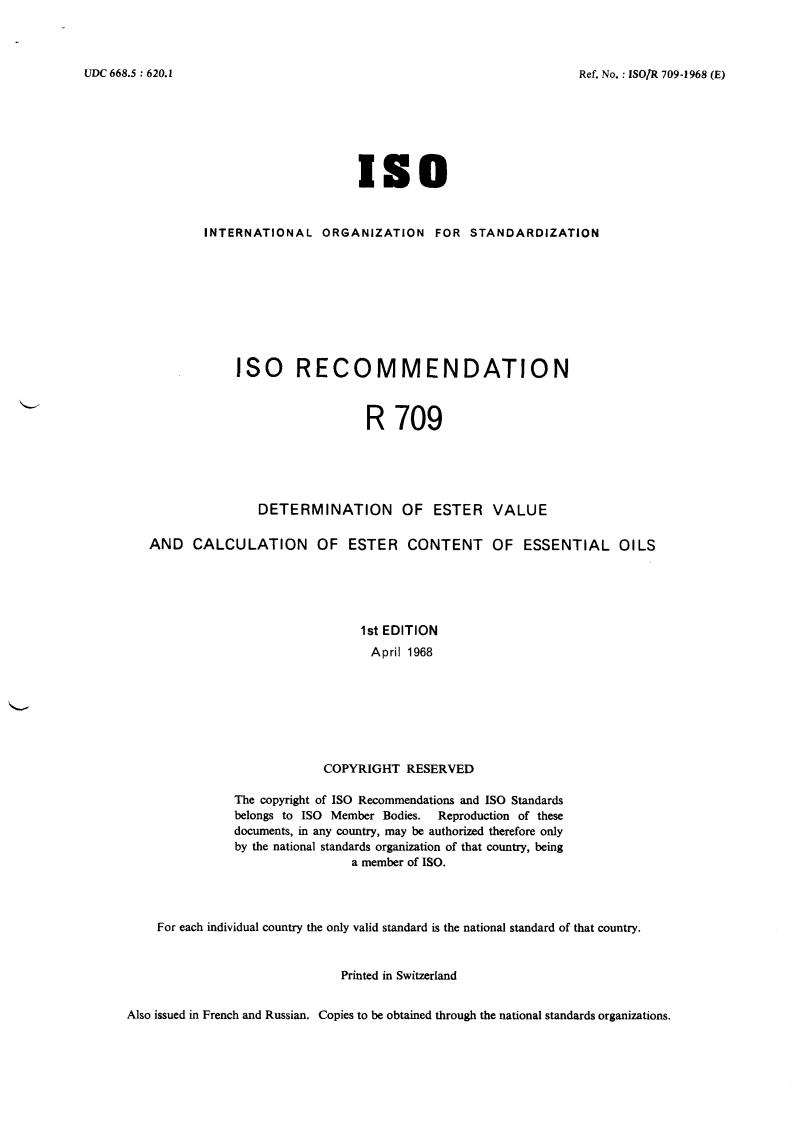
UDC 668.5 : 620.1
Ref. No. : NOIR 709-1968 (E)
IS0
I N T E R N AT I O N A L O R G A N IZ AT I O N FOR S TA N DARD 1 ZATl O N
IS0 RECOMMENDATION
R 709
DETERMINATION OF ESTER VALUE
AND CALCULATION OF ESTER CONTENT OF ESSENTIAL OILS
1st EDITION
April 1968
COPYRIGHT RESERVED
of IS0 Recommendations and IS0 Standards
The copyright
belongs to IS0 Member Bodies. Reproduction of these
documents, in any country, may be authorized therefore oniy
by the national standards organization of that country, being
a member of ISO.
For each individual country the only valid standard is the national standard of that country.
Printed in Switzerland
Also issued in French and Russian. Copies to be obtained through the national standards organizations.
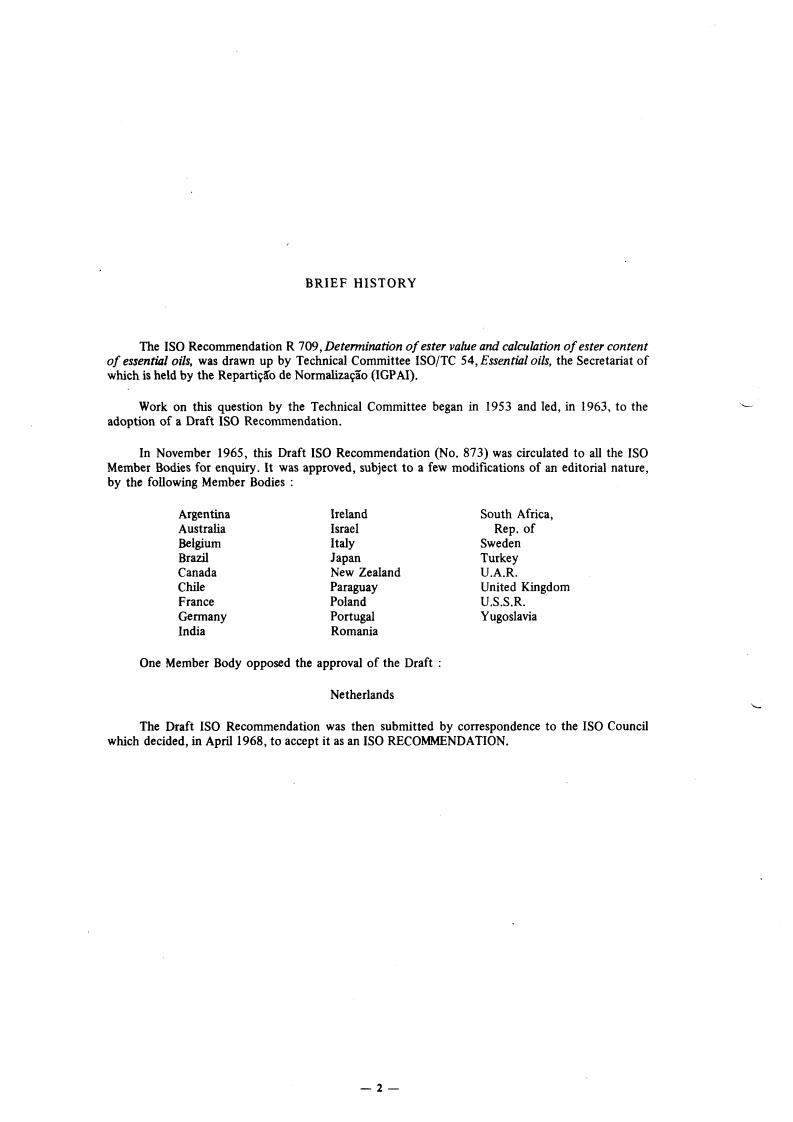
BRIEF HISTORY
The IS0 Recommendation R 709, Determination of ester value and calculation of ester content
of essenîial oils, was drawn up by Technical Committee ISO/TC 54, Essential oils, the Secretariat of
which is held by the Repartiçao de NormaiizaçZo (IGPAI).
Work on this question by the Technical Committee began in 1953 and led, in 1963, to the
adoption of a Draft IS0 Recommendation.
In November 1965, this Draft IS0 Recommendation (No. 873) was circulated to all the IS0
Member Bodies for enquiry. It was approved, subject to a few modifications of an editorial nature,
by the following Member Bodies :
Argentina Ireland South Africa,
Australia Israel Rep. of
Belgium Italy Sweden
Brazil Japan Turkey
Canada New Zealand
U.A.R.
Chile Paraguay United Kingdom
France Poland U.S.S.R.
Germany Portugal Yugoslavia
India Romania
One Member Body opposed the approval of the Draft
Netherlands
The Draft IS0 Recommendation was then submitted by correspondence to the IS0 Council
which decided, in April 1968, to accept it as an IS0 RECOMMENDATION.
-2-
ISO/R 709-1968 (E)
IS0 Recommendation R 709 April 1968
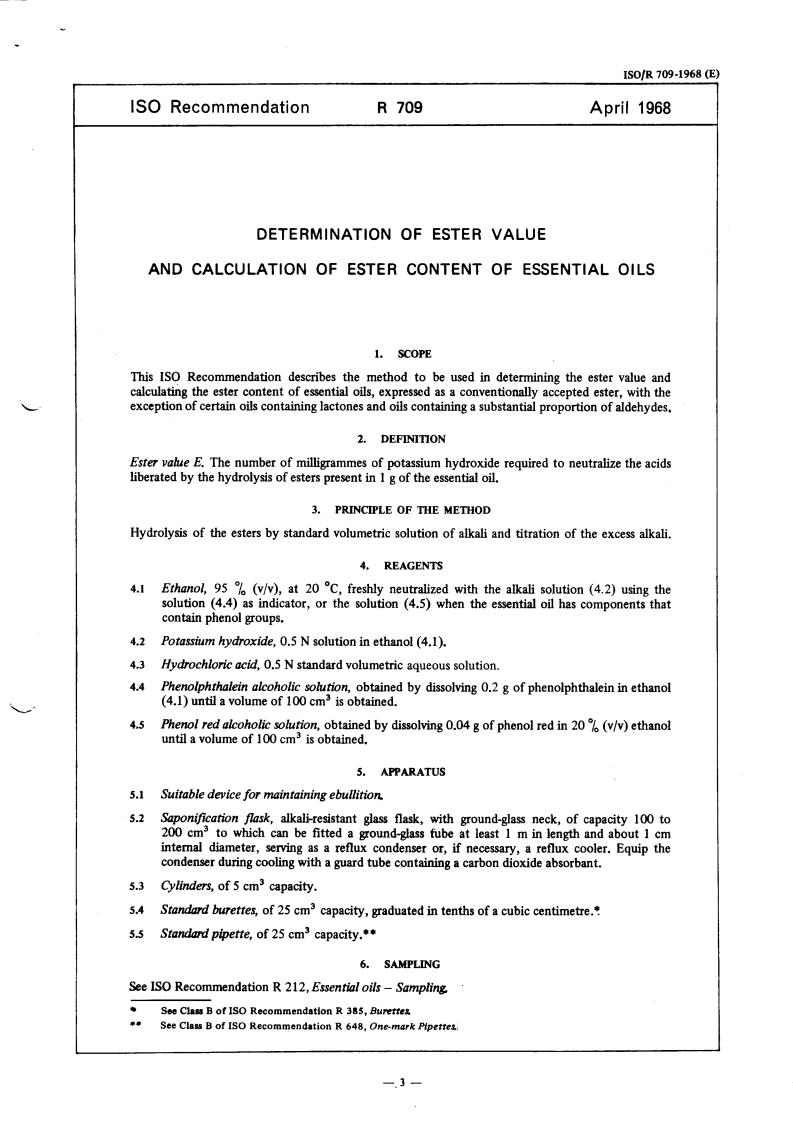
DETERMINATION OF ESTER VALUE
AND CALCULATION OF ESTER CONTENT OF ESSENTIAL OILS
1. SCOPE
This IS0 Recommendation describes the method to be used in determining the ester value and
calcula&g the ester content of essential oils, expressed as a conventionally accepted ester, with the
exception of certain oils containing lactones and oils containing a substantial proportion of aldehydes,
2. DEFMTION
Ester vatue E. The number of milligrammes of potassium hydroxide required to neutralize the acids
liberated by the hydrolysis of esters present in 1 g of the essential oil.
3. PRINCIPLE OF THE METHOD
Hydrolysis of the esters by standard volumetric solution of alkali and titration of the excess alkali.
4. REAGENTS
4.1 Ethanol, 95 oh (v/v), at 20 OC, freshly neutralized with the alkali solution (4.2) using the
solution (4.4) as indicator, or the solution (4.5) when the essential oil has components that
contain phenol groups.
Potassium hydroxide, 0.5 N solution in ethanol (4.1).
4.2
4.3 Hydrochloric acid, 0.5 N standard volumetric aqueous solution.
Phenolphthalein alcoholic solution, obtained by dissolving 0.2 g of phenolphthalein in ethanol
4.4
(4.1) until a volume of 100 cm3 is obtained.
4.5 Phenol red alcoholic solution, obtained by dissolving 0.04 g of phenol red in 20 (v/v) ethanol
until a volume of 100 cm3 is obtained.
5. APPARATUS
Suitable device for maintaining ebullition
5.1
5.2 Saponification fisk, &&resistant giass flask, with ground-glass neck, of capacity 100 to
200 cm3 to which can be fitted a ground-giass fube at least 1 m in length and about 1 cm
internal diameter, serving as a reflux condenser or, if necessary, a reflux cooler. Equip the
condenser during cooling wi
...
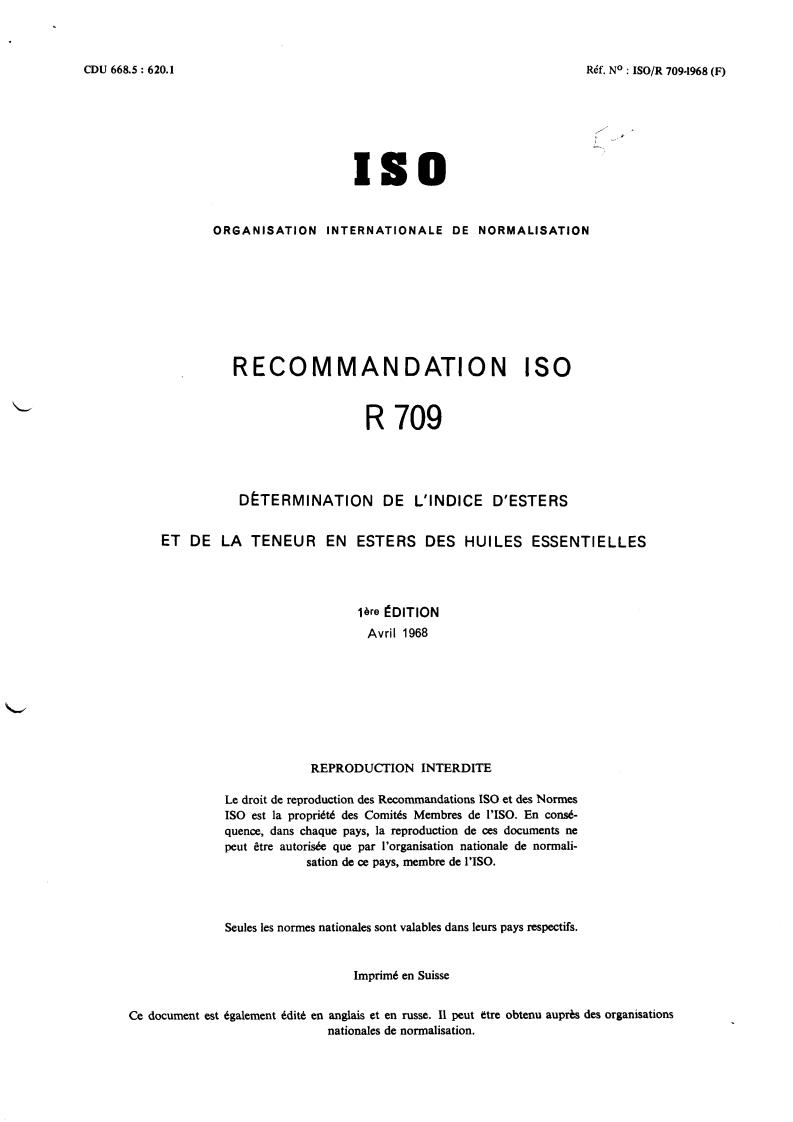
Rif. No : ISO/R 709-1968 (F)
CDU 668.5 : 620.1
IS0
O RG A N IS AT1 ON I N T ERN AT I O N A LE D E NORM A LI SAT1 ON
R E C O M M A N D AT1 O N I S O
R 709
D ÉTE R M I NAT I ON D E L’ I N DI CE D’ESTE RS
ET DE LA TENEUR EN ESTERS DES HUILES ESSENTIELLES
ibre EDITION
Avril 1968
REPRODUCïION INTERDITE
IS0 et des Normes
Le droit de reproduction des Recommandations
IS0 est la propriée des Comités Membres de 1’ISO. En consé-
quence, dans chaque pays, la reproduction de ces documents ne
peut être autorisée que par l’organisation nationale de normali-
sation de ce pays, membre de I’ISO.
Seules les normes nationales sont valables dans leurs pays respectifs.
Imprimé en Suisse
Ce document est également édiîk en anglais et en russe. I1 peut ëtre obtenu auprès des organisations
nationales de normalisation.
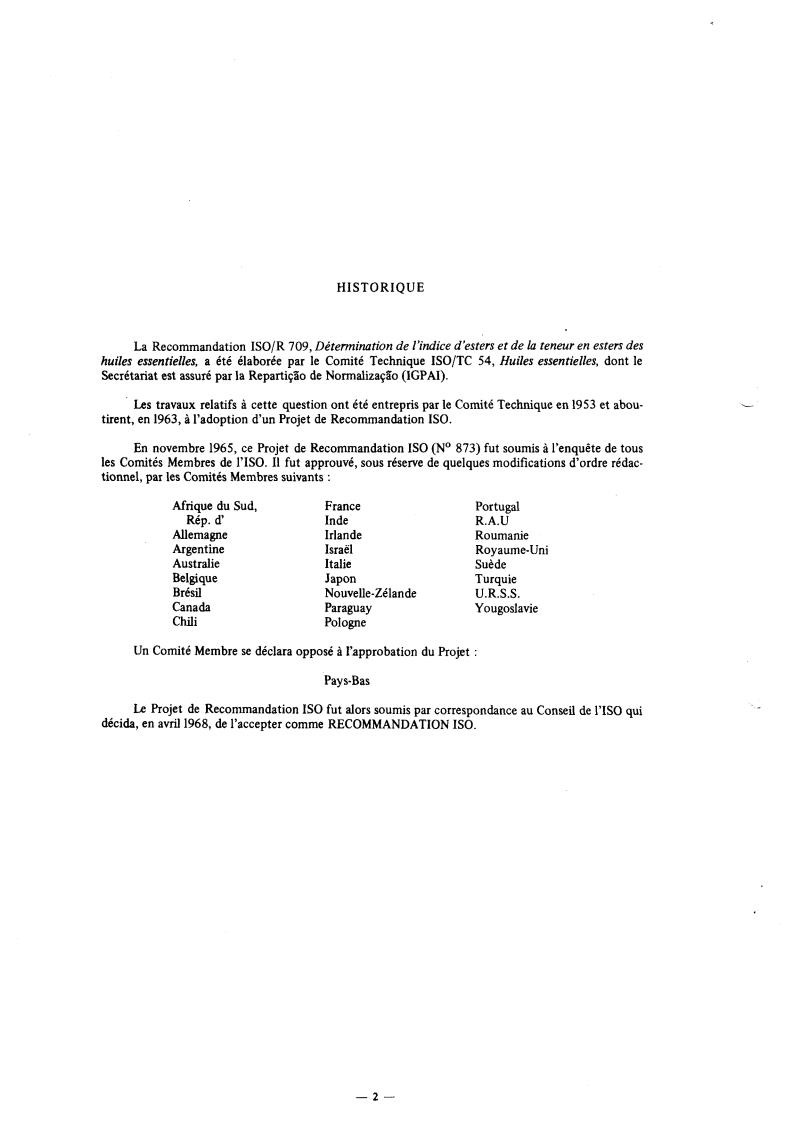
HISTORIQUE
Détermination de l’indice d’esters et de la teneur en esters des
La Recommandation ISO/R 709,
a été élaborée par le Comité Technique ISO/TC 54, Huiles essentielles, dont le
huiles essentielles,
Secrétariat est assuré par la Repartiçao de Normalizaçzo (IGPAI).
Les travaux relatifs à cette question ont été entrepris par le Comité Technique en 1953 et abou-
tirent, en 1963, à l’adoption d’un Projet de Recommandation ISO.
En novembre 1965, ce Projet de Recommandation IS0 (NO 873) fut soumis à l’enquête de tous
les Comités Membres de I’ISO. I1 fut approuvé, sous réserve de quelques modifications d’ordre rédac-
tionnel, par les Comités Membres suivants :
Afrique du Sud, France Portugal
Rép. d‘
Inde R.A.U
Allemagne Irlande Roumanie
Argentine Israël
Royaume-Uni
Australie Italie
Suède
Belgique Japon
Turquie
Brésil Nouvelle-Zélande U.R.S.S.
Canada Paraguay Yougoslavie
Chili Pologne
Un Comité Membre se déclara opposé à i’approbation du Projet
Pays-Bas
Le Projet de Recommandation IS0 fut alors soumis par correspondance au Conseil de 1’ISO qui
décida, en avril 1968, de l’accepter comme RECOMMANDATION ISO.
-2-
ISO/R 709-1968 (I
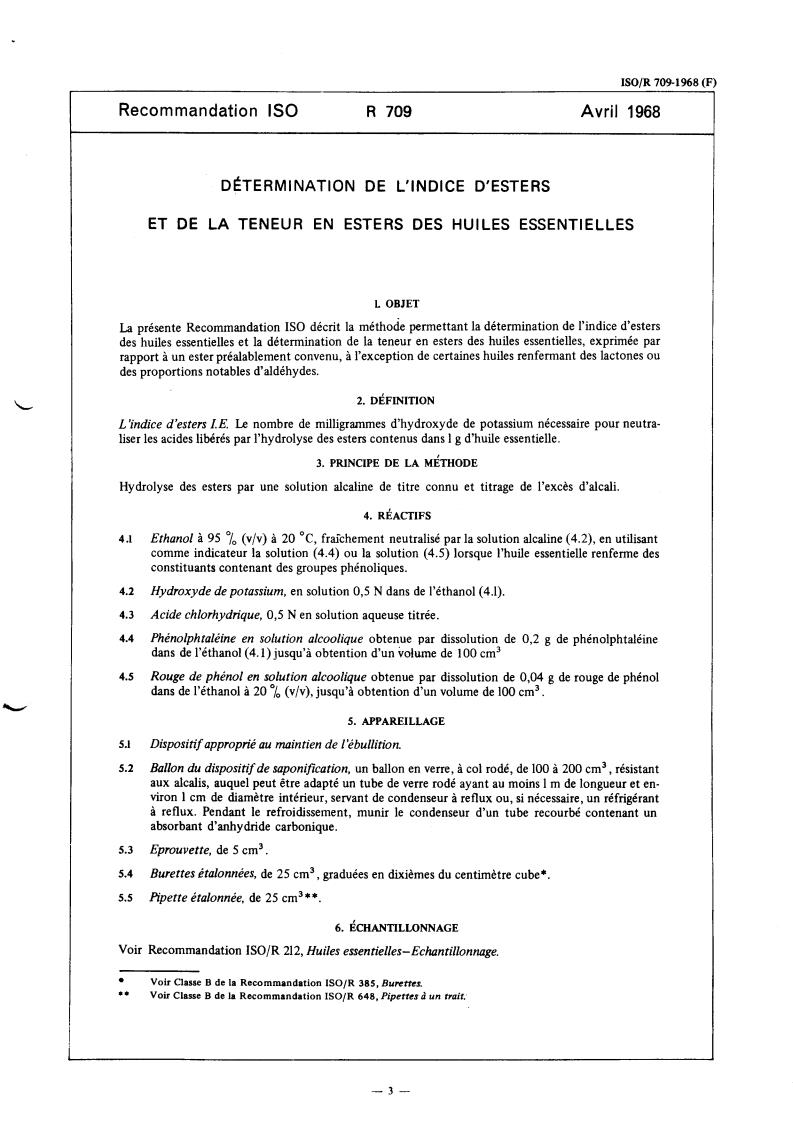
Recommandation IS0 R 709 Avril 1968
DETERMINATION DE L‘INDICE D’ESTERS
ET DE LA TENEUR EN ESTERS DES HUILES ESSENTIELLES
L OBJET
La présente Recommandation IS0 décrit la méthode permettant la détermination de l’indice d’esters
des huiles essentielles et la détermination de la teneur en esters des huiles essentielles, exprimée par
rapport à un ester préalablement convenu, à l’exception de certaines huiles renfermant des lactones ou
des proportions notables d’aldéhydes.
2. DEFINITION
L’indice d’esters I.E. Le nombre de milligrammes d’hydroxyde de potassium nécessaire pour neutra-
liser les acides libérés par l’hydrolyse des esters contenus dans l g d’huile essentielle.
3. PRINCIPE DE LA MÉTHODE
Hydrolyse des esters par une solution alcaline de titre connu et titrage de l’excès d’alcali.
4. REACTIFS
4.1 Ethanol à 95 (v/v) à 20 OC, fraïchement neutralisé par la solution alcaline (4.2), en utilisant
comme indicateur la solution (4.4) ou la solution (4.5) lorsque l’huile essentielle renferme des
constituants contenant des groupes phénoliques.
4.2 Hydroxyde de potassium, en solution 0,s N dans de l’éthanol (4.1).
4.3 Acide chlorhydrique, 0,s N en solution aqueuse titrée.
4.4 Phénolphtaléine en solution alcoolique obtenue par dissolution de 0,2 g de phénolphtaléine
dans de l’éthanol (4.1) jusqu’à obtention d‘un volume de 100 cm3
4.5 Rouge de phénol en solution alcoolique obtenue par dissolution de 0,04 g de rouge de phénol
dans de l’éthanol à 20 ok (vlv), jusqu’à obtention d‘un volume de 100 cm3.
5. APPAREILLAGE
5.1 Dispositif approprié au maintien de l’ébullition.
5.2 Ballon du dispositif de saponification, un ballon en verre, à col rodé, de 100 à 200 cm3, résistant
aux alcalis, auquel peut être adapté un tube de verre rodé ayant au moins 1 m de longueur et en-
viron 1 cm de diamètre intérieur, servant de condenseur à reflux ou, si nécessaire, un réfrigérant
à reflux. Pendant le refroidissement, munir le condenseur d‘un tube recourbé contenant u
...
Questions, Comments and Discussion
Ask us and Technical Secretary will try to provide an answer. You can facilitate discussion about the standard in here.
Loading comments...