

ISO/TR 18491:2015
(Main)Welding and allied processes — Guidelines for measurement of welding energies
General Information
- Abstract
The following documents, in whole or in part, are normatively referenced in ISO/TR 18491:2015 and are indispensable for its application. For dated references, only the edition cited applies. For undated references, the latest edition of the referenced document (including any amendments) applies. ISO 15607, Specification and qualification of welding procedures for metallic materials ? General rules ISO 17662, Welding ? Calibration, verification and validation of equipment used for welding, including ancillary activities ISO/TR 17671 (all parts), Welding ? Recommendations for welding of metallic materials
- Status
- Withdrawn
- Publication Date
- 05-May-2015
- Technical Committee
- ISO/TC 44/SC 10 - Quality management in the field of welding
- Drafting Committee
- ISO/TC 44/SC 10 - Quality management in the field of welding
- Current Stage
- 9599 - Withdrawal of International Standard
- Start Date
- 23-Jun-2026
- Completion Date
- 29-Aug-2026
Buy Documents


ISO/TR 18491:2015 - Welding and allied processes -- Guidelines for measurement of welding energies

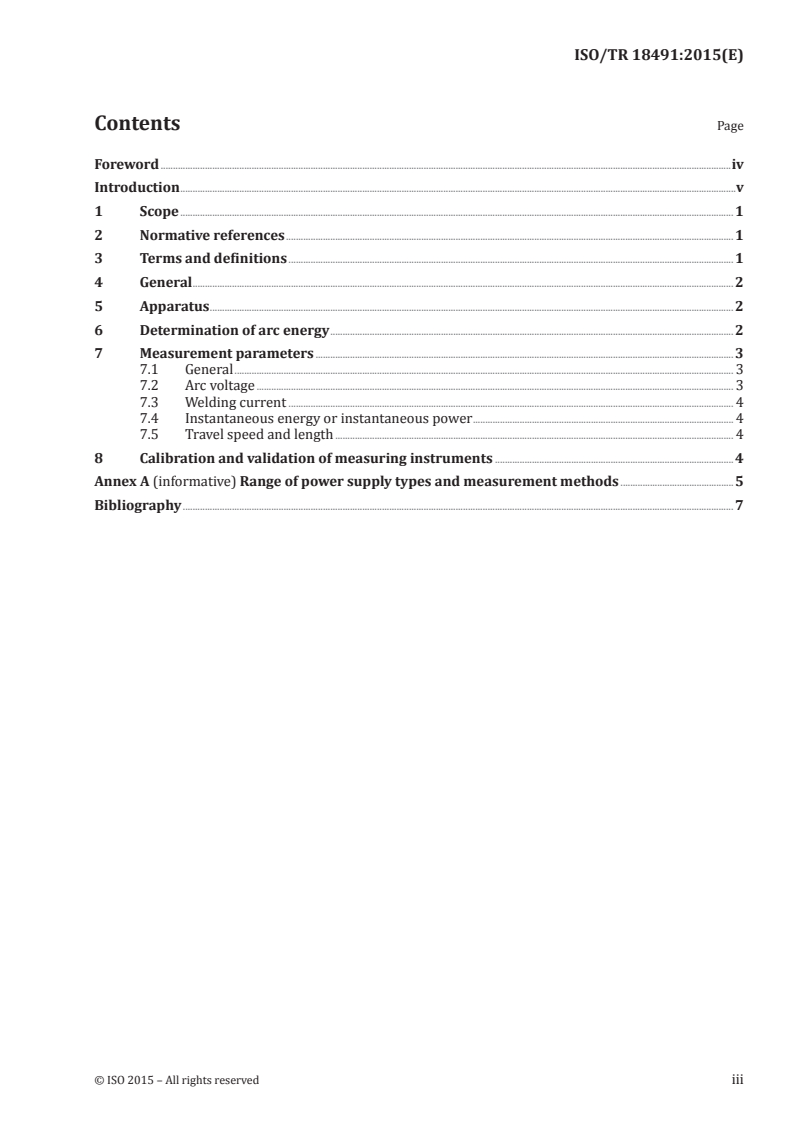
ISO/TR 18491:2015 - Welding and allied processes — Guidelines for measurement of welding energies/6/2015


ISO/TR 18491:2015 - Soudage et techniques connexes -- Lignes directrices pour le mesurage des énergies de soudage
ISO/TR 18491:2015 - Soudage et techniques connexes — Lignes directrices pour le mesurage des énergies de soudage/6/2015
Overview
ISO/TR 18491:2015 - Welding and allied processes - Guidelines for measurement of welding energies - provides practical guidance on how to measure the parameters needed to calculate arc energy and heat input for arc welding processes. The Technical Report explains measurement methods for traditional and modern, waveform‑controlled power sources, highlights common sources of error, and gives recommendations to ensure consistency between welding procedure qualification and production.
Key topics and requirements
- Arc energy vs heat input: The report distinguishes arc energy (product of arc voltage and current divided by travel speed) from heat input, which is arc energy adjusted by an arc efficiency factor. Measurement methods are the same for both.
- Three measurement methods:
- Method A: Calculate from arc voltage, welding current and travel speed.
- Method B: Calculate from instantaneous energy and run length.
- Method C: Calculate from instantaneous power and travel speed.
- Note: For waveform‑controlled welding (e.g., pulsed GMAW, synergic or microprocessor‑controlled sources) Methods B or C are recommended; Method A can introduce errors up to about 70%.
- Measurement parameters:
- Arc voltage: Measure as close to the arc as practical to avoid cable voltage drop; record connector positions in the WPQR/WPS.
- Welding current: Use a shunt or clamp meter on a straight cable section; include all return/earth conductors.
- Instantaneous energy/power: Use meters or power sources capable of true energy/power calculations with sampling rates sufficient to capture waveform changes (typical guideline: sampling ≥10× waveform frequency).
- Travel speed and run length: Determine by depositing a run, measuring time and length, or by built‑in mechanized welding meters.
- Calibration and validation: Calibrate or validate measuring instruments per ISO 17662.
Practical applications and users
ISO/TR 18491:2015 is used to:
- Verify and document Welding Procedure Specifications (WPS) and Welding Procedure Qualification Records (WPQR) consistent with ISO 15607 / ISO 15614 requirements.
- Support quality control during fabrication by welding engineers, inspectors, QA/QC personnel, and certification bodies.
- Guide suppliers of welding power sources and external meters on measurement capability for true power/energy and sampling requirements.
- Apply to manual, mechanized and multi‑arc welding operations; for multi‑arc systems measure each arc individually.
Related standards
- ISO 15607 / ISO 15614 - Welding procedure specification and qualification.
- ISO 17662 - Calibration, verification and validation of welding equipment and measuring devices.
- ISO/TR 17671 (all parts) - Recommendations for welding of metallic materials.
Keywords: ISO TR 18491:2015, welding energy measurement, arc energy, heat input, waveform-controlled welding, instantaneous power, welding calibration.
Relations
- Effective Date
- 25-Aug-2026
- Effective Date
- 25-Aug-2026
- Effective Date
- 25-Aug-2026
- Effective Date
- 25-Aug-2026
- Effective Date
- 25-Aug-2026
- Effective Date
- 25-Feb-2026
- Effective Date
- 06-Jun-2022
- Effective Date
- 13-Apr-2024
Buy Documents
ISO/TR 18491:2015 - Welding and allied processes -- Guidelines for measurement of welding energies
ISO/TR 18491:2015 - Welding and allied processes — Guidelines for measurement of welding energies/6/2015
ISO/TR 18491:2015 - Soudage et techniques connexes -- Lignes directrices pour le mesurage des énergies de soudage
ISO/TR 18491:2015 - Soudage et techniques connexes — Lignes directrices pour le mesurage des énergies de soudage/6/2015
Get Certified
Connect with accredited certification bodies for this standard

DVS-ZERT GmbH
German welding certification society.
CARES (UK Certification Authority for Reinforcing Steels)
UK certification for reinforcing steels and construction.
EWF/IIW (European/International Welding Federation)
International welding personnel certification.
Sponsored listings
Frequently Asked Questions
ISO/TR 18491:2015 is a technical report published by the International Organization for Standardization (ISO). Its full title is "Welding and allied processes — Guidelines for measurement of welding energies". This standard covers: The following documents, in whole or in part, are normatively referenced in ISO/TR 18491:2015 and are indispensable for its application. For dated references, only the edition cited applies. For undated references, the latest edition of the referenced document (including any amendments) applies. ISO 15607, Specification and qualification of welding procedures for metallic materials ? General rules ISO 17662, Welding ? Calibration, verification and validation of equipment used for welding, including ancillary activities ISO/TR 17671 (all parts), Welding ? Recommendations for welding of metallic materials
The following documents, in whole or in part, are normatively referenced in ISO/TR 18491:2015 and are indispensable for its application. For dated references, only the edition cited applies. For undated references, the latest edition of the referenced document (including any amendments) applies. ISO 15607, Specification and qualification of welding procedures for metallic materials ? General rules ISO 17662, Welding ? Calibration, verification and validation of equipment used for welding, including ancillary activities ISO/TR 17671 (all parts), Welding ? Recommendations for welding of metallic materials
ISO/TR 18491:2015 is classified under the following ICS (International Classification for Standards) categories: 25.160.01 - Welding, brazing and soldering in general. The ICS classification helps identify the subject area and facilitates finding related standards.
ISO/TR 18491:2015 has the following relationships with other standards: It is inter standard links to EN ISO 15609-1:2019, EN ISO 15614-1:2017, EN ISO 15614-7:2016, EN ISO 15614-7:2019, EN ISO 15612:2018, EN ISO 15614-2:2025, ISO 3451-1:2019, ISO 18491:2026. Understanding these relationships helps ensure you are using the most current and applicable version of the standard.
ISO/TR 18491:2015 is available in PDF format for immediate download after purchase. The document can be added to your cart and obtained through the secure checkout process. Digital delivery ensures instant access to the complete standard document.
Standards Content (Sample)
TECHNICAL ISO/TR
REPORT 18491
First edition
2015-05-01
Welding and allied processes —
Guidelines for measurement of
welding energies
Soudage et techniques connexes — Lignes directrices pour le
mesurage des énergies de soudage
Reference number
©
ISO 2015
© ISO 2015, Published in Switzerland
All rights reserved. Unless otherwise specified, no part of this publication may be reproduced or utilized otherwise in any form
or by any means, electronic or mechanical, including photocopying, or posting on the internet or an intranet, without prior
written permission. Permission can be requested from either ISO at the address below or ISO’s member body in the country of
the requester.
ISO copyright office
Ch. de Blandonnet 8 • CP 401
CH-1214 Vernier, Geneva, Switzerland
Tel. +41 22 749 01 11
Fax +41 22 749 09 47
copyright@iso.org
www.iso.org
ii © ISO 2015 – All rights reserved
Contents Page
Foreword .iv
Introduction .v
1 Scope . 1
2 Normative references . 1
3 Terms and definitions . 1
4 General . 2
5 Apparatus . 2
6 Determination of arc energy . 2
7 Measurement parameters . 3
7.1 General . 3
7.2 Arc voltage . 3
7.3 Welding current . 4
7.4 Instantaneous energy or instantaneous power . 4
7.5 Travel speed and length . 4
8 Calibration and validation of measuring instruments . 4
Annex A (informative) Range of power supply types and measurement methods .5
Bibliography . 7
Foreword
ISO (the International Organization for Standardization) is a worldwide federation of national standards
bodies (ISO member bodies). The work of preparing International Standards is normally carried out
through ISO technical committees. Each member body interested in a subject for which a technical
committee has been established has the right to be represented on that committee. International
organizations, governmental and non-governmental, in liaison with ISO, also take part in the work.
ISO collaborates closely with the International Electrotechnical Commission (IEC) on all matters of
electrotechnical standardization.
The procedures used to develop this document and those intended for its further maintenance are
described in the ISO/IEC Directives, Part 1. In particular the different approval criteria needed for the
different types of ISO documents should be noted. This document was drafted in accordance with the
editorial rules of the ISO/IEC Directives, Part 2 (see www.iso.org/directives).
Attention is drawn to the possibility that some of the elements of this document may be the subject of
patent rights. ISO shall not be held responsible for identifying any or all such patent rights. Details of any
patent rights identified during the development of the document will be in the Introduction and/or on
the ISO list of patent declarations received (see www.iso.org/patents).
Any trade name used in this document is information given for the convenience of users and does not
constitute an endorsement.
For an explanation on the meaning of ISO specific terms and expressions related to conformity
assessment, as well as information about ISO’s adherence to the WTO principles in the Technical Barriers
to Trade (TBT), see the following URL: Foreword — Supplementary information.
The committee responsible for this document is ISO/TC 44, Welding and allied processes, Subcommittee
SC 10, Unification of requirements in the field of metal welding.
iv © ISO 2015 – All rights reserved
Introduction
Welding “arc energy” or “heat input” are fundamental values used to manage the consistency of weld
metal and heat-affected zone properties. ISO 15614 requires the measurement of the welding energies
implemented during a welding procedure qualification, but it does not give details about the methods to
be used. Likewise, during the construction of a welded assembly, inspectors should make sure that the
welding energies comply with the Welding Procedure Specification (WPS). But again, the details of the
methods to be used are not specified. As a consequence, there may be a lack of consistency between the
methods used to measure the welding energies during welding of the test piece and the methods used
during the manufacturing process. This is a potential source of error which could have implications on
the safety or quality of a welded component or structure.
Moreover, the latest technological breakthroughs in microprocessors and electrical power manipulation
have yielded welding power sources and control systems that are capable of generating complex
waveforms. However, these control systems and waveforms increase the difficulties related to voltage
and current intensity measurements, as their values are manipulated at frequencies which can reach
thousands of Hertz. The measuring instruments generally used by inspectors, such as TRMS clamp
meters, can no longer be relied on to correctly measure the welding energy since differences exceeding
30 % with respect to the true energy can sometimes be found.
This Technical Report provides guidance on how to accurately measure welding energy and calculate
heat input, both in the case of traditional welding systems and those that employ complex waveforms.
TECHNICAL REPORT ISO/TR 18491:2015(E)
Welding and allied processes — Guidelines for
measurement of welding energies
1 Scope
This Technical Report presents the guidelines for measuring the parameters needed to calculate arc
energies for arc welding processes.
2 Normative references
The following documents, in whole or in part, are normatively referenced in this document and are
indispensable for its application. For dated references, only the edition cited applies. For undated
references, the latest edition of the referenced document (including any amendments) applies.
ISO 15607, Specification and qualification of welding procedures for metallic materials — General rules
ISO 17662, Welding — Calibration, verification and validation of equipment used for welding, including
ancillary activities
ISO/TR 17671 (all parts), Welding — Recommendations for welding of metallic materials
3 Terms and definitions
For the purposes of this document, the terms and definitions given in ISO 15607 and ISO/TR 17671 (all
parts) and the following apply.
3.1
arc energy
E
product of welding voltage and current divided by travel speed of welding
Note 1 to entry: The often-used term “heat input” is more correctly the arc energy modified by an arc efficiency factor.
3.2
waveform controlled welding
welding process modification of the voltage and/or current wave shape to control characteristics such
as droplet shape, penetration, wetting, bead shape, or transfer mode(s)
3.3
instantaneous energy
IE
welding energy determined by summing the product of current and voltage measurements made at
rapid intervals which capture brief changes in the welding waveform
3.4
instantaneous power
IP
welding power determined by averaging the product of current and voltage measurements made over
time at rapid intervals which capture brief changes in the welding waveform
3.5
run out length
length of a run produced by the melting of a covered electrode
[SOURCE: ISO/TR 17671-2:2002, 3.2]
4 General
The term “heat input” is often used to describe two different concepts. In this Technical Report, these
concepts are identified as heat input and as arc en
...
TECHNICAL ISO/TR
REPORT 18491
First edition
2015-05-01
Welding and allied processes —
Guidelines for measurement of
welding energies
Soudage et techniques connexes — Lignes directrices pour le
mesurage des énergies de soudage
Reference number
©
ISO 2015
© ISO 2015, Published in Switzerland
All rights reserved. Unless otherwise specified, no part of this publication may be reproduced or utilized otherwise in any form
or by any means, electronic or mechanical, including photocopying, or posting on the internet or an intranet, without prior
written permission. Permission can be requested from either ISO at the address below or ISO’s member body in the country of
the requester.
ISO copyright office
Ch. de Blandonnet 8 • CP 401
CH-1214 Vernier, Geneva, Switzerland
Tel. +41 22 749 01 11
Fax +41 22 749 09 47
copyright@iso.org
www.iso.org
ii © ISO 2015 – All rights reserved
Contents Page
Foreword .iv
Introduction .v
1 Scope . 1
2 Normative references . 1
3 Terms and definitions . 1
4 General . 2
5 Apparatus . 2
6 Determination of arc energy . 2
7 Measurement parameters . 3
7.1 General . 3
7.2 Arc voltage . 3
7.3 Welding current . 4
7.4 Instantaneous energy or instantaneous power . 4
7.5 Travel speed and length . 4
8 Calibration and validation of measuring instruments . 4
Annex A (informative) Range of power supply types and measurement methods .5
Bibliography . 7
Foreword
ISO (the International Organization for Standardization) is a worldwide federation of national standards
bodies (ISO member bodies). The work of preparing International Standards is normally carried out
through ISO technical committees. Each member body interested in a subject for which a technical
committee has been established has the right to be represented on that committee. International
organizations, governmental and non-governmental, in liaison with ISO, also take part in the work.
ISO collaborates closely with the International Electrotechnical Commission (IEC) on all matters of
electrotechnical standardization.
The procedures used to develop this document and those intended for its further maintenance are
described in the ISO/IEC Directives, Part 1. In particular the different approval criteria needed for the
different types of ISO documents should be noted. This document was drafted in accordance with the
editorial rules of the ISO/IEC Directives, Part 2 (see www.iso.org/directives).
Attention is drawn to the possibility that some of the elements of this document may be the subject of
patent rights. ISO shall not be held responsible for identifying any or all such patent rights. Details of any
patent rights identified during the development of the document will be in the Introduction and/or on
the ISO list of patent declarations received (see www.iso.org/patents).
Any trade name used in this document is information given for the convenience of users and does not
constitute an endorsement.
For an explanation on the meaning of ISO specific terms and expressions related to conformity
assessment, as well as information about ISO’s adherence to the WTO principles in the Technical Barriers
to Trade (TBT), see the following URL: Foreword — Supplementary information.
The committee responsible for this document is ISO/TC 44, Welding and allied processes, Subcommittee
SC 10, Unification of requirements in the field of metal welding.
iv © ISO 2015 – All rights reserved
Introduction
Welding “arc energy” or “heat input” are fundamental values used to manage the consistency of weld
metal and heat-affected zone properties. ISO 15614 requires the measurement of the welding energies
implemented during a welding procedure qualification, but it does not give details about the methods to
be used. Likewise, during the construction of a welded assembly, inspectors should make sure that the
welding energies comply with the Welding Procedure Specification (WPS). But again, the details of the
methods to be used are not specified. As a consequence, there may be a lack of consistency between the
methods used to measure the welding energies during welding of the test piece and the methods used
during the manufacturing process. This is a potential source of error which could have implications on
the safety or quality of a welded component or structure.
Moreover, the latest technological breakthroughs in microprocessors and electrical power manipulation
have yielded welding power sources and control systems that are capable of generating complex
waveforms. However, these control systems and waveforms increase the difficulties related to voltage
and current intensity measurements, as their values are manipulated at frequencies which can reach
thousands of Hertz. The measuring instruments generally used by inspectors, such as TRMS clamp
meters, can no longer be relied on to correctly measure the welding energy since differences exceeding
30 % with respect to the true energy can sometimes be found.
This Technical Report provides guidance on how to accurately measure welding energy and calculate
heat input, both in the case of traditional welding systems and those that employ complex waveforms.
TECHNICAL REPORT ISO/TR 18491:2015(E)
Welding and allied processes — Guidelines for
measurement of welding energies
1 Scope
This Technical Report presents the guidelines for measuring the parameters needed to calculate arc
energies for arc welding processes.
2 Normative references
The following documents, in whole or in part, are normatively referenced in this document and are
indispensable for its application. For dated references, only the edition cited applies. For undated
references, the latest edition of the referenced document (including any amendments) applies.
ISO 15607, Specification and qualification of welding procedures for metallic materials — General rules
ISO 17662, Welding — Calibration, verification and validation of equipment used for welding, including
ancillary activities
ISO/TR 17671 (all parts), Welding — Recommendations for welding of metallic materials
3 Terms and definitions
For the purposes of this document, the terms and definitions given in ISO 15607 and ISO/TR 17671 (all
parts) and the following apply.
3.1
arc energy
E
product of welding voltage and current divided by travel speed of welding
Note 1 to entry: The often-used term “heat input” is more correctly the arc energy modified by an arc efficiency factor.
3.2
waveform controlled welding
welding process modification of the voltage and/or current wave shape to control characteristics such
as droplet shape, penetration, wetting, bead shape, or transfer mode(s)
3.3
instantaneous energy
IE
welding energy determined by summing the product of current and voltage measurements made at
rapid intervals which capture brief changes in the welding waveform
3.4
instantaneous power
IP
welding power determined by averaging the product of current and voltage measurements made over
time at rapid intervals which capture brief changes in the welding waveform
3.5
run out length
length of a run produced by the melting of a covered electrode
[SOURCE: ISO/TR 17671-2:2002, 3.2]
4 General
The term “heat input” is often used to describe two different concepts. In this Technical Report, these
concepts are identified as heat input and as arc en
...
RAPPORT ISO/TR
TECHNIQUE 18491
Première édition
2015-05-01
Soudage et techniques connexes —
Lignes directrices pour le mesurage
des énergies de soudage
Welding and allied processes — Guidelines for measurement of
welding energies
Numéro de référence
©
ISO 2015
DOCUMENT PROTÉGÉ PAR COPYRIGHT
© ISO 2015
Droits de reproduction réservés. Sauf indication contraire, aucune partie de cette publication ne peut être reproduite ni utilisée
sous quelque forme que ce soit et par aucun procédé, électronique ou mécanique, y compris la photocopie, l’affichage sur
l’internet ou sur un Intranet, sans autorisation écrite préalable. Les demandes d’autorisation peuvent être adressées à l’ISO à
l’adresse ci-après ou au comité membre de l’ISO dans le pays du demandeur.
ISO copyright office
Case postale 56 • CH-1211 Geneva 20
Tel. + 41 22 749 01 11
Fax + 41 22 749 09 47
E-mail copyright@iso.org
Web www.iso.org
Publié en Suisse
ii © ISO 2015 – Tous droits réservés
Sommaire Page
Avant-propos .iv
Introduction .v
1 Domaine d’application . 1
2 Références normatives . 1
3 Termes et définitions . 1
4 Généralités . 2
5 Appareils de mesure . 2
6 Détermination de l’énergie électrique de l’arc . 3
7 Paramètres de mesurage . 3
7.1 Généralités . 3
7.2 Tension à l’arc . 4
7.3 Courant de soudage . 4
7.4 Énergie instantanée ou puissance instantanée. 4
7.5 Vitesse d’avance et longueur . 5
8 Étalonnage et validation des instruments de mesure . 5
Annexe A (informative) Domaine de validité et méthode de mesure . 6
Bibliographie . 9
Avant-propos
L’ISO (Organisation internationale de normalisation) est une fédération mondiale d’organismes
nationaux de normalisation (comités membres de l’ISO). L’élaboration des Normes internationales est
en général confiée aux comités techniques de l’ISO. Chaque comité membre intéressé par une étude
a le droit de faire partie du comité technique créé à cet effet. Les organisations internationales,
gouvernementales et non gouvernementales, en liaison avec l’ISO participent également aux travaux.
L’ISO collabore étroitement avec la Commission électrotechnique internationale (IEC) en ce qui concerne
la normalisation électrotechnique.
Les procédures suivies pour élaborer le présent document et celles visant à assurer son maintien sont
décrites dans les Directives ISO/IEC, Partie 1. Les différents critères d’approbation nécessaires aux
différents types de documents ISO doivent particulièrement être notés. Le présent document a été élaboré
conformément aux règles éditoriales des directives ISO/IEC, Partie 2 (voir www.iso.org/directives).
L’attention est appelée sur le fait que certains des éléments du présent document peuvent faire l’objet de
droits de propriété intellectuelle ou de droits analogues. L’ISO ne saurait être tenue pour responsable
de ne pas avoir identifié de tels droits de propriété et averti de leur existence. Des détails portant sur
tout droit de propriété intellectuelle identifiés durant l’élaboration du présent document figureront à
l’Introduction et/ou à la liste de déclarations de détention de brevet soumises à l’ISO (voir www.iso.
org/patents).
Pour des raisons de commodités, toute référence à un nom commercial dans le présent document est
faite à titre informatif pour les utilisateurs et ne saurait constituer une promotion de celui-ci.
Pour obtenir une explication sur la signification des termes spécifiques de l’ISO et les expressions
relatives à l’évaluation de la conformité, ainsi que des informations sur l’adhérence de l’ISO aux principes
de l’OMC dans les Obstacles techniques au commerce (OTC), aller à l’adresse URL suivante: Foreword -
Supplementary information.
Le comité technique responsable de l’élaboration du présent document est l’ISO/TC 44, Soudage et
techniques connexes, Sous-comité SC 10, Unification des prescriptions dans la technique du soudage.
iv © ISO 2015 – Tous droits réservés
Introduction
En soudage, “l’énergie de l’arc” ou “l’apport de chaleur” sont des paramètres essentiels utilisés pour
contrôler la cohérence des propriétés du métal fondu et de la zone affectée thermiquement. L’ISO 15614
exige un relevé des énergies de soudage mises en œuvre lors de la réalisation d’une qualification de
mode opératoire de soudage (QMOS), mais ne précise pas le détail des méthodes à utiliser. De la même
manière que pendant la réalisation d’une construction soudée, il convient que les inspecteurs s’assurent
que les énergies de soudage sont conformes au descriptif de mode opératoire de soudage (DMOS). Mais,
une fois de plus, le détail des méthodes à utiliser n’est pas spécifié. Par conséquent, il peut y avoir un
manque de cohérence entre les méthodes utilisées lors de la mesure des énergies de soudage pendant le
soudage de l’assemblage de qualification, et celles utilisées pendant le processus de fabrication. Ceci est
potentiellement source d’erreur qui pourrait avoir des conséquences sur la sécurité ou la qualité d’un
composant ou d’une structure soudé.
Par ailleurs, les dernières évolutions technologiques dans le domaine des microprocesseurs et les
systèmes de gestion de l’énergie électrique ont permis de développer des sources de courant de soudage
et des systèmes de commande capables de générer des formes d’onde complexes. Cependant, ces systèmes
de commande et ces formes d’onde augmentent les difficultés liées aux mesures de tension et d’intensité
de courant, étant donné que leurs valeurs sont manipulées à des fréquences pouvant atteindre des
centaines d’Hertz. Les instruments de mesure généralement utilisés par les inspecteurs, tels que les
pinces ampèremétriques TRMS, ne peuvent plus être tenus pour fiables pour mesurer correctement
l’énergie de soudage puisque des écarts de plus de 30 % par rapport à l’énergie réelle peuvent parfois
être constatés.
Le présent rapport technique fournit des indications sur la manière de mesurer l’énergie de soudage et
de calculer l’apport de chaleur avec exactitude, aussi bien pour les systèmes de soudage traditionnels
que pour ceux utilisant des formes d’onde complexes.
RAPPORT TECHNIQUE ISO/TR 18491:2015(F)
Soudage et techniques connexes — Lignes directrices pour
le mesurage des énergies de soudage
1 Domaine d’application
Le présent Rapport Technique donne des indications pour la mesure des paramètres nécessaires au
calcul des énergies de soudage pour les procédés de soudage à l’arc.
2 Références normatives
Les documents suivants, en totalité ou en partie, sont référencés de manière normative dans le présent
document et sont indispensables pour son application. Pour les références datées, seule l’édition citée
s’applique. Pour les références non datées, la dernière édition du document de référence s’applique (y
compris les éventuels amendements).
ISO 15607, Descriptif et qualification d’un mode opératoire de soudage pour les matériaux métalliques —
Règles générales
ISO 17662, Soudage — Étalonnage, vérification et validation du matériel utilisé pour le soudage, y compris
pour les procédés connexes
ISO/TR 17671 (toutes les parties), Soudage — Recommandations pour le soudage des matériaux métalliques
3 Termes et définitions
Pour les besoins du présent document, les termes et définitions donnés dans l’ISO 15607 et l’ISO/TR 17671
(toutes les parties) ainsi que les suivants s’appliquent.
3.1
énergie de l’arc
E
produit de la tension et de l’intensité du courant de soudage divisé par la vitesse d’avance de soudage
Note 1 à l’article: Le terme “apport de chaleur”, souvent utilisé, désigne plus précisément l’énergie de l’arc modifiée
par un facteur de rendement du procédé.
3.2
soudage avec forme d’onde contrôlée
soudage au moyen d’un générateur permettant de modifier la tension et/ou la forme d’onde du courant
électrique employé afin de contrôler des caractéristiques telles que la forme des gouttes de produit
d’apport, la pénétration, le mouillage, la forme du cordon de soudure, ou le (les) mode(s) de transfert
3.3
énergie instantanée
IE
énergie de soudage, déterminée en mesurant à intervalles très courts la tension et l’intensité employées
et en additionnant le produit de ces valeurs, tenant ainsi compte des brefs changements de la forme
d’onde du courant de soudage
3.4
puissance instantanée
IP
puissance de soudage, déterminée mesurant à intervalles très courts la tension et l’intensité employées
et en faisant la moyenne du produit de ces valeurs sur une période donnée, tenant ainsi compte des brefs
changements de la forme d’onde du courant de soudage
3.5
longueur effective de cordon
longueur du cordon obtenu après avoir fondu une électrode enrobée
[SOURCE: ISO/TR 17671-2:2002, 3.2]
4 Généralités
Le terme “apport de chaleur” est souvent utilisé pour décrire deux notions différentes. Dans le présent
rapport technique, ces notions sont identifiées comme étant l’apport de chaleur et l’énergie de l’arc. La
détermination de l’apport de chaleur est en partie basée sur un coefficient de rendement thermique,
exprimé sans unité, ce qui n’est pas le cas de l’énergie électrique de l’arc. A l’exception de cette différence,
les méthodes de mesure sont identiques. L’énergie de l’arc est déterminée comme indiqué dans les
Formules (1), (2) et (3). Les symboles indiqués dans le Tableau 1 sont utilisés pour toutes les formules.
Tableau 1 — Symboles des termes utilisés
Abréviations et
Terme Unité
symboles
I Intensité de l’arc A
L Longueur du cordon mm
U Tension à l’arc V
v Vitesse d’avance mm/s
E Énergie de l’arc kJ/mm
IE Énergie instantanée J
IP Puissance instantanée J/s
La Formule (1) permet de déterminer l’énergie de l’arc sur la base de la mesure de l’intensité et de la
tension de
...
RAPPORT ISO/TR
TECHNIQUE 18491
Première édition
2015-05-01
Soudage et techniques connexes —
Lignes directrices pour le mesurage
des énergies de soudage
Welding and allied processes — Guidelines for measurement of
welding energies
Numéro de référence
©
ISO 2015
DOCUMENT PROTÉGÉ PAR COPYRIGHT
© ISO 2015
Droits de reproduction réservés. Sauf indication contraire, aucune partie de cette publication ne peut être reproduite ni utilisée
sous quelque forme que ce soit et par aucun procédé, électronique ou mécanique, y compris la photocopie, l’affichage sur
l’internet ou sur un Intranet, sans autorisation écrite préalable. Les demandes d’autorisation peuvent être adressées à l’ISO à
l’adresse ci-après ou au comité membre de l’ISO dans le pays du demandeur.
ISO copyright office
Case postale 56 • CH-1211 Geneva 20
Tel. + 41 22 749 01 11
Fax + 41 22 749 09 47
E-mail copyright@iso.org
Web www.iso.org
Publié en Suisse
ii © ISO 2015 – Tous droits réservés
Sommaire Page
Avant-propos .iv
Introduction .v
1 Domaine d’application . 1
2 Références normatives . 1
3 Termes et définitions . 1
4 Généralités . 2
5 Appareils de mesure . 2
6 Détermination de l’énergie électrique de l’arc . 3
7 Paramètres de mesurage . 3
7.1 Généralités . 3
7.2 Tension à l’arc . 4
7.3 Courant de soudage . 4
7.4 Énergie instantanée ou puissance instantanée. 4
7.5 Vitesse d’avance et longueur . 5
8 Étalonnage et validation des instruments de mesure . 5
Annexe A (informative) Domaine de validité et méthode de mesure . 6
Bibliographie . 9
Avant-propos
L’ISO (Organisation internationale de normalisation) est une fédération mondiale d’organismes
nationaux de normalisation (comités membres de l’ISO). L’élaboration des Normes internationales est
en général confiée aux comités techniques de l’ISO. Chaque comité membre intéressé par une étude
a le droit de faire partie du comité technique créé à cet effet. Les organisations internationales,
gouvernementales et non gouvernementales, en liaison avec l’ISO participent également aux travaux.
L’ISO collabore étroitement avec la Commission électrotechnique internationale (IEC) en ce qui concerne
la normalisation électrotechnique.
Les procédures suivies pour élaborer le présent document et celles visant à assurer son maintien sont
décrites dans les Directives ISO/IEC, Partie 1. Les différents critères d’approbation nécessaires aux
différents types de documents ISO doivent particulièrement être notés. Le présent document a été élaboré
conformément aux règles éditoriales des directives ISO/IEC, Partie 2 (voir www.iso.org/directives).
L’attention est appelée sur le fait que certains des éléments du présent document peuvent faire l’objet de
droits de propriété intellectuelle ou de droits analogues. L’ISO ne saurait être tenue pour responsable
de ne pas avoir identifié de tels droits de propriété et averti de leur existence. Des détails portant sur
tout droit de propriété intellectuelle identifiés durant l’élaboration du présent document figureront à
l’Introduction et/ou à la liste de déclarations de détention de brevet soumises à l’ISO (voir www.iso.
org/patents).
Pour des raisons de commodités, toute référence à un nom commercial dans le présent document est
faite à titre informatif pour les utilisateurs et ne saurait constituer une promotion de celui-ci.
Pour obtenir une explication sur la signification des termes spécifiques de l’ISO et les expressions
relatives à l’évaluation de la conformité, ainsi que des informations sur l’adhérence de l’ISO aux principes
de l’OMC dans les Obstacles techniques au commerce (OTC), aller à l’adresse URL suivante: Foreword -
Supplementary information.
Le comité technique responsable de l’élaboration du présent document est l’ISO/TC 44, Soudage et
techniques connexes, Sous-comité SC 10, Unification des prescriptions dans la technique du soudage.
iv © ISO 2015 – Tous droits réservés
Introduction
En soudage, “l’énergie de l’arc” ou “l’apport de chaleur” sont des paramètres essentiels utilisés pour
contrôler la cohérence des propriétés du métal fondu et de la zone affectée thermiquement. L’ISO 15614
exige un relevé des énergies de soudage mises en œuvre lors de la réalisation d’une qualification de
mode opératoire de soudage (QMOS), mais ne précise pas le détail des méthodes à utiliser. De la même
manière que pendant la réalisation d’une construction soudée, il convient que les inspecteurs s’assurent
que les énergies de soudage sont conformes au descriptif de mode opératoire de soudage (DMOS). Mais,
une fois de plus, le détail des méthodes à utiliser n’est pas spécifié. Par conséquent, il peut y avoir un
manque de cohérence entre les méthodes utilisées lors de la mesure des énergies de soudage pendant le
soudage de l’assemblage de qualification, et celles utilisées pendant le processus de fabrication. Ceci est
potentiellement source d’erreur qui pourrait avoir des conséquences sur la sécurité ou la qualité d’un
composant ou d’une structure soudé.
Par ailleurs, les dernières évolutions technologiques dans le domaine des microprocesseurs et les
systèmes de gestion de l’énergie électrique ont permis de développer des sources de courant de soudage
et des systèmes de commande capables de générer des formes d’onde complexes. Cependant, ces systèmes
de commande et ces formes d’onde augmentent les difficultés liées aux mesures de tension et d’intensité
de courant, étant donné que leurs valeurs sont manipulées à des fréquences pouvant atteindre des
centaines d’Hertz. Les instruments de mesure généralement utilisés par les inspecteurs, tels que les
pinces ampèremétriques TRMS, ne peuvent plus être tenus pour fiables pour mesurer correctement
l’énergie de soudage puisque des écarts de plus de 30 % par rapport à l’énergie réelle peuvent parfois
être constatés.
Le présent rapport technique fournit des indications sur la manière de mesurer l’énergie de soudage et
de calculer l’apport de chaleur avec exactitude, aussi bien pour les systèmes de soudage traditionnels
que pour ceux utilisant des formes d’onde complexes.
RAPPORT TECHNIQUE ISO/TR 18491:2015(F)
Soudage et techniques connexes — Lignes directrices pour
le mesurage des énergies de soudage
1 Domaine d’application
Le présent Rapport Technique donne des indications pour la mesure des paramètres nécessaires au
calcul des énergies de soudage pour les procédés de soudage à l’arc.
2 Références normatives
Les documents suivants, en totalité ou en partie, sont référencés de manière normative dans le présent
document et sont indispensables pour son application. Pour les références datées, seule l’édition citée
s’applique. Pour les références non datées, la dernière édition du document de référence s’applique (y
compris les éventuels amendements).
ISO 15607, Descriptif et qualification d’un mode opératoire de soudage pour les matériaux métalliques —
Règles générales
ISO 17662, Soudage — Étalonnage, vérification et validation du matériel utilisé pour le soudage, y compris
pour les procédés connexes
ISO/TR 17671 (toutes les parties), Soudage — Recommandations pour le soudage des matériaux métalliques
3 Termes et définitions
Pour les besoins du présent document, les termes et définitions donnés dans l’ISO 15607 et l’ISO/TR 17671
(toutes les parties) ainsi que les suivants s’appliquent.
3.1
énergie de l’arc
E
produit de la tension et de l’intensité du courant de soudage divisé par la vitesse d’avance de soudage
Note 1 à l’article: Le terme “apport de chaleur”, souvent utilisé, désigne plus précisément l’énergie de l’arc modifiée
par un facteur de rendement du procédé.
3.2
soudage avec forme d’onde contrôlée
soudage au moyen d’un générateur permettant de modifier la tension et/ou la forme d’onde du courant
électrique employé afin de contrôler des caractéristiques telles que la forme des gouttes de produit
d’apport, la pénétration, le mouillage, la forme du cordon de soudure, ou le (les) mode(s) de transfert
3.3
énergie instantanée
IE
énergie de soudage, déterminée en mesurant à intervalles très courts la tension et l’intensité employées
et en additionnant le produit de ces valeurs, tenant ainsi compte des brefs changements de la forme
d’onde du courant de soudage
3.4
puissance instantanée
IP
puissance de soudage, déterminée mesurant à intervalles très courts la tension et l’intensité employées
et en faisant la moyenne du produit de ces valeurs sur une période donnée, tenant ainsi compte des brefs
changements de la forme d’onde du courant de soudage
3.5
longueur effective de cordon
longueur du cordon obtenu après avoir fondu une électrode enrobée
[SOURCE: ISO/TR 17671-2:2002, 3.2]
4 Généralités
Le terme “apport de chaleur” est souvent utilisé pour décrire deux notions différentes. Dans le présent
rapport technique, ces notions sont identifiées comme étant l’apport de chaleur et l’énergie de l’arc. La
détermination de l’apport de chaleur est en partie basée sur un coefficient de rendement thermique,
exprimé sans unité, ce qui n’est pas le cas de l’énergie électrique de l’arc. A l’exception de cette différence,
les méthodes de mesure sont identiques. L’énergie de l’arc est déterminée comme indiqué dans les
Formules (1), (2) et (3). Les symboles indiqués dans le Tableau 1 sont utilisés pour toutes les formules.
Tableau 1 — Symboles des termes utilisés
Abréviations et
Terme Unité
symboles
I Intensité de l’arc A
L Longueur du cordon mm
U Tension à l’arc V
v Vitesse d’avance mm/s
E Énergie de l’arc kJ/mm
IE Énergie instantanée J
IP Puissance instantanée J/s
La Formule (1) permet de déterminer l’énergie de l’arc sur la base de la mesure de l’intensité et de la
tension de
...