

ISO 10062:2022/Amd 1:2024
(Amendment)Corrosion tests in artificial atmosphere at very low concentrations of polluting gas(es) — Amendment 1: Footnote of Warning
General Information
- Abstract
- Status
- Published
- Publication Date
- 06-Jun-2024
- Technical Committee
- ISO/TC 156 - Corrosion of metals and alloys
- Drafting Committee
- ISO/TC 156 - Corrosion of metals and alloys
- Current Stage
- 6060 - International Standard published
- Start Date
- 07-Jun-2024
- Due Date
- 20-Jun-2025
- Completion Date
- 07-Jun-2024
Buy Documents

ISO 10062:2022/Amd 1:2024 - Corrosion tests in artificial atmosphere at very low concentrations of polluting gas(es) — Amendment 1: Footnote of Warning Released:6/7/2024

ISO 10062:2022/Amd 1:2024 - Essais de corrosion en atmosphère artificielle à très faible concentration en gaz polluants — Amendement 1: Note de bas de page relative à l'Avertissement/27/2024
REDLINE ISO 10062:2022/Amd 1:2024 - Essais de corrosion en atmosphère artificielle à très faible concentration en gaz polluants — Amendement 1: Note de bas de page relative à l'Avertissement/27/2024
Overview
ISO 10062:2022/Amd 1:2024 is an important amendment to the third edition of the international standard ISO 10062, which addresses corrosion tests conducted in artificial atmospheres with very low concentrations of polluting gases. This amendment, issued in June 2024 by the International Organization for Standardization (ISO), specifically updates the footnote related to the registered trademark "CAS Registry Number." The amendment clarifies the trademark status and usage of CAS Registry Numbers to ensure users understand the scope and limitations of ISO’s endorsement.
This updated standard plays a crucial role in guiding laboratories and industries that perform precise corrosion testing on metals and alloys under controlled, low pollution conditions, helping maintain accuracy, safety, and consistency in test results worldwide.
Key Topics
Corrosion Testing in Low-Pollution Artificial Atmospheres
The standard provides methodologies for evaluating material corrosion resistance when exposed to atmospheres containing very low concentrations of polluting gases, simulating real-world environmental conditions.Trademark Clarification on CAS Registry Number
Amendment 1 revises the footnote on CAS Registry Numbers - trademarks of the American Chemical Society (ACS). It informs users that while CAS numbers are provided for convenience, ISO does not endorse specific products, and equivalent substances may be used if they demonstrate equivalent test results.International Collaboration and Standardization
Developed by ISO Technical Committee ISO/TC 156 in collaboration with CEN/TC 262, this standard reflects global consensus and cooperation across international bodies to promote harmonized corrosion testing procedures.Implementation and Intellectual Property Considerations
The document highlights ISO’s stance on the use of patent rights and trademarks, advising users to verify patent information independently for compliant implementation.
Applications
Material and Alloy Testing Laboratories
Laboratories conducting corrosion tests for metals and alloys benefit from this standard to simulate environments with very low pollution levels, ensuring accurate and reproducible results.Industrial Quality Control
Industries such as automotive, aerospace, and construction utilize the standard to evaluate materials’ long-term durability against atmospheric pollutants, aiding in product development and certification.Environmental Simulation Research
Researchers studying corrosion mechanisms under realistic but controlled pollution scenarios apply these test methods to better understand degradation processes and develop protective strategies.Standard Compliance and Reporting
Organizations aiming to meet international corrosion testing benchmarks rely on ISO 10062 amendments to maintain compliance, especially when referencing chemical substances identified by CAS numbers.
Related Standards
ISO/IEC Directives
Governs the editorial and procedural rules followed during the development and maintenance of ISO documents, ensuring consistency and quality in international standards.ISO 9227 – Salt Spray Tests
Provides complementary test methods for accelerated corrosion testing in artificial saline atmospheres, often used alongside ISO 10062 for comprehensive corrosion assessment.CEN/TC 262 Standards on Metallic Coatings
Includes standards related to corrosion protection and coatings that complement the testing procedures of ISO 10062 for materials exposed to various environmental conditions.ISO 12944 – Paints and Varnishes – Corrosion Protection of Steel Structures
Addresses corrosion protection measures relevant to the environments simulated under ISO 10062 testing protocols.
Keywords: ISO 10062:2022 amendment, corrosion tests, artificial atmosphere, low concentration polluting gases, CAS Registry Number trademark, corrosion testing standard, metals and alloys corrosion, ISO corrosion standards, international corrosion testing guidelines
Relations
- Effective Date
- 12-Feb-2026
- Effective Date
- 24-Jun-2023
Buy Documents
ISO 10062:2022/Amd 1:2024 - Corrosion tests in artificial atmosphere at very low concentrations of polluting gas(es) — Amendment 1: Footnote of Warning Released:6/7/2024
ISO 10062:2022/Amd 1:2024 - Essais de corrosion en atmosphère artificielle à très faible concentration en gaz polluants — Amendement 1: Note de bas de page relative à l'Avertissement/27/2024
REDLINE ISO 10062:2022/Amd 1:2024 - Essais de corrosion en atmosphère artificielle à très faible concentration en gaz polluants — Amendement 1: Note de bas de page relative à l'Avertissement/27/2024
Get Certified
Connect with accredited certification bodies for this standard

Element Materials Technology
Materials testing and product certification.

Inštitut za kovinske materiale in tehnologije
Institute of Metals and Technology. Materials testing, metallurgical analysis, NDT.
Sponsored listings
Frequently Asked Questions
ISO 10062:2022/Amd 1:2024 is a standard published by the International Organization for Standardization (ISO). Its full title is "Corrosion tests in artificial atmosphere at very low concentrations of polluting gas(es) — Amendment 1: Footnote of Warning". This standard covers: Corrosion tests in artificial atmosphere at very low concentrations of polluting gas(es) — Amendment 1: Footnote of Warning
Corrosion tests in artificial atmosphere at very low concentrations of polluting gas(es) — Amendment 1: Footnote of Warning
ISO 10062:2022/Amd 1:2024 is classified under the following ICS (International Classification for Standards) categories: 77.060 - Corrosion of metals. The ICS classification helps identify the subject area and facilitates finding related standards.
ISO 10062:2022/Amd 1:2024 has the following relationships with other standards: It is inter standard links to EN ISO 10062:2022/A1:2024, ISO 10062:2022. Understanding these relationships helps ensure you are using the most current and applicable version of the standard.
ISO 10062:2022/Amd 1:2024 is available in PDF format for immediate download after purchase. The document can be added to your cart and obtained through the secure checkout process. Digital delivery ensures instant access to the complete standard document.
Standards Content (Sample)
International
Standard
ISO 10062
Third edition
Corrosion tests in artificial
2022-11
atmosphere at very low
concentrations of polluting gas(es)
AMENDMENT 1
2024-06
AMENDMENT 1: Footnote of Warning
Essais de corrosion en atmosphère artificielle à très faible
concentration en gaz polluants
AMENDEMENT 1: Note de bas de page relative à l'Avertissement
Reference number
ISO 10062:2022/Amd.1:2024(en) © ISO 2024
ISO 10062:2022/Amd.1:2024(en)
© ISO 2024
All rights reserved. Unless otherwise specified, or required in the context of its implementation, no part of this publication may
be reproduced or utilized otherwise in any form or by any means, electronic or mechanical, including photocopying, or posting on
the internet or an intranet, without prior written permission. Permission can be requested from either ISO at the address below
or ISO’s member body in the country of the requester.
ISO copyright office
CP 401 • Ch. de Blandonnet 8
CH-1214 Vernier, Geneva
Phone: +41 22 749 01 11
Email: copyright@iso.org
Website: www.iso.org
Published in Switzerland
ii
ISO 10062:2022/Amd.1:2024(en)
Foreword
ISO (the International Organization for Standardization) is a worldwide federation of national standards
bodies (ISO member bodies). The work of preparing International Standards is normally carried out through
ISO technical committees. Each member body interested in a subject for which a technical committee
has been established has the right to be represented on that committee. International organizations,
governmental and non-governmental, in liaison with ISO, also take part in the work. ISO collaborates closely
with the International Electrotechnical Commission (IEC) on all matters of electrotechnical standardization.
The procedures used to develop this document and those intended for its further maintenance are described
in the ISO/IEC Directives, Part 1. In particular, the different approval criteria needed for the different types
of ISO document should be noted. This document was drafted in accordance with the editorial rules of the
ISO/IEC Directives, Part 2 (see www.iso.org/directives).
ISO draws attention to the possibility that the implementation of this document may involve the use of (a)
patent(s). ISO
...
Norme
internationale
ISO 10062
Troisième édition
Essais de corrosion en atmosphère
2022-11
artificielle à très faible
concentration en gaz polluants
AMENDEMENT 1
2024-06
AMENDEMENT 1: Note de bas de page
relative à l'Avertissement
Corrosion tests in artificial atmosphere at very low
concentrations of polluting gas(es)
AMENDMENT 1: Footnote of Warning
Numéro de référence
ISO 10062:2022/Amd.1:2024(fr) © ISO 2024
ISO 10062:2022/Amd.1:2024(fr)
DOCUMENT PROTÉGÉ PAR COPYRIGHT
© ISO 2024
Tous droits réservés. Sauf prescription différente ou nécessité dans le contexte de sa mise en œuvre, aucune partie de cette
publication ne peut être reproduite ni utilisée sous quelque forme que ce soit et par aucun procédé, électronique ou mécanique,
y compris la photocopie, ou la diffusion sur l’internet ou sur un intranet, sans autorisation écrite préalable. Une autorisation peut
être demandée à l’ISO à l’adresse ci-après ou au comité membre de l’ISO dans le pays du demandeur.
ISO copyright office
Case postale 401 • Ch. de Blandonnet 8
CH-1214 Vernier, Genève
Tél.: +41 22 749 01 11
E-mail: copyright@iso.org
Web: www.iso.org
Publié en Suisse
ii
ISO 10062:2022/Amd.1:2024(fr)
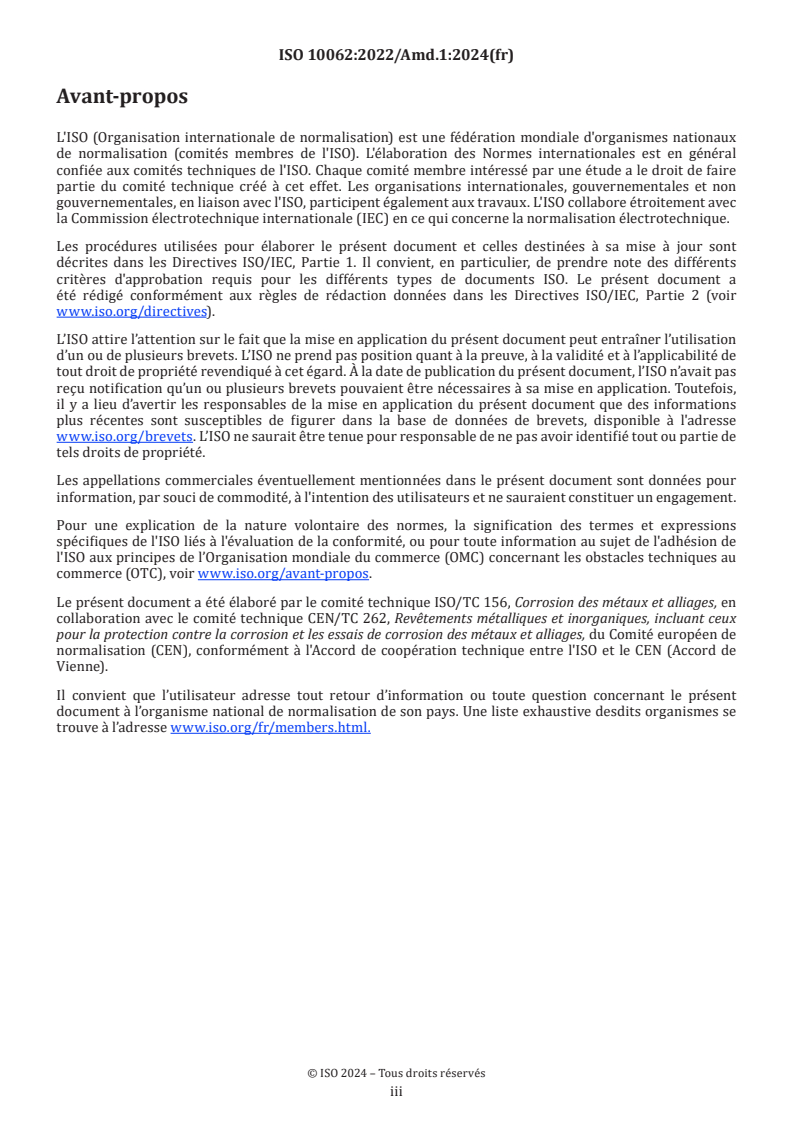
Avant-propos
L'ISO (Organisation internationale de normalisation) est une fédération mondiale d'organismes nationaux
de normalisation (comités membres de l'ISO). L'élaboration des Normes internationales est en général
confiée aux comités techniques de l'ISO. Chaque comité membre intéressé par une étude a le droit de faire
partie du comité technique créé à cet effet. Les organisations internationales, gouvernementales et non
gouvernementales, en liaison avec l'ISO, participent également aux travaux. L'ISO collabore étroitement avec
la Commission électrotechnique internationale (IEC) en ce qui concerne la normalisation électrotechnique.
Les procédures utilisées pour élaborer le présent document et celles destinées à sa mise à jour sont
décrites dans les Directives ISO/IEC, Partie 1. Il convient, en particulier, de prendre note des différents
critères d'approbation requis pour les différents types de documents ISO. Le présent document a
été rédigé conformément aux règles de rédaction données dans les Directives ISO/IEC, Partie 2 (voir
www.iso.org/directives).
L’ISO attire l’attention sur le fait que la mise en application du présent document peut entraîner l’utilisation
d’un ou de plusieurs brevets. L’ISO ne prend pas position quant à la preuve, à la validité et à l’applicabilité de
tout droit de propriété revendiqué à cet égard. À la date de publication du présent document, l’
...
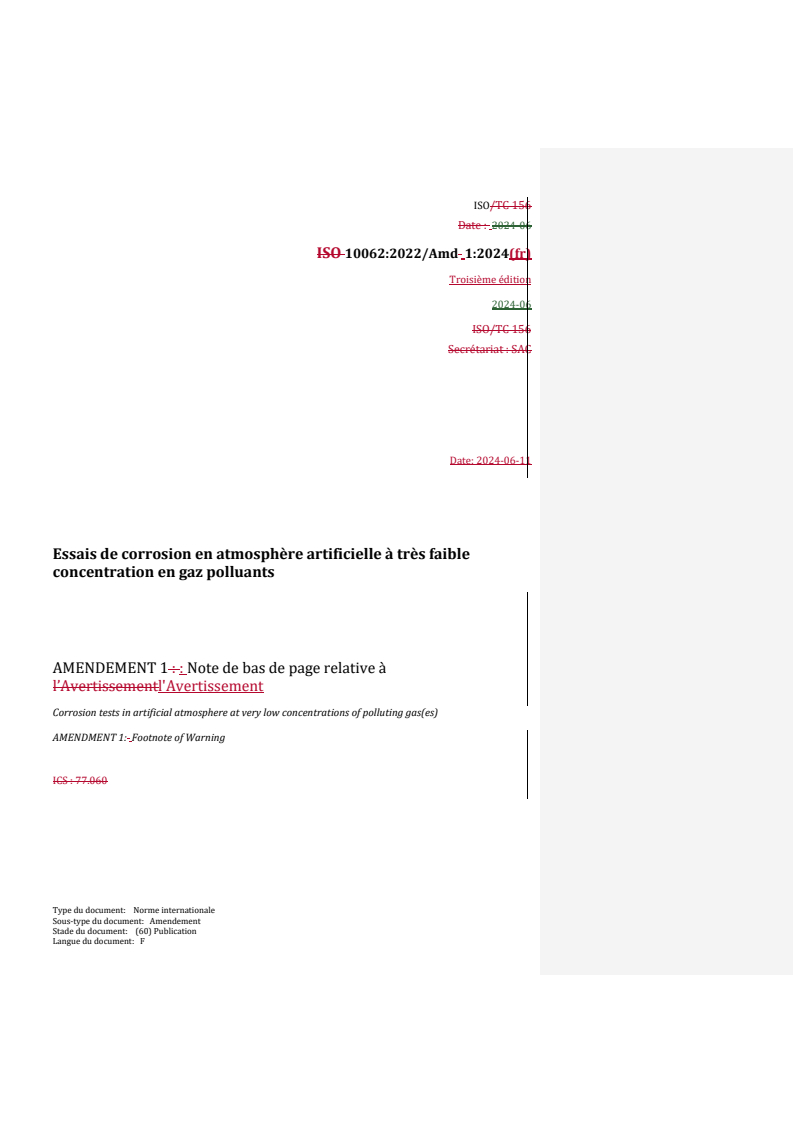
ISO/TC 156
Date : 2024-06
ISO 10062:2022/Amd 1:2024(fr)
Troisième édition
2024-06
ISO/TC 156
Secrétariat : SAC
Date: 2024-06-11
Essais de corrosion en atmosphère artificielle à très faible
concentration en gaz polluants
AMENDEMENT 1 : : Note de bas de page relative à
l’Avertissementl'Avertissement
Corrosion tests in artificial atmosphere at very low concentrations of polluting gas(es)
AMENDMENT 1: Footnote of Warning
ICS : 77.060
Type du document: Norme internationale
Sous-type du document: Amendement
Stade du document: (60) Publication
Langue du document: F
ISO #####-#:####(X)
DOCUMENT PROTÉGÉ PAR COPYRIGHT
©
2 © ISO #### – Tous droits réservés
ISO 10062:2022/Amd 1:2024(fr)
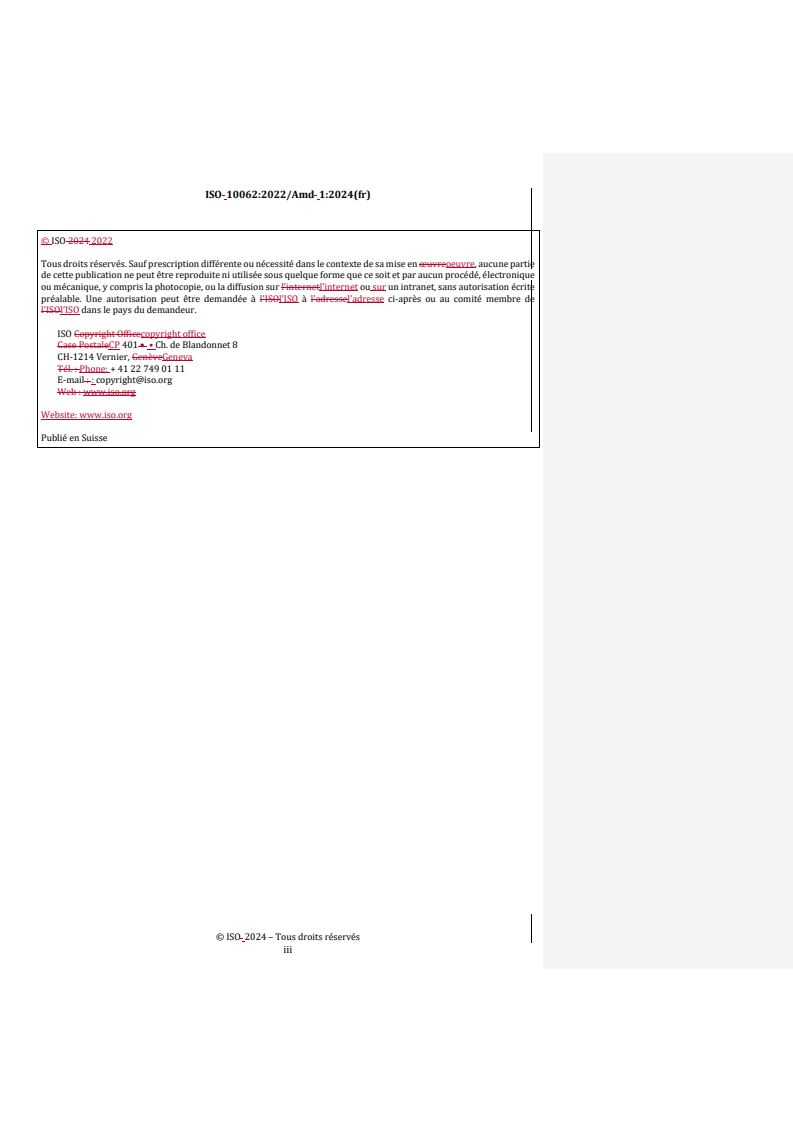
Tous droits réservés. Sauf prescription différente ou nécessité dans le contexte de sa mise en œuvreoeuvre, aucune partie
de cette publication ne peut être reproduite ni utilisée sous quelque forme que ce soit et par aucun procédé, électronique
ou mécanique, y compris la photocopie, ou la diffusion sur l'internetl’internet ou sur un intranet, sans autorisation écrite
préalable. Une autorisation peut être demandée à l'ISOl’ISO à l'adressel’adresse ci-après ou au comité membre de
l'ISOl’ISO dans le pays du demandeur.
ISO Copyright Officecopyright office
Case PostaleCP 401 • • Ch. de Blandonnet 8
CH-1214 Vernier, GenèveGeneva
Tél. : Phone: + 41 22 749 01 11
E-mail : : copyright@iso.org
Web : www.iso.org
Website: www.iso.org
Publié en Suisse
© ISO 2024 – Tous droits réservés
iii
ISO 10062:2022/Amd 1:2024(fr)
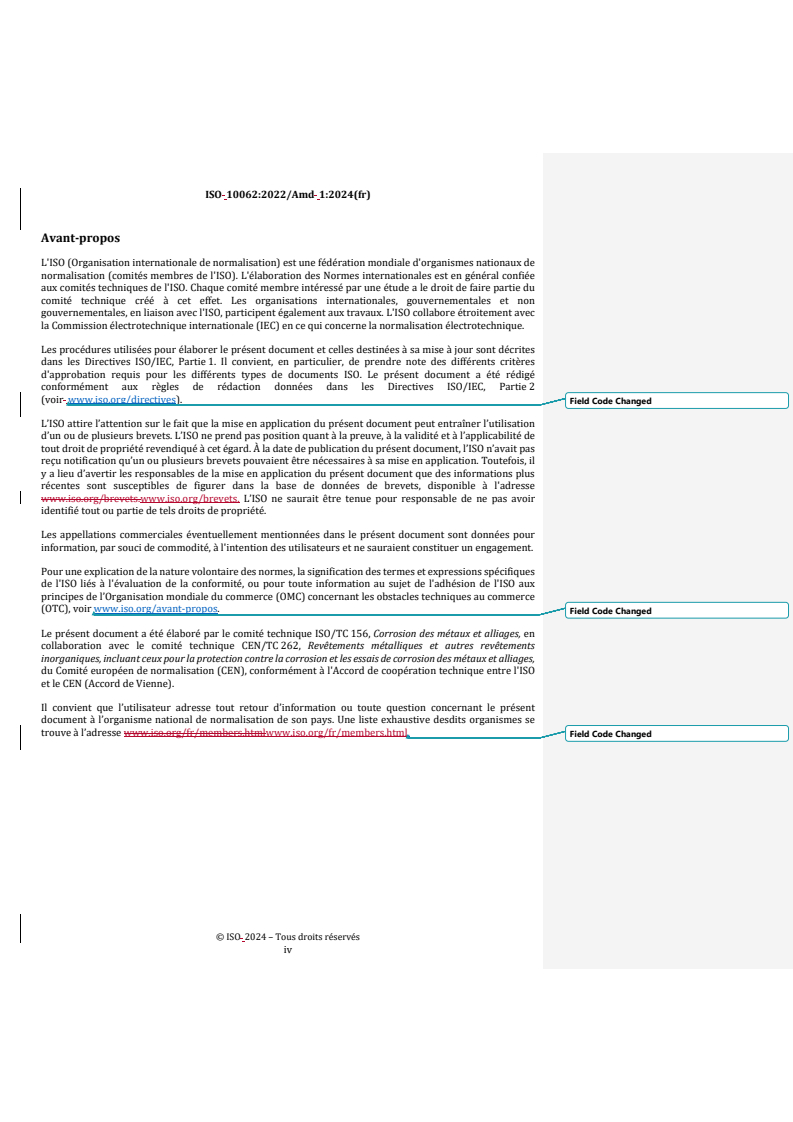
Avant-propos
L'ISO (Organisation internationale de normalisation) est une fédération mondiale d'organismes nationaux de
normalisation (comités membres de l'ISO). L'élaboration des Normes internationales est en général confiée
aux comités techniques de l'ISO. Chaque comité membre intéressé par une étude a le droit de faire partie du
comité technique créé à cet effet. Les organisations internationales, gouvernementales et non
gouvernementales, en liaison avec l'ISO, participent également aux travaux. L'ISO collabore étroitement avec
la Commission électrotechnique internationale (IEC) en ce qui concerne la normalisation électrotechnique.
Les procédures utilisées pour élaborer le présent document et celles destinées à sa mise à jour sont décrites
dans les Directives ISO/IEC, Partie 1. Il convient, en particulier, de prendre note des différents critères
d'approbation requis pour les différents types de documents ISO. Le présent document a été rédigé
conformément aux règles de rédaction données dans les Directives ISO/IEC, Partie 2
(voir www.iso.org/directives).
Field Code Changed
L’ISO attire l’attention sur le fait que la mise en application du présent document peut entraîner l’utilisation
d’un ou de plusieurs
...