

ISO 10325:2026
(Main)Fibre ropes — High modulus polyethylene — 8-strand braided ropes, 12-strand braided ropes and covered ropes
- Abstract
This document specifies requirements for 8-strand braided ropes, for 12-strand braided ropes, and for covered rope constructions (single braid, double braid and multi-core construction) for general purpose made of high modulus polyethylene (HMPE), and gives rules for their designation. Many different types and grades of HMPE fibre exist which are commonly used to produce rope products. This document does not apply to all variations in strength or product performance.
- Status
- Published
- Publication Date
- 04-Jun-2026
- Technical Committee
- ISO/TC 38 - Textiles
- Drafting Committee
- ISO/TC 38/WG 21 - Ropes, cordage, slings and netting
- Current Stage
- 6060 - International Standard published
- Start Date
- 05-Jun-2026
- Due Date
- 02-Sep-2026
- Completion Date
- 05-Jun-2026
Buy Documents
ISO 10325:2026 - Fibre ropes — High modulus polyethylene — 8-strand braided ropes, 12-strand braided ropes and covered ropes
ISO 10325:2026 - Cordages en fibres — Polyéthylène à haut module — Cordages tressés à 8 torons, cordages tressés à 12 torons et cordages avec couverture
ISO 10325:2026 is an International Standard from ISO for fibre ropes made of high modulus polyethylene (HMPE). It specifies requirements for 8-strand braided ropes, 12-strand braided ropes, and covered rope constructions for general purpose, and it gives designation rules for ordering and identification. It is written for rope manufacturers, suppliers, buyers, and users who need to specify, check, or select these ropes.
What does ISO 10325:2026 specify?
ISO 10325:2026 specifies the requirements for HMPE fibre ropes in three rope families - 8-strand braided, 12-strand braided, and covered constructions. The scope is limited to general purpose use, and it notes that HMPE exists in many types and grades, so the document does not cover every strength or performance variation.
The document is organized into clauses on scope, normative references, terms and definitions, designation, material, general requirements, physical properties, and marking. Clause 7 contains the declared linear density and minimum breaking strength information, while the earlier clauses define how the ropes are identified and built.
What are the key requirements of ISO 10325:2026?
ISO 10325:2026 ties together designation, material, construction, declared properties, and marking so that the rope can be specified and compared in a consistent way. In practice, the standard tells the reader what the rope shall be made from, how it shall be built, how it shall be identified, and which property values are used for general-purpose selection.
Designation
Clause 4 requires each fibre rope designation to state the words “fibre rope”, the document number ISO 10325, the rope construction or type, the reference number, the rope material, and the stabilization type according to ISO 9554. HMPE ropes that have been heat set are type 1, and those that have not been heat set are type 2, so the designation shows whether the rope was heat treated.
This matters because the designation is what appears in purchase descriptions, technical data sheets, and delivery documents. It helps prevent confusion between similar ropes that differ in construction, material, or heat setting.
Material and rope build
Clause 5 requires the rope, or the load-bearing core of the rope, to be made of filament HMPE fibres. For covered ropes, the cover can be made from different fibre materials and can vary in thickness and coatings, depending on the application.
Clause 5 also notes that heat setting can increase break strength per unit weight, but it may reduce service life, and that different HMPE grades can have different creep and fatigue behavior. If requested, the manufacturer shall provide creep and fatigue information, which helps the user judge suitability for long-term loading.
Constructions and manufacture
Clause 6.1 limits the construction to type L 8-strand braided ropes, type T 12-strand braided ropes, and type K covered ropes. Clause 6.2 states that the construction, manufacture, and braid pitch or lay length shall conform to ISO 9554, and that the cover on a covered rope is non-load-bearing.
For covered ropes, strand interchanges are allowed in the protective cover if they are properly staggered. That gives manufacturers some construction flexibility, while keeping the rope functionally consistent.
Physical properties
Clause 7 states that linear density and minimum breaking strength shall conform to the tables in the standard, which are presented for general purpose ropes only. The tables distinguish unspliced ropes and ropes with eye-spliced terminations, and for covered ropes they also distinguish jacket materials.
This matters in practice because the declared values are used for selection and comparison, but the standard also warns that actual performance can change with coatings, terminations, loading rate, conditioning, bends over sheaves, and knots. The supplier shall also provide instructions for use and maintenance, so the user can match the rope design to the intended application.
Marking
Clause 8 allows the manufacturer to use coloured synthetic yarns for identification and requires printed marker tape in accordance with ISO 9554. This supports traceability and helps users identify the rope type after delivery and during service.
What terms does ISO 10325:2026 define?
- Cover / jacket - A braided cover or other protective layer placed over the rope core, and it does not contribute significantly to rope strength.
- Heat-set rope - A rope whose properties have been modified by heat while under controlled tensile load.
- General purpose use - Use based on a conservative approach that gives a safety margin for foreseeable use and reasonably foreseeable misuse.
- High modulus polyethylene (HMPE) - The fibre material used for the ropes covered by this standard.
- Type 1 - The designation used for HMPE ropes that have been heat set.
- Type 2 - The designation used for HMPE ropes that have not been heat set.
Who uses ISO 10325:2026?
ISO 10325:2026 is used by rope manufacturers who need to build HMPE ropes to a defined construction and mark them correctly. It is also used by suppliers, buyers, and quality managers who need to specify rope type, reference number, material, and stabilization type in orders and technical documents.
Test laboratories and technical staff use the standard together with ISO 2307 when measuring physical properties. Users who select rope for an application use it to compare declared linear density, minimum breaking strength, cover construction, and service-related information such as creep, fatigue, and maintenance instructions.
What changed in ISO 10325:2026 from the previous edition?
ISO 10325:2026 is the third edition and cancels and replaces ISO 10325:2018. The standard states that it has been technically revised.
The changes listed in the foreword are:
- a safety and risk warning was added before the Scope
- Clause 3 gained a definition of general purpose use
- Clause 5 was revised for material description
- Clause 6 had Figure 1 revised and the figure layout aligned
- Clause 7 was revised for physical properties, including the linear density values in Table 1 and Table 2 and the related footnotes
Which standards are used with ISO 10325:2026?
- ISO 1968 - Provides the vocabulary for fibre ropes and cordage used in Clause 3.
- ISO 2307 - Provides the method for determining certain physical and mechanical properties, including the linear density measurement referenced in Clause 7.
- ISO 9554 - Provides general specifications used for rope construction, manufacture, lay length or braid pitch, labelling, packaging, invoicing, delivered lengths, and stabilization type.
What does the ISO 10325:2026 document contain?
ISO 10325:2026 contains a designation rule in Clause 4, construction rules in Clause 6, and property tables in Clause 7. It also includes figures for type L, type T, and type K rope constructions, plus an example designation in Clause 4.
Clause 7 presents the declared linear density and minimum breaking strength information for general-purpose use, with separate entries for unspliced ropes and ropes with eye-spliced terminations. The document also uses notes and footnotes to explain how cover design, coatings, terminations, and loading conditions affect practical performance.
Relations
- Effective Date
- 12-Feb-2026
- Effective Date
- 14-Sep-2024
- Effective Date
- 07-Sep-2024
Buy Documents
ISO 10325:2026 - Fibre ropes — High modulus polyethylene — 8-strand braided ropes, 12-strand braided ropes and covered ropes
ISO 10325:2026 - Cordages en fibres — Polyéthylène à haut module — Cordages tressés à 8 torons, cordages tressés à 12 torons et cordages avec couverture
Get Certified
Connect with accredited certification bodies for this standard

Control Union Certifications
Global certification for agriculture and sustainability.

Hohenstein Institut
Textile testing and certification.

Bureau Veritas Bangladesh
Bureau Veritas certification services in Bangladesh.
Sponsored listings
Frequently Asked Questions
ISO 10325:2026 is a standard published by the International Organization for Standardization (ISO). Its full title is "Fibre ropes — High modulus polyethylene — 8-strand braided ropes, 12-strand braided ropes and covered ropes". This standard covers: This document specifies requirements for 8-strand braided ropes, for 12-strand braided ropes, and for covered rope constructions (single braid, double braid and multi-core construction) for general purpose made of high modulus polyethylene (HMPE), and gives rules for their designation. Many different types and grades of HMPE fibre exist which are commonly used to produce rope products. This document does not apply to all variations in strength or product performance.
This document specifies requirements for 8-strand braided ropes, for 12-strand braided ropes, and for covered rope constructions (single braid, double braid and multi-core construction) for general purpose made of high modulus polyethylene (HMPE), and gives rules for their designation. Many different types and grades of HMPE fibre exist which are commonly used to produce rope products. This document does not apply to all variations in strength or product performance.
ISO 10325:2026 is classified under the following ICS (International Classification for Standards) categories: 59.080.50 - Ropes. The ICS classification helps identify the subject area and facilitates finding related standards.
ISO 10325:2026 has the following relationships with other standards: It is inter standard links to EN ISO 10325:2026, ISO/TS 4985:2023, ISO 10325:2018. Understanding these relationships helps ensure you are using the most current and applicable version of the standard.
ISO 10325:2026 is available in PDF format for immediate download after purchase. The document can be added to your cart and obtained through the secure checkout process. Digital delivery ensures instant access to the complete standard document.
Standards Content (Sample)
International
Standard
ISO 10325
Third edition
Fibre ropes — High modulus
2026-06
polyethylene — 8-strand braided
ropes, 12-strand braided ropes and
covered ropes
Cordages en fibres — Polyéthylène à haut module — Cordages
tressés à 8 torons, cordages tressés à 12 torons et cordages avec
couverture
Reference number
© ISO 2026
All rights reserved. Unless otherwise specified, or required in the context of its implementation, no part of this publication may
be reproduced or utilized otherwise in any form or by any means, electronic or mechanical, including photocopying, or posting on
the internet or an intranet, without prior written permission. Permission can be requested from either ISO at the address below
or ISO’s member body in the country of the requester.
ISO copyright office
CP 401 • Ch. de Blandonnet 8
CH-1214 Vernier, Geneva
Phone: +41 22 749 01 11
Email: copyright@iso.org
Website: www.iso.org
Published in Switzerland
ii
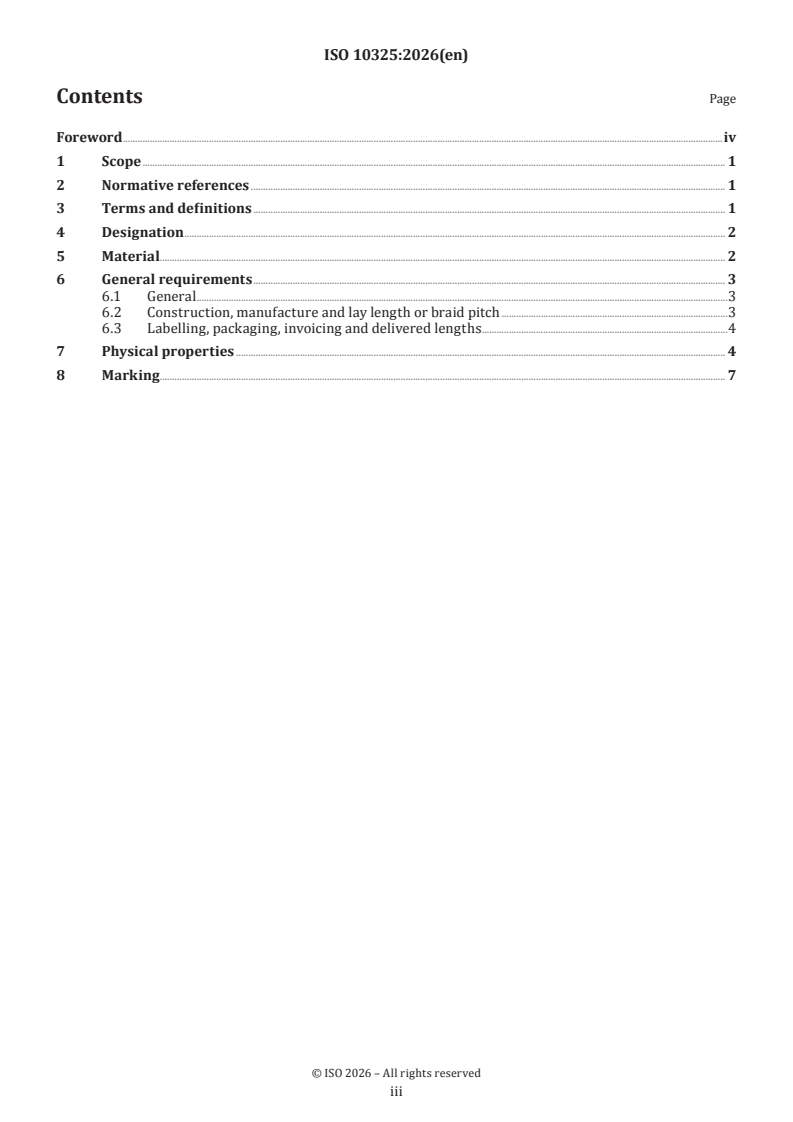
Contents Page
Foreword .iv
1 Scope . 1
2 Normative references . 1
3 Terms and definitions . 1
4 Designation . 2
5 Material. 2
6 General requirements . 3
6.1 General .3
6.2 Construction, manufacture and lay length or braid pitch .3
6.3 Labelling, packaging, invoicing and delivered lengths .4
7 Physical properties . 4
8 Marking . . 7
iii
Foreword
ISO (the International Organization for Standardization) is a worldwide federation of national standards
bodies (ISO member bodies). The work of preparing International Standards is normally carried out through
ISO technical committees. Each member body interested in a subject for which a technical committee
has been established has the right to be represented on that committee. International organizations,
governmental and non-governmental, in liaison with ISO, also take part in the work. ISO collaborates closely
with the International Electrotechnical Commission (IEC) on all matters of electrotechnical standardization.
The procedures used to develop this document and those intended for its further maintenance are described
in the ISO/IEC Directives, Part 1. In particular, the different approval criteria needed for the different types
of ISO document should be noted. This document was drafted in accordance with the editorial rules of the
ISO/IEC Directives, Part 2 (see www.iso.org/directives).
ISO draws attention to the possibility that the implementation of this document may involve the use of (a)
patent(s). ISO takes no position concerning the evidence, validity or applicability of any claimed patent
rights in respect thereof. As of the date of publication of this document, ISO had not received notice of (a)
patent(s) which may be required to implement this document. However, implementers are cautioned that
this may not represent the latest information, which may be obtained from the patent database available at
www.iso.org/patents. ISO shall not be held responsible for identifying any or all such patent rights.
Any trade name used in this document is information given for the convenience of users and does not
constitute an endorsement.
For an explanation of the voluntary nature of standards, the meaning of ISO specific terms and expressions
related to conformity assessment, as well as information about ISO's adherence to the World Trade
Organization (WTO) principles in the Technical Barriers to Trade (TBT), see www.iso.org/iso/foreword.html.
This document was prepared by Technical Committee ISO/TC 38, Textiles, in collaboration with the European
Committee for Standardization (CEN) Technical Committee CEN/TC 248, Textiles and textile products, in
accordance with the Agreement on technical cooperation between ISO and CEN (Vienna Agreement).
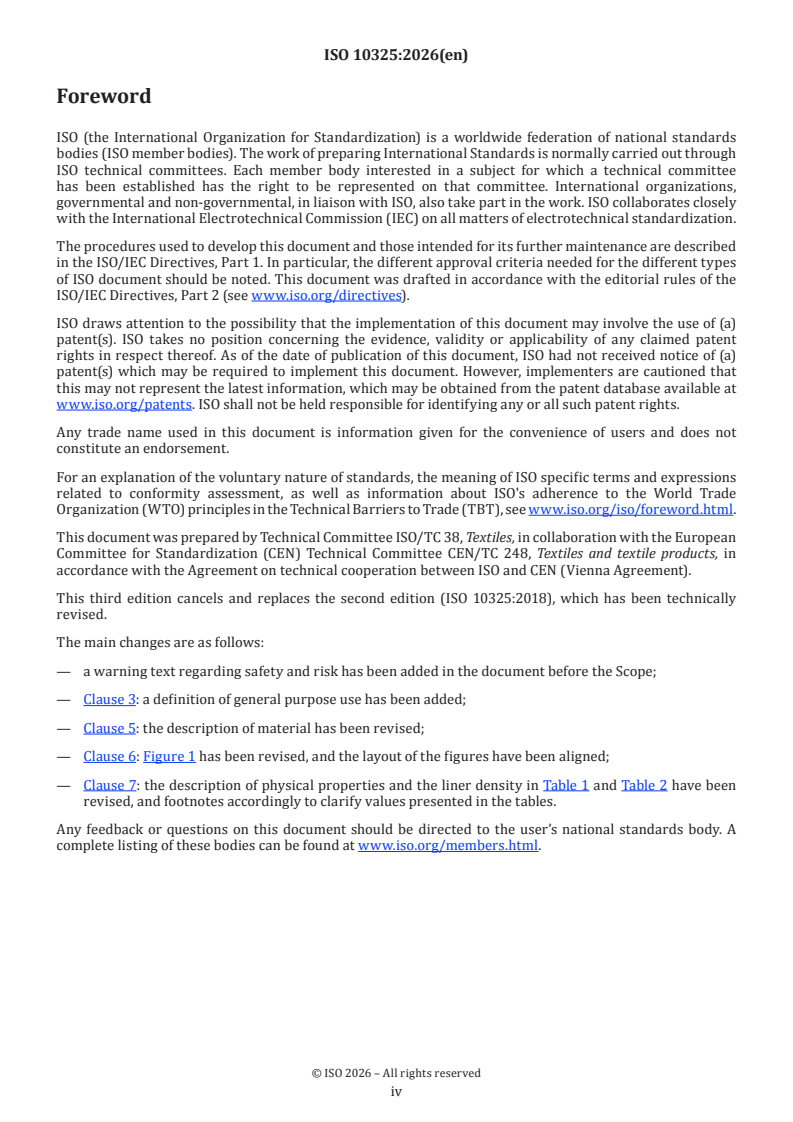
This third edition cancels and replaces the second edition (ISO 10325:2018), which has been technically
revised.
The main changes are as follows:
— a warning text regarding safety and risk has been added in the document before the Scope;
— Clause 3: a definition of general purpose use has been added;
— Clause 5: the description of material has been revised;
— Clause 6: Figure 1 has been revised, and the layout of the figures have been aligned;
— Clause 7: the description of physical properties and the liner density in Table 1 and Table 2 have been
revised, and footnotes accordingly to clarify values presented in the tables.
Any feedback or questions on this document should be directed to the user’s national standards body. A
complete listing of these bodies can be found at www.iso.org/members.html.
iv
International Standard ISO 10325:2026(en)
Fibre ropes — High modulus polyethylene — 8-strand
braided ropes, 12-strand braided ropes and covered ropes
WARNING — The use of rope and cordage products has inherent safety risks which are subject to
highly variable conditions, and which may change over time. Conformance with this document does
not guarantee safe use under all circumstances. If the user has any questions or uncertainties about
the proper use of rope or cordage, or about safe practices for general purpose use, a competent
person shall be consulted.
1 Scope
This document specifies requirements for 8-strand braided ropes, for 12-strand braided ropes, and for
covered rope constructions (single braid, double braid and multi-core construction) for general purpose
made of high modulus polyethylene (HMPE), and gives rules for their designation.
Many different types and grades of HMPE fibre exist which are commonly used to produce rope products.
This document does not apply to all variations in strength or product performance
2 Normative references
The following documents are referred to in the text in such a way that some or all of their content constitutes
requirements of this document. For dated references, only the edition cited applies. For undated references,
the latest edition of the referenced document (including any amendments) applies.
ISO 1968, Fibre ropes and cordage — Vocabulary
ISO 2307, Fibre ropes — Determination of certain physical and mechanical properties
ISO 9554, Fibre ropes — General specifications
3 Terms and definitions
For the purposes of this document, the terms and definitions given in ISO 1968 and the following apply.
ISO and IEC maintain terminology databases for use in standardization at the following addresses:
— ISO Online browsing platform: available at https:// www .iso .org/ obp
— IEC Electropedia: available at https:// www .electropedia .org/
3.1
cover
jacket
braided cover or other protective layer, which is placed over the rope core
Note 1 to entry: The cover has no significant contribution to the rope strength.
3.2
heat-set rope
rope whose properties have been modified by applying heat while simultaneously subjecting it to a
controlled tensile load
3.3
general purpose use
use where a conservative approach addressing most foreseeable use, and reasonably foreseeable misuse,
provide a sufficient margin of safety against unknown variables associated with potential conditions of use
4 Designation
Fibre ropes shall be designated as follows:
— the words “fibre rope”;
— the number of this document, i.e. ISO 10325;
— the construction or type of the rope (see Clause 6);
— the reference number of the rope;
— the material from which the rope is made (including cover material if applicable);
— the type of stabilization (type 1 or type 2 in accordance with ISO 9554).
HMPE ropes that have been heat set are designated as type 1 ropes. HMPE ropes that have not been heat set
are designated as type 2 ropes.
EXAMPLE Designation of a 12-strand braided rope, reference number 20 (type T), corresponding to a linear
density of 232 ktex made of high modulus polyethylene (HMPE) that has not been heat set:
Fibre rope ISO 10325 - T - 20 - HMPE - 2
5 Material
5.1 The ropes, or load bearing core of the rope, shall be made of filament HMPE fibres. The rope user shall
consult the rope manufacturer to ensure the intended design meets the requirements of the application.
5.2 Overlay finishes and coating
...
Norme
internationale
ISO 10325
Troisième édition
Cordages en fibres — Polyéthylène à
2026-06
haut module — Cordages tressés à 8
torons, cordages tressés à 12 torons
et cordages avec couverture
Fibre ropes — High modulus polyethylene — 8-strand braided
ropes, 12-strand braided ropes and covered ropes
Numéro de référence
DOCUMENT PROTÉGÉ PAR COPYRIGHT
© ISO 2026
Tous droits réservés. Sauf prescription différente ou nécessité dans le contexte de sa mise en œuvre, aucune partie de cette
publication ne peut être reproduite ni utilisée sous quelque forme que ce soit et par aucun procédé, électronique ou mécanique,
y compris la photocopie, ou la diffusion sur l’internet ou sur un intranet, sans autorisation écrite préalable. Une autorisation peut
être demandée à l’ISO à l’adresse ci-après ou au comité membre de l’ISO dans le pays du demandeur.
ISO copyright office
Case postale 401 • Ch. de Blandonnet 8
CH-1214 Vernier, Genève
Tél.: +41 22 749 01 11
E-mail: copyright@iso.org
Web: www.iso.org
Publié en Suisse
ii
Sommaire Page
Avant-propos .iv
1 Domaine d'application . 1
2 Références normatives . 1
3 Termes et définitions . 1
4 Désignation . 2
5 Matériau . 2
6 Exigences générales . . 3
6.1 Généralités .3
6.2 Construction, fabrication et pas de commettage ou de tressage .4
6.3 Étiquetage, emballage, facturation et longueurs de livraison.4
7 Propriétés physiques . 4
8 Marquage . 7
iii
Avant-propos
L'ISO (Organisation internationale de normalisation) est une fédération mondiale d'organismes nationaux
de normalisation (comités membres de l'ISO). L'élaboration des Normes internationales est en général
confiée aux comités techniques de l'ISO. Chaque comité membre intéressé par une étude a le droit de faire
partie du comité technique créé à cet effet. Les organisations internationales, gouvernementales et non
gouvernementales, en liaison avec l'ISO participent également aux travaux. L'ISO collabore étroitement avec
la Commission électrotechnique internationale (IEC) en ce qui concerne la normalisation électrotechnique.
Les procédures utilisées pour élaborer le présent document et celles destinées à sa mise à jour sont
décrites dans les Directives ISO/IEC, Partie 1. Il convient, en particulier, de prendre note des différents
critères d'approbation requis pour les différents types de documents ISO. Le présent document a
été rédigé conformément aux règles de rédaction données dans les Directives ISO/IEC, Partie 2 (voir
www.iso.org/directives).
L'ISO attire l'attention sur le fait que la mise en application du présent document peut entraîner l'utilisation
d'un ou de plusieurs brevets. L'ISO ne prend pas position quant à la preuve, à la validité et à l'applicabilité de
tout droit de brevet revendiqué à cet égard. À la date de publication du présent document, l'ISO n'avait pas
reçu notification qu'un ou plusieurs brevets pouvaient être nécessaires à sa mise en application. Toutefois,
il y a lieu d'avertir les responsables de la mise en application du présent document que des informations
plus récentes sont susceptibles de figurer dans la base de données de brevets, disponible à l'adresse
www.iso.org/brevets. L'ISO ne saurait être tenue pour responsable de ne pas avoir identifié tout ou partie de
tels droits de brevet.
Les appellations commerciales éventuellement mentionnées dans le présent document sont données pour
information, par souci de commodité, à l'intention des utilisateurs et ne sauraient constituer un engagement.
Pour une explication de la nature volontaire des normes, la signification des termes et expressions
spécifiques de l'ISO liés à l'évaluation de la conformité, ou pour toute information au sujet de l'adhésion de
l'ISO aux principes de l'Organisation mondiale du commerce (OMC) concernant les obstacles techniques au
commerce (OTC), voir www.iso.org/iso/fr/avant-propos.html.
Le présent document a été élaboré par le comité technique ISO/TC 38, Textiles, en collaboration avec le
comité technique CEN/TC 248, Textiles et produits textiles, du Comité européen de normalisation (CEN),
conformément à l'Accord de coopération technique entre l'ISO et le CEN (Accord de Vienne).
Cette troisième édition annule et remplace la deuxième édition (ISO 10325:2018), qui a fait l'objet d'une
révision technique.
Les principales modifications sont les suivantes:
— un texte d'avertissement concernant la sécurité et le risque a été ajouté dans le document avant le
domaine d'application;
— paragraphe 3: une définition d'usage général a été ajoutée;
— paragraphe 5: la description du matériau a été révisée;
— paragraphe 6: la Figure 1 a été révisée et la présentation des figures a été alignée;
— paragraphe 7: la description des propriétés physiques et la masse linéique dans le Tableau 1 et le Tableau 2
ont été révisées, et les notes de bas de page ont été modifiées en conséquence pour clarifier les valeurs
présentées dans les tableaux.
Il convient que l'utilisateur adresse tout retour d'information ou toute question concernant le présent
document à l'organisme national de normalisation de son pays. Une liste exhaustive desdits organismes se
trouve à l'adresse www.iso.org/fr/members.html.
iv
Norme internationale ISO 10325:2026(fr)
Cordages en fibres — Polyéthylène à haut module — Cordages
tressés à 8 torons, cordages tressés à 12 torons et cordages
avec couverture
AVERTISSEMENT — L’utilisation de cordes et de cordages présente des risques inhérents pour la
sécurité, ceux-ci étant soumis à des conditions très variables et qui peuvent changer au fil du temps.
La conformité au présent document ne garantit pas une utilisation sûre en toutes circonstances. Si
l'utilisateur a des questions ou des incertitudes sur le bon usage de la corde ou du cordage, ou sur les
pratiques sûres pour un usage général, une personne compétente doit être consultée.
1 Domaine d'application
Le présent document spécifie les exigences applicables aux cordages tressés à 8 torons, aux cordages
tressés à 12 torons et aux cordages avec couverture (cordage tressé, cordage coaxial et construction à âmes
multiples) pour usage général fabriqués en polyéthylène à haut module (HMPE), et il précise les règles pour
leur désignation.
Il existe de nombreux types et de nombreuses qualités différentes de fibres HMPE qui sont couramment
utilisés pour fabriquer des cordages. Le présent document ne couvre pas toutes les variations de résistance
ou de performance des produits.
2 Références normatives
Les documents suivants sont cités dans le texte de sorte qu’ils constituent, pour tout ou partie de leur
contenu, des exigences du présent document. Pour les références datées, seule l’édition citée s’applique. Pour
les références non datées, la dernière édition du document de référence s'applique (y compris les éventuels
amendements).
ISO 1968, Cordages en fibres et articles de corderie — Vocabulaire
ISO 2307, Cordages en fibres — Détermination de certaines caractéristiques physiques et mécaniques
ISO 9554, Cordages en fibres — Spécifications générales
3 Termes et définitions
Pour les besoins du présent document, les termes et les définitions de l'ISO 1968 ainsi que les suivants
s’appliquent.
L’ISO et l’IEC tiennent à jour des bases de données terminologiques destinées à être utilisées en normalisation,
consultables aux adresses suivantes:
— ISO Online browsing platform: disponible à l’adresse https:// www .iso .org/ obp
— IEC Electropedia: disponible à l’adresse https:// www .electropedia .org/
3.1
couverture
gaine
couverture tressée ou autre couche protectrice, qui est placée autour de l'âme du cordage
Note 1 à l'article: La contribution de la couverture à la résistance du cordage est négligeable.
3.2
cordage thermofixé
cordage dont les propriétés ont été modifiées en appliquant de la chaleur tout en le soumettant simultanément
à une charge de traction contrôlée
3.3
usage général
utilisation pour laquelle est adoptée une approche prudente couvrant la plupart des usages prévisibles ainsi
que les mauvais usages raisonnablement prévisibles, de manière à assurer une marge de sécurité suffisante
face aux variables inconnues associées aux conditions potentielles d'utilisation
4 Désignation
Les cordages en fibres doivent être désignés de la manière suivante:
— le terme «cordage en fibres»;
— le numéro du présent document, à savoir ISO 10325;
— la construction ou le type de cordage (voir 6);
— le numéro de référence du cordage;
— le matériau constitutif du cordage (y compris le matériau de couverture, le cas échéant);
— le type de stabilisation (type 1 ou type 2, conformément à l'ISO 9554).
Les cordages HMPE qui ont été thermofixés sont désignés comme des cordages de type 1. Les cordages
HMPE qui n'ont pas été thermofixés sont désignés comme des cordages de type 2.
EXEMPLE Désignation d'un cordage tressé à 12 torons, numéro de référence 20 (type T), correspondant à une
masse linéique de 232 ktex, fabriqué en polyéthylène à haut module (HMPE), qui n'a pas été thermofixé:
Cordage en fibres ISO 10325 - T - 20 - HMPE - 2
5 Matériau
5.1 Les cordages, ou l'âme
...