

ISO 5164:2014
(Main)Petroleum products — Determination of knock characteristics of motor fuels — Research method
General Information
- Abstract
ISO 5164:2014 establishes the rating of liquid spark-ignition engine fuel in terms of an arbitrary scale of octane numbers using a standard single-cylinder, four-stroke cycle, variable compression ratio, carburetted, CFR engine operated at constant speed. Research octane number (RON) provides a measure of the knock characteristics of motor fuels in automotive engines under mild conditions of operation. ISO 5164:2014 is applicable for the entire scale range from 0 RON to 120 RON, but the working range is 40 RON to 120 RON. Typical motor fuel testing is in the range of 88 RON to 101 RON. ISO 5164:2014 is applicable for oxygenate-containing fuels containing up to 4,0 % (m/m) oxygen and for gasoline containing up to 25 % (V/V) ethanol.
- Status
- Published
- Publication Date
- 20-May-2014
- Current Stage
- 9092 - International Standard to be revised
- Start Date
- 19-Mar-2026
- Completion Date
- 29-Aug-2026
Buy Documents

ISO 5164:2014 - Petroleum products -- Determination of knock characteristics of motor fuels -- Research method
ISO 5164:2014 - Petroleum products — Determination of knock characteristics of motor fuels — Research method/21/2014
ISO 5164:2014 - Produits pétroliers -- Détermination des caractéristiques antidétonantes des carburants pour moteurs -- Méthode de recherche
ISO 5164:2014 - Produits pétroliers — Détermination des caractéristiques antidétonantes des carburants pour moteurs — Méthode de recherche/21/2014
ISO 5164:2014 - Petroleum products — Determination of knock characteristics of motor fuels — Research method/16/2015
Overview
ISO 5164:2014 specifies the research method for determining the knock characteristics of motor fuels by assigning a Research Octane Number (RON). The method uses a standard single‑cylinder, four‑stroke, variable‑compression‑ratio, carburetted CFR engine (CFR F‑1 Octane Rating Unit) operated at constant speed. ISO 5164:2014 covers the full octane scale from 0 RON to 120 RON (working range 40–120 RON), with typical motor fuel testing in the 88–101 RON range. The standard is applicable to oxygenate‑containing fuels up to 4.0 % (m/m) oxygen and gasolines containing up to 25 % (V/V) ethanol.
Key Topics
- Test principle - rating fuels on an arbitrary octane scale using a CFR engine to measure knock under mild operating conditions.
- Apparatus and instrumentation - detailed requirements for the CFR engine, knock/detonation meter (analogue and XCP digital systems are allowed), carburettor and ancillary equipment.
- Engine settings and environmental control - mandatory settings and limits (engine speed, valve timing and lift, intake air temperature/humidity, coolant and oil temperatures, spark settings, fuel–air ratio).
- Sampling and sample preparation - guidance for representative sampling and handling of motor fuel samples.
- Calibration, qualification and procedure - engine fit‑for‑use tests, calibration with primary reference fuels, step‑by‑step test procedure and special instructions for ratings above 100 RON.
- Calculation and expression of results - how to derive RON values and report them.
- Precision and uncertainty - repeatability and reproducibility data, including provisions for fuels with high ethanol content.
- Test reporting - required information and documentation for conformity and traceability.
Applications
- Quality control and acceptance testing of automotive gasoline and gasoline blends.
- Research and development of new fuel formulations and octane rating optimization.
- Regulatory compliance and fuel specification verification for refineries and fuel distributors.
- Engine calibration and knock mitigation studies for OEMs and testing laboratories.
- Comparative studies of ethanol‑blended fuels and oxygenated gasoline performance.
Who should use this standard
- Accredited fuel testing laboratories and petrochemical quality control teams.
- Refiners and fuel marketers developing or verifying gasoline grades.
- Automotive OEMs and engine research groups assessing fuel knock characteristics.
- Regulatory bodies and standards organizations setting fuel specifications.
Related Standards
- ISO 5164:2014 formally adopts procedures aligned with ASTM D2699 (the ASTM CFR research octane test method) and refers to its annexes and appendices for detailed equipment and operational tables. ISO/TC 28 (Petroleum products and lubricants) is the responsible committee.
Keywords: ISO 5164, research octane number, RON, knock characteristics, CFR engine, motor fuel testing, octane rating, petroleum standards.
Relations
- Effective Date
- 12-Feb-2026
- Effective Date
- 17-Mar-2012
Buy Documents
ISO 5164:2014 - Petroleum products -- Determination of knock characteristics of motor fuels -- Research method
ISO 5164:2014 - Petroleum products — Determination of knock characteristics of motor fuels — Research method/21/2014
ISO 5164:2014 - Produits pétroliers -- Détermination des caractéristiques antidétonantes des carburants pour moteurs -- Méthode de recherche
ISO 5164:2014 - Produits pétroliers — Détermination des caractéristiques antidétonantes des carburants pour moteurs — Méthode de recherche/21/2014
ISO 5164:2014 - Petroleum products — Determination of knock characteristics of motor fuels — Research method/16/2015
Get Certified
Connect with accredited certification bodies for this standard

Element Materials Technology
Materials testing and product certification.

ABS Group Brazil
ABS Group certification services in Brazil.

ABS Quality Evaluations Inc.
American Bureau of Shipping quality certification.
Sponsored listings
Frequently Asked Questions
ISO 5164:2014 is a standard published by the International Organization for Standardization (ISO). Its full title is "Petroleum products — Determination of knock characteristics of motor fuels — Research method". This standard covers: ISO 5164:2014 establishes the rating of liquid spark-ignition engine fuel in terms of an arbitrary scale of octane numbers using a standard single-cylinder, four-stroke cycle, variable compression ratio, carburetted, CFR engine operated at constant speed. Research octane number (RON) provides a measure of the knock characteristics of motor fuels in automotive engines under mild conditions of operation. ISO 5164:2014 is applicable for the entire scale range from 0 RON to 120 RON, but the working range is 40 RON to 120 RON. Typical motor fuel testing is in the range of 88 RON to 101 RON. ISO 5164:2014 is applicable for oxygenate-containing fuels containing up to 4,0 % (m/m) oxygen and for gasoline containing up to 25 % (V/V) ethanol.
ISO 5164:2014 establishes the rating of liquid spark-ignition engine fuel in terms of an arbitrary scale of octane numbers using a standard single-cylinder, four-stroke cycle, variable compression ratio, carburetted, CFR engine operated at constant speed. Research octane number (RON) provides a measure of the knock characteristics of motor fuels in automotive engines under mild conditions of operation. ISO 5164:2014 is applicable for the entire scale range from 0 RON to 120 RON, but the working range is 40 RON to 120 RON. Typical motor fuel testing is in the range of 88 RON to 101 RON. ISO 5164:2014 is applicable for oxygenate-containing fuels containing up to 4,0 % (m/m) oxygen and for gasoline containing up to 25 % (V/V) ethanol.
ISO 5164:2014 is classified under the following ICS (International Classification for Standards) categories: 75.160.20 - Liquid fuels. The ICS classification helps identify the subject area and facilitates finding related standards.
ISO 5164:2014 has the following relationships with other standards: It is inter standard links to EN ISO 5164:2014, ISO 5164:2005. Understanding these relationships helps ensure you are using the most current and applicable version of the standard.
ISO 5164:2014 is available in PDF format for immediate download after purchase. The document can be added to your cart and obtained through the secure checkout process. Digital delivery ensures instant access to the complete standard document.
Standards Content (Sample)
INTERNATIONAL ISO
STANDARD 5164
Fourth edition
2014-06-01
Petroleum products — Determination
of knock characteristics of motor fuels
— Research method
Produits pétroliers — Détermination des caractéristiques
antidétonantes des carburants pour moteurs — Méthode de recherche
Reference number
©
ISO 2014
© ISO 2014
All rights reserved. Unless otherwise specified, no part of this publication may be reproduced or utilized otherwise in any form
or by any means, electronic or mechanical, including photocopying, or posting on the internet or an intranet, without prior
written permission. Permission can be requested from either ISO at the address below or ISO’s member body in the country of
the requester.
ISO copyright office
Case postale 56 • CH-1211 Geneva 20
Tel. + 41 22 749 01 11
Fax + 41 22 749 09 47
E-mail copyright@iso.org
Web www.iso.org
Published in Switzerland
ii © ISO 2014 – All rights reserved
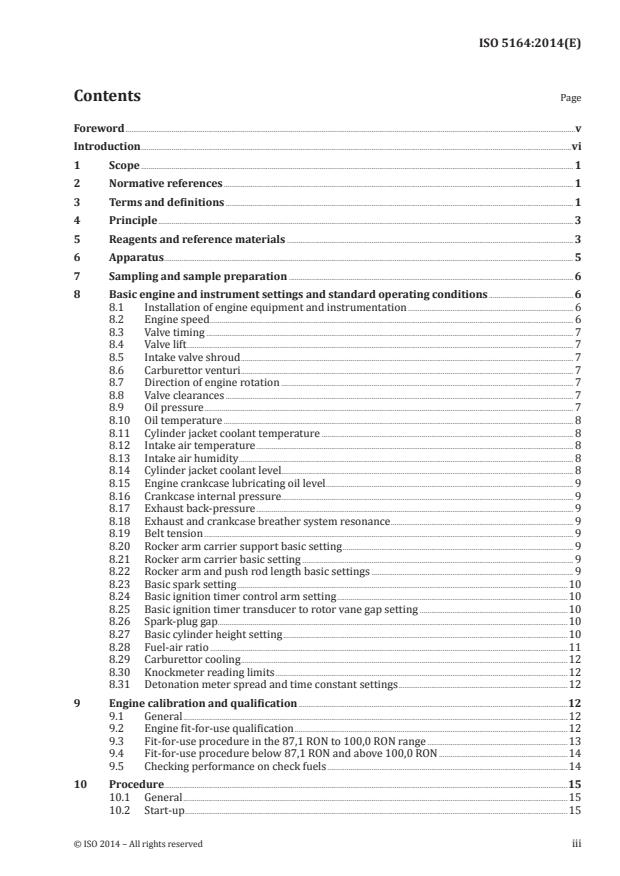
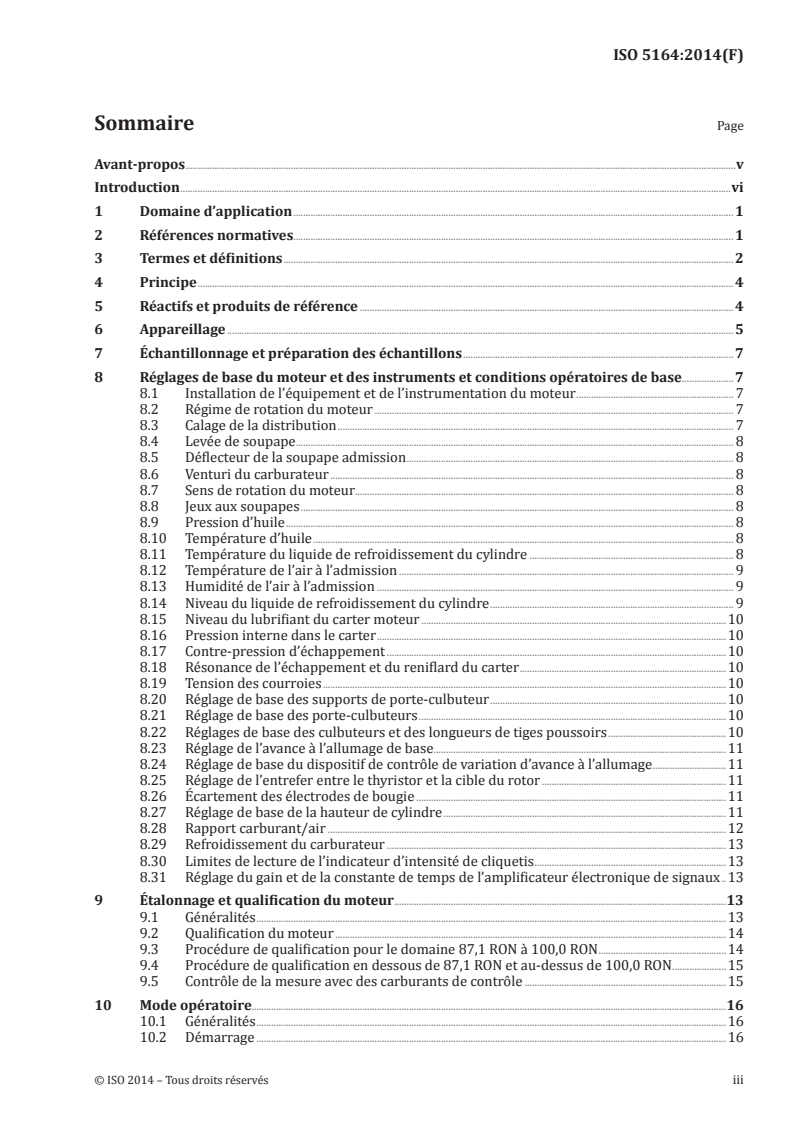
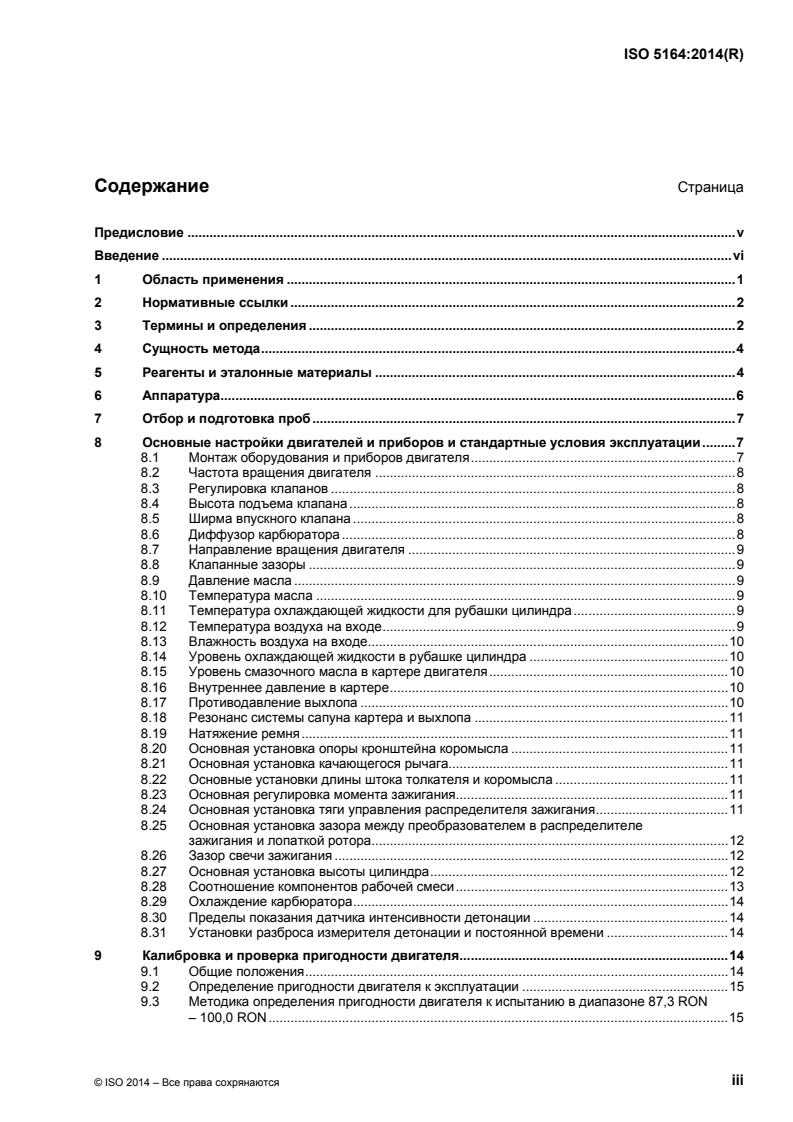
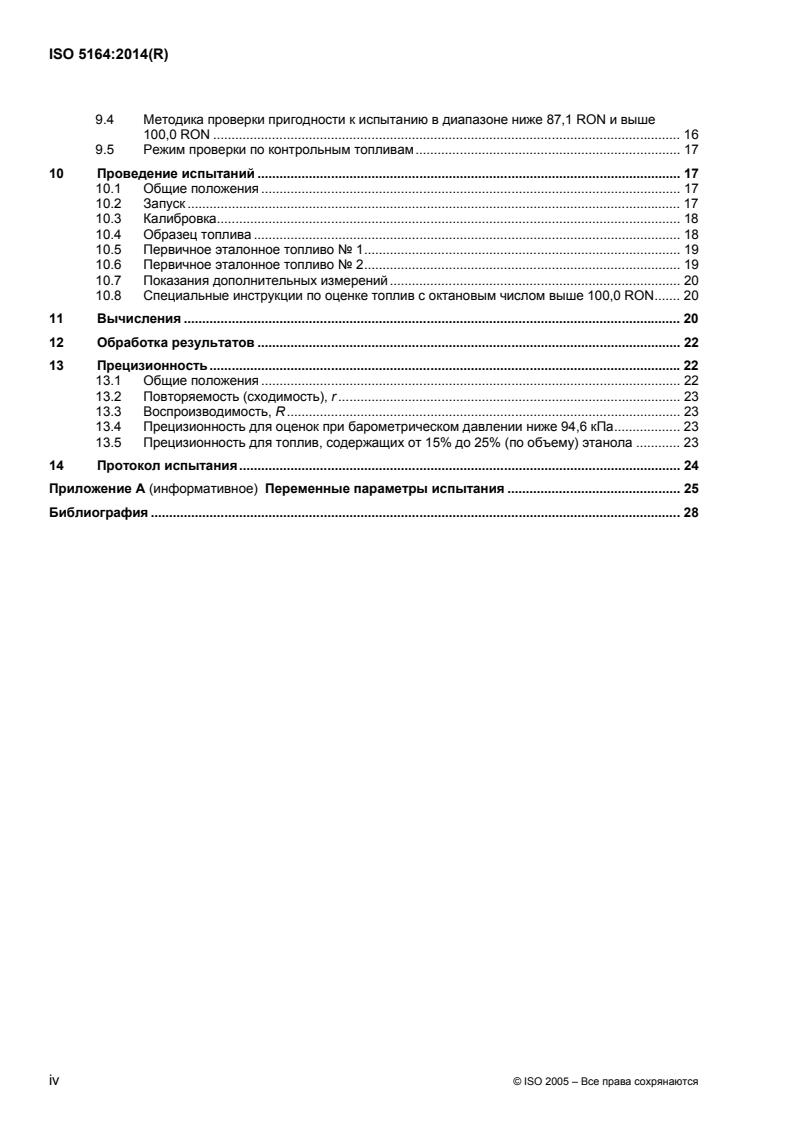
Contents Page
Foreword .v
Introduction .vi
1 Scope . 1
2 Normative references . 1
3 Terms and definitions . 1
4 Principle . 3
5 Reagents and reference materials . 3
6 Apparatus . 5
7 Sampling and sample preparation . 6
8 Basic engine and instrument settings and standard operating conditions .6
8.1 Installation of engine equipment and instrumentation . 6
8.2 Engine speed . 6
8.3 Valve timing . 7
8.4 Valve lift . 7
8.5 Intake valve shroud . 7
8.6 Carburettor venturi . 7
8.7 Direction of engine rotation . 7
8.8 Valve clearances . 7
8.9 Oil pressure . 7
8.10 Oil temperature . 8
8.11 Cylinder jacket coolant temperature . 8
8.12 Intake air temperature . 8
8.13 Intake air humidity . 8
8.14 Cylinder jacket coolant level. 8
8.15 Engine crankcase lubricating oil level. 9
8.16 Crankcase internal pressure . 9
8.17 Exhaust back-pressure . 9
8.18 Exhaust and crankcase breather system resonance . 9
8.19 Belt tension . 9
8.20 Rocker arm carrier support basic setting . 9
8.21 Rocker arm carrier basic setting . 9
8.22 Rocker arm and push rod length basic settings . 9
8.23 Basic spark setting .10
8.24 Basic ignition timer control arm setting .10
8.25 Basic ignition timer transducer to rotor vane gap setting .10
8.26 Spark-plug gap .10
8.27 Basic cylinder height setting .10
8.28 Fuel-air ratio .11
8.29 Carburettor cooling .12
8.30 Knockmeter reading limits .12
8.31 Detonation meter spread and time constant settings .12
9 Engine calibration and qualification .12
9.1 General .12
9.2 Engine fit-for-use qualification .12
9.3 Fit-for-use procedure in the 87,1 RON to 100,0 RON range .13
9.4 Fit-for-use procedure below 87,1 RON and above 100,0 RON .14
9.5 Checking performance on check fuels .14
10 Procedure.15
10.1 General .15
10.2 Start-up .15
10.3 Calibration .15
10.4 Sample fuel .16
10.5 Primary reference fuel No. 1 .16
10.6 Primary reference fuel No. 2 .17
10.7 Additional measurement readings .17
10.8 Special instructions for ratings above 100,0 RON .17
11 Calculation .18
12 Expression of results .18
13 Precision .19
13.1 General .19
13.2 Repeatability, r . 19
13.3 Reproducibility, R . 19
13.4 Precision for ratings at barometric pressures below 94,6 kPa .19
13.5 Precision for fuels containing 15% to 25% (V/V) ethanol .20
14 Test report .20
Annex A (informative) Test variable characteristics .21
Bibliography .24
iv © ISO 2014 – All rights reserved
Foreword
ISO (the International Organization for Standardization) is a worldwide federation of national standards
bodies (ISO member bodies). The work of preparing International Standards is normally carried out
through ISO technical committees. Each member body interested in a subject for which a technical
committee has been established has the right to be represented on that committee. International
organizations, governmental and non-governmental, in liaison with ISO, also take part in the work.
ISO collaborates closely with the International Electrotechnical Commission (IEC) on all matters of
electrotechnical standardization.
The procedures used to develop this document and those intended for its further maintenance are
described in the ISO/IEC Directives, Part 1. In particular the different approval criteria needed for the
different types of ISO documents should be noted. This document was drafted in accordance with the
editorial rules of the ISO/IEC Directives, Part 2. www.iso.org/directives
Attention is drawn to the possibility that some of the elements of this document may be the subject of
patent rights. ISO shall not be held responsible for identifying any or all such patent rights. Details of any
patent rights identified during the development of the document will be in the Introduction and/or on
the ISO list of patent declarations received. www.iso.org/patents
Any trade name used in this document is information given for the convenience of users and does not
constitute an endorsement.
For an explanation on the meaning of ISO specific terms and expressions related to conformity
assessment, as well as information about ISO’s adherence to the WTO principles in the Technical Barriers
to Trade (TBT), see the following URL: Foreword - Supplementary information
The committee responsible for this document is ISO/TC 28, Petroleum products and lubricants.
This fourth edition cancels and replaces the third edition (ISO 5164:2005). Besides improving the
understanding of some of the procedures, the main revision lays in the introduction of the so-called
digital detonation meter. The revision includes allowances both measurement systems:
a) the knock measurement system based on analogue technology, and
b) the XCP digital technology used in the digital detonation meter.
Introduction
The purpose of this International Standard is to accord ISO status to a test procedure that is already used
in a standardized form all over the world. The procedure in question is published by ASTM International
as Standard Test Method D 2699-12.
By publishing this International Standard, ISO recognizes that this method is used in its original text in
many member countries and that the standard equipment and many of the accessories and materials
required for the method are obtainable only from specific manufacturers or suppliers. To carry out
the procedure in every detail requires reference to annexes and appendices of ASTM D 2699-12. The
annexes detail the specific equipment and instrumentation required, the critical component settings and
adjustments, and include the working tables of referenced settings. The appendices provide background
and additional insight about auxiliary equipment, operational techniques and the concepts relative to
proper maintenance of the engine and instrumentation items.
The accumulated motor fuel data relating to knock characteristics determined in many countries has,
for many years, been based on the use of the CFR engine and the ASTM octane test methods. Accepted
worldwide, petroleum industry octane number requirements for motor fuels are defined by the research
1)
method and associated CFR F-1 Octane Rating Unit , which emphasizes the need for this method and
test equipment to be standardized. The initiation of studies to use a different engine for ISO purposes
has therefore been considered an unnecessary duplication of effort.
For these reasons, it has been considered desirable by ISO Technical Committee 28, Petroleum products
and lubricants, to adopt the ASTM D 2699 standard procedures. However, this International Standard
refers to annexes and appendices of ASTM D 2699 without change because of their extensive detail.
These annexes and appendices are not included in this International Standard because they are available
from ASTM International.
Due to identified component obsolescence issues, the original, analogue control panel has been replaced
by the manufacturer by new digital panel as of 2011. Service parts availability for the analogue system
[5]
will be phased out in the future. Research work was executed by ASTM International to check
whether there was statistically observable systemic bias between the 501C and the new digital knock
measurement system.
With respect to precision ISO and ASTM technical committees concluded that there was numerically
comparable precision for repeatability between the 501C and new panel knock measurement systems,
and no statistically observable difference for reproducibility between the 501C and new panel knock
measurement systems. This means that the new CFR octane panel could be included in the test method.
1) The sole manufacturer of the Model CFR F-1 Octane Rating Unit is Waukesha Engine, Dresser Waukesha,
Inc., 1000 West St. Paul Avenue, Waukesha, WI 53188, USA.
vi © ISO 2014 – All rights reserved
INTERNATIONAL STANDARD ISO 5164:2014(E)
Petroleum products — Determination of knock
characteristics of motor fuels — Research method
WARNING — The use of this International Standard may involve hazardous materials, operations
and equipment. This International Standard does not purport to address of the safety problems
associated with its use. It is the responsibility of the user of this International Standard to
establish appropriate safety and health practices and determine the applicability of regulatory
limitations prior to use.
1 Scope
This International Standard establishes the rating of liquid spark-ignition engine fuel in terms of
an arbitrary scale of octane numbers using a standard single-cylinder, four-stroke cycle, variable
compression ratio, carburetted, CFR engine operated at constant speed. Research octane number
(RON) provides a measure of the knock characteristics of motor fuels in automotive engines under mild
conditions of operation.
This International Standard is applicable for the entire scale range from 0 RON to 120 RON, but the
working range is 40 RON to 120 RON. Typical motor fuel testing is in the range of 88 RON to 101 RON.
This International Standard is applicable for oxygenate-containing fuels containing up to 4,0 % (m/m)
oxygen and for gasoline containing up to 25 %(V/V) ethanol.
NOTE 1 Although 25 % (V/V) of ethanol corresponds to approximately 9 % (m/m) oxygen, full applicability of
this test method for that oxygen range has only been checked for gasoline type of fuels.
NOTE 2 Work is under way to check the possibility to use the method up to and including 85 %(V/V) ethanol.
NOTE 3 This International Standard specifies operating conditions in SI units but engine measurements may
be specified in inch-pound units because these were the units used in the manufacture of the equipment, and thus
some references in this International Standard include these units in parenthesis.
NOTE 4 For the purposes of this standard, the terms “% (m/m)” and “% (V/V)” are used to represent the mass
fraction, µ, and the volume fraction, φ, of a material respectively.
2 Normative references
The following documents, in whole or in part, are normatively referenced in this document and are
indispensable for its application. For dated references, only the edition cited applies. For undated
references, the latest edition of the referenced document (including any amendments) applies.
ISO 3170, Petroleum liquids — Manual sampling
ISO 3171, Petroleum liquids — Automatic pipeline sampling
ISO 3696, Water for analytical laboratory use — Specification and test methods
ISO 4787, Laboratory glassware — Volumetric instruments — Methods for testing of capacity and for use
ASTM D2699-12, Standard Test Method for Research Octane Number of Spark-Ignition Engine Fuel
3 Terms and definitions
For the purposes of this document, the following terms and definitions apply.
3.1
accepted reference value
ARV
value that serves as an agreed-upon reference for comparison, and which is derived as: a theoretical or
established value, based on scientific principles, an assigned or certified value, based on experimental
work of some national or international organization, or a consensus or certified value, based on
collaborative experimental work under the auspices of a scientific or engineering group
3.2
check fuel
fuel of selected characteristics that has a RON accepted reference value determined by round-robin
testing by multiple engines in different locations
3.3
cylinder height
relative vertical position of the CFR engine cylinder with respect to the piston at top dead center (t.d.c.)
or the top machined surface of the crankcase
3.4
dial indicator reading
numerical indication of cylinder height, indexed to a basic setting when the engine is motored with the
compression ratio set to produce a specified compression pressure
Note 1 to entry: The dial indicator reading is expressed in thousandths of an inch.
3.5
digital counter reading
numerical indication of cylinder height, indexed to a basic setting when the engine is motored with the
compression ratio set to produce a specified compression pressure
3.6
detonation meter
knock signal conditioning instrumentation that accepts the electrical signal from the detonation pickup
and produces an output signal for display
Note 1 to entry: The meter is either analogue or digital.
3.7
detonation pickup
magnetostrictive-type transducer that threads into the engine cylinder to sense combustion-chamber
pressure and provide an electrical signal proportional to the rate-of-change of that cylinder pressure
3.8
firing
engine operation with fuel and ignition
3.9
fuel-air ratio for maximum knock intensity
proportion of fuel to air that produces the highest knock intensity for each fuel
3.10
guide table
tabulation of the specific relationship between cylinder height and octane number for the CFR engine
operated at standard knock intensity and a specified barometric pressure
3.11
knock
abnormal combustion, often producing an audible sound, caused by auto-ignition of the air-fuel mixture
2 © ISO 2014 – All rights reserved
3.12
knock intensity
measure of engine knock
3.13
knockmeter
indicating meter with a division scale that displays the knock intensity signal from the detonation meter
Note 1 to entry: The meter is either analogue or digital.
3.14
motoring
engine operation without fuel and with the ignition shut off
3.15
research octane number
RON
numerical rating of knock resistance for a fuel obtained by comparing its knock intensity with that of
primary reference fuels of known research octane number when tested in a standardized CFR engine
operating under conditions specified in this document
3.16
oxygenate
oxygen-containing organic compound, such as various alcohols or ethers, used as a fuel or fuel supplement
3.17
primary reference fuel
PRF
2,2,4-trimethylpentane (iso-octane), n-heptane, volumetrically proportioned mixtures of iso-octane
with n-heptane, or blends of tetraethyl lead in iso-octane, which define the octane number scale
3.18
spread
sensitivity of the detonation meter expressed in knockmeter divisions per octane number
3.19
toluene standardization fuel
TSF
volumetrically proportioned blend that has RON accepted reference value and specified rating tolerances
4 Principle
A sample fuel, operating in a CFR engine at the fuel-air ratio that maximizes its knock, is compared to
primary reference fuel blends to determine that blend which, when operated at the fuel-air ratio that
maximizes its knock, would result in both fuels producing the same standard knock intensity when
tested at the same engine compression ratio. The volumetric composition of the primary reference fuel
blend defines both its octane number and that of the sample fuel.
5 Reagents and reference materials
5.1 Cylinder-jacket coolant, consisting of water conforming to grade 3 of ISO 3696. Water shall be used
in the cylinder jacket for laboratory locations where the resultant boiling temperature is 100 °C ± 1,5 °C
(212 °F ± 3 °F). Water with commercial glycol-based antifreeze added in sufficient quantity to meet the
boiling temperature requirement shall be used when laboratory altitude dictates.
A commercial multi-functional water treatment material should be used in the coolant to minimize
corrosion and mineral scale that can alter heat transfer and rating results.
5.2 Carburettor coolant, if required (see 8.29), consisting of water or a water-antifreeze mixture,
chilled sufficiently to prevent fuel bubbling and excessive vaporization, but neither colder than 0,6 °C nor
warmer than 10 °C.
5.3 Engine crankcase-lubricating oil, comprising an SAE 30 viscosity grade oil meeting service
classification API SF/CE or better.
2 2
It shall contain a detergent additive and have a kinematic viscosity of 9,3 mm /s to 12,5 mm /s at 100 °C
(212 °F) and a viscosity index of not less than 85. Oils containing viscosity index improvers shall not be
used. Multi-grade lubricating oils shall not be used.
5.4 2,2,4-trimethylpentane (iso-octane) primary reference fuel, of minimum purity 99,75 % (V/V),
containing no more than 0,10 % (V/V) heptane and no more than 0,5 mg/l lead. This material shall be
1)
designated as 100 RON .
WARNING — iso-Octane is flammable and its vapours are harmful. Vapours may cause flash fire.
5.5 n-Heptane primary reference fuel, of minimum purity 99,75 % (V/V), containing no more than
2)
0,10 % (V/V) isooctane and no more than 0,5 mg/l lead. This material shall be designated as 0 RON .
WARNING — n-heptane is flammable and its vapours are harmful. Vapours may cause flash fire.
5.6 80-octane primary reference fuel blend, prepared using reference fuel grade iso-octane (5.4)
and n-heptane (5.5); this blend shall contain 80 % (V/V) ± 0,1 % (V/V) iso-octane.
NOTE ASTM D 2699–12, Annex A3 (Reference Fuel Blending Tables), provides information for preparation of
primary reference fuel blends to specific RON values.
5.7 Tetraethyl lead, dilute, (TEL dilute volume basis), consisting of a solution of aviation mix tetraethyl
lead antiknock compound in a hydrocarbon diluent of 70 % (V/V) xylene and 30 % (V/V) n-heptane.
WARNING —Tetraethyl lead is poisonous and flammable. It may be harmful or fatal if inhaled,
swallowed, or absorbed through the skin. May cause flash fire.
The anti-knock compound shall contain 18,23 % (m/m) ± 0,05 % (m/m) tetraethyl lead and have a relative
density at 15,6 °C/15,6 °C (60 °F/60 °F) of 0,957 to 0,967.
NOTE 1 The typical composition of the compound, excluding the tetraethyl lead, is as follows:
Ethylene dibromide (scavenger): 10,6 % (m/m)
Diluent:
xylene 52,5 % (m/m)
heptane 17,8 % (m/m)
Dye, antioxidant and inerts 0,87 % (m/m)
NOTE 2 Developments within ISO are under way in order to make less use of lead-containing PRFs.
5.8 Primary reference fuel blends for ratings over 100 RON, prepared by adding dilute tetraethyl
lead (5.7), in millilitre quantities, to a 400 ml volume of iso-octane (5.4). These blends define the RON
scale above 100.
1) PRFSs are commercially available, currently from Chevron Phillips Chemical Company LP., 1301 McKinney,
Suite 2130, Houston, TX 77010–3030, USA or Haltermann Products—Werk Hamburg, Zweigniederlassung der DOW
Olefinverbund GmbH, Schlengendeich 17, 21107 Hamburg, Germany.
4 © ISO 2014 – All rights reserved
NOTE ASTM D 2699–12, Annex A3 (Reference Fuel Blending Tables), provides information on the RON values
for blends of tetraethyl lead in isooctane.
5.9 Methylbenzene (toluene), reference fuel grade, with a minimum purity of 99,5 % (V/V) as
determined by chromatographic analysis, a peroxide number not exceeding 5 mg/kg and a water content
not exceeding 200 mg/kg.
Antioxidant treatment should be added by the supplier at a rate suitable for long term stability as
empirically determined with the assistance of the antioxidant supplier.
5.10 Check fuels, consisting of in-house typical spark-ignition engine fuels having RON accepted
reference values, low volatility and good long-term stability.
6 Apparatus
6.1 Test engine assembly, a CFR octane rating unit consisting of a single-cylinder engine consisting of
a standard crankcase, a cylinder/clamping sleeve assembly to provide continuously variable compression
ratio adjustable with the engine operating, thermal-siphon recirculating jacket cooling system, a multiple
fuel tank system with selector valving to deliver fuel through a single jet passage and carburettor venturi,
an intake air system with controlled temperature and humidity equipment, electrical controls, and a
suitable exhaust pipe.
The engine flywheel shall be connected by a belt to a special electric power-absorption motor that acts
as a motor driver to start the engine and as a means to absorb power at constant speed when combustion
is occurring (engine firing).
NOTE Test engine assembly is available from the single source manufacturer, GE Waukesha gas engine,
Dresser, Inc., 1000 West St. Paul Avenue, Waukesha, WI 53188, USA. This information is given for the convenience
of users of this International Standard but does not constitute an endorsement by ISO of this product.
6.2 Instrumentation, consisting of electronic detonation metering instrumentation, including a
detonation pickup and knockmeter to measure and display the intensity of combustion knock, as well as
conventional hardware, tubing, fasteners, electrical and electronic items.
NOTE Instrumentation is available from multiple sources. In some cases, selection of specific dimensions or
specification criteria are important to achieve proper conditions for the knock testing unit, and these are included
in ASTM D2699–12, Appendix X1 when applicable.
6.3 Reference and standardization fuel dispensing equipment, consisting of calibrated burettes or
volumetric ware having a capacity of 200 ml to 500 ml and a maximum volumetric tolerance of ±0,2 %.
Calibration shall be verified in accordance with ISO 4787. Burettes shall be outfitted with a delivery
valve and delivery tip to accurately control dispensed volumes. The delivery tip shall be of such size
and design that shut-off tip discharge does not exceed 0,5 ml. The rate of delivery from the dispensing
system shall not exceed 400 ml/min. The installation shall be in such a manner and be supplied with
fluids such that all components of each batch or blend are dispensed at the same temperature.
6.4 Gravimetric blending of reference fuels, use of blending systems that allow preparation of the
volumetrically-defined blends by gravimetric (mass) measurements based on the density of the individual
components is also permitted, provided the system meets the requirement for maximum 0.2 % blending
tolerance limits.
Calculate the mass equivalents of the volumetrically-defined blend components from the densities of the
individual components at 15,56°C (60°F).
6.5 Tetraethyl lead (TEL) dispensing equipment, consisting of a calibrated burette, pipette assembly,
or other liquid-dispensing apparatus, having a capacity not exceeding 4,0 ml, and a critically controlled
tolerance for dispensing dilute TEL into 400 ml batches of iso-octane.
Calibration shall be verified in accordance with ISO 4787.
NOTE ASTM D 2699–12, Appendix X2 (Volumetric Reference Fuel Blending Apparatus and Procedures),
provides additional information for application.
6.6 Special maintenance tools, consisting of a number of speciality tools and measuring instruments
available for easy, convenient and effective maintenance of the engine and testing equipment.
NOTE Lists and descriptions of these tools and instruments are available from the manufacturers of the
engine equipment and those organizations offering engineering and service support for this International
Standard.
7 Sampling and sample preparation
7.1 Unless otherwise specified in the commodity specification, samples shall be taken as described
in ISO 3170 or ISO 3171 and/or in accordance with the requirements of national regulations for the
sampling of the product under test, or an equivalent national standard.
7.2 Cool samples to 2 °C to 10 °C(35 °F to 50 °F) in the container in which they are received and before
the container is opened.
7.3 Minimize the sample’s exposure to light before pouring it into the engine carburettor fuel bowl,
because of possible sensitivity to light that can affect fuel characteristics. Collect and store samples in an
opaque container.
8 Basic engine and instrument settings and standard operating conditions
8.1 Installation of engine equipment and instrumentation
Locate the octane test engine in an area where it will not be affected by certain gases and fumes that
may have a measurable effect on the RON test result (see Clause 1).
Installation of the engine and instrumentation requires placement of the engine on a suitable foundation
and hook-up of all utilities. Engineering and technical support for this function is required, and the
user shall be responsible for complying with all local and national codes and installation requirements.
Proper operation of the CFR engine requires assembly of a number of engine components and adjustment
of a series of engine variables to prescribed specifications. Some of these settings are established by
component specifications, others are established at the time of engine assembly or after overhaul, and
still others are engine running conditions that must be observed or determined by the operator during
the testing process. Annex A gives further information on the test variable characteristics.
8.2 Engine speed
Engine speed shall be 600 r/min ± 6 r/min when the engine is operating with combustion with a
maximum variation of 6 r/min occurring during a rating.
Engine speed when combustion is occurring shall not be more than 3 r/min greater than for motoring
without combustion.
6 © ISO 2014 – All rights reserved
8.3 Valve timing
With the piston at the highest point of travel in the cylinder, set the flywheel pointer mark in alignment
with the 0° mark on the flywheel in accordance with the instructions of the manufacturer.
The four-stroke cycle engine uses two crankshaft revolutions for each complete combustion cycle. The
two critical valve events are those that occur near top-dead-centre (t.d.c.), i.e. intake valve opening and
exhaust valve closing. Intake valve opening shall occur 10,0° ± 2,5° after t.d.c. with closing at 34° after-
bottom-dead-centre (a.b.d.c.) on one revolution of the crankshaft and flywheel. Exhaust valve opening
shall occur 40° before-bottom-dead-centre (b.b.d.c.) on the second revolution of the crankshaft and
flywheel with closing at 15,0° ± 2,5° after t.d.c. on the next revolution of the crankshaft and flywheel.
8.4 Valve lift
Intake and exhaust cam lobe contours, while different in shape, shall have a contour rise of 6,248 mm
to 6,350 mm (0,246 in to 0,250 in) from the base circle to the top of the lobe so that the resulting valve
lift shall be 6,045 mm ± 0,050 mm (0,238 in ± 0,002 in). See ASTM D 2699-12, Annex A2 (Apparatus
Assembly and Setting Instructions), for procedures for measuring valve lift which shall apply for this
International Standard.
8.5 Intake valve shroud
The 180° shroud or protrusion directs the incoming fuel-air mixture and increases its turbulence in
the combustion chamber. This valve stem is drilled for a pin, which is restrained in a valve guide slot, to
prevent the valve from rotating and thus maintain the direction of swirl. The valve shall be assembled
in the cylinder, with the pin aligned in the valve guide, so that the shroud is toward the spark plug
side of the combustion chamber and the swirl is directed in a counter-clockwise direction if it could be
observed from the top of the cylinder.
8.6 Carburettor venturi
The venturi throat size, regardless of ambient barometric pressure, shall be 1,43 cm (9/16 in).
8.7 Direction of engine rotation
The crankshaft, when observed from the front of the engine, rotates in a clockwise direction.
8.8 Valve clearances
With the engine cold prior to being operated, set the clearance between each valve stem and valve rocker
half-ball to the following approximate measurements upon assembly, which will typically provide the
controlling engine running and hot clearance:
— intake valve: 0,10 mm (0,004 in);
— exhaust valve: 0,36 mm (0,014 in).
These clearances should ensure that both valves have sufficient clearance to cause valve seating during
engine warm-up. The adjustable-length valve push rods shall be set so that the valve rocker adjusting
screws have adequate travel to permit the final clearance setting. Engine running and hot clearance
for both intake and exhaust valves shall be set to 0,200 mm ± 0,025 mm (0,008 in ± 0,001 in) measured
under standard operating conditions with the engine running at equilibrium conditions on a 90 RON
primary reference fuel.
8.9 Oil pressure
Oil pressure shall be 172 kPa to 207 kPa (25 psi to 30 psi).
8.10 Oil temperature
Oil temperature shall be 57 °C ± 8 °C (135 °F ± 15 °F), accuracy recommended as with the ASTM 83 °C
(83 °F) thermometer.
8.11 Cylinder jacket coolant temperature
Cylinder jacket coolant temperature shall be 100,0 °C ± 1,5 °C (212 °F ± 3 °F), but shall not vary by more
than ± 0,5 °C (1 °F) during a rating of either certified reference material or knock intensity.
8.12 Intake air temperature
8.12.1 Set the temperature to 52 °C ± 1 °C during a rating made at a standard barometric pressure of
101,3 kPa (29,92 in Hg). At other barometric pressures, set the temperature to the value listed in Table 1
for that prevailing pressure. If intake air temperature tuning is utilized to qualify the engine as fit-for-
use based on the RON value of the appropriate toluene standardization fuel (TSF) blend, the selected
temperature shall be within ± 22 °C (40 °F) of the temperature listed in Table 1 for the prevailing barometric
pressure. When the intake air temperature is tuned, the temperature selected to provide the RON of the
appropriate TSF blend shall be used during that operating period for all ratings in the applicable RON
range for that TSF blend. The intake air temperature variation during a rating (tuned or untuned) while
KI reading are being taken shall not exceed 1 °C (2 °F).
Table 1 — Intake air temperatures for prevailing barometric pressures
Prevailing barometric pressure Standard intake air temperature
kPa (in Hg) °C (in °F)
104,6 (30,9) 59,4 (139)
101,3 (29,92) 52,0 (125,6)
98,2 (29,0) 43,9 (111)
94,8 (28,0) 36,1 (97)
91,4 (27,0) 27,8 (82)
88,0 (26,0) 19,4 (67)
86,3 (25,5) and lower 15,6 (60)
8.12.2 Temperature measurement systems used to establish the Intake Air Temperature in this test
method shall exhibit the same temperature indicating characteristics and accuracy as the ASTM 83°C
(83°F) thermometer installed at the orifice provided using the manufacturers prescribed fitting.
8.12.3 To ensure the correct temperature is indicated the temperature measurement system shall be
installed in accordance with the instructions provided for this specific application.
8.13 Intake air humidity
The water content of the air shall be between 0,003 56 kg per kilogram of dry air and 0,007 12 kg per
kilogram of dry air.
8.14 Cylinder jacket coolant level
The coolant level when the engine is running and hot shall be within ± 10 mm of the “LEVEL HOT” mark
on the coolant condenser.
NOTE With the engine cold prior to being operated, treated coolant added to the cooling condenser/cylinder
jacket to a level just observable in the bottom of the condenser sight glass, will typically provide the controlling
engine running and hot operating level.
8 © ISO 2014 – All rights reserved
8.15 Engine crankcase lubricating oil level
The controlling engine running and hot operating level of the oil in the crankcase shall be approximately
mid-position in the crankcase sight glass.
NOTE With the engine cold prior to being operated, oil added to the crankcase so that the level is near the top
of the sight glass, will typically provide this condition.
8.16 Crankcase internal pressure
The pressure shall be less than zero (a vacuum) and typically from 25 mm to 150 mm of water less
than atmospheric pressure, as measured by a gauge, a pressure sensor or manometer connected to an
opening to the inside of the crankcase through a snubber orifice to minimize pulsations. Vacuum shall
not exceed 255 mm of water.
8.17 Exhaust back-pressure
The static pressure shall be as low as possible, but shall not create a vacuum nor exceed 255 mm of
water differential in excess of atmospheric pressure, as measured by a gauge or manometer connected
to an opening in the exhaust surge tank or main exhaust stack through a snubber orifice to minimize
pulsations.
8.18 Exhaust and crankcase breather system resonance
The exhaust and crankcase breather piping systems shall have internal volumes and be of such length
that gas resonance does not occur.
NOTE ASTM D 2699–12, Appendix X3 (Operating Techniques — Adjustment of Variables), provides a suitable
procedure to determine if resonance exists.
8.19 Belt tension
The belts connecting the flywheel to the absorption motor shall be tightened, after initial break-in, so
that with the engine stopped, a 2,25 kg mass suspended from one belt h
...
INTERNATIONAL ISO
STANDARD 5164
Fourth edition
2014-06-01
Petroleum products — Determination
of knock characteristics of motor fuels
— Research method
Produits pétroliers — Détermination des caractéristiques
antidétonantes des carburants pour moteurs — Méthode de recherche
Reference number
©
ISO 2014
© ISO 2014
All rights reserved. Unless otherwise specified, no part of this publication may be reproduced or utilized otherwise in any form
or by any means, electronic or mechanical, including photocopying, or posting on the internet or an intranet, without prior
written permission. Permission can be requested from either ISO at the address below or ISO’s member body in the country of
the requester.
ISO copyright office
Case postale 56 • CH-1211 Geneva 20
Tel. + 41 22 749 01 11
Fax + 41 22 749 09 47
E-mail copyright@iso.org
Web www.iso.org
Published in Switzerland
ii © ISO 2014 – All rights reserved
Contents Page
Foreword .v
Introduction .vi
1 Scope . 1
2 Normative references . 1
3 Terms and definitions . 1
4 Principle . 3
5 Reagents and reference materials . 3
6 Apparatus . 5
7 Sampling and sample preparation . 6
8 Basic engine and instrument settings and standard operating conditions .6
8.1 Installation of engine equipment and instrumentation . 6
8.2 Engine speed . 6
8.3 Valve timing . 7
8.4 Valve lift . 7
8.5 Intake valve shroud . 7
8.6 Carburettor venturi . 7
8.7 Direction of engine rotation . 7
8.8 Valve clearances . 7
8.9 Oil pressure . 7
8.10 Oil temperature . 8
8.11 Cylinder jacket coolant temperature . 8
8.12 Intake air temperature . 8
8.13 Intake air humidity . 8
8.14 Cylinder jacket coolant level. 8
8.15 Engine crankcase lubricating oil level. 9
8.16 Crankcase internal pressure . 9
8.17 Exhaust back-pressure . 9
8.18 Exhaust and crankcase breather system resonance . 9
8.19 Belt tension . 9
8.20 Rocker arm carrier support basic setting . 9
8.21 Rocker arm carrier basic setting . 9
8.22 Rocker arm and push rod length basic settings . 9
8.23 Basic spark setting .10
8.24 Basic ignition timer control arm setting .10
8.25 Basic ignition timer transducer to rotor vane gap setting .10
8.26 Spark-plug gap .10
8.27 Basic cylinder height setting .10
8.28 Fuel-air ratio .11
8.29 Carburettor cooling .12
8.30 Knockmeter reading limits .12
8.31 Detonation meter spread and time constant settings .12
9 Engine calibration and qualification .12
9.1 General .12
9.2 Engine fit-for-use qualification .12
9.3 Fit-for-use procedure in the 87,1 RON to 100,0 RON range .13
9.4 Fit-for-use procedure below 87,1 RON and above 100,0 RON .14
9.5 Checking performance on check fuels .14
10 Procedure.15
10.1 General .15
10.2 Start-up .15
10.3 Calibration .15
10.4 Sample fuel .16
10.5 Primary reference fuel No. 1 .16
10.6 Primary reference fuel No. 2 .17
10.7 Additional measurement readings .17
10.8 Special instructions for ratings above 100,0 RON .17
11 Calculation .18
12 Expression of results .18
13 Precision .19
13.1 General .19
13.2 Repeatability, r . 19
13.3 Reproducibility, R . 19
13.4 Precision for ratings at barometric pressures below 94,6 kPa .19
13.5 Precision for fuels containing 15% to 25% (V/V) ethanol .20
14 Test report .20
Annex A (informative) Test variable characteristics .21
Bibliography .24
iv © ISO 2014 – All rights reserved
Foreword
ISO (the International Organization for Standardization) is a worldwide federation of national standards
bodies (ISO member bodies). The work of preparing International Standards is normally carried out
through ISO technical committees. Each member body interested in a subject for which a technical
committee has been established has the right to be represented on that committee. International
organizations, governmental and non-governmental, in liaison with ISO, also take part in the work.
ISO collaborates closely with the International Electrotechnical Commission (IEC) on all matters of
electrotechnical standardization.
The procedures used to develop this document and those intended for its further maintenance are
described in the ISO/IEC Directives, Part 1. In particular the different approval criteria needed for the
different types of ISO documents should be noted. This document was drafted in accordance with the
editorial rules of the ISO/IEC Directives, Part 2. www.iso.org/directives
Attention is drawn to the possibility that some of the elements of this document may be the subject of
patent rights. ISO shall not be held responsible for identifying any or all such patent rights. Details of any
patent rights identified during the development of the document will be in the Introduction and/or on
the ISO list of patent declarations received. www.iso.org/patents
Any trade name used in this document is information given for the convenience of users and does not
constitute an endorsement.
For an explanation on the meaning of ISO specific terms and expressions related to conformity
assessment, as well as information about ISO’s adherence to the WTO principles in the Technical Barriers
to Trade (TBT), see the following URL: Foreword - Supplementary information
The committee responsible for this document is ISO/TC 28, Petroleum products and lubricants.
This fourth edition cancels and replaces the third edition (ISO 5164:2005). Besides improving the
understanding of some of the procedures, the main revision lays in the introduction of the so-called
digital detonation meter. The revision includes allowances both measurement systems:
a) the knock measurement system based on analogue technology, and
b) the XCP digital technology used in the digital detonation meter.
Introduction
The purpose of this International Standard is to accord ISO status to a test procedure that is already used
in a standardized form all over the world. The procedure in question is published by ASTM International
as Standard Test Method D 2699-12.
By publishing this International Standard, ISO recognizes that this method is used in its original text in
many member countries and that the standard equipment and many of the accessories and materials
required for the method are obtainable only from specific manufacturers or suppliers. To carry out
the procedure in every detail requires reference to annexes and appendices of ASTM D 2699-12. The
annexes detail the specific equipment and instrumentation required, the critical component settings and
adjustments, and include the working tables of referenced settings. The appendices provide background
and additional insight about auxiliary equipment, operational techniques and the concepts relative to
proper maintenance of the engine and instrumentation items.
The accumulated motor fuel data relating to knock characteristics determined in many countries has,
for many years, been based on the use of the CFR engine and the ASTM octane test methods. Accepted
worldwide, petroleum industry octane number requirements for motor fuels are defined by the research
1)
method and associated CFR F-1 Octane Rating Unit , which emphasizes the need for this method and
test equipment to be standardized. The initiation of studies to use a different engine for ISO purposes
has therefore been considered an unnecessary duplication of effort.
For these reasons, it has been considered desirable by ISO Technical Committee 28, Petroleum products
and lubricants, to adopt the ASTM D 2699 standard procedures. However, this International Standard
refers to annexes and appendices of ASTM D 2699 without change because of their extensive detail.
These annexes and appendices are not included in this International Standard because they are available
from ASTM International.
Due to identified component obsolescence issues, the original, analogue control panel has been replaced
by the manufacturer by new digital panel as of 2011. Service parts availability for the analogue system
[5]
will be phased out in the future. Research work was executed by ASTM International to check
whether there was statistically observable systemic bias between the 501C and the new digital knock
measurement system.
With respect to precision ISO and ASTM technical committees concluded that there was numerically
comparable precision for repeatability between the 501C and new panel knock measurement systems,
and no statistically observable difference for reproducibility between the 501C and new panel knock
measurement systems. This means that the new CFR octane panel could be included in the test method.
1) The sole manufacturer of the Model CFR F-1 Octane Rating Unit is Waukesha Engine, Dresser Waukesha,
Inc., 1000 West St. Paul Avenue, Waukesha, WI 53188, USA.
vi © ISO 2014 – All rights reserved
INTERNATIONAL STANDARD ISO 5164:2014(E)
Petroleum products — Determination of knock
characteristics of motor fuels — Research method
WARNING — The use of this International Standard may involve hazardous materials, operations
and equipment. This International Standard does not purport to address of the safety problems
associated with its use. It is the responsibility of the user of this International Standard to
establish appropriate safety and health practices and determine the applicability of regulatory
limitations prior to use.
1 Scope
This International Standard establishes the rating of liquid spark-ignition engine fuel in terms of
an arbitrary scale of octane numbers using a standard single-cylinder, four-stroke cycle, variable
compression ratio, carburetted, CFR engine operated at constant speed. Research octane number
(RON) provides a measure of the knock characteristics of motor fuels in automotive engines under mild
conditions of operation.
This International Standard is applicable for the entire scale range from 0 RON to 120 RON, but the
working range is 40 RON to 120 RON. Typical motor fuel testing is in the range of 88 RON to 101 RON.
This International Standard is applicable for oxygenate-containing fuels containing up to 4,0 % (m/m)
oxygen and for gasoline containing up to 25 %(V/V) ethanol.
NOTE 1 Although 25 % (V/V) of ethanol corresponds to approximately 9 % (m/m) oxygen, full applicability of
this test method for that oxygen range has only been checked for gasoline type of fuels.
NOTE 2 Work is under way to check the possibility to use the method up to and including 85 %(V/V) ethanol.
NOTE 3 This International Standard specifies operating conditions in SI units but engine measurements may
be specified in inch-pound units because these were the units used in the manufacture of the equipment, and thus
some references in this International Standard include these units in parenthesis.
NOTE 4 For the purposes of this standard, the terms “% (m/m)” and “% (V/V)” are used to represent the mass
fraction, µ, and the volume fraction, φ, of a material respectively.
2 Normative references
The following documents, in whole or in part, are normatively referenced in this document and are
indispensable for its application. For dated references, only the edition cited applies. For undated
references, the latest edition of the referenced document (including any amendments) applies.
ISO 3170, Petroleum liquids — Manual sampling
ISO 3171, Petroleum liquids — Automatic pipeline sampling
ISO 3696, Water for analytical laboratory use — Specification and test methods
ISO 4787, Laboratory glassware — Volumetric instruments — Methods for testing of capacity and for use
ASTM D2699-12, Standard Test Method for Research Octane Number of Spark-Ignition Engine Fuel
3 Terms and definitions
For the purposes of this document, the following terms and definitions apply.
3.1
accepted reference value
ARV
value that serves as an agreed-upon reference for comparison, and which is derived as: a theoretical or
established value, based on scientific principles, an assigned or certified value, based on experimental
work of some national or international organization, or a consensus or certified value, based on
collaborative experimental work under the auspices of a scientific or engineering group
3.2
check fuel
fuel of selected characteristics that has a RON accepted reference value determined by round-robin
testing by multiple engines in different locations
3.3
cylinder height
relative vertical position of the CFR engine cylinder with respect to the piston at top dead center (t.d.c.)
or the top machined surface of the crankcase
3.4
dial indicator reading
numerical indication of cylinder height, indexed to a basic setting when the engine is motored with the
compression ratio set to produce a specified compression pressure
Note 1 to entry: The dial indicator reading is expressed in thousandths of an inch.
3.5
digital counter reading
numerical indication of cylinder height, indexed to a basic setting when the engine is motored with the
compression ratio set to produce a specified compression pressure
3.6
detonation meter
knock signal conditioning instrumentation that accepts the electrical signal from the detonation pickup
and produces an output signal for display
Note 1 to entry: The meter is either analogue or digital.
3.7
detonation pickup
magnetostrictive-type transducer that threads into the engine cylinder to sense combustion-chamber
pressure and provide an electrical signal proportional to the rate-of-change of that cylinder pressure
3.8
firing
engine operation with fuel and ignition
3.9
fuel-air ratio for maximum knock intensity
proportion of fuel to air that produces the highest knock intensity for each fuel
3.10
guide table
tabulation of the specific relationship between cylinder height and octane number for the CFR engine
operated at standard knock intensity and a specified barometric pressure
3.11
knock
abnormal combustion, often producing an audible sound, caused by auto-ignition of the air-fuel mixture
2 © ISO 2014 – All rights reserved
3.12
knock intensity
measure of engine knock
3.13
knockmeter
indicating meter with a division scale that displays the knock intensity signal from the detonation meter
Note 1 to entry: The meter is either analogue or digital.
3.14
motoring
engine operation without fuel and with the ignition shut off
3.15
research octane number
RON
numerical rating of knock resistance for a fuel obtained by comparing its knock intensity with that of
primary reference fuels of known research octane number when tested in a standardized CFR engine
operating under conditions specified in this document
3.16
oxygenate
oxygen-containing organic compound, such as various alcohols or ethers, used as a fuel or fuel supplement
3.17
primary reference fuel
PRF
2,2,4-trimethylpentane (iso-octane), n-heptane, volumetrically proportioned mixtures of iso-octane
with n-heptane, or blends of tetraethyl lead in iso-octane, which define the octane number scale
3.18
spread
sensitivity of the detonation meter expressed in knockmeter divisions per octane number
3.19
toluene standardization fuel
TSF
volumetrically proportioned blend that has RON accepted reference value and specified rating tolerances
4 Principle
A sample fuel, operating in a CFR engine at the fuel-air ratio that maximizes its knock, is compared to
primary reference fuel blends to determine that blend which, when operated at the fuel-air ratio that
maximizes its knock, would result in both fuels producing the same standard knock intensity when
tested at the same engine compression ratio. The volumetric composition of the primary reference fuel
blend defines both its octane number and that of the sample fuel.
5 Reagents and reference materials
5.1 Cylinder-jacket coolant, consisting of water conforming to grade 3 of ISO 3696. Water shall be used
in the cylinder jacket for laboratory locations where the resultant boiling temperature is 100 °C ± 1,5 °C
(212 °F ± 3 °F). Water with commercial glycol-based antifreeze added in sufficient quantity to meet the
boiling temperature requirement shall be used when laboratory altitude dictates.
A commercial multi-functional water treatment material should be used in the coolant to minimize
corrosion and mineral scale that can alter heat transfer and rating results.
5.2 Carburettor coolant, if required (see 8.29), consisting of water or a water-antifreeze mixture,
chilled sufficiently to prevent fuel bubbling and excessive vaporization, but neither colder than 0,6 °C nor
warmer than 10 °C.
5.3 Engine crankcase-lubricating oil, comprising an SAE 30 viscosity grade oil meeting service
classification API SF/CE or better.
2 2
It shall contain a detergent additive and have a kinematic viscosity of 9,3 mm /s to 12,5 mm /s at 100 °C
(212 °F) and a viscosity index of not less than 85. Oils containing viscosity index improvers shall not be
used. Multi-grade lubricating oils shall not be used.
5.4 2,2,4-trimethylpentane (iso-octane) primary reference fuel, of minimum purity 99,75 % (V/V),
containing no more than 0,10 % (V/V) heptane and no more than 0,5 mg/l lead. This material shall be
1)
designated as 100 RON .
WARNING — iso-Octane is flammable and its vapours are harmful. Vapours may cause flash fire.
5.5 n-Heptane primary reference fuel, of minimum purity 99,75 % (V/V), containing no more than
2)
0,10 % (V/V) isooctane and no more than 0,5 mg/l lead. This material shall be designated as 0 RON .
WARNING — n-heptane is flammable and its vapours are harmful. Vapours may cause flash fire.
5.6 80-octane primary reference fuel blend, prepared using reference fuel grade iso-octane (5.4)
and n-heptane (5.5); this blend shall contain 80 % (V/V) ± 0,1 % (V/V) iso-octane.
NOTE ASTM D 2699–12, Annex A3 (Reference Fuel Blending Tables), provides information for preparation of
primary reference fuel blends to specific RON values.
5.7 Tetraethyl lead, dilute, (TEL dilute volume basis), consisting of a solution of aviation mix tetraethyl
lead antiknock compound in a hydrocarbon diluent of 70 % (V/V) xylene and 30 % (V/V) n-heptane.
WARNING —Tetraethyl lead is poisonous and flammable. It may be harmful or fatal if inhaled,
swallowed, or absorbed through the skin. May cause flash fire.
The anti-knock compound shall contain 18,23 % (m/m) ± 0,05 % (m/m) tetraethyl lead and have a relative
density at 15,6 °C/15,6 °C (60 °F/60 °F) of 0,957 to 0,967.
NOTE 1 The typical composition of the compound, excluding the tetraethyl lead, is as follows:
Ethylene dibromide (scavenger): 10,6 % (m/m)
Diluent:
xylene 52,5 % (m/m)
heptane 17,8 % (m/m)
Dye, antioxidant and inerts 0,87 % (m/m)
NOTE 2 Developments within ISO are under way in order to make less use of lead-containing PRFs.
5.8 Primary reference fuel blends for ratings over 100 RON, prepared by adding dilute tetraethyl
lead (5.7), in millilitre quantities, to a 400 ml volume of iso-octane (5.4). These blends define the RON
scale above 100.
1) PRFSs are commercially available, currently from Chevron Phillips Chemical Company LP., 1301 McKinney,
Suite 2130, Houston, TX 77010–3030, USA or Haltermann Products—Werk Hamburg, Zweigniederlassung der DOW
Olefinverbund GmbH, Schlengendeich 17, 21107 Hamburg, Germany.
4 © ISO 2014 – All rights reserved
NOTE ASTM D 2699–12, Annex A3 (Reference Fuel Blending Tables), provides information on the RON values
for blends of tetraethyl lead in isooctane.
5.9 Methylbenzene (toluene), reference fuel grade, with a minimum purity of 99,5 % (V/V) as
determined by chromatographic analysis, a peroxide number not exceeding 5 mg/kg and a water content
not exceeding 200 mg/kg.
Antioxidant treatment should be added by the supplier at a rate suitable for long term stability as
empirically determined with the assistance of the antioxidant supplier.
5.10 Check fuels, consisting of in-house typical spark-ignition engine fuels having RON accepted
reference values, low volatility and good long-term stability.
6 Apparatus
6.1 Test engine assembly, a CFR octane rating unit consisting of a single-cylinder engine consisting of
a standard crankcase, a cylinder/clamping sleeve assembly to provide continuously variable compression
ratio adjustable with the engine operating, thermal-siphon recirculating jacket cooling system, a multiple
fuel tank system with selector valving to deliver fuel through a single jet passage and carburettor venturi,
an intake air system with controlled temperature and humidity equipment, electrical controls, and a
suitable exhaust pipe.
The engine flywheel shall be connected by a belt to a special electric power-absorption motor that acts
as a motor driver to start the engine and as a means to absorb power at constant speed when combustion
is occurring (engine firing).
NOTE Test engine assembly is available from the single source manufacturer, GE Waukesha gas engine,
Dresser, Inc., 1000 West St. Paul Avenue, Waukesha, WI 53188, USA. This information is given for the convenience
of users of this International Standard but does not constitute an endorsement by ISO of this product.
6.2 Instrumentation, consisting of electronic detonation metering instrumentation, including a
detonation pickup and knockmeter to measure and display the intensity of combustion knock, as well as
conventional hardware, tubing, fasteners, electrical and electronic items.
NOTE Instrumentation is available from multiple sources. In some cases, selection of specific dimensions or
specification criteria are important to achieve proper conditions for the knock testing unit, and these are included
in ASTM D2699–12, Appendix X1 when applicable.
6.3 Reference and standardization fuel dispensing equipment, consisting of calibrated burettes or
volumetric ware having a capacity of 200 ml to 500 ml and a maximum volumetric tolerance of ±0,2 %.
Calibration shall be verified in accordance with ISO 4787. Burettes shall be outfitted with a delivery
valve and delivery tip to accurately control dispensed volumes. The delivery tip shall be of such size
and design that shut-off tip discharge does not exceed 0,5 ml. The rate of delivery from the dispensing
system shall not exceed 400 ml/min. The installation shall be in such a manner and be supplied with
fluids such that all components of each batch or blend are dispensed at the same temperature.
6.4 Gravimetric blending of reference fuels, use of blending systems that allow preparation of the
volumetrically-defined blends by gravimetric (mass) measurements based on the density of the individual
components is also permitted, provided the system meets the requirement for maximum 0.2 % blending
tolerance limits.
Calculate the mass equivalents of the volumetrically-defined blend components from the densities of the
individual components at 15,56°C (60°F).
6.5 Tetraethyl lead (TEL) dispensing equipment, consisting of a calibrated burette, pipette assembly,
or other liquid-dispensing apparatus, having a capacity not exceeding 4,0 ml, and a critically controlled
tolerance for dispensing dilute TEL into 400 ml batches of iso-octane.
Calibration shall be verified in accordance with ISO 4787.
NOTE ASTM D 2699–12, Appendix X2 (Volumetric Reference Fuel Blending Apparatus and Procedures),
provides additional information for application.
6.6 Special maintenance tools, consisting of a number of speciality tools and measuring instruments
available for easy, convenient and effective maintenance of the engine and testing equipment.
NOTE Lists and descriptions of these tools and instruments are available from the manufacturers of the
engine equipment and those organizations offering engineering and service support for this International
Standard.
7 Sampling and sample preparation
7.1 Unless otherwise specified in the commodity specification, samples shall be taken as described
in ISO 3170 or ISO 3171 and/or in accordance with the requirements of national regulations for the
sampling of the product under test, or an equivalent national standard.
7.2 Cool samples to 2 °C to 10 °C(35 °F to 50 °F) in the container in which they are received and before
the container is opened.
7.3 Minimize the sample’s exposure to light before pouring it into the engine carburettor fuel bowl,
because of possible sensitivity to light that can affect fuel characteristics. Collect and store samples in an
opaque container.
8 Basic engine and instrument settings and standard operating conditions
8.1 Installation of engine equipment and instrumentation
Locate the octane test engine in an area where it will not be affected by certain gases and fumes that
may have a measurable effect on the RON test result (see Clause 1).
Installation of the engine and instrumentation requires placement of the engine on a suitable foundation
and hook-up of all utilities. Engineering and technical support for this function is required, and the
user shall be responsible for complying with all local and national codes and installation requirements.
Proper operation of the CFR engine requires assembly of a number of engine components and adjustment
of a series of engine variables to prescribed specifications. Some of these settings are established by
component specifications, others are established at the time of engine assembly or after overhaul, and
still others are engine running conditions that must be observed or determined by the operator during
the testing process. Annex A gives further information on the test variable characteristics.
8.2 Engine speed
Engine speed shall be 600 r/min ± 6 r/min when the engine is operating with combustion with a
maximum variation of 6 r/min occurring during a rating.
Engine speed when combustion is occurring shall not be more than 3 r/min greater than for motoring
without combustion.
6 © ISO 2014 – All rights reserved
8.3 Valve timing
With the piston at the highest point of travel in the cylinder, set the flywheel pointer mark in alignment
with the 0° mark on the flywheel in accordance with the instructions of the manufacturer.
The four-stroke cycle engine uses two crankshaft revolutions for each complete combustion cycle. The
two critical valve events are those that occur near top-dead-centre (t.d.c.), i.e. intake valve opening and
exhaust valve closing. Intake valve opening shall occur 10,0° ± 2,5° after t.d.c. with closing at 34° after-
bottom-dead-centre (a.b.d.c.) on one revolution of the crankshaft and flywheel. Exhaust valve opening
shall occur 40° before-bottom-dead-centre (b.b.d.c.) on the second revolution of the crankshaft and
flywheel with closing at 15,0° ± 2,5° after t.d.c. on the next revolution of the crankshaft and flywheel.
8.4 Valve lift
Intake and exhaust cam lobe contours, while different in shape, shall have a contour rise of 6,248 mm
to 6,350 mm (0,246 in to 0,250 in) from the base circle to the top of the lobe so that the resulting valve
lift shall be 6,045 mm ± 0,050 mm (0,238 in ± 0,002 in). See ASTM D 2699-12, Annex A2 (Apparatus
Assembly and Setting Instructions), for procedures for measuring valve lift which shall apply for this
International Standard.
8.5 Intake valve shroud
The 180° shroud or protrusion directs the incoming fuel-air mixture and increases its turbulence in
the combustion chamber. This valve stem is drilled for a pin, which is restrained in a valve guide slot, to
prevent the valve from rotating and thus maintain the direction of swirl. The valve shall be assembled
in the cylinder, with the pin aligned in the valve guide, so that the shroud is toward the spark plug
side of the combustion chamber and the swirl is directed in a counter-clockwise direction if it could be
observed from the top of the cylinder.
8.6 Carburettor venturi
The venturi throat size, regardless of ambient barometric pressure, shall be 1,43 cm (9/16 in).
8.7 Direction of engine rotation
The crankshaft, when observed from the front of the engine, rotates in a clockwise direction.
8.8 Valve clearances
With the engine cold prior to being operated, set the clearance between each valve stem and valve rocker
half-ball to the following approximate measurements upon assembly, which will typically provide the
controlling engine running and hot clearance:
— intake valve: 0,10 mm (0,004 in);
— exhaust valve: 0,36 mm (0,014 in).
These clearances should ensure that both valves have sufficient clearance to cause valve seating during
engine warm-up. The adjustable-length valve push rods shall be set so that the valve rocker adjusting
screws have adequate travel to permit the final clearance setting. Engine running and hot clearance
for both intake and exhaust valves shall be set to 0,200 mm ± 0,025 mm (0,008 in ± 0,001 in) measured
under standard operating conditions with the engine running at equilibrium conditions on a 90 RON
primary reference fuel.
8.9 Oil pressure
Oil pressure shall be 172 kPa to 207 kPa (25 psi to 30 psi).
8.10 Oil temperature
Oil temperature shall be 57 °C ± 8 °C (135 °F ± 15 °F), accuracy recommended as with the ASTM 83 °C
(83 °F) thermometer.
8.11 Cylinder jacket coolant temperature
Cylinder jacket coolant temperature shall be 100,0 °C ± 1,5 °C (212 °F ± 3 °F), but shall not vary by more
than ± 0,5 °C (1 °F) during a rating of either certified reference material or knock intensity.
8.12 Intake air temperature
8.12.1 Set the temperature to 52 °C ± 1 °C during a rating made at a standard barometric pressure of
101,3 kPa (29,92 in Hg). At other barometric pressures, set the temperature to the value listed in Table 1
for that prevailing pressure. If intake air temperature tuning is utilized to qualify the engine as fit-for-
use based on the RON value of the appropriate toluene standardization fuel (TSF) blend, the selected
temperature shall be within ± 22 °C (40 °F) of the temperature listed in Table 1 for the prevailing barometric
pressure. When the intake air temperature is tuned, the temperature selected to provide the RON of the
appropriate TSF blend shall be used during that operating period for all ratings in the applicable RON
range for that TSF blend. The intake air temperature variation during a rating (tuned or untuned) while
KI reading are being taken shall not exceed 1 °C (2 °F).
Table 1 — Intake air temperatures for prevailing barometric pressures
Prevailing barometric pressure Standard intake air temperature
kPa (in Hg) °C (in °F)
104,6 (30,9) 59,4 (139)
101,3 (29,92) 52,0 (125,6)
98,2 (29,0) 43,9 (111)
94,8 (28,0) 36,1 (97)
91,4 (27,0) 27,8 (82)
88,0 (26,0) 19,4 (67)
86,3 (25,5) and lower 15,6 (60)
8.12.2 Temperature measurement systems used to establish the Intake Air Temperature in this test
method shall exhibit the same temperature indicating characteristics and accuracy as the ASTM 83°C
(83°F) thermometer installed at the orifice provided using the manufacturers prescribed fitting.
8.12.3 To ensure the correct temperature is indicated the temperature measurement system shall be
installed in accordance with the instructions provided for this specific application.
8.13 Intake air humidity
The water content of the air shall be between 0,003 56 kg per kilogram of dry air and 0,007 12 kg per
kilogram of dry air.
8.14 Cylinder jacket coolant level
The coolant level when the engine is running and hot shall be within ± 10 mm of the “LEVEL HOT” mark
on the coolant condenser.
NOTE With the engine cold prior to being operated, treated coolant added to the cooling condenser/cylinder
jacket to a level just observable in the bottom of the condenser sight glass, will typically provide the controlling
engine running and hot operating level.
8 © ISO 2014 – All rights reserved
8.15 Engine crankcase lubricating oil level
The controlling engine running and hot operating level of the oil in the crankcase shall be approximately
mid-position in the crankcase sight glass.
NOTE With the engine cold prior to being operated, oil added to the crankcase so that the level is near the top
of the sight glass, will typically provide this condition.
8.16 Crankcase internal pressure
The pressure shall be less than zero (a vacuum) and typically from 25 mm to 150 mm of water less
than atmospheric pressure, as measured by a gauge, a pressure sensor or manometer connected to an
opening to the inside of the crankcase through a snubber orifice to minimize pulsations. Vacuum shall
not exceed 255 mm of water.
8.17 Exhaust back-pressure
The static pressure shall be as low as possible, but shall not create a vacuum nor exceed 255 mm of
water differential in excess of atmospheric pressure, as measured by a gauge or manometer connected
to an opening in the exhaust surge tank or main exhaust stack through a snubber orifice to minimize
pulsations.
8.18 Exhaust and crankcase breather system resonance
The exhaust and crankcase breather piping systems shall have internal volumes and be of such length
that gas resonance does not occur.
NOTE ASTM D 2699–12, Appendix X3 (Operating Techniques — Adjustment of Variables), provides a suitable
procedure to determine if resonance exists.
8.19 Belt tension
The belts connecting the flywheel to the absorption motor shall be tightened, after initial break-in, so
that with the engine stopped, a 2,25 kg mass suspended from one belt h
...
NORME ISO
INTERNATIONALE 5164
Quatrième édition
2014-06-01
Produits pétroliers — Détermination
des caractéristiques antidétonantes
des carburants pour moteurs —
Méthode de recherche
Petroleum products — Determination of knock characteristics of
motor fuels — Research method
Numéro de référence
©
ISO 2014
DOCUMENT PROTÉGÉ PAR COPYRIGHT
© ISO 2014
Droits de reproduction réservés. Sauf indication contraire, aucune partie de cette publication ne peut être reproduite ni utilisée
sous quelque forme que ce soit et par aucun procédé, électronique ou mécanique, y compris la photocopie, l’affichage sur
l’internet ou sur un Intranet, sans autorisation écrite préalable. Les demandes d’autorisation peuvent être adressées à l’ISO à
l’adresse ci-après ou au comité membre de l’ISO dans le pays du demandeur.
ISO copyright office
Case postale 56 • CH-1211 Geneva 20
Tel. + 41 22 749 01 11
Fax + 41 22 749 09 47
E-mail copyright@iso.org
Web www.iso.org
Publié en Suisse
ii © ISO 2014 – Tous droits réservés
Sommaire Page
Avant-propos .v
Introduction .vi
1 Domaine d’application . 1
2 Références normatives . 1
3 Termes et définitions . 2
4 Principe . 4
5 Réactifs et produits de référence . 4
6 Appareillage . 5
7 Échantillonnage et préparation des échantillons . 7
8 Réglages de base du moteur et des instruments et conditions opératoires de base .7
8.1 Installation de l’équipement et de l’instrumentation du moteur . 7
8.2 Régime de rotation du moteur . 7
8.3 Calage de la distribution . 7
8.4 Levée de soupape . 8
8.5 Déflecteur de la soupape admission . 8
8.6 Venturi du carburateur . 8
8.7 Sens de rotation du moteur. 8
8.8 Jeux aux soupapes . 8
8.9 Pression d’huile . 8
8.10 Température d’huile . 8
8.11 Température du liquide de refroidissement du cylindre . 8
8.12 Température de l’air à l’admission . 9
8.13 Humidité de l’air à l’admission . 9
8.14 Niveau du liquide de refroidissement du cylindre . 9
8.15 Niveau du lubrifiant du carter moteur .10
8.16 Pression interne dans le carter .10
8.17 Contre-pression d’échappement .10
8.18 Résonance de l’échappement et du reniflard du carter .10
8.19 Tension des courroies .10
8.20 Réglage de base des supports de porte-culbuteur .10
8.21 Réglage de base des porte-culbuteurs .10
8.22 Réglages de base des culbuteurs et des longueurs de tiges poussoirs .10
8.23 Réglage de l’avance à l’allumage de base .11
8.24 Réglage de base du dispositif de contrôle de variation d’avance à l’allumage .11
8.25 Réglage de l’entrefer entre le thyristor et la cible du rotor .11
8.26 Écartement des électrodes de bougie .11
8.27 Réglage de base de la hauteur de cylindre .11
8.28 Rapport carburant/air .12
8.29 Refroidissement du carburateur .13
8.30 Limites de lecture de l’indicateur d’intensité de cliquetis .13
8.31 Réglage du gain et de la constante de temps de l’amplificateur électronique de signaux .13
9 Étalonnage et qualification du moteur .13
9.1 Généralités .13
9.2 Qualification du moteur .14
9.3 Procédure de qualification pour le domaine 87,1 RON à 100,0 RON .14
9.4 Procédure de qualification en dessous de 87,1 RON et au-dessus de 100,0 RON .15
9.5 Contrôle de la mesure avec des carburants de contrôle .15
10 Mode opératoire.16
10.1 Généralités .16
10.2 Démarrage .16
10.3 Étalonnage .16
10.4 Échantillon de carburant .17
10.5 Carburant de référence primaire n° 1 .18
10.6 Carburant de référence primaire n° 2 .18
10.7 Relevés additionnels des mesures .19
10.8 Instructions spécifiques concernant les mesures supérieures à 100,0 RON .19
11 Calculs .19
12 Expression des résultats.20
13 Fidélité .21
13.1 Généralités .21
13.2 Répétabilité (r) .21
13.3 Reproductibilité (R) .21
13.4 Fidélité pour des mesures à des pressions barométriques inférieures à 94,6 kPa.22
13.5 Fidélité pour des carburants contenant 15 à 25 % (V/V) d’éthanol .22
14 Rapport d’essai .22
Annexe A (informative) Caractéristiques des variables d’essai .23
Bibliographie .26
iv © ISO 2014 – Tous droits réservés
Avant-propos
L’ISO (Organisation internationale de normalisation) est une fédération mondiale d’organismes
nationaux de normalisation (comités membres de l’ISO). L’élaboration des Normes internationales est
en général confiée aux comités techniques de l’ISO. Chaque comité membre intéressé par une étude
a le droit de faire partie du comité technique créé à cet effet. Les organisations internationales,
gouvernementales et non gouvernementales, en liaison avec l’ISO participent également aux travaux.
L’ISO collabore étroitement avec la Commission électrotechnique internationale (CEI) en ce qui concerne
la normalisation électrotechnique.
Les procédures utilisées pour élaborer le présent document et celles destinées à sa mise à jour sont
décrites dans les Directives ISO/CEI, Partie 1. Il convient, en particulier de prendre note des différents
critères d’approbation requis pour les différents types de documents ISO. Le présent document a été
rédigé conformément aux règles de rédaction données dans les Directives ISO/CEI, Partie 2, www.iso.
org/directives.
L’attention est appelée sur le fait que certains des éléments du présent document peuvent faire l’objet de
droits de propriété intellectuelle ou de droits analogues. L’ISO ne saurait être tenue pour responsable
de ne pas avoir identifié de tels droits de propriété et averti de leur existence. Les détails concernant les
références aux droits de propriété intellectuelle ou autres droits analogues identifiés lors de l’élaboration
du document sont indiqués dans l’Introduction et/ou sur la liste ISO des déclarations de brevets reçues,
www.iso.org/brevets.
Les éventuelles appellations commerciales utilisées dans le présent document sont données pour
information à l’intention des utilisateurs et ne constituent pas une approbation ou une recommandation.
Pour une explication de la signification des termes et expressions spécifiques de l’ISO liés à l’évaluation de
la conformité, aussi bien que pour des informations au-sujet de l’adhésion de l’ISO aux principes de l’OMC
concernant les obstacles techniques au commerce (OTC) voir le lien suivant: Foreword - Supplementary
information.
Le comité en charge de ce document est l’ISO/TC 28, Produits pétroliers et lubrifiants.
Cette quatrième édition annule et remplace la troisième (EN ISO 5164:2005). Outre l’amélioration de
la compréhension de certains modes opératoires, la principale révision consiste en l’introduction du
compteur de détonation numérique. Cette révision inclut des tolérances destinées aux deux systèmes
de mesure:
a) le système de mesure du cliquetis qui s’appuie sur la technologie analogique et
b) la technologie numérique XCP utilisée dans le compteur de détonation numérique.
Introduction
L’objet de la présente Norme internationale est d’accorder le statut ISO à une méthode d’essai qui est déjà
utilisée dans le monde entier sous une forme normalisée. La méthode en question est publiée par «ASTM
International» comme méthode d’essai normalisée D 2699-12.
En publiant la présente Norme internationale, l’ISO reconnaît que la présente méthode est utilisée dans
sa forme originelle dans beaucoup de pays membres et que l’appareillage de base ainsi que nombre des
accessoires et équipements nécessaires ne sont disponibles qu’auprès de fabricants et de fournisseurs
spécifiques. Pour la mise en œuvre de la méthode dans le moindre détail, il faut se référer aux annexes
et appendices de l’ASTM D 2699-12. Les annexes indiquent en détail les accessoires et l’instrumentation
qui sont nécessaires, les réglages et ajustements critiques, et comportent les tableaux à appliquer pour
les réglages de référence. Les appendices fournissent le contexte ainsi que des données complémentaires
sur l’appareillage auxiliaire, les techniques opératoires et des notions pour une bonne maintenance du
moteur et de l’appareillage.
Depuis de nombreuses années et dans de nombreux pays, un grand nombre de résultats ont été
archivés sur les caractéristiques antidétonantes des carburants pour moteur automobile, tous basés
sur l’utilisation du moteur CFR et des méthodes ASTM de mesure de l’octane. Acceptées dans le monde
entier, les exigences d’indice d’octane pour les carburants pour moteur automobile de l’industrie
1)
pétrolière sont définies sur la base de la méthode recherche et du moteur «CFR F-1 Octane Rating Unit»
qui lui est associé. Cela met en relief le besoin pour cette méthode et pour ce moteur d’être normalisés.
Il est apparu aussi que le lancement d’études de développement d’un nouveau moteur pour l’ISO aurait
représenté un double emploi inutile.
Pour l’ensemble de ces raisons, le comité technique ISO/TC 28 Produits pétroliers et lubrifiants a
jugé souhaitable d’adopter les procédures de la norme ASTM D 2699. Cependant la présente Norme
internationale donne référence à des annexes et appendices de l’ASTM D 2699 sans changement, car
il s’agit de textes très détaillés. Ces annexes et appendices ne sont pas repris dans la présente Norme
internationale car ils sont disponibles à l’ASTM.
En raison de problèmes d’obsolescence de certains de ses composants, le panneau de contrôle analogique
d’origine a été remplacé par le constructeur par le nouveau panneau numérique à partir de 2011. Les
pièces de rechange destinées au système analogique seront peu à peu supprimées à l’avenir. L’ASTM
[5]
International a entrepris des travaux de recherche afin de vérifier s’il existait une erreur de justesse
systémique statistiquement observable entre le 501C et le nouveau système numérique de mesure du
cliquetis.
En ce qui concerne la fidélité, les comités techniques ISO et ASTM ont conclu qu’il existait une fidélité
numériquement comparable en termes de répétabilité entre le 501C et les systèmes de mesure du
cliquetis munis du nouveau panneau, et qu’il n’existait aucune différence statistiquement observable en
termes de reproductibilité entre le 501C et ces mêmes systèmes. Cela signifie que le nouveau panneau
octane CFR pourrait être inclus dans la méthode d’essai.
1) Le seul fabricant du moteur de modèle «CFR F-1 Octane Rating Unit» est Waukesha Engine, Dresser Waukesha,
Inc., 1000 West St. Paul Avenue, Waukesha, WI 53188, USA.
vi © ISO 2014 – Tous droits réservés
NORME INTERNATIONALE ISO 5164:2014(F)
Produits pétroliers — Détermination des caractéristiques
antidétonantes des carburants pour moteurs — Méthode
de recherche
AVERTISSEMENT — L’utilisation de la présente Norme internationale peut impliquer
l’intervention de produits, d’opérations et d’équipements à caractère dangereux. La présente
norme internationale n’est pas censée aborder tous les problèmes de sécurité concernés par son
usage. Il est de la responsabilité de l’utilisateur de consulter et d’établir des règles de sécurité
et d’hygiène appropriées et de déterminer l’applicabilité des restrictions réglementaires avant
utilisation.
1 Domaine d’application
La présente Norme internationale spécifie une méthode de cotation des carburants liquides pour
moteurs à allumage commandé, exprimée sur une échelle arbitraire d’indice d’octane, en utilisant
un moteur monocylindre à quatre temps, à taux de compression variable, à carburateur, le moteur
CFR fonctionnant à vitesse constante. L’indice d’octane recherche (RON) constitue une mesure des
caractéristiques antidétonantes des carburants dans les moteurs pour automobiles dans des conditions
de fonctionnement peu sévères.
La présente Norme internationale s’applique dans une gamme d’indices d’octane allant de 0 RON à
120 RON, mais les essais courants se font entre 40 RON et 120 RON. La gamme de mesure classique pour
les carburants moteurs va de 88 RON à 101 RON.
La présente Norme internationale est applicable aux carburants qui comportent des oxygénés et
contiennent au maximum 4,0 % (m/m) d’oxygène et aux essences contenant jusqu’à 25 % (V/V ) d’éthanol.
NOTE 1 Bien que 25 % (V/V) d’éthanol corresponde à approximativement 9 % (m/m) d’oxygène, l’applicabilité
complète de cette méthode d’essai à ce niveau d’oxygène n’a été vérifiée que pour les carburants de type essence.
NOTE 2 Des études sont actuellement en cours pour déterminer s’il est possible d’utiliser la méthode pour des
carburants contenant jusqu’à 85 % (V/V) d’éthanol.
NOTE 3 La présente Norme internationale définit les conditions opératoires en unités SI, mais les mesures
du moteur peuvent être spécifiées en unités «inch-pound», car ce sont les unités qui ont été utilisées pour la
construction de l’équipement, et ces unités sont quelquefois données entre parenthèses dans la présente Norme
Internationale.
NOTE 4 Pour les besoins de la présente norme, les expressions «% (m/m)» et «% (V/V)» représentent
respectivement la fraction massique, µ, et la fraction volumique, φ.
2 Références normatives
Les documents de référence suivants sont indispensables pour l’application du présent document. Pour
les références datées, seule l’édition citée s’applique. Pour les références non datées, la dernière édition
du document de référence s’applique (y compris les éventuels amendements).
ISO 3170, Produits pétroliers liquides — Échantillonnage manuel
ISO 3171, Produits pétroliers liquides — Échantillonnage automatique en oléoduc
ISO 3696, Eau pour laboratoire à usage analytique — Spécification et méthodes d’essai
ISO 4787, Verrerie de laboratoire — Instruments volumétriques — Méthodes de vérification de la capacité
et d’utilisation
ASTM D2699-12, Standard Test Method for Research Octane Number of Spark-Ignition Engine Fuel
3 Termes et définitions
Pour les besoins du présent document, les termes et définitions suivants s’appliquent.
3.1
valeur de référence acceptée
ARV
valeur qui sert de référence, agréée pour une comparaison, et qui résulte: d’une valeur théorique ou
établie, fondée sur des principes scientifiques, d’une valeur assignée ou certifiée, fondée sur les travaux
expérimentaux d’une organisation nationale ou internationale, ou d’une valeur de consensus ou certifiée,
fondée sur un travail expérimental en collaboration et placé sous les auspices d’un groupe scientifique
ou technique
3.2
carburant de contrôle
carburant de caractéristiques choisies dont le RON constitue une valeur de référence qui a été déterminée
par un essai circulaire ayant mis en jeu différents moteurs dans différents lieux
3.3
hauteur de cylindre
position verticale relative du cylindre du moteur CFR par rapport au point mort haut (p.m.h.) du piston
ou à la surface usinée supérieure du carter
3.4
lecture au micromètre
indication numérique de la hauteur de cylindre rapportée à un réglage de base pour lequel le taux de
compression du moteur est réglé de façon à produire une pression de compression donnée
Note 1 à l’article: La lecture au micromètre est exprimée en millièmes d’inch.
3.5
lecture de compteur digital
indication numérique de la hauteur de cylindre, rapportée à un réglage de base pour lequel le taux de
compression du moteur est réglé de façon à produire une pression de compression donnée
3.6
amplificateur électronique de signaux
«detonation meter»
instrumentation de conditionnement du signal de cliquetis qui reçoit le signal électrique du capteur de
détonation et produit un signal de sortie pour l’affichage
3.7
capteur de pression
transducteur de type magnétosensible qui se fixe dans le cylindre du moteur et qui, en réagissant à la
pression au sein de la chambre de combustion, envoie un signal électrique proportionnel à l’évolution de
cette pression de cylindre
Note 1 à l’article: L’appareil est soit analogique, soit numérique.
3.8
allumage
fonctionnement du moteur alimenté en carburant et avec allumage
3.9
dosage carburant/air produisant l’intensité maximale de cliquetis
proportion de carburant par rapport à l’air qui produit l’intensité maximale de cliquetis, ceci pour
chaque carburant
2 © ISO 2014 – Tous droits réservés
3.10
tableau guide
expression sous forme de tableau de la relation spécifique entre la hauteur de cylindre et l’indice d’octane
pour un moteur CFR fonctionnant avec l’intensité de cliquetis standard et à une pression barométrique
déterminée
3.11
cliquetis
combustion anormale provoquant souvent un son perceptible, causée par l’auto-inflammation du
mélange carburant/air
3.12
intensité de cliquetis
mesure du cliquetis du moteur
3.13
indicateur d’intensité de cliquetis
«knockmeter»
galvanomètre indiquant sur une échelle l’intensité de cliquetis issue de l’amplificateur électronique de
signaux
Note 1 à l’article: L’appareil est soit analogique, soit numérique .
3.14
entraînement par la génératrice
fonctionnement du moteur sans carburant et allumage coupé
3.15
indice d’octane recherche
RON
cotation numérique de la résistance au cliquetis d’un carburant, mesurée sur un moteur CFR fonctionnant
dans les conditions spécifiées dans le présent document, en comparant l’intensité de cliquetis qu’il
provoque à celle d’un carburant de référence primaire d’indice d’octane recherche connu
3.16
oxygéné
produit oxygéné
composé organique contenant de l’oxygène, tel que différents alcools ou éthers, utilisé comme carburant
ou comme adjuvant au carburant
3.17
carburant de référence primaire
CRP
2,2,4-triméthylpentane (iso-octane), n-heptane, mélange volumétrique d’iso-octane et de n-heptane,
ou mélange de plomb tétraéthyle dans l’iso-octane, l’ensemble de ces produits définissant l’échelle des
indices d’octanes
3.18
gain
sensibilité de l’amplificateur électronique de signaux exprimée en nombre de graduations de
galvanomètre par point de variation d’indice d’octane
3.19
carburant étalon au toluène
TSF
mélange volumétriquement proportionné ayant une valeur de référence de RON acceptée, avec des
tolérances de mesure spécifiées
4 Principe
Un échantillon de carburant, utilisé dans un moteur CFR dans un rapport carburant/air permettant de
produire l’intensité de cliquetis maximal, est comparé à des carburants de référence primaires afin de
déterminer avec lequel d’entre eux, lorsqu’il est utilisé à un rapport carburant/air qui rend le cliquetis
maximal, on produit le même niveau d’intensité de cliquetis lorsque tous deux sont testés avec le même
taux de compression du moteur. La composition volumétrique du mélange carburant de référence
primaire définit à la fois son indice d’octane et celui de l’échantillon de carburant.
5 Réactifs et produits de référence
5.1 Liquide de refroidissement de cylindre, constitué d’eau conforme à la qualité 3 de l’ISO 3696.
L’eau seule peut être utilisée selon l’altitude du laboratoire pour établir une température du cylindre de
100 °C ± 1,5 °C. Si nécessaire, l’eau sera additivée d’un antigel commercial à base de glycol, de façon que
l’ébullition se produise à partir de 100 °C, pour les laboratoires situés à plus haute altitude.
Afin d’éviter la corrosion ou l’entartrage, qui risquent d’être préjudiciables aux échanges thermiques
et d’affecter les résultats, il convient d’ajouter à l’agent de refroidissement un produit commercial
multifonctionnel de traitement de l’eau.
5.2 Agent de refroidissement du carburateur, si nécessaire (voir 8.29), constitué d’eau ou d’un
mélange eau-antigel, refroidi suffisamment pour empêcher la formation de bulles dans le carburant
et une vaporisation excessive, mais de telle sorte que sa température ne soit pas inférieure à 0,6 °C ni
supérieure à 10 °C.
5.3 Huile lubrifiante pour le carter moteur, constitué d’une huile de grade de viscosité SAE 30
répondant au moins à la classification de service API SF/CE.
2 2
Elle doit contenir un additif détergent et avoir une viscosité cinématique de 9,3 mm /s à 12,5 mm /s à
100 °C et un indice de viscosité qui ne soit pas inférieur à 85. Il ne faut pas utiliser d’huiles contenant des
améliorateurs d’indice de viscosité ni d’huiles lubrifiantes multigrades.
5.4 2,2,4-triméthylpentane (iso-octane) comme carburant de référence primaire, d’une pureté
minimale de 99,75 % (V/V), ne contenant pas plus de 0,10 % (V/V) de n-heptane et pas plus de 0,50 mg/l
1)
de plomb. Ce produit doit être nommé 100 RON .
AVERTISSEMENT — L’iso-octane est inflammable et dégage des vapeurs dangereuses. Ces
vapeurs peuvent s’enflammer rapidement.
5.5 n-Heptane comme carburant de référence primaire, d’une pureté minimale de 99,75 % (V/V),
ne contenant pas plus de 0,10 % (V/V) d’isooctane et pas plus de 0,5 mg/l de plomb. Ce produit doit être
2)
nommé 0 RON .
AVERTISSEMENT — Le n-heptane est inflammable et dégage des vapeurs dangereuses. Ces
vapeurs peuvent s’enflammer rapidement.
5.6 Mélange à 80 d’octane comme carburant de référence primaire, préparé en utilisant l’iso-octane
de qualité carburant de référence (5.4) et le n-heptane (5.5), ce mélange devant contenir 80 % (V/V)
± 0,1 % (V/V) d’iso-octane.
NOTE L’ASTM D 2699-12, Annexe A3 (Tableaux des mélanges carburants de référence), fournit toutes
informations pour la préparation de mélanges carburants de référence de valeurs de RON données.
1) Les PRFS sont actuellement commercialisés par Chevron Phillips Chemical Company LP., 1301 McKinney,
Suite 2130, Houston, TX 77010–3030, USA et Haltermann Products–Werk Hamburg, Zweigniederlassung der DOW
Olefinverbund GmbH, Schlengendeich 17, 21107 Hamburg, Allemagne.
4 © ISO 2014 – Tous droits réservés
5.7 Plomb tétraéthyle, dilué, (TEL dilué en volume), constitué d’une solution à base d’un composé
antidétonant pour aviation au plomb tétraéthyle dans un diluant hydrocarboné de 70 % (V/V) de xylène
et de 30 % (V/V) de n-heptane.
AVERTISSEMENT — Le plomb tétraéthyle est toxique et inflammable. Il peut s’avérer dangereux
voire mortel en cas d’inhalation, d’ingestion ou d’absorption cutanée. Il peut s’enflammer
rapidement.
Le composé antidétonant doit contenir 18,23 % (m/m) ± 0,05 % (m/m) de plomb tétraéthyle et avoir une
densité relative à 15,6 °C/15,6 °C de 0,957 à 0,967.
NOTE 1 Outre le plomb tétraéthyle, le produit a la composition typique suivante:
Dibromure d’éthylène (nettoyeur) 10,6 % (m/m)
Diluant:
xylène 52,5 % (m/m)
heptane 17,8 % (m/m)
Colorant, antioxydant, produits inertes 0,87 % (m/m)
NOTE 2 Des développements sont en cours au sein de l’ISO afin de réduire l’usage des CRP au plomb.
5.8 Mélanges carburants de référence primaires pour mesures au-dessus de 100 RON, préparés
en ajoutant le plomb tétraéthyle dilué (5.7), en quantités exprimées en millilitres, à 400 ml d’iso-octane
(5.4).
Ces mélanges définissent l’échelle de RON au-dessus de 100.
NOTE L’ASTM D 2699-12, Annexe A3 (Tableaux des mélanges carburants de référence), fournit des
informations sur les valeurs de RON des mélanges de plomb tétraéthyle dans l’iso-octane.
5.9 Méthylbenzène (toluène), qualité carburant de référence, d’une pureté minimale de 99,5 % (V/V)
mesurée par chromatographie, ayant un indice de peroxyde d’au plus 5 mg/kg et une teneur en eau d’au
plus 200 mg/kg.
Il convient que le fournisseur ajoute un antioxydant à un taux optimisé pour une conservation de
longue durée, cette quantité étant déterminée empiriquement en collaboration avec le fournisseur
d’antioxydant.
5.10 Carburants de contrôle, consistant en carburants produits in situ, pour moteurs à allumage
commandé, ayant des niveaux de référence RON reconnus, avec une faible volatilité et une bonne stabilité
à long terme.
6 Appareillage
6.1 Moteur d’essai, ensemble de mesure de l’indice d’octane CFR constitué d’un moteur monocylindre
comprenant un carter moteur classique, un ensemble cylindre/manchon de serrage fournissant en
permanence un taux de compression variable réglable moteur en marche, un système de chemise de
refroidissement utilisant le principe de circulation par thermosiphon, un système de plusieurs réservoirs
de carburant avec un robinet sélecteur distribuant le carburant en un jet unique et un carburateur à
venturi, un système d’admission avec un équipement de contrôle de la température et de l’humidité de
l’air, des équipements électriques de régulation et un tuyau d’échappement adéquat.
Le volant moteur doit être relié par une courroie à un moteur électrique spécial qui fonctionne en
moteur d’entraînement pour démarrer le moteur CFR et en génératrice pour absorber sa puissance en
maintenant la vitesse constante lorsqu’il y a combustion.
NOTE Le moteur d’essai est disponible chez un seul fabricant, GE Waukesha Gas Engine, Dresser, Inc., 1000
West St. Paul Avenue, Waukesha, WI 53188, USA. Cette information est donnée à l’intention des utilisateurs de la
présente Norme internationale et ne signifie nullement que l’ISO approuve ou recommande l’emploi exclusif du
produit ainsi désigné.
6.2 Appareillage, consistant en un dispositif électronique de mesurage, comprenant un capteur de
pression et un indicateur d’intensité de cliquetis, permettant de mesurer et d’afficher l’intensité de
cliquetis de combustion, en plus des matériels, tuyaux, fixations et composants électriques et électroniques
conventionnels.
NOTE L’appareillage est disponible chez plusieurs fabricants. Dans certains cas, il est important de choisir des
critères de spécification ou des dimensions spécifiques afin d’obtenir des conditions acceptables pour l’ensemble
de mesure du cliquetis. Ces éléments sont donnés dans l’ASTM D2699-12, Appendice X1, le cas échéant.
6.3 Équipement de distribution de carburant de référence, constitué de burettes étalonnées ou de
matériels de verrerie calibrés, de capacité de 200 ml à 500 ml, et dont la tolérance est de ± 0,2 %.
L’étalonnage doit être vérifié conformément à l’ISO 4787. Les burettes doivent être munies d’un robinet
distributeur et d’une tubulure de sortie permettant de contrôler avec précision le volume écoulé. La
tubulure de sortie doit être d’une taille et d’une conception telles que le volume écoulé à la fermeture
du robinet ne soit pas supérieur à 0,5 ml. Le débit d’écoulement au travers de ce système ne doit pas
dépasser 400 ml/min. L’installation doit être constituée et alimentée en fluides de telle sorte que tous
les composants de chaque volume ou mélange soient distribués à la même température.
6.4 Mélangeur gravimétrique de carburants de référence, l’utilisation de systèmes de mixage qui
assure la préparation de mélanges volumétriquement définis par des mesures gravimétriques (masse)
sur la base de la masse volumique des composants est aussi permise, du moment que le système répond
à l’exigence pour les limites maximales de tolérance des mélange de 0,2 %.
Calculer les équivalents en masse des composants du mélange volumétriquement défini à partir des
masses volumiques des composants individuels à 15,56 °C.
6.5 Équipement de distribution du plomb tétraéthyle (TEL), constitué d’une burette étalonnée,
d’un système de pipetage ou autre système de distribution de liquide dont la capacité n’excède pas 4,0 ml
et qui ait une tolérance contrôlée pour la distribution du TEL liquide dans des cuves de 400 ml d’iso-
octane.
L’étalonnage doit être vérifié selon l’ISO 4787.
NOTE L’ASTM D 2699-12, Appendice X2 (Appareils et procédures volumétriques de mélange des carburants
de référence) fournit des informations supplémentaires utiles à l’application de la présente Norme internationale.
6.6 Outils spécifiques de maintenance, consistant en un certain nombre d’outils et d’instruments de
mesure spéciaux qui peuvent être utilisés pour une maintenance facile, pratique et efficace du moteur
d’essai et de l’appareillage.
NOTE Les listes et descriptions des outils et des instruments sont disponibles auprès du fabricant des moteurs
et de l’appareillage et des organisations qui offrent un soutien technique et une assistance pour l’utilisation de la
présente Norme internationale.
6 © ISO 2014 – Tous droits réservés
7 Échantillonnage et préparation des échantillons
7.1 Sauf indication contraire dans la spécification du produit, les échantillons doivent être prélevés
tel que décrit dans l’ISO 3170 ou l’ISO 3171 et/ou conformément aux exigences des réglementations
nationales relatives à l’échantillonnage du produit à l’essai, ou dans toute norme nationale équivalente.
7.2 Les échantillons doivent être refroidis à une température de 2 °C à 10 °C, dans le récipient dans
lequel ils ont été apportés et avant ouverture de ce récipient.
7.3 Réduire au minimum l’exposition à la lumière de l’échantillon avant de le verser dans la cuve du
carburateur du moteur, parce qu’une éventuelle sensibilité à la lumière du carburant peut modifier ses
caractéristiques. Recueillir et conserver les échantillons dans un récipient opaque.
8 Réglages de base du moteur et des instruments et conditions opératoires
de base
8.1 Installation de l’équipement et de l’instrumentation du moteur
Placer le moteur d’essai en un lieu où il ne sera pas perturbé par certains gaz et fumées qui pourraient
avoir un effet notable sur le résultat de la mesure du RON (voir l’Article 1).
L’installation du moteur et de l’appareillage exige de placer le moteur sur une assise appropriée et
d’effectuer toutes les connections. Prévoir le soutien technologique nécessaire, l’utilisateur étant
responsable du respect des réglementations locales et nationales et des spécifications en matière
d’installation. Le fonctionnement acceptable du moteur CFR exige le montage d’un certain nombre
de composants et le réglage d’un ensemble de paramètres moteur selon des spécifications établies.
Certains de ces réglages sont fixés par des spécifications propres au composant, d’autres sont définis
lors du montage du moteur ou après une révision, d’autres encore font partie des conditions de marche
du moteur, qui doivent être observées ou définies par l’opérateur en cours d’essai. L’Annexe A fournit des
informations supplémentaires sur les caractéristiques des variables d’essai.
8.2 Régime de rotation du moteur
−1
Le régime du moteur lorsqu’il fonctionne avec la combustion doit être de 600 ± 6 s (trs/min), avec une
−1
variation maximale de 6 s (trs/min) au cours d’un essai.
−1
Le régime de rotation du moteur lorsqu’il y a combustion ne doit pas dépasser de plus de 3 s (trs/min),
celui du moteur entraîné.
8.3 Calage de la distribution
Le piston se trouvant au point le plus haut de sa course dans le cylindre, aligner le repère de volant sur
la marque 0° présente sur le volant, conformément aux instructions du fabricant.
Le moteur fonctionne selon un cycle à quatre temps avec deux tours de vilebrequin par cycle complet de
combustion. Les deux événements importants des soupapes ont lieu près du point mort haut (p.m.h.), à
savoir l’ouverture de la soupape d’admission et la fermeture de la soupape d’échappement. L’ouverture
de la soupape d’admission doit se faire à 10,0° ± 2,5° après le point mort haut (ap. p.m.h.) et la fermeture
à 34° après le point mort bas (ap. p.m.b.) sur le premier tour de vilebrequin et du volant. L’ouverture
de la soupape d’échappement doit se faire à 40° avant le point mort bas (av. p.m.b.) au second tour du
vilebrequin et du volant, avec fermeture à 15,0° ± 2,5° après le point mort haut (ap. p.m.h) au tour suivant
du vilebrequin et du volant.
8.4 Levée de soupape
Les profils des cames d’admission et d’échappement, de formes différentes, doivent avoir une levée de
contour comprise entre 6,248 mm et 6,350 mm (de 0,246 in à 0,250 in) du cercle de base au haut de
came de telle sorte que la levée de soupape soit de 6,045 mm ± 0,050 mm (0,238 in ± 0,002 in). Voir
l’ASTM D 2699-12, Annexe A2 (Instructions de montage et de réglage de l’appareil) pour la définition
des procédures pour la mesure de levée de soupape qui doivent s’appliquer pour la présente Norme
internationale.
8.5 Déflecteur de la soupape admission
Une saillie ou un déflecteur à 180° dirigent le mélange carburant/air entrant et augmentent sa turbulence
dans la chambre de combustion. La tige de cette soupape comporte un trou destiné à recevoir une goupille,
retenue dans une rainure dans le guide de soupape, empêchant la soupape de tourner et maintenant
ainsi le sens de la turbulence. La soupape doit être montée dans le cylindre, la goupille alignée dans le
guide de soupape, de telle sorte que le déflecteur soit placé du côté de la chambre de combustion abritant
la bougie d’allumage et que la turbulence, observée depuis le haut du cylindre, se déplace dans le sens
inverse des aiguilles d’une montre.
8.6 Venturi du carburateur
Le diamètre du venturi du carburateur est de 1,43 cm (9/16 in), quelle que soit la pression barométrique
ambiante.
8.7 Sens de rotation du moteur
Rotation du vilebrequin dans le sens des aiguilles d’une montre lorsqu’on observe le moteur de face.
8.8 Jeux aux soupapes
Les valeurs approximatives suivantes de jeu à froid, entre la tige de soupape et la demi-sphère du
culbuteur, conduisent généralement aux tolérances prévues en fonctionnement et à chaud:
— soupape d’admission: 0,10 mm (0,004 in)
— soupape d’échappement: 0,36 mm (0,014 in)
Ces tolérances devraient permettre que les jeux aux deux soupapes soient suffisants pour qu’elles reposent
bien sur leur siège, pendant la mise en action du moteur. La longueur des tiges de culbuteurs doit être
réglée de sorte que les vis de réglage des culbuteurs aient une course adaptée qui permette le réglage
final du jeu. Le jeu aux soupapes d’admission et d’échappement doit être réglé à 0,200 mm ± 0,025 mm
(0,008 in ± 0,001 in), mesuré dans les conditions opératoires normales, avec le moteur fonctionnant
dans des conditions stabilisées avec un carburant de référence primaire de 90 RON.
8.9 Pression d’huile
La pression d’huile doit être entre 172 kPa et 207 kPa (25 psi à 30 psi).
8.10 Température d’huile
La température d’huile doit être de 57 °C ± 8 °C (135 °F± 15 °F), précision recommandée comme avec le
thermomètre ASTM de 83 °C.
8.11 Température du liquide de refroidissement du cylindre
La température du liquide de refroidissement du cylindre doit être de 100,0 °C ± 1,5 °C, mais elle ne doit
pas varier de plus de ± 0,5 °C pendant une mesure d’intensité de cliquetis ou de produit de référence
certifié.
8 © ISO 2014 – Tous droits réservés
8.12 Température de l’air à l’admission
8.12.1 Régler la température à 52°C ± 1 °C lorsque la mesure est effectuée à une pression barométrique
normale de 101,3 kPa (29,92 in Hg). Pour d’autres pressions barométriques, régler la température selon
le Tableau 1, en fonction de la pression barométrique au moment du mesurage. Si une correction de la
température de l’air à l’admission est utilisée pour la validation du moteur par la mesure du RON sur le
mélange d’étalonnage au toluène (mélange TSF) approprié, la température choisie doit se situer à ± 22 °C
des températures don
...
NORME ISO
INTERNATIONALE 5164
Quatrième édition
2014-06-01
Produits pétroliers — Détermination
des caractéristiques antidétonantes
des carburants pour moteurs —
Méthode de recherche
Petroleum products — Determination of knock characteristics of
motor fuels — Research method
Numéro de référence
©
ISO 2014
DOCUMENT PROTÉGÉ PAR COPYRIGHT
© ISO 2014
Droits de reproduction réservés. Sauf indication contraire, aucune partie de cette publication ne peut être reproduite ni utilisée
sous quelque forme que ce soit et par aucun procédé, électronique ou mécanique, y compris la photocopie, l’affichage sur
l’internet ou sur un Intranet, sans autorisation écrite préalable. Les demandes d’autorisation peuvent être adressées à l’ISO à
l’adresse ci-après ou au comité membre de l’ISO dans le pays du demandeur.
ISO copyright office
Case postale 56 • CH-1211 Geneva 20
Tel. + 41 22 749 01 11
Fax + 41 22 749 09 47
E-mail copyright@iso.org
Web www.iso.org
Publié en Suisse
ii © ISO 2014 – Tous droits réservés
Sommaire Page
Avant-propos .v
Introduction .vi
1 Domaine d’application . 1
2 Références normatives . 1
3 Termes et définitions . 2
4 Principe . 4
5 Réactifs et produits de référence . 4
6 Appareillage . 5
7 Échantillonnage et préparation des échantillons . 7
8 Réglages de base du moteur et des instruments et conditions opératoires de base .7
8.1 Installation de l’équipement et de l’instrumentation du moteur . 7
8.2 Régime de rotation du moteur . 7
8.3 Calage de la distribution . 7
8.4 Levée de soupape . 8
8.5 Déflecteur de la soupape admission . 8
8.6 Venturi du carburateur . 8
8.7 Sens de rotation du moteur. 8
8.8 Jeux aux soupapes . 8
8.9 Pression d’huile . 8
8.10 Température d’huile . 8
8.11 Température du liquide de refroidissement du cylindre . 8
8.12 Température de l’air à l’admission . 9
8.13 Humidité de l’air à l’admission . 9
8.14 Niveau du liquide de refroidissement du cylindre . 9
8.15 Niveau du lubrifiant du carter moteur .10
8.16 Pression interne dans le carter .10
8.17 Contre-pression d’échappement .10
8.18 Résonance de l’échappement et du reniflard du carter .10
8.19 Tension des courroies .10
8.20 Réglage de base des supports de porte-culbuteur .10
8.21 Réglage de base des porte-culbuteurs .10
8.22 Réglages de base des culbuteurs et des longueurs de tiges poussoirs .10
8.23 Réglage de l’avance à l’allumage de base .11
8.24 Réglage de base du dispositif de contrôle de variation d’avance à l’allumage .11
8.25 Réglage de l’entrefer entre le thyristor et la cible du rotor .11
8.26 Écartement des électrodes de bougie .11
8.27 Réglage de base de la hauteur de cylindre .11
8.28 Rapport carburant/air .12
8.29 Refroidissement du carburateur .13
8.30 Limites de lecture de l’indicateur d’intensité de cliquetis .13
8.31 Réglage du gain et de la constante de temps de l’amplificateur électronique de signaux .13
9 Étalonnage et qualification du moteur .13
9.1 Généralités .13
9.2 Qualification du moteur .14
9.3 Procédure de qualification pour le domaine 87,1 RON à 100,0 RON .14
9.4 Procédure de qualification en dessous de 87,1 RON et au-dessus de 100,0 RON .15
9.5 Contrôle de la mesure avec des carburants de contrôle .15
10 Mode opératoire.16
10.1 Généralités .16
10.2 Démarrage .16
10.3 Étalonnage .16
10.4 Échantillon de carburant .17
10.5 Carburant de référence primaire n° 1 .18
10.6 Carburant de référence primaire n° 2 .18
10.7 Relevés additionnels des mesures .19
10.8 Instructions spécifiques concernant les mesures supérieures à 100,0 RON .19
11 Calculs .19
12 Expression des résultats.20
13 Fidélité .21
13.1 Généralités .21
13.2 Répétabilité (r) .21
13.3 Reproductibilité (R) .21
13.4 Fidélité pour des mesures à des pressions barométriques inférieures à 94,6 kPa.22
13.5 Fidélité pour des carburants contenant 15 à 25 % (V/V) d’éthanol .22
14 Rapport d’essai .22
Annexe A (informative) Caractéristiques des variables d’essai .23
Bibliographie .26
iv © ISO 2014 – Tous droits réservés
Avant-propos
L’ISO (Organisation internationale de normalisation) est une fédération mondiale d’organismes
nationaux de normalisation (comités membres de l’ISO). L’élaboration des Normes internationales est
en général confiée aux comités techniques de l’ISO. Chaque comité membre intéressé par une étude
a le droit de faire partie du comité technique créé à cet effet. Les organisations internationales,
gouvernementales et non gouvernementales, en liaison avec l’ISO participent également aux travaux.
L’ISO collabore étroitement avec la Commission électrotechnique internationale (CEI) en ce qui concerne
la normalisation électrotechnique.
Les procédures utilisées pour élaborer le présent document et celles destinées à sa mise à jour sont
décrites dans les Directives ISO/CEI, Partie 1. Il convient, en particulier de prendre note des différents
critères d’approbation requis pour les différents types de documents ISO. Le présent document a été
rédigé conformément aux règles de rédaction données dans les Directives ISO/CEI, Partie 2, www.iso.
org/directives.
L’attention est appelée sur le fait que certains des éléments du présent document peuvent faire l’objet de
droits de propriété intellectuelle ou de droits analogues. L’ISO ne saurait être tenue pour responsable
de ne pas avoir identifié de tels droits de propriété et averti de leur existence. Les détails concernant les
références aux droits de propriété intellectuelle ou autres droits analogues identifiés lors de l’élaboration
du document sont indiqués dans l’Introduction et/ou sur la liste ISO des déclarations de brevets reçues,
www.iso.org/brevets.
Les éventuelles appellations commerciales utilisées dans le présent document sont données pour
information à l’intention des utilisateurs et ne constituent pas une approbation ou une recommandation.
Pour une explication de la signification des termes et expressions spécifiques de l’ISO liés à l’évaluation de
la conformité, aussi bien que pour des informations au-sujet de l’adhésion de l’ISO aux principes de l’OMC
concernant les obstacles techniques au commerce (OTC) voir le lien suivant: Foreword - Supplementary
information.
Le comité en charge de ce document est l’ISO/TC 28, Produits pétroliers et lubrifiants.
Cette quatrième édition annule et remplace la troisième (EN ISO 5164:2005). Outre l’amélioration de
la compréhension de certains modes opératoires, la principale révision consiste en l’introduction du
compteur de détonation numérique. Cette révision inclut des tolérances destinées aux deux systèmes
de mesure:
a) le système de mesure du cliquetis qui s’appuie sur la technologie analogique et
b) la technologie numérique XCP utilisée dans le compteur de détonation numérique.
Introduction
L’objet de la présente Norme internationale est d’accorder le statut ISO à une méthode d’essai qui est déjà
utilisée dans le monde entier sous une forme normalisée. La méthode en question est publiée par «ASTM
International» comme méthode d’essai normalisée D 2699-12.
En publiant la présente Norme internationale, l’ISO reconnaît que la présente méthode est utilisée dans
sa forme originelle dans beaucoup de pays membres et que l’appareillage de base ainsi que nombre des
accessoires et équipements nécessaires ne sont disponibles qu’auprès de fabricants et de fournisseurs
spécifiques. Pour la mise en œuvre de la méthode dans le moindre détail, il faut se référer aux annexes
et appendices de l’ASTM D 2699-12. Les annexes indiquent en détail les accessoires et l’instrumentation
qui sont nécessaires, les réglages et ajustements critiques, et comportent les tableaux à appliquer pour
les réglages de référence. Les appendices fournissent le contexte ainsi que des données complémentaires
sur l’appareillage auxiliaire, les techniques opératoires et des notions pour une bonne maintenance du
moteur et de l’appareillage.
Depuis de nombreuses années et dans de nombreux pays, un grand nombre de résultats ont été
archivés sur les caractéristiques antidétonantes des carburants pour moteur automobile, tous basés
sur l’utilisation du moteur CFR et des méthodes ASTM de mesure de l’octane. Acceptées dans le monde
entier, les exigences d’indice d’octane pour les carburants pour moteur automobile de l’industrie
1)
pétrolière sont définies sur la base de la méthode recherche et du moteur «CFR F-1 Octane Rating Unit»
qui lui est associé. Cela met en relief le besoin pour cette méthode et pour ce moteur d’être normalisés.
Il est apparu aussi que le lancement d’études de développement d’un nouveau moteur pour l’ISO aurait
représenté un double emploi inutile.
Pour l’ensemble de ces raisons, le comité technique ISO/TC 28 Produits pétroliers et lubrifiants a
jugé souhaitable d’adopter les procédures de la norme ASTM D 2699. Cependant la présente Norme
internationale donne référence à des annexes et appendices de l’ASTM D 2699 sans changement, car
il s’agit de textes très détaillés. Ces annexes et appendices ne sont pas repris dans la présente Norme
internationale car ils sont disponibles à l’ASTM.
En raison de problèmes d’obsolescence de certains de ses composants, le panneau de contrôle analogique
d’origine a été remplacé par le constructeur par le nouveau panneau numérique à partir de 2011. Les
pièces de rechange destinées au système analogique seront peu à peu supprimées à l’avenir. L’ASTM
[5]
International a entrepris des travaux de recherche afin de vérifier s’il existait une erreur de justesse
systémique statistiquement observable entre le 501C et le nouveau système numérique de mesure du
cliquetis.
En ce qui concerne la fidélité, les comités techniques ISO et ASTM ont conclu qu’il existait une fidélité
numériquement comparable en termes de répétabilité entre le 501C et les systèmes de mesure du
cliquetis munis du nouveau panneau, et qu’il n’existait aucune différence statistiquement observable en
termes de reproductibilité entre le 501C et ces mêmes systèmes. Cela signifie que le nouveau panneau
octane CFR pourrait être inclus dans la méthode d’essai.
1) Le seul fabricant du moteur de modèle «CFR F-1 Octane Rating Unit» est Waukesha Engine, Dresser Waukesha,
Inc., 1000 West St. Paul Avenue, Waukesha, WI 53188, USA.
vi © ISO 2014 – Tous droits réservés
NORME INTERNATIONALE ISO 5164:2014(F)
Produits pétroliers — Détermination des caractéristiques
antidétonantes des carburants pour moteurs — Méthode
de recherche
AVERTISSEMENT — L’utilisation de la présente Norme internationale peut impliquer
l’intervention de produits, d’opérations et d’équipements à caractère dangereux. La présente
norme internationale n’est pas censée aborder tous les problèmes de sécurité concernés par son
usage. Il est de la responsabilité de l’utilisateur de consulter et d’établir des règles de sécurité
et d’hygiène appropriées et de déterminer l’applicabilité des restrictions réglementaires avant
utilisation.
1 Domaine d’application
La présente Norme internationale spécifie une méthode de cotation des carburants liquides pour
moteurs à allumage commandé, exprimée sur une échelle arbitraire d’indice d’octane, en utilisant
un moteur monocylindre à quatre temps, à taux de compression variable, à carburateur, le moteur
CFR fonctionnant à vitesse constante. L’indice d’octane recherche (RON) constitue une mesure des
caractéristiques antidétonantes des carburants dans les moteurs pour automobiles dans des conditions
de fonctionnement peu sévères.
La présente Norme internationale s’applique dans une gamme d’indices d’octane allant de 0 RON à
120 RON, mais les essais courants se font entre 40 RON et 120 RON. La gamme de mesure classique pour
les carburants moteurs va de 88 RON à 101 RON.
La présente Norme internationale est applicable aux carburants qui comportent des oxygénés et
contiennent au maximum 4,0 % (m/m) d’oxygène et aux essences contenant jusqu’à 25 % (V/V ) d’éthanol.
NOTE 1 Bien que 25 % (V/V) d’éthanol corresponde à approximativement 9 % (m/m) d’oxygène, l’applicabilité
complète de cette méthode d’essai à ce niveau d’oxygène n’a été vérifiée que pour les carburants de type essence.
NOTE 2 Des études sont actuellement en cours pour déterminer s’il est possible d’utiliser la méthode pour des
carburants contenant jusqu’à 85 % (V/V) d’éthanol.
NOTE 3 La présente Norme internationale définit les conditions opératoires en unités SI, mais les mesures
du moteur peuvent être spécifiées en unités «inch-pound», car ce sont les unités qui ont été utilisées pour la
construction de l’équipement, et ces unités sont quelquefois données entre parenthèses dans la présente Norme
Internationale.
NOTE 4 Pour les besoins de la présente norme, les expressions «% (m/m)» et «% (V/V)» représentent
respectivement la fraction massique, µ, et la fraction volumique, φ.
2 Références normatives
Les documents de référence suivants sont indispensables pour l’application du présent document. Pour
les références datées, seule l’édition citée s’applique. Pour les références non datées, la dernière édition
du document de référence s’applique (y compris les éventuels amendements).
ISO 3170, Produits pétroliers liquides — Échantillonnage manuel
ISO 3171, Produits pétroliers liquides — Échantillonnage automatique en oléoduc
ISO 3696, Eau pour laboratoire à usage analytique — Spécification et méthodes d’essai
ISO 4787, Verrerie de laboratoire — Instruments volumétriques — Méthodes de vérification de la capacité
et d’utilisation
ASTM D2699-12, Standard Test Method for Research Octane Number of Spark-Ignition Engine Fuel
3 Termes et définitions
Pour les besoins du présent document, les termes et définitions suivants s’appliquent.
3.1
valeur de référence acceptée
ARV
valeur qui sert de référence, agréée pour une comparaison, et qui résulte: d’une valeur théorique ou
établie, fondée sur des principes scientifiques, d’une valeur assignée ou certifiée, fondée sur les travaux
expérimentaux d’une organisation nationale ou internationale, ou d’une valeur de consensus ou certifiée,
fondée sur un travail expérimental en collaboration et placé sous les auspices d’un groupe scientifique
ou technique
3.2
carburant de contrôle
carburant de caractéristiques choisies dont le RON constitue une valeur de référence qui a été déterminée
par un essai circulaire ayant mis en jeu différents moteurs dans différents lieux
3.3
hauteur de cylindre
position verticale relative du cylindre du moteur CFR par rapport au point mort haut (p.m.h.) du piston
ou à la surface usinée supérieure du carter
3.4
lecture au micromètre
indication numérique de la hauteur de cylindre rapportée à un réglage de base pour lequel le taux de
compression du moteur est réglé de façon à produire une pression de compression donnée
Note 1 à l’article: La lecture au micromètre est exprimée en millièmes d’inch.
3.5
lecture de compteur digital
indication numérique de la hauteur de cylindre, rapportée à un réglage de base pour lequel le taux de
compression du moteur est réglé de façon à produire une pression de compression donnée
3.6
amplificateur électronique de signaux
«detonation meter»
instrumentation de conditionnement du signal de cliquetis qui reçoit le signal électrique du capteur de
détonation et produit un signal de sortie pour l’affichage
3.7
capteur de pression
transducteur de type magnétosensible qui se fixe dans le cylindre du moteur et qui, en réagissant à la
pression au sein de la chambre de combustion, envoie un signal électrique proportionnel à l’évolution de
cette pression de cylindre
Note 1 à l’article: L’appareil est soit analogique, soit numérique.
3.8
allumage
fonctionnement du moteur alimenté en carburant et avec allumage
3.9
dosage carburant/air produisant l’intensité maximale de cliquetis
proportion de carburant par rapport à l’air qui produit l’intensité maximale de cliquetis, ceci pour
chaque carburant
2 © ISO 2014 – Tous droits réservés
3.10
tableau guide
expression sous forme de tableau de la relation spécifique entre la hauteur de cylindre et l’indice d’octane
pour un moteur CFR fonctionnant avec l’intensité de cliquetis standard et à une pression barométrique
déterminée
3.11
cliquetis
combustion anormale provoquant souvent un son perceptible, causée par l’auto-inflammation du
mélange carburant/air
3.12
intensité de cliquetis
mesure du cliquetis du moteur
3.13
indicateur d’intensité de cliquetis
«knockmeter»
galvanomètre indiquant sur une échelle l’intensité de cliquetis issue de l’amplificateur électronique de
signaux
Note 1 à l’article: L’appareil est soit analogique, soit numérique .
3.14
entraînement par la génératrice
fonctionnement du moteur sans carburant et allumage coupé
3.15
indice d’octane recherche
RON
cotation numérique de la résistance au cliquetis d’un carburant, mesurée sur un moteur CFR fonctionnant
dans les conditions spécifiées dans le présent document, en comparant l’intensité de cliquetis qu’il
provoque à celle d’un carburant de référence primaire d’indice d’octane recherche connu
3.16
oxygéné
produit oxygéné
composé organique contenant de l’oxygène, tel que différents alcools ou éthers, utilisé comme carburant
ou comme adjuvant au carburant
3.17
carburant de référence primaire
CRP
2,2,4-triméthylpentane (iso-octane), n-heptane, mélange volumétrique d’iso-octane et de n-heptane,
ou mélange de plomb tétraéthyle dans l’iso-octane, l’ensemble de ces produits définissant l’échelle des
indices d’octanes
3.18
gain
sensibilité de l’amplificateur électronique de signaux exprimée en nombre de graduations de
galvanomètre par point de variation d’indice d’octane
3.19
carburant étalon au toluène
TSF
mélange volumétriquement proportionné ayant une valeur de référence de RON acceptée, avec des
tolérances de mesure spécifiées
4 Principe
Un échantillon de carburant, utilisé dans un moteur CFR dans un rapport carburant/air permettant de
produire l’intensité de cliquetis maximal, est comparé à des carburants de référence primaires afin de
déterminer avec lequel d’entre eux, lorsqu’il est utilisé à un rapport carburant/air qui rend le cliquetis
maximal, on produit le même niveau d’intensité de cliquetis lorsque tous deux sont testés avec le même
taux de compression du moteur. La composition volumétrique du mélange carburant de référence
primaire définit à la fois son indice d’octane et celui de l’échantillon de carburant.
5 Réactifs et produits de référence
5.1 Liquide de refroidissement de cylindre, constitué d’eau conforme à la qualité 3 de l’ISO 3696.
L’eau seule peut être utilisée selon l’altitude du laboratoire pour établir une température du cylindre de
100 °C ± 1,5 °C. Si nécessaire, l’eau sera additivée d’un antigel commercial à base de glycol, de façon que
l’ébullition se produise à partir de 100 °C, pour les laboratoires situés à plus haute altitude.
Afin d’éviter la corrosion ou l’entartrage, qui risquent d’être préjudiciables aux échanges thermiques
et d’affecter les résultats, il convient d’ajouter à l’agent de refroidissement un produit commercial
multifonctionnel de traitement de l’eau.
5.2 Agent de refroidissement du carburateur, si nécessaire (voir 8.29), constitué d’eau ou d’un
mélange eau-antigel, refroidi suffisamment pour empêcher la formation de bulles dans le carburant
et une vaporisation excessive, mais de telle sorte que sa température ne soit pas inférieure à 0,6 °C ni
supérieure à 10 °C.
5.3 Huile lubrifiante pour le carter moteur, constitué d’une huile de grade de viscosité SAE 30
répondant au moins à la classification de service API SF/CE.
2 2
Elle doit contenir un additif détergent et avoir une viscosité cinématique de 9,3 mm /s à 12,5 mm /s à
100 °C et un indice de viscosité qui ne soit pas inférieur à 85. Il ne faut pas utiliser d’huiles contenant des
améliorateurs d’indice de viscosité ni d’huiles lubrifiantes multigrades.
5.4 2,2,4-triméthylpentane (iso-octane) comme carburant de référence primaire, d’une pureté
minimale de 99,75 % (V/V), ne contenant pas plus de 0,10 % (V/V) de n-heptane et pas plus de 0,50 mg/l
1)
de plomb. Ce produit doit être nommé 100 RON .
AVERTISSEMENT — L’iso-octane est inflammable et dégage des vapeurs dangereuses. Ces
vapeurs peuvent s’enflammer rapidement.
5.5 n-Heptane comme carburant de référence primaire, d’une pureté minimale de 99,75 % (V/V),
ne contenant pas plus de 0,10 % (V/V) d’isooctane et pas plus de 0,5 mg/l de plomb. Ce produit doit être
2)
nommé 0 RON .
AVERTISSEMENT — Le n-heptane est inflammable et dégage des vapeurs dangereuses. Ces
vapeurs peuvent s’enflammer rapidement.
5.6 Mélange à 80 d’octane comme carburant de référence primaire, préparé en utilisant l’iso-octane
de qualité carburant de référence (5.4) et le n-heptane (5.5), ce mélange devant contenir 80 % (V/V)
± 0,1 % (V/V) d’iso-octane.
NOTE L’ASTM D 2699-12, Annexe A3 (Tableaux des mélanges carburants de référence), fournit toutes
informations pour la préparation de mélanges carburants de référence de valeurs de RON données.
1) Les PRFS sont actuellement commercialisés par Chevron Phillips Chemical Company LP., 1301 McKinney,
Suite 2130, Houston, TX 77010–3030, USA et Haltermann Products–Werk Hamburg, Zweigniederlassung der DOW
Olefinverbund GmbH, Schlengendeich 17, 21107 Hamburg, Allemagne.
4 © ISO 2014 – Tous droits réservés
5.7 Plomb tétraéthyle, dilué, (TEL dilué en volume), constitué d’une solution à base d’un composé
antidétonant pour aviation au plomb tétraéthyle dans un diluant hydrocarboné de 70 % (V/V) de xylène
et de 30 % (V/V) de n-heptane.
AVERTISSEMENT — Le plomb tétraéthyle est toxique et inflammable. Il peut s’avérer dangereux
voire mortel en cas d’inhalation, d’ingestion ou d’absorption cutanée. Il peut s’enflammer
rapidement.
Le composé antidétonant doit contenir 18,23 % (m/m) ± 0,05 % (m/m) de plomb tétraéthyle et avoir une
densité relative à 15,6 °C/15,6 °C de 0,957 à 0,967.
NOTE 1 Outre le plomb tétraéthyle, le produit a la composition typique suivante:
Dibromure d’éthylène (nettoyeur) 10,6 % (m/m)
Diluant:
xylène 52,5 % (m/m)
heptane 17,8 % (m/m)
Colorant, antioxydant, produits inertes 0,87 % (m/m)
NOTE 2 Des développements sont en cours au sein de l’ISO afin de réduire l’usage des CRP au plomb.
5.8 Mélanges carburants de référence primaires pour mesures au-dessus de 100 RON, préparés
en ajoutant le plomb tétraéthyle dilué (5.7), en quantités exprimées en millilitres, à 400 ml d’iso-octane
(5.4).
Ces mélanges définissent l’échelle de RON au-dessus de 100.
NOTE L’ASTM D 2699-12, Annexe A3 (Tableaux des mélanges carburants de référence), fournit des
informations sur les valeurs de RON des mélanges de plomb tétraéthyle dans l’iso-octane.
5.9 Méthylbenzène (toluène), qualité carburant de référence, d’une pureté minimale de 99,5 % (V/V)
mesurée par chromatographie, ayant un indice de peroxyde d’au plus 5 mg/kg et une teneur en eau d’au
plus 200 mg/kg.
Il convient que le fournisseur ajoute un antioxydant à un taux optimisé pour une conservation de
longue durée, cette quantité étant déterminée empiriquement en collaboration avec le fournisseur
d’antioxydant.
5.10 Carburants de contrôle, consistant en carburants produits in situ, pour moteurs à allumage
commandé, ayant des niveaux de référence RON reconnus, avec une faible volatilité et une bonne stabilité
à long terme.
6 Appareillage
6.1 Moteur d’essai, ensemble de mesure de l’indice d’octane CFR constitué d’un moteur monocylindre
comprenant un carter moteur classique, un ensemble cylindre/manchon de serrage fournissant en
permanence un taux de compression variable réglable moteur en marche, un système de chemise de
refroidissement utilisant le principe de circulation par thermosiphon, un système de plusieurs réservoirs
de carburant avec un robinet sélecteur distribuant le carburant en un jet unique et un carburateur à
venturi, un système d’admission avec un équipement de contrôle de la température et de l’humidité de
l’air, des équipements électriques de régulation et un tuyau d’échappement adéquat.
Le volant moteur doit être relié par une courroie à un moteur électrique spécial qui fonctionne en
moteur d’entraînement pour démarrer le moteur CFR et en génératrice pour absorber sa puissance en
maintenant la vitesse constante lorsqu’il y a combustion.
NOTE Le moteur d’essai est disponible chez un seul fabricant, GE Waukesha Gas Engine, Dresser, Inc., 1000
West St. Paul Avenue, Waukesha, WI 53188, USA. Cette information est donnée à l’intention des utilisateurs de la
présente Norme internationale et ne signifie nullement que l’ISO approuve ou recommande l’emploi exclusif du
produit ainsi désigné.
6.2 Appareillage, consistant en un dispositif électronique de mesurage, comprenant un capteur de
pression et un indicateur d’intensité de cliquetis, permettant de mesurer et d’afficher l’intensité de
cliquetis de combustion, en plus des matériels, tuyaux, fixations et composants électriques et électroniques
conventionnels.
NOTE L’appareillage est disponible chez plusieurs fabricants. Dans certains cas, il est important de choisir des
critères de spécification ou des dimensions spécifiques afin d’obtenir des conditions acceptables pour l’ensemble
de mesure du cliquetis. Ces éléments sont donnés dans l’ASTM D2699-12, Appendice X1, le cas échéant.
6.3 Équipement de distribution de carburant de référence, constitué de burettes étalonnées ou de
matériels de verrerie calibrés, de capacité de 200 ml à 500 ml, et dont la tolérance est de ± 0,2 %.
L’étalonnage doit être vérifié conformément à l’ISO 4787. Les burettes doivent être munies d’un robinet
distributeur et d’une tubulure de sortie permettant de contrôler avec précision le volume écoulé. La
tubulure de sortie doit être d’une taille et d’une conception telles que le volume écoulé à la fermeture
du robinet ne soit pas supérieur à 0,5 ml. Le débit d’écoulement au travers de ce système ne doit pas
dépasser 400 ml/min. L’installation doit être constituée et alimentée en fluides de telle sorte que tous
les composants de chaque volume ou mélange soient distribués à la même température.
6.4 Mélangeur gravimétrique de carburants de référence, l’utilisation de systèmes de mixage qui
assure la préparation de mélanges volumétriquement définis par des mesures gravimétriques (masse)
sur la base de la masse volumique des composants est aussi permise, du moment que le système répond
à l’exigence pour les limites maximales de tolérance des mélange de 0,2 %.
Calculer les équivalents en masse des composants du mélange volumétriquement défini à partir des
masses volumiques des composants individuels à 15,56 °C.
6.5 Équipement de distribution du plomb tétraéthyle (TEL), constitué d’une burette étalonnée,
d’un système de pipetage ou autre système de distribution de liquide dont la capacité n’excède pas 4,0 ml
et qui ait une tolérance contrôlée pour la distribution du TEL liquide dans des cuves de 400 ml d’iso-
octane.
L’étalonnage doit être vérifié selon l’ISO 4787.
NOTE L’ASTM D 2699-12, Appendice X2 (Appareils et procédures volumétriques de mélange des carburants
de référence) fournit des informations supplémentaires utiles à l’application de la présente Norme internationale.
6.6 Outils spécifiques de maintenance, consistant en un certain nombre d’outils et d’instruments de
mesure spéciaux qui peuvent être utilisés pour une maintenance facile, pratique et efficace du moteur
d’essai et de l’appareillage.
NOTE Les listes et descriptions des outils et des instruments sont disponibles auprès du fabricant des moteurs
et de l’appareillage et des organisations qui offrent un soutien technique et une assistance pour l’utilisation de la
présente Norme internationale.
6 © ISO 2014 – Tous droits réservés
7 Échantillonnage et préparation des échantillons
7.1 Sauf indication contraire dans la spécification du produit, les échantillons doivent être prélevés
tel que décrit dans l’ISO 3170 ou l’ISO 3171 et/ou conformément aux exigences des réglementations
nationales relatives à l’échantillonnage du produit à l’essai, ou dans toute norme nationale équivalente.
7.2 Les échantillons doivent être refroidis à une température de 2 °C à 10 °C, dans le récipient dans
lequel ils ont été apportés et avant ouverture de ce récipient.
7.3 Réduire au minimum l’exposition à la lumière de l’échantillon avant de le verser dans la cuve du
carburateur du moteur, parce qu’une éventuelle sensibilité à la lumière du carburant peut modifier ses
caractéristiques. Recueillir et conserver les échantillons dans un récipient opaque.
8 Réglages de base du moteur et des instruments et conditions opératoires
de base
8.1 Installation de l’équipement et de l’instrumentation du moteur
Placer le moteur d’essai en un lieu où il ne sera pas perturbé par certains gaz et fumées qui pourraient
avoir un effet notable sur le résultat de la mesure du RON (voir l’Article 1).
L’installation du moteur et de l’appareillage exige de placer le moteur sur une assise appropriée et
d’effectuer toutes les connections. Prévoir le soutien technologique nécessaire, l’utilisateur étant
responsable du respect des réglementations locales et nationales et des spécifications en matière
d’installation. Le fonctionnement acceptable du moteur CFR exige le montage d’un certain nombre
de composants et le réglage d’un ensemble de paramètres moteur selon des spécifications établies.
Certains de ces réglages sont fixés par des spécifications propres au composant, d’autres sont définis
lors du montage du moteur ou après une révision, d’autres encore font partie des conditions de marche
du moteur, qui doivent être observées ou définies par l’opérateur en cours d’essai. L’Annexe A fournit des
informations supplémentaires sur les caractéristiques des variables d’essai.
8.2 Régime de rotation du moteur
−1
Le régime du moteur lorsqu’il fonctionne avec la combustion doit être de 600 ± 6 s (trs/min), avec une
−1
variation maximale de 6 s (trs/min) au cours d’un essai.
−1
Le régime de rotation du moteur lorsqu’il y a combustion ne doit pas dépasser de plus de 3 s (trs/min),
celui du moteur entraîné.
8.3 Calage de la distribution
Le piston se trouvant au point le plus haut de sa course dans le cylindre, aligner le repère de volant sur
la marque 0° présente sur le volant, conformément aux instructions du fabricant.
Le moteur fonctionne selon un cycle à quatre temps avec deux tours de vilebrequin par cycle complet de
combustion. Les deux événements importants des soupapes ont lieu près du point mort haut (p.m.h.), à
savoir l’ouverture de la soupape d’admission et la fermeture de la soupape d’échappement. L’ouverture
de la soupape d’admission doit se faire à 10,0° ± 2,5° après le point mort haut (ap. p.m.h.) et la fermeture
à 34° après le point mort bas (ap. p.m.b.) sur le premier tour de vilebrequin et du volant. L’ouverture
de la soupape d’échappement doit se faire à 40° avant le point mort bas (av. p.m.b.) au second tour du
vilebrequin et du volant, avec fermeture à 15,0° ± 2,5° après le point mort haut (ap. p.m.h) au tour suivant
du vilebrequin et du volant.
8.4 Levée de soupape
Les profils des cames d’admission et d’échappement, de formes différentes, doivent avoir une levée de
contour comprise entre 6,248 mm et 6,350 mm (de 0,246 in à 0,250 in) du cercle de base au haut de
came de telle sorte que la levée de soupape soit de 6,045 mm ± 0,050 mm (0,238 in ± 0,002 in). Voir
l’ASTM D 2699-12, Annexe A2 (Instructions de montage et de réglage de l’appareil) pour la définition
des procédures pour la mesure de levée de soupape qui doivent s’appliquer pour la présente Norme
internationale.
8.5 Déflecteur de la soupape admission
Une saillie ou un déflecteur à 180° dirigent le mélange carburant/air entrant et augmentent sa turbulence
dans la chambre de combustion. La tige de cette soupape comporte un trou destiné à recevoir une goupille,
retenue dans une rainure dans le guide de soupape, empêchant la soupape de tourner et maintenant
ainsi le sens de la turbulence. La soupape doit être montée dans le cylindre, la goupille alignée dans le
guide de soupape, de telle sorte que le déflecteur soit placé du côté de la chambre de combustion abritant
la bougie d’allumage et que la turbulence, observée depuis le haut du cylindre, se déplace dans le sens
inverse des aiguilles d’une montre.
8.6 Venturi du carburateur
Le diamètre du venturi du carburateur est de 1,43 cm (9/16 in), quelle que soit la pression barométrique
ambiante.
8.7 Sens de rotation du moteur
Rotation du vilebrequin dans le sens des aiguilles d’une montre lorsqu’on observe le moteur de face.
8.8 Jeux aux soupapes
Les valeurs approximatives suivantes de jeu à froid, entre la tige de soupape et la demi-sphère du
culbuteur, conduisent généralement aux tolérances prévues en fonctionnement et à chaud:
— soupape d’admission: 0,10 mm (0,004 in)
— soupape d’échappement: 0,36 mm (0,014 in)
Ces tolérances devraient permettre que les jeux aux deux soupapes soient suffisants pour qu’elles reposent
bien sur leur siège, pendant la mise en action du moteur. La longueur des tiges de culbuteurs doit être
réglée de sorte que les vis de réglage des culbuteurs aient une course adaptée qui permette le réglage
final du jeu. Le jeu aux soupapes d’admission et d’échappement doit être réglé à 0,200 mm ± 0,025 mm
(0,008 in ± 0,001 in), mesuré dans les conditions opératoires normales, avec le moteur fonctionnant
dans des conditions stabilisées avec un carburant de référence primaire de 90 RON.
8.9 Pression d’huile
La pression d’huile doit être entre 172 kPa et 207 kPa (25 psi à 30 psi).
8.10 Température d’huile
La température d’huile doit être de 57 °C ± 8 °C (135 °F± 15 °F), précision recommandée comme avec le
thermomètre ASTM de 83 °C.
8.11 Température du liquide de refroidissement du cylindre
La température du liquide de refroidissement du cylindre doit être de 100,0 °C ± 1,5 °C, mais elle ne doit
pas varier de plus de ± 0,5 °C pendant une mesure d’intensité de cliquetis ou de produit de référence
certifié.
8 © ISO 2014 – Tous droits réservés
8.12 Température de l’air à l’admission
8.12.1 Régler la température à 52°C ± 1 °C lorsque la mesure est effectuée à une pression barométrique
normale de 101,3 kPa (29,92 in Hg). Pour d’autres pressions barométriques, régler la température selon
le Tableau 1, en fonction de la pression barométrique au moment du mesurage. Si une correction de la
température de l’air à l’admission est utilisée pour la validation du moteur par la mesure du RON sur le
mélange d’étalonnage au toluène (mélange TSF) approprié, la température choisie doit se situer à ± 22 °C
des températures don
...
МЕЖДУНАРОДНЫЙ ISO
СТАНДАРТ 5164
Третье издание
2014-06-01
Нефтепродукты. Определение
антидетонационных свойств
моторного топлива.
Исследовательский метод
Petroleum products – Determination of knock characteristics of motor
fuels – Research method
Ответственность за подготовку русской версии несёт GOST R
(Российская Федерация) в соответствии со статьёй 18.1 Устава ISO
Ссылочный номер
©
ISO 2014
Отказ от ответственности при работе в PDF
Настоящий файл PDF может содержать интегрированные шрифты. В соответствии с условиями лицензирования, принятыми
фирмой Adobe, этот файл можно распечатать или смотреть на экране, но его нельзя изменить, пока не будет получена
лицензия на интегрированные шрифты и они не будут установлены на компьютере, на котором ведется редактирование. В
случае загрузки настоящего файла заинтересованные стороны принимают на себя ответственность за соблюдение
лицензионных условий фирмы Adobe. Центральный секретариат ISO не несет никакой ответственности в этом отношении.
Adobe - торговый знак фирмы Adobe Systems Incorporated.
Подробности, относящиеся к программным продуктам, использованные для создания настоящего файла PDF, можно найти в
рубрике General Info файла; параметры создания PDF были оптимизированы для печати. Были приняты во внимание все
меры предосторожности с тем, чтобы обеспечить пригодность настоящего файла для использования комитетами-членами
ISO. В редких случаях возникновения проблемы, связанной со сказанным выше, просьба проинформировать Центральный
секретариат по адресу, приведенному ниже.
ДОКУМЕНТ ЗАЩИЩЕН АВТОРСКИМ ПРАВОМ
Все права сохраняются. Если не указано иное, никакую часть настоящей публикации нельзя копировать или использовать в
какой-либо форме или каким-либо электронным или механическим способом, включая фотокопии и микрофильмы, без
предварительного письменного согласия ISO, которое должно быть получено после запроса о разрешении, направленного по
адресу, приведенному ниже, или в комитет-член ISO в стране запрашивающей стороны.
ISO copyright office
Case postale 56 • CH-1211 Geneva 20
Tel. + 41 22 749 01 11
Fax + 41 22 734 09 47
E-mail copyright @ iso.org
Web www.iso.org
Опубликовано в Швейцарии
ii © ISO 2014 – Все права сохраняются
Содержание Страница
Предисловие .v
Введение .vi
1 Область применения .1
2 Нормативные ссылки .2
3 Термины и определения .2
4 Сущность метода.4
5 Реагенты и эталонные материалы .4
6 Аппаратура.6
7 Отбор и подготовка проб.7
8 Основные настройки двигателей и приборов и стандартные условия эксплуатации.7
8.1 Монтаж оборудования и приборов двигателя.7
8.2 Частота вращения двигателя .8
8.3 Регулировка клапанов .8
8.4 Высота подъема клапана.8
8.5 Ширма впускного клапана .8
8.6 Диффузор карбюратора .8
8.7 Направление вращения двигателя .9
8.8 Клапанные зазоры .9
8.9 Давление масла .9
8.10 Температура масла .9
8.11 Температура охлаждающей жидкости для рубашки цилиндра.9
8.12 Температура воздуха на входе.9
8.13 Влажность воздуха на входе.10
8.14 Уровень охлаждающей жидкости в рубашке цилиндра .10
8.15 Уровень смазочного масла в картере двигателя.10
8.16 Внутреннее давление в картере.10
8.17 Противодавление выхлопа .10
8.18 Резонанс системы сапуна картера и выхлопа .11
8.19 Натяжение ремня.11
8.20 Основная установка опоры кронштейна коромысла .11
8.21 Основная установка качающегося рычага.11
8.22 Основные установки длины штока толкателя и коромысла .11
8.23 Основная регулировка момента зажигания.11
8.24 Основная установка тяги управления распределителя зажигания.11
8.25 Основная установка зазора между преобразователем в распределителе
зажигания и лопаткой ротора.12
8.26 Зазор свечи зажигания .12
8.27 Основная установка высоты цилиндра.12
8.28 Соотношение компонентов рабочей смеси.13
8.29 Охлаждение карбюратора.14
8.30 Пределы показания датчика интенсивности детонации .14
8.31 Установки разброса измерителя детонации и постоянной времени .14
9 Калибровка и проверка пригодности двигателя.14
9.1 Общие положения.14
9.2 Определение пригодности двигателя к эксплуатации .15
9.3 Методика определения пригодности двигателя к испытанию в диапазоне 87,3 RON
– 100,0 RON.15
9.4 Методика проверки пригодности к испытанию в диапазоне ниже 87,1 RON и выше
100,0 RON . 16
9.5 Режим проверки по контрольным топливам. 17
10 Проведение испытаний . 17
10.1 Общие положения . 17
10.2 Запуск . 17
10.3 Калибровка. 18
10.4 Образец топлива . 18
10.5 Первичное эталонное топливо № 1. 19
10.6 Первичное эталонное топливо № 2. 19
10.7 Показания дополнительных измерений. 20
10.8 Специальные инструкции по оценке топлив с октановым числом выше 100,0 RON. 20
11 Вычисления . 20
12 Обработка результатов . 22
13 Прецизионность .22
13.1 Общие положения . 22
13.2 Повторяемость (сходимость), r . 23
13.3 Воспроизводимость, R. 23
13.4 Прецизионность для оценок при барометрическом давлении ниже 94,6 кПа. 23
13.5 Прецизионность для топлив, содержащих от 15% до 25% (по объему) этанола . 23
14 Протокол испытания. 24
Приложение А (информативное) Переменные параметры испытания . 25
Библиография . 28
iv © ISO 2005 – Все права сохрянаются
Предисловие
Международная организация по стандартизации (ISO) является всемирной федерацией национальных
организаций по стандартизации (комитетов-членов ISO). Разработка международных стандартов
обычно осуществляется техническими комитетами ISO. Каждый комитет-член, заинтересованный в
деятельности, для которой был создан технический комитет, имеет право быть представленным в этом
комитете. Международные правительственные и неправительственные организации, имеющие связи с
ISO, также принимают участие в работах. Что касается стандартизации в области электротехники, ISO
работает в тесном сотрудничестве с Международной электротехнической комиссией (IEC).
Процедуры, используемые для разработки данного документа, и процедуры, предусмотренные для его
дальнейшего ведения, описаны в Директивах ISO/IEC Directives, Part 1. В частности, следует отметить
различные критерии утверждения, требуемые для различных типов документов ISO. Проект данного
документа был разработан в соответствии с редакционными правилами Директив ISO/IEC Directives,
Part 2. www.iso.org/directives.
Необходимо обратить внимание на возможность того, что ряд элементов данного документа могут
быть предметом патентных прав. Международная организация ISO не должна нести ответственность
за идентификацию таких прав, частично или полностью. Сведения о патентных правах,
идентифицированных при разработке документа, будут указаны во Введении и/или в перечне
полученных ISO объявлениях о патентном праве. www.iso.org/patents.
Любое торговое название, использованное в данном документе, является информацией,
предоставляемой для удобства пользователей, а не свидетельством в пользу того или иного товара
или той или иной компании.
Для пояснения значений конкретных терминов и выражений ISO, относящихся к оценке соответствия, а
также информация о соблюдении Международной организацией ISO принципов ВТО по техническим
барьерам в торговле (TБT), см. следующий унифицированный локатор ресурса (URL): Foreword -
Supplementary information
Технический комитет, несущий ответственность за данный документ ISO/ТК 28, Нефтепродукты и
смазочные материалы.
Данное четвертое издание отменяет и заменяет третье издание (ISO 5164:2005). Кроме улучшения
понимания некоторых процедур, основной пересмотр коснулся ввода так называемого цифрового
детонометра. Пересмотр включает допуски для обеих измерительных систем:
a) систему измерения детонации, основанную на аналоговой технологии, и
b) цифрового детонометра, основанного на цифровой технологии XCP.
Введение
Назначение настоящего международного стандарта заключается в придании статуса ISO методу
испытания, который уже используется в стандартизированной форме во всем мире. Означенная
методика опубликована компанией «ASTM International» как Стандартный метод испытания D 2699-12.
Публикуя настоящий международный стандарт, ISO признает, что данный метод используется в его
первоначальном виде во многих странах-членах и что стандартное оборудование и многие
комплектующие изделия и материалы, требуемые для применения указанного метода, могут быть
получены только от определенных производителей или поставщиков. Для применения указанного
метода требуется обратиться к дополнениям и приложениям ASTM D 2699-12. Дополнения приводят
информацию, касающуюся требуемого специального оборудования и контрольно-измерительной
аппаратуры, критических настроек и регулировок компонентов, и включают рабочие таблицы
контрольных настроек. Приложения содержат исходные данные и дополнительную информацию в
отношении вспомогательного оборудования, операционных методов и концепций, относящихся к
надлежащему техническому обслуживанию двигателя и изделий контрольно-измерительной
аппаратуры.
Данные о детонационных характеристиках моторного топлива, накопленные во многих странах в
течение ряда лет, основывались на использовании двигателей CFR и методах определения
октанового числа. Признанные во всех мире требования к октановому числу моторного топлива,
принятые в нефтяной промышленности, определяются моторным методом и связанной с этим
1)
единицей оценки детонационной стойкости по модели CFR – F1 , что указывает на необходимость
стандартизации данного метода и испытательного оборудования. Инициатива по исследованиям в
области применения другого двигателя для целей ISO, следовательно, была сочтена ненужным
дублированием усилий.
По этим причинам Технический комитет ISO/TC 28, Нефтепродукты и смазочные материалы,
считает нужным принять стандартные процедуры ASTM D 2699. Вместе с тем, настоящий
международный стандарт рассматривает дополнения и приложения к ASTM D 2699 без изменений
ввиду их широкой детализации. Эти приложения и дополнения не включены в настоящий
международный стандарт, поскольку их можно приобрести в ASTM International.
Из-за выявленных проблем устаревания компонентов аналоговую панель управления изготовитель
заменяет на новую цифровую панель с 2011 г. Наличие запасных частей для аналоговой системы в
будущем будет свернуто. Общество ASTM International[5] провело исследовательскую работу, чтобы
проверить, была ли статистически наблюдаемая систематическая погрешность между системой 501C
и новой цифровой системой измерения детонации.
В отношении прецизионности технические комитеты ISO и ASTM пришли к выводу, что между
системами 501С и новой цифровой панелью системы измерения детонации существует численно
сравнимая повторяемость, и не существует статистически наблюдаемого расхождения для
воспроизводимости между указанными системами. Это означает, что новая панель CFR для
определения октанового числа может быть включена в метод испытания.
1)
Единственный изготовитель агрегата определения октанового числа модели CFR F-1 является компания
Waukesha Engine, Dresser, Inc., располагающаяся по адресу: 1000 West St. Paul Avenue, Waukesha, WI 53188, USA
vi © ISO 2005 – Все права сохрянаются
МЕЖДУНАРОДНЫЙ СТАНДАРТ ISO 5164:2005(R)
Нефтепродукты. Определение антидетонационных свойств
моторного топлива. Исследовательский метод
ВНИМАНИЕ. Применение настоящего международного стандарта может быть связано с
опасными материалами, режимами эксплуатации и оборудованием. Настоящий международный
стандарт не рассматривает все проблемы безопасности, связанные с его применением.
Пользователь настоящего международного стандарта несет ответственность за установление
соответствующих правил по технике безопасности и охране здоровья, а также определяет
целесообразность применения законодательных ограничений перед его использованием.
1 Область применения
Настоящий международный стандарт устанавливает метод определения детонационных
характеристик жидкого топлива для двигателей с искровым зажиганием с помощью произвольной
шкалы октановых чисел, используя одноцилиндровый, четырехтактный, карбюраторный, двигатель
CFR, работающий с постоянной скоростью и с переменной степенью сжатия. Определение октанового
числа по исследовательскому методу (RОN) предусматривает определение детонационных
характеристик моторных топлив в автомобильных двигателях в мягких условиях эксплуатации.
Настоящий международный стандарт распространяется на весь диапазон шкалы от 0 RON до 120 RON,
при этом рабочий диапазон находится в пределах 40 RON – 120 RON. Испытание моторного топлива,
как правило, проводят в диапазоне от 88 RON до 101 RON.
Настоящий международный стандарт может распространяться для испытаний топлив, содержащих
оксигенаты до 4,0 % (по массе кислорода) и для авиационных бензинов, содержащих до 25 %(по
объему) этанола.
Определенные газы и пары, например, галогенсодержащие хладагенты, используемые в
оборудовании кондиционирования воздуха, которые могут находиться вблизи двигателя CFR, могут
оказывать существенное влияние на RON. Также на значения RON могут воздействовать всплески или
кратковременные изменения напряжения или частоты электрического тока.
ПРИМЕЧАНИЕ 1 Хотя 25 % этилового спирта (по объему) соответствуют приблизительно 9 % кислорода (по
массе), полная применимость метода испытаний для данного диапазона содержания кислорода проверена только
для бензинового типа топлива.
ПРИМЕЧАНИЕ 2 Проводятся работы для определения возможности использования метода для бензина,
содержащего до 85 % этилового спирта (по объему).
ПРИМЕЧАНИЕ 3 Настоящий международный стандарт устанавливает параметры рабочих условий в единицах
CИ, однако, измерения, относящиеся к двигателям, приводится в единицах дюйм-фунт, поскольку данные
единицы измерения используются при изготовлении означенного оборудования, и поэтому в настоящем
международном стандарте они приведены в круглых скобках.
ПРИМЕЧАНИЕ 4 Исходя из целей настоящего международного стандарта, термины “% (по массе)” и “%
(по объему)“ обозначают массу и объемные доли материала соответственно.
2 Нормативные ссылки
Следующие нормативные документы являются обязательными для применения настоящего
международного стандарта. Для жестких ссылок применяются только указанное по тексту издание. Для
плавающих ссылок необходимо использовать самое последнее издание нормативного ссылочного
документа (включая его любые изменения).
ISO 3170, Нефтепродукты жидкие. Ручной отбор проб
ISO 3171, Нефтепродукты жидкие. Автоматический отбор проб из трубопроводов
ISO 3696, Вода для лабораторного анализа. Технические требования и методы испытаний
ISO 4787, Лабораторная стеклянная посуда. Мерная стеклянная посуда. Методы применения и
контроля совместимости
ASTM D 2299-12, Стандартный исследовательский метод определения моторного октанового
числа топлива для двигателей искрового зажигания
3 Термины и определения
Применительно к настоящему документу, используются нижеследующие термины и их определения.
3.1
принятое опорное значение
accepted reference value
ARV
значение, которое служит в качестве согласованного для сравненияи получено как: теоретическое или
установленное значение, базирующееся на научных принципах, приписанное или аттестованное
значение, базирующееся на экспериментальных работах какой-либо национальной или
международной организации, или согласованное или аттестованное значение, базирующееся на
совместных экспериментальных работах под руководством научной или инженерной группы
3.2
контрольное топливо
check fuel
топливо с заданными характеристиками, которое имеет приписанное MON эталонное значение,
определенное в ходе кругового испытания многодвигательных установок в различных местах
3.3
высота цилиндра
cylinder height
вертикальное положение цилиндра двигателя CFR относительно поршня в верхней мертвой точке
(t.d.c.) или в верхней механической обработанной поверхности картера
3.4
показание циферблатного указателя
показание шкалы индикатора
dial indicator reading
числовое показание высоты цилиндра, индексированное по основной настройке, когда двигатель
работает при степени сжатия, установленной для получения заданного давления сжатия
ПРИМЕЧАНИЕ 1 к статье: Показание циферблатного указателя выражается в тысячных долях дюйма.
2 © ISO 2014 – Все права сохрянаются
3.5
показание цифрового счетчика
digital counter reading
числовое показание высоты цилиндра, индексированное по основной настройке, когда двигатель
работает при степени сжатия, установленной для получения заданного давления сжатия
3.6
измеритель детонации
детонометр
detonation meter
прибор для согласования сигнала детонации, который воспринимает электрический сигнал от датчика
детонации и отображает выходной сигнал для считывания
ПРИМЕЧАНИЕ 1 к статье Данный измеритель может быть как аналоговым, так и цифровым.
3.7
датчик детонации
detonation pickup
преобразователь магнитострикционного типа, который ввинчивается в цилиндр двигателя для
определения давления камеры сгорания и обеспечения электрического сигнала, пропорционального
скорости изменения электрического сигнала давления цилиндра
3.8
режим зажигания
firing
работа двигателя на топливе от зажигания
3.9
соотношение компонентов рабочей или топливно-воздушной смеси для максимальной
интенсивности детонации
fuel-air ratio for maximum knock intensity
пропорция топлива к воздуху, которая вызывает наибольшую интенсивность детонации для каждого
топлива
3.10
справочная таблица
guide table
табулированные данные специфической зависимости между высотой и октановым числом для
двигателя CFR, работающего при стандартной детонационной интенсивности и заданном
барометрическом давлении
3.11
детонация
knock
анормальное сгорание, часто производящее слышимый звук, вызванный самовоспламенением
топливно-воздушной смеси
3.12
интенсивность детонации
knock intensity
критерий детонации двигателя
3.13
датчик интенсивности детонации
knockmeter
указательный прибор с делением шкалы от 0 до 100, который отображает сигнал интенсивности
детонации от измерителя детонации
ПРИМЕЧАНИЕ 1 к статье: Данный измеритель может быть как аналоговым, так и цифровым.
3.14
прокручивание двигателя
motoring
работа двигателя без топлива с отключенным зажиганием
3.15
октановое число по исследовательскому методу
research octane number
RON
числовой показатель стойкости топлива к детонации, полученный сравнением интенсивности его
детонации с интенсивностью детонации первичных эталонных топлив с известным октановым числом
по исследовательскому методу при испытании на стандартном двигателе CFR, работающем в
условиях, установленных в настоящем международном стандарте
3.16
оксигенат
окислитель
oxygenate
кислородсодержащее органическое соединение, например, различные спирты или простые эфиры,
используемые в качестве топлива или топливной добавки
3.17
первичное эталонное топливо
primary reference fuel
PRF
изооктан (2,2,4-триметилпентан), н-гептан, пропорциональные по объему смеси изооктана с н-гептаном
или смеси тетраэтилсвинца в изооктане, которые используются для построения условной шкалы
октановых чисел
3.18
разброс
spread
чувствительность измерителя детонации, выраженная в делениях датчика интенсивности детонации
на единицу октанового числа
3.19
стандартизованная топливная смесь на основе толуола
смесь TSF
toluene standardization fuel blend
TSF blend
пропорциональная по объему смесь, которая имеет принятое опорное значение RОN и заданные
значения допусков
4 Сущность метода
Результаты испытания топлива в двигателях типа CFR при составе топливо-воздушной смеси,
приводящем к максимальной детонации, сравнивают с результатами испытаний смесей первичных
эталонных топлив и определяют смесьрезультаты испытания которой при составе топливо воздушной
смеси, приводящем к максимальной детонации, имеют ту же стандартную интенсивность детонации
при испытании с той же степенью сжатия. Состав смеси первичного эталонного топлива (по объему)
характеризует как его октановое число, так и октановое число образца топлива.
5 Реагенты и эталонные материалы
5.1 Охлаждающий состав для рубашки цилиндра, состоящий из воды, соответствующей сорту 3
ISO 3696. Вода должна использоваться в рубашке цилиндра для мест нахождения лабораторий, где
результирующая температура кипения составляет 100 ± 2 °C (212 °F ± 3 °F). Вода с техническим
4 © ISO 2014 – Все права сохрянаются
антифризом на основе гликоля, добавленного в достаточном количестве для соответствия требованию
температуры кипения, должна использоваться, как это диктует высота, на которой расположена
лаборатория.
Техническое многофункциональное вещество для обработки воды должно добавляться в
охлаждающую жидкость для сведения к минимуму коррозии и минеральной окалины, которые могут
изменить теплопередачу и результаты определения октанового числа.
5.2 Охлаждающая жидкость карбюратора, если требуется (см. 8.29), состоящая из воды или
смеси воды и антифриза, достаточно охлажденная, чтобы предотвратить образование пузырей и
избыточное испарение, но не холоднее, чем 0,6 °C, и не теплее, чем 10 °C.
5.3 Смазочное масло для картера двигателя, включает сорт масла вязкостью SAE 30,
отвечающий эксплуатационной классификации API SF/CE или лучше.
Оно должно содержать моющую присадку и иметь кинематическую вязкость от 9,3 до 12,5 мм /с при
температуре 100 °C (212 °F) и показатель вязкости не меньше, чем 85. Масла, содержащие добавки
или присадки, изменяющие коэффициент вязкости, не должны использоваться. Всесезонные
смазочные масла не должны использоваться.
5.4 Первичное эталонное топливо на основе изооктана (2,2.4-триметилпентана), минимальной
чистоты 99,75 % (по объему), содержащее не более, чем 0,10 % по объему гептана и не более, чем
1)
0,5 мг/л свинца. Должно обозначаться как RON 100 .
ПРЕДУПРЕЖЕНИЕ — Изооктан горюч и его пары опасны. Пары могут привести к возгоранию.
5.5 Первичное эталонное топливо на основе н-гептана, минимальной чистоты 99,75 % (по
объему), содержащее не более, чем 0,10 % изооктана и не более, чем 0,5 мг/л свинца. Данное
1)
вещество должно обозначаться как 0 RON .
ПРЕДУПРЕЖЕНИЕ — н-Гептан горюч и его пары опасны. Пары могут привести к возгоранию.
5.6 Первичное эталонное топливо с октановым числом 80, приготовленное с использованием
изооктана сорта эталонного топлива (5.4) и н-гептана (5.5); данная смесь должна содержать 80 % (по
объему) ± 0,1 % (по объему) изооктана.
ПРИМЕЧАНИЕ ASTM D 2699-12, Приложение А3 (таблица смешивания эталонных топлив) приводит
информацию, касающуюся приготовления смесей первичного эталонного топлива согласно заданным
значениям RON.
5.7 Тетраэтилсвинец, разбавленный (разбавленный в объемном отношении ТЭС), состоящий из
авиационной смест раствора антидетонационной присадки на основе тетраэтилсвинца в
углеводородном растворителе, содержащем 70 % (по объему) ксилола и 30 % (по объему) н-гептана.
ПРЕДУПРЕЖДЕНИЕ —Тетраэтилсвинец ядовит и огнеопасен. При вдыхании, проглатывании и
проникновении через кожу может быть вреден для здоровья или смертелен. Может привести к
возгоранию.
Антидетонационная присадка должна содержать 18,23 %(по массе) ± 0,05 (по массе) тетраэтилсвинца
и иметь относительную плотность от 0,957 до 0,967 при температуре 15,6 °C/15,6 °C (60 °F/60 °F) .
ПРИМЕЧАНИЕ Типичный состав этой смеси, не включая тетраэтилсвинец, в % по массе, является
следующим:
1)
Эталонные топлива PRFS имеются в продаже, в настоящее время можно приобрести у компании Chevron
Phillips Chemical Company LP., 1301 McKinney, Suite 2130, Houston, TX 77010–3030, USA или Haltermann Products—
Werk Hamburg, Zweigniederlassung der DOW Olefinverbund GmbH, Schlengendeich 17, 21107 Hamburg, Germany
Этилендибромид (противонагарная присадка) 10,6 % (по массе)
Разбавитель:
ксилен 52,5 % (по массе)
гептан 17,8 % (по массе)
краситель, антиоксидант и инертные компоненты 0,87 % (по массе)
5.8 Смеси первичных эталонных топлив для оценки октановых чисел выше 100 RON,
приготовленные путем добавления разбавленного тетраэтилсвинца (5.7), в заданных миллилитровых
количествах, в 400 мл изооктана (5.4). Эти смеси определяют условную шкалу RON выше 100.
ПРИМЕЧАНИЕ ASTM D 2699-12, Приложение А3 (таблица смешивания эталонных топлив) приводит величины
RON для смесей тетраэтилсвинца в изооктане.
5.9 Метилбензол (толуол), сорт эталонного топлива минимальной чистоты 99,5 % (по объему),
определенный посредством хроматографического анализа, с перекисным числом, не превышающим
5 мг/кг, и содержанием воды, не превышающим 200 мг/кг.
Длительную стабильность толуола обеспечивает добавление поставщиком эмпирически
определенного количества антиоксиданта . Должно быть указано содержание антиоксиданта.
5.10 Контрольные топлива, представляющие собой стандартные разработанные фирмами топлива
для двигателей с искровым зажиганием, имеющие принятые опорные значения RON, низкую летучесть
и хорошую долгосрочную стабильность.
6 Аппаратура
6.1 Экспериментальный двигатель в сборе, установка для определения октанового числа типа CFR,
состоящая из одноцилиндрового двигателя, включающего в себя стандартный картер, цилиндр с
переменной степень сжатия с закрепительной втулкой, охлаждающую рубашку с термосифонной
системой рециркуляции, топливную камеру для подачи топлива через форсунку с одним отверстием
(обычно используют систему из ряда топливных камер с селекторными клапанами), карбюратор,
систему забора воздуха с устройством для регулирования температуры и влажности, электрощит, а
также соответствующую выхлопную трубу.
Маховик двигателя должен соединяться с помощью ременной передачи со специальным
электромотором поглощения мощности, который действует как привод для запуска двигателя и как
средство поглощения мощности при постоянной скорости, когда происходит сгорание (режим работы
двигателя с зажиганием).
ПРИМЕЧАНИЕ Испытательный двигатель в сборе можно приобрести у единственного изготовителя, GE
Waukesha gas engine, Dresser, Inc., 1000 West St. Paul Avenue, Waukesha, WI 53188, USA. Эта информация дается
для удобства пользователей данного международного стандарта, и не указывает на предпочтение со стороны ISO
в отношении этой продукции.
6.2 Контрольно-измерительная аппаратура, состоящая из электронной аппаратуры измерения
детонации, включая датчик детонации и датчик интенсивности детонации и для измерения и
отображения интенсивности детонации при сгорании, а также общепринятую термометрию, манометры и
универсальные измерители.
ПРИМЕЧАНИЕ Оборудование можно приобрести у разных компаний. В некоторых случаях выбор конкретных
размеров или критериев спецификации важен для достижения надлежащих условий установки для измерения
детонации, эти условия описаны в ASTM D2700–12, Приложение X1, там где применяются.
6.3 Дозирующее оборудование для приготовления эталонных топлив и стандартных
(контрольных) топлив, включающее калиброванные (поверенные) бюретки или мерную посуду,
6 © ISO 2014 – Все права сохрянаются
имеющую емкость от 200 мл до 500 мл и максимальный допуск на объем ± 0,2 %.
Калибровка должна проверяться в соответствии с ISO 4787. Бюретки комплектуют нагнетательным
клапаном и наконечником для подачи точно дозированных объемов. Этот наконечник должен иметь
такие размеры и конструкцию, при которых остаток жидкости в наконечнике не превышал бы 0,5 мл.
Скорость нагнетания дозирующей системы не должна превышать 400 мл/мин. Установка должна
снабжаться такими жидкостями и таким образом, чтобы все компоненты каждой партии или смеси
отмерялись при одной и той же температуре.
6.4 Гравиметрическое смешивание эталонных топлив, применение систем для получения
смесей, которые позволяют приготовить волюметрически-определяемые смеси гравиметрическими
измерениями (массы) на основе плотности отдельных компонентов также допускается, при условии,
что выбранная система удовлетворяет требованиям к максимальным 0,2 %-ным пределам
смешивания.
Вычисляют массовые эквиваленты волюметрически определяемых компонентов смесей по плотности
отдельных компонентов при температуре 15,56°C (60°F).
6.5 Оборудование для дозирования тетраэтилсвинца (ТЭС), состоящее из калиброванной
бюретки, пипетки в сборе или другого устройства подачи жидкости, вместимостью, не превышающей
4,0 мл, с точно контролируемым допуском на дозировку разбавленного ТЭС в 400 мл партиях
изооктана.
Калибровка должна проверяться в соответствии с ISO 4787.
ПРИМЕЧАНИЕ ASTM D 2700-12, Приложение Х2 (Волюметрические методы и устройства для смешивания
эталонного топлива) приводит информацию для применения.
6.6 Специальные инструменты для технического обслуживания и ремонта, включающие
специальные инструменты и измерительные приборы, предназначенные для удобного и эффективного
технического обслуживания и ремонта двигателя и испытательного оборудования.
ПРИМЕЧАНИЕ Номенклатура и описание этих инструментов и приборов может быть получена у
изготовителей двигательного оборудования и у тех предприятий, которые оказывают инженерную и
эксплуатационную поддержку в соответствии с настоящим международным стандартом.
7 Отбор и подготовка проб
7.1 Если нет иных указаний в технических условиях на продукцию, пробы должны отбираться в
соответствии с ISO 3170 или ISO 3171 и/или в соответствии с требованиями национальных регламентов
к отбору проб испытуемой продукции, или согласно равноценному национальному стандарту.
7.2 Охлаждают пробы до температуры 2 °C – 10 °C (35 °F to 50 °F) в контейнере, в котором они были
получены и до того, как контейнер будет вскрыт.
7.3 Защищают пробы от воздействие света на пробы перед их заливкой в топливные камеры
карбюратора двигателя из-за возможной их чувствительности к свету, что может изменить
характеристики топлива. Пробы отбирают и хранят в непрозрачном контейнере.
8 Основные настройки двигателей и приборов и стандартные условия
эксплуатации
8.1 Монтаж оборудования и приборов двигателя
Для определения октанового числа двигатель помещают в таком месте, где на него не будут оказывать
влияние газы и пары, которые могут оказать измеримое воздействие на результат определения RON
(см. Раздел 1).
Монтаж оборудования и приборов требует установки двигателя на соответствующее основание и
подключения всех соответствующих коммуникаций. Инженерная и техническая поддержка требуется
для осуществления данной функции, и пользователь должен нести ответственность за соблюдение
всех местных и национальных законодательных постановлений и требований к монтажу. Правильная
работа испытательного двигателя требует сборки ряда комплектующих двигателя и регулировки ряда
его переменных величин в соответствии с заданными требованиями. Некоторые из этих настроек
устанавливаются в ТУ на детали, другие определяются во время сборки двигателя или после
капитального ремонта, третьи - требуются условиями работы двигателя, которые должны соблюдаться
и/или устанавливаться оператором в ходе испытания. В Приложении A дается дополнительная
информация по оцениваемым при испытании параметрам.
8.2 Частота вращения двигателя
Частота вращения двигателя должна составлять 600 ± 6 об/мин, когда двигатель работает в режиме
горения, с максимальным отклонением 6 об/мин при оценивании.
Частота вращения двигателя в режиме сгорания не должна превышать частоту вращения двигателя
при прокручивании без сгорания более чем на 3 об/мин.
8.3 Регулировка клапанов
Когда поршень находится в верхней точке хода в цилиндре, совмещают метку указателя маховика с 0°
отметкой на маховике в соответствии с инструкциями изготовителя.
Двигатель с четырехтактным циклом использует два оборота коленчатого вала на каждый цикл
сгорания. Двумя критическими моментами являются те, которые отмечаются вблизи верхней мертвой
точки (t.d.c.), то есть открытие впускного клапана и закрытие выпускного клапана. Открытие впускного
клапана должно происходить при 10,0° ± 2,5° после t.d.c., с закрытием при 34° после достижения
нижней мертвой точки (a.b.d.c.) при одном обороте коленчатого вала и маховика. Открытие выхлопного
клапана должно отмечаться при 40° до достижения нижней мертвой точки (b.b.d.c.) при втором обороте
коленчатого вала и маховика с закрытием при 15,0° ± 2,5°после достижения a.t.d.c. при следующем
обороте коленчатого вала и маховика.
8.4 Высота подъема клапана
Контуры выступов кулачков впускного и выпускного клапанов, различаясь по своей форме, должны
подниматься на 6,248 мм – 6,350 мм (0,246 дюймов – 0,250 дюймов) от основной окружности до
верхней части выступа, таким образом, чтобы результирующий подъем клапана составил 6,045 мм ±
0,050 мм (0,238 дюйма ± 0,002 дюйма). См. ASTM D 2699-12, Приложение А2 (Инструкции по монтажу и
наладке аппарата), относительно методик измерения подъема клапана, которые должны отвечать
настоящему международному стандарту.
8.5 Ширма впускного клапана
Впускной клапан имеет ширму на 180° по окружности или выступ для направления поступающей
топливовоздушной смеси и увеличения ее турбулентности в камере сгорания. Стержень в штоке
клапана сопрягается с пазом в направляющей клапана для предотвращения вращения последнего и,
поддержания, таким образом, направления завихрения. Установка клапана в цилиндре требует того,
чтобы центровка стержня и штока располагала ширму клапана в сторону свечи зажигания камеры
сгорания, а завихрение топливовоздушной смеси было направлено против часовой стрелки, если
наблюдать с верхней части цилиндра.
8.6 Диффузор карбюратора
Размер горловины диффузора карбюратора, независимо от окружающего барометрического давления,
должен составлять 1,43 см (9/16 дюйма).
8 © ISO 2014 – Все права сохрянаются
8.7 Направление вращения двигателя
Коленчатый вал, если смотреть на него с передней стороны двигателя, вращается по направлению
часовой стрелки.
8.8 Клапанные зазоры
Перед работой непрогретого двигателя устанавливают зазор между каждым штоком клапана и
полусферой коромысла клапана в соответствии с нижеследующими приблизительными измерениями,
которые обычно обеспечивают контролируемый зазор в работающем разогретом двигателе:
– впускной клапан 0,102 мм (0,004 дюйма);
– выпускной клапан 0,356 мм (0,014 дюйма).
Эти зазоры должны гарантировать, плотную посадку обоих клапанов во время прогрева двигателя.
Регулируемые по длине штоки толкателей клапанов должны устанавливаться таким образом, чтобы
регулировочные винты коромысел клапанов имели адекватный ход, позволяющий установить
окончательный зазор. Зазор в прогретом работающем двигателе как для впускного, так и выпускного
клапана должен составлять 0,200 ± 0,025 мм (0,008 ± 0,001 дюйма), измеренный при стандартных
условиях эксплуатации для двигателя, работающего в режиме равновесия на первичном эталонном
топливе RON 90.
8.9 Давление масла
Давление масло должно составлять от 172 кПа до 207 кПа (от 25 фунтов на кв. дюйм до 30 фунтов на
кв. дюйм).
8.10 Температура масла
Температура масло должна составлять 57 °C ± 8 °C (135 °F ± 15 °F), точность рекомендуется в
соответствии с термометром ASTM 83 °C (83 °F).
8.11 Температура охлаждающей жидкости для рубашки цилиндра
Температура охлаждающей жидкости для рубашки цилиндра должна составлять 100,0 °C ± 1,5 °C
(212 °F ± 3 °F), однако, не должна варьироваться более чем на ± 0,5°C (1 °F) при оценке
аттестованного стандартного образца или интенсивности детонации.
8.12 Температура воздуха на входе
8.12.1 Устанавливают температуру на 52 °C ± 1 °C в ходе оценки, проводимой при стандартном
барометрическом давлении 101,3 кПа (29,92 дюйма ртутного столба). При других барометрических
давлениях, устанавливают температуру всасываемого воздуха на величину, перечисленную в Таблице
1, для данного преобладаюющего давления. Если температура всасываемого воздуха используется
для оценки пригодности двигателя к эксплуатации на основании значения RON соответствующего
стандартизованному эталонному топливу на основе толуола (TSF), выбранная температура должна
находиться в пределах ± 22 °C (40 °F) от значений температуры, указанных в Таблице 1 для
преобладающего барометрического давления. Когда температура всасываемого воздуха
отрегулирована, ее используют в течение рабочего периода для оценки всех топлив в
соответствующем диапазоне RON для означенной смеси TSF. Изменение температуры всасываемого
воздуха в ходе любой оценки (при настройке или без настройки), при снятии показания KI, не должна
превышать 1 °C (2 °F).
Таблица 1 – Температура всасываемого воздуха для преобладающих барометрических
давлений
Преобладающее барометрическое давление Стандартная температура всасываемого воздуха
кПа (дюймы рт. ст.)
°C (°F)
104,6 (30,9) 59,4 (139)
101,3 (29,92) 52,0 (125,6)
98,2 (29,0) 43,9 (111)
94,8 (28,0) 36,1 (97)
91,4 (27,0) 27,8 (82)
88,0 (26,0) 19,4 (67)
86,3 (25,5) и ниже 15,6 (60)
8.12.2 Системы для измерения температуры, используемые для установки температуры забора
воздуха в данном методе должны демонстрировать такие же характеристики и точность показаний
температуры как термометр ASTM 83 °C (83 °F), установленный в отверстии, оснащенном
предписанным изготовителем креплением.
8.12.3 Чтобы обеспечить правильное показание температуры, система измерения температуры
должна быть установлена в соответствии с инструкциями, предоставленными для данного конкретного
применения.
8.13 Влажность воздуха на входе
Содержание воды в воздухе должно находиться между 0,00
...
МЕЖДУНАРОДНЫЙ ISO
СТАНДАРТ 5164
Третье издание
2014-06-01
Нефтепродукты. Определение
антидетонационных свойств
моторного топлива.
Исследовательский метод
Petroleum products – Determination of knock characteristics of motor
fuels – Research method
Ответственность за подготовку русской версии несёт GOST R
(Российская Федерация) в соответствии со статьёй 18.1 Устава ISO
Ссылочный номер
©
ISO 2014
Отказ от ответственности при работе в PDF
Настоящий файл PDF может содержать интегрированные шрифты. В соответствии с условиями лицензирования, принятыми
фирмой Adobe, этот файл можно распечатать или смотреть на экране, но его нельзя изменить, пока не будет получена
лицензия на интегрированные шрифты и они не будут установлены на компьютере, на котором ведется редактирование. В
случае загрузки настоящего файла заинтересованные стороны принимают на себя ответственность за соблюдение
лицензионных условий фирмы Adobe. Центральный секретариат ISO не несет никакой ответственности в этом отношении.
Adobe - торговый знак фирмы Adobe Systems Incorporated.
Подробности, относящиеся к программным продуктам, использованные для создания настоящего файла PDF, можно найти в
рубрике General Info файла; параметры создания PDF были оптимизированы для печати. Были приняты во внимание все
меры предосторожности с тем, чтобы обеспечить пригодность настоящего файла для использования комитетами-членами
ISO. В редких случаях возникновения проблемы, связанной со сказанным выше, просьба проинформировать Центральный
секретариат по адресу, приведенному ниже.
ДОКУМЕНТ ЗАЩИЩЕН АВТОРСКИМ ПРАВОМ
Все права сохраняются. Если не указано иное, никакую часть настоящей публикации нельзя копировать или использовать в
какой-либо форме или каким-либо электронным или механическим способом, включая фотокопии и микрофильмы, без
предварительного письменного согласия ISO, которое должно быть получено после запроса о разрешении, направленного по
адресу, приведенному ниже, или в комитет-член ISO в стране запрашивающей стороны.
ISO copyright office
Case postale 56 • CH-1211 Geneva 20
Tel. + 41 22 749 01 11
Fax + 41 22 734 09 47
E-mail copyright @ iso.org
Web www.iso.org
Опубликовано в Швейцарии
ii © ISO 2014 – Все права сохраняются
Содержание Страница
Предисловие .v
Введение .vi
1 Область применения .1
2 Нормативные ссылки .2
3 Термины и определения .2
4 Сущность метода.4
5 Реагенты и эталонные материалы .4
6 Аппаратура.6
7 Отбор и подготовка проб.7
8 Основные настройки двигателей и приборов и стандартные условия эксплуатации.7
8.1 Монтаж оборудования и приборов двигателя.7
8.2 Частота вращения двигателя .8
8.3 Регулировка клапанов .8
8.4 Высота подъема клапана.8
8.5 Ширма впускного клапана .8
8.6 Диффузор карбюратора .8
8.7 Направление вращения двигателя .9
8.8 Клапанные зазоры .9
8.9 Давление масла .9
8.10 Температура масла .9
8.11 Температура охлаждающей жидкости для рубашки цилиндра.9
8.12 Температура воздуха на входе.9
8.13 Влажность воздуха на входе.10
8.14 Уровень охлаждающей жидкости в рубашке цилиндра .10
8.15 Уровень смазочного масла в картере двигателя.10
8.16 Внутреннее давление в картере.10
8.17 Противодавление выхлопа .10
8.18 Резонанс системы сапуна картера и выхлопа .11
8.19 Натяжение ремня.11
8.20 Основная установка опоры кронштейна коромысла .11
8.21 Основная установка качающегося рычага.11
8.22 Основные установки длины штока толкателя и коромысла .11
8.23 Основная регулировка момента зажигания.11
8.24 Основная установка тяги управления распределителя зажигания.11
8.25 Основная установка зазора между преобразователем в распределителе
зажигания и лопаткой ротора.12
8.26 Зазор свечи зажигания .12
8.27 Основная установка высоты цилиндра.12
8.28 Соотношение компонентов рабочей смеси.13
8.29 Охлаждение карбюратора.14
8.30 Пределы показания датчика интенсивности детонации .14
8.31 Установки разброса измерителя детонации и постоянной времени .14
9 Калибровка и проверка пригодности двигателя.14
9.1 Общие положения.14
9.2 Определение пригодности двигателя к эксплуатации .15
9.3 Методика определения пригодности двигателя к испытанию в диапазоне 87,3 RON
– 100,0 RON.15
9.4 Методика проверки пригодности к испытанию в диапазоне ниже 87,1 RON и выше
100,0 RON . 16
9.5 Режим проверки по контрольным топливам. 17
10 Проведение испытаний . 17
10.1 Общие положения . 17
10.2 Запуск . 17
10.3 Калибровка. 18
10.4 Образец топлива . 18
10.5 Первичное эталонное топливо № 1. 19
10.6 Первичное эталонное топливо № 2. 19
10.7 Показания дополнительных измерений. 20
10.8 Специальные инструкции по оценке топлив с октановым числом выше 100,0 RON. 20
11 Вычисления . 20
12 Обработка результатов . 22
13 Прецизионность .22
13.1 Общие положения . 22
13.2 Повторяемость (сходимость), r . 23
13.3 Воспроизводимость, R. 23
13.4 Прецизионность для оценок при барометрическом давлении ниже 94,6 кПа. 23
13.5 Прецизионность для топлив, содержащих от 15% до 25% (по объему) этанола . 23
14 Протокол испытания. 24
Приложение А (информативное) Переменные параметры испытания . 25
Библиография . 28
iv © ISO 2005 – Все права сохрянаются
Предисловие
Международная организация по стандартизации (ISO) является всемирной федерацией национальных
организаций по стандартизации (комитетов-членов ISO). Разработка международных стандартов
обычно осуществляется техническими комитетами ISO. Каждый комитет-член, заинтересованный в
деятельности, для которой был создан технический комитет, имеет право быть представленным в этом
комитете. Международные правительственные и неправительственные организации, имеющие связи с
ISO, также принимают участие в работах. Что касается стандартизации в области электротехники, ISO
работает в тесном сотрудничестве с Международной электротехнической комиссией (IEC).
Процедуры, используемые для разработки данного документа, и процедуры, предусмотренные для его
дальнейшего ведения, описаны в Директивах ISO/IEC Directives, Part 1. В частности, следует отметить
различные критерии утверждения, требуемые для различных типов документов ISO. Проект данного
документа был разработан в соответствии с редакционными правилами Директив ISO/IEC Directives,
Part 2. www.iso.org/directives.
Необходимо обратить внимание на возможность того, что ряд элементов данного документа могут
быть предметом патентных прав. Международная организация ISO не должна нести ответственность
за идентификацию таких прав, частично или полностью. Сведения о патентных правах,
идентифицированных при разработке документа, будут указаны во Введении и/или в перечне
полученных ISO объявлениях о патентном праве. www.iso.org/patents.
Любое торговое название, использованное в данном документе, является информацией,
предоставляемой для удобства пользователей, а не свидетельством в пользу того или иного товара
или той или иной компании.
Для пояснения значений конкретных терминов и выражений ISO, относящихся к оценке соответствия, а
также информация о соблюдении Международной организацией ISO принципов ВТО по техническим
барьерам в торговле (TБT), см. следующий унифицированный локатор ресурса (URL): Foreword -
Supplementary information
Технический комитет, несущий ответственность за данный документ ISO/ТК 28, Нефтепродукты и
смазочные материалы.
Данное четвертое издание отменяет и заменяет третье издание (ISO 5164:2005). Кроме улучшения
понимания некоторых процедур, основной пересмотр коснулся ввода так называемого цифрового
детонометра. Пересмотр включает допуски для обеих измерительных систем:
a) систему измерения детонации, основанную на аналоговой технологии, и
b) цифрового детонометра, основанного на цифровой технологии XCP.
Введение
Назначение настоящего международного стандарта заключается в придании статуса ISO методу
испытания, который уже используется в стандартизированной форме во всем мире. Означенная
методика опубликована компанией «ASTM International» как Стандартный метод испытания D 2699-12.
Публикуя настоящий международный стандарт, ISO признает, что данный метод используется в его
первоначальном виде во многих странах-членах и что стандартное оборудование и многие
комплектующие изделия и материалы, требуемые для применения указанного метода, могут быть
получены только от определенных производителей или поставщиков. Для применения указанного
метода требуется обратиться к дополнениям и приложениям ASTM D 2699-12. Дополнения приводят
информацию, касающуюся требуемого специального оборудования и контрольно-измерительной
аппаратуры, критических настроек и регулировок компонентов, и включают рабочие таблицы
контрольных настроек. Приложения содержат исходные данные и дополнительную информацию в
отношении вспомогательного оборудования, операционных методов и концепций, относящихся к
надлежащему техническому обслуживанию двигателя и изделий контрольно-измерительной
аппаратуры.
Данные о детонационных характеристиках моторного топлива, накопленные во многих странах в
течение ряда лет, основывались на использовании двигателей CFR и методах определения
октанового числа. Признанные во всех мире требования к октановому числу моторного топлива,
принятые в нефтяной промышленности, определяются моторным методом и связанной с этим
1)
единицей оценки детонационной стойкости по модели CFR – F1 , что указывает на необходимость
стандартизации данного метода и испытательного оборудования. Инициатива по исследованиям в
области применения другого двигателя для целей ISO, следовательно, была сочтена ненужным
дублированием усилий.
По этим причинам Технический комитет ISO/TC 28, Нефтепродукты и смазочные материалы,
считает нужным принять стандартные процедуры ASTM D 2699. Вместе с тем, настоящий
международный стандарт рассматривает дополнения и приложения к ASTM D 2699 без изменений
ввиду их широкой детализации. Эти приложения и дополнения не включены в настоящий
международный стандарт, поскольку их можно приобрести в ASTM International.
Из-за выявленных проблем устаревания компонентов аналоговую панель управления изготовитель
заменяет на новую цифровую панель с 2011 г. Наличие запасных частей для аналоговой системы в
будущем будет свернуто. Общество ASTM International[5] провело исследовательскую работу, чтобы
проверить, была ли статистически наблюдаемая систематическая погрешность между системой 501C
и новой цифровой системой измерения детонации.
В отношении прецизионности технические комитеты ISO и ASTM пришли к выводу, что между
системами 501С и новой цифровой панелью системы измерения детонации существует численно
сравнимая повторяемость, и не существует статистически наблюдаемого расхождения для
воспроизводимости между указанными системами. Это означает, что новая панель CFR для
определения октанового числа может быть включена в метод испытания.
1)
Единственный изготовитель агрегата определения октанового числа модели CFR F-1 является компания
Waukesha Engine, Dresser, Inc., располагающаяся по адресу: 1000 West St. Paul Avenue, Waukesha, WI 53188, USA
vi © ISO 2005 – Все права сохрянаются
МЕЖДУНАРОДНЫЙ СТАНДАРТ ISO 5164:2005(R)
Нефтепродукты. Определение антидетонационных свойств
моторного топлива. Исследовательский метод
ВНИМАНИЕ. Применение настоящего международного стандарта может быть связано с
опасными материалами, режимами эксплуатации и оборудованием. Настоящий международный
стандарт не рассматривает все проблемы безопасности, связанные с его применением.
Пользователь настоящего международного стандарта несет ответственность за установление
соответствующих правил по технике безопасности и охране здоровья, а также определяет
целесообразность применения законодательных ограничений перед его использованием.
1 Область применения
Настоящий международный стандарт устанавливает метод определения детонационных
характеристик жидкого топлива для двигателей с искровым зажиганием с помощью произвольной
шкалы октановых чисел, используя одноцилиндровый, четырехтактный, карбюраторный, двигатель
CFR, работающий с постоянной скоростью и с переменной степенью сжатия. Определение октанового
числа по исследовательскому методу (RОN) предусматривает определение детонационных
характеристик моторных топлив в автомобильных двигателях в мягких условиях эксплуатации.
Настоящий международный стандарт распространяется на весь диапазон шкалы от 0 RON до 120 RON,
при этом рабочий диапазон находится в пределах 40 RON – 120 RON. Испытание моторного топлива,
как правило, проводят в диапазоне от 88 RON до 101 RON.
Настоящий международный стандарт может распространяться для испытаний топлив, содержащих
оксигенаты до 4,0 % (по массе кислорода) и для авиационных бензинов, содержащих до 25 %(по
объему) этанола.
Определенные газы и пары, например, галогенсодержащие хладагенты, используемые в
оборудовании кондиционирования воздуха, которые могут находиться вблизи двигателя CFR, могут
оказывать существенное влияние на RON. Также на значения RON могут воздействовать всплески или
кратковременные изменения напряжения или частоты электрического тока.
ПРИМЕЧАНИЕ 1 Хотя 25 % этилового спирта (по объему) соответствуют приблизительно 9 % кислорода (по
массе), полная применимость метода испытаний для данного диапазона содержания кислорода проверена только
для бензинового типа топлива.
ПРИМЕЧАНИЕ 2 Проводятся работы для определения возможности использования метода для бензина,
содержащего до 85 % этилового спирта (по объему).
ПРИМЕЧАНИЕ 3 Настоящий международный стандарт устанавливает параметры рабочих условий в единицах
CИ, однако, измерения, относящиеся к двигателям, приводится в единицах дюйм-фунт, поскольку данные
единицы измерения используются при изготовлении означенного оборудования, и поэтому в настоящем
международном стандарте они приведены в круглых скобках.
ПРИМЕЧАНИЕ 4 Исходя из целей настоящего международного стандарта, термины “% (по массе)” и “%
(по объему)“ обозначают массу и объемные доли материала соответственно.
2 Нормативные ссылки
Следующие нормативные документы являются обязательными для применения настоящего
международного стандарта. Для жестких ссылок применяются только указанное по тексту издание. Для
плавающих ссылок необходимо использовать самое последнее издание нормативного ссылочного
документа (включая его любые изменения).
ISO 3170, Нефтепродукты жидкие. Ручной отбор проб
ISO 3171, Нефтепродукты жидкие. Автоматический отбор проб из трубопроводов
ISO 3696, Вода для лабораторного анализа. Технические требования и методы испытаний
ISO 4787, Лабораторная стеклянная посуда. Мерная стеклянная посуда. Методы применения и
контроля совместимости
ASTM D 2299-12, Стандартный исследовательский метод определения моторного октанового
числа топлива для двигателей искрового зажигания
3 Термины и определения
Применительно к настоящему документу, используются нижеследующие термины и их определения.
3.1
принятое опорное значение
accepted reference value
ARV
значение, которое служит в качестве согласованного для сравненияи получено как: теоретическое или
установленное значение, базирующееся на научных принципах, приписанное или аттестованное
значение, базирующееся на экспериментальных работах какой-либо национальной или
международной организации, или согласованное или аттестованное значение, базирующееся на
совместных экспериментальных работах под руководством научной или инженерной группы
3.2
контрольное топливо
check fuel
топливо с заданными характеристиками, которое имеет приписанное MON эталонное значение,
определенное в ходе кругового испытания многодвигательных установок в различных местах
3.3
высота цилиндра
cylinder height
вертикальное положение цилиндра двигателя CFR относительно поршня в верхней мертвой точке
(t.d.c.) или в верхней механической обработанной поверхности картера
3.4
показание циферблатного указателя
показание шкалы индикатора
dial indicator reading
числовое показание высоты цилиндра, индексированное по основной настройке, когда двигатель
работает при степени сжатия, установленной для получения заданного давления сжатия
ПРИМЕЧАНИЕ 1 к статье: Показание циферблатного указателя выражается в тысячных долях дюйма.
2 © ISO 2014 – Все права сохрянаются
3.5
показание цифрового счетчика
digital counter reading
числовое показание высоты цилиндра, индексированное по основной настройке, когда двигатель
работает при степени сжатия, установленной для получения заданного давления сжатия
3.6
измеритель детонации
детонометр
detonation meter
прибор для согласования сигнала детонации, который воспринимает электрический сигнал от датчика
детонации и отображает выходной сигнал для считывания
ПРИМЕЧАНИЕ 1 к статье Данный измеритель может быть как аналоговым, так и цифровым.
3.7
датчик детонации
detonation pickup
преобразователь магнитострикционного типа, который ввинчивается в цилиндр двигателя для
определения давления камеры сгорания и обеспечения электрического сигнала, пропорционального
скорости изменения электрического сигнала давления цилиндра
3.8
режим зажигания
firing
работа двигателя на топливе от зажигания
3.9
соотношение компонентов рабочей или топливно-воздушной смеси для максимальной
интенсивности детонации
fuel-air ratio for maximum knock intensity
пропорция топлива к воздуху, которая вызывает наибольшую интенсивность детонации для каждого
топлива
3.10
справочная таблица
guide table
табулированные данные специфической зависимости между высотой и октановым числом для
двигателя CFR, работающего при стандартной детонационной интенсивности и заданном
барометрическом давлении
3.11
детонация
knock
анормальное сгорание, часто производящее слышимый звук, вызванный самовоспламенением
топливно-воздушной смеси
3.12
интенсивность детонации
knock intensity
критерий детонации двигателя
3.13
датчик интенсивности детонации
knockmeter
указательный прибор с делением шкалы от 0 до 100, который отображает сигнал интенсивности
детонации от измерителя детонации
ПРИМЕЧАНИЕ 1 к статье: Данный измеритель может быть как аналоговым, так и цифровым.
3.14
прокручивание двигателя
motoring
работа двигателя без топлива с отключенным зажиганием
3.15
октановое число по исследовательскому методу
research octane number
RON
числовой показатель стойкости топлива к детонации, полученный сравнением интенсивности его
детонации с интенсивностью детонации первичных эталонных топлив с известным октановым числом
по исследовательскому методу при испытании на стандартном двигателе CFR, работающем в
условиях, установленных в настоящем международном стандарте
3.16
оксигенат
окислитель
oxygenate
кислородсодержащее органическое соединение, например, различные спирты или простые эфиры,
используемые в качестве топлива или топливной добавки
3.17
первичное эталонное топливо
primary reference fuel
PRF
изооктан (2,2,4-триметилпентан), н-гептан, пропорциональные по объему смеси изооктана с н-гептаном
или смеси тетраэтилсвинца в изооктане, которые используются для построения условной шкалы
октановых чисел
3.18
разброс
spread
чувствительность измерителя детонации, выраженная в делениях датчика интенсивности детонации
на единицу октанового числа
3.19
стандартизованная топливная смесь на основе толуола
смесь TSF
toluene standardization fuel blend
TSF blend
пропорциональная по объему смесь, которая имеет принятое опорное значение RОN и заданные
значения допусков
4 Сущность метода
Результаты испытания топлива в двигателях типа CFR при составе топливо-воздушной смеси,
приводящем к максимальной детонации, сравнивают с результатами испытаний смесей первичных
эталонных топлив и определяют смесьрезультаты испытания которой при составе топливо воздушной
смеси, приводящем к максимальной детонации, имеют ту же стандартную интенсивность детонации
при испытании с той же степенью сжатия. Состав смеси первичного эталонного топлива (по объему)
характеризует как его октановое число, так и октановое число образца топлива.
5 Реагенты и эталонные материалы
5.1 Охлаждающий состав для рубашки цилиндра, состоящий из воды, соответствующей сорту 3
ISO 3696. Вода должна использоваться в рубашке цилиндра для мест нахождения лабораторий, где
результирующая температура кипения составляет 100 ± 2 °C (212 °F ± 3 °F). Вода с техническим
4 © ISO 2014 – Все права сохрянаются
антифризом на основе гликоля, добавленного в достаточном количестве для соответствия требованию
температуры кипения, должна использоваться, как это диктует высота, на которой расположена
лаборатория.
Техническое многофункциональное вещество для обработки воды должно добавляться в
охлаждающую жидкость для сведения к минимуму коррозии и минеральной окалины, которые могут
изменить теплопередачу и результаты определения октанового числа.
5.2 Охлаждающая жидкость карбюратора, если требуется (см. 8.29), состоящая из воды или
смеси воды и антифриза, достаточно охлажденная, чтобы предотвратить образование пузырей и
избыточное испарение, но не холоднее, чем 0,6 °C, и не теплее, чем 10 °C.
5.3 Смазочное масло для картера двигателя, включает сорт масла вязкостью SAE 30,
отвечающий эксплуатационной классификации API SF/CE или лучше.
Оно должно содержать моющую присадку и иметь кинематическую вязкость от 9,3 до 12,5 мм /с при
температуре 100 °C (212 °F) и показатель вязкости не меньше, чем 85. Масла, содержащие добавки
или присадки, изменяющие коэффициент вязкости, не должны использоваться. Всесезонные
смазочные масла не должны использоваться.
5.4 Первичное эталонное топливо на основе изооктана (2,2.4-триметилпентана), минимальной
чистоты 99,75 % (по объему), содержащее не более, чем 0,10 % по объему гептана и не более, чем
1)
0,5 мг/л свинца. Должно обозначаться как RON 100 .
ПРЕДУПРЕЖЕНИЕ — Изооктан горюч и его пары опасны. Пары могут привести к возгоранию.
5.5 Первичное эталонное топливо на основе н-гептана, минимальной чистоты 99,75 % (по
объему), содержащее не более, чем 0,10 % изооктана и не более, чем 0,5 мг/л свинца. Данное
1)
вещество должно обозначаться как 0 RON .
ПРЕДУПРЕЖЕНИЕ — н-Гептан горюч и его пары опасны. Пары могут привести к возгоранию.
5.6 Первичное эталонное топливо с октановым числом 80, приготовленное с использованием
изооктана сорта эталонного топлива (5.4) и н-гептана (5.5); данная смесь должна содержать 80 % (по
объему) ± 0,1 % (по объему) изооктана.
ПРИМЕЧАНИЕ ASTM D 2699-12, Приложение А3 (таблица смешивания эталонных топлив) приводит
информацию, касающуюся приготовления смесей первичного эталонного топлива согласно заданным
значениям RON.
5.7 Тетраэтилсвинец, разбавленный (разбавленный в объемном отношении ТЭС), состоящий из
авиационной смест раствора антидетонационной присадки на основе тетраэтилсвинца в
углеводородном растворителе, содержащем 70 % (по объему) ксилола и 30 % (по объему) н-гептана.
ПРЕДУПРЕЖДЕНИЕ —Тетраэтилсвинец ядовит и огнеопасен. При вдыхании, проглатывании и
проникновении через кожу может быть вреден для здоровья или смертелен. Может привести к
возгоранию.
Антидетонационная присадка должна содержать 18,23 %(по массе) ± 0,05 (по массе) тетраэтилсвинца
и иметь относительную плотность от 0,957 до 0,967 при температуре 15,6 °C/15,6 °C (60 °F/60 °F) .
ПРИМЕЧАНИЕ Типичный состав этой смеси, не включая тетраэтилсвинец, в % по массе, является
следующим:
1)
Эталонные топлива PRFS имеются в продаже, в настоящее время можно приобрести у компании Chevron
Phillips Chemical Company LP., 1301 McKinney, Suite 2130, Houston, TX 77010–3030, USA или Haltermann Products—
Werk Hamburg, Zweigniederlassung der DOW Olefinverbund GmbH, Schlengendeich 17, 21107 Hamburg, Germany
Этилендибромид (противонагарная присадка) 10,6 % (по массе)
Разбавитель:
ксилен 52,5 % (по массе)
гептан 17,8 % (по массе)
краситель, антиоксидант и инертные компоненты 0,87 % (по массе)
5.8 Смеси первичных эталонных топлив для оценки октановых чисел выше 100 RON,
приготовленные путем добавления разбавленного тетраэтилсвинца (5.7), в заданных миллилитровых
количествах, в 400 мл изооктана (5.4). Эти смеси определяют условную шкалу RON выше 100.
ПРИМЕЧАНИЕ ASTM D 2699-12, Приложение А3 (таблица смешивания эталонных топлив) приводит величины
RON для смесей тетраэтилсвинца в изооктане.
5.9 Метилбензол (толуол), сорт эталонного топлива минимальной чистоты 99,5 % (по объему),
определенный посредством хроматографического анализа, с перекисным числом, не превышающим
5 мг/кг, и содержанием воды, не превышающим 200 мг/кг.
Длительную стабильность толуола обеспечивает добавление поставщиком эмпирически
определенного количества антиоксиданта . Должно быть указано содержание антиоксиданта.
5.10 Контрольные топлива, представляющие собой стандартные разработанные фирмами топлива
для двигателей с искровым зажиганием, имеющие принятые опорные значения RON, низкую летучесть
и хорошую долгосрочную стабильность.
6 Аппаратура
6.1 Экспериментальный двигатель в сборе, установка для определения октанового числа типа CFR,
состоящая из одноцилиндрового двигателя, включающего в себя стандартный картер, цилиндр с
переменной степень сжатия с закрепительной втулкой, охлаждающую рубашку с термосифонной
системой рециркуляции, топливную камеру для подачи топлива через форсунку с одним отверстием
(обычно используют систему из ряда топливных камер с селекторными клапанами), карбюратор,
систему забора воздуха с устройством для регулирования температуры и влажности, электрощит, а
также соответствующую выхлопную трубу.
Маховик двигателя должен соединяться с помощью ременной передачи со специальным
электромотором поглощения мощности, который действует как привод для запуска двигателя и как
средство поглощения мощности при постоянной скорости, когда происходит сгорание (режим работы
двигателя с зажиганием).
ПРИМЕЧАНИЕ Испытательный двигатель в сборе можно приобрести у единственного изготовителя, GE
Waukesha gas engine, Dresser, Inc., 1000 West St. Paul Avenue, Waukesha, WI 53188, USA. Эта информация дается
для удобства пользователей данного международного стандарта, и не указывает на предпочтение со стороны ISO
в отношении этой продукции.
6.2 Контрольно-измерительная аппаратура, состоящая из электронной аппаратуры измерения
детонации, включая датчик детонации и датчик интенсивности детонации и для измерения и
отображения интенсивности детонации при сгорании, а также общепринятую термометрию, манометры и
универсальные измерители.
ПРИМЕЧАНИЕ Оборудование можно приобрести у разных компаний. В некоторых случаях выбор конкретных
размеров или критериев спецификации важен для достижения надлежащих условий установки для измерения
детонации, эти условия описаны в ASTM D2700–12, Приложение X1, там где применяются.
6.3 Дозирующее оборудование для приготовления эталонных топлив и стандартных
(контрольных) топлив, включающее калиброванные (поверенные) бюретки или мерную посуду,
6 © ISO 2014 – Все права сохрянаются
имеющую емкость от 200 мл до 500 мл и максимальный допуск на объем ± 0,2 %.
Калибровка должна проверяться в соответствии с ISO 4787. Бюретки комплектуют нагнетательным
клапаном и наконечником для подачи точно дозированных объемов. Этот наконечник должен иметь
такие размеры и конструкцию, при которых остаток жидкости в наконечнике не превышал бы 0,5 мл.
Скорость нагнетания дозирующей системы не должна превышать 400 мл/мин. Установка должна
снабжаться такими жидкостями и таким образом, чтобы все компоненты каждой партии или смеси
отмерялись при одной и той же температуре.
6.4 Гравиметрическое смешивание эталонных топлив, применение систем для получения
смесей, которые позволяют приготовить волюметрически-определяемые смеси гравиметрическими
измерениями (массы) на основе плотности отдельных компонентов также допускается, при условии,
что выбранная система удовлетворяет требованиям к максимальным 0,2 %-ным пределам
смешивания.
Вычисляют массовые эквиваленты волюметрически определяемых компонентов смесей по плотности
отдельных компонентов при температуре 15,56°C (60°F).
6.5 Оборудование для дозирования тетраэтилсвинца (ТЭС), состоящее из калиброванной
бюретки, пипетки в сборе или другого устройства подачи жидкости, вместимостью, не превышающей
4,0 мл, с точно контролируемым допуском на дозировку разбавленного ТЭС в 400 мл партиях
изооктана.
Калибровка должна проверяться в соответствии с ISO 4787.
ПРИМЕЧАНИЕ ASTM D 2700-12, Приложение Х2 (Волюметрические методы и устройства для смешивания
эталонного топлива) приводит информацию для применения.
6.6 Специальные инструменты для технического обслуживания и ремонта, включающие
специальные инструменты и измерительные приборы, предназначенные для удобного и эффективного
технического обслуживания и ремонта двигателя и испытательного оборудования.
ПРИМЕЧАНИЕ Номенклатура и описание этих инструментов и приборов может быть получена у
изготовителей двигательного оборудования и у тех предприятий, которые оказывают инженерную и
эксплуатационную поддержку в соответствии с настоящим международным стандартом.
7 Отбор и подготовка проб
7.1 Если нет иных указаний в технических условиях на продукцию, пробы должны отбираться в
соответствии с ISO 3170 или ISO 3171 и/или в соответствии с требованиями национальных регламентов
к отбору проб испытуемой продукции, или согласно равноценному национальному стандарту.
7.2 Охлаждают пробы до температуры 2 °C – 10 °C (35 °F to 50 °F) в контейнере, в котором они были
получены и до того, как контейнер будет вскрыт.
7.3 Защищают пробы от воздействие света на пробы перед их заливкой в топливные камеры
карбюратора двигателя из-за возможной их чувствительности к свету, что может изменить
характеристики топлива. Пробы отбирают и хранят в непрозрачном контейнере.
8 Основные настройки двигателей и приборов и стандартные условия
эксплуатации
8.1 Монтаж оборудования и приборов двигателя
Для определения октанового числа двигатель помещают в таком месте, где на него не будут оказывать
влияние газы и пары, которые могут оказать измеримое воздействие на результат определения RON
(см. Раздел 1).
Монтаж оборудования и приборов требует установки двигателя на соответствующее основание и
подключения всех соответствующих коммуникаций. Инженерная и техническая поддержка требуется
для осуществления данной функции, и пользователь должен нести ответственность за соблюдение
всех местных и национальных законодательных постановлений и требований к монтажу. Правильная
работа испытательного двигателя требует сборки ряда комплектующих двигателя и регулировки ряда
его переменных величин в соответствии с заданными требованиями. Некоторые из этих настроек
устанавливаются в ТУ на детали, другие определяются во время сборки двигателя или после
капитального ремонта, третьи - требуются условиями работы двигателя, которые должны соблюдаться
и/или устанавливаться оператором в ходе испытания. В Приложении A дается дополнительная
информация по оцениваемым при испытании параметрам.
8.2 Частота вращения двигателя
Частота вращения двигателя должна составлять 600 ± 6 об/мин, когда двигатель работает в режиме
горения, с максимальным отклонением 6 об/мин при оценивании.
Частота вращения двигателя в режиме сгорания не должна превышать частоту вращения двигателя
при прокручивании без сгорания более чем на 3 об/мин.
8.3 Регулировка клапанов
Когда поршень находится в верхней точке хода в цилиндре, совмещают метку указателя маховика с 0°
отметкой на маховике в соответствии с инструкциями изготовителя.
Двигатель с четырехтактным циклом использует два оборота коленчатого вала на каждый цикл
сгорания. Двумя критическими моментами являются те, которые отмечаются вблизи верхней мертвой
точки (t.d.c.), то есть открытие впускного клапана и закрытие выпускного клапана. Открытие впускного
клапана должно происходить при 10,0° ± 2,5° после t.d.c., с закрытием при 34° после достижения
нижней мертвой точки (a.b.d.c.) при одном обороте коленчатого вала и маховика. Открытие выхлопного
клапана должно отмечаться при 40° до достижения нижней мертвой точки (b.b.d.c.) при втором обороте
коленчатого вала и маховика с закрытием при 15,0° ± 2,5°после достижения a.t.d.c. при следующем
обороте коленчатого вала и маховика.
8.4 Высота подъема клапана
Контуры выступов кулачков впускного и выпускного клапанов, различаясь по своей форме, должны
подниматься на 6,248 мм – 6,350 мм (0,246 дюймов – 0,250 дюймов) от основной окружности до
верхней части выступа, таким образом, чтобы результирующий подъем клапана составил 6,045 мм ±
0,050 мм (0,238 дюйма ± 0,002 дюйма). См. ASTM D 2699-12, Приложение А2 (Инструкции по монтажу и
наладке аппарата), относительно методик измерения подъема клапана, которые должны отвечать
настоящему международному стандарту.
8.5 Ширма впускного клапана
Впускной клапан имеет ширму на 180° по окружности или выступ для направления поступающей
топливовоздушной смеси и увеличения ее турбулентности в камере сгорания. Стержень в штоке
клапана сопрягается с пазом в направляющей клапана для предотвращения вращения последнего и,
поддержания, таким образом, направления завихрения. Установка клапана в цилиндре требует того,
чтобы центровка стержня и штока располагала ширму клапана в сторону свечи зажигания камеры
сгорания, а завихрение топливовоздушной смеси было направлено против часовой стрелки, если
наблюдать с верхней части цилиндра.
8.6 Диффузор карбюратора
Размер горловины диффузора карбюратора, независимо от окружающего барометрического давления,
должен составлять 1,43 см (9/16 дюйма).
8 © ISO 2014 – Все права сохрянаются
8.7 Направление вращения двигателя
Коленчатый вал, если смотреть на него с передней стороны двигателя, вращается по направлению
часовой стрелки.
8.8 Клапанные зазоры
Перед работой непрогретого двигателя устанавливают зазор между каждым штоком клапана и
полусферой коромысла клапана в соответствии с нижеследующими приблизительными измерениями,
которые обычно обеспечивают контролируемый зазор в работающем разогретом двигателе:
– впускной клапан 0,102 мм (0,004 дюйма);
– выпускной клапан 0,356 мм (0,014 дюйма).
Эти зазоры должны гарантировать, плотную посадку обоих клапанов во время прогрева двигателя.
Регулируемые по длине штоки толкателей клапанов должны устанавливаться таким образом, чтобы
регулировочные винты коромысел клапанов имели адекватный ход, позволяющий установить
окончательный зазор. Зазор в прогретом работающем двигателе как для впускного, так и выпускного
клапана должен составлять 0,200 ± 0,025 мм (0,008 ± 0,001 дюйма), измеренный при стандартных
условиях эксплуатации для двигателя, работающего в режиме равновесия на первичном эталонном
топливе RON 90.
8.9 Давление масла
Давление масло должно составлять от 172 кПа до 207 кПа (от 25 фунтов на кв. дюйм до 30 фунтов на
кв. дюйм).
8.10 Температура масла
Температура масло должна составлять 57 °C ± 8 °C (135 °F ± 15 °F), точность рекомендуется в
соответствии с термометром ASTM 83 °C (83 °F).
8.11 Температура охлаждающей жидкости для рубашки цилиндра
Температура охлаждающей жидкости для рубашки цилиндра должна составлять 100,0 °C ± 1,5 °C
(212 °F ± 3 °F), однако, не должна варьироваться более чем на ± 0,5°C (1 °F) при оценке
аттестованного стандартного образца или интенсивности детонации.
8.12 Температура воздуха на входе
8.12.1 Устанавливают температуру на 52 °C ± 1 °C в ходе оценки, проводимой при стандартном
барометрическом давлении 101,3 кПа (29,92 дюйма ртутного столба). При других барометрических
давлениях, устанавливают температуру всасываемого воздуха на величину, перечисленную в Таблице
1, для данного преобладаюющего давления. Если температура всасываемого воздуха используется
для оценки пригодности двигателя к эксплуатации на основании значения RON соответствующего
стандартизованному эталонному топливу на основе толуола (TSF), выбранная температура должна
находиться в пределах ± 22 °C (40 °F) от значений температуры, указанных в Таблице 1 для
преобладающего барометрического давления. Когда температура всасываемого воздуха
отрегулирована, ее используют в течение рабочего периода для оценки всех топлив в
соответствующем диапазоне RON для означенной смеси TSF. Изменение температуры всасываемого
воздуха в ходе любой оценки (при настройке или без настройки), при снятии показания KI, не должна
превышать 1 °C (2 °F).
Таблица 1 – Температура всасываемого воздуха для преобладающих барометрических
давлений
Преобладающее барометрическое давление Стандартная температура всасываемого воздуха
кПа (дюймы рт. ст.)
°C (°F)
104,6 (30,9) 59,4 (139)
101,3 (29,92) 52,0 (125,6)
98,2 (29,0) 43,9 (111)
94,8 (28,0) 36,1 (97)
91,4 (27,0) 27,8 (82)
88,0 (26,0) 19,4 (67)
86,3 (25,5) и ниже 15,6 (60)
8.12.2 Системы для измерения температуры, используемые для установки температуры забора
воздуха в данном методе должны демонстрировать такие же характеристики и точность показаний
температуры как термометр ASTM 83 °C (83 °F), установленный в отверстии, оснащенном
предписанным изготовителем креплением.
8.12.3 Чтобы обеспечить правильное показание температуры, система измерения температуры
должна быть установлена в соответствии с инструкциями, предоставленными для данного конкретного
применения.
8.13 Влажность воздуха на входе
Содержание воды в воздухе должно находиться между 0,00
...