

ISO 22081:2021
(Main)Geometrical product specifications (GPS) — Geometrical tolerancing — General geometrical specifications and general size specifications
General Information
- Abstract
This document gives rules for definition and interpretation of general geometrical specifications and general size specifications defined according to ISO 8015:2011, 5.12. General specifications defined in other standards, and the link to these standards, are not covered by this document. The general geometrical specifications and general size (linear or angular) specifications defined in this document apply only to integral features (including features of size). These specifications do not apply to derived features or integral lines (see ISO 17450-1 for the definitions of integral features and derived features). Dimensions other than linear or angular sizes (see ISO 14405-2) are not covered by this document.
- Status
- Published
- Publication Date
- 03-Feb-2021
- Drafting Committee
- ISO/TC 213/WG 18 - Geometrical tolerancing
- Current Stage
- 9093 - International Standard confirmed
- Start Date
- 19-Jun-2026
- Completion Date
- 29-Aug-2026
Buy Documents

ISO 22081:2021 - Geometrical product specifications (GPS) -- Geometrical tolerancing -- General geometrical specifications and general size specifications
ISO 22081:2021 - Geometrical product specifications (GPS) — Geometrical tolerancing — General geometrical specifications and general size specifications/4/2021


ISO 22081:2021 - Spécification géométrique des produits (GPS) -- Tolérancement géométrique -- Spécifications géométriques générales et spécifications de taille générales
ISO 22081:2021 - Spécification géométrique des produits (GPS) — Tolérancement géométrique — Spécifications géométriques générales et spécifications de taille générales/4/2021
Overview
ISO 22081:2021 - "Geometrical product specifications (GPS) - Geometrical tolerancing - General geometrical specifications and general size specifications" - defines rules for creating and interpreting general geometrical specifications and general size specifications used in technical product documentation (TPD). It provides a structured way to apply common tolerances across many integral features of a part (thereby reducing repetitive indication) while clarifying limits: it applies only to integral features (including features of size), linear or angular size dimensions, and does not cover derived features, integral lines, or non-linear/non-angular dimensions.
Key topics and requirements
- Scope and applicability
- Applies only to integral features as defined by ISO 17450-1.
- Excludes derived features, integral lines, and dimensions other than linear or angular (see ISO 14405 series).
- Indication in TPD
- General specifications must be clearly indicated (e.g., wording “General tolerances” with a reference to ISO 22081) in or near the title block or product definition dataset.
- Tolerance values can be single or variable (dependent on feature size or distance to the datum system using TEDs).
- Types of general specifications
- Two main types: general geometrical specifications and general size specifications (linear or angular).
- Rule: only the specification types listed in the standard’s tables (Tables 1 & 2) may be used to define general specifications.
- General geometrical specification format
- The standard requires the general geometrical specification to be indicated with a surface profile characteristic.
- Applicability exceptions
- General specs do not apply where an integral feature is:
- specified by an individual or general size specification;
- specified by an individual geometrical specification (or its derived feature);
- used as a datum in the datum system referenced by the general specification;
- represented only in simplified form (e.g., threads, fillets not modeled in CAD).
- General specs do not apply where an integral feature is:
- Designer responsibilities
- Ensure functional requirements are captured, appropriate features are specified, and the overall part specification is complete and unambiguous.
Applications
- Streamlines drawings and 3D CAD datasets by applying consistent tolerances across multiple similar features.
- Useful for mechanical designers, CAD modelers, manufacturing and quality engineers, and technical drafters to:
- reduce annotation clutter in TPD,
- standardize tolerances across families of features,
- support inspection planning and contract requirements with clear general tolerancing rules.
- Supports both 2D drawing conventions and 3D model-based definition workflows (see ISO 16792 for CAD attachment rules).
Related standards
- ISO 8015 (fundamental GPS principles)
- ISO 17450‑1 / ISO 17450‑2 (GPS model and concepts)
- ISO 14405 series (size definitions)
- ISO 5459, ISO 1101 (geometrical specification elements)
- ISO 14638, ISO 14253‑1, ISO 22432, ISO 25378 (GPS system context)
For implementation, reference the full ISO 22081:2021 text and consult your national standards body or ISO/TC 213 guidance.
Relations
- Effective Date
- 16-Sep-2026
- Effective Date
- 09-Feb-2026
- Effective Date
- 09-Feb-2026
- Effective Date
- 09-Feb-2026
- Effective Date
- 09-Feb-2026
- Effective Date
- 09-Feb-2026
- Effective Date
- 12-Feb-2026
- Effective Date
- 06-Jun-2022
- Effective Date
- 15-Apr-2017
Buy Documents
ISO 22081:2021 - Geometrical product specifications (GPS) -- Geometrical tolerancing -- General geometrical specifications and general size specifications
ISO 22081:2021 - Geometrical product specifications (GPS) — Geometrical tolerancing — General geometrical specifications and general size specifications/4/2021
ISO 22081:2021 - Spécification géométrique des produits (GPS) -- Tolérancement géométrique -- Spécifications géométriques générales et spécifications de taille générales
ISO 22081:2021 - Spécification géométrique des produits (GPS) — Tolérancement géométrique — Spécifications géométriques générales et spécifications de taille générales/4/2021
Get Certified
Connect with accredited certification bodies for this standard

BSMI (Bureau of Standards, Metrology and Inspection)
Taiwan's standards and inspection authority.
Sponsored listings
Frequently Asked Questions
ISO 22081:2021 is a standard published by the International Organization for Standardization (ISO). Its full title is "Geometrical product specifications (GPS) — Geometrical tolerancing — General geometrical specifications and general size specifications". This standard covers: This document gives rules for definition and interpretation of general geometrical specifications and general size specifications defined according to ISO 8015:2011, 5.12. General specifications defined in other standards, and the link to these standards, are not covered by this document. The general geometrical specifications and general size (linear or angular) specifications defined in this document apply only to integral features (including features of size). These specifications do not apply to derived features or integral lines (see ISO 17450-1 for the definitions of integral features and derived features). Dimensions other than linear or angular sizes (see ISO 14405-2) are not covered by this document.
This document gives rules for definition and interpretation of general geometrical specifications and general size specifications defined according to ISO 8015:2011, 5.12. General specifications defined in other standards, and the link to these standards, are not covered by this document. The general geometrical specifications and general size (linear or angular) specifications defined in this document apply only to integral features (including features of size). These specifications do not apply to derived features or integral lines (see ISO 17450-1 for the definitions of integral features and derived features). Dimensions other than linear or angular sizes (see ISO 14405-2) are not covered by this document.
ISO 22081:2021 is classified under the following ICS (International Classification for Standards) categories: 17.040.40 - Geometrical Product Specification (GPS). The ICS classification helps identify the subject area and facilitates finding related standards.
ISO 22081:2021 has the following relationships with other standards: It is inter standard links to EN ISO 3964-1:2026, EN ISO 15875-3:2003, EN ISO 15874-3:2013, EN ISO 21003-3:2008, EN ISO 22391-3:2009, EN ISO 15876-3:2017, EN ISO 22081:2021, ISO 4997:2015, ISO 2768-2:1989. Understanding these relationships helps ensure you are using the most current and applicable version of the standard.
ISO 22081:2021 is available in PDF format for immediate download after purchase. The document can be added to your cart and obtained through the secure checkout process. Digital delivery ensures instant access to the complete standard document.
Standards Content (Sample)
INTERNATIONAL ISO
STANDARD 22081
First edition
2021-02
Geometrical product specifications
(GPS) — Geometrical tolerancing —
General geometrical specifications
and general size specifications
Spécification géométrique des produits (GPS) — Tolérancement
géométrique — Spécifications géométriques générales et
spécifications de taille générales
Reference number
©
ISO 2021
© ISO 2021
All rights reserved. Unless otherwise specified, or required in the context of its implementation, no part of this publication may
be reproduced or utilized otherwise in any form or by any means, electronic or mechanical, including photocopying, or posting
on the internet or an intranet, without prior written permission. Permission can be requested from either ISO at the address
below or ISO’s member body in the country of the requester.
ISO copyright office
CP 401 • Ch. de Blandonnet 8
CH-1214 Vernier, Geneva
Phone: +41 22 749 01 11
Email: copyright@iso.org
Website: www.iso.org
Published in Switzerland
ii © ISO 2021 – All rights reserved
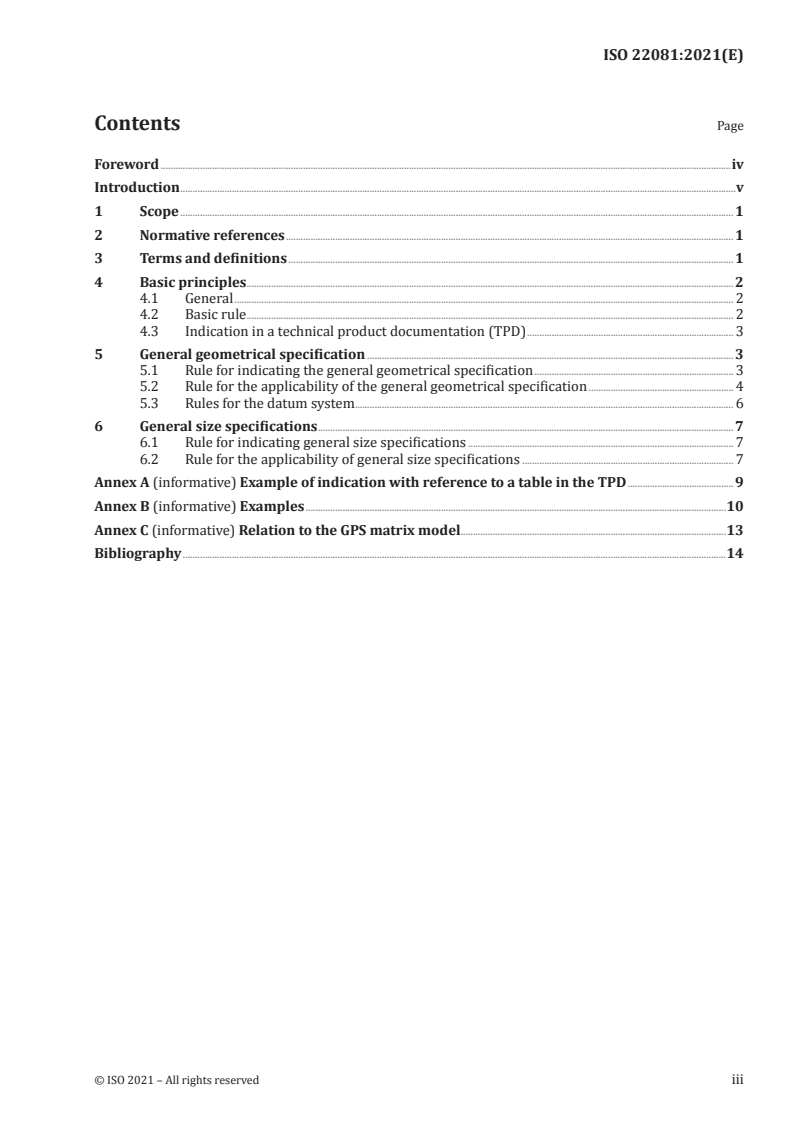
Contents Page
Foreword .iv
Introduction .v
1 Scope . 1
2 Normative references . 1
3 Terms and definitions . 1
4 Basic principles . 2
4.1 General . 2
4.2 Basic rule . 2
4.3 Indication in a technical product documentation (TPD) . 3
5 General geometrical specification . 3
5.1 Rule for indicating the general geometrical specification . 3
5.2 Rule for the applicability of the general geometrical specification . 4
5.3 Rules for the datum system . 6
6 General size specifications . 7
6.1 Rule for indicating general size specifications . 7
6.2 Rule for the applicability of general size specifications . 7
Annex A (informative) Example of indication with reference to a table in the TPD .9
Annex B (informative) Examples .10
Annex C (informative) Relation to the GPS matrix model .13
Bibliography .14
Foreword
ISO (the International Organization for Standardization) is a worldwide federation of national standards
bodies (ISO member bodies). The work of preparing International Standards is normally carried out
through ISO technical committees. Each member body interested in a subject for which a technical
committee has been established has the right to be represented on that committee. International
organizations, governmental and non-governmental, in liaison with ISO, also take part in the work.
ISO collaborates closely with the International Electrotechnical Commission (IEC) on all matters of
electrotechnical standardization.
The procedures used to develop this document and those intended for its further maintenance are
described in the ISO/IEC Directives, Part 1. In particular, the different approval criteria needed for the
different types of ISO documents should be noted. This document was drafted in accordance with the
editorial rules of the ISO/IEC Directives, Part 2 (see www .iso .org/ directives).
Attention is drawn to the possibility that some of the elements of this document may be the subject of
patent rights. ISO shall not be held responsible for identifying any or all such patent rights. Details of
any patent rights identified during the development of the document will be in the Introduction and/or
on the ISO list of patent declarations received (see www .iso .org/ patents).
Any trade name used in this document is information given for the convenience of users and does not
constitute an endorsement.
For an explanation of the voluntary nature of standards, the meaning of ISO specific terms and
expressions related to conformity assessment, as well as information about ISO's adherence to the
World Trade Organization (WTO) principles in the Technical Barriers to Trade (TBT), see www .iso .org/
iso/ foreword .html.
This document was prepared by Technical Committee ISO/TC 213, Dimensional and geometrical product
specifications and verification, in collaboration with the European Committee for Standardization (CEN)
Technical Committee CEN/TC 290, Dimensional and geometrical product specification and verification, in
accordance with the Agreement on technical cooperation between ISO and CEN (Vienna Agreement).
This first edition cancels and replaces ISO 2768-2:1989, which has been technically revised.
The main changes to ISO 2768-2:1989 are as follows:
— tools have been added to specify a general geometrical specification and a general size specification;
— the rules for application of general geometrical specification and general size specification have
been clarified.
Any feedback or questions on this document should be directed to the user’s national standards body. A
complete listing of these bodies can be found at www .iso .org/ members .html.
iv © ISO 2021 – All rights reserved
Introduction
This document is a geometrical product specification (GPS) standard and is to be regarded as a general
GPS standard (see ISO 14638). It influences chain links A, B and C of the chain of standards on size,
distance, form, orientation and location.
The ISO/GPS matrix model given in ISO 14638 gives an overview of the ISO/GPS system of which this
document is a part. The fundamental rules of ISO/GPS given in ISO 8015 apply to this document and
the default decision rules given in ISO 14253-1 apply to the specifications made in accordance with this
document, unless otherwise indicated.
For more detailed information of the relation of this document to other standards and the GPS matrix
model, see Annex C.
This document deals with general geometrical specification and general size specifications, which can
be used to reduce the number of individual specification indications in technical product documentation
(TPD). Many geometrical features have individual specifications which are similar or identical. As an
alternative, general geometrical specifications, general size specifications or both may be applied.
All figures in this document for the 2D drawing indications have been drawn in first-angle projection
with dimensions and tolerances in millimetres. It should be understood that third-angle projection
and other units of measurement could have been used equally well without prejudice to the principles
established.
The figures in this document represent either 2D drawing views or 3D axonometric views and
are intended to illustrate how a specification can be fully indicated with visible annotation. For
possibilities of illustrating a specification where elements of the specification may be available through
a query function or other interrogation of information on the 3D CAD model, and rules for attaching
specifications to 3D CAD models, see ISO 16792.
All figures are not complete and should not be seen as a way to fully specify a part. Theoretically exact
dimensions (TED) which are not indicated are assumed to be obtained from the 3D CAD model.
INTERNATIONAL STANDARD ISO 22081:2021(E)
Geometrical product specifications (GPS) — Geometrical
tolerancing — General geometrical specifications and
general size specifications
1 Scope
This document gives rules for definition and interpretation of general geometrical specifications and
general size specifications defined according to ISO 8015:2011, 5.12.
General specifications defined in other standards, and the link to these standards, are not covered by
this document.
The general geometrical specifications and general size (linear or angular) specifications defined in
this document apply only to integral features (including features of size).
These specifications do not apply to derived features or integral lines (see ISO 17450-1 for the definitions
of integral features and derived features).
Dimensions other than linear or angular sizes (see ISO 14405-2) are not covered by this document.
2 Normative references
The following documents are referred to in the text in such a way that some or all of their content
constitutes requirements of this document. For dated references, only the edition cited applies. For
undated references, the latest edition of the referenced document (including any amendments) applies.
ISO 8015, Geometrical product specifications (GPS) — Fundamentals — Concepts, principles and rules
ISO 17450-1, Geometrical product specifications (GPS) — General concepts — Part 1: Model for geometrical
specification and verification
ISO 17450-2, Geometrical product specifications (GPS) — General concepts — Part 2: Basic tenets,
specifications, operators, uncertainties and ambiguities
ISO 22432, Geometrical product specifications (GPS) — Features utilized in specification and verification
ISO 25378, Geometrical product specifications (GPS) — Characteristics and conditions — Definitions
3 Terms and definitions
For the purposes of this document, the terms and definitions given in ISO 8015, ISO 17450-1, ISO 17450-2,
ISO 22432 and ISO 25378 and the following apply.
ISO and IEC maintain terminological databases for use in standardization at the following addresses:
— ISO Online browsing platform: available at https:// www .iso .org/ obp
— IEC Electropedia: available at http:// www .electropedia .org/
3.1
general geometrical specification
geometrical specification indicated in the technical product documentation (TPD) which is not an
individual specification
3.2
general size specification
size specification (linear size specification or angular size specification) indicated in the technical
product documentation (TPD) which is not an individual specification
Note 1 to entry: Linear size specifications are defined in ISO 14405-1. Angular size specifications are defined in
ISO 14405-3.
3.3
integral feature
geometrical feature belonging to the real surface of the workpiece or to a surface model
Note 1 to entry: An integral feature is intrinsically defined, e.g. skin of the workpiece.
Note 2 to entry: For the statement of specifications, features obtained from partition of the surface model or of
real surface of workpiece shall be defined. These features, called “integral features”, are models of the different
physical parts of the workpiece that have specific functions, especially those in contact with the adjacent
workpieces.
Note 3 to entry: An integral feature can be identified, for example, by:
— a partition of the surface model;
— a partition of another integral feature;
— a collection of other integral features.
[SOURCE: ISO 17450-1:2011, 3.3.5]
4 Basic principles
4.1 General
When using general geometrical specifications or general size specifications, the designer should be
aware of the following risks:
— overlooking important functional requirements;
— selecting unnecessarily tight tolerances regarding the functional requirement.
It is the responsibility of the designer to ensure that:
— functional requirements are properly defined;
— the geometrical features influencing the functions are properly specified;
—
...
INTERNATIONAL ISO
STANDARD 22081
First edition
2021-02
Geometrical product specifications
(GPS) — Geometrical tolerancing —
General geometrical specifications
and general size specifications
Spécification géométrique des produits (GPS) — Tolérancement
géométrique — Spécifications géométriques générales et
spécifications de taille générales
Reference number
©
ISO 2021
© ISO 2021
All rights reserved. Unless otherwise specified, or required in the context of its implementation, no part of this publication may
be reproduced or utilized otherwise in any form or by any means, electronic or mechanical, including photocopying, or posting
on the internet or an intranet, without prior written permission. Permission can be requested from either ISO at the address
below or ISO’s member body in the country of the requester.
ISO copyright office
CP 401 • Ch. de Blandonnet 8
CH-1214 Vernier, Geneva
Phone: +41 22 749 01 11
Email: copyright@iso.org
Website: www.iso.org
Published in Switzerland
ii © ISO 2021 – All rights reserved
Contents Page
Foreword .iv
Introduction .v
1 Scope . 1
2 Normative references . 1
3 Terms and definitions . 1
4 Basic principles . 2
4.1 General . 2
4.2 Basic rule . 2
4.3 Indication in a technical product documentation (TPD) . 3
5 General geometrical specification . 3
5.1 Rule for indicating the general geometrical specification . 3
5.2 Rule for the applicability of the general geometrical specification . 4
5.3 Rules for the datum system . 6
6 General size specifications . 7
6.1 Rule for indicating general size specifications . 7
6.2 Rule for the applicability of general size specifications . 7
Annex A (informative) Example of indication with reference to a table in the TPD .9
Annex B (informative) Examples .10
Annex C (informative) Relation to the GPS matrix model .13
Bibliography .14
Foreword
ISO (the International Organization for Standardization) is a worldwide federation of national standards
bodies (ISO member bodies). The work of preparing International Standards is normally carried out
through ISO technical committees. Each member body interested in a subject for which a technical
committee has been established has the right to be represented on that committee. International
organizations, governmental and non-governmental, in liaison with ISO, also take part in the work.
ISO collaborates closely with the International Electrotechnical Commission (IEC) on all matters of
electrotechnical standardization.
The procedures used to develop this document and those intended for its further maintenance are
described in the ISO/IEC Directives, Part 1. In particular, the different approval criteria needed for the
different types of ISO documents should be noted. This document was drafted in accordance with the
editorial rules of the ISO/IEC Directives, Part 2 (see www .iso .org/ directives).
Attention is drawn to the possibility that some of the elements of this document may be the subject of
patent rights. ISO shall not be held responsible for identifying any or all such patent rights. Details of
any patent rights identified during the development of the document will be in the Introduction and/or
on the ISO list of patent declarations received (see www .iso .org/ patents).
Any trade name used in this document is information given for the convenience of users and does not
constitute an endorsement.
For an explanation of the voluntary nature of standards, the meaning of ISO specific terms and
expressions related to conformity assessment, as well as information about ISO's adherence to the
World Trade Organization (WTO) principles in the Technical Barriers to Trade (TBT), see www .iso .org/
iso/ foreword .html.
This document was prepared by Technical Committee ISO/TC 213, Dimensional and geometrical product
specifications and verification, in collaboration with the European Committee for Standardization (CEN)
Technical Committee CEN/TC 290, Dimensional and geometrical product specification and verification, in
accordance with the Agreement on technical cooperation between ISO and CEN (Vienna Agreement).
This first edition cancels and replaces ISO 2768-2:1989, which has been technically revised.
The main changes to ISO 2768-2:1989 are as follows:
— tools have been added to specify a general geometrical specification and a general size specification;
— the rules for application of general geometrical specification and general size specification have
been clarified.
Any feedback or questions on this document should be directed to the user’s national standards body. A
complete listing of these bodies can be found at www .iso .org/ members .html.
iv © ISO 2021 – All rights reserved
Introduction
This document is a geometrical product specification (GPS) standard and is to be regarded as a general
GPS standard (see ISO 14638). It influences chain links A, B and C of the chain of standards on size,
distance, form, orientation and location.
The ISO/GPS matrix model given in ISO 14638 gives an overview of the ISO/GPS system of which this
document is a part. The fundamental rules of ISO/GPS given in ISO 8015 apply to this document and
the default decision rules given in ISO 14253-1 apply to the specifications made in accordance with this
document, unless otherwise indicated.
For more detailed information of the relation of this document to other standards and the GPS matrix
model, see Annex C.
This document deals with general geometrical specification and general size specifications, which can
be used to reduce the number of individual specification indications in technical product documentation
(TPD). Many geometrical features have individual specifications which are similar or identical. As an
alternative, general geometrical specifications, general size specifications or both may be applied.
All figures in this document for the 2D drawing indications have been drawn in first-angle projection
with dimensions and tolerances in millimetres. It should be understood that third-angle projection
and other units of measurement could have been used equally well without prejudice to the principles
established.
The figures in this document represent either 2D drawing views or 3D axonometric views and
are intended to illustrate how a specification can be fully indicated with visible annotation. For
possibilities of illustrating a specification where elements of the specification may be available through
a query function or other interrogation of information on the 3D CAD model, and rules for attaching
specifications to 3D CAD models, see ISO 16792.
All figures are not complete and should not be seen as a way to fully specify a part. Theoretically exact
dimensions (TED) which are not indicated are assumed to be obtained from the 3D CAD model.
INTERNATIONAL STANDARD ISO 22081:2021(E)
Geometrical product specifications (GPS) — Geometrical
tolerancing — General geometrical specifications and
general size specifications
1 Scope
This document gives rules for definition and interpretation of general geometrical specifications and
general size specifications defined according to ISO 8015:2011, 5.12.
General specifications defined in other standards, and the link to these standards, are not covered by
this document.
The general geometrical specifications and general size (linear or angular) specifications defined in
this document apply only to integral features (including features of size).
These specifications do not apply to derived features or integral lines (see ISO 17450-1 for the definitions
of integral features and derived features).
Dimensions other than linear or angular sizes (see ISO 14405-2) are not covered by this document.
2 Normative references
The following documents are referred to in the text in such a way that some or all of their content
constitutes requirements of this document. For dated references, only the edition cited applies. For
undated references, the latest edition of the referenced document (including any amendments) applies.
ISO 8015, Geometrical product specifications (GPS) — Fundamentals — Concepts, principles and rules
ISO 17450-1, Geometrical product specifications (GPS) — General concepts — Part 1: Model for geometrical
specification and verification
ISO 17450-2, Geometrical product specifications (GPS) — General concepts — Part 2: Basic tenets,
specifications, operators, uncertainties and ambiguities
ISO 22432, Geometrical product specifications (GPS) — Features utilized in specification and verification
ISO 25378, Geometrical product specifications (GPS) — Characteristics and conditions — Definitions
3 Terms and definitions
For the purposes of this document, the terms and definitions given in ISO 8015, ISO 17450-1, ISO 17450-2,
ISO 22432 and ISO 25378 and the following apply.
ISO and IEC maintain terminological databases for use in standardization at the following addresses:
— ISO Online browsing platform: available at https:// www .iso .org/ obp
— IEC Electropedia: available at http:// www .electropedia .org/
3.1
general geometrical specification
geometrical specification indicated in the technical product documentation (TPD) which is not an
individual specification
3.2
general size specification
size specification (linear size specification or angular size specification) indicated in the technical
product documentation (TPD) which is not an individual specification
Note 1 to entry: Linear size specifications are defined in ISO 14405-1. Angular size specifications are defined in
ISO 14405-3.
3.3
integral feature
geometrical feature belonging to the real surface of the workpiece or to a surface model
Note 1 to entry: An integral feature is intrinsically defined, e.g. skin of the workpiece.
Note 2 to entry: For the statement of specifications, features obtained from partition of the surface model or of
real surface of workpiece shall be defined. These features, called “integral features”, are models of the different
physical parts of the workpiece that have specific functions, especially those in contact with the adjacent
workpieces.
Note 3 to entry: An integral feature can be identified, for example, by:
— a partition of the surface model;
— a partition of another integral feature;
— a collection of other integral features.
[SOURCE: ISO 17450-1:2011, 3.3.5]
4 Basic principles
4.1 General
When using general geometrical specifications or general size specifications, the designer should be
aware of the following risks:
— overlooking important functional requirements;
— selecting unnecessarily tight tolerances regarding the functional requirement.
It is the responsibility of the designer to ensure that:
— functional requirements are properly defined;
— the geometrical features influencing the functions are properly specified;
—
...
NORME ISO
INTERNATIONALE 22081
Première édition
2021-02
Spécification géométrique des
produits (GPS) — Tolérancement
géométrique — Spécifications
géométriques générales et
spécifications de taille générales
Geometrical product specifications (GPS) — Geometrical tolerancing
— General geometrical specifications and general size specifications
Numéro de référence
©
ISO 2021
DOCUMENT PROTÉGÉ PAR COPYRIGHT
© ISO 2021
Tous droits réservés. Sauf prescription différente ou nécessité dans le contexte de sa mise en œuvre, aucune partie de cette
publication ne peut être reproduite ni utilisée sous quelque forme que ce soit et par aucun procédé, électronique ou mécanique,
y compris la photocopie, ou la diffusion sur l’internet ou sur un intranet, sans autorisation écrite préalable. Une autorisation peut
être demandée à l’ISO à l’adresse ci-après ou au comité membre de l’ISO dans le pays du demandeur.
ISO copyright office
Case postale 401 • Ch. de Blandonnet 8
CH-1214 Vernier, Genève
Tél.: +41 22 749 01 11
E-mail: copyright@iso.org
Web: www.iso.org
Publié en Suisse
ii © ISO 2021 – Tous droits réservés
Sommaire Page
Avant-propos .iv
Introduction .v
1 Domaine d'application .1
2 Références normatives .1
3 Termes et définitions .1
4 Principes de base .2
4.1 Généralités . 2
4.2 Règle de base . 2
4.3 Indication sur la documentation technique de produit (DTP) . 3
5 Spécification géométrique générale .4
5.1 Règle pour l'indication de la spécification géométrique générale . 4
5.2 Règle pour l'application de la spécification géométrique générale . 4
5.3 Règles pour le système de références spécifiées . 7
6 Spécifications de taille générales .7
6.1 Règle pour l'indication de spécifications de taille générales . 7
6.2 Règle pour l'application de spécifications de taille générales . 7
Annexe A (informative) Exemple d'indication avec référence à un tableau dans la DTP .9
Annexe B (informative) Exemples .10
Annexe C (informative) Relation avec le modèle de matrice GPS .13
Bibliographie .14
Avant-propos
L'ISO (Organisation internationale de normalisation) est une fédération mondiale d'organismes
nationaux de normalisation (comités membres de l'ISO). L'élaboration des Normes internationales est
en général confiée aux comités techniques de l'ISO. Chaque comité membre intéressé par une étude
a le droit de faire partie du comité technique créé à cet effet. Les organisations internationales,
gouvernementales et non gouvernementales, en liaison avec l'ISO participent également aux travaux.
L'ISO collabore étroitement avec la Commission électrotechnique internationale (IEC) en ce qui
concerne la normalisation électrotechnique.
Les procédures utilisées pour élaborer le présent document et celles destinées à sa mise à jour sont
décrites dans les Directives ISO/IEC, Partie 1. Il convient, en particulier de prendre note des différents
critères d'approbation requis pour les différents types de documents ISO. Le présent document a été
rédigé conformément aux règles de rédaction données dans les Directives ISO/IEC, Partie 2 (voir www
.iso .org/ directives).
L'attention est attirée sur le fait que certains des éléments du présent document peuvent faire l'objet de
droits de propriété intellectuelle ou de droits analogues. L'ISO ne saurait être tenue pour responsable
de ne pas avoir identifié de tels droits de propriété et averti de leur existence. Les détails concernant
les références aux droits de propriété intellectuelle ou autres droits analogues identifiés lors de
l'élaboration du document sont indiqués dans l'Introduction et/ou dans la liste des déclarations de
brevets reçues par l'ISO (voir www .iso .org/ brevets).
Les appellations commerciales éventuellement mentionnées dans le présent document sont données
pour information, par souci de commodité, à l’intention des utilisateurs et ne sauraient constituer un
engagement.
Pour une explication de la nature volontaire des normes, la signification des termes et expressions
spécifiques de l'ISO liés à l'évaluation de la conformité, ou pour toute information au sujet de l'adhésion
de l'ISO aux principes de l’Organisation mondiale du commerce (OMC) concernant les obstacles
techniques au commerce (OTC), voir www .iso .org/ avant -propos.
Le présent document a été élaboré par le comité technique ISO/TC 213, Spécifications et vérification
dimensionnelles et géométriques des produits, en collaboration avec le comité technique CEN/TC 290,
Spécification dimensionnelle et géométrique des produits, et vérification correspondante, du Comité
européen de normalisation (CEN) conformément à l’Accord de coopération technique entre l’ISO et le
CEN (Accord de Vienne).
Cette première édition annule et remplace l'ISO 2768-2:1989, qui a fait l'objet d'une révision technique.
Les principales modifications par rapport à l'ISO 2768-2:1989 sont les suivantes:
— des outils ont été ajoutés afin de spécifier une spécification géométrique générale et une spécification
de taille générale;
— les règles pour l'application d'une spécification géométrique générale et d'une spécification de taille
générale ont été clarifiées.
Il convient que l’utilisateur adresse tout retour d’information ou toute question concernant le présent
document à l’organisme national de normalisation de son pays. Une liste exhaustive desdits organismes
se trouve à l’adresse www .iso .org/ members .html.
iv © ISO 2021 – Tous droits réservés
Introduction
Le présent document est une norme de spécification géométrique des produits (GPS) et est à considérer
comme une norme GPS générale (voir l’ISO 14638). Il influence les maillons A, B et C de la chaîne de
normes relatives à la taille, la distance, la forme, l'orientation et la position.
Le modèle de matrice ISO/GPS donné dans l'ISO 14638 donne une vue d'ensemble du système ISO/
GPS dont le présent document fait partie. Les principes fondamentaux du système ISO/GPS donnés
dans l'ISO 8015 s'appliquent au présent document et les règles de décision par défaut données dans
l'ISO 14253-1 s'appliquent aux spécifications faites conformément au présent document, sauf indication
contraire.
Pour de plus amples informations sur la relation du présent document avec les autres normes et le
modèle de matrice GPS, voir l'Annexe C.
Le présent document traite de spécification géométrique générale et de spécifications de taille
générales, qui peuvent servir à réduire le nombre d'indications de spécification individuelle dans la
documentation technique de produits (DTP). De nombreux éléments géométriques ont des exigences
individuelles similaires ou identiques. Alternativement, des spécifications géométriques générales, des
spécifications de taille générales ou les deux peuvent s'appliquer.
Toutes les figures du présent document pour les indications des dessins en 2D ont été tracées par
projection du premier dièdre avec des dimensions et des tolérances en millimètres. Il est entendu que la
projection du troisième dièdre et d'autres unités de mesure pourraient de la même façon être utilisées
sans nuire aux principes établis.
Les figures du présent document sont soit des vues de dessins en 2D, soit des vues axonométriques en
3D, et elles visent à illustrer la façon dont une spécification peut être indiquée dans son intégralité avec
une annotation visible. Pour connaître les possibilités en matière de représentation d'une spécification
dont les éléments de spécification peuvent être disponibles via une fonction de recherche ou toute autre
interrogation des données sur le modèle CAO en 3D, ainsi que les règles applicables au rattachement des
spécifications aux modèles CAO en 3D, voir l’ISO 16792.
Aucune figure n'est complète et ne doit être vue comme une façon de spécifier complètement une pièce.
Les dimensions théoriques exactes (TED) qui ne sont pas indiquées sont présumées avoir été obtenues
à partir du modèle CAO en 3D.
NORME INTERNATIONALE ISO 22081:2021(F)
Spécification géométrique des produits (GPS) —
Tolérancement géométrique — Spécifications
géométriques générales et spécifications de taille
générales
1 Domaine d'application
Le présent document donne les règles de définition et d’interprétation des spécifications géométriques
générales et des spécifications de taille générales définies selon l’ISO 8015:2011, 5.12.
Les spécifications générales définies dans d'autres normes, et le lien à ces normes, ne sont pas couverts
par le présent document.
Les spécifications géométriques et les spécifications de taille (linéaire ou angulaire) générales définies
dans le présent document s’appliquent uniquement aux éléments intégraux (y compris les entités
dimensionnelles).
Ces spécifications ne s'appliquent pas aux éléments dérivés ou aux lignes intégrales (voir l'ISO 17450-1
pour les définitions des éléments intégraux et des éléments dérivés).
Les dimensions autres que les tailles linéaires ou angulaires (voir ISO 14405-2) ne sont pas couvertes
par le présent document.
2 Références normatives
Les documents suivants sont cités dans le texte de sorte qu’ils constituent, pour tout ou partie de leur
contenu, des exigences du présent document. Pour les références datées, seule l’édition citée s’applique.
Pour les références non datées, la dernière édition du document de référence s'applique (y compris les
éventuels amendements).
ISO 8015, Spécification géométrique des produits (GPS) — Principes fondamentaux — Concepts, principes
et règles
ISO 17450-1, Spécification géométrique des produits (GPS) — Concepts généraux — Partie 1: Modèle pour
la spécification et la vérification géométriques
ISO 17450-2, Spécification géométrique des produits (GPS) — Concepts généraux — Partie 2: Principes de
base, spécifications, opérateurs, incertitudes et ambiguïtés
ISO 22432, Spécification géométrique des produits (GPS) — Éléments utilisés en spécification et vérification
ISO 25378, Spécification géométrique des produits — Caractéristiques et conditions — Définitions
3 Termes et définitions
Pour les besoins du présent document, les termes et définitions des ISO 8015, ISO 17450-1,
ISO 17450-2, ISO 22432 et ISO 25378 et les suivants s’appliquent.
L’ISO et l’IEC tiennent à jour des bases de données terminologiques destinées à être utilisées en
normalisation, consultables aux adresses suivantes:
— ISO Online browsing platform: disponible à l'adresse https:// www .iso .org/ obp
— IEC Electropedia: disponible à l'adresse http:// www .electropedia .org/
3.1
spécification géométrique générale
spécification géométrique indiquée dans la documentation technique de produits (DTP) qui n’est pas
une spécification individuelle
3.2
spécification de taille générale
spécification de taille (spécification de taille linéaire ou spécification de taille angulaire) indiquée dans
la documentation technique de produits (DTP) qui n’est pas une spécification individuelle
Note 1 à l'article: Les spécifications de taille linéaire sont définies dans l'ISO 14405-1. Les spécifications de taille
angulaire sont définies dans l'ISO 14405-3.
3.3
élément intégral
élément géométrique appartenant à la surface réelle de la pièce ou à un modèle de la surface
Note 1 à l'article: Un élément intégral est intrinsèquement défini, par exemple peau de la pièce.
Note 2 à l'article: Pour l'établissement des spécifications, les éléments obtenus à partir d'une partition d'un
modèle de surface de la pièce doivent être définis. Ces éléments, appelés «éléments intégraux», sont des modèles
des différentes parties physiques de la pièce qui ont des fonctions spécifiques, en particulier celles en contact
avec les pièces voisines.
Note 3 à l'article: Un élément intégral peut être identifié, par exemple par:
— une partition du modèle de surface;
— une partition d'un autre élément intégral;
— une collection d'autres éléments intégraux.
[SOURCE: ISO 17450-1:2011, 3.3.5]
4 Principes de base
4.1 Généralités
Lorsque les spécifications géométriques générales ou les spécifications de taille générales sont utilisées,
il convient que le concepteur soit conscient des risques suivants:
— négliger des exigences fonctionnelles importantes;
— sélectionner des tolérances inutilement serrées concernant l’exigence fonctionnelle.
Il est de la responsabilité du concepteur de veiller à ce que:
— les exigences fonctionnelles soient convenablement définies;
— les éléments géométriques influençant les fonctions soient correctement spécifiés;
— la pièce entière, i.e. tous les éléments géométriques, soit spécifiée complètement et sans équivoque.
La spécification géométrique générale et la spécification de taille générale sont des moyens de
minimiser le nombre d'indications dans la DTP.
4.2 Règle de base
Le présent document définit deux types de spécifications générales:
— les spécifications géométriques générales;
2 ©
...
NORME ISO
INTERNATIONALE 22081
Première édition
2021-02
Spécification géométrique des
produits (GPS) — Tolérancement
géométrique — Spécifications
géométriques générales et
spécifications de taille générales
Geometrical product specifications (GPS) — Geometrical tolerancing
— General geometrical specifications and general size specifications
Numéro de référence
©
ISO 2021
DOCUMENT PROTÉGÉ PAR COPYRIGHT
© ISO 2021
Tous droits réservés. Sauf prescription différente ou nécessité dans le contexte de sa mise en œuvre, aucune partie de cette
publication ne peut être reproduite ni utilisée sous quelque forme que ce soit et par aucun procédé, électronique ou mécanique,
y compris la photocopie, ou la diffusion sur l’internet ou sur un intranet, sans autorisation écrite préalable. Une autorisation peut
être demandée à l’ISO à l’adresse ci-après ou au comité membre de l’ISO dans le pays du demandeur.
ISO copyright office
Case postale 401 • Ch. de Blandonnet 8
CH-1214 Vernier, Genève
Tél.: +41 22 749 01 11
E-mail: copyright@iso.org
Web: www.iso.org
Publié en Suisse
ii © ISO 2021 – Tous droits réservés
Sommaire Page
Avant-propos .iv
Introduction .v
1 Domaine d'application .1
2 Références normatives .1
3 Termes et définitions .1
4 Principes de base .2
4.1 Généralités . 2
4.2 Règle de base . 2
4.3 Indication sur la documentation technique de produit (DTP) . 3
5 Spécification géométrique générale .4
5.1 Règle pour l'indication de la spécification géométrique générale . 4
5.2 Règle pour l'application de la spécification géométrique générale . 4
5.3 Règles pour le système de références spécifiées . 7
6 Spécifications de taille générales .7
6.1 Règle pour l'indication de spécifications de taille générales . 7
6.2 Règle pour l'application de spécifications de taille générales . 7
Annexe A (informative) Exemple d'indication avec référence à un tableau dans la DTP .9
Annexe B (informative) Exemples .10
Annexe C (informative) Relation avec le modèle de matrice GPS .13
Bibliographie .14
Avant-propos
L'ISO (Organisation internationale de normalisation) est une fédération mondiale d'organismes
nationaux de normalisation (comités membres de l'ISO). L'élaboration des Normes internationales est
en général confiée aux comités techniques de l'ISO. Chaque comité membre intéressé par une étude
a le droit de faire partie du comité technique créé à cet effet. Les organisations internationales,
gouvernementales et non gouvernementales, en liaison avec l'ISO participent également aux travaux.
L'ISO collabore étroitement avec la Commission électrotechnique internationale (IEC) en ce qui
concerne la normalisation électrotechnique.
Les procédures utilisées pour élaborer le présent document et celles destinées à sa mise à jour sont
décrites dans les Directives ISO/IEC, Partie 1. Il convient, en particulier de prendre note des différents
critères d'approbation requis pour les différents types de documents ISO. Le présent document a été
rédigé conformément aux règles de rédaction données dans les Directives ISO/IEC, Partie 2 (voir www
.iso .org/ directives).
L'attention est attirée sur le fait que certains des éléments du présent document peuvent faire l'objet de
droits de propriété intellectuelle ou de droits analogues. L'ISO ne saurait être tenue pour responsable
de ne pas avoir identifié de tels droits de propriété et averti de leur existence. Les détails concernant
les références aux droits de propriété intellectuelle ou autres droits analogues identifiés lors de
l'élaboration du document sont indiqués dans l'Introduction et/ou dans la liste des déclarations de
brevets reçues par l'ISO (voir www .iso .org/ brevets).
Les appellations commerciales éventuellement mentionnées dans le présent document sont données
pour information, par souci de commodité, à l’intention des utilisateurs et ne sauraient constituer un
engagement.
Pour une explication de la nature volontaire des normes, la signification des termes et expressions
spécifiques de l'ISO liés à l'évaluation de la conformité, ou pour toute information au sujet de l'adhésion
de l'ISO aux principes de l’Organisation mondiale du commerce (OMC) concernant les obstacles
techniques au commerce (OTC), voir www .iso .org/ avant -propos.
Le présent document a été élaboré par le comité technique ISO/TC 213, Spécifications et vérification
dimensionnelles et géométriques des produits, en collaboration avec le comité technique CEN/TC 290,
Spécification dimensionnelle et géométrique des produits, et vérification correspondante, du Comité
européen de normalisation (CEN) conformément à l’Accord de coopération technique entre l’ISO et le
CEN (Accord de Vienne).
Cette première édition annule et remplace l'ISO 2768-2:1989, qui a fait l'objet d'une révision technique.
Les principales modifications par rapport à l'ISO 2768-2:1989 sont les suivantes:
— des outils ont été ajoutés afin de spécifier une spécification géométrique générale et une spécification
de taille générale;
— les règles pour l'application d'une spécification géométrique générale et d'une spécification de taille
générale ont été clarifiées.
Il convient que l’utilisateur adresse tout retour d’information ou toute question concernant le présent
document à l’organisme national de normalisation de son pays. Une liste exhaustive desdits organismes
se trouve à l’adresse www .iso .org/ members .html.
iv © ISO 2021 – Tous droits réservés
Introduction
Le présent document est une norme de spécification géométrique des produits (GPS) et est à considérer
comme une norme GPS générale (voir l’ISO 14638). Il influence les maillons A, B et C de la chaîne de
normes relatives à la taille, la distance, la forme, l'orientation et la position.
Le modèle de matrice ISO/GPS donné dans l'ISO 14638 donne une vue d'ensemble du système ISO/
GPS dont le présent document fait partie. Les principes fondamentaux du système ISO/GPS donnés
dans l'ISO 8015 s'appliquent au présent document et les règles de décision par défaut données dans
l'ISO 14253-1 s'appliquent aux spécifications faites conformément au présent document, sauf indication
contraire.
Pour de plus amples informations sur la relation du présent document avec les autres normes et le
modèle de matrice GPS, voir l'Annexe C.
Le présent document traite de spécification géométrique générale et de spécifications de taille
générales, qui peuvent servir à réduire le nombre d'indications de spécification individuelle dans la
documentation technique de produits (DTP). De nombreux éléments géométriques ont des exigences
individuelles similaires ou identiques. Alternativement, des spécifications géométriques générales, des
spécifications de taille générales ou les deux peuvent s'appliquer.
Toutes les figures du présent document pour les indications des dessins en 2D ont été tracées par
projection du premier dièdre avec des dimensions et des tolérances en millimètres. Il est entendu que la
projection du troisième dièdre et d'autres unités de mesure pourraient de la même façon être utilisées
sans nuire aux principes établis.
Les figures du présent document sont soit des vues de dessins en 2D, soit des vues axonométriques en
3D, et elles visent à illustrer la façon dont une spécification peut être indiquée dans son intégralité avec
une annotation visible. Pour connaître les possibilités en matière de représentation d'une spécification
dont les éléments de spécification peuvent être disponibles via une fonction de recherche ou toute autre
interrogation des données sur le modèle CAO en 3D, ainsi que les règles applicables au rattachement des
spécifications aux modèles CAO en 3D, voir l’ISO 16792.
Aucune figure n'est complète et ne doit être vue comme une façon de spécifier complètement une pièce.
Les dimensions théoriques exactes (TED) qui ne sont pas indiquées sont présumées avoir été obtenues
à partir du modèle CAO en 3D.
NORME INTERNATIONALE ISO 22081:2021(F)
Spécification géométrique des produits (GPS) —
Tolérancement géométrique — Spécifications
géométriques générales et spécifications de taille
générales
1 Domaine d'application
Le présent document donne les règles de définition et d’interprétation des spécifications géométriques
générales et des spécifications de taille générales définies selon l’ISO 8015:2011, 5.12.
Les spécifications générales définies dans d'autres normes, et le lien à ces normes, ne sont pas couverts
par le présent document.
Les spécifications géométriques et les spécifications de taille (linéaire ou angulaire) générales définies
dans le présent document s’appliquent uniquement aux éléments intégraux (y compris les entités
dimensionnelles).
Ces spécifications ne s'appliquent pas aux éléments dérivés ou aux lignes intégrales (voir l'ISO 17450-1
pour les définitions des éléments intégraux et des éléments dérivés).
Les dimensions autres que les tailles linéaires ou angulaires (voir ISO 14405-2) ne sont pas couvertes
par le présent document.
2 Références normatives
Les documents suivants sont cités dans le texte de sorte qu’ils constituent, pour tout ou partie de leur
contenu, des exigences du présent document. Pour les références datées, seule l’édition citée s’applique.
Pour les références non datées, la dernière édition du document de référence s'applique (y compris les
éventuels amendements).
ISO 8015, Spécification géométrique des produits (GPS) — Principes fondamentaux — Concepts, principes
et règles
ISO 17450-1, Spécification géométrique des produits (GPS) — Concepts généraux — Partie 1: Modèle pour
la spécification et la vérification géométriques
ISO 17450-2, Spécification géométrique des produits (GPS) — Concepts généraux — Partie 2: Principes de
base, spécifications, opérateurs, incertitudes et ambiguïtés
ISO 22432, Spécification géométrique des produits (GPS) — Éléments utilisés en spécification et vérification
ISO 25378, Spécification géométrique des produits — Caractéristiques et conditions — Définitions
3 Termes et définitions
Pour les besoins du présent document, les termes et définitions des ISO 8015, ISO 17450-1,
ISO 17450-2, ISO 22432 et ISO 25378 et les suivants s’appliquent.
L’ISO et l’IEC tiennent à jour des bases de données terminologiques destinées à être utilisées en
normalisation, consultables aux adresses suivantes:
— ISO Online browsing platform: disponible à l'adresse https:// www .iso .org/ obp
— IEC Electropedia: disponible à l'adresse http:// www .electropedia .org/
3.1
spécification géométrique générale
spécification géométrique indiquée dans la documentation technique de produits (DTP) qui n’est pas
une spécification individuelle
3.2
spécification de taille générale
spécification de taille (spécification de taille linéaire ou spécification de taille angulaire) indiquée dans
la documentation technique de produits (DTP) qui n’est pas une spécification individuelle
Note 1 à l'article: Les spécifications de taille linéaire sont définies dans l'ISO 14405-1. Les spécifications de taille
angulaire sont définies dans l'ISO 14405-3.
3.3
élément intégral
élément géométrique appartenant à la surface réelle de la pièce ou à un modèle de la surface
Note 1 à l'article: Un élément intégral est intrinsèquement défini, par exemple peau de la pièce.
Note 2 à l'article: Pour l'établissement des spécifications, les éléments obtenus à partir d'une partition d'un
modèle de surface de la pièce doivent être définis. Ces éléments, appelés «éléments intégraux», sont des modèles
des différentes parties physiques de la pièce qui ont des fonctions spécifiques, en particulier celles en contact
avec les pièces voisines.
Note 3 à l'article: Un élément intégral peut être identifié, par exemple par:
— une partition du modèle de surface;
— une partition d'un autre élément intégral;
— une collection d'autres éléments intégraux.
[SOURCE: ISO 17450-1:2011, 3.3.5]
4 Principes de base
4.1 Généralités
Lorsque les spécifications géométriques générales ou les spécifications de taille générales sont utilisées,
il convient que le concepteur soit conscient des risques suivants:
— négliger des exigences fonctionnelles importantes;
— sélectionner des tolérances inutilement serrées concernant l’exigence fonctionnelle.
Il est de la responsabilité du concepteur de veiller à ce que:
— les exigences fonctionnelles soient convenablement définies;
— les éléments géométriques influençant les fonctions soient correctement spécifiés;
— la pièce entière, i.e. tous les éléments géométriques, soit spécifiée complètement et sans équivoque.
La spécification géométrique générale et la spécification de taille générale sont des moyens de
minimiser le nombre d'indications dans la DTP.
4.2 Règle de base
Le présent document définit deux types de spécifications générales:
— les spécifications géométriques générales;
2 ©
...