

ISO 9344:2016
(Main)Microscopes — Graticules for eyepieces
General Information
- Abstract
ISO 9344:2016 specifies dimensions and permissible material defects and processing faults for graticules with diameters of 19 mm, 21 mm and 26 mm to be used in microscope eyepieces for the purposes of measurement, assessment and comparison.
- Status
- Published
- Publication Date
- 07-Nov-2016
- Technical Committee
- ISO/TC 172/SC 5 - Microscopes and endoscopes
- Drafting Committee
- ISO/TC 172/SC 5/WG 9 - Optical performance of microscope components
- Current Stage
- 9093 - International Standard confirmed
- Start Date
- 15-Mar-2022
- Completion Date
- 29-Aug-2026
Overview
ISO 9344:2016 specifies the dimensional and quality requirements for graticules used in microscope eyepieces. It covers graticules with nominal diameters of 19 mm, 21 mm and 26 mm, defining acceptable sizes, permissible material defects and processing faults, and marking requirements for Type 1 and Type 2 graticules. The standard supports reliable measurement, assessment and comparison in microscopy by standardizing graticule form and quality.
Key topics and requirements
- Dimensions and types: Table-based dimension requirements distinguish Type 1 and Type 2 graticules (see ISO 9344 for full dimensional tables and tolerances). Protective chamfer requirements are specified in accordance with ISO 10110‑1.
- Permissible defects and processing faults: The standard specifies permitted levels for:
- Bubbles and inclusions (referencing ISO 10110‑3)
- Striae and inhomogeneities (ISO 10110‑4)
- Surface form and irregularity limits (ISO 10110‑5)
- Surface imperfections and scratches (ISO 10110‑7)
- Surface texture / roughness and waviness (ISO 10110‑8)
- Parallelism tolerance (explicit limit stated in the standard)
- A coding system (defect code × area/number) is used to express permissible counts and maximum sizes of defects.
- Marking: To identify the tighter‑tolerance variant, Type 2 graticules must be marked with “Type 2 conforming to ISO 9344” on the graticule or packaging.
- Normative references: ISO 10110 series (Parts 1, 3, 4, 5, 7 and 8) are normative and define test methods and interpretation of the defect/quality codes.
Applications and users
ISO 9344:2016 is used by:
- Graticule and eyepiece manufacturers to design, produce and mark compliant graticules.
- Quality control and inspection labs for acceptance criteria when receiving or validating graticules.
- Calibration and metrology facilities applying standardized reference marks in optical measurements.
- Microscopy laboratories and research facilities that require traceable, repeatable measurement grids.
- Procurement and specification writers who need to call out standardized graticules in purchase orders and test specifications.
Related standards
- ISO 10110‑1, ‑3, ‑4, ‑5, ‑7, ‑8 (optics drawing preparation; material, surface and texture imperfection standards)
- ISO/TC 172 (committee responsible for optics and photonics standards)
Keywords: ISO 9344:2016, microscope graticules, eyepiece graticules, graticule dimensions, permissible defects, ISO 10110, microscopy measurement standards, graticule marking.
Relations
- Effective Date
- 11-Oct-2014
Frequently Asked Questions
ISO 9344:2016 is a standard published by the International Organization for Standardization (ISO). Its full title is "Microscopes — Graticules for eyepieces". This standard covers: ISO 9344:2016 specifies dimensions and permissible material defects and processing faults for graticules with diameters of 19 mm, 21 mm and 26 mm to be used in microscope eyepieces for the purposes of measurement, assessment and comparison.
ISO 9344:2016 specifies dimensions and permissible material defects and processing faults for graticules with diameters of 19 mm, 21 mm and 26 mm to be used in microscope eyepieces for the purposes of measurement, assessment and comparison.
ISO 9344:2016 is classified under the following ICS (International Classification for Standards) categories: 37.020 - Optical equipment. The ICS classification helps identify the subject area and facilitates finding related standards.
ISO 9344:2016 has the following relationships with other standards: It is inter standard links to ISO 9344:2011. Understanding these relationships helps ensure you are using the most current and applicable version of the standard.
ISO 9344:2016 is available in PDF format for immediate download after purchase. The document can be added to your cart and obtained through the secure checkout process. Digital delivery ensures instant access to the complete standard document.
Standards Content (Sample)
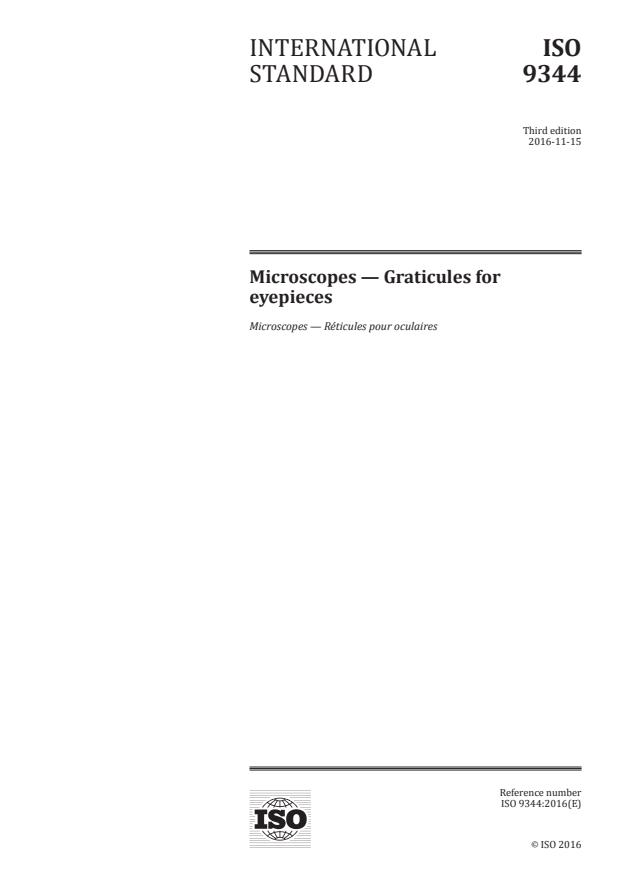
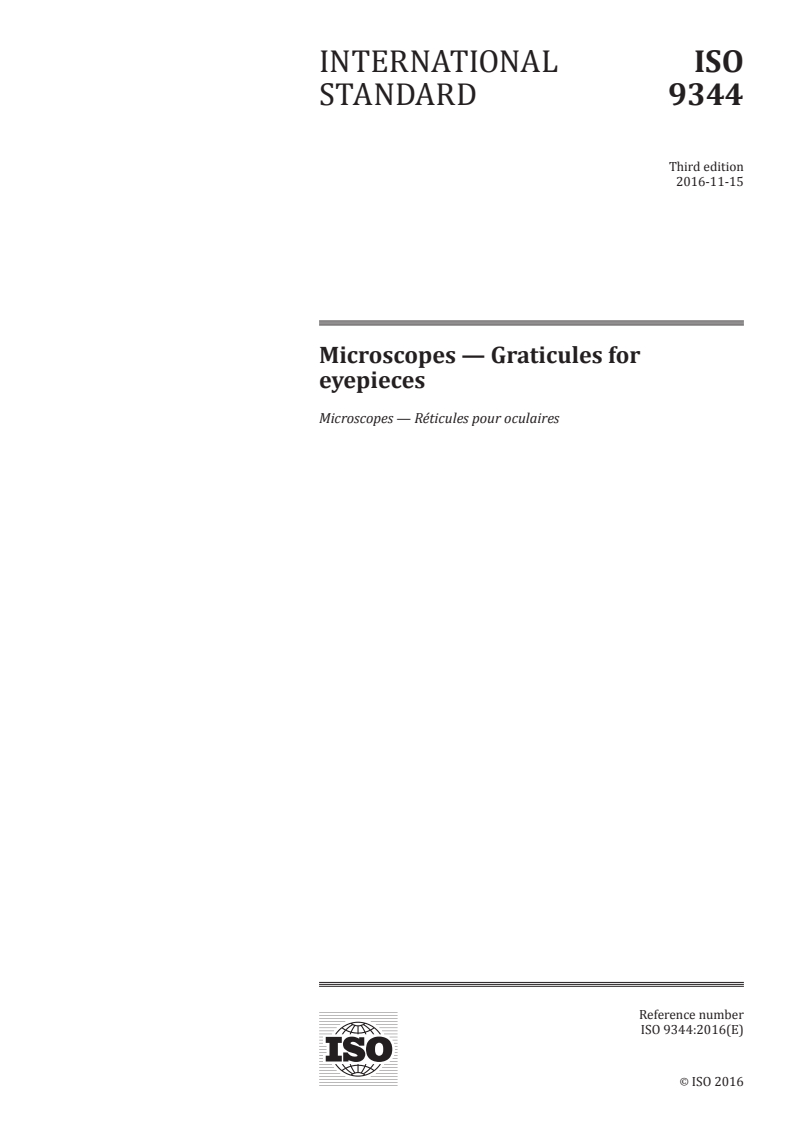
INTERNATIONAL ISO
STANDARD 9344
Third edition
2016-11-15
Microscopes — Graticules for
eyepieces
Microscopes — Réticules pour oculaires
Reference number
©
ISO 2016
© ISO 2016, Published in Switzerland
All rights reserved. Unless otherwise specified, no part of this publication may be reproduced or utilized otherwise in any form
or by any means, electronic or mechanical, including photocopying, or posting on the internet or an intranet, without prior
written permission. Permission can be requested from either ISO at the address below or ISO’s member body in the country of
the requester.
ISO copyright office
Ch. de Blandonnet 8 • CP 401
CH-1214 Vernier, Geneva, Switzerland
Tel. +41 22 749 01 11
Fax +41 22 749 09 47
copyright@iso.org
www.iso.org
ii © ISO 2016 – All rights reserved
Contents Page
Foreword .iv
1 Scope . 1
2 Normative references . 1
3 Terms and definitions . 1
4 Requirements . 1
4.1 Dimensions . 1
4.2 Permissible material defects and processing faults . 2
5 Marking . 2
Foreword
ISO (the International Organization for Standardization) is a worldwide federation of national standards
bodies (ISO member bodies). The work of preparing International Standards is normally carried out
through ISO technical committees. Each member body interested in a subject for which a technical
committee has been established has the right to be represented on that committee. International
organizations, governmental and non-governmental, in liaison with ISO, also take part in the work.
ISO collaborates closely with the International Electrotechnical Commission (IEC) on all matters of
electrotechnical standardization.
The procedures used to develop this document and those intended for its further maintenance are
described in the ISO/IEC Directives, Part 1. In particular the different approval criteria needed for the
different types of ISO documents should be noted. This document was drafted in accordance with the
editorial rules of the ISO/IEC Directives, Part 2 (see www.iso.org/directives).
Attention is drawn to the possibility that some of the elements of this document may be the subject of
patent rights. ISO shall not be held responsible for identifying any or all such patent rights. Details of
any patent rights identified during the development of the document will be in the Introduction and/or
on the ISO list of patent declarations received (see www.iso.org/patents).
Any trade name used in this document is information given for the convenience of users and does not
constitute an endorsement.
For an explanation on the meaning of ISO specific terms and expressions related to conformity assessment,
as well as information about ISO’s adherence to the World Trade Organization (WTO) principles in the
Technical Barriers to Trade (TBT) see the following URL: www.iso.org/iso/foreword.html.
The committee responsible for this document is ISO/TC 172, Optics and photonics, Subcommittee SC 5
Microscopes and endoscopes.
This third edition cancels and replaces the second edition (ISO 9344:2011), which has been technically
revised to add ISO 10110-7 and ISO 10110-8 in the normative references; see also Table 2.
iv © ISO 2016 – All rights reserved
...
INTERNATIONAL ISO
STANDARD 9344
Third edition
2016-11-15
Microscopes — Graticules for
eyepieces
Microscopes — Réticules pour oculaires
Reference number
©
ISO 2016
© ISO 2016, Published in Switzerland
All rights reserved. Unless otherwise specified, no part of this publication may be reproduced or utilized otherwise in any form
or by any means, electronic or mechanical, including photocopying, or posting on the internet or an intranet, without prior
written permission. Permission can be requested from either ISO at the address below or ISO’s member body in the country of
the requester.
ISO copyright office
Ch. de Blandonnet 8 • CP 401
CH-1214 Vernier, Geneva, Switzerland
Tel. +41 22 749 01 11
Fax +41 22 749 09 47
copyright@iso.org
www.iso.org
ii © ISO 2016 – All rights reserved
Contents Page
Foreword .iv
1 Scope . 1
2 Normative references . 1
3 Terms and definitions . 1
4 Requirements . 1
4.1 Dimensions . 1
4.2 Permissible material defects and processing faults . 2
5 Marking . 2
Foreword
ISO (the International Organization for Standardization) is a worldwide federation of national standards
bodies (ISO member bodies). The work of preparing International Standards is normally carried out
through ISO technical committees. Each member body interested in a subject for which a technical
committee has been established has the right to be represented on that committee. International
organizations, governmental and non-governmental, in liaison with ISO, also take part in the work.
ISO collaborates closely with the International Electrotechnical Commission (IEC) on all matters of
electrotechnical standardization.
The procedures used to develop this document and those intended for its further maintenance are
described in the ISO/IEC Directives, Part 1. In particular the different approval criteria needed for the
different types of ISO documents should be noted. This document was drafted in accordance with the
editorial rules of the ISO/IEC Directives, Part 2 (see www.iso.org/directives).
Attention is drawn to the possibility that some of the elements of this document may be the subject of
patent rights. ISO shall not be held responsible for identifying any or all such patent rights. Details of
any patent rights identified during the development of the document will be in the Introduction and/or
on the ISO list of patent declarations received (see www.iso.org/patents).
Any trade name used in this document is information given for the convenience of users and does not
constitute an endorsement.
For an explanation on the meaning of ISO specific terms and expressions related to conformity assessment,
as well as information about ISO’s adherence to the World Trade Organization (WTO) principles in the
Technical Barriers to Trade (TBT) see the following URL: www.iso.org/iso/foreword.html.
The committee responsible for this document is ISO/TC 172, Optics and photonics, Subcommittee SC 5
Microscopes and endoscopes.
This third edition cancels and replaces the second edition (ISO 9344:2011), which has been technically
revised to add ISO 10110-7 and ISO 10110-8 in the normative references; see also Table 2.
iv © ISO 2016 – All rights reserved
...