

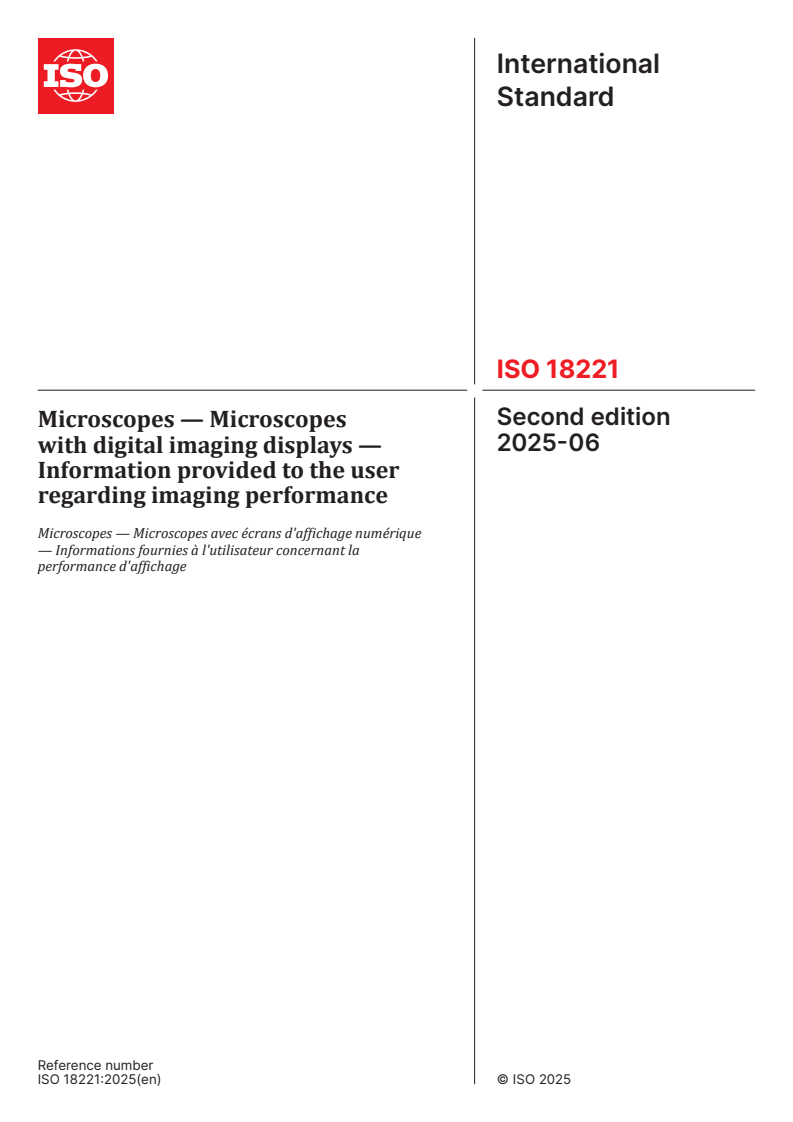
ISO 18221:2025
(Main)Microscopes — Microscopes with digital imaging displays — Information provided to the user regarding imaging performance
General Information
- Abstract
This document specifies the minimum information to be provided to the user by the manufacturers of microscopes with digital displays regarding imaging performance. It further specifies terms and definitions for describing the optical performance of the digital imaging path of microscopy systems including the observation of the image on digital displays. This standard does not apply to confocal microscopes. NOTE Terms and definitions for the direct visual observation with eyepieces are specified in ISO 8039 and ISO 10934.
- Status
- Published
- Publication Date
- 24-Jun-2025
- Technical Committee
- ISO/TC 172/SC 5 - Microscopes and endoscopes
- Drafting Committee
- ISO/TC 172/SC 5 - Microscopes and endoscopes
- Current Stage
- 6060 - International Standard published
- Start Date
- 25-Jun-2025
- Due Date
- 29-Nov-2025
- Completion Date
- 25-Jun-2025
Overview
ISO 18221:2025 - Microscopes - Microscopes with digital imaging displays - Information provided to the user regarding imaging performance defines the minimum information that microscope manufacturers must provide about imaging performance when microscopes include digital displays. This second edition updates terms, formulas and reporting requirements for the digital imaging path (objective → image sensor → digital display). It does not apply to confocal microscopes. For direct visual eyepiece terminology see ISO 8039 and ISO 10934.
Key topics and technical requirements
The standard standardizes terminology and minimum user information for digital microscopy systems. Major technical topics explicitly addressed include:
- Terms and definitions for digital microscopy systems, image sensors and digital displays (digital microscopy system, image sensor, digital display, resolving power limit, pixel pitch).
- Magnification definitions and formulas:
- Optical magnification (image on sensor).
- Display lateral magnification (image presented on monitor).
- Visual display magnification (observer’s perceived magnification), with the reference viewing distance of 250 mm.
- Resolving power limits reported in line pairs per millimetre (lp/mm):
- Optical resolving power limit (function of NA and wavelength).
- Sensor resolving power limit (function of sensor pixel pitch, magnification and sensor operation mode/binnings).
- Display resolving power limit (function of display pixel pitch and display magnification).
- System resolving power limit - the minimum of optical, sensor and display limits.
- Useful range of magnification and viewing distance, including the perceptual limits (angle subtended by resolved details).
- Object field, pixel size in object space and depth of field, with updated formulae and reporting expectations.
- Manufacturer information to users (Clause 10): general system specs and imaging performance data that must be provided (examples given in Annex A).
Practical applications and who uses this standard
ISO 18221:2025 is practical for stakeholders who design, buy, specify or certify digital microscopes:
- Manufacturers and product managers - to prepare consistent, standards-compliant datasheets and user information about imaging performance.
- Quality engineers and compliance teams - to verify declared resolving power, magnification ranges, pixel size in object space and depth of field.
- Laboratory managers and procurement specialists - to compare microscope models objectively when purchasing digital microscopy systems for research, clinical, industrial inspection or education.
- Metrology labs and integrators - for system validation, performance reporting and avoiding Moiré or undersampling issues.
- Regulatory and standards professionals - to harmonize specifications across suppliers.
Related standards
- ISO 10934 - Microscopes: Vocabulary for light microscopy (referenced for terminology).
- ISO 8039 - Terms for direct visual observation with eyepieces.
Keywords: ISO 18221:2025, microscopes with digital displays, imaging performance, resolving power, magnification, pixel pitch, image sensor, digital display, microscope manufacturer guidance.
Relations
- Effective Date
- 06-Jun-2022
Frequently Asked Questions
ISO 18221:2025 is a standard published by the International Organization for Standardization (ISO). Its full title is "Microscopes — Microscopes with digital imaging displays — Information provided to the user regarding imaging performance". This standard covers: This document specifies the minimum information to be provided to the user by the manufacturers of microscopes with digital displays regarding imaging performance. It further specifies terms and definitions for describing the optical performance of the digital imaging path of microscopy systems including the observation of the image on digital displays. This standard does not apply to confocal microscopes. NOTE Terms and definitions for the direct visual observation with eyepieces are specified in ISO 8039 and ISO 10934.
This document specifies the minimum information to be provided to the user by the manufacturers of microscopes with digital displays regarding imaging performance. It further specifies terms and definitions for describing the optical performance of the digital imaging path of microscopy systems including the observation of the image on digital displays. This standard does not apply to confocal microscopes. NOTE Terms and definitions for the direct visual observation with eyepieces are specified in ISO 8039 and ISO 10934.
ISO 18221:2025 is classified under the following ICS (International Classification for Standards) categories: 37.020 - Optical equipment. The ICS classification helps identify the subject area and facilitates finding related standards.
ISO 18221:2025 has the following relationships with other standards: It is inter standard links to ISO 18221:2016. Understanding these relationships helps ensure you are using the most current and applicable version of the standard.
ISO 18221:2025 is available in PDF format for immediate download after purchase. The document can be added to your cart and obtained through the secure checkout process. Digital delivery ensures instant access to the complete standard document.
Standards Content (Sample)
International
Standard
ISO 18221
Second edition
Microscopes — Microscopes
2025-06
with digital imaging displays —
Information provided to the user
regarding imaging performance
Microscopes — Microscopes avec écrans d'affichage numérique
— Informations fournies à l'utilisateur concernant la
performance d'affichage
Reference number
© ISO 2025
All rights reserved. Unless otherwise specified, or required in the context of its implementation, no part of this publication may
be reproduced or utilized otherwise in any form or by any means, electronic or mechanical, including photocopying, or posting on
the internet or an intranet, without prior written permission. Permission can be requested from either ISO at the address below
or ISO’s member body in the country of the requester.
ISO copyright office
CP 401 • Ch. de Blandonnet 8
CH-1214 Vernier, Geneva
Phone: +41 22 749 01 11
Email: copyright@iso.org
Website: www.iso.org
Published in Switzerland
ii
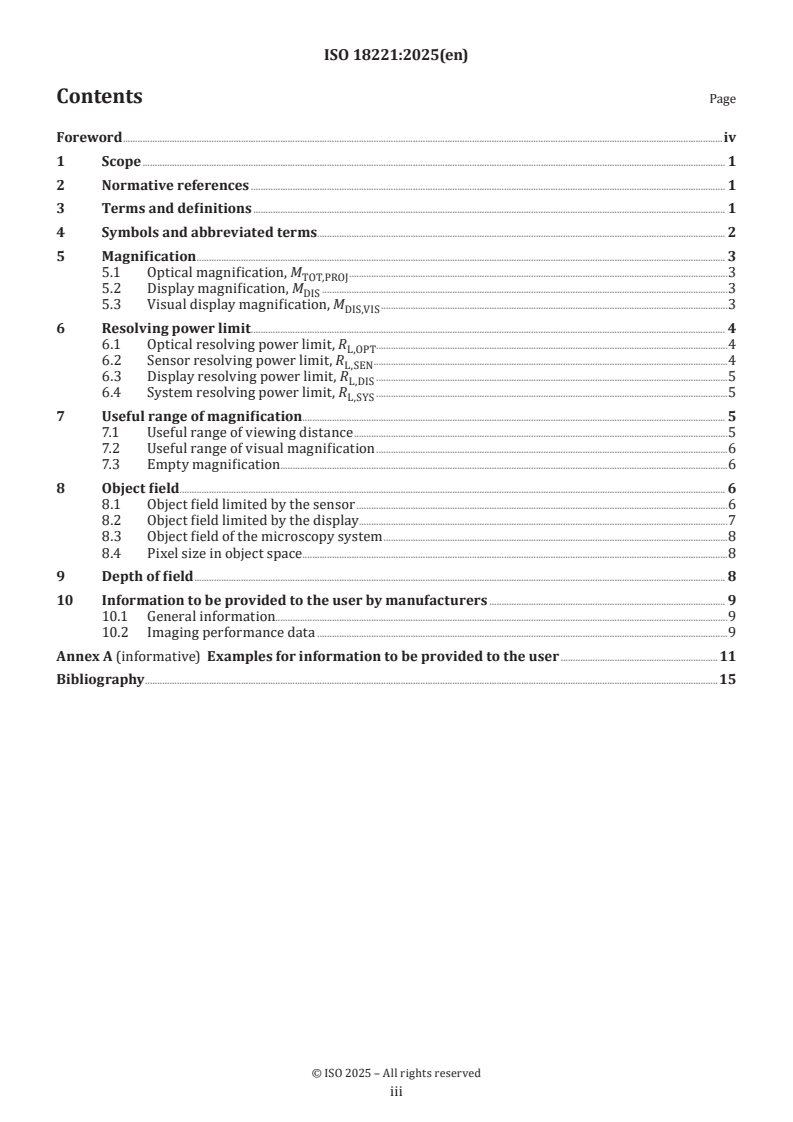
Contents Page
Foreword .iv
1 Scope . 1
2 Normative references . 1
3 Terms and definitions . 1
4 Symbols and abbreviated terms. 2
5 Magnification . 3
5.1 Optical magnification, M .3
TOT,PROJ
5.2 Display magnification, M .3
DIS
5.3 Visual display magnification, M .3
DIS,VIS
6 Resolving power limit . 4
6.1 Optical resolving power limit, R .4
L,OPT
6.2 Sensor resolving power limit, R .4
L,SEN
6.3 Display resolving power limit, R .5
L,DIS
6.4 System resolving power limit, R .5
L,SYS
7 Useful range of magnification . . 5
7.1 Useful range of viewing distance .5
7.2 Useful range of visual magnification .6
7.3 Empty magnification .6
8 Object field . . 6
8.1 Object field limited by the sensor .6
8.2 Object field limited by the display . .7
8.3 Object field of the microscopy system .8
8.4 Pixel size in object space .8
9 Depth of field . 8
10 Information to be provided to the user by manufacturers . 9
10.1 General information.9
10.2 Imaging performance data .9
Annex A (informative) Examples for information to be provided to the user .11
Bibliography .15
iii
Foreword
ISO (the International Organization for Standardization) is a worldwide federation of national standards
bodies (ISO member bodies). The work of preparing International Standards is normally carried out through
ISO technical committees. Each member body interested in a subject for which a technical committee
has been established has the right to be represented on that committee. International organizations,
governmental and non-governmental, in liaison with ISO, also take part in the work. ISO collaborates closely
with the International Electrotechnical Commission (IEC) on all matters of electrotechnical standardization.
The procedures used to develop this document and those intended for its further maintenance are described
in the ISO/IEC Directives, Part 1. In particular, the different approval criteria needed for the different types
of ISO document should be noted. This document was drafted in accordance with the editorial rules of the
ISO/IEC Directives, Part 2 (see www.iso.org/directives).
ISO draws attention to the possibility that the implementation of this document may involve the use of (a)
patent(s). ISO takes no position concerning the evidence, validity or applicability of any claimed patent
rights in respect thereof. As of the date of publication of this document, ISO had not received notice of (a)
patent(s) which may be required to implement this document. However, implementers are cautioned that
this may not represent the latest information, which may be obtained from the patent database available at
www.iso.org/patents. ISO shall not be held responsible for identifying any or all such patent rights.
Any trade name used in this document is information given for the convenience of users and does not
constitute an endorsement.
For an explanation of the voluntary nature of standards, the meaning of ISO specific terms and expressions
related to conformity assessment, as well as information about ISO's adherence to the World Trade
Organization (WTO) principles in the Technical Barriers to Trade (TBT), see www.iso.org/iso/foreword.html.
This document was prepared by Technical Committee ISO/TC 172, Optics and photonics, Subcommittee SC 5,
Microscopes and endoscopes.
This second edition cancels and replaces the first edition (ISO 18221:2016), which has been technically
revised.
The main changes are as follows:
— addition of formula expression to 8.1 and 8.2;
— addition of subclause 8.4 Pixel size in object space;
— addition of content to Clause 9;
— revision of formula for depth of field in Clause 9;
— addition of f) in 10.2;
— addition of content to Tables A.1 to A.5.
Any feedback or questions on this document should be directed to the user’s national standards body. A
complete listing of these bodies can be found at www.iso.org/members.html.
iv
International Standard ISO 18221:2025(en)
Microscopes — Microscopes with digital imaging displays
— Information provided to the user regarding imaging
performance
1 Scope
This document specifies the minimum information to be provided to the user by the manufacturers of
microscopes with digital displays regarding imaging performance.
It further specifies terms and definitions for describing the optical performance of the digital imaging path
of microscopy systems including the observation of the image on digital displays.
This standard does not apply to confocal microscopes.
NOTE Terms and definitions for the direct visual observation with eyepieces are specified in ISO 8039 and
ISO 10934.
2 Normative references
The following documents are referred to in the text in such a way that some or all of their content constitutes
requirements of this document. For dated references, only the edition cited applies. For undated references,
the latest edition of the referenced document (including any amendments) applies.
ISO 10934, Microscopes — Vocabulary for light microscopy
3 Terms and definitions
For the purposes of this document, the terms and definitions given in ISO 10934 and the following apply.
ISO and IEC maintain terminology databases for use in standardization at the following addresses:
— ISO Online browsing platform: available at https:// www .iso .org/ obp
— IEC Electropedia: available at https:// www .electropedia .org/
3.1
digital microscopy system
instrument consisting of an objective, an image sensor (3.2) and a digital display (3.3) to make visible minute
details that are not seen with unaided eye
Note 1 to entry: The system might include means for image enhancement, image analysis, archiving, etc.
3.2
image sensor
device to transform an optical image into a digital image
3.3
digital display
output device for the visual presentation of a digital image and other information
3.4
resolving power limit
maximum spatial frequency distinguishable in object space, expressed in line pairs per millimetre (lp/mm)
Note 1 to entry: The resolving power actually achieved will always be lower than the resolving power limit due to
reduced contrast, Moiré patterns, etc. In addition, it depends on sensor type, object structure, illumination, etc.
3.5
pixel pitch
distance between the centres of adjacent pixels (picture elements) in an image sensor (3.2) or a digital
display (3.3)
3.6
line pair
one line and one space between the lines of a spatial grid with equal line thickness and space width between lines
3.7
viewing distance
distance between the digital display (3.3) and the observer’s eye
4 Symbols and abbreviated terms
c coefficient related to the operation mode of the image sensor
d depth of field for observation of the image presented on the digital display
AX,SYS
d actual viewing distance
VIEW
d useful range of viewing distance
VIEW,USEF
h height of the object field limited by the image area in the display
LIM,DIS
h height of the object field limited by the sensor
LIM,SEN
h height of the object field of the microscopy system
SYS
λ wavelength
lp line pair
M display lateral magnification
DIS
M visual display magnification
DIS,VIS
M useful range of the perceived visual display magnification
DIS,VIS,USEF
M lateral magnification at the image projected onto the sensor
TOT,PROJ
M total visual magnification of the virtual microscope image formed by the eyepiece
TOT,VIS
NA numerical aperture
N number of image pixels in the display in x-direction
xDIS
N number of active image sensor pixels in x-direction
xSEN
N number of image pixels in the display in y-direction
yDIS
N number of active image sensor pixels in y-direction
ySEN
n refractive index of the object or of the immersion media
p pixel pitch of the digital display
p,DIS
p pixel pitch in object space
p,OBJ
p pixel pitch of the image sensor
p,SEN
R display resolving power limit in object space
L,DIS
R optical resolving power limit in object space
L,OPT
R sensor resolving power limit in object space
L,SEN
R system resolving power limit in object space
L,SYS
w width of the object field limited by the image area in the display
LIM,DIS
w width of the object field limited by the sensor
LIM,SEN
w width of the object field of the microscopy system
SYS
5 Magnification
5.1 Optical magnification, M
TOT,PROJ
M is the lateral magnification of the image projected onto the image sensor. It should be expressed in
TOT,PROJ
proportional form, e.g. 10:1.
5.2 Display magnification, M
DIS
M is the lateral magnification of the digital image presented on the digital display or monitor. It should be
DIS
expressed in proportional form, e.g. 100:1.
NOTE The display magnification, M , is the ratio of a given distance in the image presented on the monitor to the
DIS
corresponding distance in the object.
5.3 Visual display magnification, M
DIS,VIS
M is the display lateral magnification by observing the digital image presented on the digital display. It
DIS VIS
should be expressed in numerical form with the multiplication sign, e.g. ×50.
The visual display magnification is given by Formula (1):
M ⋅250
DIS
M = (1)
DISV, IS
d
VIEW
where
M is the visual display magnification;
DIS,VIS
M is the display lateral magnification;
DIS
250 is the reference viewing distance in mm;
d is the actual viewing distance in mm.
VIEW
NOTE The value of M is comparable with the value of M of light microscopes with eyepieces.
DIS VIS TOT VIS
6 Resolving power limit
6.1 Optical resolving power limit, R
L,OPT
R is the lateral resolving power limit in object space that is limited by the optical system. It should be
L,OPT
expressed in line pairs per millimetre, e.g. 200 lp/mm. It is given by Formula (2):
21⋅⋅NA 0
R = (2)
L,OPT
λ
where
R is the optical resolving power limit in object space in line pairs per millimetre;
L,OPT
NA is the effective numerical aperture at object side of the optical system projecting the
image onto the sensor;
λ is the wavelength in nm.
NOTE 1 The formula for R does not apply for super-resolution.
L,OPT
NOTE 2 In consideration of consistency with the definition of resolving limit of electric equipment, the optical
resolving limit defined in this International Standard is based on the cut-off frequency of an optical system.
6.2 Sensor resolving power limit, R
L,SEN
R is the lateral resolving power limit in object space that is limited by the image sensor. It should be
L,SEN
expressed in line pairs per millimetre, e.g. 100 lp/mm. It is given by Formula (3):
500⋅M
TOT,PROJ
R = (3)
L,SEN
cp⋅
1p,SEN
where
R is the sensor resolving power limit in object space in line pairs per millimetre;
L,SEN
M is the lateral magnification at the image projected onto the sensor;
TOT,PROJ
c is a coefficient related to the operation mode of the image sensor;
p is the pixel pitch of the image sensor in μm.
p,SEN
EXAMPLES for the values of c
1 corresponds to a standard or full frame mode;
2 corresponds to a 2 × 2 binning mode;
3 corresponds to a 3 × 3 binning mode;
0,5 corresponds to a pixel shift mode with a lateral movement of the image sensor of 0,5 p .
p,SEN
6.3 Display resolving power limit, R
L,DIS
R is the lateral resolving power limit in object space that is limited by the digital display. It should be
L,DIS
expressed in line pairs per millimetre, e.g. 50 lp/mm. It is given by Formula (4)
M
DIS
R = (4)
L,DIS
2⋅p
p,DIS
where
R is the display resolving power limit in object space in line pairs per millimetre;
L,DIS
M is the display lateral magnification;
DIS
p is the pixel pitch of the digital display in millimetres.
p,DIS
6.4 System resolving power limit, R
L,SYS
R is the lateral resolving power limit in object space of the microscopy system. It should be expressed
L,SYS
in line pairs per millimetre, e.g. 50 lp/mm. Its value corresponds to the smallest value of either the optical
resolving power limit or the sensor resolving power limit or the display resolving power limit, as given in
Formula (5):
RR=min ;;RR (5)
()
L,SYSL,OPT L,SENL,DIS
where
R is the system resolving power limit in object space in line pairs per millimetre;
L,SYS
R is the optical resolving power limit in line pairs per millimetre;
L,OPT
R is the sensor resolving power limit in object space in line pairs per millimetre;
L,SEN
R is the di
...