

ISO/IEC 23000-9:2008/Amd 2:2010
(Amendment)Information technology — Multimedia application format (MPEG-A) — Part 9: Digital Multimedia Broadcasting application format — Amendment 2: Harmonization on MPEG-2 TS storage
General Information
- Abstract
- Status
- Published
- Publication Date
- 30-Jun-2010
- Current Stage
- 6060 - International Standard published
- Start Date
- 01-Jul-2010
- Due Date
- 09-Feb-2012
- Completion Date
- 09-Feb-2012
Buy Documents

ISO/IEC 23000-9:2008/Amd 2:2010 - Information technology — Multimedia application format (MPEG-A) — Part 9: Digital Multimedia Broadcasting application format — Amendment 2: Harmonization on MPEG-2 TS storage Released:7/1/2010
Overview
ISO/IEC 23000-9:2008/Amd 2:2010 is an important amendment to the international standard covering the Digital Multimedia Broadcasting (DMB) application format, part of the MPEG-A family for multimedia application formats. This amendment focuses on the harmonization of MPEG-2 Transport Stream (TS) storage to enhance compatibility and efficiency in storage and playback of digital multimedia broadcast content. It provides guidelines on the structured storage and handling of MPEG-2 TS within media containers using the ISO Base Media File Format (ISO-FF).
Key Topics
- MPEG-2 TS Storage Harmonization: Defines a method for storing MPEG-2 Transport Streams sequentially as sample data, ensuring alignment with TS packet boundaries.
- Hint Track Utilization: Introduces the use of 'hint' tracks with 'hmhd' headers to guide seamless playback and streaming of stored TS content.
- Sample Format Definition: Specifies grouping of TS packets into samples based on Group of Pictures (GOP) for video content or audio frames, facilitating independently decodable media units.
- Sample Description Restrictions: Establishes constraints on sample description entries using MPEG2TSReceptionSampleEntry (code ‘rm2t’) to guarantee consistency. Includes mandatory presence of Program Map Table (PMT) and timing boxes, essential for synchronization.
- Random Access and Timing: Details how to identify random-access points within TS packets using indicators, and how to correctly reconstruct Program Clock Reference (PCR) timing for precise playback.
- BIFSBox and ODBox Syntax: Defines specific container box structures for handling Binary Format for Scenes (BIFS) and Object Descriptors (OD), including access units’ timing and random access flags.
- Media Header and Time Scale Configuration: Clarifies the media header parameters, including track header flags and time scale (set to 45,000), for accurate synchronization and playback control.
Applications
Digital Multimedia Broadcasting Systems
This standard amendment is vital for broadcasters and streaming providers who store and transmit MPEG-2 TS streams. It ensures that multimedia content can be stored efficiently and played back smoothly with accurate timing and random access capabilities.Media Player Development
Software and hardware media players supporting MPEG-A formats leverage this amendment for local preview or playback of recorded or stored MPEG-2 TS content, ensuring compliance with international standards and interoperability.Streaming Server Implementation
Although this amendment focuses on playback rather than streaming, the defined hint tracks can support streaming server functionality by guiding transport stream generation from stored content.Content Packaging and Distribution
Media packaging solutions use these definitions to organize multimedia broadcast data into file-based containers, improving distribution and storage workflows while maintaining compatibility with MPEG-A specifications.
Related Standards
ISO/IEC 14496-12:2008/Amd.1:2009
ISO Base Media File Format Amendment that introduces hint tracks, metadata support, and sample grouping relevant to this amendment’s MPEG-2 TS storage approach.ISO/IEC 23000 MPEG-A Series
The overall multimedia application format family under which Part 9 and this amendment fall, covering various aspects of multimedia content packaging and usage.ISO/IEC JTC 1/SC 29 Technical Committee
The subcommittee responsible for the development of coding standards for audio, picture, multimedia, and hypermedia information, including MPEG standards.
Keywords: MPEG-2 Transport Stream storage, Digital Multimedia Broadcasting, MPEG-A, ISO Base Media File Format, transport stream playback, hint track, random access MPEG-2 TS, multimedia broadcasting standard, ISO/IEC 23000-9 amendment, MPEG-2 TS sample format, media synchronization
Relations
- Effective Date
- 14-Aug-2021
Buy Documents
ISO/IEC 23000-9:2008/Amd 2:2010 - Information technology — Multimedia application format (MPEG-A) — Part 9: Digital Multimedia Broadcasting application format — Amendment 2: Harmonization on MPEG-2 TS storage Released:7/1/2010
Get Certified
Connect with accredited certification bodies for this standard

BSI Group
BSI (British Standards Institution) is the business standards company that helps organizations make excellence a habit.

NYCE
Mexican standards and certification body.
Sponsored listings
Frequently Asked Questions
ISO/IEC 23000-9:2008/Amd 2:2010 is a standard published by the International Organization for Standardization (ISO). Its full title is "Information technology — Multimedia application format (MPEG-A) — Part 9: Digital Multimedia Broadcasting application format — Amendment 2: Harmonization on MPEG-2 TS storage". This standard covers: Information technology — Multimedia application format (MPEG-A) — Part 9: Digital Multimedia Broadcasting application format — Amendment 2: Harmonization on MPEG-2 TS storage
Information technology — Multimedia application format (MPEG-A) — Part 9: Digital Multimedia Broadcasting application format — Amendment 2: Harmonization on MPEG-2 TS storage
ISO/IEC 23000-9:2008/Amd 2:2010 is classified under the following ICS (International Classification for Standards) categories: 35.040 - Information coding; 35.040.40 - Coding of audio, video, multimedia and hypermedia information. The ICS classification helps identify the subject area and facilitates finding related standards.
ISO/IEC 23000-9:2008/Amd 2:2010 has the following relationships with other standards: It is inter standard links to ISO/IEC 23000-9:2008. Understanding these relationships helps ensure you are using the most current and applicable version of the standard.
ISO/IEC 23000-9:2008/Amd 2:2010 is available in PDF format for immediate download after purchase. The document can be added to your cart and obtained through the secure checkout process. Digital delivery ensures instant access to the complete standard document.
Standards Content (Sample)
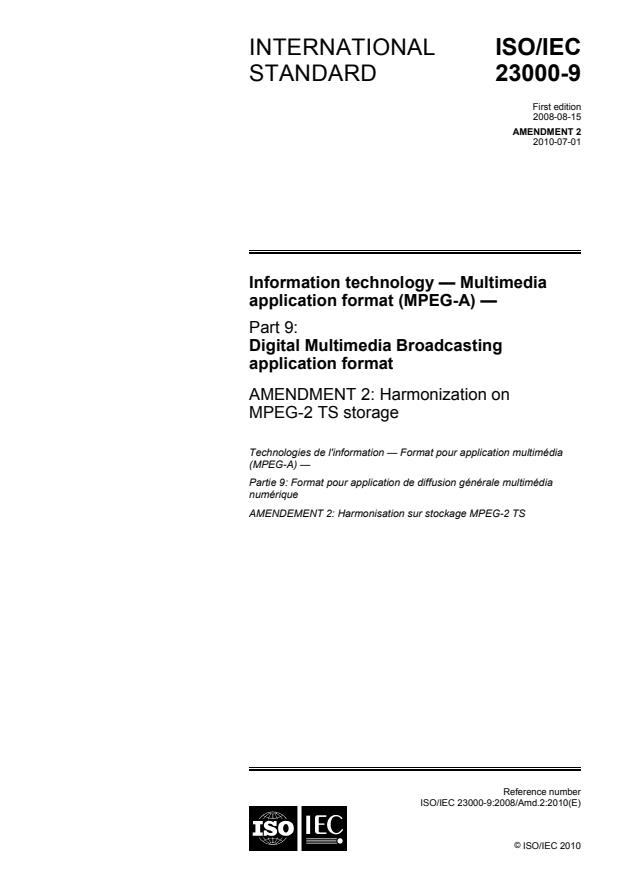
INTERNATIONAL ISO/IEC
STANDARD 23000-9
First edition
2008-08-15
AMENDMENT 2
2010-07-01
Information technology — Multimedia
application format (MPEG-A) —
Part 9:
Digital Multimedia Broadcasting
application format
AMENDMENT 2: Harmonization on
MPEG-2 TS storage
Technologies de l'information — Format pour application multimédia
(MPEG-A) —
Partie 9: Format pour application de diffusion générale multimédia
numérique
AMENDEMENT 2: Harmonisation sur stockage MPEG-2 TS
Reference number
ISO/IEC 23000-9:2008/Amd.2:2010(E)
©
ISO/IEC 2010
ISO/IEC 23000-9:2008/Amd.2:2010(E)
PDF disclaimer
This PDF file may contain embedded typefaces. In accordance with Adobe's licensing policy, this file may be printed or viewed but
shall not be edited unless the typefaces which are embedded are licensed to and installed on the computer performing the editing. In
downloading this file, parties accept therein the responsibility of not infringing Adobe's licensing policy. The ISO Central Secretariat
accepts no liability in this area.
Adobe is a trademark of Adobe Systems Incorporated.
Details of the software products used to create this PDF file can be found in the General Info relative to the file; the PDF-creation
parameters were optimized for printing. Every care has been taken to ensure that the file is suitable for use by ISO member bodies. In
the unlikely event that a problem relating to it is found, please inform the Central Secretariat at the address given below.
© ISO/IEC 2010
All rights reserved. Unless otherwise specified, no part of this publication may be reproduced or utilized in any form or by any means,
electronic or mechanical, including photocopying and microfilm, without permission in writing from either ISO at the address below or
ISO's member body in the country of the requester.
ISO copyright office
Case postale 56 • CH-1211 Geneva 20
Tel. + 41 22 749 01 11
Fax + 41 22 749 09 47
E-mail copyright@iso.org
Web www.iso.org
Published in Switzerland
ii © ISO/IEC 2010 – All rights reserved
ISO/IEC 23000-9:2008/Amd.2:2010(E)
Foreword
ISO (the International Organization for Standardization) and IEC (the International Electrotechnical
Commission) form the specialized system for worldwide standardization. National bodies that are members of
ISO or IEC participate in the development of International Standards through technical committees
established by the respective organization to deal with particular fields of technical activity. ISO and IEC
technical committees collaborate in fields of mutual interest. Other international organizations, governmental
and non-governmental, in liaison with ISO and IEC, also take part in the work. In the field of information
technology, ISO and IEC have established a joint technical committee, ISO/IEC JTC 1.
International Standards are drafted in accordance with the rules given in the ISO/IEC Directives, Part 2.
The main task of the joint technical committee is to prepare International Standards. Draft International
Standards adopted by the joint technical committee are circulated to national bodies for voting. Publication as
an International Standard requires approval by at least 75 % of the national bodies casting a vote.
Attention is drawn to the possibility that some of the elements of this document may be the subject of patent
rights. ISO and IEC shall not be held responsible for identifying any or all such patent rights.
Amendment 2 to ISO/IEC 23000-9:2008 was prepared by Joint Technical Committee ISO/IEC JTC 1,
Information technology, Subcommittee SC 29, Coding of audio, picture, multimedia and hypermedia
information.
© ISO/IEC 2010 – All rights reserved iii
ISO/IEC 23000-9:2008/Amd.2:2010(E)
Information technology — Multimedia application format
(MPEG-A) —
Part 9:
Digital Multimedia Broadcasting application format
AMENDMENT 2: Harmonization on MPEG-2 TS storage
Replace 6.5 with the following:
6.5 Storage and playback of transport stream
6.5.1 Introduction
A simple storage and playback method of MPEG-2 TS is defined by utilizing a subset of MPEG-2 TS
Reception Hint Track functionalities defined in the ISO-FF (more specifically, ISO/IEC 14496-
12:2008/Amd.1:2009, Information technology — Coding of audio-visual objects — Part 12: ISO base media
file format — AMENDMENT 1: General improvements including hint tracks, metadata support, and sample
groups. Thus, if otherwise mentioned in this standard, the restrictions in the ISO-FF shall apply.
6.5.2 File structure and track type definition
An MPEG-2 TS is stored sequentially (i.e., untouched) as a sample data. A sample can be the whole TS to be
stored or a segment of it. All the sample boundaries shall be aligned with the TS packet boundaries.
A handler type of ‘hint’ (hint track) is used for the stored MPEG-2 TS and the matching media information
header shall be ‘hmhd’ (hint media header). The maxPDUsize and avgPDUsize fields in the ‘hmhd’ of the
TS hint track shall take the value of 188 (the TS packet size).
MPEG-2 TS hint tracks can be used in two contexts; one is to guide streaming servers to easily generate a
transport stream from the stored MPEG-2 TS and the other is to guide players for local playback or preview of
stored (or recorded) MPEG-2 TS. Note that this standard defines the latter one only.
In this standard, an MPEG-2 TS is always stored as ‘already-prepared’ samples regardless of whether it is
from direct reception or from content providers. Thus the MPEG-2 TS hint track defined in this standard does
not refer to other media tracks for dynamic composition of MPEG-2 TS from
...