

ISO 10215:2018
(Main)Anodizing of aluminium and its alloys — Visual determination of image clarity of anodic oxidation coatings — Chart scale method
General Information
- Abstract
ISO 10215:2018 specifies a visual method for determining the image clarity of anodic oxidation coatings on aluminium and its alloys, using a chart scale and a lightness scale, which are defined. The method is applicable only to flat surfaces that can reflect the image of the chart scale pattern.
- Status
- Published
- Publication Date
- 07-Feb-2018
- Technical Committee
- ISO/TC 79/SC 2 - Organic and anodic oxidation coatings on aluminium
- Drafting Committee
- ISO/TC 79/SC 2/WG 15 - Anodic oxidation coatings on aluminium
- Current Stage
- 9093 - International Standard confirmed
- Start Date
- 02-Nov-2023
- Completion Date
- 29-Aug-2026
Buy Documents
ISO 10215:2018 - Anodizing of aluminium and its alloys -- Visual determination of image clarity of anodic oxidation coatings -- Chart scale method
ISO 10215:2018 - Anodizing of aluminium and its alloys — Visual determination of image clarity of anodic oxidation coatings — Chart scale method/8/2018
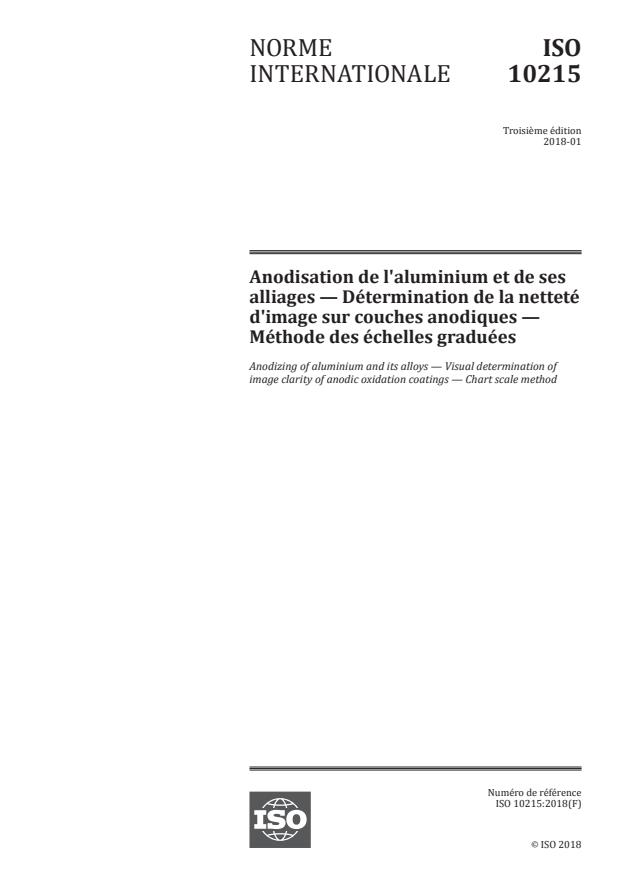
ISO 10215:2018 - Anodisation de l'aluminium et de ses alliages -- Détermination de la netteté d'image sur couches anodiques -- Méthode des échelles graduées
ISO 10215:2018 - Anodisation de l'aluminium et de ses alliages — Détermination de la netteté d'image sur couches anodiques — Méthode des échelles graduées/8/2018
Overview
ISO 10215:2018 - "Anodizing of aluminium and its alloys - Visual determination of image clarity of anodic oxidation coatings - Chart scale method" - specifies a standardized visual test to evaluate the image clarity of anodic oxidation (anodized) coatings on aluminium and its alloys. The method uses an optical chart scale (optical combs) together with a lightness scale to rank how clearly a surface reflects an image. It is applicable only to flat, reflective surfaces that can reproduce the chart pattern.
Key topics and requirements
- Principle: Image clarity is assessed visually by measuring three properties: image clearness, image distortion, and haze. These are evaluated using the chart scale and a neutral lightness scale defined in the standard.
- Chart scale: Optical comb pattern with Grades 1–11 (Grade 1 = widest lines, Grade 11 = finest lines). The pattern is used to determine the limit of visual resolution (clearness) and to identify distortion caused by surface waviness.
- Lightness (haze) scale: Neutral scale with lightness chips from H = 9.5 down to H = 1.0 (pitch 0.5), tied to L* values per ISO 11664‑3.
- Specimen and apparatus: Uses an observation box incorporating the chart scale, a light source and a lightness scale. Test specimens should be representative flat surfaces (standard specimen size > 90 mm × 65 mm) and must be clean and free of contamination.
- Procedure: Determine clearness and distortion in longitudinal and transverse directions and assign a haze value. Image clarity is then calculated from these measured values as specified in Clause 8.
- Reporting: Test reports must reference ISO 10215:2018 and include product identification, alloy and finish, and the measured image clarity value.
Applications and who uses it
- Quality control and inspection in anodizing plants, surface‑finish laboratories and metal finishing contractors.
- Product designers, specifiers and procurement teams requiring reproducible acceptance criteria for decorative or functional anodized finishes where mirror-like reflection or image reproduction is critical (e.g., architectural panels, consumer electronics enclosures, decorative trim).
- Comparative evaluation of anodic coatings during process development or between suppliers.
- Useful when a quick, standardized visual determination is preferred; instrumental alternatives (see Related Standards) are recommended for dispute resolution or higher accuracy.
Related standards
- ISO 10216 - Instrumental measurement of image clarity using optical combs (more accurate, for disputes).
- ISO 7583 - Terms and definitions for anodizing of aluminium and its alloys.
- ISO 11664‑3 - Colorimetric L* references used for the lightness scale.
Keywords: ISO 10215:2018, anodizing aluminium, anodic oxidation coatings, image clarity, chart scale method, visual determination, lightness scale, optical combs.
Relations
- Effective Date
- 12-Feb-2026
- Effective Date
- 20-Aug-2016
Buy Documents
ISO 10215:2018 - Anodizing of aluminium and its alloys -- Visual determination of image clarity of anodic oxidation coatings -- Chart scale method
ISO 10215:2018 - Anodizing of aluminium and its alloys — Visual determination of image clarity of anodic oxidation coatings — Chart scale method/8/2018
ISO 10215:2018 - Anodisation de l'aluminium et de ses alliages -- Détermination de la netteté d'image sur couches anodiques -- Méthode des échelles graduées
ISO 10215:2018 - Anodisation de l'aluminium et de ses alliages — Détermination de la netteté d'image sur couches anodiques — Méthode des échelles graduées/8/2018
Get Certified
Connect with accredited certification bodies for this standard

DVS-ZERT GmbH
German welding certification society.
CARES (UK Certification Authority for Reinforcing Steels)
UK certification for reinforcing steels and construction.
EWF/IIW (European/International Welding Federation)
International welding personnel certification.
Sponsored listings
Frequently Asked Questions
ISO 10215:2018 is a standard published by the International Organization for Standardization (ISO). Its full title is "Anodizing of aluminium and its alloys — Visual determination of image clarity of anodic oxidation coatings — Chart scale method". This standard covers: ISO 10215:2018 specifies a visual method for determining the image clarity of anodic oxidation coatings on aluminium and its alloys, using a chart scale and a lightness scale, which are defined. The method is applicable only to flat surfaces that can reflect the image of the chart scale pattern.
ISO 10215:2018 specifies a visual method for determining the image clarity of anodic oxidation coatings on aluminium and its alloys, using a chart scale and a lightness scale, which are defined. The method is applicable only to flat surfaces that can reflect the image of the chart scale pattern.
ISO 10215:2018 is classified under the following ICS (International Classification for Standards) categories: 25.220.20 - Surface treatment. The ICS classification helps identify the subject area and facilitates finding related standards.
ISO 10215:2018 has the following relationships with other standards: It is inter standard links to EN ISO 10215:2018, ISO 10215:2010. Understanding these relationships helps ensure you are using the most current and applicable version of the standard.
ISO 10215:2018 is available in PDF format for immediate download after purchase. The document can be added to your cart and obtained through the secure checkout process. Digital delivery ensures instant access to the complete standard document.
Standards Content (Sample)
INTERNATIONAL ISO
STANDARD 10215
Third edition
2018-01
Anodizing of aluminium and its
alloys — Visual determination of
image clarity of anodic oxidation
coatings — Chart scale method
Anodisation de l'aluminium et de ses alliages — Détermination de
la netteté d'image sur couches anodiques — Méthode des échelles
graduées
Reference number
©
ISO 2018
© ISO 2018
All rights reserved. Unless otherwise specified, or required in the context of its implementation, no part of this publication may
be reproduced or utilized otherwise in any form or by any means, electronic or mechanical, including photocopying, or posting
on the internet or an intranet, without prior written permission. Permission can be requested from either ISO at the address
below or ISO’s member body in the country of the requester.
ISO copyright office
CP 401 • Ch. de Blandonnet 8
CH-1214 Vernier, Geneva, Switzerland
Tel. +41 22 749 01 11
Fax +41 22 749 09 47
copyright@iso.org
www.iso.org
Published in Switzerland
ii © ISO 2018 – All rights reserved
Contents Page
Foreword .iv
Introduction .v
1 Scope . 1
2 Normative references . 1
3 Terms and definitions . 1
4 Principle . 2
5 Apparatus . 2
6 Test specimen . 5
6.1 Sampling . 5
6.2 Size . 5
6.3 Treatment before testing . 5
7 Procedure. 5
7.1 General . 5
7.2 Determination of image clearness, C . 5
7.3 Determination of image distortion, I . 6
7.4 Determination of haze value, H . 6
n
8 Expression of results . 6
9 Test report . 7
Bibliography . 8
Foreword
ISO (the International Organization for Standardization) is a worldwide federation of national standards
bodies (ISO member bodies). The work of preparing International Standards is normally carried out
through ISO technical committees. Each member body interested in a subject for which a technical
committee has been established has the right to be represented on that committee. International
organizations, governmental and non-governmental, in liaison with ISO, also take part in the work.
ISO collaborates closely with the International Electrotechnical Commission (IEC) on all matters of
electrotechnical standardization.
The procedures used to develop this document and those intended for its further maintenance are
described in the ISO/IEC Directives, Part 1. In particular the different approval criteria needed for the
different types of ISO documents should be noted. This document was drafted in accordance with the
editorial rules of the ISO/IEC Directives, Part 2 (see www .iso .org/ directives).
Attention is drawn to the possibility that some of the elements of this document may be the subject of
patent rights. ISO shall not be held responsible for identifying any or all such patent rights. Details of
any patent rights identified during the development of the document will be in the Introduction and/or
on the ISO list of patent declarations received (see www .iso .org/ patents).
Any trade name used in this document is information given for the convenience of users and does not
constitute an endorsement.
For an explanation on the voluntary nature of standards, the meaning of ISO specific terms and
expressions related to conformity assessment, as well as information about ISO’s adherence to the
World Trade Organization (WTO) principles in the Technical Barriers to Trade (TBT) see the following
URL: www .iso .org/ iso/ foreword .html.
This document was prepared by Technical Committee ISO/TC 79, Light metals and their alloys,
Subcommittee SC 2, Organic and anodic oxidation coatings on aluminium.
This third edition cancels and replaces the second edition (ISO 10215:2010), which has been technically
revised.
The main changes compared to the previous edition are as follows:
— the normative reference of ISO/TR 8125 has been deleted since it has been withdrawn;
— ISO/TR 8125:1984, Table 2 has been added as Table 2;
— the specification of the test specimen has been revised.
iv © ISO 2018 – All rights reserved
Introduction
Estimation of the image clarity of anodic oxidation coatings on aluminium and its alloys is normally
carried out visually by observing the clearness of an image on the surface. However, the image can
be observed at various angles and can be confused with the gloss level of a surface; and while the
degree of image clarity is mainly influenced by the clearness of the coating, it is also affected by image
distortion caused by surface irregularities and the haziness of the coating layer. Standardized methods
of determining image clarity are therefore required.
This document specifies the use of a chart scale based on optical combs, together with a lightness scale
to rank image clarity, and has been found to give good correlation with visual evaluation. A related
document, ISO 10216, specifies an instrumental method of measuring image clarity, also by using
optical combs. The instrumental method provides a more accurate measurement of image clarity than
visual evaluation and should be used in cases of dispute.
INTERNATIONAL STANDARD ISO 10215:2018(E)
Anodizing of aluminium and its alloys — Visual
determination of image clarity of anodic oxidation coatings
— Chart scale method
1 Scope
This document specifies a visual method for determining the image clarity of anodic oxidation coatings
on aluminium and its alloys, using a chart scale and a lightness scale, which are defined. The method is
applicable only to flat surfaces that can reflect the image of the chart scale pattern.
2 Normative references
The following documents are referred to in the text in such a way that some or all of their content
constitutes requirements of this document. For dated references, only the edition cited applies. For
undated references, the latest edition of the referenced document (including any amendments) applies.
ISO 7583, Anodizing of aluminium and its alloys — Terms and definitions
3 Terms and definitions
For the purposes of this document, the terms and definitions given in ISO 7583 and the following apply.
ISO and IEC maintain terminological databases for use in standardization at the following address:
— ISO Online browsing platform: available at https:// www .iso .org/ obp
— IEC Electropedia: available at http:// www .electr
...
INTERNATIONAL ISO
STANDARD 10215
Third edition
2018-01
Anodizing of aluminium and its
alloys — Visual determination of
image clarity of anodic oxidation
coatings — Chart scale method
Anodisation de l'aluminium et de ses alliages — Détermination de
la netteté d'image sur couches anodiques — Méthode des échelles
graduées
Reference number
©
ISO 2018
© ISO 2018
All rights reserved. Unless otherwise specified, or required in the context of its implementation, no part of this publication may
be reproduced or utilized otherwise in any form or by any means, electronic or mechanical, including photocopying, or posting
on the internet or an intranet, without prior written permission. Permission can be requested from either ISO at the address
below or ISO’s member body in the country of the requester.
ISO copyright office
CP 401 • Ch. de Blandonnet 8
CH-1214 Vernier, Geneva, Switzerland
Tel. +41 22 749 01 11
Fax +41 22 749 09 47
copyright@iso.org
www.iso.org
Published in Switzerland
ii © ISO 2018 – All rights reserved
Contents Page
Foreword .iv
Introduction .v
1 Scope . 1
2 Normative references . 1
3 Terms and definitions . 1
4 Principle . 2
5 Apparatus . 2
6 Test specimen . 5
6.1 Sampling . 5
6.2 Size . 5
6.3 Treatment before testing . 5
7 Procedure. 5
7.1 General . 5
7.2 Determination of image clearness, C . 5
7.3 Determination of image distortion, I . 6
7.4 Determination of haze value, H . 6
n
8 Expression of results . 6
9 Test report . 7
Bibliography . 8
Foreword
ISO (the International Organization for Standardization) is a worldwide federation of national standards
bodies (ISO member bodies). The work of preparing International Standards is normally carried out
through ISO technical committees. Each member body interested in a subject for which a technical
committee has been established has the right to be represented on that committee. International
organizations, governmental and non-governmental, in liaison with ISO, also take part in the work.
ISO collaborates closely with the International Electrotechnical Commission (IEC) on all matters of
electrotechnical standardization.
The procedures used to develop this document and those intended for its further maintenance are
described in the ISO/IEC Directives, Part 1. In particular the different approval criteria needed for the
different types of ISO documents should be noted. This document was drafted in accordance with the
editorial rules of the ISO/IEC Directives, Part 2 (see www .iso .org/ directives).
Attention is drawn to the possibility that some of the elements of this document may be the subject of
patent rights. ISO shall not be held responsible for identifying any or all such patent rights. Details of
any patent rights identified during the development of the document will be in the Introduction and/or
on the ISO list of patent declarations received (see www .iso .org/ patents).
Any trade name used in this document is information given for the convenience of users and does not
constitute an endorsement.
For an explanation on the voluntary nature of standards, the meaning of ISO specific terms and
expressions related to conformity assessment, as well as information about ISO’s adherence to the
World Trade Organization (WTO) principles in the Technical Barriers to Trade (TBT) see the following
URL: www .iso .org/ iso/ foreword .html.
This document was prepared by Technical Committee ISO/TC 79, Light metals and their alloys,
Subcommittee SC 2, Organic and anodic oxidation coatings on aluminium.
This third edition cancels and replaces the second edition (ISO 10215:2010), which has been technically
revised.
The main changes compared to the previous edition are as follows:
— the normative reference of ISO/TR 8125 has been deleted since it has been withdrawn;
— ISO/TR 8125:1984, Table 2 has been added as Table 2;
— the specification of the test specimen has been revised.
iv © ISO 2018 – All rights reserved
Introduction
Estimation of the image clarity of anodic oxidation coatings on aluminium and its alloys is normally
carried out visually by observing the clearness of an image on the surface. However, the image can
be observed at various angles and can be confused with the gloss level of a surface; and while the
degree of image clarity is mainly influenced by the clearness of the coating, it is also affected by image
distortion caused by surface irregularities and the haziness of the coating layer. Standardized methods
of determining image clarity are therefore required.
This document specifies the use of a chart scale based on optical combs, together with a lightness scale
to rank image clarity, and has been found to give good correlation with visual evaluation. A related
document, ISO 10216, specifies an instrumental method of measuring image clarity, also by using
optical combs. The instrumental method provides a more accurate measurement of image clarity than
visual evaluation and should be used in cases of dispute.
INTERNATIONAL STANDARD ISO 10215:2018(E)
Anodizing of aluminium and its alloys — Visual
determination of image clarity of anodic oxidation coatings
— Chart scale method
1 Scope
This document specifies a visual method for determining the image clarity of anodic oxidation coatings
on aluminium and its alloys, using a chart scale and a lightness scale, which are defined. The method is
applicable only to flat surfaces that can reflect the image of the chart scale pattern.
2 Normative references
The following documents are referred to in the text in such a way that some or all of their content
constitutes requirements of this document. For dated references, only the edition cited applies. For
undated references, the latest edition of the referenced document (including any amendments) applies.
ISO 7583, Anodizing of aluminium and its alloys — Terms and definitions
3 Terms and definitions
For the purposes of this document, the terms and definitions given in ISO 7583 and the following apply.
ISO and IEC maintain terminological databases for use in standardization at the following address:
— ISO Online browsing platform: available at https:// www .iso .org/ obp
— IEC Electropedia: available at http:// www .electr
...
NORME ISO
INTERNATIONALE 10215
Troisième édition
2018-01
Anodisation de l'aluminium et de ses
alliages — Détermination de la netteté
d'image sur couches anodiques —
Méthode des échelles graduées
Anodizing of aluminium and its alloys — Visual determination of
image clarity of anodic oxidation coatings — Chart scale method
Numéro de référence
©
ISO 2018
DOCUMENT PROTÉGÉ PAR COPYRIGHT
© ISO 2018
Tous droits réservés. Sauf prescription différente ou nécessité dans le contexte de sa mise en oeuvre, aucune partie de cette
publication ne peut être reproduite ni utilisée sous quelque forme que ce soit et par aucun procédé, électronique ou mécanique,
y compris la photocopie, ou la diffusion sur l’internet ou sur un intranet, sans autorisation écrite préalable. Une autorisation peut
être demandée à l’ISO à l’adresse ci-après ou au comité membre de l’ISO dans le pays du demandeur.
ISO copyright office
CP 401 • Ch. de Blandonnet 8
CH-1214 Vernier, Geneva, Switzerland
Tel. +41 22 749 01 11
Fax +41 22 749 09 47
copyright@iso.org
www.iso.org
Publié en Suisse
ii © ISO 2018 – Tous droits réservés
Sommaire Page
Avant-propos .iv
Introduction .v
1 Domaine d’application . 1
2 Références normatives . 1
3 Termes et définitions . 1
4 Principe . 2
5 Appareillage . 2
6 Éprouvette . 4
6.1 Échantillonnage . 4
6.2 Dimensions . 5
6.3 Traitement avant essai . 5
7 Mode opératoire. 5
7.1 Généralités . 5
7.2 Détermination de la définition de l’image, C .5
7.3 Détermination de la distorsion de l’image, I .5
7.4 Détermination du voile, Hn . 6
8 Expression des résultats. 6
9 Rapport d’essai . 6
Bibliographie . 8
Avant-propos
L'ISO (Organisation internationale de normalisation) est une fédération mondiale d'organismes
nationaux de normalisation (comités membres de l'ISO). L'élaboration des Normes internationales est
en général confiée aux comités techniques de l'ISO. Chaque comité membre intéressé par une étude
a le droit de faire partie du comité technique créé à cet effet. Les organisations internationales,
gouvernementales et non gouvernementales, en liaison avec l'ISO participent également aux travaux.
L'ISO collabore étroitement avec la Commission électrotechnique internationale (IEC) en ce qui
concerne la normalisation électrotechnique.
Les procédures utilisées pour élaborer le présent document et celles destinées à sa mise à jour sont
décrites dans les Directives ISO/IEC, Partie 1. Il convient, en particulier de prendre note des différents
critères d'approbation requis pour les différents types de documents ISO. Le présent document a été
rédigé conformément aux règles de rédaction données dans les Directives ISO/IEC, Partie 2 (voir www
.iso .org/ directives).
L'attention est attirée sur le fait que certains des éléments du présent document peuvent faire l'objet de
droits de propriété intellectuelle ou de droits analogues. L'ISO ne saurait être tenue pour responsable
de ne pas avoir identifié de tels droits de propriété et averti de leur existence. Les détails concernant
les références aux droits de propriété intellectuelle ou autres droits analogues identifiés lors de
l'élaboration du document sont indiqués dans l'Introduction et/ou dans la liste des déclarations de
brevets reçues par l'ISO (voir www .iso .org/ brevets).
Les appellations commerciales éventuellement mentionnées dans le présent document sont données
pour information, par souci de commodité, à l’intention des utilisateurs et ne sauraient constituer un
engagement.
Pour une explication de la nature volontaire des normes, la signification des termes et expressions
spécifiques de l'ISO liés à l'évaluation de la conformité, ou pour toute information au sujet de l'adhésion
de l'ISO aux principes de l’Organisation mondiale du commerce (OMC) concernant les obstacles
techniques au commerce (OTC), voir le lien suivant: www .iso .org/ avant -propos.
Le présent document a été élaboré par le comité technique ISO/TC 79, Métaux légers et leurs alliages,
sous-comité SC 2, Couches organiques et couches d’oxydation anodique sur l’aluminium.
Cette troisième édition annule et remplace la deuxième édition (ISO 10215:2010), qui a fait l’objet d’une
révision technique.
Les principales modifications par rapport à l’édition précédente sont les suivantes:
— suppression de la référence normative ISO/TR 8125 en raison du retrait de ladite norme;
— ajout du Tableau 2 repris de l’ISO/TR 8125:1984, Tableau 2;
— révision de la spécification des éprouvettes.
iv © ISO 2018 – Tous droits réservés
Introduction
L’estimation de la netteté d’image réfléchie par les couches anodiques déposées sur l’aluminium et ses
alliages s’effectue normalement par observation à l’œil nu de la définition de l’image sur la surface.
Cette image peut cependant s’observer sous divers angles et peut être troublée par le brillant de la
surface, et bien que le degré de netteté d’image dépende principalement de la définition, il est également
conditionné par la distorsion due aux irrégularités superficielles et au voile de la couche de revêtement.
Il est donc essentiel de disposer de méthodes normalisées pour la détermination de la netteté d’image.
Le présent document spécifie une méthode basée sur une échelle graduée composée de peignes
optiques et sur une échelle de clarté permettant une classification de la netteté de l’image; il apparaît
que cette méthode permet une mise en corrélation satisfaisante avec les résultats de l’examen visuel. Un
document connexe, l’ISO 10216, spécifie une méthode instrumentale permettant de mesurer la netteté
d’image, également à l’aide de peignes optiques. La méthode instrumentale permettant un mesurage de
la netteté plus précis que l’examen visuel, c’est elle qu’il convient d’utiliser en cas de litige.
NORME INTERNATIONALE ISO 10215:2018(F)
Anodisation de l'aluminium et de ses alliages —
Détermination de la netteté d'image sur couches
anodiques — Méthode des échelles graduées
1 Domaine d’application
Le présent document spécifie une méthode visuelle pour la détermination de la netteté de l’image
réfléchie par les couches anodiques déposées sur l’aluminium et ses alliages, utilisant une échelle
graduée et une échelle de clarté. La méthode n’est applicable qu’aux surfaces planes susceptibles de
refléter l’image d’une échelle graduée type.
2 Références normatives
Les documents suivants cités dans le texte constituent, pour tout ou partie de leur contenu, des
exigences du présent document. Pour les références datées, seule l’édition citée s’applique. Pour les
références non datées, la dernière édition du document de référence s'applique (y compris les éventuels
amendements).
ISO 7583, Anodisation de l’aluminium et de ses alliages — Termes et définitions
3 Termes et définitions
Pour les besoins du présent document, les termes et définitions de l’ISO 7583 ainsi que les suivants,
s’appliquent.
L’ISO et l’IEC tiennent à jour des bases de données terminologiques destinées à être utilisées en
normalisation, consultables aux adresses suivantes:
— ISO Online browsing platform: disponible à l'adresse https:// www .iso .org/ obp
— IEC Electropedia: disponible à l'adresse http:// www .electropedia .org/
3.1
netteté d’image
Cv
capacité de la surface d’une couche anodique à donner une image claire d’un ob
...
NORME ISO
INTERNATIONALE 10215
Troisième édition
2018-01
Anodisation de l'aluminium et de ses
alliages — Détermination de la netteté
d'image sur couches anodiques —
Méthode des échelles graduées
Anodizing of aluminium and its alloys — Visual determination of
image clarity of anodic oxidation coatings — Chart scale method
Numéro de référence
©
ISO 2018
DOCUMENT PROTÉGÉ PAR COPYRIGHT
© ISO 2018
Tous droits réservés. Sauf prescription différente ou nécessité dans le contexte de sa mise en oeuvre, aucune partie de cette
publication ne peut être reproduite ni utilisée sous quelque forme que ce soit et par aucun procédé, électronique ou mécanique,
y compris la photocopie, ou la diffusion sur l’internet ou sur un intranet, sans autorisation écrite préalable. Une autorisation peut
être demandée à l’ISO à l’adresse ci-après ou au comité membre de l’ISO dans le pays du demandeur.
ISO copyright office
CP 401 • Ch. de Blandonnet 8
CH-1214 Vernier, Geneva, Switzerland
Tel. +41 22 749 01 11
Fax +41 22 749 09 47
copyright@iso.org
www.iso.org
Publié en Suisse
ii © ISO 2018 – Tous droits réservés
Sommaire Page
Avant-propos .iv
Introduction .v
1 Domaine d’application . 1
2 Références normatives . 1
3 Termes et définitions . 1
4 Principe . 2
5 Appareillage . 2
6 Éprouvette . 4
6.1 Échantillonnage . 4
6.2 Dimensions . 5
6.3 Traitement avant essai . 5
7 Mode opératoire. 5
7.1 Généralités . 5
7.2 Détermination de la définition de l’image, C .5
7.3 Détermination de la distorsion de l’image, I .5
7.4 Détermination du voile, Hn . 6
8 Expression des résultats. 6
9 Rapport d’essai . 6
Bibliographie . 8
Avant-propos
L'ISO (Organisation internationale de normalisation) est une fédération mondiale d'organismes
nationaux de normalisation (comités membres de l'ISO). L'élaboration des Normes internationales est
en général confiée aux comités techniques de l'ISO. Chaque comité membre intéressé par une étude
a le droit de faire partie du comité technique créé à cet effet. Les organisations internationales,
gouvernementales et non gouvernementales, en liaison avec l'ISO participent également aux travaux.
L'ISO collabore étroitement avec la Commission électrotechnique internationale (IEC) en ce qui
concerne la normalisation électrotechnique.
Les procédures utilisées pour élaborer le présent document et celles destinées à sa mise à jour sont
décrites dans les Directives ISO/IEC, Partie 1. Il convient, en particulier de prendre note des différents
critères d'approbation requis pour les différents types de documents ISO. Le présent document a été
rédigé conformément aux règles de rédaction données dans les Directives ISO/IEC, Partie 2 (voir www
.iso .org/ directives).
L'attention est attirée sur le fait que certains des éléments du présent document peuvent faire l'objet de
droits de propriété intellectuelle ou de droits analogues. L'ISO ne saurait être tenue pour responsable
de ne pas avoir identifié de tels droits de propriété et averti de leur existence. Les détails concernant
les références aux droits de propriété intellectuelle ou autres droits analogues identifiés lors de
l'élaboration du document sont indiqués dans l'Introduction et/ou dans la liste des déclarations de
brevets reçues par l'ISO (voir www .iso .org/ brevets).
Les appellations commerciales éventuellement mentionnées dans le présent document sont données
pour information, par souci de commodité, à l’intention des utilisateurs et ne sauraient constituer un
engagement.
Pour une explication de la nature volontaire des normes, la signification des termes et expressions
spécifiques de l'ISO liés à l'évaluation de la conformité, ou pour toute information au sujet de l'adhésion
de l'ISO aux principes de l’Organisation mondiale du commerce (OMC) concernant les obstacles
techniques au commerce (OTC), voir le lien suivant: www .iso .org/ avant -propos.
Le présent document a été élaboré par le comité technique ISO/TC 79, Métaux légers et leurs alliages,
sous-comité SC 2, Couches organiques et couches d’oxydation anodique sur l’aluminium.
Cette troisième édition annule et remplace la deuxième édition (ISO 10215:2010), qui a fait l’objet d’une
révision technique.
Les principales modifications par rapport à l’édition précédente sont les suivantes:
— suppression de la référence normative ISO/TR 8125 en raison du retrait de ladite norme;
— ajout du Tableau 2 repris de l’ISO/TR 8125:1984, Tableau 2;
— révision de la spécification des éprouvettes.
iv © ISO 2018 – Tous droits réservés
Introduction
L’estimation de la netteté d’image réfléchie par les couches anodiques déposées sur l’aluminium et ses
alliages s’effectue normalement par observation à l’œil nu de la définition de l’image sur la surface.
Cette image peut cependant s’observer sous divers angles et peut être troublée par le brillant de la
surface, et bien que le degré de netteté d’image dépende principalement de la définition, il est également
conditionné par la distorsion due aux irrégularités superficielles et au voile de la couche de revêtement.
Il est donc essentiel de disposer de méthodes normalisées pour la détermination de la netteté d’image.
Le présent document spécifie une méthode basée sur une échelle graduée composée de peignes
optiques et sur une échelle de clarté permettant une classification de la netteté de l’image; il apparaît
que cette méthode permet une mise en corrélation satisfaisante avec les résultats de l’examen visuel. Un
document connexe, l’ISO 10216, spécifie une méthode instrumentale permettant de mesurer la netteté
d’image, également à l’aide de peignes optiques. La méthode instrumentale permettant un mesurage de
la netteté plus précis que l’examen visuel, c’est elle qu’il convient d’utiliser en cas de litige.
NORME INTERNATIONALE ISO 10215:2018(F)
Anodisation de l'aluminium et de ses alliages —
Détermination de la netteté d'image sur couches
anodiques — Méthode des échelles graduées
1 Domaine d’application
Le présent document spécifie une méthode visuelle pour la détermination de la netteté de l’image
réfléchie par les couches anodiques déposées sur l’aluminium et ses alliages, utilisant une échelle
graduée et une échelle de clarté. La méthode n’est applicable qu’aux surfaces planes susceptibles de
refléter l’image d’une échelle graduée type.
2 Références normatives
Les documents suivants cités dans le texte constituent, pour tout ou partie de leur contenu, des
exigences du présent document. Pour les références datées, seule l’édition citée s’applique. Pour les
références non datées, la dernière édition du document de référence s'applique (y compris les éventuels
amendements).
ISO 7583, Anodisation de l’aluminium et de ses alliages — Termes et définitions
3 Termes et définitions
Pour les besoins du présent document, les termes et définitions de l’ISO 7583 ainsi que les suivants,
s’appliquent.
L’ISO et l’IEC tiennent à jour des bases de données terminologiques destinées à être utilisées en
normalisation, consultables aux adresses suivantes:
— ISO Online browsing platform: disponible à l'adresse https:// www .iso .org/ obp
— IEC Electropedia: disponible à l'adresse http:// www .electropedia .org/
3.1
netteté d’image
Cv
capacité de la surface d’une couche anodique à donner une image claire d’un ob
...