

ISO 24131-4:2026
(Main)Internal protection by polymeric lining for ductile iron pipes — Requirements and test methods — Part 4: Ceramic epoxy lining
- Abstract
This document specifies the requirements and test methods applicable to factory applied ceramic epoxy lining for ductile iron pipes conforming to ISO 2531, ISO 7186 and ISO 16631, excluding potable water, for operating temperature up to 50 °C.
- Status
- Published
- Publication Date
- 11-Jun-2026
- Technical Committee
- ISO/TC 5/SC 2 - Cast iron pipes, fittings and their joints
- Drafting Committee
- ISO/TC 5/SC 2/WG 24 - Internal Protection
- Current Stage
- 6060 - International Standard published
- Start Date
- 12-Jun-2026
- Due Date
- 16-Jul-2027
- Completion Date
- 12-Jun-2026


ISO 24131-4:2026 is an ISO International Standard for factory applied ceramic epoxy lining inside ductile iron pipes. It specifies the requirements and test methods for pipes conforming to ISO 2531, ISO 7186 and ISO 16631, for non-potable use and operating temperatures up to 50 °C.
What does ISO 24131-4:2026 specify?
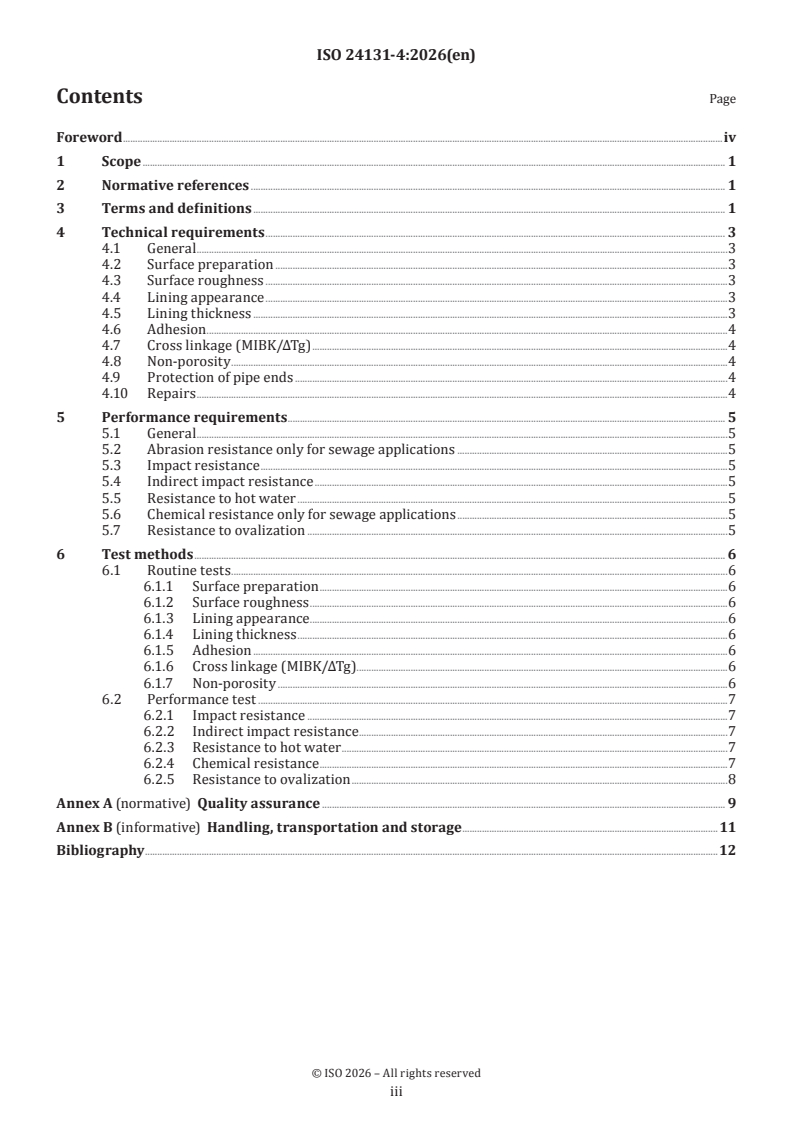
ISO 24131-4:2026 covers the internal protection of ductile iron pipes with ceramic epoxy lining, including production requirements, performance requirements, and the test methods used to verify them. It is organized into Clauses 1 to 6, with Annex A on quality assurance and Annex B on handling, transportation and storage.
| Annex | What it covers |
|---|---|
| Annex A | Normative quality assurance, including performance tests, routine tests and DN grouping |
| Annex B | Informative guidance on handling, transportation and storage |
What are the key requirements of ISO 24131-4:2026?
Surface preparation and lining condition
Clause 4.2 requires the surfaces to be clean, dry and free from oil and grease before lining is applied, with surface temperature kept above the dew point when moisture could condense. That matters because trapped moisture or contamination can reduce adhesion and create lining defects.
Clause 4.3 links surface roughness to the lining system, with Ra and Rz values used when required by the lining material provider or manufacturer. Clause 4.4 requires a uniform appearance with no visible defects such as pinholes, bubbles, blisters, wrinkles, cracks or voids, except for permitted markings and allowable repairs.
Thickness, adhesion and cure
Clause 4.5 sets both a localized minimum thickness and a minimum average thickness. In practice, this means the lining has to be thick enough at individual points and overall, so the pipe barrel has consistent protection.
Clause 4.6 requires adhesion testing on production samples, with a minimum single value of 8.0 MPa. Clause 4.7 gives two ways to assess cross linkage: the MIBK wipe test with limits set by the manufacturer, or a glass transition temperature change, ΔTg, of no more than 5 °C.
Clause 4.8 requires non-porosity under a high-voltage test based on the minimum average thickness, with no electrical puncture except in designated zones. Clause 4.9 requires the spigot end and internal socket profile to be coated as specified for the pipe family, and Clause 4.10 requires repaired areas to meet the same thickness, cure and non-porosity requirements.
Performance verification before production
Clause 5 requires performance tests before production lining, and again when the lining material or lining process changes. This is the document’s way of checking that the system works as intended before it is used on production pipes.
For sewage applications, Clause 5.2 and 5.6 add abrasion resistance and chemical resistance requirements. Clause 5.3 and 5.4 cover impact resistance and indirect impact resistance, Clause 5.5 covers hot-water resistance, and Clause 5.7 covers resistance to ovalization.
What the tests prove in practice
The performance tests check whether the lining survives mechanical damage, heat, chemicals and pipe deformation without losing protection. For buyers and manufacturers, this means the lining system is not only measured at application stage, but also challenged under service-like conditions.
What terms does ISO 24131-4:2026 define?
- Ceramic epoxy lining - a factory applied lining made from at least 20% by volume ceramic quartz in a two-component amine-cured epoxy system.
- Routine test - a test used to control the manufacturing process, with frequency set by the standard or the manufacturer.
- Cross linkage - the chemical reaction between epoxy resin and hardener that forms the cured lining.
- Non-porosity - the absence of electrical puncture in a high-voltage holiday test under defined conditions.
- Designated zone - a pipe area where lower coating performance is accepted because of geometry, jointing or similar constraints.
- Abrasion resistance - the ability of the material or structure to withstand wear by rubbing.
- Impact resistance - the energy the lining can withstand without damage under defined test conditions.
- Ovalization - a deformation measure based on vertical deflection relative to pipe outside diameter.
Who uses ISO 24131-4:2026?
ISO 24131-4:2026 is used by manufacturers of ductile iron pipes and lining systems, especially where ceramic epoxy lining is applied in production. It is also used by quality control teams and test laboratories that measure thickness, adhesion, cure and holiday-free performance.
Procurement teams, specifiers and project engineers use it when they need a clear technical basis for lining performance on non-potable pipe systems, including sewerage applications. It is also relevant for handling, transport and storage decisions because Annex B addresses how to avoid damage after lining.
Which standards are used with ISO 24131-4:2026?
- ISO 2531 - provides the base ductile iron pipe family and is also the source for some terms used in the document.
- ISO 7186 - supports sewerage applications, including abrasion and chemical resistance requirements.
- ISO 16631 - covers ductile iron pipes compatible with plastic piping systems for water applications and plastic pipeline connections.
- ISO 4624 - gives the pull-off adhesion test method used for adhesion measurements.
- ISO 8503-1 - provides the surface roughness comparator method for checking abrasive blast-cleaned surfaces.
- ISO 11357-2 - supports the differential scanning calorimetry method used for the ΔTg option in cross-linkage assessment.
- ISO 8501-1 and ISO 8502-3 - are cited as applicable references for surface cleanliness and dust assessment.
- ISO 9001 - is named in Annex A as an example of a quality management system a manufacturer may implement.
What does the ISO 24131-4:2026 document contain?
ISO 24131-4:2026 contains the technical requirements for surface preparation, appearance, thickness, adhesion, cross linkage, non-porosity, end protection and repairs, plus the performance requirements for abrasion, impact, hot water, chemicals and ovalization. It also contains the routine and performance test methods used to check each requirement in production and qualification.
The document includes Table A.1 for performance test planning, Table A.2 for routine test planning, and Table A.3 for DN grouping. It also includes Figure 1 showing the defined pipe areas for end coating, and detailed test set-ups for pull-off adhesion, MIBK wiping, holiday testing, impact, hot-water exposure, chemical immersion and ovalization.
Get Certified
Connect with accredited certification bodies for this standard

Institut za varilstvo d.o.o. (Welding Institute)
Slovenia's leading welding institute since 1952. ISO 3834, EN 1090, pressure equipment certification, NDT personnel, welder qualification. Only IIW Au
Sponsored listings
Frequently Asked Questions
ISO 24131-4:2026 is a standard published by the International Organization for Standardization (ISO). Its full title is "Internal protection by polymeric lining for ductile iron pipes — Requirements and test methods — Part 4: Ceramic epoxy lining". This standard covers: This document specifies the requirements and test methods applicable to factory applied ceramic epoxy lining for ductile iron pipes conforming to ISO 2531, ISO 7186 and ISO 16631, excluding potable water, for operating temperature up to 50 °C.
This document specifies the requirements and test methods applicable to factory applied ceramic epoxy lining for ductile iron pipes conforming to ISO 2531, ISO 7186 and ISO 16631, excluding potable water, for operating temperature up to 50 °C.
ISO 24131-4:2026 is classified under the following ICS (International Classification for Standards) categories: 23.040.10 - Iron and steel pipes. The ICS classification helps identify the subject area and facilitates finding related standards.
ISO 24131-4:2026 is available in PDF format for immediate download after purchase. The document can be added to your cart and obtained through the secure checkout process. Digital delivery ensures instant access to the complete standard document.
Standards Content (Sample)
International
Standard
ISO 24131-4
First edition
Internal protection by polymeric
2026-06
lining for ductile iron pipes —
Requirements and test methods —
Part 4:
Ceramic epoxy lining
Protection interne des tuyaux en fonte ductile par revêtement
polymérique — Exigences et méthodes d'essai —
Partie 4: Revêtement époxy céramique
Reference number
© ISO 2026
All rights reserved. Unless otherwise specified, or required in the context of its implementation, no part of this publication may
be reproduced or utilized otherwise in any form or by any means, electronic or mechanical, including photocopying, or posting on
the internet or an intranet, without prior written permission. Permission can be requested from either ISO at the address below
or ISO’s member body in the country of the requester.
ISO copyright office
CP 401 • Ch. de Blandonnet 8
CH-1214 Vernier, Geneva
Phone: +41 22 749 01 11
Email: copyright@iso.org
Website: www.iso.org
Published in Switzerland
ii
Contents Page
Foreword .iv
1 Scope . 1
2 Normative references . 1
3 Terms and definitions . 1
4 Technical requirements . 3
4.1 General .3
4.2 Surface preparation .3
4.3 Surface roughness .3
4.4 Lining appearance .3
4.5 Lining thickness .3
4.6 Adhesion .4
4.7 Cross linkage (MIBK/ΔTg) .4
4.8 Non-porosity .4
4.9 Protection of pipe ends .4
4.10 Repairs .4
5 Performance requirements . . 5
5.1 General .5
5.2 Abrasion resistance only for sewage applications .5
5.3 Impact resistance .5
5.4 Indirect impact resistance .5
5.5 Resistance to hot water .5
5.6 Chemical resistance only for sewage applications .5
5.7 Resistance to ovalization .5
6 Test methods . 6
6.1 Routine tests . .6
6.1.1 Surface preparation .6
6.1.2 Surface roughness .6
6.1.3 Lining appearance . .6
6.1.4 Lining thickness .6
6.1.5 Adhesion .6
6.1.6 Cross linkage (MIBK/ΔTg).6
6.1.7 Non-porosity .6
6.2 Performance test .7
6.2.1 Impact resistance .7
6.2.2 Indirect impact resistance . .7
6.2.3 Resistance to hot water .7
6.2.4 Chemical resistance .7
6.2.5 Resistance to ovalization .8
Annex A (normative) Quality assurance . 9
Annex B (informative) Handling, transportation and storage .11
Bibliography .12
iii
Foreword
ISO (the International Organization for Standardization) is a worldwide federation of national standards
bodies (ISO member bodies). The work of preparing International Standards is normally carried out through
ISO technical committees. Each member body interested in a subject for which a technical committee
has been established has the right to be represented on that committee. International organizations,
governmental and non-governmental, in liaison with ISO, also take part in the work. ISO collaborates closely
with the International Electrotechnical Commission (IEC) on all matters of electrotechnical standardization.
The procedures used to develop this document and those intended for its further maintenance are described
in the ISO/IEC Directives, Part 1. In particular, the different approval criteria needed for the different types
of ISO document should be noted. This document was drafted in accordance with the editorial rules of the
ISO/IEC Directives, Part 2 (see www.iso.org/directives).
ISO draws attention to the possibility that the implementation of this document may involve the use of (a)
patent(s). ISO takes no position concerning the evidence, validity or applicability of any claimed patent
rights in respect thereof. As of the date of publication of this document, ISO had not received notice of (a)
patent(s) which may be required to implement this document. However, implementers are cautioned that
this may not represent the latest information, which may be obtained from the patent database available at
www.iso.org/patents. ISO shall not be held responsible for identifying any or all such patent rights.
Any trade name used in this document is information given for the convenience of users and does not
constitute an endorsement.
For an explanation of the voluntary nature of standards, the meaning of ISO specific terms and expressions
related to conformity assessment, as well as information about ISO's adherence to the World Trade
Organization (WTO) principles in the Technical Barriers to Trade (TBT), see www.iso.org/iso/foreword.html.
This document was prepared by Technical Committee ISO/TC 5, Ferrous metal pipes and metallic fittings,
Subcommittee SC 2, Cast iron pipes, fittings and their joints.
A list of all parts in the ISO 24131 series can be found on the ISO website.
Any feedback or questions on this document should be directed to the user’s national standards body. A
complete listing of these bodies can be found at www.iso.org/members.html.
iv
International Standard ISO 24131-4:2026(en)
Internal protection by polymeric lining for ductile iron
pipes — Requirements and test methods —
Part 4:
Ceramic epoxy lining
1 Scope
This document specifies the requirements and test methods applicable to factory applied ceramic epoxy
lining for ductile iron pipes conforming to ISO 2531, ISO 7186 and ISO 16631, excluding potable water, for
operating temperature up to 50 °C.
2 Normative references
The following documents are referred to in the text in such a way that some or all of their content constitutes
requirements of this document. For dated references, only the edition cited applies. For undated references,
the latest edition of the referenced document (including any amendments) applies.
ISO 2531, Ductile iron pipes, fittings, accessories and their joints for water applications
ISO 7186, Ductile iron products for sewerage applications
ISO 16631, Ductile iron pipes, fittings, accessories and their joints compatible with plastic (PVC or PE) piping
systems, for water applications and for plastic pipeline connections, repair and replacement
ISO 4624, Paints and varnishes — Pull-off test for adhesion
ISO 8503-1, Preparation of steel substrates before application of paints and related products — Surface
roughness characteristics of blast-cleaned steel substrates — Part 1: Specifications and definitions for ISO
surface profile comparators for the assessment of abrasive blast-cleaned surfaces
3 Terms and definitions
For the purposes of this document, the terms and definitions given in ISO 2531 and the following apply.
ISO and IEC maintain terminological databases for use in standardization at the following addresses:
— ISO Online browsing platform: available at https:// www .iso .org/ obp
— IEC Electropedia: available at https:// www .electropedia .org/
3.1
ceramic epoxy lining
factory applied lining which consists of at least 20% by volume of ceramic quartz, and the lining material is
two-component amine cured epoxy which is mixed together in the proportion specified by the manufacturer
before application
3.2
routine test
test carried out to control the manufacturing process
Note 1 to entry: The frequency of the test is defined by this document or the manufacturer.
3.3
cross linkage
chemical reaction between epoxy resin and hardener to form the final cured lining
3.4
non-porosity
absence of electrical puncture in a high voltage test (holiday test) under defined test condition
3.5
designated zone
area of a casting where, because of jointing tolerance restrictions, testing difficulties or enveloping by a
gasket, etc., a lower standard of coating performance is inevitable
Note 1 to entry: For the purpose of this document, their areas are defined as:
— joint areas;
— bolt holes;
— permitted markings;
— ribs;
— edges.
Note 2 to entry: Where necessary, these zones can be protected by appropriate additional corrosion protection actions
during or after installation. However, such actions are not covered in this document.
3.6
abrasion resistance
ability of materials and structures to withstand abrasion
3.7
impact resistance
energy which a lining can withstand without damage under defined test conditions
3.8
indirect impact resistance
impact energy applied from outside of the pipe with deformation to which a lining can withstand without
damage under defined test conditions
3.9
ovalization
100 times the measured vertical deflection, (caused by the applied load) divided by the measured pipe
external diameter
3.10
pull off test
force per unit area, applied perpendicular to the surface, which is necessary to separate the lining from its
substrate
3.11
performance test
test which is done once and thereafter only when there is a change in the lining material or lining process
3.12
hardness
resistance of the lining to the penetration of a ball under defined test conditions
3.13
chalking
superficial reaction of ceramic epoxy lining due to exposure to UV-radiation
Note 1 to entry: The process is confined to the surface only and results in a dulling of the surface.
3.14
localized minimum thickness
minimum thickness measured at any one point of one lined product
4 Technical requirements
4.1 General
The following technical requirements shall be demonstrated by routine tests applied in production, on in-
process and finished lined products with defined frequency. Routine tests shall be in accordance with the
overview of requirements provided in Table A.2.
Quality assurance for ceramic epoxy lining shall be in accordance with Annex A.
4.2 Surface preparation
Prior to lining application, all surfaces to be lined shall be substantially clean and free from oil, grease and
moisture.
In cold weather, or anytime when moisture tends to condense on the surface of the pipe, it shall be uniformly
warmed for sufficient time to dry before cleaning. The surface temperature shall be maintained at least 3 °C
above the dew point.
Surface preparation shall be designed to reach the required performances specified in this document. It
is the responsibility of the manufacturer to demonstrate the fitness for purpose of surface preparation
technology and to put in place a quality control procedure to ensure the stability of those performances.
NOTE The requirements of Class Sa 2.5 of ISO 8501-1 and ≤ Rating 3 dust quantity and Class 2 for dust size of
ISO 8502-3 can be applied.
4.3 Surface roughness
The surface roughness Ra shall be at leas
...