


ISO 2485:1973
(Main)Potassium sulphate for industrial use — Determination of potassium content — Gravimetric method as potassium tetraphenylborate
Potassium sulphate for industrial use — Determination of potassium content — Gravimetric method as potassium tetraphenylborate
Dissolution of a test portion taken from the laboratory sample, previosly ground and sifted. Addition of formaldehyde to transform any ammonium ions present into hexamethylenetetramine and of the disodium salt of ethylenediamin tetra-acetic acid to complex any extraneous cations present which could cause excessive errors. These additions have no detrimental effect on the precision or reproduciblility of the method. Precipitation of the potassium by sodium tetraphenylborate in a weakly alkaline medium. Drying and weighing of the precipitate.
Sulfate de potassium à usage industriel — Dosage du potassium — Méthode gravimétrique à l'état de tétraphénylborate de potassium
General Information
- Status
- Withdrawn
- Publication Date
- 31-Mar-1973
- Withdrawal Date
- 31-Mar-1973
- Technical Committee
- ISO/TC 47 - Chemistry
- Drafting Committee
- ISO/TC 47 - Chemistry
- Current Stage
- 9599 - Withdrawal of International Standard
- Start Date
- 27-May-2002
- Completion Date
- 14-Feb-2026
Buy Documents

ISO 2485:1973 - Potassium sulphate for industrial use -- Determination of potassium content -- Gravimetric method as potassium tetraphenylborate

ISO 2485:1973 - Sulfate de potassium a usage industriel -- Dosage du potassium -- Méthode gravimétrique a l'état de tétraphénylborate de potassium
ISO 2485:1973 - Sulfate de potassium a usage industriel -- Dosage du potassium -- Méthode gravimétrique a l'état de tétraphénylborate de potassium
Get Certified
Connect with accredited certification bodies for this standard

ECOCERT
Organic and sustainability certification.

Eurofins Food Testing Global
Global leader in food, environment, and pharmaceutical product testing.

Intertek Bangladesh
Intertek certification and testing services in Bangladesh.
Sponsored listings
Frequently Asked Questions
ISO 2485:1973 is a standard published by the International Organization for Standardization (ISO). Its full title is "Potassium sulphate for industrial use — Determination of potassium content — Gravimetric method as potassium tetraphenylborate". This standard covers: Dissolution of a test portion taken from the laboratory sample, previosly ground and sifted. Addition of formaldehyde to transform any ammonium ions present into hexamethylenetetramine and of the disodium salt of ethylenediamin tetra-acetic acid to complex any extraneous cations present which could cause excessive errors. These additions have no detrimental effect on the precision or reproduciblility of the method. Precipitation of the potassium by sodium tetraphenylborate in a weakly alkaline medium. Drying and weighing of the precipitate.
Dissolution of a test portion taken from the laboratory sample, previosly ground and sifted. Addition of formaldehyde to transform any ammonium ions present into hexamethylenetetramine and of the disodium salt of ethylenediamin tetra-acetic acid to complex any extraneous cations present which could cause excessive errors. These additions have no detrimental effect on the precision or reproduciblility of the method. Precipitation of the potassium by sodium tetraphenylborate in a weakly alkaline medium. Drying and weighing of the precipitate.
ISO 2485:1973 is classified under the following ICS (International Classification for Standards) categories: 71.060.50 - Salts. The ICS classification helps identify the subject area and facilitates finding related standards.
ISO 2485:1973 is available in PDF format for immediate download after purchase. The document can be added to your cart and obtained through the secure checkout process. Digital delivery ensures instant access to the complete standard document.
Standards Content (Sample)
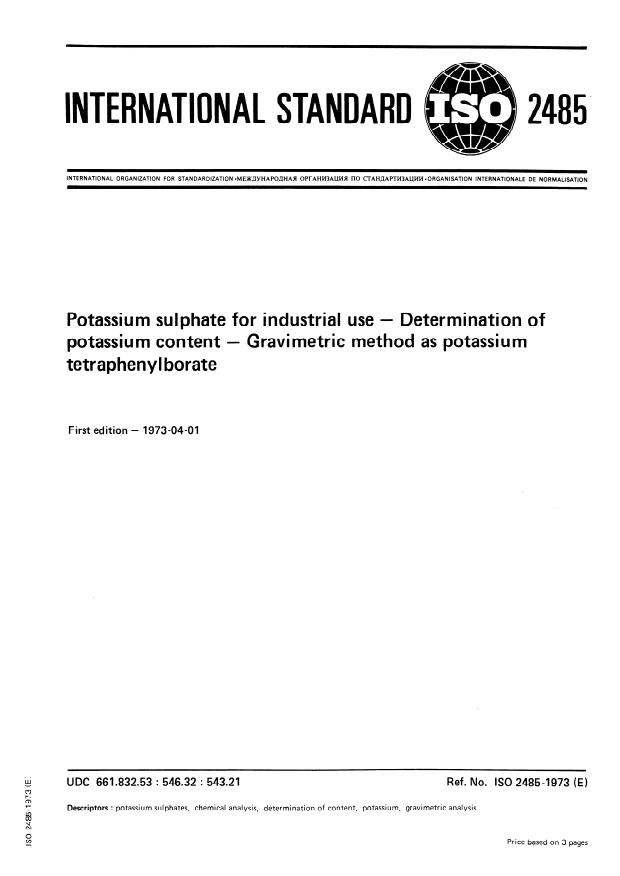
INTERNATIONAL STANDARD
INTERNATIONAL ORGANIZATION FOR STANDARDIZATION l EXAYHAPOAHAJI OPTAHM3AUMR l-IO ~AHAAPTM3A~WW .ORGANISATION INTERNATIONALE DE
NORMALISATION
Potassium sulphate for industrial use - Determination of
potassium content - Gravimetric method as potassium
tetraphenyl borate
First edition - 1973-04-01
UDC 661.83253 : 546.32 : 543.21 Ref. No. IS0 2485-1973 (E)
Descriptors : potassium sulphates, chemical analysis, determination of content, potassium, gravimetric analysis.
Price based on 3 pages
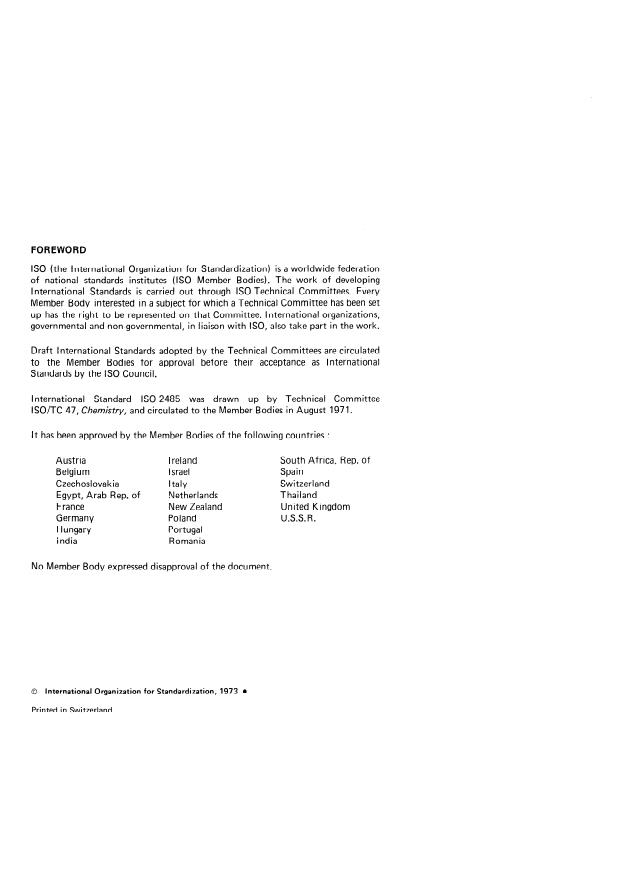
FOREWORD
IS0 (the International Organization for Standardization) is a worldwide federation
of national standards institutes (IS0 Member Bodies). The work of developing
International Standards is carried out through IS0 Technical Committees. Every
Member Body interested in a subject for which a Technical Committee has been set
up has the right to be represented on that Committee. International organizations,
governmental and non-governmental, in liaison with ISO, also take part in the work.
Draft International Standards adopted by the Technical Committees are circulated
to the Member Bodies for approval before their acceptance as International
Standards by the IS0 Council.
International Standard IS0 2485 was drawn up by Technical Committee
lSO/TC 47, Chemistry, and circulated to the Member Bodies in August 1971.
It has been approved by the Member Bodies of the following countries :
Austria Ireland South Africa, Rep. of
Belgium Israel Spain
Czechoslovakia Italy Switzerland
Egypt, Arab Rep. of Netherlands Thailand
France New Zealand United Kingdom
Germany Poland U.S.S.R.
Hungary Portugal
india Romania
No Member Body expressed disapproval of the document.
0 International Organization for Standardization, 1973 l
Printed in Switzerland
IS0 24854973 (E)
INTERNATIONAL STANDARD
Potassium sulphate for industrial use - Determination of
potassium content - Gravimetric method as potassium
tetraphenyl borate
3.3 Sodium tetraphenylborate, alkaline solution.
1 SCOPE AND FIELD OF APPLICATION
Dissolve 325 g of sodium tetraphenylborate in 480 ml of
This International Standard specifies a gravimetric method
water. Add 2 ml of sodium hydroxide solution (3.1) and
for the determination of the potassium content of
20 ml of magnesium chloride (MgCI,.GH,O) 100 g/l
potassium sulphate for industrial use.1 )
solution. Stir for 15 min and filter through a fine textu .e
filter.
2 PRINCIPLE
Replace this reagent each week and filter immediate
Dissolution of a test portion taken from the laboratory
before use.
sample, previously ground and sifted.
3.4 Wash solution (saturated solution of potassium
Addition of formaldehyde to transform any ammonium
tetraphenylborate).
ions present into hexamethylenetetramine and of the
disodium salt of ethylenediamine tetra-acetic acid to
Precipitate O,5 g of potassium tetraphenylborate in a
complex any extraneous cations present which could cause
solution of pure potassium chloride. Filter the precipitate
excessive errors.
and wash it with water. Bring the precipitate back into sus-
pension in 5 I of water and shake for about 1 h. Immedi-
NOTE - These additions, which make the method of general appli-
have no detrimental effect on its precision or repro- ately before use, filter the quantity of reagent required for
cation,
ducibility.
the determination.
Precipitation of the potassium by sodium tetraphenylborate
3.5 Formaldehyde, 30 % (m/m) solution.
in a weakly alkaline medium.
Filter immediately before use.
Drying and weighing of the precipitate.
3.6 Phenolphthalein, 5 g/l ethanolic solution.
3 REAGENTS
Dissolve 0,5 g of phenolphthalein in 100 ml of 95 % (V/V)
ethanol.
Distilled water, or water of equivalent purity, shall be used in
the test.
3.1 Sodium hydroxide, approximately 400 g/l solution.
4 APPARATUS
3.2 Disodium salt of ethylenediamine tetra-acetic acid
Ordinary laboratory’apparatus and
(EDTA), 40 g/l solution.
Dissolve 40 g of disodium ethylenediamine tetra-acetate 4.1 Filter crucible, glass or porcelain, of porosity grade
dihydrate in water and dilute to 1 000 ml. PlO or P16 (i.e. maximum pore size between 4 and 16 ym).
I) See also the same determination in
- IS0 2484, Flame emission spectrophotometric method.
- I SO 2486, Sodium tetraphen ylborate volumetric method.
IS0 2485 -1973 (E)
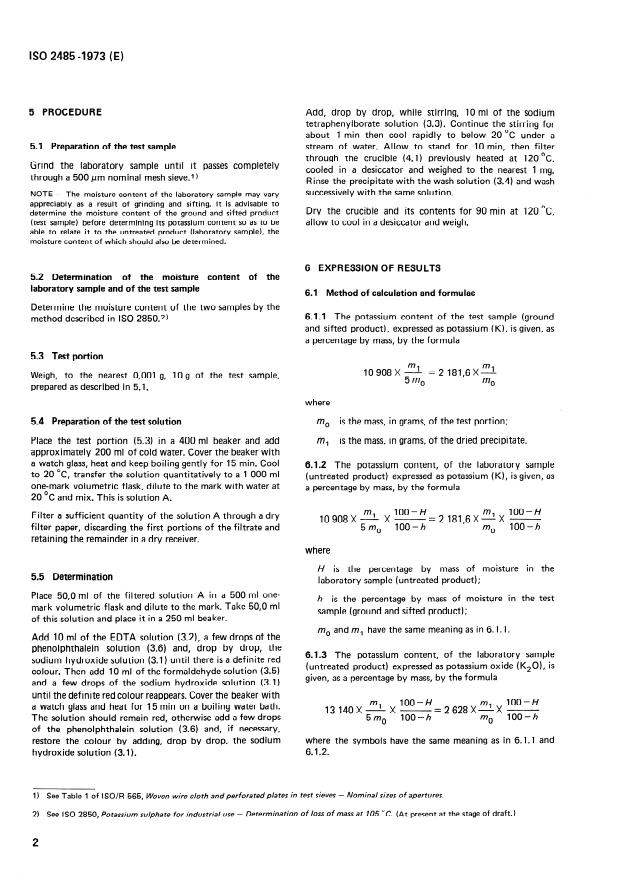
5 PROCEDURE
Add, drop by drop, while stirring, 10 ml of the sodium
tetraphenylborate solution (3.3). Continue the stirring for
about 1 min then cool rapidly to below 20 “C under a
5.1 Preparation of the test sample
...
NORME INTERNATIONALE
INTERNATIONAL ORGANIZATION FOR STANDARDIZATION l MEXAYHAPOAHA(I OPTAHM3ALWI l-l0 CTAHAAPTM3A~WW -ORGANISATION INTERNATIONALE DE NORMALISATION
Sulfate de potassium à usage industriel - Dosage du
potassium - Méthode gravimétrique à l’état de
tétraphénylborate de potassium
Première édition - 1973-04-01
Réf. No : ISO 2485-1973 (F)
CDU 661.832.53 : 546.32 : 543.21
: sulfate de potassium, analyse chimique, dosage, potassium, analyse gravimétrique.
Descripteurs
Prix basé sur 3 pages
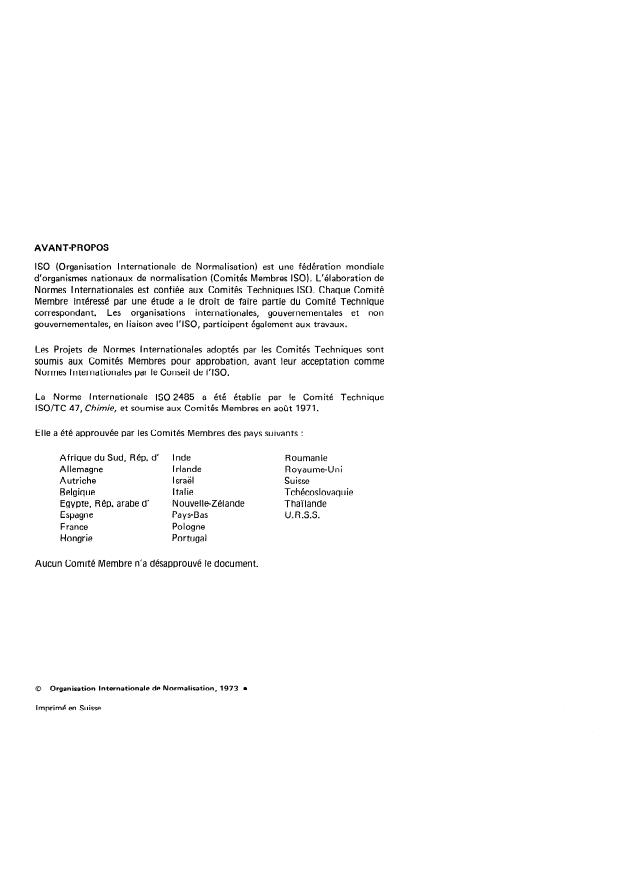
AVANT-PROPOS
ISO (Organisation Internationale de Normalisation) est une fédération mondiale
d’organismes nationaux de normalisation (Comités Membres ISO). L’élaboration de
Normes Internationales est confiée aux Comités Techniques ISO. Chaque Comité
Membre intéressé par une étude a le droit de faire partie du Comité Technique
correspondant. Les organisations internationales, gouvernementales et non
gouvernementales, en liaison avec I’ISO, participent également aux travaux.
Les Projets de Normes Internationales adoptés par les Comités Techniques sont
soumis aux Comités Membres pour approbation, avant leur acceptation comme
Normes Internationales par le Conseil de VISO.
La Norme Internationale ISO 2485 a été établie par le Comité Technique
lSO/TC 47, Chimie, et soumise aux Comités Membres en août 1971.
Elle a été approuvée par les Comités Membres des pays suivants :
Afrique du Sud, Rép. d’ Inde Roumanie
Allemagne Irlande Royaume-Uni
Autriche Israël Suisse
Belgique Italie Tchécoslovaquie
Egypte, Rép. arabe d’ Nouvelle-Zélande Thaïlande
Espagne Pays-Bas U.R.S.S.
France Pologne
Hongrie Portugal
Aucun Comité Membre n’a désapprouvé le document.
0 Organisation Internationale de Normalisation, 1973 l
Imprimé en Suisse
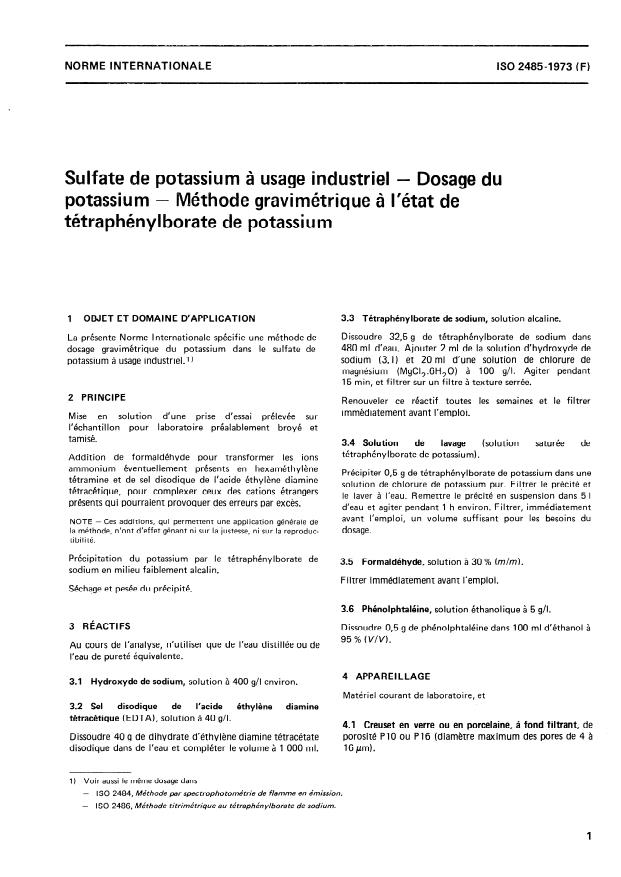
NORME INTERNATIONALE ISO 2485-1973 (F)
Sulfate de potassium à usage industriel - Dosage du
potassium - Méthode gravimétrique à I’état de
tétraphénylborate de potassium
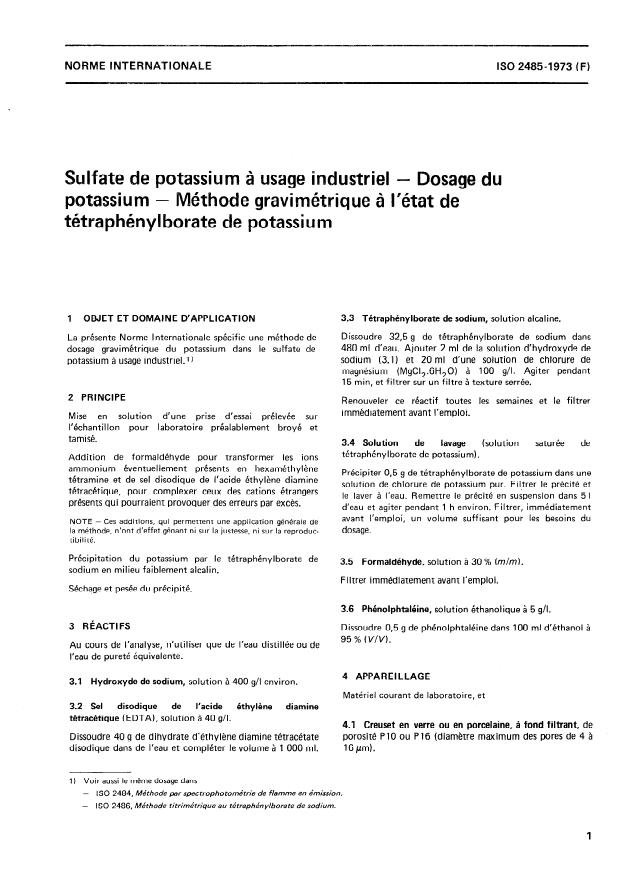
1 OBJET ET QOMAINE D’APPLICATION 3.3 Tétraphénylborate de sodium, solution alcaline.
Dissoudre 32,5 g de tétraphénylborate de sodium dans
La présente Norme Internationale spécifie une méthode de
480 ml d’eau. Ajouter 2 ml de la solution d’hydroxyde de
dosage gravimétrique du potassium dans le sulfate de
sodium (3.1) et 20 ml d’une solution de chlorure de
potassium à usage industriel.1 )
magnésium (MgCI,.GH,O) à 100 g/l. Agiter pendant
15 min, et filtrer sur un filtre à texture serrée.
2 PRINCIPE
Renouveler ce réactif toutes les semaines et le filtrer
immédiatement avant l’emploi.
Mise en solution d’une prise d’essai prélevée sur
I’échantil Ion pour laboratoire préalablement broyé et
tamisé.
3.4 Solution de lavage (solution saturée de
tétraphénylborate de potassium).
Addition de formaldéhyde pour transformer les ions
ammonium éventuellement présents en hexaméthylène
Précipiter 0,5 g de tétraphénylborate de potassium dans une
tétramine et de sel disodique de l’acide éthylène diamine
solution de chlorure de potassium pur. Filtrer le précité et
tétracétique, pour complexer ceux des cations étrangers
le laver à l’eau. Remettre le précité en suspension dans 5 I
présents qui pourraient provoquer des erreurs par excès.
d’eau et agiter pendant 1 h environ. Filtrer, immédiatement
avant l’emploi, un volume suffisant pour les besoins du
NOTE - Ces additions, qui permettent une application générale de
dosage.
la méthode, n’ont d’effet gonant ni sur la justesse, ni sur la reproduc-
tibilité.
Précipitation du potassium par le tétraphénylborate de
3.5 Formaldéhyde, solution à 30 % (m/m).
sodium en milieu faiblement alcalin.
Filtrer immédiatement avant l’emploi.
Séchage et pesee du précipité.
3.6 Phénolphtaléine, solution éthanolique à 5 g/l.
3 RÉACTIFS
Dissoudre 0,5 g de phénolphtaléine dans 100 ml d’éthanol à
95 % (WV).
Au cours de l’analyse, n’utiliser que de l’eau distillée ou de
l’eau de pureté équivalente.
4 APPAREILLAGE
3.1 Hydroxyde de sodium, solution à 400 g/l environ.
Matériel courant de laboratoire, et
l’acide éthylène diamine
3.2 Sel disodique de
tétracétique (EDTA), solution à 40 g/l.
4.1 Creuset en verre ou en porcelaine, à fond filtrant, de
Dissoudre 40 g de dihydrate d’éthylène diamine tétracétate porosité PlO ou PI6 (diamètre maximum des pores de 4 à
disodique dans de l’eau et compléter le volume à 1 000 ml. 16 pm).
1) Voir aussi le même dosage dans
-
ISO 2484, Méthode par spectrophotométrie de flamme en émission.
- I SO 2486, Méthode titrimétrîque au tétraphén ylborate de sodium.
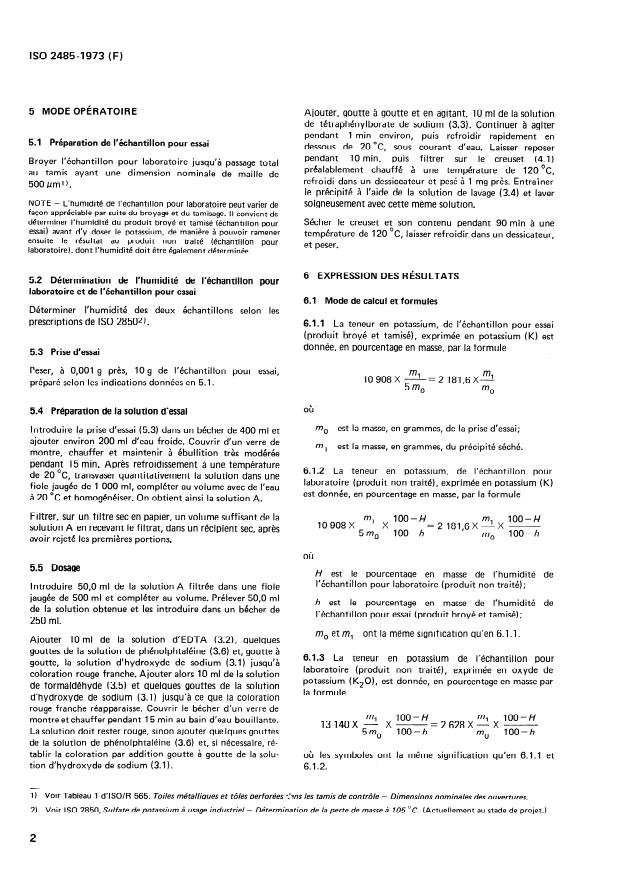
ISO 2485-1973 (F)
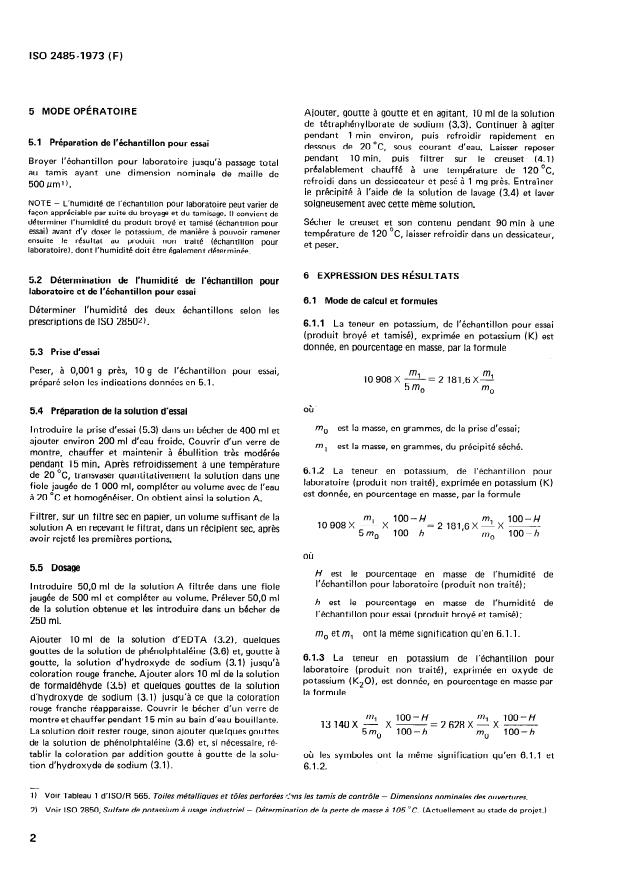
5 MODE OPÉRATOIRE
Ajouter, goutte à goutte et en agitant, 10 ml de la solution
de tétraphénylborate de sodium (3.3). Continuer à agiter
pendant 1 min environ, puis refroidir rapidement en
5.1 Préparation de I’khantillon pour essai
dessous de 20 OC, sous courant d’eau. Laisser reposer
pendant 10 min, puis filtrer sur le creuset. (4.1)
Broyer l’échantillon pour laboratoire jusqu’à passage total
préalablement chauffé à une
...
NORME INTERNATIONALE
INTERNATIONAL ORGANIZATION FOR STANDARDIZATION l MEXAYHAPOAHA(I OPTAHM3ALWI l-l0 CTAHAAPTM3A~WW -ORGANISATION INTERNATIONALE DE NORMALISATION
Sulfate de potassium à usage industriel - Dosage du
potassium - Méthode gravimétrique à l’état de
tétraphénylborate de potassium
Première édition - 1973-04-01
Réf. No : ISO 2485-1973 (F)
CDU 661.832.53 : 546.32 : 543.21
: sulfate de potassium, analyse chimique, dosage, potassium, analyse gravimétrique.
Descripteurs
Prix basé sur 3 pages
AVANT-PROPOS
ISO (Organisation Internationale de Normalisation) est une fédération mondiale
d’organismes nationaux de normalisation (Comités Membres ISO). L’élaboration de
Normes Internationales est confiée aux Comités Techniques ISO. Chaque Comité
Membre intéressé par une étude a le droit de faire partie du Comité Technique
correspondant. Les organisations internationales, gouvernementales et non
gouvernementales, en liaison avec I’ISO, participent également aux travaux.
Les Projets de Normes Internationales adoptés par les Comités Techniques sont
soumis aux Comités Membres pour approbation, avant leur acceptation comme
Normes Internationales par le Conseil de VISO.
La Norme Internationale ISO 2485 a été établie par le Comité Technique
lSO/TC 47, Chimie, et soumise aux Comités Membres en août 1971.
Elle a été approuvée par les Comités Membres des pays suivants :
Afrique du Sud, Rép. d’ Inde Roumanie
Allemagne Irlande Royaume-Uni
Autriche Israël Suisse
Belgique Italie Tchécoslovaquie
Egypte, Rép. arabe d’ Nouvelle-Zélande Thaïlande
Espagne Pays-Bas U.R.S.S.
France Pologne
Hongrie Portugal
Aucun Comité Membre n’a désapprouvé le document.
0 Organisation Internationale de Normalisation, 1973 l
Imprimé en Suisse
NORME INTERNATIONALE ISO 2485-1973 (F)
Sulfate de potassium à usage industriel - Dosage du
potassium - Méthode gravimétrique à I’état de
tétraphénylborate de potassium
1 OBJET ET QOMAINE D’APPLICATION 3.3 Tétraphénylborate de sodium, solution alcaline.
Dissoudre 32,5 g de tétraphénylborate de sodium dans
La présente Norme Internationale spécifie une méthode de
480 ml d’eau. Ajouter 2 ml de la solution d’hydroxyde de
dosage gravimétrique du potassium dans le sulfate de
sodium (3.1) et 20 ml d’une solution de chlorure de
potassium à usage industriel.1 )
magnésium (MgCI,.GH,O) à 100 g/l. Agiter pendant
15 min, et filtrer sur un filtre à texture serrée.
2 PRINCIPE
Renouveler ce réactif toutes les semaines et le filtrer
immédiatement avant l’emploi.
Mise en solution d’une prise d’essai prélevée sur
I’échantil Ion pour laboratoire préalablement broyé et
tamisé.
3.4 Solution de lavage (solution saturée de
tétraphénylborate de potassium).
Addition de formaldéhyde pour transformer les ions
ammonium éventuellement présents en hexaméthylène
Précipiter 0,5 g de tétraphénylborate de potassium dans une
tétramine et de sel disodique de l’acide éthylène diamine
solution de chlorure de potassium pur. Filtrer le précité et
tétracétique, pour complexer ceux des cations étrangers
le laver à l’eau. Remettre le précité en suspension dans 5 I
présents qui pourraient provoquer des erreurs par excès.
d’eau et agiter pendant 1 h environ. Filtrer, immédiatement
avant l’emploi, un volume suffisant pour les besoins du
NOTE - Ces additions, qui permettent une application générale de
dosage.
la méthode, n’ont d’effet gonant ni sur la justesse, ni sur la reproduc-
tibilité.
Précipitation du potassium par le tétraphénylborate de
3.5 Formaldéhyde, solution à 30 % (m/m).
sodium en milieu faiblement alcalin.
Filtrer immédiatement avant l’emploi.
Séchage et pesee du précipité.
3.6 Phénolphtaléine, solution éthanolique à 5 g/l.
3 RÉACTIFS
Dissoudre 0,5 g de phénolphtaléine dans 100 ml d’éthanol à
95 % (WV).
Au cours de l’analyse, n’utiliser que de l’eau distillée ou de
l’eau de pureté équivalente.
4 APPAREILLAGE
3.1 Hydroxyde de sodium, solution à 400 g/l environ.
Matériel courant de laboratoire, et
l’acide éthylène diamine
3.2 Sel disodique de
tétracétique (EDTA), solution à 40 g/l.
4.1 Creuset en verre ou en porcelaine, à fond filtrant, de
Dissoudre 40 g de dihydrate d’éthylène diamine tétracétate porosité PlO ou PI6 (diamètre maximum des pores de 4 à
disodique dans de l’eau et compléter le volume à 1 000 ml. 16 pm).
1) Voir aussi le même dosage dans
-
ISO 2484, Méthode par spectrophotométrie de flamme en émission.
- I SO 2486, Méthode titrimétrîque au tétraphén ylborate de sodium.
ISO 2485-1973 (F)
5 MODE OPÉRATOIRE
Ajouter, goutte à goutte et en agitant, 10 ml de la solution
de tétraphénylborate de sodium (3.3). Continuer à agiter
pendant 1 min environ, puis refroidir rapidement en
5.1 Préparation de I’khantillon pour essai
dessous de 20 OC, sous courant d’eau. Laisser reposer
pendant 10 min, puis filtrer sur le creuset. (4.1)
Broyer l’échantillon pour laboratoire jusqu’à passage total
préalablement chauffé à une
...
Questions, Comments and Discussion
Ask us and Technical Secretary will try to provide an answer. You can facilitate discussion about the standard in here.
Loading comments...