

ISO/PRF 25325
(Main)Requirements for the training of citizen science divers
- Abstract
This standard specifies the requirements for the training of citizen science divers. The standard shall have a broad scope so as to be applicable to all disciplines of science. This document is applicable to all recreational divers independent of any scientific background (unlike the ISO 8804 standard series which a primarily directed at the scientific diving community). A citizen science diver is competent in basic underwater scientific methodologies and protocols and shall be able to assist in scientific diving activities. This standard will specify competencies, prerequisites for training, Introductory information, Required theoretical knowledge, Required practical skills, Practical training parameters and Evaluation criteria for training systems aimed at training citizen science divers.
- Status
- Not Published
- Technical Committee
- ISO/TC 228 - Tourism and related services
- Drafting Committee
- ISO/TC 228/WG 1 - Diving services
- Current Stage
- 5020 - FDIS ballot initiated: 2 months. Proof sent to secretariat
- Start Date
- 06-Oct-2026
- Completion Date
- 31-Oct-2026
Buy Documents

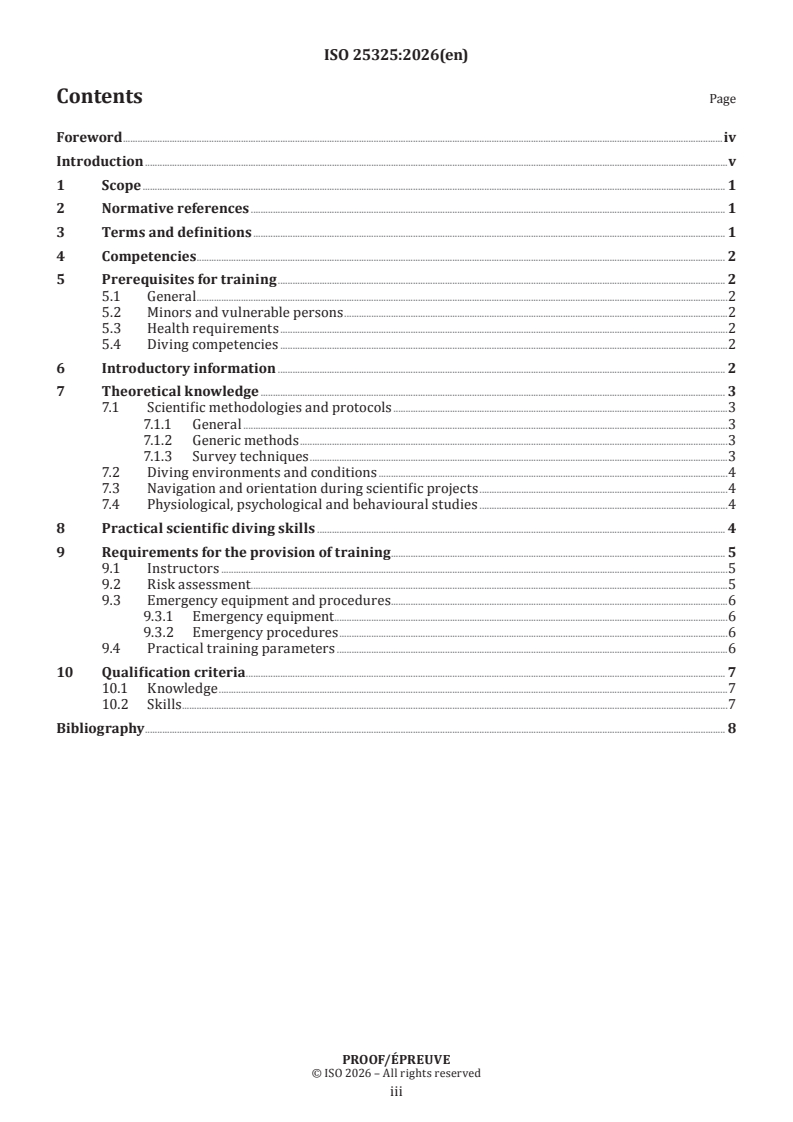
ISO/PRF 25325 - Requirements for the training of citizen science divers

REDLINE ISO/PRF 25325 - Requirements for the training of citizen science divers
ISO/PRF 25325 is an ISO document on the requirements for the training of citizen science divers. It specifies the minimum competencies, prerequisites, knowledge, practical skills, training delivery conditions, and qualification criteria for recreational divers who assist in scientific diving activities.
What does ISO/PRF 25325 specify?
ISO/PRF 25325 specifies minimum training requirements for citizen science divers who assist in scientific diving projects. It is written for recreational divers, regardless of prior scientific background, and it sets a common baseline that can be used across scientific disciplines.
The document also specifies how training is to be delivered and assessed. In practice, that means a training provider has to show not only what trainees learn, but also how instructors, supervision, risk control, emergency readiness, and qualification checks are handled.
ISO/PRF 25325 is organized into clauses on scope, normative references, terms and definitions, competencies, prerequisites for training, introductory information, theoretical knowledge, practical scientific diving skills, requirements for the provision of training, and qualification criteria. No annexes are listed.
What are the key requirements of ISO/PRF 25325?
ISO/PRF 25325 focuses on a training outcome: a citizen science diver must be able to assist in scientific diving activities with suitable knowledge, skills, and experience. The standard is practical, not academic - it ties training directly to field work, supervision, and safe data collection.
Competency outcome (Clause 4): trainees must be able to collect data for scientific projects and take part in scientific diving activities within their diving qualification limits. This matters because the standard is meant to define what a trained citizen science diver can actually do in the water.
Entry conditions (Clause 5): the training provider must check that trainees meet the prerequisites, including medical suitability for diving and qualification to ISO 24801-2. For minors or vulnerable persons, the provider must have protective policies and obtain parental or legal guardian consent when needed.
Introductory information (Clause 6): trainees must be informed of the limits of the training and qualification, and the general provider information required by ISO 24803. This helps avoid overestimating what the qualification covers.
Theoretical knowledge (Clause 7): training must cover scientific ethics, sustainable practices, underwater task conduct, accurate data collection, common data errors, and safety issues. It must also include basic knowledge of methods such as site marking, photo and video use, sampling, survey techniques, photogrammetry, geolocation, and navigation tools such as a compass and global navigation satellite systems (GNSS).
Environmental awareness (Clause 7.2): trainees need basic knowledge of how conditions such as depth, visibility, ice, temperature, remote locations, currents, pollution, and salinity affect scientific dives. In practice, this means they must recognize hazards and stay within their own limits and qualification.
Practical skills and dive minimums (Clause 8 and 10): trainees must complete at least three dives in actual or simulated scientific projects and apply at least two scientific tasks, such as recording flora or fauna, photogrammetry, restoration, debris removal, or survey work. They must also show good buoyancy, buddy system discipline, safety monitoring, and environmental care.
Training provision and safety (Clause 9): underwater training must be directly supervised by an instructor with at least the competencies of ISO 24802-2. Each site needs a site- and task-specific risk assessment, emergency equipment, and a documented emergency plan with recall, rescue, evacuation, oxygen, and medical contact details.
What terms does ISO/PRF 25325 define?
ISO/PRF 25325 defines a small set of core terms that frame the qualification.
- Scientific diving: diving performed as part of a scientific, research, or educational activity.
- Citizen science diving: voluntary participation in scientific research by divers who are typically not trained scientists.
- Citizen science diver: a diver competent to assist in scientific diving.
- Direct supervision: supervision by a scuba instructor or dive leader positioned to intervene quickly on behalf of the diver.
These definitions matter because they separate this training from ordinary recreational diving and from the broader scientific diving community.
Who uses ISO/PRF 25325?
ISO/PRF 25325 is used by training providers, scuba instructors, specialist lecturers, and scientists who involve divers in field projects. It is also relevant to recreational diving organizations that want a recognized training path for citizen science work.
In practice, it helps project leaders understand what trained divers can be asked to do, and it helps buyers or managers compare training programs. It is aimed at people who need a common baseline for teamwork, data collection, and safe participation in scientific projects.
Which standards are used with ISO/PRF 25325?
ISO/PRF 25325 cites several standards that support its training model:
- ISO 24803:2017 - gives the general requirements for recreational diving providers, including the introductory information that must be given to trainees.
- ISO 24801-2 - sets the recreational scuba diver qualification that trainees must already hold before entering this program.
- ISO 24802-2 - sets the instructor level used as the benchmark for direct underwater supervision and for instructors delivering the course.
- ISO 21416 - supports the sustainable diving practices and aquatic ecosystem restoration topics covered in the theory.
ISO/PRF 25325 also refers to ISO 8804-1:2024 as the standard for scientific divers, which helps distinguish citizen science diver training from the broader scientific diving series.
What does the ISO/PRF 25325 document contain?
ISO/PRF 25325 contains clauses for competencies, prerequisites, introductory information, theory, practical skills, training provision, and qualification criteria. It sets out the content areas trainees must learn, such as scientific methods, environments, navigation, and data handling, and it ties those topics to real or simulated dives.
The document also describes the training conditions that matter in practice: instructor qualifications, supervision, risk assessment, emergency oxygen, rescue planning, and when a dive must be cancelled or aborted. It includes a bibliography with related medical, scientific diving, ethics, and underwater heritage references.
Relations
- Consolidates
prEN ISO 25325 - Requirements for the training of citizen science divers (ISO/DIS 25325:2025) - Effective Date
- 12-Feb-2026
Buy Documents
ISO/PRF 25325 - Requirements for the training of citizen science divers
REDLINE ISO/PRF 25325 - Requirements for the training of citizen science divers
Get Certified
Connect with accredited certification bodies for this standard

BSI Group
BSI (British Standards Institution) is the business standards company that helps organizations make excellence a habit.

Bureau Veritas
Bureau Veritas is a world leader in laboratory testing, inspection and certification services.

DNV
DNV is an independent assurance and risk management provider.
Sponsored listings
Frequently Asked Questions
ISO/PRF 25325 is a draft published by the International Organization for Standardization (ISO). Its full title is "Requirements for the training of citizen science divers". This standard covers: This standard specifies the requirements for the training of citizen science divers. The standard shall have a broad scope so as to be applicable to all disciplines of science. This document is applicable to all recreational divers independent of any scientific background (unlike the ISO 8804 standard series which a primarily directed at the scientific diving community). A citizen science diver is competent in basic underwater scientific methodologies and protocols and shall be able to assist in scientific diving activities. This standard will specify competencies, prerequisites for training, Introductory information, Required theoretical knowledge, Required practical skills, Practical training parameters and Evaluation criteria for training systems aimed at training citizen science divers.
This standard specifies the requirements for the training of citizen science divers. The standard shall have a broad scope so as to be applicable to all disciplines of science. This document is applicable to all recreational divers independent of any scientific background (unlike the ISO 8804 standard series which a primarily directed at the scientific diving community). A citizen science diver is competent in basic underwater scientific methodologies and protocols and shall be able to assist in scientific diving activities. This standard will specify competencies, prerequisites for training, Introductory information, Required theoretical knowledge, Required practical skills, Practical training parameters and Evaluation criteria for training systems aimed at training citizen science divers.
ISO/PRF 25325 is classified under the following ICS (International Classification for Standards) categories: 03.100.30 - Management of human resources. The ICS classification helps identify the subject area and facilitates finding related standards.
ISO/PRF 25325 has the following relationships with other standards: It is inter standard links to prEN ISO 25325. Understanding these relationships helps ensure you are using the most current and applicable version of the standard.
ISO/PRF 25325 is available in PDF format for immediate download after purchase. The document can be added to your cart and obtained through the secure checkout process. Digital delivery ensures instant access to the complete standard document.
Standards Content (Sample)
International
Standard
ISO 25325
First edition
Requirements for the training of
citizen science divers
Exigences relatives à la formation des plongeurs scientifiques
citoyens
PROOF/ÉPREUVE
Reference number
ISO 25325:2026(en) © ISO 2026
ISO 25325:2026(en)
© ISO 2026
All rights reserved.
This ISO publication is protected by copyright and is owned by ISO and/or its licensors.
The content of this ISO publication is provided under licence, not sold. Use is subject to the applicable licence terms issued by ISO,
an ISO member body, or an authorized third-party distributor.
Except as required for implementation or expressly permitted by a separate licence, no part of this ISO publication may be
reproduced, distributed, modified, used, or made available in any form or by any means – electronic or mechanical, including
photocopying, scanning, recording, or posting on internal or external digital platforms.
Any use beyond the scope of the granted rights is prohibited and may result in legal action.
ISO copyright office
CP 401 • CH-1214 Vernier, Geneva
Phone: +41 22 749 01 11
Email: copyright@iso.org
Website: www.iso.org
Published in Switzerland
PROOF/ÉPREUVE
ii
ISO 25325:2026(en)
Contents Page
Foreword .iv
Introduction .v
1 Scope . 1
2 Normative references . 1
3 Terms and definitions . 1
4 Competencies . 2
5 Prerequisites for training . 2
5.1 General .2
5.2 Minors and vulnerable persons .2
5.3 Health requirements .2
5.4 Diving competencies .2
6 Introductory information . 2
7 Theoretical knowledge . 3
7.1 Scientific methodologies and protocols .3
7.1.1 General .3
7.1.2 Generic methods .3
7.1.3 Survey techniques .3
7.2 Diving environments and conditions .4
7.3 Navigation and orientation during scientific projects .4
7.4 Physiological, psychological and behavioural studies .4
8 Practical scientific diving skills . 4
9 Requirements for the provision of training . 5
9.1 Instructors .5
9.2 Risk assessment .5
9.3 Emergency equipment and procedures.6
9.3.1 Emergency equipment .6
9.3.2 Emergency procedures .6
9.4 Practical training parameters .6
10 Qualification criteria . . 7
10.1 Knowledge .7
10.2 Skills . .7
Bibliography . 8
PROOF/ÉPREUVE
iii
ISO 25325:2026(en)
Foreword
ISO (the International Organization for Standardization) is a worldwide federation of national standards
bodies (ISO member bodies). The work of preparing International Standards is normally carried out through
ISO technical committees. Each member body interested in a subject for which a technical committee
has been established has the right to be represented on that committee. International organizations,
governmental and non-governmental, in liaison with ISO, also take part in the work. ISO collaborates closely
with the International Electrotechnical Commission (IEC) on all matters of electrotechnical standardization.
The procedures used to develop this document and those intended for its further maintenance are described
in the ISO/IEC Directives, Part 1. In particular, the different approval criteria needed for the different types
of ISO document should be noted. This document was drafted in accordance with the editorial rules of the
ISO/IEC Directives, Part 2 (see www.iso.org/directives).
ISO draws attention to the possibility that the implementation of this document may involve the use of (a)
patent(s). ISO takes no position concerning the evidence, validity or applicability of any claimed patent
rights in respect thereof. As of the date of publication of this document, ISO had not received notice of (a)
patent(s) which may be required to implement this document. However, implementers are cautioned that
this may not represent the latest information, which may be obtained from the patent database available at
www.iso.org/patents. ISO shall not be held responsible for identifying any or all such patent rights.
Any trade name used in this document is information given for the convenience of users and does not
constitute an endorsement.
For an explanation of the voluntary nature of standards, the meaning of ISO specific terms and expressions
related to conformity assessment, as well as information about ISO's adherence to the World Trade
Organization (WTO) principles in the Technical Barriers to Trade (TBT), see www.iso.org/iso/foreword.html.
This document was prepared by Technical Committee ISO/TC 228, Tourism and related services, in
collaboration with the European Committee for Standardization (CEN) Technical Committee CEN/TC 329,
Tourism services, in accordance with the Agreement on technical cooperation between ISO and CEN (Vienna
Agreement).
Any feedback or questions on this document should be directed to the user’s national standards body. A
complete listing of these bodies can be found at www.iso.org/members.html.
PROOF/ÉPREUVE
iv
ISO 25325:2026(en)
Introduction
This document is aimed primarily at recreational divers wishing to become citizen science divers and
sets minimum requirements for their training. It is intended to benefit both the organizations involved in
training citizen science divers and the scientific diving community as a whole.
This document is considered the minimum competency standard for recognition as a citizen science diver.
It is intended to provide agreed-upon minimum training requirements, thereby easing barriers to cross-
programme co-operation and reciprocity by acknowledging a common basic skill set for citizen science
divers. This document also provides requirements for scientists wishing to involve such divers in scientific
projects, concerning the capabilities and limitations of individuals trained according to this document.
Divers trained according to this document can take part in projects under the supervision of a project leader,
or independently while following proper safety and data collection protocols.
PROOF/ÉPREUVE
v
International Standard ISO 25325:2026(en)
Requirements for the training of citizen science divers
1 Scope
This document specifies minimum requirements for the training of citizen science divers to assist in
conducting scientific diving projects.
This document specifies evaluation criteria for these competencies.
This document specifies the requirements under which training is provided, in addition to the general
requirements for recreational diving service provision in accordance with ISO 24803.
2 Normative references
The following documents are referred to in the text in such a way that some or all of their content constitutes
requirements of this document. For dated references, only the edition cited applies. For undated references,
the latest edition of the referenced document (including any amendments) applies.
ISO 21416, Recreational diving services — Requirements and guidance on environmentally sustainable practices
in recreational diving
ISO 24801-2, Recreational diving services — Requirements for the training of recreational scuba divers — Part
2: Level 2 — Autonomous diver
ISO 24802-2, Recreational diving services — Requirements for the training of scuba instructors — Part 2: Level
ISO 24803:2017, Recreational diving services — Requirements for recreational diving providers
3 Terms and definitions
For the purposes of this document, the following terms and definitions apply.
ISO and IEC maintain terminology databases for use in standardization at the following addresses:
— ISO Online browsing platform: available at https:// www .iso .org/ obp
— IEC Electropedia: available at https:// www .electropedia .org/
3.1
scientific diving
diving performed as part of a scientific, research or educational activity
[SOURCE: ISO 8804-1:2024, 3.1]
3.2
citizen science diving
participation in scientific research conducted voluntarily by divers who are typically not trained scientists
3.3
citizen scienc
...
ISO/DISPRF 25325:2025(en)
ISO/TC 228
Secretariat: UNE
Date: 2026-07-1510-05
Requirements for the training of citizen science divers
This draft is submitted to a parallel vote in ISO, CEN.
© Exigences relatives à la formation des plongeurs scientifiques citoyens
PROOF
This draft is submitted to a parallel vote in ISO, CEN.
ISO/DISPRF 25325:20252026(en)
All rights reserved. Unless otherwise specified,
This ISO publication is protected by copyright and is owned by ISO and/or its licensors.
The content of this ISO publication is provided under licence, not sold. Use is subject to the applicable licence terms issued
by ISO, an ISO member body, or an authorized third-party distributor.
Except as required in the context of its for implementation or expressly permitted by a separate licence, no part of this
ISO publication may be reproduced or utilized otherwise, distributed, modified, used, or made available in any form or
by any means, – electronic or mechanical, including photocopying, scanning, recording, or posting on internal or external
digital platforms.
Any use beyond the internet or an intranet, without prior written permission. Permission can be requested from either
ISO at the address below or ISO’s member body in the countryscope of the requestergranted rights is prohibited and may
result in legal action.
ISO copyright office
CP 401 • Ch. de Blandonnet 8
CH-1214 Vernier, Geneva
Phone: + 41 22 749 01 11
Fax: +41 22 749 09 47
Email: copyright@iso.org
Website: www.iso.org
Published in Switzerland
iii
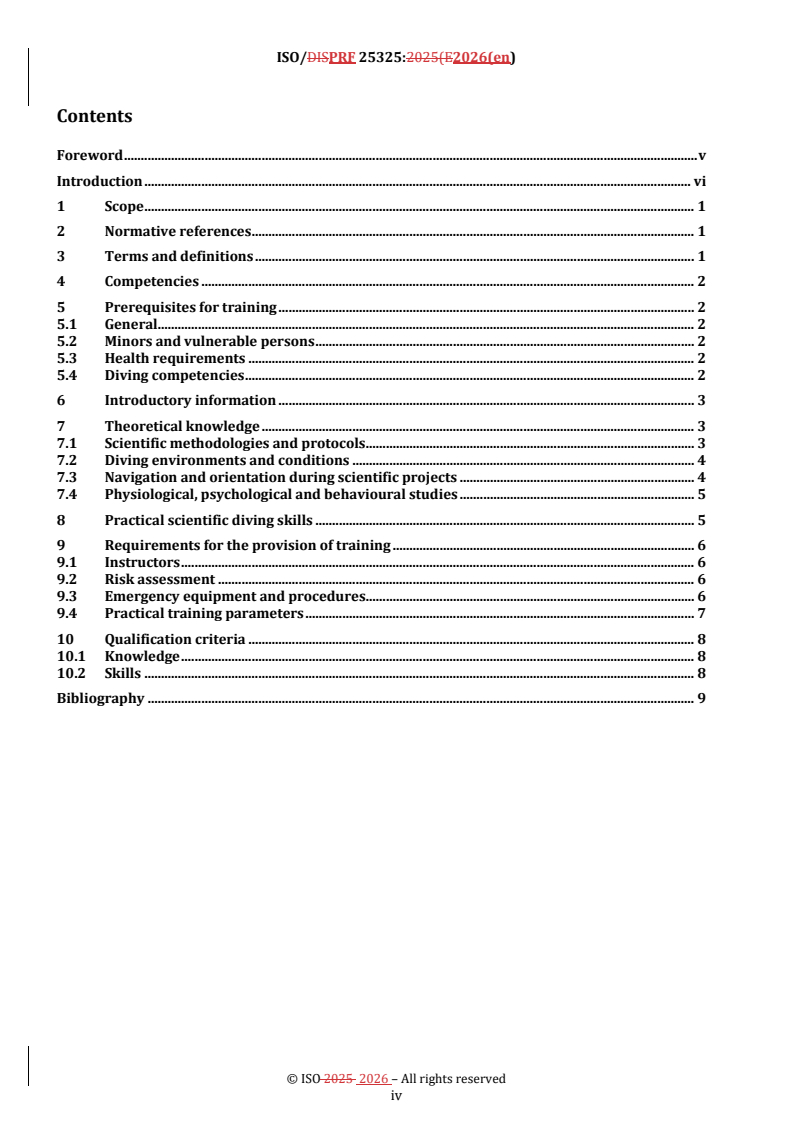
ISO/DISPRF 25325:2025(E2026(en)
Contents
Foreword . v
Introduction . vi
1 Scope . 1
2 Normative references . 1
3 Terms and definitions . 1
4 Competencies . 2
5 Prerequisites for training . 2
5.1 General. 2
5.2 Minors and vulnerable persons . 2
5.3 Health requirements . 2
5.4 Diving competencies . 2
6 Introductory information . 3
7 Theoretical knowledge . 3
7.1 Scientific methodologies and protocols . 3
7.2 Diving environments and conditions . 4
7.3 Navigation and orientation during scientific projects . 4
7.4 Physiological, psychological and behavioural studies . 5
8 Practical scientific diving skills . 5
9 Requirements for the provision of training . 6
9.1 Instructors . 6
9.2 Risk assessment . 6
9.3 Emergency equipment and procedures . 6
9.4 Practical training parameters . 7
10 Qualification criteria . 8
10.1 Knowledge . 8
10.2 Skills . 8
Bibliography . 9
iv
ISO/DISPRF 25325:20252026(en)
Foreword
ISO (the International Organization for Standardization) is a worldwide federation of national standards
bodies (ISO member bodies). The work of preparing International Standards is normally carried out through
ISO technical committees. Each member body interested in a subject for which a technical committee has been
established has the right to be represented on that committee. International organizations, governmental and
non-governmental, in liaison with ISO, also take part in the work. ISO collaborates closely with the
International Electrotechnical Commission (IEC) on all matters of electrotechnical standardization.
The procedures used to develop this document and those intended for its further maintenance are described
in the ISO/IEC Directives, Part 1. In particular, the different approval criteria needed for the different types of
ISO document should be noted. This document was drafted in accordance with the editorial rules of the
ISO/IEC Directives, Part 2 (see www.iso.org/directives).
ISO draws attention to the possibility that the implementation of this document may involve the use of (a)
patent(s). ISO takes no position concerning the evidence, validity or applicability of any claimed patent rights
in respect thereof. As of the date of publication of this document, ISO had not received notice of (a) patent(s)
which may be required to implement this document. However, implementers are cautioned that this may not
represent the latest information, which may be obtained from the patent database available at
www.iso.org/patents. ISO shall not be held responsible for identifying any or all such patent rights.
Any trade name used in this document is information given for the convenience of users and does not
constitute an endorsement.
For an explanation of the voluntary nature of standards, the meaning of ISO specific terms and expressions
related to conformity assessment, as well as information about ISO's adherence to the World Trade
Organization (WTO) principles in the Technical Barriers to Trade (TBT), see www.iso.org/iso/foreword.html.
This document was prepared by Technical Committee ISO/TC 228, Tourism and related services, in
collaboration with the European Committee for Standardization (CEN) Technical Committee CEN/TC 329,
Tourism services, in accordance with the Agreement on technical cooperation between ISO and CEN (Vienna
Agreement).
Any feedback or questions on this document should be directed to the user’s national standards body. A
complete listing of these bodies can be found at www.iso.org/members.html.
v
ISO/DISPRF 25325:2025(E2026(en)
Introduction
This document is aimed primarily at recreational divers wishing to become citizen science divers and sets
minimum requirements for their training. It is intended to benefit both tothe organizations involved in
training citizen science divers and the scientific diving community as a whole.
This document is considered the minimum competency standard for recognition as a citizen science diver. It
is intended to provide requirements regarding agreed-upon minimum training requirements, thereby easing
barriers to cross-programme co-operation and reciprocity by acknowledging a common basic skill set for
citizen science divers. This document also provides requirements tofor scientists wishing to involve such
divers in scientific projects, concerning the capabilities and limitations of individuals trained according to this
document.
Divers trained according to this document can take part in projects under the supervision of a project leader,
or independently while following proper safety and data collection protocols.
vi
DRAFT International Standard ISO/DIS 25325:2025(en)
Requirements for the training of citizen science divers
1 Scope
This document specifies minimum requirements for the training of citizen science divers to assist in
conducting scientific diving projects.
This document specifies evaluation criteria for these competencies.
This document specifies the requirements under which training is provided, in addition to the general
requirements for recreational diving service provision in accordance with ISO 24803.
2 Normative references
The following documents are referred to in the text in such a way that some or all of their content constitutes
requirements of this document. For dated references, only the edition cited applies. For undated references,
the latest edition of the referenced document (including any amendments) applies.
ISO 21416, Recreational diving services — Requirements and guidance on environmentally sustainable practices
in recreational diving
ISO 24801--2, Recreational diving services — Requirements for the training of recreational scuba divers — Part
2: Level 2 — Autonomous diver
ISO 24802--2, Recreational diving services — Requirements for the training of scuba instructors — Part 2: Level
ISO 24803:2017, Recreational diving services — Requirements for recreational diving providers
3 Terms and definitions
For the purposes of this document, the following terms and definitions apply.
ISO and IEC maintain terminology databases for use in standardization at the following addresses:
— — ISO Online browsing platform: available at https://www.iso.org/obp
— — IEC Electropedia: available at https://www.electropedia.org/
3.1 3.1
scientific diving
diving performed as part of a scientific, research or educational activity
[SOURCE: ISO 8804-1:2024, 3.1]
3.2 3.2
citizen science diving
participation in scientific research conducted voluntarily by divers who are typically not trained scientists
ISO/DISPRF 25325:2025(E2026(en)
3.3 3.3
citizen science diver
diver competent to assist in scientific diving (3.1(3.1))
3.4 3.4
direct supervision
supervision by a scuba instructor or a dive leader of a group of divers in a position allowing rapid intervention
on behalf of the diver
4 Competencies
Citizen science divers shall be trained such that when evaluated in accordance with Clause 8Clause 8 they are
deemed to have sufficient knowledge, skills and experience with regard to diving as well as basic underwater
scientific methodologies and protocols to assist in scientific diving activities.
Citizen science divers trained in accordance with this document are competent to:
— — collect data for scientific projects that typically have been designed by or are overseen by scientists;
— — participate in scientific diving activities within the limits of their diving qualification.
5 Prerequisites for training
5.1 General
The training provider shall ensure that the trainee fulfils the following prerequisites (see 5.2specified in 5.2
to
...