

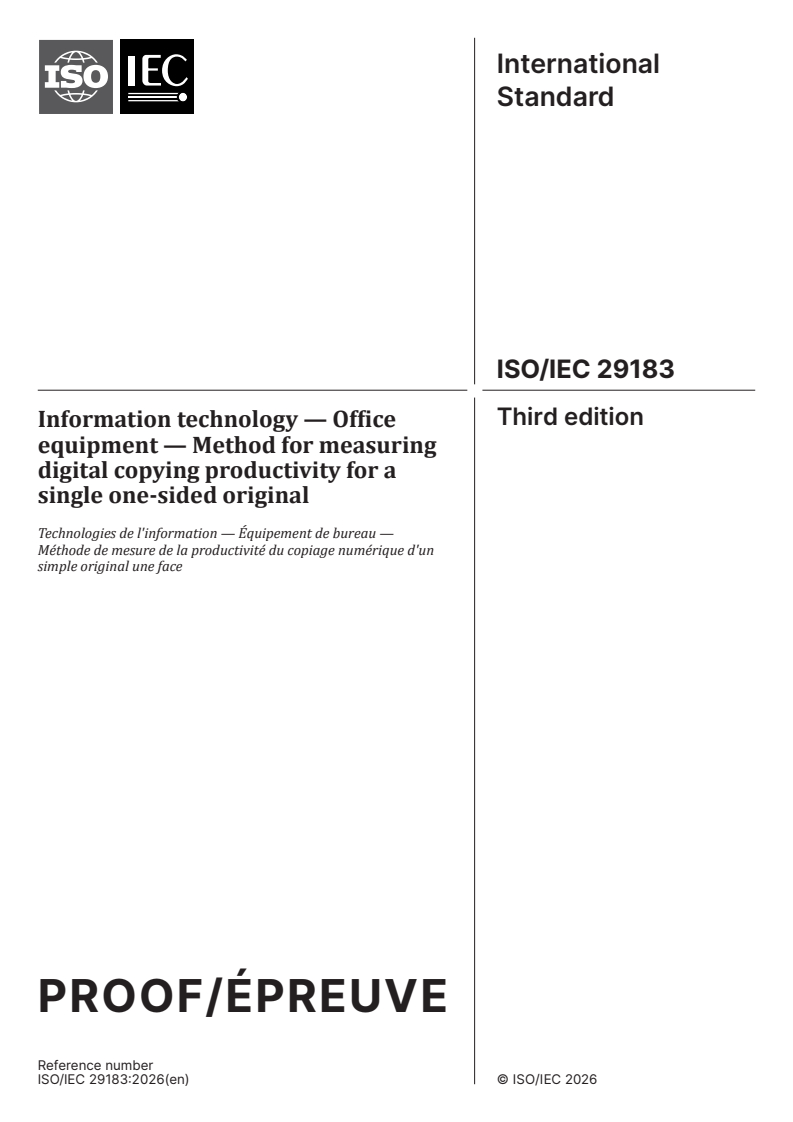
ISO/IEC 29183
(Main)Information technology — Office equipment — Method for measuring digital copying productivity for a single one-sided original
- Abstract
This document specifies a method for measuring productivity of digital copying devices and multifunctional devices with various copying modes and a single one-sided original. The document is applicable to digital copying devices and multifunctional devices. The document is intended to be used for black and white (B&W) as well as colour digital copying devices and multifunctional devices of any underlying marking technology. This document includes instructions for the creation of test charts, test setup procedure, test procedure, and the reporting requirements for the digital copying productivity measurements. This document is not intended to replace manufacturer's rated speeds.
- Status
- Not Published
- Technical Committee
- ISO/IEC JTC 1/SC 28 - Office equipment
- Drafting Committee
- ISO/IEC JTC 1/SC 28/WG 3 - Productivity
- Current Stage
- 6000 - International Standard under publication - 60 Publication
- Start Date
- 31-Oct-2026
Buy Documents
ISO/IEC PRF 29183 - Information technology — Office equipment — Method for measuring digital copying productivity for a single one-sided original
REDLINE ISO/IEC PRF 29183 - Information technology — Office equipment — Method for measuring digital copying productivity for a single one-sided original
ISO/IEC 29183 is an International Standard from ISO and IEC that specifies a method for measuring digital copying productivity for a single one-sided original. It applies to digital copying devices and multifunctional devices, in black and white (B&W) and colour, and defines how to prepare test charts, set up the device, run the tests, and report sFCOT, sESAT and sEFTP.
What does ISO/IEC 29183 specify?
ISO/IEC 29183 specifies a productivity test method for digital copying devices and multifunctional devices using a single one-sided original and defined copying modes. It covers the test charts, setup conditions, timing procedure, data treatment, and reporting format needed to compare copying productivity in a repeatable way.
The standard applies to B&W and colour devices of any underlying marking technology. It is written for representative office usage, not as a replacement for a manufacturer’s rated speed.
The document is organized into these main clauses and annexes:
| Part | What it covers |
|---|---|
| Clause 1 | Scope |
| Clause 2 | Normative references |
| Clause 3 | Terms and definitions |
| Clause 4 | Test parameters and conditions |
| Clause 5 | Test method |
| Clause 6 | Calculations and treatment of data |
| Clause 7 | Presentation of results |
| Annex A | Report presentation |
| Annex B | Full detailed report example |
| Annex C | Test targets for measurement of copying productivity |
| Annex D | Procedure to establish ready delay time |
What are the key requirements of ISO/IEC 29183?
ISO/IEC 29183 requires a controlled setup, a defined set of copy tests, and reporting that shows how the productivity result was obtained. The practical point is that the same device settings, paper, environment and timing rules must be used so results can be compared fairly.
Test setup and device condition
Clause 4 requires the copying device to be installed according to the manufacturer’s recommendations, placed on a horizontal surface, and fully enclosed in its normal cover. The device and all supplies must be acclimated in the test environment for at least 8 h. In practice, this keeps temperature, humidity and consumables from distorting the measurement.
Clause 4 also requires default or preset settings for image and copying modes, with any extra image quality or digital processing features kept in their normal default condition and reported. Manufacturer default routines such as automatic cleaning, calibration cycles and energy save settings are not to be disabled. This matters because the test is intended to reflect normal shipped behavior.
Paper, targets, environment and voltage
Clause 4 limits the paper and test targets to defined conditions. The output paper must match the manufacturer’s written paper guidance, and the paper for the performance test shall be cut sheet A4 and/or 8.5" × 11". The test targets are created from the official electronic test file, and the paper used to make them must have at least 80 % brightness, at least 64 g/m² grammage, and no visible defects.
Clause 4 also sets the environment and power supply conditions. If the manufacturer gives no operating recommendation, the test environment is 18 °C to 25 °C and 30 % to 70 % relative humidity, and the supply voltage must stay within the manufacturer’s operating range. These conditions matter because they affect scan time, recovery behavior and copy output.
Copying procedure and timing
Clause 5 uses three main test types: a 1 copy test, a 1 copy + 30 s test, and a 1 copy + 4 min test. The 1 copy test is used to measure sFCOT from ready, sleep and off. The longer tests are used to calculate sESAT and sEFTP for sustained copying.
Clause 5 requires repeatability checks and allows up to three runs per case. If the first two results are not consistent within ±5 %, a third run is required. This gives a simple acceptance rule for deciding whether the measured timings are stable enough to average.
Clause 5 also defines how the device is handled between jobs. A ready delay time is used between tests, the default power management delay to sleep is determined, and the off-state delay for sFCOT from off is 60 min. Annex D gives a separate procedure for establishing a stable ready delay time when needed.
Test targets and copy modes
Clause 5 requires four test targets, identified as A, B, C and D. Test target A is required for the 1 copy + 4 min test, while B, C and D are optional for that case. If the saturated time per copy is consistent within ±5 % across all four targets, testing may be done using only target A, and that choice must be reported.
Clause 5 requires testing with the scanning glass when the device has both a scanning glass and an ADF (automatic document feeder). The ADF test is optional in that case, but if both are used, both results must be reported. For colour devices, colour copying is required and monochrome copying is optional; for B&W devices, only monochrome copying is done.
Data treatment and reporting
Clause 6 requires times to be recorded to two decimal places, but reported values must not be rounded to show better performance than measured. Throughput values are expressed in images per minute (ipm), and the averaging is done on the calculated results, not by averaging raw times first. That keeps the reported productivity aligned with the standard’s formulas.
Clause 7 defines three reporting levels: minimum declaration, summary report and full report. The minimum declaration names this standard, gives the average sESAT, and points to the full detailed report. The summary and full reports also identify the paper size, paper feed orientation, device settings, and whether the results were obtained with optional modes.
What terms does ISO/IEC 29183 define?
- sFCOT (single one-sided first copy out time) - the number of seconds from job initiation to the complete exit of the first copy.
- sESAT (single one-sided estimated saturated throughput) - the rate at which the device produces pages from the complete exit of the first test set to the complete exit of the last test set.
- sEFTP (single one-sided effective throughput) - the rate at which the device produces pages measured from job initiation to the complete exit of the last test set.
- sleep state - a low power state in which the device is not actively performing tasks but can resume quickly.
- off state - a state from which the device cannot make a copy without user intervention to turn on power.
- power management delay time - the time the device waits before entering a lower power state such as sleep or off.
- test target - the hardcopy page used for testing, created from the test file.
- recovery time - the time needed for the device to recover from sleep, measured against the ready-state copy time.
Who uses ISO/IEC 29183?
ISO/IEC 29183 is used by manufacturers of digital copying devices and multifunctional devices, and by organizations that measure or compare their productivity. It helps them describe how a machine performs with different copying modes, B&W or colour output, and a single one-sided original.
It is also used by buyers and evaluators who need a common method for comparing office equipment in representative use. In practice, they use it to test product speed under defined conditions, prepare product information, and compare reported productivity across models.
What changed in ISO/IEC 29183 from the previous edition?
ISO/IEC 29183 is the third edition and it cancels and replaces ISO/IEC 29183:2021. The main changes stated for this edition are the addition of the term “sleep state” and its definition, and an optional test to measure sFCOT from sleep for 15 min.
Which standards are used with ISO/IEC 29183?
ISO/IEC 29183 uses these normative references:
- ISO 536 - used to determine paper grammage for the paper used in the test and in test-target preparation.
- ISO 2470-1 - used to measure diffuse blue reflectance factor, which the standard uses for paper brightness.
- ISO/IEC 24734 - provides referenced terms and definitions used by this document.
What does the ISO/IEC 29183 document contain?
ISO/IEC 29183 contains the full test flow, calculation rules, and reporting formats needed to measure copying productivity in a repeatable way. Clause 5 includes the test measurement procedure, the consistency checks, and the method for estimating the number of copies needed to reach the 30 s and 4 min test windows.
The document also includes a suggested flow chart, formulas for sESAT, sEFTP, recovery time and warm-up time, and rules for combining tests when sFCOT is constant. These parts are used during testing and data reduction so the results are calculated consistently.
Annex A and Annex B show how to present results in summary and full detailed reports, including example tables and the items that must be recorded. Annex C gives the four-page test target layouts and explains how to create the actual targets from the official electronic files. Annex D gives a step-by-step procedure for establishing ready delay time when a stable value is needed for testing.
Relations
- Effective Date
- 31-Aug-2024
Buy Documents
ISO/IEC PRF 29183 - Information technology — Office equipment — Method for measuring digital copying productivity for a single one-sided original
REDLINE ISO/IEC PRF 29183 - Information technology — Office equipment — Method for measuring digital copying productivity for a single one-sided original
Frequently Asked Questions
ISO/IEC 29183 is a draft published by the International Organization for Standardization (ISO). Its full title is "Information technology — Office equipment — Method for measuring digital copying productivity for a single one-sided original". This standard covers: This document specifies a method for measuring productivity of digital copying devices and multifunctional devices with various copying modes and a single one-sided original. The document is applicable to digital copying devices and multifunctional devices. The document is intended to be used for black and white (B&W) as well as colour digital copying devices and multifunctional devices of any underlying marking technology. This document includes instructions for the creation of test charts, test setup procedure, test procedure, and the reporting requirements for the digital copying productivity measurements. This document is not intended to replace manufacturer's rated speeds.
This document specifies a method for measuring productivity of digital copying devices and multifunctional devices with various copying modes and a single one-sided original. The document is applicable to digital copying devices and multifunctional devices. The document is intended to be used for black and white (B&W) as well as colour digital copying devices and multifunctional devices of any underlying marking technology. This document includes instructions for the creation of test charts, test setup procedure, test procedure, and the reporting requirements for the digital copying productivity measurements. This document is not intended to replace manufacturer's rated speeds.
ISO/IEC 29183 is classified under the following ICS (International Classification for Standards) categories: 37.100.10 - Reproduction equipment. The ICS classification helps identify the subject area and facilitates finding related standards.
ISO/IEC 29183 has the following relationships with other standards: It is inter standard links to ISO/IEC 29183:2021. Understanding these relationships helps ensure you are using the most current and applicable version of the standard.
ISO/IEC 29183 is available in PDF format for immediate download after purchase. The document can be added to your cart and obtained through the secure checkout process. Digital delivery ensures instant access to the complete standard document.
Standards Content (Sample)
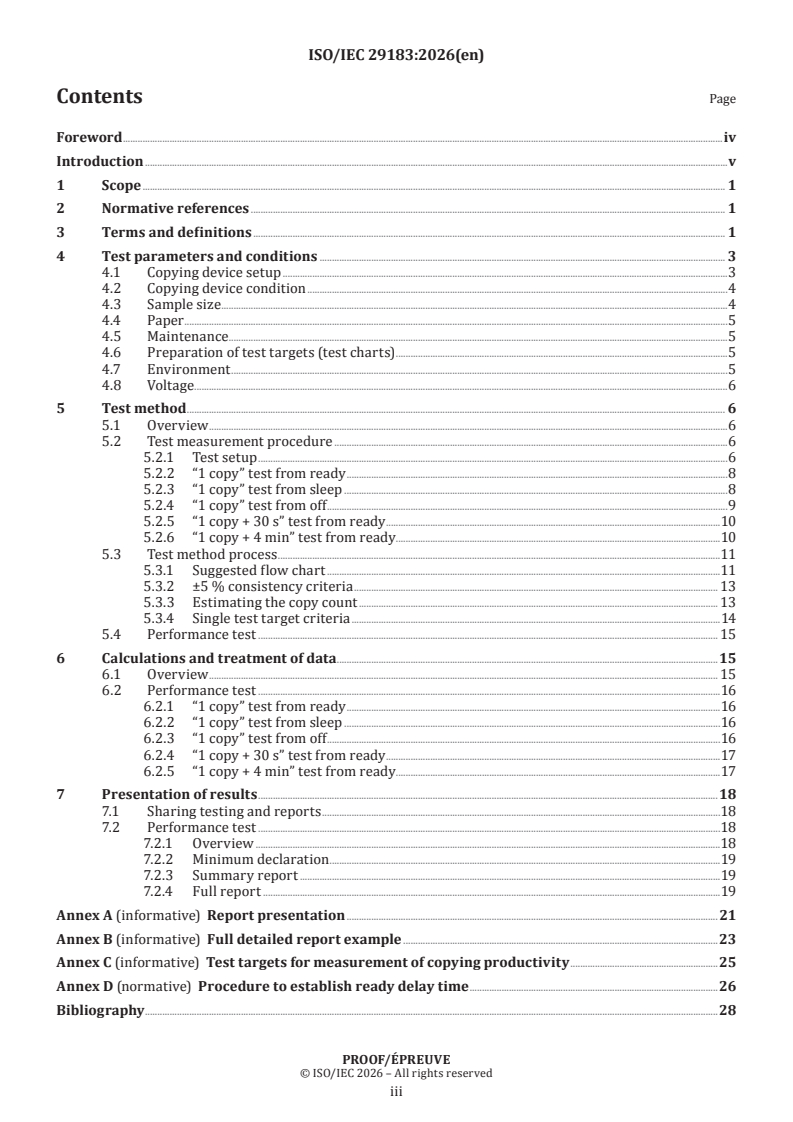
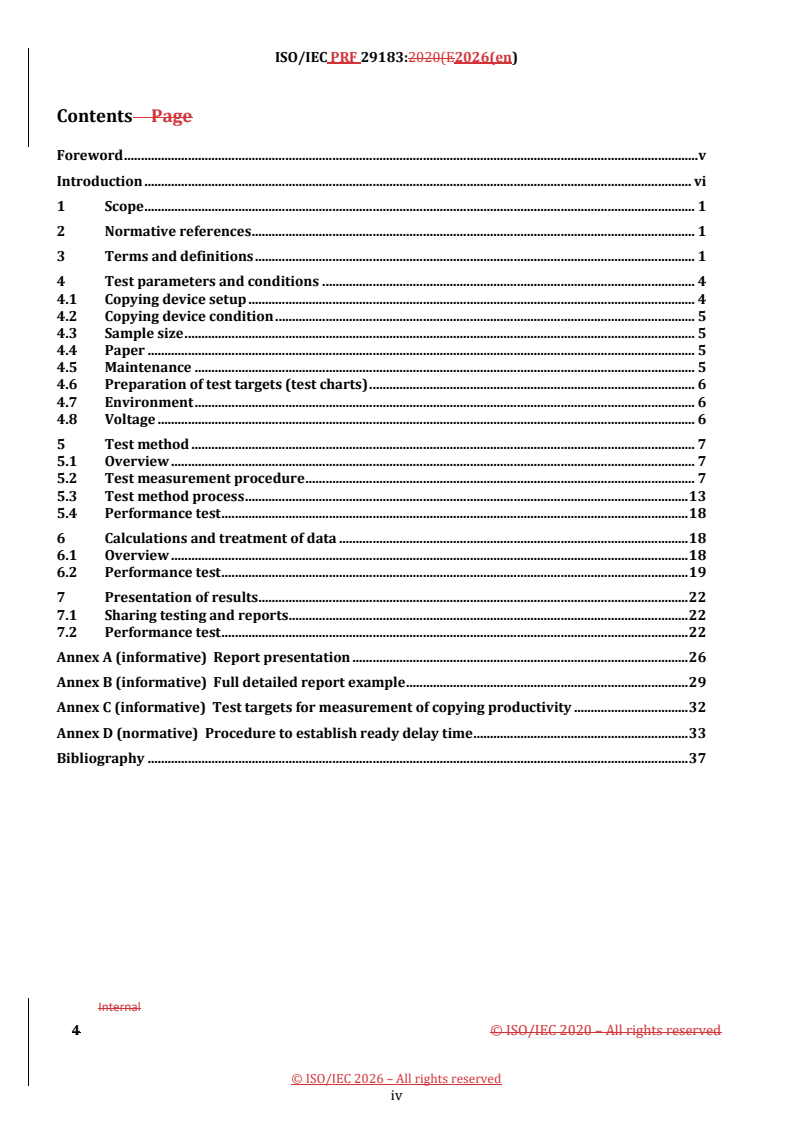
Contents
- Introduction
- 1 Scope
- 2 Normative references
- 3 Terms and definitions
- 3.1 sEFTP
- 3.2 sESAT
- 3.3 sFCOT
- 3.4 full report
- 3.5 off state
- 3.6 performance test
- 3.7 power management delay time
- 3.8 recovery time
- 3.9 sleep state
- 3.10 saturated time per copy
- 3.11 test run
- 3.12 test set
- 3.13 test target
- 3.14 warm-up time
- 4 Test parameters and conditions
- 4.1 Copying device setup
- 4.2 Copying device condition
- 4.3 Sample size
- 4.4 Paper
- 4.5 Maintenance
- 4.6 Preparation of test targets (test charts)
- 4.7 Environment
- 4.8 Voltage
- 5 Test method
- 5.1 Overview
- 5.2 Test measurement procedure
- 5.3 Test method process
- 5.4 Performance test
- 6 Calculations and treatment of data
- 6.1 Overview
- 6.2 Performance test
- 7 Presentation of results
- 7.1 Sharing testing and reports
- 7.2 Performance test
- Annex A
- Annex B
- Annex C
- Annex D
- Bibliography
Introduction
Many digital copying devices produce copied pages at a different rate than their nominal speed when running with different quality modes, different substrate grammage, different job content and job lengths. The degree to which a change in productivity is experienced depends significantly on other parameters of the job stream. The most dominant of the parameters of the job stream are: image quality modes selected, job content, black and white (B&W) and colour reproduction job stream, run length. ISO/IEC 24735 only addresses the productivity issues for digital copying devices when using both collation and an ADF (automatic document feeder) and cannot be used for a single one sided original. This document provides a general method for measuring productivity when the above-mentioned job stream parameters for digital copying devices are taken into consideration. This document also includes instructions for the creation of test charts. It allows manufacturers and buyers of digital copying devices to describe the productivity of various digital copying devices with respect to representative office usage. PROOF/ÉPREUVE
International Standard ISO/IEC 29183:2026(en) Information technology — Office equipment — Method for measuring digital copying productivity for a single one-sided original
1 Scope
This document specifies a method for measuring productivity of digital copying devices and multifunctional devices with various copying modes and a single one-sided original. The document is applicable to digital copying devices and multifunctional devices. The document is intended to be used for black and white (B&W) as well as colour digital copying devices and multifunctional devices of any underlying marking technology. This document includes instructions for the creation of test charts, test setup procedure, test procedure and the reporting requirements for the digital copying productivity measurements. This document is not intended to replace manufacturer's rated speeds.
2 Normative references
The following documents are referred to in the text in such a way that some or all of their content constitutes requirements of this document. For dated references, only the edition cited applies. For undated references, the latest edition of the referenced document (including any amendments) applies. ISO 536, Paper and board — Determination of grammage ISO 2470-1, Paper, board and pulps — Measurement of diffuse blue reflectance factor — Part 1: Indoor daylight conditions (ISO brightness) ISO/IEC 24734, Information technology — Office equipment — Method for measuring digital printing productivity
3 Terms and definitions
For the purposes of this document, the terms and definitions given in ISO/IEC 24734 and the following apply. ISO and IEC maintain terminological databases for use in standardization at the following addresses:
- ISO Online browsing platform: available at https:// www .iso .org/ obp
- IEC Electropedia: available at https:// www .electropedia .org/
3.1 sEFTP
single one-sided effective throughput rate at which a device produces pages measured from the initiation of the job through the complete exit of the last test set (3.12) Note 1 to entry: “s” in "sEFTP" denotes that a single one-sided original is used for the measurement. Note 2 to entry: sEFTP is expressed in images per minute (ipm). sEFTP can be affected by scan time, digital processing time and maintenance as well as the run time of the test.
[SOURCE: ISO/IEC 24734:2021, 3.6, modified — The term "EFTP" has been replaced by "sEFTP" and Note 1 to entry has been added.] PROOF/ÉPREUVE
ISO/IEC 29183:2026(en)
3.2 sESAT
single one-sided estimated saturated throughput rate at which a device produces pages measured from the complete exit of the first test set (3.12) to the complete exit of the last test set Note 1 to entry: “s” in "sESAT" denotes that a single one-sided original is used for the measurement. Note 2 to entry: sESAT is expressed in images per minute (ipm). Note 3 to entry: Since each test set is one page, it is by definition the last page of the test set. [SOURCE: ISO/IEC 24734:2021, 3.7, modified — The term "ESAT" has been replaced by "sESAT" and Notes 1 and 3 to entry have been added.]
3.3 sFCOT
single one-sided first copy out time number of seconds between the initiation of the job to the complete exit of the first copy Note 1 to entry: “s” in "sFCOT" denotes that a single one-sided original is used for the measurement. Note 2 to entry: For a single one-sided original, the first copy is the first set and sFCOT equals sFSOT. Note 3 to entry: sFCOT can refer to sFCOT from ready, sFCOT from sleep, sFCOT from off. Specific usage is noted by sFCOT , sFCOT , sFCOT .
ready sleep off Note 4 to entry: sFCOT is strongly affected by the scanning time.
3.4 full report
<single sided copy> presentation of results including the single one-sided first copy out time (sFCOT) (3.3) from ready, sFCOT from sleep, sFCOT from off, single one-sided estimated saturated throughput (sESAT) (3.2) and single one-sided effective throughput (sEFTP) (3.1) values as well as the calculated averages for each value
3.5 off state
state from which a device is not capable of making a copy without user intervention to turn on the power Note 1 to entry: A device can enter off state due to a user turning the device off, or the device can enter off state automatically after a delay.
3.6 performance test
test used to evaluate productivity by providing single one-sided first copy out time (sFCOT) (3.3), single onesided estimated saturated throughput (sESAT) (3.2) and single one-sided effective throughput (sEFTP) (3.1)
3.7 power management delay time
time that a device waits between the exit of the last page of the last job and being in a lower power state such as sleep state (3.9) or off state (3.5) Note 1 to entry: The power management delay time corresponding to the setting as shipped is referred to as “default power management delay time” or "default delay time".
3.8 recovery time
time required by a device to recover from a sleep state (3.9) given by the difference in the exit timing of the first page of the sleep state job and the exit timing of the first page of the ready state job Note 1 to entry: Other related terms are “resume time” and “return time”. Other similar terms are used in industry as well.
PROOF/ÉPREUVE
ISO/IEC 29183:2026(en)
3.9 sleep state
low power state in which a device is not actively performing tasks but quickly resumes operation when needed, and most components are powered down or operating at minimal levels to conserve energy, while critical functions (such as memory retention and wake-up detection) remain active Note 1 to entry: Some devices can have multiple low power states. Note 2 to entry: Other equivalent terms are “power save”, “low power mode”, and “energy save”. Other terms are used in industry as well.
3.10 saturated time per copy
average time per copy measured from the complete exit of the first copy to the complete exit of the last copy
3.11 test run
operation of copying one test target (3.13), in a particular system configuration, with a particular test set (3.12) and page count Note 1 to entry: Copy times are recorded for each test run.
3.12 test set
test copy <single sided copy> single page test target (3.13) [SOURCE: ISO/IEC 24735:2021, 3.11, modified — The definition modified for single page.]
3.13 test target
test chart hardcopy page used for testing per the test method, created from the test file [SOURCE: ISO/IEC 24735:2021, 3.12, modified — The word "document" has been replaced by "page".]
3.14 warm-up time
time required by a device to recover from off state (3.5) given by the difference in single one-sidedfirst copy out time (sFCOT) (3.3) between off state and ready state Note 1 to entry: Other similar terms, such as "wait time", are used in industry as well.
4 Test parameters and conditions
4.1 Copying device setup
Place the copying device on a horizontal surface and set up the copying device according to the manufacturer's recommendations.
The copying device shall be fully enclosed in its normal exterior cover. The machine and all of its necessary supplies shall be acclimated in the test environment prior to conducting the test(s) for at least 8 h. All supplies used in the test(s), including copy paper, shall be those specified by the manufacturer. All image and copying modes shall be at their factory preset configuration for the copying device. It is assumed that the settings listed in Table 1 are common to all copying devices. These listed settings shall be set to the manufacturer's default or preset condition for the device. If a device has settings not listed in Table 1, they too shall be set to default settings. For copying devices that have additional print quality and digital image processing features, those features shall be set to match their normal default condition and included in the result reporting.
PROOF/ÉPREUVE
ISO/IEC 29183:2026(en) Disabling manufacturer default installed features, routines or applications, is not allowed. EXAMPLE 1 Examples of routines that cannot be disabled include, but are not limited to the following:
- automatic cleaning;
- calibration cycles;
- energy save settings.
If the system has automatic media detect (automatic paper type selection), it can be disabled, and paper used in the test shall be selected manually. This shall be noted in the full detailed report. Examples of the full detailed report are provided in Annex B. The following preset values in the test will be noted on this report format. If the system has multiple paper feed trays, the name of paper feed tray used shall be noted in the test report. Examples of the test report are provided in Annex B. Additional optional tests with non-default settings or configurations may be run.
If the copying device is setup with internal or external options such as memory, sorter, or finisher as default, then these options shall be noted on the full detailed report format in the configuration options. Example of the full detailed report are provided in Annex B.
EXAMPLE 2 Examples of configurations options to be captured:
- finisher as default;
- 160 GB HDD installed.
Table 1 — Preset settings Preset item Preset value Output resolution default Output quality default Mode Copying mode default Auto density adjustment default Collating function default Paper sending direction default Paper Paper type setting default Paper feeding default paper feed tray Paper-path Paper exit standard exit tray Face up exit default Fixing capability default Image quality stability default Temporary stop Capacity of paper default Others default
4.2 Copying device condition
All supplies used in the test(s), including paper and printing device consumables, shall be only those specified as acceptable for use by the manufacturer (or otherwise noted). If available, the number of pages printed on the engine and printed on the consumables prior to the start of the test shall be recorded and reported. The machine and all of its necessary supplies shall be acclimated in the test environment prior to conducting the test(s) at least 8 h.
4.3 Sample size
Each target shall be tested and measured at least twice for repeatability. All required tests shall be run using one device.
PROOF/ÉPREUVE
ISO/IEC 29183:2026(en)
4.4 Paper
The output paper used in this test shall be within the range of, and/or not violate, specific written attribute guidelines and recommendations provided by the copying device manufacturer, which may include but are not limited to: size, grammage, composition, paper manufacturer(s), paper type, part number and other physical characteristics. Care shall be taken to use a paper that conforms to the copying device manufacturers' paper specifications for the default copying device settings. The paper used for the performance test in 5.4 shall be cut sheet, A4 and/or 8,5" × 11" (215,9 mm × 279,4 mm) size. The paper used in the test shall be recorded in the full detailed test report.
The same paper size should be used for each machine when wanting to compare the productivity results of one machine with other machines. If the copying device is used in “thick paper mode” for copying, then this optional mode should be noted on the full detailed report format in corresponding column in Annex B.
4.5 Maintenance
Copying device maintenance routines shall be performed throughout testing per the manufacturer's recommendations on an as needed basis.
EXAMPLE Examples of maintenance routines:
- cleaning routines;
- consumables replacement.
4.6 Preparation of test targets (test charts)
The copying test file is outlined in Annex C.
The test file consists of four single-sided pages. When using the test file for the copying productivity test, the test targets shall be created by printing the most recent electronic test file. If the intended machine does not have a printer function, then record the name of the printer which is used to print out the actual test targets. The quality of test targets can affect the productivity measurement. Test targets should be created according to the following instructions.
a) The test targets shall be printed by the equipment to be tested in its default-printing mode in simplex mode.
b) The paper used for creating the test targets shall have a brightness of at least 80 % to eliminate the influence of background.
c) The paper used for creating the test targets shall be 64 g/m or above and sufficiently opaque. d) The paper used for creating the test targets shall be free of wrinkles or other surface defects. e) Confirm that there are no defects such as unexpected dots or contamination on the paper. f) Page scaling shall not be used. Typically, this is done by setting page scaling to “none”. Options such as “Fit to printable area” shall not be used.
The brightness shall be measured according to ISO 2470-1. The paper grammage shall be measured according to ISO 536.
4.7 Environment
The test environment, including temperature and humidity, shall be within the ranges recommended by the manufacturer for operating the device. If no recommendation is available, the following ranges shall apply:
- temperature: 18 °C to 25 °C,
- relative humidity: 30 % to 70 %.
PROOF/ÉPREUVE
ISO/IEC 29183:2026(en) The temperature and humidity ranges of the test environment shall be recorded in the full detailed report.
4.8 Voltage
The copying device shall be connected to a voltage supply within the manufacturer specified operating voltage range for the copying device under test. The voltage should be measured under no-load condition prior to each test suite and recorded in the full detailed report. NOTE Devices that utilise a heater can have a longer sFCOT time when the line voltage is at the lower value of the recommended operating range.
5 Test method
5.1 Overview
The test procedures in this document apply to tests using either the scanning glass or ADF. For devices with both ADF and a scanning glass, testing with the scanning glass is mandatory, testing with the ADF is optional. If the test is performed with the scanning glass and the ADF, then results from both tests shall be documented in the full test report. It is acceptable to test with only the ADF if it is the only scanner input path. This can be the case on scroll fed scanners, such as those typically found on fax machines. A single copy (1 copy test) of the relevant test target is copied in order to measure first copy out time from ready (sFCOT ), sleep (sFCOT ), and off (sFCOT ). Multiple, N sets, of each relevant test target are ready sleep off copied and measured for the 1 copy + 30 s test run to calculate estimated saturated throughput (sESAT ) 30 sec and effective throughput (sEFTP ), where N is the number of sets needed to meet sLSOT - sFSOT 30 sec 30 sec 30 sec ≥ 30 s, and sLSOT is the last set out time for the 1 copy + 30 s test. The 1 copy + 4 min test is a similar 30 sec concept used to calculate sEFTP .
4 min The 1 copy + 30 s test is used to provide a test for products across varying segments. Without defining and categorizing products by segments, this simple method allows faster products to be tested with more sets and slower products to be tested with fewer sets, therefore more consistent with their usage. The 1 copy + 4 min test is intended to provide a test to illustrate that differences in productivity can occur for longer printing times compared to shorter printing times. It is understood and recognized that 4 min can be a long test for some devices, but a short test for other, higher end devices. The 4 min time is a compromise to meet the needs of the many products across many segments covered in the scope of this document. In order to ensure clarity between the results of each test and to avoid test result confusion that can be caused by back to back job spooling effect, each copy job test should be started only after the last copy of the previous test has been fully ejected from the machine and the device has returned to a ready state. Repeat the (1 copy test, 1 copy + 30 s test, and 1 copy + 4 min test) for each required/optional test target, test suite, as applicable for the relevant copying modes on the device under test as shown in Table 2 and/or Table 3.
5.2 Test measurement procedure
5.2.1 Test setup
Before testing, the following setup activities shall be completed. a) Install the copying device following the manufacturer's recommendations. b) Clean the surface of the image scanning device if needed.
c) The default required tests shall be run after the copying device has warmed-up and entered a ready state. Use of warm-up copying (that means at least one page is copied just before testing) to ready the copying device is acceptable.
PROOF/ÉPREUVE
ISO/IEC 29183:2026(en) d) Set the system parameters (such as paper grammage selection, paper size and feed orientation, quality mode) for test. Record the copying device model, configuration (options), default condition and any other variations if selected. If the system has automatic media detect (automatic paper type selection), it may be disabled, and paper used in the test shall be selected manually. This shall be noted in the full detailed report.
e) Refer to Annex B for an example of settings to record. Refer to 5.4 for information on required tests. Refer to Clause 6 for information on the calculation and treatment of data. Refer to Clause 7 for information on data reporting.
f) Prepare the test targets (test charts) that will be used in the test, identified as described in 4.6, and place the target on the scanning glass of the device.
g) Refer to 5.4 to decide what tests are to be run.
h) The 1 copy test and the 1 copy + 30 s test are required for each test target A, B, C and D. Only test target A is required for the 1 copy + 4 min test while test targets B, C and D are optional. These tests may be performed in any order with any of the test targets.
NOTE 1 Four test targets are used in order to test the productivity versus the content of various originals. This document is not designed or intended to test the time it takes for an operator to switch originals on the scanner glass.
i) As described in 5.3.4, if the saturated time per copy is consistent to ±5 % between the four test targets, testing may be carried out on only test target A. If only test target A is used, it shall be noted in the full detailed test report.
...
Contents
- Introduction
- 1 Scope
- 2 Normative references
- 3 Terms and definitions
- 4 Test parameters and conditions
- 4.1 Copying device setup
- 4.2 Copying device condition
- 4.3 Sample size
- 4.4 Paper
- 4.5 Maintenance
- 4.6 Preparation of test targets (test charts)
- 4.7 Environment
- 4.8 Voltage
- 5 Test method
- 5.1 Overview
- 5.2 Test measurement procedure
- 5.3 Test method process
- 2 × 𝑆
- 2 × 𝑆
- 2 × 𝑆
- 30 × (𝑁 − 1)
- 5.4 Performance test
- 6 Calculations and treatment of data
- 6.1 Overview
- 6.2 Performance test
- 60 × (𝑁 − 1)
- 60 × 𝛮
- 60 × 𝛮
- 7 Presentation of results
- 7.1 Sharing testing and reports
- 7.2 Performance test
- Annex A
- Annex B
- Annex C
- Annex D
- Bibliography
Introduction
Many digital copying devices produce copied pages at a different rate than their nominal speed when running with different quality modes, different substrate grammage, different job content and job lengths. The degree to which a change in productivity is experienced depends significantly on other parameters of the job stream. The most dominant of the parameters of the job stream are: image quality modes selected, job content, black and white (B&W) and colour reproduction job stream, run length. ISO/IEC 24735 only addresses the productivity issues for digital copying devices when using both collation and an ADF (automatic document feeder) and cannot be used for a single one sided original.
This document provides a general method for measuring productivity when the above-mentioned job stream parameters for digital copying devices are taken into consideration. This document also includes instructions for the creation of test charts. It allows manufacturers and buyers of digital copying devices to describe the productivity of various digital copying devices with respect to representative office usage. Internal
DRAFT International Standard ISO/IEC DIS 29183:2025(en)
Information technology — Office equipment — Method for measuring digital copying productivity for a single one-sided original
1 Scope
This document specifies a method for measuring productivity of digital copying devices and multifunctional devices with various copying modes and a single one-sided original. The document is applicable to digital copying devices and multifunctional devices. The document is intended to be used for black and white (B&W) as well as colour digital copying devices and multifunctional devices of any underlying marking technology. This document includes instructions for the creation of test charts, test setup procedure, test procedure and the reporting requirements for the digital copying productivity measurements. This document is not intended to replace manufacturer's rated speeds.
2 Normative references
The following documents are referred to in the text in such a way that some or all of their content constitutes requirements of this document. For dated references, only the edition cited applies. For undated references, the latest edition of the referenced document (including any amendments) applies. ISO 536, Paper and board — Determination of grammage ISO 2470--1, Paper, board and pulps — Measurement of diffuse blue reflectance factor — Part 1: Indoor daylight conditions (ISO brightness) ISO/IEC 24734, Information technology — Office equipment — Method for measuring digital printing productivity
3 Terms and definitions
For the purposes of this document, the terms and definitions given in ISO/IEC 24734 and the following apply. ISO and IEC maintain terminological databases for use in standardization at the following addresses:
- — ISO Online browsing platform: available at https://www.iso.org/obp
- — IEC Electropedia: available at https://www.electropedia.org/ 3.1 3.1 sEFTP single one-sided effective throughput rate at which a device produces pages measured from the initiation of the job through the complete exit of the last test set (3.12(3.12)) Note 1 to entry: “s” in "sEFTP" denotes that a single one-sided original is used for the measurement. Note 2 to entry: sEFTP is expressed in images per minute (ipm). sEFTP can be affected by scan time, digital processing time and maintenance as well as the run time of the test.
ISO/IEC PRF 29183:2020(E2026(en) [SOURCE: ISO/IEC 24734:2021, 3.6, modified — The term "EFTP" has been replaced by "sEFTP" and Note 1 to entry has been added.] 3.2 3.2 sESAT single one-sided estimated saturated throughput rate at which a device produces pages measured from the complete exit of the first test set (3.12(3.12)) to the complete exit of the last test set Note 1 to entry: “s” in "sESAT" denotes that a single one-sided original is used for the measurement. Note 2 to entry: sESAT is expressed in images per minute (ipm). Note 3 to entry: Since each test set is one page, it is by definition the last page of the test set. [SOURCE: ISO/IEC 24734:2021, 3.7, modified — The term "ESAT" has been replaced by "sESAT" and Notes 1 and 3 to entry have been added.] 3.3 3.3 sFCOT single one-sided first copy out time number of seconds between the initiation of the job to the complete exit of the first copy Note 1 to entry: “s” in "sFCOT" denotes that a single one-sided original is used for the measurement. Note 2 to entry: For a single one-sided original, the first copy is the first set and sFCOT equals sFSOT. Note 3 to entry: sFCOT can refer to sFCOT from ready, sFCOT from sleep, sFCOT from off. Specific usage is noted by sFCOT , sFCOT , sFCOT .
ready sleep off Note 4 to entry: sFCOT is strongly affected by the scanning time.
3.4 3.4 full report <single sided copy> presentation of results including the single one-sided first copy out time (sFCOT) (3.3(3.3)) from ready, sFCOT from sleep, sFCOT from off, single one-sided estimated saturated throughput (sESAT) (3.2(3.2)) and single one-sided effective throughput (sEFTP) (3.1(3.1)) values as well as the calculated averages for each value 3.5 3.5 off state state from which a device is not capable of making a copy without user intervention to turn on the power Note 1 to entry: A device can enter off state due to a user turning the device off, or the device can enter off state automatically after a delay.
3.6 3.6 performance test test used to evaluate productivity by providing single one-sided first copy out time (sFCOT) (3.3(3.3),), single one-sided estimated saturated throughput (sESAT) (3.2(3.2)) and single one-sided effective throughput (sEFTP) (3.1(3.1)) Internal
ISO/IEC DISPRF 29183:20252026(en) 3.7 3.7 power management delay time time that a device waits between the exit of the last page of the last job and being in a lower power state such as sleep state (3.9) or off state (3.5(3.5)) Note 1 to entry: The power management delay time corresponding to the setting as shipped is referred to as “default power management delay time” or "default delay time".
3.8 3.8 recovery time time required by a device to recover from a sleep state (3.9) given by the difference in the exit timing of the first page of the sleep state job and the exit timing of the first page of the ready state job Note 1 to entry: Other related terms are “resume time” and “return time”. Other similar terms are used in industry as well.
3.9 3.9 sleep state low power state in which a device is not actively performing tasks but quickly resumeresumes operation when needed, and most components are powered down or operating at minimal levels to conserve energy, while critical functions (such as memory retention and wake-up detection) remain active Note 1 to entry: Some devices can have multiple low power states. Note 2 to entry: Other equivalent terms are “power save”, “low power mode”, and “energy save”. Other terms are used in industry as well.
3.10 3.10 saturated time per copy average time per copy measured from the complete exit of the first copy to the complete exit of the last copy 3.11 3.11 test run operation of copying one test target (3.13(3.13),), in a particular system configuration, with a particular test set (3.12(3.12)) and page count Note 1 to entry: Copy times are recorded for each test run.
3.12 3.12 test set test copy <single sided copy> single page test target (3.13(3.13)) [SOURCE: ISO/IEC 24735:2021, 3.11, modified — The definition modified for single page.] 3.13 3.13 test target test chart hardcopy page used for testing per the test method, created from the test file [SOURCE: ISO/IEC 24735:2021, 3.2512, modified — The word "document" has been replaced by "page".] 3.14 3.14 warm-up time time required by a device to recover from off state (3.5(3.5)) given by the difference in firstsingle one-sided first copy out time (sFCOT) (3.3(3.3)) between off state and ready state
ISO/IEC PRF 29183:2020(E2026(en) Note 1 to entry: Other similar terms, such as "wait time", are used in industry as well.
4 Test parameters and conditions
4.1 Copying device setup
Place the copying device on a horizontal surface and set up the copying device according to the manufacturer's recommendations.
The copying device shall be fully enclosed in its normal exterior cover. The machine and all of its necessary supplies shall be acclimated in the test environment prior to conducting the test(s) for at least 8 h. All supplies used in the test(s), including copy paper, shall be those specified by the manufacturer. All image and copying modes shall be at their factory preset configuration for the copying device. It is assumed that the settings listed in Table 1 Table 1 are common to all copying devices. These listed settings shall be set to the manufacturer's default or preset condition for the device. If a device has settings not listed in Table 1 Table 1,, they too shall be set to default settings. For copying devices that have additional print quality and digital image processing features, those features shall be set to match their normal default condition and included in the result reporting.
Disabling manufacturer default installed features, routines or applications, is not allowed. EXAMPLE 1 Examples of routines that cannot be disabled include, but are not limited to the following:
- — automatic cleaning;
- — calibration cycles;
- — energy save settings.
If the system has automatic media detect (automatic paper type selection), it can be disabled, and paper used in the test shall be selected manually. This shall be noted in the full detailed report. Examples of the full detailed report are provided in Annex BAnnex B.. The following preset values in the test will be noted on this report format. If the system has multiple paper feed trays, the name of paper feed tray used shall be noted in the test report. Examples of the test report are provided in Annex BAnnex B.. Additional optional tests with non-default settings or configurations may be run.
If the copying device is setup with internal or external options such as memory, sorter, or finisher as default, then these options shall be noted on the full detailed report format in the configuration options. Example of the full detailed report are provided in Annex BAnnex B..
EXAMPLE 2 Examples of configurations options to be captured:
- — finisher as default;
- — 160GB160 GB HDD installed.
Table 1 — Preset settings Preset item Preset value Output resolution default Mode Output quality default Copying mode default Internal
ISO/IEC DISPRF 29183:20252026(en) Preset item Preset value Auto density adjustment default Collating function default Paper sending direction default Paper Paper type setting default Paper feeding default paper feed tray Paper-path Paper exit standard exit tray Face up exit default Fixing capability default Image quality stability default Temporary stop Capacity of paper default Others default
4.2 Copying device condition
All supplies used in the test(s), including paper and printing device consumables, shall be only those specified as acceptable for use by the manufacturer (or otherwise noted). If available, the number of pages printed on the engine and printed on the consumables prior to the start of the test shall be recorded and reported. The machine and all of its necessary supplies shall be acclimated in the test environment prior to conducting the test(s) at least 8 h.
4.3 Sample size
Each target shall be tested and measured at least twice for repeatability. All required tests shall be run using one device.
4.4 Paper
The output paper used in this test shall be within the range of, and/or not violate, specific written attribute guidelines and recommendations provided by the copying device manufacturer, which may include but are not limited to: size, grammage, composition, paper manufacturer(s), paper type, part number and other physical characteristics. Care shall be taken to use a paper that conforms to the copying device manufacturers' paper specifications for the default copying device settings. The paper used for the performance test in 5.45.4 shall be cut sheet, A4 and/or 8,5" × 11" (215,9 mm × 279,4 mm) size. The paper used in the test shall be recorded in the full detailed test report.
The same paper size should be used for each machine when wanting to compare the productivity results of one machine with other machines. If the copying device is used in “thick paper mode” for copying, then this optional mode should be noted on the full detailed report format in corresponding column in Annex BAnnex B..
4.5 Maintenance
Copying device maintenance routines shall be performed throughout testing per the manufacturer's recommendations on an as needed basis.
EXAMPLE Examples of maintenance routines:
- — cleaning routines;
ISO/IEC PRF 29183:2020(E2026(en) - — consumables replacement.
4.6 Preparation of test targets (test charts)
The copying test file is outlined in Annex CAnnex C..
The test file consists of four single-sided pages. When using the test file for the copying productivity test, the test targets shall be created by printing the most recent electronic test file. If the intended machine does not have a printer function, then record the name of the printer which is used to print out the actual test targets. The quality of test targets can affect the productivity measurement. Test targets should be created according to the following instructions.
a) a) The test targets shall be printed by the equipment to be tested in its default-printing mode in simplex mode.
b) b) The paper used for creating the test targets shall have a brightness of at least 80 % to eliminate the influence of background.
c) c) The paper used for creating the test targets shall be 64 g/m or above and sufficiently opaque. d) d) The paper used for creating the test targets shall be free of wrinkles or other surface defects. e) e) Confirm that there are no defects such as unexpected dots or contamination on the paper. f) f) Page scaling shall not be used. Typically, this is done by setting page scaling to “none”. Options such as “Fit to printable area” shall not be used.
The brightness shall be measured according to ISO 2470--1. The paper grammage shall be measured according to ISO 536.
4.7 Environment
The test environment, including temperature and humidity, shall be within the ranges recommended by the manufacturer for operating the device. If no recommendation is available, the following ranges shall apply:
- — temperature: 18 °C to 25 °C,
- — relative humidity: 30 % to 70 %.
The temperature and humidity ranges of the test environment shall be recorded in the full detailed report.
4.8 Voltage
The copying device shall be connected to a voltage supply within the manufacturer specified operating voltage range for the copying device under test. The voltage should be measured under no-load condition prior to each test suite and recorded in the full detailed report.
NOTE Devices that utilise a heater can have a longer sFCOT time when the line voltage is at the lower value of the recommended operating range.
Internal
ISO/IEC DISPRF 29183:20252026(en)
5 Test method
5.1 Overview
The test procedures in this document apply to tests using either the scanning glass or ADF. For devices with both ADF and a scanning glass, testing with the scanning glass is mandatory, testing with the ADF is optional. If the test is performed with the scanning glass and the ADF, then results from both tests shall be documented in the full test report. It is acceptable to test with only the ADF if it is the only scanner input path. This can be the case on scroll fed scanners, such as those typically found on fax machines. A single copy (1 copy test) of the relevant test target is copied in order to measure first copy out time from ready (sFCOT ), sleep (sFCOT ), and off (sFCOT ). Multiple, N sets, of each relevant test target are copied ready sleep off and measured for the 1 copy + 30 s test run to calculate estimated saturated throughput (sESAT sESAT ) 30sec 30 sec and effective throughput (sEFTP sEFTP ), where N is the number of sets needed to meet sLSOT - 30sec 30 sec 30sec sFSOT sLSOT - sFSOT ≥ 30 s, and sLSOT sLSOT is the last set out time for the 1 copy + 30 s 30sec 30 sec 30 sec 30sec 30 sec test. The 1 copy + 4 min test is a similar concept used to calculate sEFTP sEFTP . 4min 4 min The 1 copy + 30 s test is used to provide a test for products across varying segments. Without defining and categorizing products by segments, this simple method allows faster products to be tested with more sets and slower products to be tested with fewer sets, therefore more consistent with their usage. The 1 copy + 4 min test is intended to provide a test to illustrate that differences in productivity can occur for longer printing times compared to shorter printing times. It is understood and recognized that 4 min can be a long test for some devices, but a short test for other, higher end devices. The 4 min time is a compromise to meet the needs of the many products across many segments covered in the scope of this document. In order to ensure clarity between the results of each test and to avoid test result confusion that can be caused by back to back job spooling effect, each copy job test should be started only after the last copy of the previous test has been fully ejected from the machine and the device has returned to a ready state. Repeat the (1 copy test, 1 copy + 30 s test, and 1 copy + 4 min test) for each required/optional test target, test suite, as applicable for the relevant copying modes on the device under test as shown in Table 2 Table 2 and/or Table 3 Table 3..
5.2 Test measurement procedure
5.2.1 Test setup
Before testing, the following setup activities shall be completed. a) a) Install the copying device following the manufacturer's recommendations. b) b) Clean the surface of the image scanning device if needed. c) c) The default required tests shall be run after the copying device has warmed-up and entered a ready state. Use of warm-up copying (that means at least one page is copied just before testing) to ready the copying device is acceptable.
d) d) Set the system parameters (such as paper grammage selection, paper size and feed orientation, quality mode) for test. Record the copying device model, configuration (options), default condition and any other variations if selected. If the system has automatic media detect (automatic paper type selection), it may be disabled, and paper used in the test shall be selected manually. This shall be noted in the full detailed report.
ISO/IEC PRF 29183:2020(E2026(en) e) e) Refer to Annex BAnnex B for an example of settings to record. Refer to 5.45.4 for information on required tests. Refer to 6Clause 6 for information on the calculation and treatment of data. Refer to 7Clause 7 for information on data reporting.
f) f) Prepare the test targets (test charts) that will be used in the test, identified as described in 4.64.6,, and place the target on the scanning glass of the device. g) g) Refer to 5.45.4 to decide what tests are to be run.
h) h) The 1 copy test and the 1 copy + 30 s test are required for each test target A, B, C and D. Only test target A is required for the 1 copy + 4 min test while test targets B, C and D are optional. These tests may be performed in any order with any of the test targets.
NOTE 1 Four test targets are used in order to test the productivity versus the content of various originals. This document is not designed or intended to test the time it takes for an operator to switch originals on the scanner glass.
...