

ISO 13722:2017
(Main)Microbiology of the food chain — Enumeration of Brochothrix spp. — Colony-count technique
General Information
- Abstract
ISO 13722:2017 specifies a method for the enumeration of viable Brochothrix spp. by means of a colony-count technique. ISO 13722:2017 is especially applicable to meat and meat products, but is also suitable for the examination of the following: - other products intended for human consumption, - products intended for animal feeding, - environmental samples in the area of food and feed production, handling, and - samples from the primary production stage.
- Status
- Published
- Publication Date
- 18-Jul-2017
- Technical Committee
- ISO/TC 34/SC 9 - Microbiology
- Drafting Committee
- ISO/TC 34/SC 9 - Microbiology
- Current Stage
- 9093 - International Standard confirmed
- Start Date
- 21-Feb-2023
- Completion Date
- 29-Aug-2026
Buy Documents
ISO 13722:2017 - Microbiology of the food chain -- Enumeration of Brochothrix spp. -- Colony-count technique
ISO 13722:2017 - Microbiology of the food chain — Enumeration of Brochothrix spp. — Colony-count technique/19/2017
Overview
ISO 13722:2017 specifies a standardized colony-count technique for the enumeration of viable Brochothrix spp. in the food chain. Originally focused on meat and meat products, the method is also applicable to other foods for human consumption, animal feed, environmental samples in food/feed production and handling, and primary production samples. The standard defines the principle, culture media (STAA), incubation conditions, confirmation tests and reporting format for reliable Brochothrix spp. counts.
Key topics and technical requirements
- Principle: Surface plating (spread plate) of test sample or decimal dilutions onto streptomycin sulfate/thallium acetate agar (STAA), incubation and colony confirmation.
- Inoculation: Transfer 0.1 ml of test sample or initial suspension to each plate and spread evenly; duplicate plates recommended for single suspensions.
- Incubation: Invert plates and incubate 22 °C to 25 °C for 48 h ± 4 h.
- Colony selection and counting: Count characteristic shiny, off‑white, round colonies ≥ 1 mm on plates containing 10–150 colonies; calculate results as CFU per gram or millilitre.
- Confirmation tests: Perform oxidase test (Brochothrix spp. are oxidase‑negative) and catalase test (Brochothrix spp. are catalase‑positive). Select five colonies per plate for confirmation.
- Media and safety notes: The STAA medium formulation is given in the annex; cycloheximide (actidione) has been omitted because of toxicity. Culture media performance testing follows ISO 11133.
- Performance: Validation data from an NMKL collaborative study are included; reported repeatability and reproducibility standard deviations were ~0.13 and 0.22 cfu/g, respectively.
Applications
- Routine food microbiology testing and quality control in meat processing and ready‑to‑eat products where Brochothrix (notably Br. thermosphacta) impacts shelf life and spoilage.
- Environmental monitoring in production and handling areas within food and feed facilities.
- Regulatory and laboratory confirmation testing, research on spoilage organisms, and comparative studies of microbial loads at different production stages.
Who should use this standard
- Food and feed testing laboratories, quality assurance teams in meat and seafood industries, regulatory authorities, and microbiologists conducting shelf‑life or spoilage investigations.
Related standards
- ISO 6887 (sample preparation and dilutions)
- ISO 7218 (general microbiological requirements)
- ISO 11133 (culture media preparation and performance)
- Sampling guidance: ISO/TS 17728, ISO 13307, ISO 17604, ISO 18593
- NMKL methods cited for validation data
Keywords: ISO 13722:2017, Brochothrix spp., Brochothrix thermosphacta, colony-count technique, STAA, food microbiology, enumeration, meat products, ISO standard.
Relations
- Effective Date
- 04-Nov-2015
Buy Documents
ISO 13722:2017 - Microbiology of the food chain -- Enumeration of Brochothrix spp. -- Colony-count technique
ISO 13722:2017 - Microbiology of the food chain — Enumeration of Brochothrix spp. — Colony-count technique/19/2017
Frequently Asked Questions
ISO 13722:2017 is a standard published by the International Organization for Standardization (ISO). Its full title is "Microbiology of the food chain — Enumeration of Brochothrix spp. — Colony-count technique". This standard covers: ISO 13722:2017 specifies a method for the enumeration of viable Brochothrix spp. by means of a colony-count technique. ISO 13722:2017 is especially applicable to meat and meat products, but is also suitable for the examination of the following: - other products intended for human consumption, - products intended for animal feeding, - environmental samples in the area of food and feed production, handling, and - samples from the primary production stage.
ISO 13722:2017 specifies a method for the enumeration of viable Brochothrix spp. by means of a colony-count technique. ISO 13722:2017 is especially applicable to meat and meat products, but is also suitable for the examination of the following: - other products intended for human consumption, - products intended for animal feeding, - environmental samples in the area of food and feed production, handling, and - samples from the primary production stage.
ISO 13722:2017 is classified under the following ICS (International Classification for Standards) categories: 07.100.30 - Food microbiology. The ICS classification helps identify the subject area and facilitates finding related standards.
ISO 13722:2017 has the following relationships with other standards: It is inter standard links to ISO 13722:1996. Understanding these relationships helps ensure you are using the most current and applicable version of the standard.
ISO 13722:2017 is available in PDF format for immediate download after purchase. The document can be added to your cart and obtained through the secure checkout process. Digital delivery ensures instant access to the complete standard document.
Standards Content (Sample)
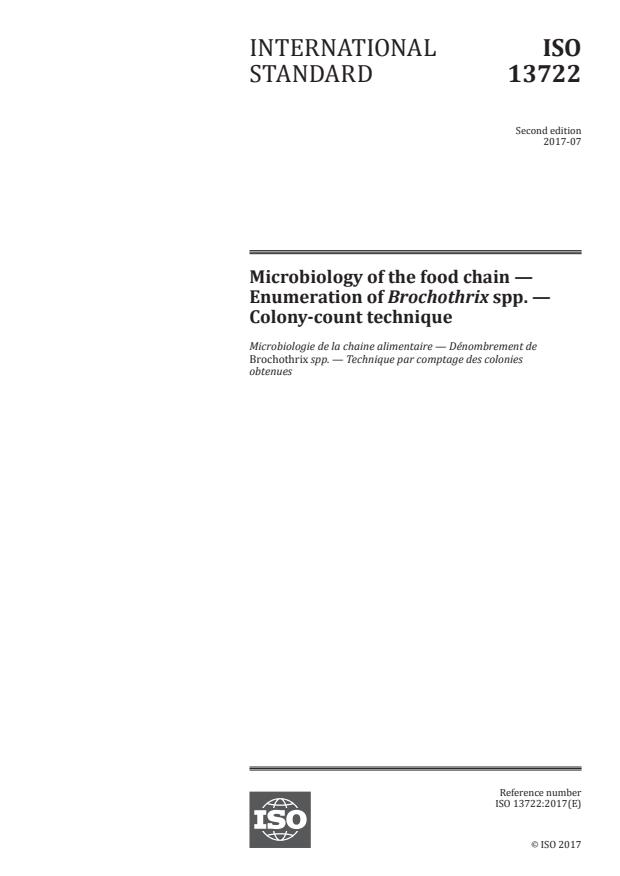
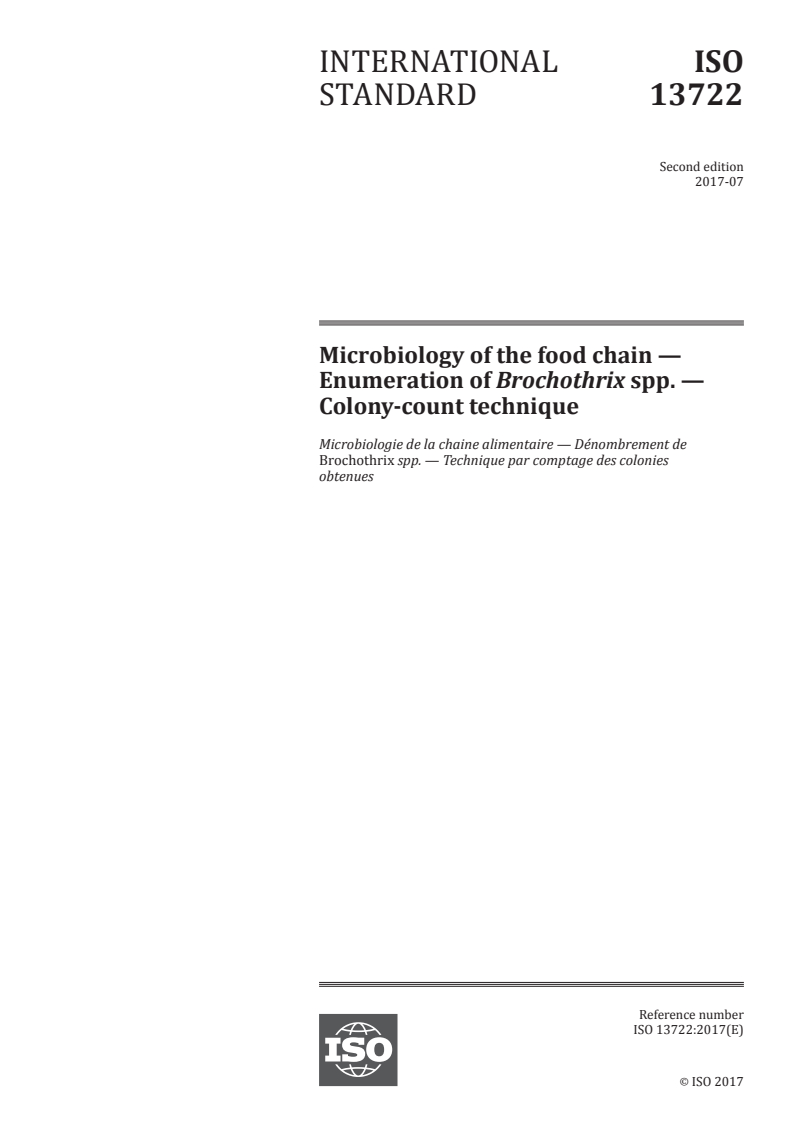
INTERNATIONAL ISO
STANDARD 13722
Second edition
2017-07
Microbiology of the food chain —
Enumeration of Brochothrix spp. —
Colony-count technique
Microbiologie de la chaine alimentaire — Dénombrement de
Brochothrix spp. — Technique par comptage des colonies
obtenues
Reference number
©
ISO 2017
© ISO 2017, Published in Switzerland
All rights reserved. Unless otherwise specified, no part of this publication may be reproduced or utilized otherwise in any form
or by any means, electronic or mechanical, including photocopying, or posting on the internet or an intranet, without prior
written permission. Permission can be requested from either ISO at the address below or ISO’s member body in the country of
the requester.
ISO copyright office
Ch. de Blandonnet 8 • CP 401
CH-1214 Vernier, Geneva, Switzerland
Tel. +41 22 749 01 11
Fax +41 22 749 09 47
copyright@iso.org
www.iso.org
ii © ISO 2017 – All rights reserved
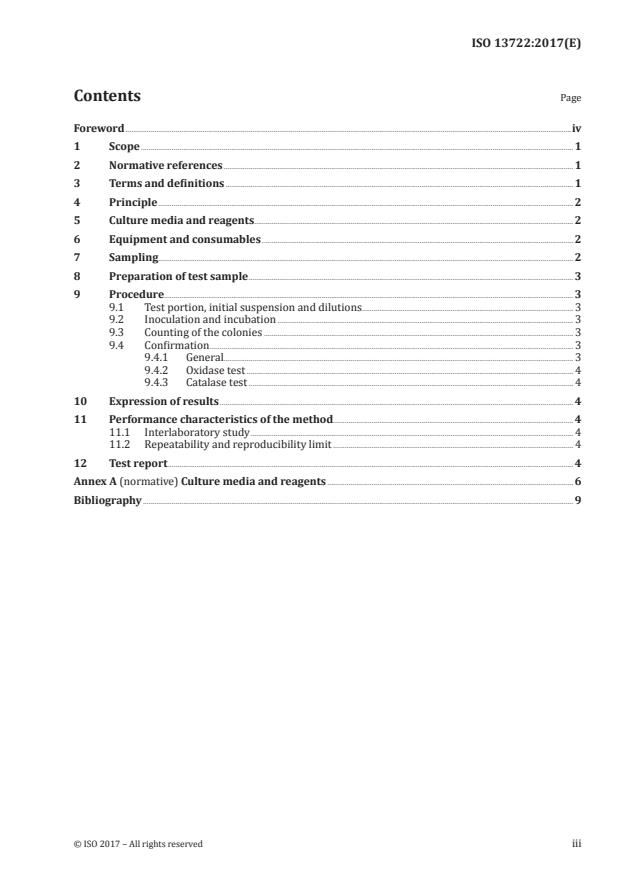
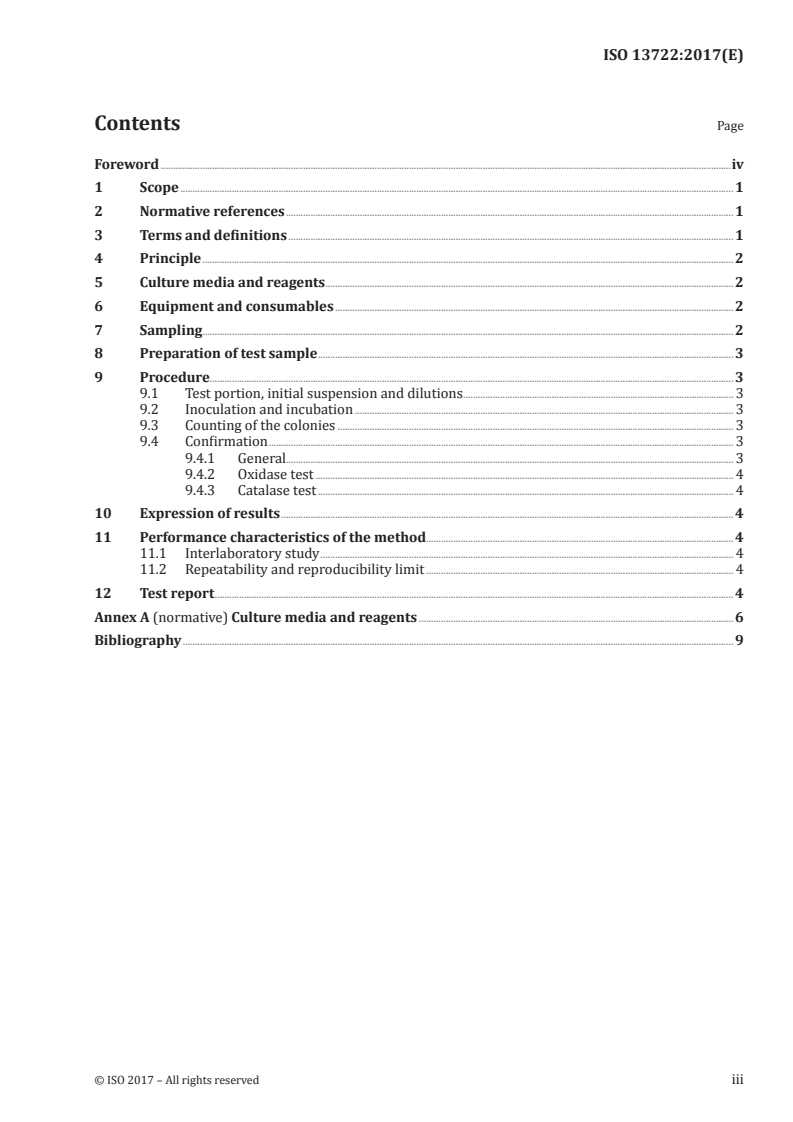
Contents Page
Foreword .iv
1 Scope . 1
2 Normative references . 1
3 Terms and definitions . 1
4 Principle . 2
5 Culture media and reagents . 2
6 Equipment and consumables . 2
7 Sampling . 2
8 Preparation of test sample . 3
9 Procedure. 3
9.1 Test portion, initial suspension and dilutions . 3
9.2 Inoculation and incubation . 3
9.3 Counting of the colonies . 3
9.4 Confirmation . 3
9.4.1 General. 3
9.4.2 Oxidase test . 4
9.4.3 Catalase test . 4
10 Expression of results . 4
11 Performance characteristics of the method . 4
11.1 Interlaboratory study . 4
11.2 Repeatability and reproducibility limit . 4
12 Test report . 4
Annex A (normative) Culture media and reagents . 6
Bibliography . 9
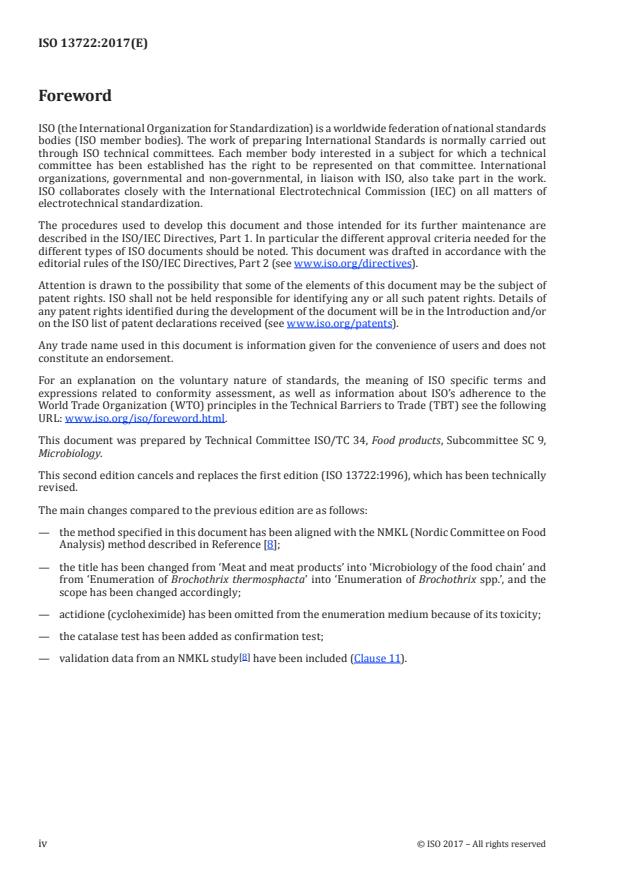
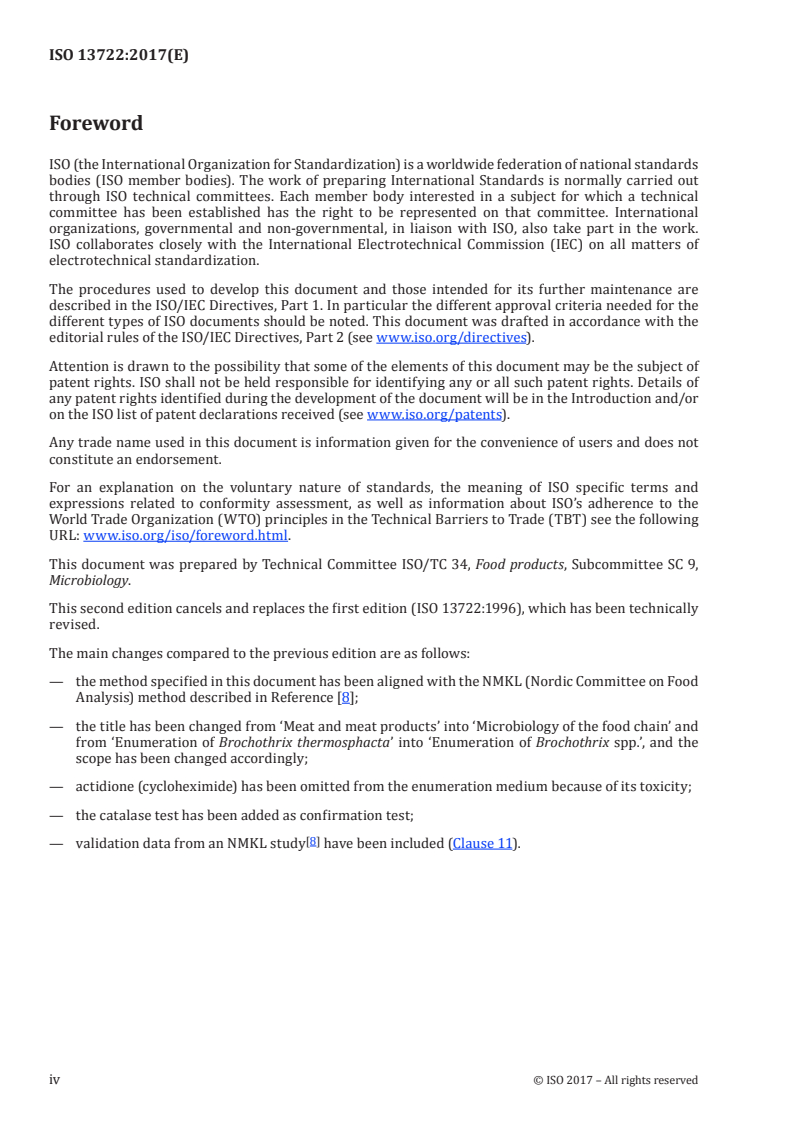
Foreword
ISO (the International Organization for Standardization) is a worldwide federation of national standards
bodies (ISO member bodies). The work of preparing International Standards is normally carried out
through ISO technical committees. Each member body interested in a subject for which a technical
committee has been established has the right to be represented on that committee. International
organizations, governmental and non-governmental, in liaison with ISO, also take part in the work.
ISO collaborates closely with the International Electrotechnical Commission (IEC) on all matters of
electrotechnical standardization.
The procedures used to develop this document and those intended for its further maintenance are
described in the ISO/IEC Directives, Part 1. In particular the different approval criteria needed for the
different types of ISO documents should be noted. This document was drafted in accordance with the
editorial rules of the ISO/IEC Directives, Part 2 (see www .iso .org/ directives).
Attention is drawn to the possibility that some of the elements of this document may be the subject of
patent rights. ISO shall not be held responsible for identifying any or all such patent rights. Details of
any patent rights identified during the development of the document will be in the Introduction and/or
on the ISO list of patent declarations received (see www .iso .org/ patents).
Any trade name used in this document is information given for the convenience of users and does not
constitute an endorsement.
For an explanation on the voluntary nature of standards, the meaning of ISO specific terms and
expressions related to conformity assessment, as well as information about ISO’s adherence to the
World Trade Organization (WTO) principles in the Technical Barriers to Trade (TBT) see the following
URL: w w w . i s o .org/ iso/ foreword .html.
This document was prepared by Technical Committee ISO/TC 34, Food products, Subcommittee SC 9,
Microbiology.
This second edition cancels and replaces the first edition (ISO 13722:1996), which has been technically
revised.
The main changes compared to the previous edition are as follows:
— the method specified in this document has been aligned with the NMKL (Nordic Committee on Food
Analysis) method described in Reference [8];
— the title has been changed from ‘Meat and meat products’ into ‘Microbiology of the food chain’ and
from ‘Enumeration of Brochothrix thermosphacta’ into ‘Enumeration of Brochothrix spp.’, and the
scope has been changed accordingly;
— actidione (cycloheximide) has been omitted from the enumeration medium because of its toxicity;
— the catalase test has been added as confirmation test;
[8]
— validation data from an NMKL study have been included (Clause 11).
iv © ISO 2017 – All rights reserved
INTERNATIONAL STANDARD ISO 13722:2017(E)
Microbiology of the food chain — Enumeration of
Brochothrix spp. — Colony-count technique
1 Scope
This document specifies a method for the enumeration of viable Brochothrix spp. by means of a colony-
count technique.
This document is especially applicable to meat and meat products, but is also suitable for the
examination of the following:
— other products intended for human consumption,
— products intended for animal feeding,
— environmental samples in the area of food and feed production, handling, and
— samples from the primary production stage.
2 Normative references
The following documents are referred to in the text in such a way that some or all of their content
constitutes requirements of this document. For dated references, only the edition cited applies. For
undated references, the latest edition of the referenced document (including any amendments) applies.
ISO 6887 (all parts), Microbiology of the food chain — Preparation of test samples, initial suspension and
decimal dilutions for microbiological examination
ISO 7218, Microbiology of food and animal feeding stuffs — General requirements and guidance for
microbiological examinations
ISO 11133, Microbiology of food, animal feed and water — Preparation, production, storage and
performance testing of culture media
3 Terms and definitions
For the purposes of this document, the following terms and definitions apply.
ISO and IEC maintain terminological databases for use in standardization at the following addresses:
— IEC Electropedia: available at http:// www.e lectropedia. org/
— ISO Online browsing platform: available at http:// www. iso. org/o bp
3.1
Brochothrix spp.
Gram-positive bacteria which form characteristic oxidase-negative and catalase-positive colonies on a
solid selective medium [streptomycin sulfate/thallium acetate agar (STAA)] under the test conditions
specified in this document
Note 1 to entry: To date only two species of Brochothrix have been described, Br. thermosphacta and Br. campestris.
Br. thermosphacta has often been reported in meat and meat products, but Br. campestris has so far only been
[9,10]
identified in samples from soil and grass. The method described in this document cannot differentiate
between these two species.
4 Principle
4.1 Surface plating, on a solid selective culture medium contained in Petri dishes, of a specified quantity
of the test sample if the initial product is liquid, or of a specified quantity of the initial suspension in the
case of other products. Preparation of other plates, under the same conditions, using decimal dilutions of
the test sample or of the initial suspension.
4.2 Incubation of the plates between 22 °C and 25 °C for 48 h.
4.3 Subjection of the colonies to confirmation tests.
4.4 From the number of colonies confirmed, calculation of the number of Brochothrix spp. per millilitre
or per gram of sample from colonies obtained on plates at dilution levels chosen so as to give the most
reliable result.
5 Culture media and reagents
Follow current laboratory practices as specified in ISO 7218.
Carry out the performance testing of culture media as specified in ISO 11133.
The composition of culture media and reagents and their preparation are specified in Annex A.
6 Equipment and consumables
Disposable equipment is an acceptable alternative to reusable glassware if it has suitable specifications.
Usual microbiological laboratory equipment, as specified in ISO 7218, and, in particular, the following.
6.1 Apparatus for dry heat sterilization (oven) or wet heat sterilization (autoclave).
6.2 Incubator or drying cabinet, capable of operating between 25 °C and 50 °C.
6.3 Incubator, capable of operating between 22 °C and 25 °C.
6.4 Petri dishes, made of glass or plastic, of diameter 90 mm to 100 mm.
6.5 pH-meter, accurate to within ±0,1 pH unit
...
INTERNATIONAL ISO
STANDARD 13722
Second edition
2017-07
Microbiology of the food chain —
Enumeration of Brochothrix spp. —
Colony-count technique
Microbiologie de la chaine alimentaire — Dénombrement de
Brochothrix spp. — Technique par comptage des colonies
obtenues
Reference number
©
ISO 2017
© ISO 2017, Published in Switzerland
All rights reserved. Unless otherwise specified, no part of this publication may be reproduced or utilized otherwise in any form
or by any means, electronic or mechanical, including photocopying, or posting on the internet or an intranet, without prior
written permission. Permission can be requested from either ISO at the address below or ISO’s member body in the country of
the requester.
ISO copyright office
Ch. de Blandonnet 8 • CP 401
CH-1214 Vernier, Geneva, Switzerland
Tel. +41 22 749 01 11
Fax +41 22 749 09 47
copyright@iso.org
www.iso.org
ii © ISO 2017 – All rights reserved
Contents Page
Foreword .iv
1 Scope . 1
2 Normative references . 1
3 Terms and definitions . 1
4 Principle . 2
5 Culture media and reagents . 2
6 Equipment and consumables . 2
7 Sampling . 2
8 Preparation of test sample . 3
9 Procedure. 3
9.1 Test portion, initial suspension and dilutions . 3
9.2 Inoculation and incubation . 3
9.3 Counting of the colonies . 3
9.4 Confirmation . 3
9.4.1 General. 3
9.4.2 Oxidase test . 4
9.4.3 Catalase test . 4
10 Expression of results . 4
11 Performance characteristics of the method . 4
11.1 Interlaboratory study . 4
11.2 Repeatability and reproducibility limit . 4
12 Test report . 4
Annex A (normative) Culture media and reagents . 6
Bibliography . 9
Foreword
ISO (the International Organization for Standardization) is a worldwide federation of national standards
bodies (ISO member bodies). The work of preparing International Standards is normally carried out
through ISO technical committees. Each member body interested in a subject for which a technical
committee has been established has the right to be represented on that committee. International
organizations, governmental and non-governmental, in liaison with ISO, also take part in the work.
ISO collaborates closely with the International Electrotechnical Commission (IEC) on all matters of
electrotechnical standardization.
The procedures used to develop this document and those intended for its further maintenance are
described in the ISO/IEC Directives, Part 1. In particular the different approval criteria needed for the
different types of ISO documents should be noted. This document was drafted in accordance with the
editorial rules of the ISO/IEC Directives, Part 2 (see www .iso .org/ directives).
Attention is drawn to the possibility that some of the elements of this document may be the subject of
patent rights. ISO shall not be held responsible for identifying any or all such patent rights. Details of
any patent rights identified during the development of the document will be in the Introduction and/or
on the ISO list of patent declarations received (see www .iso .org/ patents).
Any trade name used in this document is information given for the convenience of users and does not
constitute an endorsement.
For an explanation on the voluntary nature of standards, the meaning of ISO specific terms and
expressions related to conformity assessment, as well as information about ISO’s adherence to the
World Trade Organization (WTO) principles in the Technical Barriers to Trade (TBT) see the following
URL: w w w . i s o .org/ iso/ foreword .html.
This document was prepared by Technical Committee ISO/TC 34, Food products, Subcommittee SC 9,
Microbiology.
This second edition cancels and replaces the first edition (ISO 13722:1996), which has been technically
revised.
The main changes compared to the previous edition are as follows:
— the method specified in this document has been aligned with the NMKL (Nordic Committee on Food
Analysis) method described in Reference [8];
— the title has been changed from ‘Meat and meat products’ into ‘Microbiology of the food chain’ and
from ‘Enumeration of Brochothrix thermosphacta’ into ‘Enumeration of Brochothrix spp.’, and the
scope has been changed accordingly;
— actidione (cycloheximide) has been omitted from the enumeration medium because of its toxicity;
— the catalase test has been added as confirmation test;
[8]
— validation data from an NMKL study have been included (Clause 11).
iv © ISO 2017 – All rights reserved
INTERNATIONAL STANDARD ISO 13722:2017(E)
Microbiology of the food chain — Enumeration of
Brochothrix spp. — Colony-count technique
1 Scope
This document specifies a method for the enumeration of viable Brochothrix spp. by means of a colony-
count technique.
This document is especially applicable to meat and meat products, but is also suitable for the
examination of the following:
— other products intended for human consumption,
— products intended for animal feeding,
— environmental samples in the area of food and feed production, handling, and
— samples from the primary production stage.
2 Normative references
The following documents are referred to in the text in such a way that some or all of their content
constitutes requirements of this document. For dated references, only the edition cited applies. For
undated references, the latest edition of the referenced document (including any amendments) applies.
ISO 6887 (all parts), Microbiology of the food chain — Preparation of test samples, initial suspension and
decimal dilutions for microbiological examination
ISO 7218, Microbiology of food and animal feeding stuffs — General requirements and guidance for
microbiological examinations
ISO 11133, Microbiology of food, animal feed and water — Preparation, production, storage and
performance testing of culture media
3 Terms and definitions
For the purposes of this document, the following terms and definitions apply.
ISO and IEC maintain terminological databases for use in standardization at the following addresses:
— IEC Electropedia: available at http:// www.e lectropedia. org/
— ISO Online browsing platform: available at http:// www. iso. org/o bp
3.1
Brochothrix spp.
Gram-positive bacteria which form characteristic oxidase-negative and catalase-positive colonies on a
solid selective medium [streptomycin sulfate/thallium acetate agar (STAA)] under the test conditions
specified in this document
Note 1 to entry: To date only two species of Brochothrix have been described, Br. thermosphacta and Br. campestris.
Br. thermosphacta has often been reported in meat and meat products, but Br. campestris has so far only been
[9,10]
identified in samples from soil and grass. The method described in this document cannot differentiate
between these two species.
4 Principle
4.1 Surface plating, on a solid selective culture medium contained in Petri dishes, of a specified quantity
of the test sample if the initial product is liquid, or of a specified quantity of the initial suspension in the
case of other products. Preparation of other plates, under the same conditions, using decimal dilutions of
the test sample or of the initial suspension.
4.2 Incubation of the plates between 22 °C and 25 °C for 48 h.
4.3 Subjection of the colonies to confirmation tests.
4.4 From the number of colonies confirmed, calculation of the number of Brochothrix spp. per millilitre
or per gram of sample from colonies obtained on plates at dilution levels chosen so as to give the most
reliable result.
5 Culture media and reagents
Follow current laboratory practices as specified in ISO 7218.
Carry out the performance testing of culture media as specified in ISO 11133.
The composition of culture media and reagents and their preparation are specified in Annex A.
6 Equipment and consumables
Disposable equipment is an acceptable alternative to reusable glassware if it has suitable specifications.
Usual microbiological laboratory equipment, as specified in ISO 7218, and, in particular, the following.
6.1 Apparatus for dry heat sterilization (oven) or wet heat sterilization (autoclave).
6.2 Incubator or drying cabinet, capable of operating between 25 °C and 50 °C.
6.3 Incubator, capable of operating between 22 °C and 25 °C.
6.4 Petri dishes, made of glass or plastic, of diameter 90 mm to 100 mm.
6.5 pH-meter, accurate to within ±0,1 pH unit
...