


ISO 19141:2008
(Main)Geographic information — Schema for moving features
Geographic information — Schema for moving features
ISO 19141:2008 defines a method to describe the geometry of a feature that moves as a rigid body. Such movement has the following characteristics. The feature moves within any domain composed of spatial objects as specified in ISO 19107. The feature may move along a planned route, but it may deviate from the planned route. Motion may be influenced by physical forces, such as orbital, gravitational, or inertial forces. Motion of a feature may influence or be influenced by other features, for example: The moving feature might follow a predefined route (e.g. road), perhaps part of a network, and might change routes at known points (e.g. bus stops, waypoints). Two or more moving features may be “pulled” together or pushed apart (e.g. an airplane will be refuelled during flight, a predator detects and tracks a prey, refugee groups join forces). Two or more moving features may be constrained to maintain a given spatial relationship for some period (e.g. tractor and trailer, convoy). ISO 19141:2008 does not address other types of change to the feature. Examples of changes that are not adressed include the following: The deformation of features. The succession of either features or their associations. The change of non-spatial attributes of features. The feature's geometric representation cannot be embedded in a geometric complex that contains the geometric representations of other features, since this would require the other features' representations to be updated as the feature moves. Because ISO 19141:2008 is concerned with the geometric description of feature movement, it does not specify a mechanism for describing feature motion in terms of geographic identifiers. This is done, in part, in ISO 19133.
Information géographique — Schéma des entités mobiles
L'ISO 19141:2008 définit une méthode permettant de décrire la géométrie d'une entité mobile se déplaçant comme un corps rigide. Ce type de déplacement présente les caractéristiques suivantes. L'entité se déplace à l'intérieur d'un domaine composé d'objets spatiaux conformément à l'ISO 19107. L'entité peut se déplacer le long d'un itinéraire planifié, mais elle peut s'en écarter. Le mouvement peut être influencé par les forces physiques, telles que les forces orbitale, de gravitation ou d'inertie. Le mouvement d'une entité peut influencer d'autres entités ou être influencé par elles, par exemple comme suit. L'entité mobile peut suivre un itinéraire prédéfini (tel qu'une route), pouvant faire partie d'un réseau, et peut modifier les itinéraires au niveau de points clés (par exemple arrêts de bus, points de cheminement). Deux ou plusieurs entités mobiles peuvent être «tirées» ensemble ou poussées séparément (par exemple un avion ravitaillé en vol, un prédateur ayant repéré et suivant sa proie, des groupes de réfugiés unissant leurs forces). Deux entités mobiles ou davantage peuvent être contraintes de conserver une relation spatiale donnée pendant une certaine période (par exemple tracteur et semi-remorque, convoi). L'ISO 19141:2008 ne régit pas d'autres types de changement en matière d'entité. Les changements non abordés sont par exemple les suivants. La déformation des entités. La succession de chaque entité ou leurs associations. La modification des attributs non spatiaux des entités. La représentation géométrique de l'entité ne peut pas être présente dans un complexe géométrique comportant des représentations géométriques d'autres entités, car cela impliquerait une mise à jour des représentations des autres entités en même temps que le déplacement de l'entité. Étant donné que l'ISO 19141:2008 couvre la description géométrique du déplacement de l'entité, elle ne spécifie pas un mécanisme consistant à décrire le mouvement des entités en termes d'identificateurs géographiques. Ce mécanisme est présenté en partie dans l'ISO 19133.
General Information
- Status
- Published
- Publication Date
- 20-May-2008
- Technical Committee
- ISO/TC 211 - Geographic information/Geomatics
- Drafting Committee
- ISO/TC 211 - Geographic information/Geomatics
- Current Stage
- 9093 - International Standard confirmed
- Start Date
- 23-Sep-2022
- Completion Date
- 12-Feb-2026
Overview
ISO 19141:2008 - Geographic information - Schema for moving features defines a conceptual schema for describing the geometry of features that move as a rigid body. The standard models movement as translation and/or rotation within spatial domains (per ISO 19107), using a one‑parameter set of geometries (e.g., time as the parameter). It focuses on geometric description - trajectories, temporal geometries and prisms - and explicitly excludes deformation, succession of features, changes of non‑spatial attributes, and embedding a moving feature inside a geometric complex. ISO 19141:2008 complements but does not replace identifier‑based tracking handled in ISO 19133.
Key Topics and Requirements
- Rigid‑body motion model: supports translation and rotation but not deformation.
- One‑parameter geometries: leaves (geometry at a parameter value) and trajectories (paths of points on the feature).
- Geometry packages: Defines packages such as Moving Features, Geometry Types (e.g., MF_Trajectory, MF_TemporalGeometry), and Prism Geometry (e.g., MF_PrismGeometry, MF_LocalGeometry).
- Orientation and interpolation: includes temporal orientation, rotation matrices and guidance for interpolating orientations (Annex C).
- Conformance classes: four classes split by purpose (data transfer vs data with operations) and complexity (Trajectory vs Prism Geometry). Implementations must satisfy the Abstract Test Suite (Annex A).
- Constraints and exclusions: does not cover feature deformation, changes to non‑spatial attributes, embedding in geometric complexes, or geographic identifier mechanisms.
- Normative references: interoperates with ISO 19107 (spatial schema), ISO 19108 (temporal), ISO 19109 (application schema rules), ISO 19103 (conceptual schema language) and ISO 19133 (tracking and navigation).
Applications and Who Uses It
ISO 19141 is practical for organizations and professionals working with moving‑feature geometry and spatio‑temporal models:
- Location‑Based Services (LBS) and mobile app developers needing standardized trajectory models.
- Intelligent Transportation Systems (ITS) and fleet/traffic management for route and convoy modeling.
- Tracking & Navigation (land, marine, space) for expressing rigid-body motion and orientation over time.
- Simulation, modeling and defense for representing moving objects and interactions (e.g., refuelling, convoy constraints).
- GIS architects, data modelers, and software implementers designing interoperable schemas and APIs that represent moving features.
Related Standards
- ISO 19107 - Spatial schema
- ISO 19108 - Temporal schema
- ISO 19109 - Rules for application schema
- ISO/TS 19103 - Conceptual schema language
- ISO 19133 - Location‑based services - Tracking and navigation
Keywords: ISO 19141:2008, moving features, geographic information, trajectory, prism geometry, rigid body motion, spatial-temporal schema, location-based services, intelligent transportation systems.
Get Certified
Connect with accredited certification bodies for this standard

BSI Group
BSI (British Standards Institution) is the business standards company that helps organizations make excellence a habit.

NYCE
Mexican standards and certification body.
Sponsored listings
Frequently Asked Questions
ISO 19141:2008 is a standard published by the International Organization for Standardization (ISO). Its full title is "Geographic information — Schema for moving features". This standard covers: ISO 19141:2008 defines a method to describe the geometry of a feature that moves as a rigid body. Such movement has the following characteristics. The feature moves within any domain composed of spatial objects as specified in ISO 19107. The feature may move along a planned route, but it may deviate from the planned route. Motion may be influenced by physical forces, such as orbital, gravitational, or inertial forces. Motion of a feature may influence or be influenced by other features, for example: The moving feature might follow a predefined route (e.g. road), perhaps part of a network, and might change routes at known points (e.g. bus stops, waypoints). Two or more moving features may be “pulled” together or pushed apart (e.g. an airplane will be refuelled during flight, a predator detects and tracks a prey, refugee groups join forces). Two or more moving features may be constrained to maintain a given spatial relationship for some period (e.g. tractor and trailer, convoy). ISO 19141:2008 does not address other types of change to the feature. Examples of changes that are not adressed include the following: The deformation of features. The succession of either features or their associations. The change of non-spatial attributes of features. The feature's geometric representation cannot be embedded in a geometric complex that contains the geometric representations of other features, since this would require the other features' representations to be updated as the feature moves. Because ISO 19141:2008 is concerned with the geometric description of feature movement, it does not specify a mechanism for describing feature motion in terms of geographic identifiers. This is done, in part, in ISO 19133.
ISO 19141:2008 defines a method to describe the geometry of a feature that moves as a rigid body. Such movement has the following characteristics. The feature moves within any domain composed of spatial objects as specified in ISO 19107. The feature may move along a planned route, but it may deviate from the planned route. Motion may be influenced by physical forces, such as orbital, gravitational, or inertial forces. Motion of a feature may influence or be influenced by other features, for example: The moving feature might follow a predefined route (e.g. road), perhaps part of a network, and might change routes at known points (e.g. bus stops, waypoints). Two or more moving features may be “pulled” together or pushed apart (e.g. an airplane will be refuelled during flight, a predator detects and tracks a prey, refugee groups join forces). Two or more moving features may be constrained to maintain a given spatial relationship for some period (e.g. tractor and trailer, convoy). ISO 19141:2008 does not address other types of change to the feature. Examples of changes that are not adressed include the following: The deformation of features. The succession of either features or their associations. The change of non-spatial attributes of features. The feature's geometric representation cannot be embedded in a geometric complex that contains the geometric representations of other features, since this would require the other features' representations to be updated as the feature moves. Because ISO 19141:2008 is concerned with the geometric description of feature movement, it does not specify a mechanism for describing feature motion in terms of geographic identifiers. This is done, in part, in ISO 19133.
ISO 19141:2008 is classified under the following ICS (International Classification for Standards) categories: 35.240.70 - IT applications in science. The ICS classification helps identify the subject area and facilitates finding related standards.
ISO 19141:2008 is available in PDF format for immediate download after purchase. The document can be added to your cart and obtained through the secure checkout process. Digital delivery ensures instant access to the complete standard document.
Standards Content (Sample)
INTERNATIONAL ISO
STANDARD 19141
First edition
2008-06-01
Geographic information — Schema for
moving features
Information géographique — Schéma des entités mobiles
Reference number
©
ISO 2008
PDF disclaimer
This PDF file may contain embedded typefaces. In accordance with Adobe's licensing policy, this file may be printed or viewed but
shall not be edited unless the typefaces which are embedded are licensed to and installed on the computer performing the editing. In
downloading this file, parties accept therein the responsibility of not infringing Adobe's licensing policy. The ISO Central Secretariat
accepts no liability in this area.
Adobe is a trademark of Adobe Systems Incorporated.
Details of the software products used to create this PDF file can be found in the General Info relative to the file; the PDF-creation
parameters were optimized for printing. Every care has been taken to ensure that the file is suitable for use by ISO member bodies. In
the unlikely event that a problem relating to it is found, please inform the Central Secretariat at the address given below.
© ISO 2008
All rights reserved. Unless otherwise specified, no part of this publication may be reproduced or utilized in any form or by any means,
electronic or mechanical, including photocopying and microfilm, without permission in writing from either ISO at the address below or
ISO's member body in the country of the requester.
ISO copyright office
Case postale 56 • CH-1211 Geneva 20
Tel. + 41 22 749 01 11
Fax + 41 22 749 09 47
E-mail copyright@iso.org
Web www.iso.org
Published in Switzerland
ii © ISO 2008 – All rights reserved
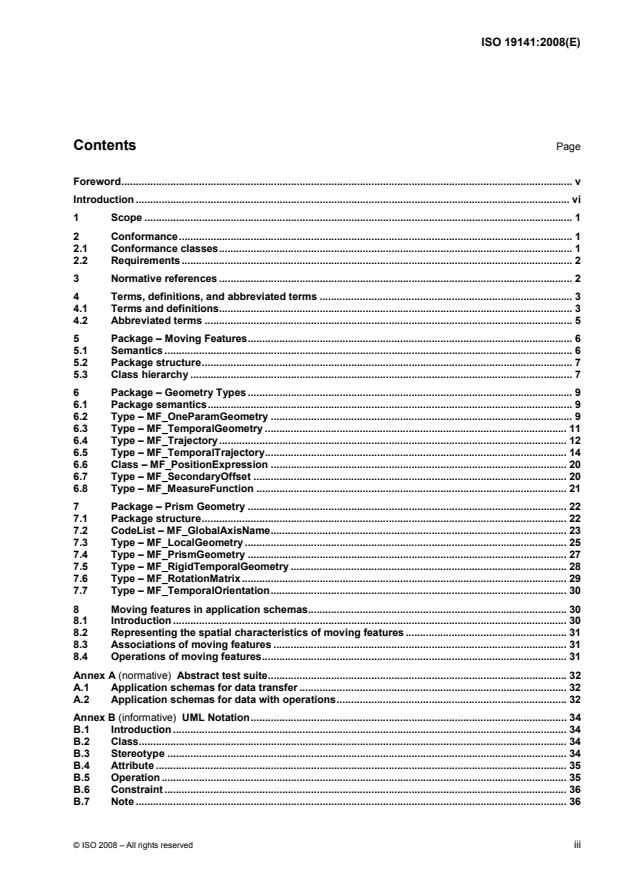
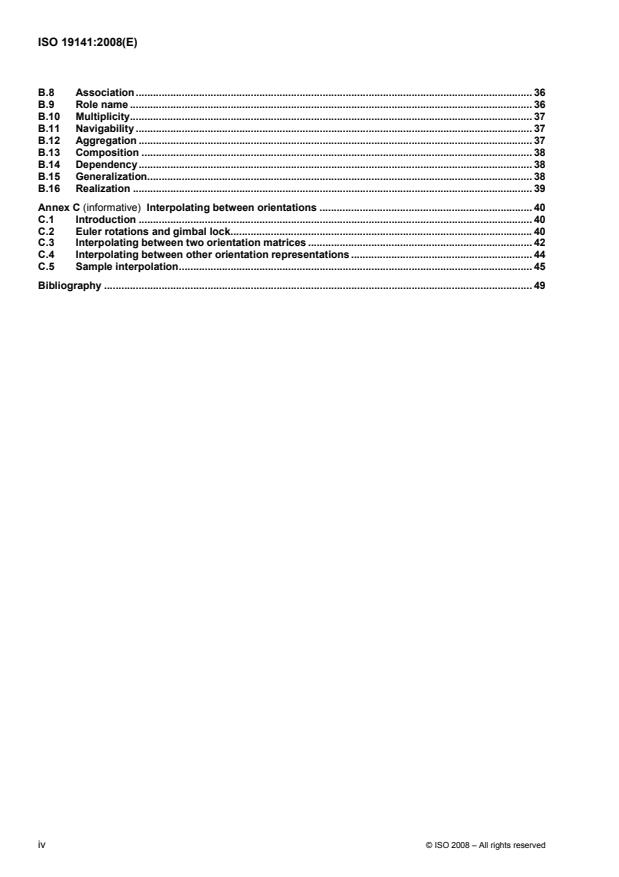
Contents Page
Foreword. v
Introduction . vi
1 Scope . 1
2 Conformance. 1
2.1 Conformance classes. 1
2.2 Requirements . 2
3 Normative references . 2
4 Terms, definitions, and abbreviated terms . 3
4.1 Terms and definitions. 3
4.2 Abbreviated terms . 5
5 Package – Moving Features. 6
5.1 Semantics . 6
5.2 Package structure. 7
5.3 Class hierarchy . 7
6 Package – Geometry Types . 9
6.1 Package semantics. 9
6.2 Type – MF_OneParamGeometry . 9
6.3 Type – MF_TemporalGeometry . 11
6.4 Type – MF_Trajectory. 12
6.5 Type – MF_TemporalTrajectory. 14
6.6 Class – MF_PositionExpression . 20
6.7 Type – MF_SecondaryOffset . 20
6.8 Type – MF_MeasureFunction . 21
7 Package – Prism Geometry . 22
7.1 Package structure. 22
7.2 CodeList – MF_GlobalAxisName. 23
7.3 Type – MF_LocalGeometry . 25
7.4 Type – MF_PrismGeometry . 27
7.5 Type – MF_RigidTemporalGeometry . 28
7.6 Type – MF_RotationMatrix . 29
7.7 Type – MF_TemporalOrientation. 30
8 Moving features in application schemas.30
8.1 Introduction . 30
8.2 Representing the spatial characteristics of moving features . 31
8.3 Associations of moving features . 31
8.4 Operations of moving features. 31
Annex A (normative) Abstract test suite. 32
A.1 Application schemas for data transfer . 32
A.2 Application schemas for data with operations. 32
Annex B (informative) UML Notation. 34
B.1 Introduction . 34
B.2 Class. 34
B.3 Stereotype . 34
B.4 Attribute . 35
B.5 Operation . 35
B.6 Constraint . 36
B.7 Note . 36
B.8 Association. 36
B.9 Role name . 36
B.10 Multiplicity. 37
B.11 Navigability . 37
B.12 Aggregation . 37
B.13 Composition . 38
B.14 Dependency. 38
B.15 Generalization. 38
B.16 Realization . 39
Annex C (informative) Interpolating between orientations . 40
C.1 Introduction . 40
C.2 Euler rotations and gimbal lock. 40
C.3 Interpolating between two orientation matrices . 42
C.4 Interpolating between other orientation representations . 44
C.5 Sample interpolation. 45
Bibliography . 49
iv © ISO 2008 – All rights reserved
Foreword
ISO (the International Organization for Standardization) is a worldwide federation of national standards bodies
(ISO member bodies). The work of preparing International Standards is normally carried out through ISO
technical committees. Each member body interested in a subject for which a technical committee has been
established has the right to be represented on that committee. International organizations, governmental and
non-governmental, in liaison with ISO, also take part in the work. ISO collaborates closely with the
International Electrotechnical Commission (IEC) on all matters of electrotechnical standardization.
International Standards are drafted in accordance with the rules given in the ISO/IEC Directives, Part 2.
The main task of technical committees is to prepare International Standards. Draft International Standards
adopted by the technical committees are circulated to the member bodies for voting. Publication as an
International Standard requires approval by at least 75 % of the member bodies casting a vote.
Attention is drawn to the possibility that some of the elements of this document may be the subject of patent
rights. ISO shall not be held responsible for identifying any or all such patent rights.
ISO 19141 was prepared by Technical Committee ISO/TC 211, Geographic information/Geomatics.
Introduction
This International Standard specifies a conceptual schema that addresses moving features, i.e., features
whose locations change over time. This schema includes classes, attributes, associations and operations that
provide a common conceptual framework that can be implemented to support various application areas that
deal with moving features, including:
⎯ Location Based Services,
⎯ Intelligent Transportation Systems,
⎯ Tracking and navigation (land-based, marine, or space), and
⎯ Modeling and simulation.
The schema specifies mechanisms to describe motion consisting of translation and/or rotation of the feature,
but not including deformation of the feature. The schema is based on the concept of a one parameter set of
geometries that may be viewed as a set of leaves or a set of trajectories, where a leaf represents the
geometry of the moving feature at a particular value of the parameter (e.g., a point in time) and a trajectory is
a curve that represents the path of a point in the geometry of the moving feature as it moves with respect to
the parameter.
vi © ISO 2008 – All rights reserved
INTERNATIONAL STANDARD ISO 19141:2008(E)
Geographic information — Schema for moving features
1 Scope
This International Standard defines a method to describe the geometry of a feature that moves as a rigid body.
Such movement has the following characteristics.
a) The feature moves within any domain composed of spatial objects as specified in ISO 19107.
b) The feature may move along a planned route, but it may deviate from the planned route.
c) Motion may be influenced by physical forces, such as orbital, gravitational, or inertial forces.
d) Motion of a feature may influence or be influenced by other features, for example:
1) The moving feature might follow a predefined route (e.g. road), perhaps part of a network, and might
change routes at known points (e.g. bus stops, waypoints).
2) Two or more moving features may be “pulled” together or pushed apart (e.g. an airplane will be
refuelled during flight, a predator detects and tracks a prey, refugee groups join forces).
3) Two or more moving features may be constrained to maintain a given spatial relationship for some
period (e.g. tractor and trailer, convoy).
This International Standard does not address other types of change to the feature. Examples of changes that
are not adressed include the following:
⎯ The deformation of features.
⎯ The succession of either features or their associations.
⎯ The change of non-spatial attributes of features.
⎯ The feature’s geometric representation cannot be embedded in a geometric complex that contains the
geometric representations of other features, since this would require the other features’ representations to
be updated as the feature moves.
Because this International Standard is concerned with the geometric description of feature movement, it does
not specify a mechanism for describing feature motion in terms of geographic identifiers. This is done, in part,
in ISO 19133.
2 Conformance
2.1 Conformance classes
2.1.1 Introduction
This International Standard specifies four conformance classes (Table 1). They are differentiated on the basis
of two criteria: purpose and level of complexity.
2.1.2 Purpose
This International Standard may be used in support of data transfer. Operations defined for objects are
irrelevant to data transfer, which requires only descriptions of the state of the objects at the time of transfer.
Thus, two conformance classes require only the implementation of attributes and associations of the classes
specified in the schema. The other two conformance classes support the object-oriented implementation of
systems or interfaces; they require implementation of operations as well as implementation of attributes and
associations.
2.1.3 Complexity
Many applications do not need a complete description of the geometry of a feature and its orientation at any
point in time. Their requirements are satisfied by describing the movement of a single reference point on the
feature using its trajectory as specified in Clause 6. One pair of conformance classes supports these simple
applications.
Other applications need knowledge of the positions at each time of all points or a significant subset of the
points on a moving feature. They require the full description provided by the prism geometry specified in
Clause 7.
Table 1 — Conformance classes
Purpose
Complexity
Data Transfer Data with operations
Trajectory A.1.1 A.2.1
Prism Geometry A.1.2 A.2.2
2.2 Requirements
To conform to this International Standard, an application schema shall satisfy the requirements of the Abstract
Test Suite in Annex A.
3 Normative references
The following referenced documents are indispensable for the application of this document. For dated
references, only the edition cited applies. For undated references, the latest edition of the referenced
document (including any amendments) applies.
ISO/TS 19103, Geographic information — Conceptual schema language
ISO 19107, Geographic information — Spatial schema
ISO 19108, Geographic information — Temporal schema
ISO 19109, Geographic information — Rules for application schema
ISO 19133, Geographic information — Location-based services — Tracking and navigation
2 © ISO 2008 – All rights reserved
4 Terms, definitions, and abbreviated terms
4.1 Terms and definitions
For the purposes of this document, the following terms and definitions apply.
4.1.1
base representation
〈moving features〉 representation, using a local origin and local ordinate vectors, of a geometric object at a
given reference time
NOTE 1 A rigid geometric object may undergo translation or rotation, but remains congruent with its base
representation.
NOTE 2 The local origin and ordinate vectors establish an engineering coordinate reference system (ISO 19111), also
called a local frame or a local Euclidean coordinate system.
4.1.2
curve
1-dimensional geometric primitive, representing the continuous image of a line
[ISO 19107:2003, definition 4.23]
NOTE The boundary of a curve is the set of points at either end of the curve. If the curve is a cycle, the two ends are
identical, and the curve (if topologically closed) is considered to not have a boundary. The first point is called the start
point, and the last is the end point. Connectivity of the curve is guaranteed by the "continuous image of a line" clause. A
topological theorem states that a continuous image of a connected set is connected.
4.1.3
design coordinate reference system
engineering coordinate reference system in which the base representation of a moving object is specified
4.1.4
feature
abstraction of real world phenomena
[ISO 19101:2002, definition 4.11]
NOTE A feature may occur as a type or an instance. Feature type or feature instance shall be used when only one is
meant.
4.1.5
feature association
relationship that links instances of one feature type with instances of the same or a different feature type
[ISO 19110:2004, definition 4.2]
NOTE Feature associations include aggregation of features.
4.1.6
feature attribute
characteristic of a feature
[ISO 19101:2002, definition 4.12]
4.1.7
feature operation
operation that every instance of a feature type may perform
[ISO 19110:2004, definition 4.5]
4.1.8
foliation
one parameter set of geometries such that each point in the prism of the set is in one and only one
trajectory and in one and only one leaf
4.1.9
geometric object
spatial object representing a geometric set
[ISO 19107:2003, definition 4.47]
4.1.10
geometric primitive
geometric object representing a single, connected, homogeneous element of space
[ISO 19107:2003, definition 4.48]
NOTE Geometric primitives are non-decomposed objects that present information about geometric configuration.
They include points, curves, surfaces, and solids.
4.1.11
instant
0-dimensional geometric primitive representing position in time
[ISO 19108:2002, definition 4.1.17]
4.1.12
leaf
〈one parameter set of geometries〉 geometry at a particular value of the parameter
4.1.13
location-based service
LBS
service whose return or other property is dependent on the location of the client requesting the service or of
some other thing, object or person
[ISO 19133:2005, definition 4.11]
4.1.14
network
abstract structure consisting of a set of 0-dimensional objects called junctions, and a set of 1-dimensional
objects called links that connect the junctions, each link being associated with a start (origin, source) junction
and end (destination, sink) junction
[ISO 19133:2005, definition 4.17]
NOTE The network is essentially the universe of discourse for the navigation problem. Networks are a variety of 1-
dimensional topological complex. In this light, junction and topological node are synonyms, as are link and directed edge.
4.1.15
one parameter set of geometries
function f from an interval t ∈ [a, b] such that f(t) is a geometry and for each point P ∈ f(a) there is a one
parameter set of points (called the trajectory of P) P(t) : [a, b] →P(t) such that P(t) ∈ f(t)
EXAMPLE A curve C with constructive parameter t is a one parameter set of points c(t).
4.1.16
period
one-dimensional geometric primitive representing extent in time
[ISO 19108:2002, definition 4.1.27]
NOTE A period is bounded by two different temporal positions.
4 © ISO 2008 – All rights reserved
4.1.17
point
0-dimensional geometric primitive, representing a position
[ISO 19107:2003, definition 4.61]
NOTE The boundary of a point is the empty set.
4.1.18
prism
〈one parameter set of geometries〉 set of points in the union of the geometries (or the union of the
trajectories) of a one parameter set of geometries
NOTE This is a generalization of the concept of a geometric prism that is the convex hull of two congruent polygons
in 3D-space. Such polyhedrons can be viewed as a foliation of congruent polygons.
4.1.19
temporal coordinate system
temporal reference system based on an interval scale on which distance is measured as a multiple of a
single unit of time
[ISO 19108:2002, definition 4.1.31]
4.1.20
temporal position
location relative to a temporal reference system
[ISO 19108:2002, definition 4.1.34]
4.1.21
temporal reference system
reference system against which time is measured
[ISO 19108:2002, definition 4.1.35]
4.1.22
trajectory
path of a moving point described by a one parameter set of points
4.1.23
vector
quantity having direction as well as magnitude
[ISO 19123:2005, definition 4.1.43]
4.2 Abbreviated terms
CRS Coordinate Reference System (ISO 19111)
SLERP Spherical Linear Interpolation
LRS Linear Referencing System (ISO 19133)
OCL Object Constraint Language (ISO/IEC 19501)
UML Unified Modelling Language (ISO/IEC 19501)
5 Package – Moving Features
5.1 Semantics
A moving feature can be modelled as a combination of movements. The overall motion can be expressed as
the temporal path or trajectory of some reference point on the object (the “origin”), such as its center of gravity.
Once the origin’s trajectory has been established, the position along the trajectory can be described using a
linear reference system (as defined in ISO 19133). The “parameterization by length” for curves (as defined in
ISO 19107) can be used as a simple linear reference if no other is available. The relationship between time (t)
and measure value (m) can be represented as the graph of the t→ m function in a plane with coordinates
(t, m). This separation of the geometry of the path and the actual “time to position” function allows the moving
feature to be tracked along existing geometry.
Figure 1 illustrates how the concepts of foliation, prism, trajectory, and leaf relate to one another. In this
illustration, a 2D rectangle moves and rotates. Each representation of the rectangle at a given time is a leaf.
The path traced by each corner point of the rectangle (and by each of its other points) is a trajectory. The set
of points contained in all of the leaves, and in all of the trajectories, forms a prism. The set of leaves also
forms a foliation.
Figure 1 — Feature movement as foliation
These two object representations, of the path and the position along that path, give the general position of the
moving feature. The other variable in describing the position of the feature is the rotation about the chosen
reference point. To describe this, a local engineering coordinate system is established using the object
reference point as its origin. The geometry of the feature is described in the engineering coordinate system
and the real-world orientation of the feature is given by mapping of the local coordinate axes to the global
coordinate system (the CRS of the trajectory of the reference point). This can be given as a matrix that maps
the unit vectors of the local coordinate system to vectors in the global CRS.
If the global CRS and local CRS have the same dimension, then each point within the local CRS can be
traced in time through the global CRS by combinations of these various mappings. The map would trace from
time (t) to the measure (m) to a position on the reference point's path using the LRS. Then using the rotation
matrix, the calculated offset from this point gives a direct position in the global CRS.
This means that the ‘prism’ of the moving feature (defined as all the points which part of the feature passes
through) can be viewed (and calculated to whatever degree of accuracy needed) as a bundle of trajectories of
6 © ISO 2008 – All rights reserved
points on the local engineering representation of the feature's geometry. If viewed in a 4 dimensional spatio-
temporal coordinate system, the points on the feature at different times are different points. Then the pre-
image of the prism (points on the trajectories augmented by a time coordinate) is a foliation, meaning that
there is a complete and separate representation of the geometry of the feature for each specific time (called a
“leaf”). These names come from a 3D metaphor of a book, where each page or leaf is a slice of time in the
“folio”.
This might form the basis for an extension of this standard to non-rigid, mutable objects. Each leaf in the 4D
foliation is a separate representation of the object, and by creating methods to describe the change through
time of the shape and form of the feature, the existing machinery in this International Standard can be used to
place those representations in positions with respect to the global coordinate system.
5.2 Package structure
This clause presents a conceptual schema for describing moving features that is specified using the Unified
Modelling Language (UML) [ISO/IEC 19501], following the guidance of ISO/TS 19103. Annex B describes
UML notation as used in this International Standard.
The schema is contained in the UML package Moving Features. Names of classes included in this package
carry the prefix "MF_". The package is subdivided into two leaf packages (Figure 2), Geometry Types and
Prism Geometry. The classes in these two packages are derived from classes included in the Geometry
Package specified in ISO 19107. Classes from the packages Basic Types [ISO/TS 19103], Geometry
[ISO 19107], Temporal Objects, and Temporal Reference System [ISO 19108] are used as data types in the
schema.
5.3 Class hierarchy
The classes of the moving features schema form an inheritance hierarchy that has its source in the classes
GM_Object and GM_Curve specified in ISO 19107 (Figure 3). This allows the subclasses specific to this
schema to be used as feature attributes in compliance with the General Feature Model specified in ISO 19109.
The second level of the hierarchy consists of a set of classes that describe a one-parameter geometry. These
might be used to describe the movement of a feature with respect to any single variable such as pressure,
temperature, or time. The third level specializes these classes to describe motion in time. The classes are
specified fully in Clauses 6 and 7.
<>
Geometry
(from ISO 19107 Spatial Schema)
ISO 19141 Moving Features
(from Logical View)
<>
Geometry Types
Coordinate geometry
(from Geometry)
+ MF_MeasureFunction
+ MF_OneParamGeometry
+ MF_PositionExpression
+ MF_SecondaryOffset
+ MF_TemporalGeometry
<>
+ MF_TemporalTrajectory
Geometry root
+ MF_Trajectory
(from Geometry)
<>
Geometric primitive
(from Geometry)
Prism Geometry
+ MF_GlobalAxisName
+ MF_LocalGeometry
+ MF_PrismGeometry
+ MF_RigidTemporalGeometry
<>
+ MF_RotationMatrix
Temporal Reference System
+ MF_TemporalOrientation
(from ISO 19108 Temporal)
Figure 2 — Moving Feature Package
<> <>
GM_Object GM_Curve
(from Geometry root) (from Geometric primitive)
<> <>
MF_OneParamGeometry MF_Trajectory
<> <>
MF_TemporalGeometry MF_TemporalTrajectory
Figure 3 — Components of the Geometry Types Package
8 © ISO 2008 – All rights reserved
6 Package – Geometry Types
6.1 Package semantics
The Geometry Types package contains seven types. Two classes – MF_OneParamGeometry and
MF_Trajectory – specify one-parameter geometry types based on the geometric objects specified in
ISO 19107 (see Figure 3). Two other classes – MF_TemporalGeometry and MF_TemporalTrajectory –
specialize the first classes in order to specify a one-parameter set of geometries in which the parameter is
time. The other three classes – MF_MeasureFunction, MF_SecondaryOffset and MF_PositionExpression
(Figure 4) – are used to extend the concepts of linear reference systems as defined in ISO 19133. Description
of movement in terms of geographic identifiers is out of scope, and is partly covered in ISO 19133.
<>
LR_LinearReferenceMethod
(from Linear Reference Systems)
+LRM
<>
LR_OffsetReference
(from Linear Reference Systems)
+ centerline
+ edgeOfTravel
+ rightOfWay
+referenceElement 1.*
+ curb
+ edgeOfBerm
+ sidewalkInside
<>
+referenceDomain
+ sidewalkOutside
LR_Element
(from Linear Reference Systems)
{ordered}
+datumMarkers
0.* 0.* +marker
<> <>
0.1
LR_PositionExpression LR_ReferenceMarker
(from Linear Reference Systems) (from Linear Reference Systems)
+referent
<>
MF_PositionExpression 0.*
MF_SecondaryOffset
+secondaryOffset + offsetVector : Vector
<>
+offset
<>
LR_OffsetExpression
MF_MeasureFunction
0.1 (from Linear Reference Systems)
+ graphOfMeasure : GM_Curve[1.*]
+ graphOfOffset[0.1] : GM_Curve[1.*]
+ graphOfSecondaryOffsets [0.1] : GM_Curve[1.*]
+ geometry : LR_Element
+ range : LR_LinearReferenceMethod
Figure 4 — Use of Linear Reference System by Moving Features
6.2 Type – MF_OneParamGeometry
6.2.1 Class semantics
A one parameter set of geometries is a function f from an interval t ∈ [a, b] such that f(t) is a geometry and for
each point P ∈ f(a) there is a one parameter set of points (called the trajectory of P) P(t) : [a, b] → P(t) such
that P(t) ∈ f(t). A leaf of a one parameter set of geometries is the geometry f(t) at a particular value of the
parameter. The set of geometries forms a prism that is the set of points in the union of the geometries (or the
union of the trajectories).
EXAMPLE A curve C with constructive parameter t is a one parameter set of points c(t).
6.2.2 Inheritance from GM_Object
The type "MF_OneParamGeometry" (Figure 5) inherits from the type "GM_Object." As such it shall implement
all attributes, operations and associations inherited from that type as specified in ISO 19107, as well as those
specified in this subclause.
<> <>
GM_Object Number
(from Geometry root) (from Numerics)
<>
MF_OneParamGeometry
+ beginDomain : Number
+ endDomain : Number
+ leafGeometry(p : Number) : GM_Object
+ trajectory(point : DirectPosition, p : Number) : MF_Trajectory
+ prism() : GM_Object
<> <>
MF_Trajectory MF_TemporalGeometry
Figure 5 — Context Diagram: MF_OneParamGeometry
6.2.3 Attribute – beginDomain
The attribute "beginDomain" shall contain the value of the parameter at the start of the domain of the one-
parameter geometry. The data type Number is specified in ISO/TS 19103.
MF_OneParamGeometry::beginDomain: Number
6.2.4 Attribute – endDomain
The attribute "endDomain" shall contain the value of the parameter at the end of the domain of the one-
parameter geometry.
MF_OneParamGeometry::endDomain: Number
6.2.5 Operation – leafGeometry
The operation leafGeometry shall accept a value of the parameter as input and return the leaf associated with
that value as an instance of GM_Object.
MF_OneParamGeometry::leafGeometry( p: Number ): GM_Object
10 © ISO 2008 – All rights reserved
6.2.6 Operation – trajectory
The operation trajectory shall accept the position of a point on a leaf (identified by a value of the parameter p)
of the one parameter set of geometries and return the trajectory of that point.
MF_OneParamGeometry::trajectory( point: DirectPosition, p: Number ):
MF_Trajectory
6.2.7 Operation – prism
The operation prism shall return an instance of GM_Object that is the prism formed by the union of all the
leaves of this instance of MF_OneParamGeometry.
MF_OneParamGeometry::prism( ): GM_Object
6.3 Type – MF_TemporalGeometry
6.3.1 Class semantics
MF_TemporalGeometry (Figure 6) is a specialization of MF_OneParamGeometry in which the parameter is
time as expressed by TM_Coordinate. TM_Coordinate is specified in ISO 19108; it expresses time as a
multiple of a single unit of measure such as year, day, or second.
<>
MF_OneParamGeometry
<>
MF_TemporalGeometry
+ leafGeometry(m : TM_Coordinate) : GM_Object
+ trajectory(point : DirectPosition, p : TM_Coordinate) : MF_TemporalTrajectory
+ startTime() : TM_Coordinate
+ endTime() : TM_Coordinate
+ nearestApproach(object : GM_Object, timeInterval : TM_Period) : Distance, TM_GeometricPrimitive[1.*]
+ intersection(object : GM_Object, timeInterval : TM_Period) : TM_TemporalGeometry
<>
<>
MF_PrismGeometry
MF_TemoporalTrajectory
(from Prism Geometry)
Figure 6 — Context Diagram: MF_TemporalGeometry
6.3.2 Inheritance from MF_OneParamGeometry
The type "MF_TemporalGeometry" inherits from the type "MF_OneParamGeometry". As such it shall
implement all inherited attributes, operations and associations.
6.3.3 Operation – leafGeometry
The operation leafGeometry shall accept a time as input and return the instance of GM_Object that describes
the leaf of the temporal geometry at that time.
MF_TemporalGeometry::leafGeometry( m: TM_Coordinate ): GM_Object
6.3.4 Operation – trajectory
The operation trajectory shall accept the position of a point on a leaf of the MF_TemporalGeometry at a
specified time and return the temporal trajectory of that point.
MF_TemporalGeometry::trajectory( point: DirectPosition, p: TM_Coordinate ):
MF_TemporalTrajectory
6.3.5 Operation – startTime
The operation startTime shall return the time at which the temporal geometry begins. This shall correspond to
the value of "beginDomain".
MF_TemporalGeometry::startTime( ): TM_Coordinate
6.3.6 Operation – endTime
The operation endTime shall return the time at which the temporal geometry ends. This shall correspond to
the value of "endDomain".
MF_TemporalGeometry::endTime( ): TM_Coordinate
6.3.7 Operation – nearestApproach
The operation "nearestApproach" shall return the distance and time of the nearest approach of the temporal
geometry to any other geometric object. If the other geometric object is also a temporal geometry, then this
operation is symmetric. The parameter "timeInterval" shall restrict the search to a particular period of time.
MF_TemporalGeometry::nearestApproach( object: GM_Object, timeInterval:
TM_Period ): Distance, TM_GeometricPrimitive[1.*]
6.3.8 Operation – intersection
The operation "intersection" shall return the temporal geometry of the intersection of the temporal geometry to
any other geometric object. If the other geometric object is also a temporal geometry, then this operation is
symmetric. The parameter "timeInterval" shall restrict the search to a particular period of time.
MF_TemporalGeometry::intersection( object: GM_Object, timeInterval:
TM_Period ): MF_TemporalGeometry
6.4 Type – MF_Trajectory
6.4.1 Class semantics
MF_Trajectory (Figure 7) describes a one-parameter geometry whose cross section is a point. The class is
subject to the constraint that the position of the GM_Point returned by the leafGeometry operation equals the
position returned by the leaf operation for the same value of the parameter m. This is expressed by the OCL:
{leafGeometry(m).position = leaf(m)}
The attributes of the class are derived using inherited operations as well as those specified for the class.
12 © ISO 2008 – All rights reserved
<>
<>
GM_Curve
MF_OneParamGeometry
(from Geometric primitive)
<>
MF_Trajectory
/+ pathGeometry : GM_Curve
/+ graphParameterToPoint : GM_Curve[1.*]
/+ graphParameterToMeasure : Set
+ leaf(p : Number) : DirectPosition
+ leafGeometry(p : Number) : GM_Point
+ prism() : GM_Curve
+ parameterToMeasure() : Set
+ positionAtParameter(p: Number) : MF_PositionExpression
<> <>
MF_TemporalTrajectory MF_MeasureFunction
Figure 7 — Context Diagram: MF_Trajectory
6.4.2 Inheritance from MF_OneParamGeometry
The type "MF_Trajectory" inherits from the type "MF_OneParamGeometry". As such it shall implement all
inherited attributes, operations and associations.
6.4.3 Inheritance from GM_Curve
The type "MF_Trajectory" inherits from the type "GM_Curve". As such it shall implement all inherited attributes,
operations and associations. GM_Curve is described using both spatial and temporal coordinates.
6.4.4 Attribute – pathGeometry
The derived attribute "pathGeometry" of a trajectory is a spatial curve that is the projection of the trajectory
over time. No relationship to time or path orientation remains. Repeated traversal of the same place at
different times is not reflected in the resultant geometry.
MF_Trajectory::pathGeometry: GM_Curve
6.4.5 Attribute – graphParameterToPoint
The derived attribute "graphParameterToPoint" is the graph of the parameter to point function, expressed as a
set of curves in a Euclidean space. Each curve is in 2D Euclidean space mapping the parameter of the
trajectory to the "pathGeometry" curve’s “parameterization by arc length” as defined in ISO 19107. Thus, the
Euclidean space of the resultant graph curves is the set of points (p, s) where "p" is the parameter of the
trajectory and "s" is the parameter of the underlying "pathGeometry".
MF_Trajectory::graphParameterToPoint: GM_Curve[1.*]
6.4.6 Attribute – graphParameterToMeasure
The derived attribute "graphParameterToMeasure" is the graph of the parameter to point function expressed
as a set of curves, each part of an MF_MeasureFunction (6.8), in a Euclidean space. Each curve is in 2D
Euclidean space mapping the parameter of the trajectory to the "pathGeometry" curves’ linear reference
measure as defined in ISO 19133.
MF_Trajectory::graphParameterToMeasure: Set
6.4.7 Operation – leaf
The operation "leaf" shall accept a value of the parameter as input and return the DirectPosition (from
ISO 19107) through which the trajectory passes at that value of the trajectory parameter.
MF_Trajectory::leaf( p: Number ): DirectPosition
6.4.8 Operation – leafGeometry
The operation "leafGeometry" shall accept a value of the parameter as input and return the GM_Point that is
at that position on the trajectory.
MF_Trajectory::leafGeometry( p: Number ): GM_Point
6.4.9 Operation – prism
The operation "prism" shall return the instance of GM_Curve that corresponds to the geometry of the
trajectory.
MF_Trajectory::prism( ): GM_Curve
6.4.10 Operation – parameterToMeasure
The operation "parameterToMeasure" shall return an instance of GM_Curve that describes the relationship
between the parameter and measure of one or more specified LRS’s along the trajectory, using the type
MF_MeasureFunction (6.8). Each GM_Curve's coordinate reference system is the Cartesian product of the
trajectory parameter and the measure associated to its containing MF_MeasureFunction.
MF_Trajectory::parameterToMeasure( ): Set
6.4.11 Operation – positionAtParameter
The operation "positionAtParameter" shall return an instance of MF_PositionExpression that describes the
position of the moving feature along the trajectory. The use of MF_PositionExpression allows the trajectory to
following existing geometry (such as a road centreline) and use offset to specify variations in any direction.
This allows the position expression to carry information about lanes in the case of land vehicles, or a
watercraft’s attitude or drift in the case of marine vehicles.
MF_Trajectory::positionAtParameter( p: Number ): MF_PositionExpression
6.5 Type – MF_TemporalTrajectory
6.5.1 Class semantics
An instance of MF_TemporalTrajectory (Figure 8) is a trajectory whose parameter is time.
14 © ISO 2008 – All rights reserved
6.5.2 Inheritance from MF_Trajectory
The type "MF_TemporalTrajectory" inherits from the type "MF_Trajectory". As such it shall implement all
inherited attributes, operations and associations.
6.5.3 Inheritance from MF_TemporalGeometry
The type "MF_TemporalTrajectory" inherits from the type "MF_TemporalGeometry". As such it shall
implement all inherited attributes, operations and associations.
6.5.4 Attribute – beginDomain
The attribute "beginDomain" shall contain the value of the time parameter at the start of the domain of the
one-parameter geometry.
MF_TemporalTrajectory::beginDomain: TM_Coordinate
NOTE This overrides the same attribute in MF_OneParamGeometry (6.2.3). Normally this would require
TM_Coordinate to be a subtype of Number, but TM_Coordinate can be expressed as a measure (which is a number, with
either an implicit or explicit unit). The specification of a particular temporal coordinate system allows a purely numeric
representation for TM_Coordinate.
6.5.5 Attribute – endDomain
The attribute "endDomain" shall contain the value of the time parameter at the end of the domain for the
trajectory.
MF_TemporalTrajectory::endDomain: TM_Coordinate
NOTE This overrides the same att
...
NORME ISO
INTERNATIONALE 19141
Première édition
2008-06-01
Information géographique — Schéma des
entités mobiles
Geographic information — Schema for moving features
Numéro de référence
©
ISO 2008
PDF – Exonération de responsabilité
Le présent fichier PDF peut contenir des polices de caractères intégrées. Conformément aux conditions de licence d'Adobe, ce fichier
peut être imprimé ou visualisé, mais ne doit pas être modifié à moins que l'ordinateur employé à cet effet ne bénéficie d'une licence
autorisant l'utilisation de ces polices et que celles-ci y soient installées. Lors du téléchargement de ce fichier, les parties concernées
acceptent de fait la responsabilité de ne pas enfreindre les conditions de licence d'Adobe. Le Secrétariat central de l'ISO décline toute
responsabilité en la matière.
Adobe est une marque déposée d'Adobe Systems Incorporated.
Les détails relatifs aux produits logiciels utilisés pour la création du présent fichier PDF sont disponibles dans la rubrique General Info
du fichier; les paramètres de création PDF ont été optimisés pour l'impression. Toutes les mesures ont été prises pour garantir
l'exploitation de ce fichier par les comités membres de l'ISO. Dans le cas peu probable où surviendrait un problème d'utilisation,
veuillez en informer le Secrétariat central à l'adresse donnée ci-dessous.
DOCUMENT PROTÉGÉ PAR COPYRIGHT
© ISO 2008
Droits de reproduction réservés. Sauf prescription différente, aucune partie de cette publication ne peut être reproduite ni utilisée sous
quelque forme que ce soit et par aucun procédé, électronique ou mécanique, y compris la photocopie et les microfilms, sans l'accord écrit
de l'ISO à l'adresse ci-après ou du comité membre de l'ISO dans le pays du demandeur.
ISO copyright office
Case postale 56 • CH-1211 Geneva 20
Tel. + 41 22 749 01 11
Fax + 41 22 749 09 47
E-mail copyright@iso.org
Web www.iso.org
Version française parue en 2009
Publié en Suisse
ii © ISO 2008 – Tous droits réservés
Sommaire Page
Avant-propos. iv
Introduction . v
1 Domaine d'application. 1
2 Conformité. 2
2.1 Classes de conformité. 2
2.2 Exigences . 2
3 Références normatives . 2
4 Termes, définitions et abréviations . 3
4.1 Termes et définitions. 3
4.2 Termes abrégés . 6
5 Package — Entités mobiles . 6
5.1 Sémantique. 6
5.2 Structure du package . 7
5.3 Hiérarchie des classes . 7
6 Package – Types de géométrie . 9
6.1 Sémantique du package. 9
6.2 Type – MF_OneParamGeometry . 10
6.3 Type – MF_TemporalGeometry . 11
6.4 Type – MF_Trajectory. 13
6.5 Type – MF_TemporalTrajectory. 15
6.6 Classe – MF_PositionExpression . 20
6.7 Type – MF_SecondaryOffset . 20
6.8 Type – MF_MeasureFunction . 21
7 Package – Géométrie de prisme . 22
7.1 Structure du package . 22
7.2 Liste des codes – MF_GlobalAxisName. 23
7.3 Type – MF_LocalGeometry . 25
7.4 Type – MF_PrismGeometry . 27
7.5 Type – MF_RigidTemporalGeometry . 28
7.6 Type – MF_RotationMatrix . 29
7.7 Type – MF_TemporalOrientation. 30
8 Entités mobiles dans les schémas d'application . 31
8.1 Introduction . 31
8.2 Représentation des caractéristiques spatiales des entités mobiles. 31
8.3 Associations des entités mobiles. 31
8.4 Opérations des entités mobiles . 31
Annexe A (normative) Suite d'essais abstraite . 32
Annexe B (informative) Notation UML. 34
Annexe C (informative) Interpolation entre les orientations. 40
Bibliographie . 49
Avant-propos
L'ISO (Organisation internationale de normalisation) est une fédération mondiale d'organismes nationaux de
normalisation (comités membres de l'ISO). L'élaboration des Normes internationales est en général confiée
aux comités techniques de l'ISO. Chaque comité membre intéressé par une étude a le droit de faire partie du
comité technique créé à cet effet. Les organisations internationales, gouvernementales et non
gouvernementales, en liaison avec l'ISO participent également aux travaux. L'ISO collabore étroitement avec
la Commission électrotechnique internationale (CEI) en ce qui concerne la normalisation électrotechnique.
Les Normes internationales sont rédigées conformément aux règles données dans les Directives ISO/CEI,
Partie 2.
La tâche principale des comités techniques est d'élaborer les Normes internationales. Les projets de Normes
internationales adoptés par les comités techniques sont soumis aux comités membres pour vote. Leur
publication comme Normes internationales requiert l'approbation de 75 % au moins des comités membres
votants.
L'attention est appelée sur le fait que certains des éléments du présent document peuvent faire l'objet de
droits de propriété intellectuelle ou de droits analogues. L'ISO ne saurait être tenue pour responsable de ne
pas avoir identifié de tels droits de propriété et averti de leur existence.
L'ISO 19141 a été élaborée par le comité technique ISO/TC 211, Information géographique/Géomatique.
iv © ISO 2008 – Tous droits réservés
Introduction
La présente Norme internationale spécifie un schéma conceptuel qui traite des entités mobiles, c'est-à-dire
des entités dont les localisations changent avec le temps. Ce schéma comporte des classes, des attributs,
des associations et des modes opératoires fournissant un cadre théorique commun qui peut être mis en
œuvre pour prendre en charge divers champs d'application traitant des entités mobiles, notamment
⎯ Location Based Services (services basés sur la localisation),
⎯ Intelligent Transportation Systems (systèmes intelligents de transport),
⎯ Tracking and navigation (suivi et navigation) (terre, mer, espace), et
⎯ Modeling and simulation (modélisation et simulation).
Le schéma spécifie des mécanismes permettant de décrire le mouvement de translation et/ou de rotation de
l'entité, sans tenir compte de la déformation de l'entité. Le schéma s'appuie sur le concept d'un ensemble de
paramètres géométriques qui peut être considéré comme un ensemble de feuilles ou de trajectoires, où une
feuille représente la géométrie de l'entité mobile à une valeur particulière du paramètre (par exemple un
instant donné) et où une trajectoire est une courbe représentant le parcours d'un point dans la géométrie de
l'entité mobile dans son déplacement par rapport au paramètre.
NORME INTERNATIONALE ISO 19141:2008(F)
Information géographique — Schéma des entités mobiles
1 Domaine d'application
La présente Norme internationale définit une méthode permettant de décrire la géométrie d'une entité mobile
se déplaçant comme un corps rigide. Ce type de déplacement présente les caractéristiques suivantes.
a) L'entité se déplace à l'intérieur d'un domaine composé d'objets spatiaux conformément à l'ISO 19107.
b) L'entité peut se déplacer le long d'un itinéraire planifié, mais elle peut s'en écarter.
c) Le mouvement peut être influencé par les forces physiques, telles que les forces orbitale, de gravitation
ou d'inertie.
d) Le mouvement d'une entité peut influencer d'autres entités ou être influencé par elles, par exemple
comme suit:
1) L'entité mobile peut suivre un itinéraire prédéfini (tel qu'une route), pouvant faire partie d'un réseau,
et peut modifier les itinéraires au niveau de points clés (par exemple arrêts de bus, points de
cheminement).
2) Deux ou plusieurs entités mobiles peuvent être «tirées» ensemble ou poussées séparément (par
exemple un avion ravitaillé en vol, un prédateur ayant repéré et suivant sa proie, des groupes de
réfugiés unissant leurs forces).
3) Deux entités mobiles ou davantage peuvent être contraintes de conserver une relation spatiale
donnée pendant une certaine période (par exemple tracteur et semi-remorque, convoi).
La présente Norme internationale ne régit pas d'autres types de changement en matière d'entité. Les
changements non abordés sont par exemple les suivants:
⎯ La déformation des entités.
⎯ La succession de chaque entité ou leurs associations.
⎯ La modification des attributs non spatiaux des entités.
⎯ La représentation géométrique de l'entité ne peut pas être présente dans un complexe géométrique
comportant des représentations géométriques d'autres entités, car cela impliquerait une mise à jour des
représentations des autres entités en même temps que le déplacement de l'entité.
Étant donné que la présente Norme internationale couvre la description géométrique du déplacement de
l'entité, elle ne spécifie pas un mécanisme consistant à décrire le mouvement des entités en termes
d'identificateurs géographiques. Ce mécanisme est présenté en partie dans l'ISO 19133.
2 Conformité
2.1 Classes de conformité
2.1.1 Introduction
La présente Norme internationale spécifie quatre classes de conformité (Tableau 1). Elles se distinguent sur
la base des critères suivants: objectif et niveau de complexité.
2.1.2 Objectif
La présente Norme internationale peut être utilisée dans le cadre de la prise en charge du transfert de
données. Les opérations définies pour les objets ne revêtent aucune importance pour le transfert de données,
qui exige uniquement des descriptions de l'état des objets au moment du transfert. Par conséquent, deux
classes de conformité exigent uniquement la mise en œuvre d'attributs et d'associations des classes
spécifiées dans le schéma. Les deux autres classes de conformité prennent en charge la mise en œuvre,
orientée objet, de systèmes ou d'interfaces; ces classes exigent la mise en œuvre d'opérations ainsi que la
mise en œuvre d'attributs et d'associations.
2.1.3 Complexité
De nombreuses applications n'ont pas besoin d'une description intégrale de la géométrie d'une entité, ni de
son orientation à tout instant. Leurs exigences sont remplies par la description du mouvement d'un seul point
de référence sur l'entité par le biais de sa trajectoire spécifiée à l'Article 6. Une paire de classes de conformité
traite de ces applications simples.
D'autres applications ont besoin de connaître les positions à tout moment de tous les points ou un sous-
ensemble important des points présents sur une entité mobile. Elles exigent la description complète fournie
par la géométrie de prisme spécifiée à l'Article 7.
Tableau 1 — Classes de conformité
Objectif
Complexité
Transfert de données Données avec opérations
Trajectoire A.1.1 A.2.1
Géométrie de prisme A.1.2 A.2.2
2.2 Exigences
Dans le respect de la présente Norme internationale, un schéma d'application doit répondre aux exigences de
la suite d'essais abstraite décrite dans l'Annexe A.
3 Références normatives
Les documents de référence suivants sont indispensables pour l'application du présent document. Pour les
références datées, seule l'édition citée s'applique. Pour les références non datées, la dernière édition du
document de référence s'applique (y compris les éventuels amendements).
ISO/TS 19103, Information géographique — Schéma de langage conceptuel
ISO 19107, Information géographique — Schéma spatial
2 © ISO 2008 – Tous droits réservés
ISO 19108, Information géographique — Schéma temporel
ISO 19109, Information géographique — Règles de schéma d'application
ISO 19133, Information géographique — Services basés sur la localisation — Suivi et navigation
4 Termes, définitions et abréviations
4.1 Termes et définitions
Pour les besoins du présent document, les termes et définitions suivants s'appliquent.
4.1.1
représentation de base
〈entités mobiles〉 représentation, utilisant des vecteurs d'ordonnée et d'origine locales, d'un objet
géométrique à un moment donné précis
NOTE 1 Un objet géométrique rigide peut subir une translation ou une rotation, néanmoins il reste conforme à sa
représentation de base.
NOTE 2 Les vecteurs d'ordonnée et d'origine locales mettent au point un système de coordonnées techniques de
référence (ISO 19111), également appelé système de coordonnées locales euclidien ou système de coordonnées de
cadre local.
4.1.2
courbe
primitive géométrique unidimensionnelle, représentant l'image continue d'une ligne
[ISO 19107:2003, définition 4.23]
NOTE La frontière d'une courbe correspond à l'ensemble des points à chaque extrémité de la courbe. Si la courbe
est un cycle, les deux extrémité sont identiques, et la courbe (si elle est topologiquement fermée) est considérée comme
n'ayant pas de frontière. Le premier point est appelé point de départ et le dernier point, point limite. La connectivité de la
courbe est assurée par l'article «image continue d'une ligne». Un théorème topologique établit qu'une image continue d'un
ensemble connecté est connectée.
4.1.3
système de référence par coordonnées de conception
système de coordonnées techniques de référence au sein duquel la représentation de base d'un objet
mobile est spécifiée
4.1.4
entité
abstraction des phénomènes du monde réel
[ISO 19101:2002, définition 4,11]
NOTE Une entité peut survenir en tant que type ou instance. Le type ou l'instance d'entité doit être utilisé lorsque
seul l'un des deux est prévu.
4.1.5
association d'éléments
relation qui lie les instances d'un type d'entité aux instances d'un type d'entité identique ou différent
[ISO 19110:2005, définition 4.2]
NOTE Les associations d'éléments comprennent l'ajout d'entités.
4.1.6
attribut de l'entité
propriété d'une entité
[ISO 19101:2002, définition 4.12]
4.1.7
opération d'entité
opération que toute instance d'un type d'entité peut réaliser
[ISO 19110:2005, définition 4.5]
4.1.8
foliation
ensemble de paramètres de géométries tel que chaque point du prisme de l'ensemble est compris dans
une et seulement une trajectoire ainsi que dans une seule feuille
4.1.9
objet géométrique
objet spatial représentant un ensemble géométrique
[ISO 19107:2003, définition 4.47]
4.1.10
primitive géométrique
objet géométrique représentant un élément de l'espace, défini comme unique, connexe et homogène
[ISO 19107:2003, définition 4.48]
NOTE Les primitives géométriques sont des objets non décomposés présentant des informations sur la configuration
géométrique. Elles comportent des points, des courbes, des surfaces et des solides.
4.1.11
instant
primitive géométrique non dimensionnelle représentant la position dans le temps
[ISO 19108:2002, définition 4.1.17]
4.1.12
feuille
〈ensemble de paramètres géométriques〉 géométrie à une valeur particulière du paramètre
4.1.13
service basé sur la localisation
LBS
service dont la prestation ou toute autre propriété dépend de la localisation du client au moment où il
demande le service ou de tout autre élément, objet ou personne
[ISO 19133:2005, définition 4.11]
4.1.14
réseau
structure abstraite, composée d'un ensemble d'objets non dimensionnels, appelés jonctions, et d'un ensemble
d'objets unidimensionnels, appelés liens, assurant la connexion entre les jonctions; chaque lien est associé à
une jonction de départ (origine, source) et à une jonction finale (destination, réception)
[ISO 19133:2005, définition 4.17]
NOTE Le réseau est au centre des débats concernant le problème de navigation. Les réseaux constituent un
ensemble de complexes topologiques unidimensionnels. Sous cet angle, les termes jonction et nœud topologique sont
synonymes, à l'instar des termes lien et arête dirigée.
4 © ISO 2008 – Tous droits réservés
4.1.15
ensemble de paramètres géométriques
fonction f issue d'un intervalle t ∈ [a, b] de sorte que f(t) soit une géométrie et que, pour chaque point P ∈ f(a),
il existe un ensemble de paramètres de points (appelé trajectoire de P), P(t): [a, b] →P(t), tel que P(t) ∈ f(t)
EXEMPLE Une courbe C avec des paramètres t constructifs est un ensemble de paramètres de points c(t).
4.1.16
période
primitive géométrique unidimensionnelle représentant la position dans le temps
[ISO 19108:2002, définition 4.1.27]
NOTE Une période est délimitée par deux positions temporelles différentes.
4.1.17
point
primitive géométrique non dimensionnelle, représentant une position
[ISO 19107:2003, définition 4.61]
NOTE La frontière d'un point correspond à un ensemble vide.
4.1.18
prisme
〈ensemble de paramètres de géométries〉 ensemble de points dans l'union des géométries (ou l'union des
trajectoires) d'un ensemble de paramètres de géométries
NOTE Il s'agit d'une généralisation du concept d'un prisme géométrique qui est l'enveloppe convexe de deux
polygones isométriques dans un espace 3D. De tels polyèdres peuvent être considérés comme une foliation de
polygones isométriques.
4.1.19
système de coordonnées temporelles
système de référence temporel fondé sur une échelle d'intervalles sur laquelle la distance est mesurée par
un multiple d'une seule unité de durée
[ISO 19108:2002, définition 4.1.31]
4.1.20
position temporelle
localisation par rapport à un système de référence temporel
[ISO 19108:2002, définition 4.1.34]
4.1.21
système de référence temporel
système de référence par lequel le temps est mesuré
[ISO 19108:2002, définition 4.1.35]
4.1.22
trajectoire
parcours d'un point mobile décrit par un ensemble de paramètres de points
4.1.23
vecteur
quantité présentant aussi bien une direction qu'une amplitude
[ISO 19123:2005, définition 4.1.43]
4.2 Termes abrégés
CRS Système de référence par coordonnées (ISO 19111)
SLERP Interpolation linéaire sphérique
LRS Système de référence linéaire (ISO 19133)
OCL Langage de contrainte d'objet (ISO/CEI 19501)
UML Langage de modélisation unifié (ISO/CEI 19501)
5 Package — Entités mobiles
5.1 Sémantique
Une entité mobile peut être modélisée par une combinaison de mouvements. Le mouvement global peut être
exprimé par le parcours temporel ou la trajectoire d'un certain point de référence sur l'objet (l'«origine»), tel
que son centre de gravité. Dès que la trajectoire de l'origine a été établie, la position le long de la trajectoire
peut être décrite à l'aide d'un système de référence linéaire (défini dans l'ISO 19133). Le «paramétrage par
longueur» pour les courbes (défini dans l'ISO 19107) peut être utilisé par une référence linéaire simple si
aucune autre référence n'est disponible. La relation entre le temps (t) et la valeur mesurée (m) peut être
représentée par le graphique de la fonction t→ m dans un plan avec des coordonnées (t, m). Cette séparation
de la géométrie du parcours et la fonction réelle «temps vers position» permettent à l'entité mobile d'être
suivie le long de la géométrie existante.
La Figure 1 illustre les relations entre les concepts de foliation, de prisme, de trajectoire et de feuille. Dans
cette illustration, un rectangle 2D se déplace et tourne. Chaque représentation du rectangle à un moment
donné est une feuille. Le parcours tracé par chaque point anguleux du rectangle (et par chacun de ses autres
points) est une trajectoire. L'ensemble de points contenus dans toutes les feuilles, ainsi que dans toutes les
trajectoires, forment un prisme. L'ensemble de feuilles forme également une foliation.
Figure 1 — Déplacement de l'entité comme foliation
6 © ISO 2008 – Tous droits réservés
Ces deux représentations objet, du parcours et de la position le long de ce parcours, fournissent la position
générale de l'entité mobile. L'autre variable dans la description de la position de l'entité est la rotation par
rapport au point de référence choisi. Pour le décrire, un système de coordonnées techniques locales est établi
à l'aide du point de référence objet comme son origine. La géométrie de l'entité est décrite dans le système de
coordonnées techniques et l'orientation de l'entité par rapport au monde réel est établie grâce à la
correspondance des axes de coordonnées locaux et du système de coordonnées globales (CRS de la
trajectoire du point de référence). La géométrie peut être donnée par une matrice établissant une
correspondance entre les vecteurs unitaires du système de coordonnées local et les vecteurs compris dans
l'ensemble du CRS.
Si les CRS local et global ont la même dimension, chaque point au sein du CRS local peut être tracé dans le
temps à travers le CRS global, à l'aide de combinaisons des différentes correspondances. La correspondance
s'étendrait du temps (t) jusqu'à la mesure (m) à une position sur le parcours du point de référence à l'aide du
LRS. Ainsi, à l'aide de la matrice de rotation, le décalage mesuré à partir de ce point indique une position
directe dans le CRS global.
Cela signifie que le «prisme» d'une entité mobile (défini par tous les points par lesquels passe une partie de
l'entité) peut donc être représenté (et calculé quel que soit le degré de précision exigé) par un ensemble de
trajectoires des points sur la représentation technique locale de la géométrie de l'entité. S'ils sont observés
dans un système de coordonnées spatio-temporel en 4 dimensions, les points sur l'entité à des moments
différents sont des points différents. En conséquence, l'aperçu du prisme (points sur les trajectoires complétés
par une coordonnée de temps) est une foliation, c'est-à-dire qu'il existe une représentation complète et
séparée de la géométrie de l'entité pour chaque temps donné (appelée «feuille»). Ces noms proviennent
d'une métaphore 3D d'un livre, où chaque page ou feuille est une période de temps dans le «folio».
Cela peut prendre la forme d'une base pour une extension de la présente Norme internationale concernant
les objets souples altérables. Chaque feuille de la foliation en 4D est une représentation séparée de l'objet; en
mettant au point des méthodes de description du changement à travers le temps de la forme et du contour de
l'entité, le mécanisme existant dans la présente Norme internationale peut être utilisé pour mettre ces
représentations en position par rapport au système de coordonnées globales.
5.2 Structure du package
Le présent article présente un schéma conceptuel décrivant les entités mobiles spécifié au moyen du langage
de modélisation unifiée (UML) [ISO/CEI 19501], en s'appuyant sur les indications de l'ISO/TS 19103.
L'Annexe B décrit la notation UML utilisée dans la présente Norme internationale.
Ce schéma est présent dans les entités mobiles du package UML. Les noms de classes compris dans ce
package portent le préfixe «MF_». Le package est subdivisé en deux sous-packages (Figure 2), Types de
géométrie et Géométrie de prisme. Les classes de ces deux packages sont dérivées des classes comprises
dans le package concernant la géométrie spécifiée dans l'ISO 19107. Les classes issues des packages types
de base [ISO/TS 19103], géométrie [ISO 19107], objets temporels, et système de référence temporelle
[ISO 19108] sont utilisées comme types de données dans le schéma.
5.3 Hiérarchie des classes
Les classes du schéma des entités mobiles constituent une hiérarchie d'héritage dont la source provient des
classes GM_Object et GM_Curve spécifiées dans l'ISO 19107 (Figure 3). Ainsi, les sous-classes propres à ce
schéma peuvent être utilisées comme attributs d'entité conformes au modèle sémantique indiqué dans
l'ISO 19109. Le deuxième niveau de la hiérarchie se compose d'un ensemble de classes décrivant une
géométrie à un paramètre. On peut s'en servir pour décrire le mouvement d'une entité par rapport à toute
variable individuelle telle que la pression, la température ou le temps. Le troisième niveau spécialise ces
classes afin de décrire le déplacement dans le temps. Les classes sont entièrement spécifiées dans les
Articles 6 et 7.
Géométrie
<>
(issu du schéma spatial de l’ISO 19107)
Entités mobiles de l’ISO 19141
(issues de la vue logique)
<>
Géométrie des coordonnées
Geometry Types
(issu de la géométrie)
+ MF_MeasureFunction
+ MF_OneParamGeometry
+ MF_PositionExpression
+ MF_SecondaryOffset
+ MF_TemporalGeometry
<>
+ MF_TemporalTrajectory
Racine de géométrie
(issu de la géométrie)
+ MF_Trajectory
<>
Primitive géométrique
(issu de la géométrie)
Prism Geometry
+ MF_GlobalAxisName
+ MF_LocalGeometry
+ MF_PrismGeometry
+ MF_RigidTemporalGeometry
<>
+ MF_RotationMatrix
Sytème de référence temporel
+ MF_TemporalOrientation
(issu de l’ISO 19108 temporelle)
Figure 2 — Package d'entité mobile
<> <>
GM_Object GM_Curve
(issu de la racine de la géométrie) (issu de la géométrie primitive)
<> <>
MF_OneParamGeometry MF_Trajectory
<> <>
MF_TemporalGeometry MF_TemporalTrajectory
Figure 3 — Composants du package des types de géométrie
8 © ISO 2008 – Tous droits réservés
6 Package – Types de géométrie
6.1 Sémantique du package
Le package types de géométries englobe sept types. Deux classes – MF_OneParamGeometry et
MF_Trajectory – spécifient des types de géométrie à un paramètre basés sur les objets géométriques
indiqués dans l'ISO 19107 (voir la Figure 3). Deux autres classes – MF_TemporalGeometry et
MF_TemporalTrajectory – spécialisent les premières classes afin d'indiquer un ensemble de paramètres
géométriques unique dans lequel le paramètre est le temps. Les trois autres classes – MF_MeasureFunction,
MF_SecondaryOffset et MF_PositionExpression (Figure 4) – sont utilisées pour étendre les concepts de
systèmes de référence linéaire spécifiés dans l'ISO 19133. La description du mouvement en termes
d'identifiants géographiques n'entre pas dans le domaine d'application, mais est en partie traitée dans
l'ISO 19133.
<>
LR_LinearReferenceMethod
(issu des systèmes de référence linéaire)
+LRM
<>
LR_OffsetReference
(issu des systèmes de référence linéaire)
+ centerline
+ edgeOfTravel
+ rightOfWay
+referenceElement 1.*
+ curb
+ edgeOfBerm
+ sidewalkInside
<>
+referenceDomain
+ sidewalkOutside
LR_Element
(issu des systèmes de référence linéaire)
{ordered}
+datumMarkers
0.* 0.* +marker
<> <>
0.1
LR_PositionExpression LR_ReferenceMarker
(issu des systèmes de référence linéaire) (issu des systèmes de référence linéaire)
+referent
<>
MF_PositionExpression 0.*
MF_SecondaryOffset
+secondaryOffset + offsetVector : Vector
+offset <>
<>
LR_OffsetExpression
MF_MeasureFunction
(issu des systèmes de référence linéaire)
0.1
+ graphOfMeasure : GM_Curve[1.*]
+ graphOfOffset[0.1] : GM_Curve[1.*]
+ graphOfSecondaryOffsets [0.1] : GM_Curve[1.*]
+ geometry : LR_Element
+ range : LR_LinearReferenceMethod
Figure 4 — Utilisation du système de référence linéaire par les entités mobiles
6.2 Type – MF_OneParamGeometry
6.2.1 Sémantique de classe
Un ensemble de paramètres de géométries est la fonction f issue d'un intervalle t ∈ [a, b] de sorte que f(t) soit
une géométrie et que, pour chaque point P ∈ f(a), il existe un ensemble de points à un seul paramètre (appelé
trajectoire de P) P(t) : [a, b] → P(t), tel que P(t) ∈ f(t). Une feuille d'un ensemble de paramètres de géométries
est la géométrie f(t) à une valeur particulière du paramètre. L'ensemble de géométries forme un prisme qui
est l'ensemble des points dans l'union des géométries (ou l'union des trajectoires).
EXEMPLE Une courbe C avec des paramètres t constructifs est un ensemble de paramètres de points c(t).
6.2.2 Héritage issu de GM_Object
Le type «MF_OneParamGeometry» (Figure 5) hérite du type «GM_Object». En tant que tel, il doit mettre en
œuvre tous les attributs, les opérations et les associations hérités de ce type comme indiqué dans
l'ISO 19107, ainsi que ceux spécifiés dans ce paragraphe.
<> <>
GM_Object Number
(issu de la racine de la géométrie) (issu des chiffres)
<>
MF_OneParamGeometry
+ beginDomain : Number
+ endDomain : Number
+ leafGeometry(p : Number) : GM_Object
+ trajectory(point : DirectPosition, p : Number) : MF_Trajectory
+ prism() : GM_Object
<> <>
MF_Trajectory MF_TemporalGeometry
Figure 5 — Diagramme de contexte: MF_OneParamGeometry
6.2.3 Attribut – beginDomain
L'attribut «beginDomain» doit contenir la valeur du paramètre au début du domaine de la géométrie à
paramètre unique. Le type de données nombre est spécifié dans l'ISO/TS 19103.
MF_OneParamGeometry::beginDomain: Number
6.2.4 Attribut – endDomain
L'attribut «endDomain» doit contenir la valeur du paramètre à la fin du domaine de la géométrie à paramètre
unique.
MF_OneParamGeometry::endDomain: Number
10 © ISO 2008 – Tous droits réservés
6.2.5 Opération – Géométrie de feuille
L'opération géométrie de feuille doit accepter une valeur du paramètre comme entrée et restituer la feuille
associée à cette valeur par une instance de GM_Object.
MF_OneParamGeometry::leafGeometry( p: Number ): GM_Object
6.2.6 Opération – trajectoire
L'opération de trajectoire doit accepter la position d'un point sur la feuille (identifié par une valeur du
paramètre p) de l'ensemble de paramètres géométriques et restituer la trajectoire de ce point.
MF_OneParamGeometry::leafGeometry( p: DirectPosition, p: Number ):
MF_Trajectory
6.2.7 Opération – prisme
L'opération de prisme doit restituer une instance de GM_Object qui est le prisme formé par l'union de toutes
les feuilles de cette instance de MF_OneParamGeometry.
MF_OneParamGeometry::beginDomain: GM_Object
6.3 Type – MF_TemporalGeometry
6.3.1 Sémantique de classe
MF_TemporalGeometry (Figure 6) est une spécialisation de MF_OneParamGeometry dans laquelle le
paramètre est le temps tel qu'exprimé par TM_Coordinate. TM_Coordinate est spécifié dans l'ISO 19108; il
représente le temps par un multiple d'une seule unité de mesure telle que année, jour ou seconde.
<>
MF_OneParamGeometry
<>
MF_TemporalGeometry
+ leafGeometry(m : TM_Coordinate) : GM_Object
+ trajectory(point : DirectPosition, p : TM_Coordinate) : MF_TemporalTrajectory
+ startTime() : TM_Coordinate
+ endTime() : TM_Coordinate
+ nearestApproach(object : GM_Object, timeInterval : TM_Period) : Distance, TM_GeometricPrimitive[1.*]
+ intersection(object : GM_Object, timeInterval : TM_Period) : TM_TemporalGeometry
<>
<>
MF_PrismGeometry
MF_TemoporalTrajectory
(issu de la géométrie de prisme)
Figure 6 — Diagramme de contexte: MF_TemporalGeometry
6.3.2 Héritage de MF_OneParamGeometry
Le type «MF_TemporalGeometry» hérite du type «MF_OneParam_Geometry». En tant que tel, il doit mettre
en œuvre tous les attributs, les opérations et les associations hérités.
6.3.3 Opération – leafGeometry
L'opération leafGeometry doit accepter une durée comme entrée et restituer l'instance de GM_Object
décrivant la feuille de la géométrie temporelle à ce moment.
MF_TemporalGeometry::leafGeometry( m: TM_Coordinate ): GM_Object
6.3.4 Opération – trajectoire
L'opération de trajectoire doit admettre la position d'un point sur une feuille de MF_TemporalGeometry à une
durée spécifiée et restituer la trajectoire temporelle de ce point.
MF_TemporalGeometry::trajectory( point: DirectPosition, p: TM_Coordinate ):
MF_TemporalTrajectory
6.3.5 Opération – startTime
StartTime doit restituer le temps auquel la géométrie temporelle commence. Cette donnée doit correspondre
à la valeur de «beginDomain».
MF_TemporalGeometry::startTime( ): TM_Coordinate
6.3.6 Opération – endTime
EndTime doit restituer le temps auquel la géométrie temporelle commence. Cette donnée doit correspondre à
la valeur de «endDomain».
MF_TemporalGeometry::endTime( ): TM_Coordinate
6.3.7 Operation – nearestApproach
L'opération «nearestApproach» doit restituer la distance et le temps d'approche à proximité de la géométrie
temporelle à tout autre objet géométrique. Si l'autre objet géométrique est également une géométrie
temporelle, cette opération est symétrique. Le paramètre «timeInterval» (intervalle de temps) doit axer la
recherche sur une période de temps précise.
MF_TemporalGeometry::nearestApproach( object: GM_Object, timeInterval:
TM_Period ): Distance, TM_GeometricPrimitive[1.*]
6.3.8 Opération – intersection
L'opération «intersection» doit restituer la géométrie temporelle de l'intersection entre la géométrie temporelle
et un autre objet géométrique. Si l'autre objet géométrique est également une géométrie temporelle, cette
opération est symétrique. Le paramètre «timeInterval» (intervalle de temps) doit axer la recherche sur une
période de temps précise.
MF_TemporalGeometry::intersection( object: GM_Object, timeInterval:
TM_Period ): MF_TemporalGeometry
12 © ISO 2008 – Tous droits réservés
6.4 Type – MF_Trajectory
6.4.1 Sémantique de classe
MF_Trajectory (Figure 7) décrit une géométrie à paramètre unique dont la section est un point. La classe est
soumise à la contrainte de la position de GM_Point restituée par l'opération leafGeometry qui est égale à la
position restituée par l'opération de leaf pour la même valeur du paramètre m. Cela est exprimé par OCL:
{leafGeometry(m).position = leaf(m)}
Les attributs de la classe sont dérivés par le biais des opérations héritées ainsi que ceux indiqués pour la
classe.
<>
<>
GM_Curve
MF_OneParamGeometry (issu de la géométrie primitive)
<>
MF_Trajectory
/+ pathGeometry : GM_Curve
/+ graphParameterToPoint : GM_Curve[1.*]
/+ graphParameterToMeasure : Set
+ leaf(p : Number) : DirectPosition
+ leafGeometry(p : Number) : GM_Point
+ prism() : GM_Curve
+ parameterToMeasure() : Set
+ positionAtParameter(p: Number) : MF_PositionExpression
<> <>
MF_TemporalTrajectory MF_MeasureFunction
Figure 7 — Diagramme de contexte: MF_Trajectory
6.4.2 Héritage de MF_OneParamGeometry
Le type «MF_Trajectory» hérite du type «MF_OneParam_Geometry». En tant que tel, il doit mettre en œuvre
tous les attributs, les opérations et les associations hérités.
6.4.3 Héritage de GM_Curve
Le type «MF_Trajectory» hérite du type «GM_Curve». En tant que tel, il doit mettre en œuvre tous les
attributs, les opérations et les associations hérités. GM_Curve est décrit à la fois à l'aide des coordonnées
spatiales et temporelles.
6.4.4 Attribut – pathGeometry
L'attribut dérivé «pathGeometry» (géométrie de trajet) d'une trajectoire est une courbe spatiale qui correspond
à la projection de la trajectoire dans le temps. Aucune relation au temps ni à l'orientation du trajet n'est
conservée. Le franchissement répété du même lieu à différents moments n'a pas d'effet sur la géométrie
obtenue.
MF_Trajectory::pathGeometry: GM_Curve
6.4.5 Attribut – graphParameterToPoint
L'attribut dérivé «graphParameterToPoint» est le graphique du paramètre pour la fonction point, exprimé par
un ensemble de courbes dans un espace euclidien. Chaque courbe se situe dans un espace euclidien en 2D
établissant la correspondance entre le paramètre de la trajectoire et le «paramétrage en longueur d'arc» de la
courbe «pathGeometry» comme indiqué dans l'ISO 19107. Par conséquent, l'espace euclidien des courbes
du graphique obtenu est l'ensemble des points (p, s), où «p» est le paramètre de la trajectoire et «s» le
paramètre de «pathGeometry» sous-jacente.
MF_Trajectory::graphParameterToPoint: GM_Curve[1.*]
6.4.6 Attribut – graphParameterToMeasure
L'attribut dérivé «graphParameterToMeasure» est le graphique du paramètre pour la fonction point, exprimé
par un ensemble de courbes, chaque partie de MF_MeasureFunction (6.8), dans un espace euclidien.
Chaque courbe se situe dans un espace euclidien en 2D établissant la correspondance entre le paramètre de
correspondance de la trajectoire et la mesure de référence linéaire des courbes «pathGeometry»
conformément à l'ISO 19133.
MF_Trajectory::graphParameterToMeasure: Set
6.4.7 Opération – leaf
L'opération «leaf» doit admettre une valeur de paramètre comme entrée et restituer DirectPosition (de
l'ISO 19107) à travers laquelle la trajectoire passe à cette valeur du paramètre de trajectoire.
MF_Trajectory::leaf( p: Number ): DirectPosition
6.4.8 Opération – leafGeometry
L'opération «leafGeometry» doit admettre une valeur du paramètre comme entrée et restituer GM_Point qui
se situe à cette position sur la trajectoire.
MF_Trajectory::leafGeometry( p: Number ): GM_Point
6.4.9 Opération – prisme
L'opération «prisme» doit restituer l'instance de GM_Curve correspondant à la géométrie de la trajectoire.
MF_Trajectory::prism( ): GM_Curve
6.4.10 Opération – parameterToMeasure
L'opération «parameterToMeasure» doit restituer une instance de GM_Curve décrivant la relation entre le
paramètre et la mesure d'une ou plusieurs LRS le long de la trajectoire, au moyen du type
MF_MeasureFunction (6.8). Chaque système de référence par coordonnées de GM_Curve est le produit
cartésien du paramètre de trajectoire et la mesure associée à son MF_MeasureFunction.
MF_Trajectory::parameterToMeasure( ): Set
14 © ISO 2008 – Tous droits réservés
6.4.11 Opération – positionAtParameter
L'opération «positionAtParameter» doit restituer une instance de MF_PositionExpression décrivant la position
de l'entité mobile le long de la trajectoire. L'utilisation de MF_PositionExpression permet à la trajectoire de
suivre la géométrie existante (telle qu'une ligne médiane de route) et d'utiliser le décalage pour spécifier les
variations dans toutes les directions. Ainsi l'expression de la position peut porter des informations relatives
aux voies dans le cas de véhicules terrestres, ou l'attitude de navigation ou de dérive dans le cas de véhicules
marins
MF_Trajectory::positionAtParameter ( p: Number ): MF_PositionExpression
6.5 Type – MF_TemporalTrajectory
6.5.1 Sémantique de classe
Une instance de MF_TemporalTrajectory (Figure 8) est une trajectoire dont le paramètre est le temps.
6.5.2 Héritage de MF_Trajectory
Le type «MF_TemporalTrajectory» hérite du type «MF_Trajectory». En tant que tel, il doit mettre en œuvre
tous les attributs, les opérations et les associations hérités.
6.5.3 Héritage de MF_TemporalGeometry
Le type «MF_TemporalTrajectory» hérite du type «MF_TemporalGeometry». En tant que tel, il doit mettre en
œuvre tous les attributs, les opérations et les associations hérités.
6.5.4 Attribut – beginDomain
L'attribut «beginDomain» doit contenir la valeur du paramètre de temps au début du domaine de la géométrie
à paramètre unique.
MF_TemporalTrajectory::beginDomain: TM_Coordinate
NOTE Le même attribut est ainsi neutralisé dans MF_OneParamGeometry (6.2.3). Cette fonction exige normalement
que TM_Coordinate soit un sous-type de Number, mais TM_Coordinate peut être exprimé par une mesure (qui est un
nombre, contenant une unité soit implicite soit explicite). La spécification d'un système de coordonnées temporelles
permet une représentation purement numérique pour TM_Coordinate.
6.5.5 Attribut – endDomain
L'attribut «endDomain» doit contenir la valeur du paramètre de temps à la fin du domaine pour la trajectoire.
MF_TemporalTrajectory::end
...
Questions, Comments and Discussion
Ask us and Technical Secretary will try to provide an answer. You can facilitate discussion about the standard in here.
Loading comments...