


ISO/IEC 9592-1:1989
(Main)Information processing systems — Computer graphics — Programmer's Hierarchical Interactive Graphics System (PHIGS) — Part 1: Functional description
Information processing systems — Computer graphics — Programmer's Hierarchical Interactive Graphics System (PHIGS) — Part 1: Functional description
Systèmes de traitement de l'information — Infographie — Interface de programmation du système graphique hiérarchisé (PHIGS) — Partie 1: Description fonctionnelle
General Information
- Status
- Withdrawn
- Publication Date
- 19-Apr-1989
- Withdrawal Date
- 19-Apr-1989
- Current Stage
- 9599 - Withdrawal of International Standard
- Start Date
- 20-Nov-1997
- Completion Date
- 12-Feb-2026
Relations
- Effective Date
- 06-Jun-2022
- Effective Date
- 06-Jun-2022
- Effective Date
- 06-Jun-2022
- Effective Date
- 15-Apr-2008
- Effective Date
- 15-Apr-2008
- Effective Date
- 15-Apr-2008
- Effective Date
- 15-Apr-2008


Get Certified
Connect with accredited certification bodies for this standard

BSI Group
BSI (British Standards Institution) is the business standards company that helps organizations make excellence a habit.

NYCE
Mexican standards and certification body.
Sponsored listings
Frequently Asked Questions
ISO/IEC 9592-1:1989 is a standard published by the International Organization for Standardization (ISO). Its full title is "Information processing systems — Computer graphics — Programmer's Hierarchical Interactive Graphics System (PHIGS) — Part 1: Functional description". This standard covers: Information processing systems — Computer graphics — Programmer's Hierarchical Interactive Graphics System (PHIGS) — Part 1: Functional description
Information processing systems — Computer graphics — Programmer's Hierarchical Interactive Graphics System (PHIGS) — Part 1: Functional description
ISO/IEC 9592-1:1989 is classified under the following ICS (International Classification for Standards) categories: 35.140 - Computer graphics. The ICS classification helps identify the subject area and facilitates finding related standards.
ISO/IEC 9592-1:1989 has the following relationships with other standards: It is inter standard links to ISO/IEC 9592-1:1989/Amd 1:1992, ISO/IEC 9592-1:1989/Cor 1:1993, ISO/IEC 9592-1:1989/Cor 2:1994, ISO/IEC 9592-1:1997; is excused to ISO/IEC 9592-1:1989/Cor 1:1993, ISO/IEC 9592-1:1989/Cor 2:1994, ISO/IEC 9592-1:1989/Amd 1:1992. Understanding these relationships helps ensure you are using the most current and applicable version of the standard.
ISO/IEC 9592-1:1989 is available in PDF format for immediate download after purchase. The document can be added to your cart and obtained through the secure checkout process. Digital delivery ensures instant access to the complete standard document.
Standards Content (Sample)
ISOIIEC
INTER NATIONAL
9592-1
STANDARD
First edition
1989-04-01
Information processing systems - Computer
graphics - Programmer's Hierarchical
Interactive Graphics System (PHIGS) -
Part 1 :
Fu nc t iona I description
Systèmes de traitement de l'information - Infographie - Interface de
programmation du système graphique hiérarchisé (PHIGS) -
Partie 1 : Description fonctionnelle
Reference number
IÇO/IEC 9592-1 : 1989 (E)
ISO/IEC 9592-1 : 1989 (E)
Page
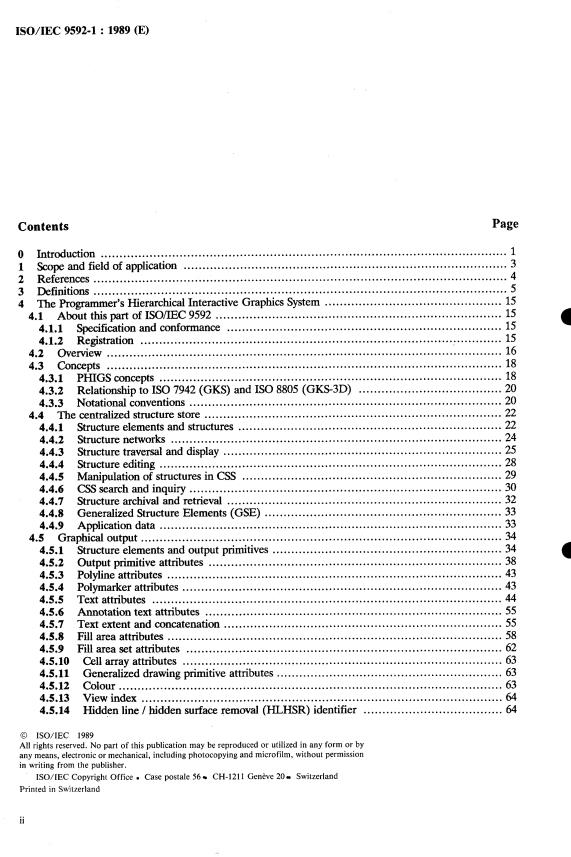
Contents
0 Introduction . 1
1 Scope and field of application . 3
2 References . 4
3 Definitions . 5
The Programmer’s Hierarchical Interactive Graphics System . 15
About this part of ISOB[Ec 9592 . 15
4.1
Specification and conformance . 15
4.1.1
4.1.2 Registration . 15
4.2 Overview . 16
4.3 Concepts . 18
4.3.1 PHIGS concepts . 18
Relationship to IS0 7942 (GKS) and IS0 8805 (GKS3D) . 20
4.3.2
4.3.3 Notational conventions . 20
The centralized structure store . 22
4.4
Structure elements and structures . 22
4.4.1
4.4.2 Structure networks . 24
Structure traversa1 and display . 25
4.4.3
4.4.4 Structure editing . 28
Manipulation of structures in CSS . 29
4.4.5
4.4.6 CSS search and inquiry . 30
Structure archival and retrieval . 32
4.4.7
Generalized Structure Elements (GSE) . 33
4.4.8
4.4.9 Application data . 33
4.5 Graphical output . 34
Structure elements and output primitives . 34
4.5.1
4.5.2 Output primitive attributes . 38
4.5.3 Polyline attributes . 43
4.5.4 Polymarker attributes . 43
4.5.5 Text attributes . 44
4.5.6 Annotation text attributes . 55
4.5.7 Text extent and concatenation . 55
4.5.8 Fill area attributes . 58
4.5.9 Fill area set attributes . 62
4.5.10 Cell array attributes . 63
4.5.11 Generalized drawing primitive attributes . 63
4.5.12 Colour . 63
4.5.13 View index . 64
4.5.14 Hidden line / hidden surface removal (HLHSR) identifier . 64
O ISO/IEC 1989
All rights reserved . No part of this publication may be reproduced or utilized in any form or by
or mechanical. including photocopying and microfilm. without permission
any means. electronic
in writing from the publisher .
ISOAEC Copyright Office . Case postale 56 CH-121 1 Genève 20 Switzerland
Printed in Switzerland
ii
ISOAEC 9592-1 : 1989 (E)
4.5.15 Name set attribute . 64
4.5.16 Minimal simulations . 65
4.5.17 Degenerate primitives . 65
4.6 Workstations . 67
4.6.1 Workstation characteristics . 67
4.6.2 Workstation selection . 68
4.6.3 Controlling picture changes . 68
4.6.4 Clearing the display surface . 75
4.6.5 Sending messages to a workstation . 75
.................. 76
4.6.6 Hidden line / hidden surface removal . .
.................. 77
Coordinate systems and transformations . .
4.7
4.7.1 Coordinate system handedness . . . 77
........ .................. 77
4.7.2 Modelling transformations and clipping .
4.7.3 Modelling utility functions . . . 79
........ .................. 80
4.7.4 Viewing .
4.7.5 Viewing utility functions . . . . 84
4.7.6 Workstation transformation . . . 90
4.7.7 Transformation of locator input . . . 92
.........................................
4.7.8 Transformation of stroke input . . 93
......................................... ................ 95
4.8 Graphical input .
......................................... ................ 95
4.8.1 Introduction to logical input devices .
.......................................................... 96
4.8.2 Logical input device model .
.
Operating modes of logical input devices . 97
4.8.3
Measures of each input class . 100
4.8.4
Input queue and current event report . 101
4.8.5
4.8.6 Initialization of input devices . 102
4.8.7 Locator and stroke input using 2D input . 104
4.9 PHIGS metafile interface . 105
4.10 PHIGS states . 107
4.11 Inquiry functions . 108
4.12 Error handling . 109
4.13 Special interfaces between PHIGS and application program . 112
4.14 Minimum support criteria . 113
5 PHIGS Functional Specification . 116
5.1 Notational conventions . 116
5.2 Control functions . 117
5.3 Output primitive functions . 122
5.4 Attribute specification functions . 132
5.4.1 Bundled attribute selection . 132
5.4.2 Individual attribute selection . 133
5.4.3 Aspect source flag setting . 150
5.4.4 Workstation attribute table definition . 150
5.4.5 Workstation filter definition . 158
5.4.6 Colour model control . 159
5.4.7 HLHSR attributes . 160
Transformation and clipping functions . . 161
5.5
........... 161
5.5.1 Modelling transformations and clipping .
5.5.2 View operations . . 165
5.5.3 Workstation transformation . . 167
5.5.4 Utility functions to support modelling . . 169
5.5.5 Utility functions to support viewing . . 176
Structure content functions . 179
5.6
Structure manipulation functions . 185
5.7
Structure display functions . 188
5.8
Structure archiving functions . 190
5.9
5.10 Input functions . 197
Pick identifier and filter . 197
5.10.1
Initialization of input devices . 197
5.10.2
...
ISO/IEC 9592-1 : 1989 (E)
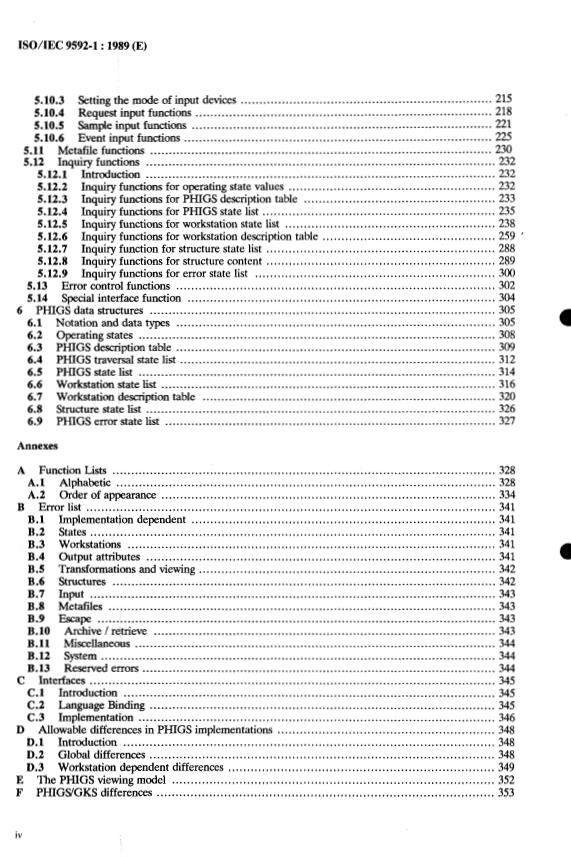
Setting the mode of input devices . 215
5.10.3
Request input functions . 218
5.10.4
Sample input functions . 221
5.10.5
5.10.6 Event input functions . 225
5.11 Metafile functions . 230
5.12 Inquiry functions . 232
5.12.1 Introduction . 232
5.12.2 Inquiry functions for operating state values . 232
5.12.3 Inquiry functions for PHIGS description table . 233
5.12.4
Inquiry functions for PHIGS state list . 235
5.12.5
Inquiry functions for workstation state list . 238
5.12.6 . 259 .
Inquiry functions for workstation description table
5.12.7 Inquiry function for structure state list . 288
5.12.8 Inquiry functions for structure content . 289
5.12.9 Inquiry functions for error state list . 300
5.13 Error control functions .
.............. 302
5.14 Special interface function .
.............. 304
6 PHIGS data structures . . 305
6.1 Notation and data types . . 305
6.2 Operating states . . 308
6.3 PHIGS descriiition table . . 309
PHIGS traversal state list . 312
6.4
PHIGS state list . 314
6.5
Workstation state list . 316
6.6
Workstation description table . 320
6.7
6.8 Structure state list . 326
6.9 PHIGS error state list . 327
Annexes
A Function Lists . 328
A.l Alphabetic . 328
A.2 Order of appearance . 334
B Error list . 341
B.l Implementation dependent . 341
B.2 States . 341
B.3 Workstations . 341
B.4 Output attributes . 341
Transformations and viewing . 342
B.5
B.6 Structures . 342
B.7 Input . 343
B.8 Metafiles . 343
B.9 Escape . 343
B.10 Archive / retrieve . 343
B.11 Miscellaneous . 344
B.12 System . 344
B.13 Reserved errors . 344
C Interfaces . 345
C.l Introduction . 345
C.2 Language Binding . 345
C.3 Implementation . 346
.......................................................... 348
D Allowable differences in PHIGS implementations
D.l Introduction . 348
D.2 Global differences . 348
Workstation dependent differences . 349
D.3
E The PHIGS viewing model . 352
F PHIGUGKS differences . 353
iv
ISO/IEC 9592-1 : 1989 (E)
G HLHSR considerations . 355
Relationship of CGM and PHIGS . 356
H
H.l Introduction . 356
H.2 Scope . 356
H.3 Overview of the differences between PHIGS and CGM . 356
H.4 Mapping concepts . 357
H.4.1 Principles . 357
H.4.2 Workstations . 357
H.4.3 Picture generation . 358
H.4.4 Picture input . 358
H.4.5 Coordinates and clipping . . 359
H.4.6 Workstation transformation . . 359
... 360
H.4.7 Colour table .
H.4.8 Set representation . . 360
H.5 Metafile generation . . 360
H.5.1 Control functions . . 360
H.5.2 Structure traversal . 362
H.5.3 Metafile description . 363
H.5.4 User items . 364
H.6 Interpretation of CGM by PHIGS . 364
Mapping between item types and elements . 366
H.7
............... 367
I Colour models .
............... 367
1.1 Introduction .
............... 368
1.2 RGB colour model .
............... 368
1.3 CIELUV colour model .
............... 368
CIE XYZ colour space .
1.3.1
............... 369
CIE 1931 (Y.x. y) space .
1.3.2
............... 372
The CIE 1976 (L*u*v*) CIELUV uniform colour space .
1.3.3
1.3.4 Colour differences . 373
HSV colour model . 374
1.4
1.5 HLS colour model . 375
Conversion between colour models . 375
1.6
1.6.1 CIE XYZ reference model . 375
............................. 376
1.6.2 Conversion between CIELW and CIE XYZ models .
............................. 376
1.6.3 Conversion between RGB and CIE XYZ models .
............................. 376
1.6.3.1 Derivation of conversion factors .
............................. 377
1.6.3.2 Conversion from RGB to CIE XYZ .
............................. 377
1.6.3.3 Conversion from CIE XYZ to RGB .
1.6.3.4 Representation of black . . 377
1.6.3.5 Example conversion . 377
V
ISO/IEC 9592-1 : 1989 (E)
Foreword
IS0 (the International Organization for Standardization) and IEC (the International
Electrotechnical Commission) together form a system for worldwide standardization as
a whole. National bodies that are members of IS0 or IEC participate in the develop-
ment of International Standards through technical committees established by the
respective organization to deal with particular fields of technical activity. IS0 and IEC
technical committees collaborate in fields of mutual interest. Other international
organizations, governmental and non-governmental, in liaison with IS0 and IEC, also
take part in the work.
I
In the field of information technology, IS0 and IEC have established a joint technical
committee, ISOAEC JTC 1. Draft International Standards adopted by the joint
technical committee are circulated to national bodies for approval before their accep-
tance as International Standards. They are approved in accordance with procedures
requiring at least 75 070 approval by the national bodies voting.
~
International Standard ISOAEC 9592-1 was prepared by Joint Technical
Committee ISOAEC JTC 1, Information technology.
~
Users should note that all International Standards undergo revision from time to time
and that any reference made herein to any other International Standard implies its
~
latest edition, unless otherwise stated.
I
ISO/IEC 9592 consists of the following parts, under the general title Information
processing systems - Computer graphics - Programmer’s Hierarchical Interactive
Graphics System (PHZGS) :
- Part 1 : Functional description
- Part 2: Archive file format
- Part 3: Clear-text encoding of archive file
Annex D forms an integral part of this part of ISOAEC 9592. Annexes A, B, C, E, F,
G, H, I are for information only.
vi
INTERNATIONAL STANDARD ISOAEC 9592-1 : 1989 (E)
Information processing systems - Computer graphics -
Programmer’s Hierarchical Interactive Graphics System
(PHIGS) -
Part 1 :
Functional description
O Introduction
The Programmer’s Hierarchical Interactive Graphics System (PHIGS) provides a set of functions for
- definition, display and modification of 2D or 3D graphical data,
- definition, display and manipulation of geometrically related objects,
- modification of graphics data and the relationships between the graphical data.
This International Standard draws extensively on GKS (Graphical Kernel System IS0 7942) and GKS3D
(Graphical Kernel System for Three Dimensions IS0 8805) for its model and functionality. In addition
this International Standard enables graphical (and application) data to be stored in a hierarchical data
store. Information in the data store can be inserted, modified and deleted with the provided functions.
The relationship of this part of ISO/IEc 9592 to GKS and GKS-3D is further described in 4.3.2.
The choice of which graphics standard to use will depend on a number of factors: application profile,
overall system architecture, equipment available, existing application database interaction, system perfor-
mance considerations, user interface requirements, management policy and other external factors. The
aim of producing a compatible set of graphics standards in GKS, GKS-3D and PHIGS is to allow that
choice to be made in the most flexible way.
The main reasons for introducing a standard in this area of computer graphics are
a) to allow application programs using dynamic hierarchical graphics to be easily portable between in-
stallations,
b) to aid the understanding and use of dynamic hierarchical graphics methods by application program-
mers;
c) to reduce program development costs and time; many of the functions currently performed by the
application program will now be performed by PHIGS;
d) to serve manufacturers of graphics equipment as a guideline in providing useful combinations of
graphics capabilities in a device.
To meet these objectives, a number of design principles were adopted:
ISO/IEC 9592-1 : 1989 (E)
Introduction
e) Consistency: the mandatory requirements of PHIGS should not be mutually contradictive.
f) Compatibility: this Standard will be compatible with GKS and GKS3D except when technical rea-
sons justify differences.
g) Orthogonality: the functions should be independent of each other.
h) Completeness: all the functions necessary for application programs to use a dynamic hierarchical
graphics system should be included.
i) Minimality: redundant functions are only supported where their availability enables application pro-
grams to improve performance or where some collection of capabilities is frequently used.
j) Programmer Experience: those using PHIGS should have a working knowledge of computer graph-
ics.
k) Error Handling: error conditions should be minimized, and their impact well defined.
1) Device Independence: PHIGS should allow an application program to address facilities of different
graphics input and output devices with minimal changes to the application program.
m) Device Dependence: PHIGS should allow an application program to address specific graphics input
and output devices in a direct manner.
n) Implementability: it should be possible to support PHIGS functions using most languages on most
operating systems.
O) Efficiency: PHIGS should be capable of being implemented and executed without consuming undue
amounts of computer resources.
p) Interaction: Some application programs will require realtime or near-realtime response from
PHIGS. PHIGS will not exclude such application programs though specific graphics devices and dedi-
be necessary.
cated computer resources may
Annexes A to C and E to I are given for information; they do not form part of this part of ISO/IEC 9592.
ISOAEC 9592-1 : 1989 (E)
1 Scope and field of application
This part of ISO/IEC 9592 specifies a set of functions for computer graphics programming, the
Programmer’s Hierarchical Interactive Graphics System (PHIGS). PHIGS is a graphics system for appli-
cation programs that produce computer generated pictures on line graphics or raster graphics output dev-
ices. It supports operator input and interactions by supplying basic functions for graphical input and
hierarchical picture definition. Picture definitions are retained in a centralized structure store where they
may be edited by an application.
Pictures are displayed on workstations consisting of a single output device and a number of input devices.
Several workstations can be used simultaneously. The application program is allowed to adapt its
behaviour at a workstation to make best use of workstation capabilities.
Functions are specified for archiving picture definitions to file. In addition an interface to the Computer
Graphics Metafile (IS0 8632) is described.
NOTE - For certain parameters of the functions, PHIGS defines value ranges as being reserved for registration (see 4.1.2). The
meanings of these values will be defined using the established procedures.
This part of ISO/IEC 9592 defines a language independent nucleus of a graphics system for integration
into a programming language. PHIGS is embedded in a language layer obeying the particular conven-
tions of the language. Such language bindings are specified for IS0 or ISO/IEC languages in ISO/IEC
9593.
a
ISO/IEC 9592-1 : 1989 (E)
2 References
IS0 646, Information processing - IS0 7-bit coded character set for information interchange.
IS0 2022, Information processing - IS0 7-bit and 8-bit coded character sets - Code extension techniques.
IS0 2382-13, Data processing - Vocabulary - Part 13: Computer graphics.
IS0 6093, Information processing - Representation of numeric values in character strings for information
interchange.
IS0 7942, Information processing systems - Computer graphics - Graphical Kernel System (GKS) functional
description.
IS0 8632, Information processing systems - Computer graphics - Metafile for the storage and transfer of pic-
ture description information
- Part 1 : Functional description
- Part 2 : Character encoding
- Part 3 : Binary encoding
- Part 4 : Clear text encoding
IS0 8805, Information processing systems - Computer graphics - Graphical Kernel System for Three Dimen-
sions (GKS-3D) functional description.
ISO/IEc 9593, Information processing systems - Computer graphics - Programmer's Hierarchical Interactive
Graphics System (PHIGS) language bindings.
CIE Recommendations on colour space, supplement to CIE publication 15.
CIE 1976 Supplementary standard colour metric of server and coordinate systems.
ISO/IEC 9592-1 : 1989 (E)
3 Definitions
For the purpose of this part of ISO/IEC 9592 the following definitions apply.
NOTE - As far as possible, graphics terminology which is commonly accepted and consistent with other graphics Standards is used.
3.1 acknowledgement: Output to the operator of a logical input device indicating that a trigger has fired.
3.2 addressable point: Any point of a device that can be addressed.
3.3 ancestor structure: A parent structure or the ancestor of a parent structure.
3.4 annotation: A class of output primitives that are defined in normalized projection coordinates but are
placed with respect to a reference point which may be anywhere in modelling coordinate space. The plane
on which the annotation appears is always parallel to the x-y plane of the display space and is unaffected
by modelling and viewing transformations, but the reference point is transformed in the normal manner.
3.5 annotation style: An aspect of annotation indicating how relationships between an annotation primi-
tive and a reference point are displayed.
3.6 annotation text relative: An output primitive consisting of a character string which is always drawn
parallel to the x-y plane of the display space. Its position is determined by a reference point defined in
modelling coordinate space and an offset in normalized projection coordinates.
3.7 application data: Data used by an application program, the nature of which is not specified in this
standard. Application data is inserted into a structure as an “application data” structure element.
3.8 archive file: A mechanism for the storage and transportation of graphical data, represented by PHZGS
structures and their contents.
3.9 aspects of output primitives: The appearance of output primitives is controlled by the values of a set
of characteristics called “aspects” examples of which are the height of a character or the linetype of a
polyline. Geometric aspects are workstation independent and are controlled by the corresponding attri-
butes. For non-geometric aspects, the mapping between a particular aspect and its controlling attribute is
defined by an associated aspect source flag (ASF). If the ASF is set to BUNDLED this aspect of the out-
put primitive is controlled by the bundle index attribute. If the ASF is set to INDIVIDUAL then the aspect
is controlled by the corresponding attribute.
3.10 aspect ratio: The ratio of lengths along the principal axes of an object.
3.11 aspect source flag (ASF): A flag indicating whether a particular workstation dependent aspect of an
output primitive is selected from an attribute bundle, or as an individual attribute selection.
3.12 attribute: Attributes control the properties of output primitives. There are four types of attributes:
geometric, non-geometric, viewing and identification. The geometric and non-geometric attributes control
the values of aspects of output primitives.
3.13 back plane: A plane parallel to the view plane whose location is specified as an N coordinate value
in the view reference coordinate system. Output primitives behind the back plane lie outside the view
volume.
3.14 break action: An implementation dependent and workstation dependent mechanism enabling the
operator to interrupt an input operation.
3.15 bundle index: An attribute of an output primitive which is an index into a bundle table; which defines
the workstation dependent aspects of the output primitive.
3.16 bundle table: A workstation dependent table specifying aspects of one or more output primitives.
PHIGS has polyline, polymarker, text, interior, and edge bundle tables.
ISOAEC 9592-1 : 1989 (E)
De finitions
3.17 bundle table entry: A single entry in a bundle table. Each entry contains one value for each aspect
which applies to the corresponding output primitive. This set is workstation dependent.
3.18 cell array: An output primitive consisting of a parallelogram of equal sized cells, each of which is a
parallelogram and has a single colour.
3.19 centralized structure store (CSS): The conceptual workstation independent storage area for structure
networks.
3.20 character base vector: An aspect of text which defines the direction of the baseline of a character.
It is a two-dimensional vector in the text plane specified in the “text” structure element.
3.21 character body: The rectangle defining the horizontal and vertical limits of an individual character.
3.22 character expansion factor: An aspect of text which specifies the deviation of character width from
the defined nominal value of a given font on a given workstation.
3.23 character height: An aspect of text which specifies the nominal value for the height of an upper case
character.
3.24 character set: A registered interpretation for entries in the character code table (see IS0 2022).
3.25 character spacing: An aspect of text which specifies the fraction of the font nominal value for char-
acter height to be added between adjacent character bodies in a string.
3.26 character up vector: An aspect of text which defines the principal up direction of the text string. It
is a two-dimensionai vector in the text plane specified in the “text” structure element.
3.27 character width: An aspect of text which specifies the nominal value of the width of a character. The
actual width depends on the width to height ratio specified by the designer of the font to which the char-
acter belongs.
3.28 child structure: A structure specified in a structure reference.
3.29 choice device: A logical input device providing a non-negative integer defining one of a set of alter-
natives.
3.30 CIE: Abbreviation for the Commission Internationale de 1’Eklairage. Used to refer to the CIE
universal colour definition system used as a colour model.
3.31 CIELUV: Abbreviation for the CIE 1976 (L*u*v*) colour space.
3.32 clipping: Removing parts of output primitives which lie outside a specified volume. The exact effect
of clipping some output primitives may be implementation or workstation dependent.
3.33 colour index: An index used to access an entry in a colour table.
3.34 colour model: Characterization of a colour space in terms of explicit parameters.
3.35 colour space: Geometric representation of colours in space, usually of three dimensions.
3.36 colour system: A colour coordinate system.
3.37 colour table: A workstation dependent table, in which the entries specify the values defining a partic-
ular colour.
3.38 composite modelling transformation: A transformation applied to output primitives produced during
structure traversal. It is defined as the concatenation of the local modelling transformation and global
modelling transformations such that the local modelling transformation is the first transformation to be
applied.
3.39 conflict resolution flag: During the process of structure archiving from the CSS or structure retrieval
from an archive, naming conflicts may occur between structures on the archiveple and structures in the
CSS. The conflict resolution flag indicates how these confiicts will be resolved.
3.40 connection identifier: An implementation specific means of defining the connection to one or more
physical entities which constitutes a single workstation.
ISO/IEC 9592-1 : 1989 (E)
Definitions
3.41 data record: A compound data type, the content of which is defined by the context within which it
is used. For example, the content of the data records used in the input device initialization functions may
vary depending upon the particular prompt and echo type specified in the invocation of the initialization
function.
3.42 deferral mode: The deferral mode for a workstation is part of the display update state and specifies
when changes to posted structure networks and the workstation state list shall be reflected in the displayed
image.
3.43 descendant structure: A child structure or the descendant of a child structure.
3.44 device coordinates (DC): A device dependent coordinate system. In PHZGS, DC units are metres on
a device capable of producing a precisely scaled image, and appropriate workstation dependent units oth-
erwise.
3.45 device driver: The device dependent part of a PHIGS implementation that supports a physical graph-
ics device. The device driver generates device dependent output and handles device dependent interac-
tion.
3.46 device space: The space defined by the addressable points of a display device. (Takenfrom IS0 7942
and IS0 8805)
3.47 display device: A graphics device on which images can be represented. A display device is one possi-
workstation.
ble component of a
3.48 display priority: The priority assigned to a structure network when it is posted. It is used to discrim-
inate between output primitives when they are mapped to the same display space location.
3.49 display space:
(1)That portion of device space corresponding to the volume available for displaying images.
(2) The working space of an input device. (Takenfrom IS0 7942 and IS0 8805)
3.50 display surface: The physical area on a display device onto which PHIGS images may be placed.
3.51 display update state: Determines how and when the display surface is modified to reflect changes in
the centralized structure store and the workstation state list. An application selects the display update state
to take into account the capabilities of a workstation and the requirements of the application program.
The display update state consists of the two workstation dependent aspects of deferral mode and modifica-
tion mode.
3.52 echo: The immediate notification to the operator of the current measure of a logical input device.
3.53 echo area; echo volume: An area or volume, defined in device coordinates, which may be used for
the display of a prompt or echo.
3.54 echo type: A parameter of device initialization which selects the echo technique for a particular logi-
cal input device.
3.55 edge: The set of boundaries of the polygons defined in thefill area set outputprimitive.
3.56 edge flag: An aspect offill area set which enables or disables the display of edges.
3.57 edgetype: An aspect of fill area set which indicates the style of the edges.
3.58 edgewidth scale factor: An aspect offill area set which indicates the relative width of the image of
an edge. The edgewidth scale factor is applied to a workstation dependent nominal value.
3.59 edit mode: Determines whether a new structure element will replace the structure element at the ele-
ment pointer or will be inserted into the open structure after the element pointer.
3.60 element pointer: A pointer used during structure editing, the value of which identifies the position in
the open structure at which element deletion and creation will occur.
3.61 element position: A number associated with a structure element which indicates the element’s posi-
tion within a structure.
ISOAEC 9592-1 : 1989 (E)
Definitions
3.62 element reference list: A list of references which define the hierarchy within one branch of a struc-
ture network. Each reference consists of a structure identifier and an element position within that structure.
if the list contains N pairs, then the first N-1 pairs identify EXECUTE STRUCTURE elements. The jth
such element references the structure named in the (j+l)st list element. The deepest element of the list
may identify any type of structure element.
3.63 element type: The identifying classification of a structure element. For example, fill area, label,
application data, linewidth scale factor.
3.64 empty interior style: One possible representation of the interior of a fill area or fill area set output
primitive. If the edges are not displayed, the image of afill area set with interior style empty is invisible.
The image of afill area output primitive with interior style empty is always invisible.
3.65 error state list: The data holding information about the most recent error condition.
3.66 escape: A function which provides access to implementation dependent or device dependent features
not concerned with the generation of graphical output.
3.67 event mode: An operating mode for a logical input device in which asynchronous input is placed on
the event queue as
...
Questions, Comments and Discussion
Ask us and Technical Secretary will try to provide an answer. You can facilitate discussion about the standard in here.
Loading comments...