

ISO/TS 20458:2023
(Main)Road vehicles — Design and performance specifications for advanced Pedestrian Legform Impactor (aPLI)
General Information
- Abstract
This document provides definitions, symbols, mechanical requirements, certification test procedure, electronic subsystem requirements and user’s manual for advanced pedestrian legform impactor (aPLI), a standardized pedestrian legform impactor with an upper mass for pedestrian subsystem testing of road vehicles. It is applicable to impact tests involving: — vehicles of category M1, except vehicles with the maximum mass above 2 500 kg and which are derived from N1 category vehicles and where the driver’s position, R-point, is either forward of the front axle or longitudinally rearwards of the front axle transverse centreline by a maximum of 1 100 mm; — vehicles of category N1, except where the driver’s position, R-point, is either forward of the front axle or longitudinally rearwards of the front axle transverse centreline by a maximum of 1 100 mm; — impacts to the bumper test area as defined by UN R127[1] and UN GTR No.9[2]; — pedestrian subsystem tests involving use of a legform for the purpose of evaluating compliance with vehicle safety standards.
- Status
- Published
- Publication Date
- 25-Jul-2023
- Technical Committee
- ISO/TC 22/SC 36 - Safety and impact testing
- Drafting Committee
- ISO/TC 22/SC 36/WG 5 - Anthropomorphic test devices
- Current Stage
- 9060 - Close of review
- Start Date
- 15-Jul-2026
- Completion Date
- 02-Dec-2026

Overview
ISO/TS 20458:2023 - "Road vehicles - Design and performance specifications for advanced Pedestrian Legform Impactor (aPLI)" specifies a harmonized design and performance baseline for an advanced pedestrian legform impactor (aPLI). The document defines mechanical requirements, certification test procedures, electronic subsystem (sensor and DAS) requirements, and a user’s manual for a standardized legform impactor that includes an upper mass to represent upper-body influence in pedestrian-subsystem testing. It is intended for impact tests on many M1 and N1 vehicles and for bumper-area tests as defined by UN R127 and UN GTR No.9.
Key topics and technical requirements
- Mechanical requirements: Detailed specifications for the aPLI upper mass, lower limb, flesh/skin assemblies and full assembly, including materials, drawings and certification criteria (see clauses 5.x).
- Certification test procedures: Procedures for validating hip joint, femur, tibia, knee assemblies and full-assembly performance and repeatability (clause 6).
- Electronic subsystems: Required and permissible sensors, their locations, mass limits, and internal data acquisition system (DAS) characteristics and placement (clause 7).
- User’s manual: Requirements for assembly/disassembly, maintenance and operation guidance (clause 8, Annex K and L for procedures and torque values).
- Supporting evidence and data: Informative annexes provide rationale, biofidelity evaluation, repeatability/reproducibility, durability, parts lists, exemplar DAS and validation results (Annexes A–P).
- Deliverables: Electronic drawings and CAD files for manufacturing and certification (Annex I, H).
Practical applications
- Standardizes the aPLI used to evaluate pedestrian leg injuries in vehicle design and compliance testing.
- Enables harmonized, repeatable bench and vehicle subsystem tests for automotive manufacturers, suppliers and independent test laboratories.
- Supports regulatory alignment and comparison of vehicle front-end designs for pedestrian protection, including bumper-area impact assessments.
- Provides instrumentation and DAS specifications to ensure consistent data capture for injury assessment, model validation and R&D.
Who should use this standard
- Vehicle manufacturers and safety engineers
- Crash test laboratories and certification bodies
- Dummy and sensor manufacturers
- Research institutes and regulators involved in pedestrian safety and injury biomechanics
Related standards
- ISO 6487 (impact test instrumentation)
- ISO/TS 13499 (multimedia data exchange for impact tests)
- SAE J2570, SAE J211-1 (ATD transducers and instrumentation)
- UN R127 and UN GTR No.9 (bumper test area definitions referenced in scope)
Keywords: ISO/TS 20458:2023, aPLI, advanced Pedestrian Legform Impactor, pedestrian safety, legform impactor, vehicle testing, certification, sensors, DAS, biofidelity, UN R127.
Get Certified
Connect with accredited certification bodies for this standard

TÜV Rheinland
TÜV Rheinland is a leading international provider of technical services.

TÜV SÜD
TÜV SÜD is a trusted partner of choice for safety, security and sustainability solutions.

BSI Group
BSI (British Standards Institution) is the business standards company that helps organizations make excellence a habit.
Sponsored listings
Frequently Asked Questions
ISO/TS 20458:2023 is a technical specification published by the International Organization for Standardization (ISO). Its full title is "Road vehicles — Design and performance specifications for advanced Pedestrian Legform Impactor (aPLI)". This standard covers: This document provides definitions, symbols, mechanical requirements, certification test procedure, electronic subsystem requirements and user’s manual for advanced pedestrian legform impactor (aPLI), a standardized pedestrian legform impactor with an upper mass for pedestrian subsystem testing of road vehicles. It is applicable to impact tests involving: — vehicles of category M1, except vehicles with the maximum mass above 2 500 kg and which are derived from N1 category vehicles and where the driver’s position, R-point, is either forward of the front axle or longitudinally rearwards of the front axle transverse centreline by a maximum of 1 100 mm; — vehicles of category N1, except where the driver’s position, R-point, is either forward of the front axle or longitudinally rearwards of the front axle transverse centreline by a maximum of 1 100 mm; — impacts to the bumper test area as defined by UN R127[1] and UN GTR No.9[2]; — pedestrian subsystem tests involving use of a legform for the purpose of evaluating compliance with vehicle safety standards.
This document provides definitions, symbols, mechanical requirements, certification test procedure, electronic subsystem requirements and user’s manual for advanced pedestrian legform impactor (aPLI), a standardized pedestrian legform impactor with an upper mass for pedestrian subsystem testing of road vehicles. It is applicable to impact tests involving: — vehicles of category M1, except vehicles with the maximum mass above 2 500 kg and which are derived from N1 category vehicles and where the driver’s position, R-point, is either forward of the front axle or longitudinally rearwards of the front axle transverse centreline by a maximum of 1 100 mm; — vehicles of category N1, except where the driver’s position, R-point, is either forward of the front axle or longitudinally rearwards of the front axle transverse centreline by a maximum of 1 100 mm; — impacts to the bumper test area as defined by UN R127[1] and UN GTR No.9[2]; — pedestrian subsystem tests involving use of a legform for the purpose of evaluating compliance with vehicle safety standards.
ISO/TS 20458:2023 is classified under the following ICS (International Classification for Standards) categories: 43.020 - Road vehicles in general. The ICS classification helps identify the subject area and facilitates finding related standards.
ISO/TS 20458:2023 is available in PDF format for immediate download after purchase. The document can be added to your cart and obtained through the secure checkout process. Digital delivery ensures instant access to the complete standard document.
Standards Content (Sample)
TECHNICAL ISO/TS
SPECIFICATION 20458
First edition
2023-07
Road vehicles — Design and
performance specifications for
advanced Pedestrian Legform
Impactor (aPLI)
Véhicules routiers — Spécifications de conception et de performance
pour l'impacteur en forme de jambe de piéton (aPLI)
Reference number
© ISO 2023
All rights reserved. Unless otherwise specified, or required in the context of its implementation, no part of this publication may
be reproduced or utilized otherwise in any form or by any means, electronic or mechanical, including photocopying, or posting on
the internet or an intranet, without prior written permission. Permission can be requested from either ISO at the address below
or ISO’s member body in the country of the requester.
ISO copyright office
CP 401 • Ch. de Blandonnet 8
CH-1214 Vernier, Geneva
Phone: +41 22 749 01 11
Email: copyright@iso.org
Website: www.iso.org
Published in Switzerland
ii
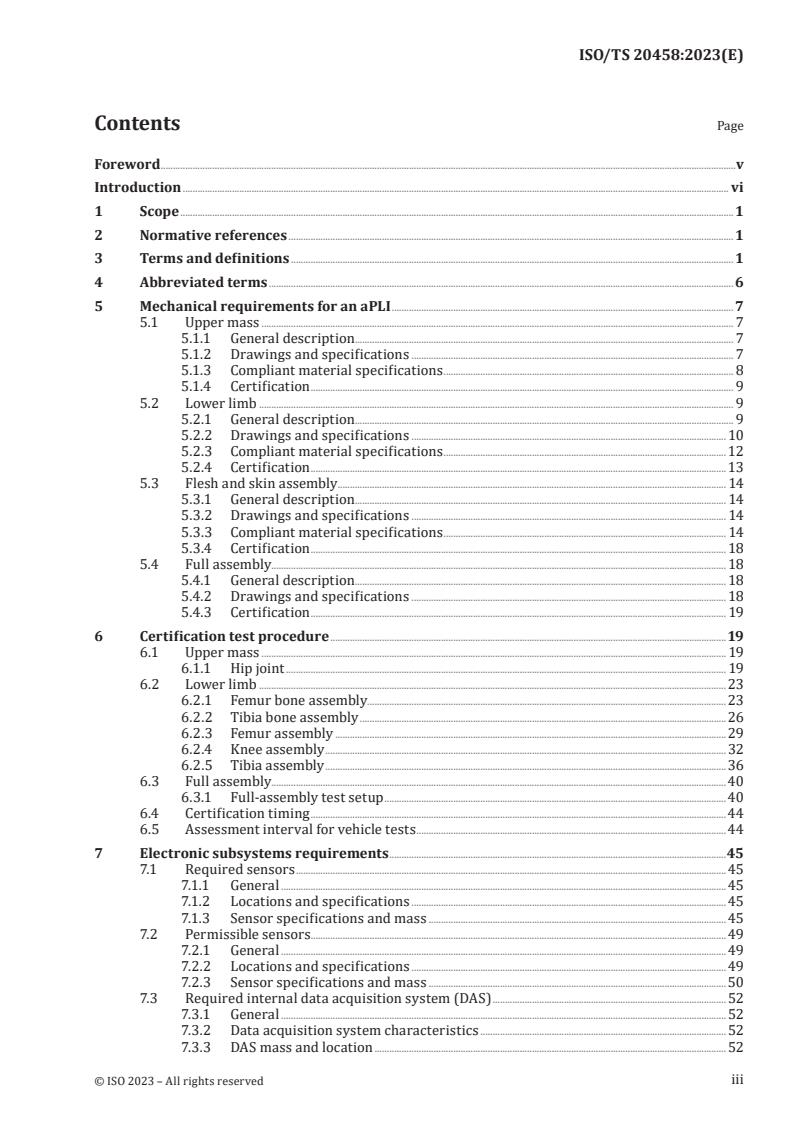
Contents Page
Foreword .v
Introduction . vi
1 Scope . 1
2 Normative references . 1
3 Terms and definitions . 1
4 Abbreviated terms . 6
5 Mechanical requirements for an aPLI . 7
5.1 Upper mass . 7
5.1.1 General description . 7
5.1.2 Drawings and specifications . 7
5.1.3 Compliant material specifications . 8
5.1.4 Certification . 9
5.2 Lower limb . 9
5.2.1 General description . . 9
5.2.2 Drawings and specifications . 10
5.2.3 Compliant material specifications .12
5.2.4 Certification .13
5.3 Flesh and skin assembly . 14
5.3.1 General description . 14
5.3.2 Drawings and specifications . 14
5.3.3 Compliant material specifications . 14
5.3.4 Certification . 18
5.4 Full assembly. 18
5.4.1 General description . 18
5.4.2 Drawings and specifications . 18
5.4.3 Certification . 19
6 Certification test procedure .19
6.1 Upper mass . 19
6.1.1 Hip joint . 19
6.2 Lower limb . 23
6.2.1 Femur bone assembly. 23
6.2.2 Tibia bone assembly .26
6.2.3 Femur assembly .29
6.2.4 Knee assembly . 32
6.2.5 Tibia assembly .36
6.3 Full assembly.40
6.3.1 Full-assembly test setup .40
6.4 Certification timing .44
6.5 Assessment interval for vehicle tests .44
7 Electronic subsystems requirements .45
7.1 Required sensors . 45
7.1.1 General . 45
7.1.2 Locations and specifications . 45
7.1.3 Sensor specifications and mass . 45
7.2 Permissible sensors . .49
7.2.1 General .49
7.2.2 Locations and specifications .49
7.2.3 Sensor specifications and mass .50
7.3 Required internal data acquisition system (DAS) . 52
7.3.1 General . 52
7.3.2 Data acquisition system characteristics . 52
7.3.3 DAS mass and location . 52
iii
8 User's manual .52
8.1 Requirements . 52
8.1.1 Disassembly and assembly . 52
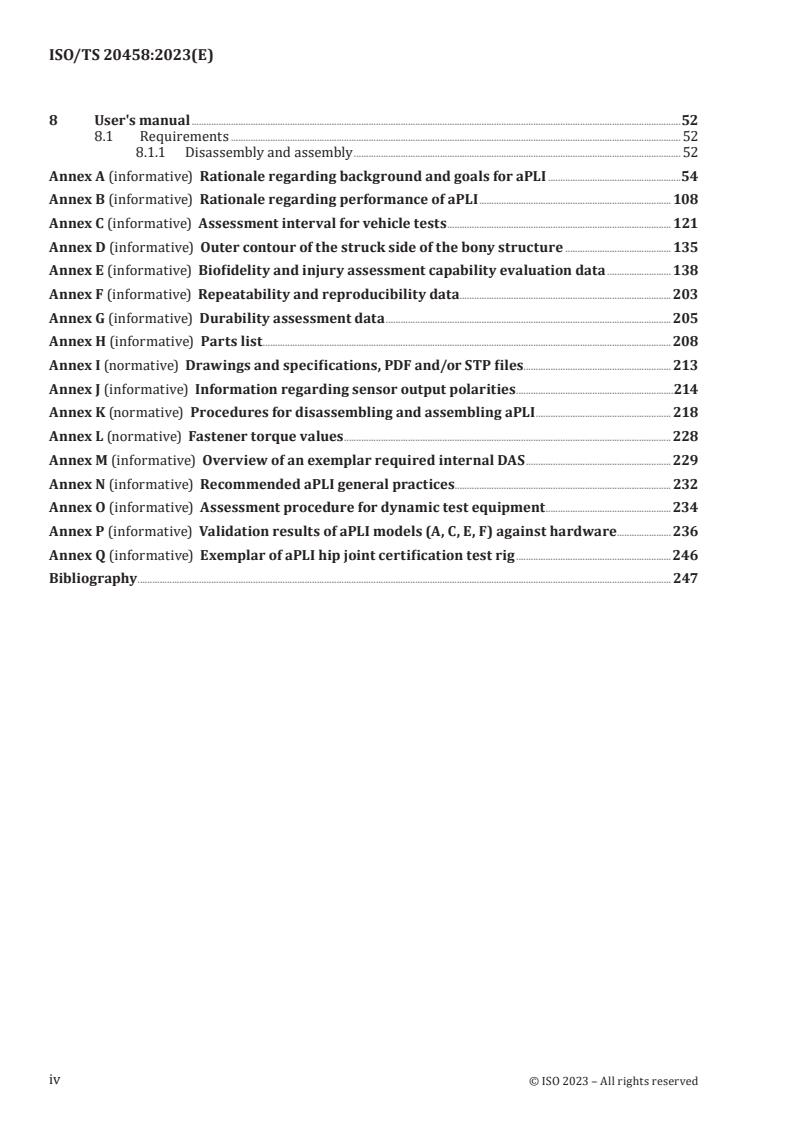
Annex A (informative) Rationale regarding background and goals for aPLI .54
Annex B (informative) Rationale regarding performance of aPLI . 108
Annex C (informative) Assessment interval for vehicle tests . 121
Annex D (informative) Outer contour of the struck side of the bony structure . 135
Annex E (informative) Biofidelity and injury assessment capability evaluation data . 138
Annex F (informative) Repeatability and reproducibility data. 203
Annex G (informative) Durability assessment data . 205
Annex H (informative) Parts list . 208
Annex I (normative) Drawings and specifications, PDF and/or STP files. 213
Annex J (informative) Information regarding sensor output polarities .214
Annex K (normative) Procedures for disassembling and assembling aPLI . 218
Annex L (normative) Fastener torque values . 228
Annex M (informative) Overview of an exemplar required internal DAS . 229
Annex N (informative) Recommended aPLI general practices. 232
Annex O (informative) Assessment procedure for dynamic test equipment . 234
Annex P (informative) Validation results of aPLI models (A, C, E, F) against hardware. 236
Annex Q (informative) Exemplar of aPLI hip joint certification test rig .246
Bibliography . 247
iv
Foreword
ISO (the International Organization for Standardization) is a worldwide federation of national standards
bodies (ISO member bodies). The work of preparing International Standards is normally carried out
through ISO technical committees. Each member body interested in a subject for which a technical
committee has been established has the right to be represented on that committee. International
organizations, governmental and non-governmental, in liaison with ISO, also take part in the work.
ISO collaborates closely with the International Electrotechnical Commission (IEC) on all matters of
electrotechnical standardization.
The procedures used to develop this document and those intended for its further maintenance are
described in the ISO/IEC Directives, Part 1. In particular, the different approval criteria needed for the
different types of ISO document should be noted. This document was drafted in accordance with the
editorial rules of the ISO/IEC Directives, Part 2 (see www.iso.org/directives).
ISO draws attention to the possibility that the implementation of this document may involve the use
of (a) patent(s). ISO takes no position concerning the evidence, validity or applicability of any claimed
patent rights in respect thereof. As of the date of publication of this document, ISO had received notice
of (a) patent(s) which may be required to implement this document. However, implementers are
cautioned that this may not represent the latest information, which may be obtained from the patent
database available at www.iso.org/patents. ISO shall not be held responsible for identifying any or all
such patent rights.
Any trade name used in this document is information given for the convenience of users and does not
constitute an endorsement.
For an explanation of the voluntary nature of standards, the meaning of ISO specific terms and
expressions related to conformity assessment, as well as information about ISO's adherence to
the World Trade Organization (WTO) principles in the Technical Barriers to Trade (TBT), see
www.iso.org/iso/foreword.html.
This document was prepared by Technical Committee ISO/TC 22, Road vehicles, Subcommittee SC 36,
Safety and impact testing.
Any feedback or questions on this document should be directed to the user’s national standards body. A
complete listing of these bodies can be found at www.iso.org/members.html.
v
Introduction
This document has been prepared on the basis of the existing design, specifications and performance
of advanced pedestrian legform impactor (aPLI) standard build level B (SBL-B). The purpose of this
document is to document the design and specifications of this pedestrian legform impactor in a form
suitable and intended for worldwide harmonized use.
In 2014, aPLI development started, with the aims of defining a globally accepted next-generation
pedestrian legform impactor, with enhanced biofidelity and injury assessment capability by
implementing an upper mass to represent the influence of the upper body of a pedestrian, and
suitable for harmonized use. Participating in the development were research institutes, dummy and
instrumentation manufacturers, governments and car manufacturers from around the world. Details
are given in Annex A through Annex G and Annex P.
aPLI drawings in electronic format are available. Details are given in Annex I and Annex H.
vi
TECHNICAL SPECIFICATION ISO/TS 20458:2023(E)
Road vehicles — Design and performance specifications
for advanced Pedestrian Legform Impactor (aPLI)
1 Scope
This document provides definitions, symbols, mechanical requirements, certification test procedure,
electronic subsystem requirements and user’s manual for advanced pedestrian legform impactor
(aPLI), a standardized pedestrian legform impactor with an upper mass for pedestrian subsystem
testing of road vehicles. It is applicable to impact tests involving:
— vehicles of category M1, except vehicles with the maximum mass above 2 500 kg and which are
derived from N1 category vehicles and where the driver’s position, R-point, is either forward of
the front axle or longitudinally rearwards of the front axle transverse centreline by a maximum of
1 100 mm;
— vehicles of category N1, except where the driver’s position, R-point, is either forward of the front
axle or longitudinally rearwards of the front axle transverse centreline by a maximum of 1 100 mm;
[1] [2]
— impacts to the bumper test area as defined by UN R127 and UN GTR No.9 ;
— pedestrian subsystem tests involving use of a legform for the purpose of evaluating compliance
with vehicle safety standards.
2 Normative references
The following documents are referred to in the text in such a way that some or all of their content
constitutes requirements of this document. For dated references, only the edition cited applies. For
undated references, the latest edition of the referenced document (including any amendments) applies.
ISO 6487, Road vehicles — Measurement techniques in impact tests — Instrumentation
ISO/TS 13499, Road vehicles — Multimedia data exchange format for impact tests
SAE J2570, Performance Specifications for Anthropomorphic Test Device Transducers
SAE J211-1, Instrumentation for Impact Test Part 1 — Electronic Instrumentation
3 Terms and definitions
For the purposes of this document, the following terms and definitions apply.
ISO and IEC maintain terminology databases for use in standardization at the following addresses:
— ISO Online browsing platform: available at https:// www .iso .org/ obp
— IEC Electropedia: available at https:// www .electropedia .org/
3.1
abduction
rotation of the lower limb (3.34) relative to the upper mass (3.49) as the lower limb is rotated toward the
struck side (3.37)
3.2
adduction
rotation of the lower limb (3.34) relative to the upper mass (3.49) as the lower limb is rotated toward the
non-struck side (3.35)
3.3
adult
person who is sixteen years old or older
3.4
aPLI
advanced pedestrian legform impactor
modified pedestrian legform impactor which incorporates a mass representing the inertial effect of the
upper part of a pedestrian body to enhance biofidelity (3.8) and injury assessment capability (3.26) of
conventional pedestrian legforms
3.5
aluminium honeycomb
manufactured material comprising multi-layered bonded sheets of aluminium bent or corrugated in a
rib pattern, in which there is an internal pattern of hexagonal cylindrical spaces
Note 1 to entry: The aluminium honeycomb is used in this document as an energy-absorbing element in full
assembly certification (3.13) tests.
3.6
AAUM
angular acceleration of upper mass
angular acceleration observed at the upper mass of the advanced pedestrian legform impactor (aPLI)
(3.4) which is obtained by differentiating the angular velocity sensor (X), installed in the upper mass
(3.49) as a required sensor
Note 1 to entry: See 7.1.3.4.
3.7
Belleville washer
type of spring which can be loaded along its axis, with its frusto-conical shape giving the spring
characteristics
3.8
biofidelity
aspect of an advanced pedestrian legform impactor (aPLI) (3.4) capability to represent impact responses
of human subjects
3.9
bone core
beam with a rectangular cross-section made of glass fibre reinforced plastic installed in the centre of
the femur (3.14) and the tibia (3.40) that provides human-like bending stiffness
3.10
bumper angle
acute angle formed by the vertical plane tangential to the surface of a car bumper and the vertical
transverse plane relative to the car
3.11
bumper system
component installed at the hip joint (3.24) inside the upper mass (3.49) composed of the bumper, the
bumper mount and the compression surface, designed to apply a force on the upper part of the femur
(3.14) in adduction (3.2) to enhance injury assessment capability (3.26) of the advanced pedestrian
legform impactor (aPLI) (3.4)
3.12
capacity
maximum value of a physical quantity which can be measured by a sensor without causing sensor
damage
3.13
certification
process by which the relevant advanced pedestrian legform impactor (aPLI) (3.4) component or full
assembly is verified and documented to meet the specifications
3.14
femur
portion of the lower limb (3.34) between the femur top (3.15) and the upper knee block (3.29), excluding
the flesh (3.22) and the skin (3.36)
3.15
femur top
aluminium part that forms the hip joint (3.24) and the junction between the upper mass (3.49) and the
femur (3.14)
3.16
femur-1
measurement location of the femur (3.14) bending moment (137 mm vertically up from the flat surface
of the knee meniscus) used in the development and evaluation phase of the advanced pedestrian legform
impactor (aPLI) (3.4)
3.17
femur-2
measurement location of the femur (3.14) bending moment (217 mm vertically up from the flat surface
of the knee meniscus) used in the development and evaluation phase of the advanced pedestrian legform
impactor (aPLI) (3.4)
3.18
femur-3
measurement location of the femur (3.14) bending moment (297 mm vertically up from the flat surface
of the knee meniscus) used in the development and evaluation phase of the advanced pedestrian legform
impactor (aPLI) (3.4)
3.19
femur-LO
measurement location of the femur (3.14) bending moment which is equal to the measurement location
of femur-1 (3.16) used in the development and evaluation phase of the advanced pedestrian legform
impactor (aPLI) (3.4)
Note 1 to entry: For the femur-LO, the femur's bending moment is specified in ISO/TS 13499.
3.20
femur-MID
measurement location of the femur (3.14) bending moment which is equal to the measurement location
of femur-2 (3.17) used in the development and evaluation phase of the advanced pedestrian legform
impactor (aPLI) (3.4)
Note 1 to entry: For the femur-MID, the femur bending moment is specified in ISO/TS 13499.
3.21
femur-UP
measurement location of the femur (3.14) bending moment which is equal to the measurement location
of femur-3 (3.18) used in the development and evaluation phase of the advanced pedestrian legform
impactor (aPLI) (3.4)
Note 1 to entry: For the femur-UP, the femur bending moment is specified in ISO/TS 13499.
3.22
flesh
moulded soft part constituting the outer layer of the lower limb (3.34) positioned inside the skin (3.36)
3.23
high-bumper car
car with a lower bumper reference line height (3.33) of 425 mm or more
3.24
hip joint
uniaxial joint that allows abduction (3.1) and adduction (3.2) and connects the upper mass (3.49) with
the lower limb (3.34)
3.25
impact carriage
moving part of the full assembly certification (3.13) test fixture comprising the impact surface with an
aluminium honeycomb (3.5) and a linearly guided rigid mass
3.26
injury assessment capability
aspect of an advanced pedestrian legform impactor (aPLI) (3.4) capability to produce peak injury values
that correlate with those obtained from human body model impact simulations
3.27
ISO metric
objective rating metric used in this document to verify time histories of sensor output against
experimentally or computationally produced target time histories
Note 1 to entry: For more information on the ISO metric, refer to ISO/TS 18571.
3.28
knee
middle part of the lower limb (3.34) that involves the knee joint, comprises the upper and lower knee
blocks (3.29) and provides a junction between the femur (3.14) and the tibia (3.40)
3.29
knee block
aluminium block that forms either the upper part of the knee joint with condyles, or the lower part of
the knee joint with the meniscus attached, accommodating knee ligaments, Belleville washers (3.7) that
represent stiffness of the knee ligaments and sensors to measure elongation of the knee ligaments and
linear acceleration and angular rate of the knee (3.28)
3.30
lateral
direction from the struck side (3.37) to the the non-struck side (3.35)
3.31
leg
portion of the lower limb (3.34) below the lower knee block (3.29), including the flesh (3.22) and the skin
(3.36)
3.32
low-bumper car
car with a lower bumper reference line height (3.33) less than 425 mm
3.33
lower bumper reference line height
LBRL height
height of the geometric trace of the lowermost points of contact between a straight edge and the
bumper, measured from the ground
3.34
lower limb
lower part of the advanced pedestrian legform impactor (aPLI) (3.4) attached to the upper mass (3.49)
via a hip joint (3.24), representing the thigh (3.39), knee (3.28) and leg (3.31) of a human in a standing
position
3.35
non-struck side
opposite side of the struck side (3.37)
3.36
skin
sheet of polychloroprene with fabric surface that covers the flesh (3.22), forming the outermost layer of
the lower limb (3.34)
3.37
struck side
side facing a car in car tests, representing the outer side of the lower limb (3.34) of a pedestrian
3.38
subsystem test
test to evaluate safety performance of cars where subsystem impactors representing individual
body regions of a pedestrian are propelled into a front-end collision with a stationary car, in impact
[1]
conditions representing specific load cases in car-pedestrian accidents, as described in UN R127 and
[2]
UN GTR No.9
3.39
thigh
portion of the lower limb (3.34) between the femur top (3.15) and the upper knee block (3.29), including
the flesh (3.22) and the skin (3.36)
3.40
tibia
portion of the lower limb (3.34) below the lower knee block (3.29), excluding the flesh (3.22) and the skin
(3.36)
3.41
tibia-1
measurement location of the tibia (3.40) bending moment (134 mm vertically down from the flat
surface of tibia plateau) used in the development and evaluation phase of the advanced pedestrian
legform impactor (aPLI) (3.4)
3.42
tibia-2
measurement location of the tibia (3.40) bending moment (214 mm vertically down from the flat
surface of tibia plateau) used in the development and evaluation phase of the advanced pedestrian
legform impactor (aPLI) (3.4)
3.43
tibia-3
measurement location of the tibia (3.40) bending moment (294 mm vertically down from the flat
surface of tibia plateau) used in the development and evaluation phase of the advanced pedestrian
legform impactor (aPLI) (3.4)
3.44
tibia-4
measurement location of the tibia (3.40) bending moment (374 mm vertically down from the flat
surface of tibia plateau) used in the development and evaluation phase of the advanced pedestrian
legform impactor (aPLI) (3.4)
3.45
tibia-LO
measurement location of the tibia (3.40) bending moment which is equal to the measurement location
of tibia-4 (3.44) used in the development and evaluation phase of the advanced pedestrian legform
impactor (aPLI) (3.4)
Note 1 to entry: For the tibia-LO, the tibia bending moment is specified in ISO/TS 13499.
3.46
tibia-MID-LO
measurement location of the tibia (3.40) bending moment which is equal to the measurement location
of tibia-3 (3.44) used in the development and evaluation phase of the advanced pedestrian legform
impactor (aPLI) (3.4)
Note 1 to entry: For the tibia-MID-LO, the tibia bending moment is specified in ISO/TS 13499.
3.47
tibia-MID-UP
measurement location of the tibia (3.40) bending moment which is equal to the measurement location
of tibia-2 (3.44) used in the development and evaluation phase of the advanced pedestrian legform
impactor (aPLI) (3.4)
Note 1 to entry: For the tibia-MID-UP, the tibia bending moment is specified in ISO/TS 13499.
3.48
tibia-UP
measurement location of the tibia (3.40) bending moment which is equal to the measurement location
of tibia-1 (3.44) used in the development and evaluation phase of the advanced pedestrian legform
impactor (aPLI) (3.4)
Note 1 to entry: For the tibia-UP, the tibia bending moment is specified in ISO/TS 13499.
3.49
upper mass
block of mass attached on top of the lower limb (3.34) via a hip joint (3.24) to represent inertial
contribution of the upper part of a pedestrian body when hit by a car
3.50
validation of biofidelity
evaluation of an anthropomorphic test device in terms of its representativeness of impact responses of
a human body
3.51
validation of injury assessment capability
evaluation of an anthropomorphic test device in terms of the correlation of the peak values of its injury
metrics with those of a human body, specifically represented by multiple HBMs
4 Abbreviated terms
See Table 1.
Table 1 — Abbreviated terms
Abbreviation Meaning
AAUM Angular Acceleration of Upper Mass
ACL Anterior Cruciate Ligament
aPLI advanced Pedestrian Legform Impactor
BLE Bonnet Leading Edge
TTabablele 1 1 ((ccoonnttiinnueuedd))
Abbreviation Meaning
BM Bending Moment
BP Bumper
DAS Data Acquisition System
FE Finite Element
HBM Human Body Model
LBRL Lower Bumper Reference Line
MCL Medial Collateral Ligament
PCL Posterior Cruciate Ligament
PMHS Post Mortem Human Subjects
RCM Real Car Model
SCM Simplified Car Model
SP Spoiler
TG Task Group
5 Mechanical requirements for an aPLI
5.1 Upper mass
5.1.1 General description
The upper mass assembly shall consist of the components and assemblies listed in the upper mass
assembly drawing aPLI-11000 (see Annex I).
5.1.2 Drawings and specifications
— The upper mass assembly and components shall conform to the assembly drawing aPLI-11000 (see
Annex I) and the subassembly and component drawings listed therein.
— The total assembly (including sensors and DAS) shall have a mass of 11,8 kg ± 0,3 kg.
— The overall dimensions and the centre of gravity shall be located as indicated in Figure 1.
— The flesh material and/or external surface characteristics shall enable attachment of adhesive
targets.
Key
1 hip joint
2 centre of gravity of upper mass
D horizontal distance between the centre of gravity of upper mass and hip joint: 8 mm + 10 mm / - 0 mm
H height of hip joint: 58 mm ± 2 mm
H height of centre of gravity: 31 mm + 10 mm / -0 mm
H height of upper mass: 220 mm + 16 mm / - 2 mm
B breadth of upper mass: 200 mm ± 5 mm
NOTE 1 An empty circle at the origin of the coordinate vector means a vector going into the page away from
the viewer.
NOTE 2 A black circle at the origin of the coordinate vector means a vector coming out of the page toward the
viewer.
Figure 1 — Overall dimensions of the upper mass and location of the centre of gravity
5.1.3 Compliant material specifications
The stiffness of the compliant materials included in the upper mass assembly are specified by the
corridors described in this subclause.
— The performance of the hip abduction stop (part aPLI-11062) is specified by the corridor presented
in Figure 2. Tabulated data of the corridor is described in Table 2. Performance shall be confirmed
using component samples. Load is applied to the sample using a flat indenter at a rate not exceeding
15 mm / min.
— The performance of the solid flesh material on the impact face of the upper mass (reference part
aPLI-11010) is described in 5.3.3.
— The performance of the hip adduction bumper (part aPLI-11059) is specified by the certification
procedure described in 6.1.1.
Key
X compression [mm]
Y force [N]
corridor
Figure 2 — Mechanical properties for the hip abduction stop (specified by corridor)
Table 2 — Mechanical properties for the hip abduction stop (specified by tabulated data)
Force [N]
Compression [mm]
Upper corridor Lower corridor
0,00 28 -28
0,50 93 37
1,00 155 99
1,50 217 161
1,75 251 185
2,00 279 206
2,25 307 227
2,50 336 248
2,75 369 273
3,00 411 304
3,25 468 346
5.1.4 Certification
When the upper mass is assembled according to 8.1.1, the upper mass shall be tested using the
procedure specified in 6.1, and the test results shall meet the specifications given in 6.1.
5.2 Lower limb
5.2.1 General description
The lower limb assembly shall consist of the components and sub-assemblies listed in the lower limb
assembly drawing aPLI-00010 (Annex I).
5.2.2 Drawings and specifications
The lower limb assembly and components shall conform to the assembly drawing aPLI-00010 (see
Annex I) and the subassembly (femur, knee and tibia) and component drawings listed therein. The total
assembly (including sensors and DAS) shall have a mass of 12,9 kg ± 0,3 kg.
— The femur assembly shall conform to the assembly drawing aPLI-21000 (see Annex I) and shall have
a mass of 4,3 kg ± 0,2 kg.
— The knee assembly shall conform to the assembly drawing aPLI-23000 (see Annex I) and shall have
a mass of 2,80 kg ± 0,1 kg.
— The tibia assembly shall conform to the assembly drawing aPLI-26000 (see Annex I) and shall have
a mass of 2,35 kg ± 0,1 kg.
The femur and tibia assemblies include cable arrangements to protect the bone and sensors from
overload condition and damage during impact testing. A clearance gap at these cables is set to
provide adequate protection and avoid early engagement that might influence overall aPLI response.
It is recommended that the clearances at these cable assemblies are checked frequently as described
in Annex N. The appropriate clearances are shown in drawings aPLI-21000 and aPLI-26000 and are
repeated here:
— 13,6 mm for the femur assembly;
— 11,3 mm for the tibia assembly.
The overall dimensions and the centre of gravity for the lower limb and constituent subassemblies
(femur, knee and tibia) shall be located as indicated in Figure 3 and Figure 4.
The flesh material and/or external surface characteristics shall enable attachment of adhesive targets.
Key
1 hip joint
2 centre of gravity of lower limb
H height of hip joint: 933 mm ± 5 mm
H height of centre of gravity of lower limb: 600 mm ± 10 mm
B breadth of lower limb including flesh: 120 mm ± 2 mm
NOTE 1 An empty circle at the origin of the coordinate vector means a vector going into the page away from
the viewer.
NOTE 2 A black circle at the origin of the coordinate vector means a vector coming out of the page toward the
viewer.
Figure 3 — Overall dimensions of the lower limb and location of the centre of gravity
Key
1 centre of gravity for the femur
2 centre of gravity for the knee
3 centre of gravity for the tibia
H height of centre of gravity for the femur: 860 mm ± 10 mm
H height of centre of gravity for the knee: 495 mm ± 5 mm
H height of centre of gravity for the tibia: 205 mm ± 5 mm
NOTE An empty circle at the origin of the coordinate vector means a vector going into the page away from
the viewer.
Figure 4 — Locations of the lower limb sub-assemblies segment centres of gravity
5.2.3 Compliant material specifications
The stiffness of the compliant materials included in the lower limb assembly is specified by the corridors
described in this subclause.
— The performance of the material installed between the segments of the femur and tibia assemblies
(part 133-5512) is specified by the corridor presented in Figure 5. Tabulated data of the corridor
is described in Table 3. Performance shall be confirmed using manufactured parts or specially
prepared material samples.
— The load is applied to the samples using a flat indenter at a rate not exceeding 15 mm/min.
Key
X strain
Y stress [MPa]
corridor
Figure 5 — Mechanical properties for the inter-segment buffer material (specified by corridor)
Table 3 — Mechanical properties for the inter-segment buffer material (specified by tabulated
data)
Stress [MPa]
Strain
Upper corridor Lower corridor
0,000 0,50 -0,50
0,100 0,96 -0,04
0,200 1,42 0,42
0,300 1,93 0,93
0,400 2,63 1,63
0,450 3,13 2,13
0,500 3,82 2,82
0,550 4,93 3,65
0,600 6,57 4,85
0,625 7,67 5,67
0,650 9,05 6,69
0,675 10,80 7,98
NOTE The performance of the inter-segment buffer is the same as
that specified in Reference [1] Annex 5, Figure 2a.
5.2.4 Certification
When the lower limb is assembled according to 8.1.1, the lower limb shall be tested using the procedure
specified in 6.2 and the test results shall meet the specifications given in 6.2.
5.3 Flesh and skin assembly
5.3.1 General description
The flesh and skin assembly shall consist of the components and sub-assemblies listed in flesh and skin
assembly drawing aPLI-27000 (see Annex I).
5.3.2 Drawings and specifications
— The upper mass flesh part shall conform to drawing aPLI-11010.
— The femur top flesh part shall conform to drawing aPLI-27010.
— The lower limb flesh assembly part shall conform to drawing aPLI-27000 and have a mass of
3,20 kg ± 0,1 kg.
— The lower limb skin shall conform to drawing aPLI-27011 and have a mass of 0,38 kg ± 0,05 kg.
5.3.3 Compliant material specifications
The stiffness of the compliant materials included in the flesh and skin assembly is specified by the
corridors described in this subclause.
— The performance of the solid flesh material (parts aPLI-11010, aPLI-27004, aPLI-27010) is specified
by the corridor presented in Figure 7. Tabulated data of the corridor is described in Table 4.
Performance shall be confirmed using samples of the material specified in the solid flesh drawings
(aPLI-11010, aPLI-27044, aPLI-27010). Material samples shall have dimensions of 50 mm diameter
and 12 mm thickness and be supported and loaded between flat faces.
— The performance of the foam flesh material (parts aPLI-27002 and aPLI-27003) is specified by the
corridor presented in Figure 8. Tabulated data of the corridor is described in Table 5. Performance
shall be confirmed using samples cut from part aPLI-27002. The length of the samples may be
varied to suit the loading equipment. To accommodate the shape of the foam flesh material samples,
a curved support block and indenter shall be used as shown in Figure 6. To calculate the loaded area
the linear width of the part is used.
— The performance of the lower limb skin material (part aPLI-27011) is specified by the corridor
presented in Figure 9. Tabulated data of the corridor is described in Table 6. Performance shall be
confirmed using cut samples of material. The dimensions of the samples may be varied to suit the
loading equipment. The component under test shall be supported and loaded between flat faces.
— All material data is based on a loading rate not exceeding 15 mm/min.
Key
1 applied force
2 loading indenter, contact surface radius 35,5 mm
3 part sample
4 support block, contact surface radius 55,5 mm
Figure 6 — Schematic image of shaped support and loading blocks for foam flesh material
testing
Key
X strain
Y stress [MPa]
corridor
Figure 7 — Mechanical properties for the solid flesh material (specified by corridor)
Table 4 — Mechanical properties for the solid flesh material (specified by tabulated data)
Stress [MPa]
Strain
Upper corridor Lower corridor
0,000 0,3 -0,3
TTabablele 4 4 ((ccoonnttiinnueuedd))
Stress [MPa]
Strain
Upper corridor Lower corridor
0,100 0,4 -0,2
0,200 0,7 0,1
0,300 1,0 0,4
0,400 1,7 1,1
0,450 2,3 1,6
0,500 3,4 2,2
0,550 5,0 3,3
0,600 7,6 5,0
0,625 9,4 6,3
0,650 11,7 7,8
Key
X strain
Y stress [MPa]
corridor
Figure 8 — Mechanical properties for the foam flesh material (specified by corridor)
Table 5 — Mechanical properties for the foam flesh material (specified by tabulated data)
Stress [MPa]
Strain
Upper corridor Lower corridor
0,000 0,023 -0,023
0,050 0,043 -0,003
0,100 0,052 0,006
0,200 0,063 0,017
0,300 0,071 0,025
0,400 0,080 0,034
0,450 0,089 0,038
0,500 0,099 0,042
TTabablele 5 5 ((ccoonnttiinnueuedd))
Stress [MPa]
Strain
Upper corridor Lower corridor
0,550 0,114 0,049
0,575 0,125 0,053
0,600 0,138 0,059
0,625 0,155 0,066
0,650 0,177 0,076
0,675 0,207 0,089
Key
X strain
Y stress [MPa]
corridor
Figure 9 — Mechanical properties for the skin layer material (specified by corridor)
Table 6 — Mechanical properties for the skin layer material (specified by tabulated data)
Stress [MPa]
Strain
Upper corridor Lower corridor
0,000 0,050 -0,050
0,200 0,100 -0,028
0,400 0,168 0,001
0,500 0,228 0,026
0,600 0,329 0,070
0,700 0,534 0,157
0,725 0,603 0,187
0,750 0,740 0,246
0,800 1,129 0,413
0,825 1,389 0,524
0,850 2,003 0,787
NOTE The performance of the lower limb skin material is the same
as that specified in Reference [1] Annex 5, Figure 2b.
TTabablele 6 6 ((ccoonnttiinnueuedd))
Stress [MPa]
Strain
Upper corridor Lower corridor
0,875 2,729 1,098
0,900 4,701 1,943
NOTE The performance of the lower limb skin material is the same
as that specified in Reference [1] Annex 5, Figure 2b.
5.3.4 Certification
No certification test is specified for the flesh and skin assembly, however periodic inspection for visible
damage is recommended according to the procedure specified in Annex N.
5.4 Full assembly
5.4.1 Gener
...