


ISO/FDIS 5311
(Main)Fertilizers - Determination of bulk density (tapped)
Fertilizers - Determination of bulk density (tapped)
Specifies two methods for dry fertilizers only: the machine-tapping method and the hand-tapping method. Its principle is pouring the fertilizer from a specified funnel into a specified measuring cylinder of known volume, tapping the cylinder by means of a tapping machine or the walls of the cylinder by hand, and weighing the contents of the cylinder. If the fertilizer has absorbed moisture during transport or storage, it is necessary to dry it in an environmental chamber.
Engrais — Détermination de la masse volumique après tassement
General Information
- Status
- Not Published
- Technical Committee
- ISO/TC 134 - Fertilizers, soil conditioners and beneficial substances
- Drafting Committee
- ISO/TC 134/WG 1 - Fertilizers
- Current Stage
- 5020 - FDIS ballot initiated: 2 months. Proof sent to secretariat
- Start Date
- 08-Dec-2025
- Completion Date
- 08-Dec-2025
Relations
- Effective Date
- 16-Aug-2025
Overview
ISO/FDIS 5311 specifies standard procedures for determining the bulk density (tapped) of dry fertilizers. The document covers two complementary methods: the machine‑tapping method and the hand‑tapping method. Results provide essential information for packaging dimensioning, warehouse capacity planning and inventory management.
The standard applies to dry fertilizers only and is not suitable for materials containing a large proportion of particles exceeding 5 mm in diameter. Method 2 (hand‑tapping) is restricted to spherical granules and prills and is not appropriate for sharp‑edged grains.
Key Topics
- Scope and applicability: Two defined test methods for tapped bulk density of solid, dry fertilizers. Limitations for particle size and grain shape are specified.
- Sample preparation: Samples shall be reduced and prepared according to referenced sampling standards. If the fertilizer has absorbed moisture during transport or storage, drying in an environmental chamber with controlled low humidity is required before testing.
- Apparatus and accuracy: Typical equipment includes a balance accurate to 1 g, measuring cylinder and funnel assembly (as per ISO 3944), spatula (~120 × 20 mm) and, for hand tapping, a rod ~200 mm long and ~10 mm diameter. The tapping machine camshaft frequency is specified (250 min⁻¹ ± 15 min⁻¹) where machine tapping is used.
- Procedures:
- Machine‑tapping: Pour through a specified funnel (discharge 6–12 s), place cylinder in the tapping machine and apply 2 500 taps, remove collar, trim surplus and weigh.
- Hand‑tapping: Pour with slower discharge (20–25 s), tap the cylinder walls manually (2–3 taps/s), raise and drop the cylinder twice (2–3 mm) to complete compaction, then trim and weigh.
- Expression of results: Bulk density (tapped) is calculated as mass divided by the known cylinder volume (g/cm³). Two determinations on separate test portions are made and the arithmetic mean reported if repeatability criteria are met.
- Repeatability: The difference between two successive determinations by the same operator and apparatus shall not exceed 0.01 g/cm³.
Applications
- Packaging design: Accurate tapped bulk density helps calculate required package volumes and material selection.
- Storage and logistics: Improved planning of silos, warehouses and transport capacities by estimating compacted volumes.
- Quality control and specification: Routine laboratory testing to confirm product handling characteristics and ensure consistency across batches.
Related Standards
- ISO 3944 - Determination of bulk density (loose)
- ISO 7742 - Reduction of samples
- ISO 14820-2 - Sampling and sample preparation, Part 2: Sample preparation
For implementation, refer to the full ISO/FDIS 5311 text and the referenced ISO documents for sampling and loose bulk density procedures. The methods are practical, repeatable and deliver data that directly support packaging, storage and inventory decisions.
ISO/FDIS 5311 - Fertilizers — Determination of bulk density (tapped) Released:11/24/2025
REDLINE ISO/FDIS 5311 - Fertilizers — Determination of bulk density (tapped) Released:11/24/2025
Frequently Asked Questions
ISO/FDIS 5311 is a draft published by the International Organization for Standardization (ISO). Its full title is "Fertilizers - Determination of bulk density (tapped)". This standard covers: Specifies two methods for dry fertilizers only: the machine-tapping method and the hand-tapping method. Its principle is pouring the fertilizer from a specified funnel into a specified measuring cylinder of known volume, tapping the cylinder by means of a tapping machine or the walls of the cylinder by hand, and weighing the contents of the cylinder. If the fertilizer has absorbed moisture during transport or storage, it is necessary to dry it in an environmental chamber.
Specifies two methods for dry fertilizers only: the machine-tapping method and the hand-tapping method. Its principle is pouring the fertilizer from a specified funnel into a specified measuring cylinder of known volume, tapping the cylinder by means of a tapping machine or the walls of the cylinder by hand, and weighing the contents of the cylinder. If the fertilizer has absorbed moisture during transport or storage, it is necessary to dry it in an environmental chamber.
ISO/FDIS 5311 is classified under the following ICS (International Classification for Standards) categories: 65.080 - Fertilizers. The ICS classification helps identify the subject area and facilitates finding related standards.
ISO/FDIS 5311 has the following relationships with other standards: It is inter standard links to ISO 5311:1992. Understanding these relationships helps ensure you are using the most current and applicable version of the standard.
ISO/FDIS 5311 is available in PDF format for immediate download after purchase. The document can be added to your cart and obtained through the secure checkout process. Digital delivery ensures instant access to the complete standard document.
Standards Content (Sample)
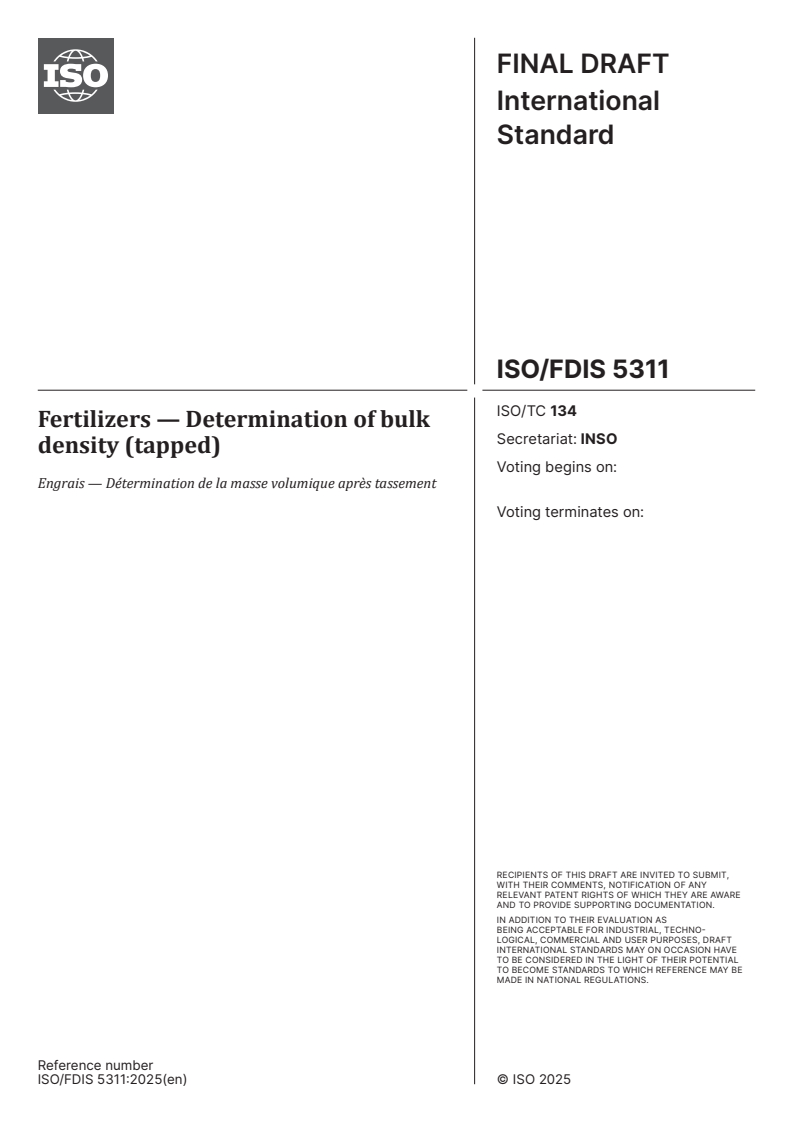
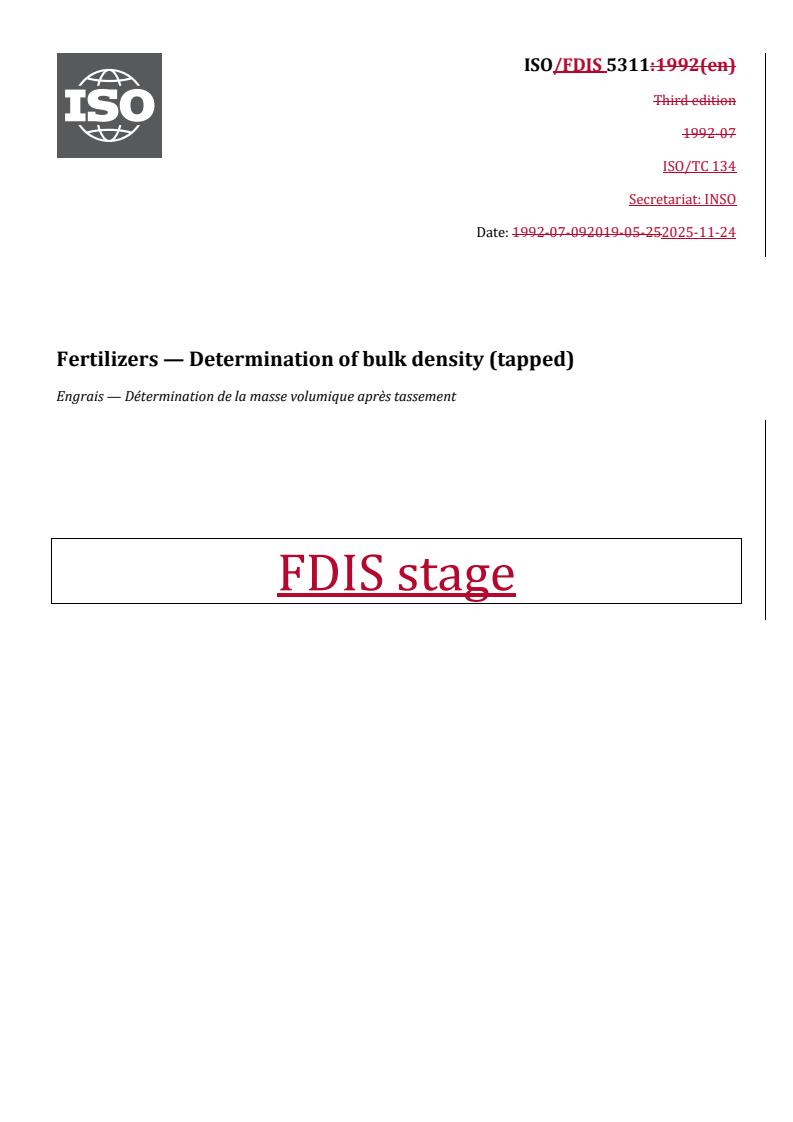
FINAL DRAFT
International
Standard
ISO/TC 134
Fertilizers — Determination of bulk
Secretariat: INSO
density (tapped)
Voting begins on:
Engrais — Détermination de la masse volumique après tassement
Voting terminates on:
RECIPIENTS OF THIS DRAFT ARE INVITED TO SUBMIT,
WITH THEIR COMMENTS, NOTIFICATION OF ANY
RELEVANT PATENT RIGHTS OF WHICH THEY ARE AWARE
AND TO PROVIDE SUPPOR TING DOCUMENTATION.
IN ADDITION TO THEIR EVALUATION AS
BEING ACCEPTABLE FOR INDUSTRIAL, TECHNO
LOGICAL, COMMERCIAL AND USER PURPOSES, DRAFT
INTERNATIONAL STANDARDS MAY ON OCCASION HAVE
TO BE CONSIDERED IN THE LIGHT OF THEIR POTENTIAL
TO BECOME STAN DARDS TO WHICH REFERENCE MAY BE
MADE IN NATIONAL REGULATIONS.
Reference number
FINAL DRAFT
International
Standard
ISO/TC 134
Fertilizers — Determination of bulk
Secretariat: INSO
density (tapped)
Voting begins on:
Engrais — Détermination de la masse volumique après tassement
Voting terminates on:
RECIPIENTS OF THIS DRAFT ARE INVITED TO SUBMIT,
WITH THEIR COMMENTS, NOTIFICATION OF ANY
RELEVANT PATENT RIGHTS OF WHICH THEY ARE AWARE
AND TO PROVIDE SUPPOR TING DOCUMENTATION.
© ISO 2025
IN ADDITION TO THEIR EVALUATION AS
All rights reserved. Unless otherwise specified, or required in the context of its implementation, no part of this publication may
BEING ACCEPTABLE FOR INDUSTRIAL, TECHNO
LOGICAL, COMMERCIAL AND USER PURPOSES, DRAFT
be reproduced or utilized otherwise in any form or by any means, electronic or mechanical, including photocopying, or posting on
INTERNATIONAL STANDARDS MAY ON OCCASION HAVE
the internet or an intranet, without prior written permission. Permission can be requested from either ISO at the address below
TO BE CONSIDERED IN THE LIGHT OF THEIR POTENTIAL
or ISO’s member body in the country of the requester.
TO BECOME STAN DARDS TO WHICH REFERENCE MAY BE
MADE IN NATIONAL REGULATIONS.
ISO copyright office
CP 401 • Ch. de Blandonnet 8
CH-1214 Vernier, Geneva
Phone: +41 22 749 01 11
Email: copyright@iso.org
Website: www.iso.org
Published in Switzerland Reference number
ii
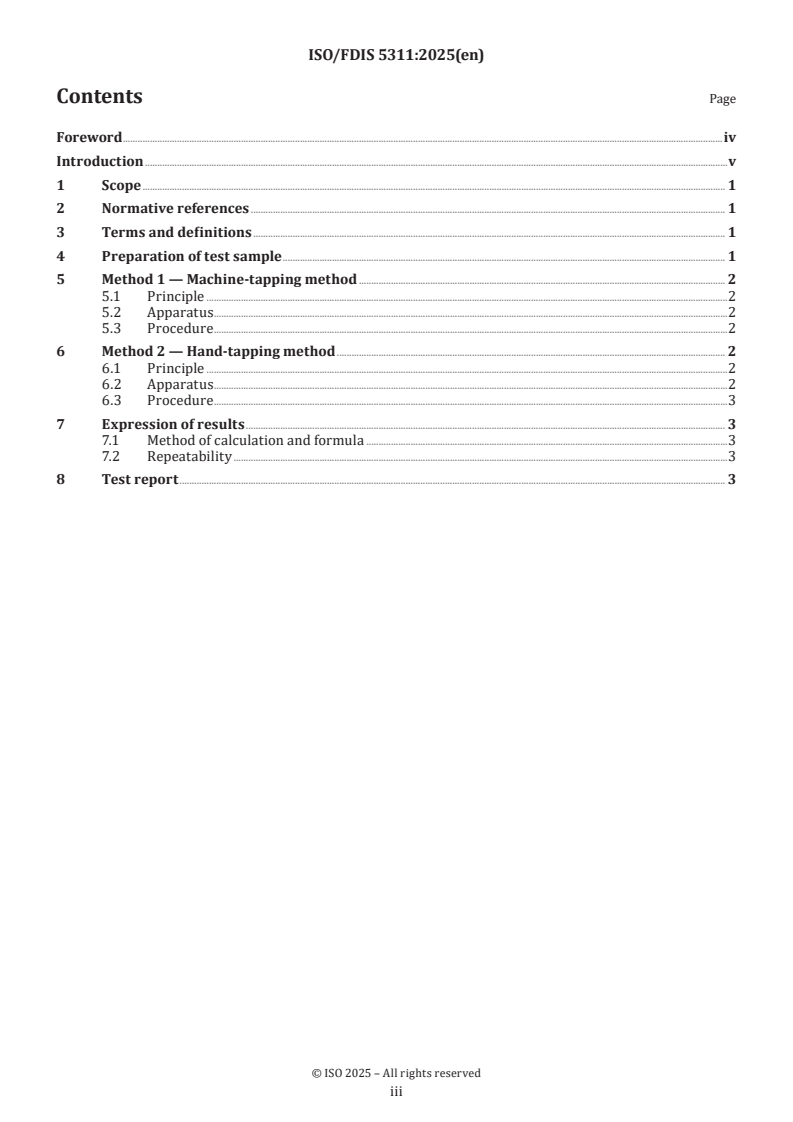
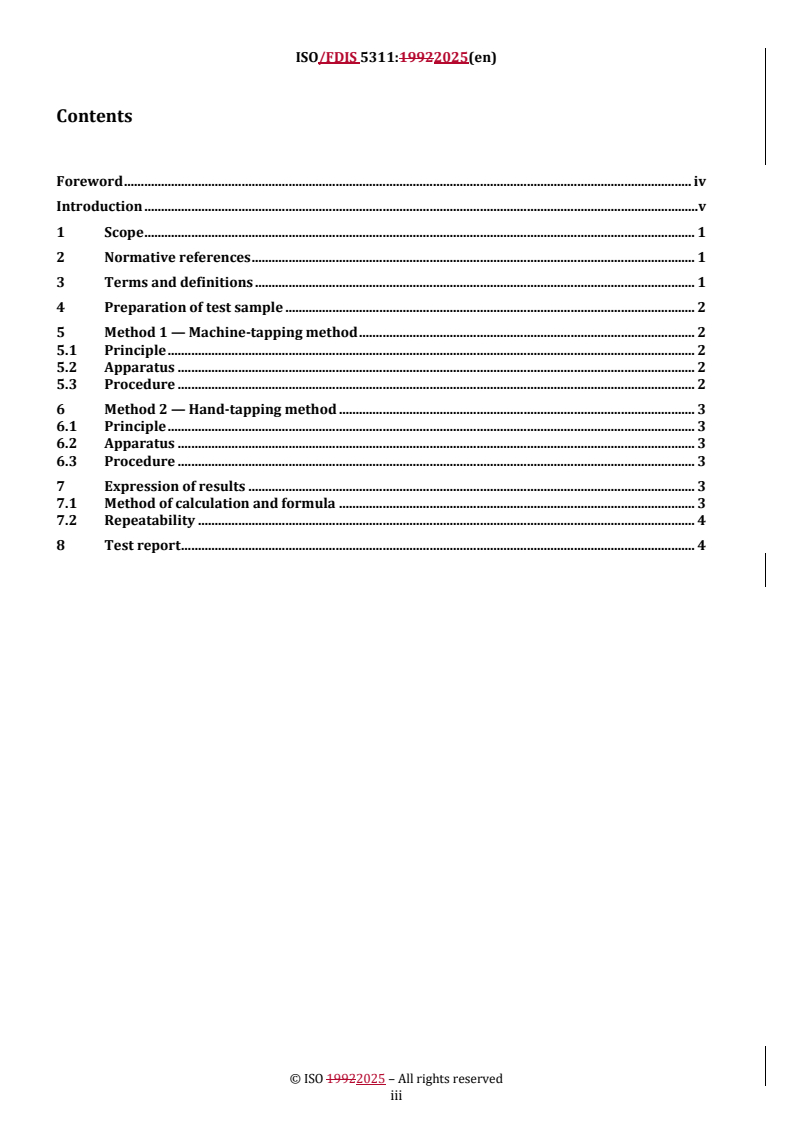
Contents Page
Foreword .iv
Introduction .v
1 Scope . 1
2 Normative references . 1
3 Terms and definitions . 1
4 Preparation of test sample . 1
5 Method 1 — Machine-tapping method . 2
5.1 Principle .2
5.2 Apparatus .2
5.3 Procedure .2
6 Method 2 — Hand-tapping method . 2
6.1 Principle .2
6.2 Apparatus .2
6.3 Procedure .3
7 Expression of results . 3
7.1 Method of calculation and formula .3
7.2 Repeatability .3
8 Test report . 3
iii
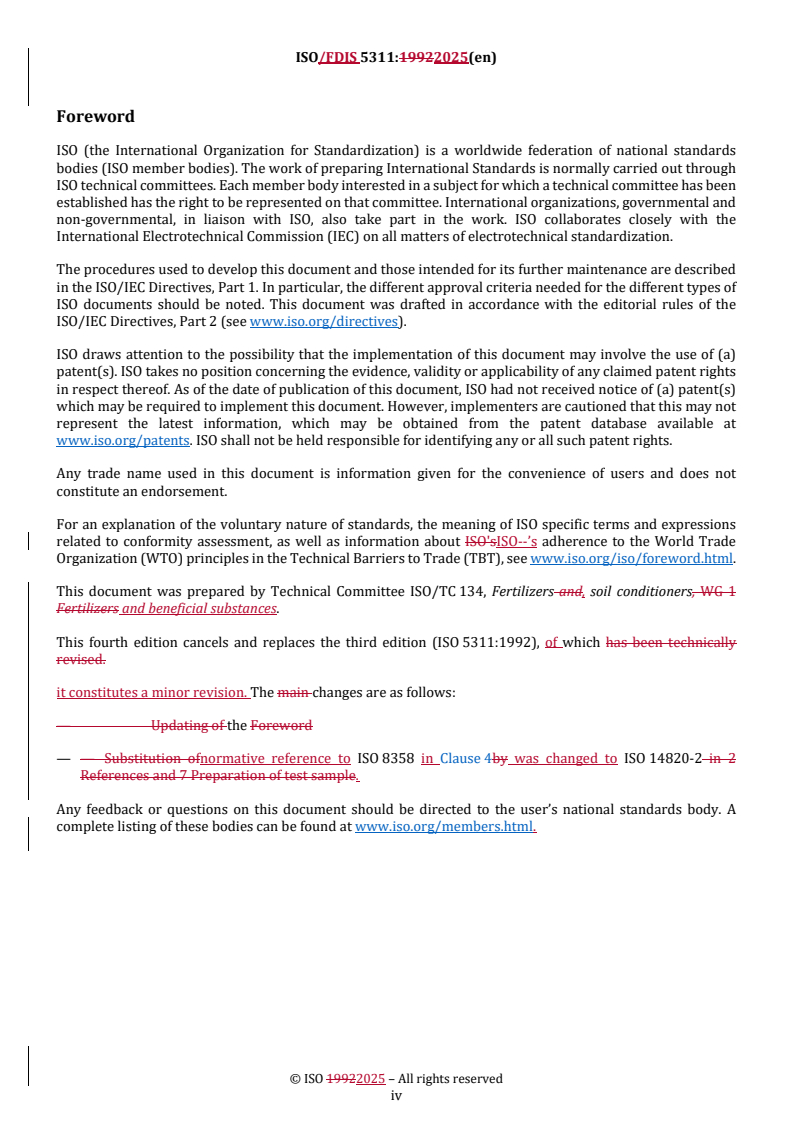
Foreword
ISO (the International Organization for Standardization) is a worldwide federation of national standards
bodies (ISO member bodies). The work of preparing International Standards is normally carried out through
ISO technical committees. Each member body interested in a subject for which a technical committee
has been established has the right to be represented on that committee. International organizations,
governmental and non-governmental, in liaison with ISO, also take part in the work. ISO collaborates closely
with the International Electrotechnical Commission (IEC) on all matters of electrotechnical standardization.
The procedures used to develop this document and those intended for its further maintenance are described
in the ISO/IEC Directives, Part 1. In particular, the different approval criteria needed for the different types
of ISO documents should be noted. This document was drafted in accordance with the editorial rules of the
ISO/IEC Directives, Part 2 (see www.iso.org/directives).
ISO draws attention to the possibility that the implementation of this document may involve the use of (a)
patent(s). ISO takes no position concerning the evidence, validity or applicability of any claimed patent
rights in respect thereof. As of the date of publication of this document, ISO had not received notice of (a)
patent(s) which may be required to implement this document. However, implementers are cautioned that
this may not represent the latest information, which may be obtained from the patent database available at
www.iso.org/patents. ISO shall not be held responsible for identifying any or all such patent rights.
Any trade name used in this document is information given for the convenience of users and does not
constitute an endorsement.
For an explanation of the voluntary nature of standards, the meaning of ISO specific terms and expressions
related to conformity assessment, as well as information about ISO ’s adherence to the World Trade
Organization (WTO) principles in the Technical Barriers to Trade (TBT), see www.iso.org/iso/foreword.html.
This document was prepared by Technical Committee ISO/TC 134, Fertilizers, soil conditioners and beneficial
substances.
This fourth edition cancels
...
Third edition
1992-07
ISO/TC 134
Secretariat: INSO
Date: 1992-07-092019-05-252025-11-24
Fertilizers — Determination of bulk density (tapped)
Engrais — Détermination de la masse volumique après tassement
FDIS stage
© ISO 19922025
All rights reserved. Unless otherwise specified, or required in the context of its implementation, no part of this publication
may be reproduced or utilized otherwise in any form or by any means, electronic or mechanical, including photocopying,
or posting on the internet or an intranet, without prior written permission. Permission can be requested from either ISO
at the address below or ISO’s member body in the country of the requester.
ISO copyright office
CP 401 • Ch. de Blandonnet 8
CH-1214 Vernier, Geneva
Phone: + 41 22 749 01 11
E-mail: copyright@iso.org
Website: www.iso.org
Published in Switzerland
© ISO 19922025 – All rights reserved
ii
Contents
Foreword . iv
Introduction . v
1 Scope . 1
2 Normative references . 1
3 Terms and definitions . 1
4 Preparation of test sample . 2
5 Method 1 — Machine-tapping method . 2
5.1 Principle . 2
5.2 Apparatus . 2
5.3 Procedure . 2
6 Method 2 — Hand-tapping method . 3
6.1 Principle . 3
6.2 Apparatus . 3
6.3 Procedure . 3
7 Expression of results . 3
7.1 Method of calculation and formula . 3
7.2 Repeatability . 4
8 Test report . 4
© ISO 19922025 – All rights reserved
iii
Foreword
ISO (the International Organization for Standardization) is a worldwide federation of national standards
bodies (ISO member bodies). The work of preparing International Standards is normally carried out through
ISO technical committees. Each member body interested in a subject for which a technical committee has been
established has the right to be represented on that committee. International organizations, governmental and
non-governmental, in liaison with ISO, also take part in the work. ISO collaborates closely with the
International Electrotechnical Commission (IEC) on all matters of electrotechnical standardization.
The procedures used to develop this document and those intended for its further maintenance are described
in the ISO/IEC Directives, Part 1. In particular, the different approval criteria needed for the different types of
ISO documents should be noted. This document was drafted in accordance with the editorial rules of the
ISO/IEC Directives, Part 2 (see www.iso.org/directives).
ISO draws attention to the possibility that the implementation of this document may involve the use of (a)
patent(s). ISO takes no position concerning the evidence, validity or applicability of any claimed patent rights
in respect thereof. As of the date of publication of this document, ISO had not received notice of (a) patent(s)
which may be required to implement this document. However, implementers are cautioned that this may not
represent the latest information, which may be obtained from the patent database available at
www.iso.org/patents. ISO shall not be held responsible for identifying any or all such patent rights.
Any trade name used in this document is information given for the convenience of users and does not
constitute an endorsement.
For an explanation of the voluntary nature of standards, the meaning of ISO specific terms and expressions
related to conformity assessment, as well as information about ISO'sISO--’s adherence to the World Trade
Organization (WTO) principles in the Technical Barriers to Trade (TBT), see www.iso.org/iso/foreword.html.
This document was prepared by Technical Committee ISO/TC 134, Fertilizers and, soil conditioners, WG 1
Fertilizers and beneficial substances.
This fourth edition cancels and replaces the third edition (ISO 5311:1992), of which has been technically
revised.
it constitutes a minor revision. The main changes are as follows:
— Updating of the Foreword
— — Substitution ofnormative reference to ISO 8358 in Clause 4by was changed to ISO 14820-2 in 2
References and 7 Preparation of test sample.
Any feedback or questions on this document should be directed to the user’s national standards body. A
complete listing of these bodies can be found at www.iso.org/members.html.
© ISO 19922025 – All rights reserved
iv
Introduction
The bulk densities (loose and tapped) of a fertilizer provide information relative to the required size of
packaging materials, store-houses, stock-rooms, etc. Generally, the bulk density (tapped) is up to 10 % greater
than the bulk density (loose), and sometimes it maycan exceed this value. Both bulk densities depend on the
actual density, surface form and particle size of the fertilizers.
The bulk density (loose) can be used to calculate the maximum volume of a given mass of fertilizer which
maycan be expected in practice. The actual volume occupied by a given mass of fertilizer will normally be
within the range calculated from the bulk density (loose) and the bulk density (tapped).
© ISO 19922025 – All rights reserved
v
Fertilizers — Determination of bulk density (tapped)
1 Scope
This International Standarddocument specifies two methods for the determination of the bulk density
(tapped) of solid fertilizers:
— the machine-tapping method (method 1);
— the hand-tapping method
...
Questions, Comments and Discussion
Ask us and Technical Secretary will try to provide an answer. You can facilitate discussion about the standard in here.
Loading comments...