

ISO 23399
(Main)Determination of antibacterial activity and efficacy of water-absorbent polyacrylate for urine absorbing products
- Abstract
This document specifies the test method for antibacterial activity and efficacy of antibacterial-processed water-absorbent polyacrylate for urine absorbing products
- Status
- Not Published
- Technical Committee
- ISO/TC 173/SC 3 - Products for ostomy and incontinence
- Drafting Committee
- ISO/TC 173/SC 3/WG 7 - Superabsorbent polymers
- Current Stage
- 6000 - International Standard under publication - 60 Publication
- Start Date
- 31-Oct-2026
Buy Documents
ISO/PRF 23399 - Determination of antibacterial activity and efficacy of water-absorbent polyacrylate for urine absorbing products

REDLINE ISO/PRF 23399 - Determination of antibacterial activity and efficacy of water-absorbent polyacrylate for urine absorbing products
ISO 23399 is an ISO test method for determining the antibacterial activity and antibacterial efficacy of antibacterial-processed water-absorbent polyacrylate used in urine absorbing products. It is written for laboratories and product teams that need to measure this material before it is incorporated into a finished product. The document sets out the specimens, media, bacteria, test sequence, calculations, and report items needed for that evaluation.
What does ISO 23399 specify?
ISO 23399 specifies a laboratory method for testing antibacterial activity and antibacterial efficacy in water-absorbent polyacrylate for urine absorbing products. The method is aimed at the material before it is built into a finished article, because extraction from a finished hygiene product can change the material’s properties.
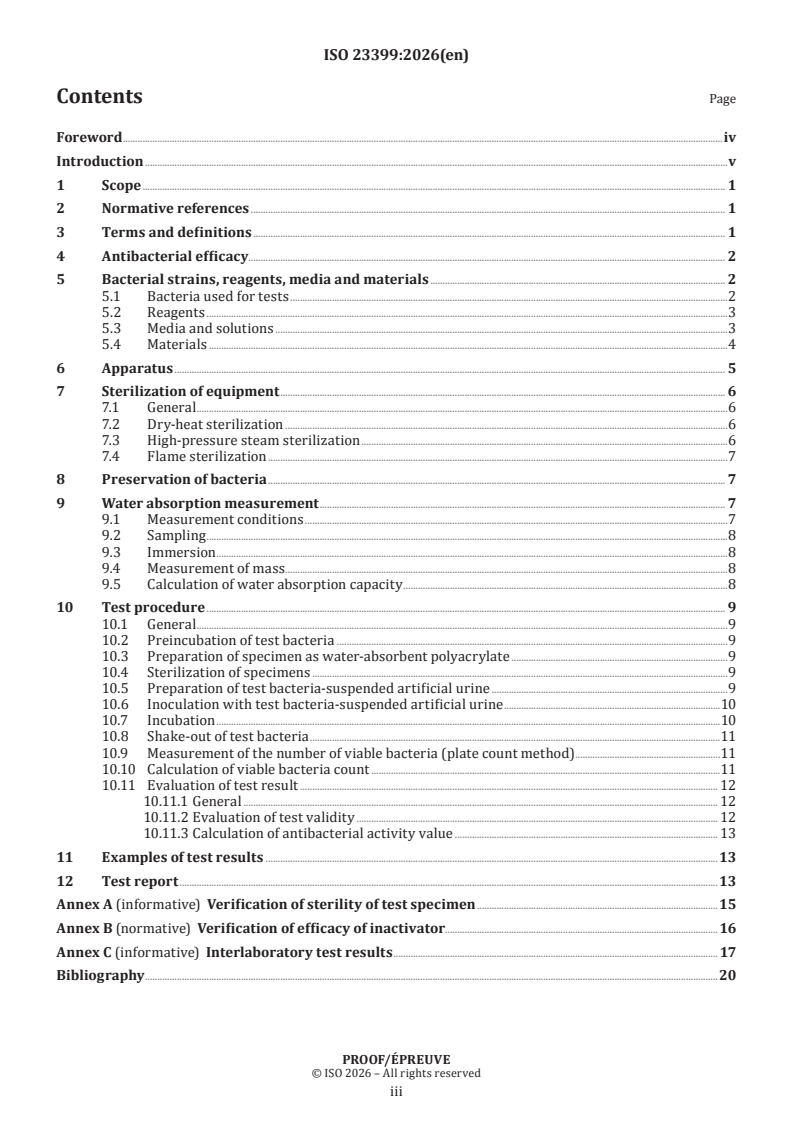
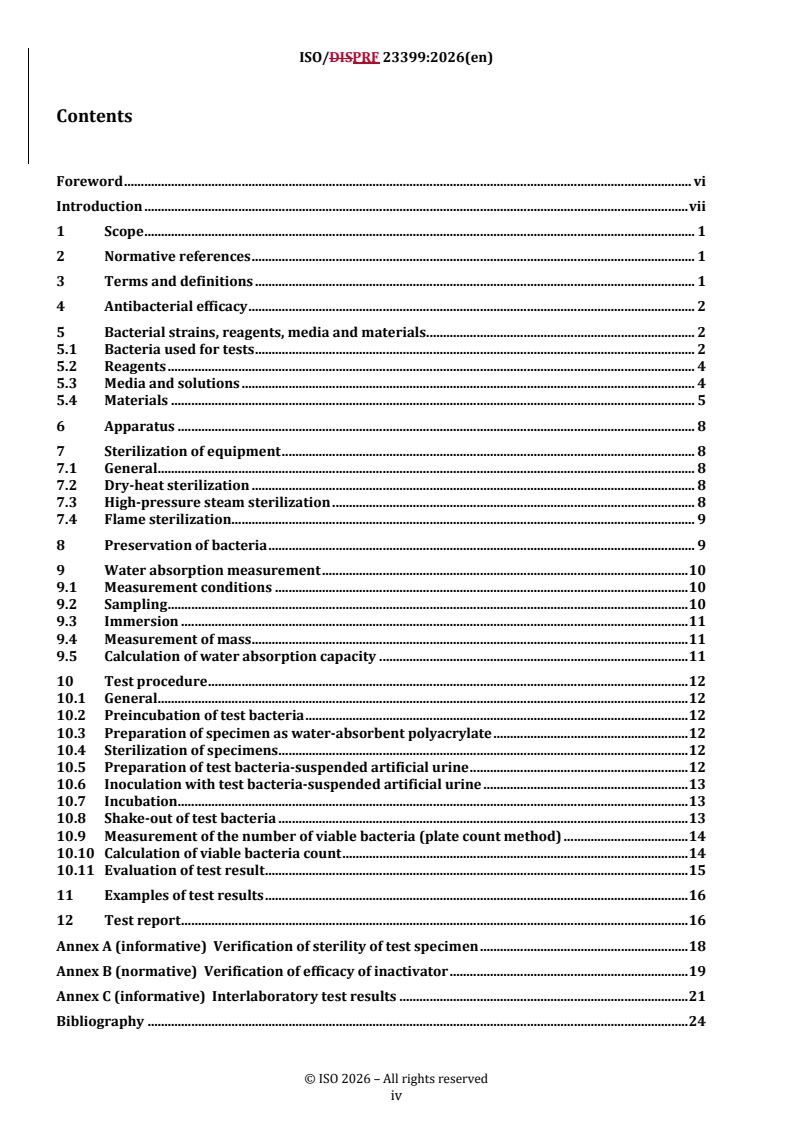
The document is organized into clauses 1 to 12, covering scope, references, terms, efficacy judgment, test bacteria and materials, apparatus, sterilization, bacterial preservation, water absorption measurement, the test procedure, example results, and the test report.
| Annex | What it covers |
|---|---|
| Annex A | Verification of sterility of the test specimen |
| Annex B | Verification of efficacy of the inactivator |
| Annex C | Interlaboratory test results |
What are the key requirements of ISO 23399?
ISO 23399 requires a combined microbiological and water-absorption-based test design. In practice, the antibacterial result is not judged only from bacterial counts - it is linked to how much artificial urine each specimen absorbs, so the test dose reflects the specimen’s actual uptake.
Test target and judgment
Clause 4 says antibacterial efficacy is judged from the antibacterial activity value for both test bacteria. A value of 2.0 or higher for both bacteria is the stated criterion for efficacy, although the client and the test operator may agree a higher criterion if needed.
That matters because the pass/fail line is explicit, and it can be tightened by agreement when a buyer or manufacturer wants a stricter internal target.
Bacteria, specimens, and control material
Clause 5.1 requires testing with Staphylococcus aureus and Escherichia coli. Other bacteria may be added for regional or purpose-specific use, but only after appropriate validation, and the report has to identify the strains, sources, and strain codes.
Clause 5.4 defines the control specimen as 100% cotton fabric prepared by repeated washing and rinsing, or, when that is not applicable, 100% cotton cloth in line with ISO 105-F02:2009. This control is the reference for bacterial growth and makes the antibacterial result interpretable.
Media, reagents, and apparatus
Clause 5.2 and 5.3 set out the reagents and prepared media, including artificial urine, nutrient agar, plate count agar, slant culture medium, SCDLP medium, and sodium chloride solution. Clause 6 lists the essential apparatus, including a class II biological safety cabinet, autoclave, dry heat sterilizer, incubator, balance, pH meter, spectrophotometer, and heat sealer.
That matters because the method is not a simple soak test - it depends on microbiological preparation, sterile handling, and controlled incubation.
Sterilization and bacterial preservation
Clause 7 requires cleaned equipment to be sterilized by dry heat or high-pressure steam, with flame sterilization used for the inoculation loop and test tubes. Clause 8 describes aseptic transfer and passage culture on slant medium, with incubation and refrigerated storage.
The practical point is that the method assumes disciplined culture handling. If the strain history, sterilization, or aseptic technique is inconsistent, the result can be invalid.
Water absorption measurement
Clause 9 measures water absorption capacity under controlled temperature and humidity. The control specimen and test specimen are prepared in teabags, immersed in artificial urine, drained, and weighed, and the absorption capacity per unit mass is calculated from those masses.
This step matters because the inoculation volume in the antibacterial test is matched to the specimen’s absorption capacity. In other words, the material is challenged with a dose proportional to what it can actually hold.
Test procedure and calculation
Clause 10 gives the core antibacterial test sequence: preincubate the test bacteria, prepare homogeneous 0.20 g specimens, sterilize them, prepare bacteria-suspended artificial urine, inoculate the specimens, incubate them for 18 hours at controlled temperature, shake out the bacteria, and determine viable counts by the plate count method.
Clause 10 then calculates the bacterial concentration of the inoculum, the bacterial count recovered from the shake-out suspension, the growth value of the control specimen, and the antibacterial activity value. Those calculations are the basis for the final judgment, so the laboratory needs to keep the dilution steps, colony counts, and averaging consistent.
Validity checks and result reporting
Clause 10 also requires the test to be judged valid only when the specified conditions are met, including acceptable control growth and verification of inactivator performance. Annex B provides the inactivator check, and Annex A allows the specimen sterilization step to be omitted if sterility has already been verified by the annex method.
Clause 12 lists the information that has to appear in the test report, including the standard reference, facility details, specimen identity, test conditions, bacterial concentration, water absorption capacity, validity result, antibacterial activity value, deviations, and unusual observations. That makes the report suitable for technical review, supplier comparison, and laboratory traceability.
What terms does ISO 23399 define?
ISO 23399 defines the terms used to interpret the method and its results.
- Water-absorbent polyacrylate - powdered or fibrous polyacrylate resin that can absorb and retain water or aqueous solutions, or both, at many times its own weight.
- Control specimen - the water-absorbent polyacrylate used to verify bacterial growth and validate the test; untreated material may serve this role.
- Antibacterial activity - the ability to reduce or mitigate bacterial growth.
- Antibacterial finish - the treatment applied to the water-absorbent polyacrylate to reduce bacterial growth.
- Antibacterial activity value - the difference between the mean logarithm of viable bacteria counts for the control specimen and the test specimen after 18 hours.
- Antibacterial efficacy - the measured effectiveness of the antibacterial finish, judged by the antibacterial activity value.
- CFU - colony-forming units, the counting unit used for viable bacteria in the plate count method.
Who uses ISO 23399?
ISO 23399 is used by laboratories that perform microbiological testing on urine absorbing products and related materials. It is also used by manufacturers and material suppliers of antibacterial-processed water-absorbent polyacrylate, especially in hygiene and incontinence product supply chains.
In practice, product developers, quality managers, and buyers use it to compare materials, confirm antibacterial claims before incorporation into a finished product, and document test results in a standardized way.
Which standards are used with ISO 23399?
ISO 23399 cites three normative references.
- ISO 105-F02:2009 - supplies the cotton and viscose adjacent fabric specification used when preparing the cotton-based control specimen.
- ISO 17190-5:2020 - supplies the teabag non-woven used for the water absorption measurement setup.
- ISO 80000-1:2022 - supplies the rounding rules used for reported calculated values.
What does the ISO 23399 document contain?
ISO 23399 contains the full test workflow, from specimen preparation to final reporting. Clause 9 gives the water absorption measurement method and its calculation formulas, while Clause 10 gives the antibacterial test sequence, the dilution and plating steps, and the formulas used to calculate viable counts, growth value, and antibacterial activity value.
The document also includes a strain table for the permitted test bacteria, a list of reagents and prepared media, and an apparatus list that supports aseptic microbiology work. Figure 1 illustrates the filter tip used in the procedure, and Figure 2 shows the bacterial transplant step for maintaining cultures.
Annex A gives a sterility verification procedure for specimens, Annex B gives the inactivator verification method, and Annex C provides interlaboratory test results with example data tables. Together, these parts support routine laboratory testing, method validation, product development, and technical comparison of antibacterial-processed water-absorbent polyacrylate.
Buy Documents
ISO/PRF 23399 - Determination of antibacterial activity and efficacy of water-absorbent polyacrylate for urine absorbing products
REDLINE ISO/PRF 23399 - Determination of antibacterial activity and efficacy of water-absorbent polyacrylate for urine absorbing products
Get Certified
Connect with accredited certification bodies for this standard

BSI Group
BSI (British Standards Institution) is the business standards company that helps organizations make excellence a habit.

TÜV Rheinland
TÜV Rheinland is a leading international provider of technical services.

TÜV SÜD
TÜV SÜD is a trusted partner of choice for safety, security and sustainability solutions.
Sponsored listings
Frequently Asked Questions
ISO 23399 is a draft published by the International Organization for Standardization (ISO). Its full title is "Determination of antibacterial activity and efficacy of water-absorbent polyacrylate for urine absorbing products". This standard covers: This document specifies the test method for antibacterial activity and efficacy of antibacterial-processed water-absorbent polyacrylate for urine absorbing products
This document specifies the test method for antibacterial activity and efficacy of antibacterial-processed water-absorbent polyacrylate for urine absorbing products
ISO 23399 is classified under the following ICS (International Classification for Standards) categories: 11.180.20 - Aids for incontinence and ostomy. The ICS classification helps identify the subject area and facilitates finding related standards.
ISO 23399 is available in PDF format for immediate download after purchase. The document can be added to your cart and obtained through the secure checkout process. Digital delivery ensures instant access to the complete standard document.
Standards Content (Sample)
Contents
- Introduction
- 1 Scope
- 2 Normative references
- 3 Terms and definitions
- 3.1 water-absorbent polyacrylate
- 3.2 control specimen
- 3.3 antibacterial activity
- 3.4 antibacterial finish
- 3.5 antibacterial activity value
- 3.6 antibacterial efficacy
- 4 Antibacterial efficacy
- 5 Bacterial strains, reagents, media and materials
- 5.1 Bacteria used for tests
- 5.2 Reagents
- 5.3 Media and solutions
- 5.4 Materials
- 6 Apparatus
- 6.2 Autoclave, capable of maintaining a temperature of (121 ± 2) °C (equivalent to pressure of
- 7 Sterilization of equipment
- 7.1 General
- 7.2 Dry-heat sterilization
- 7.3 High-pressure steam sterilization
- 7.4 Flame sterilization
- 8 Preservation of bacteria
- 9 Water absorption measurement
- 9.1 Measurement conditions
- 9.2 Sampling
- 9.3 Immersion
- 9.4 Measurement of mass
- 9.5 Calculation of water absorption capacity
- 10 Test procedure
- 10.1 General
- 10.2 Preincubation of test bacteria
- 10.3 Preparation of specimen as water-absorbent polyacrylate
- 10.4 Sterilization of specimens
- 10.5 Preparation of test bacteria-suspended artificial urine
- 10.6 Inoculation with test bacteria-suspended artificial urine
- 10.7 Incubation
- 10.8 Shake-out of test bacteria
- 10.9 Measurement of the number of viable bacteria (plate count method)
- 10.10 Calculation of viable bacteria count
- 10.11 Evaluation of test result
- 11 Examples of test results
- 12 Test report
- Annex A
- Annex B
- Annex C
- Bibliography
Introduction
[1] This document is based on JIS S 0252 (Japanese Industrial Standards S0252) developed by JHPIA (Japan Hygiene Products Industry Association) and JASPIA (Japan Superabsorbent Polymers Industrial Association). It refers to methods that have been in use for several years to characterize the safety and performance of water-absorbent polyacrylate in urine absorbing products.
PROOF/ÉPREUVE
International Standard ISO 23399:2026(en) Determination of antibacterial activity and efficacy of waterabsorbent polyacrylate for urine absorbing products
1 Scope
This document specifies the test method for the determination of antibacterial activity and antibacterial efficacy of antibacterial-processed water-absorbent polyacrylate used in urine absorbing products. NOTE This test method is intended for the evaluation of the antibacterial properties of antibacterial processed water-absorbent polyacrylate prior to its incorporation into a finished product. When the water-absorbent polyacrylate is extracted from a finished article such as a hygiene product, its properties could be altered due to processing conditions or the presence of other materials. Therefore, it is possible that results obtained from extracted water-absorbent polyacrylate do not represent the properties of the original unaltered material.
2 Normative references
The following documents are referred to in the text in such a way that some or all of their content constitutes requirements of this document. For dated references, only the edition cited applies. For undated references, the latest edition of the referenced document (including any amendments) applies. ISO 105-F02, Textiles — Tests for colour fastness — Part F02: Specification for cotton and viscose adjacent fabrics ISO 17190-5, Urine-absorbing aids for incontinence — Polyacrylate superabsorbent powders — Part 5: Test method for determination of the free swell capacity in saline by gravimetric measurement ISO 80000-1:2022, Quantities and units — Part 1: General
3 Terms and definitions
For the purposes of this document, the following terms and definitions apply. ISO and IEC maintain terminology databases for use in standardization at the following addresses:
- ISO Online browsing platform: available at https:// www .iso .org/ obp
- IEC Electropedia: available at https:// www .electropedia .org/
3.1 water-absorbent polyacrylate
powdered or fibrous resin comprising of polyacrylate that can absorb and retain either water or aqueous solutions, or both, 10 times to 1 000 times its own weight
3.2 control specimen
water-absorbent polyacrylate (3.1) used to verify the growth condition of the test bacteria and validate the test Note 1 to entry: The water-absorbent polyacrylate before the antibacterial treatment can be used as a control specimen with the same condition described in water-absorbent polyacrylate (3.1). Note 2 to entry: When the water-absorbent polyacrylate before the antibacterial treatment is not applicable (as in [2] 3.2, Note 1 to entry ) the 100 % cotton cloth described in ISO 105-F02 can be used without any chemical treatments such as the fluorescent bleach.
PROOF/ÉPREUVE
ISO 23399:2026(en)
3.3 antibacterial activity
activity to mitigate the growth of bacteria
3.4 antibacterial finish
treatment designed to mitigate the growth of bacteria on water-absorbent polyacrylate (3.1)
3.5 antibacterial activity value
difference between the arithmetic mean of the common logarithm of viable bacteria counts of control specimens (3.2) and that of test specimens after 18 h incubation
3.6 antibacterial efficacy
efficacy of antibacterial activity (3.3) shown by antibacterial finish (3.4) and evaluated by the antibacterial activity value (3.5)
4 Antibacterial efficacy
When the antibacterial activity values determined by the test method specified in this document are 2,0 or higher for both bacteria in Table 1, the antibacterial water-absorbent polyacrylate shall be regarded as having antibacterial efficacy.
An antibacterial activity value higher than 2,0 may be used as a criterion for judgement of antibacterial efficacy if so agreed between the test client and the test operator.
5 Bacterial strains, reagents, media and materials
5.1 Bacteria used for tests
The test shall be conducted on Staphylococcus aureus and Escherichia coli. Other types of bacteria can be used additionally depending on either the region or the purpose, or both after appropriate validations. The bacteria to be used in the test shall be identical to those in Table 1. The strains used in the test shall be stated in the test report together with the supply sources and strain codes. Table 1 — Bacteria strains for testing Bacteria type Strain code Preservation agency Staphylococcus aureus ATCC 6538P American Type Culture Collection FDA 209P Food and Drug Administration NBRC 12732 Biological Resource Center, National Institute of Technology and Evaluation CIP 53.156 Collection des Bacteries de l’ Institut Pasteur Deutsche DSM 346 Sammlung von Mikroorganismen und Zellkulturen Gmbh NCIB 8625 National Collection of Industrial and Marine Bacteria Ltd CICC 21600 China Center of Industrial Culture Collection Escherichia coli ATCC 8739 American Type Culture Collection NBRC 3972 Biological Resource Center, National Institute of Technology and Evaluation CIP 53.126 Collection des Bacteries de l’ Institut Pasteur Deutsche DSM 1576 Sammlung von Mikroorganismen und Zellkulturen Gmbh NCIB 8545 National Collection of Industrial and Marine Bacteria Ltd CICC 24176 China Center of Industrial Culture Collection PROOF/ÉPREUVE
ISO 23399:2026(en)
5.2 Reagents
5.2.1 Ammonium chloride, reagent grade.
5.2.2 Sodium chloride, reagent grade.
5.2.3 Hydrochloric acid, reagent grade.
5.2.4 Peptone from casein, reagent for microbiological testing. 5.2.5 Agar, reagent grade.
5.2.6 Glucose, reagent for microbiological testing.
5.2.7 Creatinine, reagent for microbiological testing.
5.2.8 Yeast extract, reagent for microbiological testing.
5.2.9 Sodium hydroxide, reagent grade.
5.2.10 Purified water, analytical quality water that can be used to prepare microbiological media, and purified by ion exchange, distillation, reverse osmosis, ultrafiltration, etc., alone or in combination. 5.2.11 Peptone from soybean, reagent for microbiological testing. 5.2.12 Tryptone, reagent for microbiological testing.
5.2.13 Meat extract, reagent for microbiological testing.
5.2.14 Urea, reagent grade.
5.2.15 Nonionic surfactant, polyoxyethylene sorbitan monooleate [Polysorbate 80 (Tween80)]. 5.2.16 Peptone, reagent for microbiological testing.
5.2.17 Potassium dihydrogen phosphate, reagent grade.
5.2.18 Disodium hydrogenphosphate, reagent grade.
5.2.19 Dipotassium hydrogenphosphate, reagent grade.
5.2.20 Lecithin, reagent for microbiological testing.
5.3 Media and solutions
Prepare and adjust media as described below. Commercially available products can be used if the composition is the same.
5.3.1 Artificial urine.
Put 10,0 g of urea (5.2.14), 9,0 g of sodium chloride (5.2.2), 2,5 g of disodium hydrogenphosphate (anhydrous) (5.2.18), 3,0 g of ammonium chloride (5.2.1), 2,5 g of dipotassium hydrogenphosphate (5.2.19), 2,0 g of PROOF/ÉPREUVE
ISO 23399:2026(en) creatinine (5.2.7), 1,5 g of meat extract (5.2.13) and 2,5 g of peptone (5.2.16) into 1 000 ml of purified water (5.2.10) in a flask and mix to dissolve thoroughly. Adjust the pH to 6,8 ± 0,2 (25 °C) with sodium hydroxide (5.2.9) solution or hydrochloric acid (5.2.3) solution, then filter through a membrane filter with pore size of 0,22 μm (5.4.6).
5.3.2 Nutrient agar.
Put 5,0 g of meat extract (5.2.13), 10,0 g of peptone (5.2.16) and 5,0 g of sodium chloride (5.2.2) into 1 000 ml of purified water (5.2.10) in a flask and mix to dissolve thoroughly. Adjust the pH to 7,0 ± 0,2 (25 °C) with sodium hydroxide (5.2.9) solution or hydrochloric acid (5.2.3) solution. Add 15,0 g of agar (5.2.5) powder, mix, and then steam sterilize under high pressure. If not used immediately after preparation, the agar shall be preserved at 5 °C to 10 °C. Any nutrient agar that has been kept for one month or longer after preparation shall not be used.
5.3.3 Plate count agar.
Put 2,5 g of yeast extract (5.2.8), 5,0 g of tryptone (5.2.12) and 1,0 g of glucose (5.2.6) into 1 000 ml of purified water (5.2.10) in a flask and mix to dissolve thoroughly. Adjust the pH to 7,1 ± 0,2 (25 °C) with sodium hydroxide (5.2.9) solution or hydrochloric acid (5.2.3) solution. Add 15,0 g of agar (5.2.5) powder, mix, and then steam sterilize under high pressure. If not used immediately after preparation, the agar shall be preserved at 5 °C to 10 °C. Any plate count agar that has been kept for one month or longer after preparation shall not be used.
5.3.4 Slant culture medium.
Warm and dissolve the nutrient agar medium described in (5.3.2). Pour 10 ml of the medium into a test tube (5.4.7), plug with a cotton stopper (5.4.15) and autoclave (6.2). After autoclaving, place the test tube in a clean room at an angle of about 15° to the horizontal surface and solidify the content. If the medium is not used immediately after preparation, store it at 5 °C to 10 °C. If the condensed water disappears, dissolve the media and solidify again before use. Any slant medium that has been kept for one month or longer after preparation shall not be used.
5.3.5 SCDLP medium.
Put 17,0 g of casein peptone (5.2.4), 3,0 g of soybean peptone (5.2.11), 5,0 g of sodium chloride (5.2.2), 2,5 g of dipotassium hydrogenphosphate (5.2.19), 2,5 g of glucose (5.2.6) and 1,0 g of lecithin (5.2.20) into 1 000 ml of purified water (5.2.10) in a flask and mix. After thoroughly dissolving the content, add 7,0 g of polysorbate 80 (5.2.15) and dissolve. Adjust the pH to 7,0 ± 0,2 (25 °C) with sodium hydroxide solution or hydrochloric acid solution, then autoclave. If the medium is not used immediately after preparation, store it at 5 °C to 10 °C. Any SCDLP medium that has been kept for one month or longer after preparation shall not be used. 5.3.6 Sodium chloride solution.
Put 8,5 g of sodium chloride 5.2.2 into 1 000 ml of purified water 5.2.10 in a flask, dissolve completely. Dispense the mixture into test tubes 5.4.7 as necessary and autoclave (6.2). If the sodium chloride solution is not used immediately after preparation, store it at 5 °C to 10 °C. Any sodium chloride solution that has been kept for one month or longer after preparation shall not be used.
5.4 Materials
5.4.1 Control specimen. It consists of 100% cotton fabric as specified in ISO 105-F02, prepared according to the following steps. Wash the fabric at 60°C for 10 minutes without detergent or bleaching agent. Rinse the fabric twice, each time for 5 minutes. Repeat the above washing and rinsing cycle 10 times. Air-dry the fabric to complete the preparation of the control specimen.
5.4.2 Aluminium foil, suitable for wrapping the opening of a vial as a lid
PROOF/ÉPREUVE
ISO 23399:2026(en)
5.4.3 Teabag made of non-woven, specified in ISO 17190-5, having dimensions of 60 mm × 40 mm to
60 mm × 85 mm and made of non-apertured heat-sealable non-woven (hereinafter referred to as “teabag”). 5.4.4 Drip pan, suitable for receiving liquid dripping from the suspended teabags. 5.4.5 Clip, for pinching a teabag for suspension after immersion in artificial urine. 5.4.6 Membrane filter, of 0,22 μm pore size.
5.4.7 Test tube, made of glass and used to sterilize.
5.4.8 Petri dish, made of plastic or glass and having an inner diameter of approximately 90 mm. 5.4.9 Spatula, to accommodate 0,2 g of water-absorbent polyacrylate. 5.4.10 Vial, made of glass with screw cap, having capacity of 50 ml made of tetrafluoroethylene resin or silicon, and cap made of phenol resin.
5.4.11 Inoculation loop, for microbiological testing.
5.4.12 Tray, made of plastic, glass, or stainless-steel, with enough capacity to contain 1 l of artificial urine. 5.4.13 Pipettes, made of plastic or glass, with capacities of (50 ± 0,5) ml, (25 ± 0,25) ml, (10 ± 0,1) ml, and (5 ± 0,05) ml.
5.4.14 Filtering tip, 5 ml tips filled with gauze for biochemical testing for cut into approximately 20 mm × 20 mm in the top (see Figure 1).
Figure 1 — Example of filter tip 5.4.15 Cotton stopper, using raw cotton or alternatively, silicon stopper, metal stopper, molton cap. 5.4.16 Tweezers.
6 Apparatus
6.1 Class II biological safety cabinet.
PROOF/ÉPREUVE
ISO 23399:2026(en)
6.2 Autoclave, capable of maintaining a temperature of (121 ± 2) °C (equivalent to pressure of
103 kPa ± 2 kPa).
6.3 Automatic pipettor, made of a plastic or glass, to which a pipette can be attached. 6.4 Dry heat sterilizer, capable of maintaining a temperature of 120 °C to 170 °C. 6.5 Water bath, capable of controlling the temperature to ±1 °C. 6.6 Test tube shaker, for microbiological test, e.g. Vortex® mixer. 6.7 Timer, accurate to 1 second in 30 minutes.
6.8 Drying rack, for suspending teabags.
6.9 Electronic precision balance, with 1 mg or better sensitivity. 6.10 Incubator, capable of maintaining a temperature of (36 ± 2) °C. 6.11 Heat sealer, capable of bonding non-woven.
6.12 Spectrophotometer, capable of measurable at the wavelength of 660 nm. 6.13 pH meter, a glass electrode for pH measurement.
6.14 Micropipette.
7 Sterilization of equipment
7.1 General
Use a neutral detergent, thoroughly rinse and dry, and then sterilize with dry heat or high-pressure steam. For sterilization, the method detailed in 7.2 or 7.3 shall be used. For flame-sterilizing an inoculation loop (5.4.11) and test tubes (5.4.7), the method detailed in 7.4 shall be used.
7.2 Dry-heat sterilization
Put the test instruments to be sterilized in a dry heat sterilizer (6.4) maintained at 160 °C to 170 °C and keep it for 1 to 2 hours. Instruments whose cotton stoppers (5.4.15) or wrapping paper are found to be wet with water after the dry heat sterilization shall not be used.
7.3 High-pressure steam sterilization
Fill an autoclave (6.2) with water, and put a wire-mesh basket containing the test instruments to be sterilized, culture media and test pieces etc. on the shelf of the autoclave. Start the heating, and keep the temperature at 121 °C (equivalent to the pressure of 103 kPa) for 15 to 20 minutes. Stop the heating, and after allowing the temperature to drop below 100 °C, open the exhaust valve to release vapour. Then open the lid of the autoclave to take out sterilized instruments, and cool them in the safety cabinet (6.1) as necessary. Wash the autoclave with a neutral detergent and rinse thoroughly with water if necessary, in order to prevent contamination by the medium, antibacterial agents, etc. and keep it clean. PROOF/ÉPREUVE
ISO 23399:2026(en)
7.4 Flame sterilization
Hold the instruments to be sterilized in a flame of gas or alcohol until complete redness if it is an inoculation loop (5.4.11), and for 2 to 3 seconds if it is a test tube (5.4.7).
...
Contents
- Introduction
- 1 Scope
- 1.1 Note
- 2 Normative references
- 3 Terms and definitions
- 3.1 Waterwater-absorbent polyacrylate, noun
- 3.2 Controlcontrol specimen, noun
- 3.3 Antibacterialantibacterial activity, noun
- 3.4 Antibacterialantibacterial finish, noun
- 3.5 Antibacterialantibacterial activity value, noun
- 3.6 Antibacterialantibacterial efficacy, noun
- 4 Antibacterial efficacy
- 5 Bacterial strains, reagents, media and materials
- 5.1 Bacteria used for tests
- 5.2 Reagents
- 5.3 Media and solutions
- 5.4 Materials
- 6 Apparatus
- 7 Sterilization of equipment
- 7.1 General
- 8 Preservation of bacteria
- 1 Condensedcondensed water
- 2 Slantslant medium
- 9 Water absorption measurement
- 9.1 Measurement conditions
- 9.2 Sampling
- 9.3 Immersion
- 9.4 Measurement of mass
- 9.5 Calculation of water absorption capacity
- 10 Test procedure
- 10.1 General
- 11 Examples of test results
- 12 Test report
- Annex A
- Annex B
- Annex C
- Bibliography
Introduction
[1] This document is based on JIS S 0252 (Japanese Industrial Standards S0252) developed by JHPIA (Japan Hygiene Products Industry Association) and JASPIA (Japan Superabsorbent Polymers Industrial Association). It refers to methods that have been in use for several years to characterize the safety and performance of water-absorbent polyacrylate in urine absorbing products.
ISO/DISPRF 23399:2026(en) Determination of antibacterial activity and efficacy of waterabsorbent polyacrylate for urine absorbing products
1 Scope
This document specifies the test method for the determination of antibacterial activity and antibacterial efficacy of antibacterial-processed water-absorbent polyacrylate used in urine absorbing products.
1.1 Note
NOTE This test method is intended for the evaluation of the antibacterial properties of antibacterial processed water-absorbent polyacrylate prior to its incorporation into a finished product. When the water-absorbent polyacrylate is extracted from a finished article such as a hygiene product, its properties could be altered due to processing conditions or the presence of other materials. Therefore, it can beis possible that results obtained from extracted water-absorbent polyacrylate do not represent the properties of the original virginunaltered material.
2 Normative references
The following documents are referred to in the text in such a way that some or all of their content constitutes requirements of this document. For dated references, only the edition cited applies. For undated references, the latest edition of the referenced document (including any amendments) applies. ISO 105-F02:2009, Textiles — Tests for colour fastness — Part F02: Specification for cotton and viscose adjacent fabrics ISO 17190-5:2020, Urine-absorbing aids for incontinence — Polyacrylate superabsorbent powders — Part 5:
Test method for determination of the free swell capacity in saline by gravimetric measurement ISO 80000-1:2022, Quantities and units — Part 1: General
3 Terms and definitions
For the purposes of this document, the following terms and definitions apply. ISO and IEC maintain terminology databases for use in standardization at the following addresses:
- ISO Online browsing platform: available at https://www.iso.org/obphttps://www.iso.org/obp
- IEC Electropedia: available at https://www.electropedia.org/https://www.electropedia.org/
3.1 Waterwater-absorbent polyacrylate, noun
powdered or fibrous resin comprising of polyacrylate that can absorb and retain either water or aqueous solutions, or both, 10 times to 1 000 times its own weight
3.2 Controlcontrol specimen, noun
, noun Waterwater-absorbent polyacrylate (3.1) used to verify the growth condition of the test bacteria and validate the test.
Note 1 to entry: The water-absorbent polyacrylate before the antibacterial treatment can be used as a control specimen with the same condition described in Waterwater-absorbent polyacrylate (3.1) .).
ISO/DISPRF 23399:2026(en) Note 2 to entry: When the water-absorbent polyacrylate before the antibacterial treatment is not applicable, (as in 3.2, [2] Note 1 to entry ,) the 100 % cotton cloth described in ISO 105-F02 :2009 can be used without any chemical treatments such as the fluorescent bleach, etc.
3.3 Antibacterialantibacterial activity, noun
activity to mitigate the growth of bacteria
3.4 Antibacterialantibacterial finish, noun
treatment designed to mitigate the growth of bacteria on Waterwater-absorbent polyacrylate (3.1)
3.5 Antibacterialantibacterial activity value, noun
Differencedifference between the arithmetic mean of the common logarithm of viable bacteria counts of control specimens (3.2) and that of test specimens after 18 h incubation.
3.6 Antibacterialantibacterial efficacy, noun
efficacy of Antibacterialantibacterial activity (3.3) shown by Antibacterialantibacterial finish (3.4) and evaluated by the Antibacterialantibacterial activity value (3.5)
4 Antibacterial efficacy
When the Antibacterial antibacterial activity values determined by the test method specified in this standarddocument are 2,0 or higher for the both bacteria in Table 1said below,, the antibacterial Waterwaterabsorbent polyacrylate shall be regarded as having Antibacterialantibacterial efficacy. An Antibacterialantibacterial activity value higher than 2,0 may be used as a criterion for judgement of antibacterial efficacy if so agreed between the test client and the test operator.
5 Bacterial strains, reagents, media and materials
5.1 Bacteria used for tests
The test shall be conducted on Staphylococcus aureus and Escherichia coli. Other types of bacteria can be used additionally depending on either the region or the purpose, or both after appropriate validations. The bacteria to be used in the test shall be identical to those in Table 1. The strains used in the test shall be stated in the test report together with the supply sources and strain codes. Table 1 — Bacteria strains for testing Bacteria type Strain code Preservation agency Staphylococcus aureus ATCC 6538P American Type Culture Collection FDA 209P Food and Drug Administration NBRC 12732 Biological Resource Center, National Institute of Technology and Evaluation CIP 53.156 Collection des Bacteries del’de l’ Institut Pasteur Deutsche DSM 346 Sammlung von Mikroorganismen und Zellkulturen Gmbh NCIB 8625 National Collection of Industrial and Marine Bacteria Ltd CICC 21600 China Center of Industrial Culture Collection
ISO/DISPRF 23399:2026(en) Bacteria type Strain code Preservation agency Escherichia coli ATCC 8739 American Type Culture Collection NBRC 3972 Biological Resource Center, National Institute of Technology and Evaluation CIP 53.126 Collection des Bacteries del’de l’ Institut Pasteur Deutsche DSM 1576 Sammlung von Mikroorganismen und Zellkulturen Gmbh NCIB 8545 National Collection of Industrial and Marine Bacteria Ltd CICC 24176 China Center of Industrial Culture Collection
ISO/DISPRF 23399:2026(en)
5.2 Reagents
5.2.1 Ammonium chloride: Reagent, reagent grade.
5.2.2 Sodium chloride: Reagent, reagent grade.
5.2.3 Hydrochloric acid: Reagent, reagent grade.
5.2.4 Peptone from casein: Reagent, reagent for microbiological testing. 5.2.5 Agar: Reagent, reagent grade.
5.2.6 Glucose: Reagent, reagent for microbiological testing.
5.2.7 Creatinine: Reagent, reagent for microbiological testing. 5.2.8 Yeast extract: Reagent, reagent for microbiological testing. 5.2.9 Sodium hydroxide: Reagent, reagent grade.
5.2.10 Purified water:, analytical quality water that can be used to prepare microbiological media, and purified by ion exchange, distillation, reverse osmosis, ultrafiltration, etc., alone or in combination. 5.2.11 Peptone from soybean: Reagent, reagent for microbiological testing. 5.2.12 Tryptone: Reagent, reagent for microbiological testing. 5.2.13 Meat extract: Reagent, reagent for microbiological testing. 5.2.14 Urea: Reagent, reagent grade.
5.2.15 Nonionic surfactant, polyoxyethylene sorbitan monooleate [Polysorbate 80 (Tween80)])]. 5.2.16 Peptone: Reagent, reagent for microbiological testing.
5.2.17 Potassium dihydrogen phosphate: Reagent, reagent grade. 5.2.18 Disodium hydrogenphosphate: Reagent, reagent grade.
5.2.19 Dipotassium hydrogenphosphate: Reagent, reagent grade.
5.2.20 Lecithin: Reagent, reagent for microbiological testing.
5.3 Media and solutions
Prepare and adjust media as described below. Commercially available products can be used if the composition is the same.
5.3.1 Artificial urine:.
Put 10,0 g of urea (5.2.14,), 9,0 g of sodium chloride (5.2.2 ,), 2,5 g of disodium hydrogenphosphate (anhydrous) (5.2.18) ,), 3,0 g of ammonium chloride (5.2.1 ,), 2,5 g of dipotassium hydrogenphosphate (5.2.19 ,), 2,0 g of creatinine (5.2.7 ,), 1,5 g of meat extract (5.2.13) and 2,5 g of peptone (5.2.16) into 1 000 ml of purified water (5.2.10) in a flask and mix to dissolve thoroughly. Adjust the pH to 6,8 ± ± 0,2 (25 °C) with sodium hydroxide (5.2.9) solution or hydrochloric acid (5.2.3) solution, then filter through a membrane filter with pore size of 0,22 μm (5.4.6).
ISO/DISPRF 23399:2026(en) 5.3.2 Nutrient agar:.
Put 5,0 g of meat extract (5.2.13 ,), 10,0 g of peptone (5.2.16) and 5,0 g of sodium chloride (5.2.2) into 1 000 ml of purified water (5.2.10) in a flask and mix to dissolve thoroughly. Adjust the pH to 7,0 ± ± 0,2 (25 °C) with sodium hydroxide (5.2.9) solution or hydrochloric acid (5.2.3) solution. Add 15,0 g of agar (5.2.5) powder, mix, and then steam sterilize under high pressure. If not used immediately after preparation, the agar shall be preserved at 5 °C to 10 °C. Any nutrient agar that has been kept for one month or longer after preparation shall not be used.
5.3.3 Plate count agar:.
Put 2,5 g of yeast extract (5.2.8 ,), 5,0 g of tryptone (5.2.12) and 1,0 g of glucose (5.2.6) into 1 000 ml of purified water (5.2.10) in a flask and mix to dissolve thoroughly. Adjust the pH to 7,1 ± 0,2 (25 °C) with sodium hydroxide (5.2.9) solution or hydrochloric acid (5.2.3) solution. Add 15,0 g of agar (5.2.5) powder, mix, and then steam sterilize under high pressure. If not used immediately after preparation, the agar shall be preserved at 5 °C to 10 °C. Any plate count agar that has been kept for one month or longer after preparation shall not be used.
5.3.4 Slant culture medium:.
Warm and dissolve the nutrient agar medium described in (5.3.2.). Pour 10 ml of the medium into a test tube (5.4.7 ,), plug with a cotton stopper (5.4.15) and autoclave (6.2 .). After autoclaving, place the test tube in a clean room at an angle of about 15 degrees° to the horizontal surface and solidify the content. If the medium is not used immediately after preparation, store it at 5 °C to 10 °C. If the condensed water disappears, dissolve the media and solidify again before use. Any slant medium that has been kept for one month or longer after preparation shall not be used.
5.3.5 SCDLP medium:.
Put 17,0 g of casein peptone (5.2.4 ,), 3,0 g of soybean peptone (5.2.11 ,), 5,0 g of sodium chloride (5.2.2 ,), 2,5 g of Dipotassiumdipotassium hydrogenphosphate (5.2.19 ,), 2,5 g of glucose (5.2.6) and 1,0 g of lecithin (5.2.20) into 1 000 ml of purified water (5.2.10) in a flask and mix. After thoroughly dissolving the content, add 7,0 g of polysorbate 80 (5.2.15 ,) and dissolve. Adjust the pH to 7,0 ± 0,2 (25 °C) with sodium hydroxide solution or hydrochloric acid solution, then autoclave. If the medium is not used immediately after preparation, store it at 5 °C to 10 °C. Any SCDLP medium that has been kept for one month or longer after preparation shall not be used.
5.3.6 Sodium chloride solution:.
Put 8,5 g of sodium chloride 5.2.2 into 1 000 ml of purified water 5.2.10 in a flask, dissolve completely. Dispense the mixture into test tubes 5.4.7 as necessary and autoclave (6.2 .). If the sodium chloride solution is not used immediately after preparation, store it at 5 °C to 10 °C. Any sodium chloride solution that has been kept for one month or longer after preparation shall not be used.
5.4 Materials
5.4.1 Control specimen:. It consists of 100% cotton fabric as specified in ISO 105-F02:2009, prepared according to the following steps:. Wash the fabric at 60°C for 10 minutes without detergent or bleaching
ISO/DISPRF 23399:2026(en) agent. Rinse the fabric twice, at each time for 5 minutes. Repeat the above washing and rinsing cycle 10 times. Air-dry the fabric to complete the preparation of the control specimen.
5.4.2 Aluminium foil, suitable for wrapping the opening of a vial as a lid
5.4.3 Teabag made of non-woven, specified in ISO 17190-5:2020, having dimensions of 60 mm x×
40 mm to 60 mm x× 85 mm and made of non-apertured heat-sealable non-woven (hereinafter referred to as “teabag)”).
5.4.4 Drip pan, suitable for receiving liquid dripping from the suspended teabags. 5.4.5 Clip, for pinching a teabag for suspension after immersion in artificial urine. 5.4.6 Membrane filter:, of 0,22 μm of pore size.
5.4.7 Test tube, made of glass and used to sterilize.
5.4.8 Petri dish:, made of plastic or glass and having an inner diameter of aboutapproximately 90 mm. 5.4.9 Spatula, to accommodate 0,2 g of water-absorbent polyacrylate. 5.4.10 Vial, made of glass with screw cap, having capacity of 50 ml made of tetrafluoroethylene resin or silicon, and cap made of phenol resin.
5.4.11 Inoculation loop, for microbiological testing.
5.4.12 Tray, made of plastic, glass, or stainless-steel, with enough capacity to contain 1L1 l of artificial urine.
5.4.13 Pipettes, made of plastic or glass, with capacities of (50 ml ± ± 0,5) ml, (25 ml ± ± 0,25) ml, (10 ml ± ± 0,1) ml, and (5 ml ± ± 0,05) ml.
5.4.14 Filtering tip:, 5 ml tips filled with gauze for biochemical testing for cut into approximately 20 mm x × 20 mm in the top (see Figure 1)).
ISO/DISPRF 23399:2026(en)
Figure 1 — An exampleExample of filter tip
ISO/DISPRF 23399:2026(en) 5.4.15 Cotton stopper:, using raw cotton or alternatively, silicon stopper, metal stopper, molton cap. 5.4.16 Tweezers.
6 Apparatus
6.1 Class II biological Safetysafety cabinet.
6.2 Autoclave, capable of maintaining a temperature of (121 °C ± ± 2) °C (equivalent to pressure of 103 kPa ± ± 2 kPa)).
6.3 Automatic pipettor, made of a plastic or glass, to which a pipette can be attached. 6.4 Dry heat sterilizer, capable of maintaining a temperature of 120 °C to 170 °C. 6.5 Water bath, capable of controlling the temperature to ±1 °C. 6.6 Test tube shaker, for microbiological test, e.g. Vortex® mixer. 6.7 Timer, accurate to 1 second in 30 minutes.
6.8 Drying rack, for suspending teabags.
6.9 Electronic precision balance, with 1 mg or better sensitivity. 6.10 Incubator, capable of maintaining a temperature of (36 °C ± ± 2) °C. 6.11 Heat sealer, capable of bonding non-woven.
6.12 Spectrophotometer, capable of measurable at the wavelength of 660 nm. 6.13 pH meter, a glass electrode for pH measurement.
6.14 Micropipette.
7 Sterilization of equipment
7.1 General
Use a neutral detergent, thoroughly rinse and dry, and then sterilize with dry heat or high-pressure steam. For sterilization, the method detailed in 7.2 or 7.3 below shall be used. For flame-sterilizing an inoculation loop (5.4.11) and test tubes (5.4.7,), the method detailed in 7.4 below shall be used. 7.17.2 Dry-heat sterilization:
Put the test instruments to be sterilized in a dry heat sterilizer (6.4) maintained at 160 °C to 170 °C and keep it for 1 to 2 hours. These instrumentsInstruments whose cotton stoppers (5.4.15) or wrapping paper are found to be wet with water after the dry heat sterilization shall not be used. 7.27.3 High-pressure steam sterilization:
Fill an autoclave (6.2) with water, and put a wire-mesh basket containing the test instruments to be sterilized, culture media and test pieces etc. on the shelf of the autoclave. Start the heating, and keep the temperature at 121 °C (equivalent to the pressure of 103 kPa) for 15 to 20 minutes. Stop the heating, and after allowing the temperature to drop below 100 °C, open the exhaust valve to release vapour. Then open the lid of the autoclave to take out sterilized instruments, and cool them in the safety cabinet (6.1) as necessary.
ISO/DISPRF 23399:2026(en) Wash the autoclave with a neutral detergent and rinse thoroughly with water if necessary, in order to prevent contamination by the medium, antibacterial agents, etc. and keep it clean. 7.37.4 Flame sterilization:
Hold the instruments to be sterilized in a flame of gas or alcohol until complete redness if it is an inoculation loop (5.4.11,), and for 2 to 3 seconds if it is a test tube (5.4.7 .).
...