


ISO 4138:2012
(Main)Passenger cars — Steady-state circular driving behaviour — Open-loop test methods
Passenger cars — Steady-state circular driving behaviour — Open-loop test methods
ISO 4138:2012 specifies open-loop test methods for determining the steady-state circular driving behaviour of passenger cars as defined in ISO 3833 and of light trucks, such behaviour being one of the factors comprising vehicle dynamics and road-holding properties. The open-loop manoeuvres included in these methods are not representative of real driving conditions, but are nevertheless useful for obtaining measures of vehicle steady-state behaviour resulting from several specific types of control inputs under closely controlled test conditions.
Voitures particulières — Tenue de route en régime permanent sur trajectoire circulaire — Méthodes d'essai en boucle ouverte
General Information
- Status
- Withdrawn
- Publication Date
- 31-May-2012
- Withdrawal Date
- 31-May-2012
- Technical Committee
- ISO/TC 22/SC 33 - Vehicle dynamics and chassis components
- Drafting Committee
- ISO/TC 22/SC 33/WG 2 - Vehicle dynamics of passenger cars
- Current Stage
- 9599 - Withdrawal of International Standard
- Start Date
- 20-Sep-2021
- Completion Date
- 12-Feb-2026
Relations
- Revised
ISO 4138:2021 - Passenger cars — Steady-state circular driving behaviour — Open-loop test methods - Effective Date
- 17-Jul-2021
- Revises
ISO 4138:2004 - Passenger cars — Steady-state circular driving behaviour — Open-loop test methods - Effective Date
- 11-Apr-2009
Get Certified
Connect with accredited certification bodies for this standard

TÜV Rheinland
TÜV Rheinland is a leading international provider of technical services.

TÜV SÜD
TÜV SÜD is a trusted partner of choice for safety, security and sustainability solutions.

AIAG (Automotive Industry Action Group)
American automotive industry standards and training.
Sponsored listings
Frequently Asked Questions
ISO 4138:2012 is a standard published by the International Organization for Standardization (ISO). Its full title is "Passenger cars — Steady-state circular driving behaviour — Open-loop test methods". This standard covers: ISO 4138:2012 specifies open-loop test methods for determining the steady-state circular driving behaviour of passenger cars as defined in ISO 3833 and of light trucks, such behaviour being one of the factors comprising vehicle dynamics and road-holding properties. The open-loop manoeuvres included in these methods are not representative of real driving conditions, but are nevertheless useful for obtaining measures of vehicle steady-state behaviour resulting from several specific types of control inputs under closely controlled test conditions.
ISO 4138:2012 specifies open-loop test methods for determining the steady-state circular driving behaviour of passenger cars as defined in ISO 3833 and of light trucks, such behaviour being one of the factors comprising vehicle dynamics and road-holding properties. The open-loop manoeuvres included in these methods are not representative of real driving conditions, but are nevertheless useful for obtaining measures of vehicle steady-state behaviour resulting from several specific types of control inputs under closely controlled test conditions.
ISO 4138:2012 is classified under the following ICS (International Classification for Standards) categories: 43.100 - Passenger cars. Caravans and light trailers. The ICS classification helps identify the subject area and facilitates finding related standards.
ISO 4138:2012 has the following relationships with other standards: It is inter standard links to ISO 4138:2021, ISO 4138:2004. Understanding these relationships helps ensure you are using the most current and applicable version of the standard.
ISO 4138:2012 is available in PDF format for immediate download after purchase. The document can be added to your cart and obtained through the secure checkout process. Digital delivery ensures instant access to the complete standard document.
Standards Content (Sample)
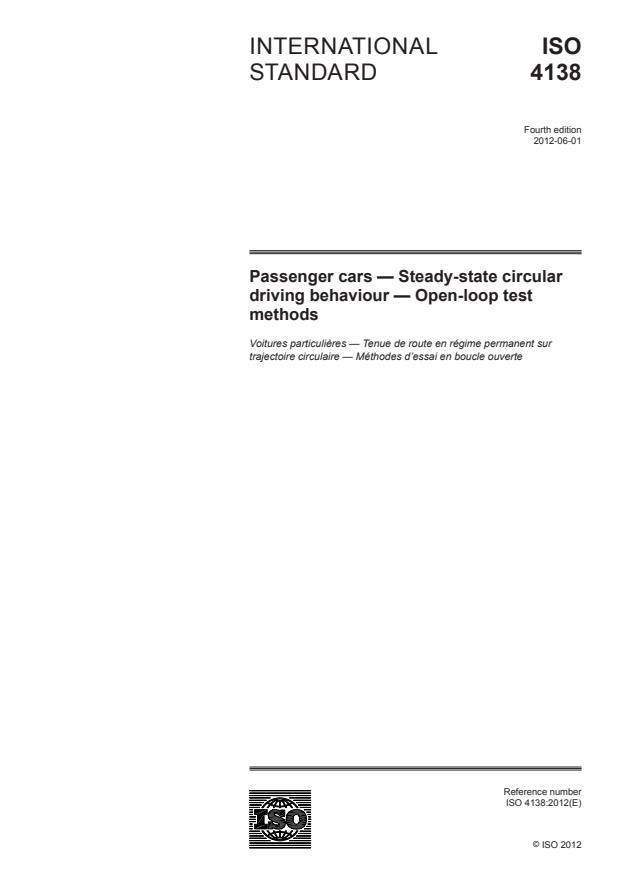
INTERNATIONAL ISO
STANDARD 4138
Fourth edition
2012-06-01
Passenger cars — Steady-state circular
driving behaviour — Open-loop test
methods
Voitures particulières — Tenue de route en régime permanent sur
trajectoire circulaire — Méthodes d’essai en boucle ouverte
Reference number
©
ISO 2012
All rights reserved. Unless otherwise specified, no part of this publication may be reproduced or utilized in any form or by any means,
electronic or mechanical, including photocopying and microfilm, without permission in writing from either ISO at the address below or ISO’s
member body in the country of the requester.
ISO copyright office
Case postale 56 • CH-1211 Geneva 20
Tel. + 41 22 749 01 11
Fax + 41 22 749 09 47
E-mail copyright@iso.org
Web www.iso.org
Published in Switzerland
ii © ISO 2012 – All rights reserved
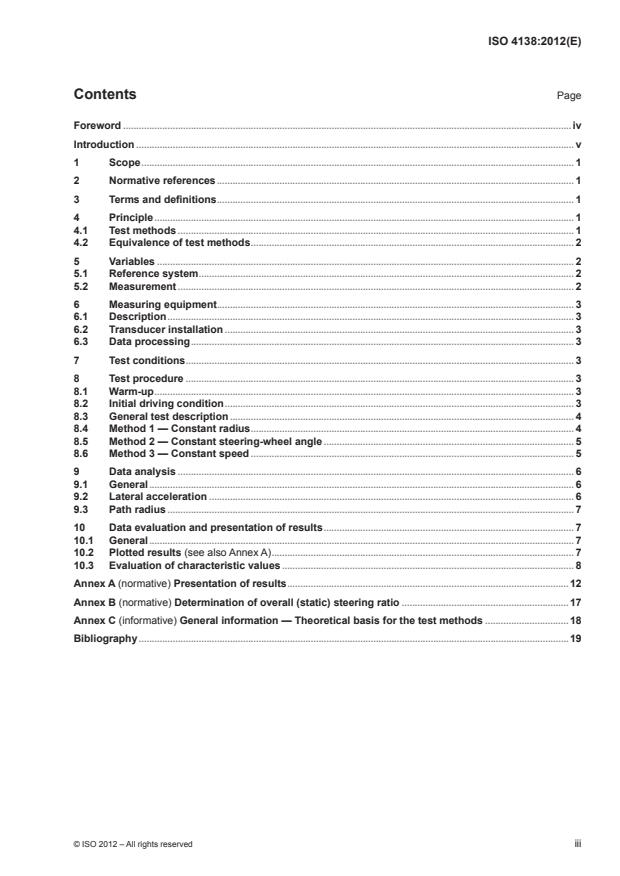
Contents Page
Foreword .iv
Introduction . v
1 Scope . 1
2 Normative references . 1
3 Terms and definitions . 1
4 Principle . 1
4.1 Test methods . 1
4.2 Equivalence of test methods . 2
5 Variables . 2
5.1 Reference system . 2
5.2 Measurement . 2
6 Measuring equipment . 3
6.1 Description . 3
6.2 Transducer installation . 3
6.3 Data processing . 3
7 Test conditions . 3
8 Test procedure . 3
8.1 Warm-up . 3
8.2 Initial driving condition . 3
8.3 General test description . 4
8.4 Method 1 — Constant radius . 4
8.5 Method 2 — Constant steering-wheel angle . 5
8.6 Method 3 — Constant speed . 5
9 Data analysis . 6
9.1 General . 6
9.2 Lateral acceleration . 6
9.3 Path radius . 7
10 Data evaluation and presentation of results . 7
10.1 General . 7
10.2 Plotted results (see also Annex A) . 7
10.3 Evaluation of characteristic values . 8
Annex A (normative) Presentation of results .12
Annex B (normative) Determination of overall (static) steering ratio .17
Annex C (informative) General information — Theoretical basis for the test methods .18
Bibliography .19
Foreword
ISO (the International Organization for Standardization) is a worldwide federation of national standards bodies
(ISO member bodies). The work of preparing International Standards is normally carried out through ISO
technical committees. Each member body interested in a subject for which a technical committee has been
established has the right to be represented on that committee. International organizations, governmental and
non-governmental, in liaison with ISO, also take part in the work. ISO collaborates closely with the International
Electrotechnical Commission (IEC) on all matters of electrotechnical standardization.
International Standards are drafted in accordance with the rules given in the ISO/IEC Directives, Part 2.
The main task of technical committees is to prepare International Standards. Draft International Standards
adopted by the technical committees are circulated to the member bodies for voting. Publication as an
International Standard requires approval by at least 75 % of the member bodies casting a vote.
Attention is drawn to the possibility that some of the elements of this document may be the subject of patent
rights. ISO shall not be held responsible for identifying any or all such patent rights.
ISO 4138 was prepared by Technical Committee ISO/TC 22, Road vehicles, Subcommittee SC 9, Vehicle
dynamics and road-holding ability.
This fourth edition cancels and replaces the third edition (ISO 4138:2004), which has been technically revised.
iv © ISO 2012 – All rights reserved
Introduction
The main purpose of this International Standard is to provide repeatable and discriminatory test results.
The dynamic behaviour of a road vehicle is a very important aspect of active vehicle safety. Any given vehicle,
together with its driver and the prevailing environment, constitutes a closed-loop system that is unique. The
task of evaluating the dynamic behaviour is therefore very difficult since the significant interactions of these
driver–vehicle–environment elements are each complex in themselves. A complete and accurate description of
the behaviour of the road vehicle must necessarily involve information obtained from a number of different tests.
Since this test method quantifies only one small part of the complete vehicle handling characteristics, the results
of these tests can only be considered significant for a correspondingly small part of the overall dynamic behaviour.
Moreover, insufficient knowledge is available concerning the relationship between overall vehicle dynamic
properties and accident avoidance. A substantial amount of work is necessary to acquire sufficient and reliable
data on the correlation between accident avoidance and vehicle dynamic properties in general and the results
of these tests in particular. Consequently, any application of this test method for regulation purposes will
require proven correlation between test results and accident statistics.
INTERNATIONAL STANDARD ISO 4138:2012(E)
Passenger cars — Steady-state circular driving behaviour —
Open-loop test methods
1 Scope
This International Standard specifies open-loop test methods for determining the steady-state circular driving
behaviour of passenger cars as defined in ISO 3833 and of light trucks, such behaviour being one of the factors
comprising vehicle dynamics and road-holding properties. The open-loop manoeuvres included in these
methods are not representative of real driving conditions, but are nevertheless useful for obtaining measures
of vehicle steady-state behaviour resulting from several specific types of control inputs under closely controlled
test conditions.
2 Normative references
The following referenced documents are indispensable for the application of this document. For dated
references, only the edition cited applies. For undated references, the latest edition of the referenced document
(including any amendments) applies.
ISO 3833:1977, Road vehicles — Types — Terms and definitions
ISO 8855:2011, Road vehicles — Vehicle dynamics and road-holding ability — Vocabulary
ISO 15037-1:2006, Road vehicles — Vehicle dynamics test methods — Part 1: General conditions for
passenger cars
3 Terms and definitions
For the purposes of this document, the terms and definitions given in ISO 8855 and the following apply.
3.1
low-speed path radius
radius of the circular path transcribed by the origin of the vehicle axis system when the vehicle is operated at
constant speed with a given fixed steering-wheel angle and with approximately zero lateral acceleration
4 Principle
4.1 Test methods
Three test methods are specified:
— Method 1, the constant-radius test method;
— Method 2, the constant steering-wheel angle test method;
— Method 3, the constant-speed test method.
Each method is presented with two variations and differs in requirements for testing space, driver skill
and instrumentation. Methods 1 and 3 depend upon the path-keeping ability of the driver to minimize
instrumentation requirements. Method 2 uses fixed steering-wheel angle and calculates path radius from
measures of inertial instruments.
4.2 Equivalence of test methods
The nature of any stable steady-state is independent of the method by which it is achieved. Therefore, to obtain
a desired set of steady-state equilibrium conditions of speed, steering-wheel angle and turning radius, it is
possible to hold any one of them constant, vary the second and measure the third. Thus, either a constant-
radius test method (in which speed is varied and steering-wheel angle is measured), a constant steering-wheel
angle test method (in which speed is varied and radius is calculated from variables of vehicle motion) or a
constant-speed test method (in which radius is varied and steering-wheel angle is either measured or varied
and the radius calculated from variables of vehicle motion) may be used. The conditions that are to be held
constant, varied and measured or calculated are summarized in Table 1.
Table 1 — Test conditions
Measured or
Test method Constant Varied
calculated
Constant radius Radius Speed Steering-wheel angle
Constant steering-wheel angle Steering-wheel angle Speed Radius
Constant speed with discrete turn radii Speed Radius Steering-wheel angle
Constant speed with discrete steering-
Speed Steering-wheel angle Radius
wheel angles
All three test methods will produce equivalent steady-state results, provided they span the same combination
of speed–steer–radius steady-state conditions. Moreover, in principle, an equivalent to any of the methods can
be obtained by cross plotting a series of results from one to produce the results from another.
EXAMPLE Taking points at constant speed from a series of constant-radius tests run on different turn radii.
In practice, however, results obtained from tests conducted with different combinations of speed, steer and
radius may differ due to differences in road-load throttle, aerodynamics, tyre slip and inclination angles at
different steering angles, etc. Also, the steering system is nonlinear in many vehicles and does not have a
fixed overall steering ratio. Gradients obtained using one method at a given steady-state equilibrium condition
can differ from those obtained using another and, whereas in one method lateral acceleration is controlled by
changing speed, in another it is controlled by changing the steering-wheel angle. Practical considerations such
as tyre heating during long test runs and failure to maintain true steady-state also tend to affect test results.
5 Variables
5.1 Reference system
The provisions given in ISO 15037-1 apply.
5.2 Measurement
Measure the following variables:
a) longitudinal velocity, v .
X
b) lateral acceleration, a ;
Y
c) steering-wheel angle, δ .
H
Alternatively, lateral acceleration may be determined from other motion variables (see 9.2).
NOTE The method chosen to determine lateral acceleration could require the measurement of additional variables
(yaw velocity, vehicle roll angle or sideslip angle) for use in the computation.
2 © ISO 2012 – All rights reserved
The following variables should also be measured:
— yaw velocity, ddψ t ;
— sideslip angle, β, and/or lateral velocity, v ;
Y
— longitudinal acceleration, a ;
X
— vehicle roll angle, ϕ ;
V
— steering-wheel torque, M .
H
The front steer angle, δ , and rear steer angle, δ , may also be measured.
F R
6 Measuring equipment
6.1 Description
The variables selected for test purposes shall be measured using appropriate transducers and the data
recorded on a multi-channel recording system having a time base. Typical operating ranges and recommended
maximum errors of the transducer and recording system are given in ISO 15037-1 and Table 2.
6.2 Transducer installation
The transducer installation shall be in accordance with ISO 15037-1:2006, 4.2.
6.3 Data processing
The provisions given in ISO 15037-1:2006, 4.3, apply.
Table 2 — Variables, their typical operating ranges and recommended maximum errors
Recommended maximum error of the
Variable Typical operating range
combined transducer/recorder system
Front-steer angle ±20° ±0,2°
Rear-steer angle ±10° ±0,1°
NOTE Increased measurement accuracy could be desirable for computation of some of the characteristic values given in 10.3.
7 Test conditions
Test conditions shall be in accordance with ISO 15037-1:2006, Clause 5. General data on the test vehicle shall
be recorded as specified in ISO 15037-1:2006, 5.4.1. In addition, the tyre type, tyre brand, any special equipment
on the test vehicle, any deviation in type or operating condition of components from the manufacturer’s
specification, the odometer reading at the beginning and end of the test, and any other condition that could
affect test results shall be recorded on the test report for general data (see ISO 15037-1:2006, Annex A).
8 Test procedure
8.1 Warm-up
The warm-up shall be carried out in accordance with ISO 15037-1:2006, 6.1.
8.2 Initial driving condition
The conditions shall be in accordance with 15037-1:2006, 6.2.1 and 6.2.3, and with 8.3 to 8.6 as follows,
according to which method and variation is used.
8.3 General test description
All necessary variables shall be recorded throughout the manoeuvre. Data shall be taken for both left and right turns.
For tests utilizing discrete increments of speed, radius or steering-wheel angle, all of the test data may be taken
in one turning direction followed by all the data in the other turning direction, as experience has shown that this
minimizes data scatter. However, to obtain more even tyre wear and reduced tyre heating, data may be taken
in alternating turning directions at each test speed/radius/steering-wheel angle.
The method chosen shall be noted on the test report, in the section on test-method-specific data for test
conditions (see ISO 15037-1:2006, Annex B). At a minimum, data shall be taken at increments of lateral
acceleration no larger than 0,5 m/s .
NOTE Where data vary rapidly with changes in lateral acceleration, it can be useful to decrease the speed/radius/
steering-wheel angle increments.
The test should be repeated several times so that the results can be examined for repeatability and averaged.
Caution should be exercised during testing so that tyre heating is minimized as much as possible. Tyre heating
is a particular concern for test methods using continuous speed increase, with attendant long periods of data
acquisition, and for all test methods at high levels of lateral acceleration. The tyres should be cooled to normal
operating temperatures between test runs.
8.4 Method 1 — Constant radius
8.4.1 Description
This test method requires driving the test vehicle at several speeds over a circular path of known radius.
The standard radius of the path shall be 100 m, but larger and smaller radii may be used, with 40 m as the
recommended lower value and 30 m as the minimum.
The directional-control response characteristics are determined from data obtained while driving the vehicle at
successively higher speeds on the constant-radius path. This procedure can be conducted in a relatively small
area. The procedure can be adapted to existing test track facilities by selecting a circle or path of appropriate
radius. A constant-radius (in plane) road will often suffice for a test facility.
The constant-radius test exists in two variations. In the first, the vehicle is driven on the circular path at discrete
constant speeds. Data are taken when steady-state is attained. The test can be run on any level constant-radius
path of sufficient length to attain and hold on-radius steady-state for at least a 3 s measurement period. In the
second, the vehicle remains on the circle with a continuous, slow speed increase, during which data are taken.
8.4.2 Procedure
8.4.2.1 General
First drive the vehicle on the desired circular path at the lowest possible speed. Record data with the steering-
wheel and throttle positions fixed, so that the approximate Ackermann steer angle can be recorded.
Then drive the vehicle at the next speed at which data are to be taken.
Increase the level of the lateral acceleration and take data until it is no longer possible to maintain steady-
state conditions.
8.4.2.2 With discrete test speeds
Drive the vehicle onto the circle at each test speed. After attaining steady-state, in which the desired path
radius is held within ± 0,5 m, the steering wheel and throttle positions shall be held constant for at least 3 s.
4 © ISO 2012 – All rights reserved
8.4.2.3 With continuous speed increase
Steadily increase the speed and record data continuously for as long as the vehicle remains on the desired
circular path within ± 0,5 m. The maximum rate of increase of lateral acceleration should be 0,1 m/s /s. The
maximum permissible rate of increase of lateral acceleration shall be 0,2 m/s /s.
8.5 Method 2 — Constant steering-wheel angle
8.5.1 Description
This test method requires driving the test vehicle at several speeds with a single selected steering-wheel angle
that is held fixed. The path radius is determined by computation: from horizontal velocity and yaw velocity, or
from horizontal velocity and lateral acceleration. The test exists in two variations: a series of discrete test runs,
or a single continuous test run. In the first, the steering-wheel angle is applied with the vehicle travelling at
discrete speeds, and is maintained until steady-state conditions are reached. In the second, the steering-wheel
angle is held fixed while speed is increased continuously at a slow rate, up to the limit of control.
The standard steering-wheel angle shall provide a low-speed path radius of 30 m. Other radii may be used,
with 20 m as the minimum. For testing to the limit of control with the standard initial condition, the path radius
can increase to 100 m or more.
8.5.2 Procedure
8.5.2.1 General
First drive the vehicle at the lowest possible speed to establish the steering-wheel angle for the selected low-
speed path radius.
Then drive the vehicle at successively higher speeds, with the steering-wheel angle held constant or
mechanically fixed within ± 1° of the selected steering-wheel angle. Run the test through the desired range of
lateral acceleration, or until the limits of test space, vehicle speed or vehicle stability are reached.
8.5.2.2 With discrete test speeds
At each selected speed, the steering wheel shall be turned to the pre-selected steering-wheel angle and
maintained until steady-state conditions, including speed and throttle, are attained. The steering-wheel angle
and throttle position shall be held constant for at least 3 s.
NOTE Except that in this this procedure the steering-wheel angle is maintained and the speed varied, it and the
procedure given in 8.5.2.3 are the same.
8.5.2.3 With continuous speed increase
The steering-wheel angle shall be held constant or mechanically fixed at the pre-selected steering-wheel
angle while the vehicle speed is steadily increased. The maximum rate of increase of lateral acceleration is
2 2
0,1 m/s /s. The maximum permissible rate of
...
Questions, Comments and Discussion
Ask us and Technical Secretary will try to provide an answer. You can facilitate discussion about the standard in here.
Loading comments...