


ISO/R 1729:1971
(Main)Title missing - Legacy paper document
Title missing - Legacy paper document
General Information
- Status
- Withdrawn
- Publication Date
- 31-Dec-1970
- Technical Committee
- ISO/TMBG - Technical Management Board - groups
- Drafting Committee
- ISO/TMBG - Technical Management Board - groups
- Current Stage
- 9599 - Withdrawal of International Standard
- Start Date
- 01-Jan-1976
- Completion Date
- 12-Feb-2026


ISO/R 1729:1971 - Title missing - Legacy paper document Released:1/1/1971


ISO/R 1729:1971 - Title missing - Legacy paper document Released:1/1/1971
Frequently Asked Questions
ISO/R 1729:1971 is a standardization document published by the International Organization for Standardization (ISO). Its full title is "Title missing - Legacy paper document". This standard covers: Title missing - Legacy paper document
Title missing - Legacy paper document
ISO/R 1729:1971 is available in PDF format for immediate download after purchase. The document can be added to your cart and obtained through the secure checkout process. Digital delivery ensures instant access to the complete standard document.
Standards Content (Sample)
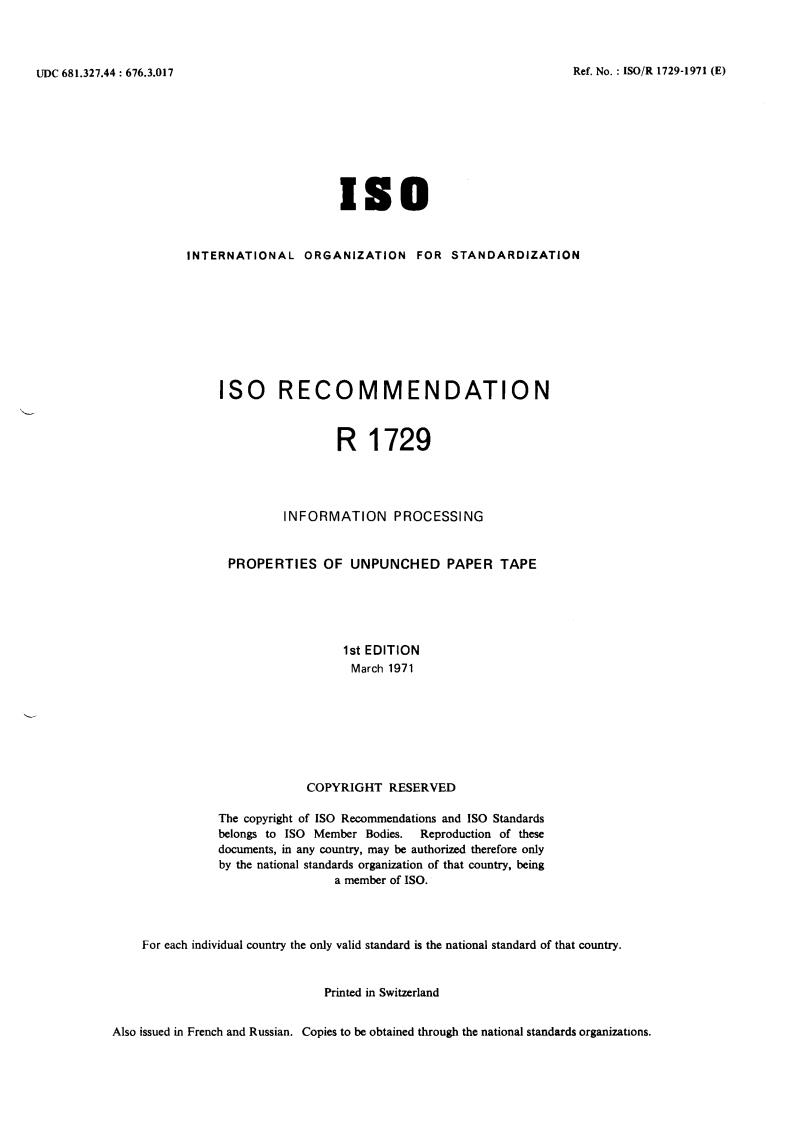
Ref. No. : ISO/R 1729-1971 (E)
UDC 681.323.44 : 676.3.017
IS0
I N T E R N AT I O N A L O R G A N 12 AT I ON FOR STAN DARD I ZAT I O N
IS0 RECOMMENDATION
R 1729
INFORMATION PROCESSING
PROPERTIES OF UNPUNCHED PAPER TAPE
1st EDITION
March 1971
COPYRIGHT RESERVED
The copyright of IS0 Recommendations and IS0 Standards
belongs to IS0 Member Bodies. Reproduction of these
documents, in any country, may be authorized therefore only
by the national standards organization of that country, being
a member of ISO.
For each individual country the only valid standard is the national standard of that country.
Printed in Switzerland
Also issued in French and Russian. Copies to be obtained through the national standards organizations.
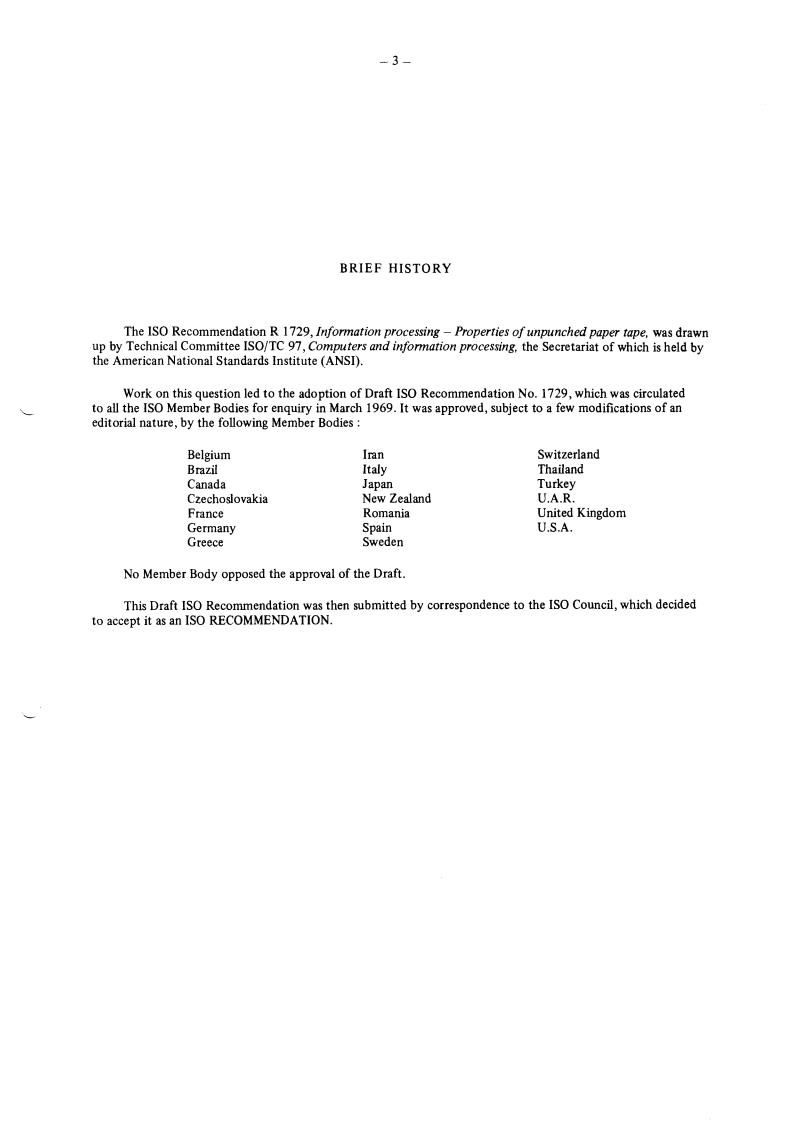
-3-
BRIEF HISTORY
The IS0 Recommendation R 1729, Information processing - Properties of unpunched paper tape, was drawn
up by Technical Committee ISO/TC 97, Computers and information processing, the Secretariat of which is held by
the American National Standards Institute (ANSI).
Work on this question led to the adoption of Draft IS0 Recommendation No. 1729, which was circulated
to all the IS0 Member Bodies for enquiry in March 1969. It was approved, subject to a few modifications of an
editorial nature, by the following Member Bodies :
Belgium Iran Switzerland
Brazil Italy Thailand
Canada Japan Turkey
Czechoslovakia New Zealand U.A.R.
France Romania United Kingdom
Germany Spain U.S.A.
Sweden
Greece
No Member Body opposed the approval of the Draft.
This Draft IS0 Recommendation was then submitted by correspondence to the IS0 Council, which decided
to accept it as an IS0 RECOMMENDATION.
-5- ISO/R 1729-1971 (E
March 1971
IS0 Recommendation R 1729
INFORMATION PROCESSING
PROPERTIES OF UNPUNCHED PAPER TAPE
1. SCOPE
This IS0 Recommendation specifies the physical properties of paper tape to be used for data interchange,
when the tape is in the unpunched condition.
2. TEST CONDITIONS AND METHODS OF TEST
2.1 Sampling
Sampling shall be carried out in accordance with the procedures described in Annex A unless otherwise
agreed between customer and supplier.
NOTE. - It is important to recognize that the majority of the physical properties will be tested by the paper maker
and the paper tape coil converter. Since the quantity of paper involved is usually quite large it is necessary to adopt a
balanced sampling procedure and often to report the result in terms of a mean value and a permissible deviation.
2.2 Test conditions
The test conditions for measurement shall be the following :
Relative humidity (R.H.) 50 f 2 %
Temperature 23 f 2 "C (73 f 3.5 OF)
2.3 Conditioning of test samples
Samples shall be conditioned prior to test in accordance with the procedures described in Annex B.
Methods of test
2.4
Tests shall be carried out in accordance with the methods standardized by Technical Committee
ISO/TC 6, Paper, board and pulps. Until the appropriate IS0 Recommendations are published, the
test methods specified in Annexes C to L shall apply.
-6- ISO/R 1729-1971 (E
3. DIMENSIONS
3.1 Width
The width of the unpunched tape shall be
mm in
Nominal width 25.40 1 .O00
Tolerance :
95 % of samples I 0.05 IO.002
100 % of samples I 0.08 f 0.003
3.2 Thickness
The thickness of the unpunched tape shall be :
mm in
Nominal thickness 0.100 0.0040
Tolerance :
k 0.008 f 0.0003
95 % of samples
f 0.010 f 0.0004
100 % of samples
4. CHEMICAL PROPERTIES OF PAPER TAPE
4.1 Hydrogen ion concentration
pH = 6 f 1.5.
NOTE. - It is desirable that the pH value oft.: paper be as high as possible within these limits.
4.2 Ash content
maximum 1 %.
Grit content
4.3
maximum 0.04 %.
Lubricating additives
4.4
In order to ensure the minimum wear of the punch elements, the tape may have lubricating additives.
The percentage of lubricating additives will depend largely on the type(s) of lubricant(s) used. It is
important that the lubricant should not adversely affect the properties of the paper tape as defined
elsewhere in this IS0 Recommendation.
NOTE. - It has been observed that silicone oils can cause paper tape to have corrosive properties.
Compoation and quality
4.5
The paper shall be free from mechanical (ground wood) pulp, holes, slime spots, shives, unbeaten fibres,
fluff, dust, grit and abrasive particles. In addition it is important that the lignin content be kept to a
minimum and that the tapes be free from translucent spots and any other defects which would interfere
with reading or punching.
5. PHYSICAL PROPERTIES OF PAPER TAPE
5.1 Basic weight
76 to 94 g/mZ (0.25 to 0.31 oz/ft2). This refers only to unoiled paper tape.
5.2 Strength
5.2.1 Static tensile strength shaii be measured in the machine direction. The mean value shall be not less
than 177 N (18.1 kgf) per 25.4 mm of width (40 lbf per inch of width). in addition the arithmetic
mean of the results less twice the standard deviation shall be not less than 156 N (1 5.9 kgf) per
25.4 mm of width (35 lbf per inch of width).
5.2.2 Internal tear resistance in both the machine direction and the cross direction shall be not less than
0.56 N (55 gf).
5.3 Dimensional stability
5.3.1 The maximum variation of the dimension in the cross direction when the relative humidity is varied
from 20 % to 75 % and also when it is varied from 75 % to 20 % shall not exceed 1 % of the length
measured at 50 5% R.H.
5.3.2 Under the same changes of relative humidity the maximum variation of the dimension in the
machine direction shall not exceed 0.5 % of the length measured at 50 "/O R.H.
5.4 Percentage of light transmission
The maximum value of light transmission shall not exceed 50 %. The method of measurement is described
in Annex M.
5.5 Electrical properties
Bulk conductivity. For the purpose of sensing, the paper shall act substantially as an insulator when
placed between two low-voltage sensing contacts.
5.6 Printability
The surface of the oiled tape shall legibly accept and retain interpretive printing, handwriting by means
of ordinary pen nib or ball point pens using commercial quality inks, lead or coloured pencils. and rubber
stamping. The legibility of both manuscript and print shall not be adversely affected by either the type
of material or the finish.
Colour
5.1
The paper tape may be of any colour, provided that all the specifications of this IS0 Kecommendation
are satisfied.
Pre-printing
5.8
Tapes may be pre-printed if required provided that each tape after printing meets all the requirements
of this IS0 Kecommendation.
5.9 Quality
The paper shall be free of slime spots, pin holes, translucent spots, holes, tears, wrinkles and crcases.
The paper shall also be us free of lint, fuzz and dust as the best manufacturing practices permit,
6. COILING OF UNPUNCHED TAPE
6.1 Inner diameter
The inner diameter of the core shall be :
mm in
Nominal 50.8 I .O00
+ 1.6 + 0.063
Tolerance
n n
-8- ISO/R 1729-1971 (I
6.2 &ter diameter
The outer diameter of a coil of unpunched tape shall be :
mm in
Nominal 203 8.00
O O
Tolerance
-3 - 0.12
End of paper tape marker
6.3
6.3.1 Each coil of tape shall be marked with a pink or red warning mark (but a contrasting colour on pink
or red tapes).
6.3.2 The length of this mark shall be about 6 m (20 ft) and there shall be an unmarked length of about
3 m (1 O ft) from the inner end of the coil.
6.3.3 The colouring matter of the marker shall be non-adhesive, non-abrasive and non-poisonous.
If the tape is fastened to the core, it shall not require a tension of more than 4 N (400 gf or 14 ozf) to
6.4
pull it off the core.
6.5 The face of the coils shall be as clean and smooth, free from dust and undamaged as the best manufacturing
process will permit. The coils shall unwind freely without sticking.
6.6 Tightness of coring
Each coil shall be wound evenly and sufficiently tightly on the core that it does not telescope with
normal handling.
ISO/R 1729-1971 (E)
-9- ANNEX A
ANNEX A
METHOD OF SAMPLING PAPER TAPE FOR TESTING
(Based on IS0 Recommendation R 186)
A.l SCOPE
This Annex specifies a method of obtaining a representative sample of a lot of coils of paper tape for test
purposes.
For certain tests, special methods of sampling will be given in the text of the appropriate method of test.
NOTE. - If, at the time of sampling, less than 50 %of the lot remains, sampling wiil be invalid in the absence of agreement
to the contrary.
A.2 DEFINITIONS
A.2.1 Consignment. One or more lots.
A.2.2 Lor. The aggregate of paper of a single kind, of specified characteristics, for example a box of coils.
A lot comprises one or more similar units, for example coils.
A.2.3 Specimens. Rectangles of paper cut to given dimensions, from the selected units.
A.2.4 Sample. All the specimens.
A.2.5 Test piece. The quantity of paper on which the test is carried out in accordance with the stipulations of
the method of test.
It may be taken from a specimen; in certain instances, the test piece may be the specimen itself, or
several specimens.
A.2.6 Selected at random. Taken in such a way that each part of the whole has an equal chance of being
selected.
Lot (Box of coils)
Unit Unit Unit (Coils)
Specimen (Length of tapes)
Test piece
ISO/R 1729-1971 (EJ
- 10 - ANNEX A
A.3 PRINCIPLE
Withdrawal of a certain number of units from each lot.
Taking of a certain number of specimens from each of these units.
In general, obtaining from these specimens the test pieces necessary for the various tests.
A.4 PREPARATION OF SPECIMENS
A.4.1 Selection of units
The units to be sampled should be selected according to the following table :
Size of lot (n) Number of units Method of
units selected selection
1 to 5 all -
6to 99 5 at random
loo to 399* n/20 at random
20 at random
400 or more
In deciding the number of units to be selected, any remainder of less than 20 units should be ignored.
The units selected should be intact and in good extemal condition.
A.4.2 Selection of specimens
For each unit withdrawn from the lot, proceed as follows :
Take the length of paper tape from each coil, as long as necessary for the tests requested.
The selection of the length of tape from the coils is made as follows :
Remove all damaged layers of paper from the outside of the coil (if any); discard in all cases at least
three undamaged layers; remove the requisite length of tape.
A.4.3 Size of specimens
It is recognized that only a limited range of tests can be performed on the specimens obtained by this
method.
A.5 ADDITIONAL REQUIREMENTS
A.S. 1 Specimens
A.5.1.1 Precautions. Specimens should be kept flat, free from wrinkles and folds and protected from
exposure to direct sunlight, liquids, varying humidity conditions and any other harmful
influences. Care should be taken in handling specimens, as contact with the hands can appreciably
affect the chemical, physical, optical, surface or other characteristics of the paper.
A.5.1.2 Marking. Each specimen should be provided with identification marks, this being necessary to
ensure that it can be recognized beyond all doubt. These marks should be indelible; they may be
limited to the number of the sampling report and the signature of the sampler. They should be in
one comer and as small as possible.
ISO/R 1729-1971 (E)
11 - ANNEX A
A.5.2 Re-sampling
A.5.2.1 if, as a result of an accident during sampling or testing, re-sampling is necessary, a new sample
should be taken according to the rules set out above; unless othenvise indicated, the selection
may be made from the same units as before.
A.5.2.2 In other circumstances, should re-sampling be deemed necessary, it is recommended that the
parties concerned should agree upon the procedure to be adopted, with due regard for the
principles specified above.
A.6 SAMPLING REPORT
The sampling report should state
the name of the person drawing the sample;
the name and address of the purchaser and the name of his representative;
the name and address of the supplier and the name of his representative;
the size of the lot;
the constitution of the lot;
of the lot and of the units;
if necessary, the references
the conditions in which the lot appears;
number of specimens constituting the sample;
the procedure employed;
all the circumstances of such nature as to influence results of the future tests;
the date of the operations;
the place of sampling;
a reference corresponding to that indicated on the samples;
any deviation from this method of sampling.
ISO/R 1729-1971 (E)
'- 12- ANNEX B
ANNEX B
METHOD FOR THE CONDITIONING OF PAPER TEST SAMPLES
(Based on IS0 Recommendation R 187)
INTRODUCTION
This Annex describes a method which should be considered as the standard method in the absence of any
previous agreement.
The physical properties of paper are affected materially by its moisture content which, in turn, is dependent
on the humidity of the surrounding atmosphere. In order that tests may be made on paper in a defined physical
state, it is brought into equilibrium with an atmosphere of standardized temperature and relative humidity and
it is tested in that atmosphere.
The moisture content of a given paper in equilibrium with a given atmosphere varies according to whether the
equilibrium is reached by sorption or desorption of moisture. This hysteresis influences those physical properties
that change with moisture content; it is recommended that the equilibrium condition be attained by a sorptive
process.
B.l SCOPE
This Annex defines the conditioning atmosphere and the method of conditioning paper before and during
testing.
B.2 DEFINITIONS
B.2.1 Relative humidity (R.H.). Ratio of the absolute humidity of the air to the humidity of air saturated
with water vapour at the same temperature and pressure.
NOTE. - The ratio is usually expressed as a percentage. At ordinary atmospheric temperatures, this ratio is almost
exactly equal to the ratio of the actual vapour pressure to the saturation vapour pressure at the same (dry bulb)
temperature.
B.2.2 Conditioning. For the purpose of this method, paper samples are conditioned when they are in
equilibrium with a conditioning atmosphere. This equilibrium is considered to be attained when, after
determining the masses of the samples at intervals of not less than 1 hour, the last two weighings do
not differ by more than the specified amount.
The establishment of moisture equilibrium is accepted as ensuring that the paper is in a stable physical
state, but in special cases, conditioning may have to be prolonged until the desired physical equilibrium
is attained. Such cases are not within the scope of this method.
B.3 PRINCIPLE
Exposure of the samples to a conditioning atmosphere in such a manner that a state of moisture content
equilibrium is reached between the paper and this atmosphere.
B.4 CONDITIONING ATMOSPHERE
Temperature 23 k 2 OC (73 5 3.5 OF)
Relative humidity (R.H.) 50*2%
ISO/R 1729-1971 (E)
- 13- ANNEX B
B.5 EQUIPMENT
B.5.1 Room and measuring instrumentation
The room in which conditioning is carried out should be provided with automatic equipment for bringing
the air to standard conditions of relative humidity and temperature and so circulating it that the
conditions at all relevant points are uniformly maintained within it. It is recommended that a recording
hygrometer, periodically checked by a standard method (for example, with wet and dry bulb thermometers),
be kept in the test space for checking purposes.
B.5.2 Determmation of temperature and relative humidity
The relative humidity of the conditioning air should be determined by a reliable method. Where a wet
and dry bulb hygrometer is used, it should be placed in an air current of the speed required by the
tables used. This should be not less than 2 m/s (6.6 ft/s).
When the two thermometers of the hygrometer are at the same temperature, their bulbs being dry, the
difference in reading should not exceed 0.2 OC (0.36 OF).
B.6 PROCEDURE
B.6.1 Preliminary treatment of samples
For tests in which the hysteresis of the equilibrium moisture content may lead to important errors, the
samples should be desiccated before conditioning, for 24 hours in air of relative humidity between
20 and 35 % and a temperature not above 40 OC (104 OF).
B.6.1 Conditioning
The specimens should be so suspended that the conditioning air has free access to all their surfaces
until they reach equilibrium moisture content. This equilibrium is considered to be attained when the
two last weighings do not differ by more than 0.25 % of the tot
...
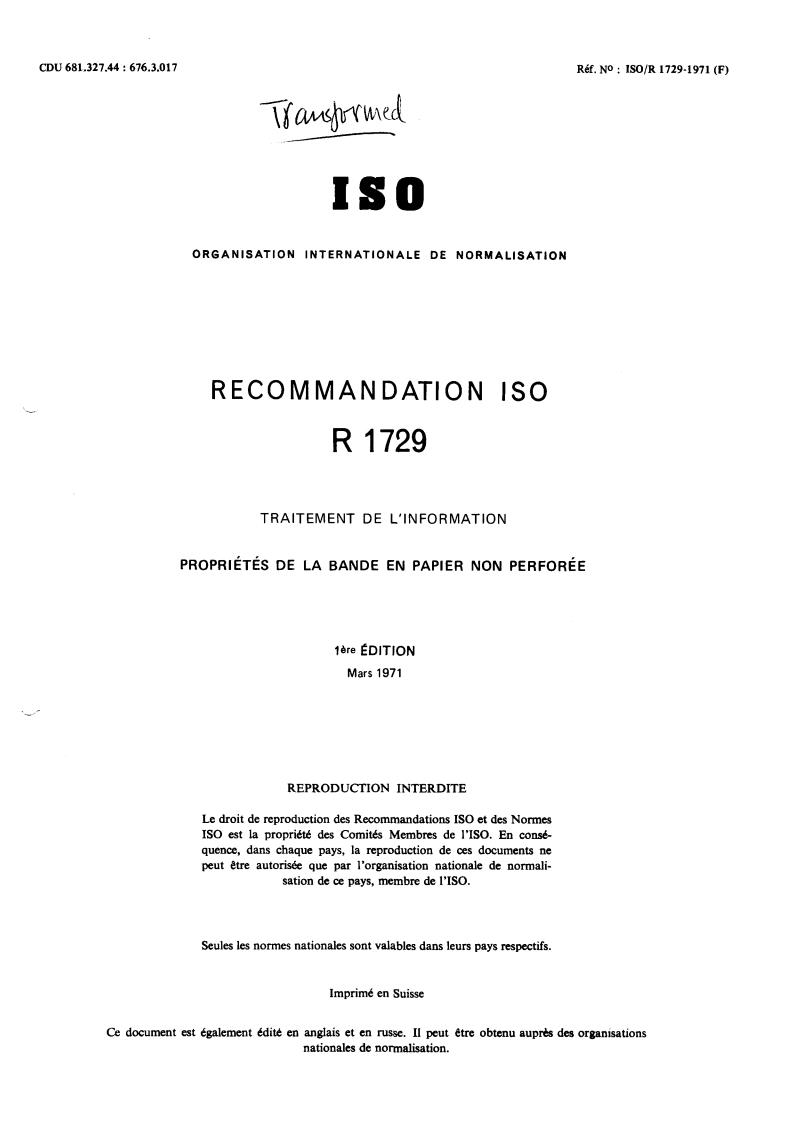
RU. NO : ISO/R 1729-1971 (F)
CDU 681.327.44 : 676.3.017
IS0
ORGAN IS AT1 ON I N T ERN AT I O N A LE DE NORM A LI SAT1 ON
RECOMMANDATION IS0
R 1729
TRAITEMENT D E L’IN FOR MAT ION
PROPRIÉTÉS DE LA BANDE EN PAPIER NON PERFORÉE
ibre EDITION
Mars 1971
REPRODUCTION INTERDITE
Le droit de reproduction des Recommandations IS0 et des Normes
IS0 est la propriété des Comités Membres de I’ISO. En consé-
quence, dans chaque pays, la reproduction de ces documents ne
peut être autori& que par l’organisation nationale de normali-
sation de ce pays, membre de I’ISO.
Seules les normes nationales sont valables dans leurs pays respectifs.
Imprimé en Suisse
Ce document est également édité en anglais et en russe. II peut être obtenu auprts des organisations
nationales de normalisation.
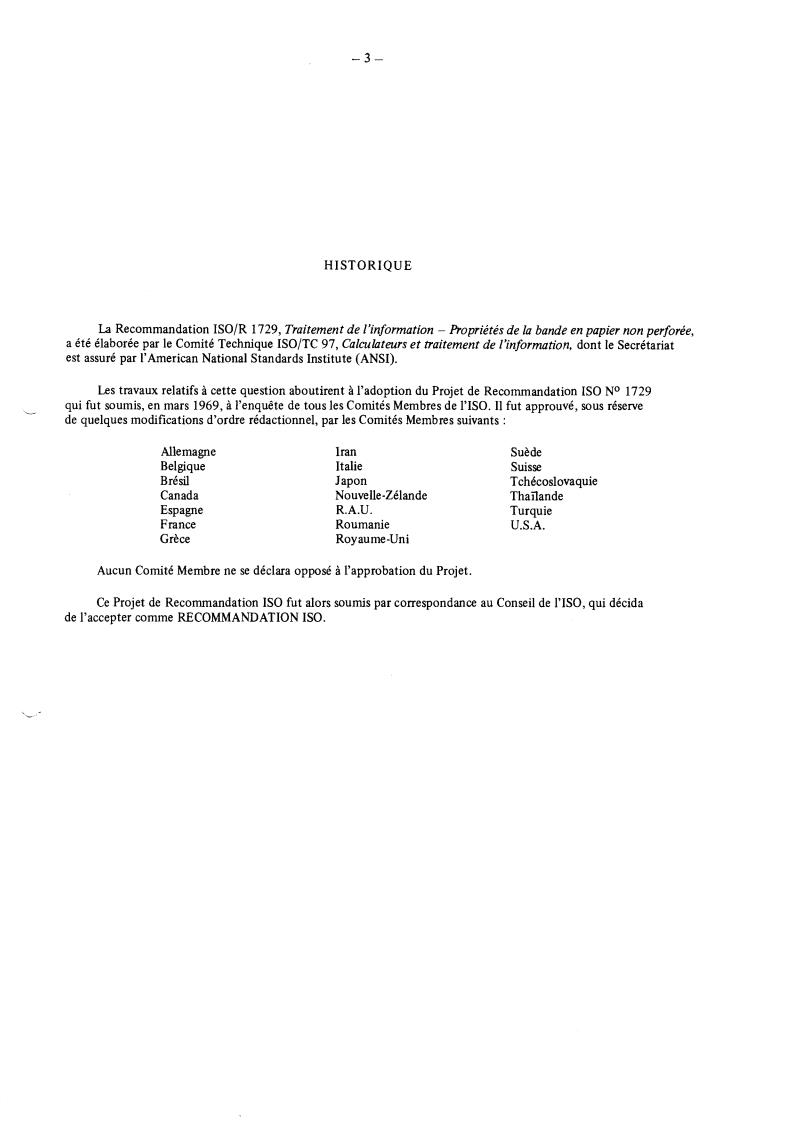
-3-
HISTORIQUE
La Recommandation ISOlR 1729, Traitement de l’information - Propriétés de la bande en papier non perforée,
a été élaborée par le Comité Technique ISO/TC 97, Calculateurs et traitement de l’information, dont le Secrétariat
est assuré par 1’American National Standards Institute (ANSI).
Les travaux relatifs à cette question aboutirent à l’adoption du Projet de Recommandation IS0 No 1729
qui fut soumis, en mars 1969, à l’enquête de tous les Comités Membres de I’ISO. I1 fut approuvé, sous réserve
v
de quelques modifications d’ordre rédactionnel, par les Comités Membres suivants :
Allemagne Iran Suède
Belgique Italie Suisse
Brésil
Japon Tchécoslovaquie
Canada
Nouvelle-Zélande Thailande
Espagne
R.A.U. Turquie
France
Roumanie U.S.A.
Grèce Royaume -Uni
Aucun Comité Membre ne se déclara opposé à l’approbation du Projet.
Ce Projet de Recommandation IS0 fut alors soumis par correspondance au Conseil de IWO, qui décida
de l’accepter comme RECOMMANDATION ISO.
-5- ISO/R 1729,1971 (I
Recommandation IS0 R 1729 Mars 1971
TRAITEMENT DE L’INFORMATION
PROPRIÉTÉS DE LA BANDE EN PAPIER NON PERFORÉE
1. OBJET
La présente Recommandation IS0 définit les propriétés physiques de la bande en papier pour l’échange
d’information, lorsqu’elle est non perforée.
2. CONDITIONS ET MÉTHODES D’ESSAIS
2.1 Echantillonnage
L’échantillonnage doit être effectué selon les méthodes décrites dans l’Annexe A à moins d’accords
différents entre acheteur et fournisseur.
NOTE. - I1 est important de reconnaître que la majorité des propriétés physiques seront contrôlées par le fabricant
de papier ou par le transformateur de papier. Etant donné que la quantité de papier traitée est en général très
importante, il est nécessaire d’adopter une méthode d’échantillonnage systématique et de présenter les résultats le
plus souvent sous forme de valeurs moyennes et d’écarts-type.
2.2 Conditions d’essais
Les conditions d’essais pour les mesurages doivent être les suivantes :
Humidité relative (H.R.) 50 +_ 2 %
Température 23 f 2 OC (73 f 3,s OF)
2.3 Mise en condition des échantillons
Les échantillons doivent être mis en condition avant les essais selon les méthodes décrites dans l‘Annexe B.
2.4 Méthodes d’essais
Les essais doivent être effectués conformément aux méthodes normalisées par le Comité Technique
ISO/TC 6, Papier, cartons et pâtes. Dans l’attente de la publication des Recommandations IS0
correspondantes, les méthodes d’essais indiquées dans les Annexes C à L doivent être appliquées.
-6- ISO/R 1729-1971 (F
3. DIMENSIONS
Largeur
3.1
La largeur de la bande non perforée doit être :
mm in
Largeur nominale 25,40 1,000
Tolérances :
95 % des échantillons f 0,05 f 0,002
100 7% des échantillons f 0,08 f 0,003
3.2 Epaisseur
L‘épaisseur de la bande non perforée doit être :
mm in
Epaisseur nominale 0,100 0,0040
Tolérances :
95 % des échantillons f 0,008 f 0,0003
100 % des échantillons f 0,010 f 0,0004
4. CARACTÉRISTIQUES CHIMIQUES DE LA BANDE EN PAPIER
Concentration en ions d’hydrogène
4.1
pH = 6 f 1,5
NOTE. - Il est souhaitable que la valeur du pH soit aussi élevée que possible en restant comprise dans ces limi S.
4.2 Teneur en cendres
1 % maximum.
Teneur en impuretés siliceuses
4.3
0,04 % maximum.
4.4 Additifs lubrifiants
En vue d’assurer une usure minimale du perforateur, la bande peut contenir des additifs lubrifiants.
Leur pourcentage variera suivant le($ type(s) de lubrifiant(s) choisi(s). I1 est important que l’additif
lubrifiant n’affecte pas les propriétés de la bande en papier, définies dans d’autres paragraphes de la
présente Recommandation KO.
NOTE. - Certaines huiles au silicone peuvent rendre corrosive la bande en papier.
4.5 Composition et qualité
Le papier doit être exempt de pâte mécanique, de trous, de taches, de déchets, de pâtons, d’incuits,
de duvet, de poussières et de particules siliceuses et abrasives. En outre, il est important que la teneur
en lignine soit réduite au minimum et que les bandes soient exemptes de taches translucides et de tout
autre défaut susceptible d’interférer avec la lecture ou la perforation.
5. CARAC~RISTIQUES PHYSIQUES DE LA BANDE EN PAPIER
5.1 Masse au m2 (grammage)
76 à 94 g/m2 (0,25 à 0,31 oz/ft2). Ceci ne s’applique qu’aux bandes en papier non huilées.
ISO/R 1729-1971 (F
-7-
5.2 Résistance à la traction
5.2.1 La résistance statique à la traction doit être mesurée dans le sens machine. La valeur moyenne
ne doit pas être inférieure à 177 N (18,l kgf) par 25,4 mm de large (40 lbf par inch de large).
La valeur moyenne arithmétique des résultats, diminuée de deux fois l’écart-type, ne doit pas être
inférieure à 156 N (15,9 kgfjpar 25,4 mm de large (35 lbf par inch de large).
5.2.2 La résistance au déchirement, dans le sens machine et dans le sens travers, ne doit pas être
inférieure à 0,56 N (55 gf).
5.3 Stabilité dimensionnelle
5.3.1 La variation maximale des dimensions dans le sens travers, pour une variation d’humidité
relative de 20 % à 75 % ou de 75 76 à 20 %, ne doit pas excéder 1 % de la longueur mesurée à 50 %
d’humidité relative.
5.3.2 Dans ces mêmes conditions de variation d‘humidité relative, la variation maximale des dimensions
dans le sens machine ne doit pas excéder 0,5 % de la longueur mesurée à 50 % d’humidité relative.
Taux de lumière transmise
5.4
La valeur maximale du taux de lumière transmise ne doit pas excéder 50 %. La méthode de mesurage est
décrite dans l’Annexe M.
5.5 Caractéristiques électriques
Conductivité. Afin de se prêter à la lecture, le papier doit se comporter sensiblement comme un isolant
quand il est placé entre deux contacts de lecture à basse tension.
5.6 Aptitude à accepter l’impression
La surface de la bande huilée doit accepter lisiblement et retenir l’impression, l’écriture manuelle faite
à l’aide d’un stylo normal ou à bille à encre de qualité commerciale ou d’un crayon à mine ou de couleur
et l’impression à tampon. La lisibilité d’une écriture manuelle et de l’impression ne doit pas être affectée
par le type de papier ou par ses caractéristiques superficielles.
Couleur
5.7
La bande en papier peut être de n’importe quelle couleur, sous réserve de satisfaire à toutes les
spécifications de la présente Recommandation ISO.
5.8 Pré-impression
Les bandes peuvent être pré-imprimées sur demande,sous réserve que chaque bande, après pré-impression,
satisfasse à toutes les spécifications de la présente Recommandation ISO.
5.9 Qualité
Le papier doit être exempt de pâtons, de trous d’épingles, de taches transparentes, de trous, de déchire-
ments, de froissement et de plis. Le papier doit être aussi exempt d’effdures et de poussières que ne
leur permettent les meilleurs procédés de fabrication.
6. ENROULEMENT DE LA BANDE NON PERFORÉE
6.1 Diamètre intérieur
Le diamètre intérieur d’un rouleau doit être
mm in
50,8 2,000
Diamètre nominal
+ 1,6 + 0,063
Tolérance
O O
- 8- ISO/R 1729-1971 (I
6.2 Diamètre extérieur
Le diamètre extérieur d’un rouleau de bande non perforée doit être :
mm in
Diamètre nominal 203 8,OO
O O
Tolérances
-3 - O,] 2
6.3 Marque de la fin de bande de papier
6.3.1 Chaque rouleau de bande doit recevoir une marque d’avertissement, de couleur rose ou rouge (mais
d’une couleur contrastant avec celle des bandes roses ou rouges).
6.3.2 La longueur de cette marque doit être d’environ 6 m (20 ft) et il doit y avoir une longueur de bande
non marquée d’environ 3 m (10 ft) à partir de l’extrémité intérieure du rouleau.
6.3.3 La matière colorante constituant la marque ne doit être ni adhésive, ni abrasive, ni toxique.
Lorsque la bande est faée au noyau,la force nécessaire pour la détacher ne doit pas être supérieure
6.4
à 4 N (400 gf ou 14 ozf).
La tranche des rouleaux doit être aussi propre et lisse, exempte de peluches et de détériorations que ne
6.5
le permettent les meilleurs procédés de fabrication. Les rouleaux doivent se dérouler librement et sans
adhérence.
6.6 Serrage de la bobine
Chaque bobine doit être enroulée de façon uniforme et suffisamment serrée sur le noyau pour ne pas
se défaire au cours d’une manipulation normale.
ISO/R 1729-1971 (F)
-9-
ANNEXE A
ANNEXE A
MÉTHODE D’ÉCHANTILLONNAGE DES BANDES EN PAPIER POUR ESSAIS
(Fondée sur la Recommandation ISO/R 186)
A.l OBJET
La présente Annexe fixe une méthode d’échantillonnage d’un lot de bobines de bandes en papier en vue
d’essais.
Pour certains essais, des méthodes spéciales d’échantillonnage seront fixées dans le texte de la méthode
d’essai correspondante.
NOTE. - Si, au moment du prélèvement des échantillons, il reste moins de 50 % du lot, l’échantillonnage sera sans valeur,
sauf accord contraire.
A.2 DÉFINITIONS
A.2.1 Livraison. Un ou plusieurs lots.
A.2.2 Lot. La totalité d’une seule sorte de papier de caractéristiques spécifiées, par exemple une boîte de bobines.
Un lot comprend une ou plusieurs unités identiques, telles que bobines.
A.2.3 Feuilles échantillons. Rectangles de papier découpés aux cotes fmées, dans les feuilles prélevées dans des
unités déterminées.
A.2.4 Echantillon. L‘ensemble des feuilles échantillons.
A.2.5 Eprouvette. La quantité de papier sur laquelle est effectué l’essai, conformément aux prescriptions de
la méthode d’essai.
L‘éprouvette peut être prélevée dans une feuille échantillon; dans certain cas, l’éprouvette est
constituée par la feuille échantillon ou par plusieurs feuilles échantillons.
A.2.6 Prélevé au hasard. Prélevé de manière que chacun des éléments a autant de chance d’être choisi.
Lot
.
(Boîte de bobines)
e6363
Unité unité Unité (Bobines)
Eprouvette Feuille (Longueur des bandes)
(chantillon
ISO/R 1729-1971 (F)
- 10- ANNEXE A
A.3 PRINCIPE
Retenue d’un certain nombre d’unités dans chaque lot.
Prélèvement d‘un certain nombre de feuilles échantillons dans chacune de ces unités.
Dans le cas général, obtention, à partir de ces feuilles échantillons, des éprouvettes nécessaires aux
différents contrôles du papier.
A.4 PRÉPARATION DES FEUILLES ÉCHANTILLONS
A.4.1 Prélèvement des unités
Le nombre d’unités à prélever dans un lot et leur mode de prélèvement sont fucés par le tableau suivant :
Nombre d’unités
Importance du lot (n)
Mode de prélèvement
I unités I prélevées
I I
-
I là 5 I toutes I I
6à 99 5 au hasard
n/20
100 à 399* au hasard
400 et plus 20 au hasard
I l I I
En déterminant le nombre d’unités ?i prélever, tout reste de moins de 20 unités doit être négligé.
Les unités retenues doivent être intactes et en bon état extérieur.
A.4.2 Prélèvement des feuilles échantillons
Sur chaque unité retenue, opérer comme suit :
Prendre une longueur de la bande en papier de chaque bobine, aussi longue qu’il est nécessaire pour
l’essai.
Le choix de la longueur de la bande à partir des bobines doit être effectué de la façon suivante :
Eliminer de l’extérieur de la bobine toute spire avariée (le cas échéant); éliminer, dans tous les cas,
au moins trois spires non avariées; prélever la longueur requise de bande.
A.4.3 Dimensions des feuilles échantillons
I1 est reconnu que seule une série limitée d’essais peut être réalisée sur les échantillons obtenus par
cette méthode.
A.5 INDICATIONS COMPLÉMENT AIRES
A.5.1 Feuilles échantillons
A.5.1.1 Précautions Ù prendre. Les feuilles échantillons doivent être conservées lisses et à plat. Elles
doivent être protégées d’une exposition directe à la lumière solaire, du contact avec les liquides,
des variations d’humidité et de toute autre influence nuisible. Un grand soin doit être apporté
à leur manipulation, le contact des mains pouvant sensiblement influencer le papier en ce qui
concerne ses caractéristiques chimiques, physiques, optiques, superficielles ou autres.
A.5.1.2 Marquage. Chaque feuille échantillon doit être pourvue de marques d’identification; ceci est
nécessaire afin qu’il soit possible de la reconnaître sans le moindre doute. Ces marques doivent
être indélébiles; elles peuvent se limiter au numéro du procès-verbal d’échantillonnage et à la
signature de l’agent ayant effectué le prélèvement. Elles doivent être apposées dans un coin,
et aussi petites que possible.
ISO/R 1729-1971 (F)
- 11 -
ANNEXE A
A.5.2 Rééchantillonnage
A.5.2.1 Si, en raison d‘un contretemps au cours de l’échantillonnage ou des essais, le rééchantillonnage est
nécessaire, un nouvel échantillon doit être prélevé selon les règles décrites ci-dessus; le prélèvement
peut être exécuté, sauf contre-indication, sur les mêmes unités.
A.5.2.2 Si le rééchantiiionnage est demandé pour d’autres motifs, il est recommandé que les parties
se mettent d’accord sur la méthode à adopter, en tenant compte des principes énoncés ci-dessus.
A.6 PROCES-VERBAL D’ÉCHANTILLONNAGE
Le procès verbal d’échantillonnage doit mentionner les indications suivantes :
le nom de la personne qui prélève l’échantillon;
le nom et l’adresse de i’acheteur et le nom de son représentant;
le nom et l’adresse du fournisseur et le nom de son représentant;
l’importance du lot;
la constitution du lot;
au besoin, les références du lot et des unités;
les conditions dans lesquelles se présente le lot;
le nombre de feuilles échantillons constituant l’échantillon;
le mode opératoire appliqué;
toutes les circonstances de nature à influencer les résultats des futurs essais;
la date des opérations;
le lieu de l’échantillonnage;
une référence correspondant à celle indiquée sur les échantillons;
toute modification apportée à cette méthode d’échantillonnage.
ISO/R 1729-1971 (F)
ANNEXE B
MÉTHODE DE CONDITIONNEMENT DES ÉCHANTILLONS DE PAPIER
(Fondée sur la Recommandation ISO/R 187)
INTRODUCTION
La présente Annexe décrit une méthode normalisée qui doit être appliquée en l’absence de tout autre accord
préalable.
Les propriétés physiques du papier sont sensiblement influencées par l’humidité qu’il contient, laquelle dépend
elle-même de l’humidité de l’atmosphère ambiante. Pour que des essais puissent être effectués sur un papier dont
l’état physique est défini, ce papier est amené à un état d’équilibre avec une atmosphère ayant une température
et une humidité relative normalisées, et le papier est essayé dans cette atmosphère.
L‘humidité contenue dans un papier déterminé, en équilibre avec une atmosphère donnée, varie selon que
cet équilibre est obtenu par sorbtion ou désorbtion de l’humidité. Cette hystérésis influence les propriétés
physiques qui varient avec l’humidité contenue dans le papier; il est recommandé d’atteindre l’état d’équilibre
par sorbtion.
B.l OBJET
La présente Annexe définit i’atmosphère conditionnée et la méthode de conditionnement des papiers,
avant et au cours des essais.
B.2 DÉFINITIONS
B.2.1 Humidité relative (H.R.). Rapport de l’humidité absolue de l’air à l’humidité de l’air saturé de vapeur
d’eau à la même température et à la même pression.
NOTE. - Ce rapport est exprimé habituellement par un pourcentage. Aux températures atmosphériques habituelles,
ce rapport est sensiblement égal au rapport de la tension de vapeur existante à la tension de vapeur de saturation à
la même température (de bulbe sec).
8.2.2 Conditionnement. Pour les buts poursuivis par la présente méthode, les échantillons de papier sont
considerés comme conditionnés lorsqu’ils sont en équilibre avec une atmosphère conditionnée. Cet
état d’équilibre est déterminé par pesée des échantillons à des intervalles de temps au moins égaux à
1 heure jusqu’à ce que les deux dernières pesées ne diffèrent pas entre elles de plus de la valeur fixée.
De même, l’établissement de l’équilibre d’humidité est consideré comme garantissant que le papier
se trouve dans un état physique stable; mais dans des cas spéciaux, il peut s’avérer nécessaire de
poursuivre le conditionnement jusqu’à ce que l’équilibre physique désiré soit atteint. De tels cas
ne rentrent pas dans le domaine d’application de cette méthode.
B.3 PRINCIPE
Exposer les échantillons dans une atmosphère conditionnée de façon à obtenir un état d’équilibre
d’humidité entre les papiers et cette atmosphère.
B.4 ATMOSPHÈRE CONDITIONNÉE
23 * 2 OC (73 f 3,5 OF)
Température
Humidité relative (H.R.) 50?2%
ISO/R 1729-1971 (F)
BS ÉQUIPEMENT
B.5.1 Local et appareils de mesurage
Le local doit comporter un système avec circulation d’air dans des conditions normales d’humidité
relative et de température, de façon que ces grandeurs soient constantes à l’intérieur du local en tous
points utiles. La régulation doit être automatique. Dans un but de vérification, il est recommandé de
placer, dans la zone des essais, un hygromètre enregistreur, qui sera vérifié périodiquement par une
méthode réglementaire (par exemple, à l’aide de thermomètres à bulbe sec et à bulbe humide).
B.5.2 Mesurage de la température et de l’humidité relative
L‘humidité relative de l’air de conditionnement doit être déterminée par une méthode satisfaisante.
Si l’on utilise un psychromètre à deux thermomètres, à bulbe sec et à bulbe humide, il doit se trouver
dans un courant d’air ayant la vitesse prescrite par les tables employées. D’une façon générale, cette
vitesse doit être supérieure à 2 m/s (6,6 ft/s).
Les indications des deux thermomètres du psychromètre, placés dans les mêmes conditions de
température, leur bulbe étant sec, ne doivent pas différer de plus de 0,2 OC (0,36 OF).
8.6 MODE OPÉRATOIRE
6.1 Traitement préalable des échantillons
Lors d’essais pour lesquels l’hystérésis de l’humidité à l’état d’équilibre peut conduire à des erreurs
importantes, les échantillons doivent, avant conditionnement, être séchés pendant 24 heures dans un
air d’humidité relative comprise entre 20 et 35 %, et de température inférieure à 40 OC (104 OF).
6.2 Conditionnement
Les feuilles échantillons doivent être suspendues de façon telle que l’air de conditionnement puisse
accéder facilement à toutes leurs surfaces jusqu’à ce que l’
...
Questions, Comments and Discussion
Ask us and Technical Secretary will try to provide an answer. You can facilitate discussion about the standard in here.
Loading comments...