

ISO 17735:2019
(Main)Workplace atmospheres — Determination of total isocyanate groups in air using 1-(9-anthracenylmethyl)piperazine (MAP) reagent and liquid chromatography
General Information
- Abstract
This document specifies a method for the sampling and analysis of airborne organic isocyanates in workplace air. This document is applicable to a wide range of organic compounds containing isocyanate groups, including monofunctional isocyanates (e.g. phenyl isocyanate), diisocyanate monomers [e.g. 1,6-hexamethylene diisocyanate (HDI), toluene diisocyanate (TDI), 4,4′-diphenylmethane diisocyanate (MDI), and isophorone diisocyanate (IPDI)], prepolymers (e.g. the biuret and isocyanurate of HDI), as well as chromatographable intermediate products formed during production or thermal breakdown of polyurethane. In mixed systems of HDI and IPDI products, it is impossible to identify and quantify low levels of IPDI monomer using this document, due to coelution of IPDI monomer with HDI-uretidinedione. It is known that the method underestimates the oligomer in MDI-based products. Total isocyanate group (NCO) is underestimated in MDI-based products by about 35 % as compared to dibutylamine titration. The method has been successfully modified to be used with LC-MS-MS for TDI monomer using an isocratic 70 % acetonitrile/30 % 10 mM ammonium formate mobile phase. The useful range of the method, expressed in moles of isocyanate group per species per sample, is approximately 1 × 10⁻¹⁰ to 2 × 10⁻⁷. The instrumental detection limit for the monomers using both ultraviolet (UV) detection and fluorescence (FL) detection is about 2 ng monomer per sample. The useful limit of detection for the method using reagent impregnated filters is about 10 ng to 20 ng monomer per sample for both UV and FL detection. For a 15 l sample, this corresponds to 0,7 µg/m−3 to 1,4 µg/m−3. For impinger samples, which require solid phase extraction, experience has shown that the useful limit of detection is about 30 ng to 80 ng monomer per sample.
- Status
- Published
- Publication Date
- 31-Mar-2019
- Technical Committee
- ISO/TC 146/SC 2 - Workplace atmospheres
- Drafting Committee
- ISO/TC 146/SC 2/WG 4 - Organic vapours
- Current Stage
- 9093 - International Standard confirmed
- Start Date
- 07-Sep-2024
- Completion Date
- 29-Aug-2026
Buy Documents





ISO 17735:2019 - Workplace atmospheres -- Determination of total isocyanate groups in air using 1-(9-anthracenylmethyl)piperazine (MAP) reagent and liquid chromatography
ISO 17735:2019 - Workplace atmospheres — Determination of total isocyanate groups in air using 1-(9-anthracenylmethyl)piperazine (MAP) reagent and liquid chromatography/1/2019
Overview - ISO 17735:2019 (Workplace atmospheres, isocyanates)
ISO 17735:2019 specifies a standardized method to sample and analyse airborne organic isocyanates in workplace atmospheres. The method uses the 1-(9‑anthracenylmethyl)piperazine (MAP) reagent to derivatize isocyanate groups (NCO), followed by separation and detection by liquid chromatography (HPLC) with UV or fluorescence detection. The procedure covers monofunctional isocyanates, common diisocyanate monomers (HDI, TDI, MDI, IPDI), prepolymers and chromatographable thermal breakdown products from polyurethane processes.
Key topics and technical requirements
- Derivatization reagent: Use of MAP reagent to convert isocyanates to chromatographable derivatives.
- Sampling media: MAP‑impregnated filters and impingers (with subsequent solid-phase extraction) are described for air collection.
- Chromatography and detection: HPLC with UV or fluorescence detectors; method modifications for LC‑MS/MS for improved TDI monomer analysis (isocratic 70% acetonitrile/30% 10 mM ammonium formate).
- Analytical performance:
- Useful range: ~1 × 10⁻¹⁰ to 2 × 10⁻⁷ moles NCO per species per sample.
- Instrumental detection limit: ≈2 ng monomer/sample (UV & FL).
- Practical LOD with MAP filters: ~10–20 ng/sample (≈0.7–1.4 µg/m3 for a 15 L air sample).
- Impinger samples (SPE required): useful LOD ≈30–80 ng/sample.
- Limitations:
- Coelution prevents reliable identification/quantification of low-level IPDI monomer in mixed HDI/IPDI systems.
- The method underestimates oligomers in MDI-based products; total NCO can be underestimated by ~35% versus dibutylamine titration.
- Quality control: Procedures for calibration, blanks, performance characteristic assessment, uncertainty estimation and spike recovery are detailed.
Applications and who uses this standard
ISO 17735:2019 is intended for:
- Occupational hygienists and industrial safety professionals performing air monitoring for isocyanate exposure.
- Analytical and occupational health laboratories conducting exposure assessment, compliance testing and surveillance in industries using polyurethanes (automotive, spray foam, coatings, adhesives).
- Manufacturers and process engineers assessing emissions, control measures and product safety.
- Regulators and consultants establishing workplace exposure limits or validating mitigation measures.
Practical uses include routine workplace monitoring, incident investigation, engineering-control verification, and research into isocyanate exposure pathways.
Related standards and context
- Developed by ISO/TC 146 (Air quality), Subcommittee SC 2 (Workplace atmospheres).
- Complementary standards cover sampling strategy, personal sampling pumps, and alternative isocyanate analytical methods (e.g., titration-based total NCO assays or LC‑MS approaches).
Keywords: ISO 17735:2019, workplace atmospheres, isocyanate groups, MAP reagent, liquid chromatography, HPLC, airborne isocyanates, HDI, TDI, MDI, IPDI, air monitoring, occupational exposure.
Relations
- Effective Date
- 12-Dec-2015
Buy Documents
ISO 17735:2019 - Workplace atmospheres -- Determination of total isocyanate groups in air using 1-(9-anthracenylmethyl)piperazine (MAP) reagent and liquid chromatography
ISO 17735:2019 - Workplace atmospheres — Determination of total isocyanate groups in air using 1-(9-anthracenylmethyl)piperazine (MAP) reagent and liquid chromatography/1/2019
Get Certified
Connect with accredited certification bodies for this standard

CIS Institut d.o.o.
Personal Protective Equipment (PPE) certification body. Notified Body NB-2890 for EU Regulation 2016/425 PPE.

Kiwa BDA Testing
Building and construction product certification.
Kmetijski inštitut Slovenije
Agricultural Institute of Slovenia. Soil testing, plant health, agricultural product analysis.
Sponsored listings
Frequently Asked Questions
ISO 17735:2019 is a standard published by the International Organization for Standardization (ISO). Its full title is "Workplace atmospheres — Determination of total isocyanate groups in air using 1-(9-anthracenylmethyl)piperazine (MAP) reagent and liquid chromatography". This standard covers: This document specifies a method for the sampling and analysis of airborne organic isocyanates in workplace air. This document is applicable to a wide range of organic compounds containing isocyanate groups, including monofunctional isocyanates (e.g. phenyl isocyanate), diisocyanate monomers [e.g. 1,6-hexamethylene diisocyanate (HDI), toluene diisocyanate (TDI), 4,4′-diphenylmethane diisocyanate (MDI), and isophorone diisocyanate (IPDI)], prepolymers (e.g. the biuret and isocyanurate of HDI), as well as chromatographable intermediate products formed during production or thermal breakdown of polyurethane. In mixed systems of HDI and IPDI products, it is impossible to identify and quantify low levels of IPDI monomer using this document, due to coelution of IPDI monomer with HDI-uretidinedione. It is known that the method underestimates the oligomer in MDI-based products. Total isocyanate group (NCO) is underestimated in MDI-based products by about 35 % as compared to dibutylamine titration. The method has been successfully modified to be used with LC-MS-MS for TDI monomer using an isocratic 70 % acetonitrile/30 % 10 mM ammonium formate mobile phase. The useful range of the method, expressed in moles of isocyanate group per species per sample, is approximately 1 × 10⁻¹⁰ to 2 × 10⁻⁷. The instrumental detection limit for the monomers using both ultraviolet (UV) detection and fluorescence (FL) detection is about 2 ng monomer per sample. The useful limit of detection for the method using reagent impregnated filters is about 10 ng to 20 ng monomer per sample for both UV and FL detection. For a 15 l sample, this corresponds to 0,7 µg/m−3 to 1,4 µg/m−3. For impinger samples, which require solid phase extraction, experience has shown that the useful limit of detection is about 30 ng to 80 ng monomer per sample.
This document specifies a method for the sampling and analysis of airborne organic isocyanates in workplace air. This document is applicable to a wide range of organic compounds containing isocyanate groups, including monofunctional isocyanates (e.g. phenyl isocyanate), diisocyanate monomers [e.g. 1,6-hexamethylene diisocyanate (HDI), toluene diisocyanate (TDI), 4,4′-diphenylmethane diisocyanate (MDI), and isophorone diisocyanate (IPDI)], prepolymers (e.g. the biuret and isocyanurate of HDI), as well as chromatographable intermediate products formed during production or thermal breakdown of polyurethane. In mixed systems of HDI and IPDI products, it is impossible to identify and quantify low levels of IPDI monomer using this document, due to coelution of IPDI monomer with HDI-uretidinedione. It is known that the method underestimates the oligomer in MDI-based products. Total isocyanate group (NCO) is underestimated in MDI-based products by about 35 % as compared to dibutylamine titration. The method has been successfully modified to be used with LC-MS-MS for TDI monomer using an isocratic 70 % acetonitrile/30 % 10 mM ammonium formate mobile phase. The useful range of the method, expressed in moles of isocyanate group per species per sample, is approximately 1 × 10⁻¹⁰ to 2 × 10⁻⁷. The instrumental detection limit for the monomers using both ultraviolet (UV) detection and fluorescence (FL) detection is about 2 ng monomer per sample. The useful limit of detection for the method using reagent impregnated filters is about 10 ng to 20 ng monomer per sample for both UV and FL detection. For a 15 l sample, this corresponds to 0,7 µg/m−3 to 1,4 µg/m−3. For impinger samples, which require solid phase extraction, experience has shown that the useful limit of detection is about 30 ng to 80 ng monomer per sample.
ISO 17735:2019 is classified under the following ICS (International Classification for Standards) categories: 13.040.30 - Workplace atmospheres. The ICS classification helps identify the subject area and facilitates finding related standards.
ISO 17735:2019 has the following relationships with other standards: It is inter standard links to ISO 17735:2009. Understanding these relationships helps ensure you are using the most current and applicable version of the standard.
ISO 17735:2019 is available in PDF format for immediate download after purchase. The document can be added to your cart and obtained through the secure checkout process. Digital delivery ensures instant access to the complete standard document.
Standards Content (Sample)
SLOVENSKI STANDARD
01-september-2019
Zrak na delovnem mestu - Določevanje skupin izocianatov v zraku z reagentom 1-
(9-antracenilmetil)piperazin (MAP) in s tekočinsko kromatografijo
Workplace atmospheres - Determination of total isocyanate groups in air using 1-(9-
anthracenylmethyl)piperazine (MAP) reagent and liquid chromatography
Air des lieux de travail - Dosage des groupements isocyanates totaux dans l'air par
réaction avec la 1-(9-anthracénylméthyl)pipérazine (MAP) et par chromatographie en
phase liquide
Ta slovenski standard je istoveten z: ISO 17735:2019
ICS:
13.040.30 Kakovost zraka na delovnem Workplace atmospheres
mestu
2003-01.Slovenski inštitut za standardizacijo. Razmnoževanje celote ali delov tega standarda ni dovoljeno.
INTERNATIONAL ISO
STANDARD 17735
Second edition
2019-04
Workplace atmospheres —
Determination of total
isocyanate groups in air using
1-(9-anthracenylmethyl)piperazine
(MAP) reagent and liquid
chromatography
Air des lieux de travail — Dosage des groupements isocyanates totaux
dans l'air par réaction avec la 1-(9-anthracénylméthyl)pipérazine
(MAP) et par chromatographie en phase liquide
Reference number
©
ISO 2019
© ISO 2019
All rights reserved. Unless otherwise specified, or required in the context of its implementation, no part of this publication may
be reproduced or utilized otherwise in any form or by any means, electronic or mechanical, including photocopying, or posting
on the internet or an intranet, without prior written permission. Permission can be requested from either ISO at the address
below or ISO’s member body in the country of the requester.
ISO copyright office
CP 401 • Ch. de Blandonnet 8
CH-1214 Vernier, Geneva
Phone: +41 22 749 01 11
Fax: +41 22 749 09 47
Email: copyright@iso.org
Website: www.iso.org
Published in Switzerland
ii © ISO 2019 – All rights reserved
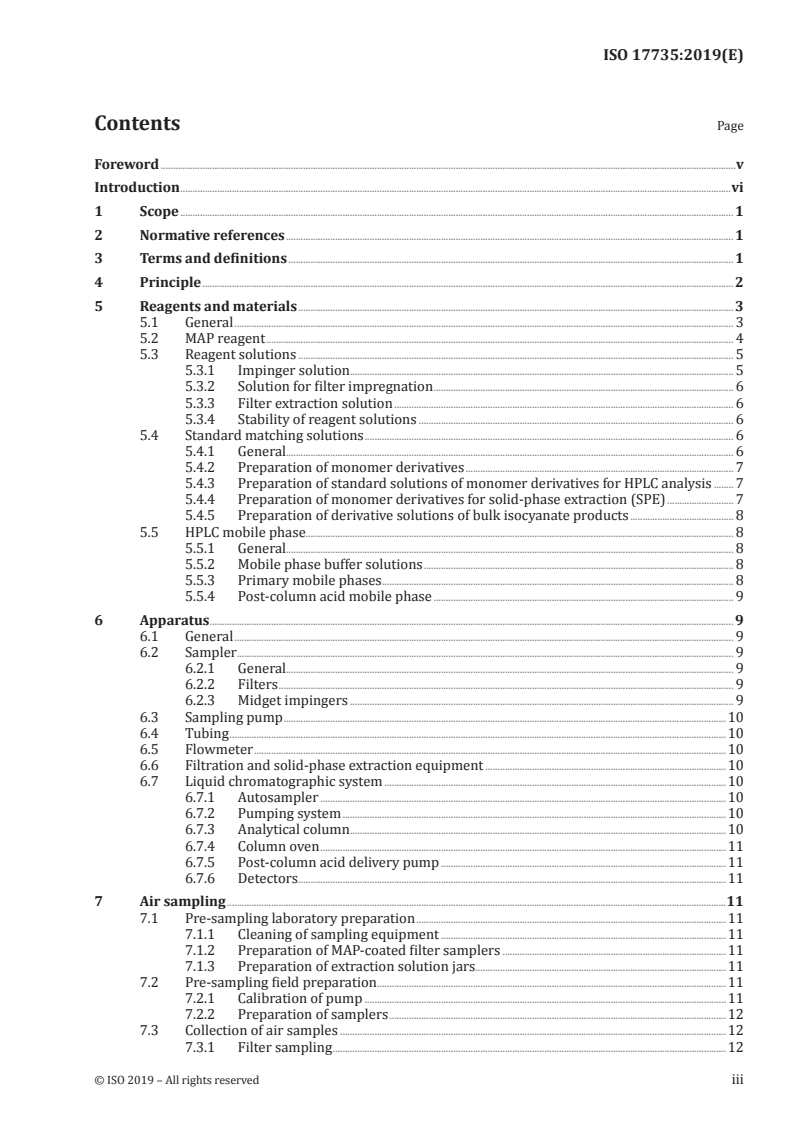
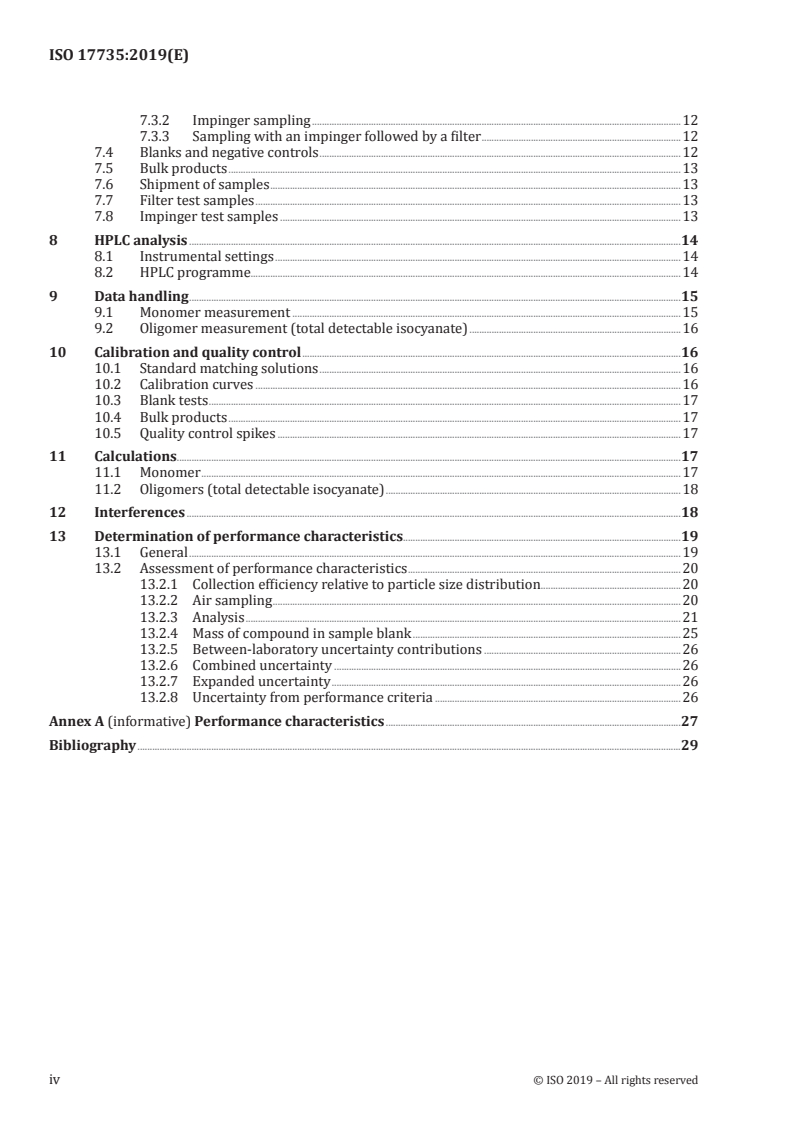
Contents Page
Foreword .v
Introduction .vi
1 Scope . 1
2 Normative references . 1
3 Terms and definitions . 1
4 Principle . 2
5 Reagents and materials . 3
5.1 General . 3
5.2 MAP reagent . 4
5.3 Reagent solutions . 5
5.3.1 Impinger solution . . 5
5.3.2 Solution for filter impregnation . 6
5.3.3 Filter extraction solution . 6
5.3.4 Stability of reagent solutions . 6
5.4 Standard matching solutions . 6
5.4.1 General. 6
5.4.2 Preparation of monomer derivatives . 7
5.4.3 Preparation of standard solutions of monomer derivatives for HPLC analysis . 7
5.4.4 Preparation of monomer derivatives for solid-phase extraction (SPE) . 7
5.4.5 Preparation of derivative solutions of bulk isocyanate products . 8
5.5 HPLC mobile phase. 8
5.5.1 General. 8
5.5.2 Mobile phase buffer solutions . 8
5.5.3 Primary mobile phases . . 8
5.5.4 Post-column acid mobile phase . 9
6 Apparatus . 9
6.1 General . 9
6.2 Sampler . 9
6.2.1 General. 9
6.2.2 Filters . 9
6.2.3 Midget impingers . 9
6.3 Sampling pump .10
6.4 Tubing .10
6.5 Flowmeter .10
6.6 Filtration and solid-phase extraction equipment .10
6.7 Liquid chromatographic system .10
6.7.1 Autosampler .10
6.7.2 Pumping system .10
6.7.3 Analytical column .10
6.7.4 Column oven .11
6.7.5 Post-column acid delivery pump .11
6.7.6 Detectors .11
7 Air sampling .11
7.1 Pre-sampling laboratory preparation .11
7.1.1 Cleaning of sampling equipment .11
7.1.2 Preparation of MAP-coated filter samplers .11
7.1.3 Preparation of extraction solution jars.11
7.2 Pre-sampling field preparation .11
7.2.1 Calibration of pump .11
7.2.2 Preparation of samplers .12
7.3 Collection of air samples .12
7.3.1 Filter sampling .12
7.3.2 Impinger sampling .12
7.3.3 Sampling with an impinger followed by a filter .12
7.4 Blanks and negative controls .12
7.5 Bulk products .13
7.6 Shipment of samples .13
7.7 Filter test samples .13
7.8 Impinger test samples .13
8 HPLC analysis .14
8.1 Instrumental settings .14
8.2 HPLC programme.14
9 Data handling .15
9.1 Monomer measurement .15
9.2 Oligomer measurement (total detectable isocyanate) .16
10 Calibration and quality control .16
10.1 Standard matching solutions .16
10.2 Calibration curves .16
10.3 Blank tests .17
10.4 Bulk products .17
10.5 Quality control spikes .17
11 Calculations.17
11.1 Monomer .17
11.2 Oligomers (total detectable isocyanate) .18
12 Interferences .18
13 Determination of performance characteristics.19
13.1 General .19
13.2 Assessment of performance characteristics .20
13.2.1 Collection efficiency relative to particle size distribution.20
13.2.2 Air sampling .20
13.2.3 Analysis .21
13.2.4 Mass of compound in sample blank .25
13.2.5 Between-laboratory uncertainty contributions .26
13.2.6 Combined uncertainty .26
13.2.7 Expanded uncertainty .26
13.2.8 Uncertainty from performance criteria .26
Annex A (informative) Performance characteristics .27
Bibliography .29
iv © ISO 2019 – All rights reserved
Foreword
ISO (the International Organization for Standardization) is a worldwide federation of national standards
bodies (ISO member bodies). The work of preparing International Standards is normally carried out
through ISO technical committees. Each member body interested in a subject for which a technical
committee has been established has the right to be represented on that committee. International
organizations, governmental and non-governmental, in liaison with ISO, also take part in the work.
ISO collaborates closely with the International Electrotechnical Commission (IEC) on all matters of
electrotechnical standardization.
The procedures used to develop this document and those intended for its further maintenance are
described in the ISO/IEC Directives, Part 1. In particular the different approval criteria needed for the
different types of ISO documents should be noted. This document was drafted in accordance with the
editorial rules of the ISO/IEC Directives, Part 2 (see www .iso .org/directives).
Attention is drawn to the possibility that some of the elements of this document may be the subject of
patent rights. ISO shall not be held responsible for identifying any or all such patent rights. Details of
any patent rights identified during the development of the document will be in the Introduction and/or
on the ISO list of patent declarations received (see www .iso .org/patents).
Any trade name used in this document is information given for the convenience of users and does not
constitute an endorsement.
For an explanation on the voluntary nature of standards, the meaning of ISO specific terms and
expressions related to conformity assessment, as well as information about ISO's adherence to the
World Trade Organization (WTO) principles in the Technical Barriers to Trade (TBT) see the following
URL: www .iso .org/iso/foreword .html.
This document was prepared by Technical Committee ISO/TC 146, Air quality, Subcommittee SC 2,
Workplace atmospheres.
This second edition cancels and replaces the first edition (ISO 17735:2009), which has been technically
revised. The main changes compared to the previous edition are as follows.
— Additional limit of detection information has been provided (Clause 1).
— The method has been used in high air concentrations successfully with a higher reagent concentration
in an impinger (5.3.1).
— During processing of impinger samples, rinsing the SPE cartridge with 6 ml dichloromethane has
been changed to rinsing with two consecutive 3 ml aliquots. This is more effective in removing all
of the butyl benzoate impinger solvent (7.8).
— The liquid chromatographic system has been adapted to use a smaller diameter analytical column
(6.7.3).
Any feedback or questions on this document should be directed to the user’s national standards body. A
complete listing of these bodies can be found at www .iso .org/members .html.
Introduction
This document specifies the use of 1-(9-anthracenylmethyl)piperazine (MAP) to measure monomeric
and oligomeric isocyanate species in workplace atmospheres. MAP was designed to improve the
reliability of identification of isocyanate species in sample chromatograms and to improve the
accuracy of quantification of these species relative to established reagents. The high performance
liquid chromatography (HPLC) analysis uses a pH gradient to selectively accelerate the elution of
MAP derivatives of oligomeric isocyanates that might be unobservable in an isocratic analysis. The
[8]
performance of MAP has been compared to other reagents used for total isocyanate analysis , MAP has
been found to react with phenyl isocyanate (used as a model isocyanate) as fast as or faster than other
reagents commonly used for isocyanate analysis. The UV response of MAP derivatives is comparable
to that of 9-(methylaminomethyl)anthracene (MAMA) derivatives and considerably greater than other
commonly used reagents [approximately three times greater than 1-(2-methoxyphenyl)piperazine
(1-2MP) derivatives of aromatic isocyanates and 14 times greater than 1-2MP derivatives of aliphatic
isocyanates]. The compound-to-compound variability of UV response per isocyanate group for MAP
derivatives is smaller than the variability of any other commonly used reagent/detector combination
(the coefficient of variation is 3,5 % for five model isocyanates). This results in more accurate
quantification of detectable non-monomeric isocyanate species based on a calibration curve generated
from analysing standards of monomeric species. The monomeric species used for calibration is generally
the one associated with the product being analysed, but others could be used due to the very small
compound-to-compound response variability of the MAP derivatives. The intensity of fluorescence
response of MAP derivatives is comparable to that of MAMA derivatives and considerably greater
than other reagents (e.g. approximately 30 times more intense than that of tryptamine derivatives).
The compound-to-compound variability in fluorescence response has been found to be smaller than
that of MAMA derivatives but larger than that of tryptamine derivatives (MAMA = 59 % coefficient
of variation, MAP = 33 % coefficient of variation, and tryptamine = 16 % coefficient of variation for
5 model isocyanates). The compound-to-compound fluorescence variability of MAP derivatives is
considered too great for accurate quantification of non-monomeric isocyanate species based on
calibration with monomer standards. However, the sensitivity of the fluorescence detection makes
it especially suitable for quantification of low levels of monomer, and the selectivity is very useful to
designate an unidentified HPLC peak as a MAP derivative. MAP derivatives also give a strong response
by electrochemical detection. The pH gradient used in the HPLC analysis selectively accelerates the
elution of amines (MAP derivatives are amines) and is very strong (it accelerates MDI more than
100-fold). Re-equilibration to initial conditions is almost immediate. Many oligomeric species can be
measured in the 30 min MAP analysis that may be unobservable in a much longer isocratic analysis.
MAP has been used in several studies comparing it side-by-side with other methods. Reference [9]
found MAP impingers and NIOSH 5521 impingers (comparable to MDHS 25) to give comparable
results in spray painting environments. Reference [9] used MAP reagent, but the pH gradient was not
employed. Reference [10] compared MAP impingers with several other impinger methods (NIOSH 5521
and NIOSH 5522) and the double filter method. The average MAP oligomer value was substantially
higher than the other impinger methods and slightly higher than the double filter method. The pH
gradient was used in these MAP analyses. Reference [11] found that the MAP oligomer results compared
favourably against several other methods for measurement of oligomeric isocyanates in the collision
repair industry, and agreed well with the reference values.
[12]
The MAP method is currently available as NIOSH Method 5525 . The performance characteristics of
the method have been evaluated in Reference [13].
vi © ISO 2019 – All rights reserved
INTERNATIONAL STANDARD ISO 17735:2019(E)
Workplace atmospheres — Determination of total
isocyanate groups in air using 1-(9-anthracenylmethyl)
piperazine (MAP) reagent and liquid chromatography
1 Scope
This document specifies a method for the sampling and analysis of airborne organic isocyanates in
workplace air.
This document is applicable to a wide range of organic compounds containing isocyanate groups,
including monofunctional isocyanates (e.g. phenyl isocyanate), diisocyanate monomers [e.g.
1,6-hexamethylene diisocyanate (HDI), toluene diisocyanate (TDI), 4,4′-diphenylmethane diisocyanate
(MDI), and isophorone diisocyanate (IPDI)], prepolymers (e.g. the biuret and isocyanurate of HDI), as
well as chromatographable intermediate products formed during production or thermal breakdown of
polyurethane.
In mixed systems of HDI and IPDI products, it is impossible to identify and quantify low levels of IPDI
monomer using this document, due to coelution of IPDI monomer with HDI-uretidinedione.
It is known that the method underestimates the oligomer in MDI-based products. Total isocyanate
group (NCO) is underestimated in MDI-based products by about 35 % as compared to dibutylamine
titration.
The method has been successfully modified to be used with LC-MS-MS for TDI monomer using an
isocratic 70 % acetonitrile/30 % 10 mM ammonium formate mobile phase.
The useful range of the method, expressed in moles of isocyanate group per species per sample, is
−10 −7
approximately 1 × 10 to 2 × 10 . The instrumental detection limit for the monomers using both
ultraviolet (UV) detection and fluorescence (FL) detection is about 2 ng monomer per sample. The
useful limit of detection for the method using reagent impregnated filters is about 10 ng to 20 ng
−3
monomer per sample for both UV and FL detection. For a 15 l sample, this corresponds to 0,7 µg/m to
−3
1,4 µg/m . For impinger samples, which require solid phase extraction, experience has shown that the
useful limit of detection is about 30 ng to 80 ng monomer per sample.
2 Normative references
The following documents are referred to in the text in such a way that some or all of their content
constitutes requirements of this document. For dated references, only the edition cited applies. For
undated references, the latest edition of the referenced document (including any amendments) applies.
EN 1232, Workplace atmospheres — Pumps for personal sampling of chemical agents — Requirements and
test methods
3 Terms and definitions
No terms and definitions are listed in this document.
ISO and IEC maintain terminological databases for use in standardization at the following addresses:
— ISO Online browsing platform: available at https: //www .iso .org/obp
— IEC Electropedia: available at http: //www .electropedia .org/
4 Principle
A measured volume of air is drawn through either an impinger containing a solution of
1-(9-anthracenylmethyl)piperazine (MAP), a filter impregnated with MAP, or a sampling train
consisting of an impinger followed by an impregnated filter. The choice of sampler depends on the
chemical and physical characteristics of the airborne isocyanate[14]. If an impinger is used, the
solution is subjected to solid-phase extraction (SPE) and the eluate is concentrated and analysed by
reverse phase high performance liquid chromatography (HPLC) with ultraviolet (UV) absorbance
and fluorescence (FL) detection in series. If an impregnated filter is used for sampling, it is extracted
with solvent either in the field after completion of sampling or in the laboratory. Waiting to extract
the filter until after the sample has been received by the analytical laboratory is acceptable only for
analysis of isocyanates collected as vapour. This solution is filtered and analysed by HPLC/UV/FL.
Isocyanate-derived peaks are identified based on their UV and FL responses and by comparison with
the chromatogram of a derivatized bulk isocyanate product if available. Quantification of compounds
for which analytical standards are available (generally monomers) is achieved by comparison of the FL
peak height of the sample peak with the FL peak height of standard matching solutions. Quantification
of compounds for which analytical standards are not available is achieved by comparison of the UV
area of the sample peak with the UV area of the appropriate monomer standard (i.e. the monomer from
which the isocyanate product is derived).
Structures of some common diisocyanate monomers are shown in Figure 1.
2 © ISO 2019 – All rights reserved
Key
1 methyl isocyanate 6 HDI
2 butyl isocyanate 7 2,4-TDI
3 phenyl isocyanate 8 IPDI
4 4,4′-MDI 9 hydrogenated MDI (HMDI)
5 2,6-TDI
Figure 1 — Structures of some common isocyanates
5 Reagents and materials
CAUTION — Observe appropriate safety precautions when preparing reagents. Carry out
preparations under a fume hood to avoid exposure to solvents, isocyanates or other volatile
reagents. Wear chemical protective gloves when manipulating reagents and solvents.
5.1 General
During the analysis, unless otherwise stated, use only reagents of HPLC grade or better, and
water of HPLC grade. The following list of reagents are used for the below procedures and for the
procedures in Clauses 6 and 7: 9-(chloromethyl)anthracene, 1,6-hexamethylene diisocyanate,
4,4′-methylenebis(cyclohexyl isocyanate), 4,4′-methylenebis(phenyl isocyanate), acetic anhydride,
acetonitrile, butyl benzoate, dichloromethane, dimethyl formamide, ethyl acetate, formic acid, hexane,
hydrochloric acid, isophorone diisocyanate, methanol, nitric acid, non-chromate/concentrated sulfuric
acid-based cleaning solution, phosphoric acid, piperazine, prepurified nitrogen compressed gas, toluene,
tolylene 2,4-diisocyanate, tolylene 2,6-diisocyanate, and triethylamine.
The following materials are used for the below procedures and for the procedures in Clauses 6 and
7: amber jars with polytetrafluoroethylene (PTFE)-lined caps, Büchner funnel, cool packs, cooler,
disposable glass vials (7 ml and 20 ml, PTFE-lined caps), dropping funnel, filter holder (open- or closed-
face 37 mm polystyrene cassettes, 13 mm polypropylene cassettes), filter paper, glass chromatography
column (short), glass fibre filter (37 mm or 13 mm, binder-free), magnetic stirring bar, nylon filter
(0,45 µm), round-bottomed flasks (250 ml two-necked; 100 ml one-necked; 1 000 ml one-necked),
separating funnel, silica gel (high-purity grade, 60 Å, 70-230 mesh), SPE tubes (normal phase silica gel,
6 ml/500 mg), syringe barrel (empty, polypropylene), syringe filter (0,45 µm PTFE), TLC plates (green
fluorescing F or blue fluorescing F ), tubing (fluoroelastomer and plastic, rubber, or other suitable
254 254s
material 900 mm long), volumetric flask (10 ml one-mark, ISO 1042:2004, Class A), wax bath.
5.2 MAP reagent
5.2.1 MAP is prepared by the reaction of 9-(chloromethyl)anthracene with piperazine as shown in
Figure 2. The procedure is as shown in 5.2.2 to 5.2.12.
Key
1 9-(chloromethyl)anthracene
2 piperazine
3 MAP
Figure 2 — Preparation of MAP
5.2.2 Dissolve 10,8 mmol (2,47 g) of 9-(chloromethyl)anthracene (98 % mass fraction) in 25 ml
dichloromethane. Place this solution in a dropping funnel.
5.2.3 Dissolve 54,4 mmol (4,69 g) of piperazine (99 % mass fraction) and 21,8 mmol (3,04 ml) of
triethylamine (99,5 % mass fraction) in 37 ml dichloromethane. Place this solution in a 250 ml two-
necked round-bottomed flask with a magnetic stirring bar.
5.2.4 While stirring this solution, add the 9-(chloromethyl)anthracene solution dropwise over a
30 min period. Rinse down the dropping funnel with an additional 10 ml of dichloromethane. Allow the
reaction to continue while stirring for at least 2 h.
5.2.5 Using a separating funnel, wash the reaction mixture three times with 130 ml water by shaking
vigorously for 1 min. Discard the emulsion that forms after the first wash, which contains primarily an
impurity and not MAP. Discard the aqueous washings.
4 © ISO 2019 – All rights reserved
5.2.6 Place the washed MAP solution in a weighed 100 ml round-bottomed flask. Allow the
dichloromethane to evaporate under a steady stream of nitrogen. Weigh the flask with the residue to
obtain an approximate yield. This crude MAP can be safely stored in a freezer until further purification.
5.2.7 MAP is purified by column chromatography followed by sublimation. Using a glass
chromatography column of internal diameter approximately 50 mm, add a slurry of silica gel (high-
purity, 60 Å, 70-230 mesh) in toluene until the silica gel bed is approximately 80 mm deep. Wash the
sides of the column down with toluene and allow the toluene to run through the column until the toluene
is even with the silica gel surface.
5.2.8 Dissolve the crude MAP in 80 ml of toluene. Sonicate the mixture for 5 min and filter through
filter paper. Save the filtrate. Suspend the residue in 20 ml toluene, sonicate for 5 min, and filter through
filter paper. Discard the residue. Combine the filtrates and carefully load them onto the top of the silica
gel bed. Pass an additional bed volume of toluene through the column. Discard the toluene eluate.
5.2.9 Begin to elute with ethyl acetate. Begin collecting 20 ml fractions in disposable vials with caps
lined with polytetrafluoroethylene (PTFE). Monitor the fractions by spotting 1 µl of each on a thin layer
chromatography (TLC) plate and viewing the intensity of the spots under UV light after the solvent has
evaporated. This procedure indicates the presence of compounds in the fraction, which may or may not
be MAP. Continue eluting with ethyl acetate until the yellow colour has eluted, which requires about
200 ml ethyl acetate. The MAP should be completely retained on the column at this point. After elution of
the yellow colour, begin eluting with methanol, which requires 1 l to 1,5 l methanol.
5.2.10 The elution of the MAP can be readily followed by TLC. A portion of the fractions that had given
a significant spot on the TLC plate are analysed by TLC (green fluorescing F or blue fluorescing F ,
254 254s
methanol) to determine which fractions contain MAP. Identify the MAP spot by comparing the retardation
factor, R , of the aliquot spots with the R of a MAP standard.
f f
5.2.11 Based on TLC analyses, combine the fractions containing pure MAP. Weigh a 1 000 ml round-
bottomed flask to be used for rotary evaporation. Add the combined fractions to the flask, but do not
exceed half the volume of the flask at any given time. Heat the evaporator bath to 35 °C to 40 °C and
use water aspirator vacuum. After evaporation and trace solvent removal from all of the combined MAP
fractions under high vacuum, weigh the flask and its contents to assess the yield.
5.2.12 Purify the MAP powder further by sublimation. Dissolve the MAP in a small volume
of dichloromethane (<20 ml) and transfer the solution to a sublimation apparatus. Allow the
dichloromethane to evaporate under a gentle stream of nitrogen, keeping the MAP below the level of
the bottom of the coldfinger. When the dichloromethane has evaporated, seal the vessel and reduce the
pressure with a vacuum pump to 6,67 Pa or less.
NOTE 1 Pa = 0,007 5 torr.
Begin a slow flow of cold water through the coldfinger and place the sublimation vessel in a wax bath
maintained at 125 °C to 130 °C. Sublimation takes many hours and may need to continue overnight.
Sublimation is complete when there is no further growth of MAP crystals on the coldfinger and the
small amount of material remaining at the bottom of the apparatus appears constant. When complete,
remove the crystals from the coldfinger with a spatula. A typical yield is 2,2 g (74 % mass fraction). The
melting point of the MAP is 146 °C to 147 °C. The purity of MAP as assessed by HPLC is typically 99 %
mass fraction.
5.3 Reagent solutions
5.3.1 Impinger solution
Butyl benzoate, 99 % mass fraction, is used as the impinger solvent. The butyl benzoate is further
purified by passing it through a bed of high-purity grade silica gel. Dissolve MAP in the butyl benzoate
−4
to make a 1 × 10 mol/l solution (27,6 mg/l). Store the solution in an amber bottle in a refrigerator
−4
until use. Higher concentrations of MAP in butyl benzoate (2- 8 × 10 mol/l) can be successfully used
in environments where high air concentrations are expected, such as spray booths and other spray
operations.
5.3.2 Solution for filter impregnation
MAP is dissolved in acetonitrile to make a solution of 2 mg/ml. Store in a freezer until use.
5.3.3 Filter extraction solution
−4
MAP is dissolved in acetonitrile to make a 1 × 10 mol/l solution (27,6 mg/l). Store in a freezer until use.
5.3.4 Stability of reagent solutions
It is best to make filter-spiking solution immediately before use, but this solution can be stored for up
to 2 weeks in a freezer. The impinger and filter extraction solutions are stable for at least one month in
a refrigerator.
5.4 Standard matching solutions
5.4.1 General
The UV detector response is nearly identical for all MAP-derivatized isocyanate groups. This allows
the use of the MAP-derivatized monomer of the isocyanate product of interest as a standard for
quantification of the other unknown oligomeric MAP-derivatized species in the chromatogram. A
calibration curve, plotting UV response as a function of number or concentration of isocyanate groups,
can then be used to quantify the oligomeric species for which there is no standard available. For this
reason, it is conceptually simpler to use standard matching solutions quantified in terms of their
concentration of isocyanate groups rather than in terms of mass concentration of isocyanate compound.
An equivalent is the amount of substance of isocyanate compound containing a mole of isocyanate
group or the amount of substance of MAP-derivatized isocyanate compound containing a mole of bound
MAP groups. The equivalent mass of an isocyanate compound is the relative molecular mass divided by
the number of isocyanate groups per molecule, n. The equivalent mass of a MAP-derivatized isocyanate
compound is the relative molecular mass divided by the number of MAP groups per molecule. The
number of isocyanate groups, irrespective of their attachment, can be measured in moles per litre.
Table 1 lists relative molecular masses and equivalent masses for common isocyanates and their MAP
derivatives.
Table 1 — Relative molecular masses and equivalent masses of some common isocyanates
and their MAP derivatives
Compound Short Relative Equivalent MAP derivative MAP derivative
form molecular mass relative molecu- equivalent mass
mass lar mass
M(eq)
1-(9-Anthracenylmethyl)piperazine MAP 276,38 276,38 — —
Methyl isocyanate — 57,05 57,05 333,43 333,43
Butyl isocyanate — 99,13 99,13 375,51 375,51
Phenyl isocyanate — 119,12 119,12 395,50 395,50
1,6-Hexamethylene diisocyanate HDI 168,20 84,10 720,96 360,48
1,6-diisocyanatohexane
Toluene diisocyanate (both 2,4- and TDI 174,16 87,08 726,92 363,46
2,6-diisocyanatotoluene)
6 © ISO 2019 – All rights reserved
Table 1 (continued)
Compound Short Relative Equivalent MAP derivative MAP derivative
form molecular mass relative molecu- equivalent mass
mass lar mass
M(eq)
Isophorone diisocyanate 1-isocy- IPDI 222,29 111,14 775,05 387,52
anato-3-isocyanatomethyl-3,5,5-tri-
methylcyclohexane
4,4′-Diphenylmethane diisocyanate 4,4′- 250,26 125,13 803,02 401,51
Di-(4-isocyanatophenyl)methane MDI
Hydrogenated MDI HMDI 262,35 131,18 815,11 407,56
Methylenebis(cyclohexyl-4-isocy-
anate)
4,4′-Dicyclohexylmethane diisocy-
anate
Isocyanate group NCO 42 42 — —
5.4.2 Preparation of monomer derivatives
Accurately weigh approximately 0,5 mmol (1 milliequivalent) of diisocyanate or 1 mmol
(1 milliequivalent) of a monoisocyanate and record the amount of substance to four decimal places.
Dissolve in 10 ml of toluene. Weigh approximately 1,2 mmol of MAP (20 % mass fraction excess) and
record the amount of substance to four decimal places. Dissolve in 20 ml of toluene. While stirring the
MAP solution, add the isocyanate solution dropwise over a period of 10 min to 15 min. Continue to stir
for at least 1 h. Tightly cover the solution and store overnight in a freezer to maximize precipitation of
product. Collect the precipitate using a Büchner funnel. Wash the precipitate several times with cold
toluene to remove residual MAP, then wash it several times with cold hexane to displace the toluene.
Transfer the solid derivative to a pre-weighed 20 ml disposable vial. Subject the vial to high vacuum
until constant mass is obtained and seal with a PTFE-lined cap. Yields are typically > 95 % mass fraction
and purity is sufficient to use this material for standard matching solutions. Experience shows that
when stored in the dark in a freezer, these derivatives are stable for several years.
5.4.3 Preparation of standard solutions of monomer derivatives for HPLC analysis
−5 −5
Weigh approximately 5,0 × 10 mol of a MAP monoisocyanate derivative or 2,5 × 10 mol of
−5
a MAP diisocyanate derivative (5,0 × 10 equivalents) into a 10 ml one-mark volumetric flask,
ISO 1042:2004, Class A. Dissolve in several millilitres dimethyl formamide (DMF) and fill to the mark
with DMF. Dichloromethane can be used instead, if desired, for MAP derivatives that are very soluble
in dichloromethane (aliphatic diisocyanates and 2,4-TDI). The stock solutions are of approximate
−3 −3
concentration 5,0 × 10 mol/l (monoisocyanate) or 2,5 × 10 mol/l (diisocyanate). Store the stock
solutions in a freezer. Working standards are made by dilution into acetonitrile, with the highest
−4 −4
concentration standard being approximately 2,0 × 10 mol/l (monoisocyanate) or 1,0 × 10 mol/l
(diisocyanate). Other concentrations can be made by serial dilution, typically the lowest concentration
−7
...
INTERNATIONAL ISO
STANDARD 17735
Second edition
2019-04
Workplace atmospheres —
Determination of total
isocyanate groups in air using
1-(9-anthracenylmethyl)piperazine
(MAP) reagent and liquid
chromatography
Air des lieux de travail — Dosage des groupements isocyanates totaux
dans l'air par réaction avec la 1-(9-anthracénylméthyl)pipérazine
(MAP) et par chromatographie en phase liquide
Reference number
©
ISO 2019
© ISO 2019
All rights reserved. Unless otherwise specified, or required in the context of its implementation, no part of this publication may
be reproduced or utilized otherwise in any form or by any means, electronic or mechanical, including photocopying, or posting
on the internet or an intranet, without prior written permission. Permission can be requested from either ISO at the address
below or ISO’s member body in the country of the requester.
ISO copyright office
CP 401 • Ch. de Blandonnet 8
CH-1214 Vernier, Geneva
Phone: +41 22 749 01 11
Fax: +41 22 749 09 47
Email: copyright@iso.org
Website: www.iso.org
Published in Switzerland
ii © ISO 2019 – All rights reserved
Contents Page
Foreword .v
Introduction .vi
1 Scope . 1
2 Normative references . 1
3 Terms and definitions . 1
4 Principle . 2
5 Reagents and materials . 3
5.1 General . 3
5.2 MAP reagent . 4
5.3 Reagent solutions . 5
5.3.1 Impinger solution . . 5
5.3.2 Solution for filter impregnation . 6
5.3.3 Filter extraction solution . 6
5.3.4 Stability of reagent solutions . 6
5.4 Standard matching solutions . 6
5.4.1 General. 6
5.4.2 Preparation of monomer derivatives . 7
5.4.3 Preparation of standard solutions of monomer derivatives for HPLC analysis . 7
5.4.4 Preparation of monomer derivatives for solid-phase extraction (SPE) . 7
5.4.5 Preparation of derivative solutions of bulk isocyanate products . 8
5.5 HPLC mobile phase. 8
5.5.1 General. 8
5.5.2 Mobile phase buffer solutions . 8
5.5.3 Primary mobile phases . . 8
5.5.4 Post-column acid mobile phase . 9
6 Apparatus . 9
6.1 General . 9
6.2 Sampler . 9
6.2.1 General. 9
6.2.2 Filters . 9
6.2.3 Midget impingers . 9
6.3 Sampling pump .10
6.4 Tubing .10
6.5 Flowmeter .10
6.6 Filtration and solid-phase extraction equipment .10
6.7 Liquid chromatographic system .10
6.7.1 Autosampler .10
6.7.2 Pumping system .10
6.7.3 Analytical column .10
6.7.4 Column oven .11
6.7.5 Post-column acid delivery pump .11
6.7.6 Detectors .11
7 Air sampling .11
7.1 Pre-sampling laboratory preparation .11
7.1.1 Cleaning of sampling equipment .11
7.1.2 Preparation of MAP-coated filter samplers .11
7.1.3 Preparation of extraction solution jars.11
7.2 Pre-sampling field preparation .11
7.2.1 Calibration of pump .11
7.2.2 Preparation of samplers .12
7.3 Collection of air samples .12
7.3.1 Filter sampling .12
7.3.2 Impinger sampling .12
7.3.3 Sampling with an impinger followed by a filter .12
7.4 Blanks and negative controls .12
7.5 Bulk products .13
7.6 Shipment of samples .13
7.7 Filter test samples .13
7.8 Impinger test samples .13
8 HPLC analysis .14
8.1 Instrumental settings .14
8.2 HPLC programme.14
9 Data handling .15
9.1 Monomer measurement .15
9.2 Oligomer measurement (total detectable isocyanate) .16
10 Calibration and quality control .16
10.1 Standard matching solutions .16
10.2 Calibration curves .16
10.3 Blank tests .17
10.4 Bulk products .17
10.5 Quality control spikes .17
11 Calculations.17
11.1 Monomer .17
11.2 Oligomers (total detectable isocyanate) .18
12 Interferences .18
13 Determination of performance characteristics.19
13.1 General .19
13.2 Assessment of performance characteristics .20
13.2.1 Collection efficiency relative to particle size distribution.20
13.2.2 Air sampling .20
13.2.3 Analysis .21
13.2.4 Mass of compound in sample blank .25
13.2.5 Between-laboratory uncertainty contributions .26
13.2.6 Combined uncertainty .26
13.2.7 Expanded uncertainty .26
13.2.8 Uncertainty from performance criteria .26
Annex A (informative) Performance characteristics .27
Bibliography .29
iv © ISO 2019 – All rights reserved
Foreword
ISO (the International Organization for Standardization) is a worldwide federation of national standards
bodies (ISO member bodies). The work of preparing International Standards is normally carried out
through ISO technical committees. Each member body interested in a subject for which a technical
committee has been established has the right to be represented on that committee. International
organizations, governmental and non-governmental, in liaison with ISO, also take part in the work.
ISO collaborates closely with the International Electrotechnical Commission (IEC) on all matters of
electrotechnical standardization.
The procedures used to develop this document and those intended for its further maintenance are
described in the ISO/IEC Directives, Part 1. In particular the different approval criteria needed for the
different types of ISO documents should be noted. This document was drafted in accordance with the
editorial rules of the ISO/IEC Directives, Part 2 (see www .iso .org/directives).
Attention is drawn to the possibility that some of the elements of this document may be the subject of
patent rights. ISO shall not be held responsible for identifying any or all such patent rights. Details of
any patent rights identified during the development of the document will be in the Introduction and/or
on the ISO list of patent declarations received (see www .iso .org/patents).
Any trade name used in this document is information given for the convenience of users and does not
constitute an endorsement.
For an explanation on the voluntary nature of standards, the meaning of ISO specific terms and
expressions related to conformity assessment, as well as information about ISO's adherence to the
World Trade Organization (WTO) principles in the Technical Barriers to Trade (TBT) see the following
URL: www .iso .org/iso/foreword .html.
This document was prepared by Technical Committee ISO/TC 146, Air quality, Subcommittee SC 2,
Workplace atmospheres.
This second edition cancels and replaces the first edition (ISO 17735:2009), which has been technically
revised. The main changes compared to the previous edition are as follows.
— Additional limit of detection information has been provided (Clause 1).
— The method has been used in high air concentrations successfully with a higher reagent concentration
in an impinger (5.3.1).
— During processing of impinger samples, rinsing the SPE cartridge with 6 ml dichloromethane has
been changed to rinsing with two consecutive 3 ml aliquots. This is more effective in removing all
of the butyl benzoate impinger solvent (7.8).
— The liquid chromatographic system has been adapted to use a smaller diameter analytical column
(6.7.3).
Any feedback or questions on this document should be directed to the user’s national standards body. A
complete listing of these bodies can be found at www .iso .org/members .html.
Introduction
This document specifies the use of 1-(9-anthracenylmethyl)piperazine (MAP) to measure monomeric
and oligomeric isocyanate species in workplace atmospheres. MAP was designed to improve the
reliability of identification of isocyanate species in sample chromatograms and to improve the
accuracy of quantification of these species relative to established reagents. The high performance
liquid chromatography (HPLC) analysis uses a pH gradient to selectively accelerate the elution of
MAP derivatives of oligomeric isocyanates that might be unobservable in an isocratic analysis. The
[8]
performance of MAP has been compared to other reagents used for total isocyanate analysis , MAP has
been found to react with phenyl isocyanate (used as a model isocyanate) as fast as or faster than other
reagents commonly used for isocyanate analysis. The UV response of MAP derivatives is comparable
to that of 9-(methylaminomethyl)anthracene (MAMA) derivatives and considerably greater than other
commonly used reagents [approximately three times greater than 1-(2-methoxyphenyl)piperazine
(1-2MP) derivatives of aromatic isocyanates and 14 times greater than 1-2MP derivatives of aliphatic
isocyanates]. The compound-to-compound variability of UV response per isocyanate group for MAP
derivatives is smaller than the variability of any other commonly used reagent/detector combination
(the coefficient of variation is 3,5 % for five model isocyanates). This results in more accurate
quantification of detectable non-monomeric isocyanate species based on a calibration curve generated
from analysing standards of monomeric species. The monomeric species used for calibration is generally
the one associated with the product being analysed, but others could be used due to the very small
compound-to-compound response variability of the MAP derivatives. The intensity of fluorescence
response of MAP derivatives is comparable to that of MAMA derivatives and considerably greater
than other reagents (e.g. approximately 30 times more intense than that of tryptamine derivatives).
The compound-to-compound variability in fluorescence response has been found to be smaller than
that of MAMA derivatives but larger than that of tryptamine derivatives (MAMA = 59 % coefficient
of variation, MAP = 33 % coefficient of variation, and tryptamine = 16 % coefficient of variation for
5 model isocyanates). The compound-to-compound fluorescence variability of MAP derivatives is
considered too great for accurate quantification of non-monomeric isocyanate species based on
calibration with monomer standards. However, the sensitivity of the fluorescence detection makes
it especially suitable for quantification of low levels of monomer, and the selectivity is very useful to
designate an unidentified HPLC peak as a MAP derivative. MAP derivatives also give a strong response
by electrochemical detection. The pH gradient used in the HPLC analysis selectively accelerates the
elution of amines (MAP derivatives are amines) and is very strong (it accelerates MDI more than
100-fold). Re-equilibration to initial conditions is almost immediate. Many oligomeric species can be
measured in the 30 min MAP analysis that may be unobservable in a much longer isocratic analysis.
MAP has been used in several studies comparing it side-by-side with other methods. Reference [9]
found MAP impingers and NIOSH 5521 impingers (comparable to MDHS 25) to give comparable
results in spray painting environments. Reference [9] used MAP reagent, but the pH gradient was not
employed. Reference [10] compared MAP impingers with several other impinger methods (NIOSH 5521
and NIOSH 5522) and the double filter method. The average MAP oligomer value was substantially
higher than the other impinger methods and slightly higher than the double filter method. The pH
gradient was used in these MAP analyses. Reference [11] found that the MAP oligomer results compared
favourably against several other methods for measurement of oligomeric isocyanates in the collision
repair industry, and agreed well with the reference values.
[12]
The MAP method is currently available as NIOSH Method 5525 . The performance characteristics of
the method have been evaluated in Reference [13].
vi © ISO 2019 – All rights reserved
INTERNATIONAL STANDARD ISO 17735:2019(E)
Workplace atmospheres — Determination of total
isocyanate groups in air using 1-(9-anthracenylmethyl)
piperazine (MAP) reagent and liquid chromatography
1 Scope
This document specifies a method for the sampling and analysis of airborne organic isocyanates in
workplace air.
This document is applicable to a wide range of organic compounds containing isocyanate groups,
including monofunctional isocyanates (e.g. phenyl isocyanate), diisocyanate monomers [e.g.
1,6-hexamethylene diisocyanate (HDI), toluene diisocyanate (TDI), 4,4′-diphenylmethane diisocyanate
(MDI), and isophorone diisocyanate (IPDI)], prepolymers (e.g. the biuret and isocyanurate of HDI), as
well as chromatographable intermediate products formed during production or thermal breakdown of
polyurethane.
In mixed systems of HDI and IPDI products, it is impossible to identify and quantify low levels of IPDI
monomer using this document, due to coelution of IPDI monomer with HDI-uretidinedione.
It is known that the method underestimates the oligomer in MDI-based products. Total isocyanate
group (NCO) is underestimated in MDI-based products by about 35 % as compared to dibutylamine
titration.
The method has been successfully modified to be used with LC-MS-MS for TDI monomer using an
isocratic 70 % acetonitrile/30 % 10 mM ammonium formate mobile phase.
The useful range of the method, expressed in moles of isocyanate group per species per sample, is
−10 −7
approximately 1 × 10 to 2 × 10 . The instrumental detection limit for the monomers using both
ultraviolet (UV) detection and fluorescence (FL) detection is about 2 ng monomer per sample. The
useful limit of detection for the method using reagent impregnated filters is about 10 ng to 20 ng
−3
monomer per sample for both UV and FL detection. For a 15 l sample, this corresponds to 0,7 µg/m to
−3
1,4 µg/m . For impinger samples, which require solid phase extraction, experience has shown that the
useful limit of detection is about 30 ng to 80 ng monomer per sample.
2 Normative references
The following documents are referred to in the text in such a way that some or all of their content
constitutes requirements of this document. For dated references, only the edition cited applies. For
undated references, the latest edition of the referenced document (including any amendments) applies.
EN 1232, Workplace atmospheres — Pumps for personal sampling of chemical agents — Requirements and
test methods
3 Terms and definitions
No terms and definitions are listed in this document.
ISO and IEC maintain terminological databases for use in standardization at the following addresses:
— ISO Online browsing platform: available at https: //www .iso .org/obp
— IEC Electropedia: available at http: //www .electropedia .org/
4 Principle
A measured volume of air is drawn through either an impinger containing a solution of
1-(9-anthracenylmethyl)piperazine (MAP), a filter impregnated with MAP, or a sampling train
consisting of an impinger followed by an impregnated filter. The choice of sampler depends on the
chemical and physical characteristics of the airborne isocyanate[14]. If an impinger is used, the
solution is subjected to solid-phase extraction (SPE) and the eluate is concentrated and analysed by
reverse phase high performance liquid chromatography (HPLC) with ultraviolet (UV) absorbance
and fluorescence (FL) detection in series. If an impregnated filter is used for sampling, it is extracted
with solvent either in the field after completion of sampling or in the laboratory. Waiting to extract
the filter until after the sample has been received by the analytical laboratory is acceptable only for
analysis of isocyanates collected as vapour. This solution is filtered and analysed by HPLC/UV/FL.
Isocyanate-derived peaks are identified based on their UV and FL responses and by comparison with
the chromatogram of a derivatized bulk isocyanate product if available. Quantification of compounds
for which analytical standards are available (generally monomers) is achieved by comparison of the FL
peak height of the sample peak with the FL peak height of standard matching solutions. Quantification
of compounds for which analytical standards are not available is achieved by comparison of the UV
area of the sample peak with the UV area of the appropriate monomer standard (i.e. the monomer from
which the isocyanate product is derived).
Structures of some common diisocyanate monomers are shown in Figure 1.
2 © ISO 2019 – All rights reserved
Key
1 methyl isocyanate 6 HDI
2 butyl isocyanate 7 2,4-TDI
3 phenyl isocyanate 8 IPDI
4 4,4′-MDI 9 hydrogenated MDI (HMDI)
5 2,6-TDI
Figure 1 — Structures of some common isocyanates
5 Reagents and materials
CAUTION — Observe appropriate safety precautions when preparing reagents. Carry out
preparations under a fume hood to avoid exposure to solvents, isocyanates or other volatile
reagents. Wear chemical protective gloves when manipulating reagents and solvents.
5.1 General
During the analysis, unless otherwise stated, use only reagents of HPLC grade or better, and
water of HPLC grade. The following list of reagents are used for the below procedures and for the
procedures in Clauses 6 and 7: 9-(chloromethyl)anthracene, 1,6-hexamethylene diisocyanate,
4,4′-methylenebis(cyclohexyl isocyanate), 4,4′-methylenebis(phenyl isocyanate), acetic anhydride,
acetonitrile, butyl benzoate, dichloromethane, dimethyl formamide, ethyl acetate, formic acid, hexane,
hydrochloric acid, isophorone diisocyanate, methanol, nitric acid, non-chromate/concentrated sulfuric
acid-based cleaning solution, phosphoric acid, piperazine, prepurified nitrogen compressed gas, toluene,
tolylene 2,4-diisocyanate, tolylene 2,6-diisocyanate, and triethylamine.
The following materials are used for the below procedures and for the procedures in Clauses 6 and
7: amber jars with polytetrafluoroethylene (PTFE)-lined caps, Büchner funnel, cool packs, cooler,
disposable glass vials (7 ml and 20 ml, PTFE-lined caps), dropping funnel, filter holder (open- or closed-
face 37 mm polystyrene cassettes, 13 mm polypropylene cassettes), filter paper, glass chromatography
column (short), glass fibre filter (37 mm or 13 mm, binder-free), magnetic stirring bar, nylon filter
(0,45 µm), round-bottomed flasks (250 ml two-necked; 100 ml one-necked; 1 000 ml one-necked),
separating funnel, silica gel (high-purity grade, 60 Å, 70-230 mesh), SPE tubes (normal phase silica gel,
6 ml/500 mg), syringe barrel (empty, polypropylene), syringe filter (0,45 µm PTFE), TLC plates (green
fluorescing F or blue fluorescing F ), tubing (fluoroelastomer and plastic, rubber, or other suitable
254 254s
material 900 mm long), volumetric flask (10 ml one-mark, ISO 1042:2004, Class A), wax bath.
5.2 MAP reagent
5.2.1 MAP is prepared by the reaction of 9-(chloromethyl)anthracene with piperazine as shown in
Figure 2. The procedure is as shown in 5.2.2 to 5.2.12.
Key
1 9-(chloromethyl)anthracene
2 piperazine
3 MAP
Figure 2 — Preparation of MAP
5.2.2 Dissolve 10,8 mmol (2,47 g) of 9-(chloromethyl)anthracene (98 % mass fraction) in 25 ml
dichloromethane. Place this solution in a dropping funnel.
5.2.3 Dissolve 54,4 mmol (4,69 g) of piperazine (99 % mass fraction) and 21,8 mmol (3,04 ml) of
triethylamine (99,5 % mass fraction) in 37 ml dichloromethane. Place this solution in a 250 ml two-
necked round-bottomed flask with a magnetic stirring bar.
5.2.4 While stirring this solution, add the 9-(chloromethyl)anthracene solution dropwise over a
30 min period. Rinse down the dropping funnel with an additional 10 ml of dichloromethane. Allow the
reaction to continue while stirring for at least 2 h.
5.2.5 Using a separating funnel, wash the reaction mixture three times with 130 ml water by shaking
vigorously for 1 min. Discard the emulsion that forms after the first wash, which contains primarily an
impurity and not MAP. Discard the aqueous washings.
4 © ISO 2019 – All rights reserved
5.2.6 Place the washed MAP solution in a weighed 100 ml round-bottomed flask. Allow the
dichloromethane to evaporate under a steady stream of nitrogen. Weigh the flask with the residue to
obtain an approximate yield. This crude MAP can be safely stored in a freezer until further purification.
5.2.7 MAP is purified by column chromatography followed by sublimation. Using a glass
chromatography column of internal diameter approximately 50 mm, add a slurry of silica gel (high-
purity, 60 Å, 70-230 mesh) in toluene until the silica gel bed is approximately 80 mm deep. Wash the
sides of the column down with toluene and allow the toluene to run through the column until the toluene
is even with the silica gel surface.
5.2.8 Dissolve the crude MAP in 80 ml of toluene. Sonicate the mixture for 5 min and filter through
filter paper. Save the filtrate. Suspend the residue in 20 ml toluene, sonicate for 5 min, and filter through
filter paper. Discard the residue. Combine the filtrates and carefully load them onto the top of the silica
gel bed. Pass an additional bed volume of toluene through the column. Discard the toluene eluate.
5.2.9 Begin to elute with ethyl acetate. Begin collecting 20 ml fractions in disposable vials with caps
lined with polytetrafluoroethylene (PTFE). Monitor the fractions by spotting 1 µl of each on a thin layer
chromatography (TLC) plate and viewing the intensity of the spots under UV light after the solvent has
evaporated. This procedure indicates the presence of compounds in the fraction, which may or may not
be MAP. Continue eluting with ethyl acetate until the yellow colour has eluted, which requires about
200 ml ethyl acetate. The MAP should be completely retained on the column at this point. After elution of
the yellow colour, begin eluting with methanol, which requires 1 l to 1,5 l methanol.
5.2.10 The elution of the MAP can be readily followed by TLC. A portion of the fractions that had given
a significant spot on the TLC plate are analysed by TLC (green fluorescing F or blue fluorescing F ,
254 254s
methanol) to determine which fractions contain MAP. Identify the MAP spot by comparing the retardation
factor, R , of the aliquot spots with the R of a MAP standard.
f f
5.2.11 Based on TLC analyses, combine the fractions containing pure MAP. Weigh a 1 000 ml round-
bottomed flask to be used for rotary evaporation. Add the combined fractions to the flask, but do not
exceed half the volume of the flask at any given time. Heat the evaporator bath to 35 °C to 40 °C and
use water aspirator vacuum. After evaporation and trace solvent removal from all of the combined MAP
fractions under high vacuum, weigh the flask and its contents to assess the yield.
5.2.12 Purify the MAP powder further by sublimation. Dissolve the MAP in a small volume
of dichloromethane (<20 ml) and transfer the solution to a sublimation apparatus. Allow the
dichloromethane to evaporate under a gentle stream of nitrogen, keeping the MAP below the level of
the bottom of the coldfinger. When the dichloromethane has evaporated, seal the vessel and reduce the
pressure with a vacuum pump to 6,67 Pa or less.
NOTE 1 Pa = 0,007 5 torr.
Begin a slow flow of cold water through the coldfinger and place the sublimation vessel in a wax bath
maintained at 125 °C to 130 °C. Sublimation takes many hours and may need to continue overnight.
Sublimation is complete when there is no further growth of MAP crystals on the coldfinger and the
small amount of material remaining at the bottom of the apparatus appears constant. When complete,
remove the crystals from the coldfinger with a spatula. A typical yield is 2,2 g (74 % mass fraction). The
melting point of the MAP is 146 °C to 147 °C. The purity of MAP as assessed by HPLC is typically 99 %
mass fraction.
5.3 Reagent solutions
5.3.1 Impinger solution
Butyl benzoate, 99 % mass fraction, is used as the impinger solvent. The butyl benzoate is further
purified by passing it through a bed of high-purity grade silica gel. Dissolve MAP in the butyl benzoate
−4
to make a 1 × 10 mol/l solution (27,6 mg/l). Store the solution in an amber bottle in a refrigerator
−4
until use. Higher concentrations of MAP in butyl benzoate (2- 8 × 10 mol/l) can be successfully used
in environments where high air concentrations are expected, such as spray booths and other spray
operations.
5.3.2 Solution for filter impregnation
MAP is dissolved in acetonitrile to make a solution of 2 mg/ml. Store in a freezer until use.
5.3.3 Filter extraction solution
−4
MAP is dissolved in acetonitrile to make a 1 × 10 mol/l solution (27,6 mg/l). Store in a freezer until use.
5.3.4 Stability of reagent solutions
It is best to make filter-spiking solution immediately before use, but this solution can be stored for up
to 2 weeks in a freezer. The impinger and filter extraction solutions are stable for at least one month in
a refrigerator.
5.4 Standard matching solutions
5.4.1 General
The UV detector response is nearly identical for all MAP-derivatized isocyanate groups. This allows
the use of the MAP-derivatized monomer of the isocyanate product of interest as a standard for
quantification of the other unknown oligomeric MAP-derivatized species in the chromatogram. A
calibration curve, plotting UV response as a function of number or concentration of isocyanate groups,
can then be used to quantify the oligomeric species for which there is no standard available. For this
reason, it is conceptually simpler to use standard matching solutions quantified in terms of their
concentration of isocyanate groups rather than in terms of mass concentration of isocyanate compound.
An equivalent is the amount of substance of isocyanate compound containing a mole of isocyanate
group or the amount of substance of MAP-derivatized isocyanate compound containing a mole of bound
MAP groups. The equivalent mass of an isocyanate compound is the relative molecular mass divided by
the number of isocyanate groups per molecule, n. The equivalent mass of a MAP-derivatized isocyanate
compound is the relative molecular mass divided by the number of MAP groups per molecule. The
number of isocyanate groups, irrespective of their attachment, can be measured in moles per litre.
Table 1 lists relative molecular masses and equivalent masses for common isocyanates and their MAP
derivatives.
Table 1 — Relative molecular masses and equivalent masses of some common isocyanates
and their MAP derivatives
Compound Short Relative Equivalent MAP derivative MAP derivative
form molecular mass relative molecu- equivalent mass
mass lar mass
M(eq)
1-(9-Anthracenylmethyl)piperazine MAP 276,38 276,38 — —
Methyl isocyanate — 57,05 57,05 333,43 333,43
Butyl isocyanate — 99,13 99,13 375,51 375,51
Phenyl isocyanate — 119,12 119,12 395,50 395,50
1,6-Hexamethylene diisocyanate HDI 168,20 84,10 720,96 360,48
1,6-diisocyanatohexane
Toluene diisocyanate (both 2,4- and TDI 174,16 87,08 726,92 363,46
2,6-diisocyanatotoluene)
6 © ISO 2019 – All rights reserved
Table 1 (continued)
Compound Short Relative Equivalent MAP derivative MAP derivative
form molecular mass relative molecu- equivalent mass
mass lar mass
M(eq)
Isophorone diisocyanate 1-isocy- IPDI 222,29 111,14 775,05 387,52
anato-3-isocyanatomethyl-3,5,5-tri-
methylcyclohexane
4,4′-Diphenylmethane diisocyanate 4,4′- 250,26 125,13 803,02 401,51
Di-(4-isocyanatophenyl)methane MDI
Hydrogenated MDI HMDI 262,35 131,18 815,11 407,56
Methylenebis(cyclohexyl-4-isocy-
anate)
4,4′-Dicyclohexylmethane diisocy-
anate
Isocyanate group NCO 42 42 — —
5.4.2 Preparation of monomer derivatives
Accurately weigh approximately 0,5 mmol (1 milliequivalent) of diisocyanate or 1 mmol
(1 milliequivalent) of a monoisocyanate and record the amount of substance to four decimal places.
Dissolve in 10 ml of toluene. Weigh approximately 1,2 mmol of MAP (20 % mass fraction excess) and
record the amount of substance to four decimal places. Dissolve in 20 ml of toluene. While stirring the
MAP solution, add the isocyanate solution dropwise over a period of 10 min to 15 min. Continue to stir
for at least 1 h. Tightly cover the solution and store overnight in a freezer to maximize precipitation of
product. Collect the precipitate using a Büchner funnel. Wash the precipitate several times with cold
toluene to remove residual MAP, then wash it several times with cold hexane to displace the toluene.
Transfer the solid derivative to a pre-weighed 20 ml disposable vial. Subject the vial to high vacuum
until constant mass is obtained and seal with a PTFE-lined cap. Yields are typically > 95 % mass fraction
and purity is sufficient to use this material for standard matching solutions. Experience shows that
when stored in the dark in a freezer, these derivatives are stable for several years.
5.4.3 Preparation of standard solutions of monomer derivatives for HPLC analysis
−5 −5
Weigh approximately 5,0 × 10 mol of a MAP monoisocyanate derivative or 2,5 × 10 mol of
−5
a MAP diisocyanate derivative (5,0 × 10 equivalents) into a 10 ml one-mark volumetric flask,
ISO 1042:2004, Class A. Dissolve in several millilitres dimethyl formamide (DMF) and fill to the mark
with DMF. Dichloromethane can be used instead, if desired, for MAP derivatives that are very soluble
in dichloromethane (aliphatic diisocyanates and 2,4-TDI). The stock solutions are of approximate
−3 −3
concentration 5,0 × 10 mol/l (monoisocyanate) or 2,5 × 10 mol/l (diisocyanate). Store the stock
solutions in a freezer. Working standards are made by dilution into acetonitrile, with the highest
−4 −4
concentration standard being approximately 2,0 × 10 mol/l (monoisocyanate) or 1,0 × 10 mol/l
(diisocyanate). Other concentrations can be made by serial dilution, typically the lowest concentration
−7 −7
being approximately 1 × 10 mol/l (monoisocyanate) or 0,5 × 10 mol/l (diisocyanate). These stock
solutions and dilutions are stable for up to three months when stored in a refrigerator.
5.4.4 Preparation of monomer derivatives for solid-phase extraction (SPE)
Evaluate recovery of MAP-derivatized monomers through solid-phase extraction (SPE) cartridges
periodically.
Stock solutions in DMF cannot be used to make SPE standards because even low concentrations of DMF
appear to cause premature elution of MAP derivatives. Standards to be passed through an SPE cartridge
should be derived from dichloromethane stock solutions. MAP-derivatives of aliphatic diisocyanates
and 2,4-TDI have better solubility in dichloromethane than do the MAP derivatives of 2,6-TDI and MDI.
−3
All MAP-derivatives except the MAP derivative of MDI are sufficiently soluble to prepare 1 × 10 mol/l
−3
(monoisocyanate) or 0,5 × 10 mol/l (diisocyanate) stock solutions. A stock solution of concentration
−4
2 × 10 mol/l can be made for the MAP derivative of MDI. These stock solutions can be further diluted
into butyl
...
INTERNATIONAL ISO
STANDARD 17735
Second edition
2019-04
Workplace atmospheres —
Determination of total
isocyanate groups in air using
1-(9-anthracenylmethyl)piperazine
(MAP) reagent and liquid
chromatography
Air des lieux de travail — Dosage des groupements isocyanates totaux
dans l'air par réaction avec la 1-(9-anthracénylméthyl)pipérazine
(MAP) et par chromatographie en phase liquide
Reference number
©
ISO 2019
© ISO 2019
All rights reserved. Unless otherwise specified, or required in the context of its implementation, no part of this publication may
be reproduced or utilized otherwise in any form or by any means, electronic or mechanical, including photocopying, or posting
on the internet or an intranet, without prior written permission. Permission can be requested from either ISO at the address
below or ISO’s member body in the country of the requester.
ISO copyright office
CP 401 • Ch. de Blandonnet 8
CH-1214 Vernier, Geneva
Phone: +41 22 749 01 11
Fax: +41 22 749 09 47
Email: copyright@iso.org
Website: www.iso.org
Published in Switzerland
ii © ISO 2019 – All rights reserved
Contents Page
Foreword .v
Introduction .vi
1 Scope . 1
2 Normative references . 1
3 Terms and definitions . 1
4 Principle . 2
5 Reagents and materials . 3
5.1 General . 3
5.2 MAP reagent . 4
5.3 Reagent solutions . 5
5.3.1 Impinger solution . . 5
5.3.2 Solution for filter impregnation . 6
5.3.3 Filter extraction solution . 6
5.3.4 Stability of reagent solutions . 6
5.4 Standard matching solutions . 6
5.4.1 General. 6
5.4.2 Preparation of monomer derivatives . 7
5.4.3 Preparation of standard solutions of monomer derivatives for HPLC analysis . 7
5.4.4 Preparation of monomer derivatives for solid-phase extraction (SPE) . 7
5.4.5 Preparation of derivative solutions of bulk isocyanate products . 8
5.5 HPLC mobile phase. 8
5.5.1 General. 8
5.5.2 Mobile phase buffer solutions . 8
5.5.3 Primary mobile phases . . 8
5.5.4 Post-column acid mobile phase . 9
6 Apparatus . 9
6.1 General . 9
6.2 Sampler . 9
6.2.1 General. 9
6.2.2 Filters . 9
6.2.3 Midget impingers . 9
6.3 Sampling pump .10
6.4 Tubing .10
6.5 Flowmeter .10
6.6 Filtration and solid-phase extraction equipment .10
6.7 Liquid chromatographic system .10
6.7.1 Autosampler .10
6.7.2 Pumping system .10
6.7.3 Analytical column .10
6.7.4 Column oven .11
6.7.5 Post-column acid delivery pump .11
6.7.6 Detectors .11
7 Air sampling .11
7.1 Pre-sampling laboratory preparation .11
7.1.1 Cleaning of sampling equipment .11
7.1.2 Preparation of MAP-coated filter samplers .11
7.1.3 Preparation of extraction solution jars.11
7.2 Pre-sampling field preparation .11
7.2.1 Calibration of pump .11
7.2.2 Preparation of samplers .12
7.3 Collection of air samples .12
7.3.1 Filter sampling .12
7.3.2 Impinger sampling .12
7.3.3 Sampling with an impinger followed by a filter .12
7.4 Blanks and negative controls .12
7.5 Bulk products .13
7.6 Shipment of samples .13
7.7 Filter test samples .13
7.8 Impinger test samples .13
8 HPLC analysis .14
8.1 Instrumental settings .14
8.2 HPLC programme.14
9 Data handling .15
9.1 Monomer measurement .15
9.2 Oligomer measurement (total detectable isocyanate) .16
10 Calibration and quality control .16
10.1 Standard matching solutions .16
10.2 Calibration curves .16
10.3 Blank tests .17
10.4 Bulk products .17
10.5 Quality control spikes .17
11 Calculations.17
11.1 Monomer .17
11.2 Oligomers (total detectable isocyanate) .18
12 Interferences .18
13 Determination of performance characteristics.19
13.1 General .19
13.2 Assessment of performance characteristics .20
13.2.1 Collection efficiency relative to particle size distribution.20
13.2.2 Air sampling .20
13.2.3 Analysis .21
13.2.4 Mass of compound in sample blank .25
13.2.5 Between-laboratory uncertainty contributions .26
13.2.6 Combined uncertainty .26
13.2.7 Expanded uncertainty .26
13.2.8 Uncertainty from performance criteria .26
Annex A (informative) Performance characteristics .27
Bibliography .29
iv © ISO 2019 – All rights reserved
Foreword
ISO (the International Organization for Standardization) is a worldwide federation of national standards
bodies (ISO member bodies). The work of preparing International Standards is normally carried out
through ISO technical committees. Each member body interested in a subject for which a technical
committee has been established has the right to be represented on that committee. International
organizations, governmental and non-governmental, in liaison with ISO, also take part in the work.
ISO collaborates closely with the International Electrotechnical Commission (IEC) on all matters of
electrotechnical standardization.
The procedures used to develop this document and those intended for its further maintenance are
described in the ISO/IEC Directives, Part 1. In particular the different approval criteria needed for the
different types of ISO documents should be noted. This document was drafted in accordance with the
editorial rules of the ISO/IEC Directives, Part 2 (see www .iso .org/directives).
Attention is drawn to the possibility that some of the elements of this document may be the subject of
patent rights. ISO shall not be held responsible for identifying any or all such patent rights. Details of
any patent rights identified during the development of the document will be in the Introduction and/or
on the ISO list of patent declarations received (see www .iso .org/patents).
Any trade name used in this document is information given for the convenience of users and does not
constitute an endorsement.
For an explanation on the voluntary nature of standards, the meaning of ISO specific terms and
expressions related to conformity assessment, as well as information about ISO's adherence to the
World Trade Organization (WTO) principles in the Technical Barriers to Trade (TBT) see the following
URL: www .iso .org/iso/foreword .html.
This document was prepared by Technical Committee ISO/TC 146, Air quality, Subcommittee SC 2,
Workplace atmospheres.
This second edition cancels and replaces the first edition (ISO 17735:2009), which has been technically
revised. The main changes compared to the previous edition are as follows.
— Additional limit of detection information has been provided (Clause 1).
— The method has been used in high air concentrations successfully with a higher reagent concentration
in an impinger (5.3.1).
— During processing of impinger samples, rinsing the SPE cartridge with 6 ml dichloromethane has
been changed to rinsing with two consecutive 3 ml aliquots. This is more effective in removing all
of the butyl benzoate impinger solvent (7.8).
— The liquid chromatographic system has been adapted to use a smaller diameter analytical column
(6.7.3).
Any feedback or questions on this document should be directed to the user’s national standards body. A
complete listing of these bodies can be found at www .iso .org/members .html.
Introduction
This document specifies the use of 1-(9-anthracenylmethyl)piperazine (MAP) to measure monomeric
and oligomeric isocyanate species in workplace atmospheres. MAP was designed to improve the
reliability of identification of isocyanate species in sample chromatograms and to improve the
accuracy of quantification of these species relative to established reagents. The high performance
liquid chromatography (HPLC) analysis uses a pH gradient to selectively accelerate the elution of
MAP derivatives of oligomeric isocyanates that might be unobservable in an isocratic analysis. The
[8]
performance of MAP has been compared to other reagents used for total isocyanate analysis , MAP has
been found to react with phenyl isocyanate (used as a model isocyanate) as fast as or faster than other
reagents commonly used for isocyanate analysis. The UV response of MAP derivatives is comparable
to that of 9-(methylaminomethyl)anthracene (MAMA) derivatives and considerably greater than other
commonly used reagents [approximately three times greater than 1-(2-methoxyphenyl)piperazine
(1-2MP) derivatives of aromatic isocyanates and 14 times greater than 1-2MP derivatives of aliphatic
isocyanates]. The compound-to-compound variability of UV response per isocyanate group for MAP
derivatives is smaller than the variability of any other commonly used reagent/detector combination
(the coefficient of variation is 3,5 % for five model isocyanates). This results in more accurate
quantification of detectable non-monomeric isocyanate species based on a calibration curve generated
from analysing standards of monomeric species. The monomeric species used for calibration is generally
the one associated with the product being analysed, but others could be used due to the very small
compound-to-compound response variability of the MAP derivatives. The intensity of fluorescence
response of MAP derivatives is comparable to that of MAMA derivatives and considerably greater
than other reagents (e.g. approximately 30 times more intense than that of tryptamine derivatives).
The compound-to-compound variability in fluorescence response has been found to be smaller than
that of MAMA derivatives but larger than that of tryptamine derivatives (MAMA = 59 % coefficient
of variation, MAP = 33 % coefficient of variation, and tryptamine = 16 % coefficient of variation for
5 model isocyanates). The compound-to-compound fluorescence variability of MAP derivatives is
considered too great for accurate quantification of non-monomeric isocyanate species based on
calibration with monomer standards. However, the sensitivity of the fluorescence detection makes
it especially suitable for quantification of low levels of monomer, and the selectivity is very useful to
designate an unidentified HPLC peak as a MAP derivative. MAP derivatives also give a strong response
by electrochemical detection. The pH gradient used in the HPLC analysis selectively accelerates the
elution of amines (MAP derivatives are amines) and is very strong (it accelerates MDI more than
100-fold). Re-equilibration to initial conditions is almost immediate. Many oligomeric species can be
measured in the 30 min MAP analysis that may be unobservable in a much longer isocratic analysis.
MAP has been used in several studies comparing it side-by-side with other methods. Reference [9]
found MAP impingers and NIOSH 5521 impingers (comparable to MDHS 25) to give comparable
results in spray painting environments. Reference [9] used MAP reagent, but the pH gradient was not
employed. Reference [10] compared MAP impingers with several other impinger methods (NIOSH 5521
and NIOSH 5522) and the double filter method. The average MAP oligomer value was substantially
higher than the other impinger methods and slightly higher than the double filter method. The pH
gradient was used in these MAP analyses. Reference [11] found that the MAP oligomer results compared
favourably against several other methods for measurement of oligomeric isocyanates in the collision
repair industry, and agreed well with the reference values.
[12]
The MAP method is currently available as NIOSH Method 5525 . The performance characteristics of
the method have been evaluated in Reference [13].
vi © ISO 2019 – All rights reserved
INTERNATIONAL STANDARD ISO 17735:2019(E)
Workplace atmospheres — Determination of total
isocyanate groups in air using 1-(9-anthracenylmethyl)
piperazine (MAP) reagent and liquid chromatography
1 Scope
This document specifies a method for the sampling and analysis of airborne organic isocyanates in
workplace air.
This document is applicable to a wide range of organic compounds containing isocyanate groups,
including monofunctional isocyanates (e.g. phenyl isocyanate), diisocyanate monomers [e.g.
1,6-hexamethylene diisocyanate (HDI), toluene diisocyanate (TDI), 4,4′-diphenylmethane diisocyanate
(MDI), and isophorone diisocyanate (IPDI)], prepolymers (e.g. the biuret and isocyanurate of HDI), as
well as chromatographable intermediate products formed during production or thermal breakdown of
polyurethane.
In mixed systems of HDI and IPDI products, it is impossible to identify and quantify low levels of IPDI
monomer using this document, due to coelution of IPDI monomer with HDI-uretidinedione.
It is known that the method underestimates the oligomer in MDI-based products. Total isocyanate
group (NCO) is underestimated in MDI-based products by about 35 % as compared to dibutylamine
titration.
The method has been successfully modified to be used with LC-MS-MS for TDI monomer using an
isocratic 70 % acetonitrile/30 % 10 mM ammonium formate mobile phase.
The useful range of the method, expressed in moles of isocyanate group per species per sample, is
−10 −7
approximately 1 × 10 to 2 × 10 . The instrumental detection limit for the monomers using both
ultraviolet (UV) detection and fluorescence (FL) detection is about 2 ng monomer per sample. The
useful limit of detection for the method using reagent impregnated filters is about 10 ng to 20 ng
−3
monomer per sample for both UV and FL detection. For a 15 l sample, this corresponds to 0,7 µg/m to
−3
1,4 µg/m . For impinger samples, which require solid phase extraction, experience has shown that the
useful limit of detection is about 30 ng to 80 ng monomer per sample.
2 Normative references
The following documents are referred to in the text in such a way that some or all of their content
constitutes requirements of this document. For dated references, only the edition cited applies. For
undated references, the latest edition of the referenced document (including any amendments) applies.
EN 1232, Workplace atmospheres — Pumps for personal sampling of chemical agents — Requirements and
test methods
3 Terms and definitions
No terms and definitions are listed in this document.
ISO and IEC maintain terminological databases for use in standardization at the following addresses:
— ISO Online browsing platform: available at https: //www .iso .org/obp
— IEC Electropedia: available at http: //www .electropedia .org/
4 Principle
A measured volume of air is drawn through either an impinger containing a solution of
1-(9-anthracenylmethyl)piperazine (MAP), a filter impregnated with MAP, or a sampling train
consisting of an impinger followed by an impregnated filter. The choice of sampler depends on the
chemical and physical characteristics of the airborne isocyanate[14]. If an impinger is used, the
solution is subjected to solid-phase extraction (SPE) and the eluate is concentrated and analysed by
reverse phase high performance liquid chromatography (HPLC) with ultraviolet (UV) absorbance
and fluorescence (FL) detection in series. If an impregnated filter is used for sampling, it is extracted
with solvent either in the field after completion of sampling or in the laboratory. Waiting to extract
the filter until after the sample has been received by the analytical laboratory is acceptable only for
analysis of isocyanates collected as vapour. This solution is filtered and analysed by HPLC/UV/FL.
Isocyanate-derived peaks are identified based on their UV and FL responses and by comparison with
the chromatogram of a derivatized bulk isocyanate product if available. Quantification of compounds
for which analytical standards are available (generally monomers) is achieved by comparison of the FL
peak height of the sample peak with the FL peak height of standard matching solutions. Quantification
of compounds for which analytical standards are not available is achieved by comparison of the UV
area of the sample peak with the UV area of the appropriate monomer standard (i.e. the monomer from
which the isocyanate product is derived).
Structures of some common diisocyanate monomers are shown in Figure 1.
2 © ISO 2019 – All rights reserved
Key
1 methyl isocyanate 6 HDI
2 butyl isocyanate 7 2,4-TDI
3 phenyl isocyanate 8 IPDI
4 4,4′-MDI 9 hydrogenated MDI (HMDI)
5 2,6-TDI
Figure 1 — Structures of some common isocyanates
5 Reagents and materials
CAUTION — Observe appropriate safety precautions when preparing reagents. Carry out
preparations under a fume hood to avoid exposure to solvents, isocyanates or other volatile
reagents. Wear chemical protective gloves when manipulating reagents and solvents.
5.1 General
During the analysis, unless otherwise stated, use only reagents of HPLC grade or better, and
water of HPLC grade. The following list of reagents are used for the below procedures and for the
procedures in Clauses 6 and 7: 9-(chloromethyl)anthracene, 1,6-hexamethylene diisocyanate,
4,4′-methylenebis(cyclohexyl isocyanate), 4,4′-methylenebis(phenyl isocyanate), acetic anhydride,
acetonitrile, butyl benzoate, dichloromethane, dimethyl formamide, ethyl acetate, formic acid, hexane,
hydrochloric acid, isophorone diisocyanate, methanol, nitric acid, non-chromate/concentrated sulfuric
acid-based cleaning solution, phosphoric acid, piperazine, prepurified nitrogen compressed gas, toluene,
tolylene 2,4-diisocyanate, tolylene 2,6-diisocyanate, and triethylamine.
The following materials are used for the below procedures and for the procedures in Clauses 6 and
7: amber jars with polytetrafluoroethylene (PTFE)-lined caps, Büchner funnel, cool packs, cooler,
disposable glass vials (7 ml and 20 ml, PTFE-lined caps), dropping funnel, filter holder (open- or closed-
face 37 mm polystyrene cassettes, 13 mm polypropylene cassettes), filter paper, glass chromatography
column (short), glass fibre filter (37 mm or 13 mm, binder-free), magnetic stirring bar, nylon filter
(0,45 µm), round-bottomed flasks (250 ml two-necked; 100 ml one-necked; 1 000 ml one-necked),
separating funnel, silica gel (high-purity grade, 60 Å, 70-230 mesh), SPE tubes (normal phase silica gel,
6 ml/500 mg), syringe barrel (empty, polypropylene), syringe filter (0,45 µm PTFE), TLC plates (green
fluorescing F or blue fluorescing F ), tubing (fluoroelastomer and plastic, rubber, or other suitable
254 254s
material 900 mm long), volumetric flask (10 ml one-mark, ISO 1042:2004, Class A), wax bath.
5.2 MAP reagent
5.2.1 MAP is prepared by the reaction of 9-(chloromethyl)anthracene with piperazine as shown in
Figure 2. The procedure is as shown in 5.2.2 to 5.2.12.
Key
1 9-(chloromethyl)anthracene
2 piperazine
3 MAP
Figure 2 — Preparation of MAP
5.2.2 Dissolve 10,8 mmol (2,47 g) of 9-(chloromethyl)anthracene (98 % mass fraction) in 25 ml
dichloromethane. Place this solution in a dropping funnel.
5.2.3 Dissolve 54,4 mmol (4,69 g) of piperazine (99 % mass fraction) and 21,8 mmol (3,04 ml) of
triethylamine (99,5 % mass fraction) in 37 ml dichloromethane. Place this solution in a 250 ml two-
necked round-bottomed flask with a magnetic stirring bar.
5.2.4 While stirring this solution, add the 9-(chloromethyl)anthracene solution dropwise over a
30 min period. Rinse down the dropping funnel with an additional 10 ml of dichloromethane. Allow the
reaction to continue while stirring for at least 2 h.
5.2.5 Using a separating funnel, wash the reaction mixture three times with 130 ml water by shaking
vigorously for 1 min. Discard the emulsion that forms after the first wash, which contains primarily an
impurity and not MAP. Discard the aqueous washings.
4 © ISO 2019 – All rights reserved
5.2.6 Place the washed MAP solution in a weighed 100 ml round-bottomed flask. Allow the
dichloromethane to evaporate under a steady stream of nitrogen. Weigh the flask with the residue to
obtain an approximate yield. This crude MAP can be safely stored in a freezer until further purification.
5.2.7 MAP is purified by column chromatography followed by sublimation. Using a glass
chromatography column of internal diameter approximately 50 mm, add a slurry of silica gel (high-
purity, 60 Å, 70-230 mesh) in toluene until the silica gel bed is approximately 80 mm deep. Wash the
sides of the column down with toluene and allow the toluene to run through the column until the toluene
is even with the silica gel surface.
5.2.8 Dissolve the crude MAP in 80 ml of toluene. Sonicate the mixture for 5 min and filter through
filter paper. Save the filtrate. Suspend the residue in 20 ml toluene, sonicate for 5 min, and filter through
filter paper. Discard the residue. Combine the filtrates and carefully load them onto the top of the silica
gel bed. Pass an additional bed volume of toluene through the column. Discard the toluene eluate.
5.2.9 Begin to elute with ethyl acetate. Begin collecting 20 ml fractions in disposable vials with caps
lined with polytetrafluoroethylene (PTFE). Monitor the fractions by spotting 1 µl of each on a thin layer
chromatography (TLC) plate and viewing the intensity of the spots under UV light after the solvent has
evaporated. This procedure indicates the presence of compounds in the fraction, which may or may not
be MAP. Continue eluting with ethyl acetate until the yellow colour has eluted, which requires about
200 ml ethyl acetate. The MAP should be completely retained on the column at this point. After elution of
the yellow colour, begin eluting with methanol, which requires 1 l to 1,5 l methanol.
5.2.10 The elution of the MAP can be readily followed by TLC. A portion of the fractions that had given
a significant spot on the TLC plate are analysed by TLC (green fluorescing F or blue fluorescing F ,
254 254s
methanol) to determine which fractions contain MAP. Identify the MAP spot by comparing the retardation
factor, R , of the aliquot spots with the R of a MAP standard.
f f
5.2.11 Based on TLC analyses, combine the fractions containing pure MAP. Weigh a 1 000 ml round-
bottomed flask to be used for rotary evaporation. Add the combined fractions to the flask, but do not
exceed half the volume of the flask at any given time. Heat the evaporator bath to 35 °C to 40 °C and
use water aspirator vacuum. After evaporation and trace solvent removal from all of the combined MAP
fractions under high vacuum, weigh the flask and its contents to assess the yield.
5.2.12 Purify the MAP powder further by sublimation. Dissolve the MAP in a small volume
of dichloromethane (<20 ml) and transfer the solution to a sublimation apparatus. Allow the
dichloromethane to evaporate under a gentle stream of nitrogen, keeping the MAP below the level of
the bottom of the coldfinger. When the dichloromethane has evaporated, seal the vessel and reduce the
pressure with a vacuum pump to 6,67 Pa or less.
NOTE 1 Pa = 0,007 5 torr.
Begin a slow flow of cold water through the coldfinger and place the sublimation vessel in a wax bath
maintained at 125 °C to 130 °C. Sublimation takes many hours and may need to continue overnight.
Sublimation is complete when there is no further growth of MAP crystals on the coldfinger and the
small amount of material remaining at the bottom of the apparatus appears constant. When complete,
remove the crystals from the coldfinger with a spatula. A typical yield is 2,2 g (74 % mass fraction). The
melting point of the MAP is 146 °C to 147 °C. The purity of MAP as assessed by HPLC is typically 99 %
mass fraction.
5.3 Reagent solutions
5.3.1 Impinger solution
Butyl benzoate, 99 % mass fraction, is used as the impinger solvent. The butyl benzoate is further
purified by passing it through a bed of high-purity grade silica gel. Dissolve MAP in the butyl benzoate
−4
to make a 1 × 10 mol/l solution (27,6 mg/l). Store the solution in an amber bottle in a refrigerator
−4
until use. Higher concentrations of MAP in butyl benzoate (2- 8 × 10 mol/l) can be successfully used
in environments where high air concentrations are expected, such as spray booths and other spray
operations.
5.3.2 Solution for filter impregnation
MAP is dissolved in acetonitrile to make a solution of 2 mg/ml. Store in a freezer until use.
5.3.3 Filter extraction solution
−4
MAP is dissolved in acetonitrile to make a 1 × 10 mol/l solution (27,6 mg/l). Store in a freezer until use.
5.3.4 Stability of reagent solutions
It is best to make filter-spiking solution immediately before use, but this solution can be stored for up
to 2 weeks in a freezer. The impinger and filter extraction solutions are stable for at least one month in
a refrigerator.
5.4 Standard matching solutions
5.4.1 General
The UV detector response is nearly identical for all MAP-derivatized isocyanate groups. This allows
the use of the MAP-derivatized monomer of the isocyanate product of interest as a standard for
quantification of the other unknown oligomeric MAP-derivatized species in the chromatogram. A
calibration curve, plotting UV response as a function of number or concentration of isocyanate groups,
can then be used to quantify the oligomeric species for which there is no standard available. For this
reason, it is conceptually simpler to use standard matching solutions quantified in terms of their
concentration of isocyanate groups rather than in terms of mass concentration of isocyanate compound.
An equivalent is the amount of substance of isocyanate compound containing a mole of isocyanate
group or the amount of substance of MAP-derivatized isocyanate compound containing a mole of bound
MAP groups. The equivalent mass of an isocyanate compound is the relative molecular mass divided by
the number of isocyanate groups per molecule, n. The equivalent mass of a MAP-derivatized isocyanate
compound is the relative molecular mass divided by the number of MAP groups per molecule. The
number of isocyanate groups, irrespective of their attachment, can be measured in moles per litre.
Table 1 lists relative molecular masses and equivalent masses for common isocyanates and their MAP
derivatives.
Table 1 — Relative molecular masses and equivalent masses of some common isocyanates
and their MAP derivatives
Compound Short Relative Equivalent MAP derivative MAP derivative
form molecular mass relative molecu- equivalent mass
mass lar mass
M(eq)
1-(9-Anthracenylmethyl)piperazine MAP 276,38 276,38 — —
Methyl isocyanate — 57,05 57,05 333,43 333,43
Butyl isocyanate — 99,13 99,13 375,51 375,51
Phenyl isocyanate — 119,12 119,12 395,50 395,50
1,6-Hexamethylene diisocyanate HDI 168,20 84,10 720,96 360,48
1,6-diisocyanatohexane
Toluene diisocyanate (both 2,4- and TDI 174,16 87,08 726,92 363,46
2,6-diisocyanatotoluene)
6 © ISO 2019 – All rights reserved
Table 1 (continued)
Compound Short Relative Equivalent MAP derivative MAP derivative
form molecular mass relative molecu- equivalent mass
mass lar mass
M(eq)
Isophorone diisocyanate 1-isocy- IPDI 222,29 111,14 775,05 387,52
anato-3-isocyanatomethyl-3,5,5-tri-
methylcyclohexane
4,4′-Diphenylmethane diisocyanate 4,4′- 250,26 125,13 803,02 401,51
Di-(4-isocyanatophenyl)methane MDI
Hydrogenated MDI HMDI 262,35 131,18 815,11 407,56
Methylenebis(cyclohexyl-4-isocy-
anate)
4,4′-Dicyclohexylmethane diisocy-
anate
Isocyanate group NCO 42 42 — —
5.4.2 Preparation of monomer derivatives
Accurately weigh approximately 0,5 mmol (1 milliequivalent) of diisocyanate or 1 mmol
(1 milliequivalent) of a monoisocyanate and record the amount of substance to four decimal places.
Dissolve in 10 ml of toluene. Weigh approximately 1,2 mmol of MAP (20 % mass fraction excess) and
record the amount of substance to four decimal places. Dissolve in 20 ml of toluene. While stirring the
MAP solution, add the isocyanate solution dropwise over a period of 10 min to 15 min. Continue to stir
for at least 1 h. Tightly cover the solution and store overnight in a freezer to maximize precipitation of
product. Collect the precipitate using a Büchner funnel. Wash the precipitate several times with cold
toluene to remove residual MAP, then wash it several times with cold hexane to displace the toluene.
Transfer the solid derivative to a pre-weighed 20 ml disposable vial. Subject the vial to high vacuum
until constant mass is obtained and seal with a PTFE-lined cap. Yields are typically > 95 % mass fraction
and purity is sufficient to use this material for standard matching solutions. Experience shows that
when stored in the dark in a freezer, these derivatives are stable for several years.
5.4.3 Preparation of standard solutions of monomer derivatives for HPLC analysis
−5 −5
Weigh approximately 5,0 × 10 mol of a MAP monoisocyanate derivative or 2,5 × 10 mol of
−5
a MAP diisocyanate derivative (5,0 × 10 equivalents) into a 10 ml one-mark volumetric flask,
ISO 1042:2004, Class A. Dissolve in several millilitres dimethyl formamide (DMF) and fill to the mark
with DMF. Dichloromethane can be used instead, if desired, for MAP derivatives that are very soluble
in dichloromethane (aliphatic diisocyanates and 2,4-TDI). The stock solutions are of approximate
−3 −3
concentration 5,0 × 10 mol/l (monoisocyanate) or 2,5 × 10 mol/l (diisocyanate). Store the stock
solutions in a freezer. Working standards are made by dilution into acetonitrile, with the highest
−4 −4
concentration standard being approximately 2,0 × 10 mol/l (monoisocyanate) or 1,0 × 10 mol/l
(diisocyanate). Other concentrations can be made by serial dilution, typically the lowest concentration
−7 −7
being approximately 1 × 10 mol/l (monoisocyanate) or 0,5 × 10 mol/l (diisocyanate). These stock
solutions and dilutions are stable for up to three months when stored in a refrigerator.
5.4.4 Preparation of monomer derivatives for solid-phase extraction (SPE)
Evaluate recovery of MAP-derivatized monomers through solid-phase extraction (SPE) cartridges
periodically.
Stock solutions in DMF cannot be used to make SPE standards because even low concentrations of DMF
appear to cause premature elution of MAP derivatives. Standards to be passed through an SPE cartridge
should be derived from dichloromethane stock solutions. MAP-derivatives of aliphatic diisocyanates
and 2,4-TDI have better solubility in dichloromethane than do the MAP derivatives of 2,6-TDI and MDI.
−3
All MAP-derivatives except the MAP derivative of MDI are sufficiently soluble to prepare 1 × 10 mol/l
−3
(monoisocyanate) or 0,5 × 10 mol/l (diisocyanate) stock solutions. A stock solution of concentration
−4
2 × 10 mol/l can be made for the MAP derivative of MDI. These stock solutions can be further diluted
into butyl
...