


ISO 6323-1:2024
(Main)Workplace air - Determination of arsenic and arsenic compounds by electrothermal atomic absorption spectrometry - Part 1: Arsenic and arsenic compounds, except arsine by ET-AAS
Workplace air - Determination of arsenic and arsenic compounds by electrothermal atomic absorption spectrometry - Part 1: Arsenic and arsenic compounds, except arsine by ET-AAS
This document specifies a method for the determination of the mass concentration of particulate arsenic and arsenic compounds in workplace air sampled on a filter (e. g. 37 mm cellulose nitrate filter), digested with acid or an acid mixture and analysed quantitively by using electrothermal atomic absorption spectrometry (ET-AAS). The method is not suitable for determination of arsenic in the form of metal arsenides, which decompose in the presence of water or acid, or for arsenic trioxide vapour. Many different types of sampling apparatus are used to collect respirable or inhalable dust, according to the occupational hygiene convention. This document is designed to accommodate the variety of samplers and collection substrates available to analysts. This document is intended to be used in conjunction with ISO 21832 which promotes best practices for these analyses. The method is applicable to the determination of masses of approximately 0,2 µg to 2 μg of arsenic per sample, for analysis of test solutions prepared using sample solution aliquots in the recommended range (see 10.1.3 and 10.1.4.1). The concentration range for arsenic in air, for which this procedure is applicable, is determined in part by the sampling procedure selected by the user. The method is applicable to personal and stationary air sampling. A number of transition metals can interfere with the determination of arsenic by electrothermal atomic absorption spectrometry (see 11.3).
Air des lieux de travail — Détermination de l'arsenic et des composés d'arsenic par spectrométrie d'absorption atomique avec atomisation électrothermique — Partie 1: Arsenic et composés d'arsenic, à l'exception de l'arsine par ET-AAS
General Information
Overview
ISO 6323-1:2024 - "Workplace air - Determination of arsenic and arsenic compounds by electrothermal atomic absorption spectrometry - Part 1" specifies a validated laboratory procedure for measuring particulate arsenic and arsenic compounds collected from workplace air. The method covers sampling on filters (for example, 37 mm cellulose nitrate filters), acid or acid‑mixture digestion of the collected particulates, and quantitative analysis by electrothermal atomic absorption spectrometry (ET‑AAS). The procedure is designed for both personal and stationary air sampling and is intended to be used alongside ISO 21832 (best practice guidance for related analyses).
Key technical topics and requirements
- Scope limitations: Not applicable to arsine gas, metal arsenides (which decompose in water/acid), or arsenic trioxide vapour.
- Sampling flexibility: Accommodates a variety of samplers and collection substrates used to collect respirable or inhalable dust in occupational hygiene.
- Sample mass range: Applicable to samples containing approximately 0.2 µg to 2 µg of arsenic per sample (based on recommended aliquot ranges).
- Sample preparation: Requires filter handling, pre‑weighing, controlled digestion (open hot block or high‑pressure microwave options), and careful cleaning, transport and storage procedures.
- Analytical method: Quantitative determination by ET‑AAS with attention to instrument setup (Annex B provides typical operating parameters).
- Interferences and quality control:
- Transition metals can interfere with arsenic determination; the standard discusses interference management.
- Procedures for estimating instrumental and method detection/quantification limits, measurement uncertainty, and use of certified reference materials are specified.
- Documentation: Specifies required contents of test records and laboratory reports for occupational exposure assessment.
Practical applications and users
- Occupational hygienists and industrial safety professionals assessing arsenic exposure in workplaces (mining, smelting, pesticide manufacturing, electronics, etc.).
- Analytical and environmental laboratories performing regulatory or compliance monitoring of workplace air.
- Health and safety regulators and consultants validating personal and stationary sampling programs.
- Researchers studying airborne arsenic distribution where particulate forms (not gaseous arsine) are of interest.
Related standards and notes
- Use in conjunction with ISO 21832 for best practice guidance on workplace air sampling and analysis.
- Annexes include temperature/pressure corrections and typical ET‑AAS operating parameters to support method implementation.
Keywords: ISO 6323-1:2024, workplace air, arsenic determination, electrothermal atomic absorption spectrometry, ET‑AAS, occupational exposure assessment, air sampling, filter digestion, detection limits.
Standards Content (Sample)
International
Standard
ISO 6323-1
First edition
Workplace air — Determination of
2024-06
arsenic and arsenic compounds by
electrothermal atomic absorption
spectrometry —
Part 1:
Arsenic and arsenic compounds,
except arsine by ET-AAS
Air des lieux de travail — Détermination de l'arsenic et des
composés d'arsenic par spectrométrie d'absorption atomique
avec atomisation électrothermique —
Partie 1: Arsenic et composés d'arsenic, à l'exception de l'arsine
par ET-AAS
Reference number
© ISO 2024
All rights reserved. Unless otherwise specified, or required in the context of its implementation, no part of this publication may
be reproduced or utilized otherwise in any form or by any means, electronic or mechanical, including photocopying, or posting on
the internet or an intranet, without prior written permission. Permission can be requested from either ISO at the address below
or ISO’s member body in the country of the requester.
ISO copyright office
CP 401 • Ch. de Blandonnet 8
CH-1214 Vernier, Geneva
Phone: +41 22 749 01 11
Email: copyright@iso.org
Website: www.iso.org
Published in Switzerland
ii
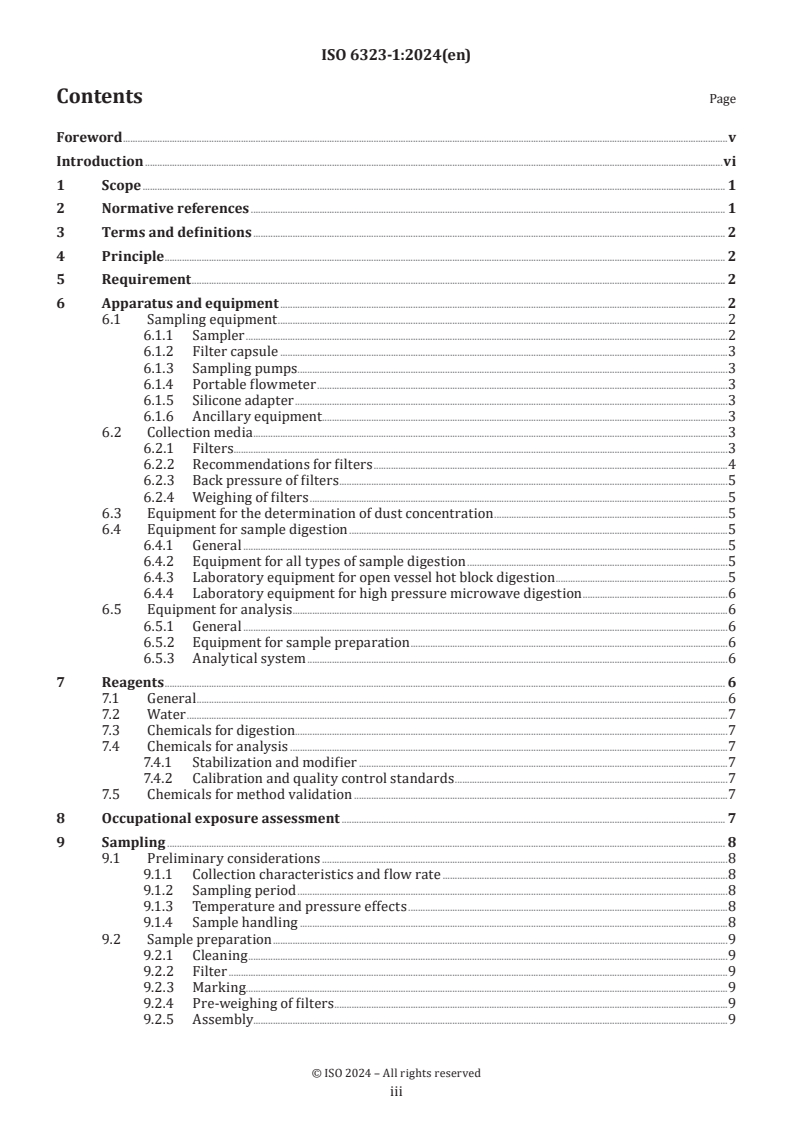
Contents Page
Foreword .v
Introduction .vi
1 Scope . 1
2 Normative references . 1
3 Terms and definitions . 2
4 Principle . 2
5 Requirement . 2
6 Apparatus and equipment . 2
6.1 Sampling equipment .2
6.1.1 Sampler .2
6.1.2 Filter capsule .3
6.1.3 Sampling pumps . . .3
6.1.4 Portable flowmeter .3
6.1.5 Silicone adapter .3
6.1.6 Ancillary equipment .3
6.2 Collection media .3
6.2.1 Filters.3
6.2.2 Recommendations for filters .4
6.2.3 Back pressure of filters .5
6.2.4 Weighing of filters .5
6.3 Equipment for the determination of dust concentration .5
6.4 Equipment for sample digestion .5
6.4.1 General .5
6.4.2 Equipment for all types of sample digestion .5
6.4.3 Laboratory equipment for open vessel hot block digestion .5
6.4.4 Laboratory equipment for high pressure microwave digestion .6
6.5 Equipment for analysis .6
6.5.1 General .6
6.5.2 Equipment for sample preparation .6
6.5.3 Analytical system .6
7 Reagents . 6
7.1 General .6
7.2 Water .7
7.3 Chemicals for digestion.7
7.4 Chemicals for analysis .7
7.4.1 Stabilization and modifier .7
7.4.2 Calibration and quality control standards .7
7.5 Chemicals for method validation .7
8 Occupational exposure assessment . 7
9 Sampling . 8
9.1 Preliminary considerations .8
9.1.1 Collection characteristics and flow rate .8
9.1.2 Sampling period .8
9.1.3 Temperature and pressure effects .8
9.1.4 Sample handling .8
9.2 Sample preparation .9
9.2.1 Cleaning .9
9.2.2 Filter .9
9.2.3 Marking . .9
9.2.4 Pre-weighing of filters .9
9.2.5 Assembly.9
iii
9.3 Sampling preparation .9
9.3.1 Initial flow rate .9
9.3.2 Field blanks .9
9.3.3 Personal sampling .9
9.3.4 Static sampling .10
9.4 Parameters .10
9.5 Performing the sampling .10
9.5.1 Start of the sampling period .10
9.5.2 Sampling period .10
9.5.3 End of the sampling period .11
9.6 Transport and storage .11
9.6.1 General .11
9.6.2 Transportation .11
9.6.3 Storage .11
10 Analysis . .12
10.1 Preparation . 12
10.1.1 General . 12
10.1.2 Weighing . 12
10.1.3 Digestion . 12
10.1.4 Solutions . 13
10.2 Instrumental analysis . 13
10.3 Estimation of detection and quantification limits .14
10.3.1 Estimation of the instrumental detection limit .14
10.3.2 Estimation of the method detection limit and quantification limit .14
10.4 Certified reference materials . 15
10.5 Measurement uncertainty . 15
11 Expression of results .15
11.1 Calculations . 15
11.2 Method performance .16
11.3 Remarks .16
12 Test report . 17
12.1 Test record.17
12.2 Laboratory report .18
Annex A (informative) Temperature and pressure correction . 19
Annex B (informative) Typical operating parameters for determination of arsenic by
electrothermal atomic absorption spectrometry .21
Bibliography .22
iv
Foreword
ISO (the International Organization for Standardization) is a worldwide federation of national standards
bodies (ISO member bodies). The work of preparing International Standards is normally carried out through
ISO technical committees. Each member body interested in a subject for which a technical committee
has been established has the right to be represented on that committee. International organizations,
governmental and non-governmental, in liaison with ISO, also take part in the work. ISO collaborates closely
with the International Electrotechnical Commission (IEC) on all matters of electrotechnical standardization.
The procedures used to develop this document and those intended for its further maintenance are described
in the ISO/IEC Directives, Part 1. In particular, the different approval criteria needed for the different types
of ISO document should be noted. This document was drafted in accordance with the editorial rules of the
ISO/IEC Directives, Part 2 (see www.iso.org/directives).
ISO draws attention to the possibility that the implementation of this document may involve the use of (a)
patent(s). ISO takes no position concerning the evidence, validity or applicability of any claimed patent
rights in respect thereof. As of the date of publication of this document, ISO had not received notice of (a)
patent(s) which may be required to implement this document. However, implementers are cautioned that
this may not represent the latest information, which may be obtained from the patent database available at
www.iso.org/patents. ISO shall not be held responsible for identifying any or all such patent rights.
Any trade name used in this document is information given for the convenience of users and does not
constitute an endorsement.
For an explanation of the voluntary nature of standards, the meaning of ISO specific terms and expressions
related to conformity assessment, as well as information about ISO's adherence to the World Trade
Organization (WTO) principles in the Technical Barriers to Trade (TBT), see www.iso.org/iso/foreword.html.
This document was prepared by Technical Committee ISO/TC 146, Air quality, Subcommittee SC 2, Workplace
atmospheres.
A list of all parts in the ISO 6323 series can be found on the ISO website.
Any feedback or questions on this document should be directed to the user’s national standards body. A
complete listing of these bodies can be found at www.iso.org/members.html.
v
Introduction
Arsenic and arsenic compounds are toxic and are recognized as human carcinogens. In particular arsenic
and arsenic compounds are a hazard to the health of workers in many industries through exposure by
inhalation. Industrial hygienists and other public health professionals need to determine the effectiveness of
measures taken to control workers’ exposure. The collection of samples of air during a work activity and then
measuring the amount of particular arsenic and arsenic compounds are often done to assess an individual’s
exposure, the effectiveness of workplace controls or respiratory protection measures. The air sampling can
be done as stationary or personal air sampling. Electrothermal atomic absorption spectrometry (ET-AAS)
analysis of particular arsenic and arsenic compounds in a sample of respirable or inhalable dust collected on
a collection substrate (membrane filter) is employed in many countries to measure and estimate exposure
to arsenic and arsenic compounds. ET-AAS is able to quantify arsenic and arsenic compounds.
vi
International Standard ISO 6323-1:2024(en)
Workplace air — Determination of arsenic and arsenic
compounds by electrothermal atomic absorption
spectrometry —
Part 1:
Arsenic and arsenic compounds, except arsine by ET-AAS
1 Scope
This document specifies a method for the determination of the mass concentration of particulate arsenic and
arsenic compounds in workplace air sampled on a filter (e. g. 37 mm cellulose nitrate filter), digested with
acid or an acid mixture and analysed quantitively by using electrothermal atomic absorption spectrometry
(ET-AAS). The method is not suitable for determination of arsenic in the form of metal arsenides, which
decompose in the presence of water or acid, or for arsenic trioxide vapour.
Many different types of sampling apparatus are used to collect respirable or inhalable dust, according to
the occupational hygiene convention. This document is designed to accommodate the variety of samplers
and collection substrates available to analysts. This document is intended to be used in conjunction with
ISO 21832 which promotes best practices for these analyses.
The method is applicable to the determination of masses of approximately 0,2 µg to 2 μg of arsenic per
sample, for analysis of test solutions prepared using sample solution aliquots in the recommended range
(see 10.1.3 and 10.1.4.1). The concentration range for arsenic in air, for which this procedure is applicable, is
determined in part by the sampling procedure selected by the user.
The method is applicable to personal and stationary air sampling.
A number of transition metals can interfere with the determination of arsenic by electrothermal atomic
absorption spectrometry (see 11.3).
2 Normative references
The following documents are referred to in the text in such a way that some or all of their content constitutes
requirements of this document. For dated references, only the edition cited applies. For undated references,
the latest edition of the referenced document (including any amendments) applies.
ISO 1042, Laboratory glassware — One-mark volumetric flasks
ISO 3696, Water for analytical laboratory use — Specification and test methods
ISO 7708, Air quality — Particle size fraction definitions for health-related sampling
ISO 13137, Workplace atmospheres — Pumps for personal sampling of chemical and biological agents —
Requirements and test methods
ISO 18158, Workplace air — Terminology
ISO 20581, Workplace air — General requirements for the performance of procedures for the measurement of
chemical agents
ISO 21832, Workplace air — Metals and metalloids in airborne particles — Requirements for evaluation of
measuring procedures
DIN 12353, Laboratory ware made from fused quartz and fused silica; boiling flasks made from fused quartz;
round bottom flasks, flat bottom flasks and conical flasks
3 Terms and definitions
For the purposes of this document, the terms and definitions given in ISO 18158 apply.
ISO and IEC maintain terminology databases for use in standardization at the following addresses:
— ISO Online browsing platform: available at https:// www .iso .org/ obp
— IEC Electropedia: available at https:// www .electropedia .org/
4 Principle
A filter (6.2.1; see Table 1) is mounted in a sampler (6.1.1) designed to collect the respirable or inhalable
fraction of airborne particles. The sampling can be performed with personal or stationary fixed samplers.
Before sampling is performed, the filter batch used shall be verified with regard to its metal content and
consequently the suitability of the minimum requirements for the performance of measuring methods.
Currently limit values in different countries exist for arsenic and its compounds either as “total dust”, defined
by the performance of a sampler, or in the inhalable size selective fraction. A suitable sampling device for the
applicable particle fraction shall be used considering the existing limit value/particle fraction.
The fraction separated on the filter is analysed for arsenic after acid digestion using ET-AAS. As digestion
media, nitric acid or a mixture of nitric and hydrochloric acid can be used. The sample solution is allowed to
cool and diluted to a given volume with ultrapure water (7.3.1), depending on the digestion type used. A test
solution is prepared by transferring an aliquot of the sample solution to a volumetric flask and dilution to
volume with ultrapure water.
The atomic absorption spectrometer is equipped with an arsenic hollow cathode lamp or electrodeless
charge lamp and heated electrically.
Absorbance measurements are made at 193,7 nm or 197,2 nm, using a graphite furnace with platform and
a matrix modifier (7.4.1.2). For background compensation, Zeeman-Mode is used. Deuterium background
compensation can also be used as an option. Results obtained by the analytical-curve technique or the
analyte addition technique.
5 Requirement
The measuring procedure shall conform to ISO 20581 or ISO 21832, which specify performance requirements
for procedures for measuring chemical agents in workplace air.
6 Apparatus and equipment
6.1 Sampling equipment
6.1.1 Sampler
The performance of the sampler used shall match the criteria for respirable or inhalable dust as specified in
ISO 7708. Samplers that use 37 mm diameter filters (6.2.1) as the collection substrate are required. A plastic
filter capsule for filters with a diameter of 37 mm are necessary. A suitable supporting grid can be necessary.
Each sampler should be labelled with a unique number, in order to identify samplers that start to under-
perform after long-term use.
Samplers shall meet the manufacturer’s requirements for calibration.
NOTE 1 For person-related or stationary sampling, filters with diameters of e.g. 70 mm up to 150 mm, can also be
used with specific sampling systems, with appropriate adjustments to the digestion conditions.
NOTE 2 In some countries, there can be exceptions due to national requirements.
6.1.2 Filter capsule
Matching plastic filter capsule with covers for the 37 mm filter (6.2.1), for insertion into the sampler.
6.1.3 Sampling pumps
Sampling pumps shall conform to the requirements of ISO 13137.
If the sampling pump is used outside the range of conditions specified in ISO 13137, appropriate actions
should be taken to ensure that the performance requirements are met.
6.1.4 Portable flowmeter
The flowmeter shall conform to the requirements of ISO 13137.
The flowmeter shall be capable of measuring the appropriate flow rate (see 9.3.1 and 9.4) to within ±5 %,
and calibrated against a primary standard, i.e. a flowmeter of which the accuracy is traceable to national
standards. If appropriate, the atmospheric temperature and pressure at which the flowmeter was calibrated
should be recorded.
6.1.5 Silicone adapter
The silicone adapter shall fit into the sampler head to connect the flowmeter (6.1.4) for measuring/setting
the air flow.
6.1.6 Ancillary equipment
The following ancillary equipment shall be used:
a) flexible tubing, to connect the sampler to the sampling pump (6.1.3);
b) belts or harnesses to which the sampling pumps can conveniently be fixed for personal air sampling; a
tripod is required for person-related or stationary sampling;
c) a means to transport the samples from the workplace to the laboratory, which minimises the possibility
of accidental transfers of collected dust to or from the collection substrate (filter); transportation
requires caps or covers for the samplers (filter capsule);
d) a thermometer (readable to 1 °C) and a barometer (readable to 0,1 kPa), to measure atmospheric
temperature and pressure for flow rate correction, when the temperature and pressure at the time of
use differ from the conditions under which the flowmeter (6.1.4) was calibrated.
6.2 Collection media
6.2.1 Filters
Filters shall be of a diameter suitable for use in the selected sampler (6.1.1) and have a capture efficiency for
respirable or inhalable particles of not less than 99 %. It is important for the analyst to know the composition
of the collection substrate used to collect the sample since it has a direct bearing on the analytical approach
used. The collection substrates generally used for the sampling of arsenic and arsenic compounds, and their
characteristics, are listed in Table 1.
Table 1 — Dust collection substrates
Sampling medium (pore size) Comments
Membrane filters are very suitable for subsequent analysis
Cellulose nitrate/cellulose acetate membrane filters (8 µm) of metals in dust, as they exhibit very low blank values and
can be readily digested by acids.
MCE filters are comprised mixtures of cellulose acetate and
Mixed esters of cellulose (MCE) (0,8 μm) cellulose nitrate. They are low in in metal background and
completely dissolvable with acids.
They are suitable for dust sampling due to their good retention
capacity. As a result of their exceedingly low and relatively
Quartz glass fibre filters constant blank values, they are substantially more suitable
than glass fibre filters for the screening of dusts for metallic
components.
The high and often fluctuating blank values of this filter
Glass fibre filters
material can adversely affect the analysis of metals in dust.
They exhibit high chemical and thermal durability and are
not dissolved by common digestion agents. Their blank value
concentrations are low, however, this filter material must be
Fluoropolymer filters (PTFE)
tested before use, as it can contain small amounts of metals.
Furthermore, the high flow resistance of this filter material
must be taken into consideration.
Other filter materials can also be used such as polycarbonate
Other filter materials
or polyvinyl chloride (PVC) filters. Polycarbonate filters, in
Polycarbonate or polyvinyl chloride filters (PVC)
particular, have a very good resistance to chemicals.
Polyurethane foams (PU foams) can be manufactured with
various pore sizes and are suitable for dividing collections
of particles into fractions. Depending on the manufacturing
process, PU foams can contain many interfering impurities
Polyurethane foams
due to auxiliary components (e.g. organic tin compounds),
pre-cleaning of the material is crucial to minimise blank
values. The limited solubility of the material during digestion
can also lead to interference.
DIS is a single-use sampler for the inhalable fraction and
includes an MCE filter bonded to a cellulose capsule. If the
capsule is fitted with a foam pre-selector, the analysis of the
Disposable inhalable sampler (DIS) with filter or foam
capsule corresponds to the respirable fraction. The inhalable
and filter
fraction is the sum of the pre-selector foam and the capsule
bonded with MCE filter. Effects of wall deposits can be elim-
inated with this sampler type.
Cellulose membrane filters are rigid and easy to handle when weighing and loading the sampler. Glass fibre
filters, quartz glass fibre filters, PVC and especially polycarbonate filters are flexible and require careful
handling.
NOTE Cellulose membrane filters completely dissolve when digested with nitric and hydrochloric acid, or only
nitric acid. Glass or quartz fibre filters, PVC or polycarbonate filters do not completely dissolve in digestion media
hydrochloric and or nitric acid. It can be necessary to filter the digestion solution before analysis.
6.2.2 Recommendations for filters
An important property of an analytical filter (6.2.1) is that it should contain no or only low concentrations of
the metals to be analysed. A constantly stable concentration of metal content of the filter is also easy to handle.
Filter materials listed in Table 1 generally do not contain compounds that interfere with the measurement
of arsenic and arsenic compounds. Impurities can be introduced during the filter manufacturing process
and blank values can increase depending on filter material. Therefore, batches of filters should be regularly
tested to detect potential interferences and background levels.
It is advisable to use filters that exhibit no blank values or blank values that are as low as possible and
constant. Experience has shown that blank value concentrations are batch-dependent, therefore a test
certificate giving information on relevant components of the filters should be available (e.g. from the
manufacturer or supplier). The test certificate should contain information on the level of the metal content
and their bandwidth. Only filters from a single batch should be used in the course of a measurement series.
Cellulose nitrate membrane filters exhibit the least variability and lowest background levels and thus are
useful in situations where low limits of detection are required.
6.2.3 Back pressure of filters
Some filters (6.2.1) have a high back pressure and thereby negatively influence the sampling, due to a higher
load on the pump. High values for back pressure can compromise the sampling time, when the sampling of a
complete 8 h shift is desired.
6.2.4 Weighing of filters
Weighing can be performed to determine the inhalable or respirable fraction and should be performed
[1]
following ISO 15767 (see 9.2.4). Filters (6.2.1) shall not be weighed in cassettes as large weight variations
[2]
have been reported. Reference shall be made to the instructions of the collection substrate manufacturer.
6.3 Equipment for the determination of dust concentration
If the determination of the inhalable or respirable fraction should be performed, a microbalance capable of
weighing ±1 µg or better over the range 0 g to 5 g is required. An electrostatic eliminator is needed when
[1]
weighing collection substrates. Weighing should be performed according to ISO 15767 .
6.4 Equipment for sample digestion
6.4.1 General
Equipment and aids for the digestion of metals and metal compounds in dust samples are listed in 6.4.2 to
6.4.4. All equipment and materials used should be as metal-free as possible. Inert materials should be used
for digestion. Contamination with metals by equipment or materials used shall be avoided. If necessary, the
equipment should be suitable cleaned before use.
6.4.2 Equipment for all types of sample digestion
6.4.2.1 Ceramic tweezer, for the transfer of the filters (6.2.1) into the digestion vessels.
6.4.2.2 Measuring cylinder of perfluoralkoxy-alkane (PFA) copolymer with volumes of 50 ml, 100 ml
and 500 ml.
6.4.2.3 Quartz glass bottle with a polytetrafluorethylene (PTFE) dispenser for the transfer of the
digestion acid or acid mixture into the digestion vessels.
6.4.2.4 Bottle of PFA with PTFE dispenser, for adding ultrapure water (7.3.1) to the digested samples.
6.4.3 Laboratory equipment for open vessel hot block digestion
6.4.3.1 Heating block made of metal or graphite with time/temperature control.
6.4.3.2 Graduated digestion vessels, preferably made of quartz glass or of comparable quality in
accordance with the requirements of DIN 12353 for reaction vessels.
Vessels made of borosilicate glass should not be used due to possible interference from boron.
6.4.3.3 Air cooler, preferably made of quartz glass with standard inner and outer ground glass joints for
mounting on a digestion vessel or of comparable quality in accordance with the requirements of ISO 1042
and DIN 12353.
6.4.3.4 Boiling rods, preferably made of quartz glass with replaceable endpieces (e.g. PTFE tube).
6.4.3.5 Polyethylene plugs for digestion vessels.
6.4.4 Laboratory equipment for high pressure microwave digestion
6.4.4.1 High pressure microwave digestion system
6.4.4.2 Suitable digestion vessels for the microwave, for instance made of quartz glass or PTFE.
6.5 Equipment for analysis
6.5.1 General
Equipment for the quantitative determination of metals and metal compounds in dust samples are listed
in 6.5.2 and 6.5.3. All equipment and materials used should be as metal-free as possible. Inert materials
should be used for digestion. Contamination with metals by equipment or materials used shall be reduced to
a minimum. If necessary, the equipment should be suitably cleaned before use.
6.5.2 Equipment for sample preparation
6.5.2.1 Volumetric flasks of PFA for standard and calibration solutions, with screw cap and ring mark,
volumes of 5 ml, 10 ml, 50 ml, 100 ml, 500 ml, 1 000 ml.
6.5.2.2 Various adjustable piston pipettes for covering a volume range of 2 µl to 10 ml.
6.5.2.3 Disposable polysytrol vessels with a volume of approximately 1,5 ml for the autosampler.
6.5.2.4 Electronic precision balance, for weighing the calibration standards.
6.5.2.5 Ultrapure water system with reverse osmosis system and ultrapure water system, for the
preparation of ultrapure water (resistivity greater than 18,2 MΩ ∙ cm at 25 °C).
6.5.3 Analytical system
Electrothermal atomic absorption spectrometer (ET-AAS), preferably with Zeeman background
correction and autosampler, graphite tube with platform, pyrocoated and arsenic hollow cathode lamp. As
an alternative, deuterium background compensation can also be used.
7 Reagents
7.1 General
Use only reagents of recognised analytical grade and only water as specified in 7.3.1. It is advisable to
check the blank values of chemicals before use. Only batch-related chemicals should be used for digestion.
Furthermore, the chemicals used shall be as free of metals as possible. The content of the analytical
standards for calibration and quality assurance shall be traceable to standard reference materials.
7.2 Water
Use water from a purification system that delivers ultrapure water of grade 1 as defined in ISO 3696.
NOTE State of the art water purification systems deliver water of grade 1 with higher quality than specified in
ISO 3696 (e.g. resistivity greater than 18,2 MΩ ∙ cm at 25 °C).
7.3 Chemicals for digestion
7.3.1 Ultrapure water, (ρ ≥ 18,2 MΩ ∙ cm at 25 °C), low metal content and an especially low content of
boron and alkalis.
7.3.2 Nitric acid 65 %; low metal content.
7.3.3 Hydrochloric acid 25 %; low metal content.
7.4 Chemicals for analysis
7.4.1 Stabilization and modifier
7.4.1.1 Nitric acid 67 % - 70 %; low metal content, for stabilization of calibration and quality control
standards. A stabilization solution of approx. 0,7 % nitric acid is produced by diluting the concentrated nitric
acid with ultrapure water 1+9 in a volumetric flask.
7.4.1.2 Matrix modifier e.g. nickel 1 000 mg/l, traceable to national standards.
7.4.2 Calibration and quality control standards
7.4.2.1 Arsenic plasma standard, e.g. 1 000 mg/l, traceable to national standards, for calibration
standards.
7.4.2.2 Multielement quality control standard with arsenic, e.g. 1 000 mg/l, traceable to national
standards.
7.4.2.3 Gas for analytical system, e.g., ultra-high purity argon (grade 5.0), minimum purity
99,999 %.
7.5 Chemicals for method validation
7.5.1 Arsenic (III)oxide, 99,996 % (metals basis excluding Sb), max. 20 ppm Sb, powder.
7.5.2 Arsenic (III)iodide, 99,999 % (metals basis), 80 mesh powder.
8 Occupational exposure assessment
[3] [3]
Refer to relevant standards, e.g. ISO 20581, EN 689 or ASTM E1370 for guidance on how to develop an
appropriate assessment strategy and for general guidance on measurement strategy.
9 Sampling
9.1 Preliminary considerations
9.1.1 Collection characteristics and flow rate
Select samplers (6.1.1) suitable for collection of the applicable fraction of airborne particles according to the
existing limit value. Size-selective samplers shall be designed to collect the appropriate fraction of airborne
particles as defined in ISO 7708 and tested in accordance with ISO 13137.
Use the samplers at their design flow rate and in accordance with the instructions provided by the
manufacturer.
The flow rate of the sampler used shall be selected in such a way that, depending on the sampling duration,
the requirements for a measurement procedure can be achieved in relation to the existing limit value.
9.1.2 Sampling period
Select a sampling period of appropriate duration, using any available information about the work process
and test atmosphere, so that the amount of arsenic is within the recommended working range of the method.
When high concentrations of airborne particles are anticipated, select a sampling period that is not so long
as to risk overloading the filter (6.2.1) with particulate matter. For example, estimate the minimum sampling
time, t , in minutes, required to ensure that the amount collected is above the lower limit of the working
min
range of the analytical method when arsenic and arsenic compounds is present in the test atmosphere at a
concentration of defined times (see ISO 21832) its limit value, using Formula (1):
m
lower
t = (1)
min
qx××ρ
VLV
where
m is the lower limit, in micrograms, of the analytical range;
lower
q is the design flow rate, in litres per minute, of the sampler;
v
x
is the factor to ensure the requirements of a measurement procedure for a limit value (e.g. 0,1 times);
ρ is the limit value, in milligrams per cubic metre.
LV
NOTE If the minimum sampling time is not long enough for the me
...
Frequently Asked Questions
ISO 6323-1:2024 is a standard published by the International Organization for Standardization (ISO). Its full title is "Workplace air - Determination of arsenic and arsenic compounds by electrothermal atomic absorption spectrometry - Part 1: Arsenic and arsenic compounds, except arsine by ET-AAS". This standard covers: This document specifies a method for the determination of the mass concentration of particulate arsenic and arsenic compounds in workplace air sampled on a filter (e. g. 37 mm cellulose nitrate filter), digested with acid or an acid mixture and analysed quantitively by using electrothermal atomic absorption spectrometry (ET-AAS). The method is not suitable for determination of arsenic in the form of metal arsenides, which decompose in the presence of water or acid, or for arsenic trioxide vapour. Many different types of sampling apparatus are used to collect respirable or inhalable dust, according to the occupational hygiene convention. This document is designed to accommodate the variety of samplers and collection substrates available to analysts. This document is intended to be used in conjunction with ISO 21832 which promotes best practices for these analyses. The method is applicable to the determination of masses of approximately 0,2 µg to 2 μg of arsenic per sample, for analysis of test solutions prepared using sample solution aliquots in the recommended range (see 10.1.3 and 10.1.4.1). The concentration range for arsenic in air, for which this procedure is applicable, is determined in part by the sampling procedure selected by the user. The method is applicable to personal and stationary air sampling. A number of transition metals can interfere with the determination of arsenic by electrothermal atomic absorption spectrometry (see 11.3).
This document specifies a method for the determination of the mass concentration of particulate arsenic and arsenic compounds in workplace air sampled on a filter (e. g. 37 mm cellulose nitrate filter), digested with acid or an acid mixture and analysed quantitively by using electrothermal atomic absorption spectrometry (ET-AAS). The method is not suitable for determination of arsenic in the form of metal arsenides, which decompose in the presence of water or acid, or for arsenic trioxide vapour. Many different types of sampling apparatus are used to collect respirable or inhalable dust, according to the occupational hygiene convention. This document is designed to accommodate the variety of samplers and collection substrates available to analysts. This document is intended to be used in conjunction with ISO 21832 which promotes best practices for these analyses. The method is applicable to the determination of masses of approximately 0,2 µg to 2 μg of arsenic per sample, for analysis of test solutions prepared using sample solution aliquots in the recommended range (see 10.1.3 and 10.1.4.1). The concentration range for arsenic in air, for which this procedure is applicable, is determined in part by the sampling procedure selected by the user. The method is applicable to personal and stationary air sampling. A number of transition metals can interfere with the determination of arsenic by electrothermal atomic absorption spectrometry (see 11.3).
ISO 6323-1:2024 is classified under the following ICS (International Classification for Standards) categories: 13.040.30 - Workplace atmospheres. The ICS classification helps identify the subject area and facilitates finding related standards.
You can purchase ISO 6323-1:2024 directly from iTeh Standards. The document is available in PDF format and is delivered instantly after payment. Add the standard to your cart and complete the secure checkout process. iTeh Standards is an authorized distributor of ISO standards.
Questions, Comments and Discussion
Ask us and Technical Secretary will try to provide an answer. You can facilitate discussion about the standard in here.
Loading comments...