

ISO 10303-32:1998
(Main)Industrial automation systems and integration — Product data representation and exchange — Part 32: Conformance testing methodology and framework: Requirements on testing laboratories and clients
General Information
- Abstract
This part of IS0 10303 specifies the techniques for conformance testing and the means to facilitate the use of those techniques by the testing laboratory and the client. This part of IS0 10303 specifies the roles of both the testing laboratory and the client during the conformance assessment process, the need to reach mutual agreements between them, and the requirements on each of them.
- Status
- Published
- Publication Date
- 02-Sep-1998
- Technical Committee
- ISO/TC 184/SC 4 - Industrial data
- Drafting Committee
- ISO/TC 184/SC 4/WG 12 - STEP product modelling and resources
- Current Stage
- 9093 - International Standard confirmed
- Start Date
- 23-Jun-2025
- Completion Date
- 29-Aug-2026
Buy Documents
ISO 10303-32:1998 - Industrial automation systems and integration — Product data representation and exchange — Part 32: Conformance testing methodology and framework: Requirements on testing laboratories and clients Released:9/3/1998
Overview
ISO 10303-32:1998 defines a methodology and framework for conformance testing within the ISO 10303 product data representation and exchange series. It specifies the techniques, roles and mutual responsibilities of testing laboratories and clients during conformance assessment. The standard’s objective is to improve comparability and consistency of conformance testing results for product data exchange implementations across the product life cycle.
Key topics and requirements
- Roles and responsibilities: Clear requirements for what testing laboratories and clients must do at each phase of the conformance assessment process.
- Test phases covered: Preparation for testing, test campaign execution, analysis of results and production of the conformance test report.
- Administrative artifacts: Requirements for production, review and completion of test-related documentation such as PICS and PIXIT and the selection/assignment of abstract test case parameters.
- Test campaign management: Procedures for assignment of test cases, parameter value assignment, execution and result collection.
- Reporting and compliance: Standardized content and structure for conformance test reports and guidance on using reports for compliance assessment.
- Mutual agreements: Emphasis on documented agreements between testing laboratory and client to ensure consistent selection and execution of standardized tests.
- Annexes and guidance: Includes proforma reports, guidance for PIXIT preparation, certification considerations and example test reports.
Practical applications
ISO 10303-32 is used to ensure objective, repeatable and comparable conformance testing of systems that implement product data exchange and representation standards. Typical uses:
- Verifying CAD/CAM/PLM software and data exchange tools for compliance with ISO 10303 application protocols.
- Defining test contracts and acceptance criteria between vendors and customers during procurement or integration projects.
- Supporting independent testing laboratories that produce conformance test reports used by certification bodies or accreditation organizations.
- Harmonizing test practices across organizations to reduce interoperability risk and improve supplier validation.
Who uses it:
- Testing laboratories and test houses
- Clients procuring product data exchange solutions
- Software vendors developing STEP/ISO 10303 implementations
- Accreditation and certification bodies
- Test realisers producing executable test suites from abstract test suites
Related standards
- ISO 10303-31 (general conformance testing concepts)
- ISO 10303-34 / -35 (abstract test methods)
- Other ISO 10303 parts (abstract test suites and application protocols) - used together to define specific test content and execution.
Keywords: ISO 10303-32, conformance testing, testing laboratory, client, product data exchange, PICS, PIXIT, conformance test report, ISO 10303.
Relations
- Effective Date
- 25-Aug-2026
Buy Documents
ISO 10303-32:1998 - Industrial automation systems and integration — Product data representation and exchange — Part 32: Conformance testing methodology and framework: Requirements on testing laboratories and clients Released:9/3/1998
Get Certified
Connect with accredited certification bodies for this standard

DVS-ZERT GmbH
German welding certification society.
CARES (UK Certification Authority for Reinforcing Steels)
UK certification for reinforcing steels and construction.
EWF/IIW (European/International Welding Federation)
International welding personnel certification.
Sponsored listings
Frequently Asked Questions
ISO 10303-32:1998 is a standard published by the International Organization for Standardization (ISO). Its full title is "Industrial automation systems and integration — Product data representation and exchange — Part 32: Conformance testing methodology and framework: Requirements on testing laboratories and clients". This standard covers: This part of IS0 10303 specifies the techniques for conformance testing and the means to facilitate the use of those techniques by the testing laboratory and the client. This part of IS0 10303 specifies the roles of both the testing laboratory and the client during the conformance assessment process, the need to reach mutual agreements between them, and the requirements on each of them.
This part of IS0 10303 specifies the techniques for conformance testing and the means to facilitate the use of those techniques by the testing laboratory and the client. This part of IS0 10303 specifies the roles of both the testing laboratory and the client during the conformance assessment process, the need to reach mutual agreements between them, and the requirements on each of them.
ISO 10303-32:1998 is classified under the following ICS (International Classification for Standards) categories: 25.040.40 - Industrial process measurement and control. The ICS classification helps identify the subject area and facilitates finding related standards.
ISO 10303-32:1998 has the following relationships with other standards: It is inter standard links to CR 13935:2000. Understanding these relationships helps ensure you are using the most current and applicable version of the standard.
ISO 10303-32:1998 is available in PDF format for immediate download after purchase. The document can be added to your cart and obtained through the secure checkout process. Digital delivery ensures instant access to the complete standard document.
Standards Content (Sample)
INTERNATIONAL IS0
STANDARD 10303-32
First edition
1998-09-01
Industrial automation systems and
integration - Product data representation
and exchange -
Part 32:
Conformance testing methodology and
framework: Requirements on testing
laboratories and clients
Systkmes d ’automatisation industrielle et intkgration - Repksentation et
khange de don&es de produits -
Partie 32: M&hodologie et cadre g&&al pour I’&aluation de la conformit&
Prescriptions relatives aux laboratoires d ’essai et aux clients
Reference number
IS0 10303-32: 1998(E)
IS0 10303=32:1998(E)
Page
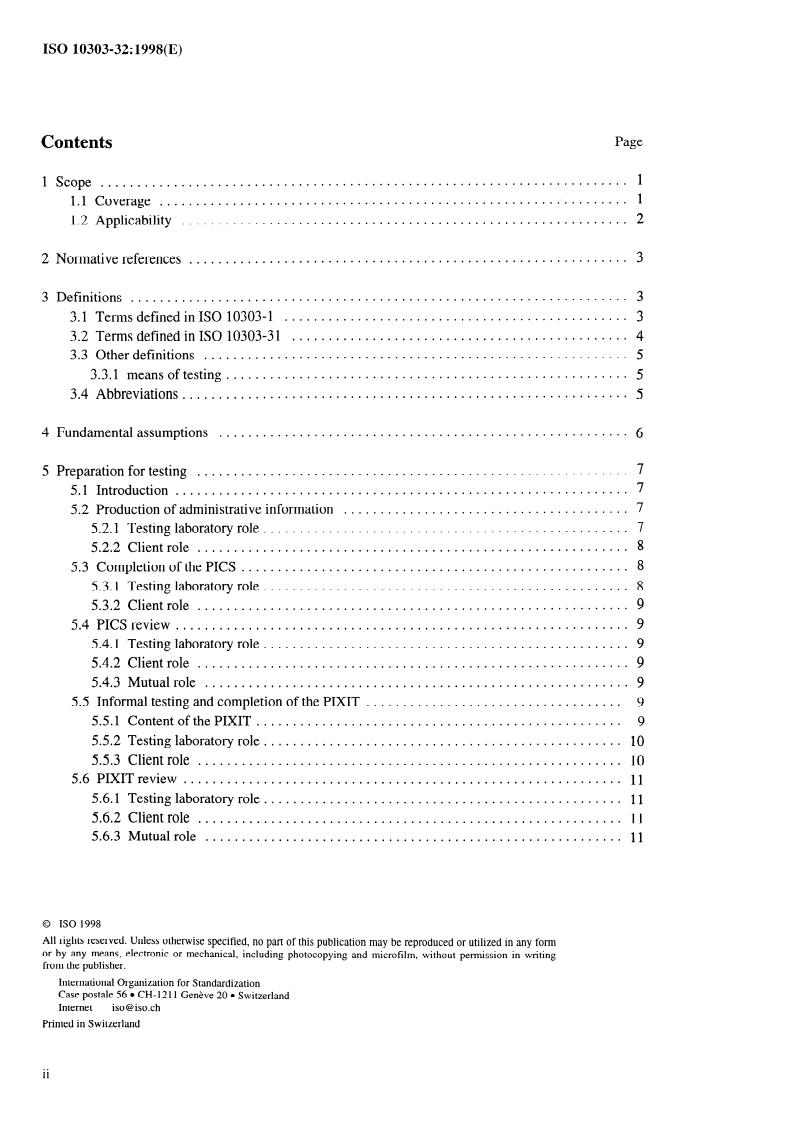
Contents
. . . . . . . . . . . . . . . . . . . . . . . . . . . . . .
...........................
1 Scope
...................
1.1 Coverage
. . . . . . . . . . . . . . . . . . . . . . . . . . . . . .
1.2 Applicability .
2 Normative references . . . . . . . . . . . . . . . . . . . . . . . . . . . . . . . . . . . . . . . . . . . . . . . . . . . . . . . . . . . . 3
......
. . . . . . . . . . . . . . .
3 Definitions . . . . . . . . . . . . . . . . . . . . . . .
......
. . . . . . . . . .
3.1 Terms defined in IS0 10303-l . l
......
3.2 Terms defined in IS0 10303-31 .
. . . . . . . . . . .
3.3 Other definitions . . . . . . . . . . . . .
......
3.3.1 means of testing . . . . . . . . . .
. . . . . . . . . . . . . . . .
3.4 Abbreviations . . . . . . . . . . . . . . . .
. . . . . . . . . . . . . . . . . . . . a . . . . . . . . . . . . . . . . . . . . . . . . . . . . . . . . . . . 6
4 Fundamental assumptions
....... ........ ........ . . . . .
5 Preparation for testing .
........ . . . . .
....... ........
5.1 Introduction .
...... ....... ........ ........ . . . . .
5.2 Production of administrative information
........ . . . . . 7
5.2.1 Testing laboratory role . . .
. . . . . 8
....... ........ ........
5.2.2 Client role .
........ ........ . . . . .
5.3 Completion of the PICS . .
. . . . .
................. ....... ........ ........ 8
5.3.1 Testing laboratory role
........ . . . . . 9
5.3.2 Client role . . .
. . . . . 9
....... ........ ........
5.4 PICS review .
........ . . . . . 9
5.4.1 Testing laboratory role . . .
. . . . .
.......................... ....... ........ ........ 9
5.4.2 Client role
........ . . . . .
5.4.3 Mutual role . . . 9
. . . . .
... ....... ........ ........ 9
5.5 Informal testing and completion of the PIXIT
........ . . . . .
5.5.1 Content of the PIXIT . . . 9
....... ........ ........ . . . . . 10
5.5.2 Testing laboratory role .
........ . . . . .
5.5.3 Client role . . . 10
....... ........ ........ . . . . .
5.6 PIXIT review . 11
........ . . . . .
5.6.1 Testing laboratory role . . . 11
....... ........ ........ . . . . .
5.6.2 Client role . 11
........ . . . . .
5.6.3 Mutual role . . . 11
0 IS0 1998
All rights reserved. Unless otherwise specified, no part of this publication may be reproduced or utilized in any form
or by any means, electronic or mechanical, including photocopying and microfilm, without permission in writing
from the publisher.
International Organization for Standardization
Case postale 56 l CH- 12 11 Geneve 20 l Switzerland
Internet iso@iso.ch
Printed in Switzerland
ii
IS0 10303-32: 1998(E)
............ . . . . 11
5.7 Final abstract test case selection and assignment of parameter values
. . . . 11
............................................
5.7.1 Testing laboratory role
. . . . 13
.....................................................
5.7.2 Client role
. . . . 13
5.7.3 Mutual role .
6 Testcampaign .
.............................................................
6.1 Introduction
I3
6.2 Testing laboratory role .
..............................................................
6.3 Clientrole
6.4 Mutualrole .
................ . . . . 14
....................... ....... .......
7 Analysis of results
....... ....... ................ . . . . 14
7.1 Testing laboratory role .
................ . . . .
....... ....... 14
7.2 Client role .
....... ................ . . . . 15
....................... .......
7.3 Mutual role
. . . . . . . . . .
.......... . . . . . . 15
8 Conformance test report production
. . . .
............... 15
8.1 Testing laboratory role
. . . .
........................ 15
8.2 Client role
. . . .
. . . . . . . . . . . . . . . . 15
8.3 Mutual role .
............... . . . .
...... ...... 16
9 Compliance .
. . . .
...... ...... ............... 16
9.1 Testing laboratory role .
............... . . . .
........................ ...... ...... 16
9.2 Client role
Annexes
. . . 17
A Information object registration . . . . . . . . . . . . .
. . .
B Conformance test report proforma . . . . . . . . . . .
. . .
C Guidance for a PIXIT . . . . . . . . . . . . . . . . . . . .
. . .
D Certification . . . . . . . . . . . . . . . . . . . . . . . . . . . .
. . .
E Example proforma conformance test report . . . .
. . .
Index.
. . .
IS0 10303=32:1998(E)
Foreword
IS0 (the International Organization for Standardization) is a worldwide federation of national standards
bodies (IS0 member bodies). The work of preparing International Standards is normally carried out
through IS0 technical committees. Each member body interested in a subject for which a technical
committee has been established has the right to be represented on that committee. International
organizations, governmental and non-governmental, in liaison with ISO, also take part in the work. IS0
collaborates closely with the International Electrotechnical Commission (IEC) on all matters of
electrotechnical standardization.
Draft International Standards adopted by technical committees are circulated to the member bodies for
voting. Publication as an International Standard requires approval by at least 75% of the member bodies
casting a vote.
International Standard 10303-32 was prepared by Technical Committee ISO/TC 184, Industrial
automation systems and integration, Subcommittee 4, Industrial data.
IS0 10303 consists of the following parts under the general title Industrial automation systems and
integration - Product data representation and exchange:
- Part 1, Overview and fundamental principles;
- Part 11, Description methods: The EXPRESS language reference manual;
- Part 12, Description methods: The EXPRESS-I language reference manual;
- Part 21, Implementation methods: Clear text encoding of the exchange structure;
- Part 22, Implementation methods: Standard data access interface specification;
- Part 23, Implementation methods: C++ language binding to the standard data access interface;
- Part 24, Implementation methods: C language binding to the standard data access interface;
- Part 26, Implementation methods: Interface definition language binding to the standard data access
interface;
- Part 31, Conformance testing methodology and framework: General concepts;
- Part 32, Conformance testing methodology and framework: Requirements on testing laboratories
and clients;
- Part 34, Conformance testing methodology and framework: Abstract test methods;
iv
ISOl0303-32:1998(E)
@ IS0
- Part 35, Conformance testing methodology and framework: Abstract test methods for SDAI
implementations;
- Part 41, Integrated generic resources: Fundamentals of product description and support;
- Part 42, Integrated generic resources: Geometric and topological representation;
- Part 43, Integrated generic resources: Representation structures;
- Part 44, Integrated generic resources: Product structure configuration;
- Part 45, Integrated generic resource: Materials;
- Part 46, Integrated generic resources: Visual presentation;
- Part 47, Integrated generic resource: Shape variation tolerances;
- Part 49, Integrated generic resource: Process structure and properties;
- Part 101, Integrated application resource: Draughting;
- Part 104, Integrated application resource: Finite element analysis;
- Part 105, Integrated application resource: Kinematics;
- Part 106, Integrated application resource: Building construction core model;
-- Part 201, Application protocol: Explicit draughting;
- Part 202, Application protocol: Associative draughting;
- Part 203, Application protocol: Configuration controlled design;
- Part 204, Application protocol: Mechanical design using boundary representation;
- Part 205, Application protocol: Mechanical design using surface representation;
- Part 207, Application protocol: Sheet metal die planning and design;
- Part 208, Application protocol: Life cycle management - Change process;
- Part 209, Application protocol: Composite and metallic structural analysis and related design;
- Part 210, Application protocol: Electronic assembly, interconnect, and packaging design;
IS0 10303=32:1998(E)
- Part 212, Application protocol: Electrotechnical design and installation;
- Part 213, Application protocol: Numerical Control process plans for machined parts;
- Part 214, Application protocol: Core data for automotive mechanical design;
- Part 215, Application protocol: Ship arrangement;
- Part 216, Application protocol: Ship moulded forms;
- Part 217, Application protocol: Ship piping;
- Part 218, Application protocol: Ship structures;
- Part 221, Application protocol: Functional data and their schematic representation for process
plant;
- Part 222, Application protocol: Exchange of product data for composite structures;
- Part 223, Application protocol: Exchange of design and manufacturing product information for
casting parts;
- Part 224, Application protocol: Mechanical products definition for process plans using machining
features;
- Part 225, Application protocol: Building elements using explicit shape representation;
- Part 226, Application protocol: Ship mechanical systems;
- Part 227, Application protocol: Plant spatial configuration;
- Part 229, Application protocol: Exchange of design and manufacturing product information for
forged parts;
- Part 230, Application protocol: Building structural frame: Steelwork;
- Part 23 1, Application protocol: Process engineering data: Process design and process specification
of major equipment;
- Part 232, Application protocol: Technical data packaging core information and exchange;
- Part 301, Abstract test suite: Explicit draughting;
- Part 302, Abstract test suite: Associative draughting;
vi
IS0 10303=32:1998(E)
- Part 303, Abstract test suite: Configuration controlled design;
- Part 304, Abstract test suite: Mechanical design using boundary representation;
- Part 305, Abstract test suite: Mechanical design using surface representation;
- Part 307, Abstract test suite: Sheet metal die planning and design;
- Part 308, Abstract test suite: Life cycle management - Change process;
- Part 309, Abstract test suite: Composite and metallic structural analysis and related design;
- Part 3 10, Abstract test suite: Electronic assembly, interconnect, and packaging design;
- Part 3 12, Abstract test suite: Electrotechnical design and installation;
- Part 313, Abstract test suite: Numerical control process plans for machined parts;
- Part 3 14, Abstract test suite: Core data for automotive mechanical design;
- Part 3 15, Abstract test suite: Ship arrangement;
- Part 3 16, Abstract test suite: Ship moulded forms;
- Part 3 17, Abstract test suite: Ship piping;
- Part 3 18, Abstract test suite: Ship structures;
- Part 321, Abstract test suite: Functional data and their schematic representation for process plant;
- Part 322, Abstract test suite: Exchange of product data for composite structures;
- Part 323, Abstract test suite: Exchange of design and manufacturing product information for
casting parts;
- Part 324, Abstract test suite: Mechanical product definition for process plans using machining
features;
- Part 325, Abstract test suite: Building elements using explicit shape representation;
_- Part 326, Abstract test suite: Ship mechanical systems;
- Part 327, Abstract test suite: Plant spatial configuration;
vii
0 IS0
IS0 10303=32:1998(E)
- Part 329, Abstract test suite: Exchange of design and manufacturing product information for forged
pm
- Part 330, Abstract test suite: Building structural frame: Steelwork;
- Part 331, Abstract test suite: Process engineering data: Process design and process specification
of major equipment;
- Part 332, Abstract test suite: Technical data packaging core information and exchange;
- Part 501, Application interpreted construct: Edge-based wireframe;
- Part 502, Application interpreted construct: Shell-based wireframe;
- Part 503, Application interpreted construct: Geometrically bounded 2D wireframe;
- Part 504, Application interpreted construct: Draughting annotation;
- Part 505, Application interpreted construct: Drawing structure and administration;
- Part 506, Application interpreted construct: Draughting elements;
- Part 507, Application interpreted construct: Geometrically bounded surface;
- Part 508, Application interpreted construct: Non-manifold surface;
- Part 509, Application interpreted construct: Manifold surface;
- Part 5 10, Application interpreted construct: Geometrically bounded wireframe;
- Part 5 11, Application interpreted construct: Topologically bounded surface;
- Part 5 12, Application interpreted construct: Faceted boundary representation;
- Part 5 13, Application interpreted construct: Elementary boundary representation;
- Part 5 14, Application interpreted construct: Advanced boundary representation;
- Part 515, Application interpreted construct: Constructive solid geometry;
- Part 5 17, Application interpreted construct: Mechanical design geometric presentation;
- Part 5 18, Application interpreted construct: Mechanical design shaded presentation.
. . .
Vlll
@ IS0 IS0 10303-32:1998(E)
The structure of this International Standard is described in IS0 10303-l. The numbering of the parts of
this International Standard reflects its structure:
- Parts 11 and 12 specify the description methods,
- Parts 21 to 26 specify the implementation methods,
- Parts 3 1 to 35 specify the conformance testing methodology and framework,
- Parts 41 to 49 specify the integrated generic resources,
- Parts 101 to 106 specify the integrated application resources,
- Parts 201 to 232 specify the application protocols,
- Parts 301 to 332 specify the abstract test suites, and
- Parts 501 to 5 18 specify the application interpreted constructs.
Should further parts be published, they will follow the same numbering pattern.
Annexes A and B form an integral part of this part of IS0 10303. Annexes C, D and E are for information
only.
ix
IS0 10303-32:1998(E)
Introduction
IS0 10303 is an International Standard for the computer-interpretable representation and exchange of
The objective is to provide a neutral mechanism capable of describing product data
product data.
throughout the life cycle of a product, independent from any particular system. The nature of this
description makes it suitable not only for neutral file exchange, but also as a basis for implementing and
sharing product databases and archiving.
This International Standard is organized as a series of parts, each published separately. The parts of IS0
10303 fall into one of the following series: description methods, integrated resources, application
abstract test suites, implementation methods, and
interpreted constructs, application protocols,
conformance testing. The series are described in IS0 10303-l. This part of IS0 10303 is a member of
the conformance testing series.
This part of IS0 10303 specifies the techniques and means to facilitate the use of those techniques by the
testing laboratory and the client for conformance testing. This part of IS0 10303 addresses the roles of
both the testing laboratory and the client during the conformance assessment process, the need to reach
mutual agreements between them, and the requirements on each of them.
A major objective of standardising the conformance assessment process is to achieve an acceptable and
useful degree of comparability of results of conformance testing of similar products. For this to be
achieved, standardised tests should be used and the methods of selecting and assigning values to
parameters of these tests should be the same. The presentation of their results should also be the same.
This part of IS0 10303 should be read in conjunction with IS0 10303-31.
This part of IS0 10303 prescribes the requirements on both the testing laboratory and the client to achieve
the necessary consistency of conformance testing. The target audiences for this part of IS0 10303 are the
testing laboratories and their clients.
This part of IS0 10303 may also be of interest to:
- test realisers who are responsible for producing the executable test suites, procedures and
executable software from standardised abstract test suites and abstract test methods:
- organisations responsible for the accreditation of testing laboratories ’);
- organisations responsible for the issue of certificates of conformity that are based upon the
conformance test reports issued by testing laboratories;
- readers of conformance test reports.
‘IFurther information on the roles of accreditation and certification organisations is given in annex D of IS0 10303-31
X
0 IS0 IS0 10303=32:1998(E)
Within this part of IS0 10303, the conformance assessment process relating to both the testing laboratory
and the client is divided into four phases as given in 6.4 of IS0 10303-3 1. Clauses 5 to 8 of this part of
IS0 10303 give requirements for conducting these four phases.
xi
INTERNATIONAL STANDARD o ~so IS0 10303=32:1998(E)
Industrial automation systems and integration -
Product data representation and exchange -
Part 32:
Conformance testing methodology and framework:
Requirements on testing laboratories and clients
1 Scope
This part of IS0 10303 specifies the techniques for conformance testing and the means to facilitate the use
of those techniques by the testing laboratory and the client. This part of IS0 10303 specifies the roles of
both the testing laboratory and the client during the conformance assessment process, the need to reach
mutual agreements between them, and the requirements on each of them.
1.1 Coverage
The following are within the scope of this part of IS0 10303:
- general requirements on the testing laboratory and on the client that are applicable to the
conformance assessment process;
- the exchange of technical and administrative information, including a protocol implementation
conformance statement (PICS) and a protocol implementation extra information for testing (PIXIT);
- the process of negotiation between the testing laboratory and the client to reach an agreement on:
a) the definition of the implementation under test (IUT);
b) the abstract test method and abstract test suite to be used;
c) the conditions under which conformance testing will be performed;
- requirements for the structure and content of the test report that document the results of the
conformance testing.
The following are outside the scope of this part of IS0 10303:
- the resolution of technical issues between the client and the testing laboratory that arise during the
conformance assessment process;
@ IS0
IS0 10303=32:1998(E)
- the production of diagnostic information in addition to the conformance log and conformance test
report;
- any aspects that are not specific to the conformance testing of implementations of IS0 10303
application protocols;
- the certification and testing laboratory accreditation processes.
NOTE - Information on requirements on the testing laboratory and the client with respect to certification are
given in annex D. Roles of accreditation and certification organisations are given in annex D of IS0 10303-3 1.
1.2 Applicability
This part of IS0 10303 applies to the conformance testing of any implementation of an IS0 10303
application protocol. The application protocols for which abstract test suites are specified are defined in
the IS0 10303-200 series. The abstract test suites are specified in the IS0 10303-300 series.
Conformance testing of an implementation is based on the use of an abstract test suite together with an
abstract test method in accordance with IS0 10303-34.
The testing laboratory is responsible for conducting the conformance testing of an implementation of IS0
10303 at the request of a client. A testing laboratory may be any of the following:
- organisations developing or supplying implementations of IS0 10303;
NOTE 1 - Referred to as implementors.
- organisations verifying implementations of IS0 10303 for their own use;
NOTE 2 - Referred to as users.
- organisations who are independent of suppliers or users of implementations of IS0 10303, and
whose business is the testing of such implementations.
NOTE 3 - Referred to as testing laboratories.
This part of IS0 10303 applies equally to those testing laboratories that are affiliated to suppliers or
procurers, and those that are independent of suppliers and procurers.
Clients may be:
- implementors or suppliers of systems using IS0 10303, who are applying for their implementations
to be tested;
- organisations that procure those implementations;
@ IS0 ISOlO303-32:1998(E)
- any other interested party.
This part of IS0 10303 applies equally to all three types of clients.
2 Normative references
The following standards contain provisions which, through reference in this text, constitute provisions of
this part of IS0 10303. At the time of publication, the editions indicated were valid. All standards are
subject to revision, and parties to agreements based on this part of IS0 10303 are encouraged to investigate
Members of IEC and
the possibility of applying the most recent editions of the standards indicated below.
IS0 maintain registers of currently valid International Standards.
ISOIIEC 88241~1995, Information technology - Abstract Syntax Notation One (ASN. I): Spectfication of
basic notation.
- Product data representation and
IS0 10303-1: 1994, Industrial automation systems and integration
exchange - Part I: Overview and fundamental principles.
IS0 10303-31~1994, Industrial automation systems and integration - Product data representation and
exchange - Part 31: Conformance testing methodology and framework: General concepts.
IS0 10303-34: -2) Industrial automation systems and integration - Product data representation and
exchange - Part 34: Conformance testing methodology and framework: Abstract test methods
3 Definitions
3.1 Terms defined in IS0 10303-l
This part of IS0 10303 makes use of the following terms defined in IS0 10303- 1:
- abstract test suite (ATS);
- application protocol (AP);
- conformance class;
- conformance requirement;
2)To be published.
IS0 10303=32:1998(E) @ IS0
- conformance testing;
- PICS proforma;
- protocol implementation conformance statement (PICS).
3.2 Terms defined in IS0 10303-31
This part of IS0 10303 makes use of the following terms defined in IS0 10303-31:
- abstract test case (ATC);
- abstract test method;
- (laboratory) accreditation;
- accreditation body;
- client (of a testing laboratory);
- conformance assessment process;
- conformance log;
- conformance test report;
- conformity;
- control board;
- executable test case (ETC);
- executable test suite;
- fail (verdict);
- implementation under test (IUT);
- inconclusive (verdict);
- in-house testing;
- non-conformity;
- pass (verdict);
IS0 10303-32: 1998(E)
@ IS0
- PIXIT proforma;
- postprocessor;
- preprocessor;
- protocol implementation extra information for testing (PIXIT);
- selected abstract test suite:
- selected executable test suite;
- system under test (SUT);
- testing laboratory;
- test campaign;
- test case error;
- test purpose;
- test realiser;
- verdict criteria.
.
3.3 Other definitions
For the purposes of this part of IS0 10303, the following definitions apply.
3.3.1 means of testing: The combination of equipment and procedures that perform the selection,
assignment of parameter values, derivation and execution of test cases, in conformance with an abstract
test suite, and that can produce a conformance log. The means of testing is provided by test realisers who
are responsible for producing the executable test suites, procedures and executable software from
standardised abstract test suites and abstract test methods.
3.4 Abbreviations
For the purposes of this part of IS0 10303, the following abbreviations apply.
AP application protocol
ATC abstract test case
IS0 10303=32:1998(E)
abstract test suite
ATS
executable test case
ETC
implementation under test
IUT
PIGS protocol implementation conformance statement
PIXIT protocol implementation extra information for testing
SUT system under test
4 Fundamental assumptions
For the purposes of this part of IS0 10303, it is assumed that a testing laboratory is available and is
organised to provide a conformance testing service. The testing laboratory is assumed to have acquired
from a test realiser a means of testing implementations under test (IUTs) for one or more application
protocols according to one or more abstract test methods. This part of IS0 10303 specifies requirements
on the testing laboratory with respect to conducting the conformance assessment process for a specific
client.
Similarly, it is assumed that a client enters into this process when it is ready to apply for conformance
testing of an implementation of IS0 10303. The client is assumed to be familiar with the appropriate
standards, with the concepts of conformance testing and abstract test methods, and is ready to cooperate
with the testing laboratory. This part of IS0 10303 specifies requirements on the client with respect to
both the testability of the proposed system under test (SUT) and its conduct in the conformance assessment
process. During the conformance assessment process a mutual education takes place, with the testing
laboratory learning about the client ’s system and the client learning about conformance testing.
It is assumed that testing laboratories will seek mutual recognition arrangements with other testing
laboratories offering conformance testing services for IS0 10303. Such recognition arrangements may
require the testing laboratory to hold accreditation by the relevant national or international accreditation
body.
Conformance testing may be accompanied by official certification. Certification authorities are established
by national or international bodies. Certification authorities may impose requirements beyond those
contained in IS0 10303.
NOTE 1 - Details of the infrastructure are documented in informative annex D of IS0 10303-3 1.
During the conformance assessment process, the client is responsible for the information provided to
accompany the SUT and for the configuration of the SUT.
It is assumed that such information regarding
the SUT to be tested can be given before the client initiates the conformance assessment process.
ISO10303-32:1998(E)
0 IS0
5 Preparation for testing
5.1 Introduction
This clause specifies requirements on both the testing laboratory and the client, for conformance testing
preparation.
The preparatory phase comprises:
- production of administrative information to enable the identification of the appropriate abstract test
suite and abstract test method;
NOTE 1 - Details are provided in 5.2 and in 6.5 of IS0 10303-31, items (a) and (c).
- completion of the PICS proforma by the client;
NOTE 2 - Details are provided in 5.3 and in 6.5 of IS0 10303-31, item (b).
- review of the PICS by the testing laboratory to ensure consistency and completeness together with
the initial selection and assignment of parameter values;
NOTE 3 - Details are provided in 5.4 and in 6.5 of IS0 10303-3 1, items (d) and (f).
- informal testing by the client and completion of the PIXIT;
NOTE 4 - Details are provided in 5.5 and in 6.5 of IS0 10303-31, items (b) and (g).
- review of the PIXIT by the testing laboratory to ensure completeness;
NOTE 5 - Details are provided in 5.6 and in 6.5 of IS0 10303-31, item (e).
- selection of the final abstract test cases and assignment of parameter values by the testing
laboratory based on the PICS and PIXIT.
NOTE 6 - Details are provided in 5.7 and in 6.5 of IS0 10303-31, item (h).
5.2 Production of administrative information
52.1 Testing laboratory role
The testing laboratory shall provide the client with the following information, as a minimum:
- a statement of requirements for the client to complete the PICS proforma and PIXIT proforma;
0 IS0
IS0 10303=32:1998(E)
- a statement of compliance with this part of IS0 10303, based on the use of the standardised
conformance test report proforma;
NOTE 1 - This is detailed in annex B;
- a statement of compliance with the abstract test suite for which a testing service is offered and the
abstract test method supported;
NOTE 2 - Abstract test suites for application protocols are documented within the IS0 10303-300 series. Each
abstract test suite corresponds to an IS0 10303-200 series application protocol.
- the accreditation status of the testing laboratory.
5.2.2 Client role
The client shall provide the testing laboratory with the following information as a minimum:
- administrative information to identify the client;
- system information to identify the SUT including the name and current version number;
- identification of application protocols and implementation methods of IS0 10303 that have been
implemented in the SUT;
- identification of the abstract test method and abstract test suite, including the year of the edition
of each part.
5.3 Completion of the PICS
The PICS proforma that is to be used as the basis for the PICS is a normative annex of the appropriate
application protocol. Information on the role and scope of the PICS is given in 5.3 of IS0 10303-3 1.
During this phase, the testing laboratory and the client shall complete the PICS proforma to the satisfaction
of both parties. This is done to ensure the characteristics of the SUT have been precisely defined. The
PICS determines and affects the choice of abstract test method.
Each of the abstract test methods described in IS0 10303-34 imposes particular requirements on the SUT
with respect to its testability. The requirements vary according to the abstract test method.
5.3.1 Testing laboratory role
The testing laboratory shall provide the PICS proforma as defined in the appropriate application protocol
for use by the client.
@ IS0 ISO10303-32:1998(E)
5.3.2 Client role
The client shall complete the PICS proforma for each application protocol that is implemented in the IUT
and for which conformance is to be tested. Completion of the PICS proforma produces the PICS. The
client shall return the completed PICS to the testing laboratory.
In the case of testing an implementation that contains both a preprocessor and a postprocessor, a separate
PICS proforma shall be completed for each.
5,4 PICS review
5,4.1 Testing laboratory role
During the PICS review, the testing laboratory shall analyse the PICS according to the following criteria:
- an answer shall be made to every appropriate question stated in the PICS proforma. An answer
may be a reference to a precise section of an external document;
- the PICS shall be self-consistent;
- the PICS shall indicate that the IUT meets the requirements of the application protocol.
5.4.2 Client role
The client shall assist the testing laboratory in resolving any inconsistencies found during the PICS review.
5.4.3 Mutual role
The testing laboratory shall inform the client of the results of the PICS review and together they shall
attempt to resolve any inconsistencies before revising the PICS and continuing with the conformance
assessment process.
5.5 Informal testing and completion of the PIXIT
5.5.1 Content of the PIXIT
Each PIXIT proforma contains the questions necessary to elicit the required information concerning the
SUT, the IUT, and any constraints required on the executable test suite parameters that are not contained
in the relevant PICS, and that are needed by the testing laboratory in order to create and run the executable
version of that abstract test suite.
NOTE - When the information requested is extensive, the PIXIT may refer to other documents that contain the
necessary information.
@ IS0
IS0 10303=32:1998(E)
The role and scope of the PIXIT are given in 6.3 of IS0 10303-31. Requirements and further guidance on
the structure and content of the PIXIT are given in annex C.
5.5.2 Testing laboratory role
The testing laboratory shall deliver a PIXIT proforma for each abstract test suite for which testing is
offered together with all the instructions necessary to complete the PIXIT.
An executable test suite containing appropriate values for parameters shall be sent to the client before the
completion of the initial PIXIT proforma. Appropriate values may be obtained from the abstract test suite
documentation.
The executable test suite provided at this stage contains initial values for parameters. Any problems in
using these values should be reported to the testing laboratory through the completion of the PIXIT
proforma. Final selection of abstract test cases and assignment of parameter values for use in the test
campaign shall be performed by the testing laboratory.
The testing laboratory shall also provide a description of the procedures that are related to running the tests
that are relevant to the client, including those to be performed by the SUT operator.
The testing laboratory shall identify in the PIXIT proforma any requirements for test execution, beyond
those in the abstract test suite, which are placed on the SUT or IUT.
If the conformance testing is to be undertaken at the testing laboratory, the testing laboratory may provide
information on any physical requirements for the client ’s equipment.
The testing laboratory shall also provide the client with a proforma statement of compliance with the
appropriate combination of conformance classes of the relevant application protocol.
5.5.3 Client role
The client shall provide the testing laboratory with the following information for the test campaign:
- specification of what part of the SUT is proposed to be the IUT;
- a statement that the SUT is suitable for testing based on a specific abstract test method and an
abstract test suite;
- the PIXIT information (see below).
The client shall complete the relevant PIXIT proforma provided by the testing laboratory for the abstract
test suite to be used for testing.
Any parameter values that are unsuitable for the IUT shall be noted in the PIXIT. On completion of the
informal testing, the client shall return the PIXIT to the testing laboratory for analysis.
0 IS0
IS0 10303=32:1998(E)
The client shall ensure that the SUT provides the necessary means of control and observation as specified
by the chosen abstract test method.
5.6 PIXIT review
5.6.1 Testing laboratory role
During the PIXIT review, the testing laboratory shall analyse the PIXIT according to the following criteria:
- the PIXIT shall contain sufficient information to perform the test campaign;
- the PIXIT shall be self-consistent;
- the PIXIT shall be consistent with the PICS.
5.6.2 Client role
The client shall assist the testing laboratory in resolving any inconsistencies found during the PIXIT
review.
5.6.3 Mutual role
The testing laboratory shall inform the client of the results of the PIXIT review and together with the client
shall resolve any inconsistencies and revise the PIXIT before continuing with the conformance assessment
process.
5.7 Final abstract test case selection and assignment of parameter values
5.7.1 Testing laboratory role
The testing laboratory shall select those abstract test cases appropriate for the IUT, based on the
information in the PICS and PIXIT, in accordance with the documentation of the means of testing and with
the requirements of the abstract test suite. The testing laboratory shall select:
- all abstract test cases for capabilities mandated by the conformance requirements identified by the
PIGS;
- all abstract test cases for optional or conditional capabilities that are present in the IUT according
to the PICS, and testable according to the PIXIT.
The testing laboratory shall ensure that the abstract test cases defined as mandatory, optional or conditional
in the abstract test suite, and relevant to this IUT according to the capabilities stated in the PICS, are
selected for the test campaign.
0 IS0
IS0 10303=32:1998(E)
Details of the selected abstract test cases shall be forwarded to the client for agreement as the scope of the
test campaign.
After the set of abstract test cases has been selected, the information provided in the PIXIT shall be used
to determine the appropriate values for each parameter in those abstract test cases, in accordance with the
means of testing and with the requirements of the abstract test suite.
NOTE 1 - See IS0 10303-31 clause 8.3 for a description of the contents of abstract test cases.
The abstract test case needs to be instanced with data and translated into an executable format required by
the SUT.
EXAMPLE 1 - IS0 10303-21 Clear text encoding of the exchange structure.
An executable test case is derived from an abstract test case and is in a form that allows it to be run on the
IUT. This derivation includes the assignment of parameter values, of which there are potentially many for
each abstract test case, and written instructions.
The testing laboratory is responsible for obtaining and retaining the documentation of the process by which
the executable test cases were derived from the abstract test cases. Such documentation shall be provided
by the test realiser.
The contents of an executable test case are documented in 8.4 of IS0 10303-3 1.
NOTE 2 - The ATC is translated by the test realiser to a description that is adapted by the testing laboratory
to the IUT. As the description becomes IUT dependent, there is a description for each conformance testing
instance and it is therefore not possible to standardise the description.
In the case of the exchange structure, there are two types of executable test cases that may be generated from
an abstract test case. The two types are the ETCs that may be processed by a preprocessor and the ETCs that
may be processed by a postprocessor.
A preprocessor ETC consists of a description that is the instantiated equivalent of the ATC description for a
given set of values. This description is made using the vocabulary understood by the IUT. A script of
implementation specific instructions may accompany the description to facilitate the introduction of the
description into the IUT.
A postprocessor ETC consists of a description in IS0 10303-21 format that has to be postprocessed by the IUT.
It is the instantiated equivalent of the ATC description for a given set of values. The verdict criteria section
of the postprocessor ETC is the documented set of verifications to be performed on the observed model stored
in the database of the IUT, resulting from the postprocessor ’s execution of the IS0 10303-21 exchange
structure.
The testing laboratory shall ensure that all the tests in the selected abstract test suite are present in the
resulting executable test suite.
IS0 10303=32:1998(E)
@ IS0
Should differences be discovered between the abstract test suite and the corresponding application
protocol, the latter shall have precedence in problem resolution.
5.7.2 Client role
The client shall review and sign an agreement to accept the selected abstract test suite provided by the
testing laboratory as the scope of the test campaign.
5.7.3 Mutual role
Before continuing with the conformance assessment process, both parties shall agree on:
- the definition of the IUT;
- the scope of the test campaign.
6 Test campaign
6.1 Introduction
A test campaign is the process of running the executable test suite for a particular IUT and producing
information required by the testing laboratory.
NOTE - Unresolved issues of a technical nature that are related to the interpretation of relevant standards
should be referred to the appropriate IS0 10303 defining group. The control board is the appropriate authority;
guidance is provided in annex D of IS0 10303-3 1.
Prior to the commencement of the test campaign, all equipment to be used by either the testing laboratory
or the client, shall be determined to be in an acceptable condition to fulfil its required role.
6.2 Testing laboratory role
The testing laboratory shall ensure that:
- the means of testing and a designated test operator are available throughout the agreed test
campaign period;
- all of the tests in the executable test suite are run, and sufficient information to assign a verdict is
obtained.
@ IS0
IS0 10303=32:1998(E)
6.3 Client role
The client shall ensure that:
- the SUT and a designated SUT operator are available throughout the agreed test campaign period;
- the SUT operator performs all data entry to and receives output from the SUT, for which the client
is responsible;
- the SUT operator is responsible for configuring the IUT to meet the requirements as specified in
the PICS and PIXIT.
6.4 Mutual role
Once a test campaign has started, no changes to the executable test suite, the IUT or its environment shall
occur.
7 Analysis of results
7.1 Testing laboratory role
The testing laboratory is responsible for assigning a verdict for each test case. The possible verdicts are
enumerated in 6.7 of IS0 10303-3 1; the procedures for assigning such verdicts are given in IS0 10303-34.
For any executable test case with an error, either in the executable version or inherited from the abstract
test case, the testing laboratory shall indicate in the conformance test report that the test case verdict was
inconclusive, test case error.
NOTE - The testing laboratory should ensure the abstract test suite is corrected by the control board via its
documented amendment and revision procedures.
For each test case that yielded an inconclusive verdict, the testing laboratory shall assess whether or not
the result was caused by reproducible behaviour in the IUT.
If the testing laboratory decides that there is a re
...