

ISO/TR 23247-101:2026
(Main)Automation systems and integration — Digital twin framework for manufacturing — Part 101: Use case on management of robotic multilayer and multipass gas-shielded metal arc welding process
General Information
- Abstract
This document describes a digital twin system for monitoring and managing the robotic multilayer and multipass gas-shielded metal arc welding process.
- Status
- Published
- Publication Date
- 13-May-2026
- Technical Committee
- ISO/TC 184/SC 4 - Industrial data
- Drafting Committee
- ISO/TC 184/SC 4/WG 15 - Digital manufacturing
- Current Stage
- 6060 - International Standard published
- Start Date
- 14-May-2026
- Due Date
- 10-May-2027
- Completion Date
- 14-May-2026
Buy Documents

ISO/TR 23247-101:2026 - Automation systems and integration — Digital twin framework for manufacturing — Part 101: Use case on management of robotic multilayer and multipass gas-shielded metal arc welding process
Overview
ISO/TR 23247-101:2026 is an ISO Technical Report focused on the application of digital twins in the management of robotic multilayer and multipass gas-shielded metal arc welding processes within manufacturing environments. This report is part of the broader ISO 23247 series, which addresses digital twin frameworks for manufacturing. The document provides a detailed use case for implementing a digital twin to monitor, control, and optimize automated welding processes, targeting improved process adaptability, quality, and operational efficiency.
A digital twin in this context refers to a virtual representation of physical welding processes, equipment, and workpieces, synchronizing real-time data and analysis to support advanced automation, predictive maintenance, and intelligent process optimization.
Key Topics
Robotic Multilayer and Multipass Welding
This standard highlights the complexities of multilayer and multipass gas-shielded metal arc welding, a process critical for the fabrication of large, thick metal structures used in industries such as construction, heavy machinery, shipbuilding, and aerospace.Digital Twin Integration
The integration of digital twin technology offers virtual simulation, real-time monitoring, and dynamic adjustment of welding parameters. This ensures higher quality control, reduced defects, and increased flexibility for customized product manufacturing.Process Monitoring and Early Warning
Continuous real-time monitoring and early warning mechanisms are enabled for key process parameters-such as current, voltage, travel speed, and molten pool condition-to improve quality and reduce manual oversight.Data-Driven Optimization The digital twin system enables optimization of both the process plan and welding parameters through data analysis, simulation, and AI-supported feedback loops. This leads to enhanced adaptability and minimized reliance on operator experience.
Predictive Maintenance and Training By utilizing the operational data from welding equipment, the digital twin supports predictive maintenance strategies, reducing unplanned downtime. The virtual environment is also used for operator and engineer training, supporting skills development and scenario testing.
Applications
Smart Manufacturing
The digital twin framework outlined in ISO/TR 23247-101:2026 enables manufacturers to transition towards intelligent, data-driven production processes. It supports end-to-end quality control, efficient resource planning, and agile adaptation to customized manufacturing demands.Welding Process Improvement
Applied in the management of thick-plate welding for large structures-such as tunnel boring machines-the digital twin enables comprehensive documentation, from workpiece selection and process planning to automated inspection, parameter adjustment, and final straightening or repair.Operational Efficiency
By leveraging synchronized real-time data and AI analysis, manufacturers can minimize manual intervention, reduce operational errors, improve weld quality consistency, and optimize energy and material consumption. Predictive and preventive maintenance further ensures higher equipment utilization and reliability.Compliance and Documentation The framework supports digital record-keeping and feedback loops. Comprehensive data collected during the welding process is used for quality analysis, continuous improvement, and compliance with manufacturing standards.
Related Standards
ISO 23247-1: Automation systems and integration - Digital twin framework for manufacturing - Part 1: Overview and general principles
Provides fundamental principles and architecture for digital twin implementation in manufacturing.ISO 23247 Series
All parts of the ISO 23247 series address implementation aspects, including communication, data exchange, and the integration of digital twins for various manufacturing applications.Relevant Process and Data Standards
Integration with standards supporting industrial data management, automation interfaces (e.g., OPC-UA), and equipment interoperability is recommended for comprehensive digital twin deployment.
By referencing ISO/TR 23247-101:2026, manufacturers can systematically adopt digital twins for advanced welding process management, ensuring consistent quality, enhanced automation, and significant operational gains in smart manufacturing environments.
Buy Documents
ISO/TR 23247-101:2026 - Automation systems and integration — Digital twin framework for manufacturing — Part 101: Use case on management of robotic multilayer and multipass gas-shielded metal arc welding process
Get Certified
Connect with accredited certification bodies for this standard

BSI Group
BSI (British Standards Institution) is the business standards company that helps organizations make excellence a habit.

DVS-ZERT GmbH
German welding certification society.
CARES (UK Certification Authority for Reinforcing Steels)
UK certification for reinforcing steels and construction.
Sponsored listings
Frequently Asked Questions
ISO/TR 23247-101:2026 is a technical report published by the International Organization for Standardization (ISO). Its full title is "Automation systems and integration — Digital twin framework for manufacturing — Part 101: Use case on management of robotic multilayer and multipass gas-shielded metal arc welding process". This standard covers: This document describes a digital twin system for monitoring and managing the robotic multilayer and multipass gas-shielded metal arc welding process.
This document describes a digital twin system for monitoring and managing the robotic multilayer and multipass gas-shielded metal arc welding process.
ISO/TR 23247-101:2026 is classified under the following ICS (International Classification for Standards) categories: 25.040.40 - Industrial process measurement and control; 35.240.50 - IT applications in industry. The ICS classification helps identify the subject area and facilitates finding related standards.
ISO/TR 23247-101:2026 is available in PDF format for immediate download after purchase. The document can be added to your cart and obtained through the secure checkout process. Digital delivery ensures instant access to the complete standard document.
Standards Content (Sample)
Technical
Report
ISO/TR 23247-101
First edition
Automation systems and
2026-05
integration — Digital twin
framework for manufacturing —
Part 101:
Use case on management of robotic
multilayer and multipass gas-
shielded metal arc welding process
Systèmes d'automatisation industrielle et intégration —
Cadre technique de jumeau numérique dans un contexte de
fabrication —
Partie 101: Cas d'utilisation concernant la gestion d'un procédé
robotisé de soudage à l'arc sous protection gazeuse multicouche
et multipasse
Reference number
© ISO 2026
All rights reserved. Unless otherwise specified, or required in the context of its implementation, no part of this publication may
be reproduced or utilized otherwise in any form or by any means, electronic or mechanical, including photocopying, or posting on
the internet or an intranet, without prior written permission. Permission can be requested from either ISO at the address below
or ISO’s member body in the country of the requester.
ISO copyright office
CP 401 • Ch. de Blandonnet 8
CH-1214 Vernier, Geneva
Phone: +41 22 749 01 11
Email: copyright@iso.org
Website: www.iso.org
Published in Switzerland
ii
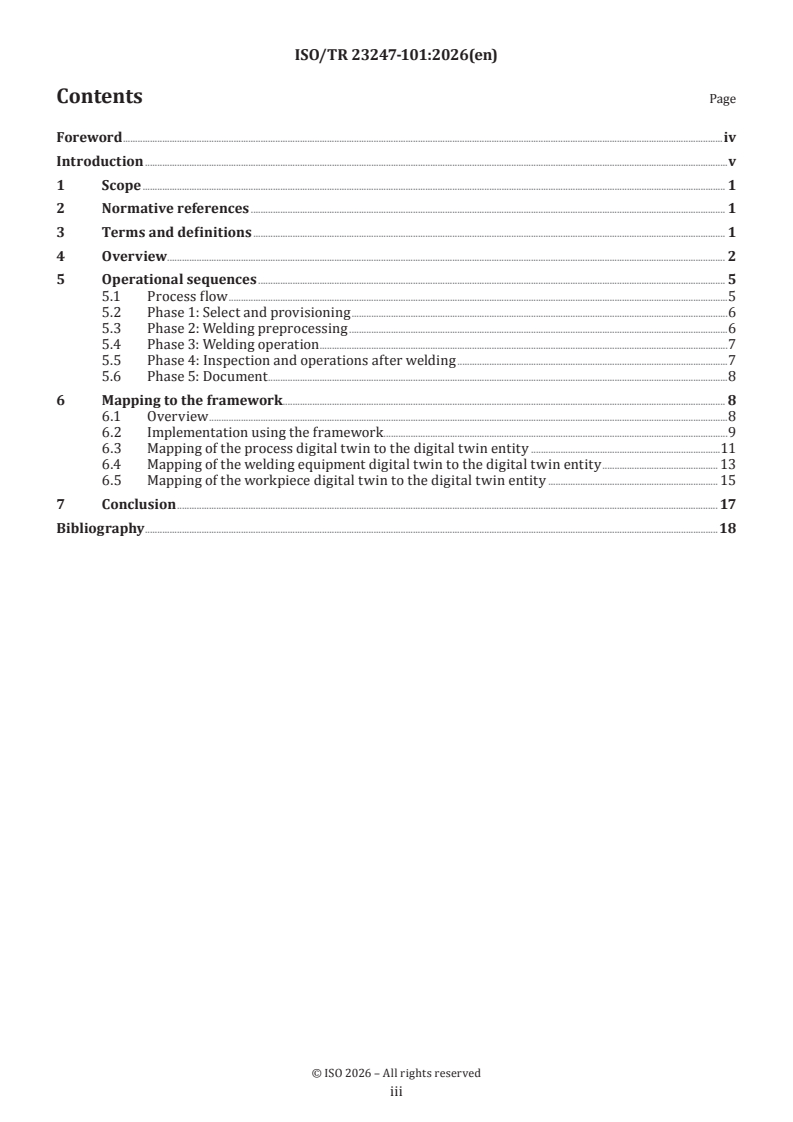
Contents Page
Foreword .iv
Introduction .v
1 Scope . 1
2 Normative references . 1
3 Terms and definitions . 1
4 Overview . 2
5 Operational sequences . 5
5.1 Process flow .5
5.2 Phase 1: Select and provisioning .6
5.3 Phase 2: Welding preprocessing .6
5.4 Phase 3: Welding operation . .7
5.5 Phase 4: Inspection and operations after welding .7
5.6 Phase 5: Document .8
6 Mapping to the framework . 8
6.1 Overview .8
6.2 Implementation using the framework .9
6.3 Mapping of the process digital twin to the digital twin entity .11
6.4 Mapping of the welding equipment digital twin to the digital twin entity . 13
6.5 Mapping of the workpiece digital twin to the digital twin entity . 15
7 Conclusion . 17
Bibliography .18
iii
Foreword
ISO (the International Organization for Standardization) is a worldwide federation of national standards
bodies (ISO member bodies). The work of preparing International Standards is normally carried out through
ISO technical committees. Each member body interested in a subject for which a technical committee
has been established has the right to be represented on that committee. International organizations,
governmental and non-governmental, in liaison with ISO, also take part in the work. ISO collaborates closely
with the International Electrotechnical Commission (IEC) on all matters of electrotechnical standardization.
The procedures used to develop this document and those intended for its further maintenance are described
in the ISO/IEC Directives, Part 1. In particular, the different approval criteria needed for the different types
of ISO document should be noted. This document was drafted in accordance with the editorial rules of the
ISO/IEC Directives, Part 2 (see www.iso.org/directives).
ISO draws attention to the possibility that the implementation of this document may involve the use of (a)
patent(s). ISO takes no position concerning the evidence, validity or applicability of any claimed patent
rights in respect thereof. As of the date of publication of this document, ISO had not received notice of (a)
patent(s) which may be required to implement this document. However, implementers are cautioned that
this may not represent the latest information, which may be obtained from the patent database available at
www.iso.org/patents. ISO shall not be held responsible for identifying any or all such patent rights.
Any trade name used in this document is information given for the convenience of users and does not
constitute an endorsement.
For an explanation of the voluntary nature of standards, the meaning of ISO specific terms and expressions
related to conformity assessment, as well as information about ISO's adherence to the World Trade
Organization (WTO) principles in the Technical Barriers to Trade (TBT), see www.iso.org/iso/foreword.html.
This document was prepared by Technical Committee ISO/TC 184, Automation systems and integration,
Subcommittee SC 4, Industrial data.
A list of all parts in the ISO 23247 series can be found on the ISO website.
Any feedback or questions on this document should be directed to the user’s national standards body. A
complete listing of these bodies can be found at www.iso.org/members.html.
iv
Introduction
Multilayer and multipass gas-shielded metal arc welding is a critical process for thick plate welding, which
is widely used in the welding of large metal structures in engineering machinery, ships, aerospace and other
fields.
Although robotic technology has enhanced automation, reduced manual intervention, and improved quality
in multilayer and multipass gas-shielded metal arc welding, the process remains challenging for highly
customized, large-scale workpieces such as tunnel boring machine cutterheads. Key issues include reliance
on manual parameter optimization and insufficient real-time process control, leading to poor adaptability,
inconsistent weld quality, and unplanned downtime.
A digital twin of robotic multilayer and multipass gas-shielded metal arc welding can effectively address
these challenges. By simulating and optimizing the entire process in a virtual environment, it reduces
reliance on manual experience and enables real-time monitoring, early warning, and dynamic adjustment of
welding parameters. This significantly enhances welding quality control and process stability.
The application of a digital twin for monitoring and controlling the robotic multilayer and multipass gas-
shielded metal arc welding offers the following advantages:
— Monitoring and early warning: A digital twin facilitates continuous real-time monitoring of the welding
process, displaying key parameters - such as current, voltage, travel speed, and molten pool state - and
triggers immediate alerts upon anomaly detection to prompt corrective operator actions.
— Process parameter optimization: A digital twin can analyse the influence of groove forms (e.g. V-groove,
J-groove) and their geometry parameters on stress, heat input, and deformation to optimize selection and
design. Additionally, it monitors weld quality and joint characteristics layer-by-layer, enabling predictive
optimization of subsequent welding parameters.
— Process plan optimization: A digital twin can evaluate the deformation and residual stress under various
welding sequences to identify the optimal welding sequence scheme. Using sensor-derived deformation
data, it also simulates straightening strategies to determine the most effective pressure, temperature,
and positioning parameters.
— Predictive maintenance of equipment: A digital twin enables predictive maintenance of welding
equipment by continuously monitoring and analysing its operational status. This allows for early
detection of potential faults, facilitating proactive interventions that minimize unplanned downtime.
— Training and simulation: A digital twin supports operator and engineer training through a virtual
environment that simulates diverse welding scenarios without physical equipment, improving skills,
enabling solution testing, and enhancing risk response capabilities.
A digital twin enhances precision in monitoring and optimizing the robotic multilayer and multipass gas-
shielded metal arc welding process, reducing defects and facilitating intelligent management of the full
workflow. By leveraging this technology, manufacturers achieve deeper process insight, improved parameter
optimization, strengthened quality control, and enhanced overall productivity and efficiency.
This document is structured into an overview, operational sequences, framework mapping and a conclusion.
Following the ISO 23247 series, the use case analysis yields a systematic implementation view and a high-
level digital twin design, ready for direct implementation with standard-compliant tools and languages.
v
Technical Report ISO/TR 23247-101:2026(en)
Automation systems and integration — Digital twin
framework for manufacturing —
Part 101:
Use case on management of robotic multilayer and multipass
gas-shielded metal arc welding process
1 Scope
This document describes a digital twin system for monitoring and managing the robotic multilayer and
multipass gas-shielded metal arc welding process.
2 Normative references
The following documents are referred to in the text in such a way that some or all of their content constitutes
requirements of this document. For dated references, only the edition cited applies. For undated references,
the latest edition of the referenced document (including any amendments) applies.
ISO 23247-1, Automation systems and integration — Digital twin framework for manufacturing — Part 1:
Overview and general principles
3 Terms and definitions
For the purposes of this document, the terms and definitions given in ISO 23247-1 and the following apply.
ISO and IEC maintain terminology databases for use in standardization at the following addresses:
— ISO Online browsing platform: available at https:// www .iso .org/ obp
— IEC Electropedia: available at https:// www .electropedia .org/
3.1
welding
joining process in which two or more parts are united producing a continuity in the nature of the workpiece
material(s) by means of heat or pressure or both, and with or without the use of filler material
3.2
gas-shielded metal arc welding
metal arc welding using a wire electrode in which the arc and the weld pool are shielded from the atmosphere
by a shroud of gas supplied from an external source
3.3
multipass welding
welding process in which the entire weld is completed using more than two weld passes
Note 1 to entry: The weld beads of multipass welding are usually deposited continuously within the same layer. Special
attention can be paid to adjusting welding parameters such as welding current and welding voltage to ensure the
compactness and mechanical properties of the weld joint.
3.4
multilayer welding
process whereby the weld joint is completed by depositing two or more weld layers, where each weld layer
consists of one or more weld beads
EXAMPLE Multilayer welding is typically used for thick plate welding. During the welding of shield tunnelling
machines and their related structural components, the thickness of each weld layer is usually controlled within the
range of 3 mm to 6 mm.
Note 1 to entry: During the multilayer welding process, the welding sequence can be properly planned to avoid welding
deformation and cracks, and to ensure the compactness and mechanical properties of the weld joint.
4 Overview
Robotic multilayer and multipass gas-shielded metal arc welding is a key process for thick-plate welding
of large structural components, given its high efficiency, high precision and excellent weld quality. In view
of the characteristics of thick-plate welding, process engineers reasonably design the groove form (e.g. the
single-V groove), groove angle, root gap and land, and adopt a multilayer and multipass welding strategy.
For example, the root pass uses single-pass welding to ensure full root penetration, the filling passes use
multipass welding to achieve uniform groove filling, and the capping passes use multipass welding to ensure
good surface formation. Combined with precisely controlled welding parameters (such as welding current,
welding voltage and travel speed), this strategy ensures welding quality while improving production
efficiency and process stability. The schematic diagram of the single-V groove weld and multilayer and
multipass welding is shown in Figure 1.
Key
1 single-V groove weld
2 multilayer
3 root pass
4 filling pass
5 capping pass
Figure 1 — Schematic diagram of single-V groove weld and multilayer and multipass welding
With reference to the production of thick-plate structural components for shield tunnelling machines, the
conventional procedures of the robotic multilayer and multipass gas-shielded metal arc welding are as
follows:
a) Workpiece selection and process provisioning: Operators select a welding part to be processed
according to production planning requirements and download the welding process plan from the
manufacturing operations management (MOM) system based on the type of welding part. The plan
includes the 3D model of the welding part, material specifications, technical parameters, hardware
equipment information, operator qualifications, operating methods and quality control requirements,
ensuring that the welding process meets product requirements and technical specifications.
b) Convert and transmit: Based on the 3D model and technical parameters in the welding process plan,
combined with the welding robot system configuration, a welding working condition environment is
constructed in the offline programming system of the upper computer. Robot instructions and programs
are generated according to the weld information and process parameters, and then issued.
c) Preparation of welding conditions: In accordance with the welding process plan, welding consumables,
the shielding gas, welding equipment, welding accessories, and jigs are selected. Meanwhile, the safety
of the working environment is confirmed, including wind protection measures, humidity control and
safety isolation. These steps ensure that material performance, equipment functionality and the welding
environment meet the requirements of production operations.
d) Joint preparation: Cleaning and degreasing of the appropriate area; in accordance with process
requirements, adopt process measures such as jigging, preheating and backing.
e) Program verification: Operators perform welding program verification based on the workpiece position,
weld position and joint dimensions.
f) Welding equipment operation: Operators strictly follow the requirements of the process plan, start the
welding equipment, and the welding robot system performs the welding operation.
g) Inspection during welding: Operators conduct inspections on the root pass and capping pass, and
perform regular sampling inspections on the filling pass in accordance with process requirements.
h) Welding parameters adjustment: Based on the results of the inspection during welding, operators
promptly adjust parameters such as welding sequence, welding trajectory and welding current to
ensure that the weld quality meets the requirements of the welding process plan.
i) Visual testing of the finished welding: The weld surface is inspected to check whether defects such as
cracks, surface pores and undercuts deviate from the acceptance criteria.
j) Straightening: The workpiece undergoes straightening to meet the design dimensions, shape and
assembly requirements.
k) Non-destructive testing and repair: Operators conduct non-destructive testing on the welds, repair the
welds based on the test results and ensure that the weld quality meets the requirements of the welding
process plan.
Although robot technology has significantly improved the automation level of the multilayer and multipass
gas-shielded metal arc welding, the process still faces many challenges in the welding of highly customized
and complex large-size workpieces such as tunnel boring machine cutterheads. For example, the optimization
of welding parameters depends on manual experience, and the dynamic perception and real-time adjustment
ability of the welding process is insufficient. These problems lead to poor process adaptability, fluctuation of
welding quality and even accidental shutdown.
A digital twin of the robotic multilayer and multipass gas-shielded metal arc welding can effectively address
these challenges. By simulating and optimizing the entire process in a virtual environment, it reduces
reliance on manual experience and enables real-time monitoring, early warning, and dynamic adjustment of
welding parameters. This significantly enhances welding quality control and process stability.
Furthermore, a digital twin enables the optimization and iterative update of robotic welding process plans
for customized products, ensuring that welding quality complies with relevant standards, improving
production efficiency, reducing operational errors, lowering production costs, and enhancing the quality
and reliability of the overall product.
Table 1 summarizes the drawbacks and advantages of the conventional robotic multilayer and multipass
welding process and the solutions offered by a digital twin.
Table 1 — Comparison of conventional robotic multilayer and multipass welding process and digital
twin solutions
Stages of robotic
Drawbacks of the Advantages of the digital
multilayer and multi- Solutions by digital twin
conventional method twin solution
pass welding process
Workpiece selection and The welding process plan The optimal plan is derived Iterative optimization and
process provisioning lacks a mechanism for based on past production consistent management of
iterative optimization and conditions welding process plans
unified management
Convert and transmit The functions of the soft- Constructing a welding Integrated digital
ware are limited by virtual environment and management and flexible
developers, resulting in generating the robotic pro- function development
insufficient functional gram
scalability
Preparation of welding Reliance on operator skill The status of production Precise and consistent
production elements factors check using sensor quality levels of welding
and machine vision production elements
technologies
Workpiece preprocessing Process omissions and Real-time monitoring and Consistent processing
quality degradation due to feedback for processing process leading to
manual operations process standardized outcomes
Program debugging and Reliance on operator Measurement and Reduced errors caused by
calibration measurement and verification using sensors manual operations
operation
Welding equipment Reliance on human judgment Conducting automated con- Reduced the equipment's
operation trol and predictive downtime and maintenance
maintenance on welding costs
equipment
Inspection during welding Manual inspection can miss Automated inspection using Efficient and reliable
subtle defects machine vision and AI inspection process
Welding parameters Reliance on operator AI-controlled parameters Higher welding quality and
adjustment experience adjustment based on re- stable
al-time feedback
Visual testing of the Reliance on human Automated inspection using Higher efficiency and
finished welding operation and judgment machine vision accuracy inspection results
Straightening Reliance on manual AI-controlled optimal Higher correction precision
experience and unstable correction plan and efficiency
precision, low efficiency
Non-destructive testing Manual judgment can miss Inspection result Higher defect detection rate
and repair detections and determination using and consistency
misjudgements machine vision and AI
Integrating a digital twin into the robotic multilayer and multipass welding process can bring significant
advantages and resolve challenges associated with conventional methodologies. It offers a more intelligent
control and optimization method, delivering better results in terms of quality, efficiency and safety.
Table 2 describes the use case for the management of the robotic multilayer and multipass
...