

ISO 23247-5:2026
(Main)Automation systems and integration — Digital twin framework for manufacturing — Part 5: Digital thread for digital twin
- Abstract
This document specifies how a digital thread enables the creation, connectivity, management, and maintenance of manufacturing digital twins across the product life cycle, including design, planning, production, and testing by defining principles, presenting methodologies, and providing use case examples.
- Status
- Published
- Publication Date
- 23-Jun-2026
- Technical Committee
- ISO/TC 184/SC 4 - Industrial data
- Drafting Committee
- ISO/TC 184/SC 4 - Industrial data
- Current Stage
- 6060 - International Standard published
- Start Date
- 24-Jun-2026
- Due Date
- 28-Sep-2026
- Completion Date
- 24-Jun-2026


ISO 23247-5:2026 is an International Standard from ISO for the digital twin framework for manufacturing. It specifies how a digital thread connects manufacturing digital twins across the product life cycle so design, planning, production, testing, operation and maintenance information can stay linked and traceable.
For engineering, quality and buying teams, the standard is about managing those links, not about defining a single data format or communication protocol. It gives principles, methods and use case examples for creating, finding, updating and maintaining digital thread connections between digital twins.
What does ISO 23247-5:2026 specify?
ISO 23247-5:2026 specifies the role of a digital thread in creating, connecting, managing and maintaining manufacturing digital twins across the product life cycle. The document is written as a framework standard: it describes how the digital thread works and how it is used, rather than prescribing one implementation.
The scope covers design, planning, production and testing, and the introduction extends the use of the digital thread to engineering, validation, operation and maintenance contexts. The document also notes that it does not prescribe specific data formats or communication protocols.
The standard is organized into:
- Clause 1 - Scope
- Clause 2 - Normative references
- Clause 3 - Terms and definitions
- Clause 4 - General concepts
- Clause 5 - Digital thread entity
- Clause 6 - Digital thread life cycle
- Clause 7 - Requirements on digital threads
- Annex A - Digital twin prototype, digital twin instance and digital twin aggregate
- Annex B - Scenarios between digital twin and digital thread
What are the key requirements of ISO 23247-5:2026?
ISO 23247-5:2026 turns the digital thread into a managed entity with a ledger, controlled links, metadata and query handling. In practice, this means the standard is about making digital twin relationships searchable, auditable and usable across lifecycle stages.
Digital thread entity and ledger
Clause 7.1 requires the digital thread entity to be implemented as a functional entity as described in ISO 23247-2. Clause 7.2 requires the entity to maintain the digital thread information in a digital thread ledger, including thread ID, creation and modification timestamps, digital twin identifiers, data store identifiers and metadata for each link.
This matters because the ledger is the traceability record. If you are implementing or buying a system, you need a way to store and maintain the relationships, not just the data objects.
Publishing and finding digital twins
Clause 7.3 requires the digital thread entity to publish information about the threads and the digital twins it manages so digital twins can find related twins and threads. Clause 7.4 requires a method for search, processing the query against the ledger, using metadata to select the most relevant twin, validating access rights, and returning identifiers or error messages.
In practice, this is what makes the digital thread usable by applications and operators. It supports discovery, but also forces access control, logging and consistent responses.
Access, updates and link management
Clause 7.5 requires a method for digital twins to access other digital twins' data stores or communicate with them, while preventing unauthorized access. Clause 7.6 requires the entity to create, delete and update links, and to ensure the source digital twin is newer than the destination digital twin.
Clause 7.7 adds management decisions after changes, such as whether a new link should create a new thread or join an existing one, and whether a deleted link should be deleted, deprecated, split or disconnected. Clause 7.8 requires interoperability between digital thread entities without centralized control so traceability can continue across a supply chain.
Maintenance, integrity and reliability
Clause 6.3 describes how the ledger is maintained over time: link validation, metadata updates, performance monitoring and error handling. It includes existence checks, accessibility checks, integrity checks, status handling, versioning, provenance, query performance, reliability and logging.
In practice, this is what keeps a digital thread trustworthy after deployment. A digital thread that cannot be validated, monitored or repaired will not support traceability for long.
What terms does ISO 23247-5:2026 define?
- Digital thread for digital twins - bidirectional, dependable and trustworthy information that links digital twins across structure, behaviour, space, time and lifecycle stages.
- Digital thread entity - the component that manages the digital thread for digital twins.
- Digital thread link - a reference or pointer that connects one digital twin to another with digital thread metadata.
- Digital thread ledger - a repository of digital thread links that identifies digital twins and their relationships.
- Digital thread metadata - information about the link between two digital twins, such as purpose, date or a summary of the linked twins.
- Digital twin prototype (DTP) - the informational set needed to describe and produce a digital twin instance; it is not linked to an observable manufacturing element.
- Digital twin instance (DTI) - a fit-for-purpose digital representation of an observable manufacturing element with synchronization between the element and its digital representation.
- Observable manufacturing element (OME) - an element with an observable physical presence or operation in manufacturing.
Who uses ISO 23247-5:2026?
ISO 23247-5:2026 is used by organizations that build, operate or integrate manufacturing digital twins. That includes manufacturers, suppliers, automation and industrial data teams, systems integrators, and product development, production planning, quality, testing and maintenance groups.
It is especially relevant where data must move across lifecycle stages and organizations. Typical tasks include linking design models to manufacturing records, tracing test results back to design intent, maintaining cross-domain references, and supporting queries for related digital twins.
What changed in ISO 23247-5:2026 from the previous edition?
ISO 23247-5:2026 is the first edition of Part 5.
Which standards are used with ISO 23247-5:2026?
| Standard | What it contributes |
|---|---|
| ISO 23247-2 | Defines the reference architecture and the functional entity model used by the digital thread entity. |
| ISO 23247-1 | Provides the overview and general principles for the digital twin framework. |
| ISO 23247-3 | Defines the digital representation of manufacturing elements used by connected twins. |
| ISO 23247-4 | Covers information exchange between entities in the reference architecture. |
| ISO 23247-6 | Covers digital twin composition, which is related to combining multiple twins. |
| ISO 10303 series | Supports product data representation and exchange across concept, design, engineering, manufacturing and support stages. |
| ISO/IEC 17025 | Supports testing and calibration laboratory competence in prototype and validation work. |
| ISO 13399 series | Supports cutting tool data representation and exchange in validation and manufacturing contexts. |
| IEC 62264 series | Supports enterprise-control system integration in production and assembly. |
| ISO 22400 series | Supports manufacturing operations management KPIs. |
| ISO/IEC 30141 | Supports IoT reference architecture for operation and monitoring. |
| IEC 62541 series | Supports OPC Unified Architecture for operational data exchange. |
| ISO 13374 series | Supports condition monitoring and diagnostics for maintenance support. |
| ISO 55000 | Supports asset management vocabulary, overview and principles for maintenance support. |
What does the ISO 23247-5:2026 document contain?
ISO 23247-5:2026 contains concepts, entity definitions, life cycle guidance, and requirements for publishing, searching, updating and maintaining digital thread links. It also includes maintenance topics such as validation, monitoring, error handling and obsolescence handling.
The document uses figures to show the structure of a digital thread, how digital twins use it, how data flows across lifecycle stages, and how queries and cross-domain links work. Annex A explains digital twin prototype, digital twin instance and digital twin aggregate, and Annex B gives operational scenarios for finding twins, adding links, deprecating links and linking twins across different domains.
Get Certified
Connect with accredited certification bodies for this standard

BSI Group
BSI (British Standards Institution) is the business standards company that helps organizations make excellence a habit.

DVS-ZERT GmbH
German welding certification society.
CARES (UK Certification Authority for Reinforcing Steels)
UK certification for reinforcing steels and construction.
Sponsored listings
Frequently Asked Questions
ISO 23247-5:2026 is a standard published by the International Organization for Standardization (ISO). Its full title is "Automation systems and integration — Digital twin framework for manufacturing — Part 5: Digital thread for digital twin". This standard covers: This document specifies how a digital thread enables the creation, connectivity, management, and maintenance of manufacturing digital twins across the product life cycle, including design, planning, production, and testing by defining principles, presenting methodologies, and providing use case examples.
This document specifies how a digital thread enables the creation, connectivity, management, and maintenance of manufacturing digital twins across the product life cycle, including design, planning, production, and testing by defining principles, presenting methodologies, and providing use case examples.
ISO 23247-5:2026 is classified under the following ICS (International Classification for Standards) categories: 25.040.40 - Industrial process measurement and control; 35.240.50 - IT applications in industry. The ICS classification helps identify the subject area and facilitates finding related standards.
ISO 23247-5:2026 is available in PDF format for immediate download after purchase. The document can be added to your cart and obtained through the secure checkout process. Digital delivery ensures instant access to the complete standard document.
Standards Content (Sample)
International
Standard
ISO 23247-5
First edition
Automation systems and
2026-06
integration — Digital twin
framework for manufacturing —
Part 5:
Digital thread for digital twin
Systèmes d'automatisation et intégration — Cadre technique de
jumeau numérique dans un contexte de fabrication —
Partie 5: Continuité numérique pour le jumeau numérique
Reference number
© ISO 2026
All rights reserved. Unless otherwise specified, or required in the context of its implementation, no part of this publication may
be reproduced or utilized otherwise in any form or by any means, electronic or mechanical, including photocopying, or posting on
the internet or an intranet, without prior written permission. Permission can be requested from either ISO at the address below
or ISO’s member body in the country of the requester.
ISO copyright office
CP 401 • Ch. de Blandonnet 8
CH-1214 Vernier, Geneva
Phone: +41 22 749 01 11
Email: copyright@iso.org
Website: www.iso.org
Published in Switzerland
ii
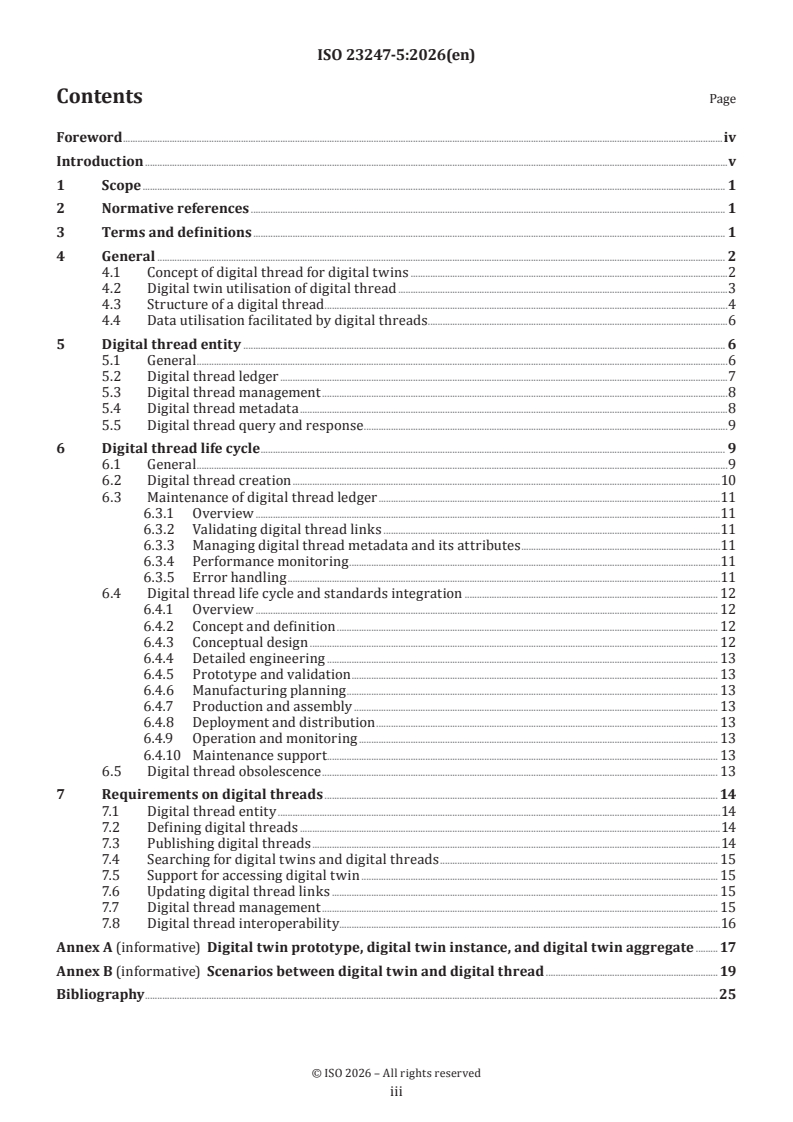
Contents Page
Foreword .iv
Introduction .v
1 Scope . 1
2 Normative references . 1
3 Terms and definitions . 1
4 General . 2
4.1 Concept of digital thread for digital twins .2
4.2 Digital twin utilisation of digital thread .3
4.3 Structure of a digital thread .4
4.4 Data utilisation facilitated by digital threads .6
5 Digital thread entity . 6
5.1 General .6
5.2 Digital thread ledger .7
5.3 Digital thread management .8
5.4 Digital thread metadata .8
5.5 Digital thread query and response .9
6 Digital thread life cycle . 9
6.1 General .9
6.2 Digital thread creation .10
6.3 Maintenance of digital thread ledger .11
6.3.1 Overview .11
6.3.2 Validating digital thread links .11
6.3.3 Managing digital thread metadata and its attributes .11
6.3.4 Performance monitoring .11
6.3.5 Error handling .11
6.4 Digital thread life cycle and standards integration . 12
6.4.1 Overview . 12
6.4.2 Concept and definition . 12
6.4.3 Conceptual design . 12
6.4.4 Detailed engineering . 13
6.4.5 Prototype and validation . 13
6.4.6 Manufacturing planning . 13
6.4.7 Production and assembly . 13
6.4.8 Deployment and distribution . 13
6.4.9 Operation and monitoring . 13
6.4.10 Maintenance support. 13
6.5 Digital thread obsolescence . 13
7 Requirements on digital threads . 14
7.1 Digital thread entity .14
7.2 Defining digital threads .14
7.3 Publishing digital threads .14
7.4 Searching for digital twins and digital threads . 15
7.5 Support for accessing digital twin . 15
7.6 Updating digital thread links . 15
7.7 Digital thread management . 15
7.8 Digital thread interoperability.16
Annex A (informative) Digital twin prototype, digital twin instance, and digital twin aggregate . 17
Annex B (informative) Scenarios between digital twin and digital thread . 19
Bibliography .25
iii
Foreword
ISO (the International Organization for Standardization) is a worldwide federation of national standards
bodies (ISO member bodies). The work of preparing International Standards is normally carried out through
ISO technical committees. Each member body interested in a subject for which a technical committee
has been established has the right to be represented on that committee. International organizations,
governmental and non-governmental, in liaison with ISO, also take part in the work. ISO collaborates closely
with the International Electrotechnical Commission (IEC) on all matters of electrotechnical standardization.
The procedures used to develop this document and those intended for its further maintenance are described
in the ISO/IEC Directives, Part 1. In particular, the different approval criteria needed for the different types
of ISO documents should be noted. This document was drafted in accordance with the editorial rules of the
ISO/IEC Directives, Part 2 (see www.iso.org/directives).
ISO draws attention to the possibility that the implementation of this document may involve the use of (a)
patent(s). ISO takes no position concerning the evidence, validity or applicability of any claimed patent
rights in respect thereof. As of the date of publication of this document, ISO had not received notice of (a)
patent(s) which may be required to implement this document. However, implementers are cautioned that
this may not represent the latest information, which may be obtained from the patent database available at
www.iso.org/patents. ISO shall not be held responsible for identifying any or all such patent rights.
Any trade name used in this document is information given for the convenience of users and does not
constitute an endorsement.
For an explanation of the voluntary nature of standards, the meaning of ISO specific terms and expressions
related to conformity assessment, as well as information about ISO's adherence to the World Trade
Organization (WTO) principles in the Technical Barriers to Trade (TBT), see www.iso.org/iso/foreword.html.
This document was prepared by Technical Committee ISO/TC 184, Automation systems and integration,
Subcommittee SC 4, Industrial data.
A list of all parts in the ISO 23247 series can be found on the ISO website.
Any feedback or questions on this document should be directed to the user’s national standards body. A
complete listing of these bodies can be found at www.iso.org/members.html.
iv
Introduction
The ISO 23247 series defines a framework to support digital twins in manufacturing. A digital twin assists
with detecting events in manufacturing processes to achieve functional objectives such as real-time control,
predictive maintenance, in-process adaptation, big data analytics, process and manufactured component
validation, and machine learning. A digital twin monitors its observable manufacturing elements by
constantly updating and analysing relevant operational and environmental data as process/part changes.
This visibility into process and execution enabled by a digital twin enhances manufacturing operations and
business cooperation.
Manufacturing supported by implementing the ISO 23247 framework depends on the standards and
technologies available to model the observable manufacturing elements. Different manufacturing domains
can use different data standards. As a framework, this document does not prescribe specific data formats or
communication protocols.
The subject areas of the six parts of this series are defined below:
— ISO 23247-1: General principles and requirements for developing digital twins in manufacturing;
— ISO 23247-2: Reference architecture with functional views;
— ISO 23247-3: List of basic information attributes for the observable manufacturing elements;
— ISO 23247-4: Technical requirements for information exchange between entities within the reference
architecture;
— ISO 23247-5: Requirements and guidance to use digital threads for connecting manufacturing lifecycle
data to digital twins;
— ISO 23247-6: Requirements and guidance for performing digital twin composition.
Figure 1 shows how the six parts of the series are related.
Figure 1 — ISO 23247 series relationships
This document describes how the digital thread supports the generation, implementation and transformation
of digital twins in manufacturing.
In manufacturing, without digital threads, data from various stages of the product life cycle, such as design,
production, quality management, and maintenance, usually remains isolated within individual digital twins.
v
Such isolation causes data and information to be fragmented, leading to inefficiencies such as processing
delays, information duplications and disruption. These problems hinder manufacturers in conducting
simulations and analyses with digital twins, as these functions depend on a continuous and integrated data
flow. The absence of digital threads makes it difficult to associate various events and complicates time series
analysis. The disconnection of information can cause delays or inhibitions in retrieving and processing data,
leading to poor decision-making and difficulty in addressing issues as they arise.
Digital threads connect digital twins representing different aspects of the product life cycle. The scalability
and adaptability of manufacturing are enhanced by digital threads that support seamless connections
between digital twins for manufacturing processes across the life cycle, and production facilities across the
extended enterprise.
This document defines the concept, requirements and operational characteristics of digital threads for
digital twins in manufacturing.
vi
International Standard ISO 23247-5:2026(en)
Automation systems and integration — Digital twin
framework for manufacturing —
Part 5:
Digital thread for digital twin
1 Scope
This document specifies how a digital thread enables the creation, connectivity, management, and
maintenance of manufacturing digital twins across the product life cycle, including design, planning,
production, and testing by defining principles, presenting methodologies, and providing use case examples.
2 Normative references
The following documents are referred to in the text in such a way that some or all of their content constitutes
requirements of this document. For dated references, only the edition cited applies. For undated references,
the latest edition of the referenced document (including any amendments) applies.
ISO 23247-2, Automation systems and integration — Digital twin framework for manufacturing — Part 2:
Reference architecture
3 Terms and definitions
ISO and IEC maintain terminology databases for use in standardization at the following addresses:
— ISO Online browsing platform: available at https:// www .iso .org/ obp
— IEC Electropedia: available at https:// www .electropedia .org/
3.1
digital thread
digital thread for digital twins
bidirectional, dependable and trustworthy information that links digital twins with multiple data
dimensions, including structure, behaviour, space, time, and lifecycle stages
Note 1 to entry: The linked digital twins can model design requirements, product models, manufacturing processes,
inspection results and verification data.
Note 2 to entry: This definition was derived from a definition developed by the Digital Twin Consortium.
3.2
digital thread entity
component that manages the digital thread for digital twins (3.1)
3.3
digital thread link
reference or pointer that connects one digital twin to another with digital thread metadata
(3.6) to establish a relationship
Note 1 to entry: Depending on performance constraints, a digital thread link (3.3) can connect digital twins using data
structure, URL, Universally Unique Identifier (UUID), DB query or other mechanisms.
3.4
data store
repository that collects, organises and manages content for the digital twin(s)
Note 1 to entry: Multiple data stores can be used for the digital twins depending on their roles (e.g. design, engineering,
manufacturing, verification).
Note 2 to entry: Depending on system architecture, a data store can be implemented as a relational database, a graph
database, a cloud storage, a distributed ledger, or other suitable solutions.
3.5
digital thread ledger
repository of digital thread links (3.3) that identifies digital twins and their relationships with
other digital twins
Note 1 to entry: In the simplest case, a digital thread ledger (3.5) contains a list of digital thread links for the life cycle
stages of one digital twin.
3.6
digital thread metadata
information about the digital thread link (3.3) between two digital twins
Note 1 to entry: The information can describe the purpose of the link, the date of the link, summarize an aspect of the
digital twins in the link, etc.
Note 2 to entry: When the term “metadata” is not further qualified, then it is assumed to be digital thread metadata.
3.7
digital twin prototype
DTP
informational sets necessary to describe and produce a digital twin instance (3.8) that duplicates or “twins”
the corresponding observable manufacturing element (OME) (3.9), including, but not limited to, requirements,
fully annotated 3D model, bill of materials (with material specifications), bill of processes, bill of services
and bill of disposal
Note 1 to entry: A digital twin prototype is not linked to an OME.
3.8
digital twin instance
DTI
fit for purpose digital representation of an observable manufacturing element (3.9) with synchronisation
between the element and its digital representation
Note 1 to entry: When the term “digital twin” is not further qualified, then it is assumed to be a digital twin instance.
3.9
observable manufacturing element
OME
element that has an observable physical presence or operation in manufacturing
Note 1 to entry: Observable manufacturing elements include personnel, equipment, material, process, facility,
environment, product and supporting documentation.
[SOURCE: ISO 23247-1:2021, 3.2.5, modified — "item" was replaced by "element".]
4 General
4.1 Concept of digital thread for digital twins
The digital thread facilitates utilization of data and information for the life cycle of digital twins. The
digital thread precedes and follows the definition and implementation of the manufacturing digital twin.
In manufacturing, a digital twin is a digital representation of an observable manufacturing element (OME).
A digital twin prototype has to meet the design requirement of the product OME, before being transformed
into a digital twin instance when the actual product is being manufactured. When the OME is in place, plans
are made for its manufacture. When the necessary equipment has been allocated, the plans are applied to
the OME. At this stage, the digital twin prototype becomes a digital twin instance. When manufacturing is
finished, the product is tested and inspected. If it is judged ready, the product is delivered to a customer.
NOTE Detailed descriptions of digital twin prototype, digital twin instance and digital twin aggregate are in
Annex A.
As the product OME moves from design concept to delivery, the digital twins are linked together using the
digital thread. These links enable upstream processes to observe their impact on the final product and allow
downstream processes to access information that affected the upstream processes. The linked digital twins
can model requirement data, product data, manufacturing process data, inspection data and verification
data. The digital thread establishes a chain of custody for the digital twins so that users and applications can
inspect their evolution from design through planning, manufacturing and inspection. With this information,
manufacturers can optimise their processes, reduce waste and adapt effectively to changes, ultimately
driving innovation and competitiveness.
The digital thread enables digital twins and diverse applications to access data and information within
the context of the appropriate digital twin, ensuring seamless data flow across the product life cycle. In
the engineering stage, the digital thread connects design digital twins with simulation results, enabling
validation and optimisation before production starts. In the manufacturing stage, the digital thread links
the design digital twins and the manufacturing digital twins to ensure products are manufactured as
designed. In the validation stage, the digital thread integrates testing, manufacturing, and design digital
twins to facilitate problem analysis and quality improvements. Beyond production, the digital thread
supports predictive maintenance by combining multiple digital twins into digital twin aggregates that
model operational performance and historical trends for proactive decision making. The digital thread
facilitates multi-manufacturer collaboration and supply chain optimisation through digital twin sharing.
4.2 Digital twin utilisation of digital thread
The information of a digital twin is derived from information systems that support and enable the OME.
This information is contextualised for traceability, allowing users to monitor the status of the product OMEs
and thereby enhancing the visibility of the production process.
Figure 2 shows how digital twins utilise digital threads to integrate and interpret manufacturing data from
various sources. Life cycle data and information are often siloed, logically or physically separated. The digital
thread enables connection to digital twins from disparate data sources. Digital twins use digital threads to
obtain base information about the manufacturing process and model components. This allows data analysis
and optimisation to represent the characteristics of the target OME. By connecting and contextualising life
cycle data, the digital thread facilitates continuous monitoring and improvement of the OME. This process
enhances decision-making, optimises production processes and fosters collaboration throughout the supply
chain, ultimately driving improvements in product design, innovation and overall visibility.
In Figure 2, the lower left box (i.e. life cycle data of digital twins) shows the existing information system,
and the upper left box (i.e. digital thread of life cycle data) shows that digital twins are realised from those
systems and linked by the digital thread. The middle figure (i.e. digital twins in manufacturing) shows a
subset of the digital twins within a digital twin entity for various life cycle stages. Changes to the OME are
mirrored in the digital twins using the infrastructure described in ISO 23247-1, ISO 23247-2, ISO 23247-3
and ISO 23247-4. Some of the information is aggregated for further analysis. New digital twins are linked to
the digital thread for usage by subsequent manufacturing processes.
Figure 2 — Digital twin utilisation of digital threads
The following are different kinds of the life cycle data shown on the lower left of Figure 2.
— Contract data are data from agreements, terms and conditions between stakeholders or partners. These
data are the foundation for initiating the life cycle by establishing project goals and expectations.
— Requirement data are data from the functional and technical requirements of the product or system. It
serves as a basis for design, development and testing.
— Design and engineering data are the physical and functional characteristics of the product, including
CAD models, schematics and engineering specifications used during the design and development stages.
— Supplier data are information related to external suppliers, including materials, components and supply
chain logistics. These data are essential for coordinating with external vendors.
— Production data are data from manufacturing processes, which include assembly instructions, machine
parameters and real-time production performance metrics.
— Test data are the results from product testing, validation and quality assurance. It specifies whether the
product meets its specifications and identifies any defects or issues.
— Operation and maintenance data include usage statistics, performance monitoring, failure analysis and
maintenance logs.
— Legacy data are the historical data from previous projects, systems or versions.
The use of a digital thread by the digital twin has many benefits shown on the right panel of Figure 2.
The primary benefit is to support continuous enhancement and innovation within manufacturing, which
leads to the enhancement of efficiency in product design and development and improved decision-making.
Furthermore, the digital thread allows for a comprehensive view of the product life cycle, which results
in better traceability, quality control, and the ability to predict and address issues proactively. The digital
thread can provide information for the digital twin to enhance visibility, which leads to an enhancement in
cooperation and supply chain collaboration, and overall productivity in manufacturing.
4.3 Structure of a digital thread
Figure 3 depicts the structure of a digital thread that consists of a series of digital twins and digital thread
links. Each digital twin has units of data with a unique identifier and other descriptive information that
represents an OME. These unique identifiers serve as the building block of the digital thread, as they are the
means for identifying digital twins. A digital thread link is a reference or pointer that connects one digital
twin to another to establish a relationship. Organising these links constitutes a digital thread that enables
traceability of data flow and transformation across different stages of the product life cycle.
Key
D , D digital twin prototypes in the design stage
1 2
E , E digital twin prototypes in the engineering stage
1 2
M , M digital twin instances of OMEs in manufacturing
1 2
V , V digital twin instances of OMEs in testing
1 2
OME , OME OMEs that correspond to digital twins
1 2
digital thread link
association between digital twin and OME
{-} digital thread metadata
Figure 3 — Representative example of a structure of digital threads for digital twins
The digital thread links shown in Figure 3 include the following:
— D E is a link between the digital twin prototype in the design stage (D ) and the digital twin
1 1 1
prototype in the engineering stage (E ), representing the relationship between the digital twins of the
initial design and the engineering specification;
— E M is a link between E and the digital twin instance in the manufacturing stage (M ), representing
1 1 1 1
the relationship between the digital twins of the engineering specification and the product in the
manufacturing stage, with OME assigned to M for synchronisation;
1 1
— E M is a link between E and the digital twin instance in the manufacturing stage (M ), representing
1 2 1 2
the relationship between the digital twins of the engineering specification and the product in the
manufacturing stage, with OME assigned to M for synchronisation.
2 2
The digital threads shown in Figure 3 are as follows:
— D E M V is a digital thread that is used to trace the life cycle of OME from design to
1 1 1 1 1
validation;
— D E M V is a digital thread that is used to trace the life cycle of OME from design to
1 1 2 2 2
validation;
— D E is a digital thread that ends at the engineering stage, which means the design has not yet moved
2 2
to manufacturing.
4.4 Data utilisation facilitated by digital threads
Figure 4 illustrates the possible data utilisation facilitated by the digital thread shown in Figure 3. The digital
thread enables seamless exchange and reuse of information across the design, engineering, manufacturing,
and validation stages between digital twin prototypes, digital twin instances, and OMEs.
Key
D , D digital twin prototypes in the design stage
1 2
E , E digital twin prototypes in the engineering stage
1 2
M , M digital twin instances in the manufacturing stage
1 2
V , V digital twin instances in the validation stage
1 2
data utilisation facilitated by digital thread
Figure 4 — Examples of data utilisation enabled by digital thread
Because each digital twin can be a composite of many other digital twins, numerous utilisation pathways
are possible. For example, a manufacturing process digital twin can be composed of a workpiece, fixture and
cutting tools, but for simplicity, they are shown as one twin in Figure 4. The following are some examples of
data utilisation that are possible from Figure 4.
— For data utilisation from D to M , a digital twin in the manufacturing stage (M ) uses D to understand
1 1 1 1
assembly constraints or critical dimensions that need to be maintained during production. This is
implied by a digital thread D E M . A similar use case can be applied to the data utilisation from
1 1 1
D to M .
1 2
— For data utilisation from M to D , a digital twin in the design stage (D ) uses M to detect production
1 1 1 1
efficiency, CNC (Computer Numerical Control) tool wear, or machining error to improve design for
manufacturability and reduce production costs. This is implied by a digital thread D E M . A
1 1 1
similar use case can be applied to the data utilisation from M to D .
2 1
— For data utilisation between D and OMEs, D communicates with OMEs to acquire operational data such
1 1
as actual machining performance or detect production efficiency. This is implied by a digital thread D
E M or D E M V .
1 1 1 1 1 1
5 Digital thread entity
5.1 General
The digital thread entity consists of two components:
a) a digital thread ledger is a repository of logical digital thread link attributes defining the data
relationship between digital twins; and
b) an agent that facilitates access to the digital twins and provides for a historical record of digital thread
activity in response to service requests.
Key
DTE digital twin entity
D , D digital twins of design prototypes
1 2
E , E digital twins of engineering prototypes
1 2
M , M digital twins of product OMEs in manufacturing
1 2
V , V digital twins of product OMEs in testing
1 2
digital thread link that connects digital twins
digital thread
S data store for the design digital twins
D
S data store for the engineering digital twins
E
S data store for the manufacturing digital twins
M
S data store for the validation digital twins
V
digital thread query and response
{-} digital thread metadata
Figure 5 — Digital thread and digital twin entities
Figure 5 shows the elements and the interactions within the framework of the digital thread shown in
Figure 3. Each digital twin (D , D , E , E , M , M , V , V ) is a representation related to the product OME
1 2 1 2 1 2 1 2
in a specific stage of the product life cycle, including design, engineering, manufacturing, and validation.
Corresponding to each stage, digital twins are stored in designated data stores (S , S , S , S ) as shown in
D E M V
Figure 5.
The digital thread connects these digital twins through digital thread links that establish a logical
relationship across the product life cycle stages. These links enable end-to-end digital thread traceability
and continuity of information as the digital twins are transitioned, evolved or composed.
5.2 Digital thread ledger
The digital thread ledger is a repository that stores digital thread links and attributes of the links that
identify digital twins and their relationship with other digital twins. Attributes are in the format of the
metadata. It maintains entries for each digital thread including the sequence of digital twins represented
by the digital twin identifiers, references to the corresponding data stores, and digital thread metadata that
describe contextual and operational meaning of each digital thread link. It is managed by the digital thread
entity.
The digital threads stored in the digital thread ledger enable traceability of digital twin interactions and
serve as a foundation for the digital thread entity to process and respond to queries from digital twins.
The digital thread ledger can be implemented using various technologies, including relational databases,
graph models, distributed ledgers, or other data structures capable of supporting relationship-based
queries.
5.3 Digital thread management
The digital thread entity facilitates the definition, operational use and management of digital threads used
by digital twins. It provides an administrative function to support a historical registry of the digital thread
usage.
The digital thread entity enables:
— receiving and processing of queries from digital twins seeking related digital twins;
— searching the digital thread ledger to identify relevant digital twins and the associated digital thread
links;
— responding to queries by providing digital twin identifiers and corresponding access paths to the
requesting digital twin;
— updating the digital thread ledger when changes occur to the digital thread links between digital twins.
5.4 Digital thread metadata
Digital thread metadata enhances the traceability, interpretability and usability of the digital thread. It is
possible to construct a digital thread using only the source and destination digital twin identifiers. However,
including the metadata provides additional contextual and operational meaning of each digital thread
link. This facilitates efficient query responses and improved traceability through identifying, filtering and
selecting the most relevant digital twins for a given query.
Advantages of using metadata include:
— assisting in the selection of the required digital twin;
— preventing applications from using irrelevant digital twins;
— enabling intelligent searching and large language model training;
— determining the utilisation of a digital twin;
— adding enterprise-specific information.
The metadata can include, but is not limited to, the following:
— digital thread link type;
NOTE Link type is a relationship between digital twins such as transition, composition, or evolution.
— descriptive information explaining the purpose of the digital thread link;
— identifiers of the source and destination digital twins;
— relevant attributes of the linked digital twins;
— timestamp, versioning and other administrative data;
— relevant attributes of domain-specific data.
The following examples describe metadata for the digital twins in Figure 3 and Figure 5.
EXAMPLE 1 D E {-}: metadata from D to E to capture the updated version number of the design modification.
2 2 2 2
EXAMPLE 2 E M {-}: metadata from E to M to document the serial number of the manufactured part.
1 2 1 2
EXAMPLE 3 M V {-}: metadata from M to V to indicate successful completion of the quality control validation.
2 2 2 2
5.5 Digital thread query and response
A digital thread query and response is an operational interface between a digital twin entity and a digital
thread entity. This interaction enables a digital twin to retrieve relevant information about other digital
twins that are connected through a digital thread, supporting traceability, decision-making and contextual
awareness throughout the product life cycle.
A digital thread query and response consists of the following steps:
— query initiation: the digital twin entity sends a query to the digital thread entity to search for related
digital twins;
— query processing: the digital thread entity searches the digital thread ledger to find the digital twin
requested by the digital twin entity;
— response: the digital thread entity provides a response containing the identifier(s) of the discovered
digital twins.
NOTE 1 Queries are submitted through an application programming interface (API), database interface, web portal
or messaging protocol such as MQTT (Message Queuing Telemetry Transport).
NOTE 2 Scenarios on how the digital threads are used by the digital twin are presented in Annex B.
6 Digital thread life cycle
6.1 General
The digital thread facilitates seamless access and exchange of information between manufacturing digital
twins. This enables a continuous data flow across the product life cycle, as shown in Figure 6.
Key
digital thread link in digital thread ledger
data or information as part of the product life cycle
standard as an enabler for the digital twin
data store interface
AP ISO 10303 Application Protocol
Figure 6 — Illustrative example of digital threads for a product life cycle
The need for a digital thread increases with the number of diverse and distributed systems working together.
In many cases, a digital twin is composed of component digital twins that are designed and maintained by
suppliers. Therefore, an integrated system of systems approach is needed to understand, design, produce
and sustain digital twins.
6.2 Digital thread creation
The digital thread entity creates a digital thread by following procedures that include, but are not limited to:
a) defining the structure: selects or develops the data model for the metadata and reference methods for
implementing the digital thread links to ensure traceability and interconnectivity;
b) setting up access and utilisation control: regulates who can read, write and modify digital thread data
to ensure secure data exchange and maintain integrity of the digital thread;
c) adopting usage control rights: inherits security permissions and ownership rights from the source
digital twin to prevent unauthorised modification and misuse of digital twin data;
d) registering a digital thread: assigns unique identifiers and classifies threads based on various factors,
such as life cycle stages, product or components, process types, time-based versions, compositions;
e) adding to a digital thread ledger: adds digital thread links to the digital thread ledger in response to
application requests. Digital threads are constructed on demand from the links by the digital thread
entity in response to application queries.
6.3 Maintenance of digital thread ledger
6.3.1 Overview
The digital thread evolves as digital twins participate in activities in manufacturing. The digital thread
entity is responsible for maintaining the accuracy, completeness and reliability of the digital thread ledger
over time. Subclauses 6.3.2 to 6.3.5 describe the maintenance capabilities provided by the digital thread
entity.
6.3.2 Validating digital thread links
Digital thread entity needs to periodically verify the validity and integrity of digital thread links recorded in
the digital thread ledger. The validation includes, but is not limited to, the following:
— existence check: both linked digital twins are present;
— accessibility check: both linked digital twins and their data stores are reachable and responsive;
— integrity check: identifiers, link types, and attributes conform to the defined metadata schema;
EXAMPLE Periodically verify that both linked digital twins exist and are in an accessible state.
6.3.3 Managing digital thread metadata and its attributes
Digital thread entity supports updates to link metadata and its attributes in alignment with the changes
to the status of the relationship between digital twins. Management of the digital thread metadata and its
attributes includes, but is not limited to, the following:
— status management: manage and control the status of the digital thread links. Link status includes active,
deprecated, superseded, or archived;
— versioning and provenance: record and manage the versions, timestamps of the change, and rationale for
changes;
— schema conformance: enforce required metadata attributes and validate optional metadata attributes
against the defined metadata schema.
EXAMPLE Change the link's status from "active" to "deprecated", as with the change to the link between digital
twins.
6.3.4 Performance monitoring
Digital thread entity monitors the operational performance of the digital thread ledger to ensure quality of
service and stability. The performance monitoring includes, but is not limited to, the following:
— query performance: check response time, throughput, and timeouts;
— reliability: check error rates and retry counts;
— data integrity: integrity checks using mechanisms such as checksums or hashes of the digital thread or
digital thread links.
EXAMPLE Generate an alert when the average response time for proce
...