


ISO 6477:1988
(Main)Cashew kernels — Specification
Cashew kernels — Specification
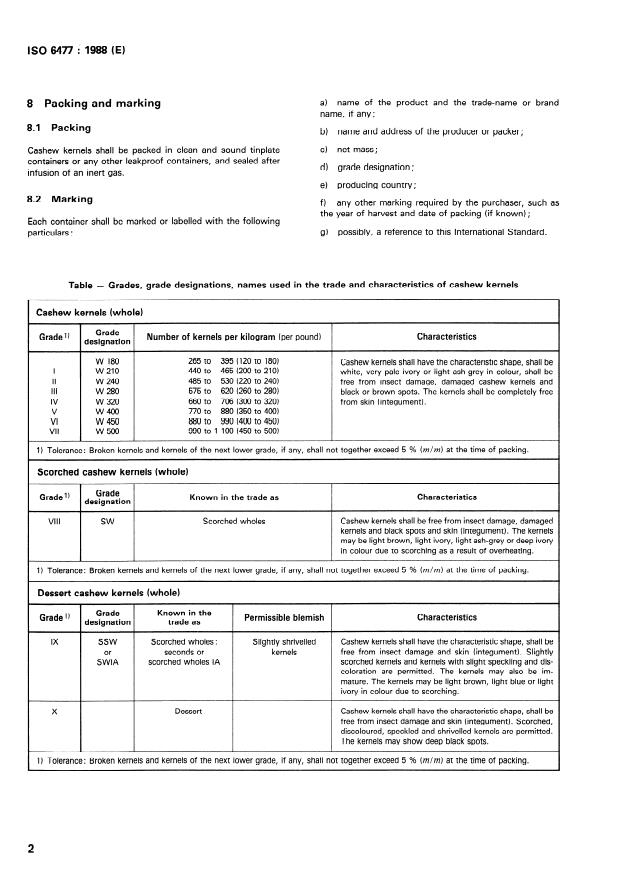
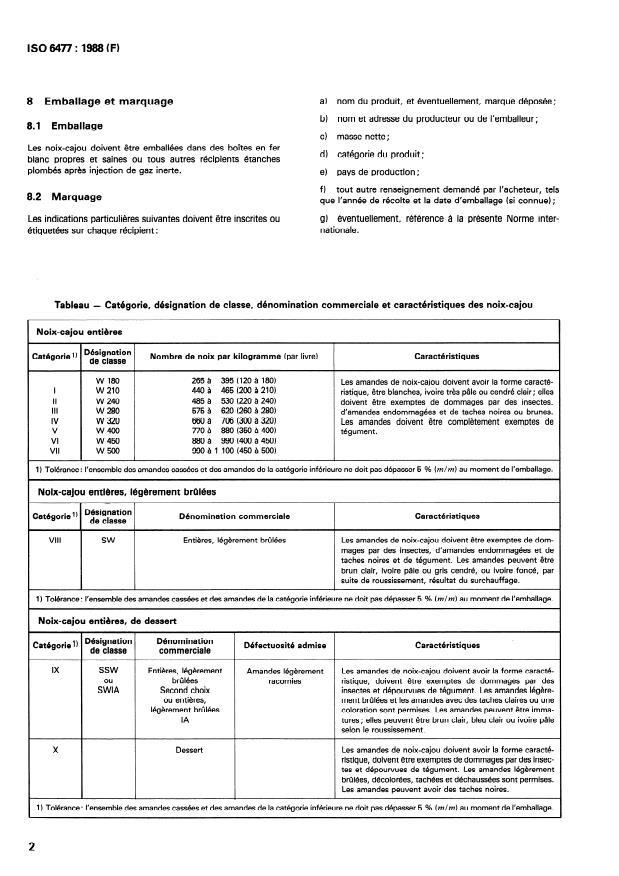
Specification of general requirements and of specific requirements, as moisture content, grading, sampling, methods of test, packing and marking. A table shois 24 grades kof the product, inclusive grade designations, names used in the trade and characteristics of cashew kernels.
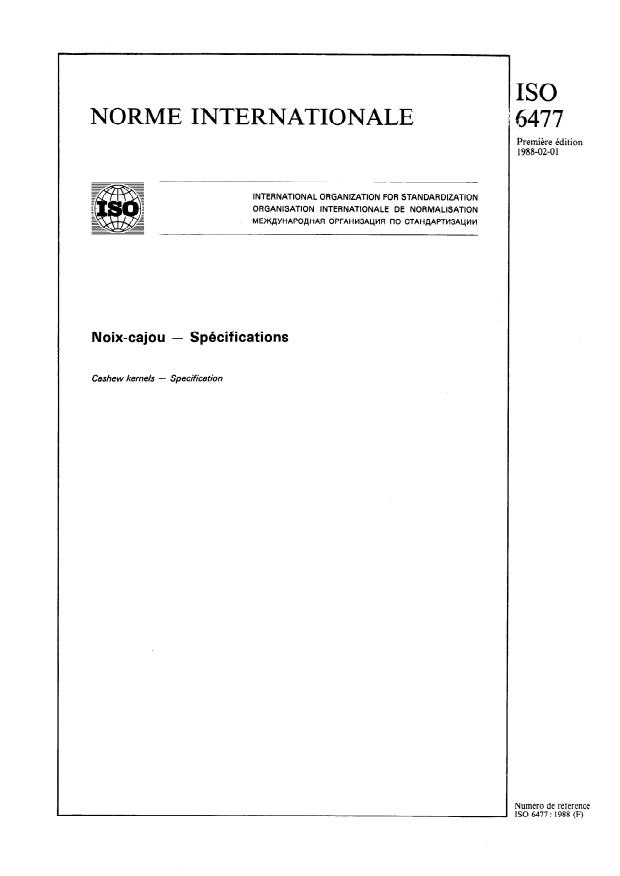
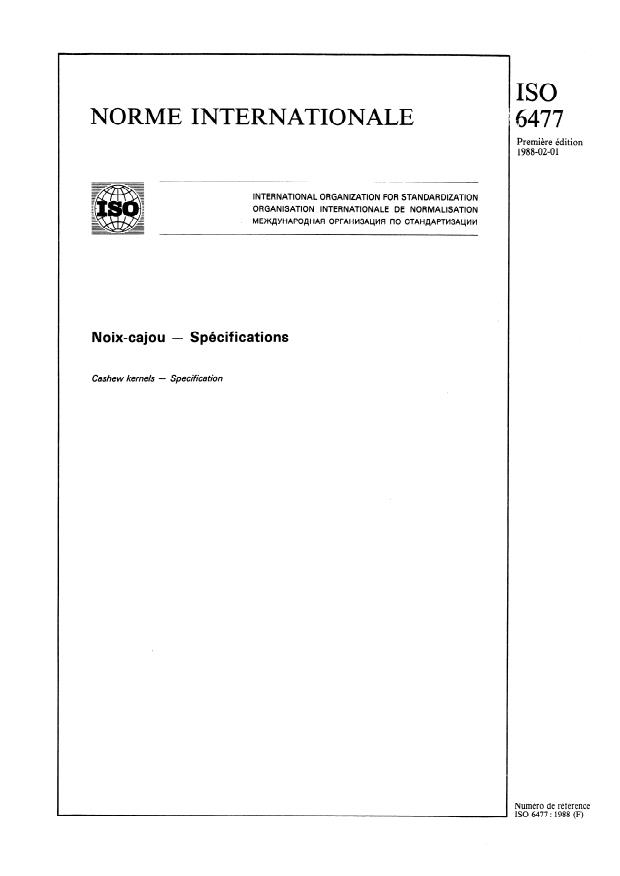
Noix-cajou — Spécifications
General Information
- Status
- Published
- Publication Date
- 03-Feb-1988
- Technical Committee
- ISO/TC 34/SC 3 - Fruits and vegetables and their derived products
- Drafting Committee
- ISO/TC 34/SC 3 - Fruits and vegetables and their derived products
- Current Stage
- 9093 - International Standard confirmed
- Start Date
- 26-Aug-2024
- Completion Date
- 12-Feb-2026
Overview
ISO 6477:1988 specifies quality and presentation requirements for cashew kernels intended for human consumption. Prepared by ISO/TC 34 (Agricultural food products), the standard covers general and specific requirements including moisture content, grading, sampling, methods of test, and packing and marking. A detailed table enumerates 24 grades with grade designations, trade names and characteristic criteria to support consistent international trade.
Key Topics
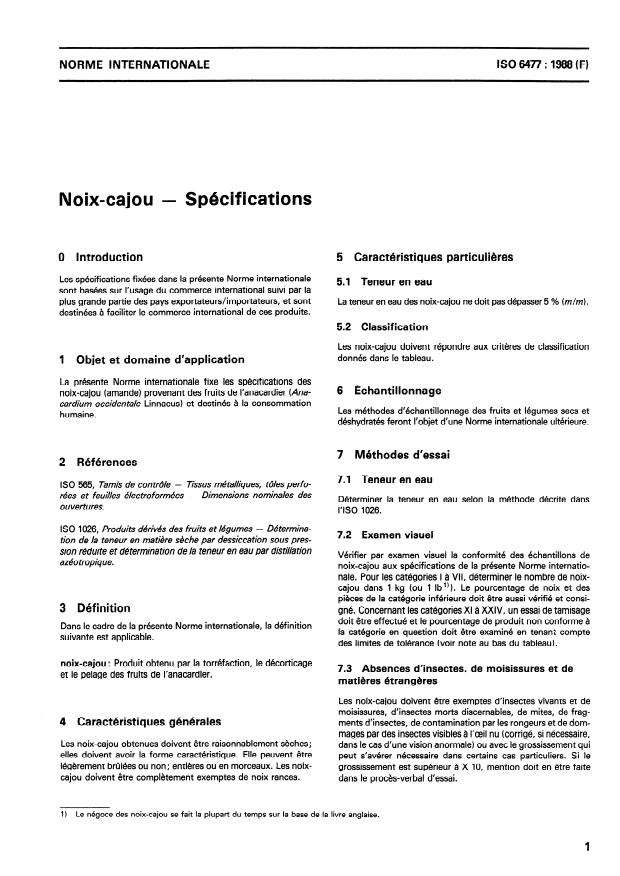
- Moisture content: The standard requires cashew kernels to have a moisture content not greater than 5% (m/m), determined by the oven-drying method specified in ISO 1026.
- Grading and classification: A comprehensive table classifies whole kernels, scorched kernels, dessert kernels and various piece categories. The grades include trade designations and characteristic limits used for commercial grading.
- Sampling and tests:
- Visual examination is used to assess conformity with grade requirements (counting kernels per kg for certain whole-kernel grades and noting pieces and next-lower-grade content).
- Sieving tests are specified for piece-size grades (referencing ISO 565 test sieves) where applicable.
- The standard notes that general methods of sampling for dry and dried fruit and vegetable products will be the subject of a future International Standard.
- Hygiene and defects: Kernels must be reasonably dry, free from rancidity, living insects and moulds, and free from discernible insect fragments and rodent contamination visible to the naked eye (or with stated magnification if used).
- Tolerances: Typical tolerances permit a small percentage of broken kernels and kernels of the next lower grade (commonly up to 5% at packing), with specific provisions noted in the grade table (some categories permit up to 10% where indicated).
- Packing and marking: Kernels shall be packed in clean, sound tinplate or other leakproof containers, sealed after infusion of an inert gas. Required markings include product name, producer/packer, net mass, grade designation, producing country and any purchaser-specific markings; a reference to this International Standard may also be included.
Applications
- Facilitates consistent international trade and commercial contracts for cashew kernels.
- Serves as a reference for exporters, importers, packers and quality-control laboratories assessing cashew kernel quality and conformity.
- Supports specification-writing for procurement, packaging, labeling and inspection procedures in the cashew supply chain.
Related Standards
- ISO 1026 - Determination of dry matter/water content by drying under reduced pressure (referenced for moisture testing).
- ISO 565 - Test sieves (referenced for piece-size classification).
For procurement teams and quality professionals, ISO 6477:1988 provides a practical framework to assess cashew kernel quality, apply consistent grading and ensure packaging and marking practices that support food safety and trade transparency.
Get Certified
Connect with accredited certification bodies for this standard

BSI Group
BSI (British Standards Institution) is the business standards company that helps organizations make excellence a habit.

Bureau Veritas
Bureau Veritas is a world leader in laboratory testing, inspection and certification services.

DNV
DNV is an independent assurance and risk management provider.
Sponsored listings
Frequently Asked Questions
ISO 6477:1988 is a standard published by the International Organization for Standardization (ISO). Its full title is "Cashew kernels — Specification". This standard covers: Specification of general requirements and of specific requirements, as moisture content, grading, sampling, methods of test, packing and marking. A table shois 24 grades kof the product, inclusive grade designations, names used in the trade and characteristics of cashew kernels.
Specification of general requirements and of specific requirements, as moisture content, grading, sampling, methods of test, packing and marking. A table shois 24 grades kof the product, inclusive grade designations, names used in the trade and characteristics of cashew kernels.
ISO 6477:1988 is classified under the following ICS (International Classification for Standards) categories: 67.080.10 - Fruits and derived products. The ICS classification helps identify the subject area and facilitates finding related standards.
ISO 6477:1988 is available in PDF format for immediate download after purchase. The document can be added to your cart and obtained through the secure checkout process. Digital delivery ensures instant access to the complete standard document.
Standards Content (Sample)
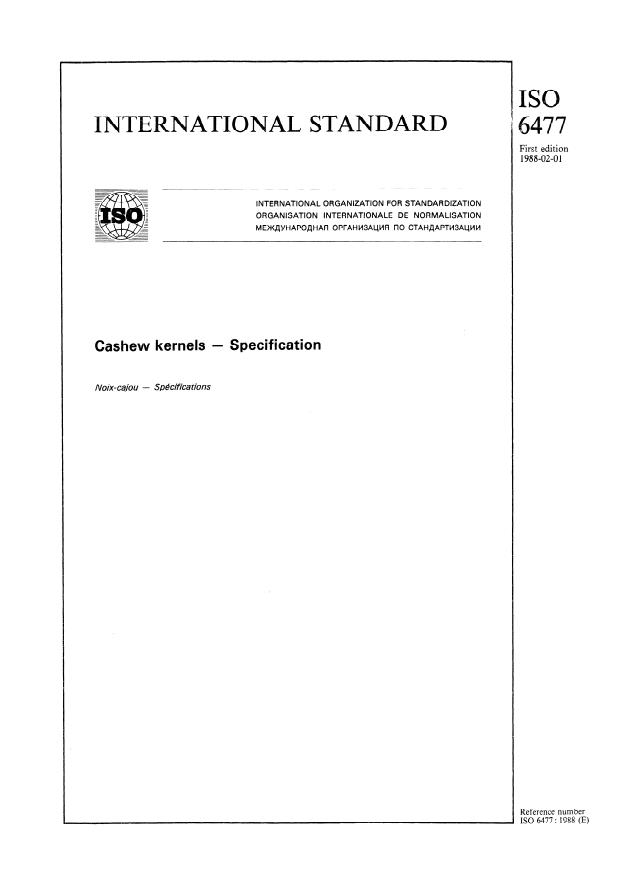
INTERNATIONAL STANDARD
First edition
1988-02-01
INTERNATIONAL ORGANIZATION FOR STANDARDIZATION
ORGANISATION INTERNATIONALE DE NORMALISATION
MEXflYHAPO,QHAFl OPl-AHM3A~Mfl l-IO CTAH~APTM3A~MM
Cashew keanels - Specification
Noix-cajou - Spbcifica tions
Reference nurnber
ISO 6477 : 1988 (E)
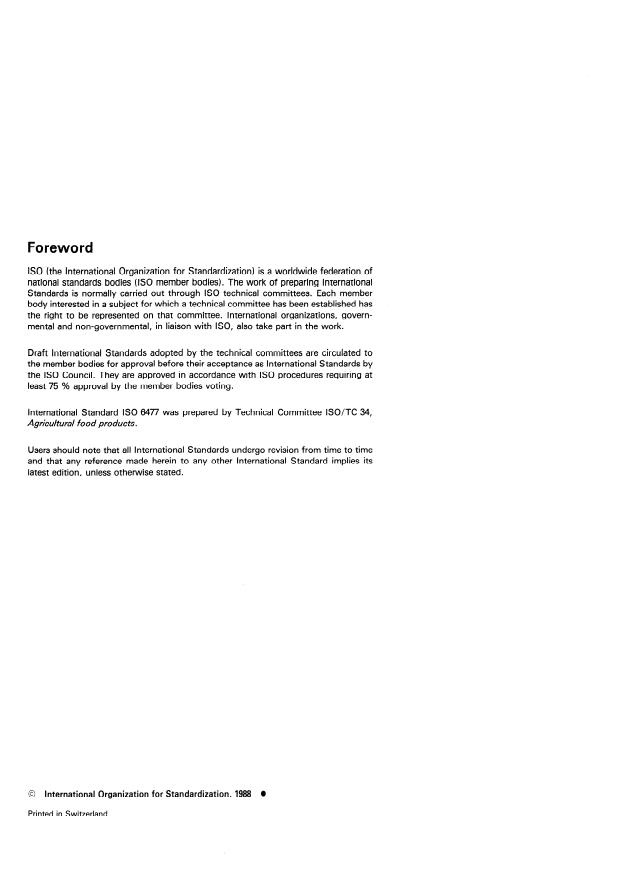
Foreword
ISO (the International Organization for Standardization) is a worldwide federation of
national Standards bodies (ISO member bedies). The work of preparing International
Standards is normally carried out through ISO technical committees. Esch member
body interested in a subject for which a technical committee has been established has
the right to be represented on that committee. International organizations, govern-
mental and non-governmental, in Iiaison with ISO, also take part in the work.
Draft International Standards adopted by the technical committees are circulated to
the member bodies for approval before their acceptance as International Standards by
the ISO Council. They are approved in accordance with ISO procedures requiring at
least 75 % approval by the member bodies voting.
International Standard ISO 6477 was prepared by Technical Committee ISO/TC 34,
Agricultural food products.
Users should note that all International Standards undergo revision from time to time
and that any reference made herein to any other International Standard implies its
latest edition, unless otherwise stated.
0 International Organkation for Standardkation, 1988 0
Printed in Switzerland
INTERNATIONAL STANDARD
Cashew kernels - Specification
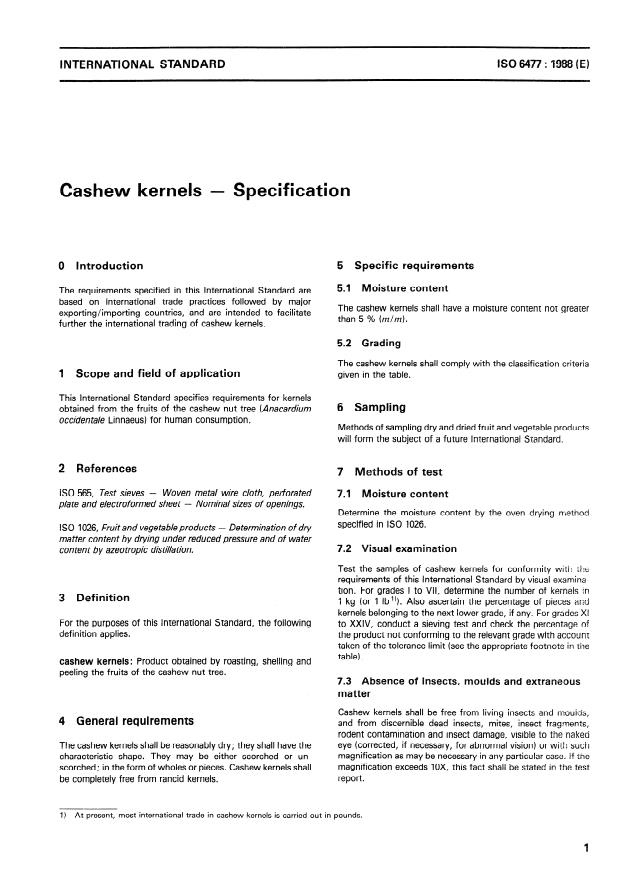
5 Specific requirements
0 lntroduction
5.1 Moisture content
The requirements specified in this International Standard are
based on international trade practices followed by major
The cashew kernels shall have a moisture content not greater
exporting/importing countries, and are intended to facilitate
than 5 % (mlm).
further the international trading sf cashew kernels.
5.2 Grading
The cashew kernels shall comply with the classification criteria
ll Scope and field of application given in the table.
This International Standard specifies requirements for kernels
6 Sampling
obtained from the fruits of the cashew nut tree (Anacardium
occidentale Linnaeus) for human consumption.
Methods of sampling dry and dried fruit and vegetable products
will form the subject sf a future International Standard.
2 References
7 Methods of test
Woven metal wire c/o th, perfora ted
ISO 565, Test sieves - 7.1 Moisture content
plate and electroformed sheet - Nominal sizes sf openings.
Determine the moisture content by the oven drying niethod
specified in ISO 1026.
ISO 1026, Fruit and vegetable products - Determination of dry
matter content by drying under reduced pressure and of water
7.2 V’isual examirmation
con ten t & y azeo tropic dis tih’a tion.
Test the samples of cashew kernels for conformity with ehe
requirements of this International Standard by visual examina-
tion. For grades I to VII, determine the number of kernels 9n
3 Definition
1 kg (or 1 Ib l)). Also ascertain the percentage of pieces and
kernels belonging to the next lower grade, if any. For grades XI
For the purposes of this International Standard, the following
to XXIY, conduct a sieving test and check the percentage sf
definition applies. the product not conforming to the relevant grade with account
taken of the tolerante limit (see the appropriate footnote in tfae
table).
cashew kernels: Product obtained by roasting, shelling and
peeling the fruits of the cashew nut tree.
7.3 Absence of insects, moulds and extraneous
matter
Cashew kernels shall be free from living insects and moulds,
4 General requirements
and from discernible dead insects, mites, insect fragments,
rodent contamination and insect darnage, visible to the naked
The cashew kernels shall be reasonably dry; they shall have the eye (corrected, if necessary, for abnormal Vision) or with such
magnification as may be necessary in any particular case. Bf tne
characteristic shape. They may be either scorched or un-
magnification exceeds lOX, this fact shall be stated in the test
scorched; in the form of wholes or pieces. Cashew kernels shall
report.
be completely free from rancid kernels.
1) At present, most international trade in cashew kernels is carried out in pounds.
Iso 6477 : 1988 (El
a) name of the product and the trade-name or brand
8 Packing and marking
name, if any;
8.1 Packing
b) name and address of the Producer or packer;
c) net mass;
Cashew kernels shall be packed in clean and Sound tinplate
Containers or any other leakproof Containers, and sealed after
d) grade designation ;
infusion of an inert gas.
e) producing country;
8.2 Marking
f) any other marking required by the purchaser, such as
the year of harvest and date of packing (if known);
Esch Container shall be marked or labelled with the foll
...
NORME INTERNATIONALE
Première édition
1988-02-01
INTERNATIQNAL ORGANIZATION FOR STANDARDIZATION
ORGANISATION INTERNATIONALE DE NORMALISATION
MEXAYHAPOflHAfl OPTAHM3A~MR Il0 CTAH~APTM3A!#Wl
Spécifications
Noix-cajou -
Cashew kernels - Specifica tion
Numéro de référence
ISO 6477 : 1988 (F)
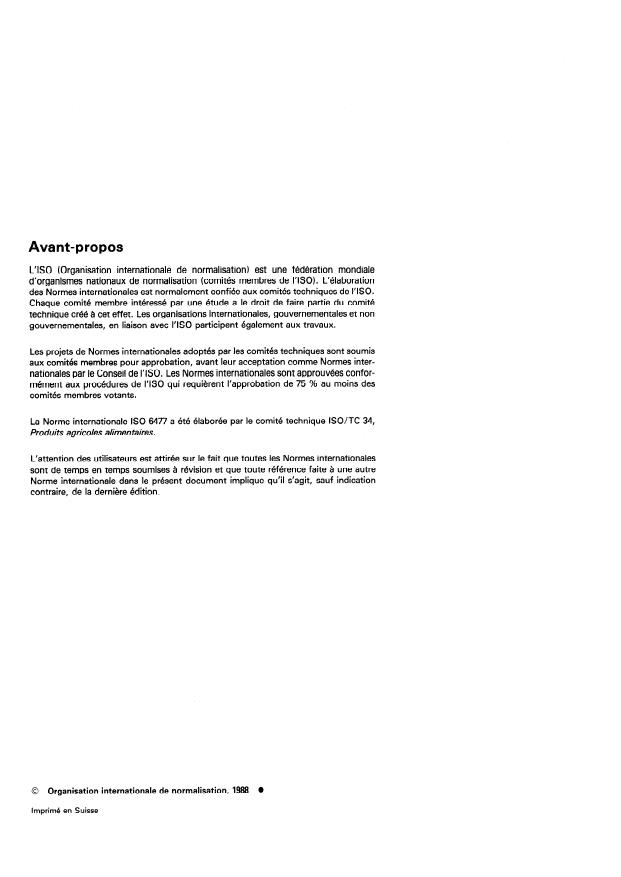
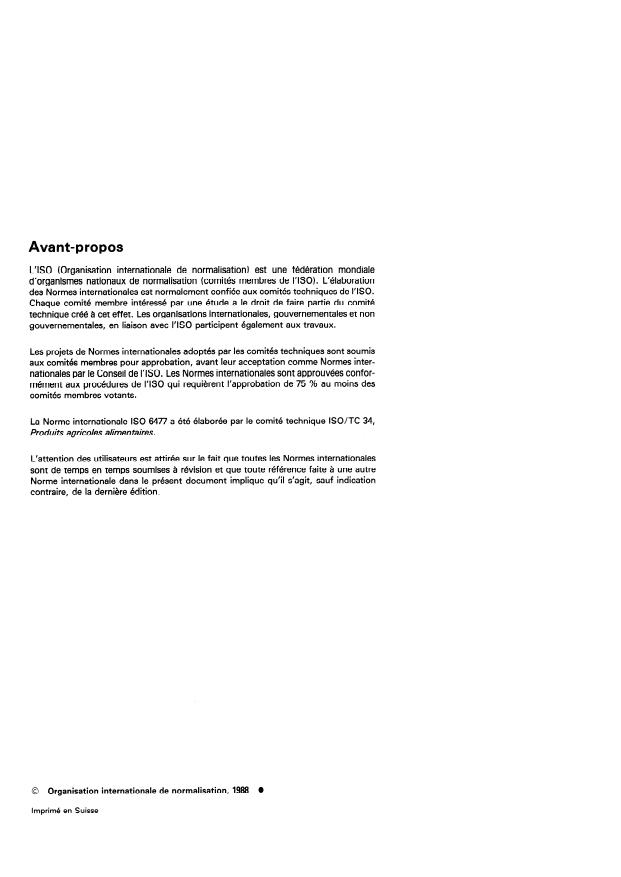
Avant-propos
L’ISO (Organisation internationale de normalisation) est une fédération mondiale
d’organismes nationaux de normalisation (comités membres de I’ISO). L’élaboration
des Normes internationales est normalement confiée aux comités techniques de I’ISO.
Chaque comite membre intéressé par une étude a le droit de faire partie du comité
technique créé à cet effet. Les organisations internationales, gouvernementales et non
gouvernementales, en liaison avec I’ISO participent également aux travaux.
Les projets de Normes internationales adoptés par les comités techniques sont soumis
aux comités membres pour approbation, avant leur acceptation comme Normes inter-
nationales par le Conseil de I’ISO. Les Normes internationales sont approuvées confor-
mément aux procédures de I’ISO qui requièrent l’approbation de 75 % au moins des
comités membres votants.
La Norme internationale ISO 6477 a été élaborée par le comité technique ISO/TC 34,
Produits agricoles alimentaires.
L’attention des utilisateurs est attirée sur le fait que toutes les Normes internationales
sont de temps en temps soumises a révision et que toute référence faite a une autre
Norme internationale dans le présent document implique qu’il s’agit, sauf indication
contraire, de la dernière édition.
0 Organisation internationale de normalisation, 1988
Imprimé en Suisse
ISO 6477 : 1988 (F)
NORME INTERNATIONALE
Noix-cajou - Spécifications
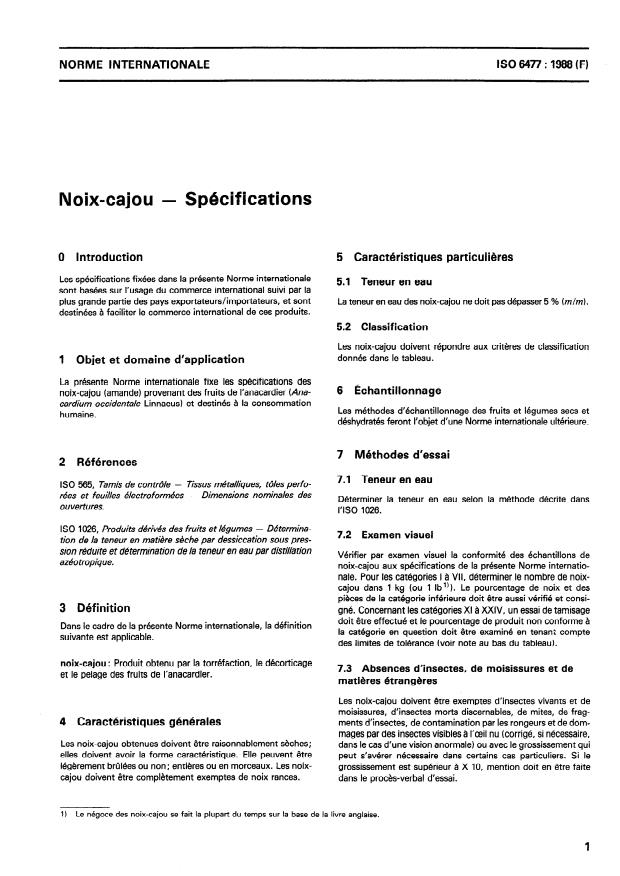
0 Introduction 5 Caractéristiques particulières
Les spécifications fixées dans la présente Norme internationale
5.1 Teneur en eau
sont basées sur l’usage du commerce international suivi par la
plus grande partie des pays exportateurs/importateurs, et sont La teneur en eau des noix-cajou ne doit pas dépasser 5 % (mlm).
destinées à faciliter le commerce international de ces produits.
5.2 Classification
Les noix-cajou doivent répondre aux critères de classification
donnés dans le tableau.
1 Objet et domaine d’application
La présente Norme internationale fixe les spécifications des
6 Échantillonnage
noix-cajou (amande) provenant des fruits de I’anacardier (Ana-
cardium occidentale Linnaeus) et destinés à la consommation
Les méthodes d’échantillonnage des fruits et légumes secs et
humaine.
déshydratés feront l’objet d’une Norme internationale ultérieure.
7 Méthodes d’essai
2 Références
7.1 Teneur en eau
Tissus métalliques, tôles petio-
ISO 565, Tamis de csntrfiie -
rées et feuilles éfectroformhes - Dimensions nominales des
Déterminer la teneur en eau selon la methode décrite dans
ouvertures.
I’ISO 1026.
ISO 1026, Produits déri& des fruits et Mgumes - Dhtermina-
7.2 Examen visuel
tion de la teneur en mati&re sèche par dessiccation sous pres-
sion rhduite et dé termina tion de la teneur en eau par distillation
Vérifier par examen visuel la conformité des échantillons de
azkotropique.
noix-cajou aux spécifications de la présente Norme internatio-
nale. Pour les catégories I à VII, déterminer le nombre de noix-
cajou dans 1 kg (ou 1 lb t) 1. Le pourcentage de noix et des
piéces de la catégorie inférieure doit être aussi vérifié et consi-
3 Définition
gné. Concernant les catégories Xl à XXIV, un essai de tamisage
doit être effectué et le pourcentage de produit non conforme à
Dans le cadre de la présente Norme internationale, la définition
la catégorie en question doit être examiné en tenant compte
suivante est applicable.
des limites de tolérance (voir note au bas du tableau).
noix-cajou : Produit obtenu par la torréfaction, le décorticage
7.3 Absences d’insectes, de moisissures et de
et le pelage des fruits de I’anacardier.
matières étrangères
Les noix-cajou doivent être exemptes d’insectes vivants et de
moisissures, d’insectes morts discernables, de mites, de frag-
4 Caractéristiques générales ments d’insectes, de contamination par les rongeurs et de dom-
mages par des insectes visibles à l’oeil nu (corrigé, si nécessaire,
Les noix-cajou obtenues doivent être raisonnablement séches;
dans le cas d’une vision anormale) ou avec le grossissement qui
elles doivent avoir la forme caractéristique. Elle peuvent être peut s’avérer nécessaire dans certains cas particuliers. Si le
Iégérement brûlées ou non; entieres ou en morceaux. Les noix-
grossissement est supérieur à X 10, mention doit en être faite
cajou doivent être complétement exemptes de noix rances. dans le proces-verbal d’essai.
1) Le négoce des noix-cajou se fait la plupart du temps sur la base de la livre anglaise.
ISO 6477 : 1988 (FI
a) nom du produit, et éventuellement, marque déposée;
8 Emballage et marquage
b) nom et adresse du producteur ou de l’emballeur;
8.1 Emballage
c) masse nette;
Les noix-cajou doivent être emballées dans des boîtes en fer
d) catégorie du produit;
blanc propres et saines ou tous autres récipients étanches
plombés après injection de gaz inerte.
e) pays de production;
f) tout autre renseignement demandé par l’acheteur, tels
8.2 Marquage
que l’année de récolte et la date d’emballage (si connue);
Les indications particulières suivantes doivent être inscrites ou g) éventuellement, référence à la présente Norme inter-
étiquetées sur chaque récipient: nationale.
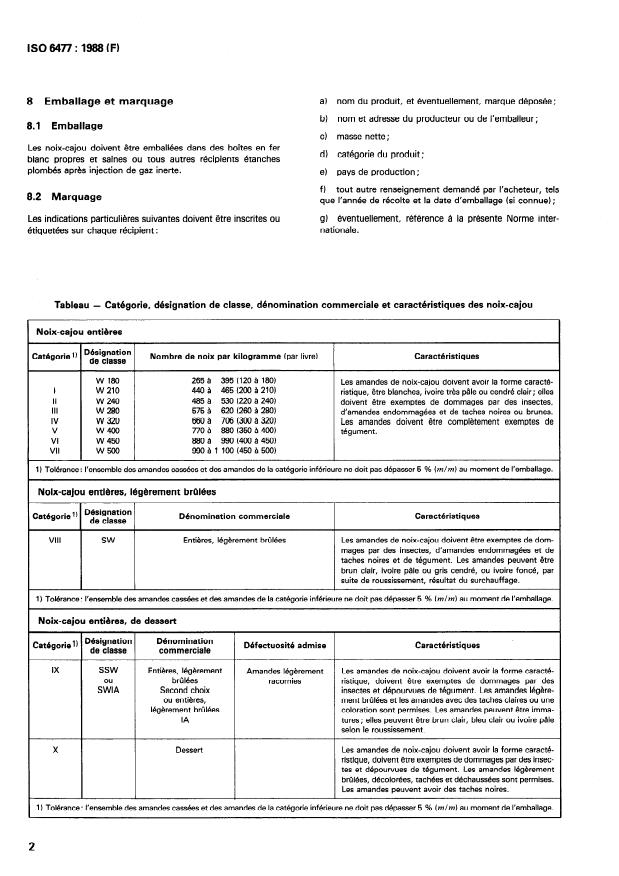
Tableau - Catbgorie, dhignation de classe, dhomination commerciale et caractéristiques des noix-cajou
Noix-cajou entieres
Dbsignation
Nombre de noix par kilogramme (par livre) Caractéristiques
Catdgorie 1)
de classe
w 180 265 à 395 (120 à 180)
Les amandes de noix-cajou doivent avoir la forme caracté-
I w 210 440 à 465 (200 à 210)
ristique, être blanches, ivoire très pâle ou cendré clair; elles
II w240 485 à 530 (220 à 240)
doivent être exemptes de dommages par des insectes,
w280 575 à 620 (260 à 280)
III d’amandes endommagées et de taches noires ou brunes.
IV W 320 660 à 706 (300 à 320)
Les amandes doivent être complètement exemptes de
770à 880(35Oà400)
V W400 tégument.
VI w450 880à 990MOOà450)
VII W500 99Oàl lOO(45Oà500
...
NORME INTERNATIONALE
Première édition
1988-02-01
INTERNATIQNAL ORGANIZATION FOR STANDARDIZATION
ORGANISATION INTERNATIONALE DE NORMALISATION
MEXAYHAPOflHAfl OPTAHM3A~MR Il0 CTAH~APTM3A!#Wl
Spécifications
Noix-cajou -
Cashew kernels - Specifica tion
Numéro de référence
ISO 6477 : 1988 (F)
Avant-propos
L’ISO (Organisation internationale de normalisation) est une fédération mondiale
d’organismes nationaux de normalisation (comités membres de I’ISO). L’élaboration
des Normes internationales est normalement confiée aux comités techniques de I’ISO.
Chaque comite membre intéressé par une étude a le droit de faire partie du comité
technique créé à cet effet. Les organisations internationales, gouvernementales et non
gouvernementales, en liaison avec I’ISO participent également aux travaux.
Les projets de Normes internationales adoptés par les comités techniques sont soumis
aux comités membres pour approbation, avant leur acceptation comme Normes inter-
nationales par le Conseil de I’ISO. Les Normes internationales sont approuvées confor-
mément aux procédures de I’ISO qui requièrent l’approbation de 75 % au moins des
comités membres votants.
La Norme internationale ISO 6477 a été élaborée par le comité technique ISO/TC 34,
Produits agricoles alimentaires.
L’attention des utilisateurs est attirée sur le fait que toutes les Normes internationales
sont de temps en temps soumises a révision et que toute référence faite a une autre
Norme internationale dans le présent document implique qu’il s’agit, sauf indication
contraire, de la dernière édition.
0 Organisation internationale de normalisation, 1988
Imprimé en Suisse
ISO 6477 : 1988 (F)
NORME INTERNATIONALE
Noix-cajou - Spécifications
0 Introduction 5 Caractéristiques particulières
Les spécifications fixées dans la présente Norme internationale
5.1 Teneur en eau
sont basées sur l’usage du commerce international suivi par la
plus grande partie des pays exportateurs/importateurs, et sont La teneur en eau des noix-cajou ne doit pas dépasser 5 % (mlm).
destinées à faciliter le commerce international de ces produits.
5.2 Classification
Les noix-cajou doivent répondre aux critères de classification
donnés dans le tableau.
1 Objet et domaine d’application
La présente Norme internationale fixe les spécifications des
6 Échantillonnage
noix-cajou (amande) provenant des fruits de I’anacardier (Ana-
cardium occidentale Linnaeus) et destinés à la consommation
Les méthodes d’échantillonnage des fruits et légumes secs et
humaine.
déshydratés feront l’objet d’une Norme internationale ultérieure.
7 Méthodes d’essai
2 Références
7.1 Teneur en eau
Tissus métalliques, tôles petio-
ISO 565, Tamis de csntrfiie -
rées et feuilles éfectroformhes - Dimensions nominales des
Déterminer la teneur en eau selon la methode décrite dans
ouvertures.
I’ISO 1026.
ISO 1026, Produits déri& des fruits et Mgumes - Dhtermina-
7.2 Examen visuel
tion de la teneur en mati&re sèche par dessiccation sous pres-
sion rhduite et dé termina tion de la teneur en eau par distillation
Vérifier par examen visuel la conformité des échantillons de
azkotropique.
noix-cajou aux spécifications de la présente Norme internatio-
nale. Pour les catégories I à VII, déterminer le nombre de noix-
cajou dans 1 kg (ou 1 lb t) 1. Le pourcentage de noix et des
piéces de la catégorie inférieure doit être aussi vérifié et consi-
3 Définition
gné. Concernant les catégories Xl à XXIV, un essai de tamisage
doit être effectué et le pourcentage de produit non conforme à
Dans le cadre de la présente Norme internationale, la définition
la catégorie en question doit être examiné en tenant compte
suivante est applicable.
des limites de tolérance (voir note au bas du tableau).
noix-cajou : Produit obtenu par la torréfaction, le décorticage
7.3 Absences d’insectes, de moisissures et de
et le pelage des fruits de I’anacardier.
matières étrangères
Les noix-cajou doivent être exemptes d’insectes vivants et de
moisissures, d’insectes morts discernables, de mites, de frag-
4 Caractéristiques générales ments d’insectes, de contamination par les rongeurs et de dom-
mages par des insectes visibles à l’oeil nu (corrigé, si nécessaire,
Les noix-cajou obtenues doivent être raisonnablement séches;
dans le cas d’une vision anormale) ou avec le grossissement qui
elles doivent avoir la forme caractéristique. Elle peuvent être peut s’avérer nécessaire dans certains cas particuliers. Si le
Iégérement brûlées ou non; entieres ou en morceaux. Les noix-
grossissement est supérieur à X 10, mention doit en être faite
cajou doivent être complétement exemptes de noix rances. dans le proces-verbal d’essai.
1) Le négoce des noix-cajou se fait la plupart du temps sur la base de la livre anglaise.
ISO 6477 : 1988 (FI
a) nom du produit, et éventuellement, marque déposée;
8 Emballage et marquage
b) nom et adresse du producteur ou de l’emballeur;
8.1 Emballage
c) masse nette;
Les noix-cajou doivent être emballées dans des boîtes en fer
d) catégorie du produit;
blanc propres et saines ou tous autres récipients étanches
plombés après injection de gaz inerte.
e) pays de production;
f) tout autre renseignement demandé par l’acheteur, tels
8.2 Marquage
que l’année de récolte et la date d’emballage (si connue);
Les indications particulières suivantes doivent être inscrites ou g) éventuellement, référence à la présente Norme inter-
étiquetées sur chaque récipient: nationale.
Tableau - Catbgorie, dhignation de classe, dhomination commerciale et caractéristiques des noix-cajou
Noix-cajou entieres
Dbsignation
Nombre de noix par kilogramme (par livre) Caractéristiques
Catdgorie 1)
de classe
w 180 265 à 395 (120 à 180)
Les amandes de noix-cajou doivent avoir la forme caracté-
I w 210 440 à 465 (200 à 210)
ristique, être blanches, ivoire très pâle ou cendré clair; elles
II w240 485 à 530 (220 à 240)
doivent être exemptes de dommages par des insectes,
w280 575 à 620 (260 à 280)
III d’amandes endommagées et de taches noires ou brunes.
IV W 320 660 à 706 (300 à 320)
Les amandes doivent être complètement exemptes de
770à 880(35Oà400)
V W400 tégument.
VI w450 880à 990MOOà450)
VII W500 99Oàl lOO(45Oà500
...
Questions, Comments and Discussion
Ask us and Technical Secretary will try to provide an answer. You can facilitate discussion about the standard in here.
Loading comments...