

ISO/TR 22251-2:2026
(Main)Packaging — Measurement results for the use of RFID on returnable transport items — Part 2: Plastic returnable transport items
- Abstract
This document summarizes measurement results for the use of RFID on plastic returnable transport items (RTIs). This document describes the followings: materials of plastic RTIs, features, reliability of RFID used for plastic RTIs, and measurement results for the use of RFID on plastic RTIs.
- Status
- Published
- Publication Date
- 01-Sep-2026
- Technical Committee
- ISO/TC 122 - Packaging
- Drafting Committee
- ISO/TC 122/WG 12 - Supply chain applications of logistics technology
- Current Stage
- 6060 - International Standard published
- Start Date
- 02-Sep-2026
- Due Date
- 18-Feb-2028
- Completion Date
- 02-Sep-2026


ISO/TR 22251-2:2026 is an ISO technical report on the use of RFID on plastic returnable transport items (RTIs). It summarizes measurement results for RF tags attached to plastic RTIs and explains the materials, reliability concerns, and test outcomes relevant to supply chain and automotive use. It is written for people who need to judge whether RFID tags will survive repeated handling, storage, washing, and environmental stress on reusable plastic transport items.
What does ISO/TR 22251-2:2026 specify?
ISO/TR 22251-2:2026 specifies the scope of the measurement results covered in the report and the structure used to present them. Clause 1 limits the subject to plastic RTIs, Clause 2 lists the vocabulary references used in the text, Clause 3 defines the terms and abbreviations used, and Clause 4 presents the characteristics and evaluation results for RFID on plastic RTIs.
The report is organized around the practical question of how RF tags behave when they are attached to reusable plastic transport items made mainly from PE or PP. Annex A gives examples of plastic RTIs used in supply chains, Annex B describes the evaluation tests and methods, and Annex C shows how communication characteristics changed after selected tests.
| Annex | What it covers |
|---|---|
| Annex A | Examples of plastic RTIs for supply chain use |
| Annex B | Evaluation tests, sample preparation, equipment, and results |
| Annex C | Changes in communication characteristics after testing |
What are the key requirements of ISO/TR 22251-2:2026?
ISO/TR 22251-2:2026 is a technical report, so its main value is the documented test approach and the observed behavior of RF tags rather than a prescriptive product specification. Clause 4 and Annex B show what was tested, how the tags were mounted, which stresses were applied, and what kinds of failures or changes were seen in practice.
- Clause 4 explains why plastic RTIs need RF tags that stay readable under repeated logistics use. It notes vibration, impact, rough handling, temperature change, chemical exposure, and washing as the main stresses. In practice, this tells a buyer or engineer what the tag must tolerate during transport and cleaning.
- Clause 4.2.1 reports that seven commercially available RF tags were attached to plastic RTI materials and subjected to 14 tests. That gives a realistic cross-check between tag construction and actual use conditions. It matters because tag choice should be based on performance under stress, not just nominal product data.
- Clause 4.2.2 identifies the main RTI materials as PE and PP and links them to different use cases. PP is presented as the common choice, while PE is associated with better low-temperature shock resistance. This matters when selecting a tag for cold-chain, automotive, or general distribution use.
- Annex B explains how the samples were prepared, including cleaning, tag placement, roller attachment, and the use of PE and PP boards or RTIs. It also gives the sample counts used in each test group. In practice, this shows that the reported results depend on a defined attachment method and test setup.
- Annex B uses visual inspection, handheld readers, and communication-characteristics measurement to judge tag condition. The report looks at external damage, data retention, and whether the tag can still communicate. That matters because a tag can look acceptable but still fail to read reliably.
- Annex B measures communication characteristics as sensitivity in the 800 to 1 000 MHz band and compares results before and after testing. This is useful when a project needs more than pass or fail and must understand how much read margin remains after aging or stress.
- The main results show that some label constructions are vulnerable to water, chemicals, heat, humidity, UV exposure, electrostatic discharge, and washing. Coated-paper surface layers were especially prone to permeation, peeling, yellowing, or powdering, while some tags also showed data loss or communication drift. For a user, this points to the need to match the tag face material and adhesive system to the actual environment.
- Annex C collects the communication-characteristics changes seen after the heat cycle, high-temperature exposure, and high-temperature/high-humidity tests. This helps readers compare performance before and after environmental loading, not just whether the tag still answered a reader.
What terms does ISO/TR 22251-2:2026 define?
- Serial number (SN) - A code, such as a sequential number, used to make each item unique; the note says the issuing agency can control the structure.
- RFID - Radio-frequency identification, the contactless identification technology used here for tracking reusable transport items.
- RTI - Returnable transport item, a reusable item such as a container, pallet, folding container, or dunnage used in logistics.
- PE - Polyethylene, a plastic material used for some RTIs, especially where low-temperature shock resistance is useful.
- PP - Polypropylene, a common RTI plastic noted for low cost, light weight, rigidity, moldability, and heat resistance.
- RSSI - Received signal strength indicator, a signal-strength measure used when comparing communication performance.
- ETSI - European Telecommunications Standards Institute, named in the abbreviation list as a standards body relevant to radio systems.
- FCC - Federal Communications Commission, named in the abbreviation list as a regulatory body relevant to radio systems.
Who uses ISO/TR 22251-2:2026?
ISO/TR 22251-2:2026 is used by packaging engineers, RFID specialists, RTI designers, and quality teams that specify or test reusable plastic transport items. It is also useful to buyers and suppliers in the automotive and distribution industries, where reusable containers and pallets are handled repeatedly and often washed.
Test laboratories can use the report as a basis for durability and communication checks on RF tags attached to PE or PP RTIs. Logistics and traceability teams can use it when deciding whether a tag design is suitable for long-term asset tracking, repeated handling, and exposure to environmental stress.
Which standards are used with ISO/TR 22251-2:2026?
| Standard | What it contributes |
|---|---|
| ISO/IEC 19762 | Vocabulary for automatic identification and data capture (AIDC) terms |
| ISO 445 | Vocabulary for pallets for materials handling |
| ISO 21067 (all parts) | Packaging vocabulary used for the document terminology |
| IEC 60068-2-2 | Dry heat testing reference used for high-temperature exposure |
| IEC 61000-4-2 | Electrostatic discharge immunity test reference |
| ISO 9227 | Salt spray test reference used for corrosion exposure |
| ISO 2248 | Vertical impact test by dropping, used for corner-drop testing |
| ISO 13355 | Vertical random vibration test reference |
| ISO 8318 | Sinusoidal vibration test reference with variable frequency |
| JIS W0812 | Reference used for the decompression test |
| ISO/IEC 18000-63 | UHF RFID air-interface parameters, relevant to the 800 to 1 000 MHz measurements |
| ISO/IEC 17360 | RFID supply-chain application context for tagging transport units |
What does the ISO/TR 22251-2:2026 document contain?
ISO/TR 22251-2:2026 contains an overview of plastic RTIs used in supply chains, followed by a detailed test program for RF tags attached to PE and PP materials. Annex B includes the test methods, sample preparation steps, measuring equipment, environmental conditions, and result tables for water immersion, chemicals, temperature, humidity, UV, pressure change, salt spray, electrostatic discharge, impact, vibration, and washing.
The annex also includes figures showing how the tags were attached and how each test was set up. Annex C adds before-and-after graphs for communication characteristics where changes were observed, which is useful for design review, qualification, and troubleshooting.
Get Certified
Connect with accredited certification bodies for this standard

BSI Group
BSI (British Standards Institution) is the business standards company that helps organizations make excellence a habit.

BRCGS (Brand Reputation Compliance Global Standards)
Global food safety and quality standards owner.

NYCE
Mexican standards and certification body.
Sponsored listings
Frequently Asked Questions
ISO/TR 22251-2:2026 is a technical report published by the International Organization for Standardization (ISO). Its full title is "Packaging — Measurement results for the use of RFID on returnable transport items — Part 2: Plastic returnable transport items". This standard covers: This document summarizes measurement results for the use of RFID on plastic returnable transport items (RTIs). This document describes the followings: materials of plastic RTIs, features, reliability of RFID used for plastic RTIs, and measurement results for the use of RFID on plastic RTIs.
This document summarizes measurement results for the use of RFID on plastic returnable transport items (RTIs). This document describes the followings: materials of plastic RTIs, features, reliability of RFID used for plastic RTIs, and measurement results for the use of RFID on plastic RTIs.
ISO/TR 22251-2:2026 is classified under the following ICS (International Classification for Standards) categories: 35.040.50 - Automatic identification and data capture techniques; 55.020 - Packaging and distribution of goods in general. The ICS classification helps identify the subject area and facilitates finding related standards.
ISO/TR 22251-2:2026 is available in PDF format for immediate download after purchase. The document can be added to your cart and obtained through the secure checkout process. Digital delivery ensures instant access to the complete standard document.
Standards Content (Sample)
Technical
Report
ISO/TR 22251-2
First edition
Packaging — Measurement results
2026-09
for the use of RFID on returnable
transport items —
Part 2:
Plastic returnable transport items
Emballages — Résultats de mesure pour l'utilisation d'étiquettes
RFID sur les emballages de transport réutilisables —
Partie 2: Emballages de transport réutilisables en plastique
Reference number
© ISO 2026
All rights reserved. Unless otherwise specified, or required in the context of its implementation, no part of this publication may
be reproduced or utilized otherwise in any form or by any means, electronic or mechanical, including photocopying, or posting on
the internet or an intranet, without prior written permission. Permission can be requested from either ISO at the address below
or ISO’s member body in the country of the requester.
ISO copyright office
CP 401 • Ch. de Blandonnet 8
CH-1214 Vernier, Geneva
Phone: +41 22 749 01 11
Email: copyright@iso.org
Website: www.iso.org
Published in Switzerland
ii
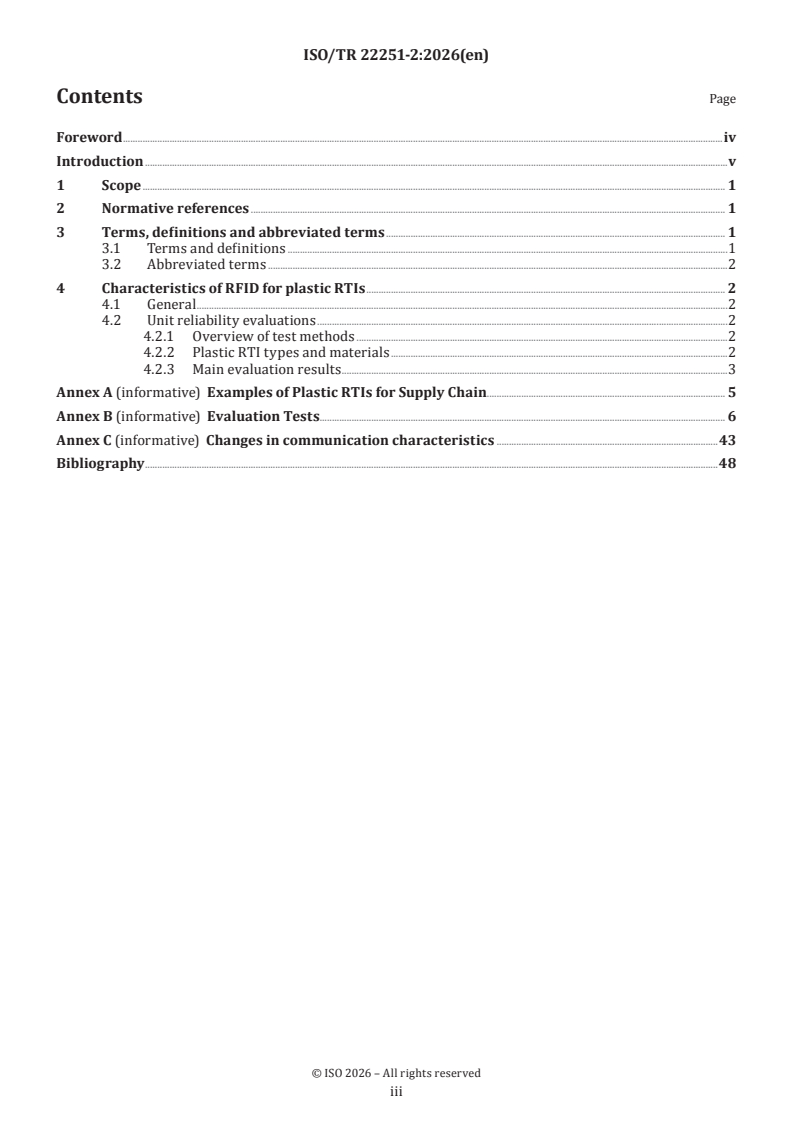
Contents Page
Foreword .iv
Introduction .v
1 Scope . 1
2 Normative references . 1
3 Terms, definitions and abbreviated terms . 1
3.1 Terms and definitions .1
3.2 Abbreviated terms .2
4 Characteristics of RFID for plastic RTIs . 2
4.1 General .2
4.2 Unit reliability evaluations .2
4.2.1 Overview of test methods .2
4.2.2 Plastic RTI types and materials .2
4.2.3 Main evaluation results .3
Annex A (informative) Examples of Plastic RTIs for Supply Chain. 5
Annex B (informative) Evaluation Tests. 6
Annex C (informative) Changes in communication characteristics .43
Bibliography .48
iii
Foreword
ISO (the International Organization for Standardization) is a worldwide federation of national standards
bodies (ISO member bodies). The work of preparing International Standards is normally carried out through
ISO technical committees. Each member body interested in a subject for which a technical committee
has been established has the right to be represented on that committee. International organizations,
governmental and non-governmental, in liaison with ISO, also take part in the work. ISO collaborates closely
with the International Electrotechnical Commission (IEC) on all matters of electrotechnical standardization.
The procedures used to develop this document and those intended for its further maintenance are described
in the ISO/IEC Directives, Part 1. In particular, the different approval criteria needed for the different types
of ISO document should be noted. This document was drafted in accordance with the editorial rules of the
ISO/IEC Directives, Part 2 (see www.iso.org/directives).
ISO draws attention to the possibility that the implementation of this document may involve the use of (a)
patent(s). ISO takes no position concerning the evidence, validity or applicability of any claimed patent
rights in respect thereof. As of the date of publication of this document, ISO had not received notice of (a)
patent(s) which may be required to implement this document. However, implementers are cautioned that
this may not represent the latest information, which may be obtained from the patent database available at
www.iso.org/patents. ISO shall not be held responsible for identifying any or all such patent rights.
Any trade name used in this document is information given for the convenience of users and does not
constitute an endorsement.
For an explanation of the voluntary nature of standards, the meaning of ISO specific terms and expressions
related to conformity assessment, as well as information about ISO's adherence to the World Trade
Organization (WTO) principles in the Technical Barriers to Trade (TBT), see www.iso.org/iso/foreword.html.
This document was prepared by Technical Committee ISO/TC 122, Packaging.
A list of all parts in the ISO 22251 series can be found on the ISO website.
Any feedback or questions on this document should be directed to the user’s national standards body. A
complete listing of these bodies can be found at www.iso.org/members.html.
iv
Introduction
The demand for more advanced traceability and reduction in both distribution costs and logistics materials
has recently increased in supply chains worldwide, and the use of radio-frequency identification (RFID) in
supply chains is regarded as an ideal solution. In actual logistics and material handling, many materials
and items are lost or go missing due to the lack of an efficient returnable transport item (RTI) management
system, imposing extra costs on companies and enterprises due to additional ordering.
Today, there is strong demand for efficient plastic RTI management especially in the automobile industry
where many parts and components are designed exclusively for automotive use. Plastic RTIs are used to
store and transport a variety of stored items. In this document, the measurement results of evaluations of RF
tag on RTIs for the transport of automotive parts are presented. The results show the changes in durability
and communication performance of RF tags attached to plastic RTIs when exposed to various environmental
stresses. The results provide insight into the durability of RF tags in various RTI environments and will be
useful in many situations where RF tags are attached to plastic RTIs.
v
Technical Report ISO/TR 22251-2:2026(en)
Packaging — Measurement results for the use of RFID on
returnable transport items —
Part 2:
Plastic returnable transport items
1 Scope
This document summarizes measurement results for the use of RFID on plastic returnable transport items
(RTIs).
This document describes the followings:
— materials of plastic RTIs,
— features, reliability of RFID used for plastic RTIs, and
— measurement results for the use of RFID on plastic RTIs.
2 Normative references
The following documents are referred to in the text in such a way that some or all of their content constitutes
requirements of this document. For dated references, only the edition cited applies. For undated references,
the latest edition of the referenced document (including any amendments) applies.
ISO/IEC 19762, Information technology — Automatic identification and data capture (AIDC) techniques —
Vocabulary
ISO 445, Pallets for materials handling — Vocabulary
ISO 21067 (all parts), Packaging — Vocabulary
3 Terms, definitions and abbreviated terms
3.1 Terms and definitions
For the purposes of this document, the terms and definitions given in ISO/IEC 19762, ISO 445, the ISO 21067
series and the following apply.
ISO and IEC maintain terminology databases for use in standardization at the following addresses:
— ISO Online browsing platform: available at https:// www .iso .org/ obp
— IEC Electropedia: available at https:// www .electropedia .org/
3.1.1
serial number
SN
codes, such as sequential numbers, used for uniqueness
Note 1 to entry: The structure of the serial number can be decided by the company that is under the control of the
issuing agency. This is normally composed of an item number and its production number (serial number).
3.2 Abbreviated terms
ETSI European Telecommunications Standards Institute
FCC Federal Communications Commission
PE polyethylene
PP polypropylene
RSSI received signal strength indicator
SUS stainless steel
4 Characteristics of RFID for plastic RTIs
4.1 General
When RF tags are attached to inexpensive plastic RTIs used for various purposes and RFID is used for
operation management, the following points are considered.
— First, RF tags attached to inexpensive plastic RTIs also need to be low cost, but inexpensive RF tags
marketed for general use are generally manufactured for use in the distribution industry, so it is unclear
whether they are reliable enough for long-term use when attached to plastic RTIs. For example, price tag
labels are attached to RF tags used in the distribution industry, but because they are used in one-way
disposable applications, the conditions for attaching them are very different from plastic RTIs for returnable
applications.
— Also, since plastic RTIs are generally transported using conveyor belts and forklifts, RF tags
are subject to various forms of physical stress, such as vibration, impact, rough handling of plastic RTIs
by operators, and shrinkage of plastic material due to temperature changes. In addition, they are also
exposed to chemical stresses from chemicals and plastic RTI washing. However, few evaluations have been
performed to assess the extent to which commercially available RF tags attached to RTIs are affected by
stresses attached to plastic RTIs during transport and washing.
— As used RF tags are generally incinerated or dissolved, the safety of written data is not considered.
In addition, for example, as the data of RF tags used in the automobile industry is common data based on ISO
standards, there is no problem even if the data is leaked. However, if security information other than ISO
standards is written, it is desirable to destroy used RF tags and IC chips so that the information cannot be
read, and to incinerate or dissolve them.
4.2 Unit reliability evaluations
4.2.1 Overview of test methods
RF tags attached to plastic RTIs are subject to physical stresses such as vibrations, shocks, rough handling
of plastic RTIs, temperature changes, and chemical stresses due to chemicals and washing during parts
transport.
Therefore, 7 kinds of commercially available RF tags were attached to the materials used for plastic RTI, and
14 kinds of tests (see Table 1 " Summary of main results ") were conducted under the assumed conditions to
evaluate the physical and the performance changes of the RF tags after the tests.
4.2.2 Plastic RTI types and materials
Plastic RTI includes special types such as containers, pallets, folding containers, and dunnages, but the
materials themselves are broadly divided into PE and PP materials. (See Annex A Examples of Plastic RTIs
for Supply Chain)
The majority of plastic RTIs used in various applications are made of PP, but some are made of PE. PE has
better shock resistance at low temperatures than PP and is used in low-temperature environments such as
the fishing industry and food industry. However, because of its low cost, light weight, rigidity, moldability
and heat resistance, PP is the plastic material of choice except for special applications such as refrigerated
warehouses.
— PP consists of homopolymers with high rigidity and high heat-resistance, random copolymers with high
transparency and high flexibility, and block copolymers with high shock-resistance, and is mainly used
for plastic returnable containers.
— PE is available in low-density, medium-density and high-density types. The high-density type is mainly
used for plastic returnable containers.
Plastic RTIs include antistatic RTIs used for storing and transporting electronic components sensitive to
static electricity; however, they are generally used less frequently and have fewer applications than general-
purpose plastic RTIs, as such, they were not evaluated here. Further, the influence of the dielectric constant
on the reading of the RF tag when the RF tag is attached to the plastic is not as serious as when the RF tag is
attached to the metal, hence, it is not an issue. Since plastic RTIs can be used for many years, we evaluated
how RF tags attached to such materials aged.
4.2.3 Main evaluation results
Table 1 shows the evaluation results of the general-purpose RF tags attached to plastic RTIs and plastic
boards. For more information on evaluation RF tag samples, evaluation methods, and results, see Annex B
and Annex C.
Table 1 — Summary of main results
Reference Measurement
Test item Results Refer to
standard conditions
— Depending on the RF tag material,
the RF tag material could become
Water immersion IPX8 or equiv- Immersed at
1 transparent due to penetration of Annex B.10
test alent 1,2 m for 1 hr.
water, or RF tags attached to PP boards
could fail to communicate.
— Depending on the RF tag material, some
Chemical resist- Immersed for
2 ― RF tag materials became transparent Annex B.11
ance test 2 hrs.
due to penetration of chemicals.
— No problems were observed in terms
Low-temperature of external appearance or physical
3 ― -40 °C for 24 hrs. Annex B.12
storage test changes, or in terms of print or
communication characteristics.
Cycled between — Warping occurred in the case of
-40 °C and 100 °C both PP and PE boards, with RF
4 Heat cycle test ― in 20 min. reten- tags attached to PE boards showing Annex B.13
tion intervals for numerous instances of rising. These
200 cycles are assumed to have affected both the
IC and conductive adhesive, as well as
the RF tag substrate material, resulting
in communication performance
IEC
High-temperature 100 °C for
degradation.
5 Annex B.14
storage test 1 752 hrs.
60068-2-2
— Partial peeling or delamination of RF
tags also occurred in many cases.
TTabablele 1 1 ((ccoonnttiinnueuedd))
Reference Measurement
Test item Results Refer to
standard conditions
— The PP board warped more than the
PE board, and the RF tags attached to
the PE board showed numerous partial
High-temperature/
peelings.
85 °C at 85 % for
high-humidity
6 ― Annex B.15
312 hrs.
— Although some RF tags showed altered
storage test
communication characteristics
(waveform/strength), no
communication affects were observed.
— Although UV irradiation showed
no effects on communication
performance, printing on the surfaces
of all RF tags showed deterioration
Light resistance UV-only irradia-
7 ― Annex B.16
(embrittlement).
test tion for 72 hrs.
— Fine cracks, etc., were observed in PP
board materials and can be presumed
to induce RF tag peeling.
Decompression
from 75,26 Kpa — No problems observed in terms of
Decompression to 23,84 Kpa external appearance or physical
8 ― Annex B.17
test in 15 sec. and changes, or in terms of print or
retained for communication characteristics.
10 min.
Sprayed with
— Partial peeling was observed on some
9 Salt-spray test ISO 9227 35 °C saltwater Annex B.18
of the RF tags.
for 6 hrs.
Three cycles of
Electrostatic dis-
IEC
150 pF/330 Ω — Some RF tags showed a loss of encoded
10 charge immunity Annex B.19
(150/2 kΩ) and data.
61000-4-2
test
±6 to 25 KV
Dropped once
Impact test
11 ISO 2248 from a height of Annex B.20
(corner drop)
28 cm
— No RF tags showed communication
Impact test Random vibra-
performance degradation or peeling
12 (horizontal ― tion at 5,8 m/s Annex B.21
as a result of physical stress exerted in
shock) for 3 h
the form of vibrations or impacts, etc.,
Each side sub-
attached to the plastic RTIs.
ISO 13355
jected to impact
13 Vibration test Annex B.22
once at a speed of
ISO 8318
3,6 km
— The cleaning solution penetrated the
Washing resist- surface substrate of some RF tags,
14 ― ― Annex B.23
ance test resulting in gradual delamination of
the RF tags.
Annex A
(informative)
Examples of Plastic RTIs for Supply Chain
A.1 Examples of Plastic RTIs
As shown in Figures A.1 and A.2, plastic RTIs used in the supply chains range from containers, pallets, folding
containers, dunnages, to more specific types. The materials are broadly divided into PP and PE materials.
Plastic RTI is used as a transportation material in the automotive and distribution industries as well as in
other industries. Empty plastic RTIs are stored as shown in Figure A.3.
Figure A.1 — Example of plastic returnable boxes
Figure A.2 — Example of plastic returnable pallets and plastic returnable dunnage
Figure A.3 — Storage of empty plastic RTIs (controlled)
Annex B
(informative)
Evaluation Tests
B.1 RF tag evaluation items
Evaluations were performed for the evaluation items shown in Table B.1, which are representative of plastic
RTI problems that could occur during their use in the market.
Table B.1 — RF tag evaluation items
Test item Evaluation method Description
1 Water immersion test
RF tags were attached to plastic boards of
2 Chemical resistance test
different materials to evaluate the condition
Low-temperature storage
of the RF tags when changes occurred.
test
[Examples of verification]
4 Heat cycle test
High-temperature storage — Conditions during plastic board expan-
Evaluations performed by
test sion and contraction
attaching 7 types of RF tags to
plastic boards made from PE
High-temperature/high-hu-
6 -> IC chip and tag antenna shifting
and PP materials used for plastic
midity storage test
RTIs
7 Light resistance test — RF tag substrate condition
— Peeling conditions caused by adhesive
8 Decompression test
changes
9 Salt-spray test Etc.
Electrostatic discharge im-
munity test
11 Impact test (corner drop)
RF tag conditions during impact, vibration,
Impact test (horizontal
or washing of general-purpose RTIs were
Evaluations performed by at-
shock)
evaluated.
taching seven types of RF tags
directly to PE and PP RTIs
Examples of verification are the same as
13 Vibration test
those shown above.
14 Washing resistance test
See each item for test methods and results of each evaluation item.
B.2 RF tags used for evaluation
Seven types of general-purpose RF tags were used for evaluations and assigned numbers starting with A, B,
C, D, E, FA or FB. See Table B.2 for other RF tag specifications such as substrate materials and applied surface
adhesives.
The evaluations in Annex B were performed by attaching general-purpose RF tags to various types of boards.
Before performing evaluations, each RF tag was encoded with a sample number, which was printed on the
surface substrate of the RF tag.
The printer ribbons used for printing were selected from among three types (a, b, c) as shown in Table B.2
based on their suitability with each label, with test printing being performed beforehand to check print
quality.
Table B.2 — List of evaluated RF tag types and specifications
Manufactur- Printer ribbon
RF tag Label Application sur-
Substrate material er-specified used
sample No. size face adhesive
sensitivity (See Table B.3)
Polyethylene
A 30×100 Acrylic adhesive 4,5 m a
Terephthalate
General-purpose
B 25×25 Polypropylene 1,5 m b
adhesive
Polyethylene General-purpose
C 27×97 7,5 m a
Terephthalate adhesive
General-purpose
D 17×73 Coated paper 10 m c
adhesive
General-purpose
E 19×44 Coated paper 4 m c
adhesive
Polyethylene
FA 34×53 Rubber adhesive 4 m a
Terephthalate
Polyethylene
FB 13×83 Rubber adhesive 7 m a
Terephthalate
Table B.3 — List of printer ribbons and their characteristics
Sample No. Characteristics
a Alcohol-resistant reinforced type
b For polypropylene
c Highly scratch-resistant type for paper
B.3 Type of boards used for RF tag attachment
An evaluation test was performed by attaching tag to the test board in Figure B.1 assuming plastic RTI
material (PE/PP).
Figure B.1 — Test board size Thickness: Approx. 2 mm
B.4 RF tag attachment method
The surface of each test board was wiped with rubbing alcohol and then the RF tag was placed near the
center as shown in Figure B.2.
The tag was then attached by rolling at a speed of 1 second with 3 reciprocating motions using a 2 kg roller,
as shown in Figure B.3.
Key
1 three 1-second reciprocating motions
2 RF tag
3 roller (2 kg)
4 board to which tag is attached
Figure B.2 — RF tag application method
Figure B.3 — Image of RF tag attachment
For impact tests (corner drop) and washability test, RF tags were attached directly to the plastic RTI surface
as shown in Figure B.4 after being wiped clean using a cloth and a commercially available 99 % ethanol
solution.
Figure B.4 — Image of RF tag attachment
B.5 Quantity of each RF tag type evaluated
Evaluation sample quantities are listed in Table B.4.
Table B.4 — List of evaluation sample quantities
Quantity of each RF tag type
Application
evaluated
Test item board mate- Test item
rial
A B C D E FA FB Total
1. Water immersion test
2. Chemical resistance test
3. Low-temperature storage test
PE 3 3 3 3 3 3 3 21
4. Heat cycle test
5. High-temperature storage
test
1-10
6. High-temperature/high-hu-
midity storage test
7. Light resistance test
8. Decompression test
PP 3 3 3 3 3 3 3 21
9. Salt-spray test
10. Electrostatic discharge im-
munity test
PE 12 12 12 12 12 12 12 84
11. Impact test (corner drop)
12. Impact test (horizontal
11~13
shock)
PP 12 12 12 12 12 12 12 84
13. Vibration test
PE 3 3 3 3 3 3 3 21
14 14. Washing resistance test
PP 3 3 3 3 3 3 3 21
— In the tests of Test items No. 1 to No. 10, three RF tags of the same type were attached to one PE board,
and each of seven kinds of tags was prepared. The same process was also carried out for the PP board.
— In the tests of Test items No. 11 to No. 13, twelve RF tags of the same type were attached to one PE RTI.
The same process was also carried out for PP RTI.
— In the test of Test item No. 14, three identical PE RTIs were prepared, and seven different RF tags were
attached to each. The same process was also carried out for PP RTI.
B.6 Measuring equipment
A commercially available RFID hand-held terminal was used as a measuring equipment to check
communication feasibility and data retention (See Figure B.5).
BHT-1281 QULWB-CE RFD8500
Figure B.5 — Measuring equipment
B.7 Evaluation method
The evaluation method includes a check of change of the communication availability by the RF tag and the
visual inspection of the change of encoded data (See Figure B.6).
Figure B.6 — Conditions when checking communication availability and data retention
B.8 Measurement of communication characteristics
The measuring equipment is shown in Figure B.7.
Voyantic Tagformance Anechoic chamber and evaluation equipment set
Figure B.7 — Measuring equipment used to measure communication characteristics
B.9 Method of evaluating communication characteristics changes
The change in the communication characteristics of the RF tag was measured using a sensitivity (m) graph
in the frequency band from 800 to 1 000 MHz, and the difference before and after the test was checked (See
Figure B.8).
Figure B.8 — Method of evaluating communication characteristics changes
B.10 Water immersion test
B.10.1 Test method
RF tags attached to PP and PE boards were immersed in water to check their condition and functionality.
(Reference standard: IPX8, etc.)
B.10.2 Test conditions
— Immersion depth: 1,2 m from top end of sample to water surface
— Immersion time: 2 hours (in 14 °C outdoor environment)
— Samples are dried at room temperature for 24 hours and then checked for communication availability,
data retention and communication characteristics.
B.10.3 Evaluation items
RF tags evaluation items are shown in Table B.5.
Table B.5 — RF tag evaluation items
Evaluation method/de-
Item Details
vice
Printing condition Visual inspection Check that the print is not erased or illegible.
RF tag condition Visual inspection Check if there is any change in condition such as peeling or collapse
Availability of com- Check via visual inspection whether communication with the hand-
Hand-held reader
munication held reader is possible.
Visually inspect to check whether encoded data has changed after
Data change Hand-held reader
testing.
Communication
Measurement devices for Measure changes in sensitivity (m) characteristics of each frequency
characteristics
RFID evaluation band.
changes
B.10.4 Test equipment
— Immersion equipment: See image below.
— Hand-held reader: DENSO WAVE INCORPORATED BHT-1281QULWB-CE
— Measurement devices for RFID evaluation: Voyantic Tagformance-Pro-0109, anechoic chamber
B.10.5 Image of test implementation
Image of water immersion test is shown in Figure B.9.
Key
1 PE bag(1,1 m×2 m) ×3
2 1,2 m
3 tap water
4 string for removal
5 6 in. paper pipe
6 metal mesh basket for test samples
7 visually check tag appearance
8 dry for 24 hrs.
9 hand-held reader
10 check whether tag data can be read
11 measure communication characteristics changes
Figure B.9 — Image of water immersion test
B.10.6 Results of water immersion test for RF tags attached to PE board
The results in Table B.6 show only tags for which some affects were observed.
(RF tag numbers A, B, C, FA, and FB remain unchanged. D and E changed.)
Table B.6 — RF tags attached to PE board (OK: No change, NG: Affected)
Condition after test
Material of RF tag Num- Serial number of the affected
Printing RF tag Data
Availability of communi- Communication characteristics
board ber RF tag
condi- condi-
cation changes
tion tion change
a
D 3 OK NG OK OK OK
PE
a
E 3 OK NG OK OK OK
a:
Water permeated the coated paper on the printed surface, making it transparent, and the antenna shape became visible. (Printed surface paper and printed text
exist.) See Figure B.10.
Figure B.10 — One of the tags with water soaked into the surface paper
B.10.7 Results of water immersion test for RF tags attached to PP board
The results in Table B.7 show only tags for which some affects were observed.
(RF tag numbers A, C, FA, and FB remain unchanged.B, D and E changed.)
Table B.7 — RF tags attached to PP board (OK: No change, NG: Affected)
Condition after test
Serial number
Material RF tag
Communication
of the affected
Printing RF tag Availability of Data
of board Number
characteristics
RF tag
condition condition communication change
changes
b b b
B 1 OK OK NG NG NG
a
PP D 3 OK NG OK OK OK
a
E 3 OK NG OK OK OK
a
:Water permeated the coated paper on the printed surface, making it transparent, and the antenna shape became visible.
(Printed surface paper and printed text exist.) See Figure B.11.
b
:Only one tag of No. B was broken. This is assumed to be due to fact that moisture reaches the IC and the IC loses functionality.
Figure B.11 — One of the tags with water permeated into the surface paper
B.10.8 Summary of water immersion tests
— One RF tag of NO. B suffered a loss in functionality or loss their ability to communicate (due to moisture
permeated to the IC chip), while the remaining 41 RF tags retained their ability to communicate (total of
2,4 % of RF tags suffered a loss in functionality).
— All paper on the printed surfaces of the tags became permeated.
— The printing surface came off or characters disappeared with even the slightest friction because the
printing surface permeated.
B.11 Chemical resistance test
B.11.1 Test method
The RF tag attached to PP and PE board was immersed in chemicals, after which their condition and
functionality were checked. After removing chemicals from the sample, data retention and communication
characteristics were checked.
B.11.2 Test conditions
— Amount of chemicals: Immersed until label is submerged. In the case of highly viscous chemicals,
apply to the entire sample.
— Immersion time: 2 hours (in 24 °C room temperature environment)
B.11.3 Evaluation items
RF tag evaluation items are shown in Table B.8.
Table B.8 — RF tag evaluation items
Evaluation meth-
Item Details
od/device
Printing condition Visual inspection Check that the print is not erased or illegible.
RF tag condition Visual inspection Check if there is any change in condition such as peeling or collapse.
Availability of Check via visual inspection whether communication with the hand-held
Hand-held reader
communication reader is possible.
Data change Hand-held reader Check via visual inspection whether encoded data has changed after testing.
B.11.4 Chemicals used for evaluation
Chemicals used for evaluation are shown in Table B.9.
Table B.9 — List of chemicals used for evaluation
No. Chemical name Manufacturer/Model No.
(1) Engine oil Gulf Current CT10W-40
(2) Brake fluid Toyota Motors 2500H-A
(3) Antifreeze Autobacs Seven Red Coolant Fluid
(4) Diesel fuel ―
(5) Gasoline ―
(6) Grease Willson Heat-resistant/Water-resistant Grease 02013
(7) Corrosion inhibitor Prostaff Rust Prevention Lubrication Spray D-64
(8) Gear oil Gulf Gear Oil 75W-90 GL-5 650711
B.11.5 Test equipment
— Immersion equipment: See image below.
— Hand-held reader: DENSO WAVE INCORPORATED BHT-1281QULWB-CE
— Measuring equipment for RFID evaluation: Voyantic Tagformance-Pro-0109, anechoic chamber
B.11.6 Image of test implementation
Image of chemical resistance test is shown in Figure B.12.
Key
1 metal tray
2 test samples
3 chemicals
4 inspect the tag appearance
5 clean by lightly pressing with cloth
6 hand-held reader
7 check whether tag data can be read
Figure B.12 — Image of chemical resistance test
B.11.7 Results of immersion tests in all chemicals for RF tags attached to PE board
The same affects as those in Table B.10 were observed in the results for all chemicals.
(RF tag numbers A, B, C, FA, and FB remain unchanged.D and E changed.)
Table B.10 — Condition of RF tags attached to PE board after immersion tests in all chemicals (OK:
No change, NG: Affected)
Condition after test
Serial number
Material of
RF Tag No. of the affected
Printing RF tag condi- Availability of com-
board
Data change
RF tag
condition tion munication
a
D 3 OK NG OK OK
PE
a
E 3 OK NG OK OK
a:
Chemical permeated the coated paper on the printed surface, making it transparent, and the antenna shape became visible.
(Printed surface paper and printed text exist.) See Figure B.13.
Figure B.13 — One of the tags with the chemical soaked into the surface paper
B.11.8 Results of immersion tests in all chemicals for RF tags attached to PP board
The same affects as those in Table B.11 were observed in the results for all chemicals.
(RF tag numbers A, B, C, FA, and FB remain unchanged.D and E changed.)
Table B.11 — Condition of RF tags attached to PP board after immersion tests in all chemicals (OK:
No change, NG: Affected)
Condition after test
Serial number
Material of RF Tag
of the affected
Printing RF tag con- Availability of
board No.
Data change
RF tag
condition dition communication
a
D 3 OK NG OK OK
PP
a
E 3 OK NG OK OK
a:
Chemical permeated the coated paper on the printed surface, making it transparent, and the antenna shape
became visible. (Printed surface paper and printed text exist.) See Figure B.14.
Figure B.14 — One of the tags with the chemical permeated into the surface paper
B.12 Low-temperature storage test
B.12.1 Test method
RF tag attached to PP and PE board was stored in a low temperature environment, after which their condition
and functionality were checked
B.12.2 Test conditions
— Storage environment : -40 °C×24 hrs.
— Start of storage: Test samples were placed in the constant temperature/humidity chamber, and the
test started after checking that the inside of the constant temperature/humidity
chamber had achieved the designated environmental conditions.
— End of storage: After 24 hours, the samples were brought to room temperature in a constant tem-
perature/humidity chamber and removed for evaluations.
B.12.3 Evaluation items
RF tag evaluation items are shown in Table B.12.
Table B.12 — RF tag evaluation items
Evaluation method/
Item Details
device
Printing condition Visual inspection Check that the print is not erased or illegible.
Check whether condition changes such as peeling, or disintegration
RF tag condition Visual inspection
have occurred.
Availability of com- Check via visual inspection whether communication with the hand-
Hand-held reader
munication held reader is possible.
Visually inspect to check whether encoded data has changed after
Data change Hand-held reader
testing.
Communication char- Measuring equipment for Measure changes in sensitivity (m) characteristics of each frequency
acteristics changes RFID evaluation band.
B.12.4 Test equipment
— Constant temperature/humidity cycle tester: Espec PL-2KP
— Hand-held reader: DENSO WAVE INCORPORATED BHT-1281QULWB-CE
— Measuring equipment for RFID evaluation: Voyantic Tagformance-Pro-0109, anechoic chamber
B.12.5 Image of test implementation
Image of low-temperature test is shown in Figure B.15.
Key
1 constant temperature/humidity chamber: PL-2KP, -40 °C×24 hrs.
2 visually check tag appearance
3 hand-held reader
4 check whether tag data can be read
5 measuring equipment for RFID evaluation
6 measure communication characteristics changes
Figure B.15 — Image of low-temperature test
B.12.6 Results of low-temperature storage test for RF tags attached to PE board
No changes were observed for any evaluation items.
B.12.7 Results of low-temperature storage test for RF tags attached to PP board
No changes were observed for any evaluation items.
B.13 Heat cycle test
B.13.1 Test method
RF tags attached to PP and PE boards were subjected to environmental load via temperature changes using
a constant temperature/humidity cycle tester, after which their condition and functionality were checked.
B.13.2 Test conditions
— Storage environment: Cycled between -40 °C and 85 °C in 20 min. retention intervals for 200 cy-
cles (one cycle = 2 hrs.) See Figure B.16.
— Start of storage: Test samples were placed in the constant temperature/humidity cycle
chamber, which was started only after checking that the inside of the con-
stant temperature/humidity cycle chamber had achieved the designated
environmental conditions.
— End of storage: After 200 cycles were completed, samples were returned to room temper-
ature in the constant temperature/humidity cycle chamber before being
removed for evaluation.
Key
1 1 cycle (2 hrs.)
Figure B.16 — Heat cycle test pattern
B.13.3 Evaluation items
RF tag evaluation items are shown in Table B.13.
Table B.13 — RF tag evaluation items
Evaluation method/
Item Details
device
Printing condition Visual inspection Check that the print is not erased or illegible.
Check whether condition changes such as peeling, or disintegration
RF tag condition Visual inspection
have occurred.
Availability of com- Check via visual inspection whether communication with the hand-
Hand-held reader
munication held reader is possible.
Visually inspect to check whether encoded data has changed after
Data change Hand-held reader
testing.
Communication
Measuring equipment Measure changes in sensitivity (m) characteristics of each frequency
characteristics
for RFID evaluation band.
changes
B.13.4 Test equipment
— Constant temperature/humidity cycle tester: Espec PL-2KP
— Hand-held reader: DENSO WAVE INCORPORATED BHT-1281QULWB-CE
— Measuring equipment for RFID evaluation: Voyantic Tagformance-Pro-0109, anechoic chamber
B.13.5 Image of test implementation
Image of heat cycle test is shown in Figure B.17.
Key
1 constant temperature/humidity cycle tester: PL-2KP, -40 °C×24 hrs.
2 visually check tag appearance
3 hand-held reader
4 check whether tag data can be read
5 measuring equipment for RFID evaluation
6 measure communication characteristics changes
Figure B.17 — Image of Heat cycle test
B.13.6 Results of heat cycle test for RF tags attached to PE board
The results in Table B.14 show only tags for which some affects were observed.
(RF tag numbers B remain unchanged. A, C, D, E, FA, and FB changed.)
Table B.14 — RF tags attached to PE board (OK: No change, NG: Affected)
Condition after test
Qty of
Material of RF Tag
Communication
RF tags
Printing RF tag Availability of
board No.
Data change characteristics
affected
condition Condition communication
changes
a
A 2 OK NG OK OK OK
a
C 3 OK NG OK OK OK
a
D 3 OK NG OK OK OK
PE
a b
E 1 OK NG OK OK NG
a b
FA 3 OK NG OK OK NG
a
FB 3 OK NG OK OK OK
a:
The surface paper of the tag was peeled off and raised. See Figure B.18.
b:
Slight changes in communication characteristics occurred. (See Table C.1).
Figure B.18 — One of the tags with the surface paper peeled off and raised
B.13.7 Results of heat cycle test for RF tags attached to PP board
The results in Table B.15 show only tags for which some affects were observed.
(RF tag numbers B, and D remain unchanged.A, C, E, FA, and FB changed.)
Table B.15 — RF tags attached to PP board (OK: No change, NG: Affected)
Condition after test
Serial num-
Material of RF Tag ber of the
Communication
Printing RF tag Availability of
board No. affected RF
Data change characteristics
condition Condition communication
tag
changes
a
A 2 OK NG OK OK OK
a b
C 3 OK NG OK OK NG
b
PP E 1 OK OK OK OK NG
a
FA 3 OK NG OK OK OK
a
FB 3 OK NG OK OK OK
a:
The surface paper of the tag was peeled off and raised. See Figure B.19.
b:
Slight changes in communication characteristics occurred. See Table C.2.
Figure B.19 — One of the tags with the surface paper peeled off and raised
B.14 High-temperature exposure test
B.14.1 Test method
RF tags attached to PP and PE boards were stored in a high-temperature environment to check their
condition and functionality (Reference standard: IEC 60068-2-2).
B.14.2 Test conditions
— Storage environment: 100 °C×1 752 hrs.
— Start of storage: Test samples were placed in the dry oven, which was started only after checking
that the inside of the dry oven had achieved the designated environmental condi-
tions.
— End of storage: After 1 752 hrs. had passed, samples were returned to room temperature in the
dry oven before being removed for evaluation.
B.14.3 Evaluation items
RF tag evaluation items are shown in Table B.16.
Table B.16 — RF tag evaluation items
Evaluation method/
Item Details
device
Printing condition Visual inspection Check that the print is not erased or illegible.
Check whether condition changes such as peeling, or disintegration
RF tag condition Visual inspection
have occurred.
Availability of com- Check via visual inspection whether communication with the hand-
Hand-held reader
munication held reader is possible.
Visually inspect to check whether encoded data has changed after
Data change Hand-held reader
testing.
Communication
Measuring equipment Measure changes in sensitivity (m) characteristics of each frequency
characteristics
for RFID evaluation band.
changes
B.14.4 Test equipment
— Dry oven: TOKYO RIKAKIKAI CO, LTD. WFO-451SD
— Hand-held reader: DENSO WAVE INCORPORATED BHT-1281QULWB-CE
— Measuring equipment for RFID evaluation: Voyantic Tagformance-Pro-0109, anechoic chamber
B.14.5 Image of test implementation
Image of high-temperature exposure test is shown in Figure B.20.
Key
1 dry oven WFO-451SD 100 °C×1 752 hrs.
2 visually check tag appearance
3 hand-held reader
4 check whether tag data can be read
5 measuring equipment for RFID evaluation
6 measure communication property changes
Figure B.20 — Image of high-temperature exposure test
B.14.6 Results of high-temperature exposure test for RF tags attached to PE board
The results in Table B.17 show only tags where some affects were observed.
(RF tag numbers B remain unchanged.A, C, D, E, FA, and FB changed.)
Table B.17 — RF tags attached to PE board (OK: No change, NG: Affected)
Condition after test
Serial num-
Material
RF Tag ber of the
Communication
of
Printing RF tag Availability of commu- Data
No. affected RF
characteristics
board
condition condition nication change
tag
changes
a
A 2 OK NG OK OK OK
a
C 3 OK NG OK OK OK
a
D 3 OK NG OK OK OK
PE
a
E 3 OK NG OK OK
...