


ISO/IEC 13249-5:2003
(Main)Information technology — Database languages — SQL multimedia and application packages — Part 5: Still image
Information technology — Database languages — SQL multimedia and application packages — Part 5: Still image
ISO/IEC 13249-5:2003: introduces the still image part of ISO/IEC 13249 (all parts); gives the references necessary for ISO/IEC 13249-5:2003; defines notations and conventions specific to ISO/IEC 13249-5:2003; defines concepts specific to ISO/IEC 13249-5:2003; defines the still image user-defined types and their associated routines. The still image user-defined types defined in ISO/IEC 13249-5:2003 adhere to the following. A still image user-defined type is generic to image handling. It addresses the need to store, manage and retrieve information based on aspects of inherent image characteristics such as height, width and format and based on image features such as average color, color histogram, positional color and texture. It also addresses the need to employ manipulation such as rotation, scaling as well as similarity assessment. A still image user-defined type does not redefine the database language SQL directly or in combination with another still image data type. The still image user-defined types are applicable to all different image formats. However, not all functionality can be used with all known still image formats. An implementation of ISO/IEC 13249-5:2003 may exist in environments that also support information and content management, decision support, data mining and data warehousing systems. Application areas addressed by implementations of ISO/IEC 13249-5:2003 include, but are not restricted to, graphics, multimedia, scientific research and medicine.
Technologies de l'information — Langages de bases de données — Multimédia SQL et paquetages d'application — Partie 5: Image fixe
General Information
Relations
Standards Content (Sample)
INTERNATIONAL ISO/IEC
STANDARD 13249-5
Second edition
2003-11-01
Information technology — Database
languages — SQL multimedia and
application packages —
Part 5:
Still image
Technologies de l’information — Langages de bases de données —
Multimédia SQL et paquetages d’application —
Partie 5: Image fixe
Reference number
©
ISO/IEC 2003
PDF disclaimer
This PDF file may contain embedded typefaces. In accordance with Adobe's licensing policy, this file may be printed or viewed but
shall not be edited unless the typefaces which are embedded are licensed to and installed on the computer performing the editing. In
downloading this file, parties accept therein the responsibility of not infringing Adobe's licensing policy. The ISO Central Secretariat
accepts no liability in this area.
Adobe is a trademark of Adobe Systems Incorporated.
Details of the software products used to create this PDF file can be found in the General Info relative to the file; the PDF-creation
parameters were optimized for printing. Every care has been taken to ensure that the file is suitable for use by ISO member bodies. In
the unlikely event that a problem relating to it is found, please inform the Central Secretariat at the address given below.
© ISO/IEC 2003
All rights reserved. Unless otherwise specified, no part of this publication may be reproduced or utilized in any form or by any means,
electronic or mechanical, including photocopying and microfilm, without permission in writing from either ISO at the address below or
ISO's member body in the country of the requester.
ISO copyright office
Case postale 56 • CH-1211 Geneva 20
Tel. + 41 22 749 01 11
Fax + 41 22 749 09 47
E-mail copyright@iso.org
Web www.iso.org
Published in Switzerland
ii © ISO/IEC 2003 – All rights reserved
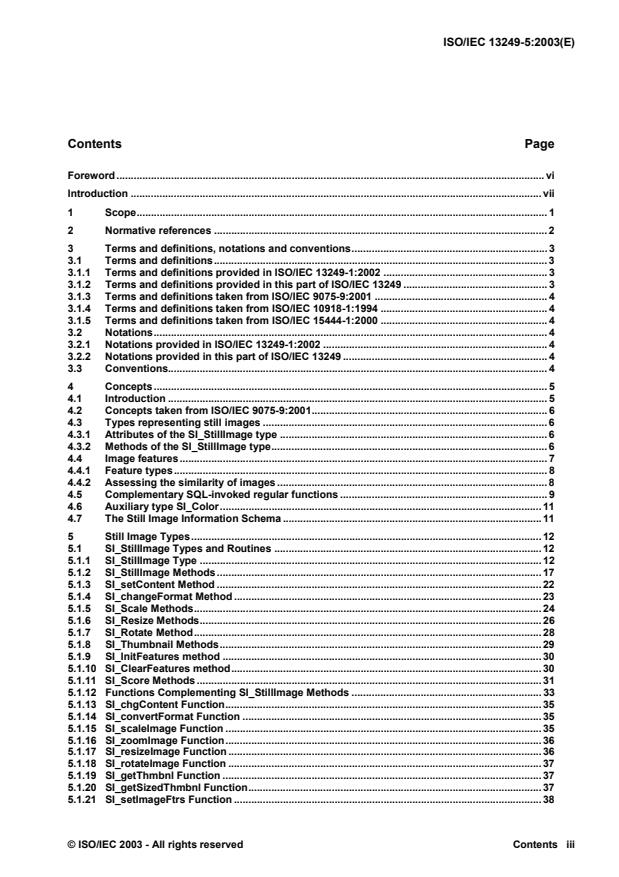
Contents Page
Foreword. vi
Introduction . vii
1 Scope. 1
2 Normative references. 2
3 Terms and definitions, notations and conventions. 3
3.1 Terms and definitions. 3
3.1.1 Terms and definitions provided in ISO/IEC 13249-1:2002 . 3
3.1.2 Terms and definitions provided in this part of ISO/IEC 13249 . 3
3.1.3 Terms and definitions taken from ISO/IEC 9075-9:2001 . 4
3.1.4 Terms and definitions taken from ISO/IEC 10918-1:1994 . 4
3.1.5 Terms and definitions taken from ISO/IEC 15444-1:2000 . 4
3.2 Notations. 4
3.2.1 Notations provided in ISO/IEC 13249-1:2002 . 4
3.2.2 Notations provided in this part of ISO/IEC 13249 . 4
3.3 Conventions. 4
4 Concepts. 5
4.1 Introduction. 5
4.2 Concepts taken from ISO/IEC 9075-9:2001. 6
4.3 Types representing still images . 6
4.3.1 Attributes of the SI_StillImage type . 6
4.3.2 Methods of the SI_StillImage type. 6
4.4 Image features. 7
4.4.1 Feature types. 8
4.4.2 Assessing the similarity of images . 8
4.5 Complementary SQL-invoked regular functions . 9
4.6 Auxiliary type SI_Color. 11
4.7 The Still Image Information Schema .11
5 Still Image Types. 12
5.1 SI_StillImage Types and Routines . 12
5.1.1 SI_StillImage Type. 12
5.1.2 SI_StillImage Methods. 17
5.1.3 SI_setContent Method. 22
5.1.4 SI_changeFormat Method. 23
5.1.5 SI_Scale Methods. 24
5.1.6 SI_Resize Methods. 26
5.1.7 SI_Rotate Method. 28
5.1.8 SI_Thumbnail Methods. 29
5.1.9 SI_InitFeatures method. 30
5.1.10 SI_ClearFeatures method. 30
5.1.11 SI_Score Methods. 31
5.1.12 Functions Complementing SI_StillImage Methods . 33
5.1.13 SI_chgContent Function. 35
5.1.14 SI_convertFormat Function. 35
5.1.15 SI_scaleImage Function. 35
5.1.16 SI_zoomImage Function. 36
5.1.17 SI_resizeImage Function. 36
5.1.18 SI_rotateImage Function. 37
5.1.19 SI_getThmbnl Function. 37
5.1.20 SI_getSizedThmbnl Function. 37
5.1.21 SI_setImageFtrs Function. 38
© ISO/IEC 2003 - All rights reserved Contents iii
5.1.22 SI_resetImageFtrs Function.38
5.1.23 Functions Complementing Observer Functions of Type SI_StillImage .39
5.1.24 Functions not intended for Public Use .40
6 Feature Types.49
6.1 SI_AverageColor Type and Routines .49
6.1.1 SI_AverageColor Type.49
6.1.2 SI_AverageColor Methods.50
6.1.3 SI_Score Method.51
6.1.4 SI_findAvgClr Function.51
6.1.5 SI_mkAvgClr Function.52
6.1.6 SI_ScoreByAvgClr Function.52
6.2 SI_ColorHistogram Type and Routines .52
6.2.1 SI_ColorHistogram Type.52
6.2.2 SI_ColorHistogram Methods.54
6.2.3 SI_Append Method.56
6.2.4 SI_Score Method.57
6.2.5 SI_findClrHstgr Function.57
6.2.6 SI_mkClrHstgr Function.58
6.2.7 SI_arrayClrHstgr Function.58
6.2.8 SI_appendClrHstgr Function.58
6.2.9 SI_ScoreByClrHstgr Function.59
6.3 SI_PositionalColor Type and Routines .59
6.3.1 SI_PositionalColor Type.59
6.3.2 SI_PositionalColor Method.60
6.3.3 SI_Score Method.61
6.3.4 SI_findPstnlClr Function.62
6.3.5 SI_ScoreByPstnlClr Function.62
6.4 SI_Texture Type and Routines.62
6.4.1 SI_Texture Type.62
6.4.2 SI_Texture Method.63
6.4.3 SI_Score Method.64
6.4.4 SI_findTexture Function.65
6.4.5 SI_ScoreByTexture Function.65
6.5 SI_FeatureList Type and Routines .65
6.5.1 SI_FeatureList Type.65
6.5.2 SI_FeatureList Method.67
6.5.3 SI_setFeature Methods.69
6.5.4 SI_Score Method.71
6.5.5 SI_mkFtrList Function.73
6.5.6 SI_ScoreByFtrList Function.73
6.5.7 Regular Functions Complementing SI_setFeature Methods.74
6.5.8 Regular Functions Complementing Observer Functions of type SI_FeatureList .75
6.6 Auxiliary Types and Routines.77
6.6.1 SI_Color Type.77
6.6.2 SI_RGBColor Method.77
6.6.3 SI_mkRGBClr Function.78
7 SQL/MM Still Image Information Schema .80
7.1 Introduction.80
7.2 SI_FEATURES view.80
7.3 SI_IMAGE_FORMATS view.80
7.4 SI_IMAGE_FORMAT_CONVERSIONS view.80
7.5 SI_IMAGE_FORMAT_FEATURES view.80
7.6 SI_THUMBNAIL_FORMATS view.81
7.7 SI_VALUES view.81
7.8 Short name views.81
8 SQL/MM Still Image Definition Schema .82
8.1 Introduction.82
8.2 SI_FEATURES base table.82
iv Contents © ISO/IEC 2003 - All rights reserved
8.3 SI_IMAGE_FORMATS base table.83
8.4 SI_IMAGE_FORMAT_CONVERSIONS base table . 84
8.5 SI_IMAGE_FORMAT_FEATURES base table . 84
8.6 SI_THUMBNAIL_FORMATS base table. 85
8.7 SI_VALUES base table. 85
9 Status Codes. 87
10 Conformance. 88
10.1 Requirements for conformance. 88
10.2 Features of ISO/IEC 9075-9:2001 required in this part of ISO/IEC 13249 . 91
10.3 Claims of conformance. 92
Annex A (informative).93
A.1 Implementation-defined Meta-variables.94
Annex B (informative). 95
B.1 Implementation-dependent Meta-variables.99
Index . 100
Tables Page
Table 1 – Method and function name correspondences. 9
Table 2 – SQLSTATE class and subclass values . 87
© ISO/IEC 2003 - All rights reserved Contents v
Foreword
ISO (the International Organization for Standardization) and IEC (the International Electrotechnical
Commission) form the specialized system for worldwide standardization. National bodies that are members of
ISO or IEC participate in the development of International Standards through technical committees
established by the respective organization to deal with particular fields of technical activity. ISO and IEC
technical committees collaborate in fields of mutual interest. Other international organizations, governmental
and non-governmental, in liaison with ISO and IEC, also take part in the work. In the field of information
technology, ISO and IEC have established a joint technical committee, ISO/IEC JTC 1.
International Standards are drafted in accordance with the rules given in the ISO/IEC Directives, Part 2.
The main task of the joint technical committee is to prepare International Standards. Draft International
Standards adopted by the joint technical committee are circulated to national bodies for voting. Publication as
an International Standard requires approval by at least 75 % of the national bodies casting a vote.
Attention is drawn to the possibility that some of the elements of this document may be the subject of patent
rights. ISO and IEC shall not be held responsible for identifying any or all such patent rights.
ISO/IEC 13249-5 was prepared by Joint Technical Committee ISO/IEC JTC 1, Information technology,
Subcommittee SC 32, Data management and interchange.
This second edition cancels and replaces the first edition (ISO/IEC 13249-5:2001), which has been technically
revised.
ISO/IEC 13249 consists of the following parts, under the general title Information technology — Database
languages — SQL multimedia and application packages:
— Part 1: Framework
— Part 2: Full-Text
— Part 3: Spatial
— Part 5: Still image
— Part 6: Data mining
vi Foreword © ISO/IEC 2003 - All rights reserved
Introduction
The purpose of this International Standard is to define multimedia and application specific types and their
associated routines using the user-defined features in ISO/IEC 9075.
This document is based on the content of ISO/IEC International Standard Database Language (SQL).
The organization of this part of ISO/IEC 13249 is as follows:
1) Clause 1, "Scope", specifies the scope of this part of ISO/IEC 13249.
2) Clause 2, "Normative references", identifies additional standards that, through reference in this part of
ISO/IEC 13249, constitute provisions of this part of ISO/IEC 13249.
3) Clause 3, "Definitions, notations, and conventions", defines the notations and conventions used in this
part of ISO/IEC 13249.
4) Clause 4, "Concepts", presents concepts used in the definition of this part of ISO/IEC 13249.
5) Clause 5, "Still Image Types", defines the still image user-defined types and associated routines.
6) Clause 6, "Feature Types", defines the user-defined types provided for the manipulation of still image
features.
7) Clause 7, "SQL/MM Still Image Information Schema" defines the SQL/MM Still Image Information
Schema.
8) Clause 8, "SQL/MM Still Image Definition Schema" defines the SQL/MM Still Image Definition Schema.
9) Clause 9, "Status Codes", defines the SQLSTATE codes used in this part of ISO/IEC 13249.
10) Clause 10, "Conformance", defines the criteria for conformance to this part of ISO/IEC 13249.
11) Annex A, "Implementation-defined elements", is an informative Annex. It lists those features for which the
body of this part of ISO/IEC 13249 states that the syntax or meaning or effect on the database is partly or
wholly implementation-defined, and describes the defining information that an implementer shall provide
in each case.
12) Annex B, "Implementation-dependent elements", is an informative Annex. It lists those features for which
the body of this part of ISO/IEC 13249 states explicitly that the meaning or effect on the database is
implementation-dependent.
© ISO/IEC 2003 - All rights reserved Introduction vii
INTERNATIONAL STANDARD ISO/IEC 13249-5:2003(E)
Information technology — Database languages —
SQL multimedia and application packages —
Part 5:
Still image
1 Scope
This part of ISO/IEC 13249:
a) introduces the still image part of ISO/IEC 13249 (all parts);
b) gives the references necessary for this part of ISO/IEC 13249;
c) defines notations and conventions specific to this part of ISO/IEC 13249;
d) defines concepts specific to this part of ISO/IEC 13249;
e) defines the still image user-defined types and their associated routines.
The still image user-defined types defined in this part of ISO/IEC 13249 adhere to the following.
— A still image user-defined type is generic to image handling. It addresses the need to store, manage and
retrieve information based on aspects of inherent image characteristics such as height, width and format
and based on image features such as average color, color histogram, positional color and texture. It also
addresses the need to employ manipulation such as rotation, scaling, as well as similarity assessment.
— A still image user-defined type does not redefine the database language SQL directly or in combination
with another still image data type.
The still image user-defined types are applicable to all different image formats. However, not all functionality
can be used with all known still image formats.
An implementation of this part of ISO/IEC 13249 may exist in environments that also support information and
content management, decision support, data mining and data warehousing systems.
Application areas addressed by implementations of this part of ISO/IEC 13249 include, but are not restricted
to, graphics, multimedia, scientific research and medicine.
© ISO/IEC 2003 - All rights reserved Scope 1
2 Normative references
The following referenced documents are indispensable for the application of this document. For dated
references, only the edition cited applies. For undated references, the latest edition of the referenced
document (including any amendments) applies.
ISO/IEC 9075-9:2001, Information technology — Database languages — SQL — Part 9: Management of
External Data (SQL/MED)
ISO/IEC 13249-1:2002, Information technology — Database languages — SQL multimedia and application
packages — Part 1: Framework
ISO/IEC 10918-1:1994, Information technology — Digital compression and coding of continuous-tone still
images: Requirements and guidelines
ISO/IEC 15444-1:2000, Information technology — JPEG 2000 image coding system — Part 1: Core coding
system
2 Normative references © ISO/IEC 2003 - All rights reserved
3 Terms and definitions, notations and conventions
3.1 Terms and definitions
3.1.1 Terms and definitions provided in ISO/IEC 13249-1:2002
This part of ISO/IEC 13249 makes use of all terms defined in ISO/IEC 13249-1:2002.
3.1.2 Terms and definitions provided in this part of ISO/IEC 13249
For the purposes of this document, the following terms and definitions apply.
3.1.2.1
basic image feature
a basic image feature is an image feature that is not a composite feature
3.1.2.2
color space
a set of conventions how to represent a color value
3.1.2.3
composite feature
an image feature, which consists of basic image features and their associated weights
3.1.2.4
image format
a set of conventions for storing the image data of still images in a specific compressed or uncompressed file
format
3.1.2.5
image feature
characteristic (other than inherent image characteristics) of the raw image
3.1.2.6
inherent image characteristics
image format and particular physical characteristics of a still image
3.1.2.7
list of weighted features
see composite feature
3.1.2.8
most significant color
a single color representing the dominant color of a part of an image
3.1.2.9
raw image
a binary string that represents a certain image
3.1.2.10
similarity of images
a numerical measure obtainable by the comparison of two images; the measure is based on image features
3.1.2.11
still image
see "image" in Subclause 3.1.5, "Terms and definitions taken from ISO/IEC 15444-1:2000"
3.1.2.12
thumbnail
a raw image which was obtained from another raw image by downsizing
© ISO/IEC 2003 - All rights reserved Terms and definitions, notations and conventions 3
3.1.3 Terms and definitions taken from ISO/IEC 9075-9:2001
This part of ISO/IEC 13249 makes use of the following terms defined in ISO/IEC 9075-9:2001:
a) datalink
3.1.4 Terms and definitions taken from ISO/IEC 10918-1:1994
This part of ISO/IEC 13249 makes use of the following terms defined in ISO/IEC 10918-1:1994:
a) columns
NOTE 1 The use of "columns" here is as defined in the JPEG standard and not as defined in the SQL
standard.
b) component
c) (digital) (still) image
NOTE 2 Parentheses around the text "digital" and "still" is a convention used by ISO/IEC 10918-1 to denote
that the phrases "digital image", "still image", and "image" are interchangeable.
d) image data
e) interchange format
f) (number of) lines
NOTE 3 Parentheses around the text "number of" is a convention used by ISO/IEC 10918-1 to denote that
the phases "number of lines" and "lines" are interchangeable.
g) sample
3.1.5 Terms and definitions taken from ISO/IEC 15444-1:2000
This part of ISO/IEC 13249 makes use of the following terms defined in ISO/IEC 15444-1:2000:
a) file format
b) reference grid
3.2 Notations
3.2.1 Notations provided in ISO/IEC 13249-1:2002
The notations used in this part of ISO/IEC 13249 are defined in ISO/IEC 13249-1:2002.
3.2.2 Notations provided in this part of ISO/IEC 13249
This part of ISO/IEC 13249 uses the prefix 'SI_' for user-defined types, attributes and SQL-invoked routine
names.
3.3 Conventions
The conventions used in this part of ISO/IEC 13249 are defined in ISO/IEC 13249-1:2002.
4 Terms and definitions, notations and conventions © ISO/IEC 2003 - All rights reserved
4 Concepts
4.1 Introduction
In the context of this part of ISO/IEC 13249, still images are effectively images consisting of 2-dimensional
arrays of samples. The internal representation of components and samples in the raw image itself is image
format specific. The color information in the image data might be represented by an index in a color look up
table, represented by multiple components, multiple binary strings which represent the color values within a
single component, or in any other image format specific way.
An image format is a set of conventions for storing images in a file format. An image consists of the
representation and organization of data that constitute the samples of the components, and prescriptions
about auxiliary data that control the interpretation and processing of the image information according to that
format.
A color space, which is used to represent the color values in the image, is either defined implicitly by the
image format or described in the header information of the raw image.
An image format is referenced by format indications. A format indication is a character string whose format
and content is implementation-defined.
A binary string that adheres to a certain image format is called a raw image.
The inherent image characteristics of a raw image consist of:
- the format of the raw image;
- the width of the raw image is the number of points in the horizontal dimension of the reference grid of
the image data;
- the height of the raw image is the number of points in the vertical dimension of the reference grid of
the image data.
An image format is a format supported by an implementation (for short: a supported format) if the
implementation is able to derive the inherent image characteristics from the raw image.
This part of ISO/IEC 13249 defines types and routines with provisions for storing and manipulating still
images. This part of ISO/IEC 13249 consists of the following parts:
- The data type SI_StillImage, a value of which has the following structure:
- a digital representation of a still image or a reference to it;
- format conventions used for representing that still image;
- physical characteristics of that still image (such as its height and width).
- Methods on the data type SI_StillImage for:
- constructing SI_StillImage values;
- obtaining the digital representation of an image, a reference to it, or the inherent image
characteristics of the image;
- obtaining a scaled still image from an SI_StillImage value;
- obtaining a resized still image from an SI_StillImage value;
- obtaining a rotated still image from an SI_StillImage value;
- obtaining a thumbnail from an SI_StillImage value;
- deriving a metric value that characterizes the content of the image with respect to features values.
© ISO/IEC 2003 - All rights reserved Concepts 5
- Feature data types that abstract from certain characteristics of the pictorial information contained in
images; these data types provide facilities for:
- deriving feature values from a given image;
- constructing feature values;
- deriving metric values that characterize the content of images with respect to feature values.
- Information Schema views that provide data describing certain capabilities of an implementation of
this part of ISO/IEC 13249.
A conforming implementation of this part of ISO/IEC 13249 shall be based on SQL-implementations that
support Core SQL as defined by ISO/IEC 9075-9:2001. A number of provisions are made for that purpose:
- No function name overloading is used for SQL-invoked regular functions that are intended for public
use;
- For every method that is intended for public use, a corresponding SQL-invoked regular function is
specified that provides the same services as the associated method;
- The lengths of the names of schemata, types and SQL-invoked regular functions that are intended for
public use do not exceed 18 characters. If the name of a view of the Still Image Information Schema
exceeds 18 characters, an equivalent view with a short identifier is also specified.
4.2 Concepts taken from ISO/IEC 9075-9:2001
The following concepts defined in ISO/IEC 9075 are used in this part of ISO/IEC 13249.
a) binary string
b) EXECUTE privilege
c) function
d) SQL-invoked regular function
4.3 Types representing still images
4.3.1 Attributes of the SI_StillImage type
The SI_StillImage type is an abstraction for still images, using the following attributes:
- The attribute SI_content to represent the raw image;
- The attribute SI_contentLength to represent the length of the raw image;
- The attribute SI_reference to represent the reference to the image content of the raw image;
- The attribute SI_format to represent a format indication; it identifies the image format of the raw
image;
- The attribute SI_width to represent the width of the raw image;
- The attribute SI_height to represent the height of the raw image.
- The attribute SI_retainFeatures to specify that the image’s features are to be computed and
maintained automatically by the implementation.
- Additional implementation-dependent attributes to store the image features or a representation of
image features.
4.3.2 Methods of the SI_StillImage type
The type SI_StillImage provides the following methods for public use:
- SI_StillImage: constructs an SI_StillImage value from a raw image;
- SI_StillImage: constructs an SI_StillImage value from a raw image and a character string representing
a format indication; this method allows for user-supplied format indication when SI_StillImage values
are to be constructed from a raw image whose format is not a supported one;
6 Concepts © ISO/IEC 2003 - All rights reserved
- SI_StillImage: constructs an SI_StillImage value from a reference to a raw image;
- SI_StillImage: constructs an SI_StillImage value from a reference to a raw image and a character
string representing a format indication; this method allows for user-supplied format indication when
SI_StillImage values are to be constructed from a raw image whose format is not a supported one;
- SI_StillImage: constructs an SI_StillImage value from a raw image and also extracts the supported
image features. This method allows for a user-supplied integer value to indicate the need for image
feature extraction. If the user-supplied integer value is 1 (one), the image features are extracted
during value construction. If the user supplied integer value is 0 (zero), the method has the same
effect as the invocation of the constructor method SI_StillImage(content);
- SI_setContent: has the same effect as the invocation of the mutator function for the SI_content
attribute, but additionally adjusts the values of the attributes that represent the inherent image
characteristics;
- SI_changeFormat: has the same effect as the invocation of the mutator function for the SI_format
attribute, but additionally adjusts the value of the attribute SI_content and the values of the attributes
which represent the inherent image characteristics. The format conversion fails if the conversion
between the source image format and the target image format is not supported;
- SI_Scale: obtains a scaled image from an SI_StillImage value. The raw image is scaled to fit into a
bounding box defined by the specified height and width. The aspect ratio of the image's height and
width shall be maintained;
- SI_Scale: obtains a scaled image from an SI_StillImage value. The raw image is scaled by the
specified factor. The aspect ratio of the image’s height and width shall be maintained;
- SI_Resize: obtains a resized image from an SI_StillImage value. The raw image is resized to the
specified height and width. The aspect ratio of the image’s height and width does not have to be
maintained;
- SI_Rotate: obtains a rotated image from an SI_StillImage value. The raw image is rotated by the
defined angle. For rotations by an angle that is not a multiple of 90 degrees, the raw image is padded
and the height and width of the resulting still image are adjusted;
- SI_Thumbnail: obtains a thumbnail from an SI_StillImage value;
- SI_InitFeatures: indicates that the attributes for supported features (average color, color histogram,
positional color, and texture) of the image are to be computed and kept updated.
- SI_ClearFeatures: indicates that the attributes for supported features of the image are to be discarded
and no longer updated.
- SI_Score: returns a numerical value that is a measure of the similarity of the image feature value to a
given feature value;
- SI_content: returns the representation of the raw image;
- SI_contentLength: returns the length in bytes of the representation of the raw image;
- SI_reference: returns the reference to the image content of the raw image;
- SI_format: returns the format indication of the image;
- SI_height: returns the number of points in the vertical dimension of the reference grid of the image;
- SI_width: returns the number of points in the horizontal dimension of the reference grid of the image.
4.4 Image features
Image features (for short: features) are used to characterize the pictorial information of an image by means
other than inherent image characteristics. This part of ISO/IEC 13249 supports four basic features and one
composite feature. The basic features are:
- Average color feature: this feature characterizes an image by its average color;
- Color histogram feature: this feature characterizes an image by the relative frequencies of the colors
exhibited by the raw image;
© ISO/IEC 2003 - All rights reserved Concepts 7
- Positional color feature: let an image be divided into n by m rectangles; the positional color feature
characterizes that image by the n by m most significant colors of these rectangles;
- Texture feature: this feature characterizes an image by the size of repeating items (coarseness),
brightness variations (contrast), and the predominant direction (directionality).
All basic features can be derived from images. In addition, the two basic features average color feature and
color histogram feature can be constructed by means of numerical values.
The composite feature is a list of up to 4 basic features, each of a different feature type. All the basic features
in the composite feature are associated with a feature weight.
Features are represented by feature types. Values of those types are used for obtaining a quantitative
measure for the similarity between two images represented as SI_StillImage values, say, I and I . If F is
1 2 2
some feature that characterizes the image I , then a similarity measure for the images I and I is obtained
2 1 2
from F by a method SI_Score that takes I as its parameter. For a given pair of images, the obtained
2 1
similarity depends on the kind of feature used for comparison; the exact relationship is implementation-
dependent.
4.4.1 Feature types
The basic features are represented by the following feature types:
- Average color feature: SI_AverageColor;
- Color histogram feature: SI_ColorHistogram;
- Positional color feature: SI_PositionalColor;
- Texture feature: SI_Texture.
The composite feature is represented by the feature type SI_FeatureList.
For all basic features methods and functions are provided that derive the corresponding feature value from an
SI_StillImage value. The functions are:
- Average color feature: SI_findAvgClr;
- Color histogram feature: SI_findClrHstgr;
- Positional color feature: SI_findPstnlClr;
- Texture feature: SI_findTexture.
SI_AverageColor and SI_ColorHistogram values can also be obtained by methods SI_AverageColor and
SI_ColorHistogram, respectively. The parameter of the first method is a color value that is used to represent
the intended average color. The second method takes a first color value and a first frequency and returns an
initial color histogram. This initial color histogram can be extended using the method SI_Append.
SI_FeatureList values shall be constructed from basic feature values and associated weights.
The observer and mutator functions of the basic feature types are not intended for public use. Thus, there are
no GRANT statements granting EXECUTE privilege on these functions.
4.4.2 Assessing the similarity of images
Every feature type has a method SI_Score. This method can be used for obtaining numerical values that
measure the similarity between two images. To that end, a distance function is used for this measurement.
The returned numerical value for the distance indicates the difference between a given feature value and a
still image value. Let F be some feature value that characterizes an SI_StillImage values I . Then
1 1
F .SI_Score(I )
1 2
returns a measure for the similarity of the SI_StillImage value I to the feature value F .
2 1
8 Concepts © ISO/IEC 2003 - All rights reserved
4.5 Complementary SQL-invoked regular functions
To ease conformance for implementation of this part of ISO/IEC 13249, each method intended for public use
is complemented by an SQL-invoked regular function.
For each such method, the type of specified method, the method name, parameter types (if any), and the
name of the corresponding SQL-invoked regular function is listed in Table 1 — Method and function name
correspondences. Since the names of these functions are unique, their parameter types are not given.
Table 1 — Method and function name correspondences
Type Name Method Name Parameter Types (if any) Function Name
SI_StillImage SI_StillImage BINARY LARGE OBJECT SI_mkStillImage1
SI_StillImage SI_StillImage BINARY LARGE OBJECT, SI_mkStillImage2
CHARACTER VARYING
SI_StillImage SI_StillImage DATALINK SI_mkStillImage3
SI_StillImage SI_StillImage DATALINK, SI_mkStillImage4
CHARACTER VARYING
SI_StillImage SI_StillImage BINARY LARGE OBJECT, SI_mkStillImage5
INTEGER
SI_StillImage SI_StillImage BINARY LARGE OBJECT, SI_mkStillImage6
CHARACTER VARYING,
INTEGER
SI_StillImage SI_setContent BINARY LARGE OBJECT SI_chgContent
SI_StillImage SI_changeFormat CHARACTER VARYING SI_convertFormat
SI_StillImage SI_Scale INTEGE
...
Questions, Comments and Discussion
Ask us and Technical Secretary will try to provide an answer. You can facilitate discussion about the standard in here.
Loading comments...